You know the place.
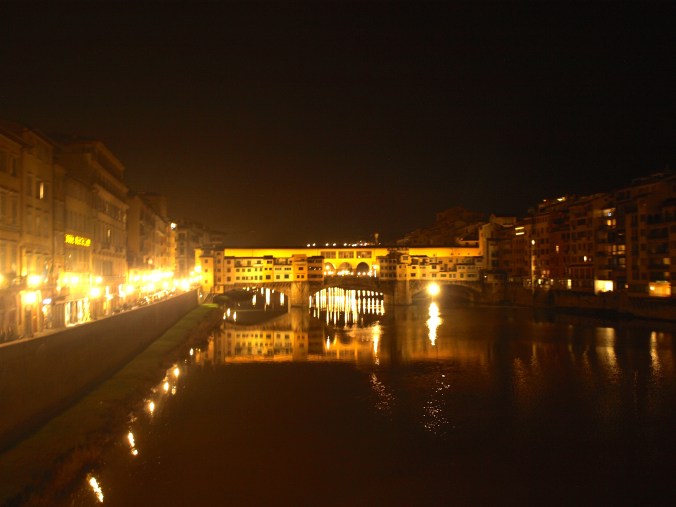
Ponte Vecchio at night
You go there to buy spectacular gold jewelry, or at least to window shop, and to take selfies.
Yet, I wonder how many of the millions of visitors in Florence each year walk over the Ponte Vecchio have any true sense of its importance within the fabric of the city. Not many, I’d wager.
There is a major clue to the bridge’s importance right there on the bridge itself, yet most travelers don’t even notice this evocation of Dante’s literary masterpiece, The Divine Comedy.
We’ll get to that in a minute, but for now, let’s discuss the bridge itself.
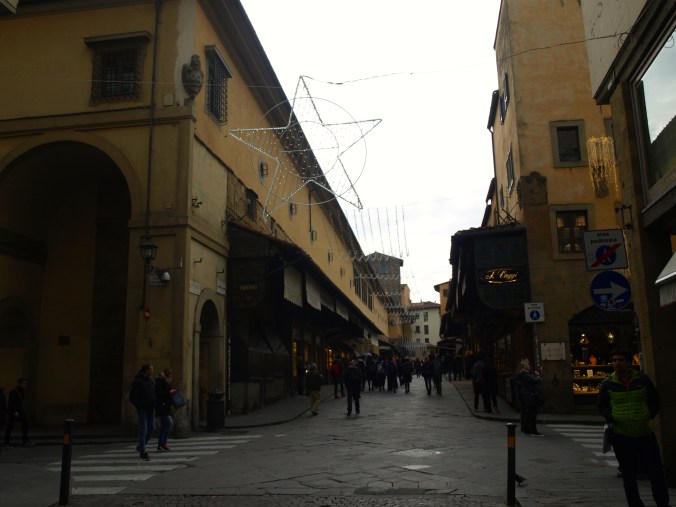
Entering Ponte Vecchio from north end
The Romans were the first to site a bridge over this spot of the Arno and the famed bridge has been the central crossing point of the Arno for some 2,000 years.
Think of that! When you cross the bridge, you do so because the Romans sited it there and built the first structure! The Romans, people!
Roman engineers chose this location, the narrowest point in the Arno in 59 B.C., when they settled the untamed floodplain that became a colony they called Florentia (for flourish). The Romans laid out their new city, drained the marshes, and built the first bridge in this location with stone piers and a wooden superstructure. Just as the Roman planners intended, Florence became the crucial link between the north and south of Italy on the Via Cassia.
The Ponte Vecchio was not only the oldest bridge in Florence, it was, until the construction of a new bridge in 1218, the Ponte alla Carraia, the only one!
Throughout the centuries, the bridge was destroyed by floods a few times, and eventually it was reconstructed in stone. Sheltered in a little loggia at the central opening of the bridge is a weathered dedication stone, which used to be legible and reads:
Nel trentatrè dopo il mille-trecento, il ponte cadde, per diluvio dell’ acque: poi dieci anni,
come al Comun piacque, rifatto fu con questo adornamento
This translates to:
In the thirty-third year following thirteen hundred, the bridge fell, from a watery flood: ten years later, at the pleasure of the Commune, it was rebuilt, with this adornment.
And then there is the Dante connection:
Durante degli Alighieri lived from about 1265 to 1321 and was, of course, a major Italian poet of the Late Middle Ages. He authored the Divine Comedy, widely considered to be the greatest work of literature composed in Italian. That work chronicles a three-day journey taken by the poet through Hell (Inferno), Purgatory (Purgatorio) and Heaven (Paradiso) and is dedicated to Beatrice, the object of his amorous obsession.
According to legend, Dante was standing near the Ponte Vecchio when he first saw a young woman standing on it. The woman was Beatrice di Folco Portinari (1266–1290), a Florentine who probably appears as one of the poet’s guides in the Divine Comedy. It is Beatrice who leads Dante into the Beatific vision, as her names suggests.
The historical Beatrice was the daughter of the banker Folco Portinari, and was married to another banker, Simone dei Bardi. Dante claimed to have met “his” Beatrice only twice, on occasions separated by nine years, but was so affected by the meetings that he carried his love for her throughout his life.
Poor Beatrice died in 1290, carried off by plague, and leaving Dante stricken with the loss. He never forgot her and came to see her as the intermediary between his soul and Heaven itself.
So now you understand how important the Ponte Vecchio itself was for Dante himself. Keep in mind that in his day, what we call the Ponte Vecchio was the only bridge spanning the Arno in Florence. You can well imagine that later, when he was exiled from Florence, the city he loved, he recalled the bridge with affection as a symbol of his birthplace.
But that still doesn’t explain the particular Dante quote on the bridge. To what does the inscription from the Divine Comedy on the bridge refer?

Is it about the meeting of Dante and Beatrice? You might think so, but you’d be wrong.
On the northeast end of the famous bridge, is this inscription taken from the 3rd part of the Paradiso (XVI, 145-47).

Looking east from north end of Ponte Vecchio

Plaque

closer view
The inscription, taken from Paradiso XVI, 145-47, reads as follows:
Conveniasi a quella pietra scema
Che guarda il ponte, che Fiorenza fesse
Vittima nella sua pace postrema.
The English translation: “How fitting for Florence to sacrifice a victim to the mutilated stone [the statue of Mars] that guards her bridge to mark the end of peace!”
So, Dante was not referring to himself and his muse, but rather to the infamous murder of the young nobleman, Buondelmonte dei Buondelmonti. On his wedding day, as Buondelmonti, dressed in white, rode his white horse from the Oltrarno to Florence over the famous bridge, he was on his way to marry a girl from the house of Donati.
However, Buondelmonti was supposed to marry another woman, a daughter of the house of Amidei. His arranged marriage to an Amidei was a part of a previously devised peace arrangement between the dissenting factions known as the Guelphs and the Ghibbelines.
Knowing of his change of plans, the Amidei and their supporters lay in wait that Easter morning beneath the statue of Mars. Buondelmonte was “pulled from his horse by Schiatta degli Uberti, assaulted and wounded by Mosca Lamberti and Lambertuccio degli Amidei, and finished off by Oderigo Fifanti. They had with them one of the Counts of Gangalandi” (Giovanni Villani, Chronicle of Florence, Book V, 38).
So, Dante’s inscription on the bridge makes reference to the war between the Guelphs and Ghibellines, that rocked many Italian communities for the next century and beyond. Until this time, Florence alternated between guelph and ghibelline rule.
Don’t forget that Dante was exiled from Florence after ending up on the loosing side of the battle between the White and Black Guelphs. Following a comprehensive victory of the Black Guelphs, Dante was condemned to exile for two years, and ordered to pay a large fine. He did not pay the fine, in part because he believed he was not guilty, and in part because all his assets in Florence had been seized by the Black Guelphs. He was, therefore, condemned to perpetual exile, and if he returned to Florence without paying the fine, he could be burned at the stake.
Dante never managed to go back to Florence, even when his sentence of death was reduced to house arrest. The lines from the Divine Comedy inscribed upon the Ponte Vecchio thus refer to the reason for Dante’s exile.
A final note about the Ponte Vecchio: it was the only bridge across the Arno that the fleeing Germans did not destroy in WWII. Instead, the Germans blocked access to the bridge by demolishing the medieval buildings on each end of it.
On November 4, 1966, the bridge miraculously withstood the tremendous weight of water and silt when the Arno once again burst its banks.
But still the bridge stands. May it ever.
 get back, lauretta!
This bridge was referenced in a book I just read. So glad I stumbled on your post about it!
I’m happy you found the post too! The bridge is a mighty Medieval monument in Florence! Thanks!