On either side of the long, languid Arno River that bisects Florence from east to west, run parallel roads, called the Lungarni. These long roadways are, in typical Florentine fashion, divided up every few blocks or so, with various names.
Italy has a lot of history and Florence in particular has a lot of names to commemorate. The Lungarni passages provide a fertile field for memorializing important names. Here they are:
North shore (from the west):
Lungarno Amerigo Vespucci
Lungarno Corsini
Lungarno Acciaiuoli
Lungarno Archibusieri
Lungarno Anna Maria Luisa de ‘Medici
Lungarno General Armando Diaz
Lungarno delle Grazie
Lungarno della Zecca Vecchia
Lungarno William Galeazzo
Lungarno del Tempio
Lungarno Cristoforo Colombo
Lungarno Aldo Moro
South shore (from the west):
Lungarno Bruno Buozzi (Lastra a Signa)
Lungarno dei Pioppi
Lungarno del Pignone
Lungarno Santa Rosa
Lungarno Soderini
Lungarno Guicciardini
Lungarno Torrigiani
Lungarno Serristori
Lungarno Benvenuto Cellini
Lungarno Francesco Ferrucci
As you can see, a lot of names were used in naming the sections of the Lungarni!
It fills me with some kind strange pride to note that I’ve had the personal good fortune to live on three sections of the Lungarni thus far in this lifetime (who knows about other lifetimes? I can’t remember!): in the Oltrarno I had the pleasure of living for time on the Lungarno Serristori and later the Lungarno Torrigiani. I loved every minute of both locations. There is no better way of exploring a new area of the city than living in it for a while!
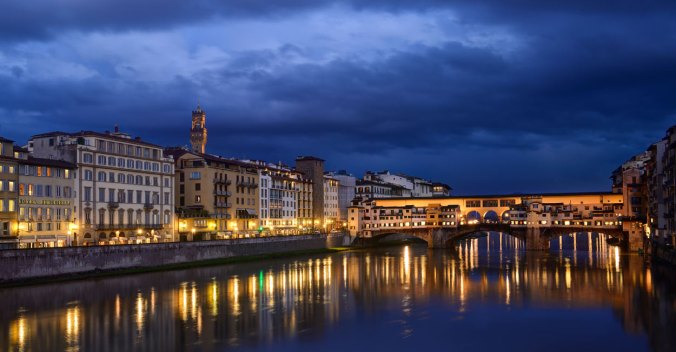
My focus today is on the North side of the river and on the section of the Lungarno on which I currently have the amazing luck to live. The prestigious Lungarno Acciaiuoli is the stretch of the north bank of the Arno River in Florence that runs from the Ponte Vecchio to the Ponte Santa Trinita. This area of Florence is among the most elegant areas in the city.
My short passage of the Lungarno ends at the east end at the storied Ponte Vecchio and overlooks, on its west end, the Torre Consorti, and one side of the Palazzo Spini-Feroni, home of the Salvatore Ferragamo palazzo and museum. It’s a tony avenue.

In olden times, this section of the Lungarno was called i cappellai or “the hatters,” after the Florentine hat makers who located their shops here.
Later, in the 19th C., two of the most important Florentine hotels were located here: the Grand Hotel Royal de l’Arno and the Hotel Royal de la Grande Bretagne. Charles Dickens, Henry James and many others stayed in these famous hotels. Sometimes, when I am walking around Florence on streets where I know for a fact that famous personalities from the past passed over, I imagine for a moment what it would be like to bump into, say Dante Alighieri or Charles Dickens walking around town. I’ve always had this sort of imagination.
Still standing from that era is the Hotel Berchielli, the ancient building that miraculously survived the landlines set by the retreating German army during WWII. This historic building has housed the Hotel Berchielli since 1890 and is among the most famous hotels in the center of Florence.
A marble plaque on the façade recalls the frequent stays of Romain Rolland, a distinguished literary critic and the winner of the Nobel Prize for Literature in 1915. Rolland chose the Hotel Berchielli as his Florentine residence.
ROMAIN ROLLAND
INSIGNE WRITER
AND ART CRITIC
sTAYed HERE
IN 1911
And while you may not be familiar with Rolland, I’m sure you know that guy named Pablo Picasso, who also, several decades later, took up residence in the hotel (fall of 1949).
Also marking the area is a plaque at Red All’84-86, of Palazzo Spini Feroni:
AVSPICIIS. ET. MVNIFICENTIA
Ferdinandi. III. M. D. ETR.
AEDIVM. SPINORVM. partem
ARCV. VIAE. IMPOSITO. FLVMINI. ANTEA. IMPENDENTEM
SERIOUS. PERICVLO. DILAPSVRAM
COMMVNE. FLORENTINORVM
A.D. CIVIVM. SECVRITATEM. ET. Maiorem. AMOENITATEM. LOCI
ONLY. AEQVANDAM. CVRAVIT
YEAR. MDCCCXXIII.
VEXILLIFERO. Iacobo. COMITE. Gvido
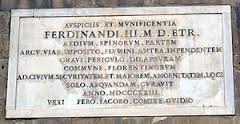
The translation is: “Under the auspices and through the munificence of Ferdinand III, Grand Duke of Tuscany, the City of Florence in the year 1823, being the standard-bearer Count Jacopo Guidi, demolished for safety of citizens, and greater beauty of the place, the part of the houses the Spini who first faced the river on a place at the turn of the bow away and threatened to collapse with grave danger. ”
(reference: Francesco Cesati, the great leader of the streets of Florence, Newton Compton Editori, Rome 2003).
From the Lungarno Acciaiuoli, the world of Florence’s history, culture and elegance are readily available.
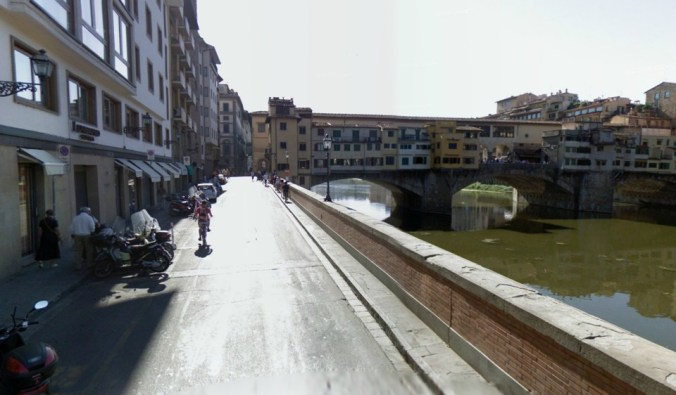
On the Lungarno Acciaiuoli, looking towards east to Ponte Vecchio:
Looking from the embankment in the opposite direction, towards the west, one can admire the graceful Ponte Santa Trinita, about which I will be posting soon. This bridge is considered to be one of the most elegant and refined bridges in Italy in particular or in all of Europe. The line of arches that create the bridge, along with the white scrolls on the summit of each arch, and the four statues placed on the corners to represent the seasons, the bridge is one of a kind. Standing on the bridge provides a unique panorama or the lovely Arno through this area.
The Lungarno Acciaiuioli is considered, along with the current Lungarno Corsini, to be the most ancient road opened along the Arno river. This section of the Lungarni has a varied character, marked as it is by two building from the Middle Ages (the Consorti tower and Palazzo Spini Feroni), as well as restored buildings from the 19th-century and still others rebuilt in the 1950s and 60s with a modern character.
What a street!




 The best of all.


 get back, lauretta!
You must be logged in to post a comment.