Epiphany in Florence, 2017

Before the month of January slips entirely through my fingers, I want to get the rest of my Epiphany photos posted.

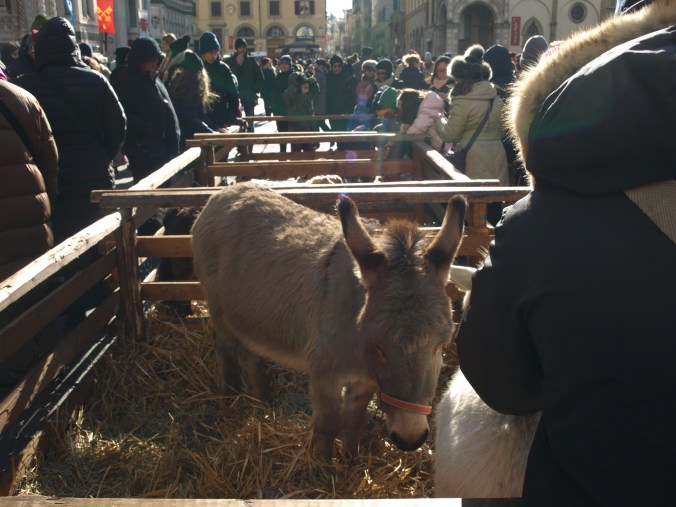
Here are the animals waiting patiently at the creche scene at the Duomo. They await the three Wise Men and their entourages,  marking the end of the long, ceremonious cavalcade.


OLYMPUS DIGITAL CAMERAOLYMPUS DIGITAL CAMERAOLYMPUS DIGITAL CAMERAOLYMPUS DIGITAL CAMERAOLYMPUS DIGITAL CAMERA


Once the Wise Men appear with their gifts, they are received by the magistrates of the city in a spectacular blending of church and state!

epifania_10

15823145_10155020962426614_8079433654972199975_n


The gifts are taken to the living creche scene.

epifania_11

After all the enactment, the hundreds of balloons, something I doubt Mary and Joseph ever imagined let alone saw, are set free!

OLYMPUS DIGITAL CAMERAOLYMPUS DIGITAL CAMERAOLYMPUS DIGITAL CAMERA


21

The entire day is a spectacle not to be missed!  I am so glad I got to see it!

Win some, lose some. The tale of my baking disasters and successes in Italy.

So, I love to bake.  The funny thing is that I am not much of a sweets eater, but I love to bake.

So, naturally, I’ve been experimenting in my new kitchen in Florence with baking.  It has been a hoot and a half getting to know the baking aisles at my local grocery stores, where I can often be found reading the fine print on the back of boxes, doing my best to understand the complicated Italian language as it describes the mysteries found inside the box!

For example: what do you think this is?

img_9096

From the picture on the box, you might think it is a cake mix.  Ha ha!  You’d be very wrong.  It is potato flour/starch.  Some of the recipes I’ve been playing with here require this completely new to me ingredient.  I felt like a winner when I finally found it on a grocery store shelf.

img_9097

Here’s the back of the box.  I decided to make these ricotta muffins, muffin all ricotta, but turn the muffins into a torta or cake.  I am still getting used to measuring grams rather than cups.  You can see the ingredients list is:

125 g di ricotta fresca       ricotta

80 g di zucchero                 sugar

70 g di farina 00                 flour, ground to 00

50 g di fecola di patate      potato flour/starch

50 g di burro                         butter

1 uovo                                     egg

a mela rosso                        red apple  (later we learn to slice thinly with skin on and lay a    piece of apple inside the batter in each muffin cup)

mezza di bustina lievito per dolce     1/2 a packet of rising agent for sweets

mezzo limone                    1/2 lemon (later in recipe we learn it is to be lemon peel)

pizzico di sale                     pinch of salt

zucchero a velo vanigliato    vanilla-flavored powdered sugar

To the best of my ability to understand Italian baking products, below we have the equivalent of what we call baking powder in the United States.  Only here it comes in packets and I share with you now what I’ve learned the hard way thus far (see below the picture).

img_9099

Read the recipe very carefully!  Because when the recipe says to use “mezza bustina di lievito per dolce” then you want to use 1/2 a packet.

I know this now, because I missed that adjective when I was baking my ricotta torta, and I wound up with a product that was completely overpowered by the taste of baking powder. Which is a nice way to say the cake tasted awful and I had to throw the whole thing out.

Fortunately, I am very patient with myself when it comes to baking (very unlike how I am when it comes to learning to speak Italian!!).  I was not very upset to bake a cake and throw it away. :-(

Whenever I bake, I like to play around with the ingredients somewhat, and I think almost every confection tastes better with vanilla.  I am accustomed to using a vanilla bean in the United States, or a high quality vanilla extract.  I haven’t been able to find that here yet, although I am certain it exists.

What I have found is this weird product:

img_9100

It is a consistency somewhere between an extract and a paste, and seems to be filled with millions of vanilla seeds, and it imparts a decent vanilla flavor to whatever I’m mixing up.

In addition, the product below is widely available in the baking aisle.  It is a white powdered version of what must be imitation vanilla?  The package says it imparts the “aroma per dolci di vanillina” or the “aroma for sweets of vanilla extract.”

Well, it does smell like vanilla but to me it doesn’t add much in the way of flavor to my baking.  I will stick to the above estratto until I can find real vanilla here.

img_9098

So, I can’t show you my finished ricotta torta, because I didn’t photograph it before I dumped it.  But here I include a picture of a torta margherita I successfully achieved a while back.

img_9079img_9086img_9090

The picture says it all!  It was wonderful!

Win some, lose some.  Questa è la vita.

I won’t stop trying!! :-))


P.S.  I’m going to try again to make the ricotta torta this weekend for a classmate’s birthday on Monday.  Wish me luck!  I am undeterred.

Beautiful Siena.


img_8835cropped-img_8835.jpgimg_8833img_8834


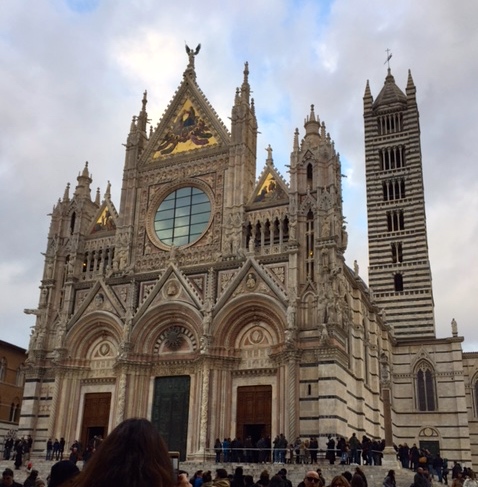
Siena still seems one of the blessed places of the Earth, a town whose beauty alone might justify the claim inscribed on the Camollia Gate:  – ‘Siena opens her heart wide to you’. From the shell-shaped Piazza del Campo, the three terzi (districts) spread along the town’s three curving ridges, their harmonious buildings constructed in the bricks of that warm hue known to artists as ‘burnt sienna’. In the prosperous years before the Black Death, ‘the city of the Virgin’, as it was called, had a population of over 50,000 in addition to another 50,000 in its contado, the country districts and small towns it controlled to its south and west. By the time of Lorenzetti’s frescoes, Siena had added Grosseto and Massa Marittima to its domains.

By the 1330s Florence had twice as many inhabitants as Siena, yet it was at this time that the smaller city, already possessor of the striking zebra-striped cathedral we see today, decided to erect the largest church in Christendom. The project was halted by the Black Death, which killed half the town’s population, and was abandoned soon afterwards, but some of its pillars and arches still stand as testament to monumental ambition. The existing cathedral, which is pretty large itself, would have become merely the transept of the greater glory. Siena’s rulers, whom their subjects might

Gilmour, David (2011-10-25). The Pursuit of Italy: A History of a Land, Its Regions, and Their Peoples (Kindle Locations 1226-1230). Farrar, Straus and Giroux. Kindle Edition.


One of the oldest Florentine churches, Santi Apostoli in the Piazza del Limbo.

If you’ve ever been to Italy, you know there are a lot of churches!  And, Florence is no slacker when it comes to houses of worship.  Florence has a lot of churches!

Near the Lungarno Acciaiuoli, about which I will soon be posting, there is a tiny piazza or city square, with the evocative name of Piazza del Limbo.  Not only is the small square a beguiling place to wander around, but it is purportedly the home of the oldest religious building in the city: the Chiesa dei Santissimi Apostoli.

The chiesa was built in the 11th century and, though it was remodelled in the 15th and 16th centuries, is one of the few in the city to have maintained its High Middle Ages features.

Tradition says that it was Michelangelo himself who convinced Bindo Altoviti, who planned to raise the ground level, not to rebuild, but to preserve the church.

The church faces the Piazza del Limbo–named because it housed a cemetery for children who died before having been baptized. It is adjacent to the Palazzo Borgherini-Rosselli del Turco.

chiesa_dei_santi_apostoli_firenze_italia_-_facciata_su_piazza_del_limbo


A slab on the façade attributes the foundation to Charlemagne and his paladin Roland in the year 800.  A paladin is any of the twelve peers of Charlemagne’s court, of whom the Count Palatine was the chief. A paladin is a knight renowned for heroism and chivalry. But scholars assign the church to the 11th century. A small bell tower was added by Baccio d’Agnolo in the 16th century.

The simple façade, in Romanesque style, has a portal attributed to Benedetto da Rovezzano. The tabernacle by Giovanni della Robbia and the tomb of Oddo Altoviti.

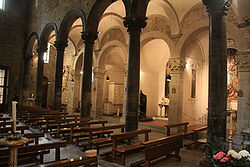
250px-inside_of_the_church_of_santi_apostoli_florence

Interior of Santi Apostoli

The church’s layout is the typical basilican plan, with a nave, two aisles, and a semicircular apse, still shows Palaeo-Christian influences. It has green marble columns that come from Prato, with capitals taken from ancient Roman remains. The Corinthian capitals may well have been taken from the Roman baths that existed in the area.

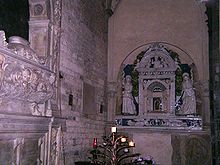
220px-santi_apostoli_tabernacolo2

The richly decorated wooden ceiling was added in 1333. Noteworthy is the pavement, with a mosaic from the original edifice which was later restored with the contributions of outstanding Florentine families (Acciaioli, Altoviti and others). The apse area appears to be Romanesque, with undecorated stones visible. The side chapels are from the 16th century.

On the left of the apse are a polychrome terracotta tabernacle by Giovanni della Robbia. To right of the entrance is the tomb with the bust of Anna Ubaldi, mother of the Gran Priore del Bene. The bust was sculpted by Giovanni Battista Foggini. The 2nd chapel on the right, chapel of San Bartolomeo was completed in the 16th century. The right wall has a stucco depicting San Paolo, and on the left wall the sepulchral monument of Piero del Bene (1530).

At the end of the nave above the door that leads to the Canon’s hall is the sepulchral monument of Bindi di Stoldo Altoviti (Bindo Altoviti) (1570) with a statue of Faith and two putti by followers of Bartolomeo Ammannati. In the apse, is the monument of Antonio Altoviti and busts of both Charlemagne and Antonio Altoviti by Giovanni Caccini. In the left nave is the monument to Oddo Altoviti (1507-1510 by Benedetto da Rovezzano.

The 4th chapel on the left has an altarpiece with the Adoration of the Shepherds and, on the wall, Archangel Raphael with Tobias and St Andrew Apostle (c. 1560 by Maso da San Friano). The 3rd chapel on the left contains the image of Archangel Michael defeating Lucifer (16th century by Alessandro Fei). The 2nd chapel has frescoes depicting the Glory of San Giovanni di Chantal by Matteo Bonechi. The first chapel has a Madonna, Child and Angels, a copy of a Paolo Schiavo originally on the facade of church.

The church houses three flints (Pietre del Santo Sepolcro) putatively from the Holy Sepulchre in Jerusalem. According to tradition, these flints were used to light the lamps of the tomb when Jesus was buried. Legend holds that they were given in 1101 to Pazzino dei Pazzi, who was among the first Christians to scale the walls of Jerusalem, leading to the capture of that city during the First Crusade.

From then on, the Pazzi included a flaming cup in their coat of arms. The flints are linked to the ceremony of Lo Scoppio del Carro and the lighting of fireworks from the Portafuoco after a celebratory mass.

Cool bijoux by Angela Caputi

I like her stuff a lot.

One of her two Florentine shops is right down the street from my home.  The other one is a 10 minute walk.  I can fill up my senses with her displays whenever I need an injection of energy and il caffè just isn’t cutting it.


img_9450

img_9446

I covet this green necklace.  It looks like a laurel wreath to me, a symbol that brings up all kinds of wonderful memories and associations for me.

img_9447img_9448img_9449img_9445

http://www.angelacaputi.com/wordpress/wp-content/uploads/2015/02/Angela_Caputi.mp4?_=1