The work of Emilio Pucci (1914-92), Florentine fashion designer and Marchese di Barsento, has been on my radar all of my life. I absolutely love it.
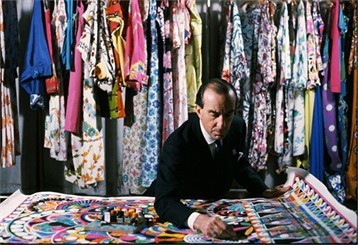
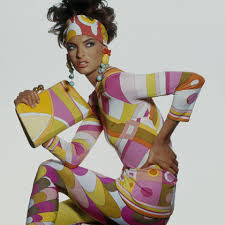
I mean, what’s not to love?
Pucci was born in 1914 to one of Florence’s oldest aristocratic families, and he both lived and worked at his family’s Palazzo Pucci, which is a stone’s throw from the Duomo in Florence, for much of his life. Check out his Palazzo here.
Pucci had an amazingly wide variety of interests and was an avid sportsman, who swam, skied, fenced, played tennis and raced cars. He attended the University of Milan for two years and then studied agriculture, of all things, in the United States at the University of Georgia. In 1935 he started school at Reed College in Oregon, where he eventually received a Master’s degree in social science. Pucci was on the ski team at Reed and his first real fashion design was created for this team.
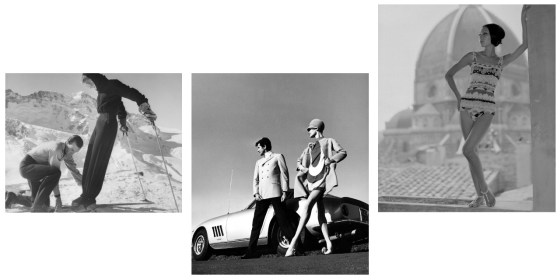
That same year he was awarded a (an honorary degree one has to suppose ) laurea in poli science from the University of Florence. Always invested in Italian politics, even at Reed College he was known as a staunch defender of the Fascist regime in Italy.
When Pucci returned home he joined the Italian air force, rising to the rank of captain. He became entwined in the lives of Benito Mussolini’s oldest daughter, Edda and her husband, which led to Pucci being arrested and tortured by the Gestapo. He lived in Switzerland until the war ended.
Pucci’s first recognition for his design was in the 1948 issue of Harper’s Bazaar. He had designed some ski wear for a friend, utilizing the new stretch fabrics, and his sleek new designs caused a sensation.
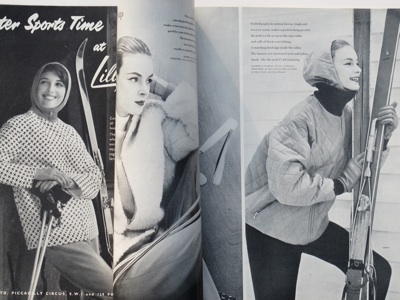
Several American manufacturers offered to produce this glamorous new ski wear, but Pucci instead set up his own atelier in the fashionable resort of Canzone del Mare on Capri, which was a brilliant strategy, for Capri was a destination for the world’s new international jet set.
Pucci’s business thrived almost immediately. He experimented with the stretch fabrics to create a swimwear line in 1949, but found his voice in designing brightly-colored patterned silk scarves. Neiman Marcus, the high end American retailer, noticed Pucci’s scarves and suggested Pucci create blouses and then a popular line of wrinkle-free printed silk dresses. He seemed to be made of gold, for his designs caught on immediately. He opened a boutique in Rome. Pucci was a hot designer commodity by the mid 1950s.
Marilyn Monroe discovered Pucci in the early 1960s and enhanced the designer by wearing his creations in some of her last photo shoots. Many celebrities wore Pucci, including Sophia Loren and Jacqueline Kennedy.
In 1959, Pucci decided to create a line of lingerie. Since he’d had some textile related issues in Italy in the 1940s, he deiced to give his lingerie contract to Formfit-Rogers mills in Chicago. It was a successful venture. In 1959, Pucci met Cristina Nannini, a Roman baroness, whom he married.
During the go-go 1960s, Braniff International Airways engaged Pucci to update the airline’s image by designing new clothing for the flight attendants (or stewardesses–as the almost exclusively female crew were then known).
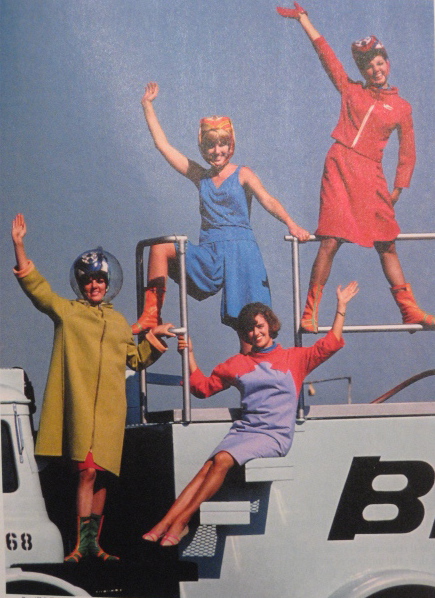
Pucci designed six complete collections for Braniff hostesses, pilots and ground crew between 1965 and 1974. The 1968 garments were copied for the very popular Barbie doll.
Among the more unusual aspects of Pucci’s Braniff designs was the so-called “bubble helmet” – a clear plastic hood worn by flight attendants between terminal building and aircraft to protect their hairdos from rain and the blast of jet engines.
Pucci’s influence even extended all the way to the Moon! He suggested the three bird motif for the Apollo 15 mission patch.

https://www.youtube.com/watch?v=rOUgbkilOb0
 get back, lauretta!