A perfect day in spring. The temperature warm enough that not even a sweater is needed, the sun bright, the sky blue, the birds singing (I never hear this sound in Florence herself, not enough trees and too urban), the views majestic.
Settignano = the perfect day trip.
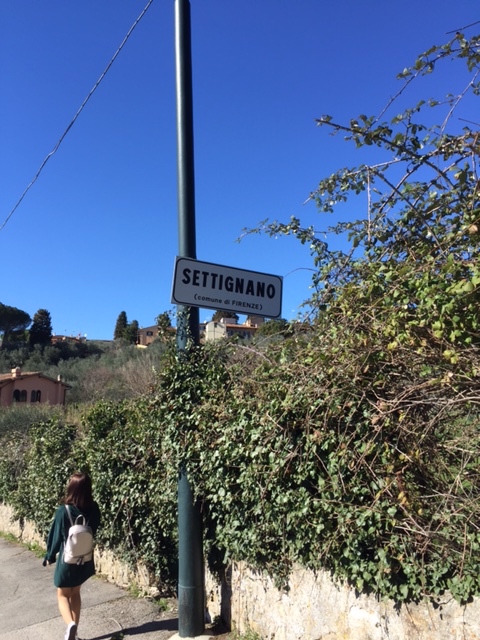
Florence, with her unmistakable dome, as seen from the hilltops of Settignano.
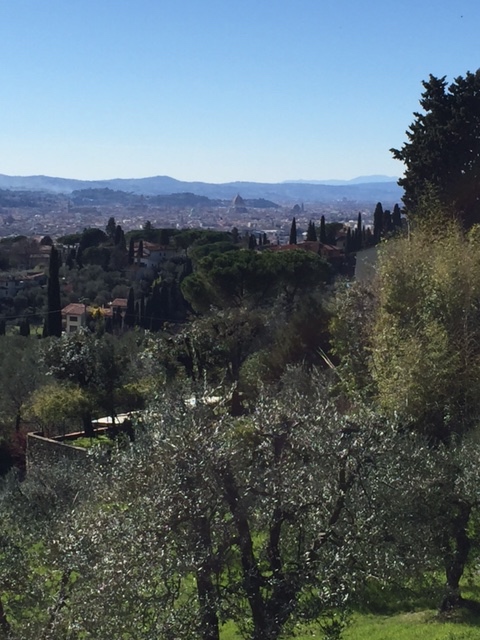
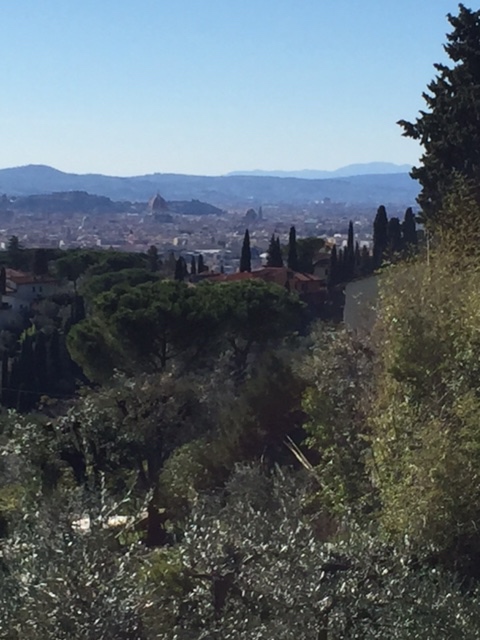
Back in piccola, picturesque, Settignano.
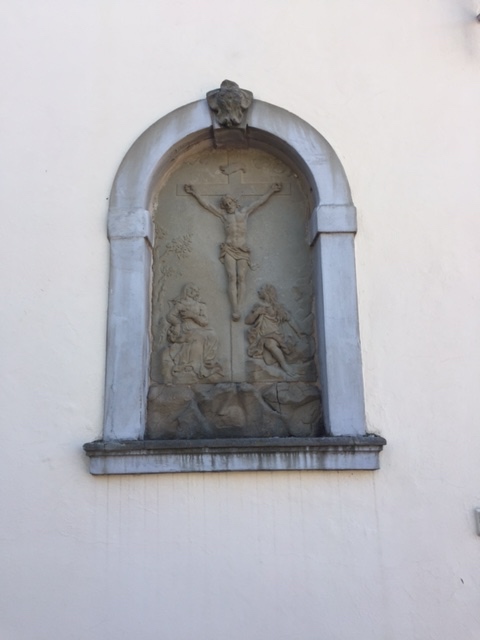
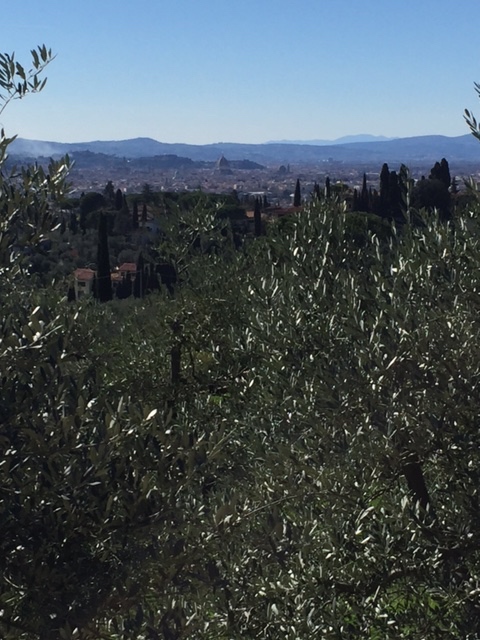
Settignano is a picturesque frazione ranged on a hillside just northeast of Florence, Italy, easy to get to by bus from San Marco (#10). With spectacular views, Settignano has attracted visitors for generations.
The little borgo of Settignano carries a familiar name for having produced three sculptors of the Florentine Renaissance, Desiderio da Settignano and the Gamberini brothers, better known as Bernardo Rossellino and Antonio Rossellino. It’s a rather romantic to think we are following in the footsteps of inspiring artists who walked these tiny, bendy streets.
The young Michelangelo lived with a sculptor and his wife in Settignano—in a farmhouse that is now the “Villa Michelangelo”— where his Michelangelo’s father owned a marble quarry.
In 1511, another sculptor was born there, Bartolomeo Ammannati.
It is rather amazing to consider that the marble quarries of Settignano produced this amazing series of sculptors.
But it was not only Renaissance sculptors who lived here; the Italian poet, writer and prince Gabriele D’Annunzio called this place home for a while. In 1898, d’Annunzio purchased the trecento Villa della Capponcina on the outskirts of Settignano, in order to be nearer to his lover Eleonora Duse, at the Villa Porziuncola.
The American humorist, Mark Twain, stayed here at Villa Viviani for the good part of a year in 1892-1893. Twain was very productive here, writing 1,800 pages including a first draft of Pudd’nhead Wilson. Twain said of Settignano: it “affords the most charming view to be found on this planet, and with it the most dreamlike and enchanting sunsets to be found in any planet or even in any solar system.” High praise indeed!
In fact, the borgo has Roman remains which claim connections to Septimius Severus, in whose honor a statue was erected in the oldest square in the 16th century. Unfortunately, the statue was destroyed in 1944.
It is known that this area was inhabited long preceded the Roman emperor.
During the Medieval and Renaissance periods, Settignano was a secure refuge for members of the Guelf faction of Florence.
Giovanni Boccaccio and Niccolò Tommaseo both appreciated its freshness, amidst the vineyards and olive groves that are the preferred setting for even the most formal Italian gardens.
Near Settignano are the Villa Gamberaia, a 14th-century villa famous for its 18th-century terraced garden, and secluded Villa I Tatti, the villa of Bernard Berenson, now a center of Italian Renaissance studies run by Harvard University.
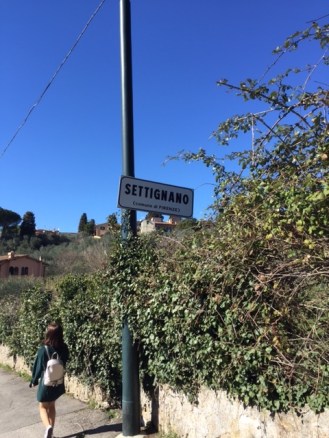
If you’ve come by bus from the centre of Florence, you’ll be dropped off right in the piazza next to the post office. Head down via della Capponina, which is to the right of the church entrance. A handsome street with pot plants and high walls, it will take you down to an intersection where you can turn left on via del Pianerottolo and wander another pretty street with views overlooking the hills and Florence’s southern neighborhoods. You will pass down towards the town cemetery, past olive groves and rampant blackberry bushes to the cypress-lined park, where you’ll see the sign for the hiking trail. If you’re the hiking type, you can also get to Settignano by hiking from Fiesole over Montececeri (or vice versa). The Sentiero degli Scalpellini follows in the footsteps of the stone-cutters who carved blocks of pietra serena and pietra forte for Florence’s palazzi and streets. It’s a walk of over 6 km that climbs over Montececeri, where Leonardo da Vinci tested his flying experiments. In la primavera, you might spot wild asparagus.
And if you want to experience this romantic view of Florence twinkling below that Twain would have seen, head down from the main piazza, on via Simone Mosca, a 2 minute walk away, for a great panoramic spot.
Settignano’s main square, Piazza Tommaseo, has all the essentials: a church, a post office, a bar, a tabacchi, an alimentari, and an enoteca.
 get back, lauretta!
Da qualunque parte la si guardi Firenze è stupenda!!!!
Bella Firenze!