Earl Grey Tea: bergamot oil and black China tea

You know how much I love bergamot.

images-15

Did you know that ever since the 19th C., bergamot oil has also been used to give a distinctive aroma and flavor to one of the most popular teas in the world.

images-6

Earl Grey is made from a blend of dark China teas treated with the bergamot oil or peel.

images-9

It is always said that the tea was named after the second Earl Grey of Howick, Britain’s prime minister from 1830 to 1834. The story revolves around a diplomatic mission to China, when Grey is supposed to have rescued the son of a Chinese mandarin from drowning. The mandarin was said to have been so grateful that he sent a box of bergamot-scented China tea to Grey in London.

images-7

There are several things in this story that don’t add up, not least that Grey never set foot in China and bergamot grew only in Calabria.

images-13

Nevertheless, it is certain that the English developed a taste for scented teas at about this time, blending Indian and Sri Lankan leaves, dousing them with oil of bergamot and naming the mixture Earl Grey in honour of their prime minister.

images-12

Earl Grey tea is still produced in the same way and consumed with undiminished enthusiasm in England. By the mid 19th C., bergamot was produced on an industrial scale, and harvesting the fruit and extracting its oil involved the entire community in the coastal Calabrian villages between Villa San Giovanni and Brancaleone.

images-11

The job of picking the bergamot was given to boys and the youngest men in the villages of Calabria. They used pruning knives to remove any stalks that might pierce or damage the skins of other fruit, and then placed the fruit gently in a basket lined with sacking to give it further protection from bruising or chafing that could cause the oil to ooze from its skin and be wasted.

images-10

When a basket was full it weighed about thirty kilos. It was the women’s job to hoist the baskets on to their heads and carry them in from the fields to the fabbrica. Here, the working day began at 4 a.m. and finished at 4 p.m.

The skin of a bergamot is so full of oil that it will begin to seep out at the slightest pressure, so initially it was extracted simply by pressing and turning the peel of the fruit against a sponge. The sponge was then squeezed into a glass phial and the liquid was left to settle and separate.

The oil produced by this ancient method is unrivalled, and according to one ‘nose’ in the perfume industry, the difference between it and oil extracted mechanically is ‘just the same as the difference between a bull and a bullock’.

In 1844 the macchina calabrese, the ‘Calabrian machine’, was invented by Nicola Barillà, and this revolutionized the laborious extraction process. A few bergamots of similar size were placed between two metal cups. The lower cup was covered in spikes to hold the fruit still and the upper one was armed with sharp blades. Two men took it in turns to operate the handle that rotated the cups, and the combination of pressure and the movement of the upper cup made oil and water spray out of the peel and fall into a copper bowl.

Finally, the mixture of grated peel and oil would be strained through woollen sacks that were hung from a rack and left to drip into another copper bowl. All of the copper bowls used during the extraction process were lined with tin to prevent the oil reacting with the copper.

images-14

Attlee, Helena (2015-01-05). The Land Where Lemons Grow: The Story of Italy and Its Citrus Fruit (Kindle Locations 2412-2422). Countryman Press. Kindle Edition.

 

Do the culinary arts follow the same patterns as the visual arts?

Noooo! reveals this clever author:

Cooking does not necessarily follow the same chronology as other fields of creative endeavor.

People did not start eating with more perspective in the Renaissance.

Nor, for that matter, did they dine more ornamentally in the Baroque period,

or more rationally during the Enlightenment.

Dickie, John (2008-01-08). Delizia!: The Epic History of the Italians and Their Food (Kindle Locations 1136-1138). Atria Books. Kindle Edition.
Wow! Florence celebrates Easter Sunday with a bang!

I’ve witnessed some celebrations in my life.  But, I can honestly say I’ve never seen anything quite like what happens every Easter morning in Florence!

OLYMPUS DIGITAL CAMERA

OLYMPUS DIGITAL CAMERA

The celebration that takes place in and in front of the Duomo is somewhere between a Chinese New Year spectacle, combined with something you might see in a festival in India, with some Roman Catholic overtones.

OLYMPUS DIGITAL CAMERA

Honestly, I’m still scratching my head!

OLYMPUS DIGITAL CAMERA

So, I got to the Piazza del Duomo about 9:45 and already the crowds were thick. I was able to nab a pretty good spot to watch part of the parade arrive in front of the Duomo.

Then I moved to a better spot to see the Carro.  Unfortunately, by 10 a.m. the crowds were super thick.

OLYMPUS DIGITAL CAMERA

OLYMPUS DIGITAL CAMERA

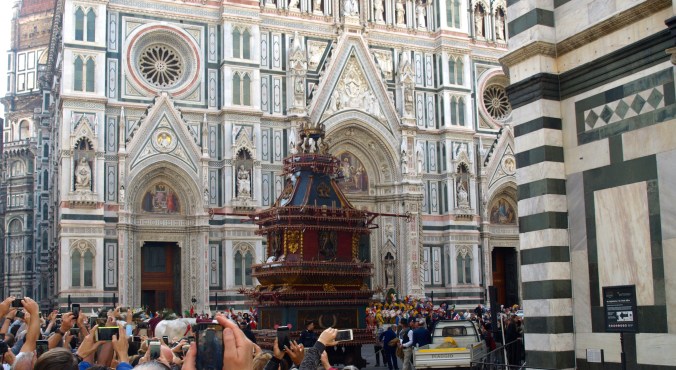
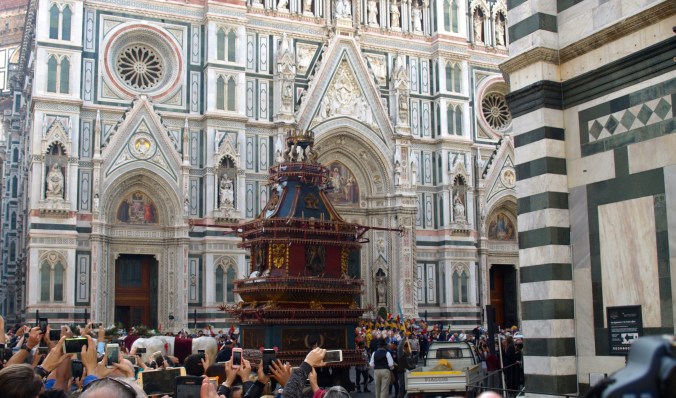
The white oxen festooned with floral wreaths pull the antique Carro to the front of the Duomo and park it there, lining it up with a mechanical dove that will shoot out of the church at the right moment, and alight the Carro.
The beloved Carro or Brindellone returns to piazza del Duomo every year on Easter Sunday. Housed 364 days of the year in via il Prato, this cart filled loaded with fireworks is paraded through the city streets, arriving in front of Santa Maria del Fiore at around 10am. After the cathedral’s morning mass, much pomp and circumstance ensues all leading to the festivity’s ending in a pyrotechnic spectacle.

dove-inside-cathedral


A dove-shaped rocket called the colombina is ignited inside the cathedral and then runs along a wire out to the Brindellone, which it ignites.

12376852_507126922813476_1701947185706443981_n

11101833_425474234279790_5775054431322835451_n

No matter how many pictures I post, nothing will take the place of these Youtube videos.  Stay with it, the fireworks are incredible.  Not sure how it celebrates the Resurrection of Christ, but that’s not a problem in this famous Florentine celebration!

Legend has it that if the Brindellone alights completely as planned, Florence will have a bountiful harvest and a great year.  From the looks of it, 2017 will be a boon year in Firenze!

Enjoy the following videos!  Buona Pasqua!


On Easter Sunday every year, Florence celebrates the religious holiday in a very special way. The Scoppio del Carro, or the “Explosion of the Cart”, dates back over 350 years. An elaborate wagon built in 1622 and standing two to three stories high is pulled by a pair of  white oxen decorated with garlands through the streets of Florence to the square between the Baptistry and Cathedral.

This tradition finds its origins in events that are partly historic and partly legendary. A young Florentine named Pazzino, a member of the noble Pazzi family, apparently took part in the First Crusade in the Holy Land in 1099, where he gave ample proof of his courage (he was the first to scale the walls of Jerusalem and raise the Christian banner).

When he came home, he brought back three flints from the Holy Sepulchre that he received for his act of courage. This reliquary, today preserved in the Church of SS. Apostoli, lies behind the Florentine celebration for the Resurrection of Christ.

Today, the ceremony still bears a strong resemblance to the way in which it has been celebrated for centuries. Starting around 10am, a priest rubs Pazzino’s three flints together until they spark and light the Easter candle; this, in turn, is used to light some coals which are placed in a container on the Cart and the procession delivers the Holy Fire to the Archbishop of Florence before Santa Maria del Fiore, better known as il Duomo. The cart is accompanied by drummers, flag throwers and figures dressed in historical costume as well as city officials and clerical representatives.


Easter in Italy; it’s at least partly about the candy!

OLYMPUS DIGITAL CAMERA


Shops around Florence have all the candy you can ever want!

First up: Rivoire!

OLYMPUS DIGITAL CAMERAOLYMPUS DIGITAL CAMERAOLYMPUS DIGITAL CAMERAOLYMPUS DIGITAL CAMERAOLYMPUS DIGITAL CAMERAOLYMPUS DIGITAL CAMERAOLYMPUS DIGITAL CAMERA


OLYMPUS DIGITAL CAMERAOLYMPUS DIGITAL CAMERA


The popular vote undoubtedly goes to Venchi.  You should see the lines outside the store.

OLYMPUS DIGITAL CAMERAOLYMPUS DIGITAL CAMERA

OLYMPUS DIGITAL CAMERAOLYMPUS DIGITAL CAMERA


My favorite little candy shop in Florence is Mignone.  Here are their offerings for Easter:


OLYMPUS DIGITAL CAMERAOLYMPUS DIGITAL CAMERAOLYMPUS DIGITAL CAMERAOLYMPUS DIGITAL CAMERAOLYMPUS DIGITAL CAMERA


Then there is Robiglio, another Florentine institution of confectionary arts:


OLYMPUS DIGITAL CAMERA


I think these Ladybug Easter packages are my favorite!  I love ladybugs!

OLYMPUS DIGITAL CAMERA


Next up, Gilli:

OLYMPUS DIGITAL CAMERAOLYMPUS DIGITAL CAMERAOLYMPUS DIGITAL CAMERAOLYMPUS DIGITAL CAMERA

OLYMPUS DIGITAL CAMERAOLYMPUS DIGITAL CAMERAOLYMPUS DIGITAL CAMERAOLYMPUS DIGITAL CAMERAOLYMPUS DIGITAL CAMERA

OLYMPUS DIGITAL CAMERA


And last, but certainly not least, on my tour of sweets on offer for Pasqua, is Scudieri:

OLYMPUS DIGITAL CAMERAOLYMPUS DIGITAL CAMERAOLYMPUS DIGITAL CAMERAOLYMPUS DIGITAL CAMERA


And I also want to give a shout out to Vestri.  I didn’t make it there today to take pictures, but I know their Easter candies would be excellent indeed!

White gold: Richard-Ginori porcelains

When porcelains were first introduced in Europe from China, the substance was known as “white gold” for its value because of its toughness, strength relative to all other known types of pottery.

images


In 1735, the Marquis Carlo Ginori, driven by an interest in the advent of European production of “white gold,” founded his porcelain manufactory in the town of Doccia in Sesto Fiorentino, near Florence in Tuscany.  

After an initial experimental period, during which he imported Chinese porcelain samples, Ginori engaged two Viennese painters, J.C.W. Anreiter and his son Anton, with Gaspare Bruschi employed as chief modeler.

By 1740 Doccia had a monopoly of porcelain making in Tuscany and in 1746 began public sales. The product was a grayish, hard-paste porcelain made from local clay, with a glaze lacking in brilliance; a finer, white paste was adopted later.

Early wares were decorated by stencil, a rare process that was to give way to a fine range of painted colors.

The Manufactory of Doccia, as it was originally known, remained on this site until 1955.


images-4

1779 An era that gives birth to some of Richard Ginori’s best known forms and decorations. Combined with elegant centrepieces, they accessorize many a famous banquet in important palazzi and ville. The woven pattern is introduced, still a must- have in the collection today. The dawn of the nineteenth century brings with it new technologies and gold decorative solutions to fuel the taste for luxury.

images-2

1850 The arrival of the international expositions and the fashion for naturalistic taste offers the Manufactory the opportunity to expand. Scenes of insects nestling among floral elements animate tableware, meanwhile the academic sculptor Urbano Lucchesi brings themes of theatrical literature, fantasy objects and the Macchiaioli school of painting into the Manufactory.


1896 Now known now as the Manufacture Richard Ginori, a major expansion in artistic and industrial manufacturing activities lead to the successful development of two innovative patents: the oven-proof Pirofilia, (c. 1897-1898) and developed expressly for scientific laboratories, Euclide porcelain (c. 1940).

1923 The architect and designer Giò Ponti is appointed as artistic director, and the Manufactory brings to the European scene new decorative designs in line with the styles of the era.

images-3

1954 Manufacture Richard Ginori interprets the new functionality of the everyday life style. Colonna, with its stackable and essential design is introduced under the artistic direction of Giovanni Gariboldi.

1985 As tastes and lifestyles evolve, the Manufactory turns to the creative talents of the great Italian architects and designers of the time: Franco Albini, Franca Helg & Antonio Piva, Sergio Asti, Achille Castiglioni, Gabriele Devecchi, Candido Fior, Gianfranco Frattini, Angelo Mangiarotti, Enzo Mari and Aldo Rossi.

2013 The renaissance of the Manufactory Richard Ginori begins. The Manufactory is acquired by Gucci and Alessandro Michele is appointed artistic director. Today, just as 280 years ago, it represents excellence in creativity, innovation and the hand-made in Italy.


http://www.klatmagazine.com/en/design-en/richard-ginori-oltre-270-anni-di-storia-evergreen-031/38197


https://www.richardginori1735.com/#