In italiano: colloquio privato

In italiano: colloquio privato
Henry Wadsworth Longfellow (1807 – 1882) was an American poet and educator whose works include “Paul Revere’s Ride“, The Song of Hiawatha, and Evangeline. He was also the first American to translate Dante Alighieri‘s Divine Comedy.
Longfellow spent several years translating Dante Alighieri’s Divine Comedy. To aid him in perfecting the translation and reviewing proofs, he invited friends to weekly meetings every Wednesday starting in 1864. The “Dante Club”, as it was called, regularly included William Dean Howells, James Russell Lowell, Charles Eliot Norton and other occasional guests. The full 3-volume translation was published in the spring of 1867, though Longfellow would continue to revise it, and went through four printings in its first year.
He was also important as a translator; his translation of Dante became a required possession for those who wanted to be a part of high culture. He also encouraged and supported other translators.
Henry Wadsworth Longfellow’s translation finds a new champion in Joseph Luzzi, in “How to Read Dante in the 21st Century” in the online edition of The American Scholar:

… one of the few truly successful English translations comes from Henry Wadsworth Longfellow, a professor of Italian at Harvard and an acclaimed poet. He produced one of the first complete, and in many respects still the best, English translations of The Divine Comedy in 1867. It did not hurt that Longfellow had also experienced the kind of traumatic loss—the death of his young wife after her dress caught fire—that brought him closer to the melancholy spirit of Dante’s writing, shaped by the lacerating exile from his beloved Florence in 1302. Longfellow succeeded in capturing the original brilliance of Dante’s lines with a close, sometimes awkwardly literal translation that allows the Tuscan to shine through the English, as though this “foreign” veneer were merely a protective layer added over the still-visible source. The critic Walter Benjamin wrote that a great translation calls our attention to a work’s original language even when we don’t speak that foreign tongue. Such extreme faithfulness can make the language of the translation feel unnatural—as though the source were shaping the translation into its own alien image.

Longfellow’s English indeed comes across as Italianate: in surrendering to the letter and spirit of Dante’s Tuscan, he loses the quirks and perks of his mother tongue. For example, he translates Dante’s beautifully compact Paradiso 2.7
L’acqua ch’io prendo già mai non si corse;
with an equally concise and evocative
The sea I sail has never yet been passed:
Emulating Dante’s talent for internal rhymes laced with hypnotic sonic patterns, Longfellow expertly repeats the s’s to give his line a sinuous, propulsive feel, which is exactly what Dante aims for in his line, as he gestures toward the originality and joy of embarking on the final leg of a divinely sanctioned journey. Thus, Longfellow demonstrates the scholarly chops necessary to convey Dante’s encyclopedic learning, and the poetic talent needed to reproduce the sound and spirit—the respiro, breath—of the original Tuscan.
Read the whole essay here – it’s fairly short and very interesting.
Do you have what it takes? In Italian you would ask it this way: Avere la stoffa?

But it is rare for [Italians] to view work as anything but a necessary evil. A survey commissioned by the weekly newsmagazine Panorama in 2006 found that two-thirds of Italians would give up their work if they could be guaranteed the relatively modest sum of € 5,000 a month.
In the same way, retirement is usually seen as entirely positive. There seems to be none of the fretting that goes on in Anglo-Saxon societies about how to cope with a loss of identity.
I have known plenty of Italians who have gone into retirement, and sometimes I have bumped into them in the street or when they have made a return visit to the offices where they worked. Not once have I heard any of them express anything but unmitigated delight at no longer having a job.
Silvio Berlusconi was still prime minister at the age of seventy-five. Mario Monti, who replaced Berlusconi in 2011, took over as head of government when he was sixty-eight. His cabinet, which was brought in as a new broom that would sweep clean and introduce wide-ranging reforms, had the highest average age of any in the European Union at the time.
And after the election that followed the fall of Monti’s government, the new parliament reelected a president, Giorgio Napolitano, who was eighty-seven. For truly untrammeled “gray power,” however, nothing compares with the universities. A study published as Monti and his ministers were settling in behind their highly polished desks found that the average age of Italy’s professors was sixty-three and that many were still clinging to their positions and the vast patronage they were afforded when they were well over seventy. Their average age was the highest anywhere.
It means that young Italians are not just imbibing the theories and attitudes of the previous generation, which is natural, but of the one before that, and in extreme cases even the one before that. The appointment of two younger prime ministers, Enrico Letta in 2013 and Matteo Renzi in 2014, has led to a rejuvenation at the highest levels of government. Renzi became Italy’s youngest ever prime minister at the age of just thirty-nine. And he set about naming a cabinet that included a party colleague who was only thirty-three at the time of her appointment.
But it remained to be seen whether the process would extend to other areas of Italian life, and particularly higher education. The role played by the elderly in the formation of Italy’s future elite continued to represent a formidable obstacle to innovation, modernization and the rethinking of established ideas. This may have some link to the enthusiasm with which so many young Italians embrace the culture of their parents. Perhaps the most striking example of this is to be found in the area of rock music: currently the ages of three of the most popular singers are fifty-two, fifty-six and sixty. Aging rock stars have kept going.
Hooper, John. The Italians, Penguin Publishing Group. Kindle Edition.
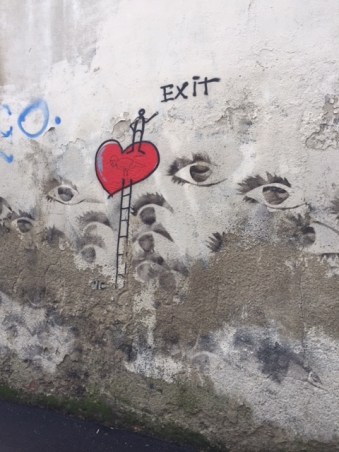
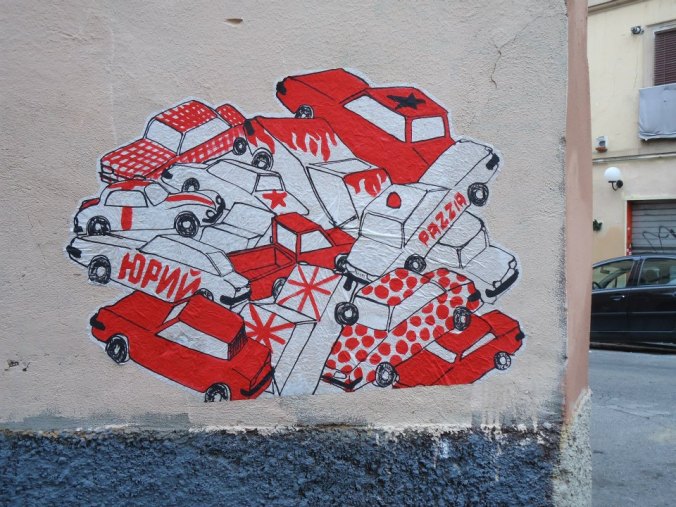
Many are the charms of seeing Florence on foot. One of my favorite things to do is to study the walls on the streets throughout the city. Certain images soon start to illuminate the artist behind the works. For a good guide to the street artists, see:
https://www.intoflorence.com/street-art-florence/
The following is taken from the source above (but I added the pictures…I can’t help myself, I am an art historian):
The Florentines are very proud that, a long time ago, the Renaissance was born in their city. Much in Florence is devoted to this crucial period and one might say that Tuscan capital has remained a bit stuck in the Renaissance, thus leaving very little room for new forms of art by young contemporary artists.
In recent years, a new generation of artists has emerged; these creative souls have started a new “renaissance,” and they bring art closer to the people once again.
The streets of Florence and the walls of the palaces are their “canvas” and not even the street signs are safe. The artists of the “Urban Renaissance” strive to make the city a bit more colorful, put a smile on your face, make you think, or inspire you.
Each has its own distinctive style, and once you know what to look for, you’ll start spotting them all over town.
Get to know the most famous urban artists of Florence with this quick Street Art Guide.
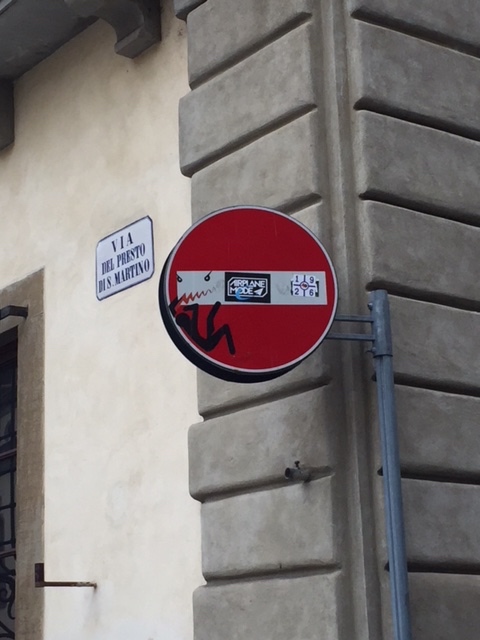
The French artist Clet Abraham found his home in Florence, where he has his studio in the San Niccolò district. After having focused mainly on painting, several years ago he started with a very particular form of street art. Mysteriously, funny stickers started appearing on the Florentine street signs, and it soon became apparent that it was Clet who rode around town on his bike at night and decorated the signs.
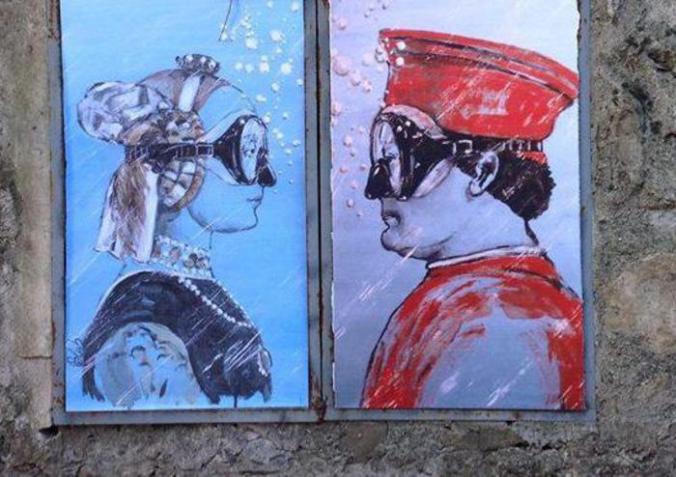
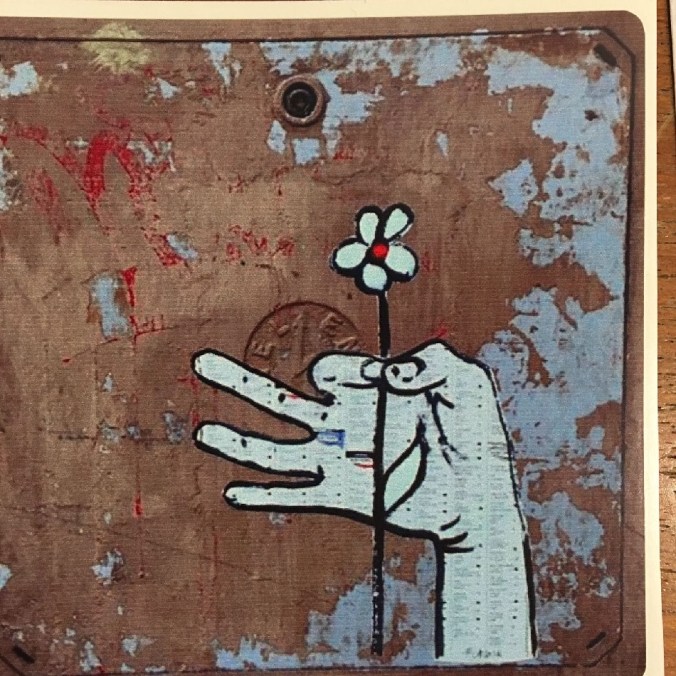
This mysterious artist is only known by his alias Blub. With his project L’Arte sa nuotare (Art can swim) he depicts famous works of art and characters mainly in blue, white and black. But what makes this so unique? They all wear a diving mask and are underwater. Blub often uses the metal doors of gas and electricity meters, on which at first he painted directly, but now sticks posters of his work to because they are regularly removed.
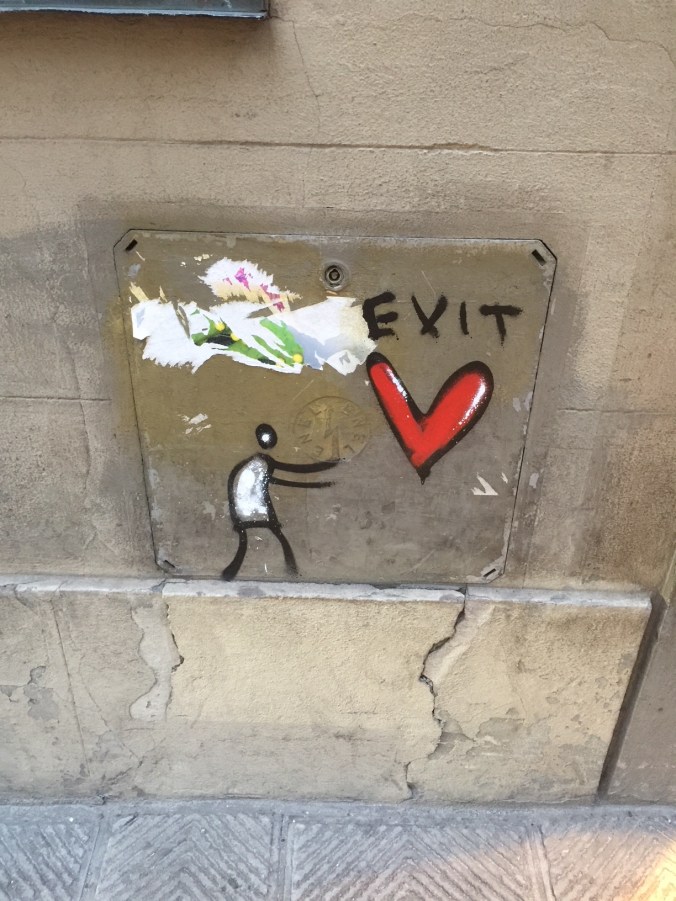
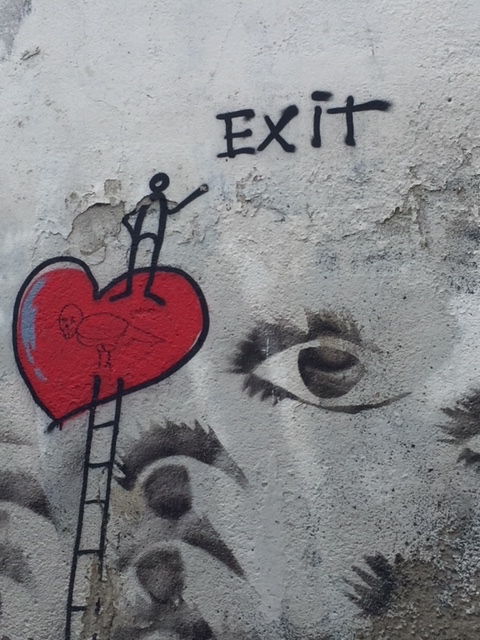
The stylized line figurines with a red heart or balloon spring from the creative mind of the Florentine artist known as Exit/Enter. With his minimalist drawings, he brightens up your day or makes you stop and think for a moment. Exit/Enter’s star is also rising outside Italy, earlier this year his work was presented at the Street Art Museum in Amsterdam.
One of the few female street art artists is Carla Bruttini, better known as Carla Bru. The most famous creation that comes from her studio in the San Niccolò district is the red-haired shaman, a powerful feminine symbol, which you can find at various spots in the city.
The most famous work of the artist born in the Marche, are the red and white figures in Via Toscanelli. With the cycling characters, he wants to promote the use of bicycles in the city. The owner of the restaurant on the opposite side of the street is the self-declared protector of the murals.


 get back, lauretta!
You must be logged in to post a comment.