Article from Washington Post, see source below.

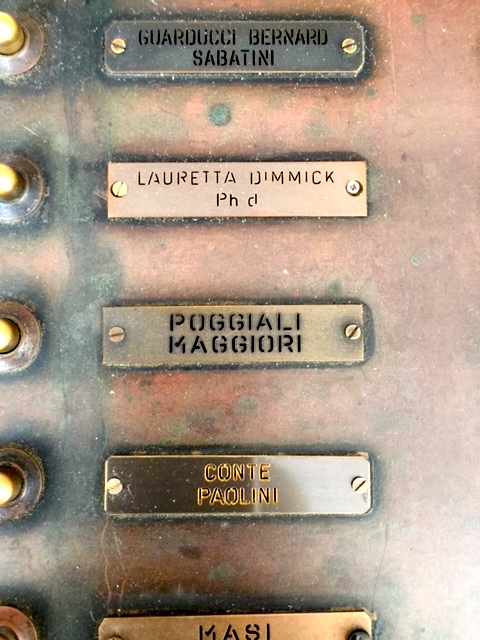
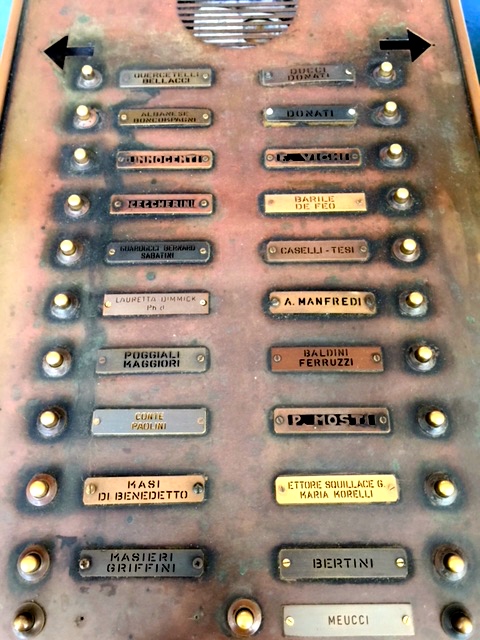
After numerous short visits to Italy of 2 weeks or more over decades, I have finally arrived as an Italian resident! Woo hoo! Since my recent move into my new condo, I finally got to put my name in print on the building’s door bell system. I’m very proud!
26 June 2018, a new article to add on Ms. Paget: https://frieze.com/article/vernon-lee-psychology-art-writer
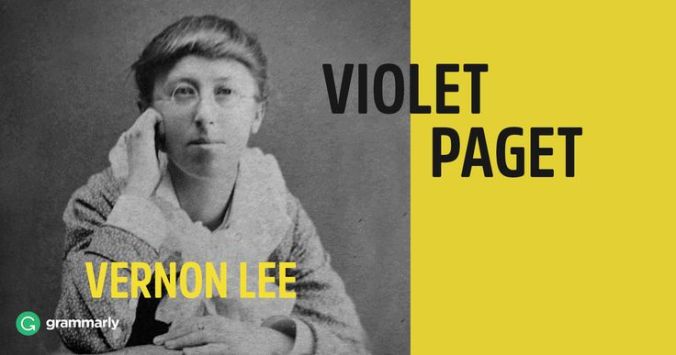 Vernon Lee, the pseudonym of Violet Paget (1856-1935), was a well-known English expat writer who lived for many years in Florence.
Lee was the author of essays, literary criticism, travelogues, novels and ghost stories. Among her many books are: Studies of the Eighteenth Century in Italy, The Countess of Albany, Limbo, Genius Loci, Hortus Vitae, The Enchanted Woods, The Spirit of Rome, Laurus Nobilis, Louis Norbert, The Handling of Words and The Golden Keys. She is remembered today primarily for her supernatural fiction and her work on aesthetics. An early follower of Walter Pater, she wrote over a dozen volumes of essays on art, music, and travel.
Paget was born in France in 1856 at Château St Leonard, Boulogne, to cosmopolitan and peripatetic intellectual British expatriate parents, who later settled in 1873 their family in Florence.

In 1878, she determined to publish under a masculine pseudonym in order to be taken seriously, and in 1880 her collection of essays that had originally appeared in Fraser’s Magazine was published under the name by which she came to be known both personally and professionally. This work, Studies of the Eighteenth Century in Italy, brought to life for English readers the hitherto unexplored world of poet-librettist Pietro Metastasio and dramatists Carlo Goldini and Carlo Gozzi.

The 1881 portrait of ‘Vernon Lee’ by John Singer Sargent
Her collections of essays Belcaro (1881), a work on aesthetics, and Euphorion (1884), which includes essays on Shakespeare and Renaissance Italy, reveal her scholarship, always enlivened by wit and imagination. In her three-volume novel, Miss Brown (1884), she brutally caricatures English aesthetic coteries (especially the Pre-Raphaelites).
Lee wrote more than 30 books, including a play, Ariadne in Mantua (1903), and several collections of stories, among them Pope Jacynth and Other Fantastic Tales (1904). Her powerful allegorical drama Satan the Waster (1920) reveals her ardent pacificism.
Although Lee primarily wrote for an English readership and made many visits to London, she spent the majority of her life on the continent, particularly in Italy. In 1889, she purchased the property known as`Il Palmerino’, where she received visits from famous figures in the world of literature: Berenson, Aldous Huxley, Carl Placci, Anatole France, Mario Praz, etc. Everyone who visited found a woman of high intellect, though sometimes aloof, according to the then young Mrs. Flavia Farrini Cini. But we also know that Lee organized wonderful theatrical recitations and plays, belying her reputation for standoffishness.
In 1922, she restored the property’s country house and Limonaia, and transformed the horse stables into a beautiful salon. She moved into this house, where she remained the rest of her life.
.jpg)
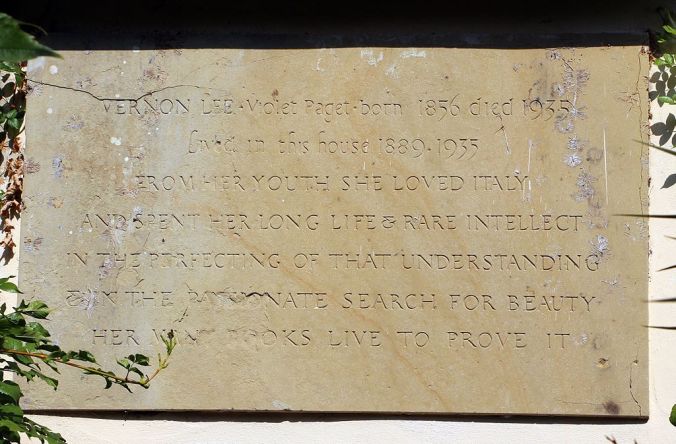
A commemorative plaque was installed on Il Palmerino, which reads:
VIOLET PAGET – VERNON LEE 1856-1935 LIVED IN THIS HOUSE SINCE 1889. FROM HER YOUTH SHE LOVED ITALY WITH HER PASSIONATE SEARCH FOR BEAUTY, HER MANY BOOKS REMAIN TO PROVE IT.
An engaged feminist, she always dressed à la garçonne. She was gay and had long-term relationships with three women, Mary Robinson, Clementina Anstruther-Thomson, and British author Amy Levy.
Lee played the harpsichord and her appreciation of music animates her first major work, Studies of the Eighteenth Century in Italy (1880). In her preface to the 2nd edition (1907), she recalled her excitement as a girl when she came across a bundle of 18th-century music. She was so nervous that it wouldn’t live up to her expectations that she escaped to the garden and listened rapturously through an open window as her mother worked out the music on the piano. Along with Pater and John Adding Symonds, she was considered an authority on the Italian Renaissance, and wrote two works that dealt with it explicitly, Euphorion (1884) and Renaissance Fancies and Studies (1895).
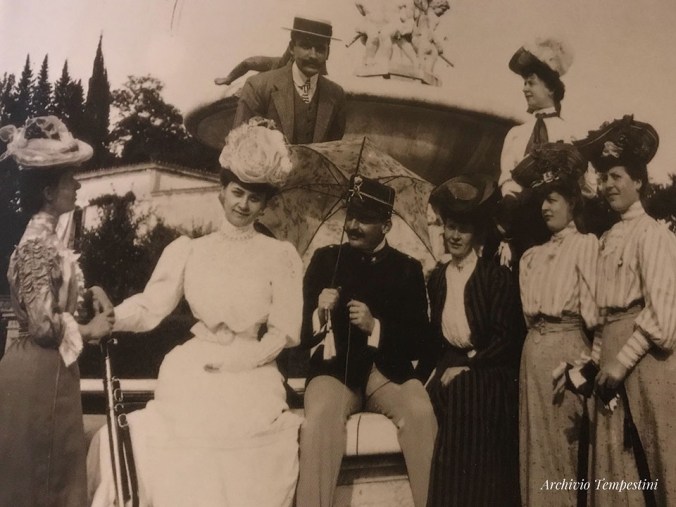
Violet Paget, Violet Keppel Trefusis e le altre Scrittrici, giornaliste, femministe, protagoniste della società del loro tempo
She was known for her numerous essays about travel in Italy, France, Germany, and Switzerland, which attempted to capture the psychological effects of places rather than to convey any particular piece of information. Like her friend Henry James, she wrote critically about the relationship between writers and their audience, pioneering the idea of critical assessment among all the arts as relating to an audience’s personal response.
She was a proponent of the Aesthetic movement, and after a lengthy written correspondence, met the movement’s effective leader, Walter Pater, in England in 1881, just after encountering one of Pater’s most famous disciples, Oscar Wilde.
Lee’s open resistance against World War I and her work Satan the Waster led to her being ostracized by the younger generation of scholars and writers. Feminist research led to a rediscovery since the 1990s.
Sources: After Lee’s death in 1935, over 400 books from her library at the Villa ‘Il Palmerino were presented to The British Institute of Florence by her friend and executrix, Irene Cooper Willis.
See also:
Festa della Repubblica (Festival of the Republic) is a national holiday celebrated in Italy on June 2 each year. It celebrates the day when Italians voted to abolish the monarchy in 1946 so their country could become a republic.

The day commemorates the institutional referendum in 1946, in which the Italian people were called to the polls to decide on the form of government, following WWII and the fall of Fascism. With 12,717,923 votes for a republic and 10,719,284 for the monarchy, the male descendants of the House of Savoy were sent into exile and Italy became a republic.
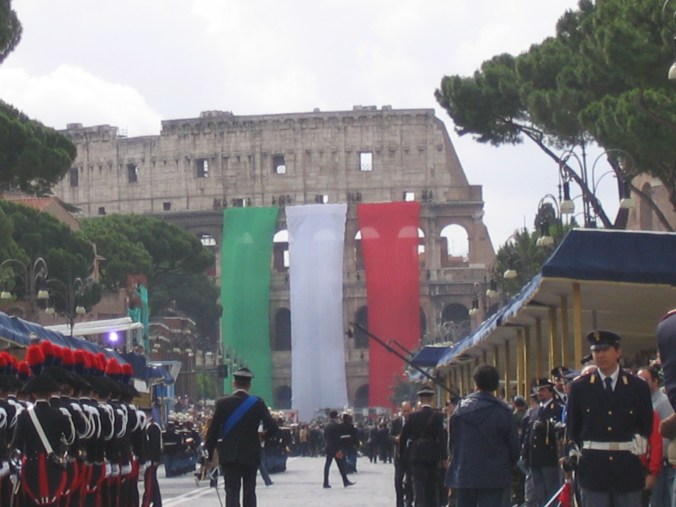
Each year, a wreath is laid at the Tomb of the Unknown Soldier on Republic Day. The tomb has an eternal flame that was added on November 4, 1921, even thought the tomb, which was designed by sculptor Alberto Sparapani, was not completed until 1924.
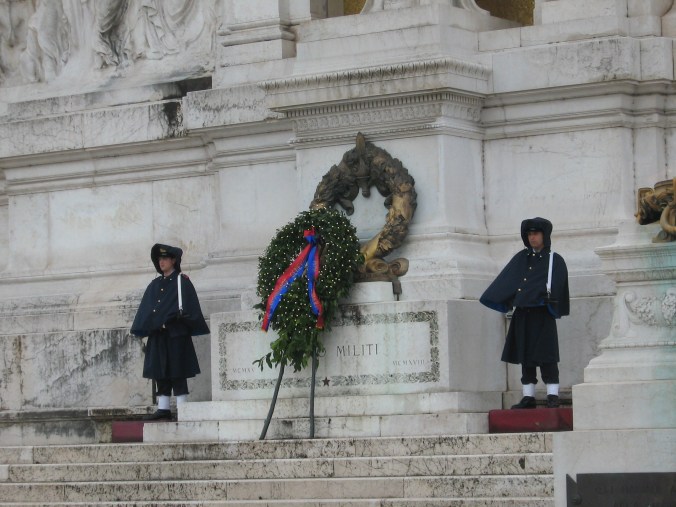
To recognize this holiday, official ceremonies are held, as well as military parades, and the laying of a wreath at the Tomb of the Unknown Soldier, inside the Altare della Patria in Rome.

The Altare della Patria (Altar of the Fatherland), also known as the Monumento Nazionale a Vittorio Emanuele II (National Monument to Victor Emmanuel II) or Il Vittoriano, is a monument built in honor of Victor Emmanuel, the first king of a unified Italy, located in Rome. The monument occupies a site between Piazza Venezia and the Capitoline Hill.
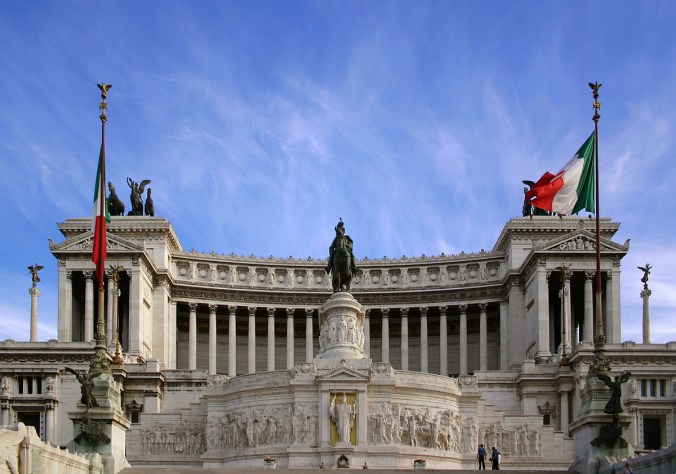
Republic Day is a federal holiday in Italy and organizations and businesses that close include government offices, post offices, banks, schools and other educational institutions.
On a recent beautiful weekend, I had the chance to visit Villa Salviati, a gorgeous locale in the hills outside of Florence. Singers from a Florentine operatic school performed in the main building’s cortile. It was so beautiful and here’s a sample.

Villa Salviati is home to the Historical Archives of the European Union, a unique resource for researchers at the EUI and far beyond.
By housing the European Union archives, the long international tradition of this villa is continued. Over the centuries this villa had Italian, French, Swedish and American owners.
The estate has naturally strong ties to Florence as well, as the original owners, the Salviati family, wealthy wool merchants and bankers, were in the 15th century closely connected to the Medici that held great power and influence in the city.
The Salviati family’s fortune grew and they went on to add grottos to the site which still stand today. The grottos are made up of frescoes and elaborate stonework that hark back to an era of affluence.
https://www.eui.eu/ServicesAndAdmin/LogisticsService/EUICampus/VillaSalviati
It is hard now to imagine a world in which reproductions of paintings were scarce ([Charles Eliot] Norton taught his art history classes [at Harvard] without them) and in which cities rarely had public collections of paintings (those that did exist contained almost no original Italian works).
Americans, for the vast majority of whom travel to Europe was prohibitively time-consuming and expensive, got their first introductions to Italian art by reading.
Berenson would aspire to follow Charles Eliot Norton in being, not only a lover of art and a bibliophile, but a friend of writers and a literary man.
Norton was close to John Ruskin, one of the English writers most responsible for the new view of Italian art that emerged among certain writers in the mid-nineteenth century.
Rachel,Cohen. Bernard Berenson (Jewish Lives) (p. 42). Yale University Press. Kindle Edition.
 get back, lauretta!
You must be logged in to post a comment.