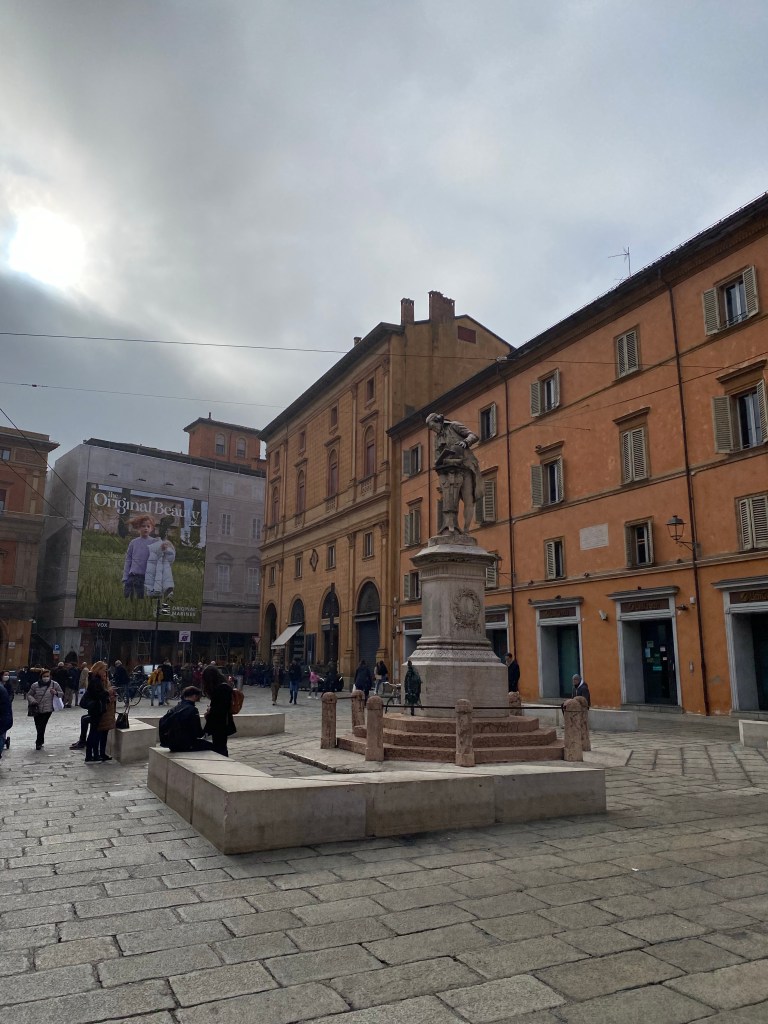
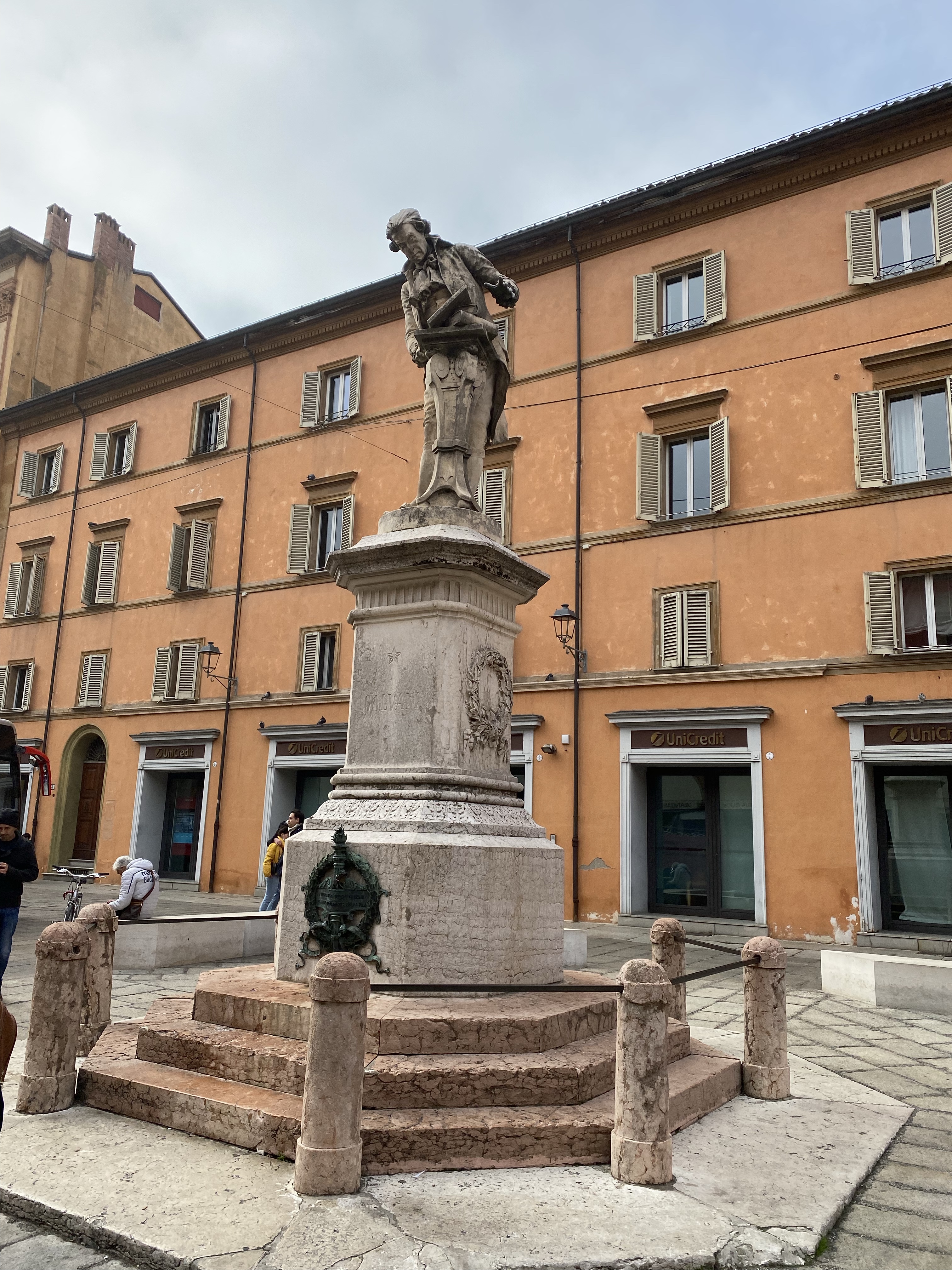
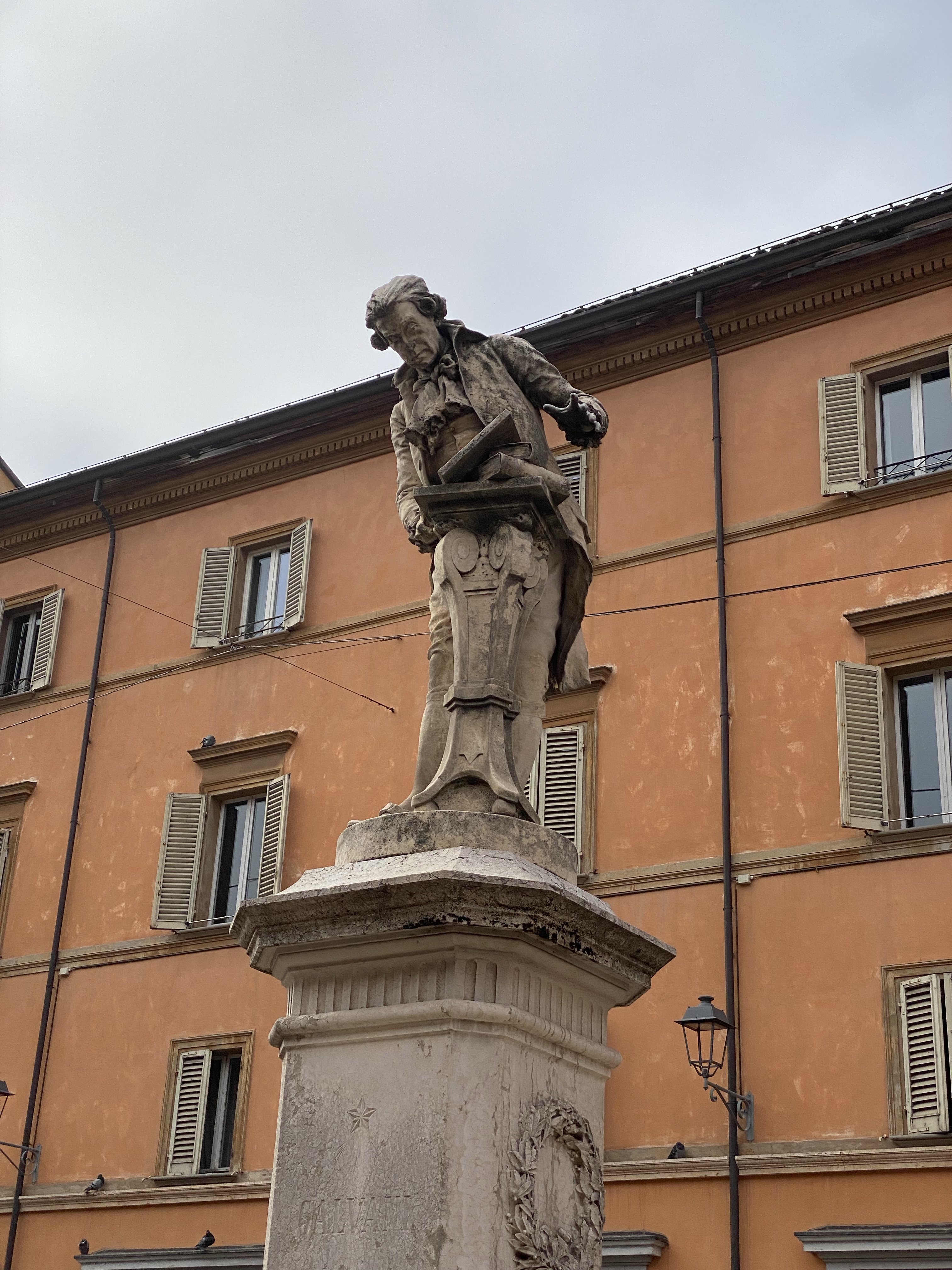
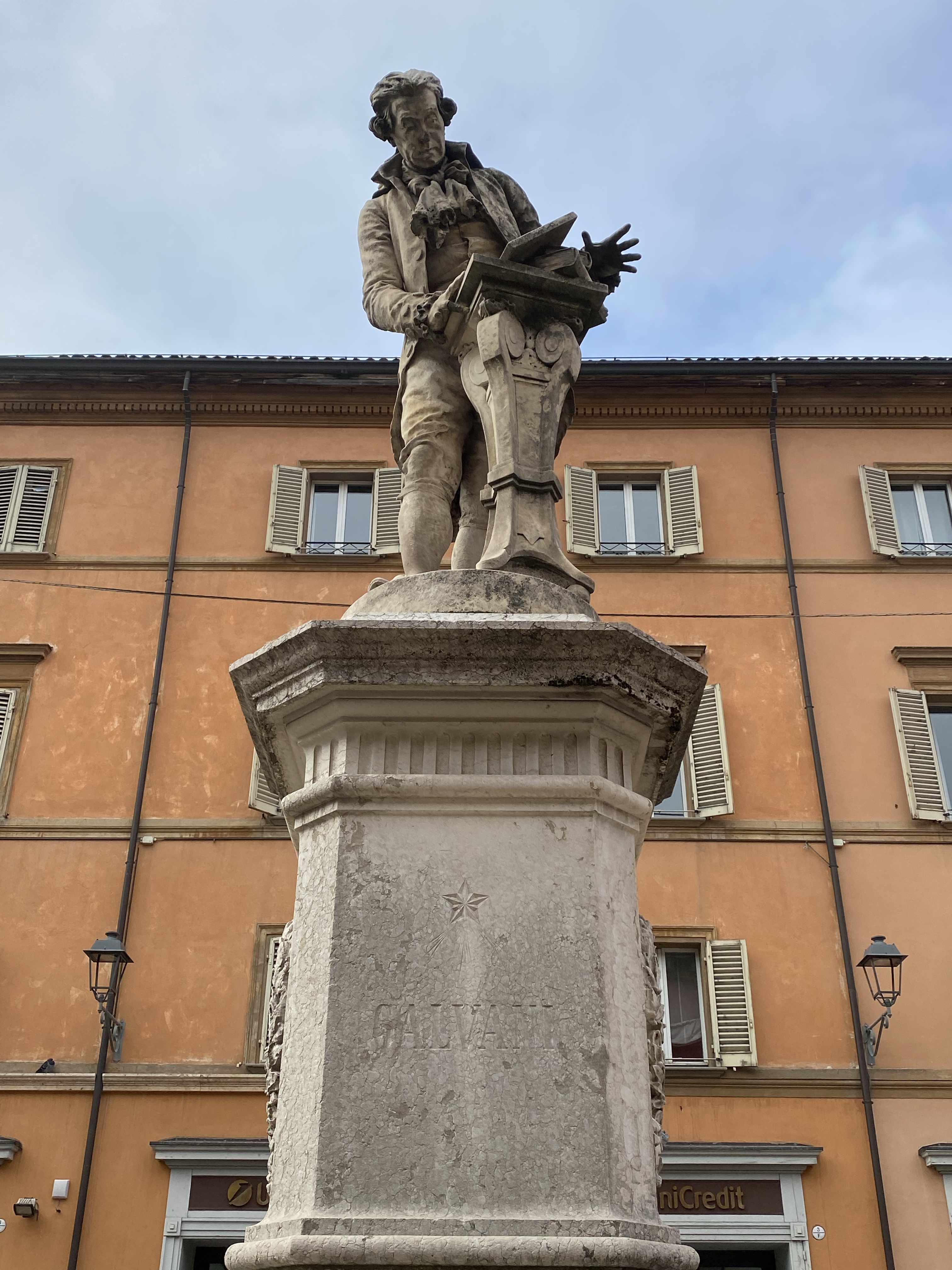
Monumento a Luigi Galvani in Piazza Galvani. Marble statue of a man, holding a tablet which frog legs and an electrical device, showing his discovery that the muscles of dead frogs’ legs twitched when struck by an electrical spark.
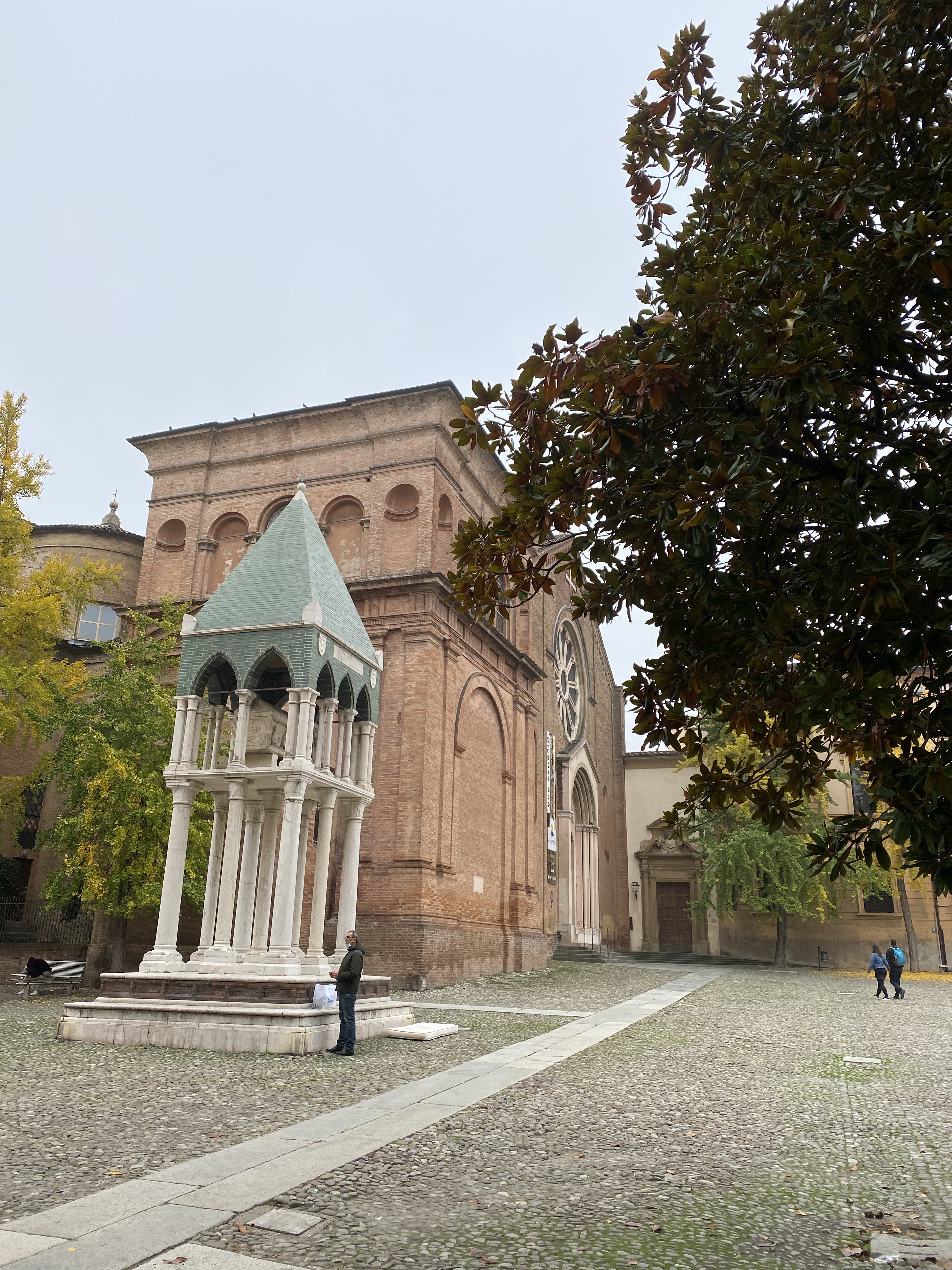
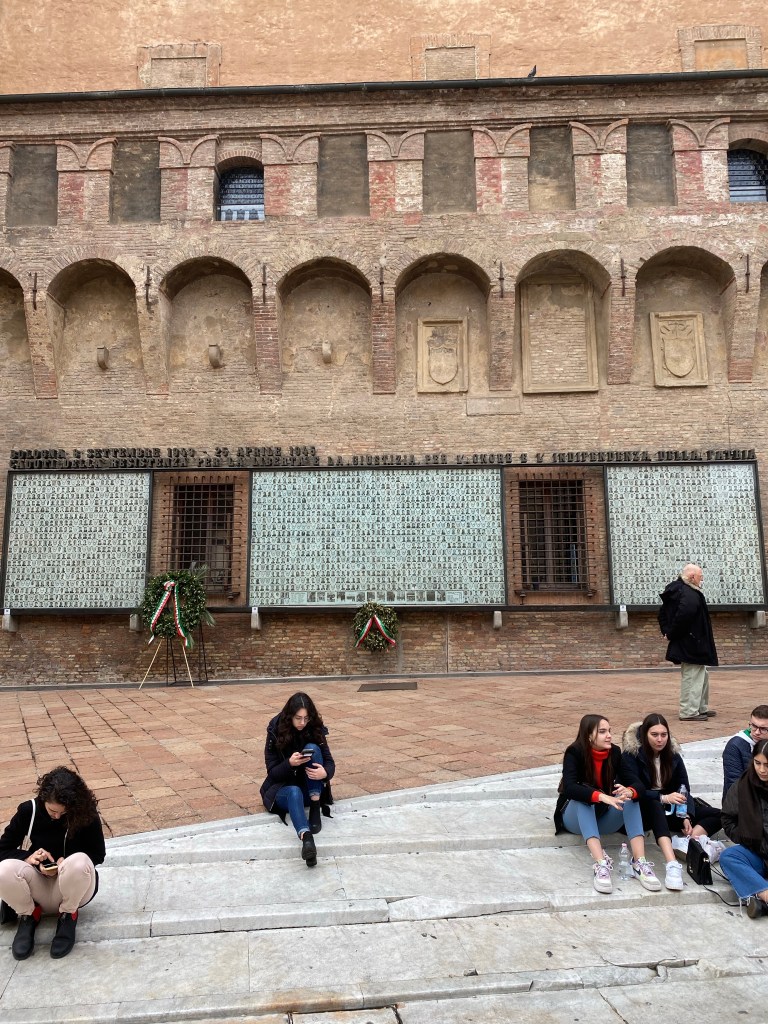
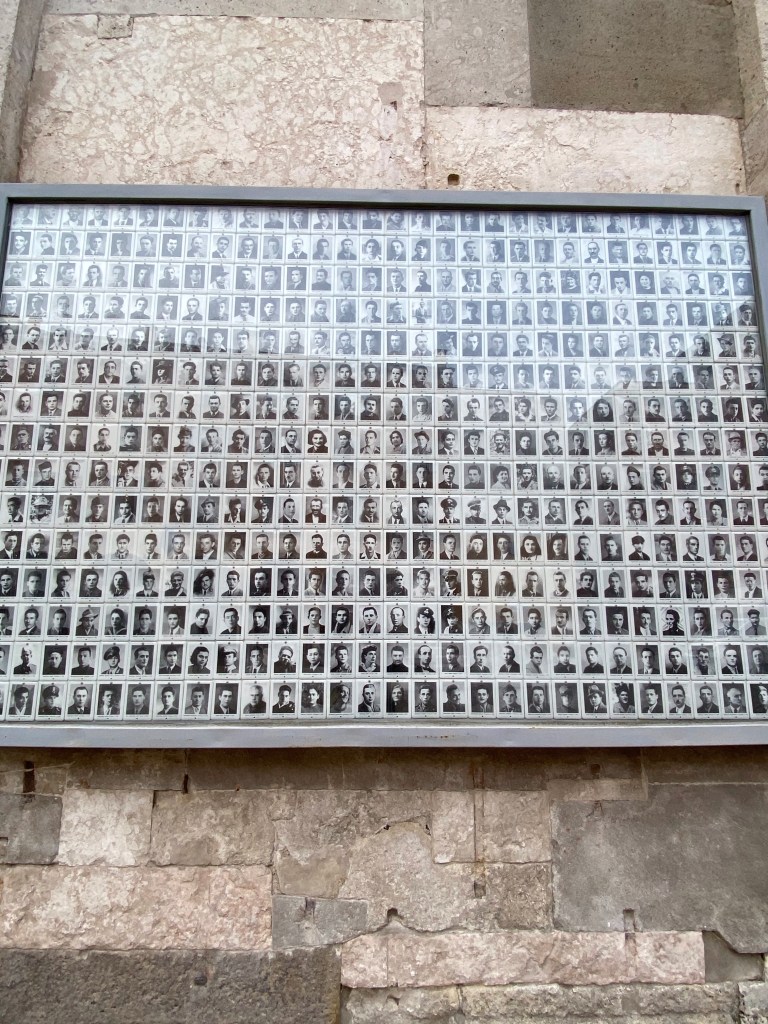
Above and below: Monument to the Fallen Partisans.
Somewhere near the main piazza of any Italian town, no matter now small, will be il monumento ai caduti (literally, “the monument to the falllen”). These pay tribute to those townspeople who died in World Wars I and II.
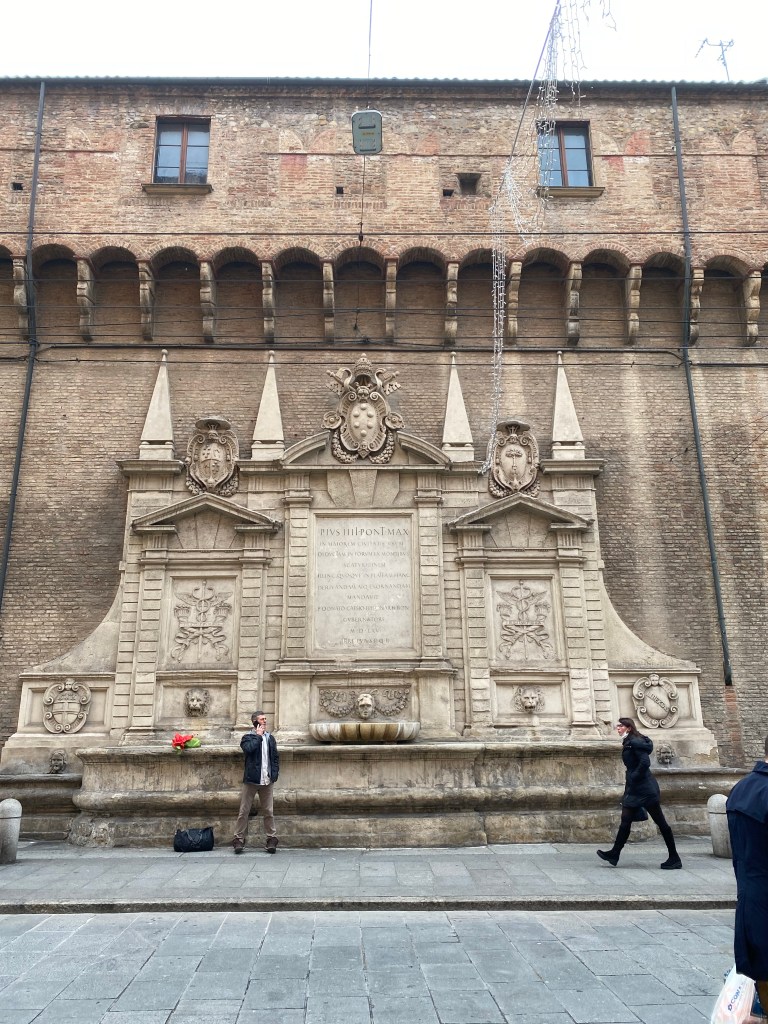
Above: La Fontana Vecchia (The Old Fountain) is built into the side of one of the walls of the Palazzo d’Accursio on Via Ugo Bassi. This is no simple fountain, though. In fact, it’s incredibly grand and impressive in its own rights, even though it was built originally more for the lower/working classes so that they wouldn’t befoul the water in the nearby Neptune Fountain while doing their washing.
Cardinal Carlo Borromeo commissioned La Fontana Vecchia in 1563, with Tommaso Palermo Laureti chosen to create the fountain. A Sicilian painter, architect, and sculptor, Laureti worked and studied extensively in Bologna. However, having spent some time in Rome, the influence of Michelangelo worked its way into his artwork. As well as designing the Fontana Vecchia, Laureti’s drawings served as the foundation for the base and its figures of the Neptune Fountain, though the rest of the fountain was created by Giambologna.
Plaques and bas-relief sculptures cover the fountain, including family coats of arms and the Papal crown and keys in the center in honor of Pope Pius IV. A member of the Medici, his coat of arms is displayed beneath the crown and keys. There are also other symbols displayed on the fountain, such as the word “Libertas,” which represents the city of Bologna. You’ll see the word in a variety of locations throughout the city.
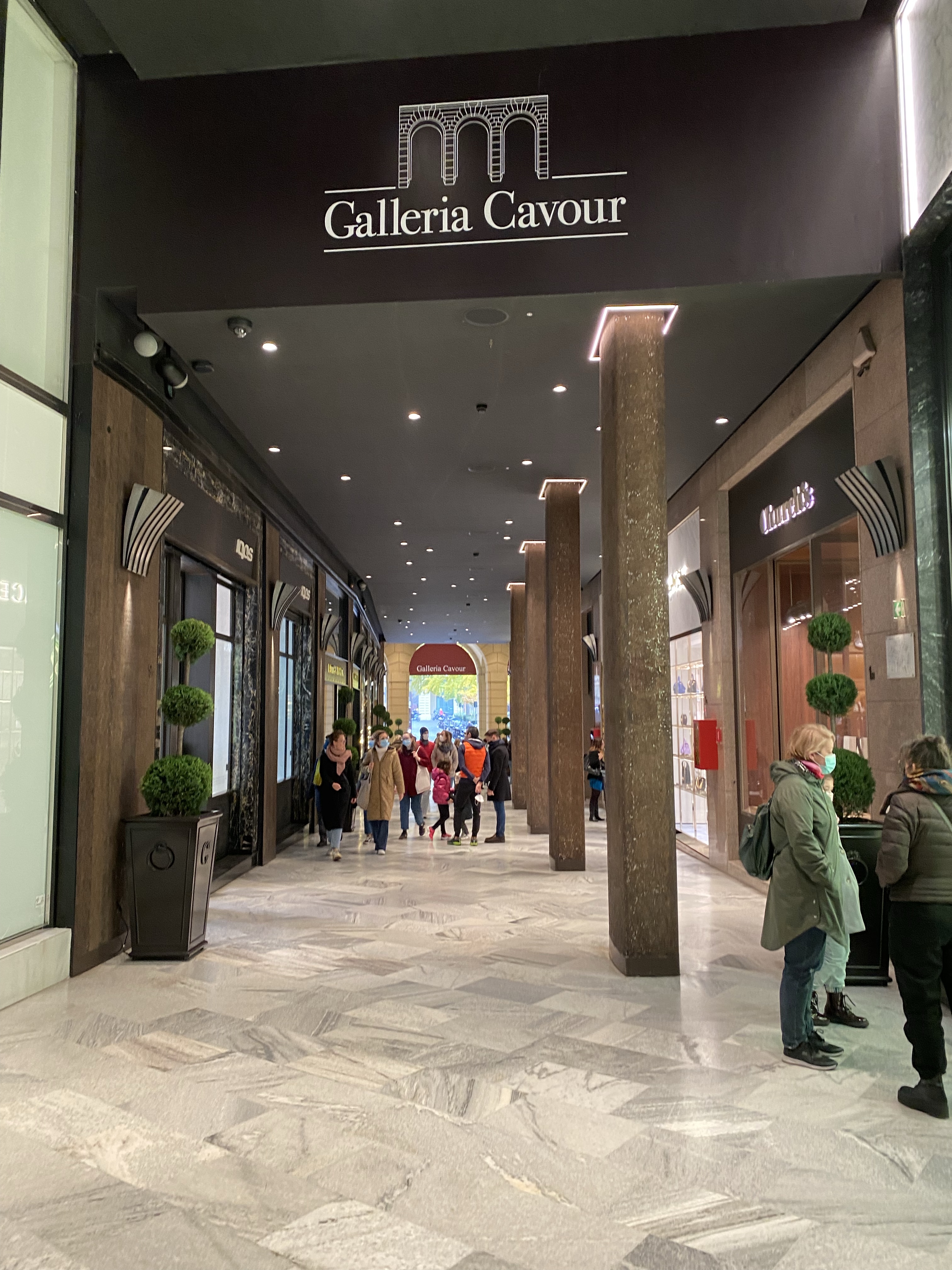
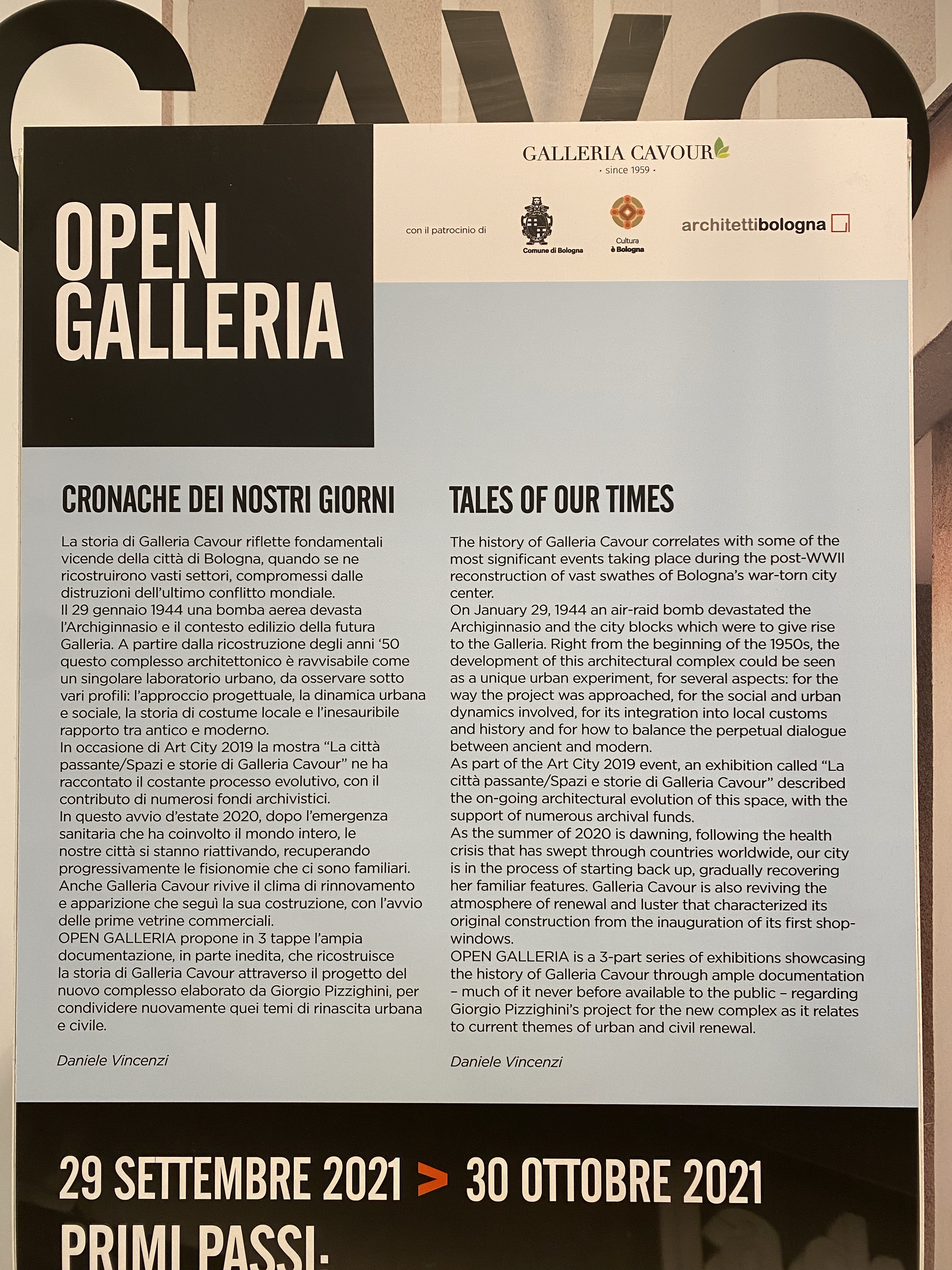
The elegant and upscale Galleria Cavour. Located in the Palazzo VASSÉ which was from 1550 an important patrician residence/ Partially destroyed in WWII, since 1959 this location has been the prestigious venue of the Cavour Gallery. The Cavour Gallery is inside one of the oldest and most important buildings in Bologna. Built in the 1500s, bombed during the war and now restored, it contains important art jewels all to be discovered.
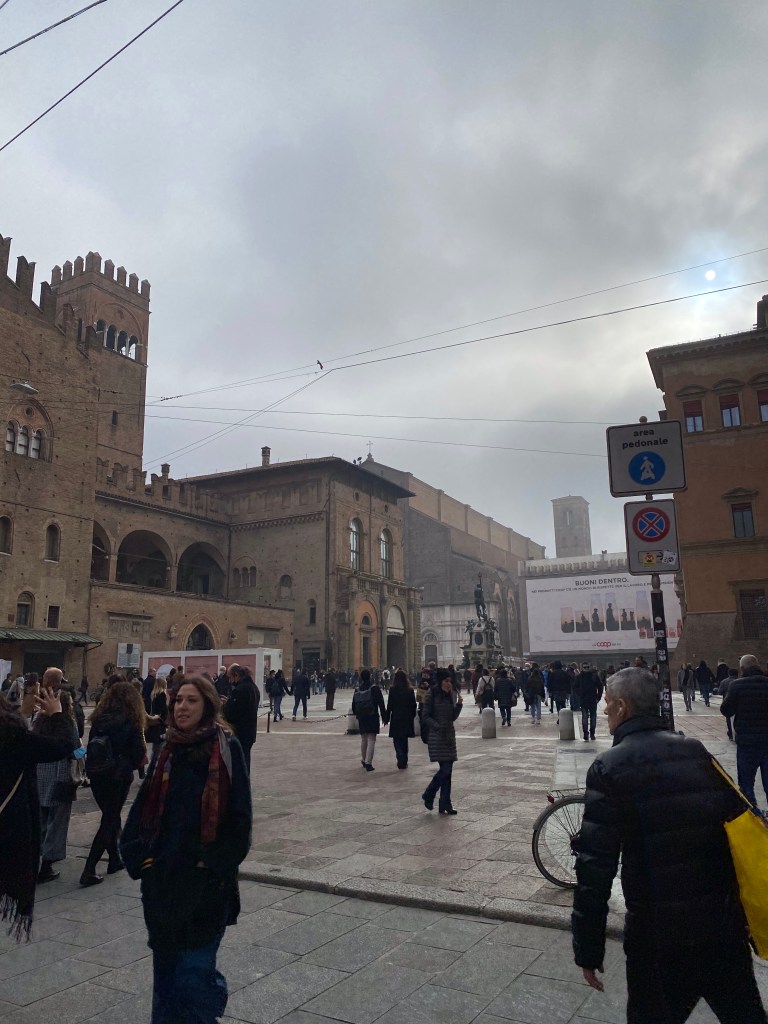
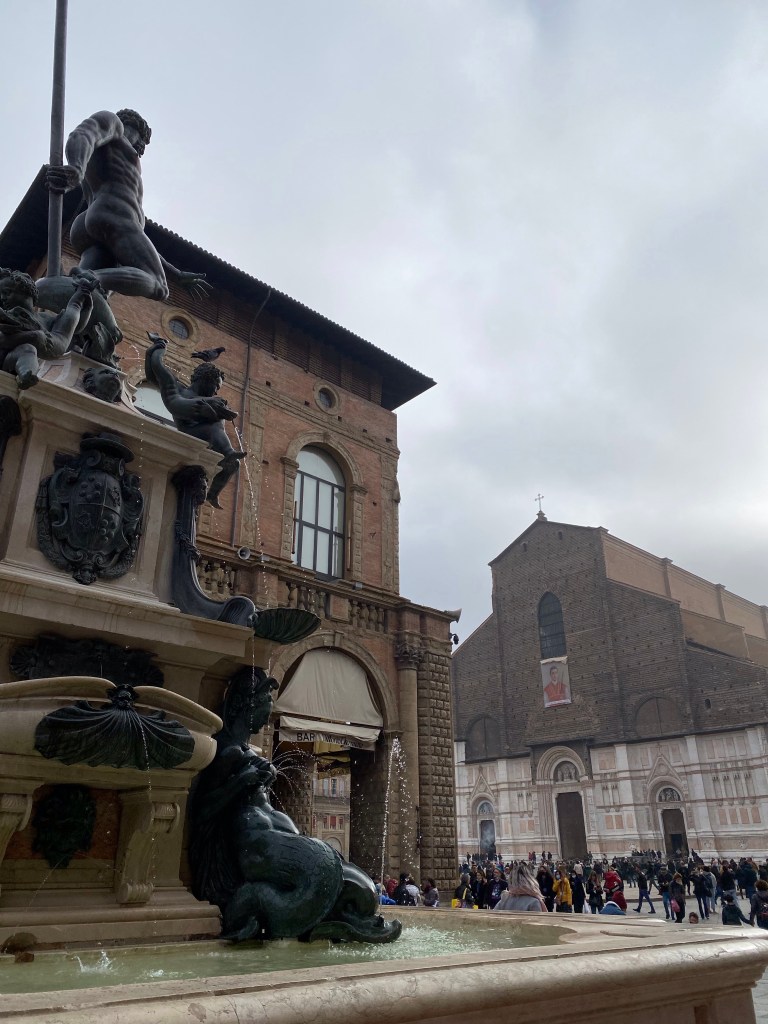
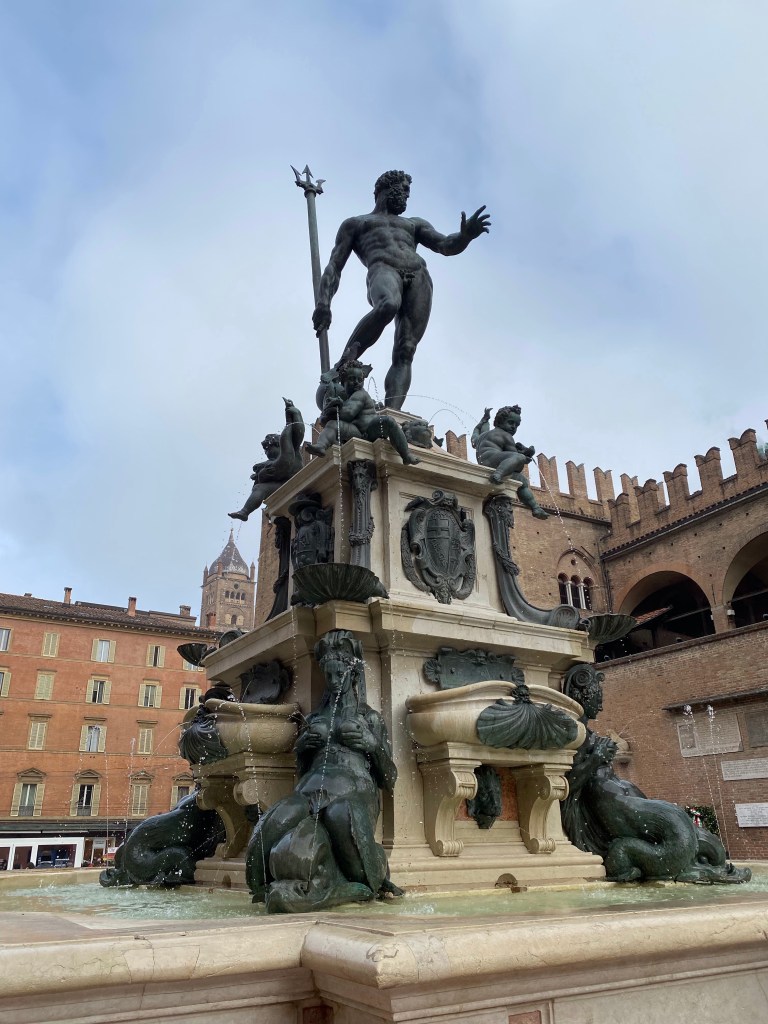
Above, looking through Piazza Nettuno, with Giambologna’s fountain masterpiece, looking further towards Piazza Maggiore with the Basilica of San Petronius.
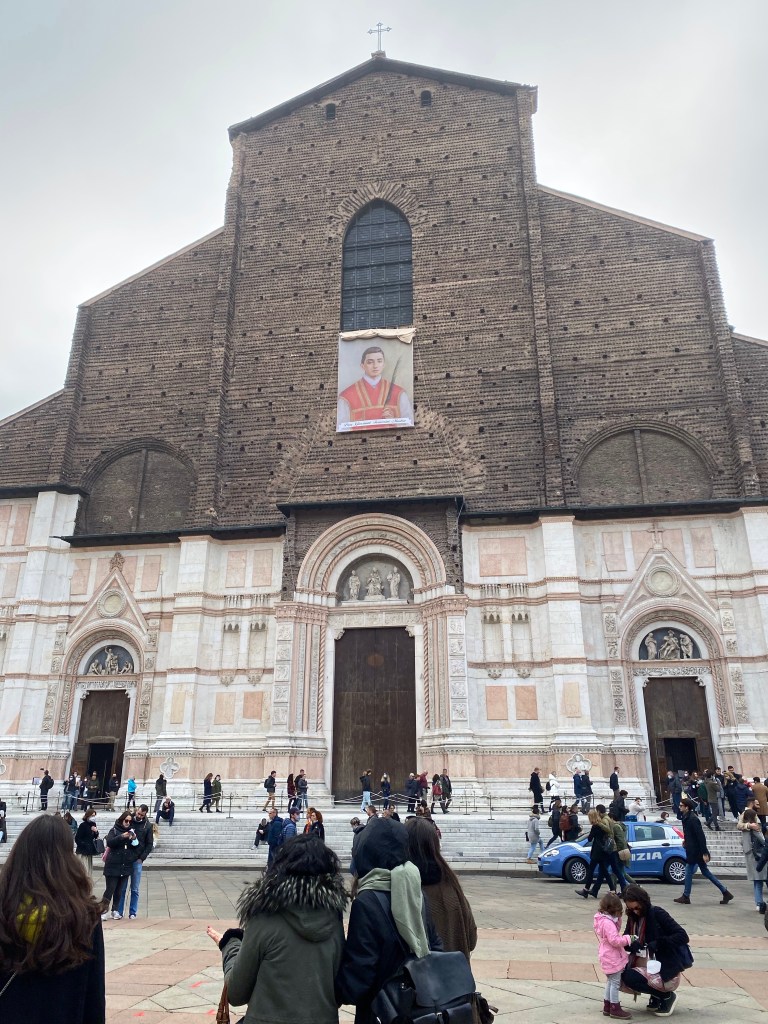
Below, the Basilica. I’ll be discussing this church in a couple of separate posts.
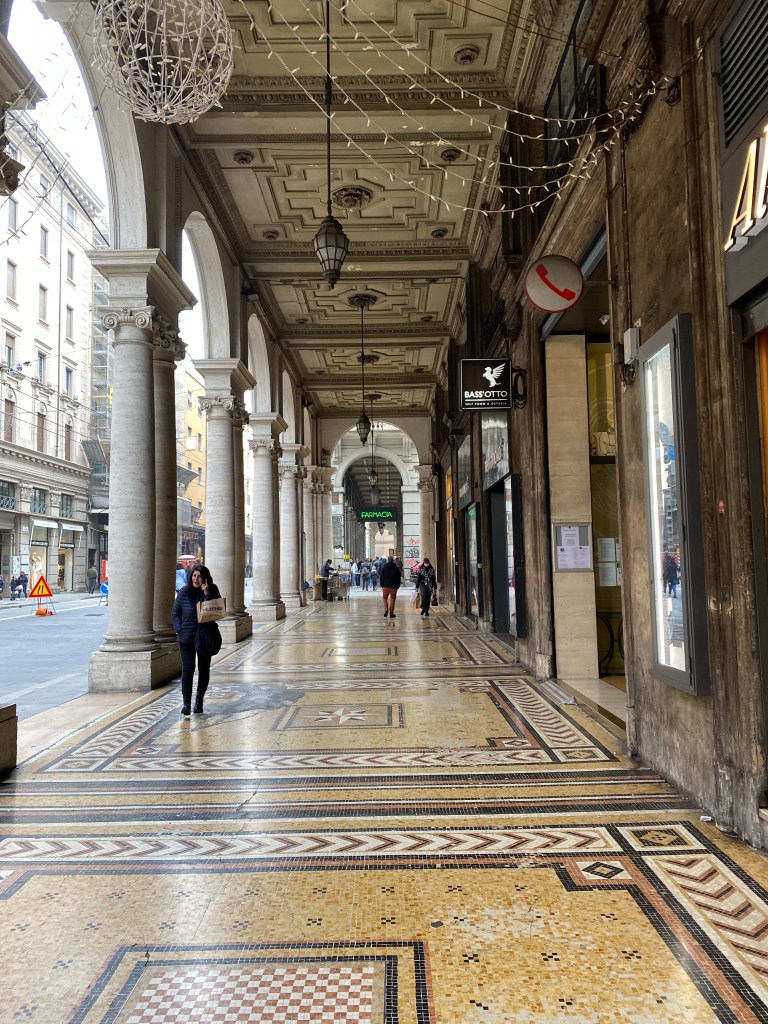
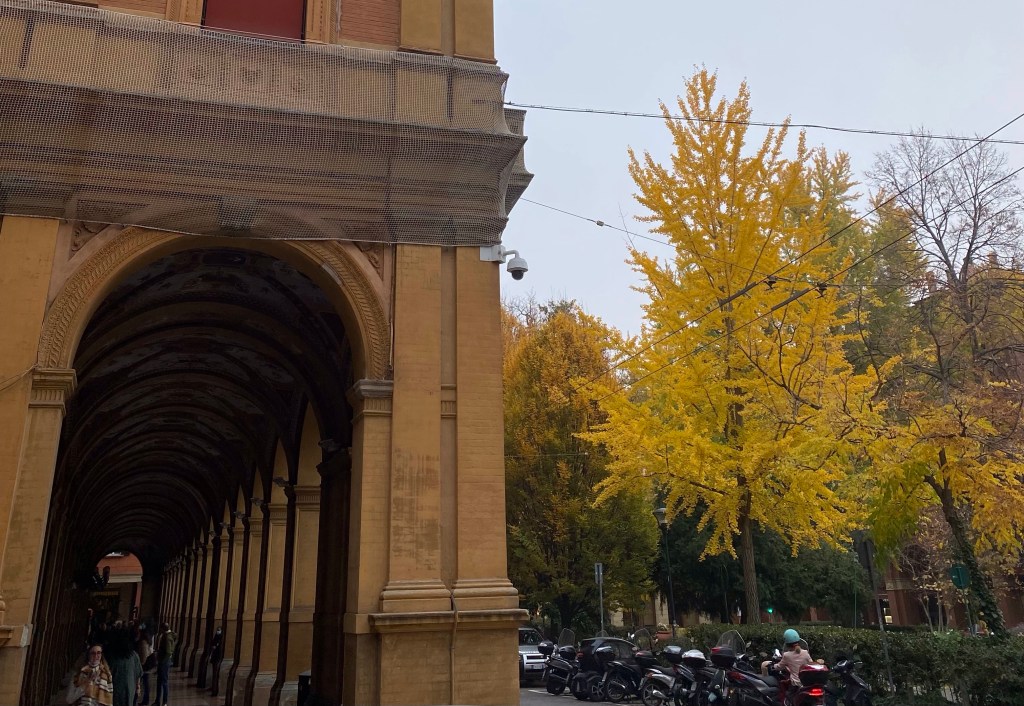
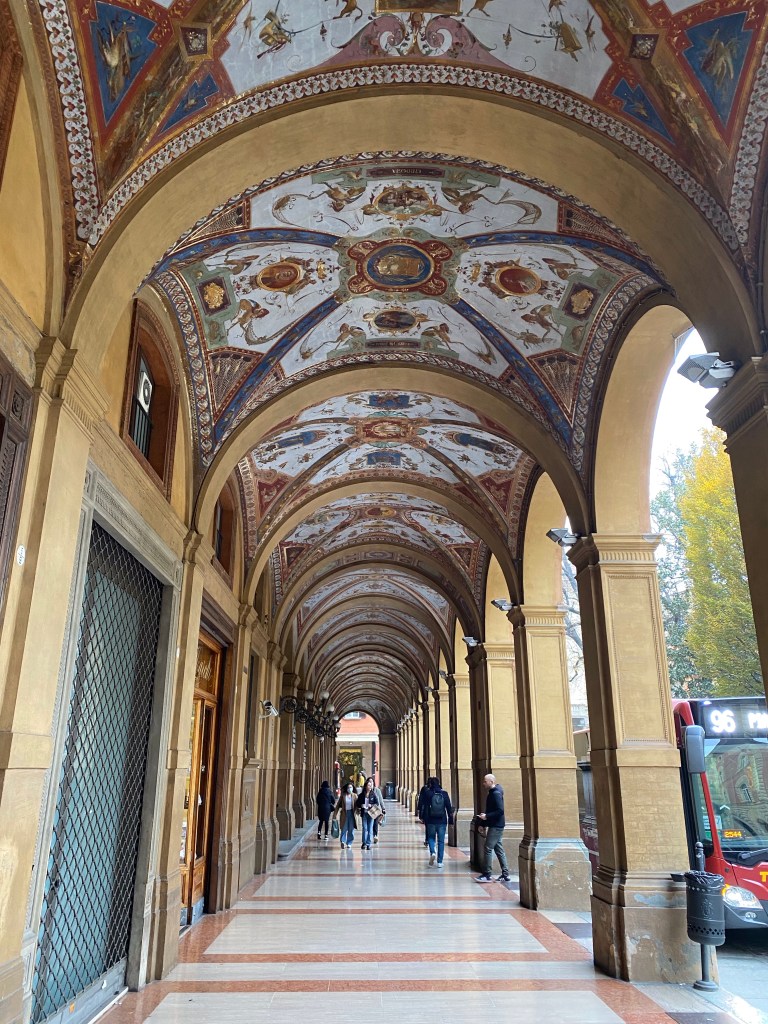
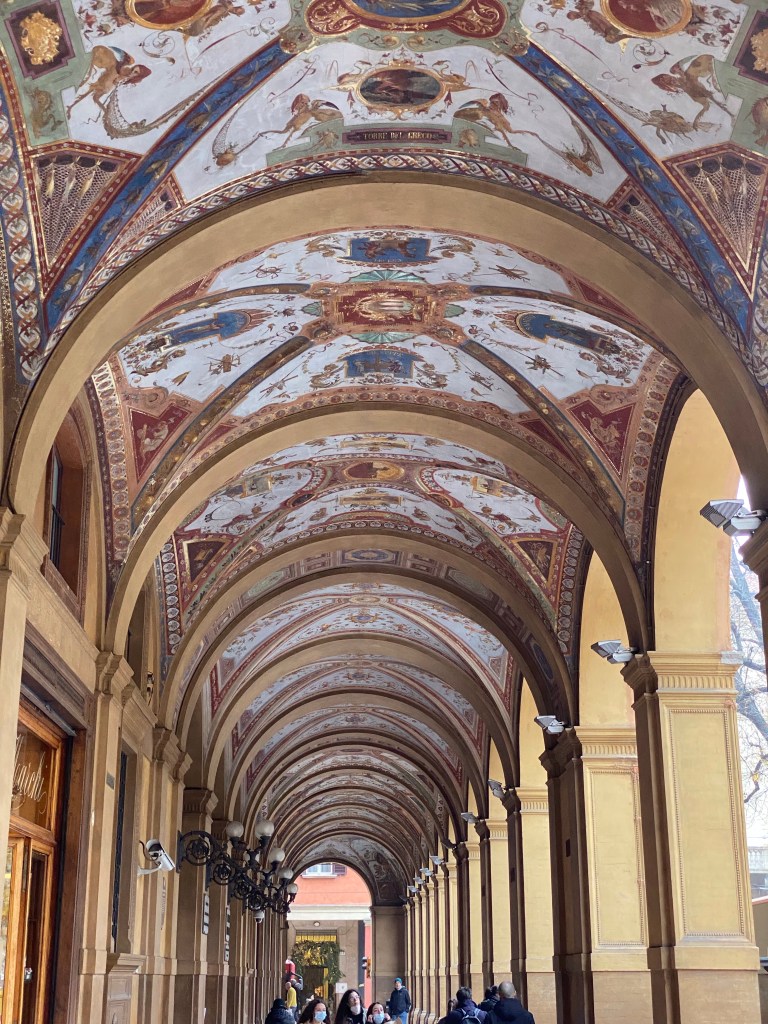
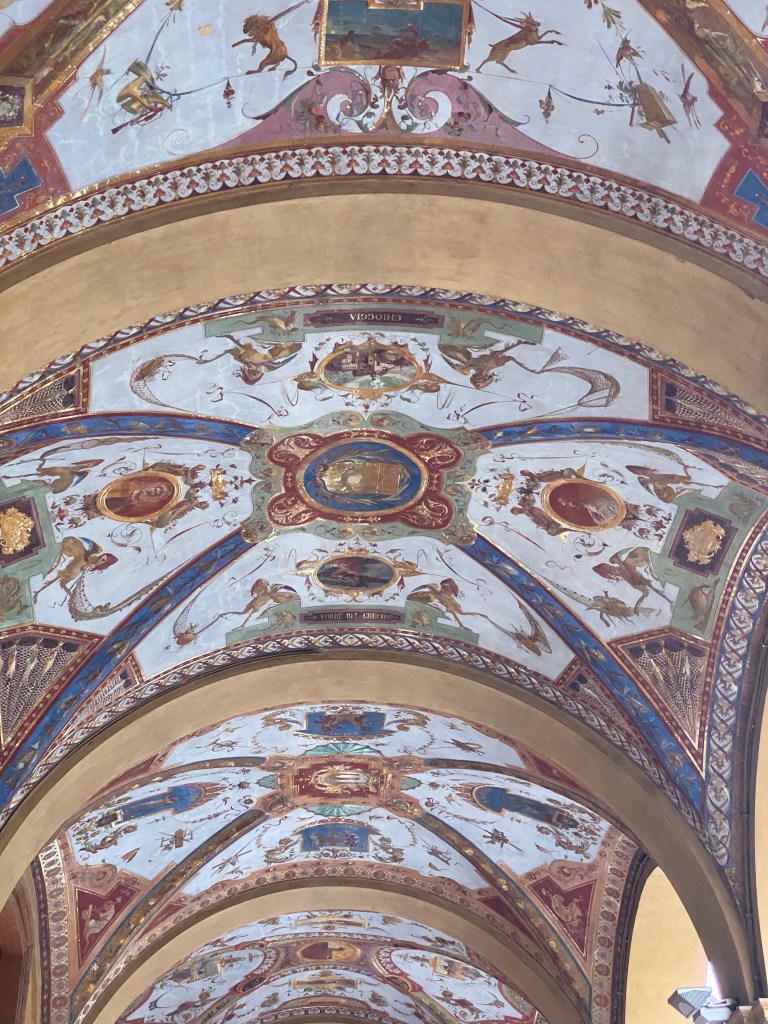
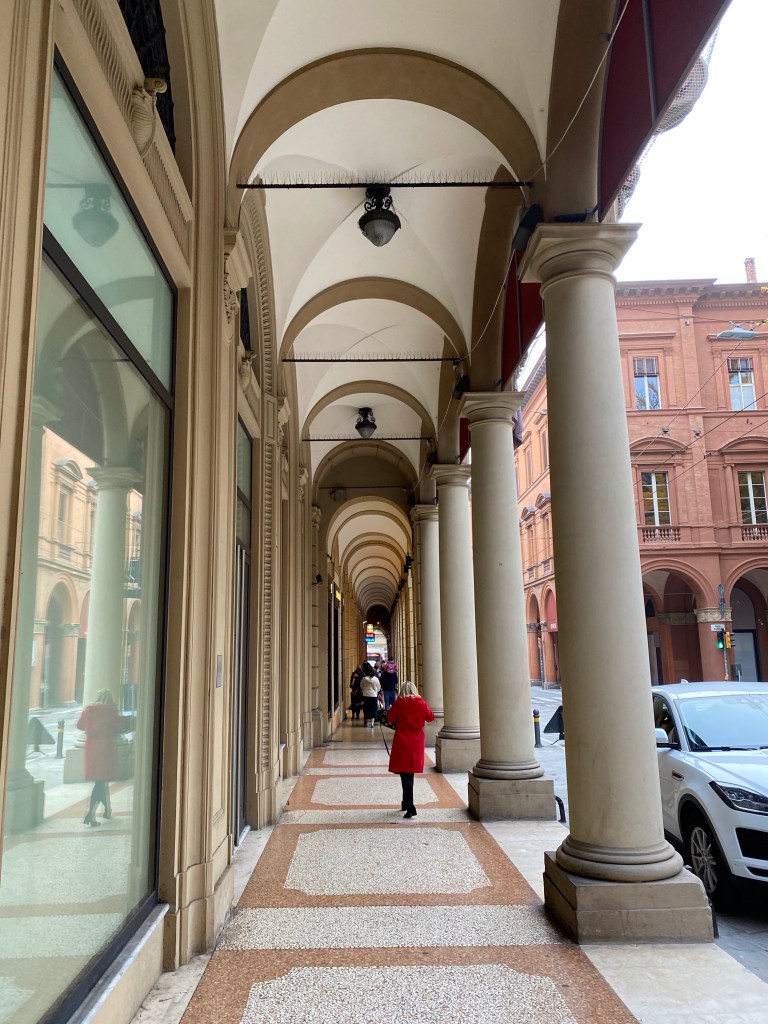
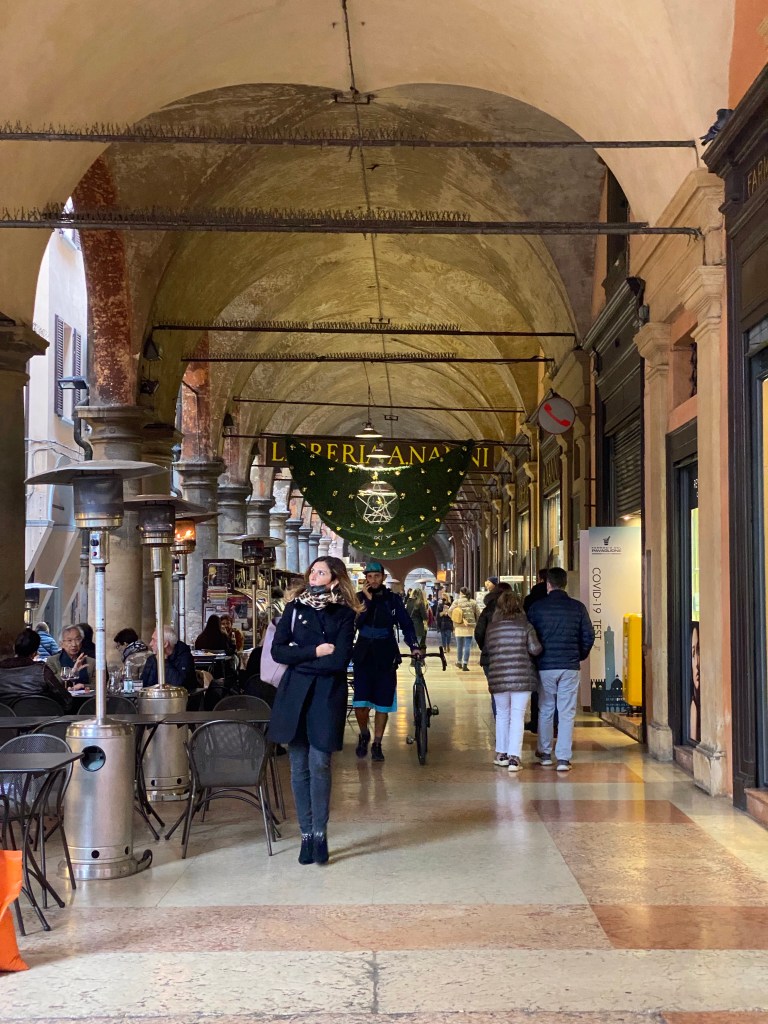
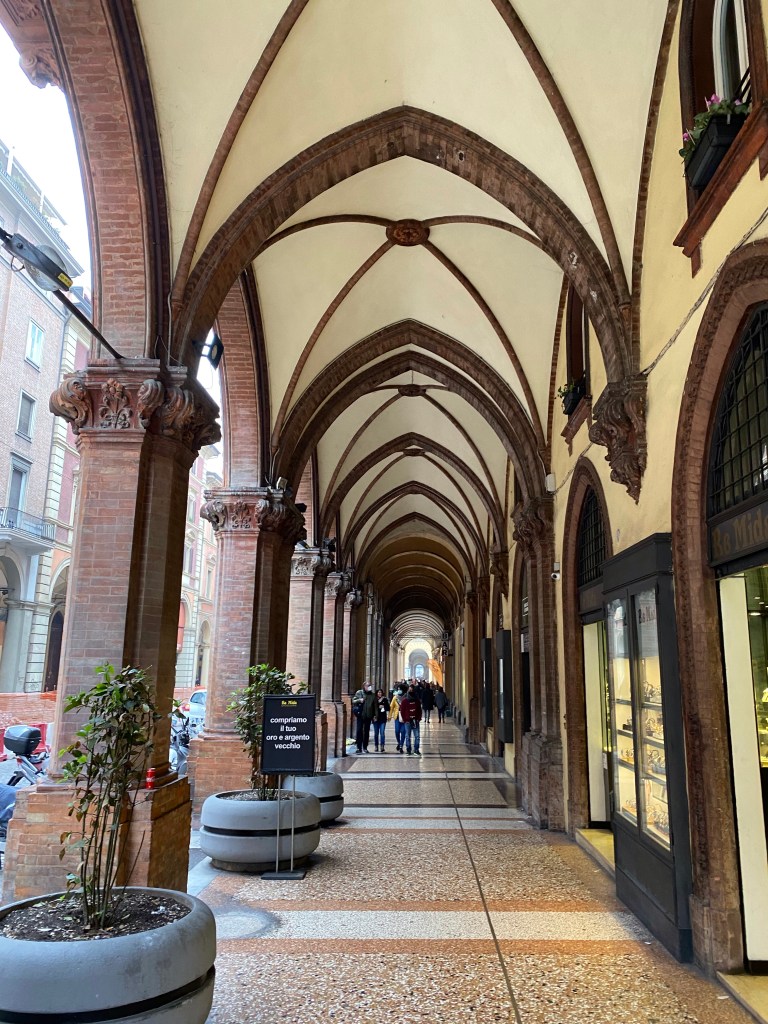
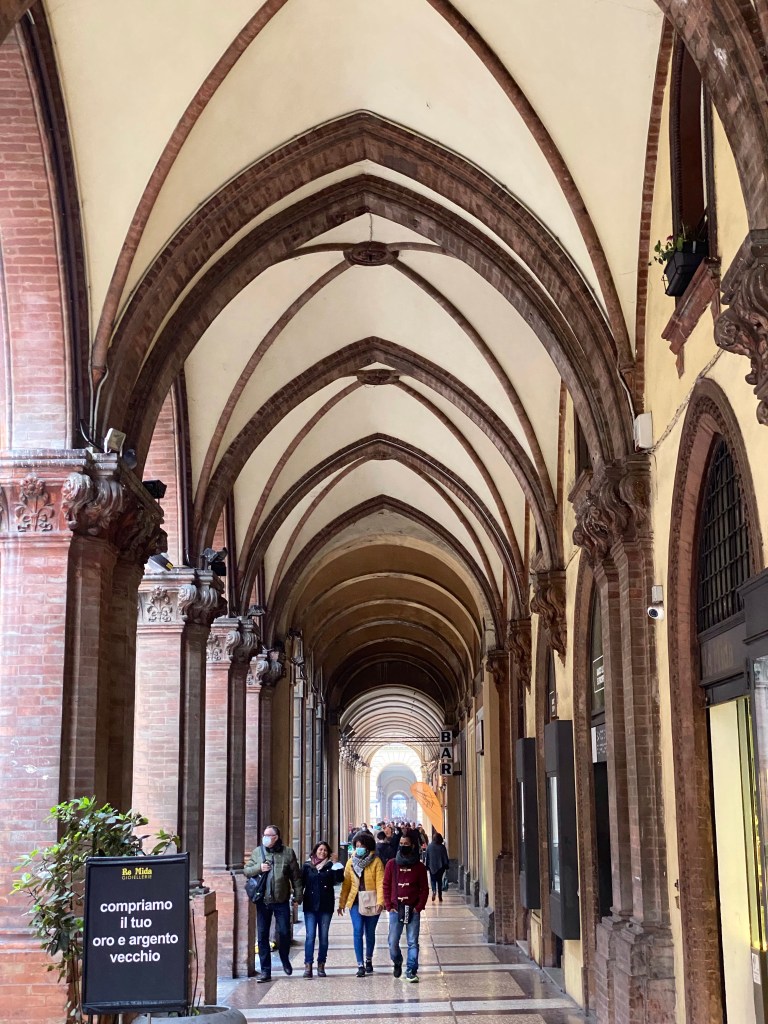
General ambience of the city and the arcades:
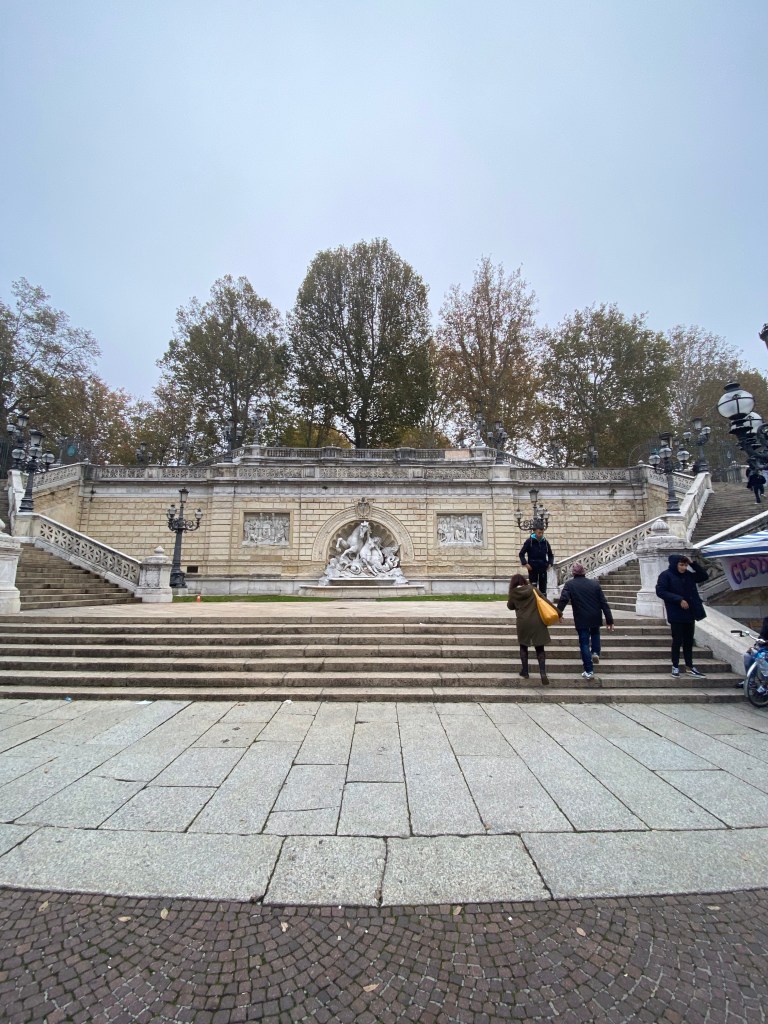
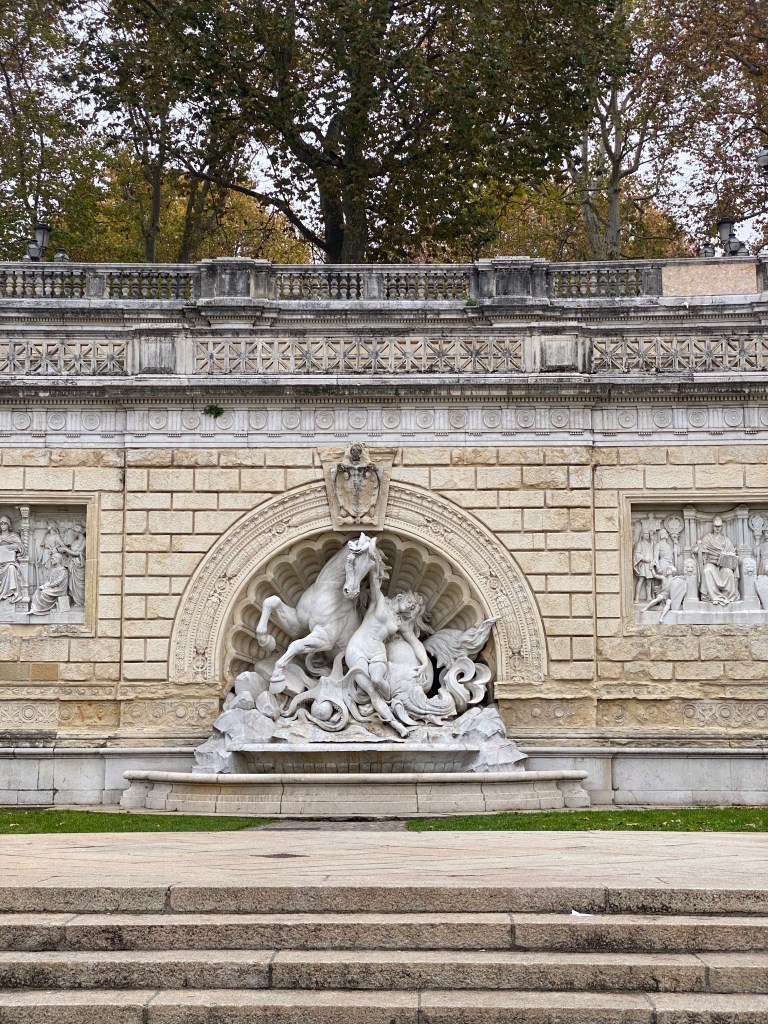
Above and below: The fountain of Pincio in Bologna, Italy, is at the entry of the Park of Montagnola, the oldest park in Bologna, opened to the public since 1664.
The Pincio staircase and the Montagnola garden
Im 1896, King Umberto I and Queen Margherita inaugurated this impressive stairway leading to the Montagnola Gardens. It was designed by Tito Azzolini (1837-1907) and Attilio Muggia (1850-1936).
Begun in 1893 by the mayor Dallolio, the works continued for three years without interruption, employing an average of 100-150 workers per day. The excavated earth served to fill the pits of the walls, between Porta S. Isaia and Porta Lame.
As a whole, the work consists of three parts: the stairs, the portico on via Indipendenza and the portico along the walls. The central body is made up of two overlapping fronts, with a panoramic terrace at the top accessible by side stairs.
The main front is decorated with two bas-reliefs: Bologna docet by Arturo Colombarini and Bologna Libertas by Ettore Sabbioni. In the center, a fountain, made by Diego Sarti (1859-1914) and Pietro Veronesi, based on a design by Muggia and Azzolini, represents a nymph attacked by an octopus. She will be commonly called “the wife of the Giant,” that is of Neptune, and Giosue Carducci will dedicate a famous sonnet to her.
On the second front, which supports the garden, there are three other bas-reliefs, with historical themes linked to the place: The return from the victory of the Fossalta by Pietro Veronesi, The expulsion of the Austrians by Tullo Golfarelli (1852-1928) – with the “saint rogue” , who “rushes against the guns leveled by the invaders of the Fatherland” (Pascoli) – and The destruction of the fortress of Galliera by Arturo Orsoni.
At the end of the passage on via Galliera, the Maccaferri building, home of the café chantant Eden, will be built three years later. The staircase is equipped with 72 cast iron candelabra with six or four lamp posts. The steps are joined to the parapets by marble edges, which will often be used by children as slides (sblisgàn).
The Montagnola garden is transformed in a more aristocratic sense. In the center is the large fountain, complete with five groups of statues with animals and mermaids, already used for the Emilian Exposition of 1888.
In the reconstruction of 1896 the original design by Diego Sarti is partly distorted: the tub is no longer in the shape of an ellipse, but round and the edge is no longer raised and wavy.
The sculptural groups are moved away from the perimeter of the basin and disconnected from each other. The turtles, originally climbing on the edge, are gathered around the central water jet.
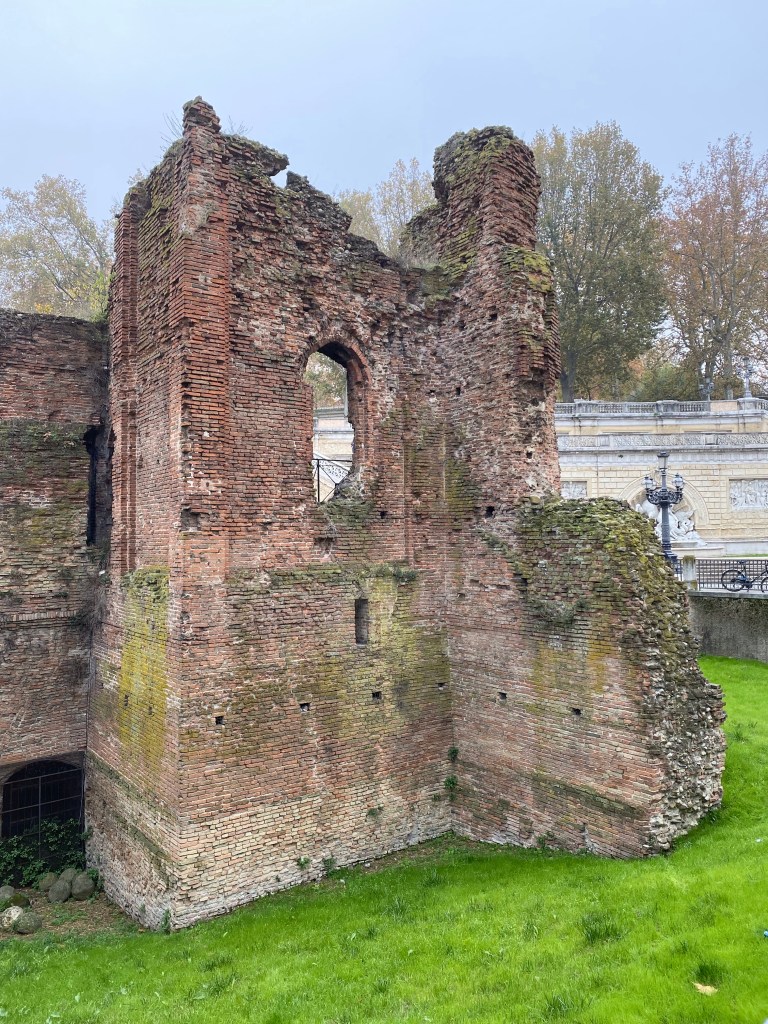
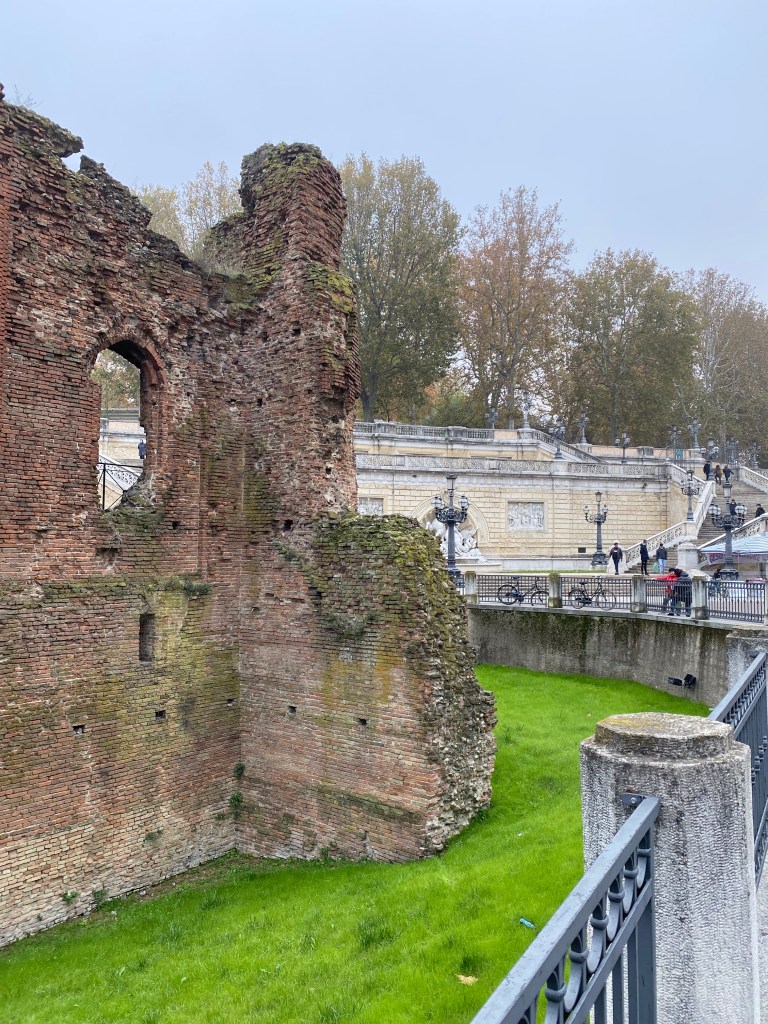
Roman ruins near the Pincio.
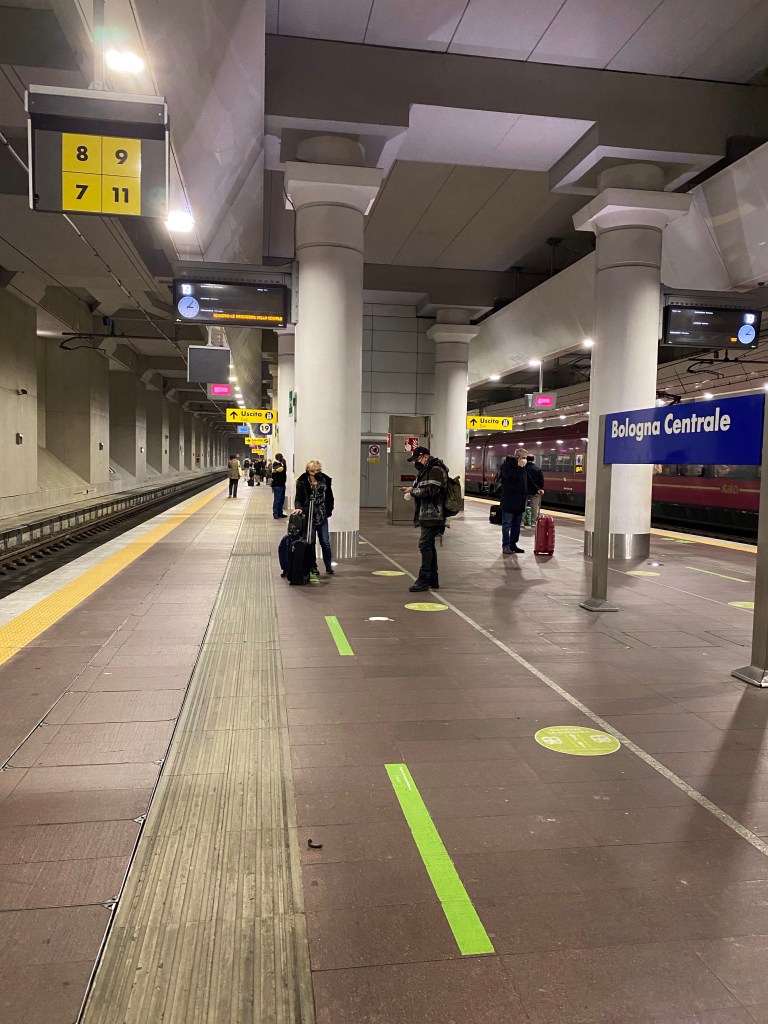
And finally, the Bologna train station. Can someone please explain to me why there are no seats to rest upon in places in Italy where one really needs them??!!
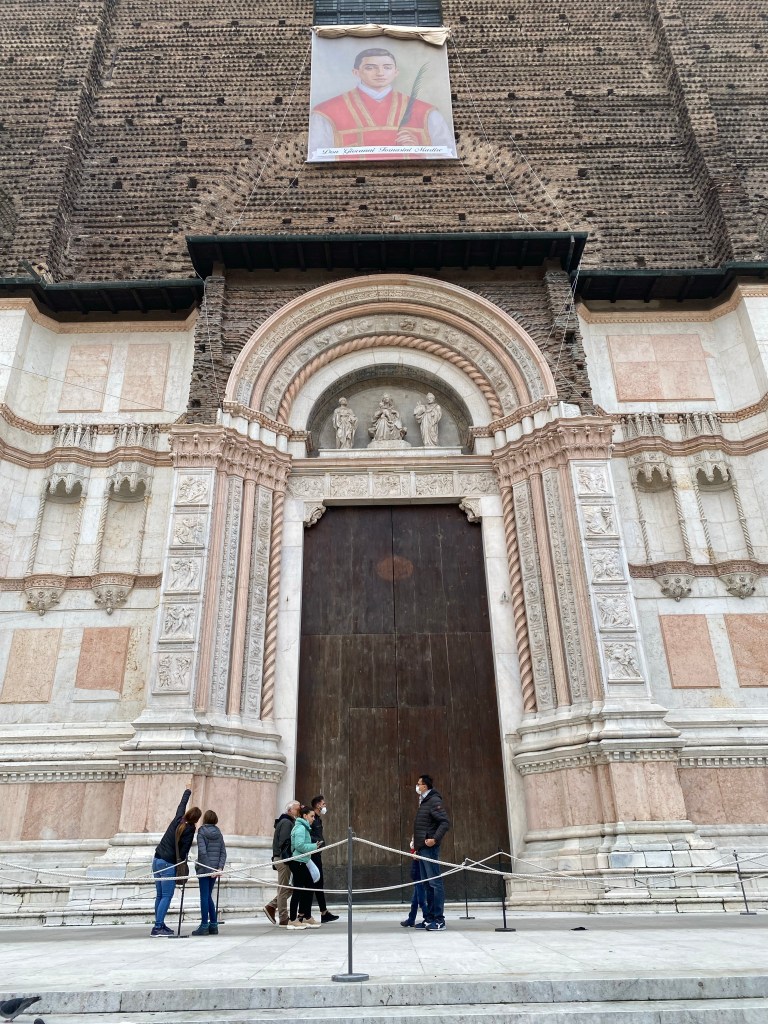
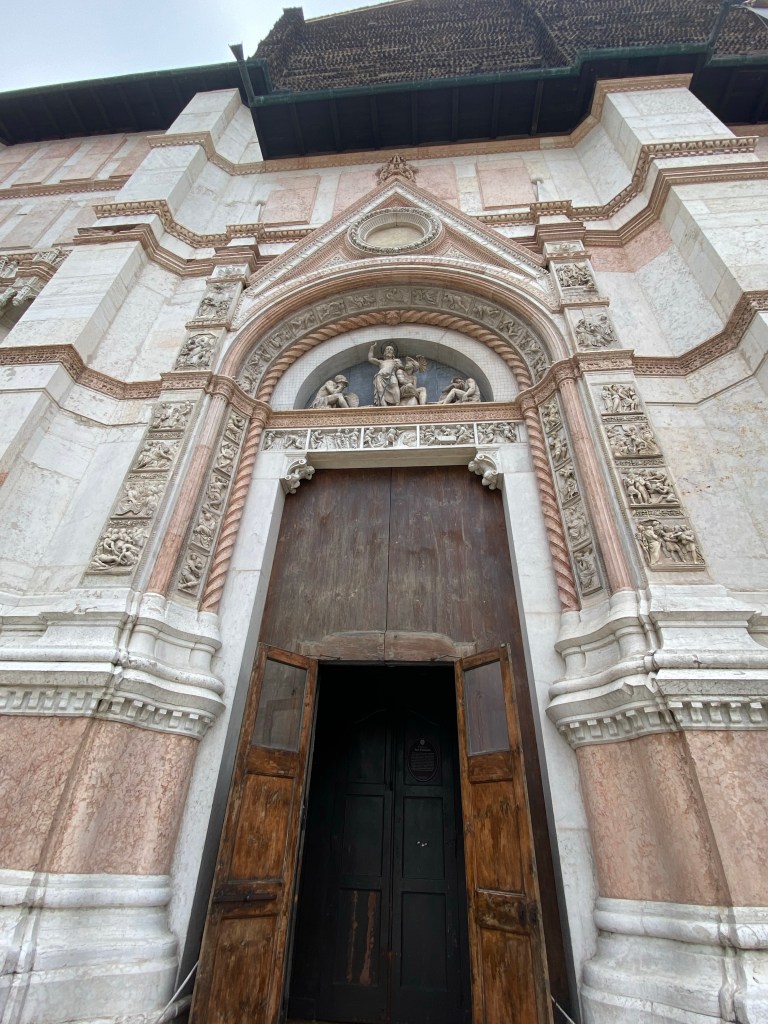
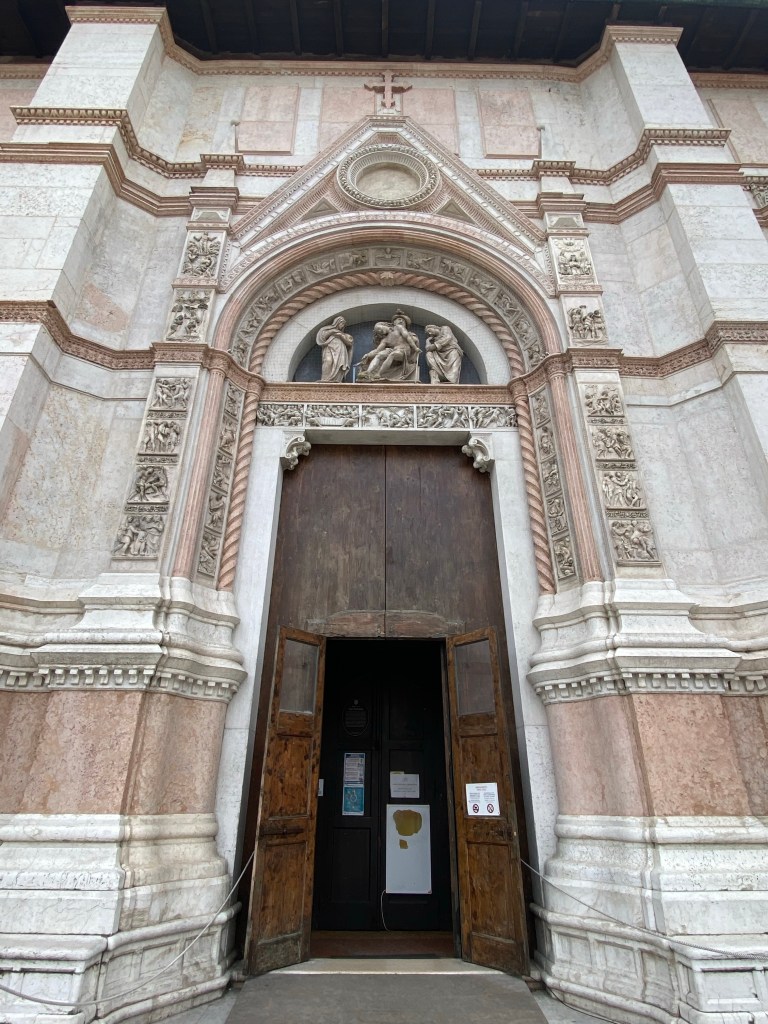
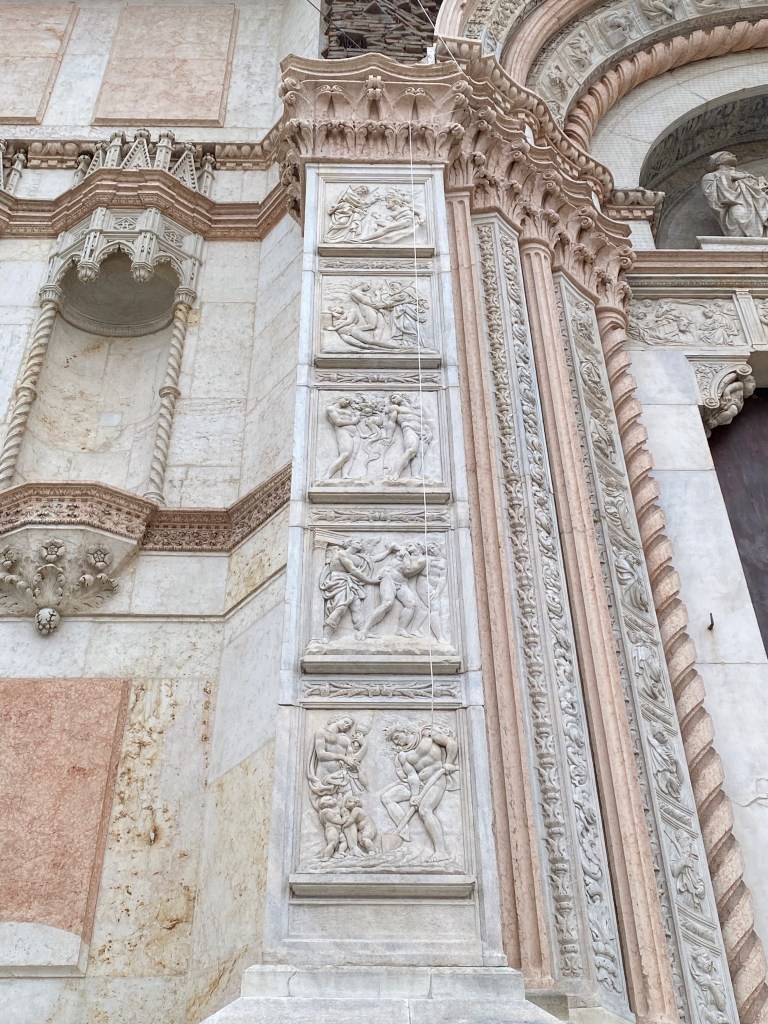
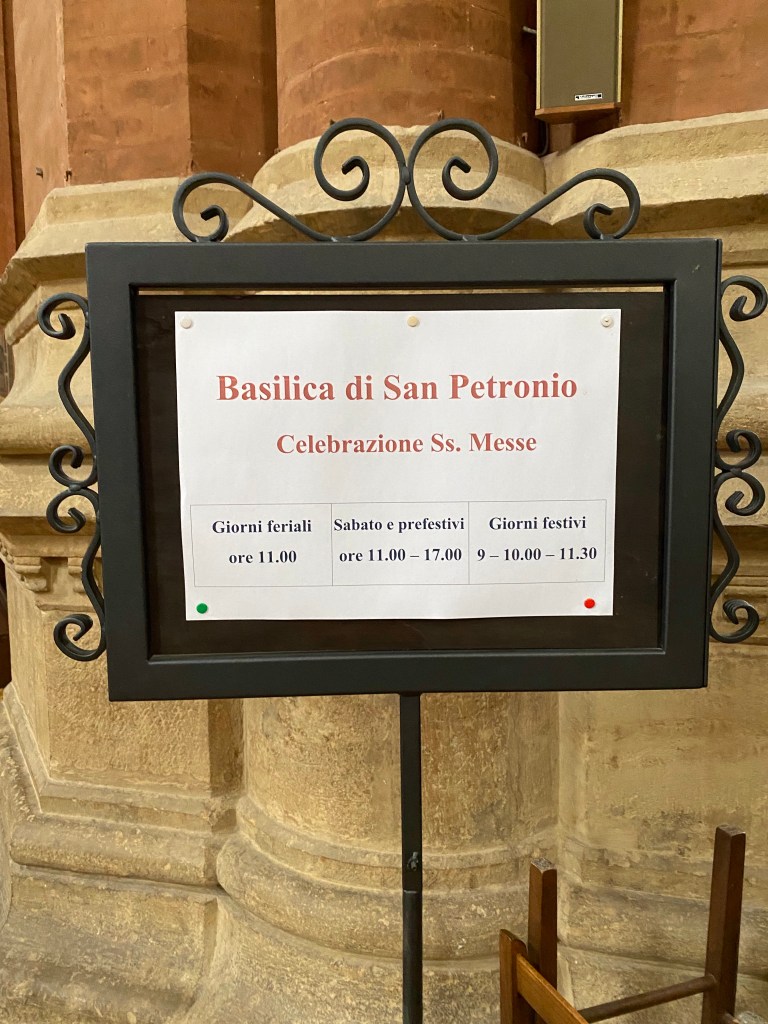
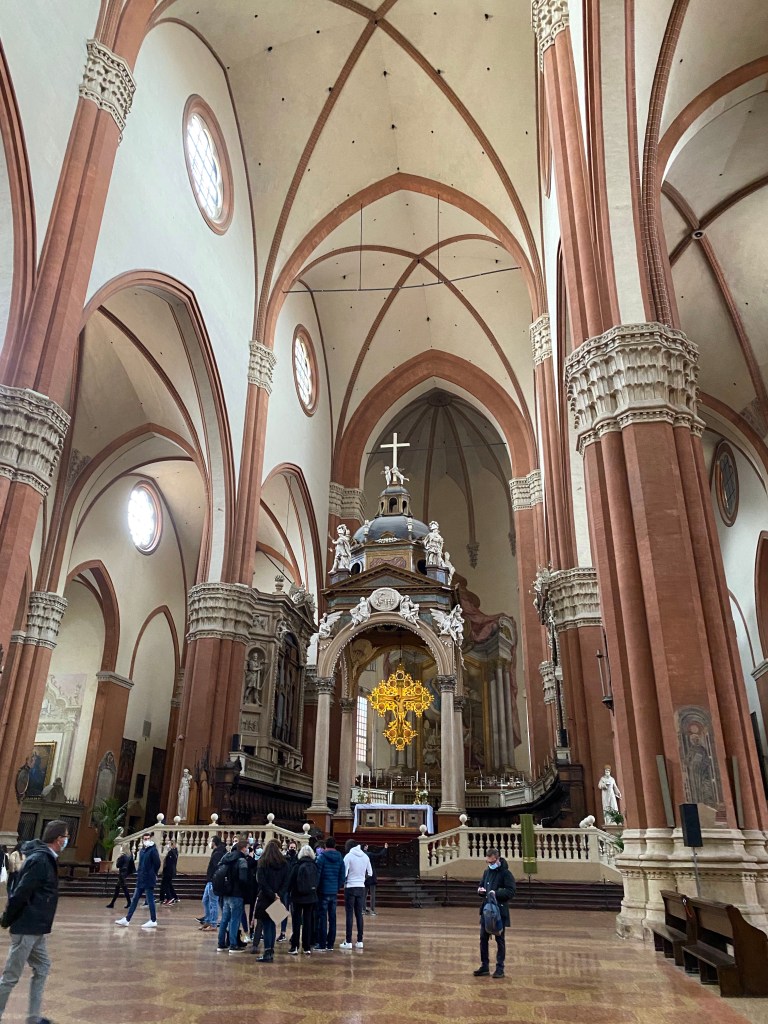
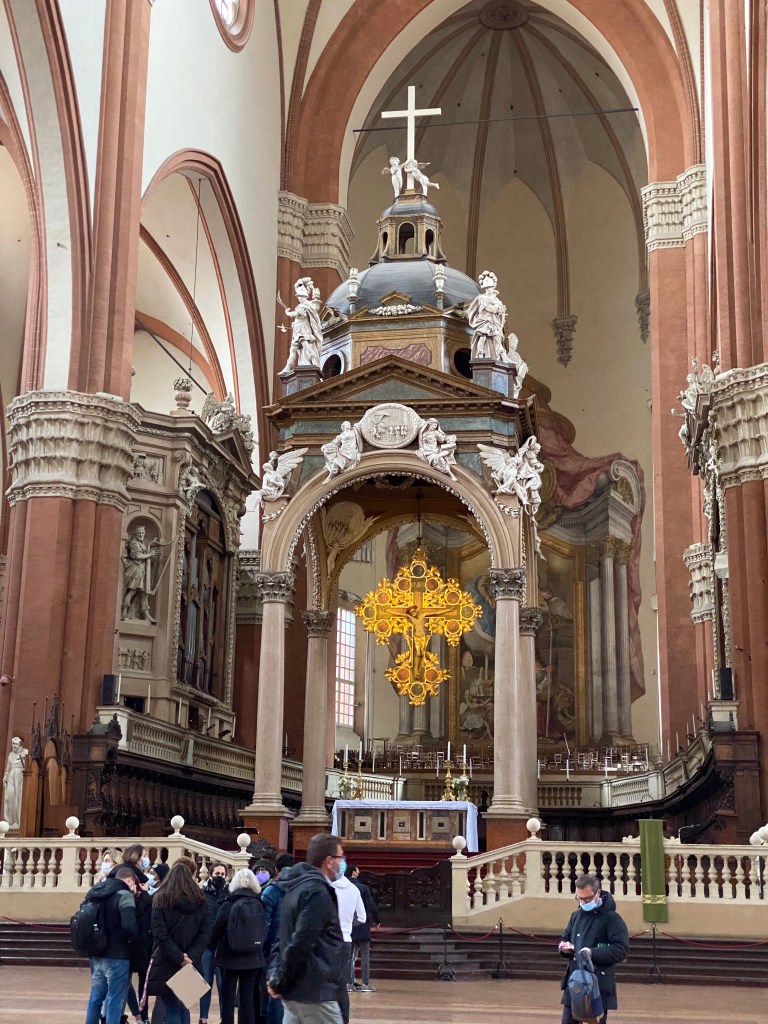
Dominating the major square of Piazza Maggiore in Bologna is this important basilica. For me, the relief sculptures on the facade are the reason to visit, but there are many other reasons as well.
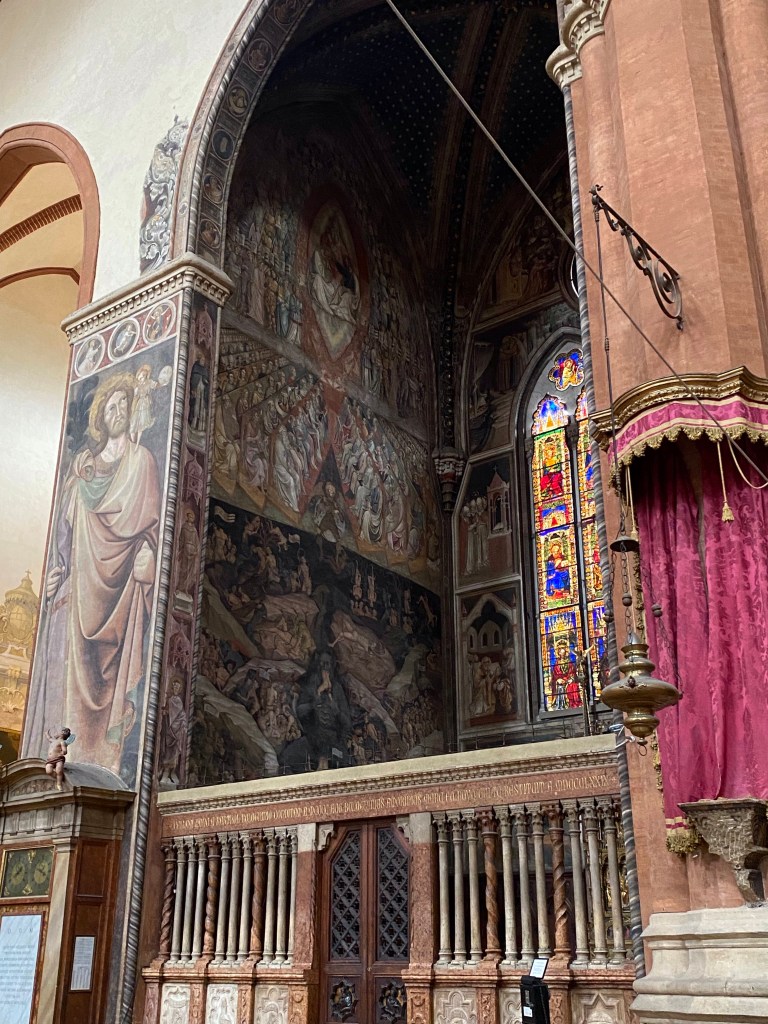
The basilica is dedicated to the patron saint of the city, Saint Petronius, who was the bishop of Bologna in the 5th century. Construction began in 1390 and its main facade has never been finished. Interestingly, the basilica was only consecrated in 1954! It has held the relics of Bologna’s patron saint only since 2000; until then they were preserved in the Santo Stefano.
Two side doors flank the central one with della Quercia’s reliefs. Alfonso Lombardi’s Resurrection sequence is on the left and Amico Aspertini’s Deposition in on the right.
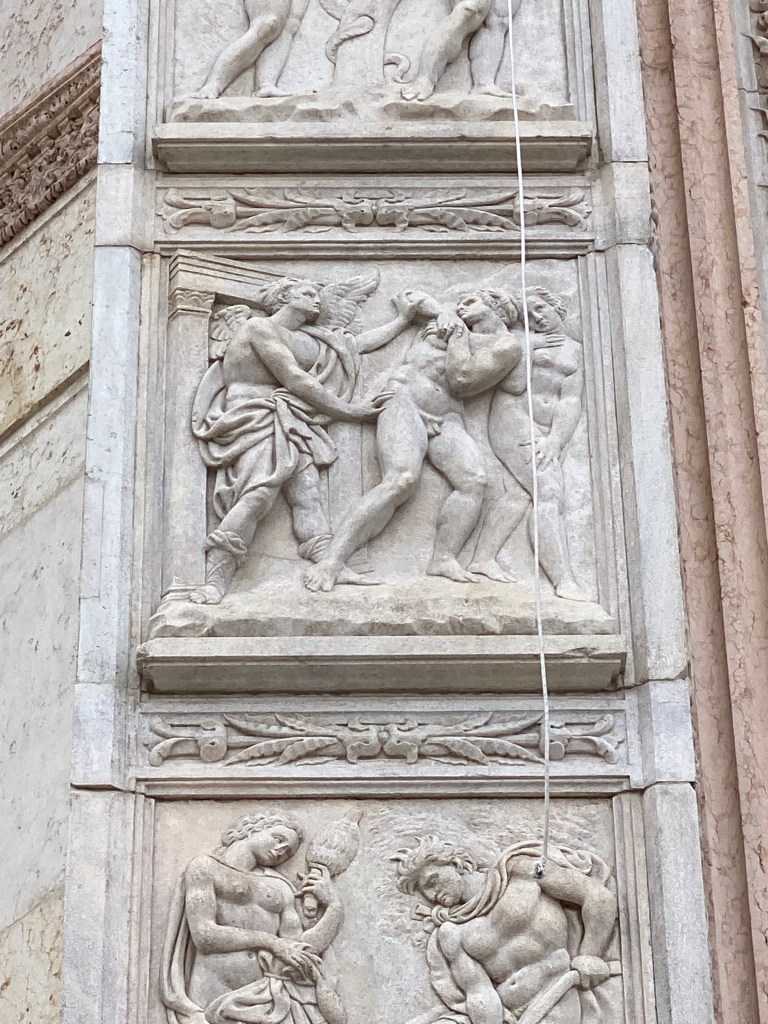
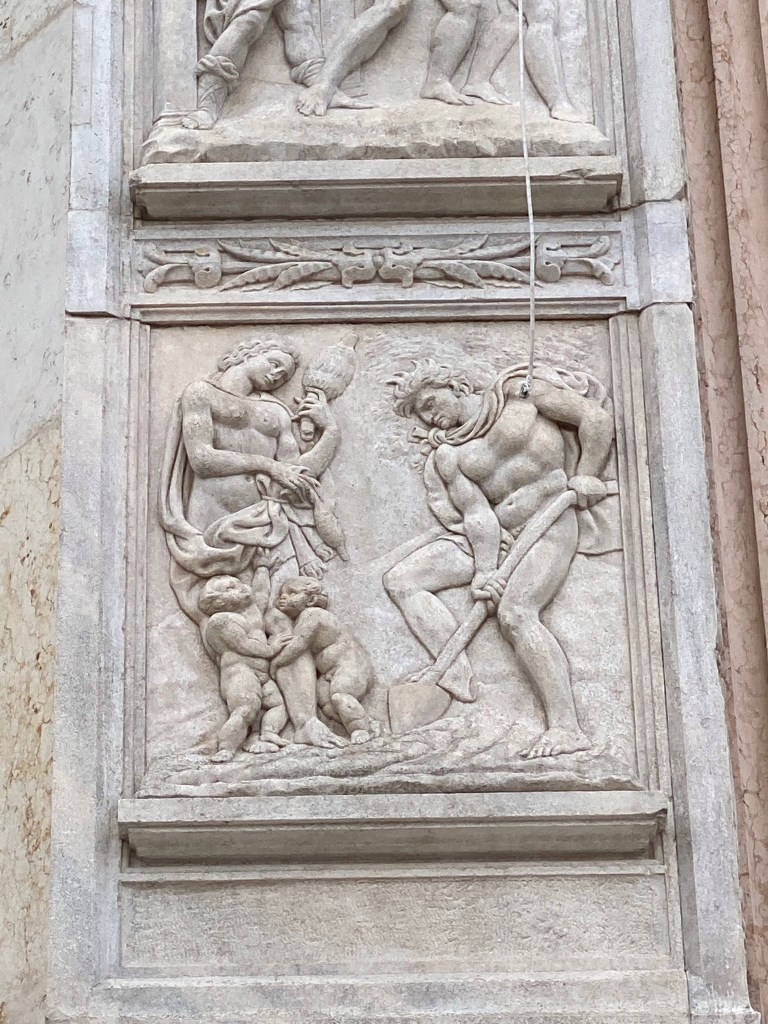
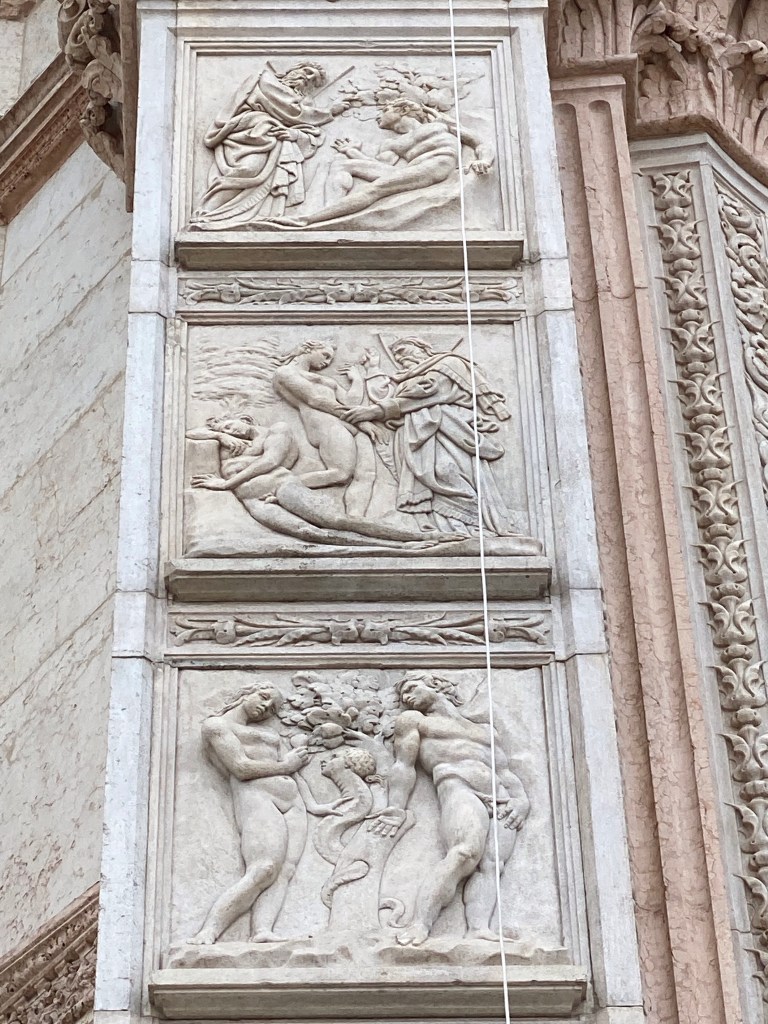
But I’m only concerned in this post with the sculpture by Jacopo della Quercia (c. 1374-1438). He was also known as Jacopo di Pietro d’Agnolo di Guarnieri. He was a major sculptor of the Renaissance, a contemporary of Brunelleschi, Ghiberti and Donatello. He is considered to be a precursor of Michelangelo.
Here is a portrait of the artist:
A
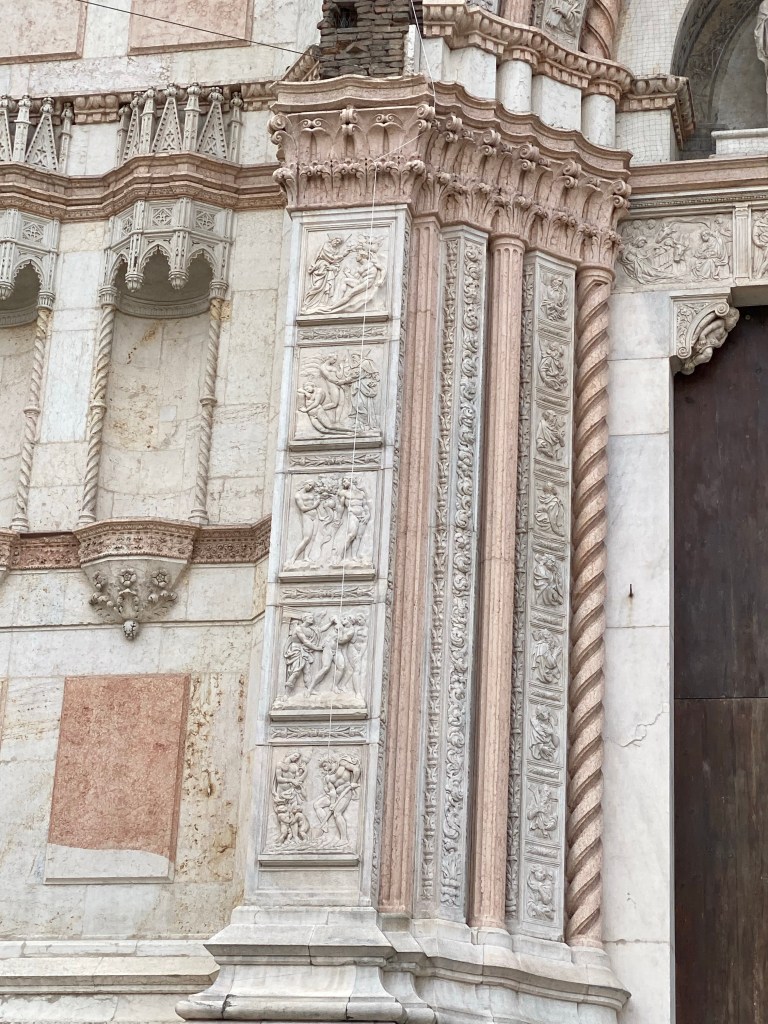
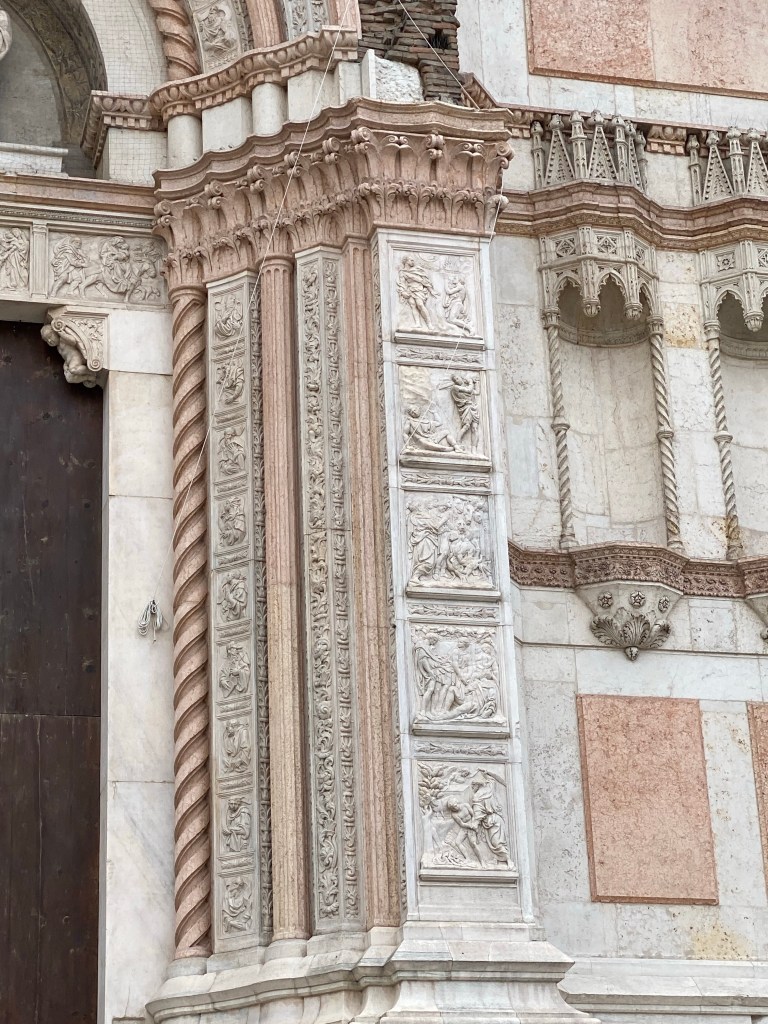
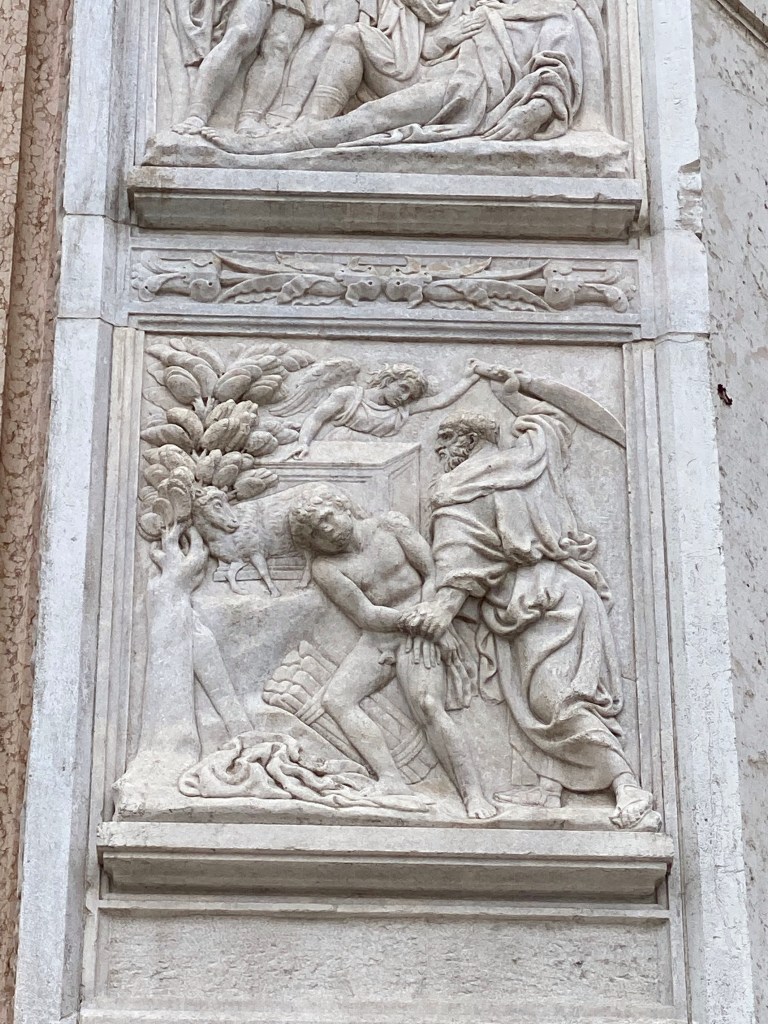
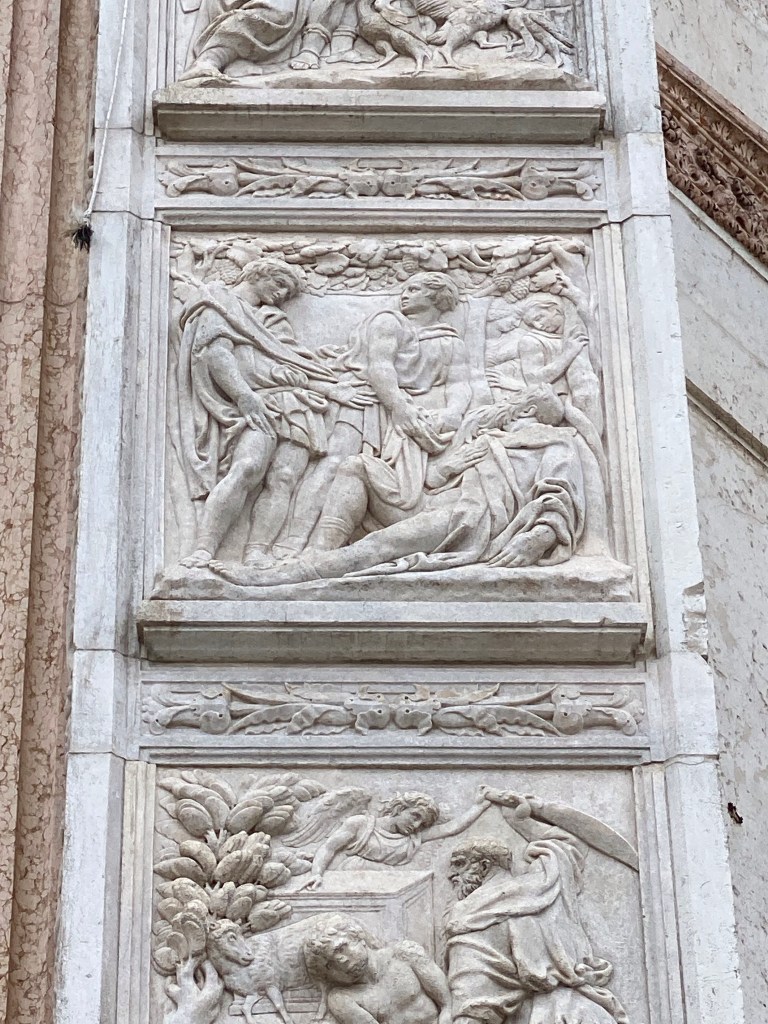
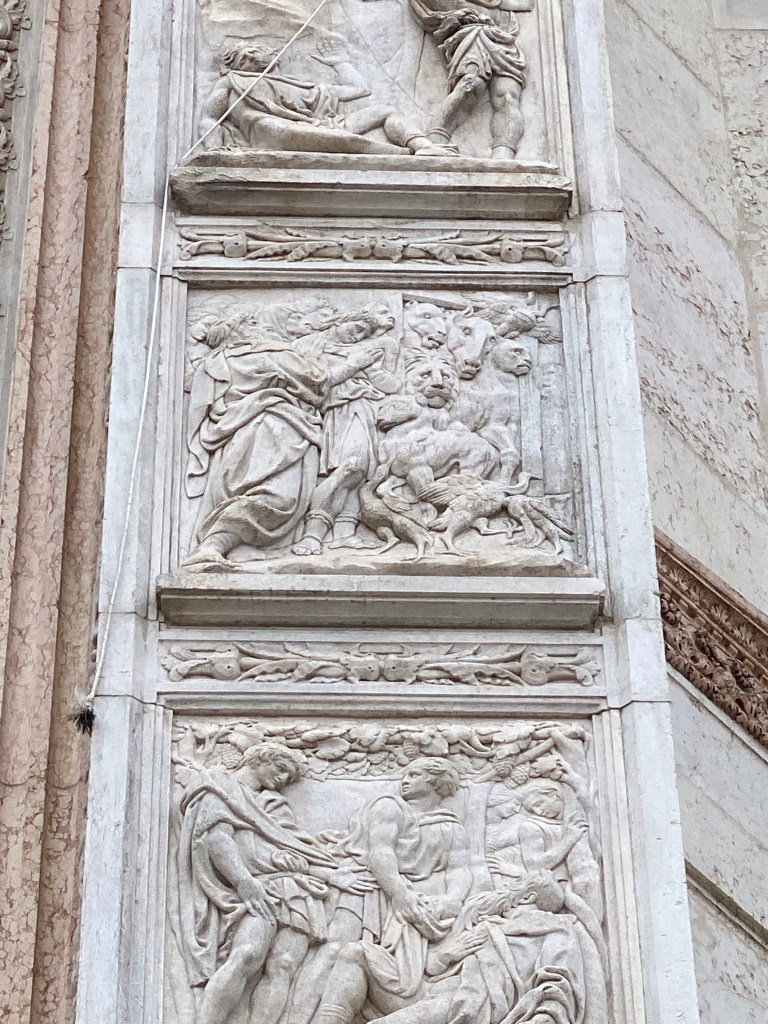
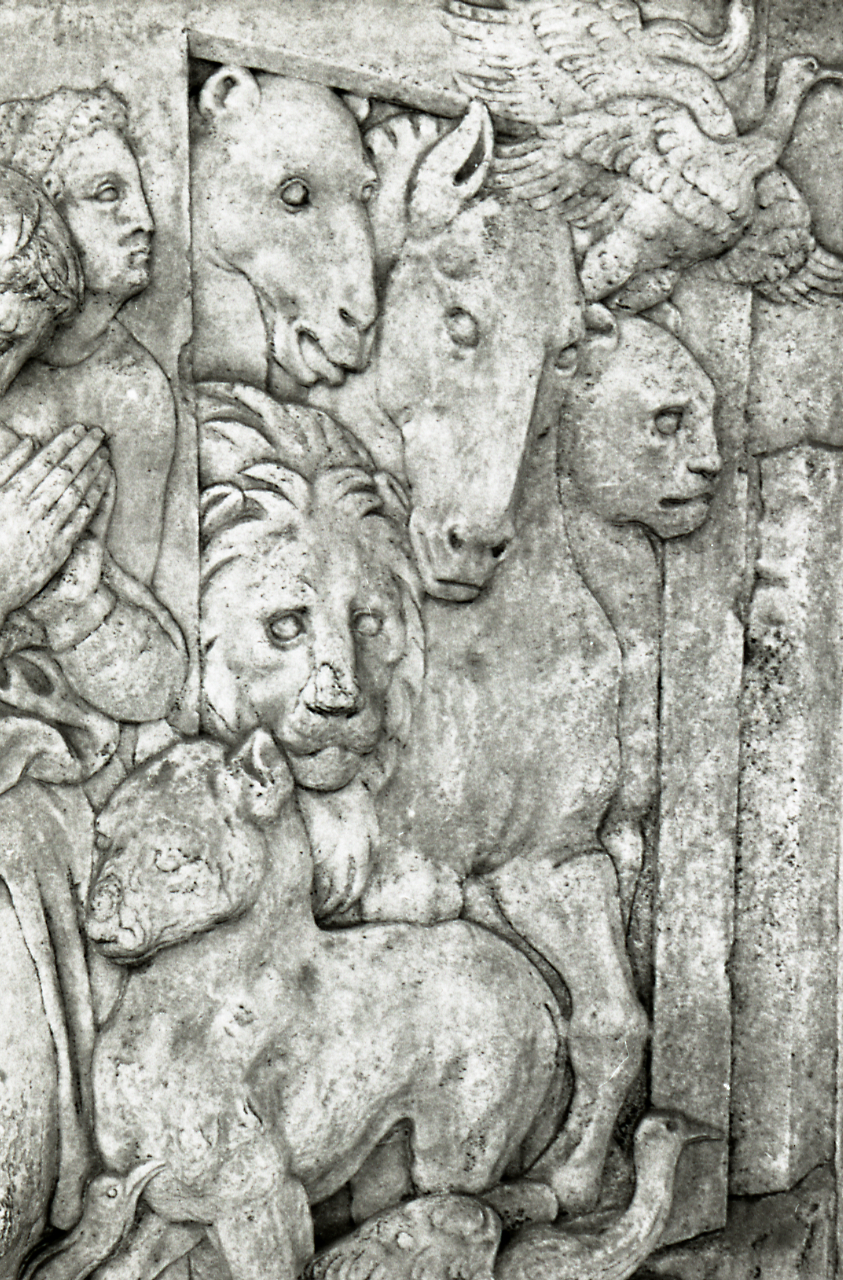
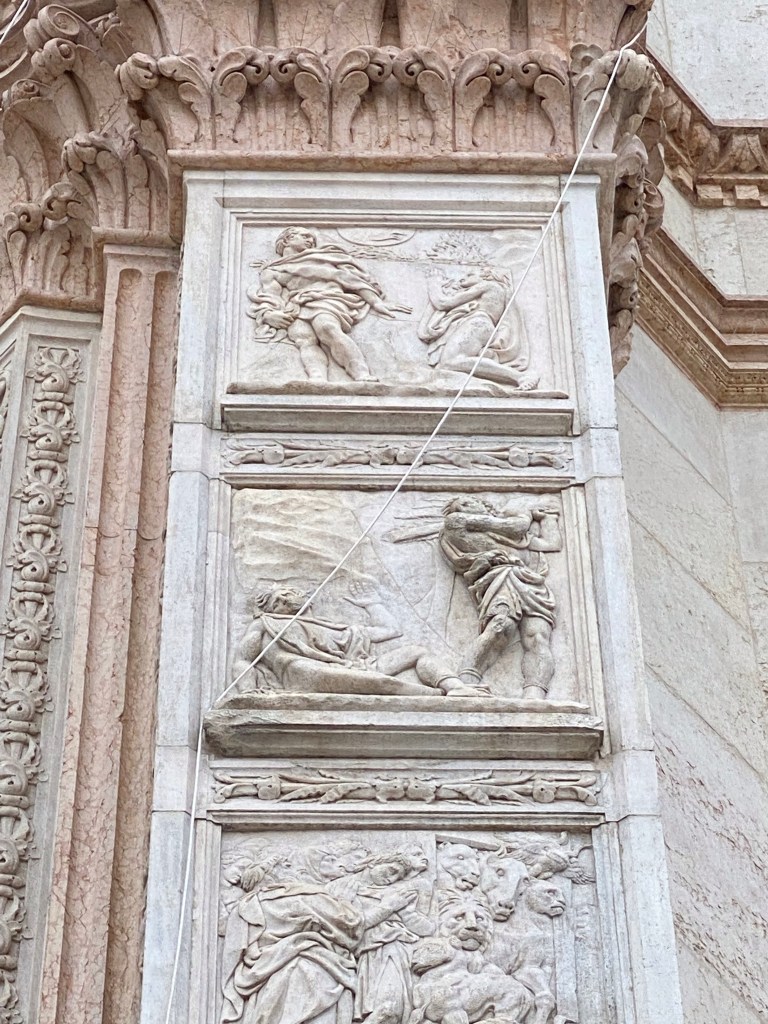
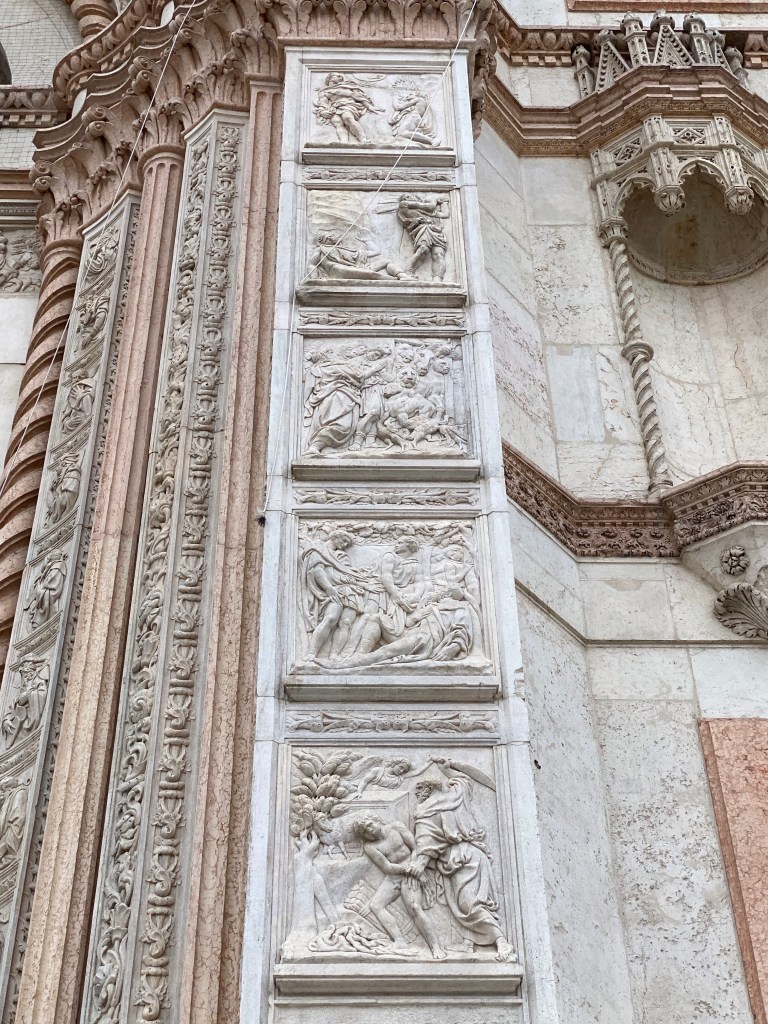
A detail of the “original sin” relief.Detail of the Noah’s ark relief.Detail of the relief depicting Isaac and Jacob.Detail of the relief depicting the Massacre of the Innocents.
Below: a detail of the archivolt sculptures of the Prophets
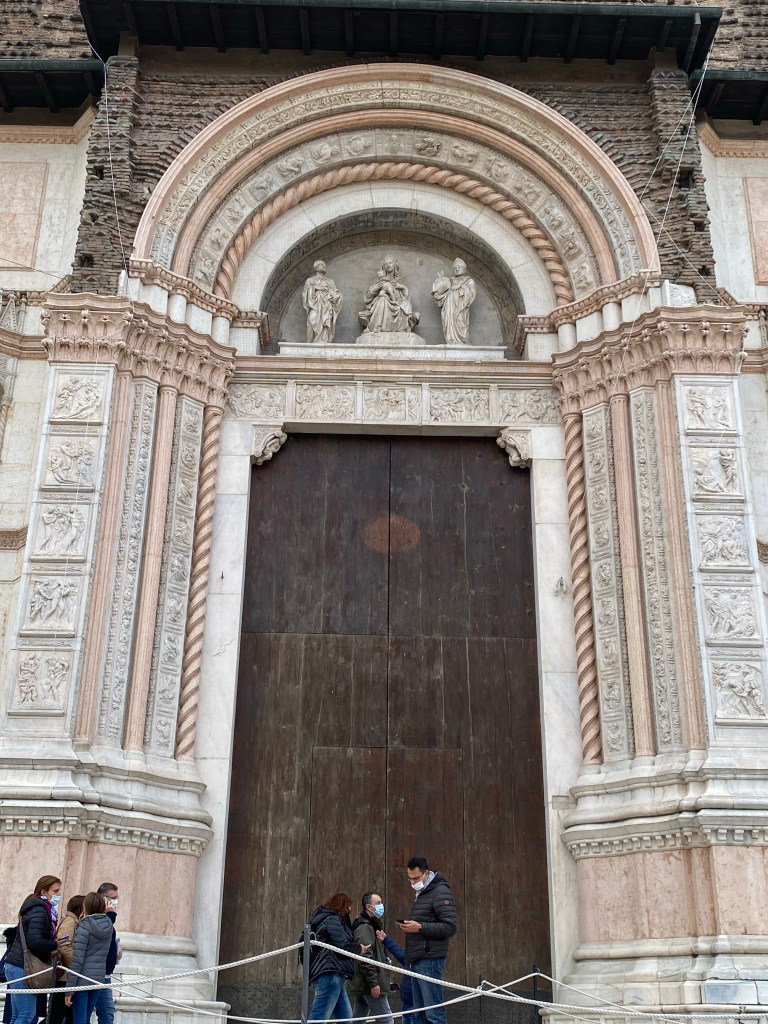
In 1425 della Quercia accepted a major commission: the design of the round-arched Porta Magna of the San Petronio church in Bologna. It would keep him busy for a good deal of the last thirteen years of his life and it is considered his masterwork. Each side of the door is flanked, first by a colonette with a spirally wound decoration, then nine busts of prophets and at the end five scenes from the Old Testament, carved into somewhat lower relief.
In the Creation of Adam, he uses the same arrangement as in the Fonte Gaia (in Siena), but in reverse order.
Michelangelo, who had visited Bologna in 1494, conceded that his Genesis on the Sistine Chapel ceiling was based on these reliefs.
The architrave above the door contains five reliefs with representations from the New Testament.
The lunette contains three free-standing statues : Virgin and Child, Saint Petronius (with a model of Bologna in his right hand) and Saint Ambrose (carved by another sculptor Domenico Aimo in 1510). Originally this third statue had to represent the papal legate Cardinal Alemmano, but this intention was quickly abandoned after the cardinal had been evicted from Bologna. He relied heavily on the artists of his Bolognese workshop, such as Cino di Bartolo, for assistance in this project.
The church has a meridian line inlaid in 1655 the paving of the left aisle; it was calculated and designed by the astronomer Giovanni Domenico Cassini, who was teaching astronomy at the University.
A meridian line does not indicate the time: instead, with its length of 66.8 metres (219 ft) it is one of the largest astronomical instruments in the world, allowing measurements that were for the time uniquely precise.
The sunlight, entering through a 27.07 mm (1.066 in) hole placed at a 27.07 m (88.8 ft) height in the church wall, projects an elliptical image of the sun, which at local noon falls exactly on the meridian line and every day is different as to position and size. The position of the projected image along the line allows to determine accurately the daily altitude of the sun at noon, from which Cassini was able to calculate with unprecedented precision astronomical parameters such as the obliquity of the ecliptic, the duration of the tropical year and the timing of equinoxes and solstices. On the other hand, the size of the projected sun’s image, and in particular its rate of variation during the year, allowed Cassini the first experimental verification of Kepler’s laws of planetary motion.
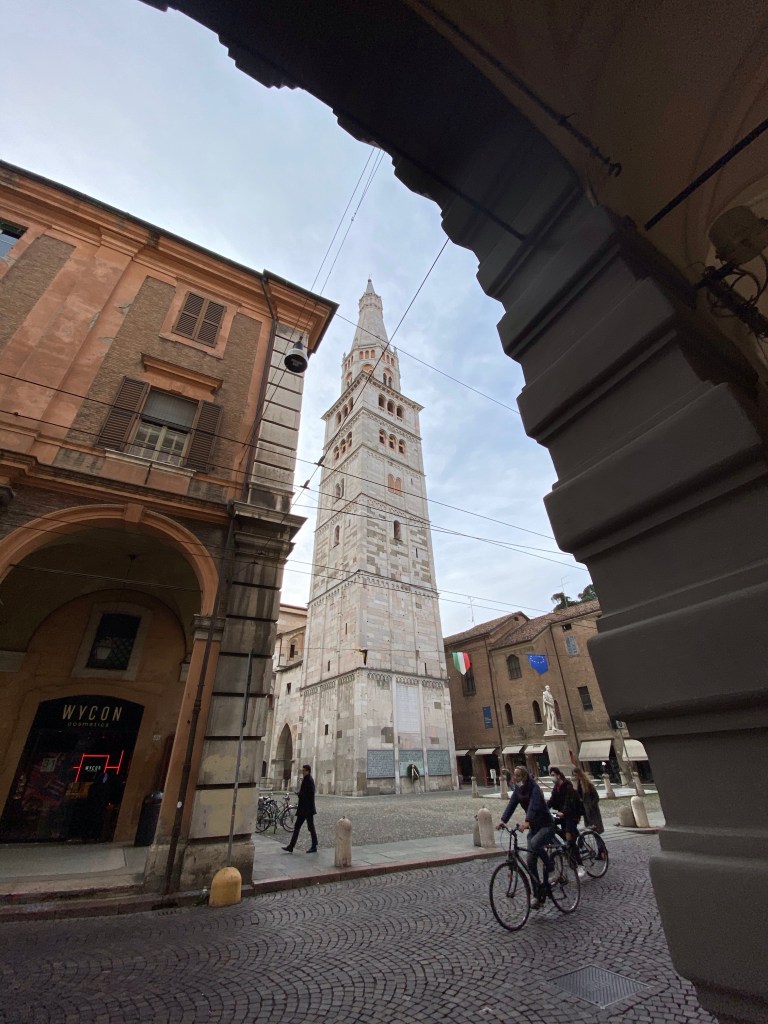
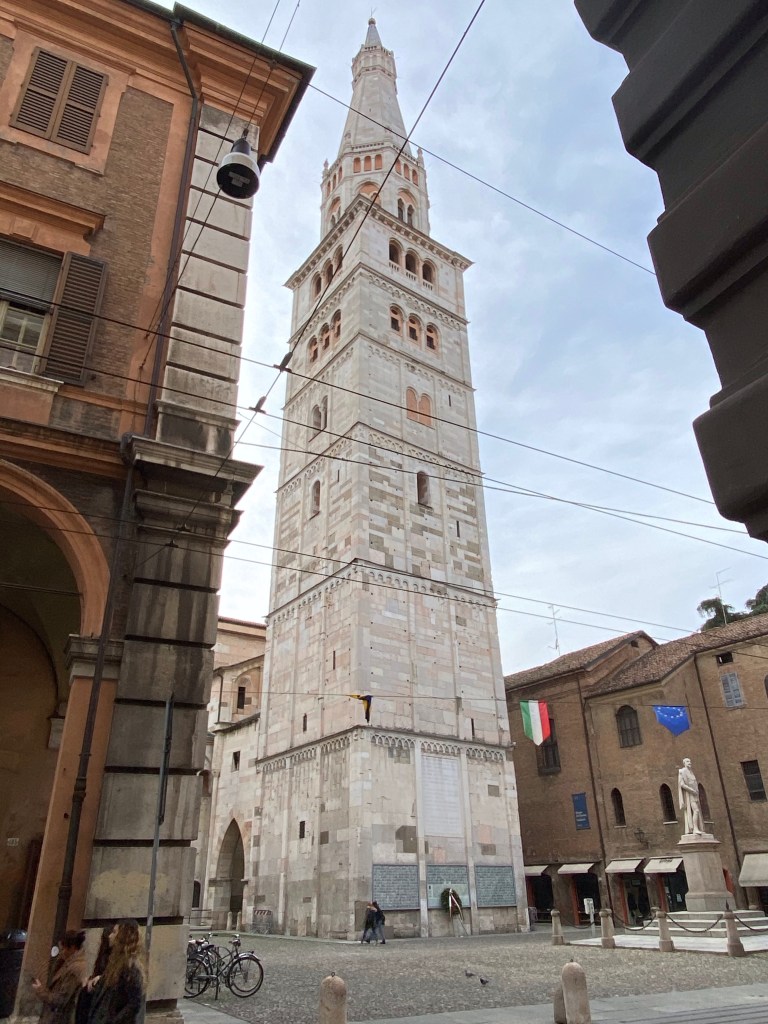
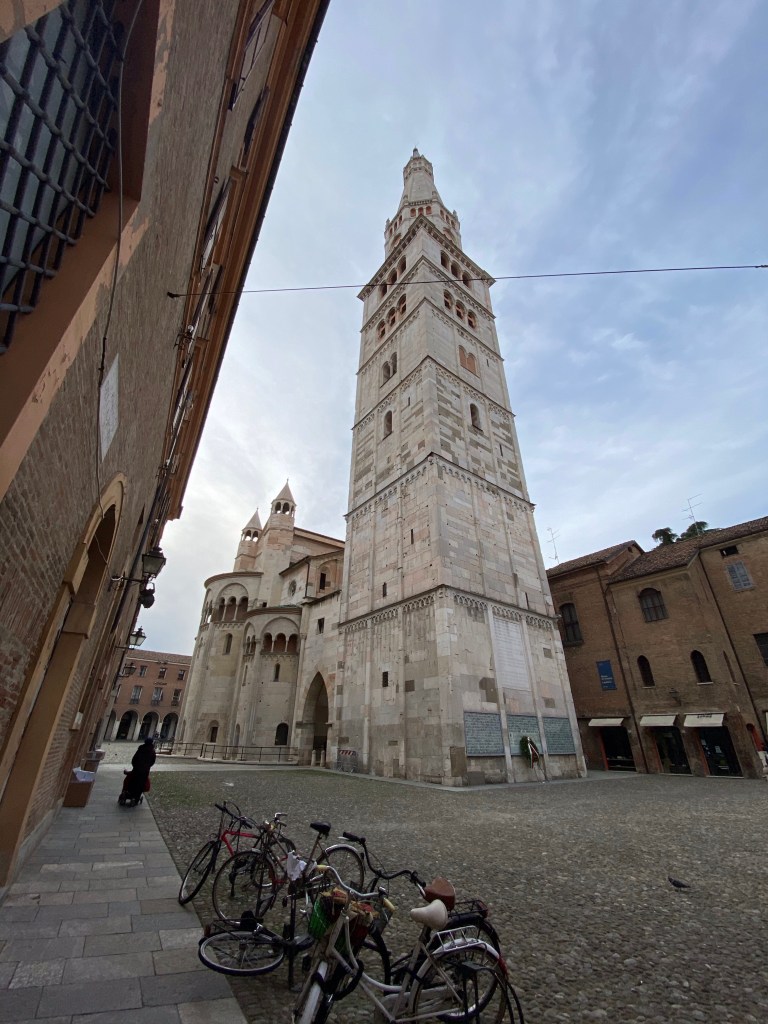
The lovely bell tower in Modena is attached to the duomo and is known as the Ghirlandina. It makes a very impressive first glance when framed by the ubiquitous arcades of the city.
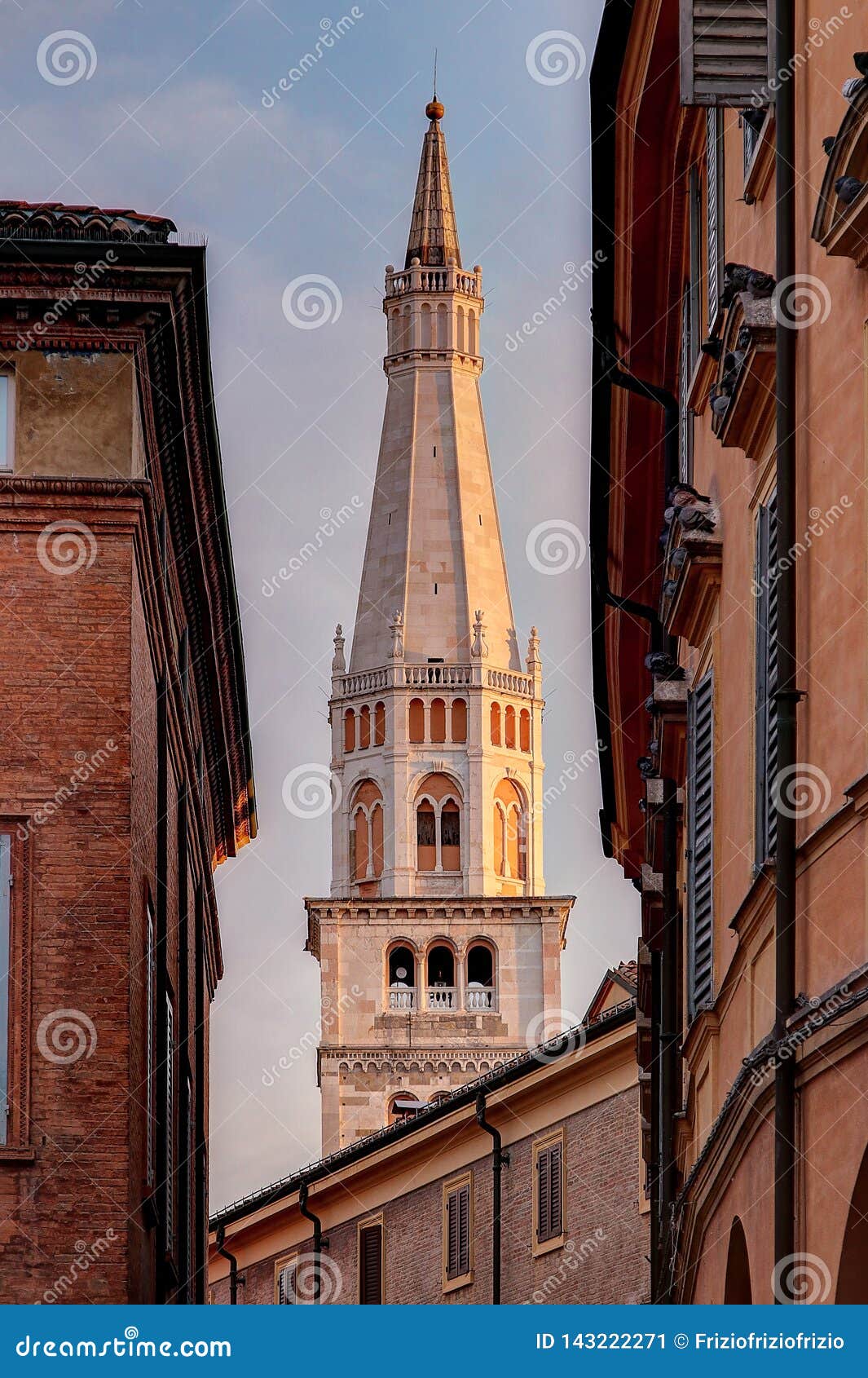
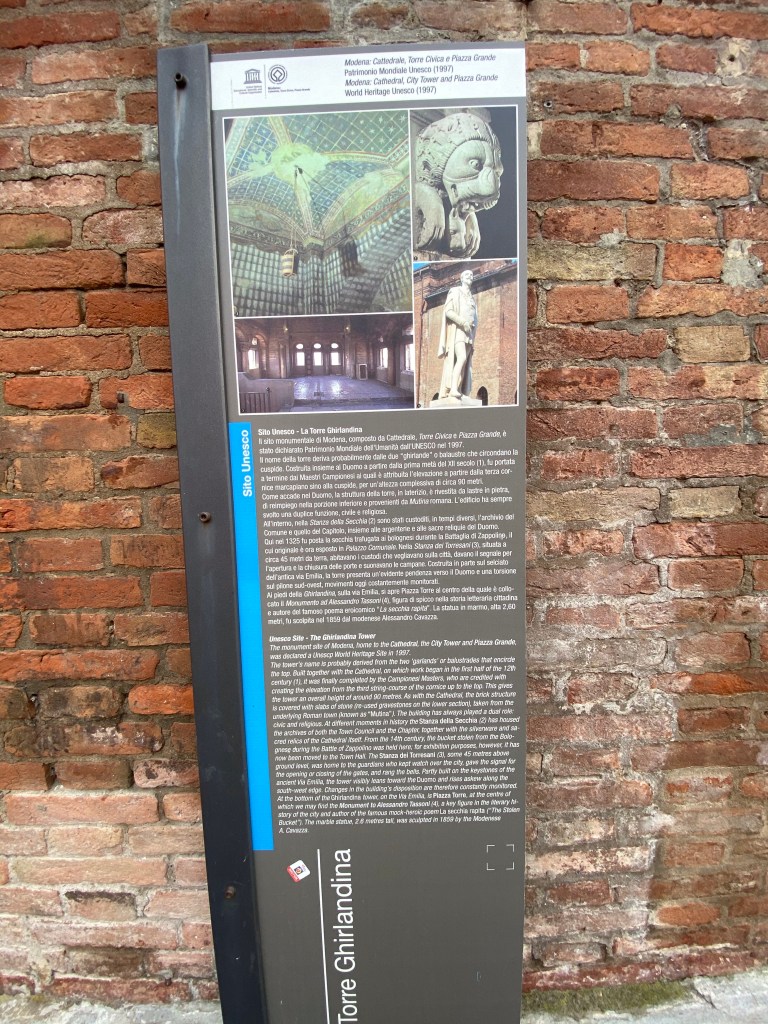
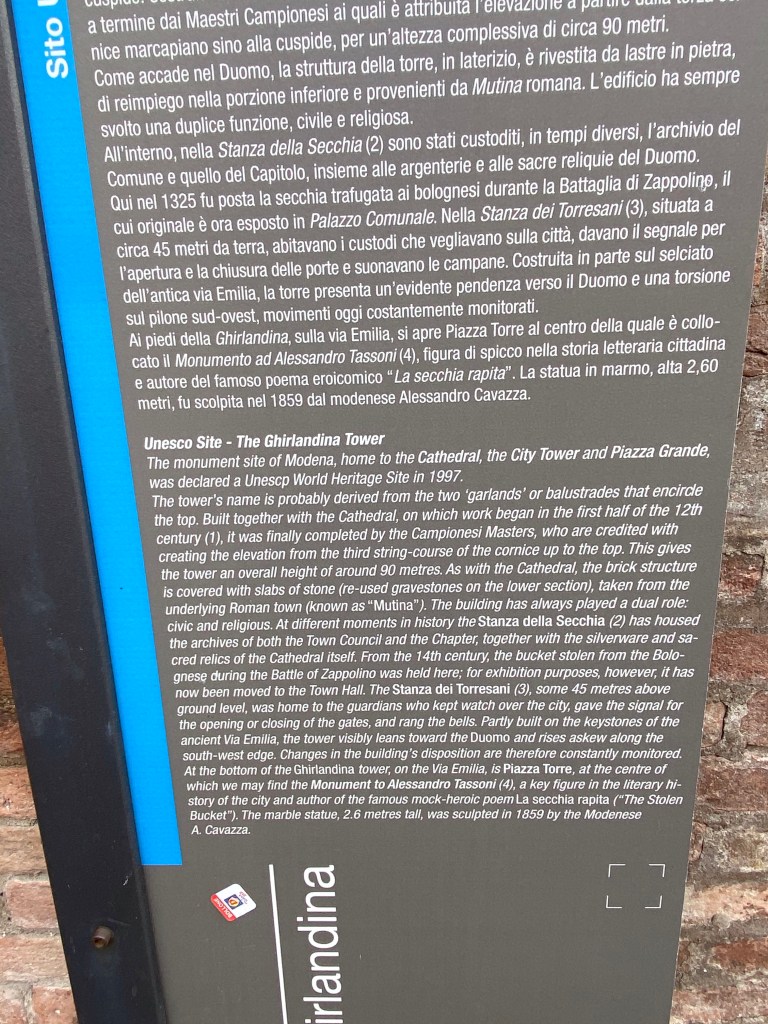
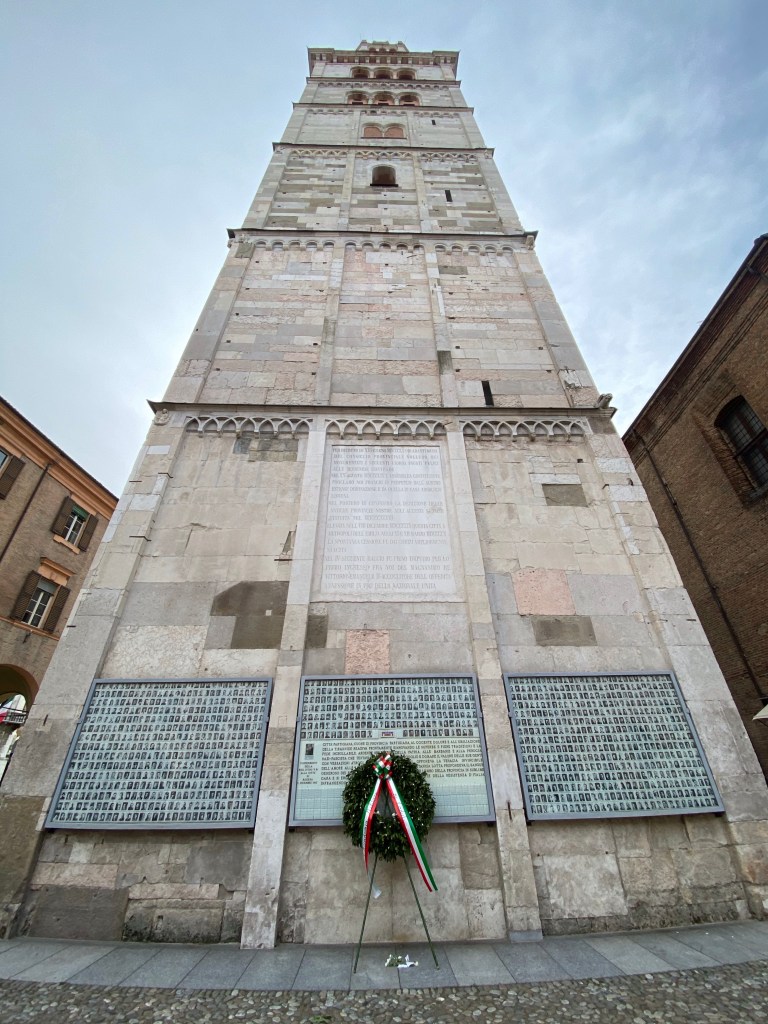
Standing alongside the apse of the cathedral, 89.32 meters tall, is the Ghirlandina bellt ower, the symbol of the city of Modena. The Ghirlandina was given this nickname by the city’s inhabitants due, perhaps, to the double ring of parapets that crown its steeple, “as light as garlands.” The word for garland in Italian is ghirlanda.
Built as the belltower for the cathedral, this tower has however played an important civic function since its origins: the ringing of its bells marked the time for life in the city, it announced the opening of the gates in the city walls and acting as a warning for the people in situations of alarm and danger.
Its mighty walls guarded the so-called “Sacristy” of the Municipality, which was home to the strongboxes, public documents and objects of great symbolic value like the famous fourteenth-century “Secchia rapita” or Stolen Bucket (a copy is currently on display). This humble yet supreme object of contention between the people of Modena and Bologna in the enflamed historic battle of Zappolino (1325) was raised to fame in the mock-heroic poem of the same name by Alessandro Tassoni.
Debate regarding the chronology of the Ghirlandina is still open because direct historic sources are missing for the initial building stages. By about 1160 the foundations were being dug and the tower was built to a height of 11 metres. Between 1167 and 1184, after a brief pause due to settlement of the site, building reached the fifth floor, topped by four corner turrets. In 1260 the sixth storey was built, which incorporated the turrets. In 1319, the tower was completed with the octagonal pinnacle, exquisitely gothic and originally decorated by numerous spires, to plans by Enrico da Campione.
The outside of the Ghirlandina is characterised by a rich array of sculptures and by stone cladding, the material salvaged from the Roman town know as “Mutina,” as revealed by scientific investigations carried out during the recent renovation work, started in 2007 and completed in 2011.
Inside the Ghirlandina, on the fifth floor there is the so-called Stanza dei Torresani, once lived in by the tower custodians and where important capitals can be admired.
Together with the cathedral and Piazza Grande, the Ghirlandina belltower has been a UNESCO World Heritage Site since 1997.
When the tower was finished as we see it today in 1588, a solemn ceremony was held during which, using an external ladder, the cross was put on the top, soldered to the golden sphere where an urn contains relics of the Patron Saint of the city, Geminiano. On the outside, S.P.Q.M. is written; that is Senatus Populus Que Mutinensis, which in Latin means ‘Senate and People of Modena’).
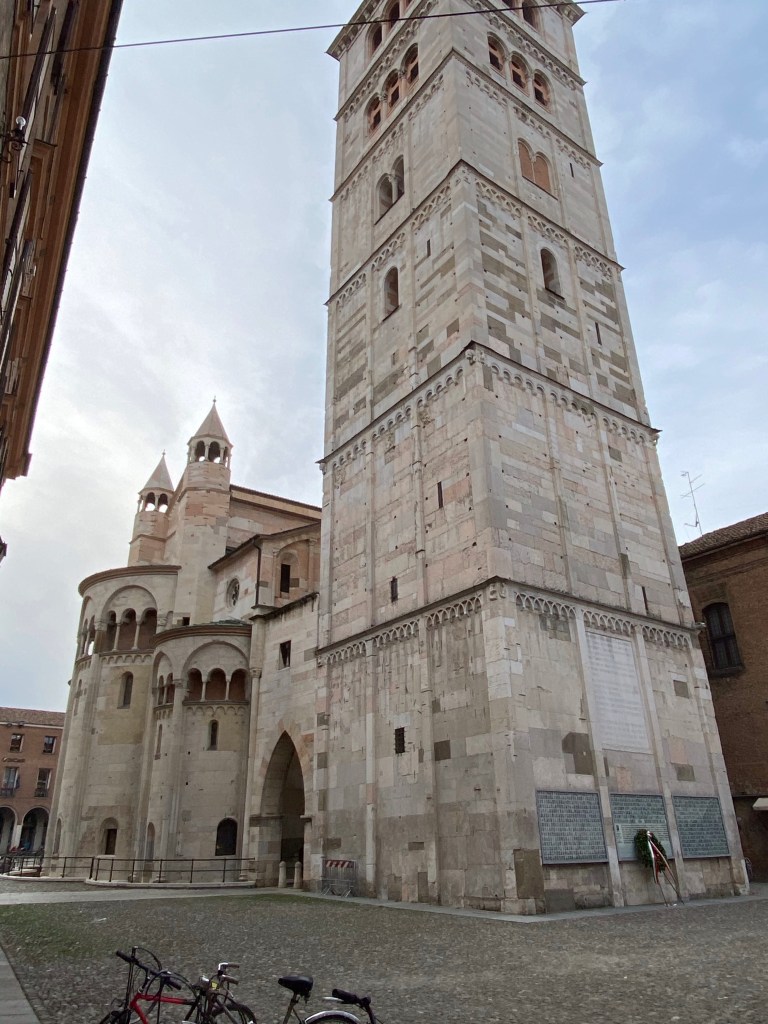
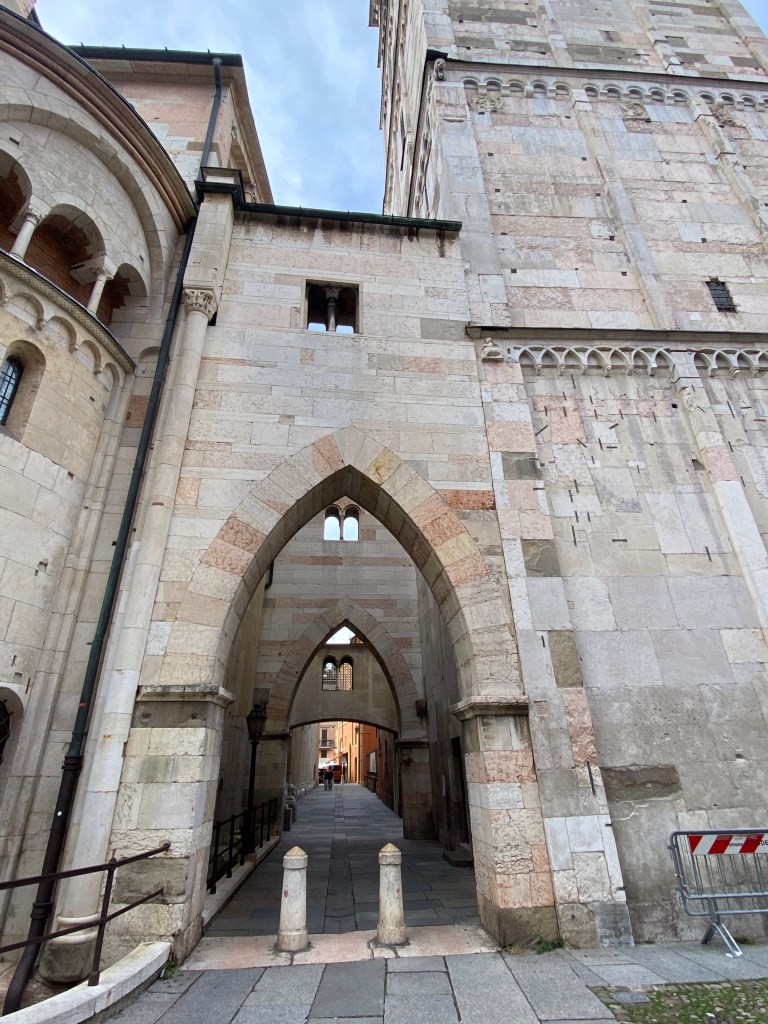
The bell tower is attached to the duomo with these arches.
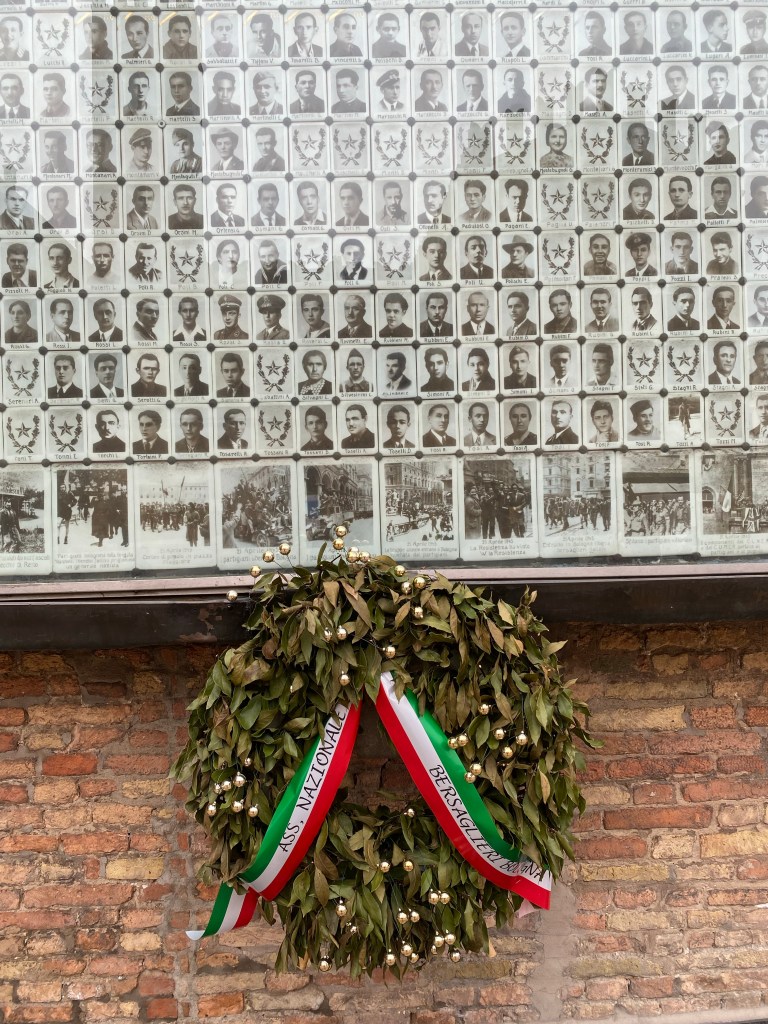
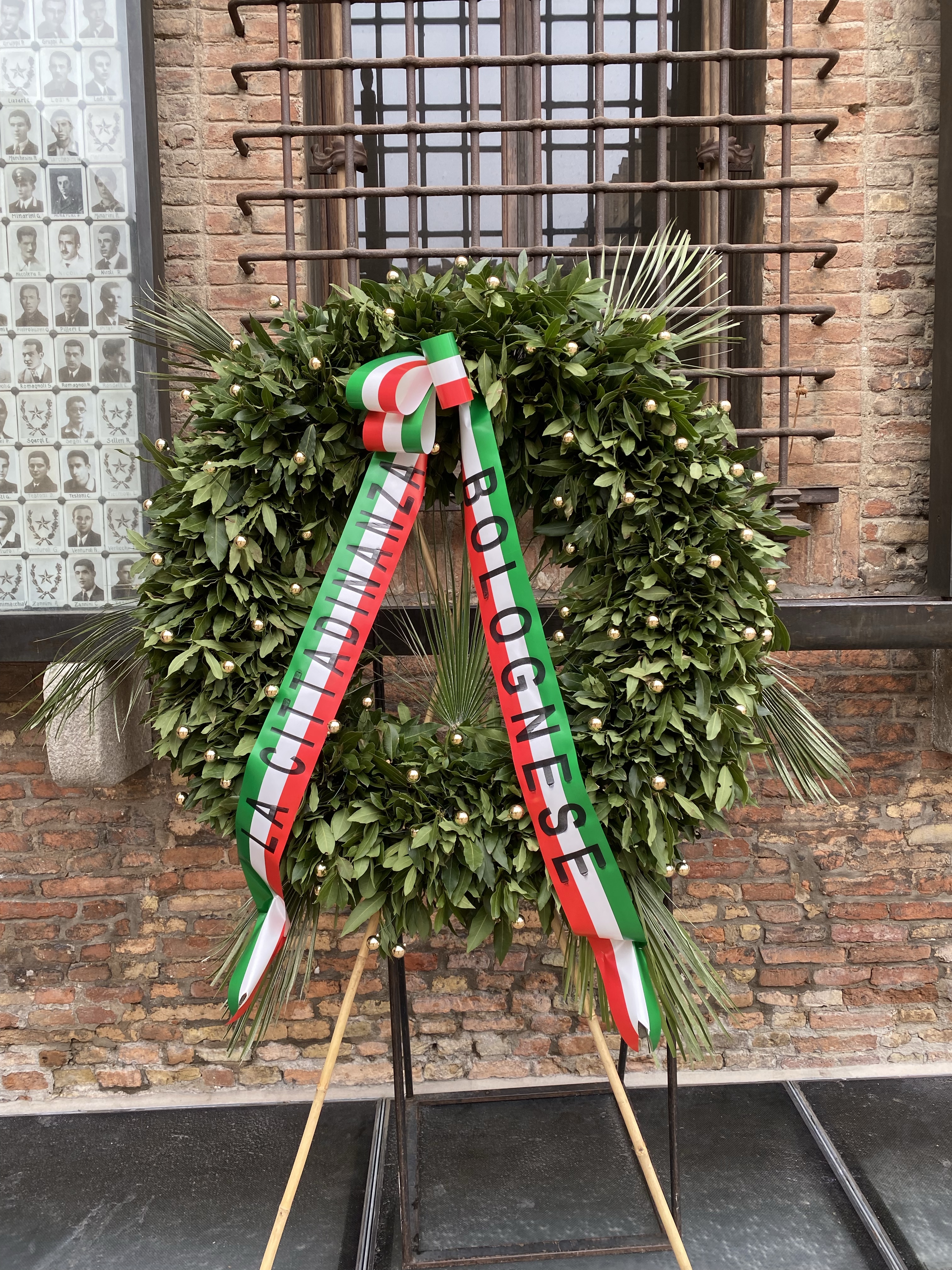
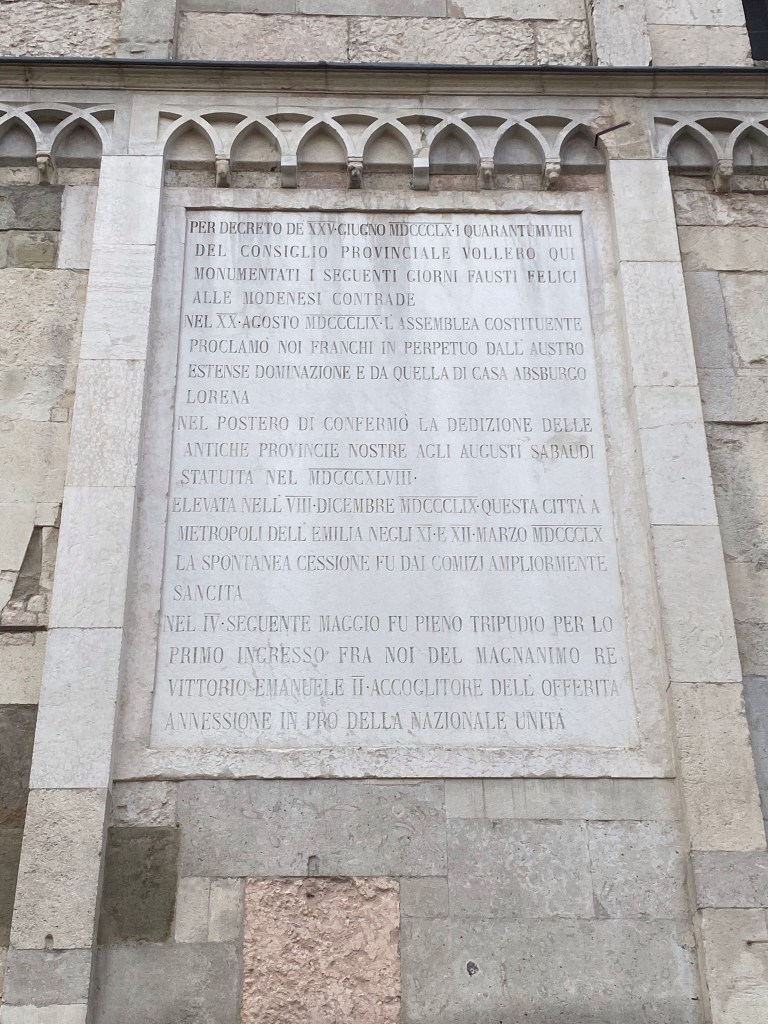
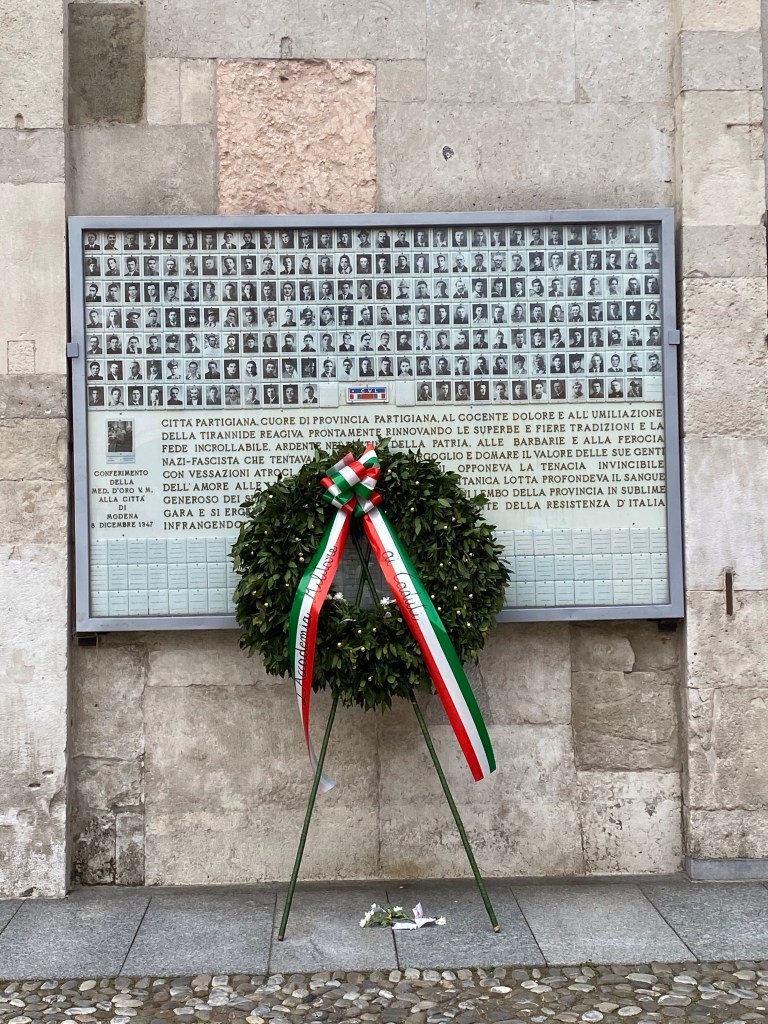
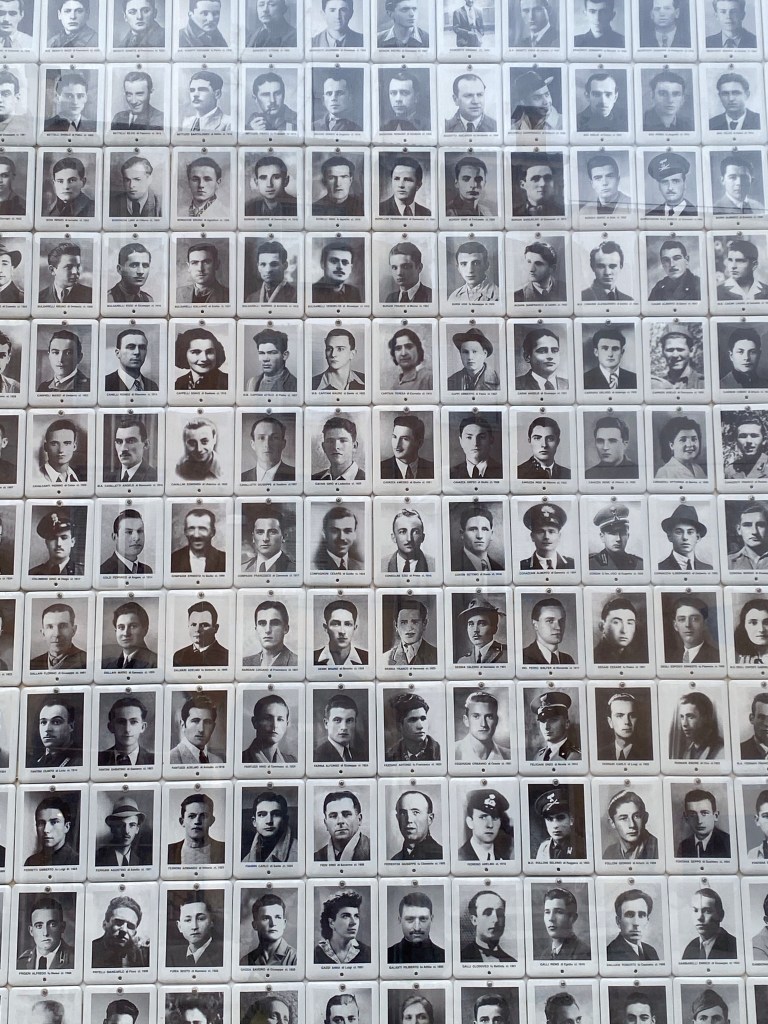
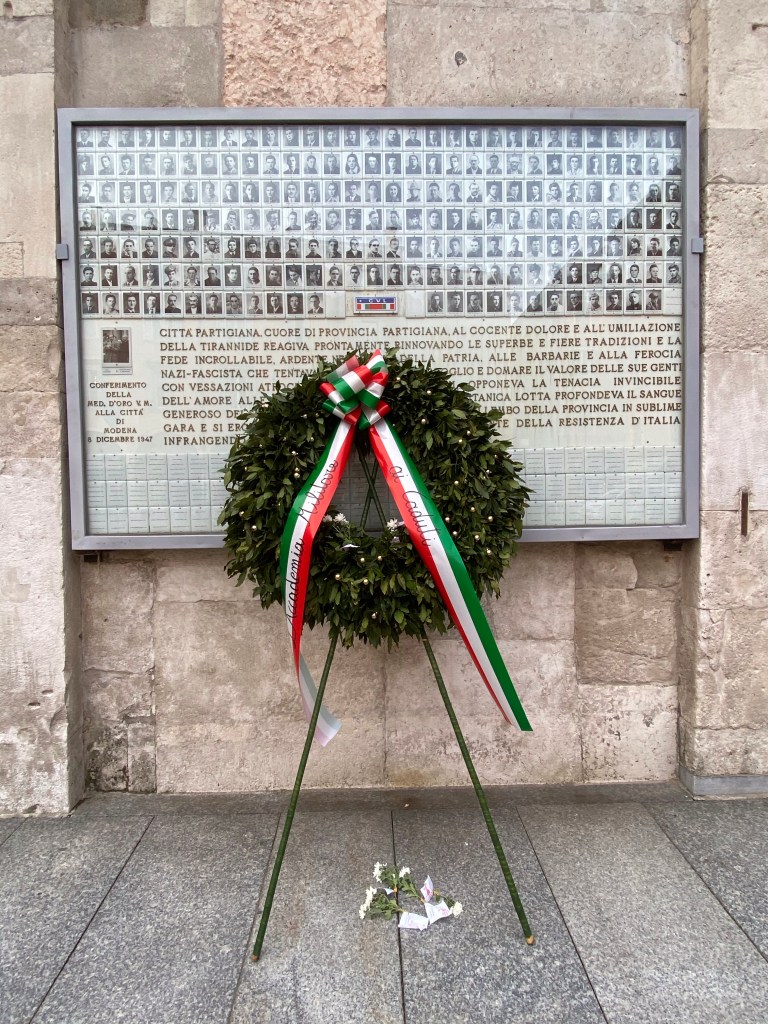
One of the most interesting things to me about the bell tower is this memorial from WWII placed on its base and dutifully commemorated with the wreath with ribbons the color of the Italian flag. This is a distinctive memorial form that I have noted in other places in Emilia-Romagna, such as in Bologna. I’ve not seen this form in other regions. Certainly not in Tuscany.
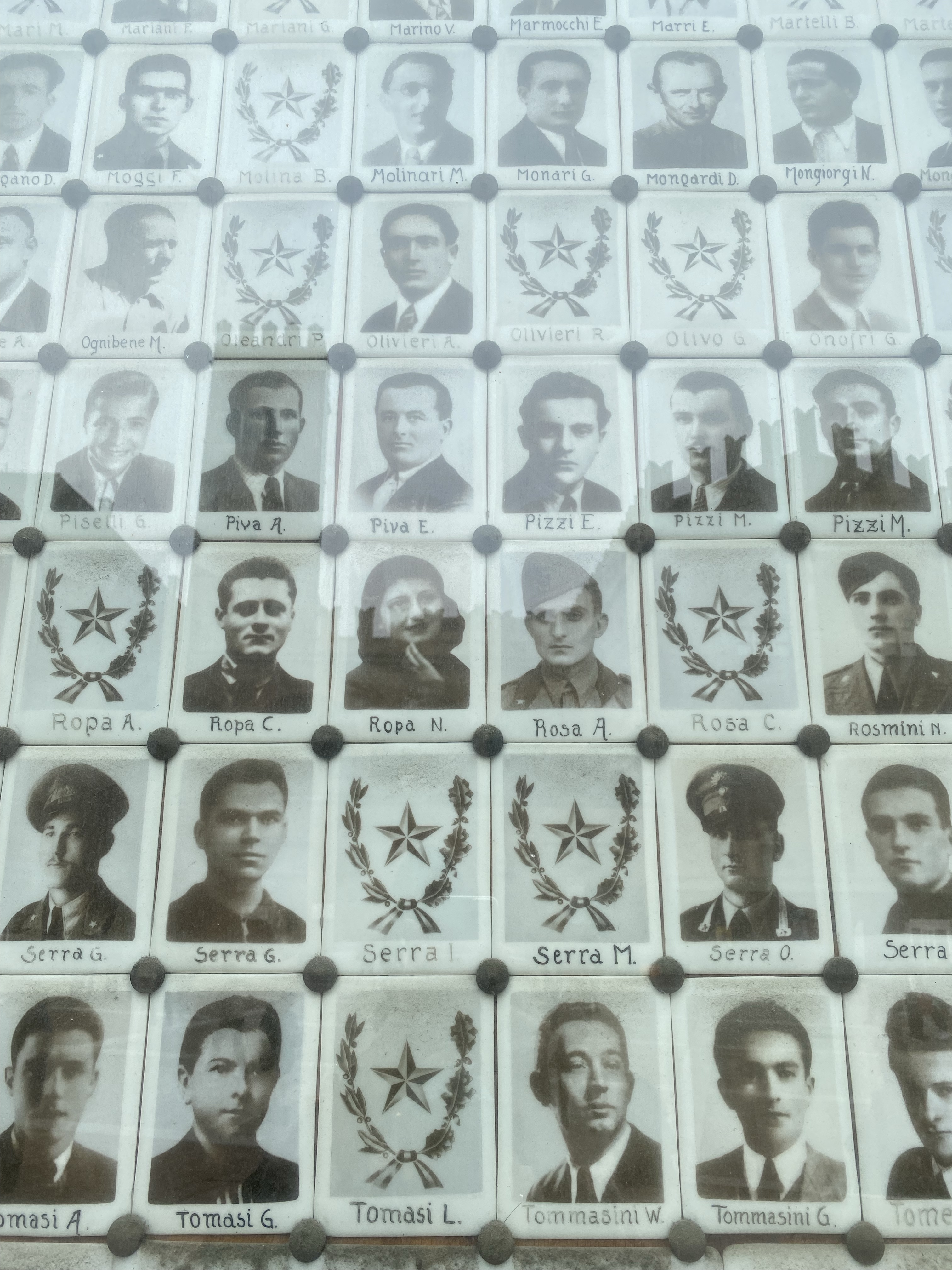
Pictures of those who lost their lives in the war are included.
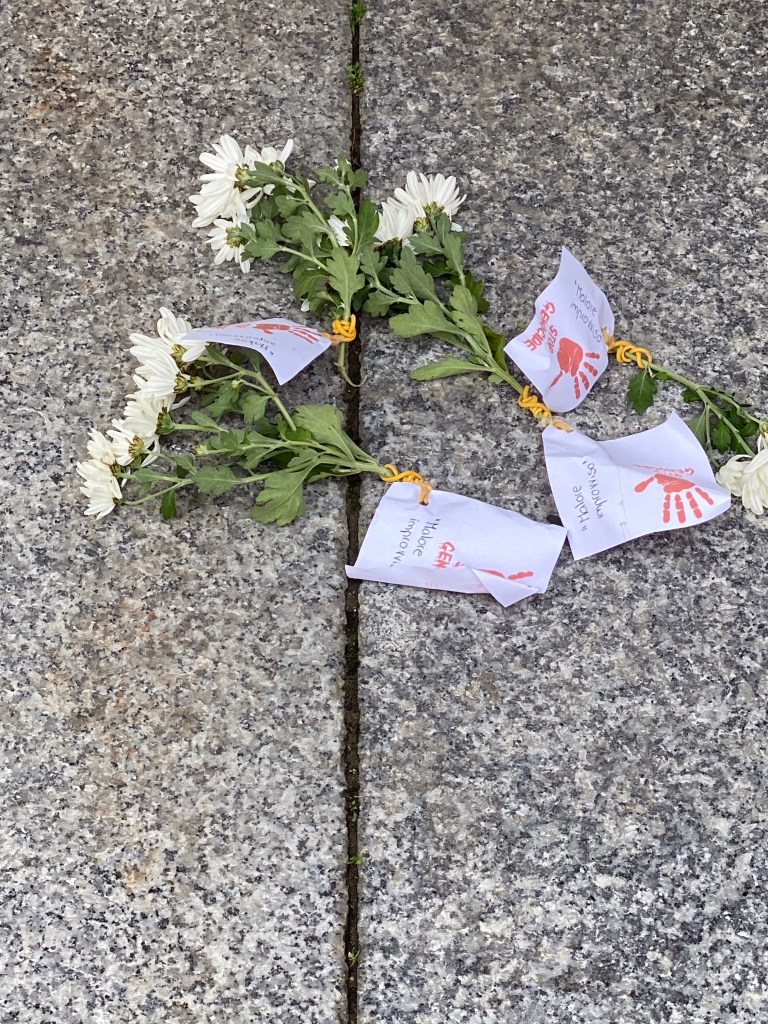
Under the memorial wreath, on the day that I visited, were these little sprigs of mums with a tag that says they are symbols of ending domestic violence. I saw them in other places around town.
At least 99% of my posts are positive if not effusive about Italy. But, every so often, I bang up against a wall here that nearly knocks me off my feet. This week was one of those weeks.
It’s Saturday morning, 2 weeks before Christmas, as I write this and I have been feeling anything but cheerful. Or well. I don’t have Covid, but I had a nasty reaction to the booster shot that I got on Wednesday.
But, my saga starts well before that. After the vaccine became widely available last winter/spring, I could not get the first two shots in Italy prior to June, because as of that date, they hadn’t opened the availability of shots to foreigners in Italy. Which of course makes no sense, because there are a lot of us and if you are trying to vaccinate a high majority of people, you would vaccinate anyone willing to take the shots.
As it happened, I was returning to the US for the summer anyway, so I decided to not fight the system in Italy and just wait. I arrived June 1 and got my first shot with no hassle at a local supermarket pharmacy on June 2. 3 weeks later I got the second shot. I got Pfizer both times and had no reaction other than a tender injection site.
All was well until the arrival of Omircron variant this past month and the high level of concern that has swept the world since. It has just been 6 months since my double vaccination in the US and technically I should be good for another 3 months, but everyone is being urged to get the booster and in Italy you are theoretically allowed to do that 5 months after your last shot, not like US where you need to wait 6 months.
I have another consideration regarding the booster. I plan to remain in Italy through March of 2022 and then go to France. I have no idea what the system for vaccination in France is and I will be at 9 months by that point after my 2nd vaccination. If the rules become tighter, I might not be allowed into France without the booster and I could be in big trouble.
Sometime over the past 6 months it has become possible for foreigners in Italy to get the vaccine (first shot, 2nd shot and booster), but you know, don’t you, that there would be a difficult, complicated path to do so. Of course you know that. If you follow my blog. Or read anything about Italy.
I am tremendously blessed here in that I have several wonderful Italian friends who help me figure out the byzantine rules here. But, it is easy to take advantage of such friendships and that’s a pet peeve. I try, therefore, to solve my own problems as much as possible by myself.
Scrolling down, you come to this item, which is “reserved for those who are not enrolled in the national health care system),” which pertains to me. I can enroll in the national health care system and have. It is expensive and has very little value for money for me. I have opted not to enroll the past 2 years.
Theoretically (n.b.: that’s a key word when living in this country), I should be able to open this page by clicking on the green dot and I’ll be set. But, not so fast.
Clicking takes me to the following screen. It says, “here is the method to register online in Tuscany for any anti Covid vaccine.” Then you fill in the blanks, first and last names, “codice numerico” (hang on, I discuss below), email, cellphone number and click, and I’m not a robot. Seems simple and straightforward, and I do all of it in a rush, but wait, what is the codice numerico (number code) they want?
I try my Codice Fiscale (kind of like a social security number in Italy)–the box will not accept the letters that are a part of this.
I call friends, I go to pharmacists, nobody knows what code this is. Friends look at all of my documents, could it be my passport number? No. Could it be my Florentine residency card number? No. I don’t have my 2021 Permesso di Soggiorno card yet (permit to stay in Italy. I applied for my 2021 card in Oct. of 2020 and still do not have it. This is normal under Covid). So, I try the number associated with my expired PS. No.
I am beginning to pull my hair out a little bit at a time. I’m not panicked because I am well within 6 months of my last shot for now, but then on Monday last, Italy changed the rules again. Now, everyone is required to carry a “super green pass”. Up until now, my CDC card from America has sufficed, but when will that change? Where will I be when it changes? Trying to travel?
I turn to my trusty friends groups on Facebook, such as Foreigners in Florence, and ask questions. Does anybody know what number that is?
The tempo is picking up on these Facebook groups as everyone struggles to figure out how to get the shots (be they 1, 2 or 3). Panic is setting in. We hear that you can go to the big vaccination site in Florence at the basketball stadium, known as Forum Nelson Mandela.
After a few days, somebody on Facebook has figured out the code. It is the number under the bar code on your last application for the Permesso di Soggiorno, only you drop the initial 0.
Here’s my PS receipt. I carry it in my wallet at all times, to prove I’ve applied for a new PS since my last permission to live in Italy is expired. Sure enough, if I drop the 0 and ignore the dash between 5-6, the number works.
I’m ready to break out the prosecco.
Remember, we are days into this process already. So, I click on avanti and am taken into a new page. Rut row: here I must choose between 4 options that describe my particular set of circumstances before making an appointment. None of the sets of circumstances apply to me (for example, I am not embassy personnel, etc.). Catch 22. You’re in Italy.
Dead space. Now what.
I pull out more hair, and consider weeping.
I decide to fib. I say one of the sets of circumstances fits me. I’ll figure I’ll deal with the consequences once I get my reservation.
But, again…not so fast. I am congratulated that my application has been accepted! But then it says the doses are currently limited and they don’t know when I will be able to make a reservation for the vaccine. I am told I find more information by clicking qui, and am thanked for my cooperation.
You know what happens, when I click qui, right? Pages and pages of text that I’ve already read that give me no new information.
Now what?
I contact my British doctor here in Florence and ask him how to get the booster. He says the only way is to make an online reservation at the webpage given at the top of my post.
An Italian friend calls her friend the doctor to ask how I can get the booster when I’m unable to make a reservation online. She says I must go to Mandela and take my chances.
A day later, somebody on Facebook says you can go to Mandela without a reservation and sometimes you can get in and get a shot. My Italian friend has an appointment on Tuesday at 11 for her booster shot at Mandela and she invites me to go with her where maybe…maybe she can talk her way into a shot for me. Such things have happened before.
I meet her there. The authorities will not even listen to her when she asks on my behalf; they tell me to come back tomorrow, Wednesday, for it will be an unannounced “open day.” Meaning, we suppose, anyone can get a shot, without a reservation.
I’m at Mandela at 8 a.m. on Wednesday and hear people murmuring on the sidelines. I find an ally. She tells me they only have Moderna vaccines; she’s there for her first shot; you have to go to the barriers where 2 Italian older men are operatically fending off all comers. One of them has the golden ticket. In fact, she thinks he has 50 golden tickets to hand out to the first 50 persistent (not to say aggressive) people who entreat the man for a slip of paper.
I leave my American body. I transform into a pilgrim, seeking salvation from the one person on earth that can give it to me. I become an aggressive, down-wrapped bundle of puffer coat, not taking no for an answer. I plow my way to the front. I get a slip. I am number 19.
What happened, you ask, to the concept of the “open day,” in which anyone can get a vaccine. Well, it has transformed too. Into 50 golden tickets that will last less than 1 hour. After that, sorry Charlie, the open day is over. And the rumor is, they will have no more of them.
Now, with my slip of paper, I am giddy. I’m still outside in the cold with all the other pilgrims and there’s no queue. They don’t do that here.
We are a chaotic group of pilgrims, all borrowing my pen because we have to fill out the slips of paper on each other’s backs. Now we huddle near the operatic men busy letting in Italians with appointments. No announcements are made. Nobody knows what is going to happen.
Times like this freak me out. As an American, I have never experienced this kind of panicky waiting and neglect by authorities. If I were at home, I could expect organization and someone who knew what would happened next. I could ask questions. Here, it is useless. It always makes me think of WWII movies and people desperate to cross borders. Of course my life doesn’t hinge on decisions made by operatic men at the Mandela Forum on this day, but you need to give that information to my amygdala. It is on high alert.
Somehow, I have become the leader of a small group of pilgrims in this quest. We are composed of an American, a German, 2 Russians. We laugh hysterically at the way Italy is run, because we are all a little bit hysterical. We madly giggle at the way it feels like we are on a scavenger hunt, when we are actually trying to be good global citizens, following the recommended rules for saving humanity from this scourge. I counsel everyone to be aggressive. This is no country for the timid, I say. Who am I?
Then, with no warning, 4 people in our larger group of pilgrims are let inside the barriers by the opera men. We crowd closer in. A little bit later the next 4 are let in, and I am aggressively one of them. I see an opening, or I make an opening, and I am in! I look back longingly at my new German friend; he has been left behind.
Later, he’s in too! We are happy! We discover we now need to fill out a new sheet of paper, but where do we get it and which one? There are 2. One impatient opera man has both sets. He asks me if I want the first shot or 3rd and he’s frustrated when I don’t understand him. Eventually I figure out that “terza” is the name we are using for the booster shot. I get the form. I fill it out on a little round bar table (one of 2 they have provided for 20 people or so) they supply. There are 6 of us at at table meant for 3. Using my pens.
We help each other figure out what information is asked for on the 2 sides of the one sheet we are given. On both sides we are asked to fill in our full names and places, dates of birth. My German friend remarks that Italian bureaucracy is like this: it is either almost non-existent, or Uber-bureaucratic. Seems like the right comment from a German.
We copy each other’s forms, checking boxes we only half understand because we just want to get to the next stop on this scavenger hunt and not be left behind. No one shows us the way. We don’t know where we are going (we hope inside the Mandela building, because it is raining now too) or when. We get into lines. We remark happily that we notice the lines are moving pretty quickly.
We get inside the building and see that it is set up with social distancing, which is kind of funny too, because we have been huddling for the past hour in our school of pilgrims and I assure you there was no social distancing there!
We are told where to sit. Now it is a game of musical chairs, except that no-one is going to be missing a chair as there are plenty now. We can begin to relax.
The line of seated people in chairs moves quickly. We arrive individually at a desk with an authority sitting on the opposite side with a screen. I show my forms filled out outside the forum. And ID. And reiterate that I am getting the 3rd shot, told it will be Moderna; I agree. Much of this info is entered into a computer.
Now I am told to wait in another spot with my new form to be filled out by the doctor who administers my booster. When I arrive in this spot, I see my doc; reading his phone.
I give him the benefit of the doubt. It is probably mind-numbing to administer shot after shot for hours on end, day after day.
He calls me in, asks me if I’m Italian with my first name, and we go over my paperwork. All is well. He gives me the shot. I ask him how it’s going. He says he has given around 10,000 shots since May, when he started. I wish him a Buon Natale.
I’m told to go to another waiting area and wait 15 minutes to be sure I don’t have a reaction to the shot.
Fortunately I don’t have a reaction and I meet up again with my German friend. We exchange numbers. It’s as if we have been in combat together.
Postscript: as a part of the process, during the brief interview, I am told to email photos of all my documents and my new form showing I’ve been given the 3rd shot, to an email address. It is highlighted in yellow on the photo of the document below. Please note: the first letter is missing. The authority calls this to my attention and reminds me to remember that it is a “U”. Sending these documents in is supposed to result in me acquiring the “super green pass.” I asked when I will receive it. He makes the “chissa‘?” gesture: who knows?
I notice this and photograph it:
At least now I won’t have to remember to add a U to the email address.
Then I notice this and photograph it in case I need more info later. Because, chissa‘?!!
It says if I have any problems, I can call 1500. Ha ha. Right. As if.










 get back, lauretta!
You must be logged in to post a comment.