Since I am still convinced I’m here to simply be swept along on a current of art, I still can’t help but notice a few of the very excellent signs in English that this museum has thoughtfully provided for some if not all of its international visitors. Because, I think to myself, this museum deserves to have international visitors because even though I did no prior research so I know nothing about this institution and its collection. That’s what I’m thinking, after about 20 minutes inside, that it is quite something. I read:

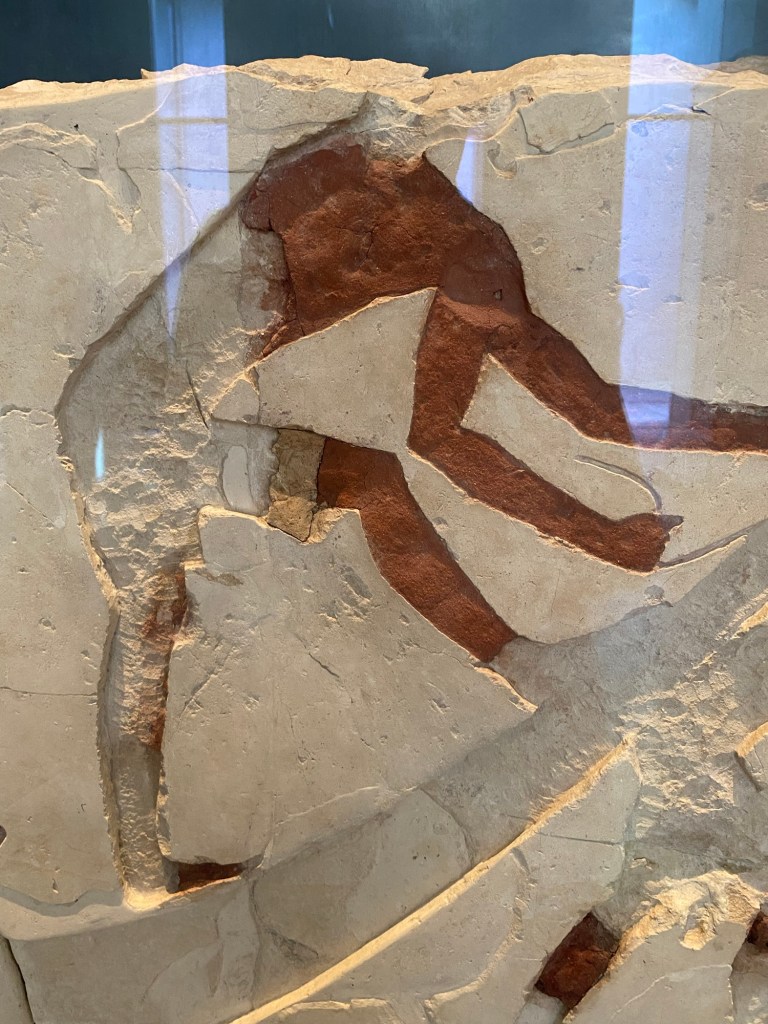
Shifting into 3rd person: Well, that’s very interesting, you muse. You can’t recall ever having that particular bit of information about how the reliefs were produced. You always thought that, if you thought about Egyptian art at all, which is rare actually, the reliefs were carved from the surface down, forming shapes as the carving was done. You hadn’t thought about gouging out the stone in a more thorough fashion and then filing it in with gesso or something and then coloring it. Ah, must have known that. But, look at how well it’s explained and the many examples they are displaying. Well, one quick picture can’t hurt to take. But, no lable picture ’cause you aren’t really here to study.
Another intriguing sign. Art and Time. That’s been my lucky life (not all of my life is lucky, but a lot of the art loving part of it has been).

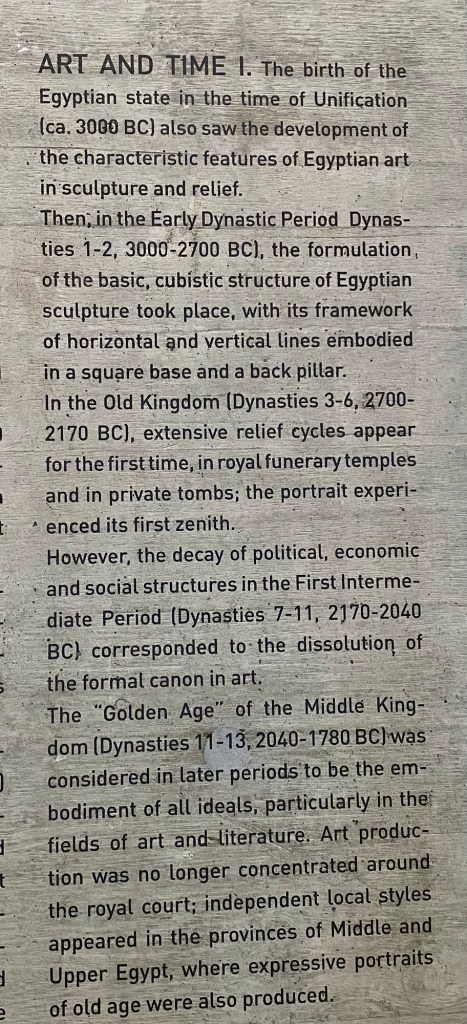
I appreciate the simplicity of the labeling. It’s short and sweet and carries a lot of excellent info. It’s digestible. It’s not a Wikipedia summary.
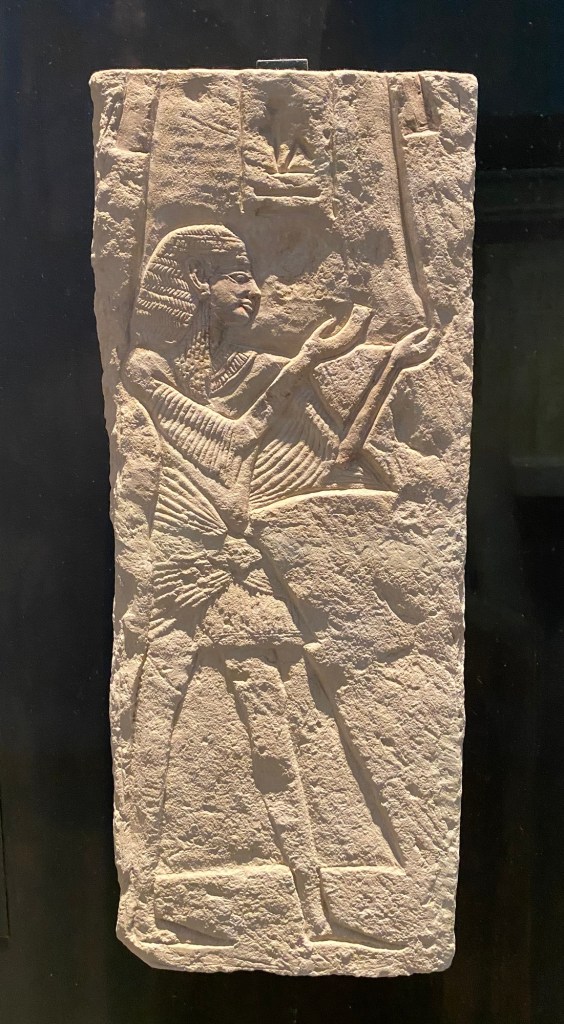
You wander along, swept by the current, and when you see the next sculpture, you are back at what you know, sculpture that is raised in relief from the background, not gouged into the stone. And then you notice all of the surfaces and think about the trouble the artist(s?) went to to portray the skin, the hair, the jewelry. You notice the almost disappearing polychrome and think about how it might have looked, fully painted. You think you prefer it this way, even if that is wrong.
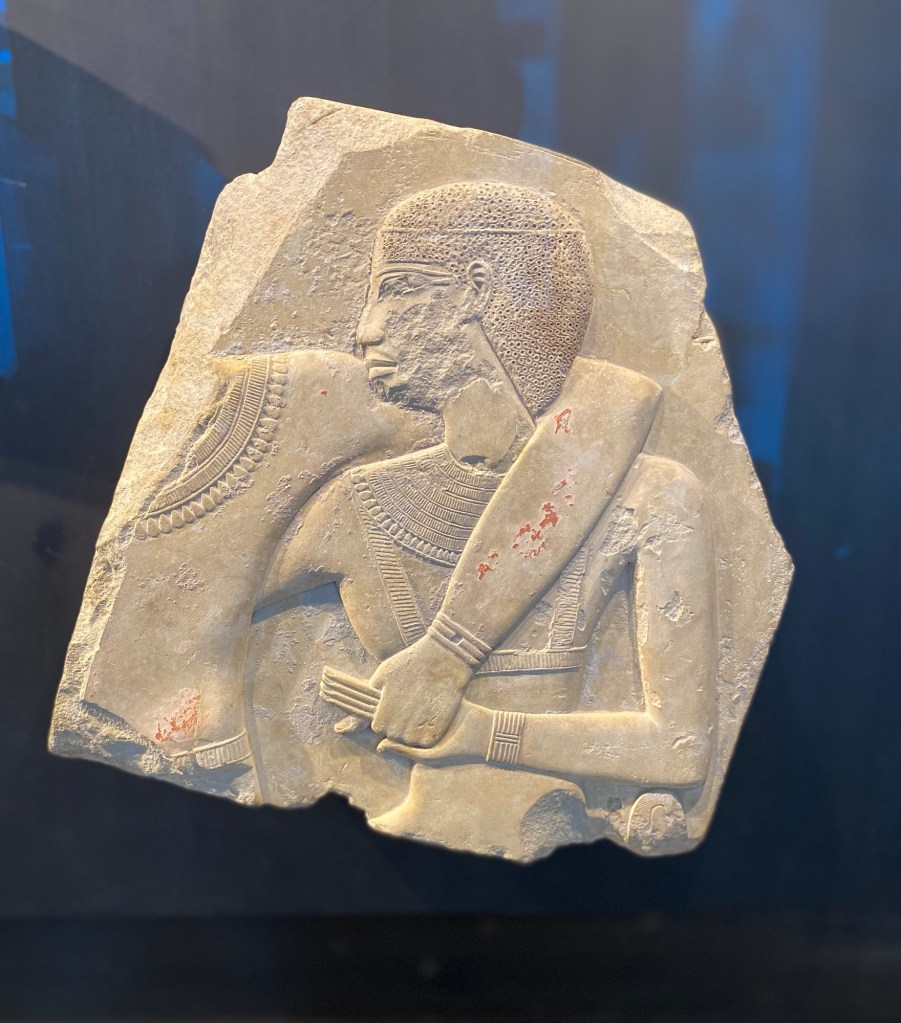
You spend more time thinking about the relief above, because once again you note the gesture of one arm behind another figure. You don’t know who these people represented are, but from the way they are dressed you’d guess that that one on the left is royal and the one on the right is an aide. Is the royal figure gripping the other for assistance in standing or walking? The almost missing royal figure looks young, so you doubt he needed help standing, but maybe he was sick or wounded. Does the aide have his arm around the royal figure out of kindness or concern, or is it just his job. You notice how the royal figure seems to grip the hand of the aide. You suspect there is real need in that grip.
Because you are an art scholar and teacher and museum curator by training, you can’t help think about how the artist mastered what is very shallow overlapping in the relief carving, but for the time period it is very advanced. You know that much. And it reminds you of the arm of the wife in the first statue, which is shown embracing her husband’s torso. Overlapping again. And, thinking back, was that a gesture of care and concern or was it just her job as his wife? Interesting to consider, don’t you think?

Then you are confronted by this sculpted head and it almost doesn’t seem Egyptian. For sure the facial features are Asiatic. What the heck? This seems new to me in an Egyptian museum. I read the label. I was right about Asia. And then my mind starts wondering about how many East Asian visitors there must have been for one of them to be represented permanently in art of the period. Who was this early voyager and what was he there for? The questions are endless, but I have miles to go and must stay on topic.

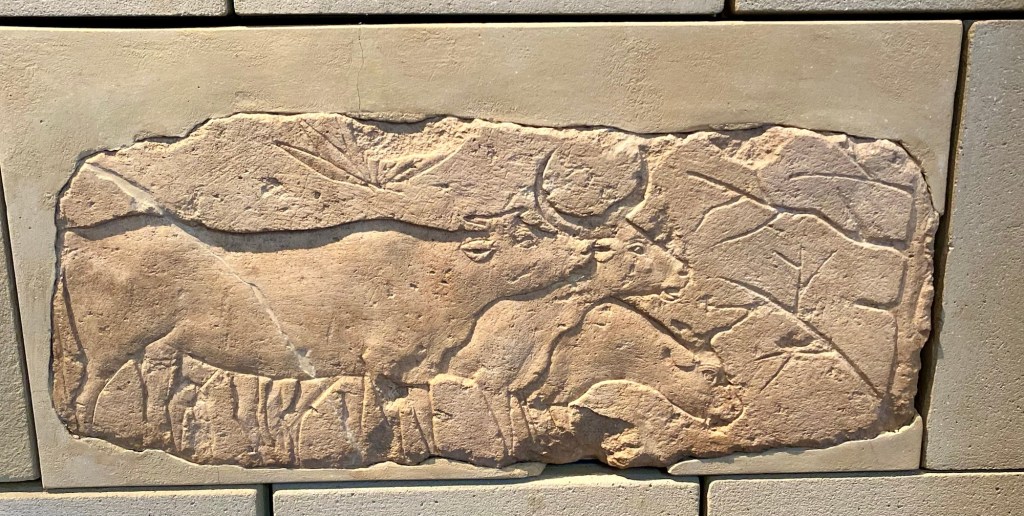
Without taking the time to photograph a label, because I’m off duty today, I can’t help but notice the use of overlap again in this relief carving of cattle. Very effective. Look at the legs as well as the heads. Very impressive.
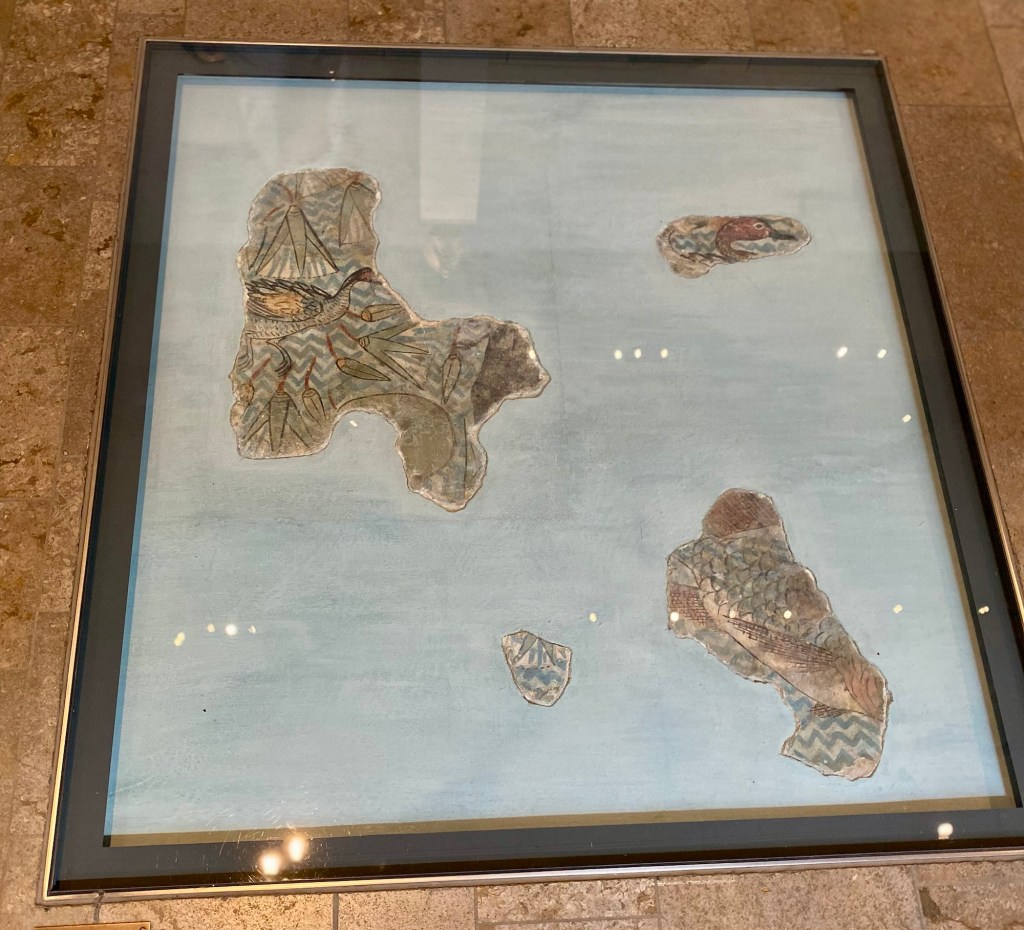
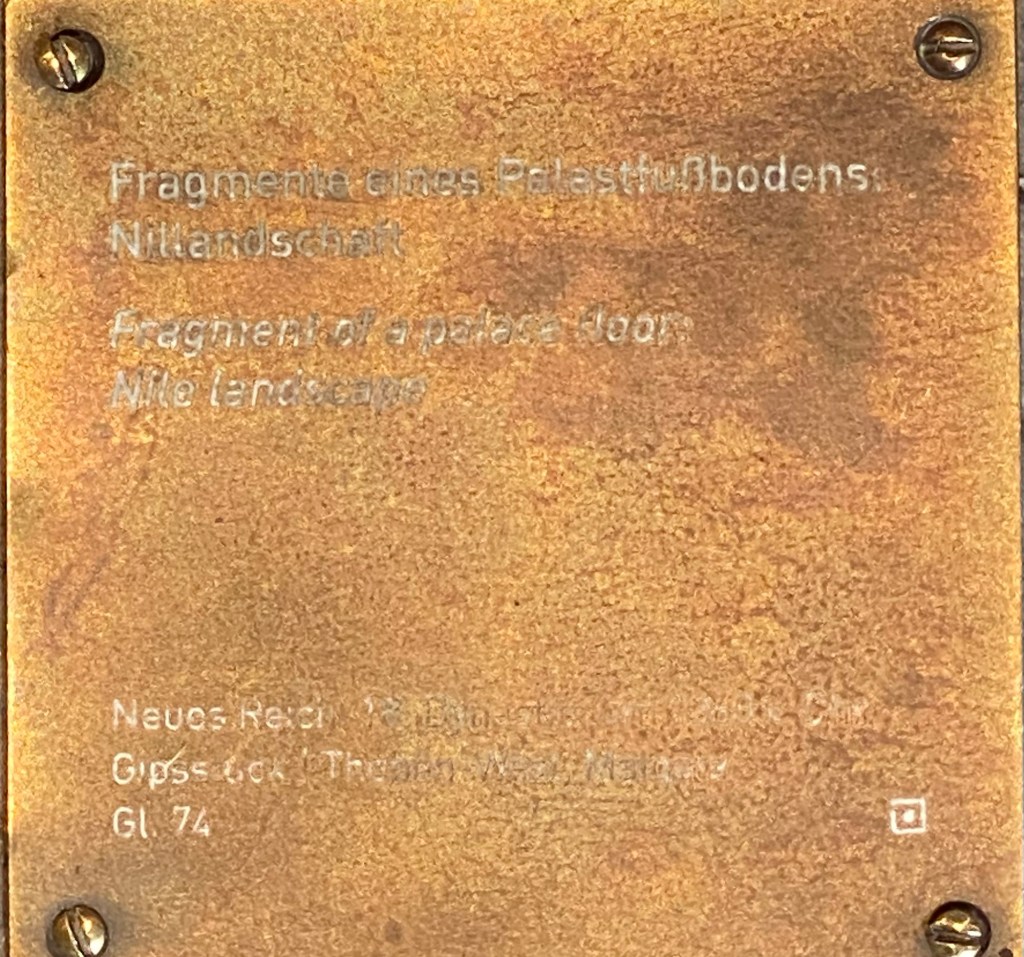
I notice an unusual display device: there is something in the floor. I spend a few moments looking at what I read in the label is a remnant of an Egyptian palace floor. Wow. For that to have survived is incredible. And I think for a moment about how Ludwig I probably was responsible for acquiring all of these incredible works of art and material culture and what must have been involved in transporting the objects from Egypt to Munich, not to mention the fact that these floor fragments were rescued at all and what was that all about? My mind is freshly blown. I must move on.
What’s this I see? I’m familiar of course with this type of sculpture. And not just from today. I’ve lectured in art history 101 about this type. I’m guessing it’s another husband and wife and I take a quick look at the label and discover its a mother and son!
Well, that’s a refreshing change in the iconography and it sets me to thinking. Because I have a grown son and I understand on a very deep level the human emotion that could underlie this grouping. Her left arm is around her son; is that an important difference? Can only royal figures or only wives use their right arm to embrace their relative?
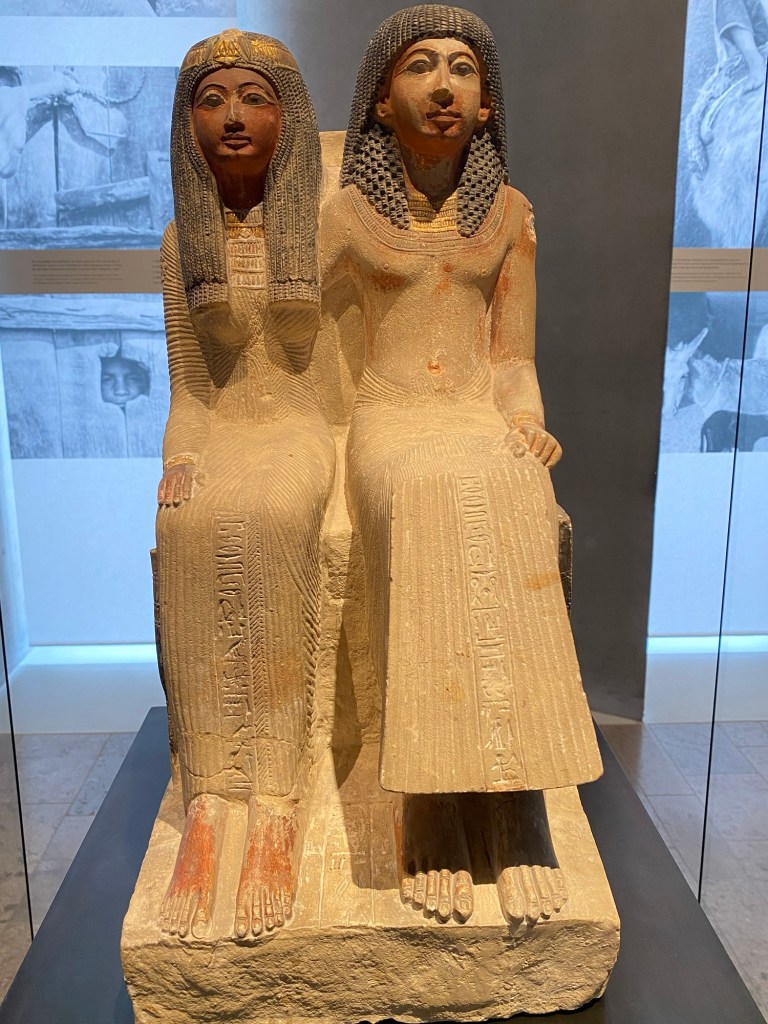
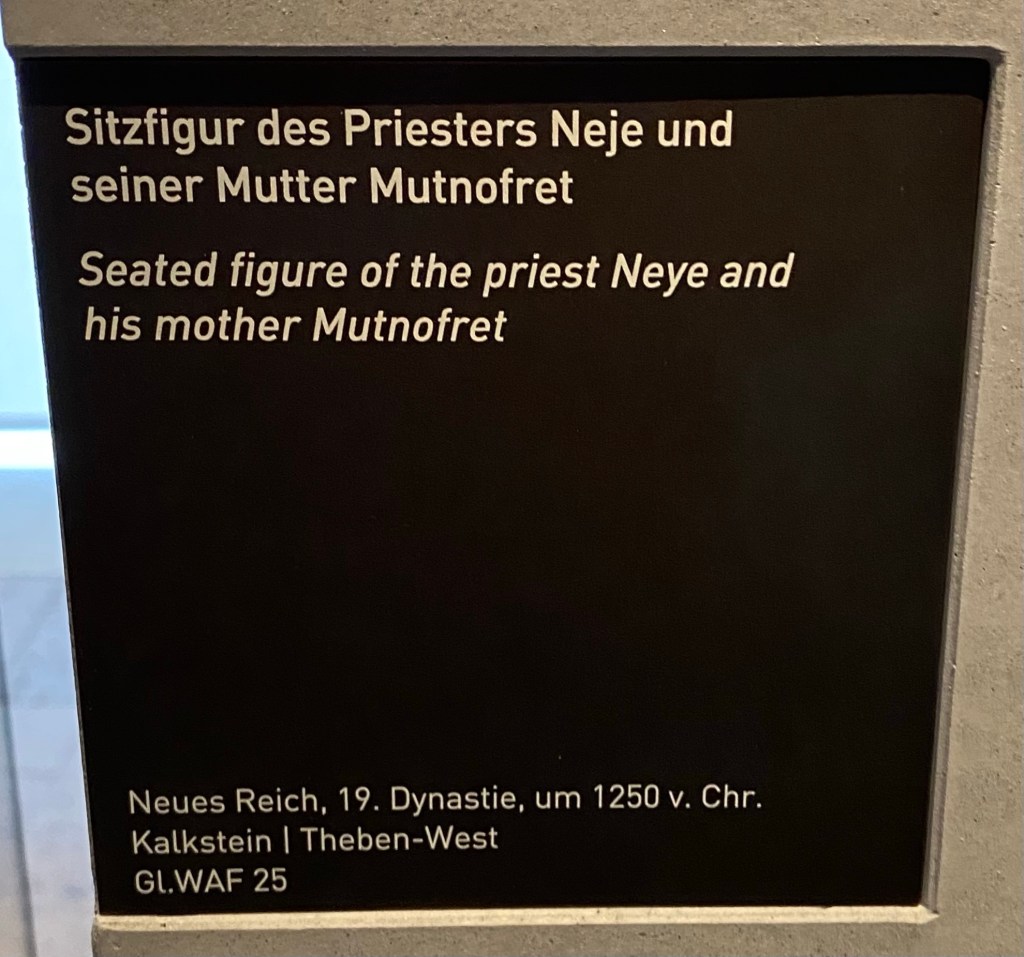
Of course I must go to the side to see if the mom’s arm is finished. It is! Her hand touches her son’s shoulder and I intuit that her touch is much more affectionate than that of the earlier wife whose arm is in contact her husband’s shoulder. Is that just my emotion talking or do you see it too?
I understand the relationship between a mother an grown son, because I have a grown son. He’s behaving like a jackal at the moment, but I still do and always will love him fiercely. And affectionately.

I honestly don’t know what caused me to take the next picture. It’s beautiful, but so were 1000 other objects in the building.
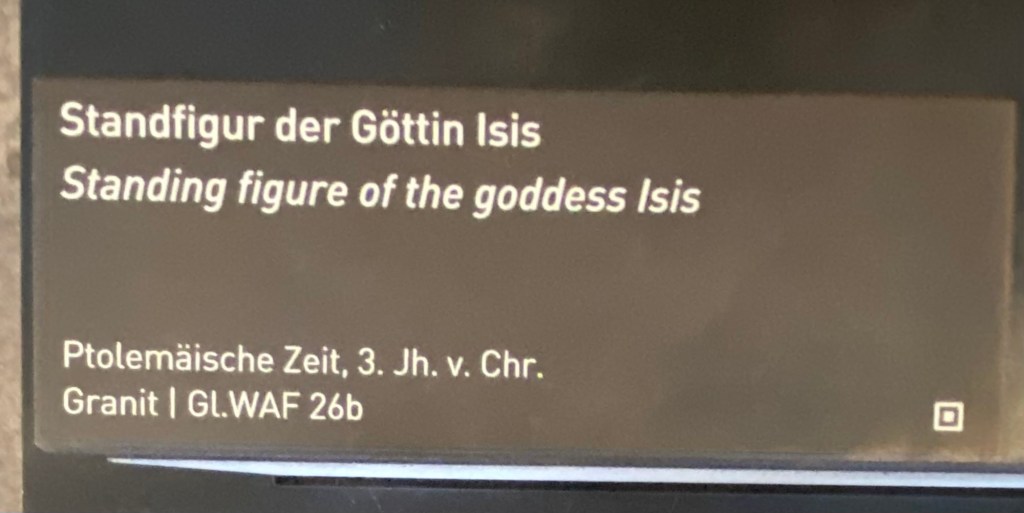
I do know why I took the next picture. It was refreshing to see a woman represented in all the standing statues. Of course, I realized when I read the label (which I photographed): it’s’ a goddess. Probably a real, regular woman (and what exactly would that be?) wouldn’t merit representation in Egypt.

The next sculpture was surprising in this gallery of static block like figures. I detect a sway, some movement, some sensuality. Something is very different.
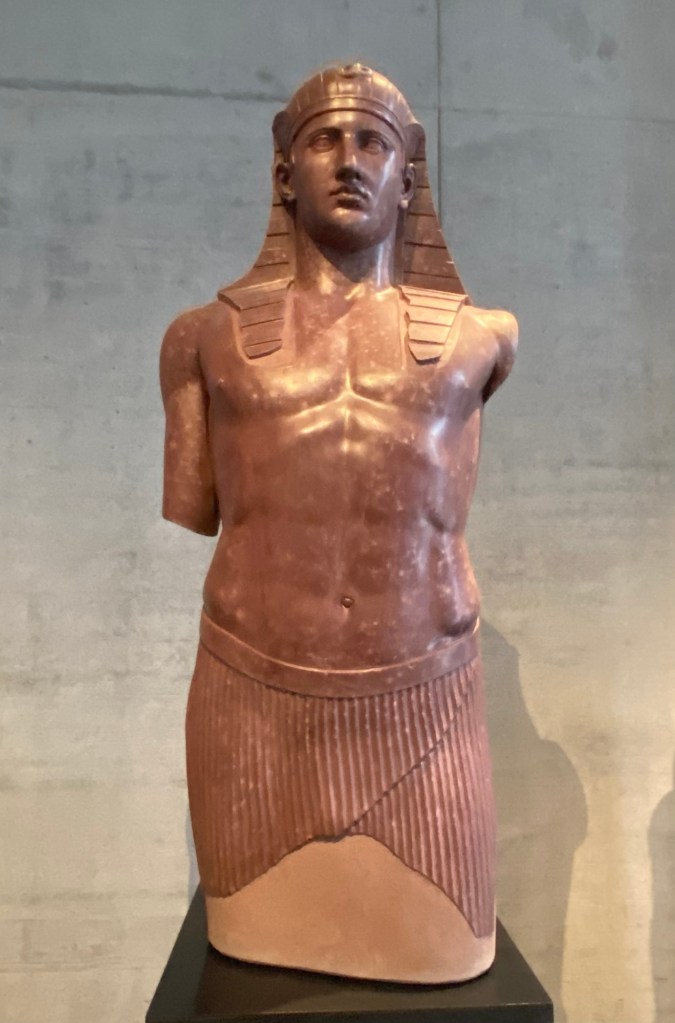
I read and photograph the label. Ah, it’s a Roman man, who has been “Egyptianized!” I know immediately when and where we are and it explains the figure to me.

I walk on. I see an obelisk in the next small gallery. I’ve seen 1000 obelisks before, if not 10,000. Ho hum I think. I’m on vacation.

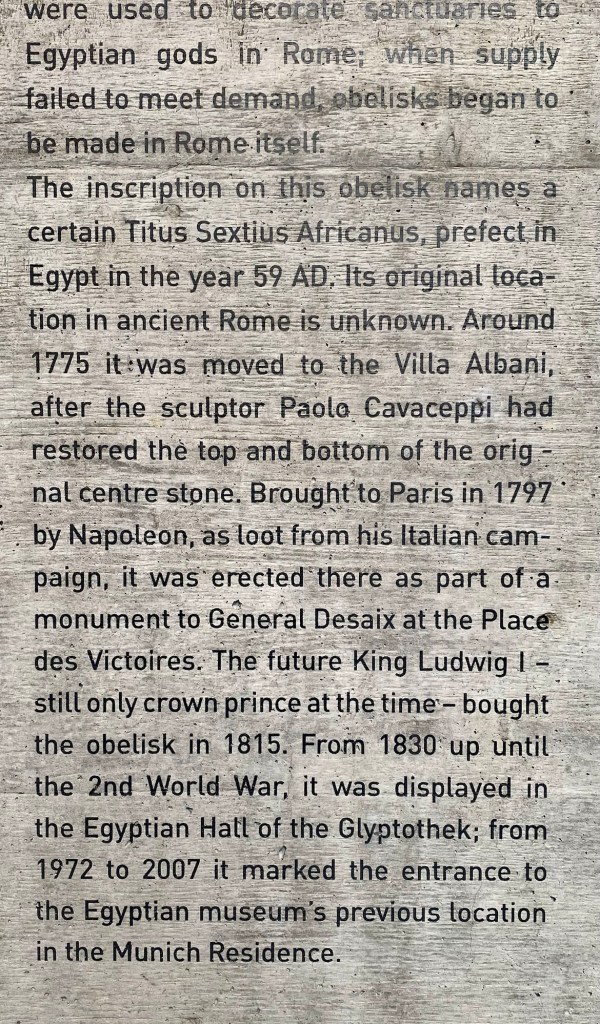
But I stop to read the excellent English label and I learn new things, in spite of me being off duty.

I had not known (even if I had read it previously) that obelisks were produced in Rome to keep up with the demand for them. That is news to me. And I love it!
And then I hone in on the provenance of this particular obelisk and I’m no longer on vacation. I am activated. This is fascinating and I want to know more and I want to think about it all.
Think about how/why this was produced. Think about where is was originally located in Rome (my Rome!) and where the heck was it for the 1700+ years after it was created? Obviously in Rome, but where? Where was it when Rome was sacked in 1527? It suffered damage to the top and restored in the 18th century by an Italian sculptor?!
When Napoleon was capturing artworks as well as kingdoms, he brought this obelisk to Paris in 1797. Ludwig I bought it and it came to Munich with so many other amazing treasures. It survived WWII. It’s before my eyes right now. It’s a miracle.
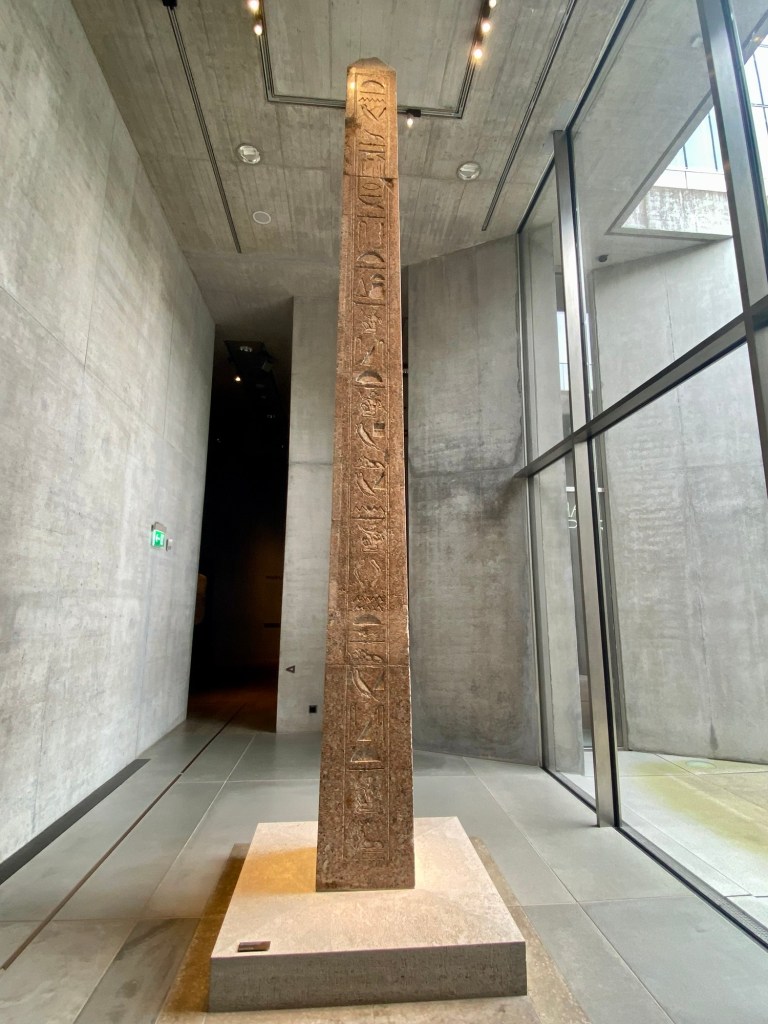
After musing for a while about the obelisk in general and this one in particular, I notice the next outsized label which captured me with its simple title: Pharaoh. Well, I mean I have to read this label. It’s arresting!

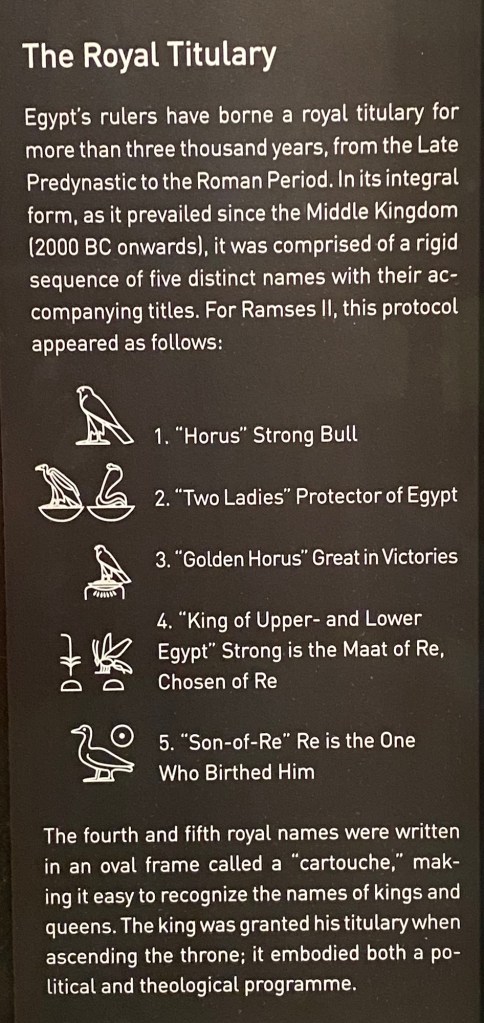
Next think I know, I’m taking pictures not of art works but of labels. There is too much great info in these labels to be ignored. Forget being off duty. I’m here! Let’s go!

Ah, I think, while reading this label. Here, in Munich and before in Berlin, I’m reminded constantly of WWII and its root causes. The “other” is always a scapegoat. The world suffers. I think of Israel and Palestine. I am saddened by current events, lost in the thought of endless battles and wars over what’s different.
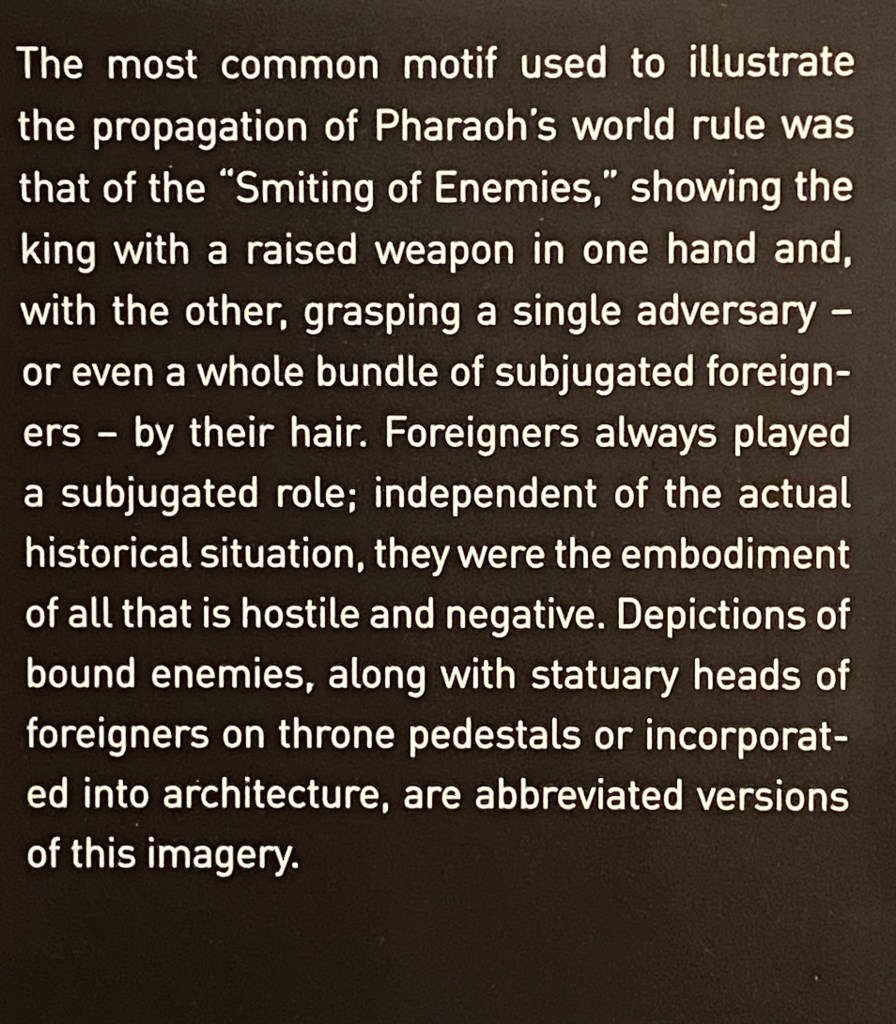
I stop reading and thinking and move on. The next labels seems so succinct, I find myself interested and taking pictures. I’ll read this all at home and think about it there, I think.
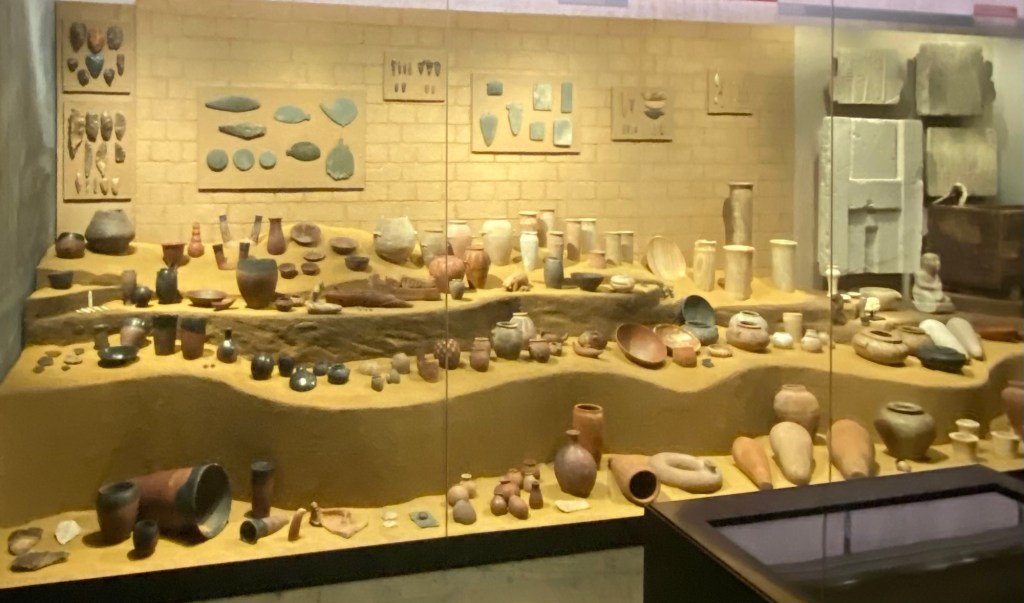
I enter the next gallery. It presents a time line of cultural developments and changes in a completely unique way. Yes, there are the dates and labels with info. But, it is SHOWN. Not told. Starting with the earliest finds of pottery, moving into the Roman era. It is presented before my eyes in the most effective way I have ever witnessed. I want to spend a day with this time line.

But, I must move on. I’m a visitor here. I don’t live here beyond the next couple of weeks.
What do you think happens next? Will I further succumb or will I be on vacation?
 get back, lauretta!
Loved this
It’s an outstanding museum and collection! :-))