On my recent visit to San Miniato al Monte, (see this post: https://getbacklauretta.com/2026/06/15/a-short-sweet-visit-with-an-ancient-friend/) I was struck by the monumentality, simplicity, and modernity of this funerary monument. Settled in a place of honor among many more traditional tomb monuments in the presitigious cemetery that forms a part of the grounds of the august basilica, I knew I was in the presence of someone of great importance, but I did not know who. I began a lovely, short voyage of discovery!
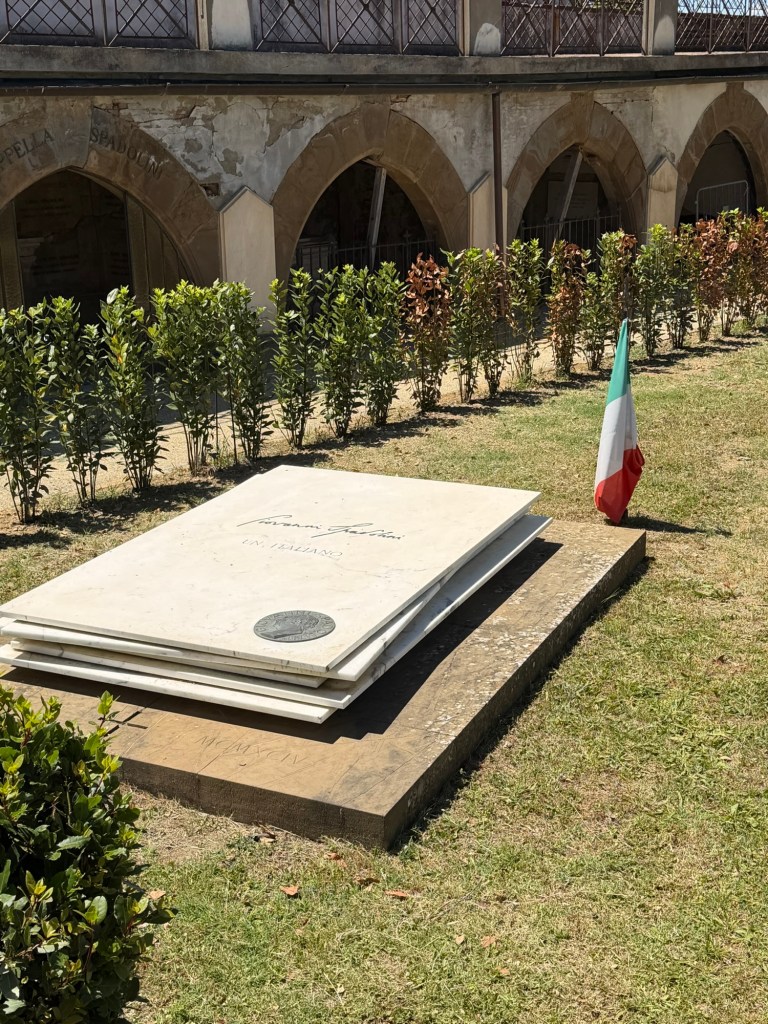
I moved in closer for a better view and was rewarded for my efforts with a clearer view of this spectacularly simple but evocative engraved slab of what appears to be a travertine block. The area was blocked off and I could not get closer for a better look.
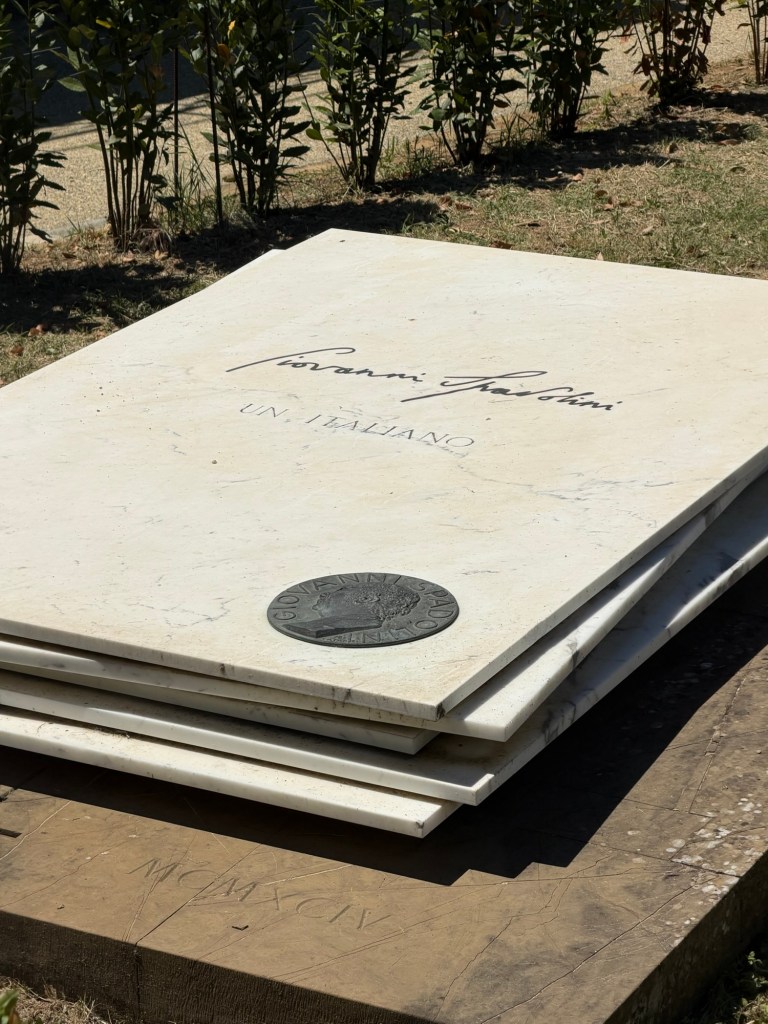
At this distance, I could get a better look at the tombstone and was even further impressed with the design of overlapping blocks of white stone that invoked the idea of books stacked up. Was I in the presence of an author?
My readers know that I know a lot about Italian art, but my knowledge of Italian literature, history and politics is spotty at best. It will take the rest of my life to develop a decent familiarity. But, I’m working on it!
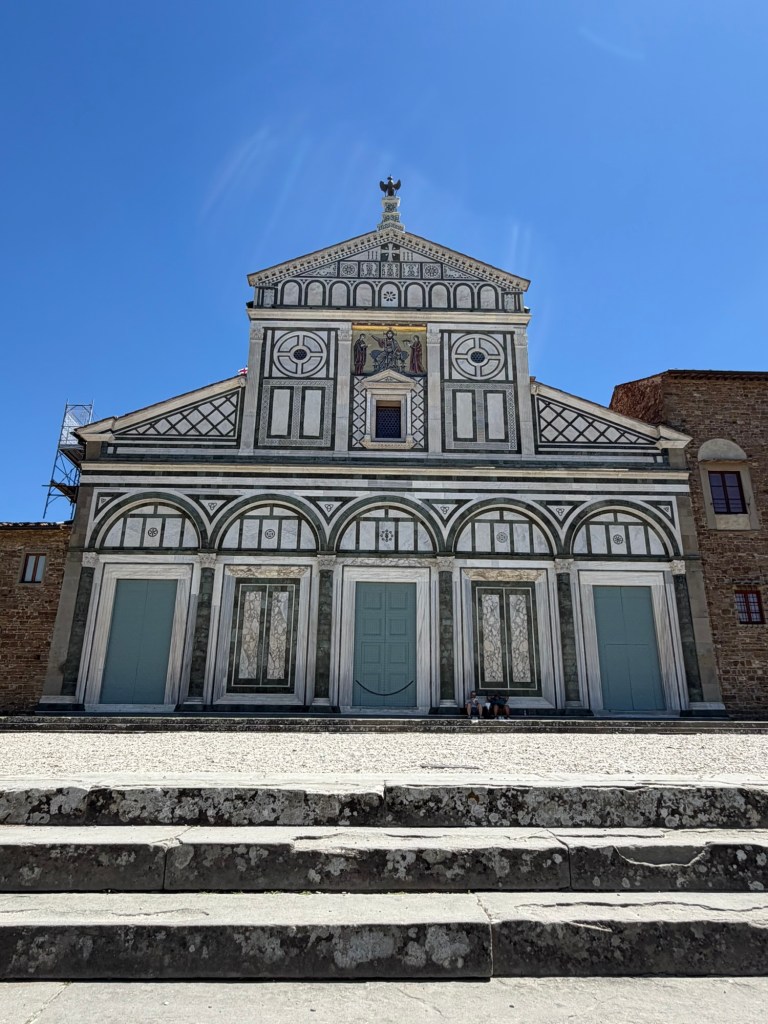
The cemetery, Cimitero delle Porte Sante (The Sacred Doors), is a monumental churchyard in Florence located within the fortified bastion of the Basilica of San Miniato al Monte. Although the basilica is ancient, the idea of a burial site near San Miniato was only conceived around 1837 and it took the camposanto (sacred ground) 11 years to be inaugurated in 1848.
The project, originally entrusted to architect Niccolò Matas (the designer of the 19th-century facade of the Basilica of Santa Croce), was enlarged; in 1864 Mariano Falcini took over and expanded the cemetery to cover the entire area of the 16th-century fortress lying around the church, including the front, sides and back of the church.
The project of the new cemetery grew parallel with the development of the new road network, elaborated by architect Giuseppe Poggi, which, with the opening of the Viale dei Colli and the new monumental staircase to the basilica itself which I climbed on this visit as I have on countless others, created new ways to access the church and surrounding cemetery.
Poggi, about whom I have often posted in this blog, is remembered for his leadership in expanding the city of Florence in recognition of its new status when it became the Capitol of the new kingdom of Italy in 1865. Poggi was appointed to direct the expansion of the city to reflect its new status. This important public commission took up all his time from 1864 to 1877 and brought him wide recognition. His work involved the creation of new avenues and squares for the city; flood defenses; modernization of the sewage system; an official plan for new residential areas and road layout; improvement of the water supply; a new livestock market and abbatoirs; the relocation of the railway network and the creation of a new station on the outskirts of the city; and the construction of the Viale dei Colli and Piazzale Michelangelo, for which he achieved most renown.
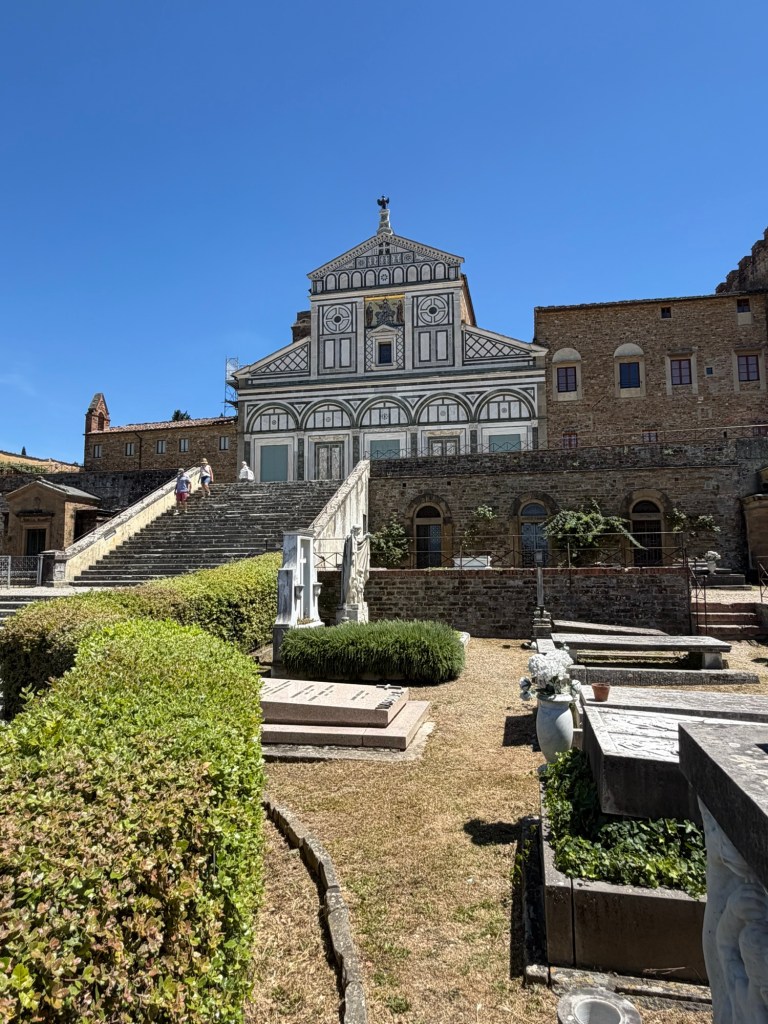
In the photo above you see the church in the background and parts of the cemetery at the lower foreground. Spadolini’s grave is in this section.
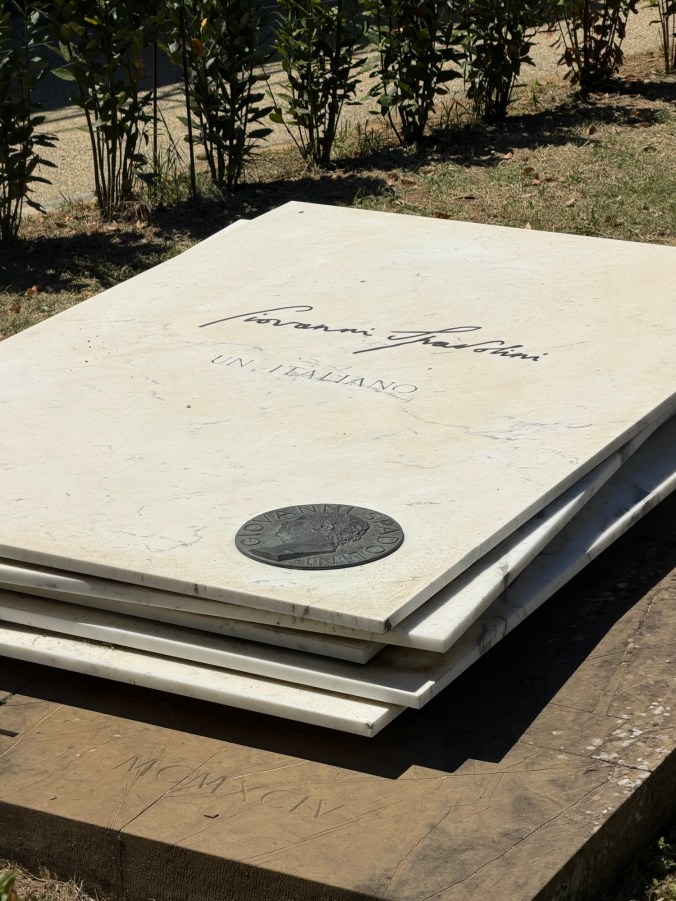
Looking closer at the top of the monument we see an engraved facsimile of Spadolini’s signature, with the stunningly simple epitaph, UN ITALIANO (an Italian). That simplicity gives a jolt of power because the rest of the cemetery is filled with the more Victorian era types of funerary monuments which are very traditional and sentimental.
Ok, I give up! Who is this man?

Giovanni Spadolini (1925 – 1994), born in Florence, was an Italian politician and statesman, who served as the 44th prime minister of Italy. He had been a leading figure in the Republican Party and the first head of a government not be a member of Christian Democrats since 1945. He was also a newspaper editor, journalist and historian. He is considered a highly respected intellectual for his literary works and his cultural contributions..
Spadolini was the first Italian Minister of Cultural Heritage and Environment from 1974 to 1976. He became Prime Minister in 1981 and he led two successive cabinets which were supported by a coalition of parties in Parliament but this only lasted a few months. He was Minister of Defence in the governments headed by Socialist leader Bettino Craxi from 1983 to 1987 before being elected President of the Senate. In 1991, Spadolini was appointed Lifetime Senator by President Francesco Cossiga.
Professor of Contemporary History at the University of Florence, he was the author of numerous historical works. He was also a journalist and editor-in-chief of the Bolognese newspaper Il Resto del Carlino, then of the Milanese newspaper Il Corriere della Sera.
And who designed this beautiful, evocative modern gravestone? Bruno Catarzi, c 1994, unique marble monument crafted to resemble a stack of overlapping books. The design pays homage to Spaolini’s life as a writer, academic, and passionate historian.
Bruno Catarzi (1903 – 1996 ) was Tuscan sculptor and engraver. He began his studies at the Academy of Fine Arts of Florence under Domenico Trentacoste. He was a prolific designer of medals. In the 1930s, he taught at the Scuola d’Arte of Pistoia (among his pupils were Agenore Fabbri and Jorio Vivarelli), and from 1963 to 1973, he taught at the Istituto d’Arte of Arezzo.
RIP


Real lives and people who have made changes, made better. That’s what makes it all so culturally rich.
I was a little disconcerted by your mention of ‘public’ abatoirs!
Haha Michael! Good catch. I was quoting Wikipedia entry, but I will change it now. I wonder what a public abattoir consisted of. Maybe it’s better not to think about it. It’s HOT here. How’s your weather?
I’m still marvelling at the detail and professionalism of the lion in the Basilica piece you did, earlier. Even in the lion’s mouth, the detailing!
I agree! Imagine carving details like that. The time, the talent.