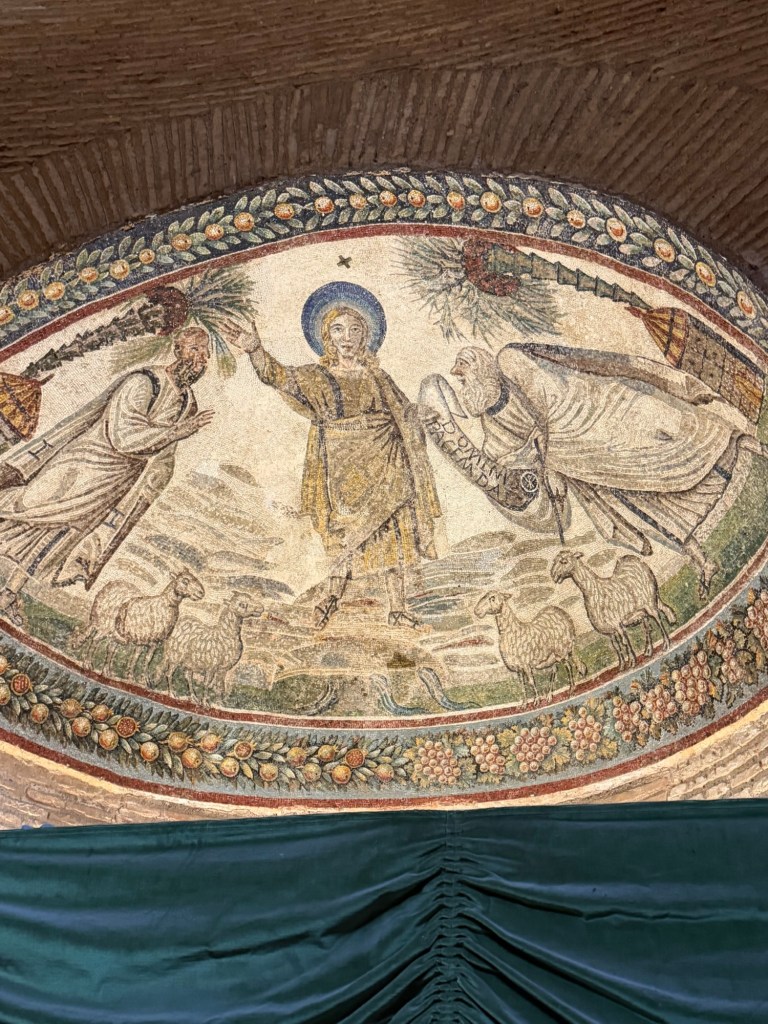
In late April of 2026 I visited this 4th C church in Rome, not far from Villa Ada. Here are my photos. Attached to this same complex are the vast Priscilla catacombs. My companion and I took a guided tour of the catacombs but were not allowed to take any photos. It is extensive and impressive, built as it is in a former Roman era quarry. Some notes on the catacombs follow at the end of this post.
The church located at the site of the Catacombs of Priscilla is the Basilica of San Silvestro in Priscilla (Basilica of St. Sylvester). Built in the early 4th century by Pope St. Sylvester (who served from 314 to 335 CE), this basilica was erected directly over the tomb of the martyred pope. It fell into disrepair over the centuries but was rebuilt in the late 19th century using original ancient remains and structural foundations




The Catacomb of Priscilla is a large archaeological site on the Via Salaria in Rome, Italy, situated in what was a quarry in Roman times. The catacombs extend underground for over seven miles, making them one of Rome’s most extensive catacombs. It was used for thousands of Christian burials from the late 2nd century through the 4th century. The origin of the catacomb’s namesake is highly contested and theorized. In one theory, Priscilla belonged to the Acilii Glabriones family and was the woman patron who donated the site. The family name can be found etched into the hypogeum.
The walls also display some of the earliest known frescos and mosaics of Biblical scenes. Many of these pictures are studied specifically for their portrayal of early Christian women.
The modern entrance to the catacombs are on the Via Salaria through the cloister of the monastery of the Benedictines of Priscilla. The Catacombs of Priscilla are divided into three notable areas: a Greek Chapel (Capella Greca), the cryptoporticus, and the tombs.
https://www.bbc.com/culture/article/20150224-the-secrets-of-the-catacombs

