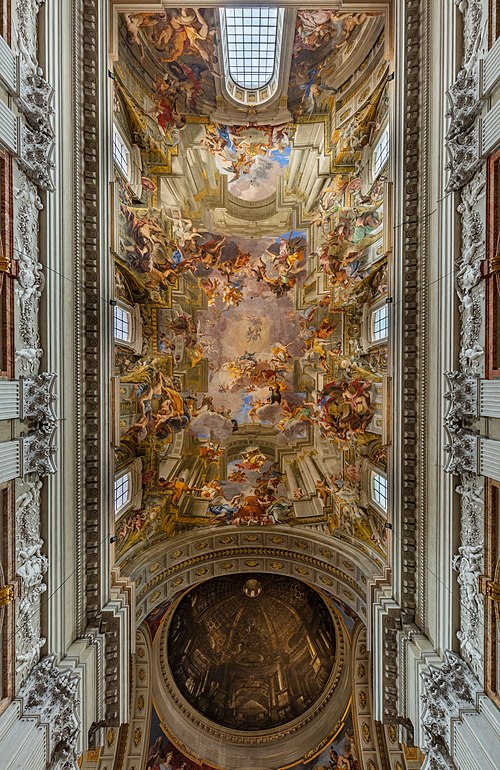
Andrea Pozzo’s painted ceiling with trompe-l’œil architecture.
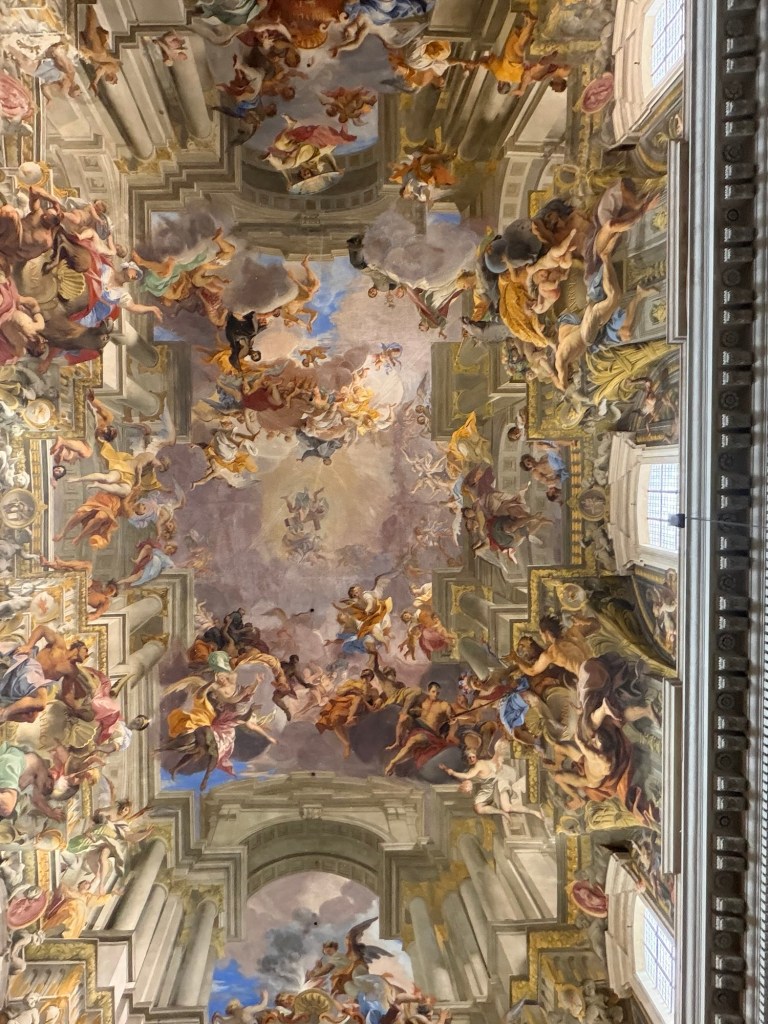
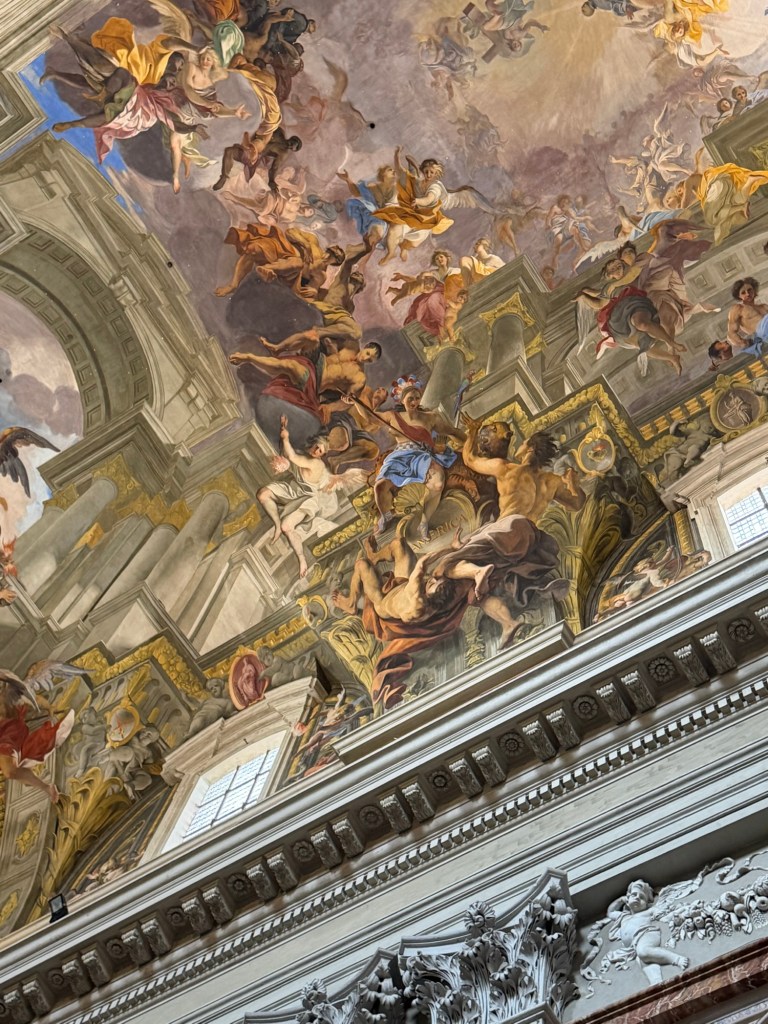
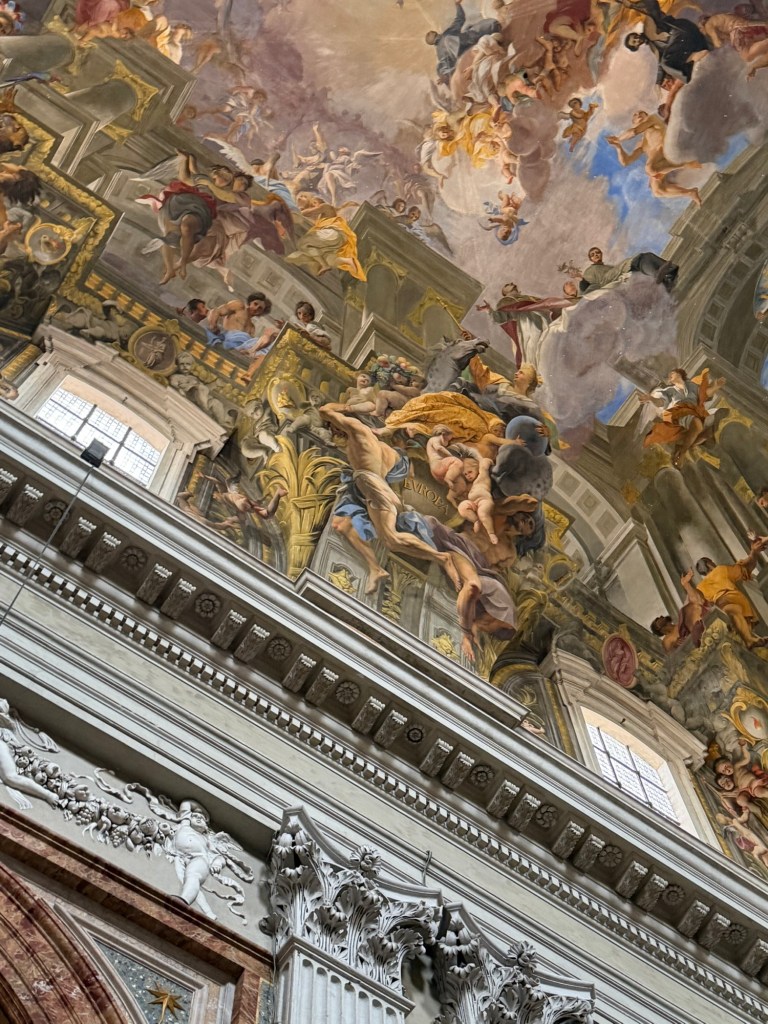
Pozzo, a Jesuit lay brother, painted the grandiose fresco that stretches across the ceiling of the nave around 1685. It celebrates the work of Saint Ignatius and the Society of Jesus in the world presenting the saint welcomed into paradise by Christ and the Virgin Mary and surrounded by allegorical representations of all four continents.
By the skilful use of linear perspective, light, and shade, he made the great barrel-vault of the nave of the church into an idealized aula from which is seen the reception of St. Ignatius into the opened heavens. Pozzo worked to open up, even dissolve the actual surface of the nave’s barrel vault to make the observer see a huge and lofty cupola (of a sort), open to the bright sky, and filled with upward floating figures. A marble disk set into the middle of the nave floor marks the ideal spot from which observers might fully experience the illusion.
A second marker in the nave floor further east provides the ideal vantage point for the trompe-l’œil painting on canvas that covers the crossing and depicts a tall, ribbed and coffered dome. The cupola one expects to see here was never built and in its place, in 1685, Andrea Pozzo supplied a painting on canvas with a projection of a cupola. The original painting, completed in 1685, was destroyed by fire; in 1823 it was faithfully reproduced by Francesco Manno on the basis of drawings and studies left by the Pozzo.
Pozzo also frescoed the pendentives in the crossing with Old Testament figures: Judith, David, Samson, and Jaele.
Pozzo also painted the frescoes in the eastern apse depicting the life and apotheosis of St Ignatius. The Siege of Pamplona in the tall panel on the left commemorates the wounding of Ignatius, which led to the convalescence that transformed his life. The panel over the high altar, Vision of St Ignatius at the Chapel of La Storta, commemorates the vision that gave the saint his divine calling. St Ignatius sends St Francis Xavier to India recalls the aggressive Jesuit missionary work in foreign countries, and finally, St Ignatius Receiving Francesco Borgia recalls the recruitment of the Spanish noble who would become General of the Company of Jesuits. Pozzo is also responsible for the fresco in the conch depicting St. Ignatius Healing the Pestilent.
Here are my photos of the remarkable ceiling from my recent visit to Rome. I never cease to be overwhelmed is a most enjoyable way whenever I view this gargantuan ceiling!
It is ALWAYS the personifications of the 4 continents that attracts my eye: Europe, America, Africa, Asia. Of course I particularly love the image of America!
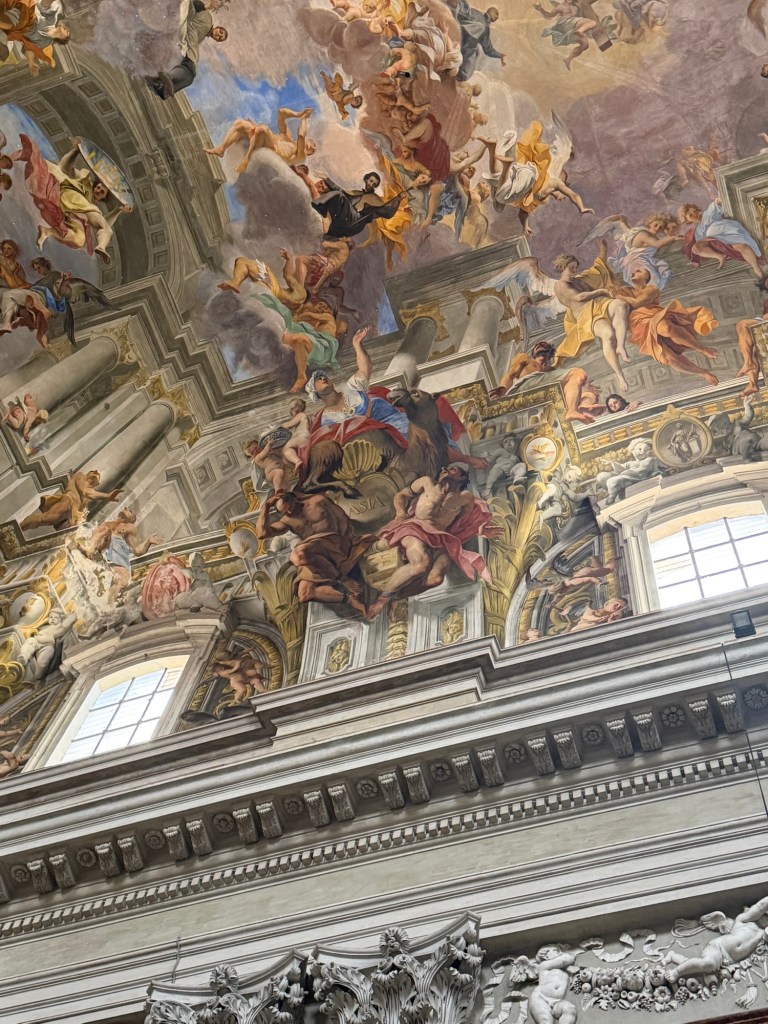
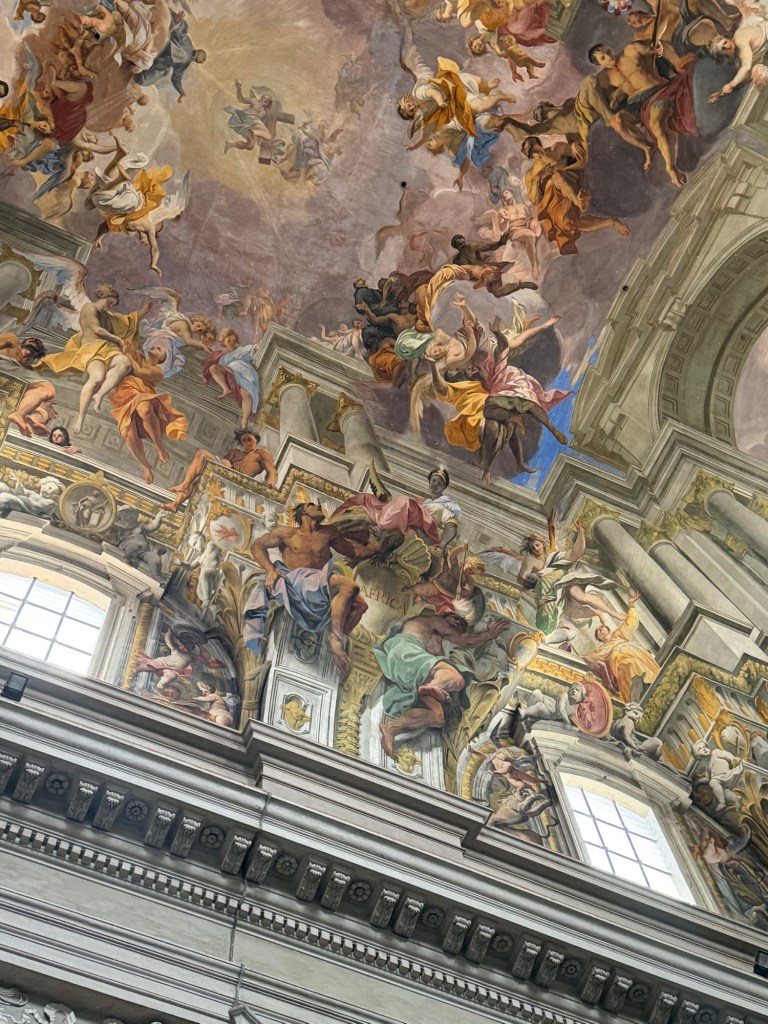
But, outside the church is just as wonderful as inside!
Surrounding Buildings & Area: Piazza Sant’Ignazio: Located directly outside the church, this triangular plaza was designed by architect Filippo Raguzzini (1727–1728). It is a unique example of Rococo urban planning, featuring uniform, concave residential apartment buildings that contrast against the grand façade of the church.
Palazzo del Collegio Romano: Situated right next to the church, this massive building was the original home of the Roman College founded by the Jesuits. Today, it houses the Biblioteca Nazionale Centrale di Roma and the Convitto Nazionale Vittorio Emanuele II.Piazza del Gesù:
Just a short walk southwest lies this iconic square, which features the Church of the Gesù—the actual mother church of the Society of Jesus (Jesuits).

The square in front of the Church of St. Ignatius in Rome is known as Piazza Sant’Ignazio. Designed between 1727 and 1728 by architect Filippo Raguzzini, it is a brilliant masterclass in Rococo urban planning.
Key HighlightsThe Concave Buildings: The most defining feature of the square is its harmonious, symmetrical arrangement of ochre-colored apartment buildings. Their unique, rippling, concave facades were built to gracefully guide the eye and accommodate the transition from the bustling city into the monumental church.
The “Chest of Drawers”: Because of their unusual rounded and undulating shapes, the buildings in the piazza were historically nicknamed canterano (Italian for “chest of drawers”).
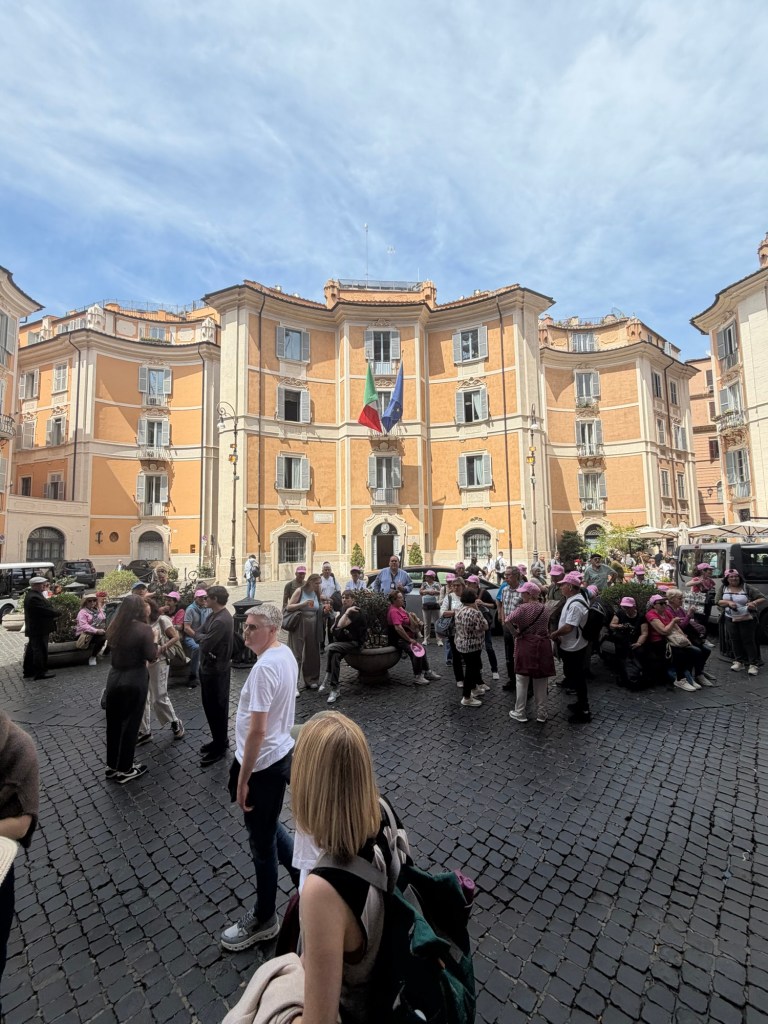


Speehless
That’s the perfect response. It is incredible.
Pingback: Sant’Ignazio di Loyola, Roma, redux: enjoyed in depth and at leisure | get back, lauretta!