A highlight of my recent week in Sardinia was visiting this archaeological site. I was completely uniformed about such locations on the island and it was a wonderful discovery to break that ignorance. Never mind that it was almost 40 degrees C when we arrived at the park, or that I’d been up that day since 4 a.m. to catch the flight from Rome to Sardegna. I was there and ready to learn.
Here’s the highlight of what I learned in that heat that day:
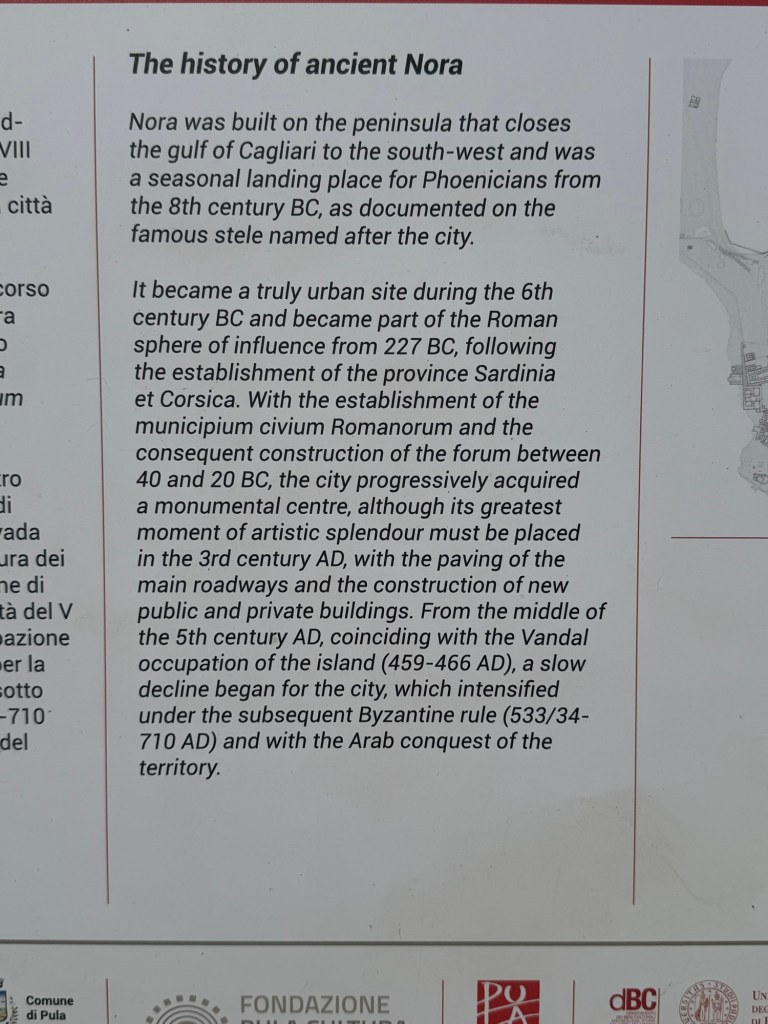
In the late 19th century, a severe storm off the coast of Sardinia revealed parts of an ancient Phoenicia-Punic tophet (ancient cemetery)! More than 100 years previously, the famous Nora Stone had been discovered, incorporated into a nearby church wall, but it wasn’t until 1889 that excavations began on the ancient city of Nora Archaeological Park, near Pula. The site is adjacent to the sea and, as sea levels rise, more is constantly being re-submerged.
When I returned home and began to study Nora, I found that in February of this year, 2026, National Geographic published the following article about Nora.
https://www.nationalgeographic.com/travel/article/nora-sardinia-italy. I quote it below. The pictures are all mine, taken that day. I can definitely recommend a visit to Sardinia and a call to this site. If I ever get there again, I want to visit the National Archaeological Museum of Cagliari (Museo Archeologico Nazionale di Cagliari). It is Sardinia’s premier archaeological repository. Located in the historic Castello district within the Citadel of Museums (Piazza Arsenale), it houses over 4,000 artifacts tracing 7,000 years of island history from the Neolithic to the Byzantine era. The Nora Stone is housed there; it is the ancient stone slab with writing on it from the Phoenician people. It is the oldest Phoenician writing ever found outside of their home land. It tells a story of a battle and uses the name “Sardinia”.
This ancient city in Sardinia was home to pirates—and is an archaeology lover’s dream
Nora doesn’t have the name recognition—or crowds—of Pompeii. But the well-preserved coastal settlement offers travelers a rare glimpse into the lives of the pirates, Vandals, Romans, Phoenicians, and Carthaginians who once laid claim to it.
Perched at the edge of a narrow peninsula in southern Sardinia, the ancient city of Nora is exposed to the elements. Wind, sun, salty air, and for centuries, even pirates. From every vantage point of the port city, residents and visitors can take in views of the Mediterranean Sea, which made Nora a thriving trade hub during the 8th century B.C.
Nora doesn’t have the name recognition, impressive towering structures, or crowds of tourists like Pompeii or Ephesus. The ancient city, now a significant archaeological site, offers history buffs a rare glimpse of over 1,500 years of life in the ancient Sardinian city—a 43-minute drive from Cagliari.
The complex history of Nora
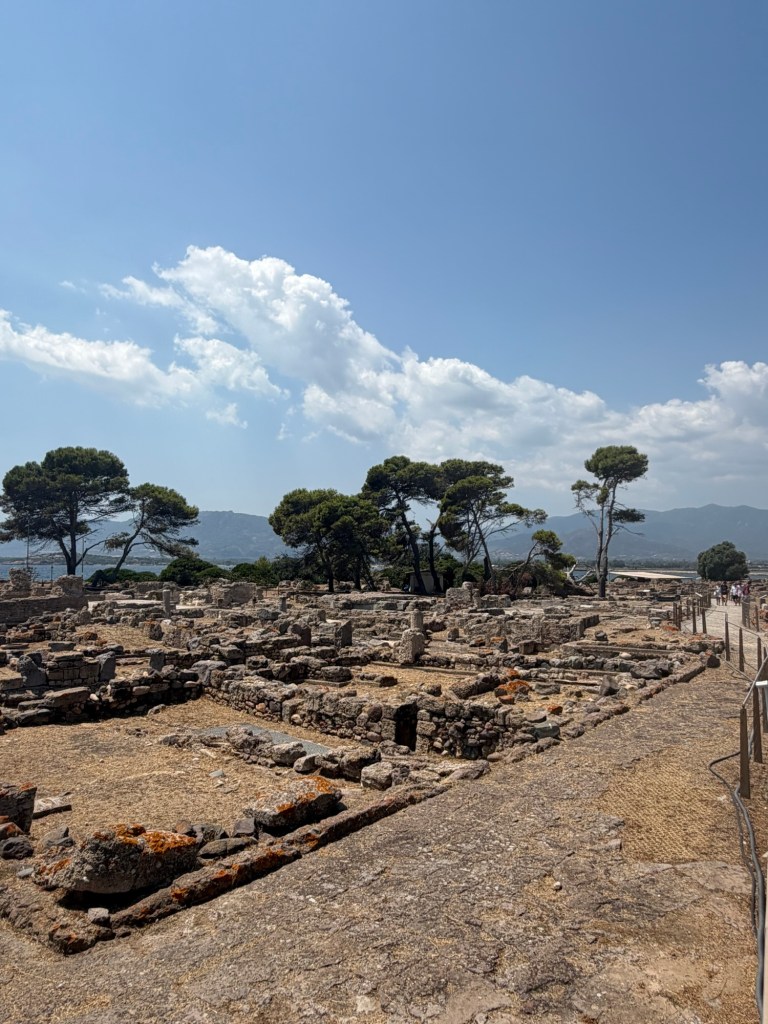
The theater, marketplace, bath complex, old roads, and a temple—most of what’s above ground at Nora—date to the Roman period from 238 B.C. to the 5th century A.D.
But, during the Bronze Age, Sardinia was home to the Nuragic people, a seafaring society that left behind thousands of prehistoric stone structures—big cone-shaped towers called Nuraghi—scattered across the island’s hills. Although there’s no trace of the Nuragic civilization in Nora today, researchers believe the Nuragic people were the first inhabitants in this area.
“The theory is that these people were a fleet of pirates from different Mediterranean islands,” says Maria Paola Loi. “[Around the Iron Age], these megalithic cultures vanished for unexplainable reasons.” By the 8th century B.C., the site had started to take shape as a Phoenician trading outpost. Over a 1,500-year period, Nora was controlled by the Phoenicians, followed by the Carthaginians, and then the Romans after 238 B.C. It was also inhabited by vandals during the mid-5th century, the Byzantines in 535 A.D., and then abandoned around the 8th century due to Arab raids.
At its peak, Nora was home to 8,000 inhabitants. For centuries, Nora was one of the most important settlements in the western Mediterranean. “Nora, like no other ancient city, is at a minimal distance between Italy, Sicily, Africa, and Spain,” says Jacopo Bonetto, professor of classical archaeology at the University of Padova, who has coordinated Nora’s research activities since 1990. “For this reason, it is the best site to study how relationships between different cultures and civilizations have built history.”
During the Middle Ages, however, life along the Sardinian coast changed. “The shores of the island became really unsafe,” says Loi. Pirates from North Africa and the eastern Mediterranean frequently raided Nora, taking advantage of its vulnerable coastal position. Around the same time, the lagoons on the backside of the cape—now home to flocks of pink flamingos—were teaming with mosquitos. Residents contracted malaria, which spread quickly and continued to ravage the island until earnest efforts began to eradicate the disease in the late 1940s.
To escape both disease and attack, Nora settlers fled inland. The nearby town of Pula flourished instead because of its location further inland on the island. Because of these dangers, Sardinians developed a fear of the sea, Loi told me. Even today, residents are much more likely to be shepherds, goatherders, cattle breeders, and miners, rather than fishermen, she says.
As a result, no modern settlements were ever built over the ruins of Nora, preserving it for future research, according to Bonetto.
continuing the article:
What makes Nora special is what’s happening beneath your feet. Since it was unearthed in 1952, archaeologists have continued to excavate the site’s historic connections to Romans, Phoenicians, and Carthaginians. Some of the artifacts from the site (like an inscribed stone known as the Nora Stele) are on display at the National Archaeological Museum in Cagliari.
Archaeologists have uncovered an ancient burial ground from the Phoenician-Punic period, with underground tombs completely intact, including pottery, jewelry, and other funerary goods that had never been disturbed. Bonetto calls this discovery, “The most important testimony of the foundation and life of the Phoenician settlement.” It’s the only known Phoenician necropolis in Sardinia that has been excavated using modern scientific methods, and it helps establish Nora as one of the oldest settlements—if not the oldest—on the island.
At many large archaeological sites, active digs are typically fenced off or otherwise kept separate from visitor routes for safety and preservation, but at Nora, you may be able to see archaeologists at work. According to Bonetto, one particularly exciting moment was when they unearthed a trove of 18 silver coins in pristine condition in the Roman Temple. It’s rare to experience a place where “the history of the city is written—and rewritten—every day.
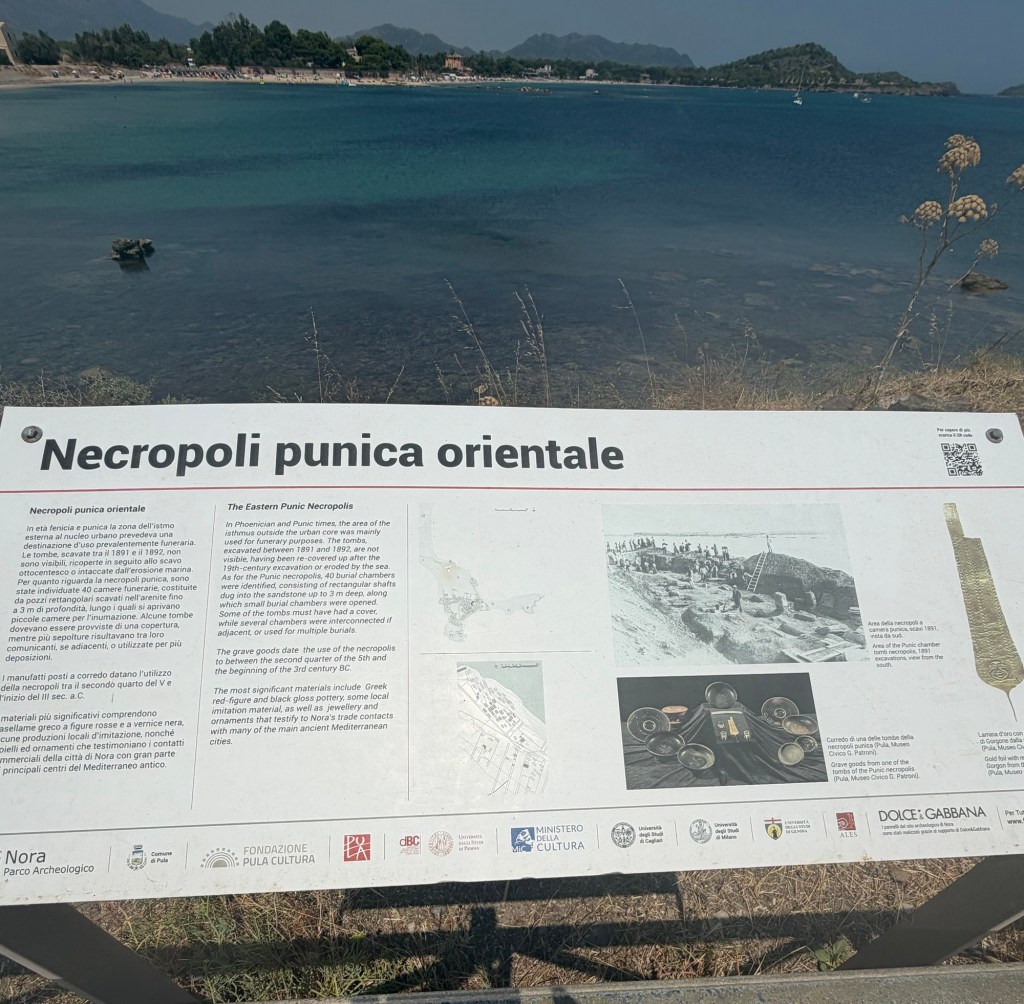
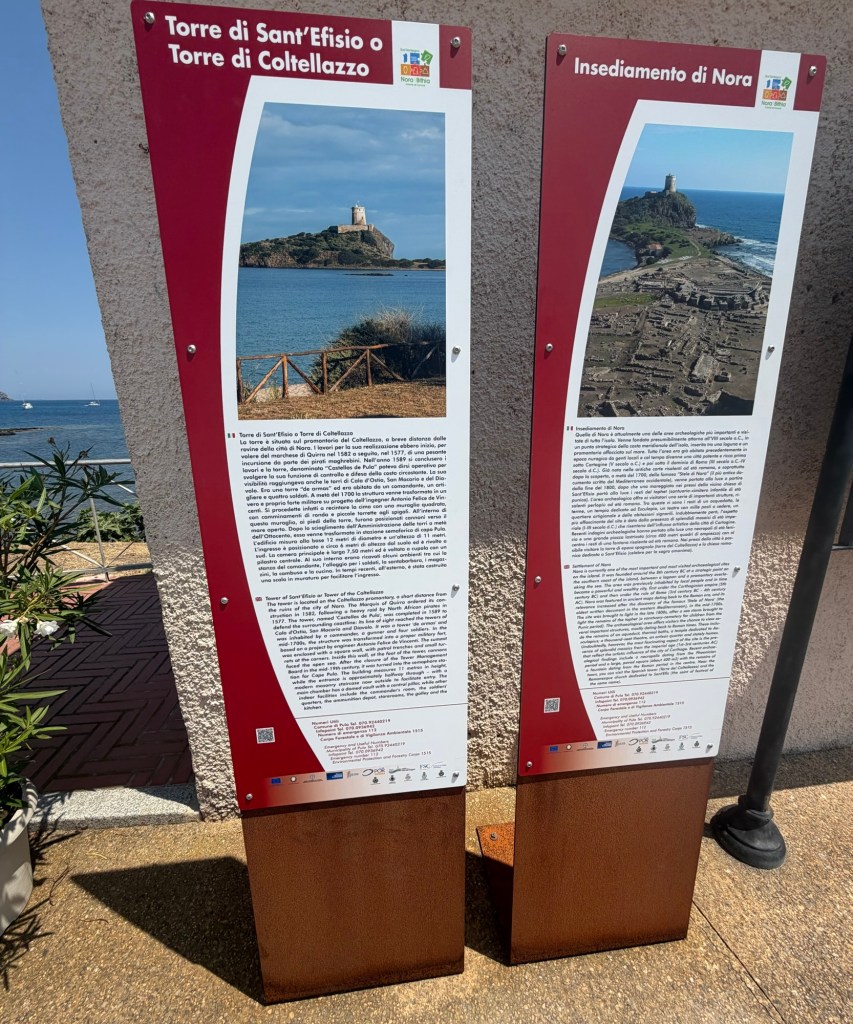
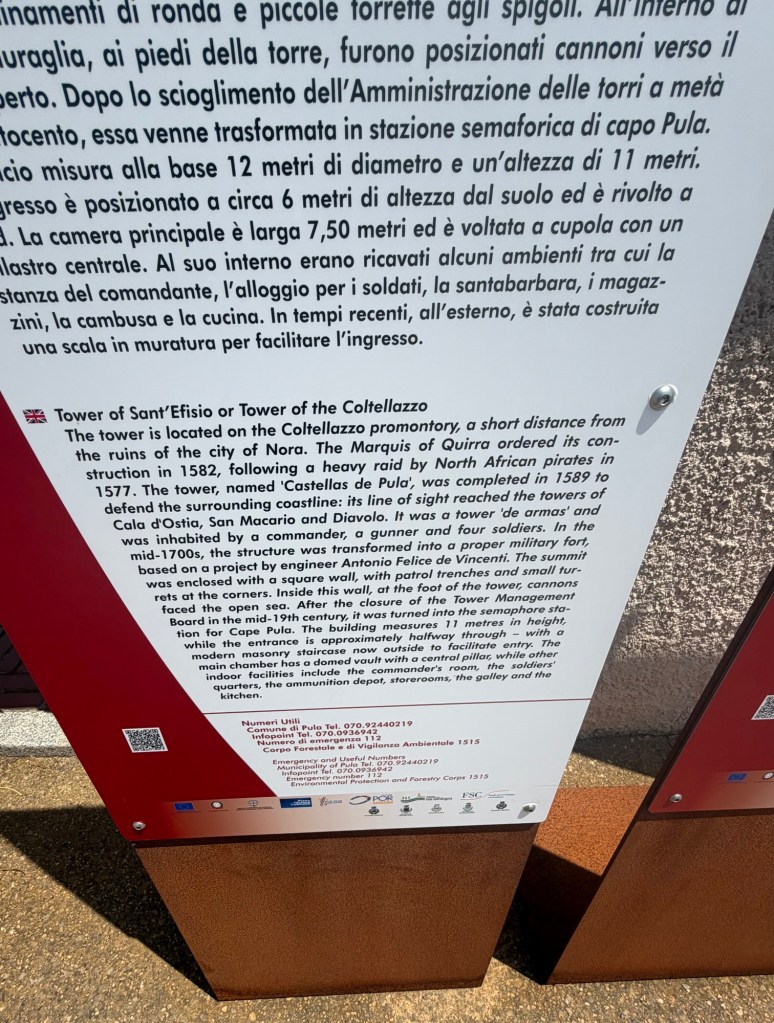
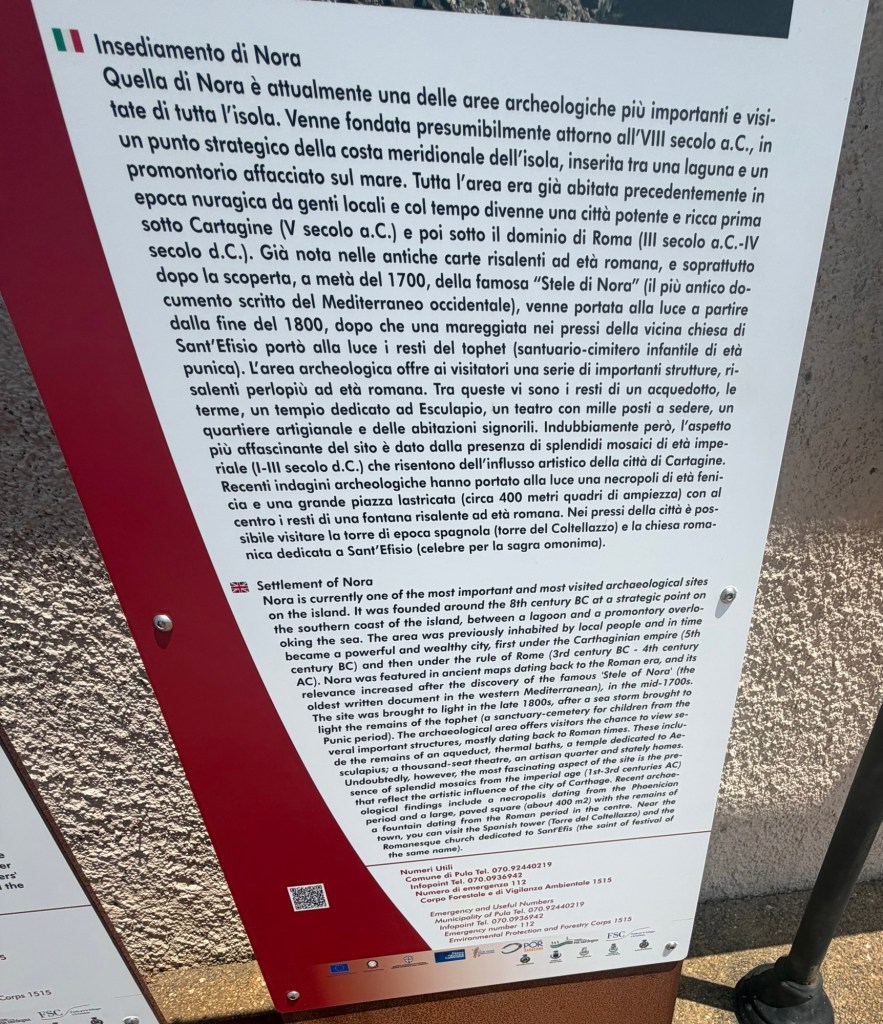
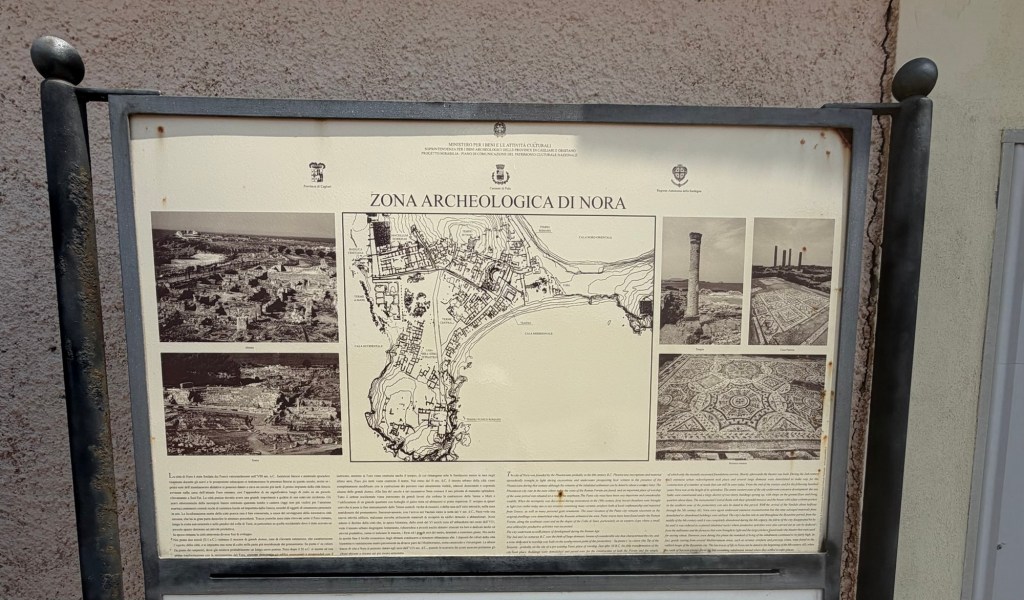
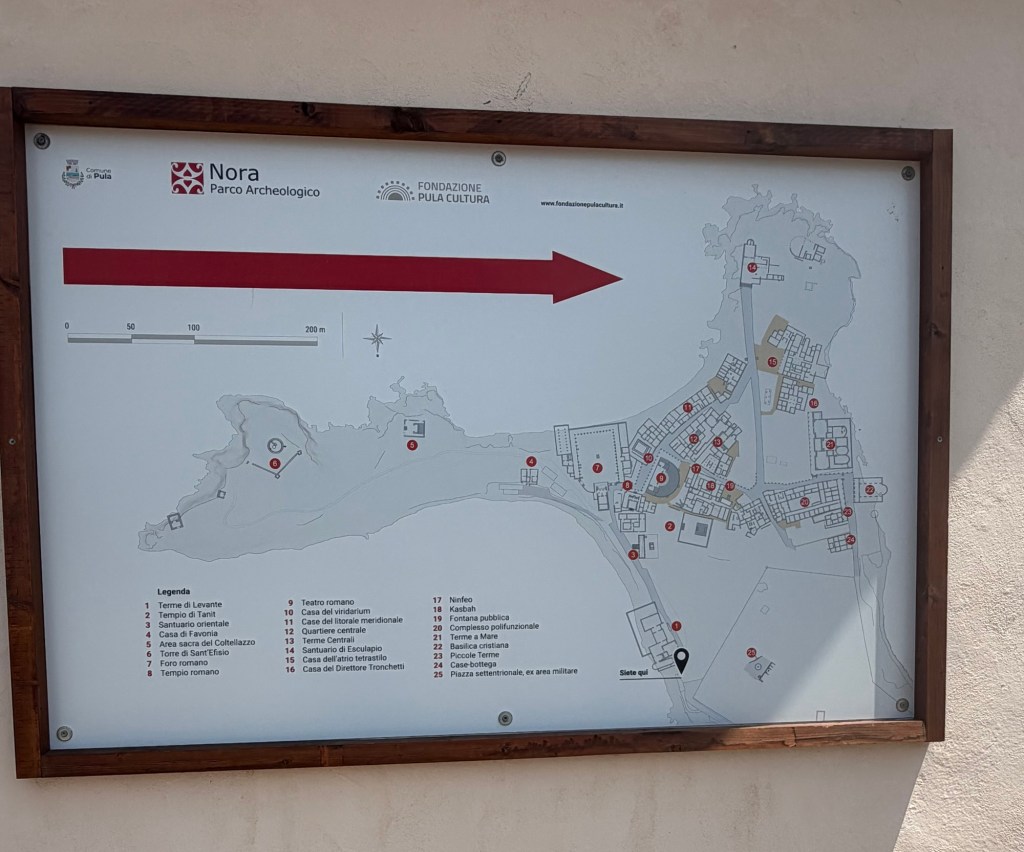
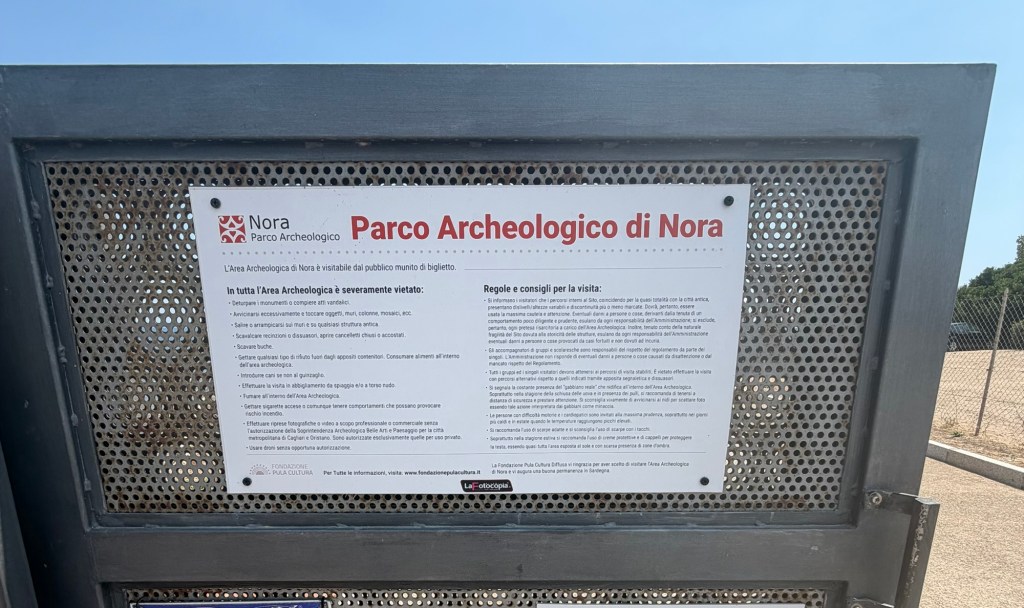
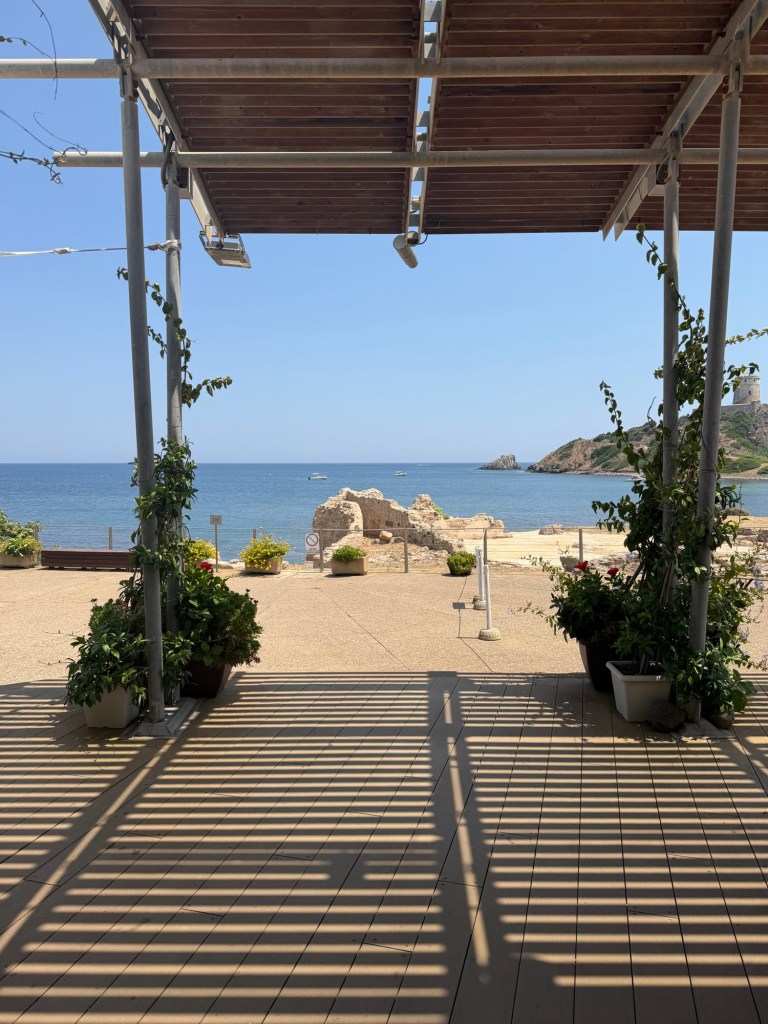
This modern structure below is the entrance to the archaeological park.
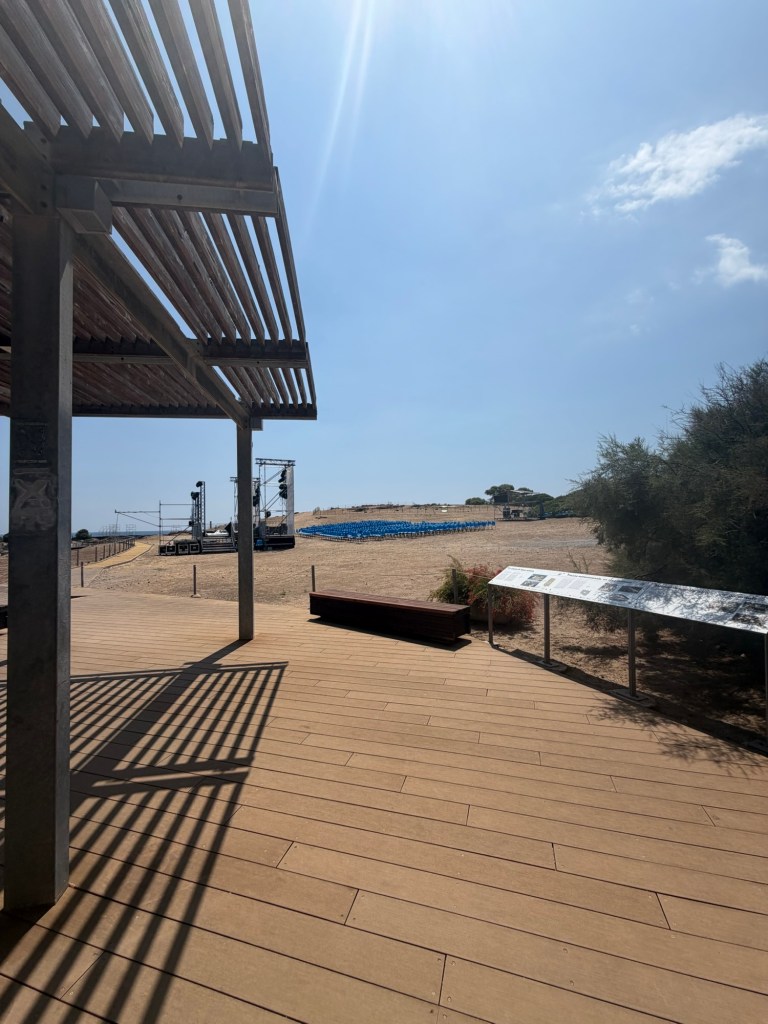
The blue chairs you see set up in the distance are for a nighttime cinema that is currently being shown. It presents a kind of dystopian landscape that stopped me in my tracks. What is this? Where am I? That reaction could partially have been a result of the blinding sun, the outrageous heat, and the fact that I’d gotten up that day at 4 a.m.
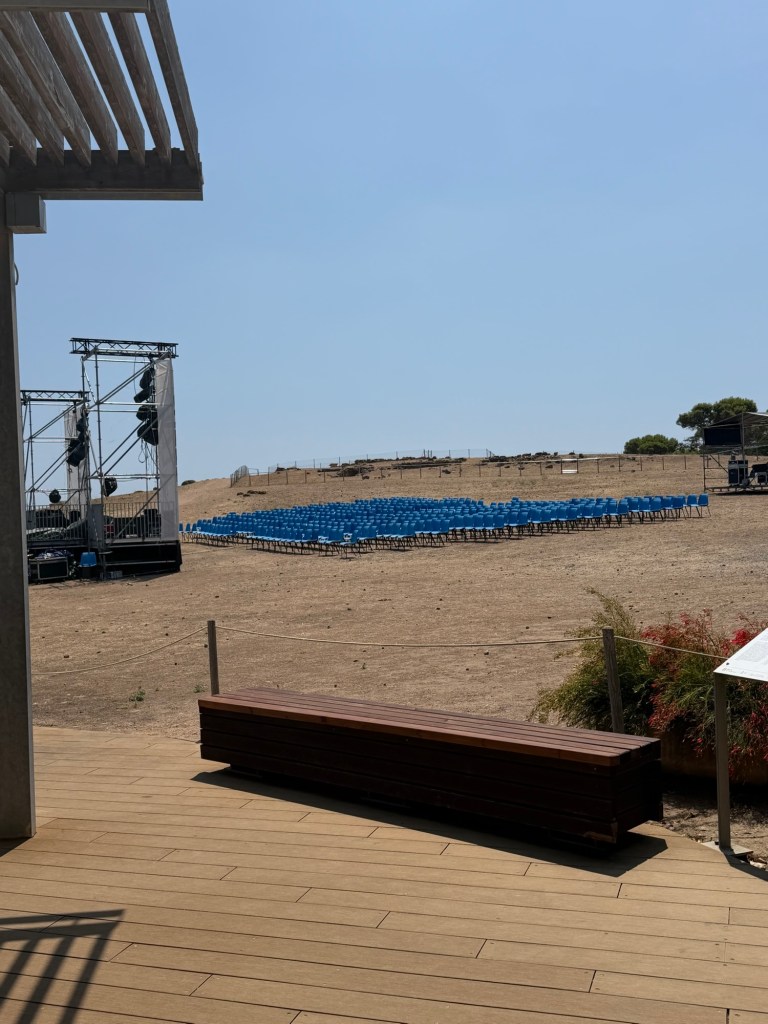
The site itself is very interesting. Remarkably, my companion and I were the only visitors. That may have been because most people are too smart to visit a stony site at mid day in August.
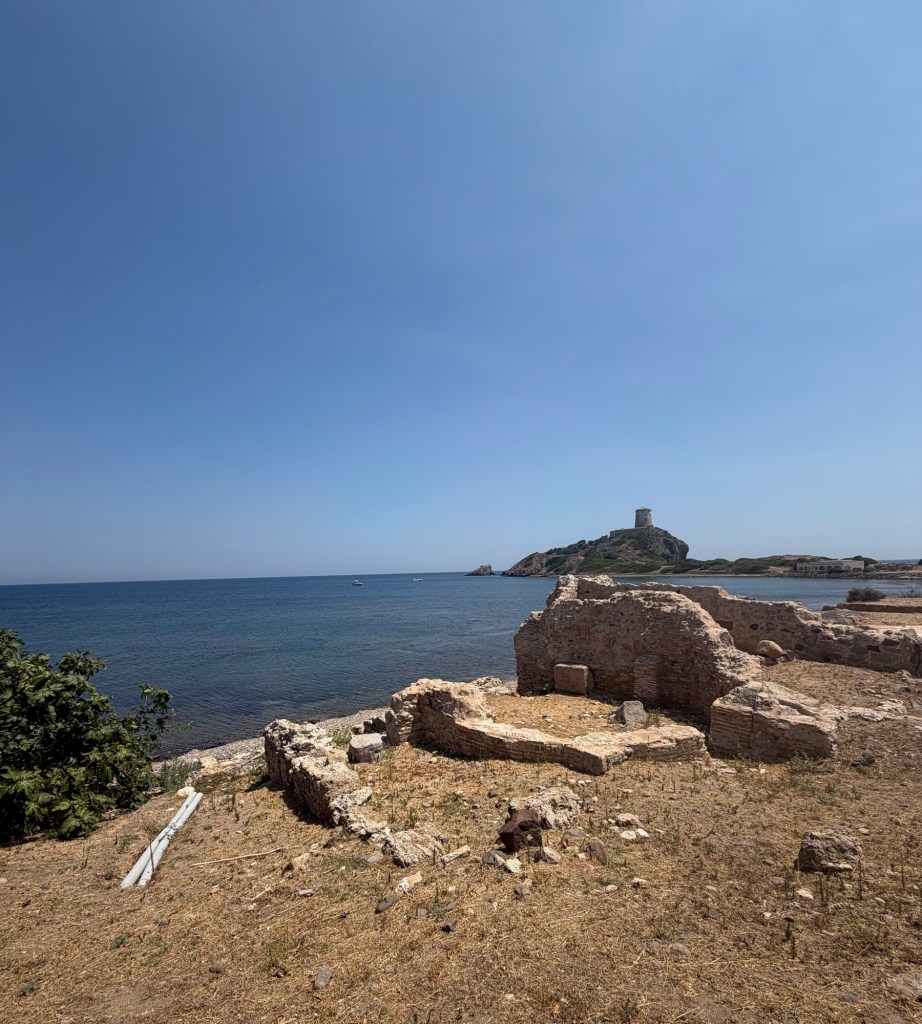
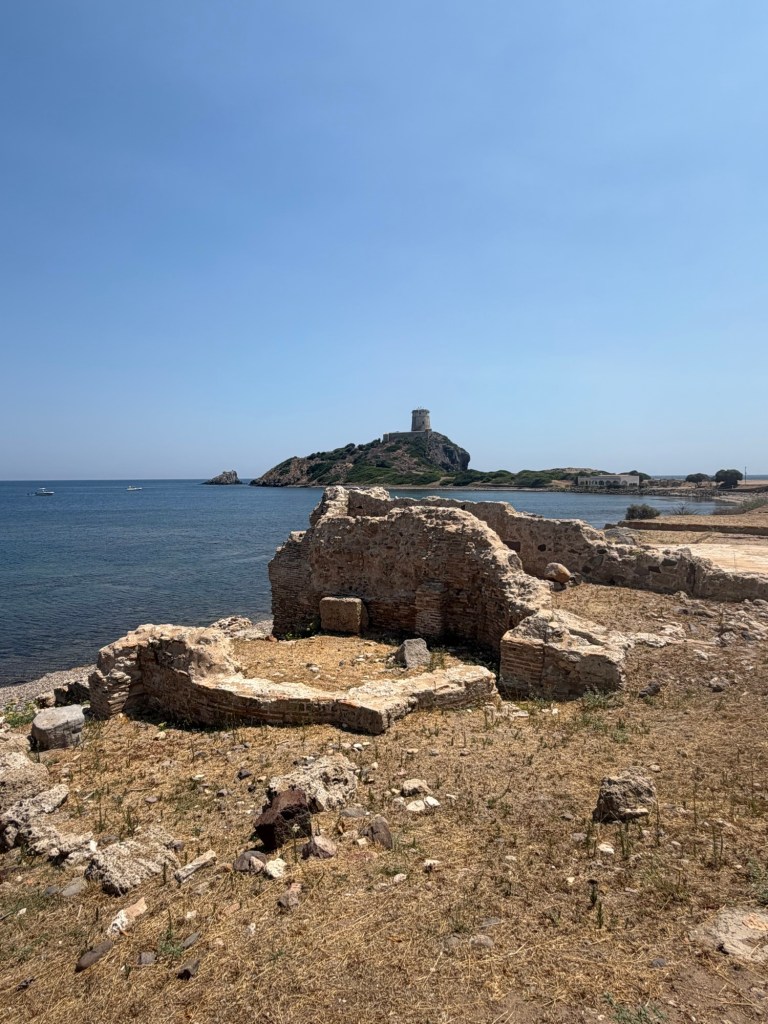
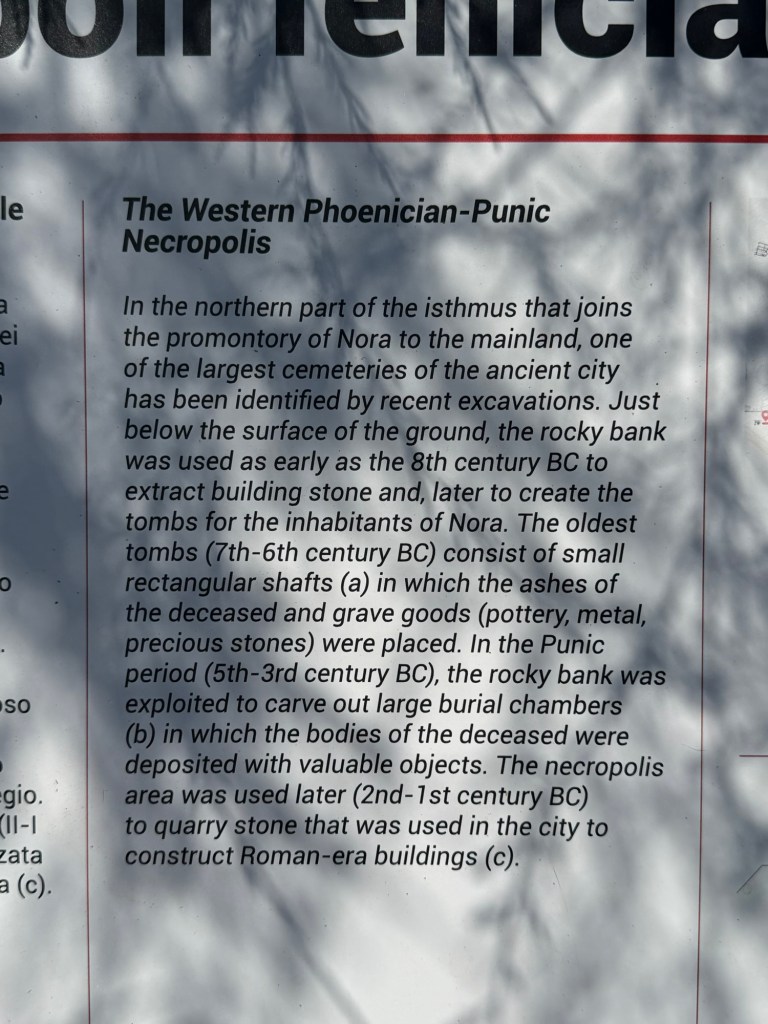
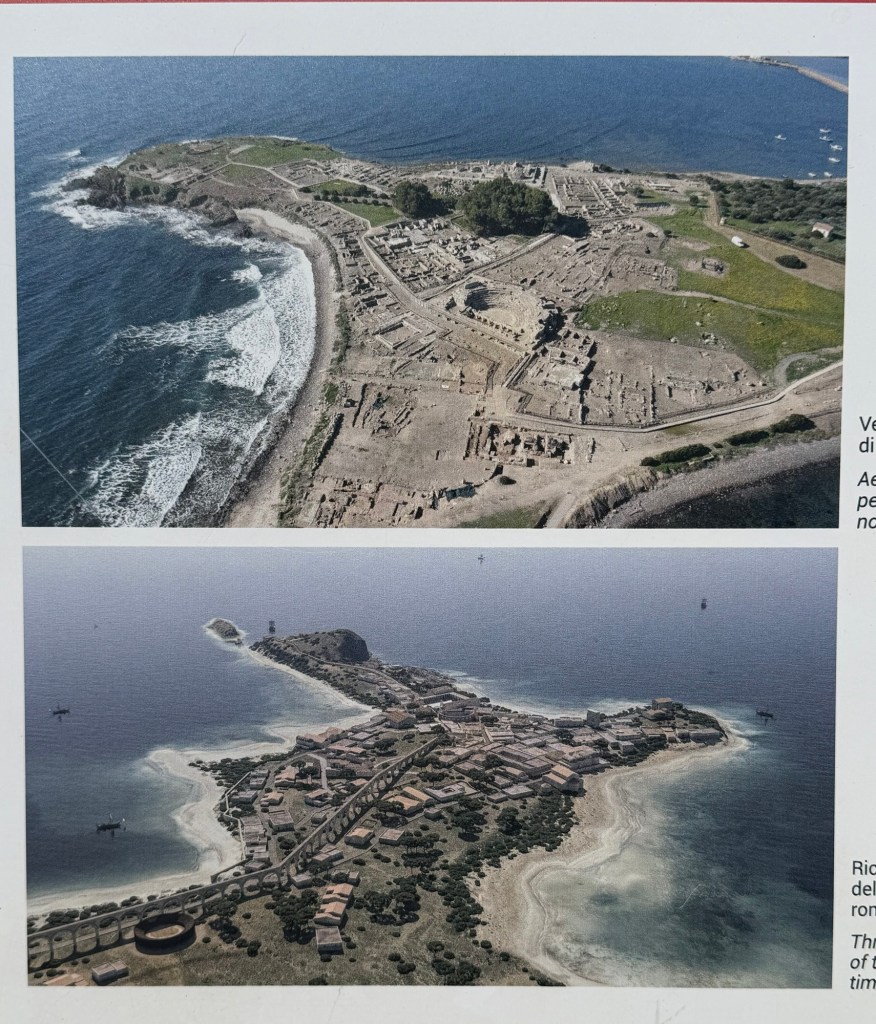
Below: a contrast between how the site looks today and a reconstruction of how it once looked: