This Cenacolo, or Last Supper, is situated the refectory of the former monastery of Sant’ Onofrio, also known as the Sisters of Foligno (yes, I am aware of the two spellings), transformed into a “Conservatory for poor and honest girls” in 1980 after the transfer of the nuns. It was called Fuligno from the name of the Franciscan nuns from Umbria, who occupied it starting in 1419, while previously this space (1316) had been home to a group of Augustinian nuns.
The refectory was renovated and embellished in the 15th century with some frescoes by Bicci di Lorenzo. There were some noble women who became nuns here including Sister Onofria de’ Conti degli Abruzzo and Sister Giovanna di Onofrio degli Onofriwho gave great impetus to the convent. Non nun noble women were connected to the convent as well. Il Magnifico, Lorenzo de’ Medici and the Lapaccini family both subsidized the cloistered couples. One can tell from the number and quality of the artworks produced for this space that there were some pretty sophisticated patrons of the convent. The nuns rooms were decorated in the period from 1480-85 by painters from the school of Perugino, in other words, some very fine painting was done here to enhance the convent.
It was suppressed in 1800 during the Napoleonic campaign to fill his coffers and became a center for the education of girls.
The fresco (4.40 x 8 m) was only found in 1845! Considered to be so fine it was initially attributed to Raphael.
Today’s art scholars agree that the work was probably created by one of the pupils of Pietro Vannucci, known as “il Perugino”(1445/50-1523). The work was painted around 1493-96. Raphael had in fact studied painting under Perugino and absorbed his luminous technique so well that his early paintings are hard to tell apart from his teacher’s. So, for almost a century after its discovery, the student got the credit for the master.
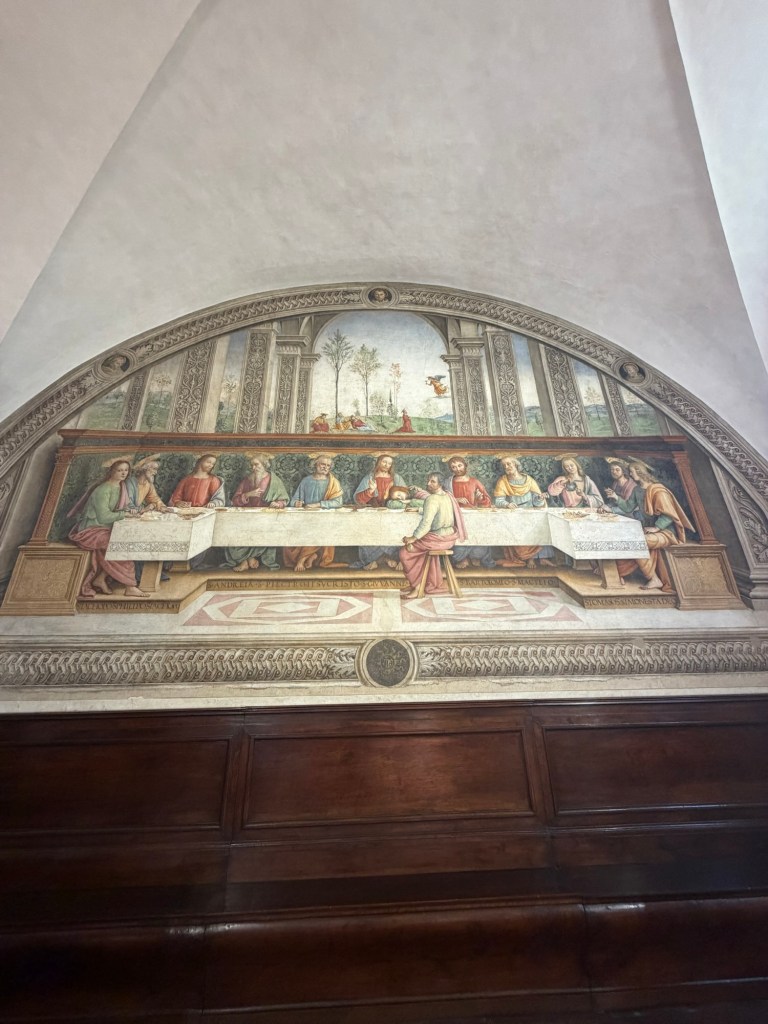
Critics have also suggested that the work replaces a previous fresco of the same subject painted by Neri di Bicci (1419-1491). The fresco is considered to be one of the most important examples of the Umbrian culture in Florentine Renaissance. The Refectory today also preserves also some frescoes by Bicci di Lorenzo (1429) removed from other parts of the convent.
What I love about this particular Cenacolo (and there are many fine Renaissance ones still extant in Florence) is that the artist didn’t just paint the usual table and seated figures, even if that is all the subject matter calls for. Behind Christ and the Apostles is a quiet glowing landscape with a second subject, The Agony in the Garden. The painter has therefore given us, the viewers, the whole night unfolding before our eyes.
Judas sits apart from the others, turned toward the viewer, as he often does in this genre of painting. One of the Apostles seems to have fallen asleep while sitting next to Christ.
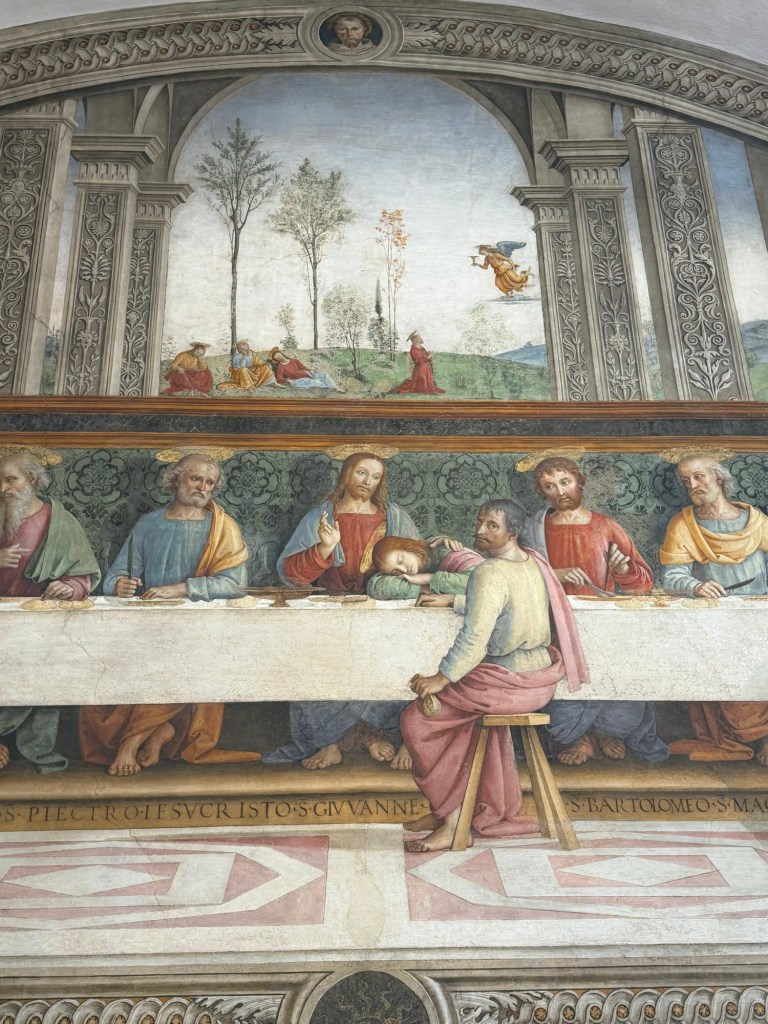
Another aspect of this painting which I very much appreciate is the attention to the eating utensils. One assumes these instruments, including the common knife but also an item that looks a lot like one chopstick but seems to be used as a pick or a fork, were in common use in the mid 1490s, when the painting was created. I’ve not seen anything like it before and these are the kinds of details I adore!
Also, I have got to mention the painted architecture! What an elaborate system of piers, decorated in relief sculpture. The painter went above and beyond what was required to represent a Cenacolo, and I for one appreciate the attention to superfluous detail!

