I recently posted about some ancient frescoes found in the area where Rome’s Stazione Termini now stands. Today this station and its bustling district is alive and filled with bus, metro and train traffic, not to mention automobile/motorcycle/motorbike/bicycle/moped/foot traffic.
But, can you imagine? This area once looked like this!

Villa Montalto Peretti Pescheria
It is hard to believe that prior to the present day cacophony around the stazione, this area used to be full of gardens, fountains, and beautiful open spaces. Here stood a large aristocratic villa, the Villa Montalto Peretti. It was a beautiful Renaissance construction with gardens, the largest built within the Aurelian Walls and one of the most sumptuous. It was the villa of Cardinal Felice Peretti, who later became Pope Sixtus V.

Above, a portrait of Sixtus V
Print Showing the Garden of Cardinal Montalto by Gottfredus de Scaichi (Gottifredi Descaichi) – Universitätsbibliothek Salzburg, G 389 III, Pubblico dominio, https://commons.wikimedia.org/w/index.php?curid=26356845
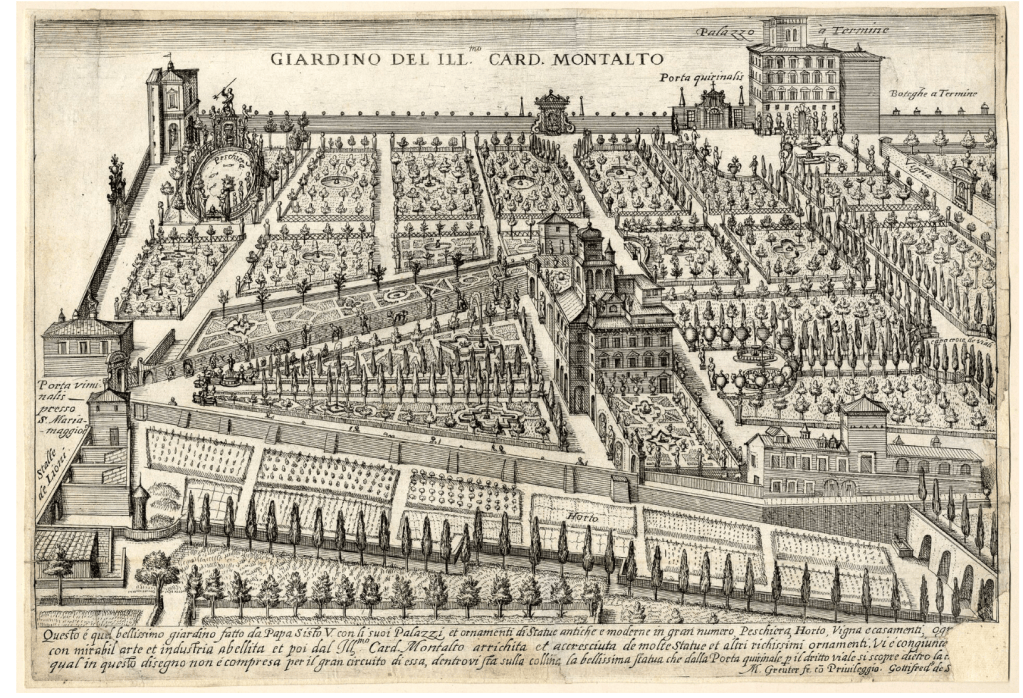
Felice Peretti purchased the land in 1570 for 1,550 scudi from the Roman physician Guglielmini, shortly after being appointed cardinal. Interestingly, the contract does not mention Peretti’s name, but rather that of the Florentine Bartolomeo Bonamici, who, months later, declared that he had purchased the property for the cardinal’s sister, Camilla Peretti, widow of Giovanni Battista Mignucci. Cardinal Peretti did not want the acquisition to arouse the wrath of Pope Gregory XIII, alerting him to the cardinal’s immense fortune, which had not yet been declared.
However, when Camilla passed the property as a dowry to her daughter-in-law. Vittoria Accoramboni, the cardinal, afraid of losing the property, legally took it back and united it with the other two properties he had purchased in the surrounding area. This was prime real estate in the Eternal City, located near both the Basilica of Santa Maria Maggiore and the Baths of Diocletian.
Peretti commissioned Domenico Fontana to build a palace on the estate. The work was completed in 1581, and the palace was decorated with paintings by Cesare Baglioni, Antonio Viviani (known as Il Sordo), Cesare Nebbia, Giovanni Guerra, and other important artists.

Palazzo alle Terme

Above: View of the garden of the Eminent Signore Cardinal Paolo Savelli Peretti near Santa Maria Maggiore
The villa’s two main buildings were the one facing the street known as the Palazzo di Sisto V alle Terme; the other was the palace that stood on the corner of today’s Via Cavour and Via Farini, known as the Casino Felice.

Above: Casino Felice
Fontana was also responsible for the landscape designs, of enormous proportions, divided into terraces and crisscrossed by paths offering splendid views, some lined with cypress trees. Numerous works of art and more than thirty fountains (fed by the new Felice aqueduct) were distributed throughout the property.
The cardinal moved into the new villa in 1585, only after being elected Pope Sixtus V, but he was so busy with his work as pontiff that he realized it would be impossible to enjoy the tranquility of the place, so he donated it again to his sister Camilla the following year. Lucky Camilla!
In 1587, Sixtus V surrounded the property with a wall opening into the property with six gates, isolating it from the rest of the city. Three years later he died, and Camilla passed the villa on to her nephew, Michele Damasceni Peretti, but continued to live there until her death in 1605. Unlucky Camilla!
Camilla’s death marked the beginning of the property’s decline, which was finally sold to the Negroni family in 1696. The lowest point in the villa’s history dates back to 1784, when it was acquired by the merchant Giuseppe Staderini: eager to recoup his investments, he spent the following years selling most of the property’s works of art. In 1789 the villa was purchased by the Marquis Francesco Camillo Massimo; his family later united the property with their nearby Villa Giustiniani Massimo.
We have an eye witness account to the experience of walking through the villa by the British author, John Evelyn who was in Rome in 1644-45. “Mont Alto’s villa is entered by a stately gate of stone built on the Viminalis, and is no other than a spacious park full of fountains, especially that which salutes us at the front; stews for fish; the cypress walks are so beset with statues, inscriptions, relievos, and other ancient marbles, that nothing can be more stately and solemn. The citron trees are uncommonly large.” John Evelyn, Diary and Correspondence

Above, The original villa’s perimeters are marked in green and overlaid on the modern city with the train station.
In 1860, during the construction of the Rome railway station, the dismemberment of the villa began, but half of the property still existed at the end of 1872. At the time, approximately 8,000 M remained, including the Palace of Sixtus V or Palazzo alle Terme, but both this and the Casino Felice were demolished in 1887.
Palazzo Massimo alle Terme was built by the later owners, which you will remember was the Massimo family; the new palazzo was constructed on the site of the main palace (Palazzo alle Terme), while Palazzo Giolitti now stands on the site of the former Casino Felice. Readers of this blog will know that I have waxed poetic about the collections now housed in the Palazzo alle Terme, which is administered by the Roman National Museum: https://getbacklauretta.com/2026/09/07/palazzo-massimo-alle-terme-rome/
Sadly one only of 30 fountains once found in the gardens survives: Domenico Fontana’s Fountain of the Prisoner. After the villa’s demolition, it was initially placed on Via Genova and, in 1938, in its current location, in R. XIII Trastevere at the end of Via Goffredo Mameli, near San Pietro in Montorio.
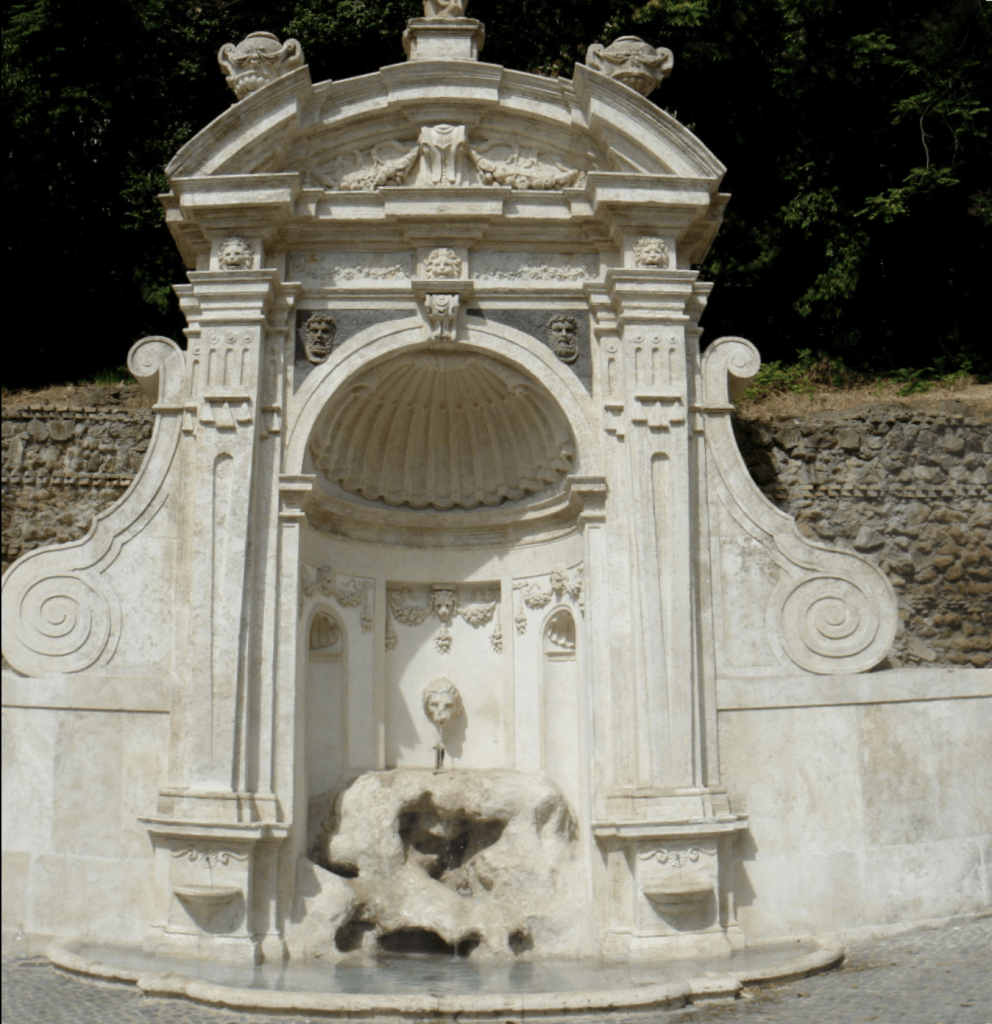
Fountain of the Prisoner, by Domenico Fontana
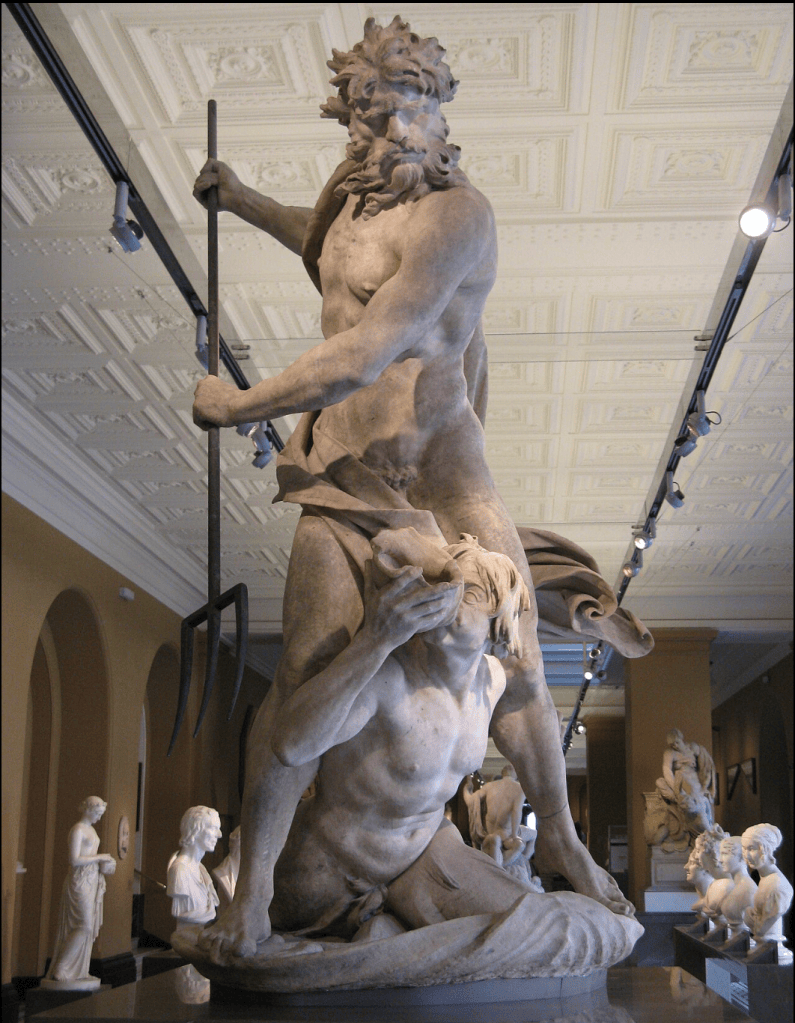
Sad as the Fontana fountain looks above, the magnitude of the villa’s former glory can be imagined when you realize it was once graced with Bernini’s incredible fountain, Neptune and Triton. That masterpiece is now housed in the Victoria and Albert Museum in London.
The villa’s main entrance portal (visible in an engraving by Vasi) now serves as the gateway to Villa Celimontana on Via della Navicella.
A great short video on the history of the villa can be found within the following link.

