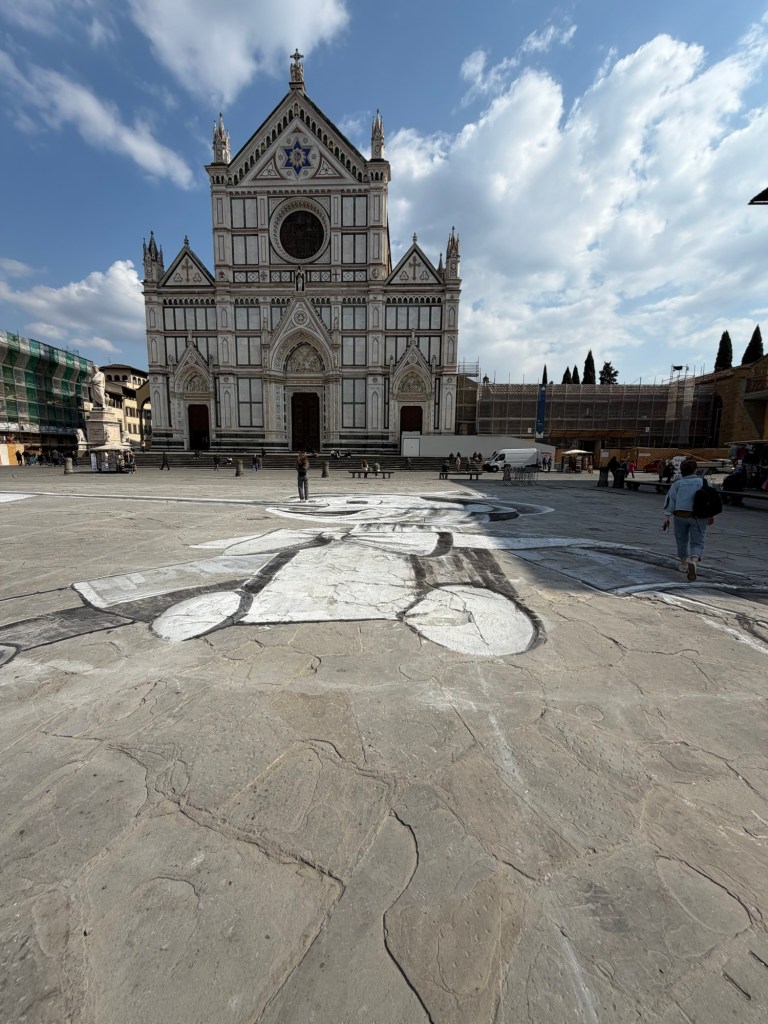
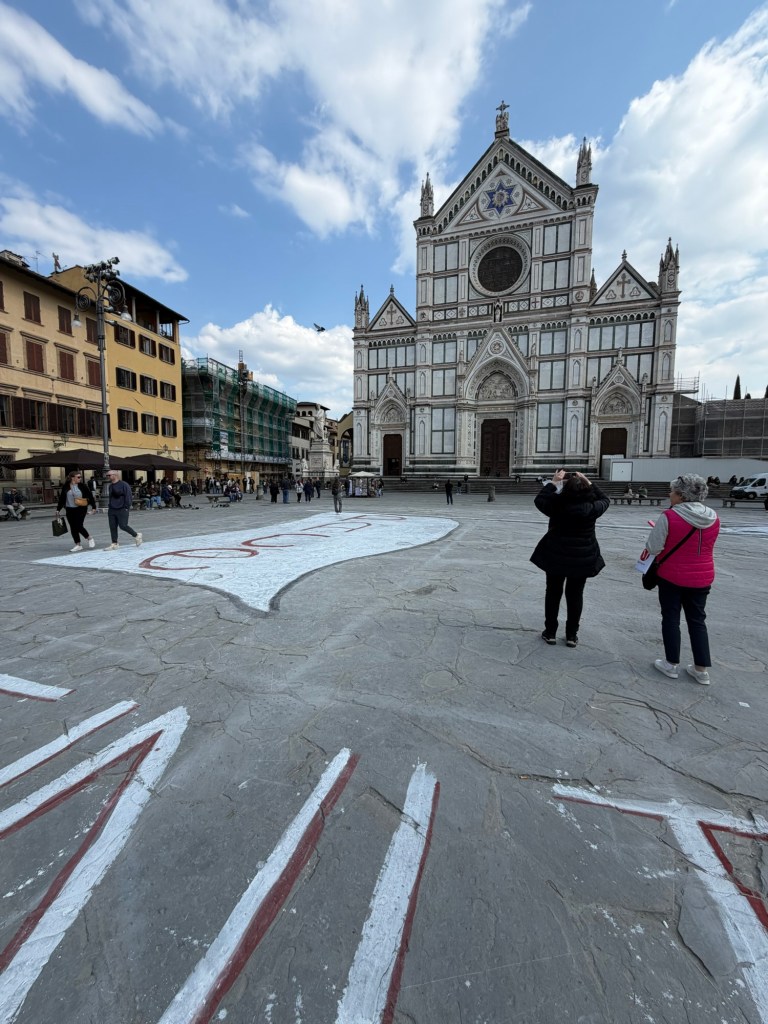
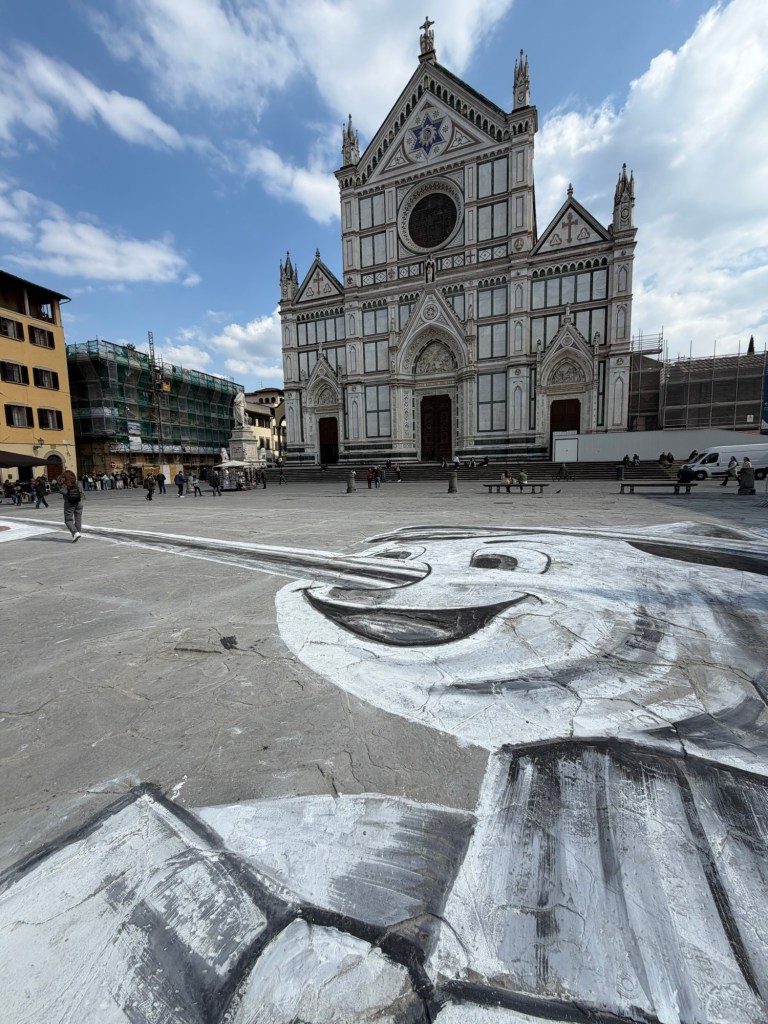
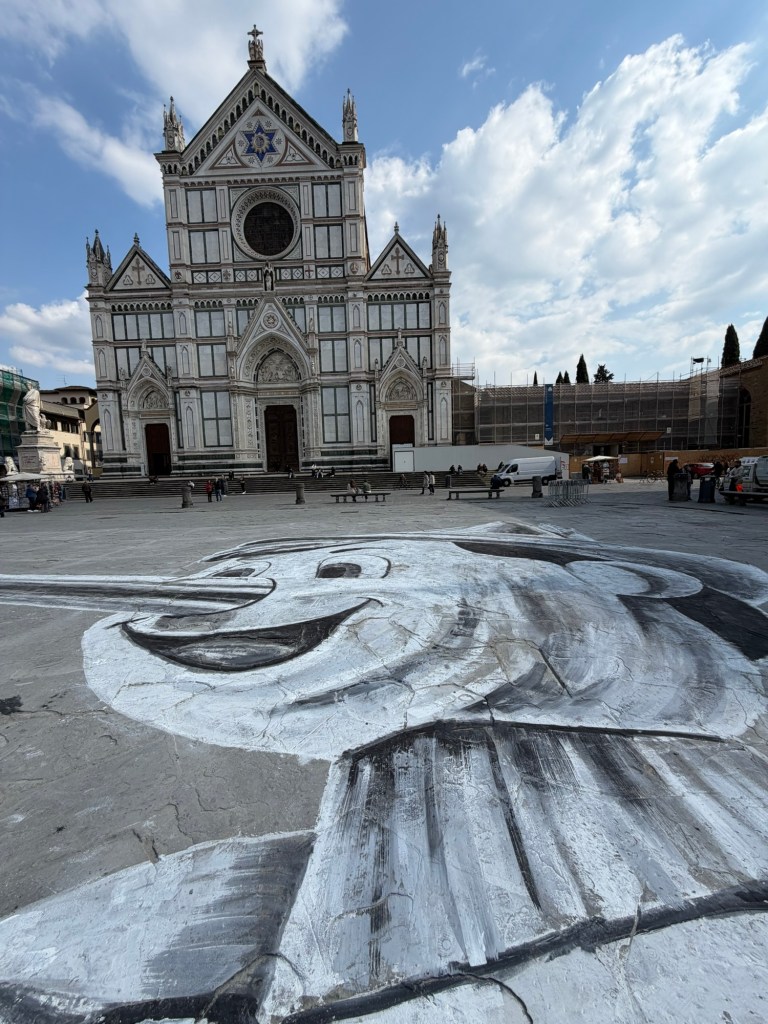
Santa Maria Novella, The Bardi Chapel and more

On my recent visit to the basilica, I took a long look and some photos in particular of The Bardi Chapel (also known as the Chapel of San Gregorio, the Chapel of the Sacrament, or, since 1715, the Chapel of San Domenico) is the first chapel on the right when entering the transept, situated between the Tornabuoni Chapel and the Filippo Strozzi Chapel.

Nothing about Italian art history is easy, because it is so old and there have been so many changes, as you can see just in the naming of this chapel. If you can read this post and not become confused, I congratulate you. I was often confused when writing it!

There is another, more famous Bardi Chapel in Florence at the basilica of Santa Croce, but this post is about the newer (relatively speaking) chapel at SMN. The Bardi was an important Florentine family.

The 13th Century and Duccio
This sacred space, so important because of its placement near the altar, was originally the chapel of the Compagnia dei Laudesi (Laudesi Company) in the 13th century and was dedicated to Saint Gregory the Great. It was that company which commissioned Duccio di Buoninsegna to decorate the chapel with frescoes. The most visible remains of these frescoes, dating to around 1285, are present in the lunettes at the top of the two side walls and depict Christ among angels (right) and Saint Gregory the Great enthroned between two palms (left).

Incidentally, it was also The Compagnia dei Laudesi that commissioned Duccio di Buoninsegna to create the famous Rucellai Madonna, an altarpiece so called because it spent a long time in the nearby Rucellai Chapel before arriving in the Uffizi Gallery, where it remains today.

The mullioned window in the masonry on the right wall dates to around 1280-1285 and predates the current church itself (it is perhaps part of the ancient church of Santa Maria delle Vigne).

The Patronage of the Bardi Family and the Fresco Cycle
Patronage of the chapel passed to the Bardi family around 1335, as evidenced by a bas-relief by an anonymous Florentine sculptor on the right pillar, depicting Riccardo de’ Bardi kneeling before Saint Gregory the Great. Under the family’s patronage, the fresco cycle still visible today, featuring scenes from the Life of Saint Gregory the Great, was created. The cycle, dating to the second half of the 14th century, is attributed to a painter in the style of Dalmasio and generally referred to as Pseudo-Dalmasio.

The frescoes, from left to right wall, depict the following scenes:

Gregory dictating the dialogues while feverish,
Emperor Trajan and his widow,
Gregory’s meeting with the angel,
Gregory’s almsgiving to the shipwrecked man,
Gregory’s discovery by the people for his election as pontiff,
Gregory blessing enthroned among the bishops.

This chapel in particular has always attracted my attention because of the large number of grand sensors that hand along the front of it.

Since the 18th Century
At the beginning of the 18th century, the chapel was newly dedicated to Saint Dominic and a complete modernization program was implemented. This led to the creation of many canvases which hung on the back and side walls, although these have since been removed from their original locations. From this 18th-century redesign, however, the stucco decoration of the vault (by Marcantonio Pandolfi based on a design by Benedetto Grilli, 1708) remains, along with the fresco of Saint Dominic in Glory by Pier Dandini (1708).

Another testimony to this renovation program is the altar with its inlaid marble frontal, a 1669 work by Pier Francesco Silvani. However, it was only moved to this chapel in the 18th century, following the suppression of the Congregation of the Priests of the Most Holy Conception of Mary, which was located on Via de’ Servi. The altar contains the Blessed Sacrament. The gate is also from this period, to be precise, 1707, the work of Giuseppe Arrigoni.

A recent addition to the chapel is the canvas of Giorgio Vasari’s Madonna of the Rosary, painted in 1569. It originally came from the third altar in the left aisle of the church, where it covered Masaccio’s Trinity.

After exiting the area near the Bardi Chapel, one encounters this permanent creche scene in the basilica.

The following photos are more details from the basilica. There are endless things to admire and enjoy in this important Dominican church.

Above is the bookstore. I mean, come on, the book store??

One of the courtyards integrated into the church complex. I was struck by the warm day in late February with the flowers in the grass and birdsong.

Lucky to live here

All my readers know I love living in Florence! Here are a few more reasons why.

For example, an exterior window sill has flowers, paint brushes and a painter’s palette. A bid odd, perhaps, but I like the sentiment, whatever it is. I know it’s artistic!

I 1ove living here because the French street artist Clet Abraham is based here and his playful modifications of traffic signs add humor and social commentary to the city’s historic streets, as seen above and below.

Above and below, I love living in an old Italian city where the 12th and 13th century walls that once surrounded it are still fully visible and part of the city’s fabric in the Oltrarno.

Above and below, I love living in a city where elegance and excellence are prized. In the narrow, uneven, often hidden, ancient stone lined streets of the historic district, you can find stores selling the most luxe of all items. Antiques and high end fragrances for the home are sold side by side.

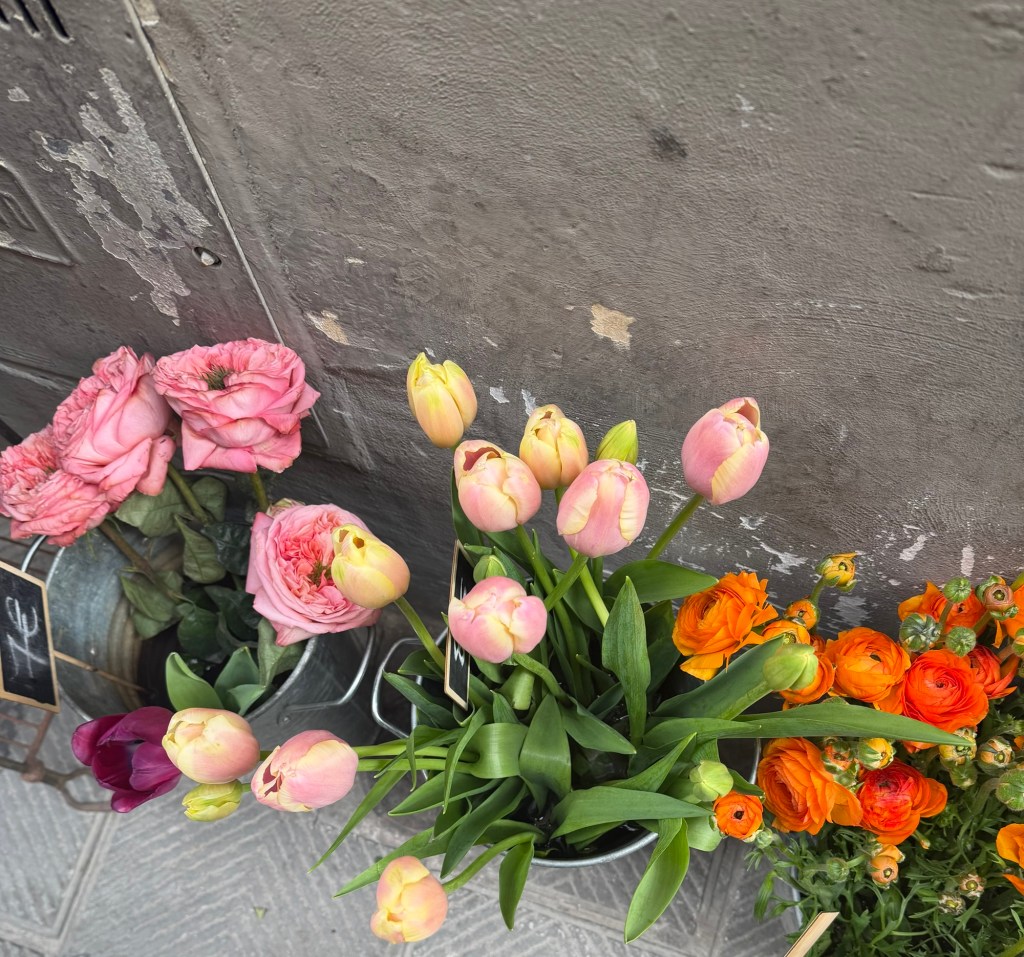
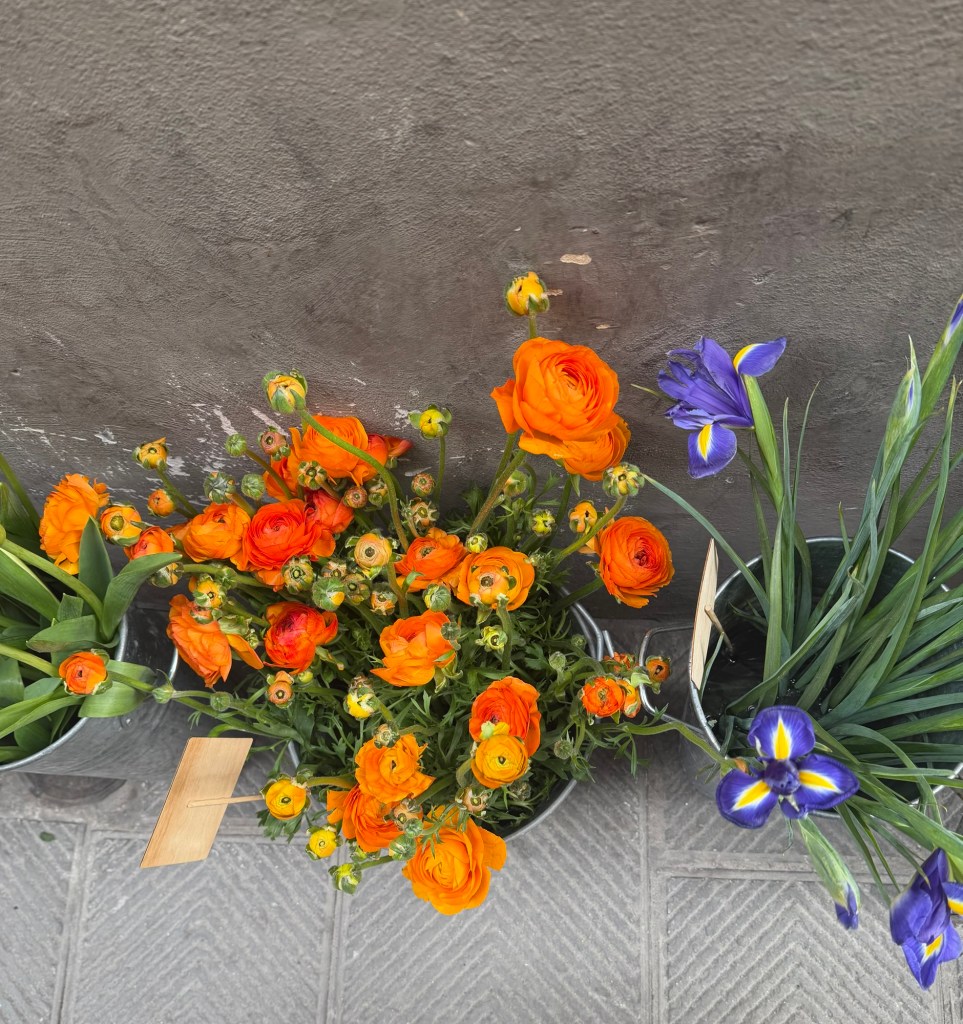
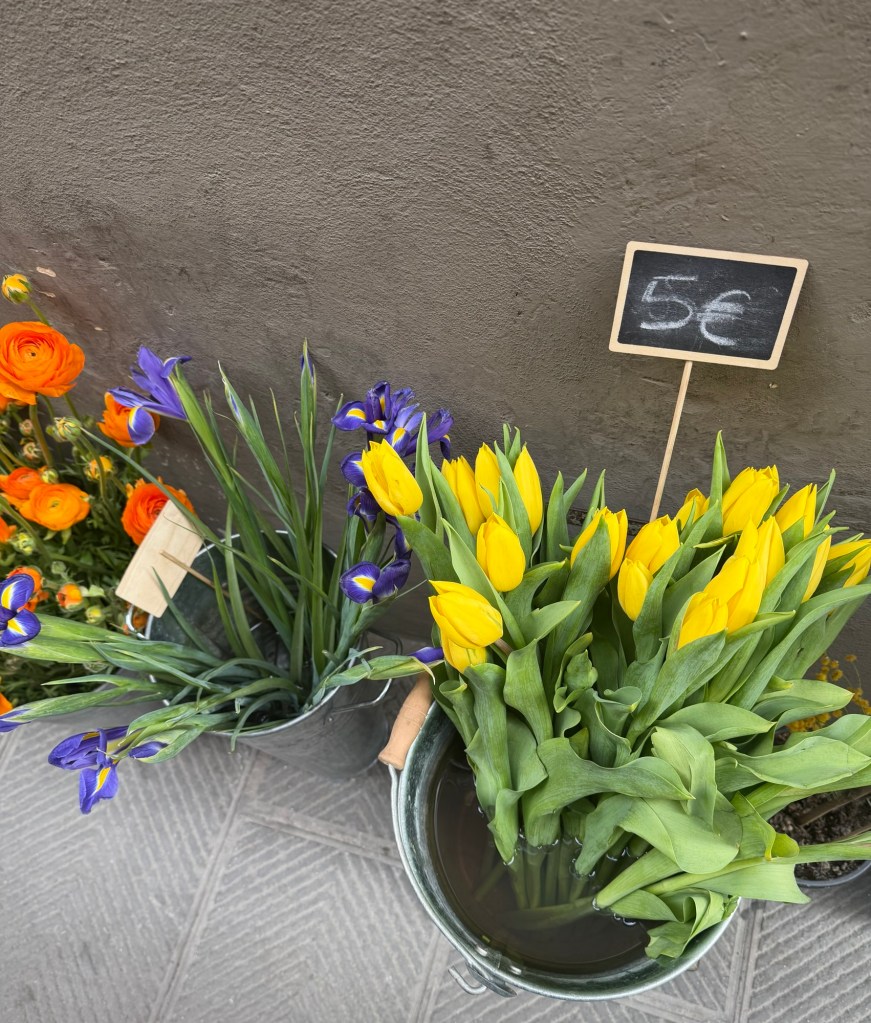
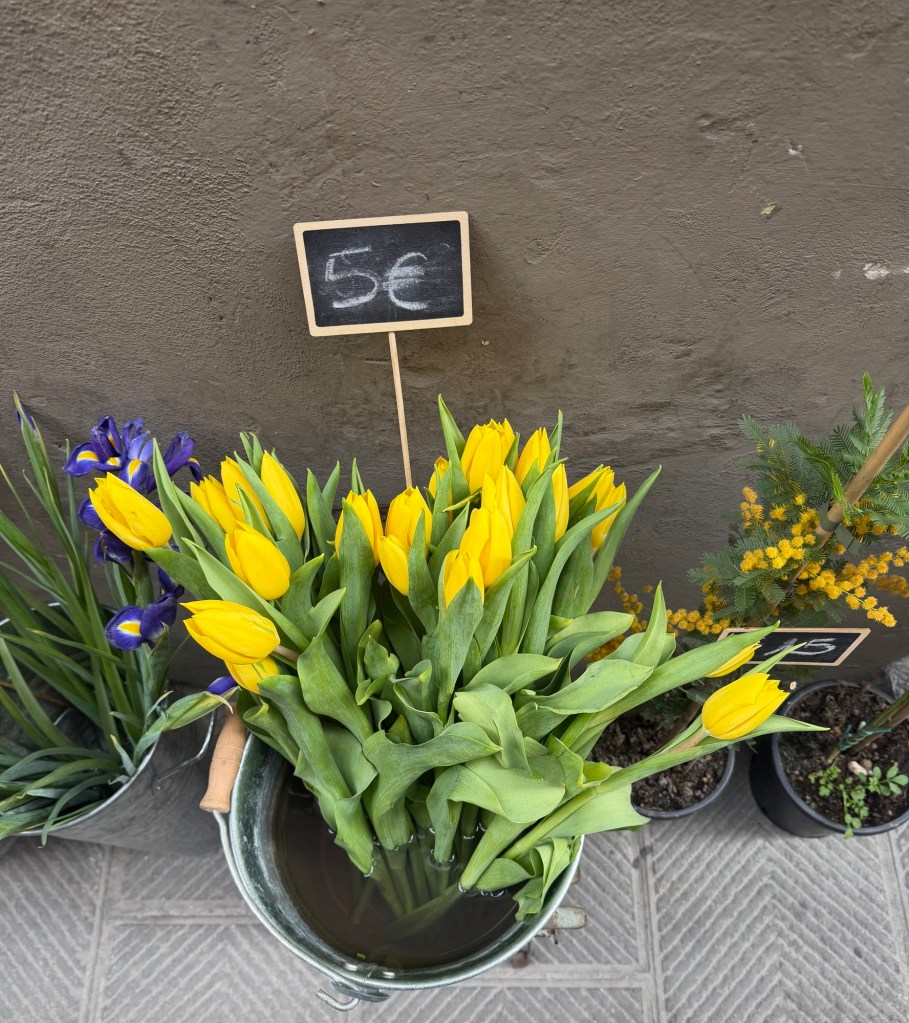
And the same store sells fresh flowers. They are always displayed in buckets right on the street and I love seeing what the day’s offering consists of.

I missed the blessing

One of the most charming aspects of living in Italy is that old traditions still exist sometimes.

Apparently, priests used to annually come to a person’s home and bless it for the coming year.

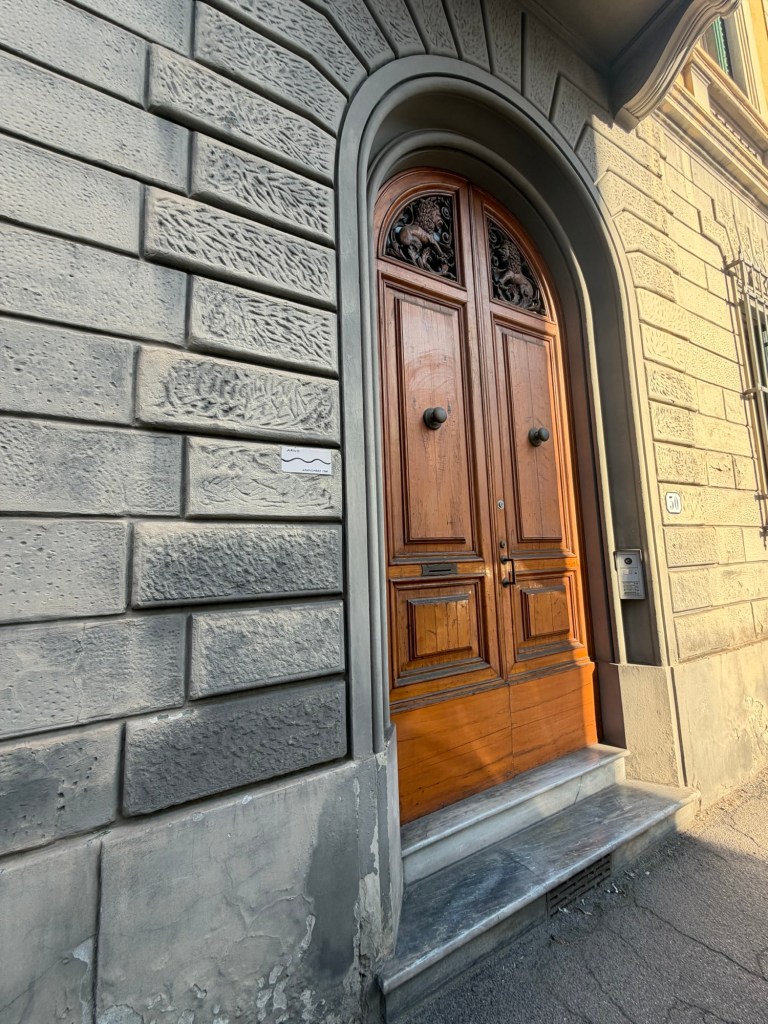
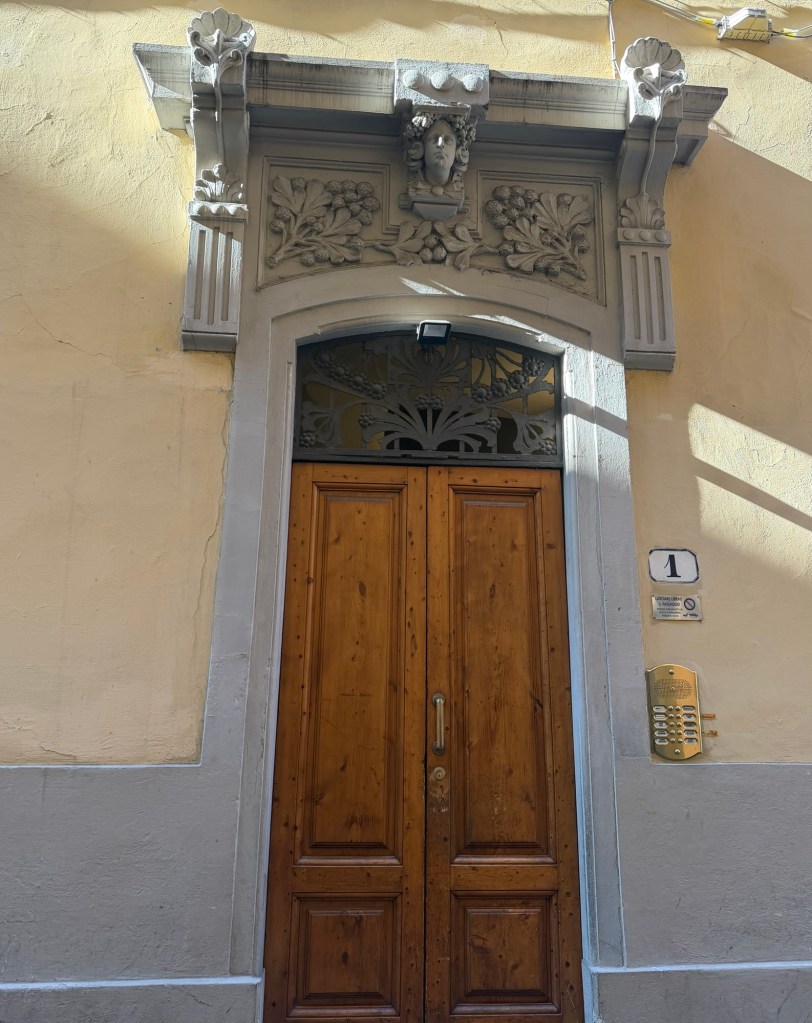
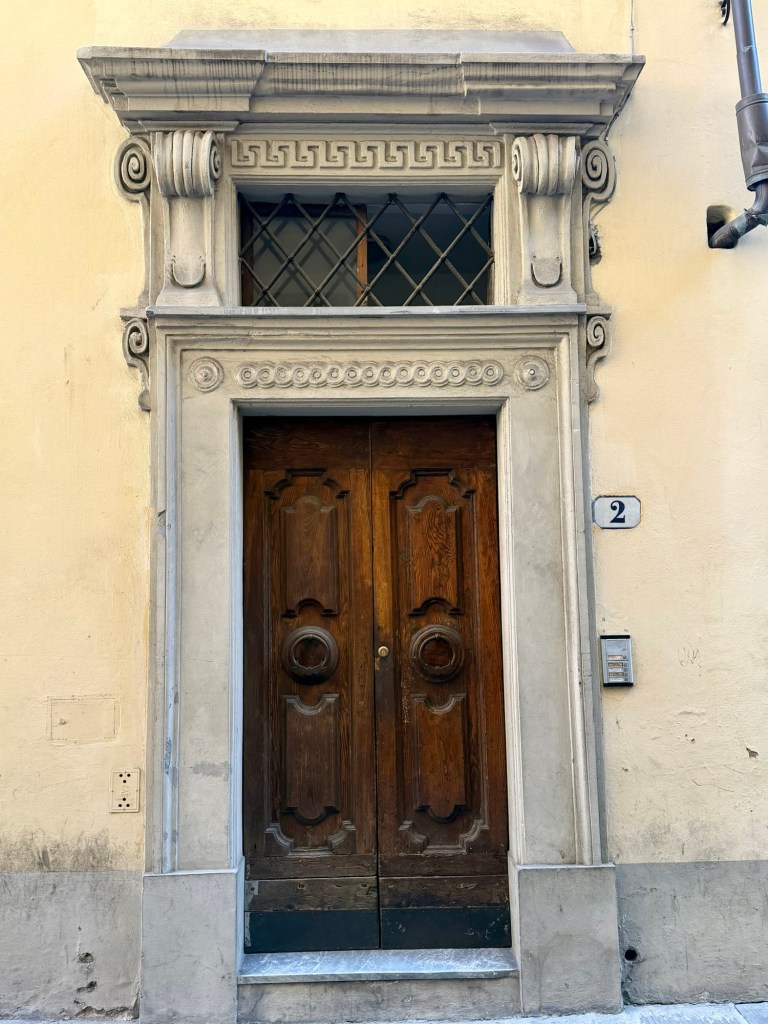
Walking thru the ancient center of Florence recently I saw this notice posted in the grand door of a lovely palazzo. It tells the inhabitants that on 23 February the priest would come by for the annual ritual of blessing the family. I do hope some people took advantage of this personalized house call, and that this year will be nothing but blessings for everyone involved!

New things I just noticed in my Florentine neighborhood and other miscellaneous

Every walk shows me something new.

I love the art deco font used to advertise this bakery.

I have a favorite old and still old-fashioned bar in the historic center of Florence. Yes, there are now 2 Starbuck’s in Florence, but I wouldn’t go to them if you paid me. I like the classics and the Italian classics most of all.

I stop by this bar almost every time I walk by it, which is at least several times a day. I love how busy it is; I love listening to the din of the employees waiting on customers; I love the creamy cappuccino they make to order. I hope this custom never dies.

This bar/pasticceria has an interesting history.

There was a poster for Valentine’s Day in Florence that I didn’t see until after the day. But it’s a cool poster and I wanted to show it to you!

Here’s another tabernacle, not far from my home. I’d love to know more about it, but the only sign I could find talks about the modern glass that has been placed in it. 🙁

As I was walking and saw the sign for this flower shop, I thought, am I in France?

My camellia shrub is still blooming its heart out and I had to take a picture with it!

Below, my home in the evening. Look at that tall fire!

The Basilica of Santa Maria Novella, Florence part 1

Some candid and random shots with almost no historic information! Just what I saw and was attracted to shoot this day in late February 2026. Enjoy this quirky tour!

I don’t know why, but I love seeing modern technology used on these medieval or ancient monuments in Italy! It just makes me smile for some reason.

I always light a few candles for my loved ones whenever I’m in a church. And I’m atheist. Again, quirky.

I always smile at these often silly neoclassical 19th century productions.

The meridian lines in major churches are of great interest to me. In the photo below you can see the line inscribed in the pavement in bronze.

They weren’t just reviewing/cleaning/whatver on the exterior of the building! They were vacuuming the inside as well on this day!

Below, inside the beautiful basilica, looking toward the altar.

Ok, I lied. Here’s some historical info.

Of course the painting I most wanted to see, the Trinity by Masaccio, is under scaffolding and being restored. If I had a nickel….

The Giotto Crucifix.

Nest we are in one of my favorite chapels in all of Italy. The Ghirlandaio frescos in the Tornabuoni Chapel behind the altar. On this day I was joined by schoolchildren, who in Italy have this artistic heritage running in their veins. Such lucky kids!

And of course my favorite scene from the entire fresco cycle is under restoration. If I had a dime….

I love these casual everyday moments sometimes inserted in 15th century paintings.

Love, love, love the costumes and hairstyles of the women.

So much to see. I’ll be back soon with part 2.

Cappella Strozzi di Mantova at Santa Maria Novella, Florence

La Cappella Strozzi, Overview of the chapel from the east.

The construction of the Dominican basilica of Santa Maria Novella began in 1246, and was essentially completed by the start of the 14th-century.

Chapels dedicated to certain elite families began to fill the sacred spaces near the altar shortly after the basilica was completed. The Strozzi Chapel is one example of such chapels, (known formally as the Cappella Strozzi di Mantova because the man who commissioned it was exiled in Mantua at the time ). It is situated on an elevated level at the end of the left transept. Tommaso Strozzi and his brothers were the sons of Rosso di Gerio Strozzi, who died in 1316. The chapel was constructed and decorated between 1340 and 1348. The Strozzi were one of the wealthiest of Florentine families, having attained wealth and influence through their trading and banking businesses beginning in the early 1300s. By creating this lavish chapel they hoped to atone for their usury.

Nardo di Cione, brother of Orcagna, painted the frescoes between 1354 and 1357. He was assisted by his Giovanni Del Biondo. These frescoes are the best of Nardo’s extant works.

Unlike earlier family chapels, this fresco program is devoted almost exclusively to a depiction of theLast Judgment, which takes up all three walls. The pictorial program of the frescoes is articulated like a triptych, with the Last Judgment on the west wall as the core of the ensemble and Paradise on the south wall as the pendant to Hell on the north wall. The frescoes were inspired by Dante’s Divine Comedy and painting on the West wall includes a portrait of Dante.

The gold encrusted altarpiece, The Redeemer with the Madonna and Saints, was completed by Andrea di Cione (known as Orcagna), brother of Nardo di Cione who was commissioned to paint the frescoes here between 1351 – 1357. Tommaso Strozzi was the patron.

I must gratefully acknowledge that all of the excellent photography of the chapel are from this site: https://www.wga.hu/html_m/n/nardo/strozzi/index.html

I spent a lot of time in this chapel recently, studying the walls and vaulted ceiling, and try as I might I could not make decent photos. The light is poor and inconsistent, so I’m grateful for the internet yet again!

The Last Judgement, on West wall behind the altarpiece

Detail of the Blessed from the Last Judgement fresco:

Detail of the Damned, from the Last Judgement fresco:

Paradise, South wall

Detail of Paradise:

Another detail from Paradise:

Hell, North wall

Detail from Hell:

The vault

The Strozzi Chapel is home to one of the most important altarpieces of the Trecento, painted by Orcagna (Andrea di Cione) between 1354 and 1357. Orcagna was the brother of Nardo di Cione who was commissioned to paint the fresco cycle. I will devote a separate post to the altarpiece later.

Books

Strangers in Time. Great book about the War effect on London.

Me Before You by Jojo Moyes. My oh my! I absolutely adored this book. I could not stop reading it. Highly, highly recommend!

I love children’s literature and don’t know how I could never have known of the Noel Streatfeild books, all titled around shoes! But, they were referred to in the movie You’ve Got Mail which I recently rewatched. I looked them up, and I’ve fallen in love. I’ll be back again with more of his titles, I can promise you!

What are you waiting for?! Read! Read! Read!