Author: get back, laurettadimmick
Viareggio, September 2021
Where oh where are my pictures of this elegant place.?
Buona sera Firenze! Good evening Florence. November 2021
Florence today
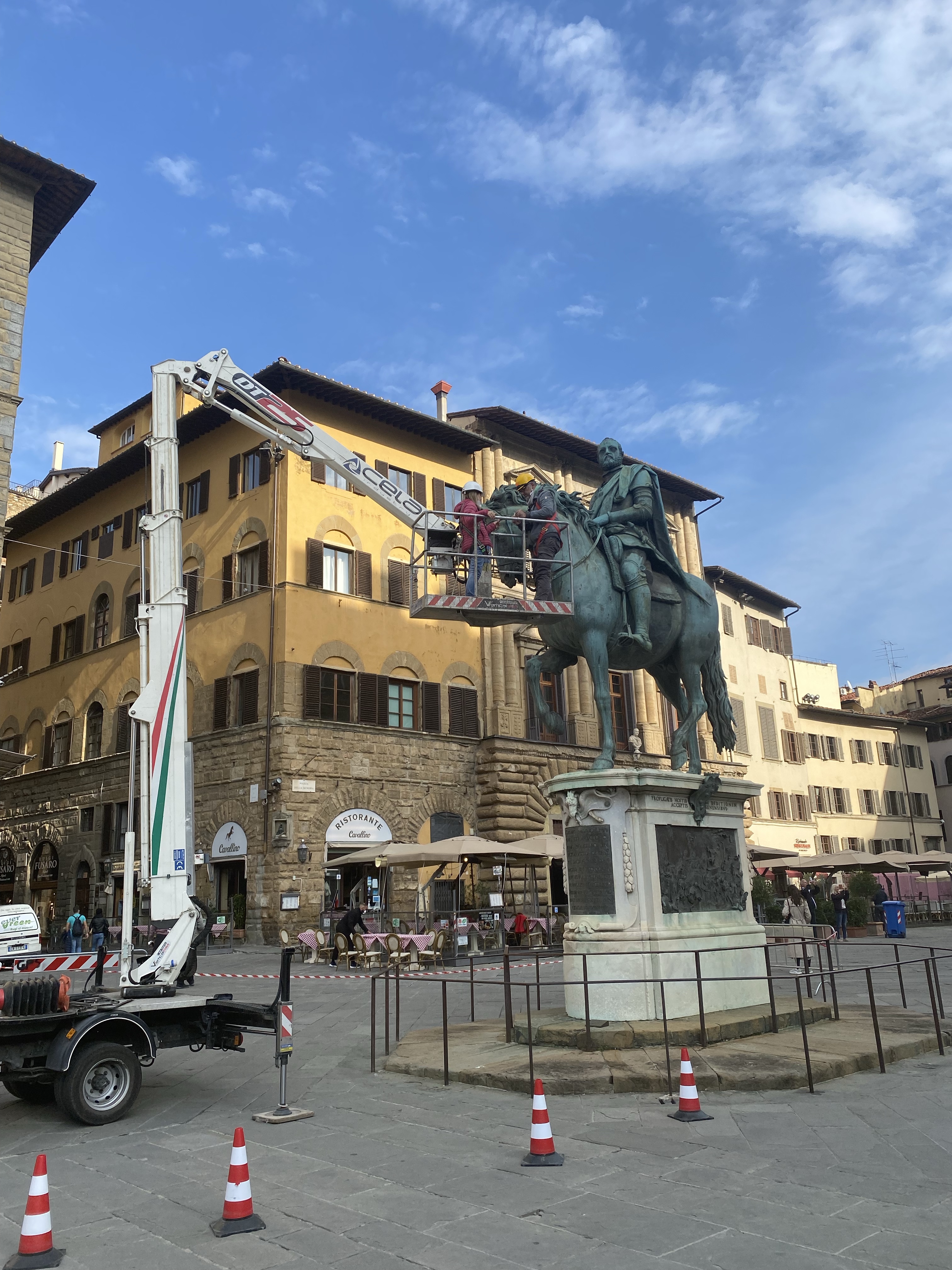
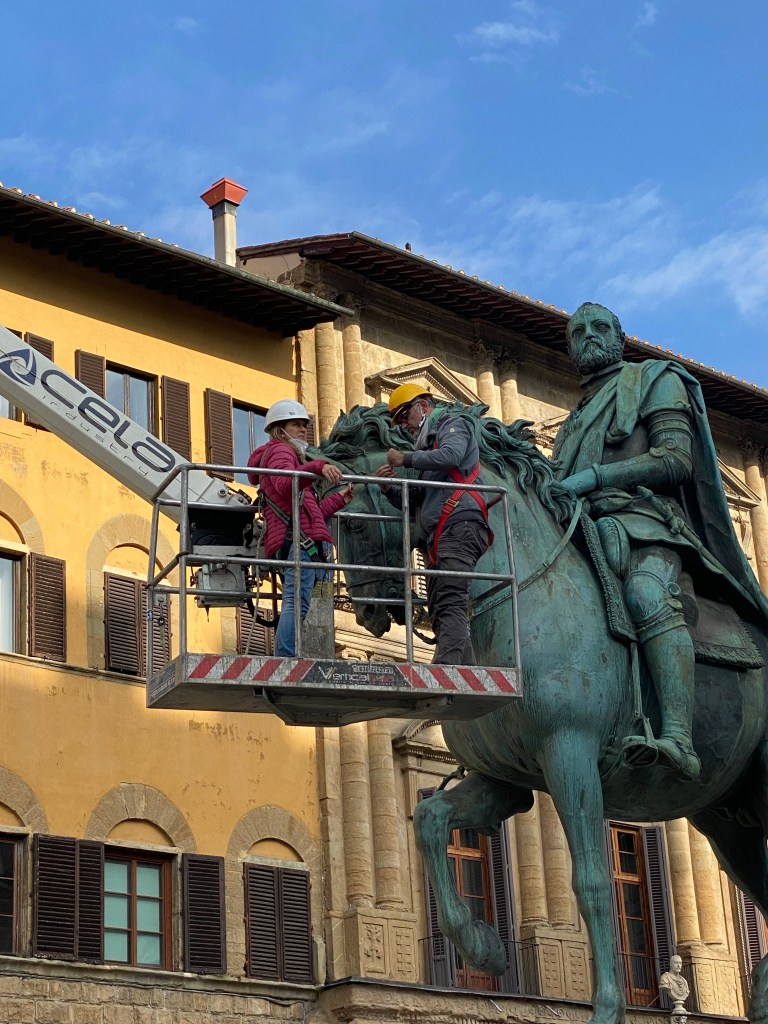
It takes constant conservation to keep the artistic treasures of Italy in good condition. I see work going on all of the time, as well it should!
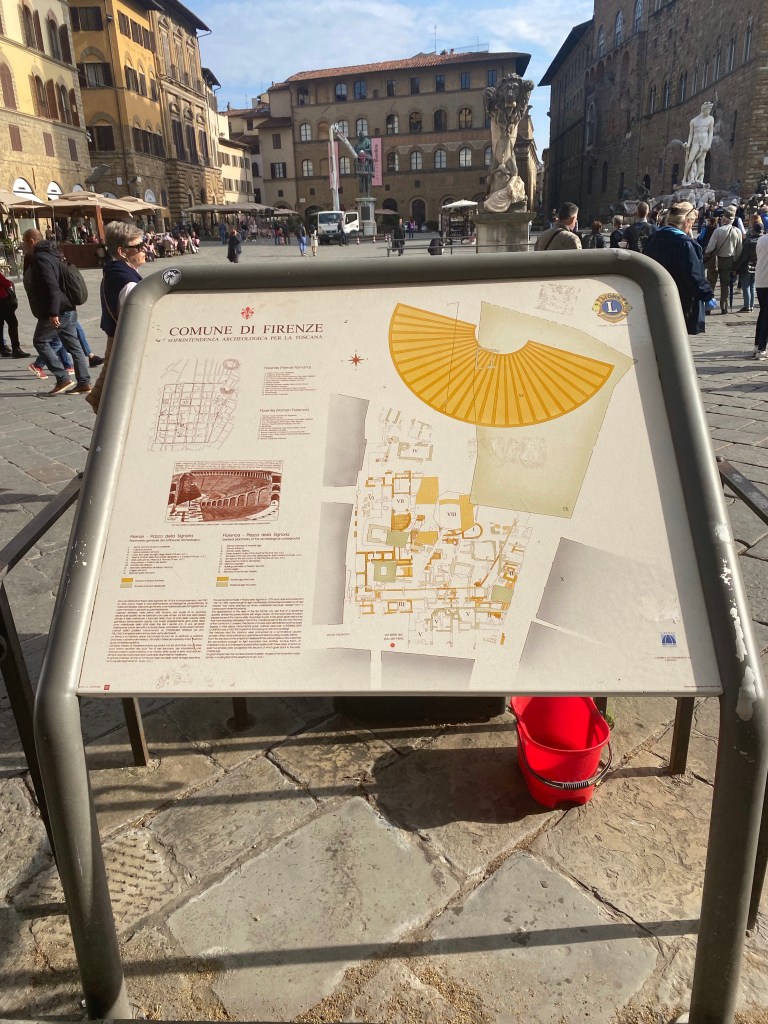
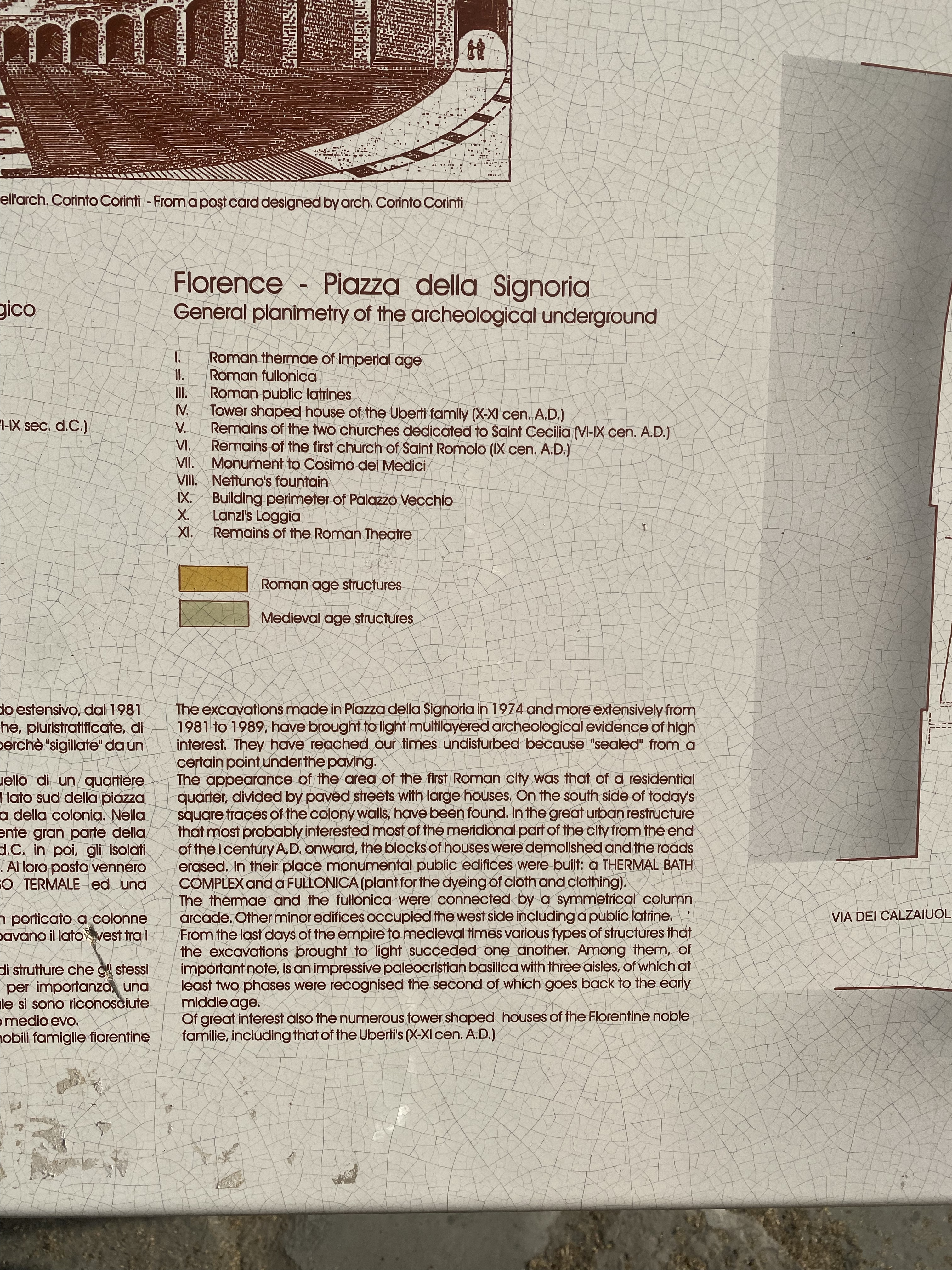
There’s a fine street sign near Rivoire in the Piazza della Signoria that points out the Roman foundations of Florence. Be sure to check it when you are around. You’ll learn a lot!
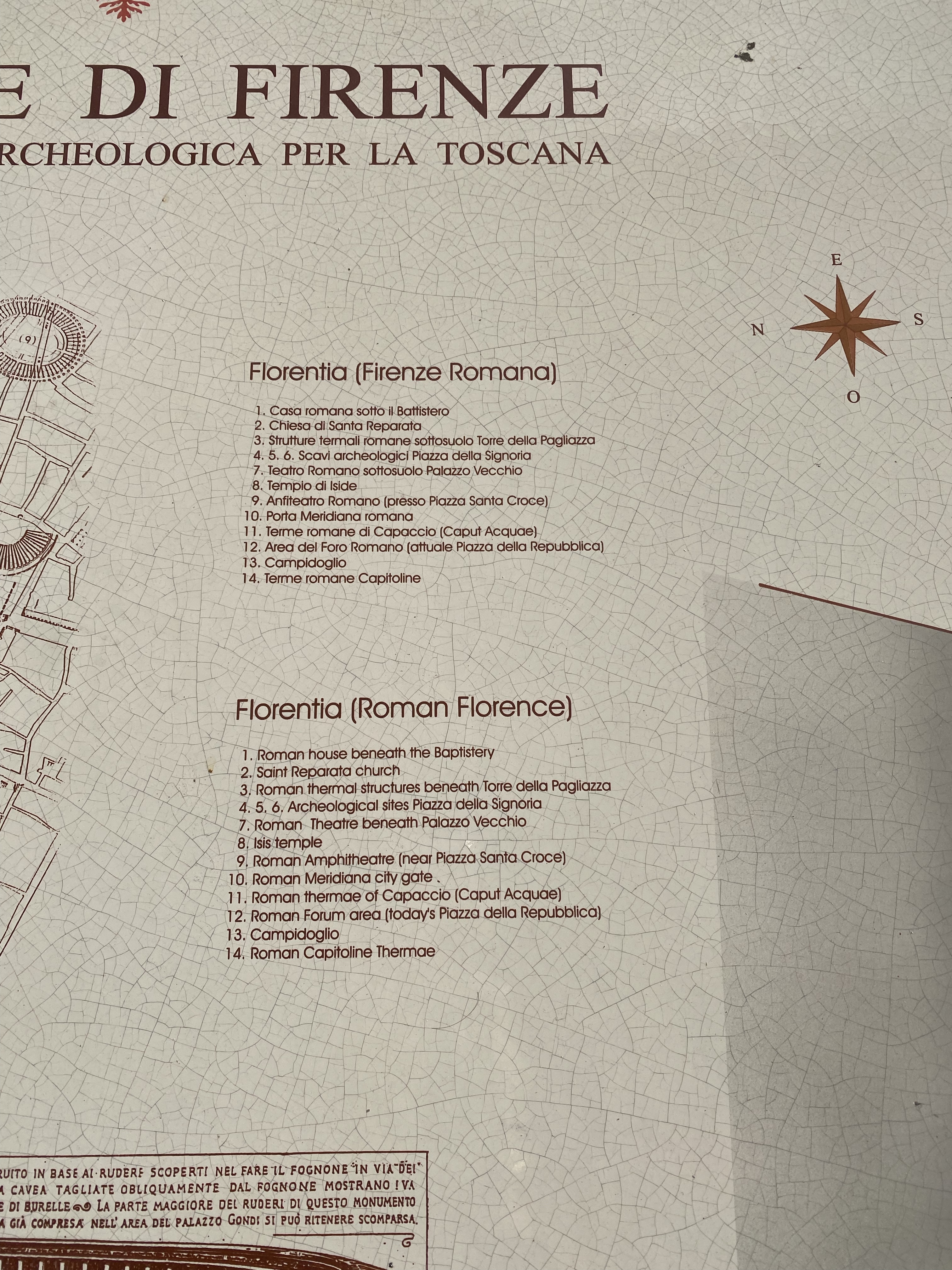
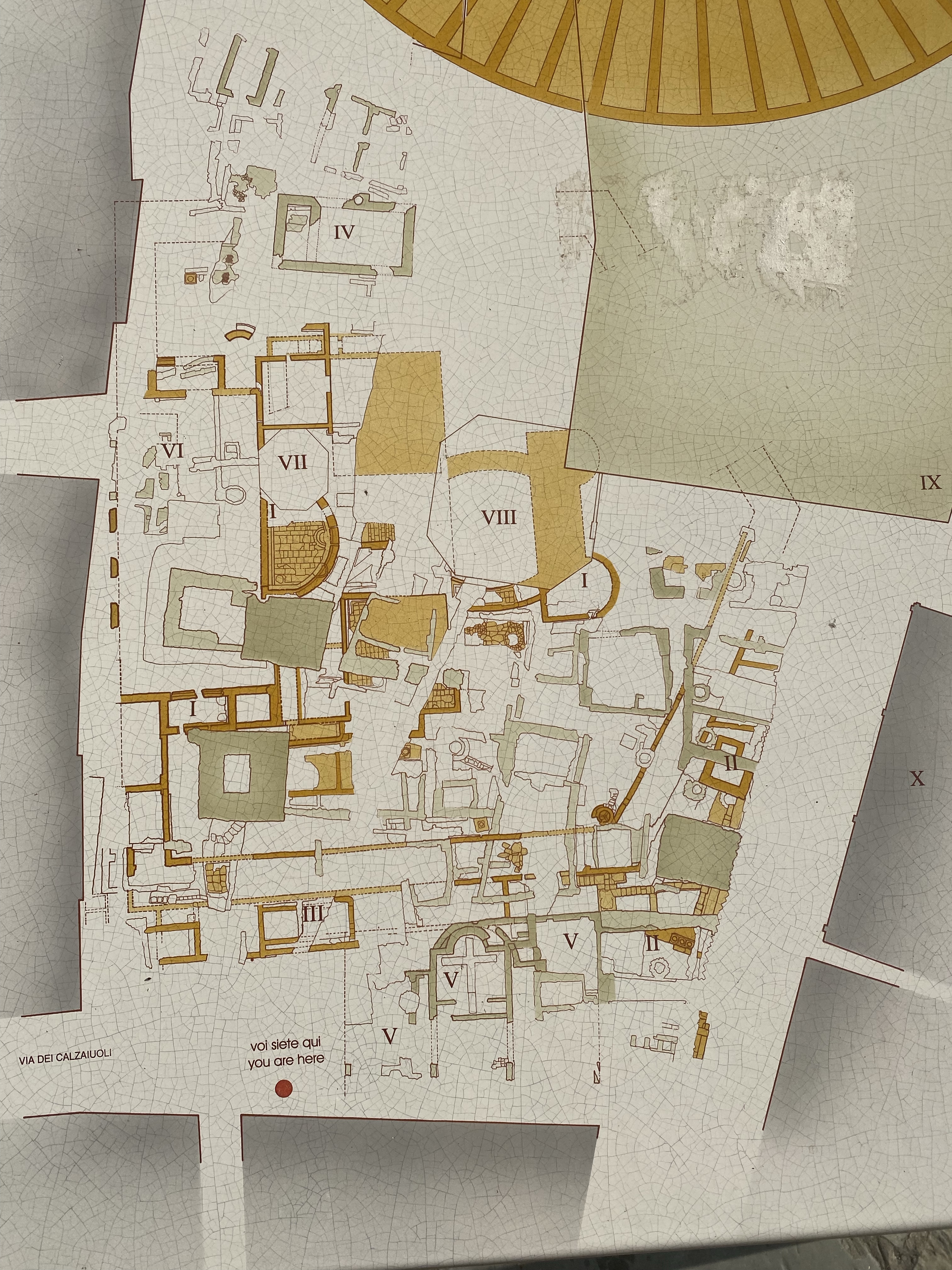
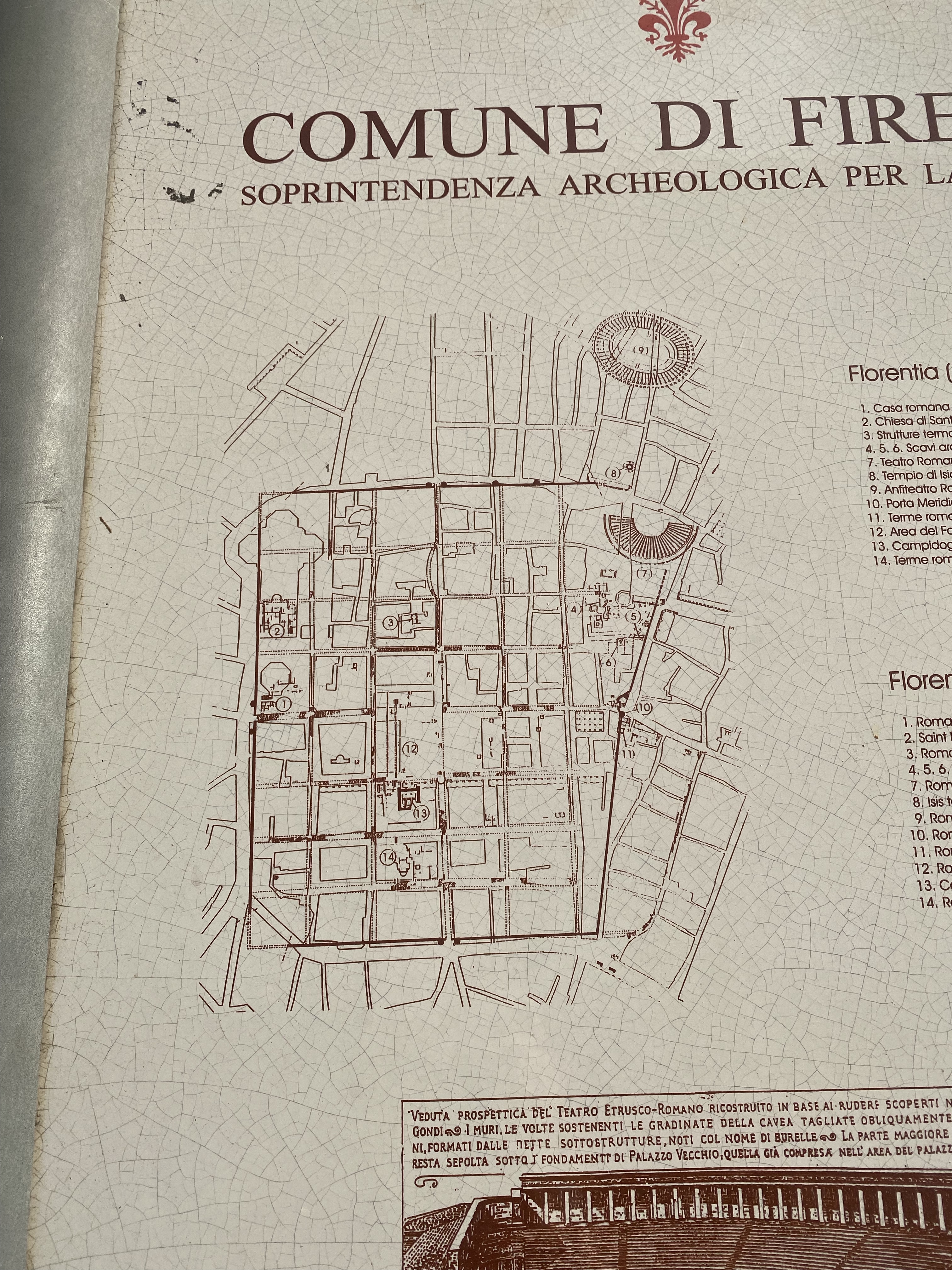
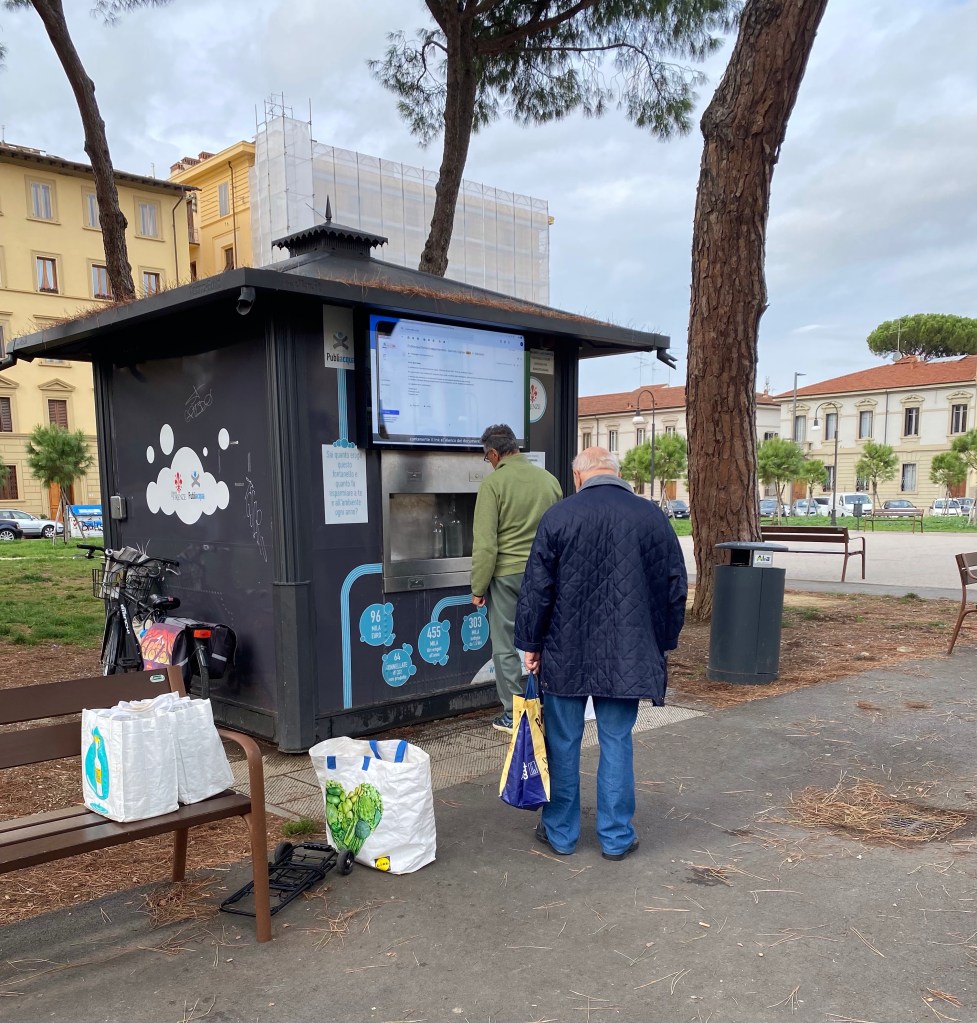
Above, one of the undeniable conveniences about living in Italy (among so many inconveniences, it’s worth noting!) are the water stations. You can get cold mineral water from these stations, for free, both natural and fizzy. I love that! The one pictured above is near my apartment.
And, last but not least, be sure to check out the windows at Rivoire. They are always lovely. I’m curious about the pink selection in November. Seems more appropriate for spring, but what do I know?!
I love the reflection of the tower of the Palazzo Vecchio in the window!
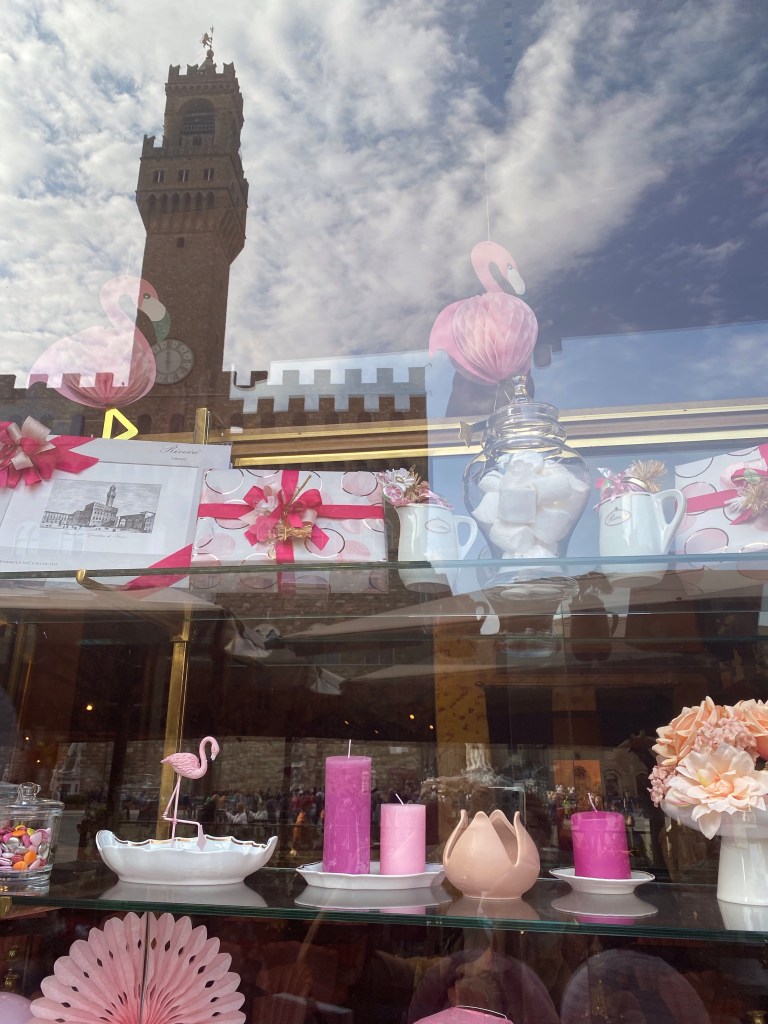
My favorite view of Florence!
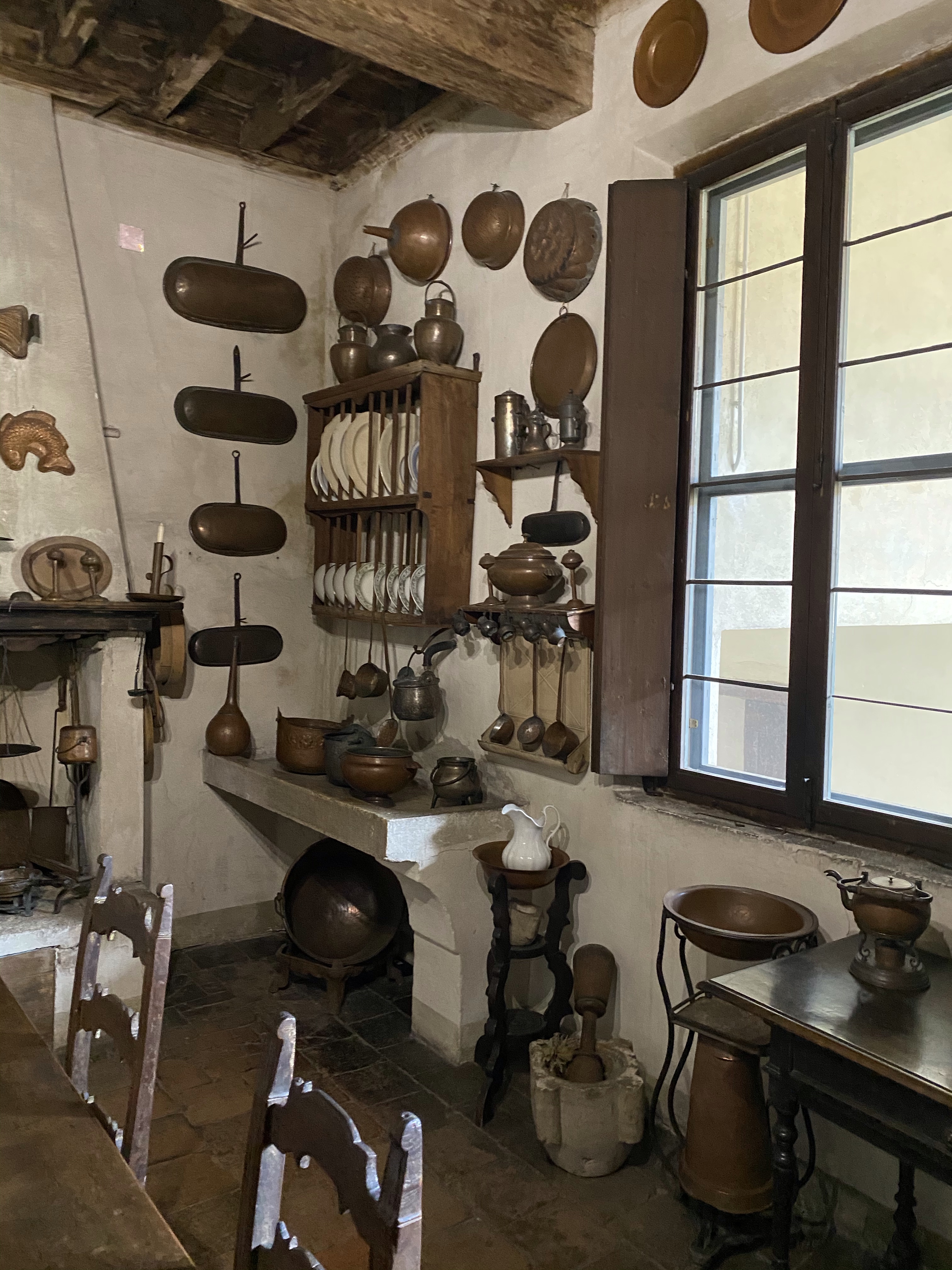
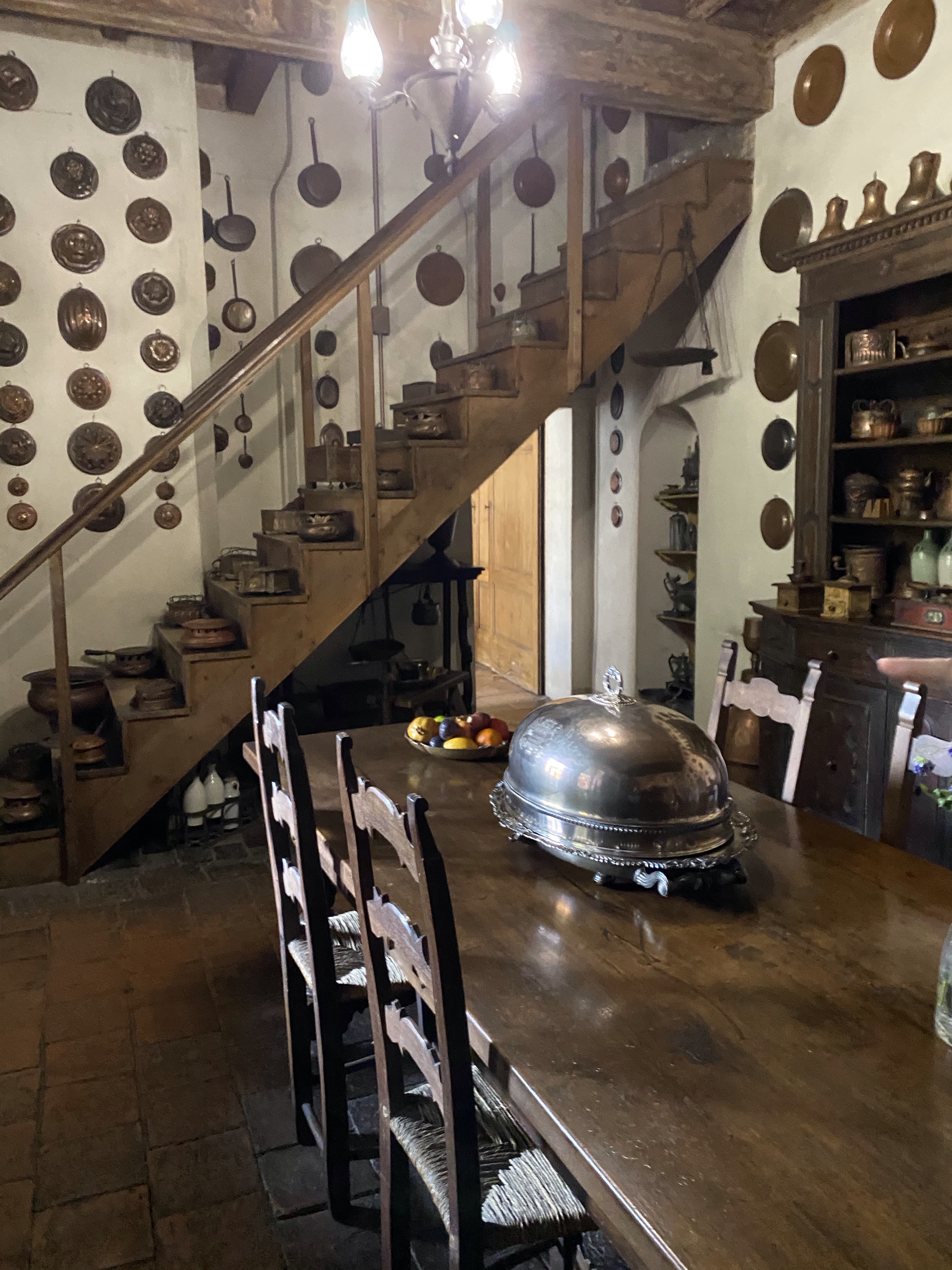
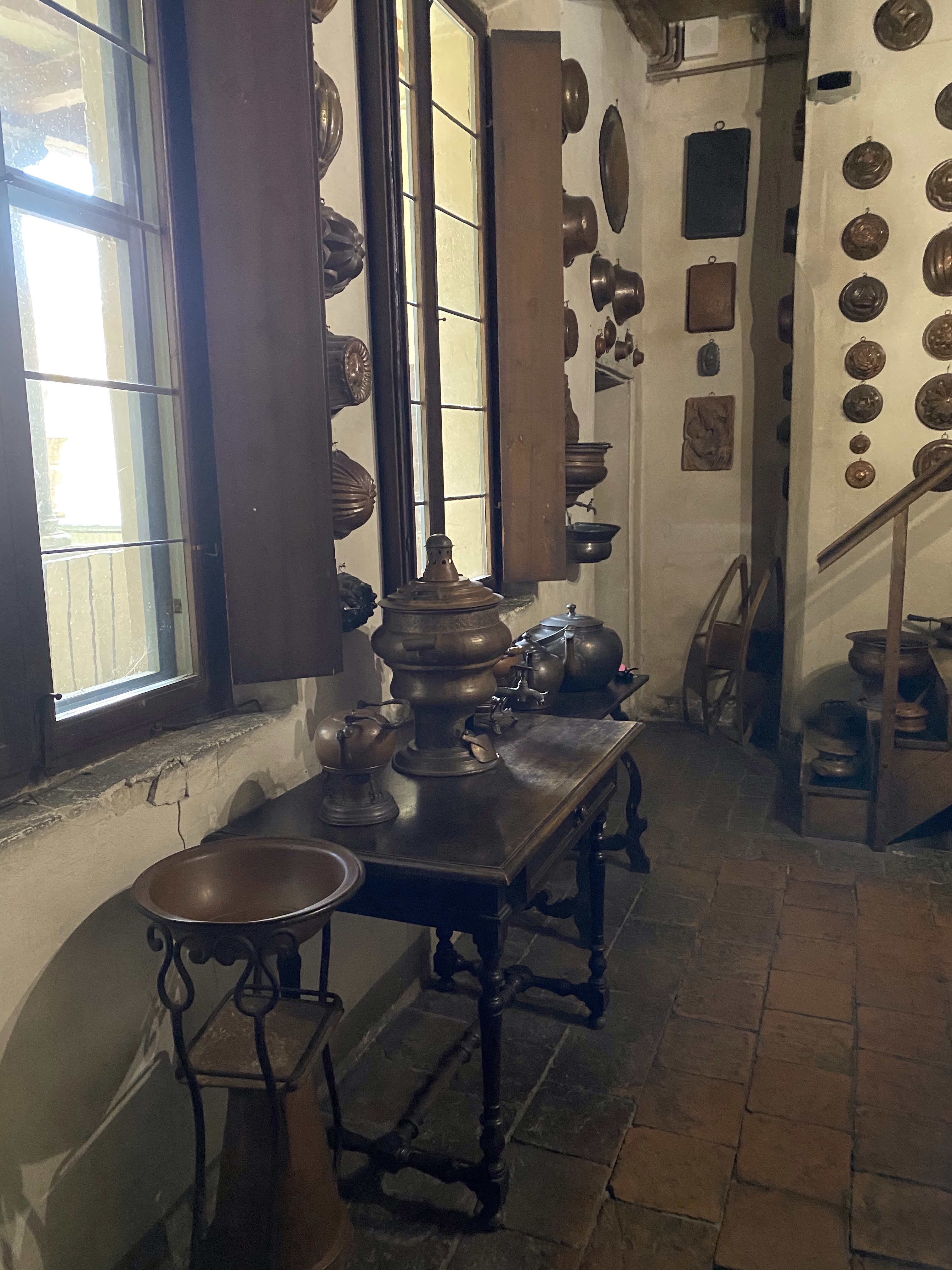
The fabulous period kitchen in the Palazzo d’Arco, Mantua
In this Neo Classically facaded palazzo, one can find an amazing period kitchen.
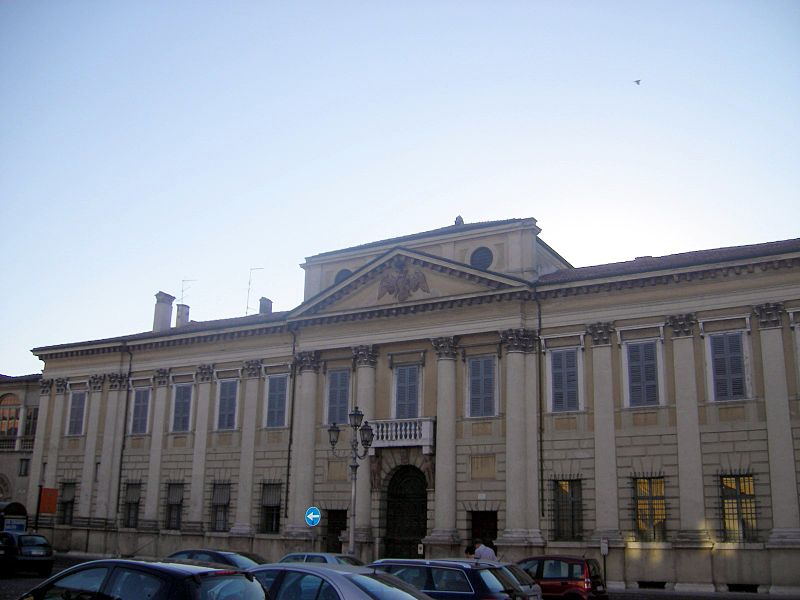
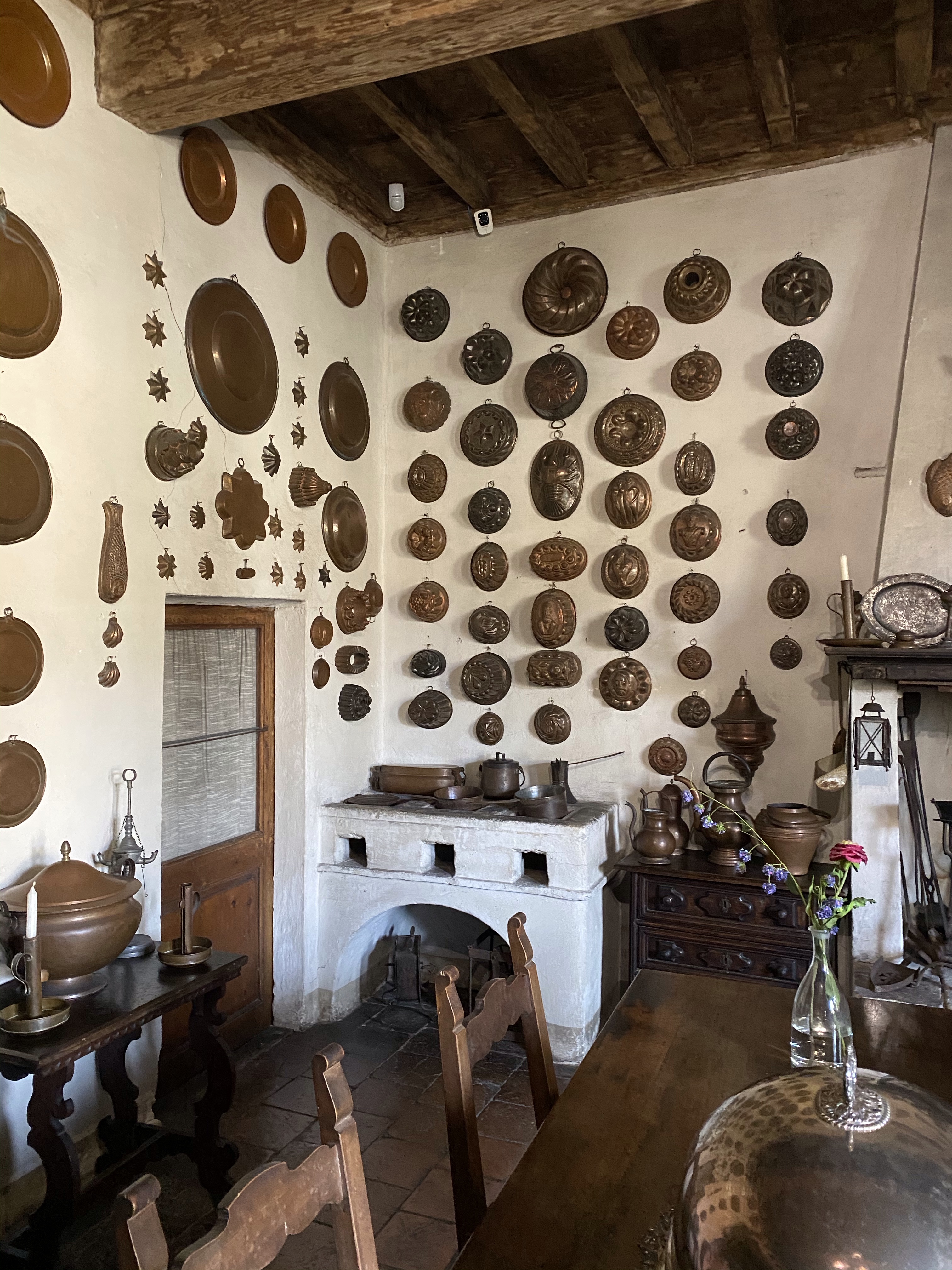
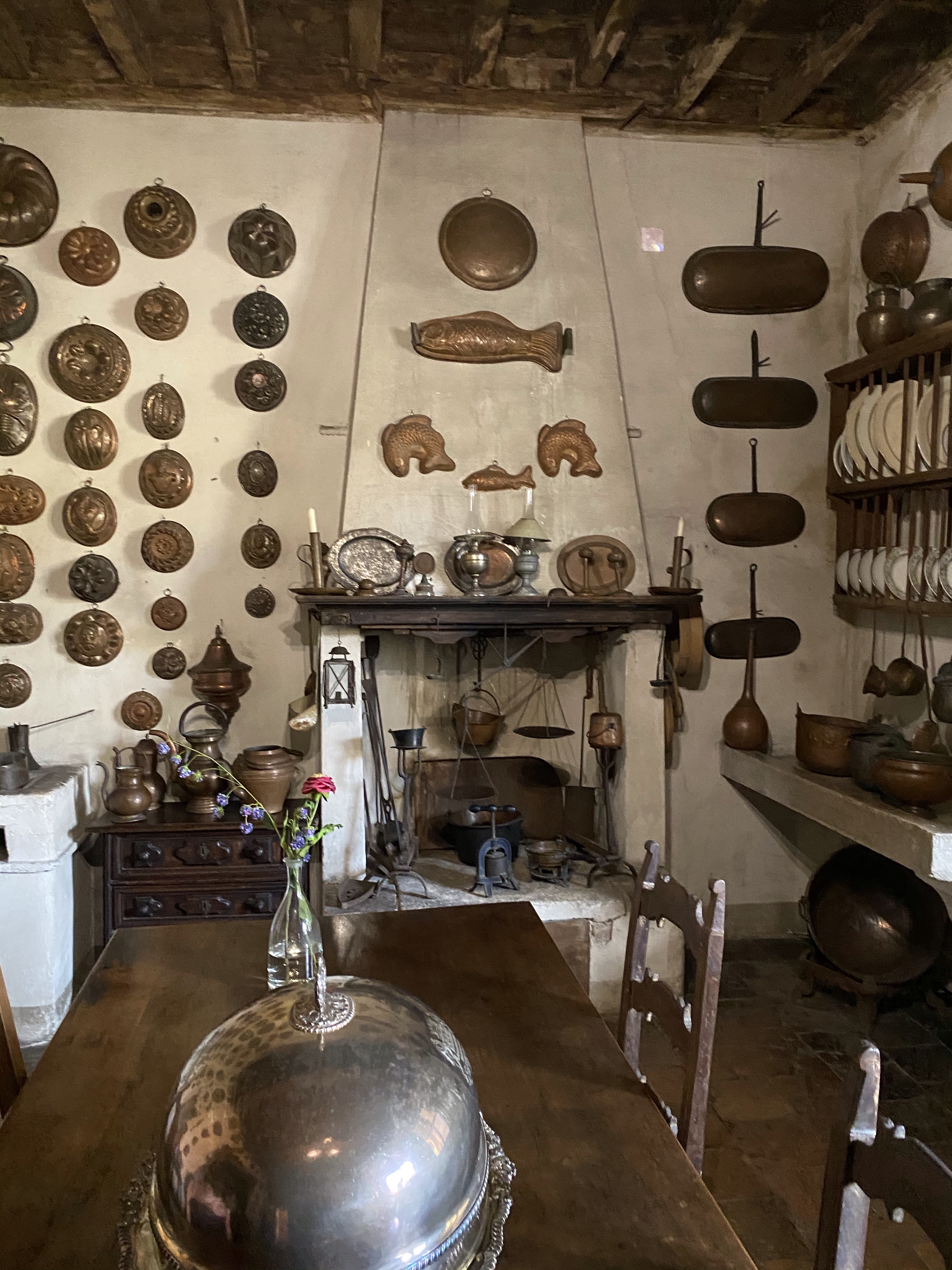
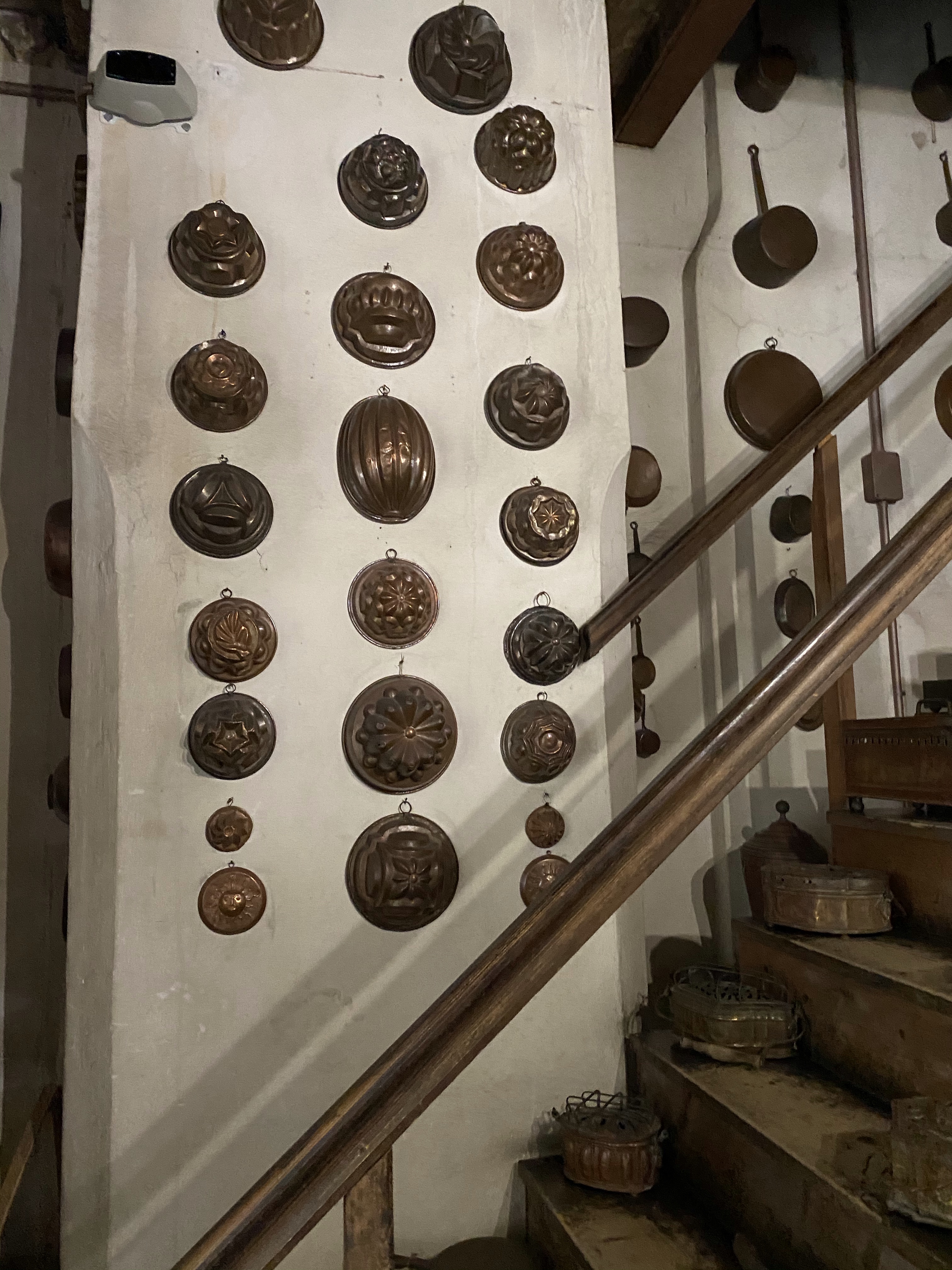
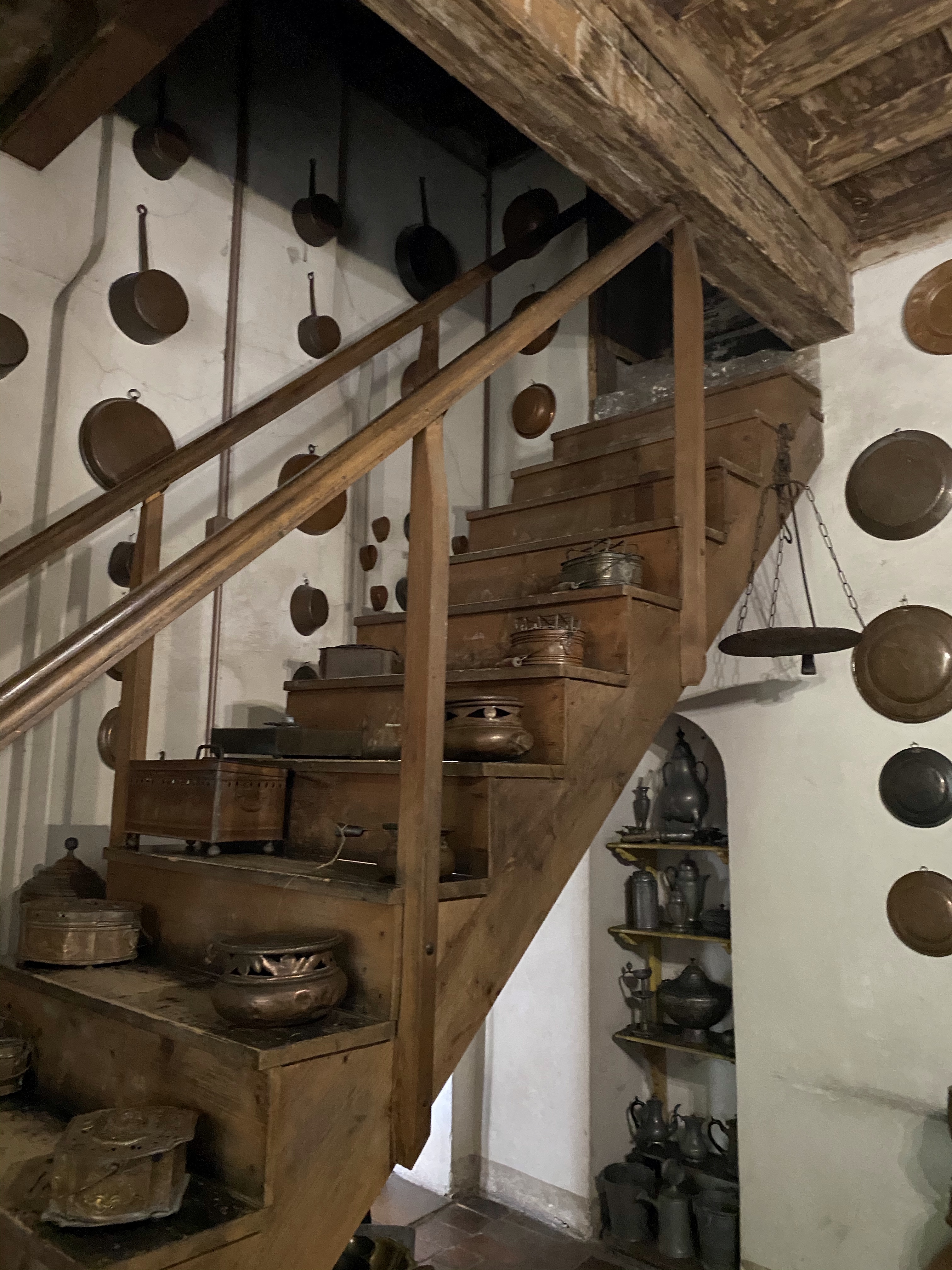
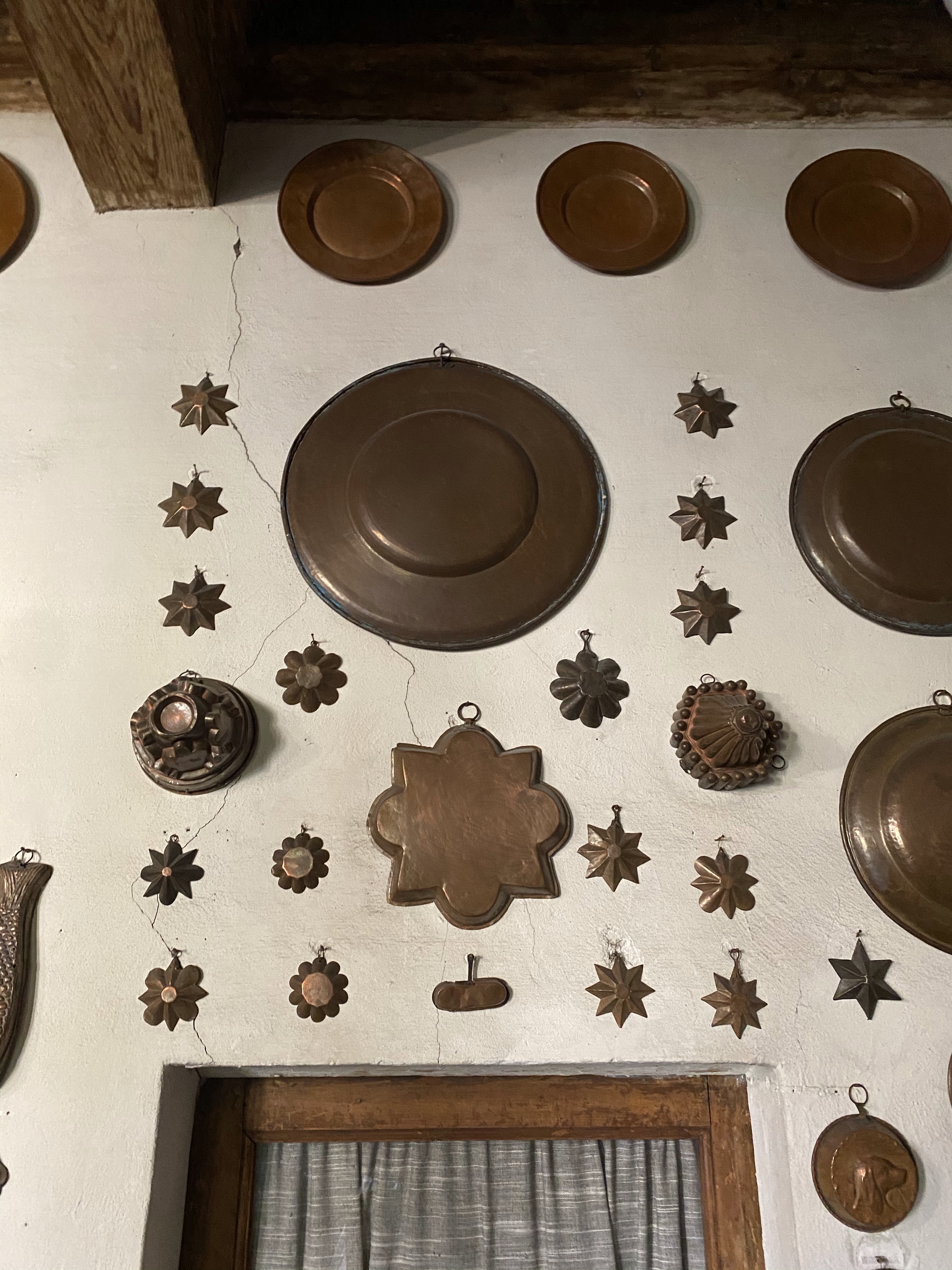
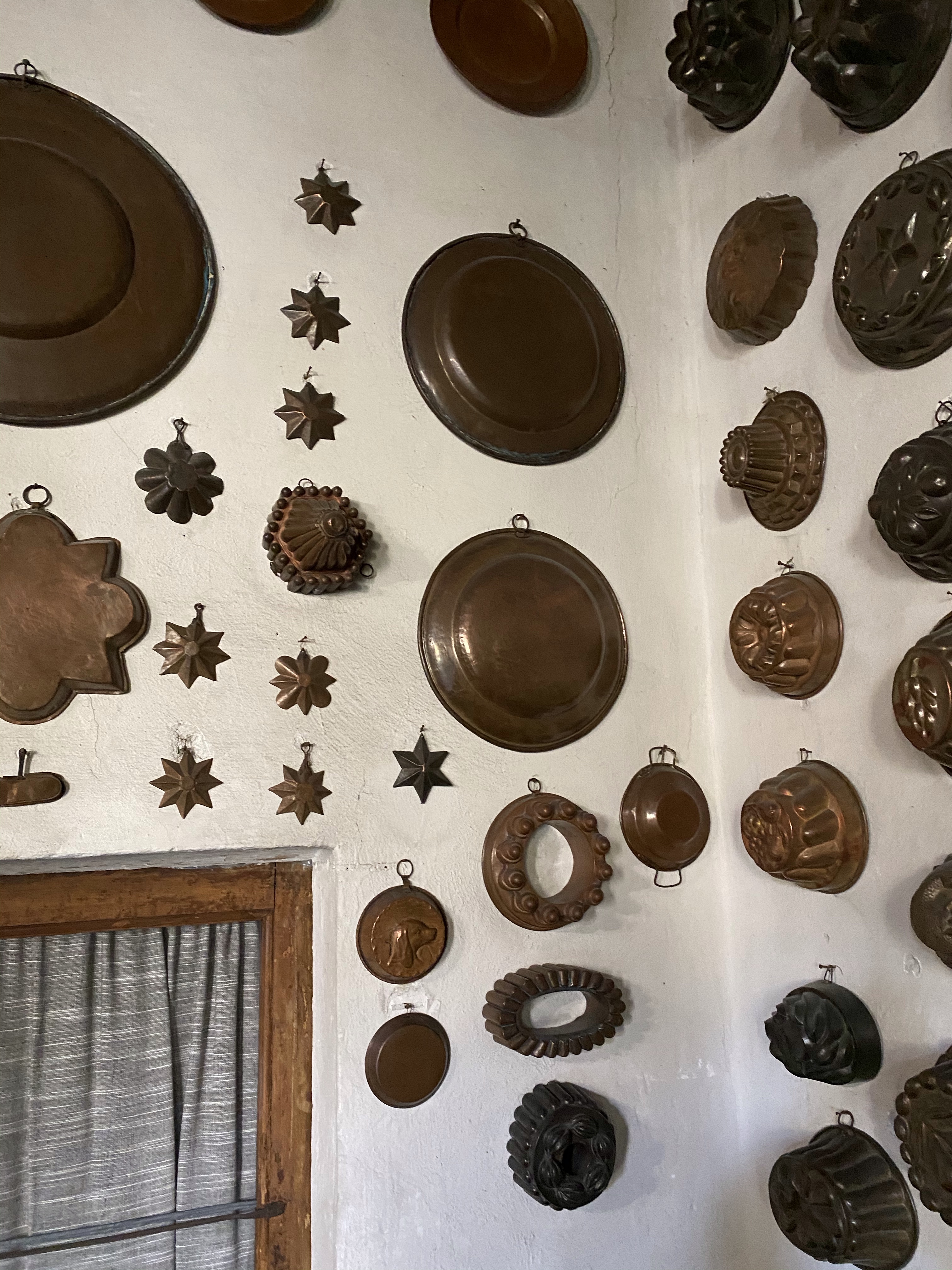
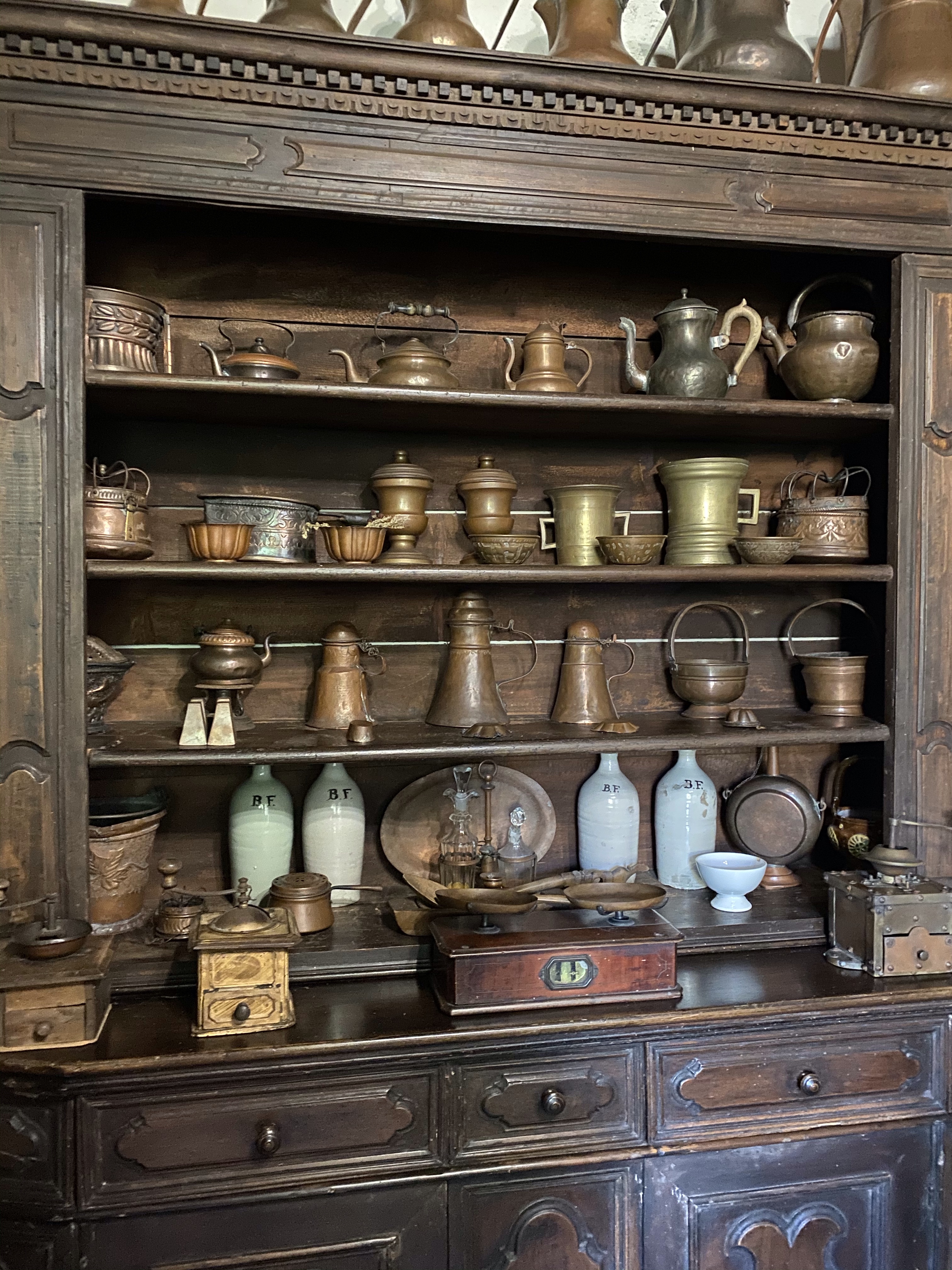
The kitchen dates to the 19th century and is a pleasant, small room where utensils and pots, pans and molds of copper, brass and pewter are displayed. The following description of the kitchen and its implements is taken from the palazzo’s website:
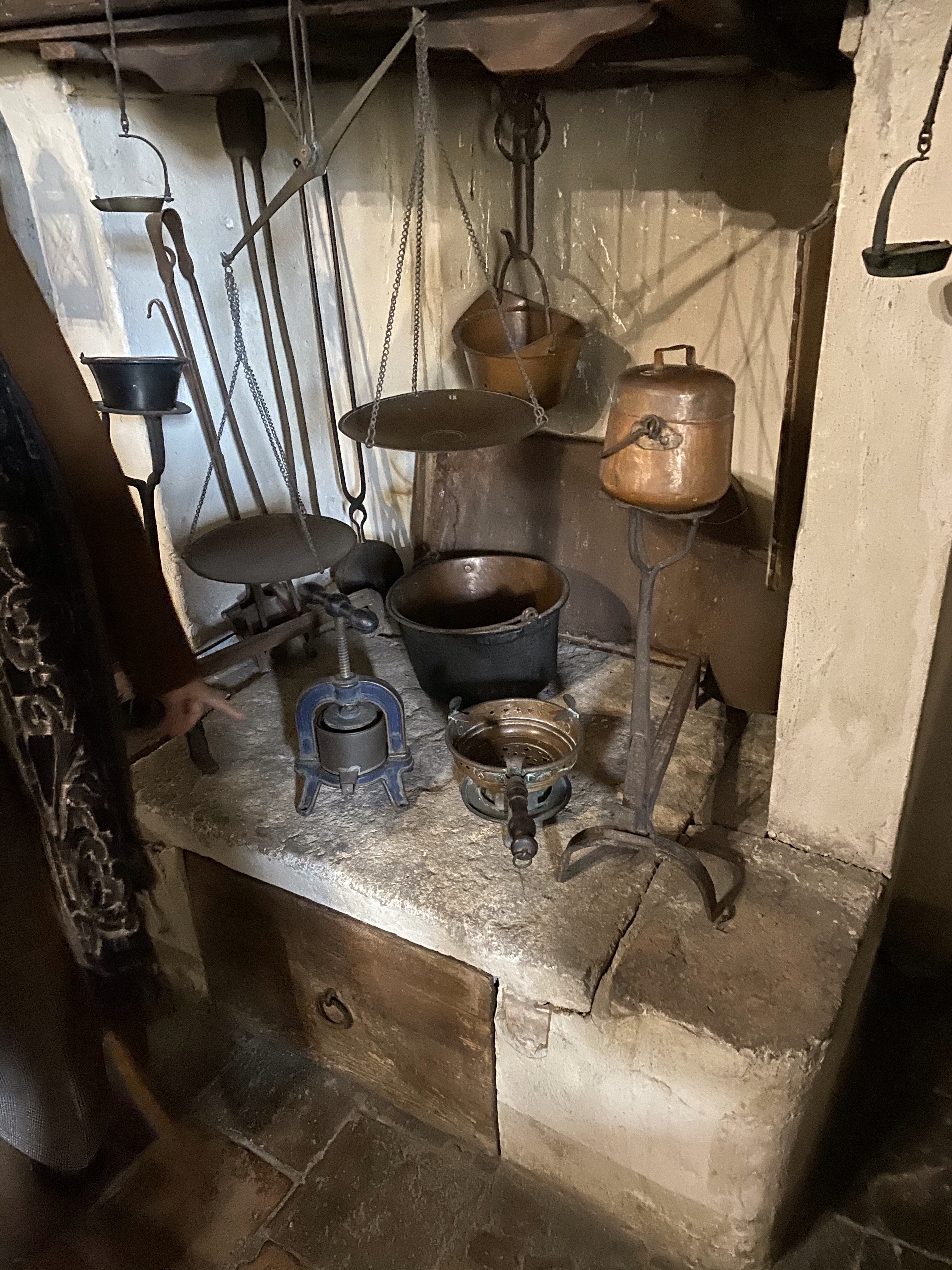
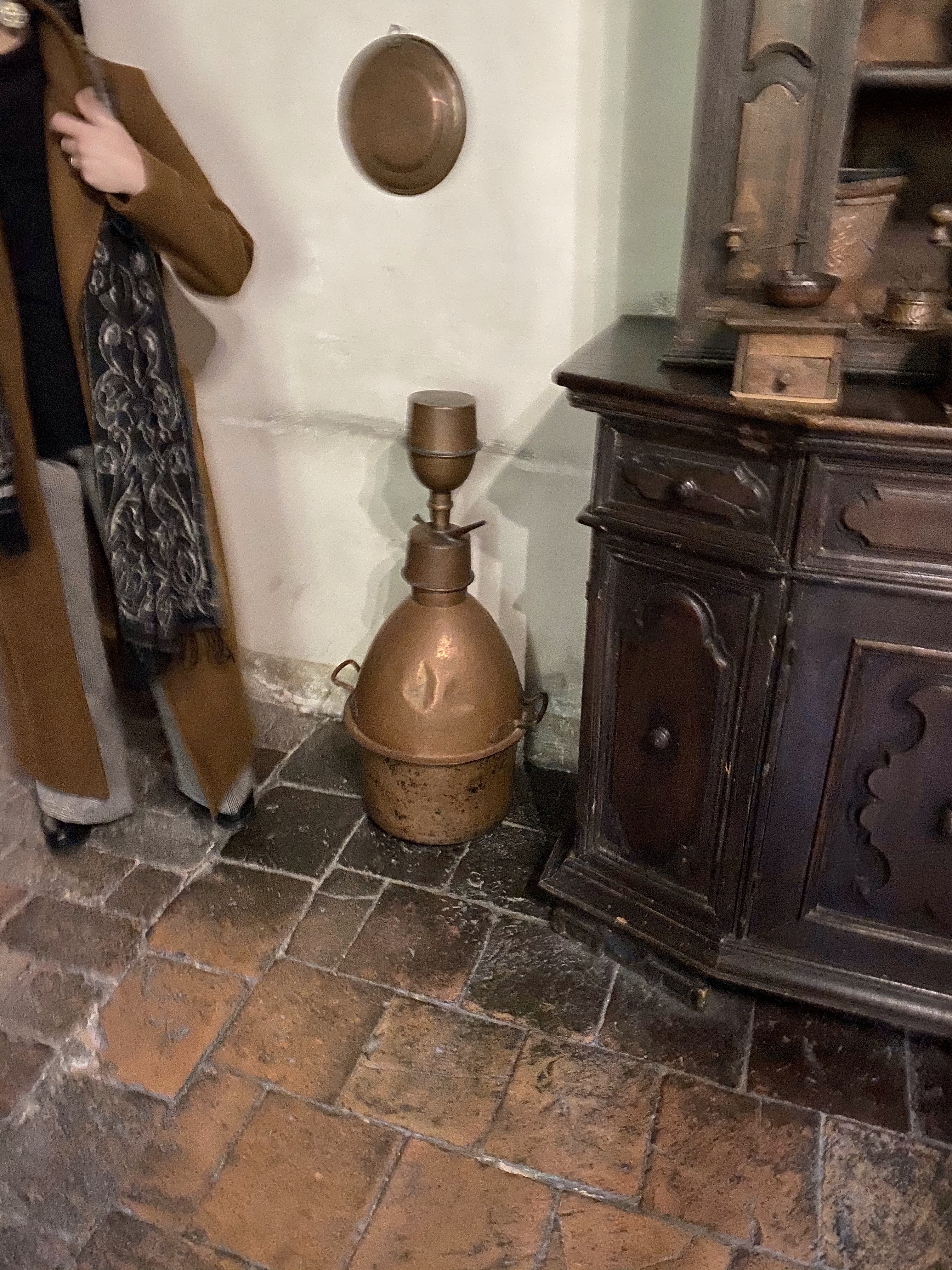
Near the entrance is a pasta press on which an alembic is placed. There is also a beautiful piece of furniture with a 17th-century base on which there are some coffee grinders, a bed warmer, jugs and various plates. There is a stone stove. On this is placed an ancient citrus juicer.
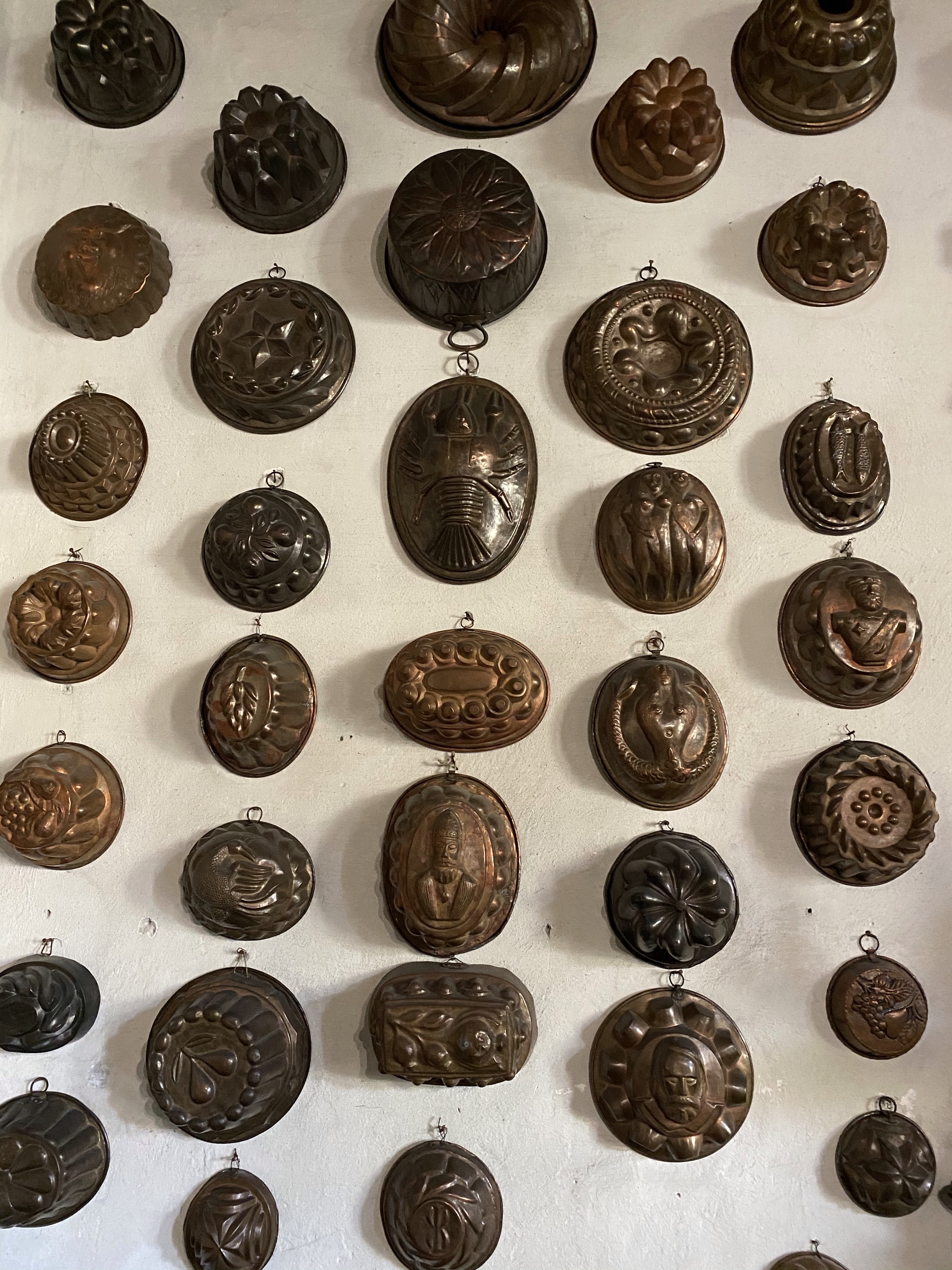
Above the stove a series of molds for figured cakes and puddings, some of which date back to the second half of the 17th century.
There is a spring mechanism for a rotisserie.
Another antique piece of furniture holds on a water tower, and the fireplace which, among other things, contains the springs to toast the coffee.
Running water was accessible to the kitchen by a tank located in the nearby mezzanine.
On this is the plate rack.
Moving along the north wall you will come across some mortars, a small table holding a scale with two plates, a second with a large teapot and a water tower on the wall.
Above this the classic “priest” whose warmer is at the base of the staircase to the attic.
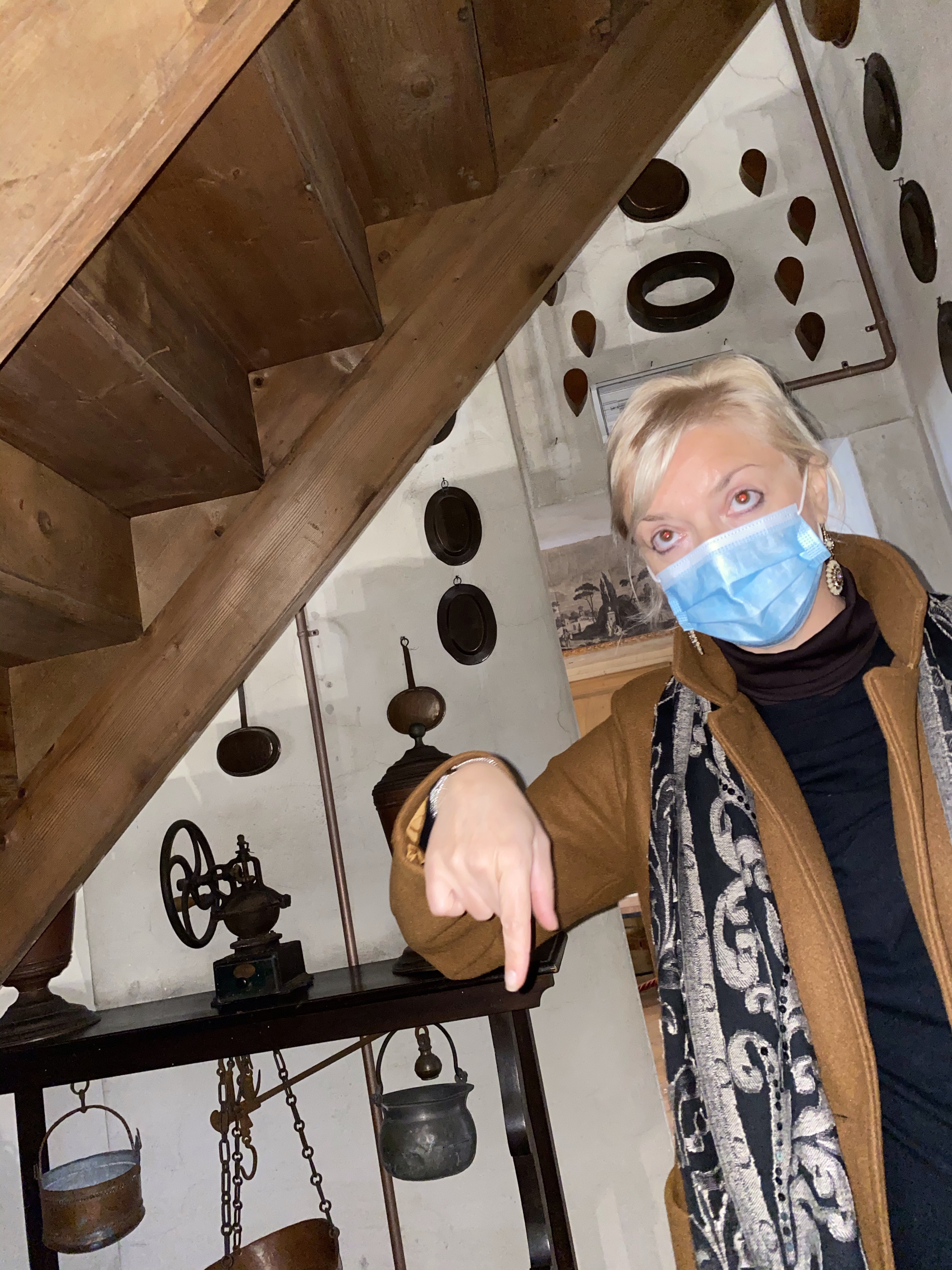
On the steps are hand warmers. Under the staircase is a steelyard, the bottle holder and an ancient coffee grinder.
On the antique fir table, in the center, stands a Russian samovar.
A second with a large teapot and a water tower on the wall.
A shortish history of Bologna
Originally Etruscan, the city has been one of the most important urban centres for centuries, first under the Etruscans (who called it Felsina), then under the Celts as Bona, later under the Romans (Bonōnia), then again in the Middle Ages, as a free municipality and signoria, when it was among the largest European cities by population.
Famous for its towers, churches and lengthy porticoes, Bologna has a well-preserved historical centre, thanks to a careful restoration and conservation policy which began at the end of the 1970s.
Home to the oldest university in the Western world, the University of Bologna, established in AD 1088, the city has a large student population that gives it a cosmopolitan character.
In 2000 it was declared European capital of culture and in 2006, a UNESCO “City of Music” and became part of the Creative Cities Network.
In 2021 UNESCO recognized the lengthy porticoes of the city as a World Heritage Site.
Traces of human habitation in the area of Bologna go back to the 3rd millennium BCE, with significant settlements from about the 9th century BCE (Villanovan culture).
The influence of Etruscan civilization reached the area in the 7th to 6th centuries, and the Etruscan city of Felsina was founded at the site of Bologna by the end of the 6th century.
By the 4th century BCE, the site was occupied by the Gaulish Boii, and it became a Roman colony and municipium with the name of Bonōnia in 196 BCE.
After the fall of the Roman Empire, Bologna, then a frontier outpost of the Byzantine Exarchate of Ravenna, was repeatedly sacked by the Goths; it is in this period that legendary Bishop Petronius, according to ancient chronicles, rebuilt the ruined town and founded the basilica of Saint Stephen. Petronius is still revered as patron saint of Bologna.
In 727–28, the city was sacked and captured by the Lombards under King Liutprand, becoming part of that kingdom. These Germanic conquerors built an important new quarter, called “addizione longobarda” (“Longobard addition”) near the complex of St. Stephen. In the last quarter of the 8th century, Charlemagne, at the request of Pope Adrian I, invaded the Lombard Kingdom, causing its eventual demise. Occupied by Frankish troops in 774 on behalf of the papacy, Bologna remained under imperial authority and prospered as a frontier mark of the Carolingian empire.
Bologna was the center of a revived study of law, including the scholar Irnerius (c 1050 – after 1125) and his famous students, the Four Doctors of Bologna.
After the death of Matilda of Tuscany in 1115, Bologna obtained substantial concessions from Emperor Henry V. However, when Frederick Barbarossa subsequently attempted to strike down the deal, Bologna joined the Lombard League, which then defeated the imperial armies at the Battle of Legnano and established an effective autonomy at the Peace of Constance in 1183.
Subsequently, the town began to expand rapidly and became one of the main commercial trade centres of northern Italy thanks to a system of canals that allowed barges and ships to come and go. Believed to have been established in 1088, the University of Bologna is widely considered the world’s oldest university in continuous operation. The university originated as a centre for the study of medieval Roman law under major glossators, including Irnerius. It numbered Dante, Boccaccio and Petrarch among its students. The medical school was especially renowned. By 1200, Bologna was a thriving commercial and artisanal centre of about 10,000 people.
During a campaign to support the imperial cities of Modena and Cremona against Bologna, Frederick II’s son, King Enzo of Sardinia, was defeated and captured on 26 May 1249 at the Battle of Fossalta. Though the emperor demanded his release, Enzo was thenceforth kept a knightly prisoner in Bologna, in a palace that came to be named Palazzo Re Enzo after him. Every attempt to escape or to rescue him failed, and he died after more than 22 years in captivity. After the death of his half-brothers Conrad IV in 1254, Frederick of Antioch in 1256 and Manfred in 1266, as well as the execution of his nephew Conradin in 1268, he was the last of the Hohenstaufen heirs.
During the late 1200s, Bologna was affected by political instability when the most prominent families incessantly fought for the control of the town. The free commune was severely weakened by decades of infighting, allowing the Pope to impose the rule of his envoy Cardinal Bertrand du Pouget in 1327. Du Pouget was eventually ousted by a popular rebellion and Bologna became a signoria under Taddeo Pepoli in 1334. By the arrival of the Black Death in 1348, Bologna had 40,000 to 50,000 inhabitants, reduced to just 20,000 to 25,000 after the plague.
In 1350, Bologna was conquered by archbishop Giovanni Visconti, the new lord of Milan. But following a rebellion by the town’s governor, a renegade member of the Visconti family, Bologna was recuperated to the papacy in 1363 by Cardinal Gil Álvarez Carrillo de Albornoz after a long negotiation involving a huge indemnity paid to Bernabò Visconti, Giovanni’s heir, who died in 1354.
In 1376, Bologna again revolted against Papal rule and joined Florence in the unsuccessful War of the Eight Saints. However, extreme infighting inside the Holy See after the Western Schism prevented the papacy from restoring its domination over Bologna, so it remained relatively independent for some decades as an oligarchic republic.
In 1401, Giovanni I Bentivoglio took power in a coup with the support of Milan, but the Milanese, having turned his back on them and allied with Florence, marched on Bologna and had Giovanni killed the following year.
In 1442, Hannibal I Bentivoglio, Giovanni’s nephew, recovered Bologna from the Milanese, only to be assassinated in a conspiracy plotted by Pope Eugene IV three years later. But the signoria of the Bentivoglio family was then firmly established, and the power passed to his cousin Sante Bentivoglio, who ruled until 1462, followed by Giovanni II. Giovanni II managed to resist the expansionist designs of Cesare Borgia for some time, but on 7 October 1506, Pope Julius II issued a bull deposing and excommunicating Bentivoglio and placing the city under interdict. When the papal troops, along with a contingent sent by Louis XII of France, marched against Bologna, Bentivoglio and his family fled. Julius II entered the city triumphantly on 10 November.
The period of Papal rule over Bologna (1506–1796) has been generally evaluated by historians as one of severe decline. However, this was not evident in the 1500s, which were marked by some major developments in Bologna. In 1530, Emperor Charles V was crowned in Bologna, the last of the Holy Roman Emperors to be crowned by the pope.
In 1564, the Piazza del Nettuno and the Palazzo dei Banchi were built, along with the Archiginnasio, the main building of the university. The period of Papal rule saw also the construction of many churches and other religious establishments, and the restoration of older ones. At this time, Bologna had ninety-six convents, more than any other Italian city. Painters working in Bologna during this period established the Bolognese School which includes Annibale Carracci, Domenichino, Guercino and others of European fame.
It was only towards the end of the 16th century that severe signs of decline began to manifest. A series of plagues in the late 16th to early 17th century reduced the population of the city from some 72,000 in the mid-16th century to about 47,000 by 1630. During the Italian Plague of 1629–31 alone, Bologna lost up to a third of its population.
In the mid-17th century, population stabilized at roughly 60,000, slowly increasing to some 70,000 by the mid-18th century. The economy of Bologna started to show signs of severe decline as the global centres of trade shifted towards the Atlantic. The traditional silk industry was in a critical state. The university was losing students, who once came from all over Europe, because of the illiberal attitudes of the Church towards culture (especially after the trial of Galileo). Bologna continued to suffer a progressive deindustrialisation also in the 18th century.
In the mid-1700s pope Benedict XIV, a Bolognese, tried to reverse the decline of the city with a series of reforms intended to stimulate the economy and promote the arts. However, these reforms achieved only mixed results. The pope’s efforts to stimulate the decaying textile industry had little success, while he was more successful in reforming the tax system, liberalising trade and relaxing the oppressive system of censorship.
The economic and demographic decline of Bologna became even more noticeable starting from the second half of the 18th century. In 1790 the city had 72,000 inhabitants, ranking as the second largest in the Papal States; however this figure had remained unchanged for decades. The economy was stagnant because of Papal policies that distorted trade with heavy custom duties and sold concessions of monopolies to single manufacturers thus lowering competition, depressing productivity and incentivising corruption.
Napoleon entered Bologna on 19 June 1796. Napoleon briefly reinstated the ancient mode of government, giving power to the Senate, which however had to swear fealty to the short lived Cispadane Republic, created as a client state of the French Empire at the congress of Reggio (27 December 1796 – 9 January 1797) but succeeded by the Cisalpine Republic on 9 July 1797, later by the Italian Republic and finally the Kingdom of Italy.
After the fall of Napoleon, the Congress of Vienna of 1815 restored Bologna to the Papal States. Papal rule was contested in the uprisings of 1831. The insurrected provinces planned to unite as the Province Italiane Unite with Bologna as capital.
Pope Gregory XVI asked for Austrian help against the rebels. Metternich warned French king Louis Philippe I against intervention in Italian affairs, and in the spring of 1831, Austrian forces marched across the Italian peninsula, defeating the rebellion by 26 April.
By the mid 1840s, unemployment levels were very high and traditional industries continued to languish or disappear; Bologna became a city of economic disparity with the top 10 percent of the population living off rent, another 20 percent exercising professions or commerce and 70 percent working in low-paid, often insecure manual jobs. The Papal census of 1841 reported 10,000 permanent beggars and another 30,000 (out of a total population of 70,000) who lived in poverty. In the revolutions of 1848 the Austrian garrisons which controlled the city on behalf of the Pope were temporarily expelled, but eventually came back and crushed the revolutionaries.
Papal rule finally ended in the aftermath of Second War of Italian Independence, when the French and Pidemontese troops expelled the Austrians from Italian lands, on 11 and 12 March 1860, Bologna voted to join the new Kingdom of Italy. In the last decades of the 19th century, Bologna once again thrived economically and socially.
In 1863 Naples was linked to Rome by railway, and the following year Bologna to Florence. Bolognese moderate agrarian elites, that supported liberal insurgencies against the papacy and were admirers of the British political system and of free trade, envisioned a unified national state that would open a bigger market for the massive agricultural production of the Emilian plains. Indeed, Bologna gave Italy one of its first prime ministers, Marco Minghetti.
After World War I, Bologna was heavily involved in the Biennio Rosso socialist uprisings. As a consequence, the traditionally moderate elites of the city turned their back on the progressive faction and gave their support to the rising Fascist movement of Benito Mussolini. Dino Grandi, a high-ranking Fascist party official and Ministry of Foreign Affairs, remembered for being an Anglophile, was from Bologna. During the interwar years, Bologna developed into an important manufacturing centre for food processing, agricultural machinery and metalworking. The Fascist regime poured in massive investments, for example with the setting up of a giant tobacco manufacturing plant in 1937.
Bologna suffered extensive damage during World War II. The strategic importance of the city as an industrial and railway hub connecting northern and central Italy made it a target for the Allied forces. On 24 July 1943, a massive aerial bombardment destroyed a significant part of the historic city centre and killed about 200 people. The main railway station and adjoining areas were severely hit, and 44% of the buildings in the centre were listed as having been destroyed or severely damaged. The city was heavily bombed again on 25 September. The raids, which this time were not confined to the city centre, left 2,481 people dead and 2,000 injured. By the end of the war, 43% of all buildings in Bologna had been destroyed or damaged.
After the armistice of 1943, the city became a key centre of the Italian resistance movement. On 7 November 1944, a pitched battle around Porta Lame, waged by partisans of the 7th Brigade of the Gruppi d’Azione Patriottica against Fascist and Nazi occupation forces, did not succeed in triggering a general uprising, despite being one of the largest resistance-led urban conflicts in the European theatre. Resistance forces entered Bologna on the morning of 21 April 1945. By this time, the Germans had already largely left the city in the face of the Allied advance, spearheaded by Polish forces advancing from the east during the Battle of Bologna which had been fought since 9 April. First to arrive in the centre was the 87th Infantry Regiment of the Friuli Combat Group under general Arturo Scattini, who entered the centre from Porta Maggiore to the south. Since the soldiers were dressed in British outfits, they were initially thought to be part of the allied forces; when the local inhabitants heard the soldiers were speaking Italian, they poured out onto the streets to celebrate.
In the post-war years, Bologna became a thriving industrial centre as well as a political stronghold of the Italian Communist Party. Between 1945 and 1999, the city was helmed by an uninterrupted succession of mayors from the PCI and its successors, the Democratic Party of the Left and Democrats of the Left, the first of whom was Giuseppe Dozza. At the end of the 1960s the city authorities, worried by massive gentrification and suburbanisation, asked Japanese starchitect Kenzo Tange to sketch a master plan for a new town north of Bologna; however, the project that came out in 1970 was evaluated as too ambitious and expensive. Eventually the city council, in spite of vetoing Tange’s master plan, decided to keep his project for a new exhibition centre and business district. At the end of 1978 the construction of a tower block and several diverse buildings and structures started. In 1985 the headquarters of the regional government of Emilia-Romagna moved in the new district.
In 1977, Bologna was the scene of rioting linked to the Movement of 1977, a spontaneous political movement of the time. The police shooting of a far-left activist, Francesco Lorusso, sparked two days of street clashes. On 2 August 1980, at the height of the “years of lead,” a terrorist bomb was set off in the central railway station of Bologna killing 85 people and wounding 200, an event which is known in Italy as the Bologna massacre.
In 1995, members of the neo-fascist group Nuclei Armati Rivoluzionari were convicted for carrying out the attack, while Licio Gelli—Grand Master of the underground Freemason lodge Propaganda Due (P2)—was convicted for hampering the investigation, together with three agents of the secret military intelligence service SISMI (including Francesco Pazienza and Pietro Musumeci). Commemorations take place in Bologna on 2 August each year, culminating in a concert in the main square.
Cityscape:
Until the late 19th century, when a large-scale urban renewal project was undertaken, Bologna was one of the few remaining large walled cities in Europe; to this day and despite having suffered considerable bombing damage in 1944, Bologna’s 142 hectares (350 acres) historic centre is Europe’s second largest, containing an immense wealth of important Medieval, Renaissance, and Baroque artistic monuments.
Bologna developed along the Via Emilia as an Etruscan and later Roman colony; the Via Emilia still runs straight through the city under the changing names of Strada Maggiore, Rizzoli, Ugo Bassi, and San Felice. Due to its Roman heritage, the central streets of Bologna, today largely pedestrianized, follow the grid pattern of the Roman settlement. The original Roman ramparts were supplanted by a high medieval system of fortifications, remains of which are still visible, and finally by a third and final set of ramparts built in the 13th century, of which numerous sections survive. No more than twenty medieval defensive towers remain out of up to 180 that were built in the 12th and 13th centuries before the arrival of unified civic government. The most famous of the towers of Bologna are the central “Due Torri” (Asinelli and Garisenda), whose iconic leaning forms provide a popular symbol of the town.
The cityscape is further enriched by its elegant and extensive porticoes, for which the city is famous. In total, there are some 38 kilometres (24 miles) of porticoes in the city’s historical centre (over 45 km [28 mi] in the city proper), which make it possible to walk for long distances sheltered from the elements.
The Portico di San Luca is possibly the world’s longest. It connects Porta Saragozza (one of the twelve gates of the ancient walls built in the Middle Ages, which circled a 7.5 km (4.7 mi) part of the city) with the Sanctuary of the Madonna di San Luca, a church begun in 1723 on the site of an 11th-century edifice which had already been enlarged in the 14th century, prominently located on a hill (289 metres (948 feet)) overlooking the town, which is one of Bologna’s main landmarks. The windy 666 vault arcades, almost four kilometres (3,796 m or 12,454 ft) long, effectively links San Luca, as the church is commonly called, to the city centre. Its porticos provide shelter for the traditional procession which every year since 1433 has carried a Byzantine icon of the Madonna with Child attributed to Luke the Evangelist down to the Bologna Cathedral during the Feast of the Ascension.
In 2021, the porticoes were named as a UNESCO World Heritage Site.
San Petronio Basilica, built between 1388 and 1479 (but still unfinished), is the tenth-largest church in the world by volume, 132 metres long and 66 metres wide, while the vault reaches 45 metres inside and 51 metres in the facade. With its volume of 258,000 m3, it is the largest (Gothic or otherwise) church built of bricks of the world.
The Basilica of Saint Stephen and its sanctuary are among the oldest structures in Bologna, having been built starting from the 8th century, according to the tradition on the site of an ancient temple dedicated to Egyptian goddess Isis.
The Basilica of Saint Dominic is an example of Romanic architecture from the 13th century, enriched by the monumental tombs of great Bolognese glossators Rolandino de’Passeggeri and Egidio Foscherari.
Basilicas of St Francis, Santa Maria dei Servi and San Giacomo Maggiore are other magnificent examples of 14th-century architecture, the latter also featuring Renaissance artworks such as the Bentivoglio Altarpiece by Lorenzo Costa. Finally, the Church of San Michele in Bosco is a 15th-century religious complex located on a hill not far from the city’s historical center.
The fabulous city of Bologna!
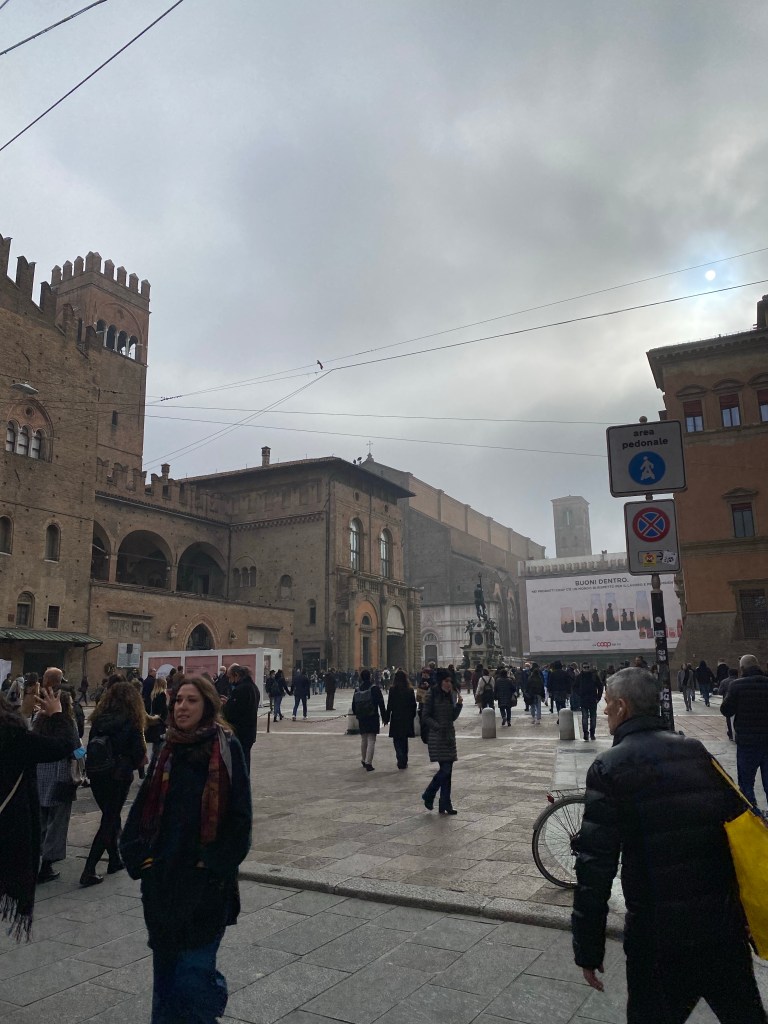
Yesterday, Saturday, I did one of my favorite things in Italy! I hopped on a train and went from Florence to Bologna. Just in time for lunch. It’s a 30 minute train ride. I marvel. I love. I want more!
I’ve been to Bologna before and visited the major art museums. But, that was a long time ago and I decided it was high-time to go there again.
Let’s talk about the city:
BOLOGNA is the Capital of the Emilia-Romagna region and it’s located between the Tuscan-Emilian Apennines and the heart of the Po Valley. The train ride from Florence is almost all underground in a vast system of tunnels.
WHY VISIT IT
City of art, culture and commerce, with a streamlined trade-fair organization and a well-known manufacturing and motor tradition, Bologna is famous for its almost 40 km (nearly 25 miles) of arcades, the longest in the world.
Also called “The Learned” for its old University, and “The Fat” for its food tradition, the city is also a “UNESCO creative City of Music” and has one of the largest and most well-preserved medieval historical centres, full of restaurants, taverns, theatres and shops.
Home of many famous artists such as Giorgio Morandi, Guido Reni, the Carraccis, Guercino, Aspertini, it has charmed notable people like Mozart, Carducci, Dante, Rossini and Guglielmo Marconi, winner of the Nobel Prize in Physics.
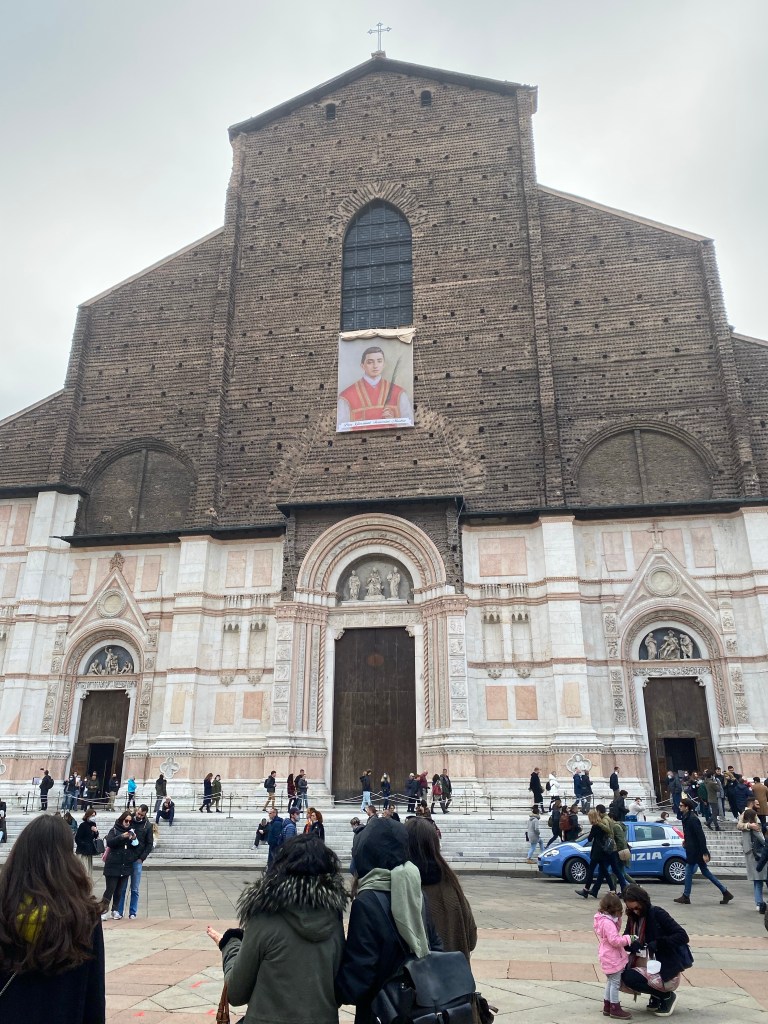
WHEN TO GO AND WHAT TO SEE
Rich in art and history, Bologna will amaze the visitor in all seasons, with its enjoyable and lively summer atmosphere or with the magic of Christmas illuminations.
A first look at the city is from the beautiful Piazza Maggiore where medieval palaces look down upon an intense public life and economic activity. They perfectly combine with modernity, while preserving their antique charm. For instance Palazzo d’Accursio, seat of the municipal administration, houses inside its ancient walls the Art Nouveau-style Salaborsa multimedia Library as well as Roman archaeological excavations, visible from a modern glass floor.
Among the symbols of Bologna is the Neptune Fountain by Giambologna:
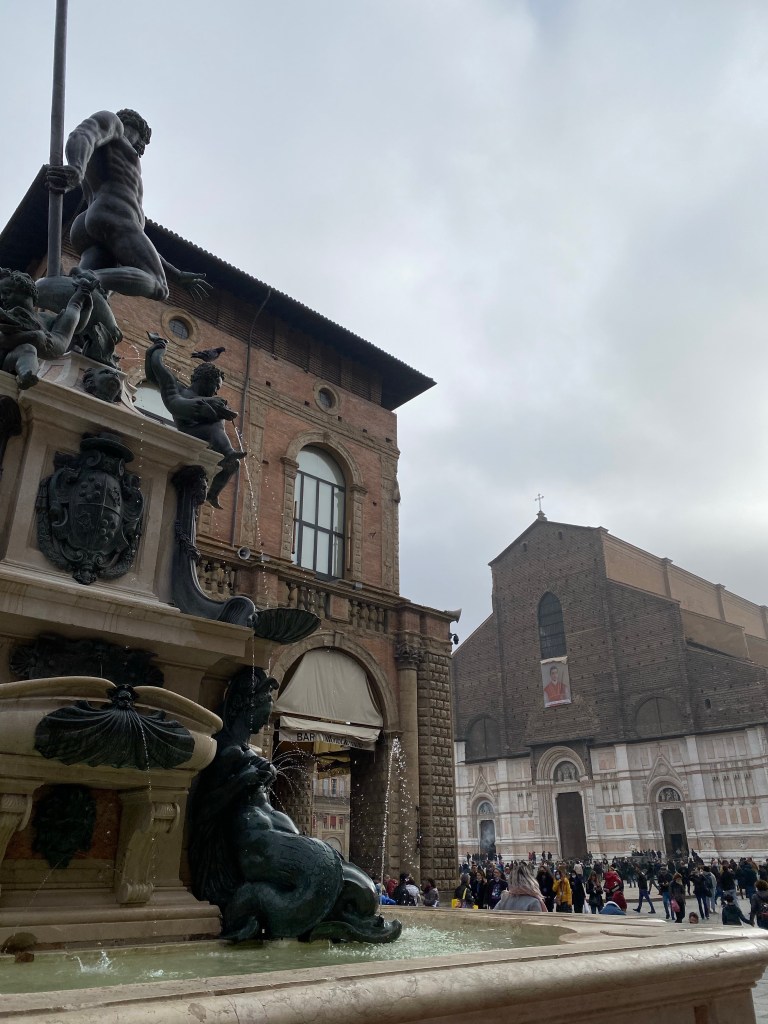
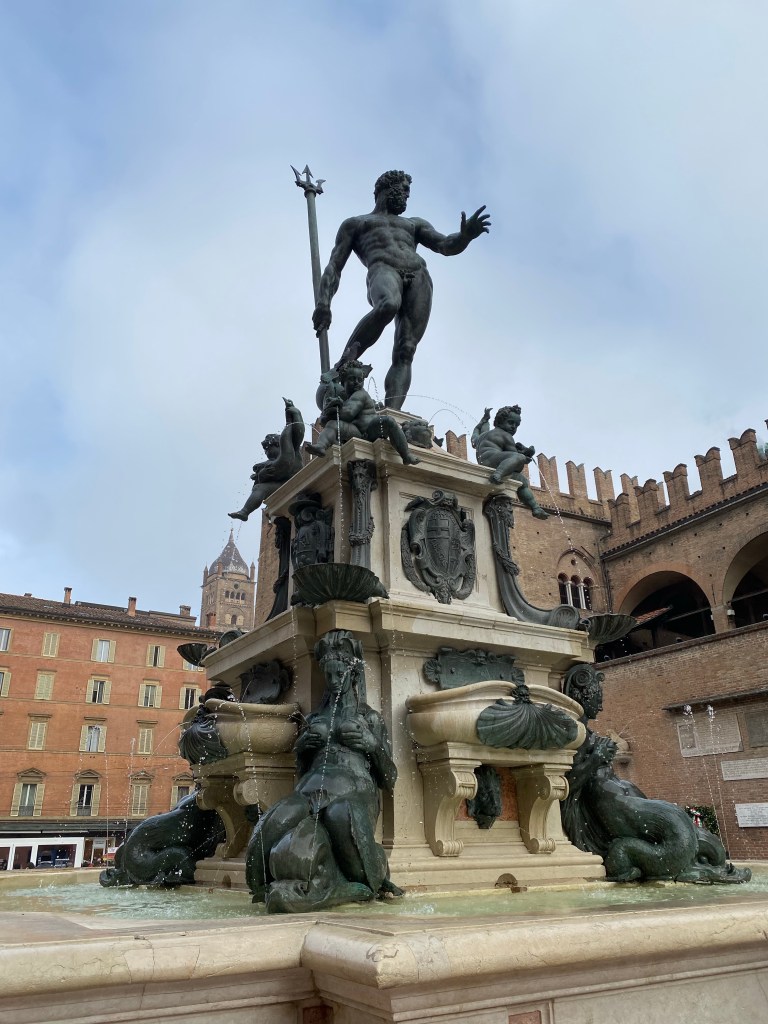
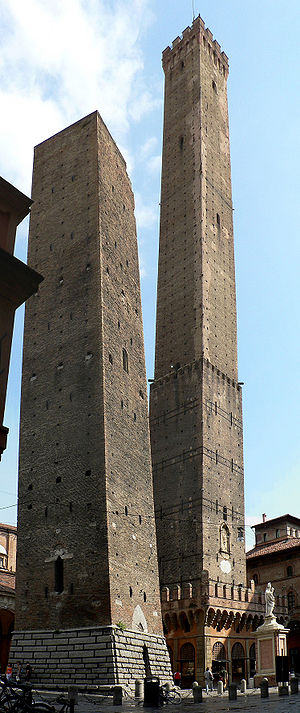
Also, the medieval towers, particularly the magnificent Two Towers: Asinelli tower (98 m) and its neighbouring “twin” Garisenda (48 m, also mentioned in Dante’s Inferno). Take in the incredible views from the tallest leaning medieval tower in the world, built between 1109 and 1119. The panoramic view from the Torre degli Asinelli will take your breath away.
Walking along the ancient streets and the never-ending porticoes, canals are an unexpected surprise. They date back to the 12th century and can be visited underground too.
A rich heritage of art is housed in the numerous museums and galleries, as well as in the multitude of religious buildings. Among them, a special mention should be made to the complex of Santo Stefano, the one of San Domenico with the Saint’s marble tomb by Nicolò dall’Arca and decorated with Michelangelo’s sculptures, and the church of Santa Maria della Vita which houses another Nicolò dall’Arca’s masterpiece, the Pietà sculpture (Lamentation over the Dead Christ).

ON THE TABLE
Bologna is synonym for food & wine tradition. Mortadella, “ragù alla Bolognese,” handmade pastas such as tortellini, lasagne and tagliatelle, boiled meat, certosino cake: these are only some of the foods that have made Bologna’s gastronomy famous throughout the world, together with the fabulous “sfogline” (women making handmade pastas) whose lessons are attended by visitors from every country in the world. Colli Bolognesi DOC wines are famous too, like the typical Pignoletto.
FUN
The city is full of life both during the day and at night, with its many taverns, theatres, book-stores, squares and shops. In the charming small streets close to Piazza Maggiore, there is the lively and picturesque market of the Quadrilatero with shops of typical products. The most gluttonous visitors cannot miss the city’s oldest and most renowned chocolate laboratory, or an aperitif in an old wine bar.
MAIN EVENTS
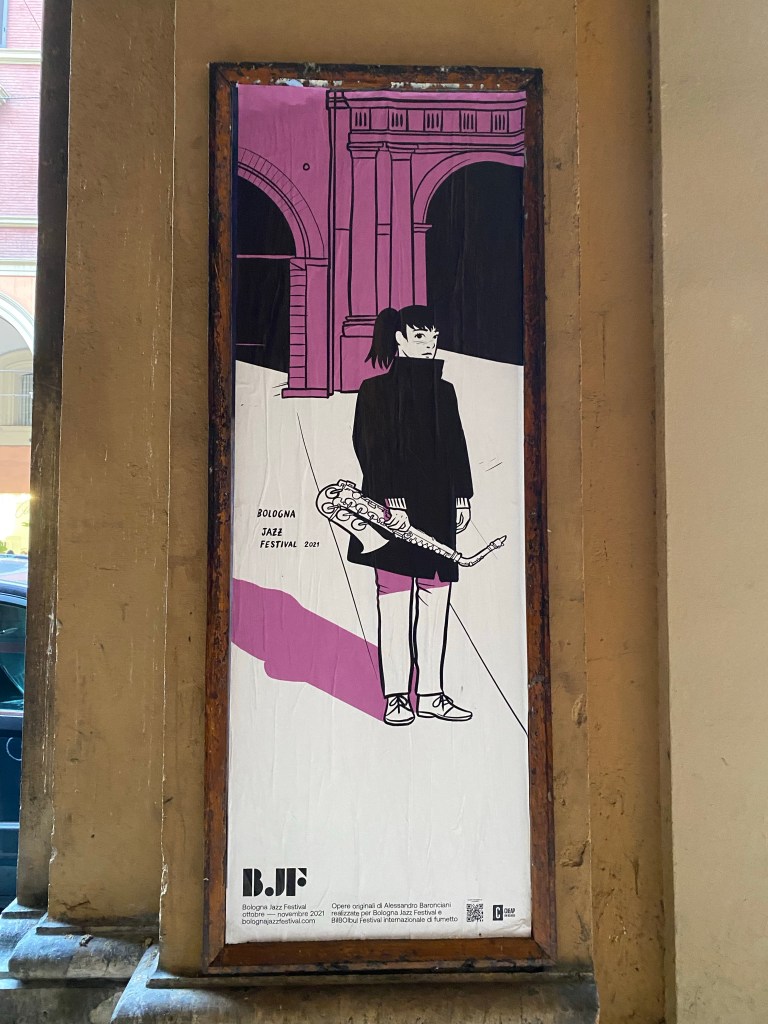
The city cultural programme, is rich in exhibitions, theatre events and festival of jazz and contemporary music. A particular mention should be made of the Opera and Ballet season of Teatro Comunale, the Concerts of Orchestra Mozart, Bologna Festival and Cinema Festivals (Cinema Ritrovato, Future Film Festival), as well as of other important events like the International Comics Festival BilBolBul, the Children’s Book Fair, ArteFiera, Arte Libro and Cioccoshow.
This post is a work in progress. I’ll be back in Bologna soon to visit some more places and will update this then. :-)
Still to do:
canals, Apparently, Bologna managed to become one of the main commercial trade centres of the Middle Ages thanks to a hydraulic system of canals and locks that produced energy for the trades, allowed large ships to come and go and improved sanitation with a number of public wash houses.
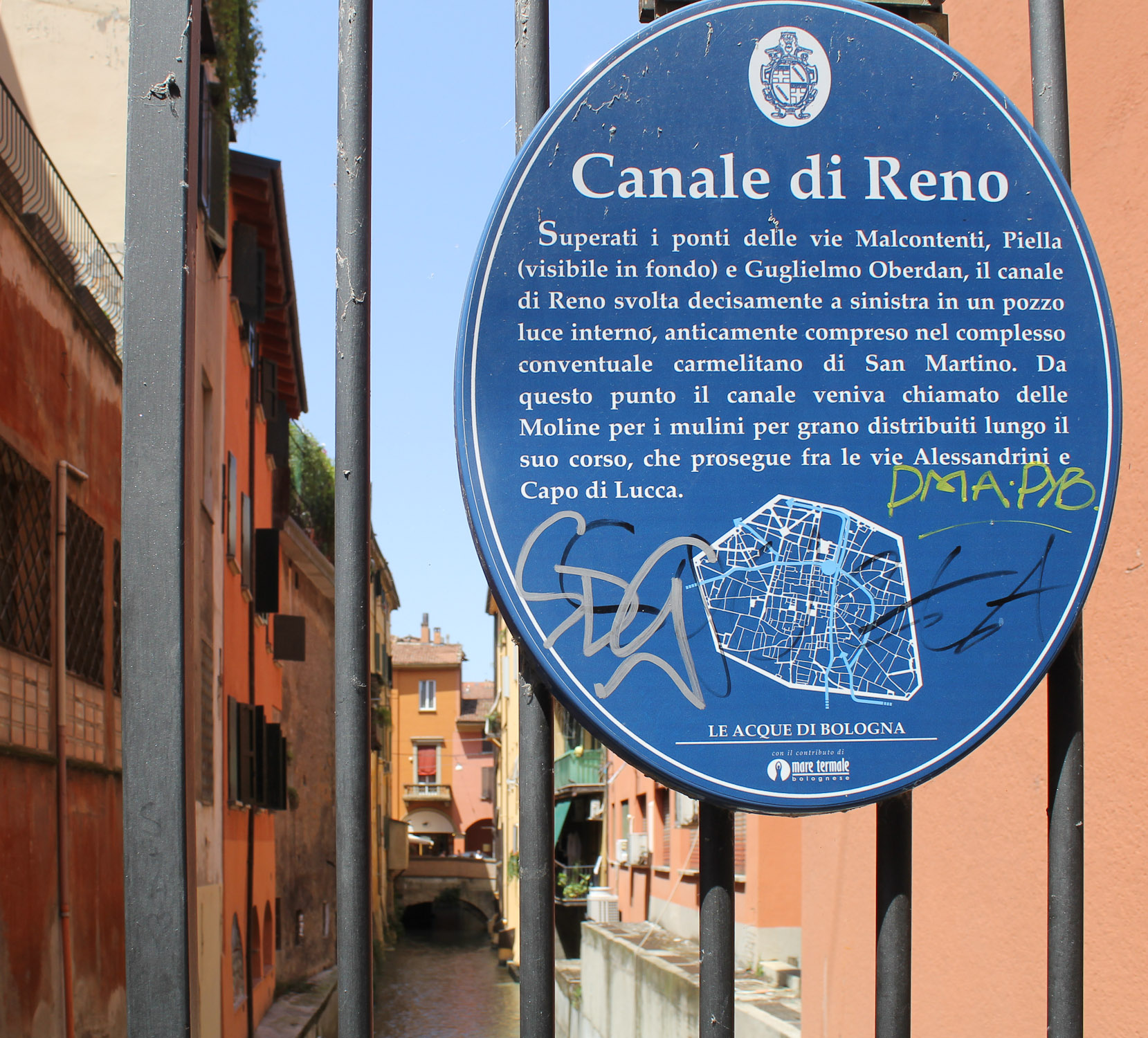
Starting in the 12th century, a total of 60 km canals were dug to connect the city with the rivers Reno and Savena. The canals were used to drive water mills eg. for grinding flour. In Via Capo di Lucca, the Moline Canal is supposed to have driven 15 big grain mills that were operated through a series of artificial drops and movable sluice gates.
Bologna became the most technological advanced silk throwing town with filatoio driven by overhead shafts that were powered by water. That way they managed to industrialise the process, where silk that has been reeled into skeins is cleaned, twisted and wound onto bobbins. And over the centuries the water mills were put to a variety of other uses.
There were bark mills producing the tannin powder used in tanneries to produce leather from degreased and soaked skins and hides of animals. Mills cutting tobacco leaves in the tobacco factory, and mills running rice huskers, brick works and power stations for use at a hospital.
Fascinated by such industry based on the ingenious and innovative use of technology, I wanted to embark on a canal tour of Bologna, only to realize that the word ‘hidden’ in the headline was to be understood literally. The canals in Bologna are not ‘secret’ or ‘undiscovered’, they are concealed and therefore more or less invisible. In the old city centre, the water is mainly distributed through underground pipes, and the few and short stretches of open canals are locked in-between buildings. For a canal chaser, there’s nothing much to see in Bologna.
Outside the old city walls it becomes easier to follow the waterways. In Casalecchio, the Reno Canal starts from a big lock, and at north of the city the canals flow into the Navile, a 36 km navigable channel that connected Bologna with other cities. The start of the Navile Channel was known as Porto di Bologna or Quartiere Porto. From here, boats transported goods and people to Ferrara and Venice in about 40 hours, and it is estimated that the middle of the 18th century a fleet of fifty boats made a thousand trips a year, carrying almost 23.000 tons of goods.
Porto di Bologna was originally designed by the celebrated architect Jacopo Barozzi da Vignola, and it soon became the commercial centre of the town with factories, warehouses and shipyards. Much of Bologna and in particular this area was sadly demolished by bombs in 1943 all that is left of the original buildings is the Salara salt warehouse.
Still, there are people in Bologna hoping to uncover the hidden canals, I did find an Insta-moment by the recently restore ‘window’ with a peak view of the Reno Canal in Via Piella, and perhaps there are more to come.
BOLOGNA SURROUNDED BY WATERWAYS
A lowland port, underground canals, monuments and Manifattura delle Arti.
The relationship between Bologna and water is centuries-old and in the period in which its maximum city power was in the making, it was not only its “Studio” (University) that served as a pole of attraction and distinction: starting from the twelfth century, the City created a series of artificial canals fed by the waters of the Aposa creek (on whose banks Etruscan Felsina was founded), which intersected with the two canals connected to the Reno and Savena rivers, also built to carry waterways inside Bologna.
BOLOGNA SURROUNDED BY WATERWAYS
A lowland port, underground canals, monuments and Manifattura delle Arti.
The relationship between Bologna and water is centuries-old and in the period in which its maximum city power was in the making, it was not only its “Studio” (University) that served as a pole of attraction and distinction: starting from the twelfth century, the City created a series of artificial canals fed by the waters of the Aposa creek (on whose banks Etruscan Felsina was founded), which intersected with the two canals connected to the Reno and Savena rivers, also built to carry waterways inside Bologna.


This abundant supply of water was used to create the energy needed to fuel craftsmanship activities: mills, grindstones, tanneries, spinning plants, knitting machines, fulling mills and, last but not least, all the activities for which a water source immediately available for energy and for processing made the difference between slow work and production of significant commercial importance. Of course, the canals were also used to transport goods and people and, when the dirt roads were slow and very bumpy, the ability to move about on boats was a viable alternative, and in some cases, also much more convenient and practical for long distances. In 1548, Bologna began construction of its port within city walls. replacing the existing ones outside the walls. It was designed by Jacopo Barozzi (Il Vignola) and remained in operation almost until 1930s, when the navigable canals were covered.

The whole area between the Via Irnerio, Via Dei Mille and Via Don Minzoni axis on one side, and the Via Riva di Reno, Via Righi and Via delle Moline axis on the other, still preserves the memory of Bologna surrounded by waters in some toponyms, starting from Via del Porto; in some places, we can still admire some glimpses of canals flowing through buildings and meadows, as in the case of the Cavaticcio canal, which gives its name to the park in which it flows, in the heart of Manifattura delle Arti, an area named in honour of shops once in operation there thanks to canal mills, and which today brings together some of Bologna’s cultural excellences, such as the Cineteca and the MAMbo (Museum of Modern Art of Bologna) on Via Don Minzoni 14, housing the permanent collection of the Morandi Museum along with regular periodic exhibitions, and immediately nearby, the Salara, the ancient port salt depot now transformed into exhibition hall and multipurpose venue of the Cassero. Right in the space between the MAMbo – Museum of Modern Art in Bologna and the Salara, Parco del Cavaticcio (Cavaticcio Park) was created recently, which takes its name from the canal showing off along a strip of green yielding a glimpse of impressive, yet peaceful urban landscape.

The viewpoint on Via Don Minzoni allows a perspective view of both park and canal, as it was at the time of the port from the customs offices, which are long gone. The Manifattura centre also includes the DAMS laboratories of the University of Bologna, featuring an experimental theatre, film laboratory, auditorium for music, plus offices and services. There is also the new seat of the Cineteca di Bologna library, a true international documentation centre with over 40,000 volumes, 18,000 audiovisuals and hundreds of thousands of photographs and film posters.

The Cineteca and the DAMS area are close to Via Riva Reno, where we can visit the Church of Santa Maria della Visitazione, built after the plague of 1527 to give homage to the averted danger: the Church stood surrounded by the waters of the now covered Reno canal. Along the same road, we come across Angolo della Pioggia (Rain Corner) at the intersection with Via Galliera: it is a very special corner which gives visitors the impression of being in a village rather than in the heart of the city, so suggestive is the enveloping feeling it yields.
The whole area revolves around rain; rather, it is a tribute to the Madonna della Pioggia, who, as tradition has it, saved Bologna from a drought, and gives its name to the Church of Santa Maria della Pioggia, built from the original thirteenthcentury complex and later dedicated to the Madonna after the procession that in 1561 brought the rain that put an end to a long heat spell.
The Church houses a painting of the Madonna that was carried in procession: a work by Michele di Matteo, a Bologna-native painter active in the mid-fifteenth century. From nearby Via Righi, we can see glimpses of Bologna waters that have not been covered, starting with the one near the big vault of Via Malcontenti, to continue with the lookout on Via Piella and then Via Oberdan, in addition to the view of nearby Via Capo di Lucca, at the corner with Via Delle Moline.

On Via Oberdan, near the canal waters in view, we arrive at the Church of San Martino (building number 25), built in the first half of the fourteenth century and worth a visit to admire the works by Paolo Uccello, Amico Aspertini and Ludovico Carracci, to cite a few, as well as the beautiful sixteenth-century organ, so precious for its decorations and sounds.
Almost in front of the Church, we find Via Marsala, where, at building number 12 stands Palazzo Grassi, one of the few residences that bear witness to the urban layout of medieval Bologna.
The portico is one of the few still standing with wooden beam columns in a typical crutch shape, and features an entrance door surmounted by a pointed ring. It is a typical example of thirteenth-century architecture in Bologna.
underground Bologna, cathedral, quadrilatero
https://en.wikipedia.org/wiki/Bologna_Cathedral, San Pietro, Via dell Indipendenza, has the terra cotta figures
the 2 towers
Your tour starts from Piazza del Nettuno. You’ll discover the Piazza Maggiore and the Basilica of San Petronio and the Meridian. Next visit the oldest library in the world and Piazza Santo Stefano, where you’ll see the wonderful Basilica that overlooks the square. Then visit the Towers of Bologna, the Asinelli and the Garisenda, before you explore the historical market Quadrilatero to admire the historical shops and take in the scents of local food. Finally, visit Palazzo Re Enzo which overlooks the square and is the palace seat of the municipality.
Discover Bologna in comfort via an open top bus, enabling you to admire and photograph all the major attractions of the city. Upon arriving at the meeting point, staff will welcome you onboard. Choose from an audioguide available in 10 different languages to learn more about the specific landmarks as well as the general history of the city. You will then journey across the city, capturing views of some of the most famous points of interest. Hop on and off at your leisure at some popular spots such as: • Basilica San Petronio • Palazzo dei Notai • Palazzo Comunale • Palazzo di Re Enzo • Palazzo del Podestà, • Tower of Asinelli and Garisenda • Museo Civico Archeologico • Archiginnasio • Palazzo Bevilacqua • Porta Saragozza • Palazzo Bentivoglio • Fontana del Nettuno • Teatro Comunale. After the tour, enjoy a food tour in a historical market in Bologna, where you will try local delicaci…
Start the tour at Archiginnasio Palace, which serves as the main office building for the oldest university in the world – the University of Bologna. After, walk to Piazza Maggiore, where the Basilica of San Petronio is located, known for its imposing facade. Continue to Piazza del Nettuno, which is surrounded by three important administrative buildings: Palazzo d’Accursio, Palazzo del Podestà, and Palazzo del Capitano del Popolo. Afterward, continue to the base of Bologna’s iconic towers, the Asinelli Tower and the Garisenda Tower. Learn about the history and features of these imposing structures. Next, continue to the wooden arch of Corte Isolani and see the Oratory of Santa Cecilia. Admire the exterior of the church of San Giacomo Maggiore, before concluding the tour in the area of Quadrilatero, which is home to many markets and shops.
The Chini ceramics of Borgo San Lorenzo, near Florence
The small town of Borgo San Lorenzo, not far from Florence, will be the 40th “City of Ceramics” in Italy and 4th in Tuscany. This thanks to the recognition received by the Italian Ministry of Economic Activities. Certainly a good business card for those wishing to know this artistic reality at the gates of Florence. Without forgetting a nice holiday in a truly delightful still unknown corner of the Tuscan countryside. The Tuscan pottery in Borgo San Lorenzo is identified with the prestigious history of the Manifattura Chini. So finally the Mugello will be included within the great areas of national and international ceramics.
It all started when Galileo Chini founded the “The art of ceramics” factory in Florence in 1896. Soon his cousins Chino, Pietro, Guido and Augusto also entered society. There followed also prestigious prizes and awards at the Turin exhibition (1998-1902) and the 1900 Paris Universal exibition.
The Tuscan pottery of this factory is very beautiful and is often inspired by the Art Nouveau-Liberty floral motifs. We also find female figures with a clear Botticellian influence for some sifted through the Pre-Raphaelites’ experience.
At the beginning of the 20th century, Galileo Chini became one of the leading exponents of Italian Liberty. His fame as an artist also reached the Far East. In fact he was called to Bangkok to paint the Palace of the Throne. In 1906 Galileo and Chino Chini founded the “Fornaci San Lorenzo” factory in Borgo San Lorenzo. The mark was a grill surmounted by a lily in honor of the Christian martyr San Lorenzo patron of the town.
The new factory will produce refined majolica, often characterized by a metallic luster cover. A vast production sector will be dedicated to architectural coatings, which still enrich many of the Mugello buildings. The San Lorenzo furnaces will also produce wonderful stained glass windows, lamps and chandeliers. The factory, after various vicissitudes, still continues to produce artistic ceramics suitable also for contemporary luxury furnishings.
The Chini museum is housed in the beautiful Villa Pecori-Giraldi located in the center of the town of Borgo San Lorenzo. The rooms of the villa were finely decorated in the late nineteenth century by the exponents of the Chini family. It mainly preserves pictorial, ceramic and architectural interventions of the great Galileo Chini. Galileo Chini as already mentioned, is one of the leading exponents of Italian Liberty. The Chini museum also houses a surprising collection of vases, stained glass and artistic objects from the Manifattura Chini (Art of Ceramics and Fornaci San Lorenzo).
The “Chini Lab” educational workshop for children is also part the museum. It is divided in different sections as to give children a truly outstanding artistic and sensorial experience.
In Borgo San Lorenzo and its surroundings a Liberty route was built to allow tourists to better appreciate the Mugello.
LIBERTY STYLE: ART NOUVEAU IN MUGELLO
Galileo Chini
Two centuries ago Chini Manufacturing was founded in Mugello. It is an excellent example of artistic craftsmanship in the production of ceramics.
At the beginning of the 19th century the head of the Chini family, Piero Alessio Chini, a decorator, passed down his passion for the arts to his children and nephews, who, from simple apprentices soon became eclectic, creative and able artists.
One of the family’s most prominent figures was definitely Galileo Chini who, along with his cousin Chino Chini, founded the “San Lorenzo Furnace” manufacturing in 1906, in Borgo San Lorenzo. They produced ceramics and glass works that immediately gained success. At the beginning of the 20th century Galileo Chini became one of the major representatives of Liberty Style (this is the name for Art Nouveau in Italy) in Italy and by 1906 his fame as an artist had reached the far east. In fact, he left for Bangkok to paint the walls the Palace of the Throne with frescoes.
Next, the manufacturing company dressed the thermal spa in Salsomaggiore “Lorenzo Berzieri” in grès ceramic, and Galileo Chini, along with other artists of the period, painted a fresco on a part of it. From 1925 on Chini Manufacturing took part in a number of national and international expositions in which the artwork of Galileo Chini, by this time a renowned decorator and able craftsman, was very much appreciated and valued.
The manufacturing company continued to produce works of great value until 1943 when, following the terrible bombing of Borgo San Lorenzo, which caused extensive damage and many victims, the damage to the company was so great that it could not continue to produce as it once had.
Today we can admire what the descents of Pietro Alessio Chini have created and what time has preserved in the Chini Ceramic Museum in Borgo San Lorenzo, as well as in many buildings all over Italy and the world.
http://www.itinerarioliberty.it
The Chini Archive of Lido di Camaiore
The Lido di Camaiore Chini Archives preserve correspondence and documents that testify to the intensity and versatility of Galileo Chini’s artistic talent throughout his life (1873-1956).
Numerous exhibitions and publications devoted to the artist appeared around the world before and after his death. Chini’s work, which continues to be acquired today, can be seen in major museums and private collections, royal palaces and government and institutional buildings. Art historians and experts study his work and disclose their research in the East and the West.
In this framework, the Chini Archives stands as a point of reference for connoisseurs and admirers of the Master and the Liberty period, of which Chini was the leading exponent in Italy.
Thanks to the curator, Paola Polidori Chini, and on-going contacts and the exchange of ideas and models with Italian and foreign universities and institutions, the Archive is a source of valuable information regarding the period.
The Archive hosts and participates in cultural and tourism events and exchange programmes between the Tuscany Riviera of Versilia and the Far East, especially Thailand.
Galileo Chini: an eclectic artist
The figure of Galileo Chini (1873 – 1956) stands out in the panorama of Italian art between the nineteenth and twentieth century.
With his multifaceted and precocious talent, he excelled in every aspect of art he ventured into. He was a great designer, sublime ceramicist (he founded “L’Arte della Ceramica” and later “Fornaci San Lorenzo”, introducing Art Nouveau into Italian heritage); he was an illustrator, set designer (he made the scenes of the first production of Puccini’s Turandot), urban planner, and painter with a strong personality that ranged from Symbolism to Divisionism to a darker, expressionist final stage.
As an artist of European stature, he participated in all major international exhibitions (London, Brussels, Ghent and St. Petersburg and others) and in Italy in the Venice Biennial and Rome Quadrennial. Chini was commissioned to decorate major public and private buildings and in 1911 he left for Siam to decorate, at the request of King Rama V, the interior of the new Throne Palace of Bangkok, where he created his most extraordinary decorative work. Upon returning to Italy, he continued his unceasing creative output.
He firmly believed in the union of arts and crafts and their fundamental role in the redevelopment of the urban landscape.
He was a member of the commission set up for the restoration of the buildings of the Viareggio Promenade and made the entire decorative structure of the Berzieri Baths in Salsomaggiore. He taught at the Academy of Florence, where Ottone Rosai, Primo Conti and Marino Marini were his pupils. In the final years of his life, Chini focused on an intimate and lyrical style of easel painting, with works denouncing the ravages of World War II and gloomy depictions of death.
The Chini Archive of Lido di Camaiore
The Lido di Camaiore Chini Archives preserve correspondence and documents that testify to the intensity and versatility of Galileo Chini’s artistic talent throughout his life (1873-1956).
Numerous exhibitions and publications devoted to the artist appeared around the world before and after his death. Chini’s work, which continues to be acquired today, can be seen in major museums and private collections, royal palaces and government and institutional buildings. Art historians and experts study his work and disclose their research in the East and the West.
In this framework, the Chini Archives stands as a point of reference for connoisseurs and admirers of the Master and the Liberty period, of which Chini was the leading exponent in Italy.
Thanks to the curator, Paola Polidori Chini, and on-going contacts and the exchange of ideas and models with Italian and foreign universities and institutions, the Archive is a source of valuable information regarding the period.
The Archive hosts and participates in cultural and tourism events and exchange programmes between the Tuscany Riviera of Versilia and the Far East, especially Thailand.
The route for enhancement and appreciation
The Chini Archives development project was established thanks to an institutional partnership that has the enhancement of cultural heritage and the spreading of culture as a common basis.
From 2012, the Chini Archives have undergone intensive reorganisation and inventory carried out by Promo PA Foundation with the support of the Fondazione Cassa di Risparmio di Lucca.
The project had two objectives: the preservation and dissemination of documents, to avert the risk of dispersion and the loss of memory of this extraordinary testimony, and the implementation of the partnership, through the involvement of all those institutional owners of “Chini works”, in order to construct a network capable of contributing to the development of the online database.
The route for enhancement and appreciation developed along two parallel tracks.
The physical reorganization of the paper and photographic documentation and the identification and inventory of the two repositories:
The repository Fondo Galileo Chini (1894-1956)
The repository Fondo Eros e Paola Chini(1957-2012)
The digitization of all the material in the repository Fondo Galileo Chini and the creation of this online Archive which aims to make the great heritage of this Tuscan artist available to the national and international community.
The Chini Archive structure
Partners
Galileo Chini, art nouveau artist in Tuscany
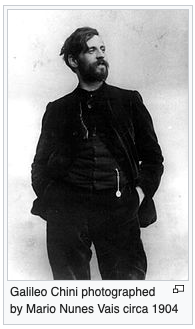
Galileo Chini (1873 – 1956) was an Italian decorator, designer, painter, and potter. A prominent member of the Italian Liberty style movement, or Italian Art Nouveau, he taught decorative arts at the Accademia di Belle Arti in Florence. He was responsible for several of the paintings and decorations in the Brandini Chapel at Castelfiorentino, the church of San Francesco de’ Ferri in Pisa, and the Ananta Samakhom Throne Hall in Bangkok. His theatrical work included designing the sets for the European premiere of Puccini’s opera Gianni Schicchi (Rome, January 1919) and the world premiere of his Turandot (Milan, 1926). He also created the sets for the premieres of Umberto Giordano’s opera La cena delle beffe (Milan, 1924) and Sem Benelli’s play of the same name on which the opera was based (Rome, 1909).
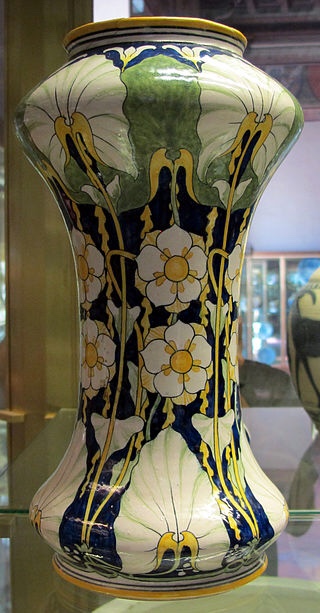
Flower vase by Chini
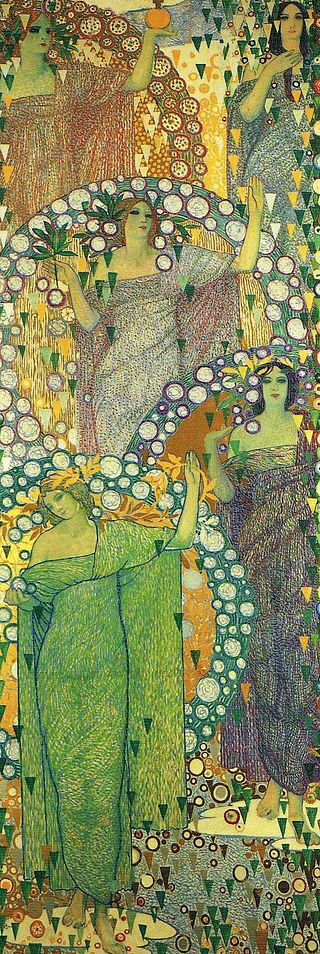
La Primavera, 1914
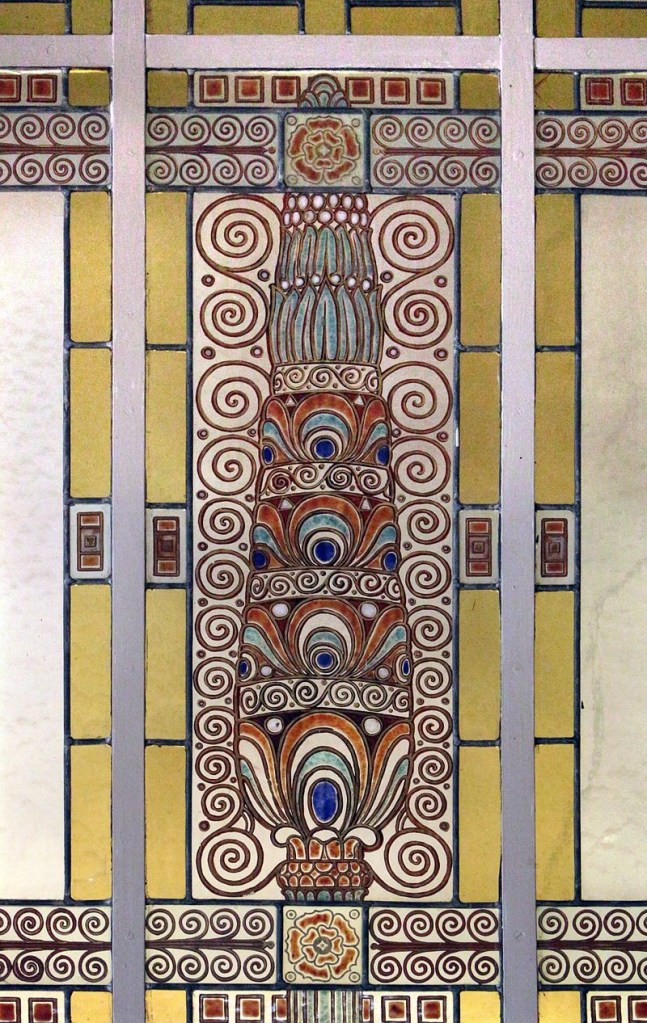
Ceramic tile façade decoration (1904)
In 1896, Chini and some of his friends founded “Arte della Ceramica.” The factory – its logo featuring a pomegranate and two clasped hands – soon gained international fame.
The large fruit, full of tasty red seeds, was a tribute to the Pre-Raphaelites and William Morris, founder of the Art and Crafts movement, who often featured the symbolic fruit in their works.
The clasped hands represent the brotherhood and unity between the founders, whose artistic partnership was similar to an Anglo-Saxon brotherhood; they felt a strong bond to the city of Florence, and wanted to preserve its art and tradition of ceramics, by contributing their modernist and innovative spirit.
In some of the vases produced by Galileo Chini, the Art Nouveau genius who understood how to harmonize experimenting with materials, the great iconographic novelties that were coming to Northern Europe at the time, and taste inspired by Florentine Renaissance masters such as Botticelli and Ghirlandaio.
With some of his splendid works, Chini and his colleagues reached unexpected celebrity, winning important awards such as the gold medal at the Turin International Exhibition of 1898, and gaining recognition around the world.
CHINI , Galileo . – He was born in Florence on December 2. 1873 by Elio, tailor and fliscorn player, and by Aristea Bastiani.
His grandfather, Pietro Alessio , painter and decorator, spent his life in Borgo San Lorenzo (Florence), where he was born on June 18, 1800 and died in 1887. The economic conditions of the family, rather modest, did not allow him regular studies: he was therefore self-taught and willing and eclectic. Equipped with good knowledge in mathematics and architecture, he designed the Giotto theater in Borgo San Lorenzo, also taking care of it in detail, from the furnishings to the decorative elements, to the machines for the stage. In his Notes … (I, 1949), C. recalls how his grandfather was interested in the conservation of the monuments of Mugello, personally intervening with restoration operations.
Having lost his father at the age of eight, and interrupted his studies in the third grade, C. was welcomed as an apprentice in the workshop of his paternal uncle Dario, a decorator, who at that time was also waiting to restore various frescoes on behalf of the Regional Office of Tuscany .
Dario, born in Borgo San Lorenzo in March 1847, was a passionate connoisseur of music (according to fliscorno), but interested above all in decoration; at the age of fifteen he had moved to Florence; and here he was welcomed by the painter and decorator Ottavio Pucci. Later he collaborated, for modest decorative cycles in private homes and public places, with the painter Annibale Gatti, until the regional office for the conservation of fine arts directed by Luigi del Moro, Guido Carocci and Giuseppe Castellazzi entrusted him with the task of restorer of ‘frescoes. So it was among the restorers of the paintings of S. Trinita ( Art and history,VII [1888], p. 127; IX [1890], p. 202) and participated in restoration works in S. Apollonia and in Orsanmichele. The technical shrewdness he achieved got him restoration assignments also outside Florence, in S. Frediano in Lucca, in S. Niccolò in Prato, in S. Biagio in Passignano. In Livorno he designed the Goldoni theater, also taking care of the decorative elements. He died in Florence on 18 Sept. 1897.
Having come into conflict with his uncle’s family, C. also began to work as a painter ( Appunti …, I, 1949), but soon returned to his relative and in 1890 participated with him in the restorations in S. Trinita in Florence. ( ibid ., F. Tarani, historical and artistic references of the church of S . Trinita …, Florence 1897, to Indicem). In that same year, at the suggestion of his friend Giulio Bargellini, he enrolled in the free nude school at the Academy of Fine Arts in Florence, attending it occasionally however: he nevertheless got to know, among others, Plinio Nomellini, Ludovico Tommasi, Giuseppe Graziosi, Libero Andreotti. By attending the Circle of artists he became friends with R. Papini, with Sem Benelli, and, in the years ’92 -’93, with Telemaco Signorini. In 1897, when his uncle Dario died, C. succeeded him in the task of restorations in Prato, Siena and San Miniato ( Arte e storia, XVII [1898], pp. 40, 88; L’Arte,I [1898], p. 214), also taking over his workshop. In the meantime he had been involved in easel painting: in 1895 he had sent one of his paintings to the first Florentine exhibition “Dell’Arte e dei Fiori”; but the work had been rejected because it was “too decorative” (so C. himself in the Appunti …, I, 1949), and then exhibited at an exhibition of the refused.
C. made his first tests as a ceramist in 1896 ( Historical Notes of the Manufactures …, ms., 1935) and between the end of that year and the beginning of the next, in cooperation with his friends Vittorio Giunti , Giovanni Montelatici, Giovanni Vannuzzi, took over a small ceramic factory in Florence that was about to close, founding the “Arte della ceramica” factory, based in via Arnolfo and sales room in via Tornabuoni (brand: a stylized pomegranate with the initials “ADC” in addition to the “F” of Florence, with two intertwined hands in the first examples).
The vases and decorative objects due to C. immediately found themselves at the forefront in Italy due to their precocious adaptation to modernist iconographic repertoires with strong oriental influences, obtaining significant awards in numerous exhibitions (gold medal at the Exposition decorative art, Turin 1898: see E. Thovez, in L’arte all’Espos . of 1898,IV, pp. 30-32; Grand Prix at the Universal of Paris, 1900; Grand Prix in Petersburg, 1901) and enjoying great success at the International Review of Decorative Arts in Turin in 1902 (Melani, 1902; Pica, 1903) where, in addition to a large number of vases, amphorae and plates, the setting of two rooms (dining room and bathroom) built with polychrome metal luster material; the façade of the exhibition sector was decorated with four stoneware bas-reliefs due to D. Trentacoste, who with C. from 1898 had the technical direction of the company ( Mostra del Liberty, 1972, p. 220). easel painting: there remain two portraits of his wife from 1899 (Lido di Camaiore, Chini heirs) and La quiete,work with a slightly scenographic layout, but lightened by the luminous tones, with which the painter began his participation in the Venice Biennale, in 1901. The first decade of the new century was a period of undisputed fortune for C. it met with stops and was profuse in the most diverse fields. In painting first of all, where, perhaps stimulated by his friend Nomellini and by the works of Segantini and Previati, he turned to symbolic themes (not entirely extraneous to his sensitivity, just think of the strong allegorical charge of his latest works), which the paintings exhibited in the various editions of the Biennale were marked: in 1903, The Sphinx and A Sunset ; in 1905, Il trionfo and La Campagna; in 1907, a fresco painted tondo , Il Battista (ill. no. 26 of the catalog), and two canvases, Icaro and Il giogo .
And with painting C. developed the activity of decorator: at the end of 1903 he began at the same time a series of pictorial decorations on the walls and ceilings of the building of the Savings Bank of Pistoia (G. Carocci, in Art and history,XXVIII [1909], pp. 333 ff.), And of the Hotel Pace in Montecatini and in the same year he participated in the decoration and furnishing of the Tuscan room at the Biennale, painting the vault, creating the terracotta and majolica frieze around the walls, designing the models of two chandeliers and two doors inlaid with semiprecious stones; in 1906 he made decorations for the Cassa di Risparmio di Arezzo. In the same turn of years, in collaboration with the architect Giovanni Michelazzi, he set about decorating numerous Florentine villas (Cresti, 1971). After having furnished the room of the “Giovine Etruria” at the 1906 Milan Exposition, and after having collaborated in the “L’arte del Sogno” room for the 1907 Biennale (among other things with a ceramic floor, together with his cousin Chino), received in 1909 theassignment to fresco the hall of the dome (main entrance) of the Biennale with the most important periods of civilization and art: the decoration was resolved in three bands, the upper one with ornamental motifs; the central one with the following eight episodes, each “explained” by a hendecasyllable by Fradeletto,The origins, The primitive arts, Greece and Italy, Byzantine art, From the Middle Ages to the Renaissance, Michelangelo, The Baroque Empire, The new civilization ; the lower one finally with motifs taken from the astrological symbol of the scarab. In the work, covered in 1936 when Giò Ponti was commissioned to renovate the building, but visible in tables 52-58 of the Decorative Art Models, II ,Milan 1909, and in the catalog of the Biennale, the taste and the happy rhythm of the story seem to prevail, even if there is no lack of compromises with the classicist rhetoric. The review of the decorative cycles still includes the arrangement of the Italian pavilion at the Universal in Brussels (1910), and participation in the celebratory exhibitions of 1911 in Rome, Turin, Florence. C. did not even interrupt his activity as a ceramist, because, if he abandoned the “Art of ceramics” in 1904, which had just moved to via Settignanese near Fontebuoni, in 1907, in partnership with his cousins Chino and Pietro, he gave birth to the “Manifattura Fornaci S. Lorenzo – Chini and C. Borgo S. Lorenzo – Ceramics and artistic glass”, whose activity lasted until the Second World War (brand:grate with or without stylized lily and written “Mugello”) with the C. artistic director and Chino director. This manufacture added to the traditional production in vases and decorative objects, with frequent use, especially until 1911, of stoneware, that of stained glass and tiles.
In 1908, creating the scenes for Sem Benelli’s Mask of Brutus , C. also began his activity as a scenographer, valuable for the lightening of the nineteenth-century farragine thanks to the introduction of stylistic characteristics of liberty. In 1909 he prepared the sets, costumes and “advertising posters” for the premiere, at the Argentina in Rome, of the Benelli ‘s Supper of the pranks and curated the scenes for the Midsummer Night’s Dream (also in Argentina) ; in 1910 still his were the scenes for L’Amore dei tre re, also by Benelli, and for the Orione by Ercole L. Morselli.
His action in the field of graphics and poster design is also significant: from the poster, for the “Art of ceramics” (reproduced in the advertising pages of the 1901 Biennale catalog) to those for the Cena delle mocker (1909), for the Etnografica in Rome (1911), for the Piccolo harem by G. Costa, for a dog show in 1925 and for Fiorenza del Benelli (1930) up to advertising posters (for savings, for example). He illustrated the Benellian volume (Florence, Calvelli, 1901) dedicated to the sculptors of the Biennale and L’Amore dei tre re (Milan, Treves, 1910), undergoing various influences, from Morris to Crane to Beardsley; from 1906 he collaborated with cartoons on the Giornalino della Domenica .
To attest to his fame came the official teaching positions: in 1908 the chair for decorative pictorial arts at the Academy of Fine Arts in Rome and in 1911 that of pictorial decoration at the Academy of Florence. In 1910 he was commissioned by the king of Siam Chulalongkorn, who had admired the decoration of the dome at the Biennale of the previous year, to decorate the royal palace in Bangkok, then in an advanced phase of construction by a group of architects ( Rigotti and Tamagno) and Italian engineers (Allegri and Gollo).
The Siamese stay lasted from 1911 to ’14 (except for a brief return to his homeland in 1913): C. painted, in the royal palace, part in fresco and part in lime (quicklime, to ensure stability to the plaster and color) , three half domes, a large lunette and the vast dome of the staircase (with historical facts and allegorical representations), and directed the ornamentation of the other parts of the building according to oriental stylistic features. But the Siamese experience is important for the harvest of impressions, images, experiments: which is immediately reflected, vividly, in a group of paintings, executed in Siam and now kept at the Chini heirs in Lido di Camaiore ( Tramonto sul Me – Nam , 1912; Full Moon on Me – Nam, 1913 ,and other similar images of the East), which present marginal points of contact with Italian Divisionism; but in reality they are irreducible to it, in their very personal synthesis of daily realism and a sense of mystery. The Chinian masterpiece shares the same atmosphere. End of the Chinese year in Bangkokfrom 1913 (currently kept by the heirs in Lido di Camaiore), a work for which a comparison with a prefuturist Boccioni around 1910 is perhaps legitimate (Vianello, 1964). A large set of studies (now at the Visconti heirs) for costumes and characters, with very bright colors, and a large number of still lifes, made with statuettes, Chinese vases, theatrical masks, of a grotesque relief, still refer to the Siamese stay. Back in Italy, C. presented at the 1914 Biennale a solo show with fifteen “impressions of the East”, a good number of ceramic and stoneware vases and oversaw the setting up of the central hall (intended for the sculptures of the Dalmatian I. ), creating eighteen mixed media panels in seventeen days (figures in oil, stucco and gold stand out on a background painted in tempera and gold).The panels, whose themes were:The life and animation of the meadows ; Nymphs and girls in the classic spring ; The spell of love and the springtime of life ; The nymphs and maidens in the forest ; The spring, which is perpetually renewed, disconcerted not a little, nor were the explanations that the author himself wrote in the catalog of the review enough: but with them C., mixing the influences of the East with the Klimtian model, reached one of the highest results of modernism in Italy, sharing a certain abstract outcome typical of certain aspects of liberty. The great war did not interrupt the activism of C., who did not disdain the stained glass windows for churches and the mosaics for cemetery chapels; then in 1917 he published the manifestoRenewing let’s renew ourselves, signed by a group of artists gathered in the artistic-industrial propaganda Association, whose main purpose was the abolition of academies and the establishment of industrial artistic schools aimed at renewing all forms of applied arts. Meanwhile (1915) he had built a house in Fosso dell’Abate, today Lido di Camaiore (he had also designed the urban plan of the place: at the Chini heirs, Lido di Camaiore), which will become his favorite residence and meeting place for some artistic personalities of the time.
In ’17 the collaboration with the Puccini theater also began to give life to the different environments of the Triptych ( Tabarro, Gianni Schicchi, Suor Angelica ) , but some differences prevented Tabarro’s sketches from being accepted, and only the scenes of Gianni Schicchi were used ( premiered at the Metropolitan in New York in 1918). After the war, resuming the Biennials, C. presented three paintings in the 1920s and took care of the pictorial decoration of the central hall with a series of panels somewhat alien to his sensibility: The glorification of the artilleryman and the daring flamethrower, of the helmsman , the aviator, the infantryman,of the lancer .
In Salsomaggiore, between ’20 and ’23, he completed the decoration of the Berzieri Baths and, later (1926) in the Grand Hotel des Termes, he took care of the preparation of the Moorish hall, the room of the caryatids and the red tavern; in the town he also decorated some rooms of the Villa Fonio (later Baciocchi), the Hotel Porro (covered later on the occasion of a modernization), the Hotel Valentini (partly covered) and a night club in Poggio Diana. Between ’21 and ’22 he decorated the Scalini villa in Carbonate (Como), illustrating the specific function of some rooms (the children’s room, the games room, etc.). In ’23 he resumed his collaboration with Puccini for Turandot,creating three series of sketches (Lido di Camaiore, Chini heirs; Casa Ricordi and La Scala Theater Museum in Milan) of which the first, in close collaboration with the composer (in the sketch for the second act, second painting, the signs of pencil drawn by the master), appears particularly lively; of ’24 were the scenes for Manon Lescaut, also by Puccini. In these years (between ’20 and ’25) he also devoted himself to huge panels for the ceilings and walls of ships (“Roma”, “Augustus”, “Ausonia”), with episodes taken from the history of the navy. The succession of awards at international exhibitions had been uninterrupted, culminating in 1925 with the awarding of the two “Granda Prizes” in Paris:one for ceramic materials and one for the production of vases.
After a last decorative cycle, performed at Villa Donegani, on Lake Como, in 1927, C., participating in a sort of “return to order”, devoted himself to a naturalistic painting, in relation to the post-Macchiaioli climate , painting still lifes, some nudes and numerous landscapes of Versilia: a painting whose distance from “secessionist decorativism and symbolism” satisfied Carrà, who wrote about it in the Ambrosiano (1932). In the 1940s, the landscapes and figures begin to take on a Fauvian inflection and a final group of works, painted between 1950 and ’54 in the drama of an impending blindness ( The heir, The waste of the sea, both by ’50; The prey, Last invitation,both of ’51; Madness macabre, from 1954, the last work: Chini heirs), takes on the tones of a tragic expressionism, on the prevailing theme of death.
C. died in Florence on 23 August. 1956 in his house in via del Ghirlandaio.
The murals decorative cycles have gone in part lost almost illegible fresco, 1914 , the Florentine house in Via del Ghirlandaio, 52, covered the dome of the 1909 Biennale (but perhaps it is possible to recover); numerous salsian decorations are dull. Some examples of painting are kept in public collections: in Cà Pesaro in Venice; at the Gallery of Modern Art in Florence; in the Uffizi Gallery of self-portraits, where a self- portrait is keptof 1935; at the Montecatini Art Academy; in the National Gallery of Modern Art in Rome. Some panels from the 14th century and numerous works from the Siamese period were collected by L. Visconti and have now passed to the heirs. But the largest number of works is still preserved by the C.’s family in the villa in Lido di Camaiore: about forty ceramic pieces (including the 1896 metal luster plate with two female profiles and butterflies which is destined for the Museum of ceramic from Faenza); among the paintings, in addition to those in the 1964 catalog , some Portraits of his wife (1899-1905); some works from the Siamese period ( Nostalgic Hour on Me – Nam, My Courtyard in Bangkok, End of the Chinese Year in Bangkok,Garden of a Buddhist temple in Bangkok ); a panel from 1914; The sun that dazzles (1916); some versions of Icarus ; numerous works performed after 1927 ( Hot Hours at Lido di Camaiore, Fosso dell’Abato, Campagna in Versilia, Zucche, all from ’28; From my window, Afternoon in the pine forest, Intimate motif, all from ’30; Landscape, from ‘ 31; Fiori, from ’32; Ruins of Florence, from ’45; The crazy dance,of ’47). Numerous ceramics are also in private collections in Milan and Florence, in Turin in the Agosti collection; in Dormelletto, owner Soc. Razza Dormello-Olgiata, as well as at the Faenza Ceramics Museum. Also in Lido di Camaiore there are some original theaters for Manon Lescaut (1924) , for L’oro del Reno, for Rossini’s Cenerentola (1936).
Nourished is the list of posthumous exhibitions (see related catalogs): Lido di Camaiore, villa Chini, 1964; Arezzo, Municipal Gallery, 1965; Florence, Saletta Gonnelli, 1967; Arezzo, Municipal Gallery, 1968; Ibid., Artistic circle, 1968; Milan, Levante gallery, 1971; Borgo San Lorenzo, Municipal Library, 1971; Florence, Palazzo Vecchio Art Gallery, 1971; Rome, Canova gallery, 1971; Città di Castello, The Well, 1971; Siena, La Mossa, 1972; Florence, Il Fiorino, 1972; Massa, Malaspina Castle, 1973; Salsomaggiore, Terme Berzieri, and Terme Zoja, 1974; Rome, La Nuova Pesa, 1974; Casola in Lunigiana, 1975; Florence, Teatro della Pergola, 1976; Milan, Pal. della Permanente, 1977; Florence, Gall. of Pal’s art. Old, 1979.
Official artist until 1920, then for a long time misunderstood, C. is undergoing a process of revision and rediscovery (Vianello, Marsan, Bossaglia, Nuzzi, Masciotta), despite the difficulty of explaining such different and irreducible experiences to a denominator common. However, its remarkable position within the Italian Art Nouveau clearly emerges, due to a not marginal action of renewal of the figurative repertoires (ceramics, decorative cycles), and perhaps pre-eminent: the panels for the 1914 Biennale, albeit late, are placed among the absolute values of liberty. The coherence of man appears indisputable, to which the lack of contact with the avant-gardes is to be referred: which did not prevent an affinity with the futurist dynamics ( End of the Chinese year in Bangkok), even if it cost him somewhat backward positions (decoration of the Berzieri and of the Grand Hotel in Salsomaggiore). Finally, the originality of the landscape painting of the 30s and 40s and of the allegorical expressionism of the very last period appears intense.
Chino , the cousin of C., head of the factory since 1889 of the “Art of ceramics”, was born to Tito, painter and decorator, in Borgo San Lorenzo on 27 July 1870 and in Borgo he attended school up to the fifth grade. He learned the art of wall decoration from his father, collaborating with him on several occasions; on his death in 1887, he continued the activity until 1899, when he moved to Florence. Hired by the “Art of Ceramics”, in 1901 he became its technical director, replacing Vittorio Giunti. He played no small part in the successes that the young factory reaped all over Europe; and in 1906 he gave life to the new factory of the “Manifattura Fornaci S. Lorenzo”. He died in Borgo San Lorenzo on February 19, 1957.
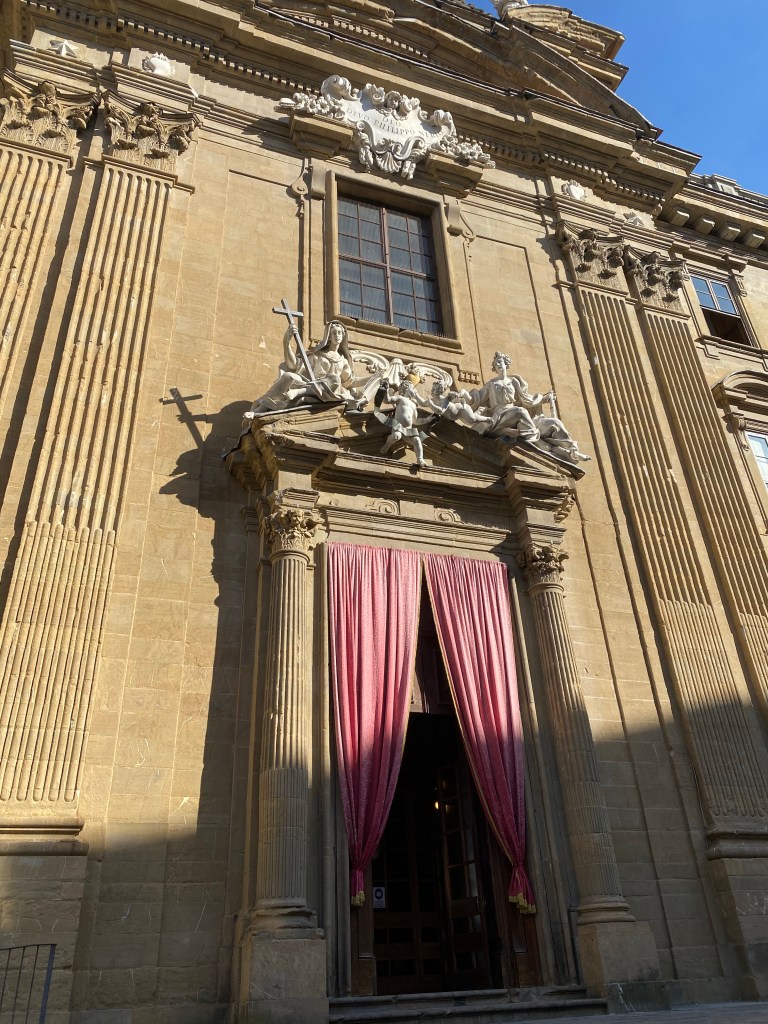
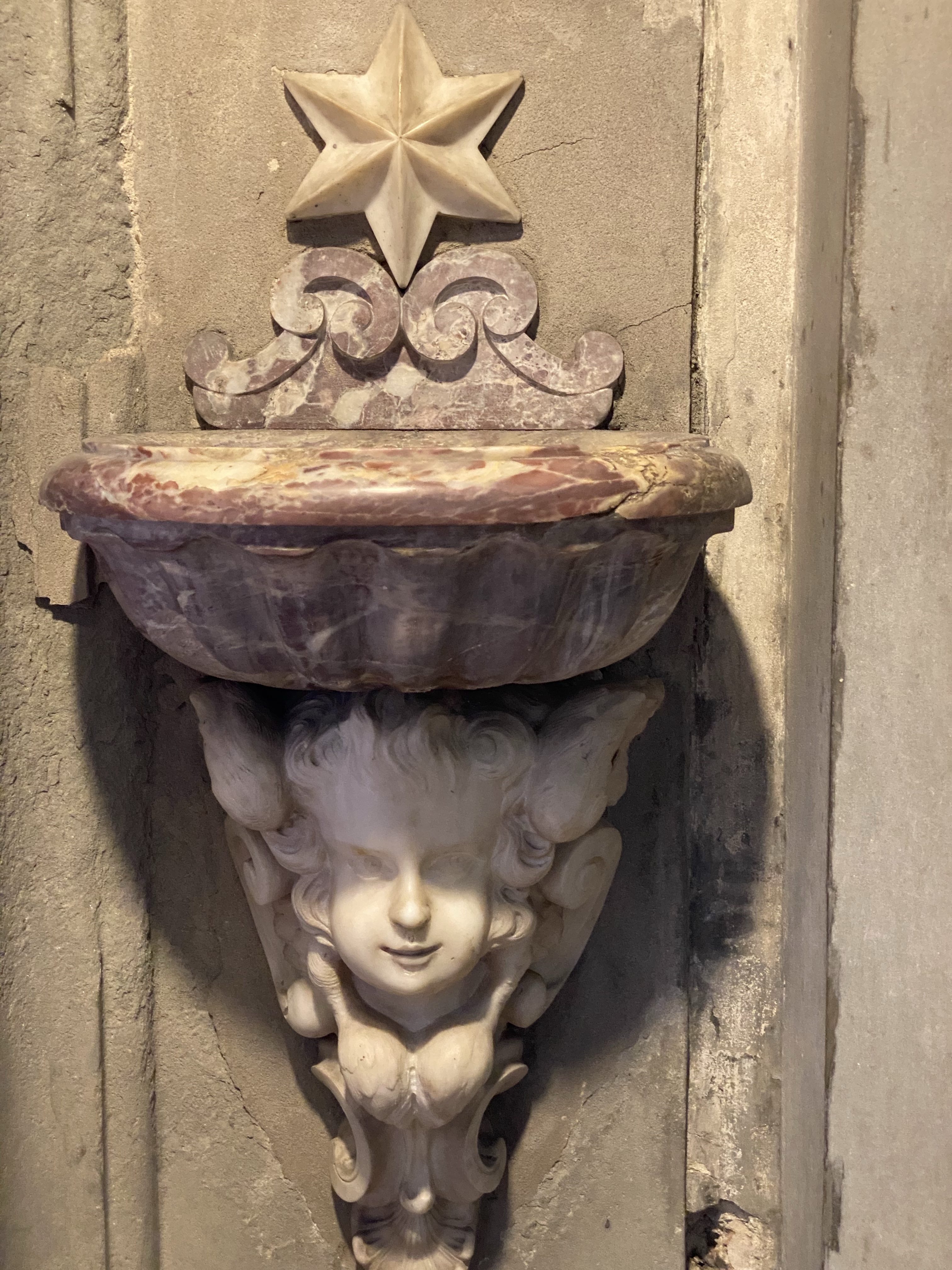
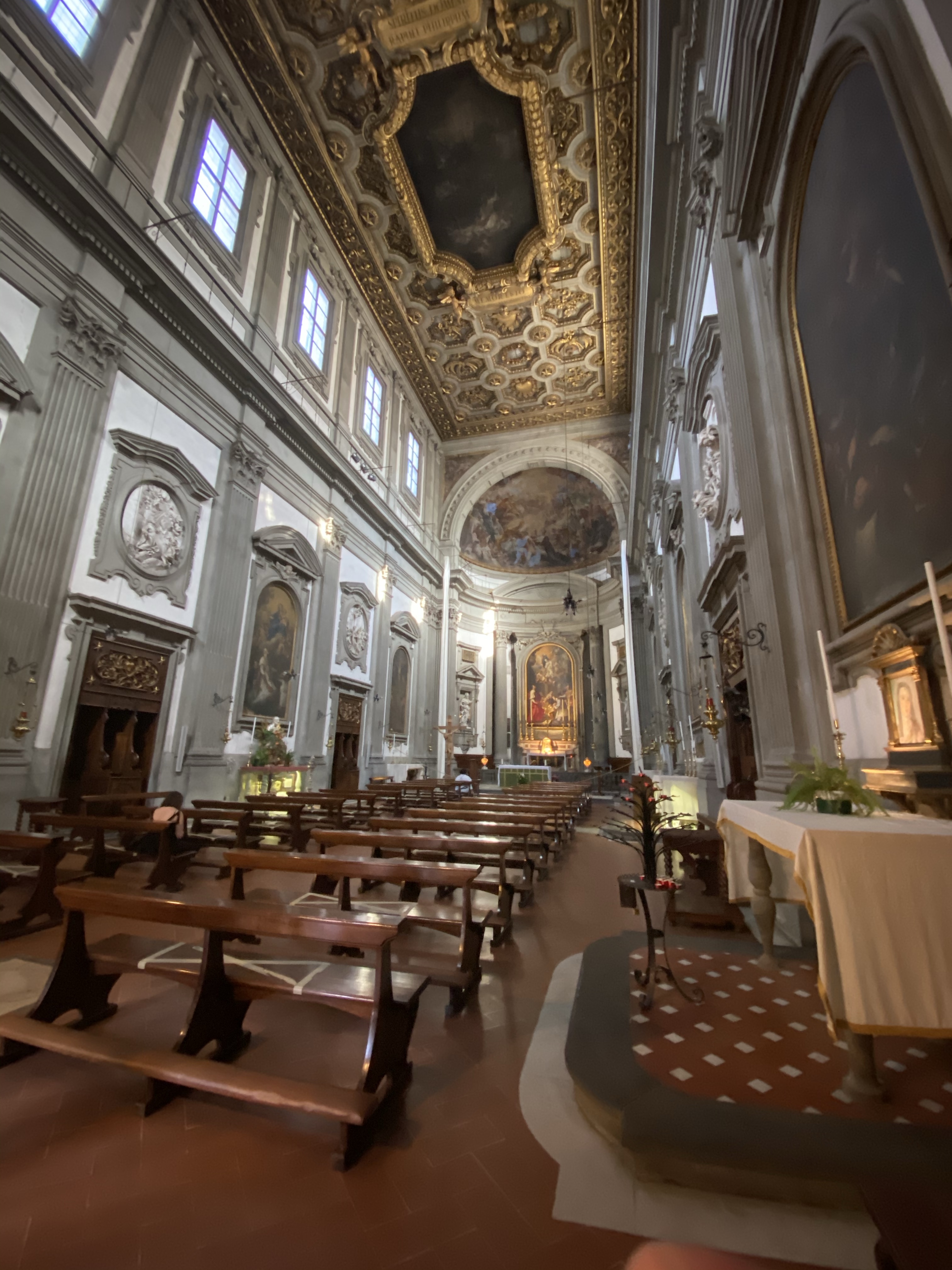
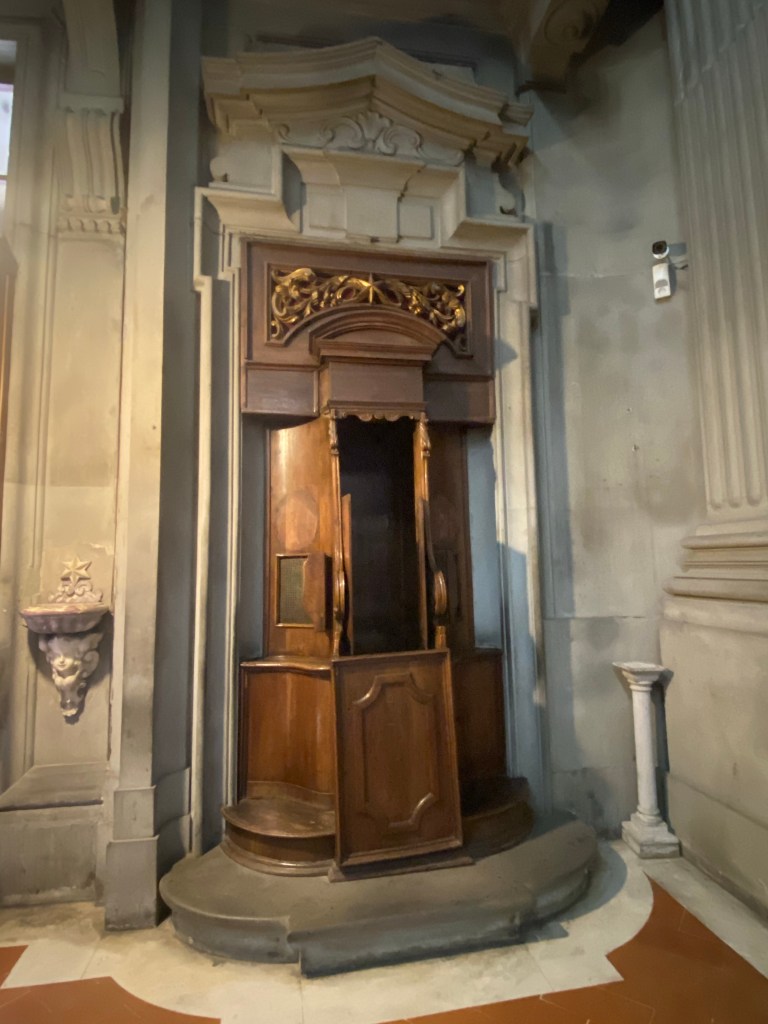
Chiesa San Firenze, Florence
There is so much to behold in Florence! It is sometimes overwhelming.
Chief among my favorite facades in the city is this Baroque church:
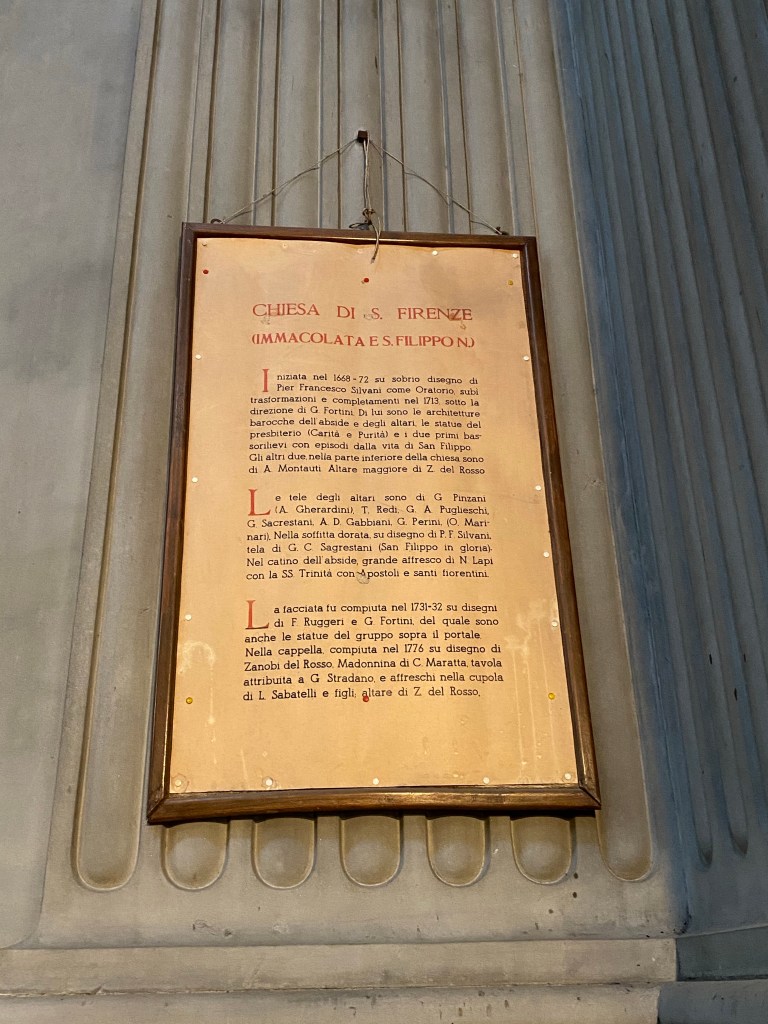
For more information, see: https://en.wikipedia.org/wiki/Complex_of_San_Firenze
 get back, lauretta!
You must be logged in to post a comment.