The Princess Diana Memorial, Hyde Park, London

During my first walk through Hyde Park and Kensington Gardens, I noticed these markers in the pavement, guiding the visitor to the Princess Diana Memorial.  I wasn’t sure I wanted to go see it.  I remember her death all too well, just like I can remember the day President Kennedy was shot.  Markers of time that I wish I could forget.

IMG_9696

In the end, I couldn’t not go.  I’m so glad I did.  It is a lovely, lighthearted place.  I think Diana would have loved it.  On the sunny Sunday afternoon I was there, families and especially children were enjoying the water as it flowed through the monument.  I loved it.  But, I couldn’t bring myself to take pictures.  It was still too raw for me.

Screen Shot 2019-07-22 at 17.27.37
The Diana, Princess of Wales Memorial Fountain is a memorial in London dedicated to Diana, Princess of Wales, who died in a car crash in 1997. It was designed to express Diana’s spirit and love of children.

The fountain was built with the best materials, talent and technology. It contains 545 pieces of Cornish granite – each shaped by the latest computer-controlled machinery and pieced together using traditional skills.

Screen Shot 2019-07-22 at 17.27.25

The design aims to reflect Diana’s life, water flows from the highest point in two directions as it cascades, swirls and bubbles before meeting in a calm pool at the bottom. The water is constantly being refreshed and is drawn from London’s water table.

Screen Shot 2019-07-22 at 17.27.51

The Memorial also symbolises Diana’s quality and openness. There are three bridges where you can cross the water and go right to the heart of the fountain.

Screen Shot 2019-07-22 at 17.21.13


The memorial was designed by American landscape architect and artist Kathryn Gustafson.


The fountain is located in the southwest corner of Hyde Park, just south of the Serpentine lake and east of the Serpentine Gallery. Its cornerstone was laid in September 2003 and it was officially opened on 6 July 2004 by Queen Elizabeth II.  Also present were Diana’s younger brother Charles Spencer, her ex-husband Prince Charles, and her sons William and Harry.

Working on the project began in 2001. The fountain was designed by Gustafson Porter.  Kathryn Gustafson, an American landscape artist said she had wanted the fountain, which was built to the south of the Serpentine, to be accessible and to reflect Diana’s “inclusive” personality. Gustafson said: “Above all I hope that it provides a fitting memorial for the princess and does credit to the amazing person that she was.”

The memorial has the form of a large, oval stream bed about 165 by 260 ft that surrounds, and is surrounded by, a lush grassy field. The granite stream bed is from 10 to 20 ft wide. It is quite shallow and is laid out on a gently sloping portion of the park, so that water pumped to the top of the oval flows down either side. One side of the stream bed descends fairly smoothly to the downhill end of the oval with gentle ripples; the other side consists of a variety of steps, rills, curves, and other shapes so that the water plays in interesting ways as it flows to the tranquil pool at the bottom. The two sides were intended to show two sides of Diana’s life: happy times, and turmoil.


https://www.archdaily.com/803509/diana-princess-of-wales-memorial-fountain-gustafson-porter-plus-bowman


The Italian Gardens, Kensington Gardens

You might know that almost the first place I would go once I got to London would be the “Italian Gardens!”  Ma, certo! Like a bee to honey.

IMG_9634

IMG_9641

IMG_9642

IMG_9643

IMG_9644


IMG_9635


IMG_9636


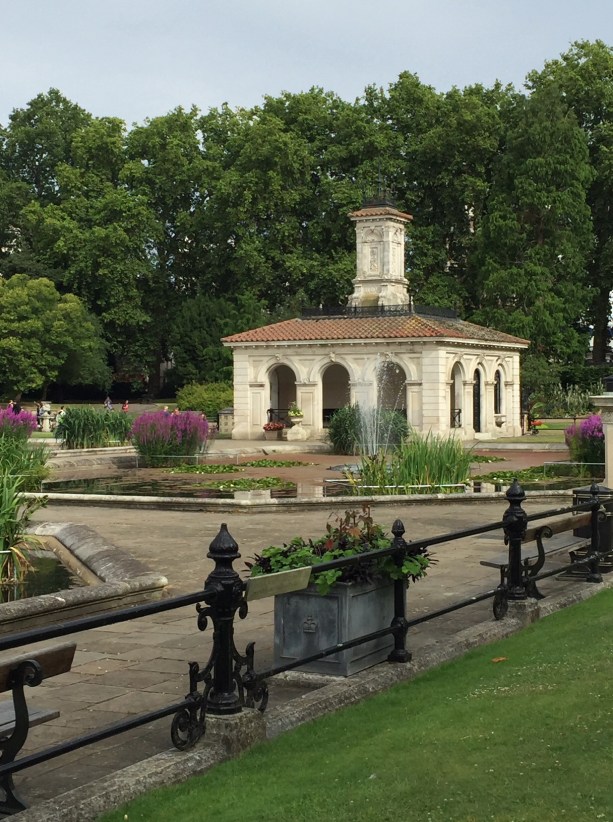
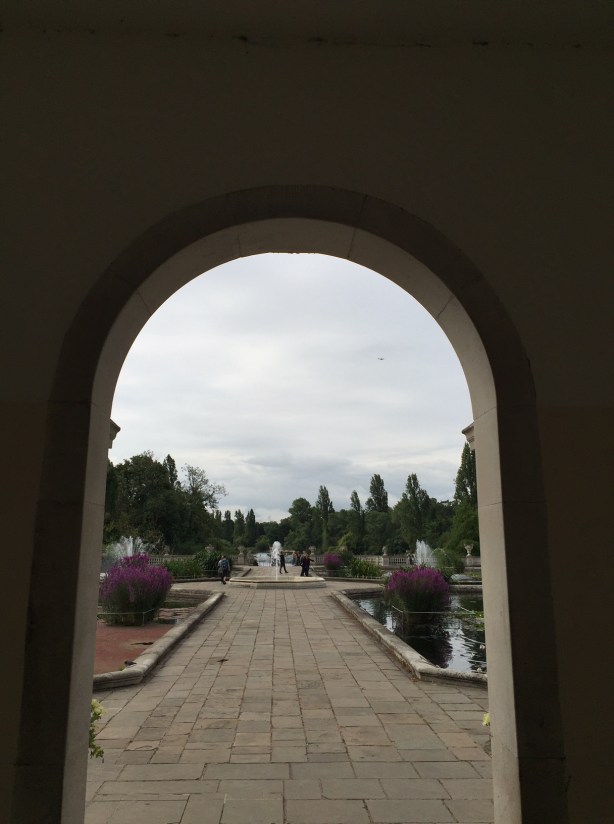
This lovely, smallish ornamental water garden was created in the 1860s and is to be found on the north side of park, near Lancaster Gate. It is believed the garden was a gift from Prince Albert  (he died 1861) to his beloved wife, Queen Victoria. Regardless of the why, they are now recognized as a site of particular importance and are listed Grade II by Historic England.

IMG_9655


IMG_9656


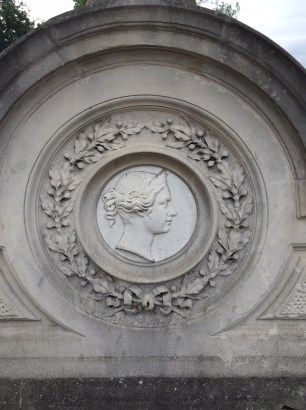
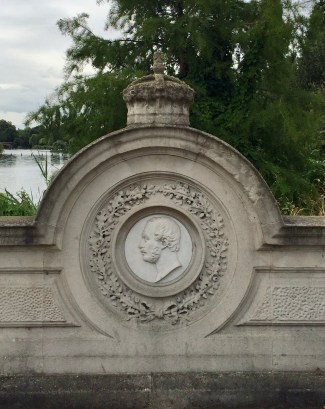
Portraits of Victoria and Albert flank the 2 sides of the balustrades overlooking the lake.


IMG_9657          fullsizeoutput_13c9


BTW, about once every six months while I am living in Italy I will see something in some work of art that causes me to say: “that’s a new one–I’ve never seen that before.”  I love it when that happens.

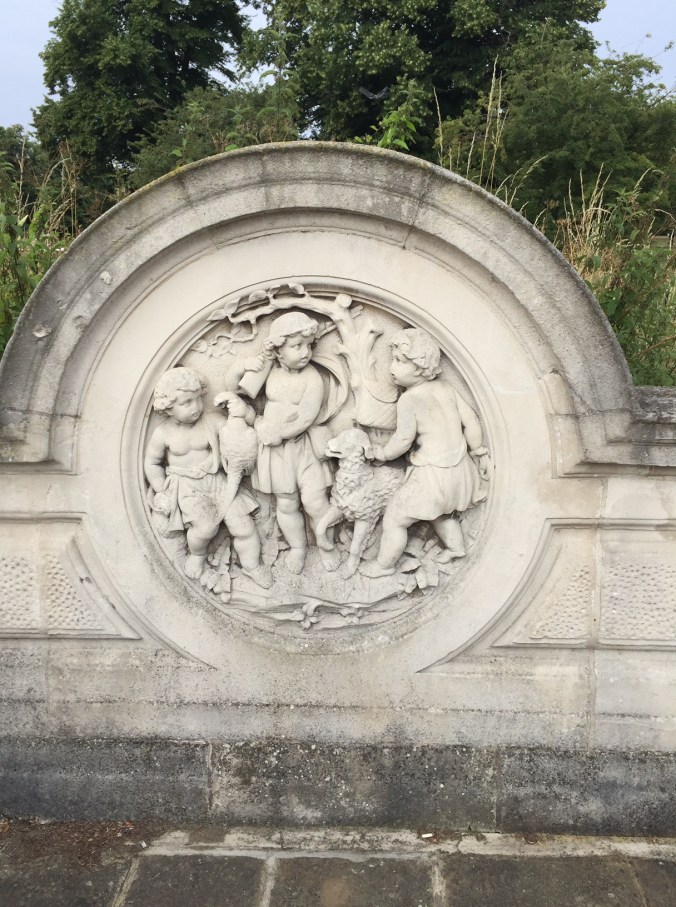
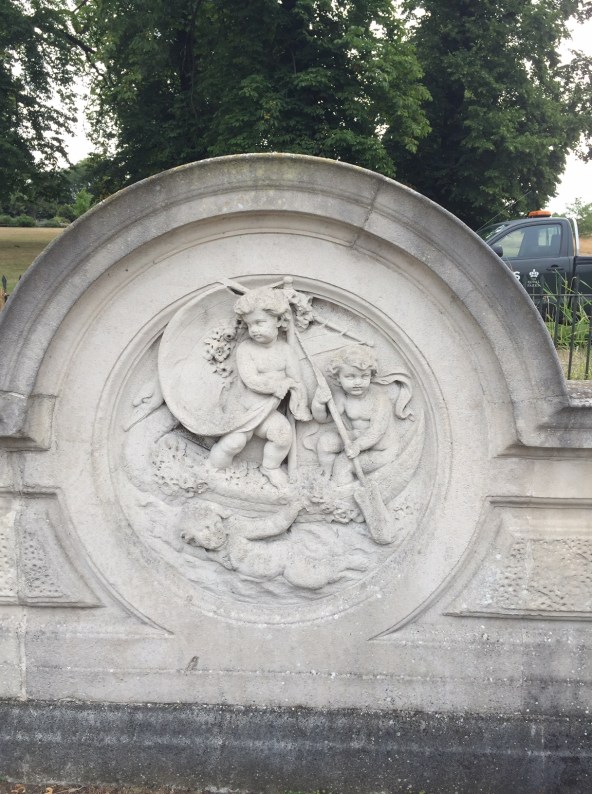
But, today, at the Italian Gardens, I had one of those moments, caused by the bas-relief below:

IMG_9649

I’ve seen a lot of weird images captured in marble sculpture, especially in the form of putti of various stripes, but I have never seen a rifle in a Neo-classical sculpture before today!  A detail of it is below:

IMG_9650


IMG_9658


IMG_9659

The Italian Gardens are found within the grounds of Kensington Gardens; you can locate them at the top of the Serpentine River in the map below:

Screen Shot 2019-07-19 at 22.37.17

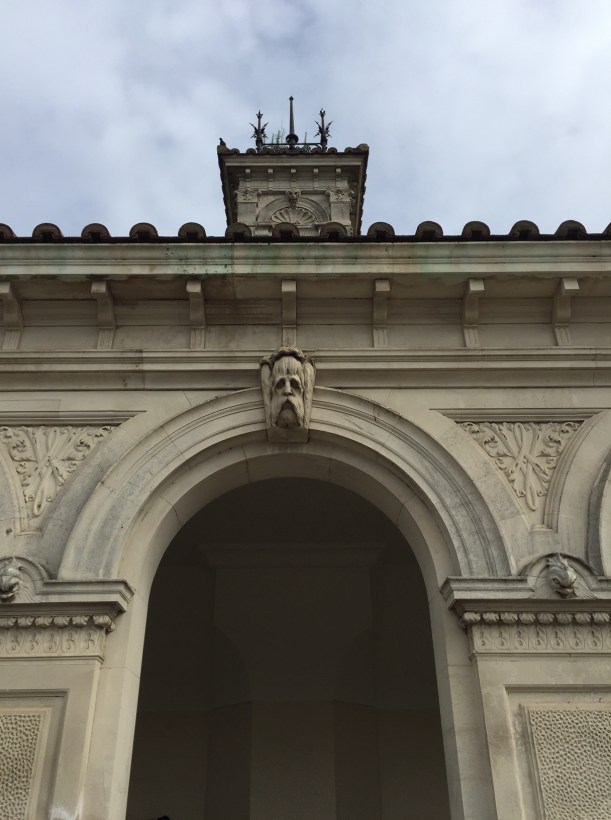
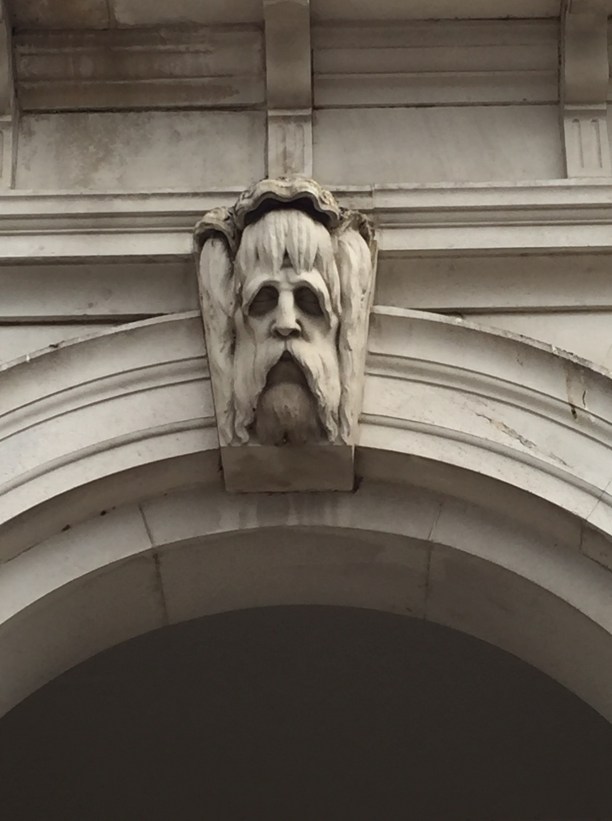
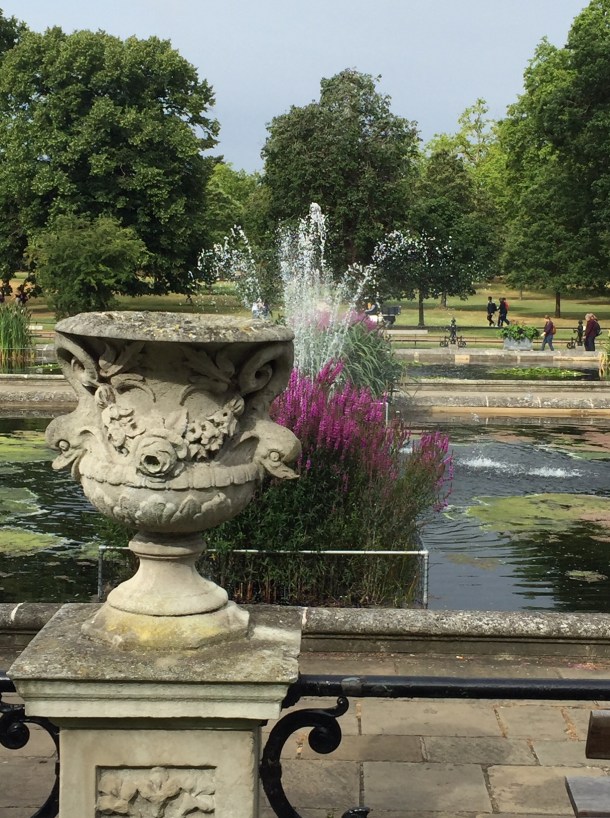
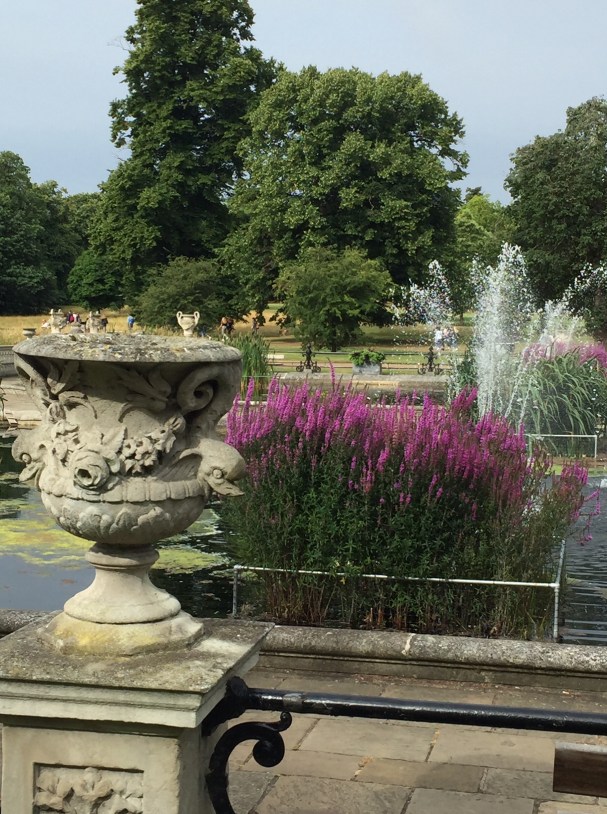
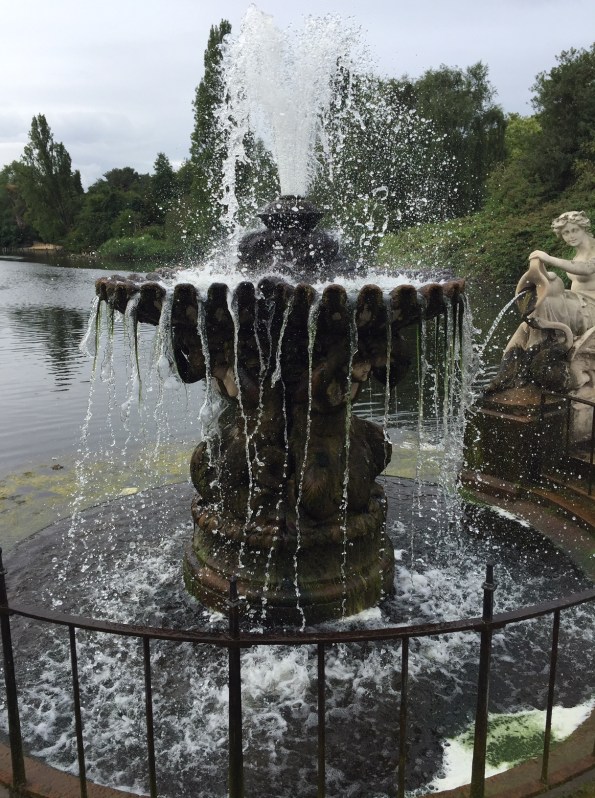
The Italian Gardens are an elaborate mix of four main basins. They feature central rosettes carved in Carrara marble, the Portland stone and white marble Tazza Fountain, and a collection of stone statues and urns. It’s fun to see if you can spot the five main urn designs – a swan’s breast, woman’s head, ram’s head, dolphin and oval.

IMG_9635

Strengthening the supposition that this decorative complex was commissioned by Prince Albert is the fact that the layout of the Italian Gardens is very similar to that of Osborne House on The Isle of Wight, where the royal family spent holidays.  Prince Albert was a keen gardener and took charge of the gardens at Osborne House, where he introduced an Italian garden with large raised terraces, fountains, urns and geometric flower beds.

IMG_9659

fullsizeoutput_13e2


It’s thought that in 1860 he brought the idea to Kensington Gardens. The design by James Pennethorne includes many features of the Osborne garden.

The initials of Queen Victoria and Prince Albert can be found on one of the walls of the Pump House, at the north of the gardens.

fullsizeoutput_13fd

fullsizeoutput_13fe You can see the V & A monogram in this photo.


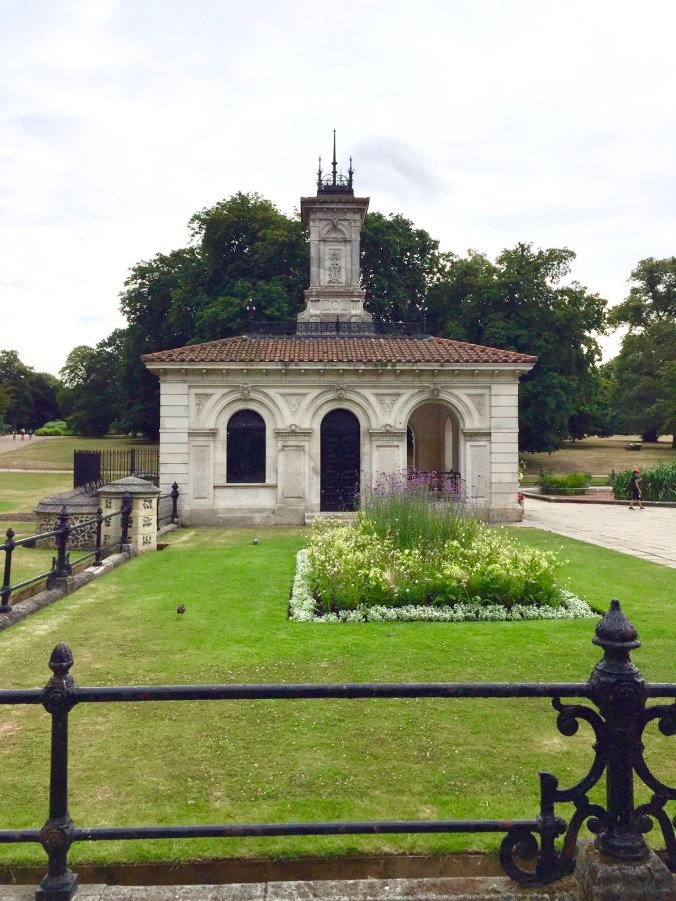
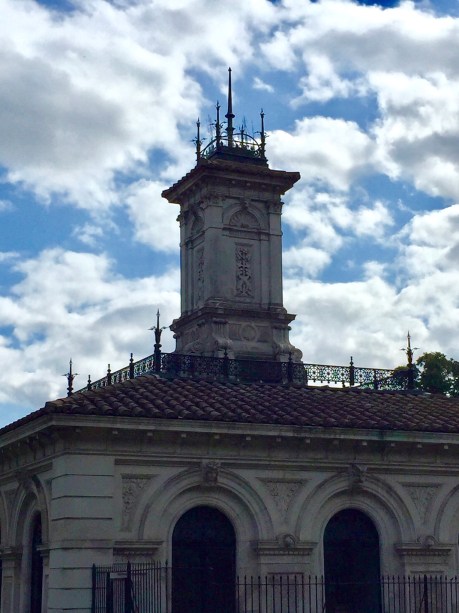
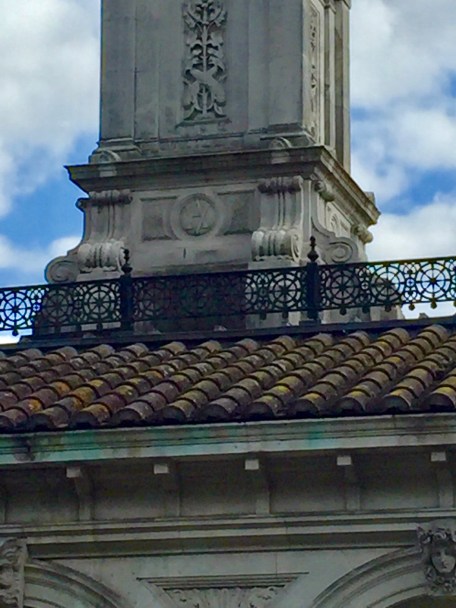
This building once contained a steam engine which operated the fountains – the pillar on the roof is a cleverly-disguised chimney. A stoker kept the engine running on Saturday nights to pump water into the Round Pond, so on Sundays there was enough water pressure to run the fountains.

In 2011, the gardens were restored to their original splendour. The project involved:

  • Restoring the original stonework. This included carving eight life-sized swan heads and necks as replacement handles on some of the urns.
  • Restoring the Tazza Fountain. Fine stone carving was carried out on-site. The central rosettes also needed careful cleaning and some sections were replaced with newly-carved marble.
  • A new planting scheme to recapture the Victorian vision and help maintain water quality. Native water lilies, yellow flag iris, flowering rush and purple loosestrife are rooted in cages just below the water. New walkways help ducks get in and out of the water.
  • A new cleaner water system and water quality improvements. 13 tons of silt were removed from the fountain basins during the restoration. The fountains are now fed with fresh water from a borehole. The water is aerated and its temperature raised as it leaps in the air, before flowing out into the Long Water.  Happily, this improves the ecology of the lake.

The restoration was funded by The Tiffany and Co. Foundation as part of a project to restore ornamental and drinking fountains across the eight Royal Parks, and known as Tiffany – Across the Water.

Also, just for fun, the Italian Gardens have provided a star location in several films.

Monet’s Water Lilies, Musée de l’Orangerie

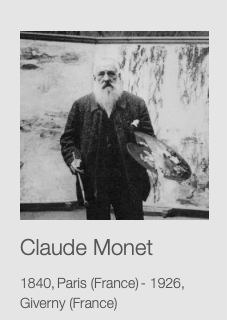
Claude Monet is known as one of the most famous painters of the Impressionist movement, which took its name from one of his paintings, Impression, soleil levant [Impression, Sunrise], dated 1872 (Musée Marmottan, Paris).

Screen Shot 2019-07-12 at 09.35.33

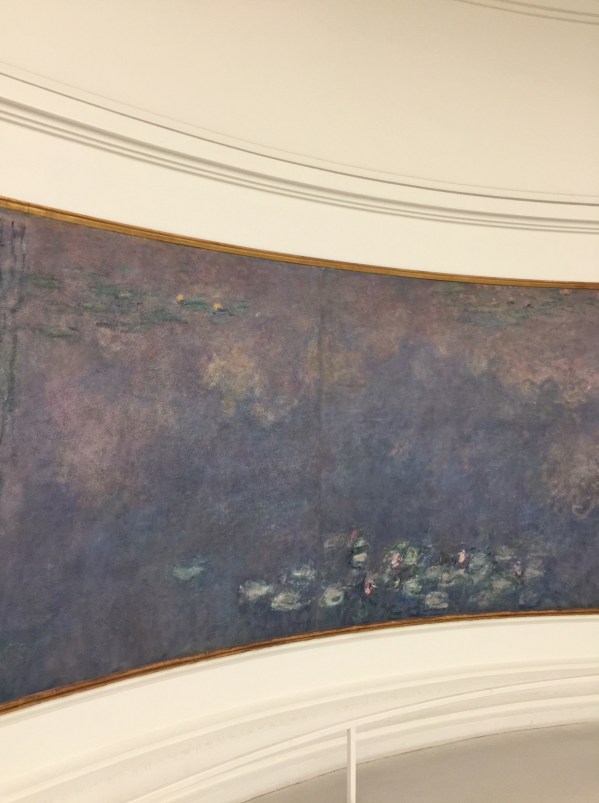
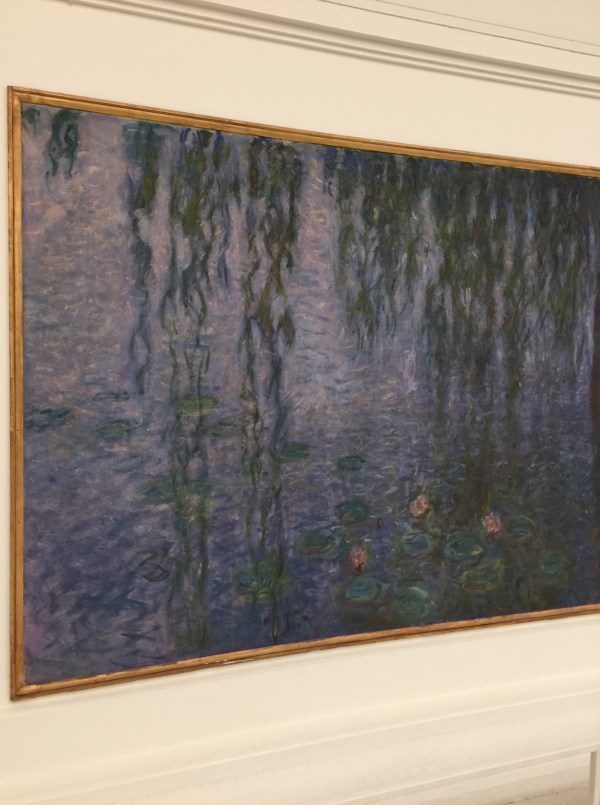
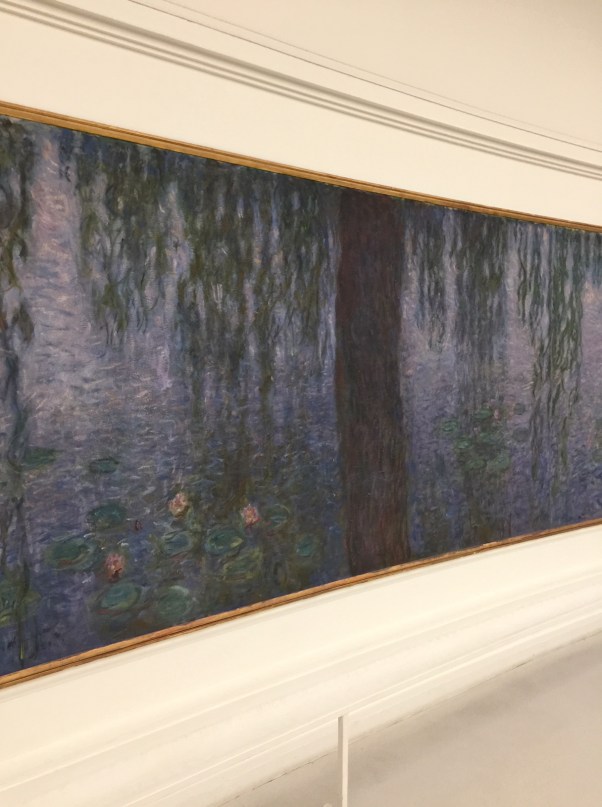
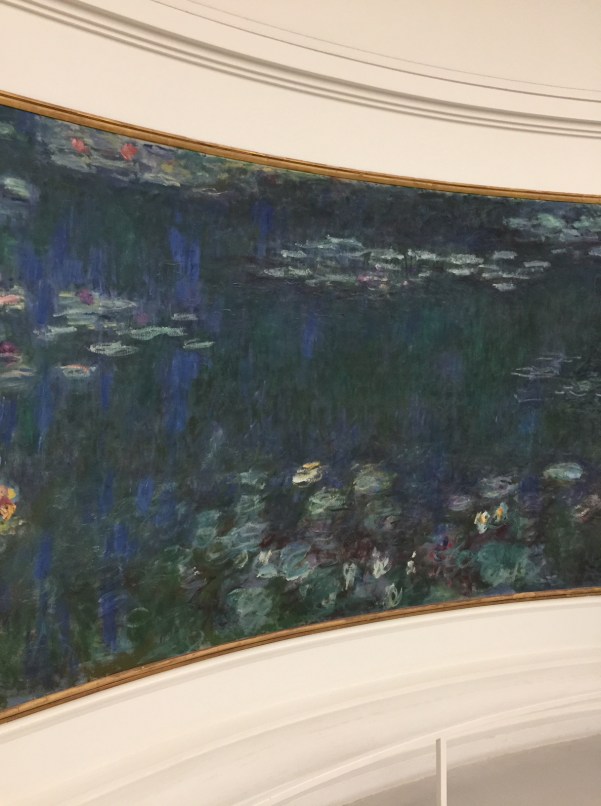
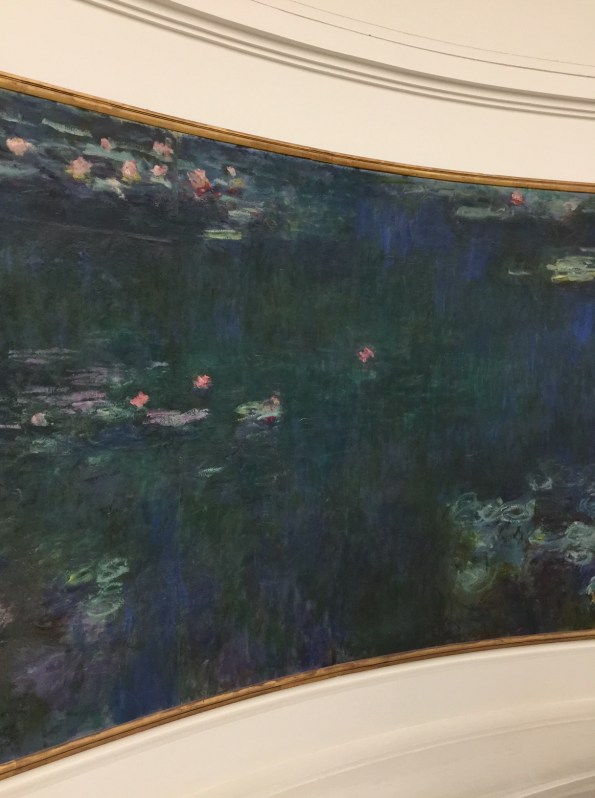
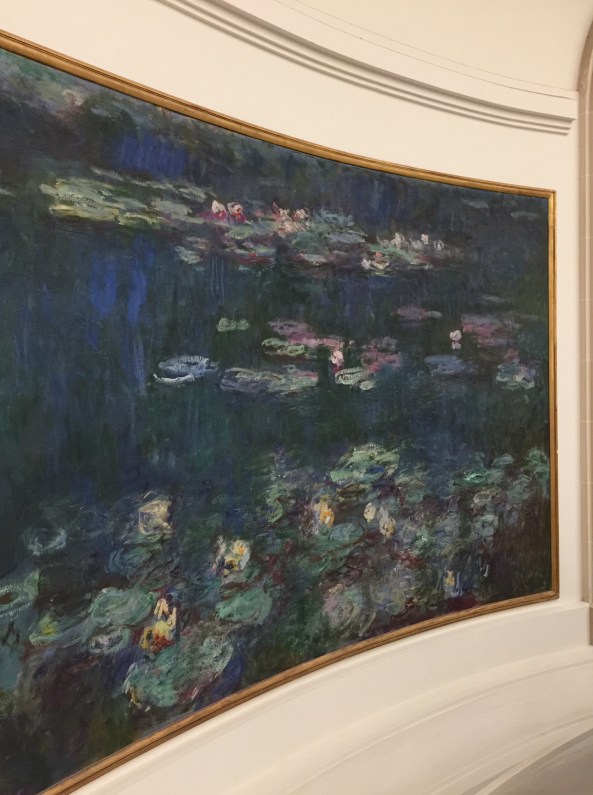
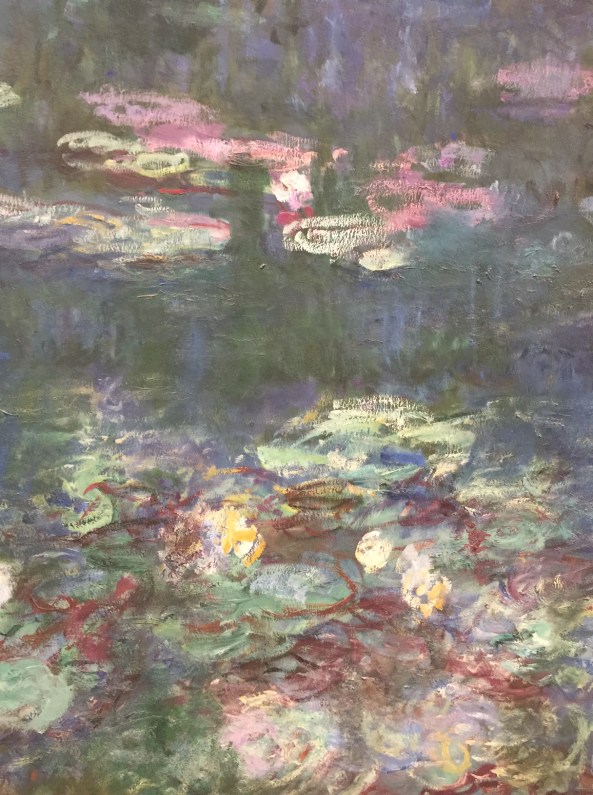
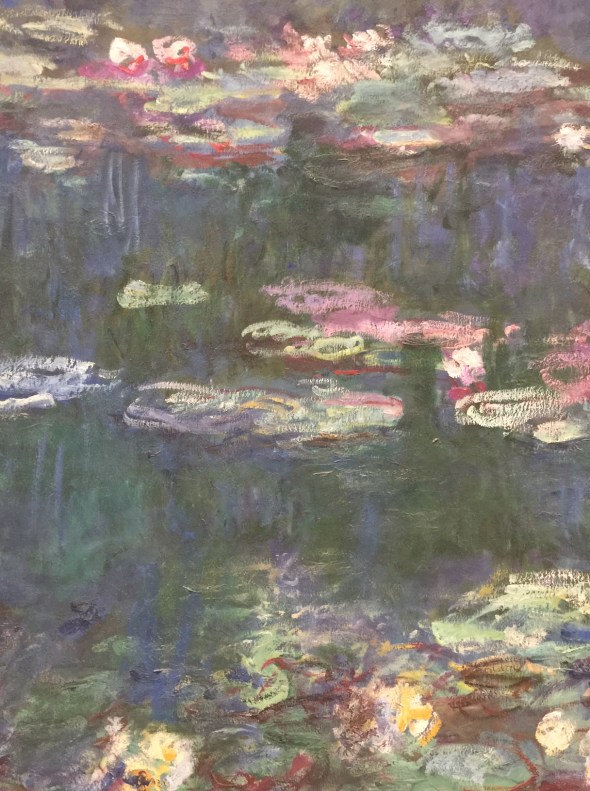
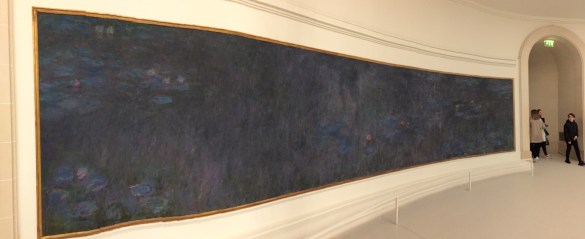
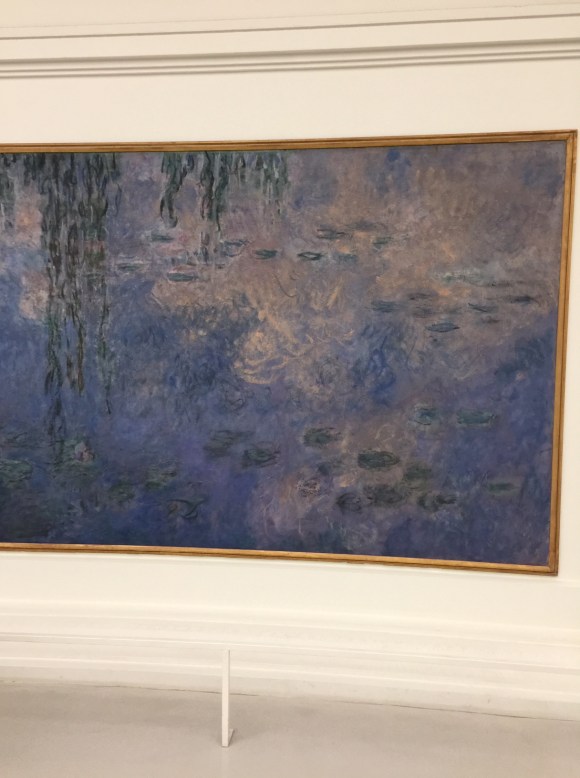
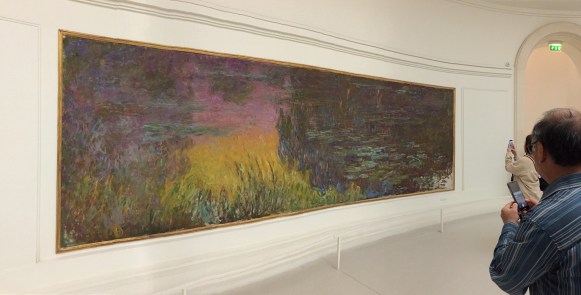
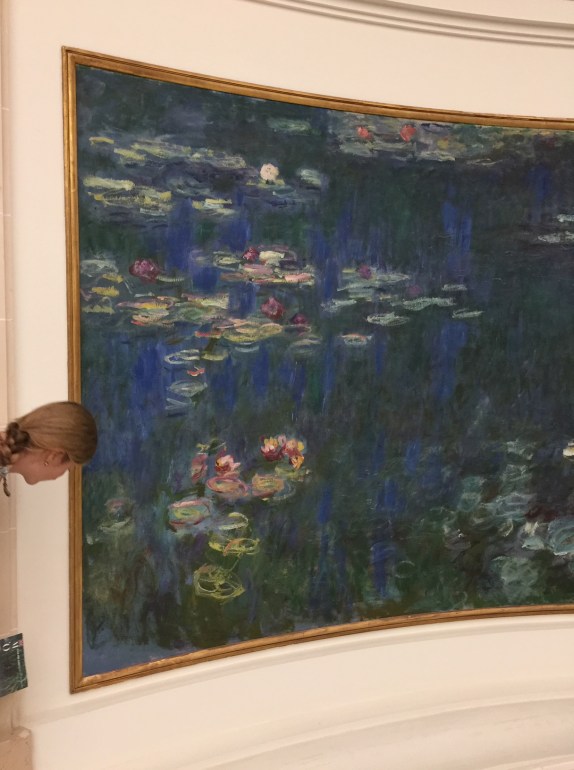
From the late 1890s to his death in 1926, the painter devoted himself to the panoramic series of Water Lilies, of which the Musée de l’Orangerie has a unique series. In fact, the artist designed several paintings specifically for the building, and donated his first two large panels to the French State as a symbol of peace on the day following the Armistice of 12 November 1918.

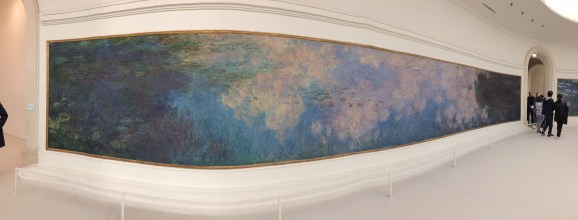
He also designed a unique space consisting of two oval rooms within the museum, giving the spectator, in Monet’s own words, “an illusion of an endless whole, of water without horizon and without shore,” and making the museum’s Water Lilies a work that is without equal anywhere in the world. Monet’s eight compositions were set out in the two consecutive oval rooms, both of which have the advantage of natural light from the skylights, and are oriented from west to east, following the course of the sun and one of the main routes through Paris along the Seine. The two ovals evoke the symbol of infinity, whereas the paintings represent the cycle of light throughout the day.

Monet greatly increased the dimensions of his initial project, started before 1914. The painter wanted visitors to be able to immerse themselves completely in the painting and to forget about the outside world. The end of the First World War in 1918 reinforced his desire to offer beauty to wounded souls.

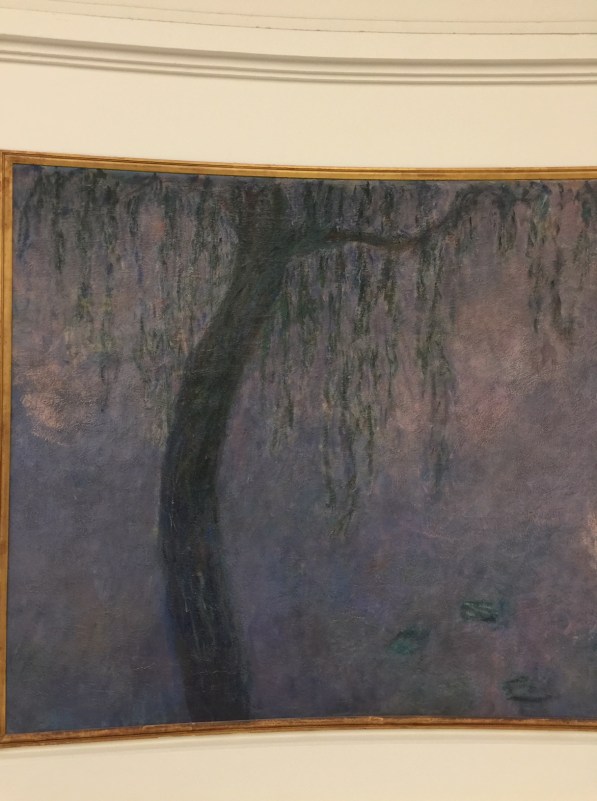
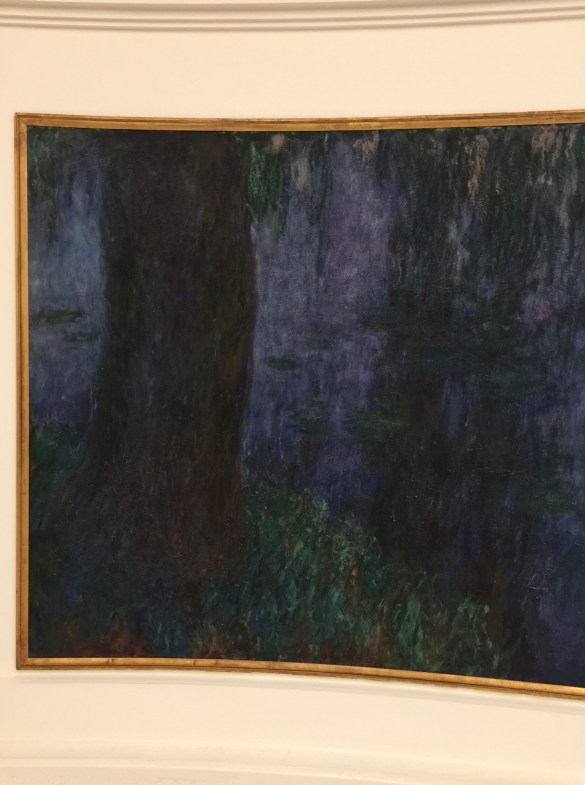
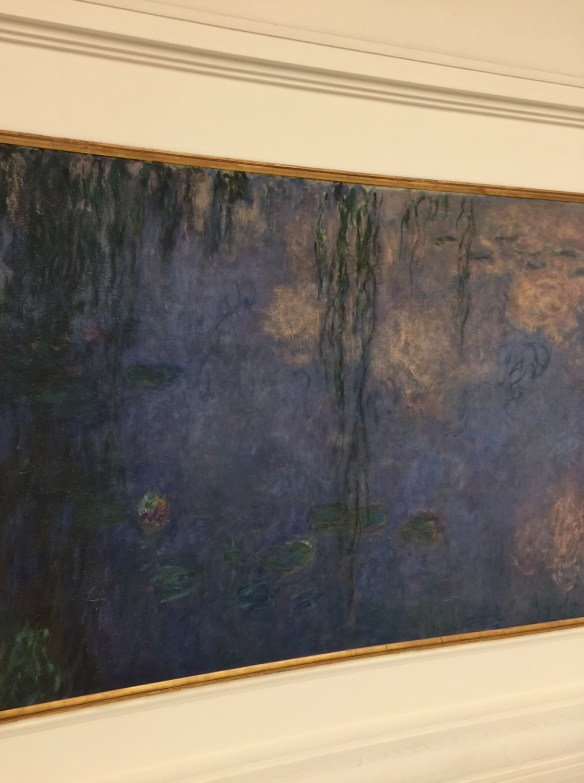
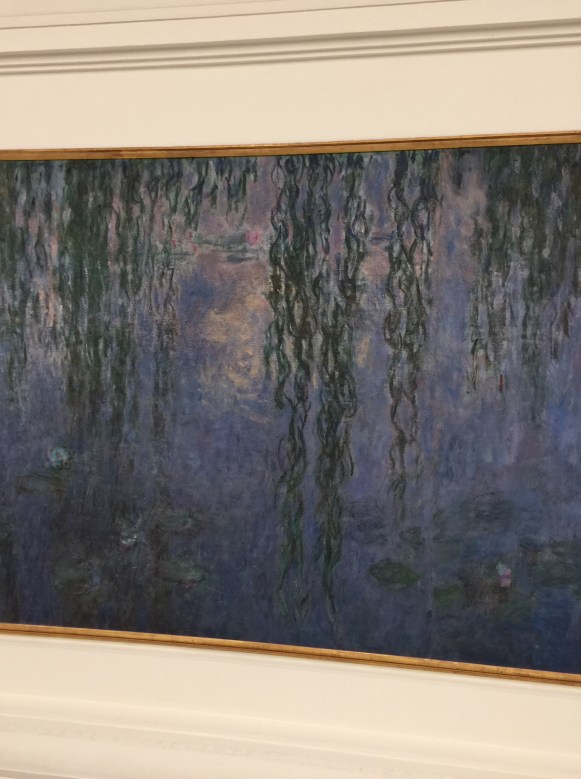
The first room brings together four compositions showing the reflections of the sky and the vegetation in the water, from morning to evening, whereas the second room contains a group of paintings with contrasts created by the branches of weeping willow around the water’s edge.


The Water Lilies were installed according to plan at the Musée de l’Orangerie in 1927, a few months after Monet’s death. This unique set of canvases were designed as a real environment and crowns the Water Lilies cycle begun nearly thirty years before.

The setting for the paintings is one of the largest monumental achievements of early twentieth century painting. The dimensions and the area covered by the paint surrounds and encompasses the viewer on nearly one hundred linear meters which unfold a landscape dotted with water lilies water, willow branches, tree and cloud reflections, giving the “illusion of an endless whole, of a wave with no horizon and no shore” in the words of Monet. This unique masterpiece has no equivalent worldwide.

IMG_8753


IMG_8754


IMG_8755


IMG_8756


IMG_8740


IMG_8741


IMG_8742


IMG_8743


IMG_8744


IMG_8746


IMG_8747


IMG_8748


IMG_8749


IMG_8750


IMG_8751


IMG_8752


IMG_8737


IMG_8738


IMG_8739


You can take a virtual tour of the Water Lilies cycle here:

https://www.musee-orangerie.fr/en/article/water-lilies-virtual-visit


Jardin du Luxembourg

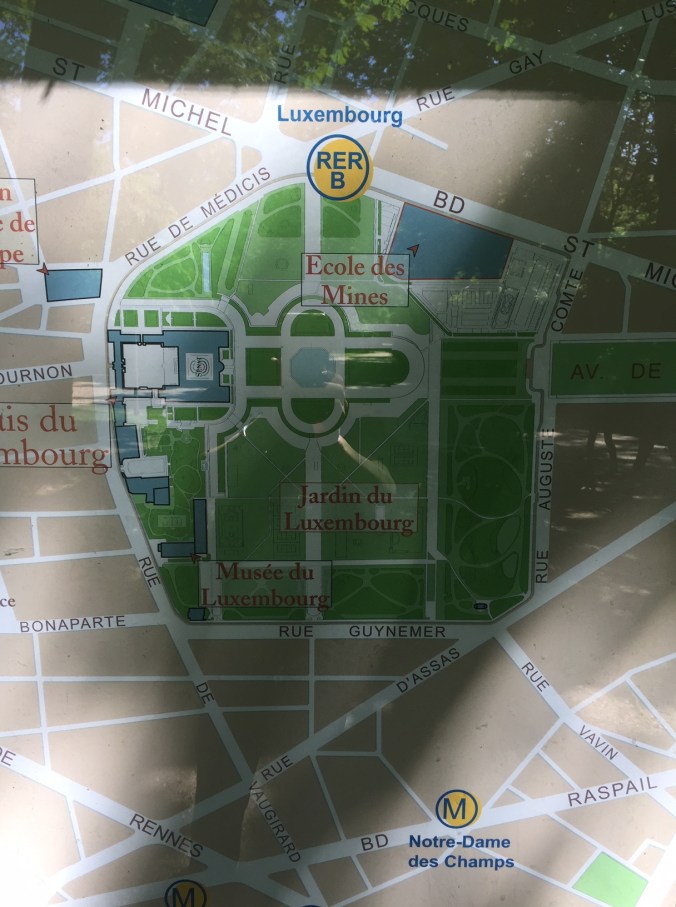
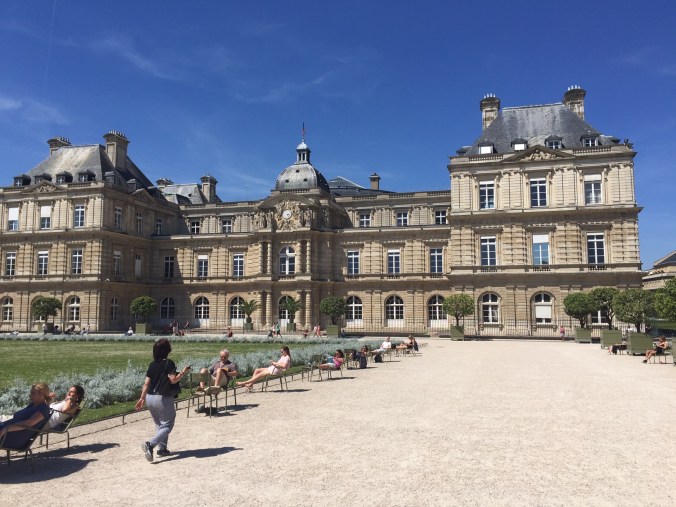
The Jardin du Luxembourg is in the 6th arrondissement of Paris. It was created by and for Marie de’ Medici, the widow of King Henry IV of France, for a new residence she constructed, the Luxembourg Palace. The complex was begun in 1612.

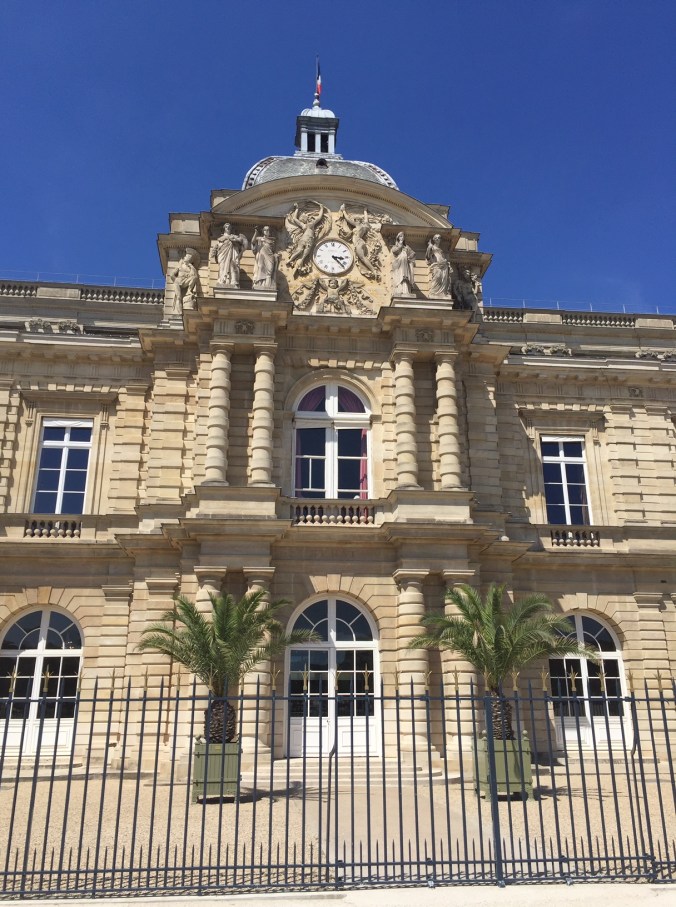
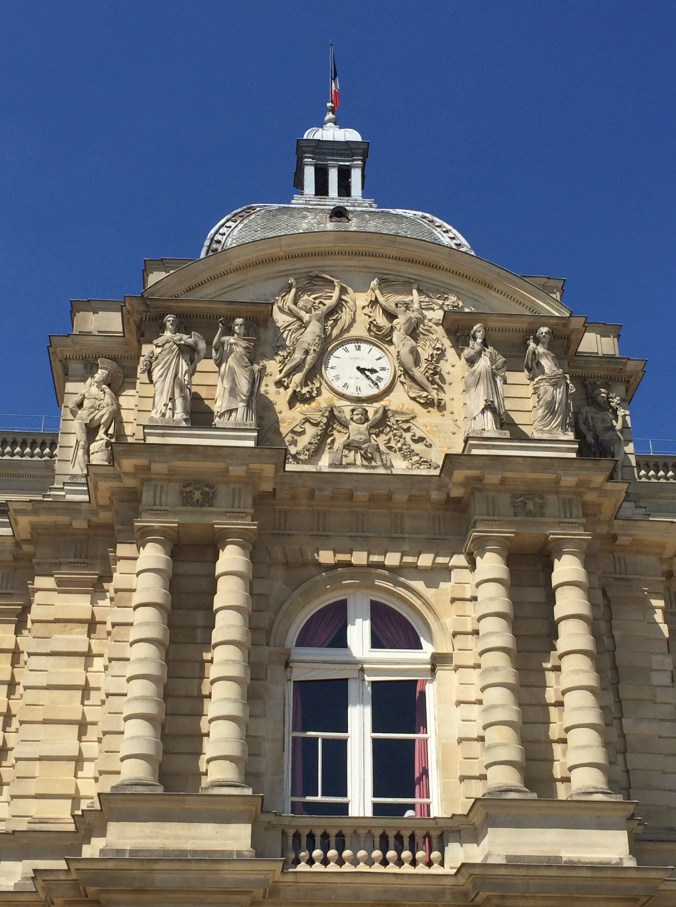
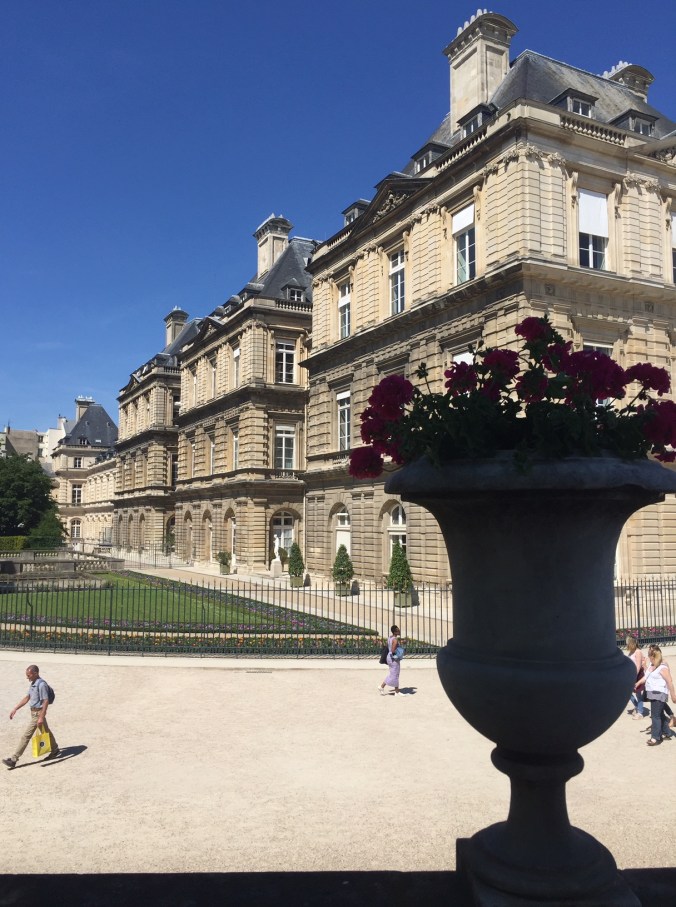
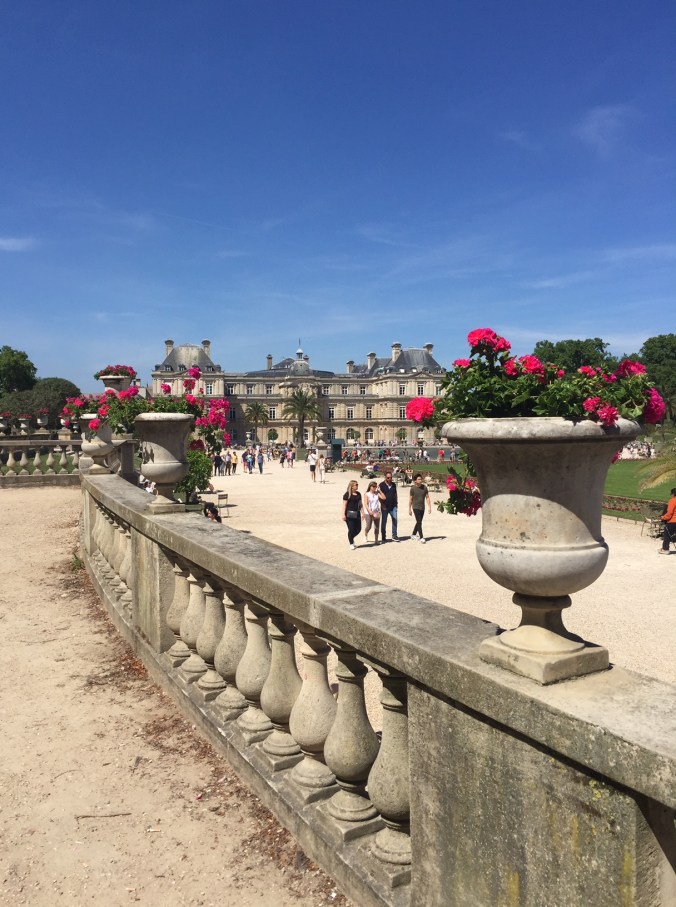
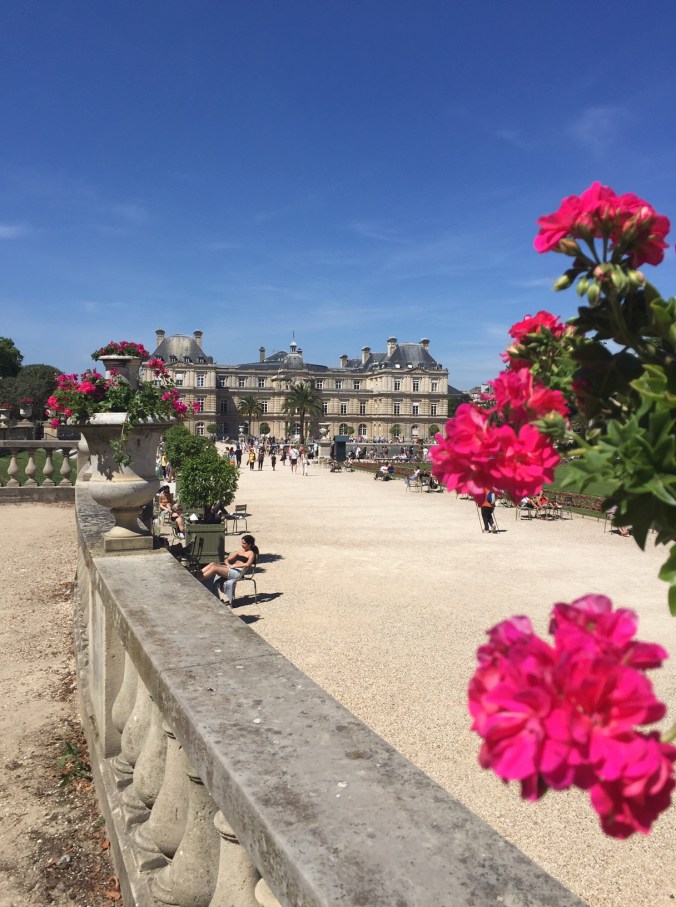
The palace: the Queen wanted it to resemble the Palazzo Pitti in Florence. Does it? Yes and no.
IMG_8328

IMG_8325IMG_8326


IMG_8355IMG_8354IMG_8331IMG_8332IMG_8335IMG_8336IMG_8346IMG_8353IMG_8354

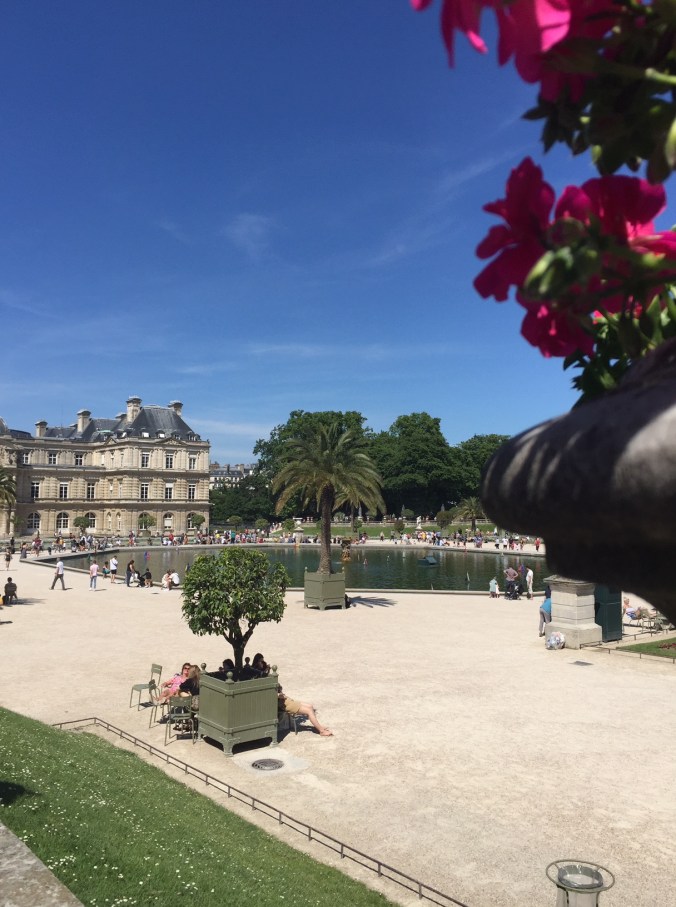
Today the garden is owned by the French Senate, which meets in the Palace. It covers 23 hectares and is known for its lawns, tree-lined promenades, flowerbeds, model sailboats on its circular basin, and picturesque Medici Fountain, built in 1620. The name Luxembourg comes from the Latin Mons Lucotitius, the name of the hill where the garden is located.

In 1611, Marie de’ Medici, the widow of Henry IV and the regent for the King Louis XIII decided to build a palace in imitation of the Pitti Palace in her native Florence. She purchased the hotel du Luxembourg (today the Petit-Luxembourg palace) and began construction of the new palace. She commissioned Salomon de Brosse to build the palace and a fountain, which still exists.

In 1612 she planted 2,000 elm trees, and directed a series of gardeners, most notably Tommaso Francini, to build a park in the style she had known as a child in Florence.

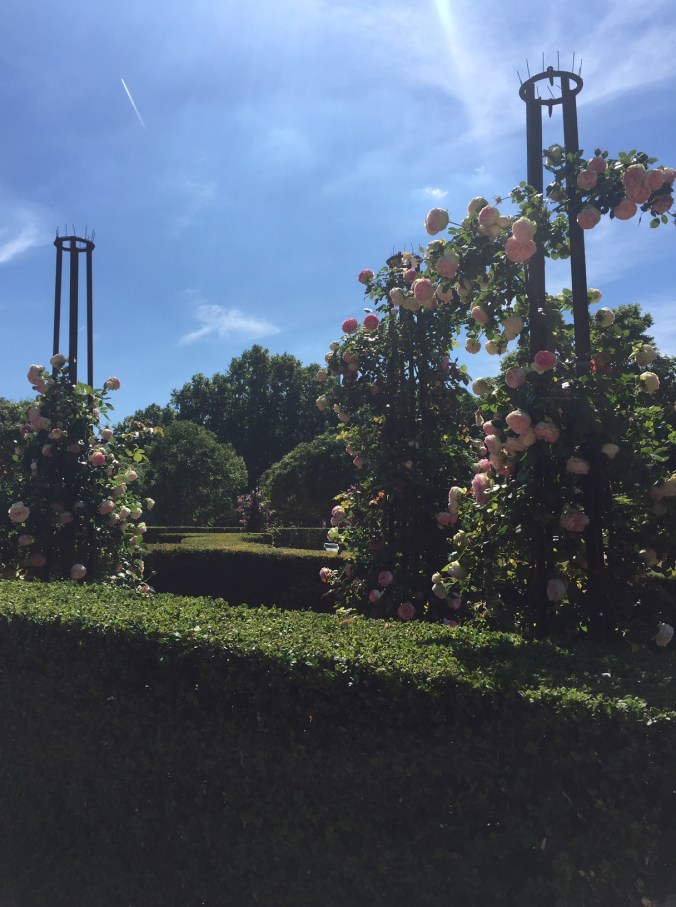
Francini planned two terraces with balustrades and parterres laid out along the axis of the chateau, aligned around a circular basin. He also built the Medici Fountain to the east of the palace as a nympheum, an artificial grotto and fountain, without its present pond and statuary.
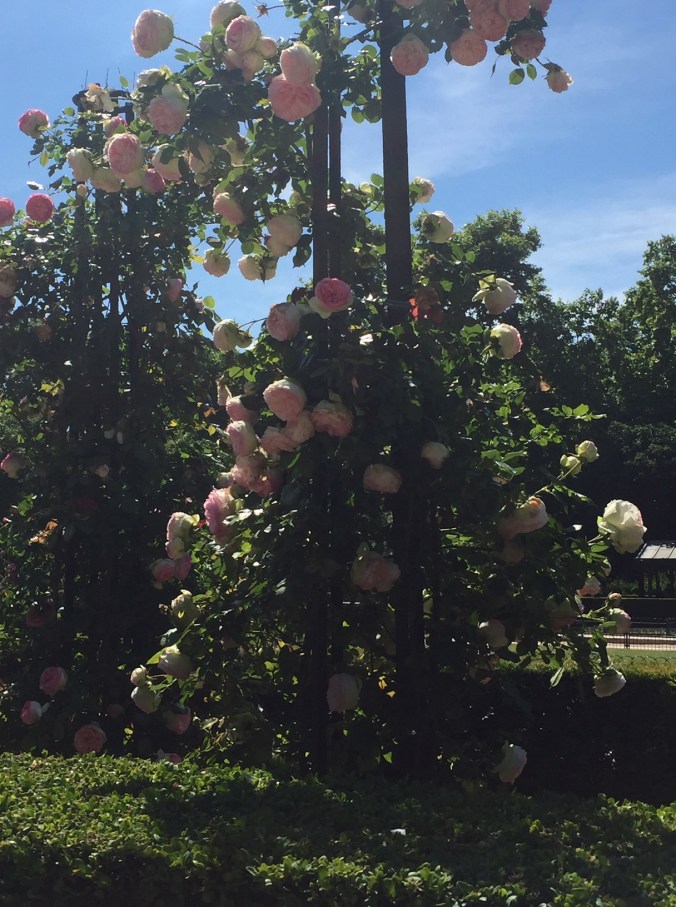
IMG_8355IMG_8357IMG_8358


The original garden was just eight hectares in size. In 1630, the Queen bought additional land and enlarged the garden to thirty hectares, entrusting the work to Jacques Boyceau de la Barauderie, the independent designer of the royal gardens of Tuileries and the early garden of Versailles. He was one of the early theorists of the new and more formal garden à la française, and he laid out a series of squares along an east-west alley closed at the east end by the Medici Fountain, and a rectangle of parterres with broderies of flowers and hedges in front of the palace. In the center he placed an octagonal basin with a fountain, with a perspective toward what is now the Paris observatory.

Later monarchs largely neglected the garden. In 1780, the Comte de Provence, the future Louis XVIII, sold the eastern part of the garden for real estate development. Following the French Revolution, however, the leaders of the French Directory expanded the garden to forty hectares by confiscating the land of the neighboring religious order of the Carthusian monks.

The architect Jean Chalgrin, the architect of the Arc de Triomphe, took on the task of restoring the garden. He remade the Medici Fountain and laid out a long perspective from the palace to the observatory. He preserved the famous pepiniere, or nursery garden of the Carthusian order, and the old vineyards, and kept the garden in a formal French style.
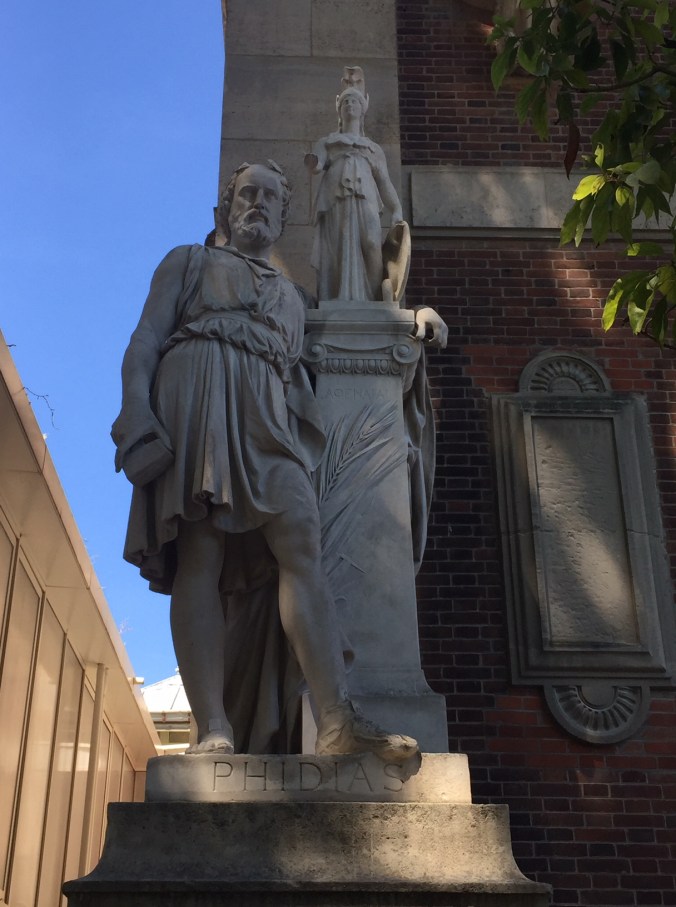
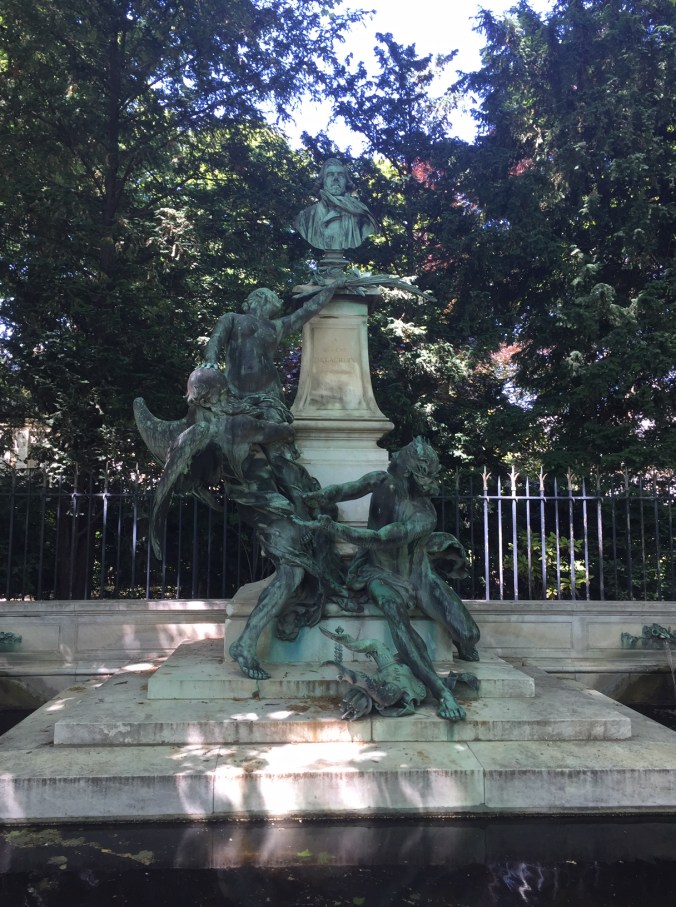
IMG_8317IMG_8318IMG_8320IMG_8321IMG_8322

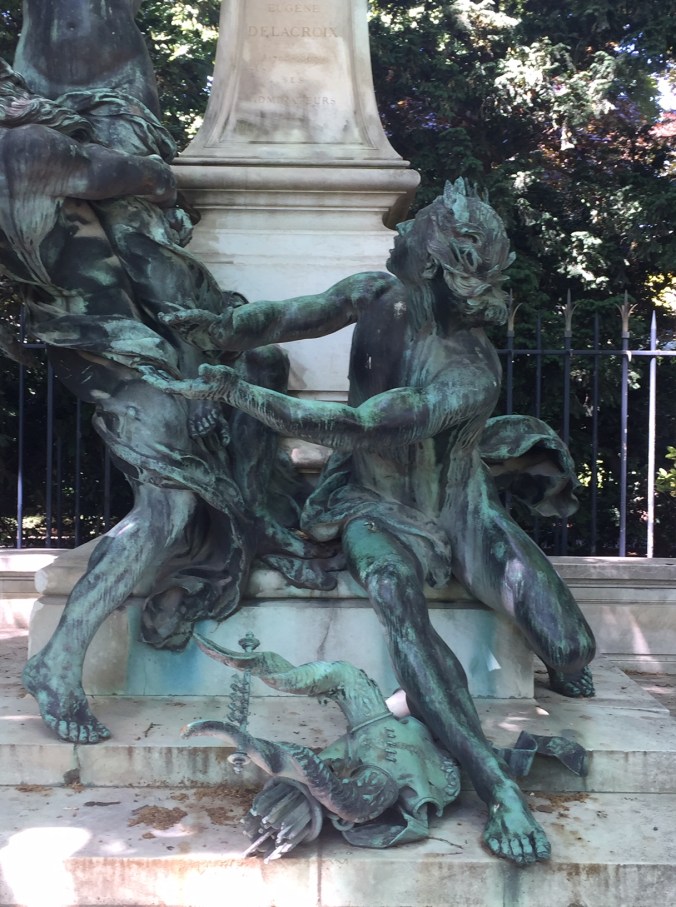
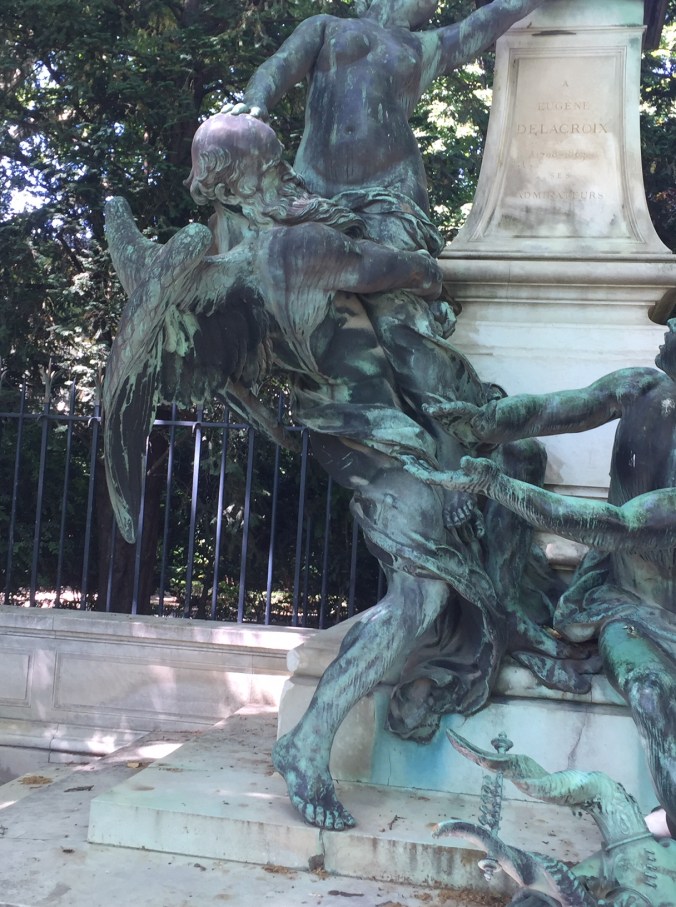
During and after the July Monarchy of 1848, the park became the home of a large population of statues; first the Queens and famous women of France lined  the terraces; then, in 1880s & 90s, monuments to writers and artists were added. A small-scale model by Bartholdi of his Liberty Enlightening the World (commonly known as the Statue of Liberty) and one modern sculpture by Zadkine.
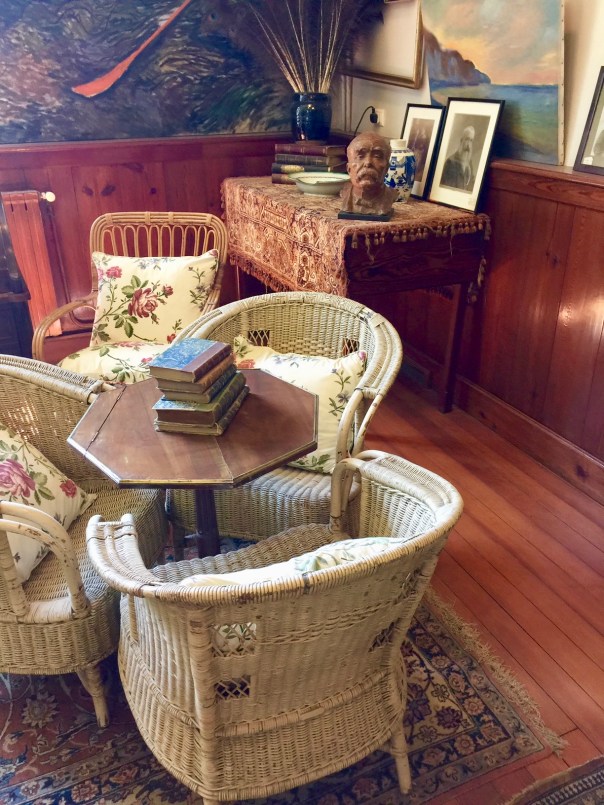
In 1865, during the reconstruction of Paris by Louis Napoleon, the rue de l’Abbé de l’Épée, (now rue Auguste-Comte) was extended into the park, cutting off about seven hectares, including a large part of the old nursery garden. The building of new streets next to the park also required moving and rebuilding the Medici Fountain to its present location. The long basin of the fountain was added at this time, along with the statues at the foot of the fountain.

During this reconstruction, the director of parks and promenades of Paris, Gabriel Davioud, built new ornamental gates and fences around the park, and polychromed brick garden houses. He also transformed what remained of the old Chartreux nursery garden, at the south end of the park, into an English garden with winding paths, and planted a fruit orchard in the southwest corner. He kept the regular geometric pattern of the paths and alleys, but did create one diagonal alley near the Medici fountain which opened a view of the Pantheon.

In the late 19th century the Jardin was also home to: a marionette theater, a music kiosk, greenhouses, an apiary or bee-house, an orangerie also used for displaying sculpture and modern art, a rose garden, the fruit orchard, and about seventy works of sculpture.
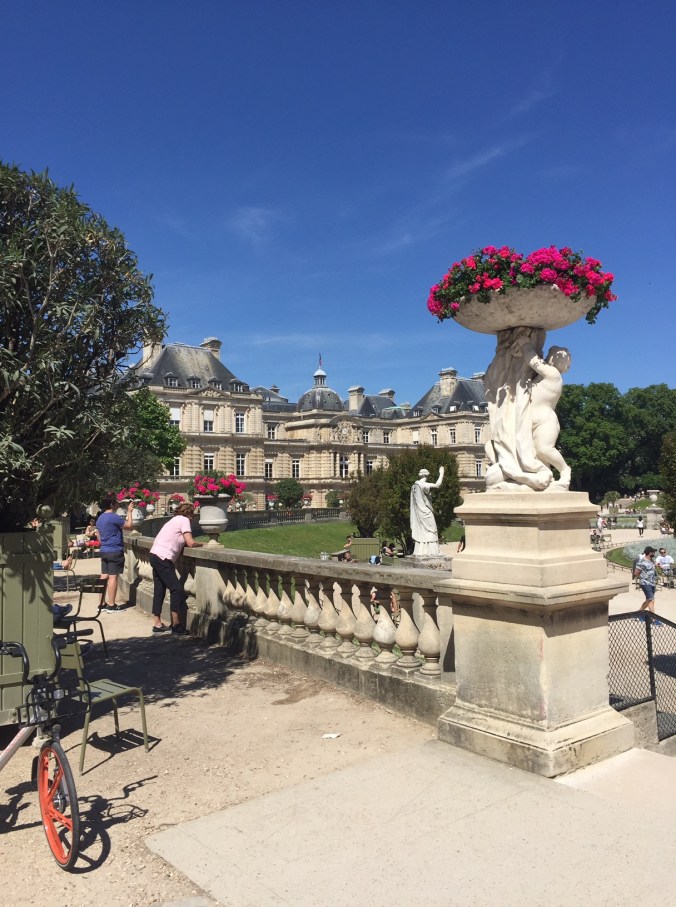
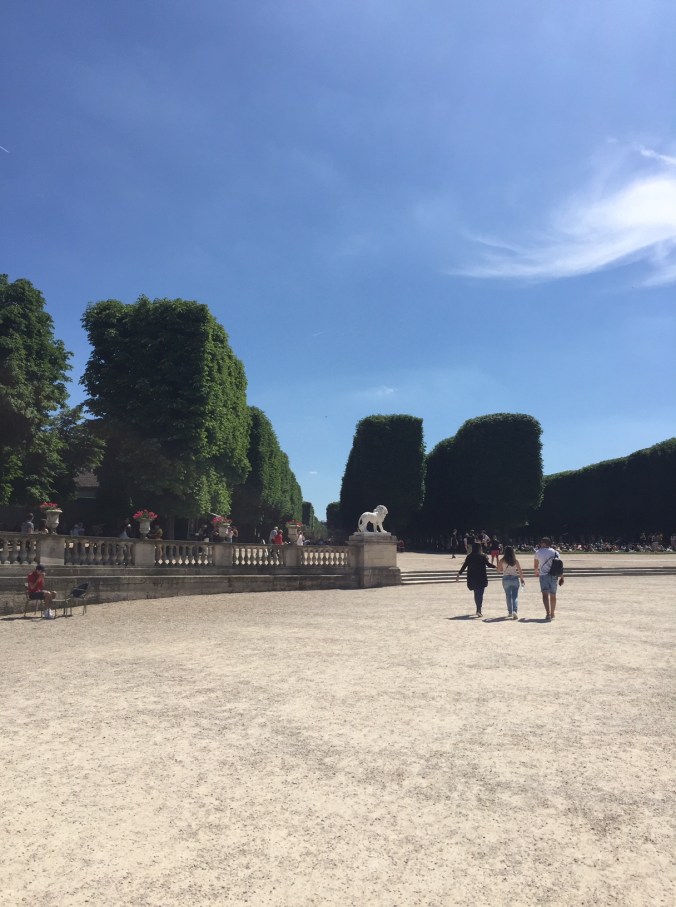
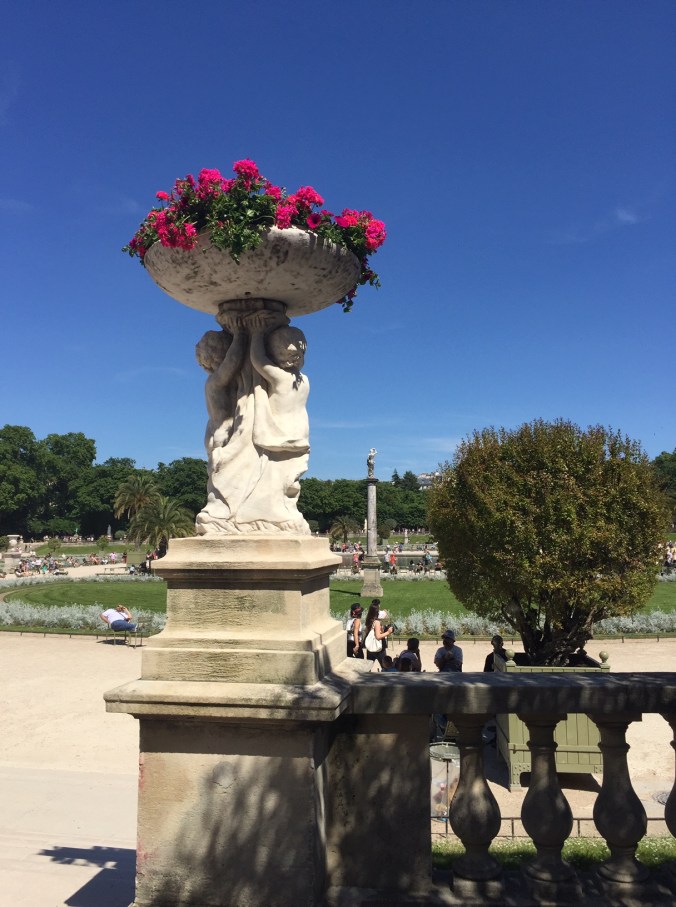
The garden is largely devoted to a green parterre of gravel and lawn populated with statues and centred on a large octagonal basin of water, with a central jet of water; in it children sail model boats. The garden is famed for its calm atmosphere. Surrounding the bassin on the raised balustraded terraces are a series of statues of former French queens, saints and copies after the antique. In the southwest corner, there is an orchard of apple and pear trees and the théâtre des marionnettes (puppet theatre).

The gardens include a large fenced-in playground for young children and their parents and a vintage carousel. In addition, free musical performances are presented in a gazebo on the grounds and there is a small cafe restaurant nearby, under the trees, with both indoor and outdoor seating from which many people enjoy the music over a glass of wine. The orangerie displays art, photography and sculptures.

The central axis of the garden is extended, beyond its wrought iron grill and gates opening to rue Auguste Comte, by the central esplanade of the rue de l’Observatoire, officially the Jardin Marco Polo, where sculptures of the four Times of Day alternate with columns and culminate at the southern end with the 1874 “Fountain of the Observatory,” also known as the Fontaine des Quatre-Parties-du-Monde or the Carpeaux Fountain, for its sculptures by Jean-Baptiste Carpeaux. It was installed as part of the development of the avenue de l’Observatoire by Gabriel Davioud in 1867.

The central axis of the garden is extended, beyond its wrought iron grill and gates opening to rue Auguste Comte, by the central esplanade of the rue de l’Observatoire, officially the Jardin Marco Polo, where sculptures of the four Times of Day alternate with columns and culminate at the southern end with the 1874 “Fountain of the Observatory”, also known as the “Fontaine des Quatre-Parties-du-Monde” or the “Carpeaux Fountain”, for its sculptures by Jean-Baptiste Carpeaux. It was installed as part of the development of the avenue de l’Observatoire by Gabriel Davioud in 1867.

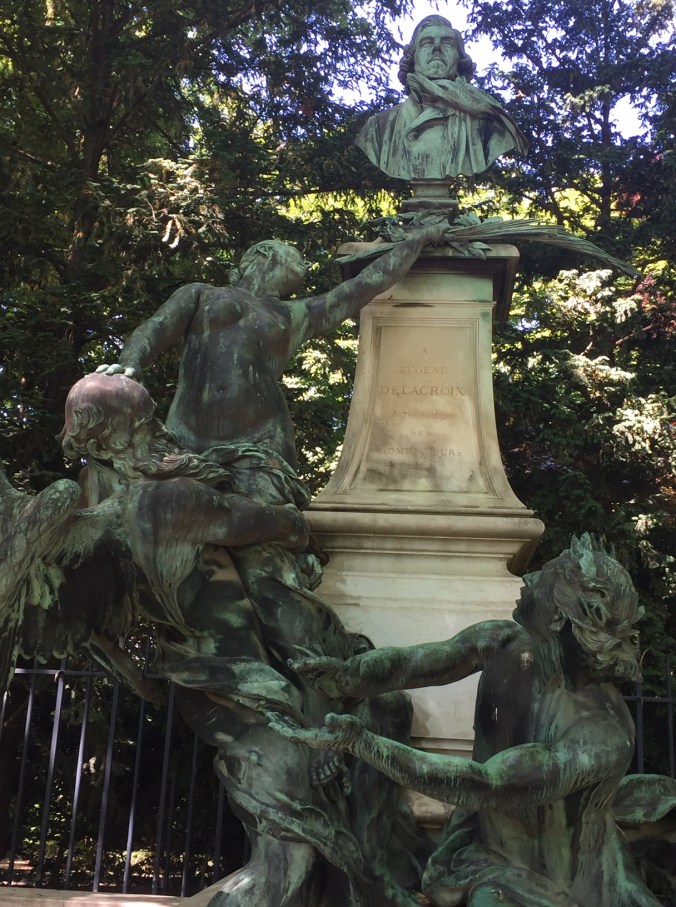
The bronze fountain represents the work of four sculptors: Louis Vuillemot carved the garlands and festoons around the pedestal, Pierre Legrain carved the armillary with interior globe and zodiac band; the animalier Emmanuel Fremiet designed the eight horses, marine turtles and spouting fish. Most importantly Jean-Baptiste Carpeaux sculpted the four nude women supporting the globe, representing the Four Continents of classical iconography.

In spring, summer and fall, the garden is generally open between 7:30 am to dusk.


Statuary:

The garden contains just over a hundred statues, monuments, and fountains, scattered throughout the grounds. Surrounding the central green space are twenty figures of French queens and illustrious women standing on pedestals. They were commissioned by Louis-Philippe in 1848 and include: Anne of Austria, Anne of Brittany, Anne of France, Anne Marie Louise of Orléans, Bertha of Burgundy, Blanche of Castile, Clémence Isaure, Jeanne III of Navarre, Laure de Noves, Louise of Savoy, Margaret of Anjou, Margaret of Provence, Marguerite of Navarre, Marie de’ Medici, Mary, Queen of Scots, Matilda, Duchess of Normandy, Saint Bathild, Saint Clotilde, Saint Genevieve, and Valentina Visconti.


Jardin du Luxembourg in popular culture
The gardens are featured prominently in Victor Hugo’s novel Les Misérables. It is here that the principal love story of the novel unfolds, as the characters Marius Pontmercy and Cosette first meet. Several scenes of André Gide’s novel The Counterfeiters also take place in the gardens.

Henry James also uses the gardens, in The Ambassadors, as the place where his character Lambert Strether has an epiphany about his identity. The final scene of William Faulkner’s novel Sanctuary is set in the gardens. Patrick Modiano heard the news he had won the 2014 Nobel Prize in Literature via a mobile phone call from his daughter while walking through Paris, “just next to the Jardin du Luxembourg”.

Non-literary references include as the setting for a few episodes of French in Action, the 10th Joe Dassin’s 1976 studio album Le Jardin du Luxembourg, the cover of Tame Impala’s 2012 album Lonerism, the title of a song by the band The Ghost of a Saber Tooth Tiger and the gardens and palace being added as a mission in the video game Assassin’s Creed Unity.