


The circle of life.
China:
Porcelain, commonly known in English as “china,” was first produced around 2000 years ago in China. It was coveted in Europe after its introduction there by the time of the Ming Dynasty (1368–1644 AD). The Ming Dynasty controlled much of the porcelain trade via the Silk Road. In 1517, Portuguese merchants began direct trade by sea with the Ming Dynasty, and in 1598, Dutch merchants followed.
Italy:
The Doccia porcelain manufactory, at Doccia near Florence, was founded in 1735 by marchese Carlo Ginori near his villa. Now known as Richard-Ginori, (following its merger with Società Richard of Milan), as of February, 2013 it was acquired by Gucci.
Back to China:
Gucci plans improve the factory in Florence, concentrate on high-end products, and sell products under its name in luxury markets such as China.
Villa Gamberaia in Settignano is truly a paradise for me. But what on earth (ha ha, get it?) do I mean by “paradise?”


I mean a walled garden where tranquility is found. A refuge. A place to restore.
In fact, the word “paradise” entered the English language from the French paradis, inherited from the Latin paradisus, from the Greek parádeisos (παράδεισος). The Greeks borrowed the word from an Old Iranian paridayda meaning “walled enclosure.” By 500 BCE, the Old Iranian word had been adopted as Assyrian pardesu or “domain.”
In general, “paradise” was first used to indicate the expansive walled gardens of the First Persian Empire. The garden is constantly used as a symbol for paradise, with shade and water as its ideal elements. ‘Gardens under which rivers flow’ is a frequently used expression for the bliss. The four main rivers of paradise are traditionally thought to be , one of water, one of milk, one of wine and one of purified honey.
This is the origin of the quartered garden, which were divided by means of four water-channels and all contained within a private, walled enclosure.

With or without masses of blooming flowers, Villa Gamberaia is paradise to me. Even without literal rivers of milk and honey. :-)) Quiet and birdsong is enough.
Think of it: every time you go to the fruit section of the grocery store, you are offered so many choices of citrus that it’s mind-boggling.

And there are often new varieties you never heard about before: Cara cara oranges; Meyer lemons; blood oranges.
It is astounding to think that the whole smorgasbord began with 4 humble taxa: the four core ancestral citrus taxa are
1. citron (C. medica)

2. pummelo (C. maxima)

3. mandarine (C. reticulata)

4. papeda (C. micrantha)

For a thousand years the citron (a kind of lemon) was the only kind of citrus fruit in Europe, nor did not lose its monopoly over the Italian peninsula until Arabic invaders brought lemons and sour oranges to Sicily.
Today, authorities agree that all citrus species are native to Southeast Asia, where they are found wild and in an uncultivated form. The citron had begun its journey to Calabria by migrating slowly into China and across India. The climate it encountered outside Assam was so much hotter, drier and more challenging that it couldn’t survive without human help, but what possible appeal could it make to a farmer?
-Would you choose to eat its fruit? Not really.
-Was its wood good for burning? Not very.
-Was it useful for building? Not at all.
-Could anyone find shade beneath its branches? Certainly not.
-Did it at least live for a long time? No.
So it was a practical failure, and yet…
…there was something miraculous about it that could not be ignored. It had an almost supernatural ability to bear a full cargo of beautiful flowers and enormous golden fruit simultaneously throughout the year.
Everything about it was scented – its pale waxy flowers, its dark green leaves, its fruit and even the wood itself – and like a glamorous woman, it was constantly surrounded by a miasma of perfumed air.
Finally, the fruit seemed eternal, neither rotting nor falling from the tree.
Although it had no obvious practical use, the tree’s mysterious habits gave it a powerful and peculiar appeal, so that people seem always to have felt compelled to cultivate it, imbue it with symbolic significance, paint its portrait and include it in ancient stories.
The citron spread gradually from India into Persia, its fruit stowed deep inside the saddlebags of merchants moving along the caravan routes that ran from the Punjab in upper India through Afghanistan to Persia and Mesopotamia (between the Tigris and Euphrates rivers in Iraq), or flashing gold among the cargoes of boats carried on monsoon winds from the west coast of India to Oman, before being taken overland to Iraq and then Iran.
And, citrons travelled well: they were slow to decay and their seeds were protected by the fruit’s enormous carapace of pith and peel.
The trees were fully acclimatized in Persia and Media (north-west Iran) by the fourth century BC, when Alexander the Great came storming through with his armies and a vast retinue of scientific experts. The scientists were commissioned by Alexander to record every aspect of the flora and fauna, geography, people, mineral deposits and infrastructure of the regions they passed through in the wake of his armies. 3 They were on the lookout for useful trees or crops that might be
Much of the above is taken, with my edits and additions from Wikipedia, from: Attlee, Helena (2015-01-05). The Land Where Lemons Grow: The Story of Italy and Its Citrus Fruit (Kindle Locations 2687-2695). Countryman Press. Kindle Edition.
After enjoying the beautiful sight of potted lemon trees all over Villa Gambreia yesterday, as here:


I started musing about one of my favorite subjects: citrus in Italy in general. These ramblings always bring me quickly to thoughts of bergamot, the scent of which I adore. In fact, I wear it everyday in this form:
t 
I adore the fragrance of bergamot! It has been described as “the scent of a spring morning in Italy, of mountain narcissus and citrus blossom after rain.”
I’ve still to see the actual fruit, but I’m going to eventually. Even if it kills me. Which I don’t think it will. I think it just means a (much wanted) 2nd trip (for me, in this lifetime) to Calabria.


Let’s consult an expert on bergamot:
“Wherever citrus trees are gathered together, whether in open ground or the shelter of a limonaia, they cross-pollinate and over time varieties develop that are peculiar to their setting.
“The first of Calabria’s unique and valuable fruits is bergamot (Citrus bergamia), the product of a natural cross-pollination between a lemon tree and a sour orange that occurred in Calabria in the mid-seventeenth century.
“Essential oil can be extracted from the bergamot’s fruit, and although its extremely high value has inspired many attempts to grow it elsewhere, bergamot is like an animal in its chosen territory: it thrives and fruits successfully only on a thin strip of coastline that runs for seventy-five kilometres from Villa San Giovanni on the Tyrrhenian coast to Brancaleone on the shores of the Ionian Sea.
“Here the tree grows tall and strong, and bears such heavy crops that its brittle branches often snap under the weight of oily fruit. Take it away from its home ground and you make it a perpetual invalid, incapable of tolerating the cold or weathering strong winds.
“Only one thing is certain: its first appearance anywhere in the world was in the mid-seventeenth century in Calabria.
“Drive south from Reggio Calabria towards Bova Marina and you can see bergamot trees on the narrow plain between the foothills of the Aspromonte mountains and the sea. They grow in glistening, dark green swathes between dramatic plugs of volcanic rock and on narrow terraces cut from a sheer cliff face.
“The trees have large glossy leaves similar to a lemon’s and bitter fruit that ripens from green to yellow and is the size and shape of an orange. Anything goes in a bergamot grove. Trees are pruned very lightly only once a year and some of them grow to over four metres high. They are carefree, liberated, untidy and entirely organic, the hippies of the citrus world. It is the essential oil stored in the pores just beneath the surface of the skin that makes bergamot so valuable.
“Ever since the beginning of the eighteenth century the principal and most lucrative use of this oil has been as a fixing agent in the perfume industry. The addition of bergamot oil makes a perfume last longer and brings all its other elements into harmony, rather like the conductor of an orchestra.
“Any essential oil extracted from fruit produced outside Calabria’s bergamot belt is of inferior quality.
“When bergamot first appeared in Calabria it was immediately appreciated for its blossom, which has a stronger scent than any other zagara. The bitter fruit was not considered edible, but bergamots were planted as ornamental trees in the gardens of villas in its homeland near the regional capital, Reggio Calabria.”

Attlee, Helena (2015-01-05). The Land Where Lemons Grow: The Story of Italy and Its Citrus Fruit (Kindle Locations 2280-2286). Countryman Press. Kindle Edition.
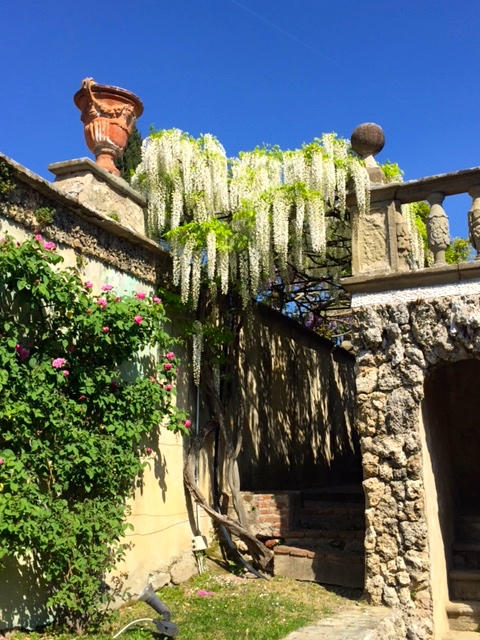
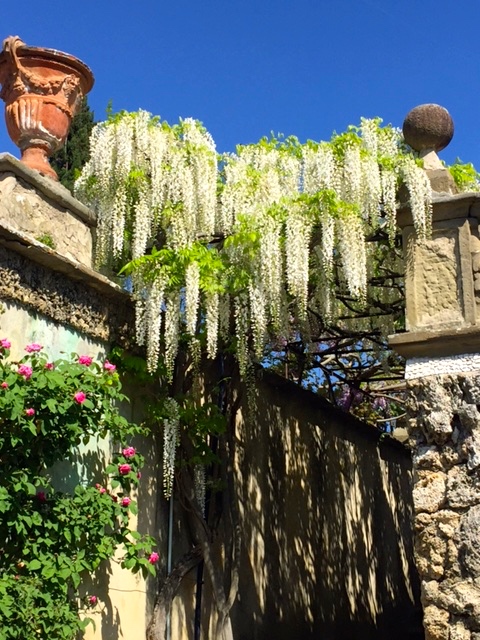
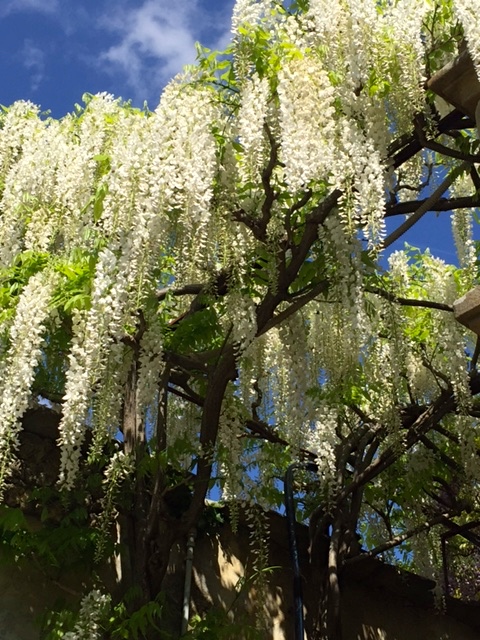
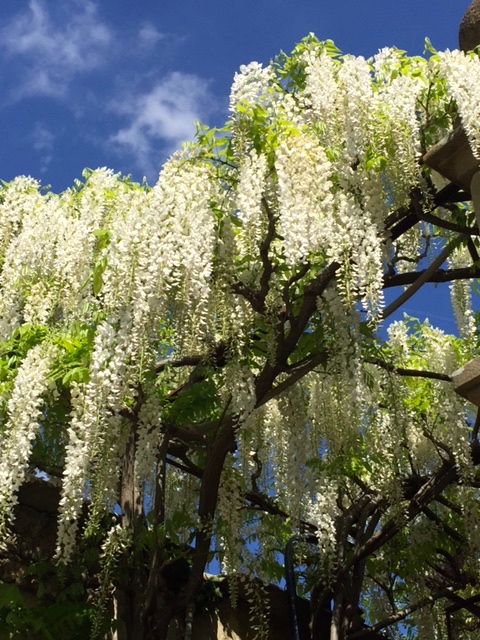
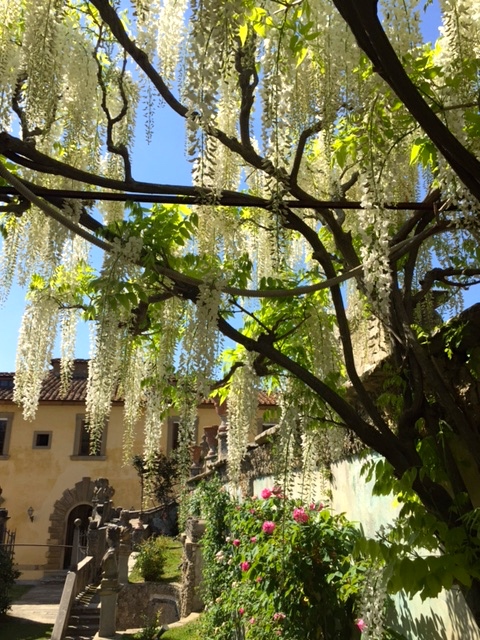
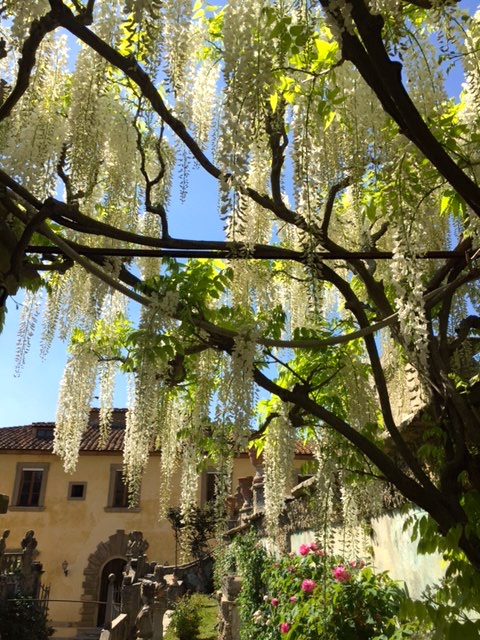
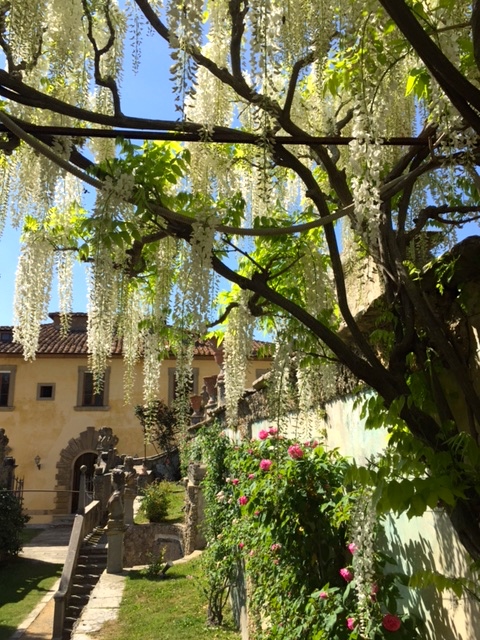
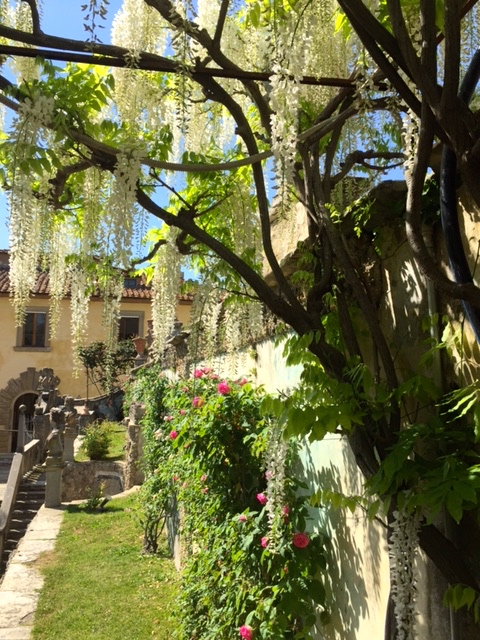
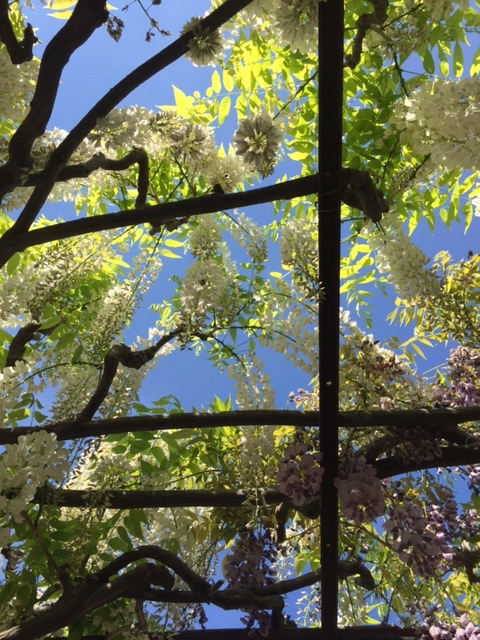
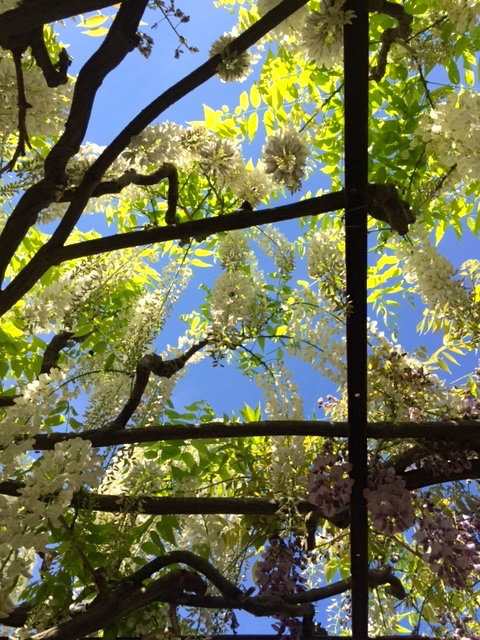
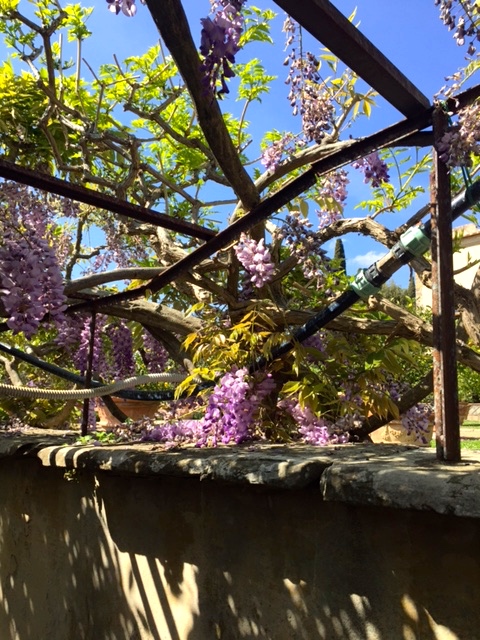
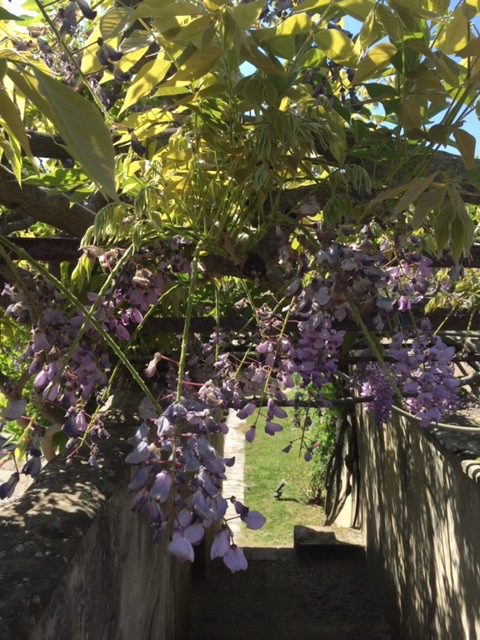
I have never seen anything more beautiful in my life than what I saw/experienced today in Settignano. The combination of elements was astounding: perfect weather, perfectly blue sky, warm sunshine, antique architecture and garden elements, gorgeous plantings of white and lavender colored wisteria. Add tranquility and birdsong. For me, it is the ideal combination of parts. It makes paradise.
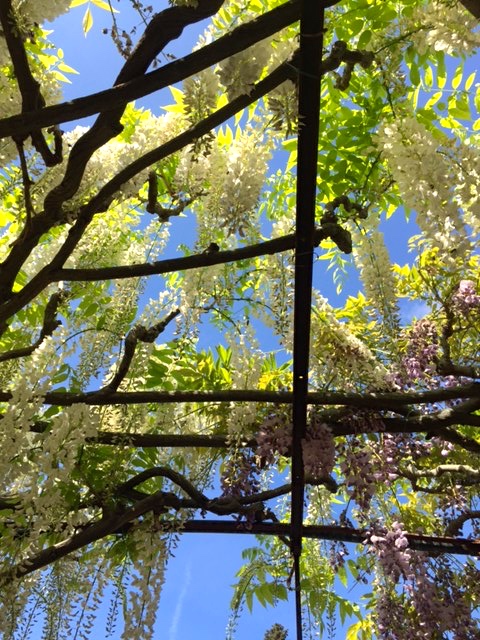
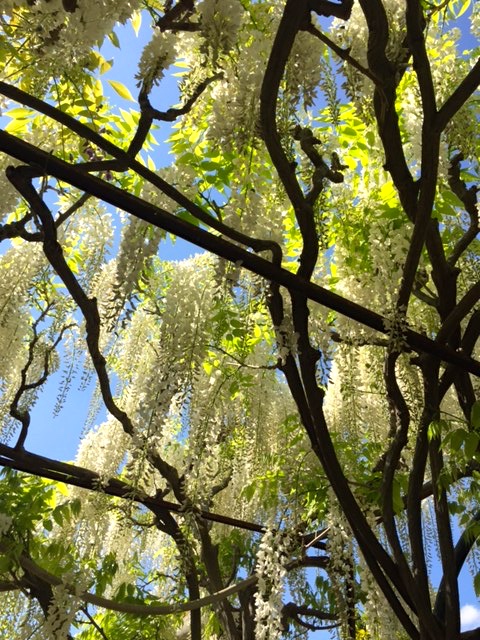
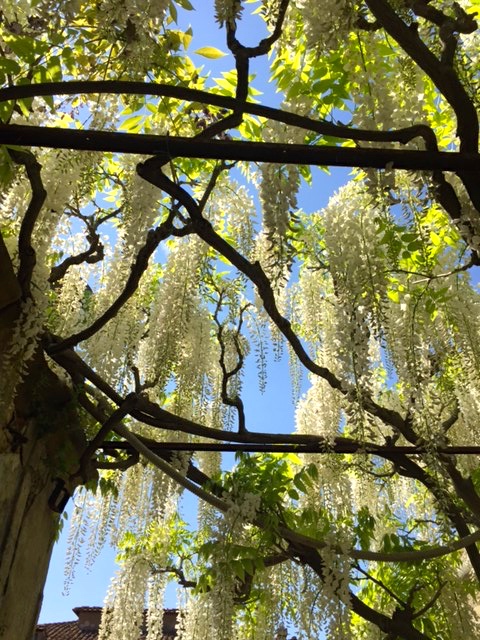
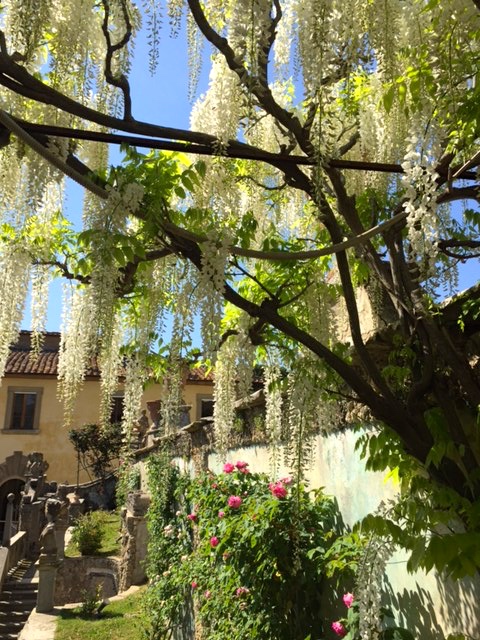

‘
I love the dark green and cream colored striped churches found throughout Tuscany!
This past weekend I went to Pistoia for the first time and look what I saw!
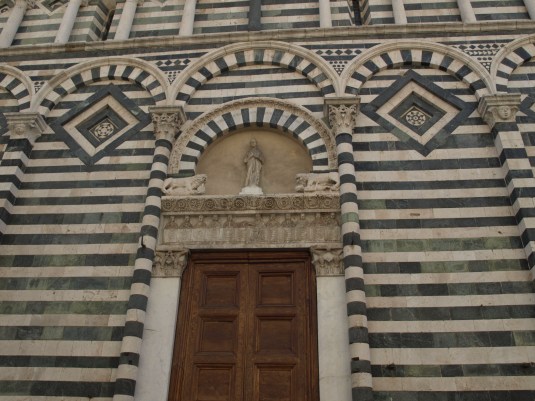
San Giovanni Fuoricivitas
Above and below, the Romanesque church of San Giovanni Fuoricivitas, (12th–14th century)
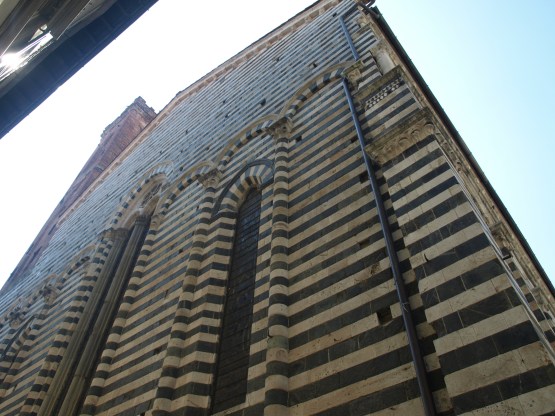
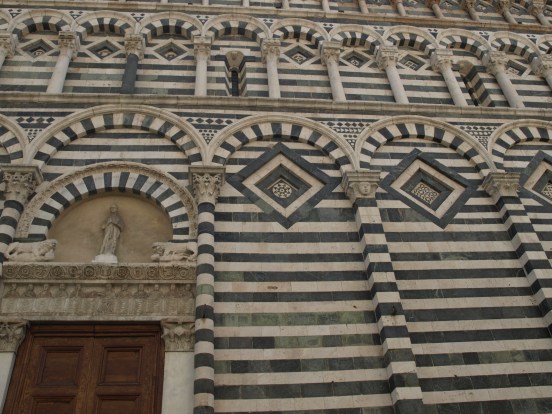
Then there is the Duomo and the beautiful 14th century Baptistry in the Piazza.
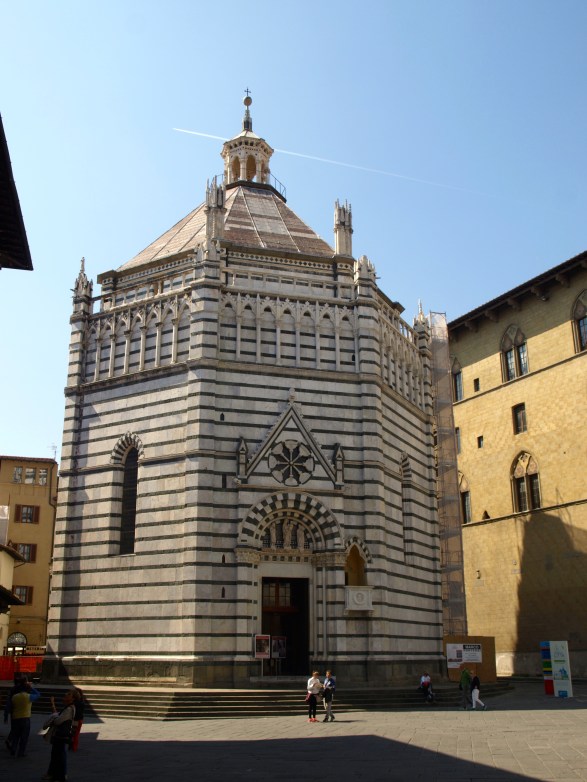
Baptistry, Pistoia
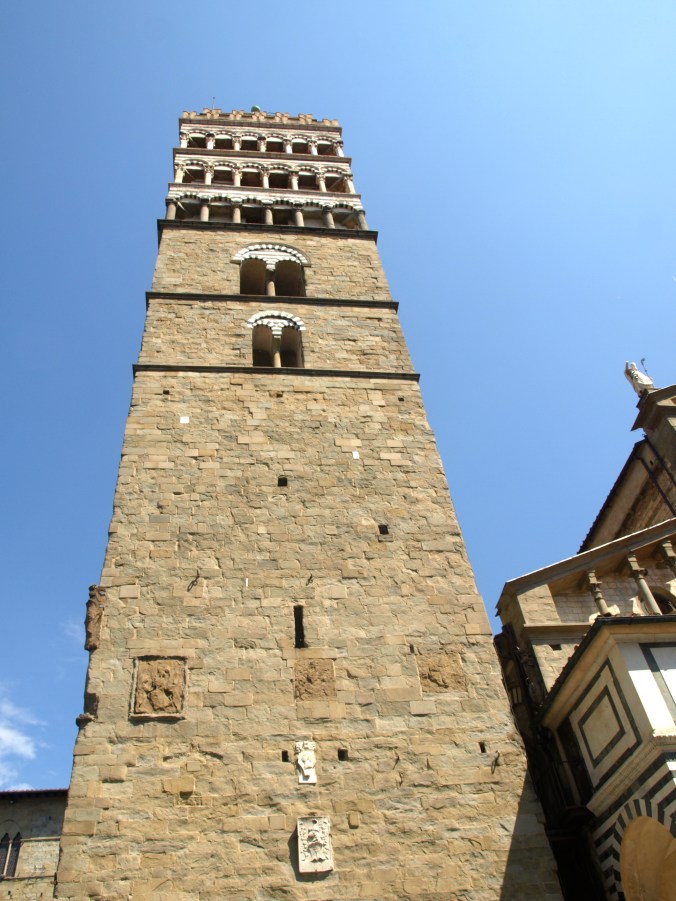
Across the Piazza del Duomo sits Il Duomo with its beautiful campanile.
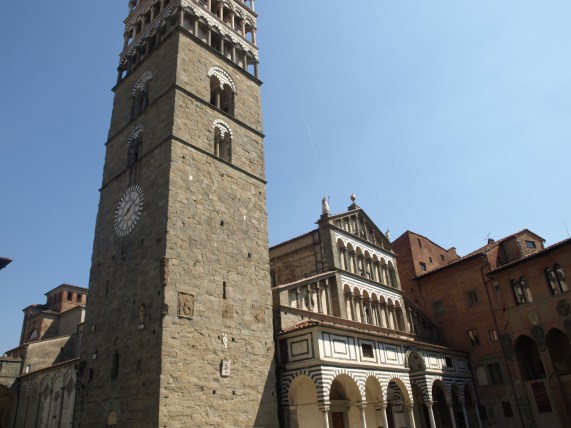
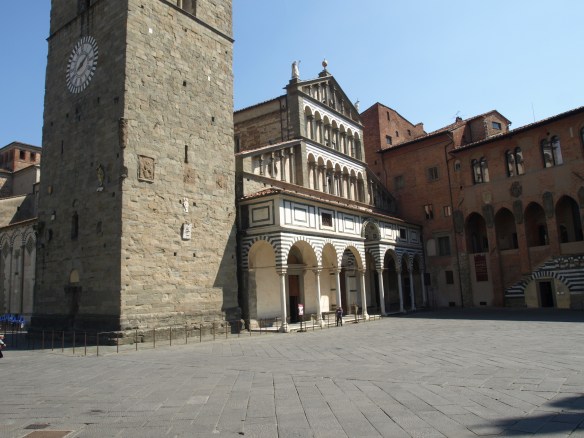
The Cathedral of San Zeno was started in the 5th century, but the building we see today took shape in the 12th century. While the facade is Romanesque, the duomo’s interior is all Baroque.
The iconic Romanesque campanile, standing at some 67 metres (220 ft), was erected over an ancient Lombard tower.
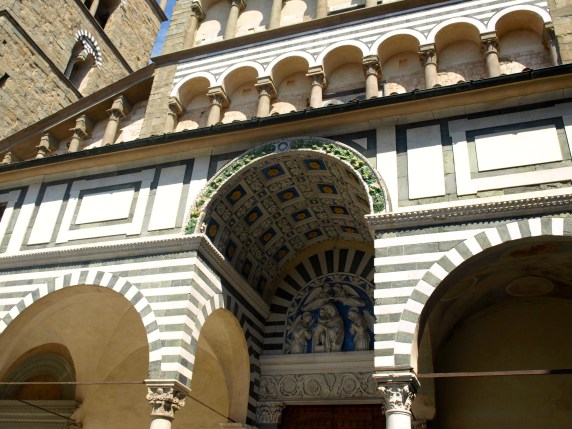
Andrea della Robbia designed the beautiful and prominent glazed ceramic sculptures over the central doorway.
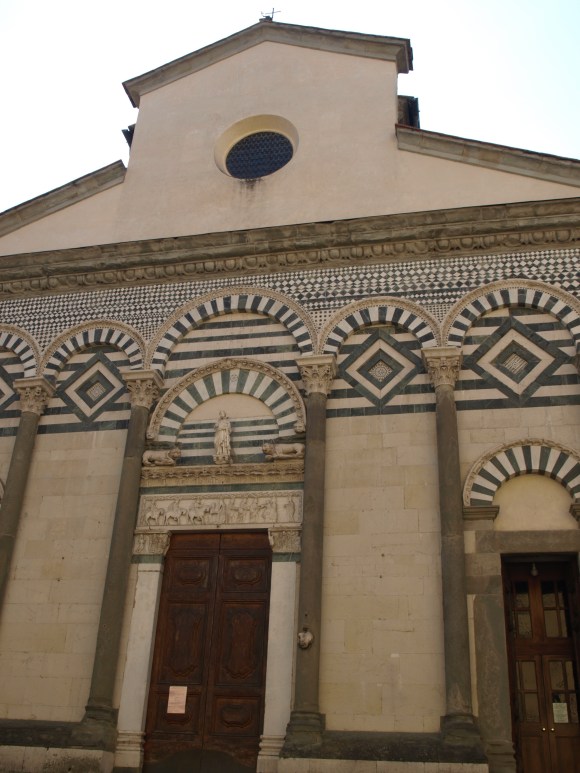
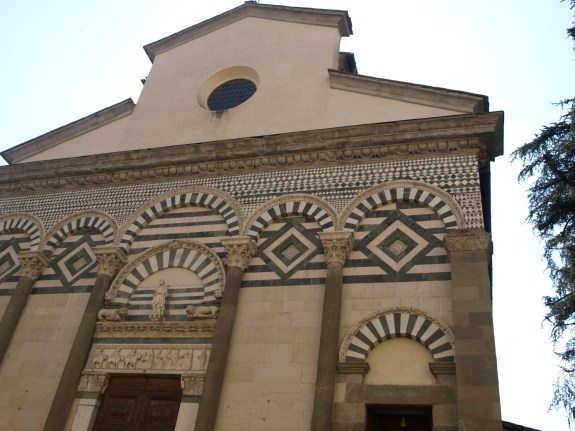
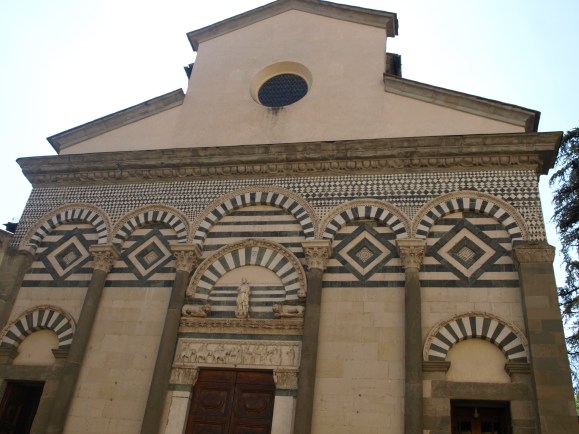
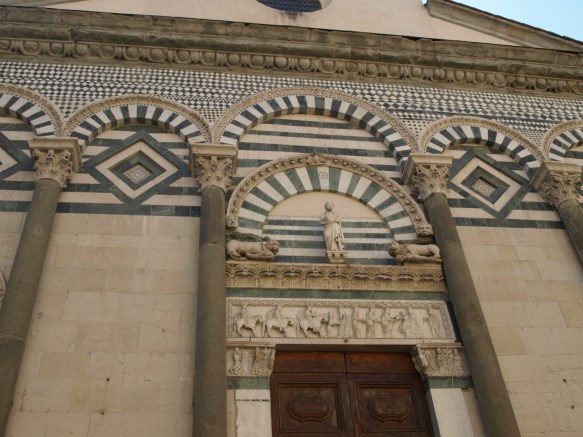
As you walk through the lovely, medieval city center, you run across several typical Tuscan Gothic/Romanesque churches. The one above is Sant’ Andrea. I’ll be writing more about it soon.

D. H. Lawrence began the period of voluntary exile after WWI that he referred to as his ‘savage pilgrimage’, a journey that took him to Sicily between 1920 and 1922. In ‘Sun’, a short story set in his sexually charged version of the Sicilian landscape, he returns again and again to images of citrus trees and their fruit, making Juliet, the angry and frustrated American heroine, meander naked through a ‘dark underworld of lemons’, discovering freedom and sensuality for the first time in her life.

Attlee, Helena (2015-01-05). The Land Where Lemons Grow: The Story of Italy and Its Citrus Fruit (Kindle Locations 56-59). Countryman Press. Kindle Edition.
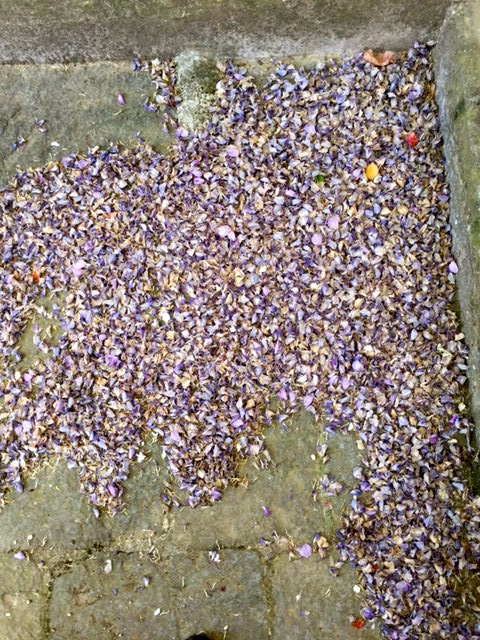
I swear, I didn’t even plan to write any more about wisteria this spring! I’ve kind of worn myself down with all its pale purple beauty.
And there I was, visiting an ancient museum and garden in Florence, and smack, I’m hit in the head with more wisteria beauty!
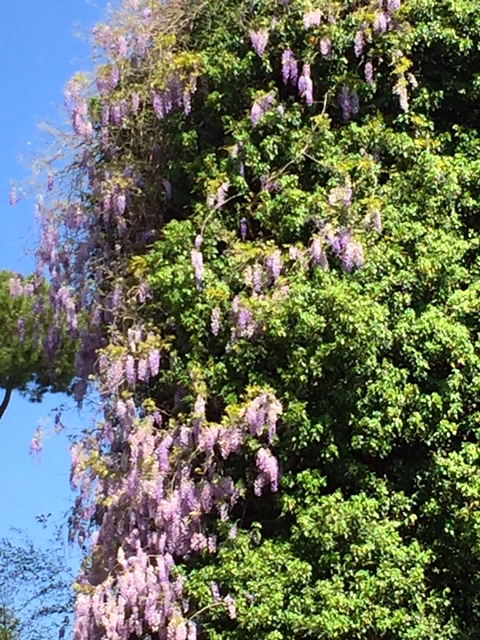
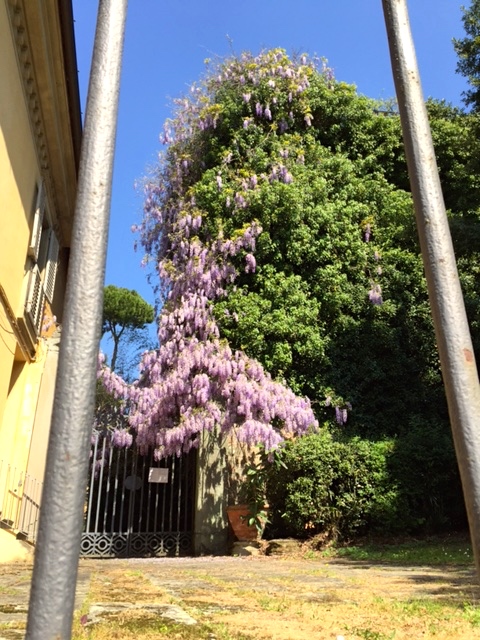
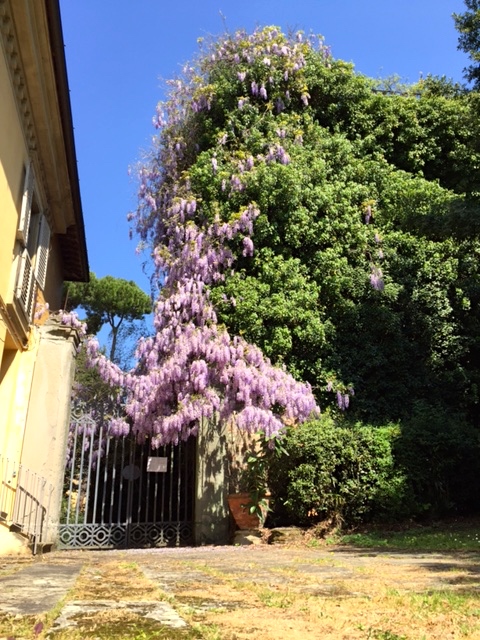
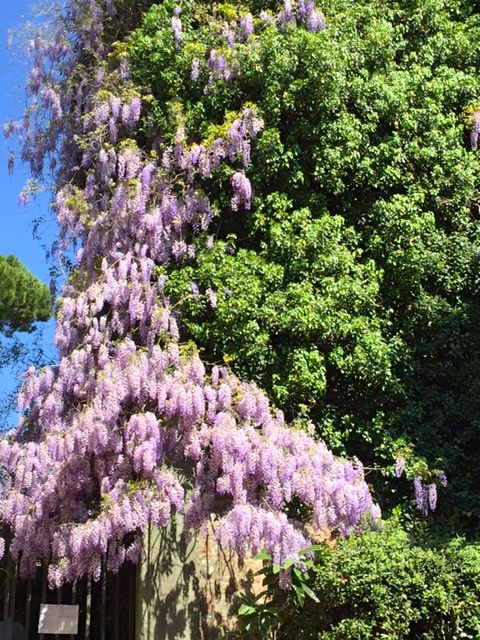
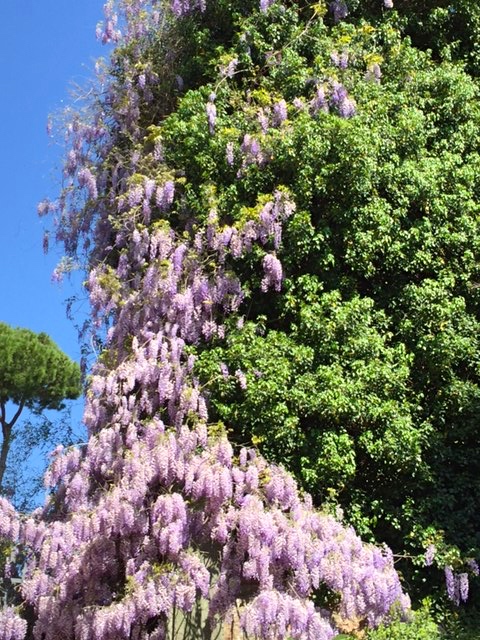
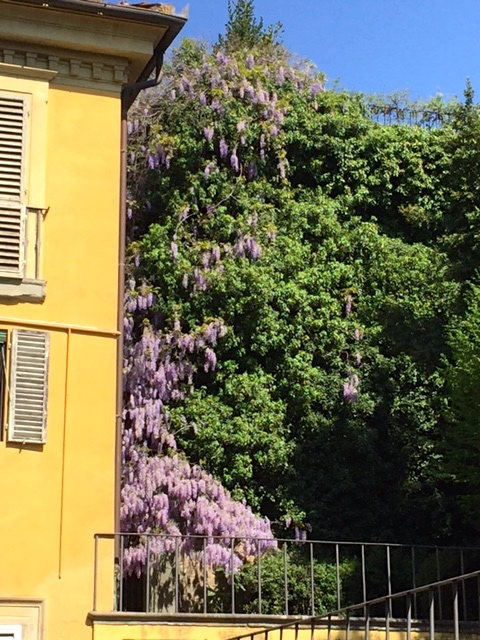
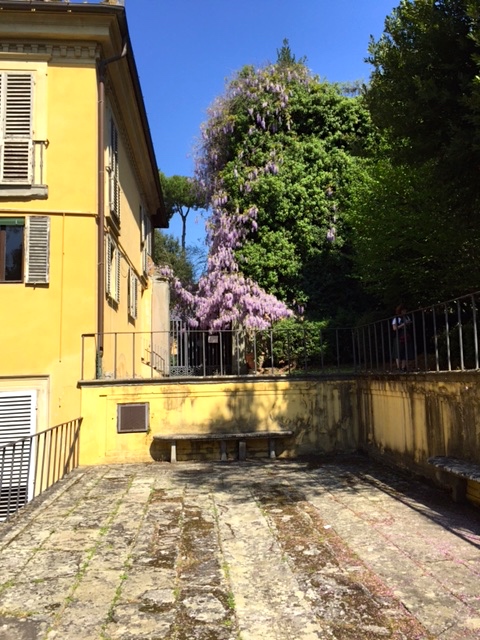
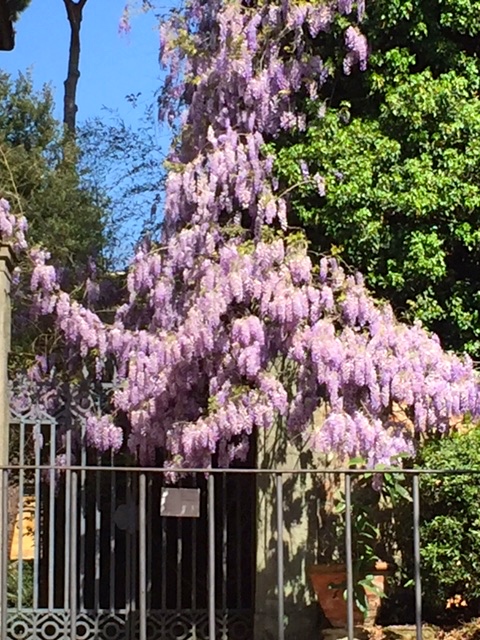
It’s everywhere in Florence and I adore it!


Hans Christian Andersen, the Danish author and poet best known for his fairytales, visited Italy in 1833, and when he saw citrus groves for the first time he responded with the mixture of rapture and envy that Italy can still provoke among visitors from colder and less romantic countries. He wrote to a friend:
“Just imagine the beautiful ocean and entire forests
with oranges and lemons,
the ground was covered with them; mignonettes and gillyflowers
grew like weeds.
My God, my God!
How unfairly we are
treated in the north; here, here is Paradise.”
Attlee, Helena (2015-01-05). The Land Where Lemons Grow: The Story of Italy and Its Citrus Fruit (Kindle Locations 47-48). Countryman Press. Kindle Edition.
 get back, lauretta!
You must be logged in to post a comment.