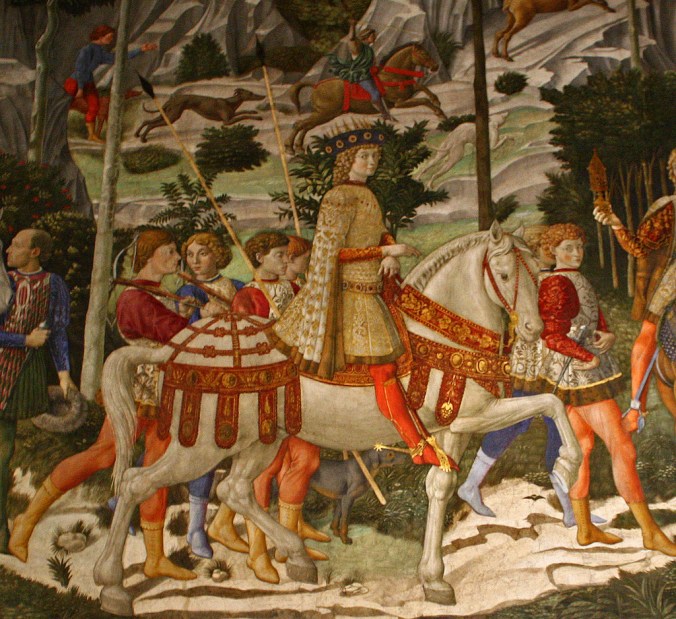
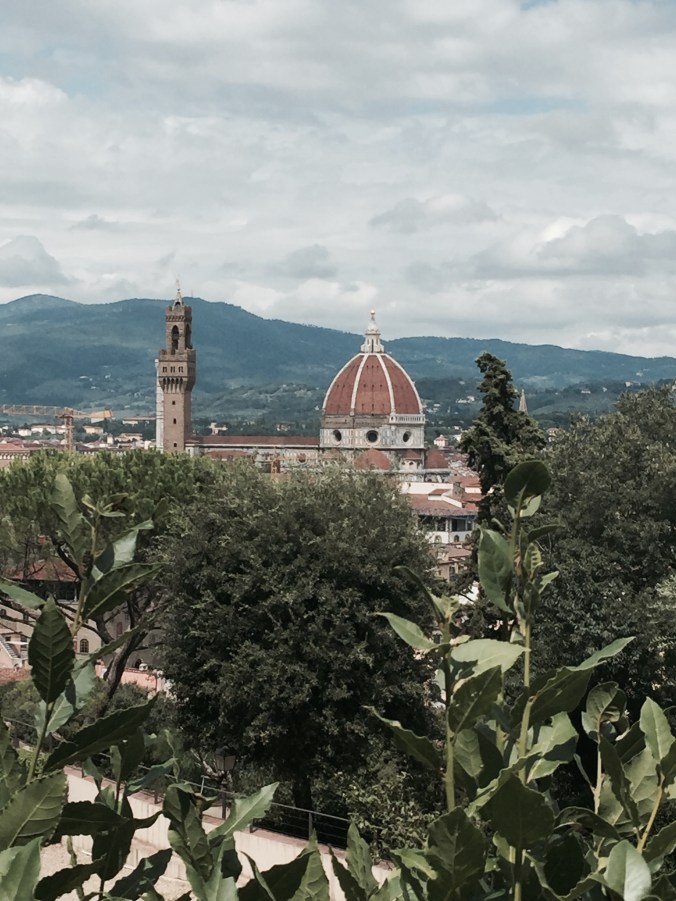
Daily life in Florence c. 1350

Another avenue into Florentine life in the mid 14th century (or any time period of course) is through the visual arts of the period. This is the reason I got mixed up with the history of art to begin with.  I’ve never regretted it.

22101887774_82dae1b520

The scene above is a detail from the fresco cycle by Andrea di Bonaiuto and his pupils in the Spanish Chapel at Santa Maria Novella. We can well imagine that this is how everyday Florentines dressed and behaved as they watch some spectacle taking place on the street below their home. I especially like the woman tending her pot of flowers; she’s my kind of girl.

How Florence became Florence: the year 1300

A huge topic, no question.

IMG_5558

But I like to think about it.  Here’s a woodcut of Florence, followed by a description of what the evolving city would have been like around 1300.  It starts to fire the imagination of Florence taking shape as the jewel it would soon become :

1

“Under the government of the Guelphs, Florence grew and prospered. All its main streets…had been paved…[under the leadership] of a Milanese Podesta, Rubaconte da Mandello….the city’s population…seems to have increased to about 45,000, considerably more than London’s and some eight times that of Oxford, even though the university there was by that time well established.

site_162696-4042

The city’s banking houses were making immense profits through their dealings with foreign powers, in particular with the Kings of France and Sicily and with the Pope;

e319e91427ce4e1fd7f9e6c3961315c8

The trade of the city was increasing in volume year by year. Merchants dealt in spices and dyes, hides and silks, sendal [a type of silk] and taffeta, gold brocades and braid, and above all in wool.

wp129d1d88_05_06


Vast quantities of woolen cloth and bales of raw wool were imported from northern Europe, mainly from France, the Low Countries, the Algarve, Spain, and by the end of the 13th century, from England.

The wool was refined and dyed in the numerous workshops of Florence, the finished bolts of cloth being sold through so many agents beyond Tuscany’s borders, in French fairs and English markets, Flemish towns and Mediterranean ports.  Pope Boniface VIII was to say that the Florentines had become a kind of 5th element: wherever earth, air, fire, water were to be found there were sure to be Florentines as well.

In all weathers flat-bottomed barges piled high with cloth could be seen drifting down towards Pisa on the Arno, whose waters–polluted with dyestuffs, tannin and rubbish, when not dried up–drove the workshop’s mills and filled the tanks in which the wool was washed and dyed.

images-5Screen-Shot-2013-11-03-at-4.27.51-PM

The dyes used were faster, and of purer, brighter color, than any to be found elsewhere in Europe.  Some were of local origin: yellow dyes came from the crocus fields near San Gimignano; but the ingredients for others had to be transported from far away, insects for cochineal from the shores of the Mediterranean, lichen for the red dye known as oracle from Majorca, cinnabar for vermilion from the Holy Land. The bitter juice of aloes which made th eyes fast came from Alexandria and the Levant.

spindle

Throughout the year thousands of ill-paid men [and women] were hard at work in the city’s shops, in wash-houses and stretching-sheds, as well as in their own cramped houses, undertaking the numerous processes through which the imported wool had to pass, the fulling, spinning and carding, the combing, weaving, stretching and trimming, as well as the washing and dyeing and drying.

images-2

images-4

images-3

Nor was it only textiles that left Florence by river or on the backs of pack-horses which made their slow way to the coast or ambled north across the Apennines to Venice for shipment to the ports of the eastern Mediterranean; grain was exported, too, oil and livestock, timber and the fine wines of Tuscany.

1954729_f520

In this commerce the banks of Florence played an essential part, not only in supplying capital and in the investment of money for their clients, but in all manner of other activities, including the ensuring of ships and cargoes. As inventors of double-entry bookkeeping and the forerunner of the cheque, and as creators of the gold floor, and lire, sold and denier, later the lsd of British capitalism, the Florentines were already regarded as the world’s leading experts in international commerce; and their banks had the reputation of being safer and more solid business houses than any others.”

The arts were flourishing in this bustling capital as well.  By about 1300, “the last of the magnificent mosaics, some by Florentines, some by a master mosaicist from Venice, had been finished.  Andrea Pisano, a sculptor from Pontedera, who was succeed Giotto as capomaestro of the Campanile, was commissioned by the rich Arte di Calimala to provide wax models from which the bronze doors for the south side of the Baptistery might be cast.

Here are the works: the mosaic masterpiece in the dome of the baptistery,  the South Doors of the same structure by Pisano, and the Campanile by Giotto.

mosaic


South_Doors_of_the_Florence_Baptistry

Campanile


Christopher Hibbert, Florence, the Biography of a City, (New York and London, 1993) pp. 23-4 and 49. Illustrations are from all over the internet.


Happy January 6th! aka the Epiphany. Let’s join a Medici celebration already in progress.

Hey there!  You!

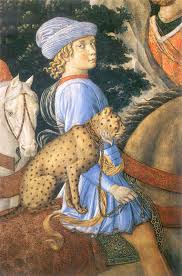
The handsome, confident guy in the blue cap!

Ciao bello!
images-7

Yes! You! I’m talking to you! The guy with the exotic leopard, riding on a horse. Which is not exactly something you see everyday of the week.

Remember me?  I’m your biggest fan.
images-7

Where are you going?  May I go with you?

Oh! how I love this fresco cycle of which the guy in blue is a part:  the Magi Chapel inside the Palazzo Medici in Florence!  I think these paintings are my very favorite of all time and that’s a big statement from one who loves art as much as I do.  I have very many favorites.
images-6

I mean, really, what’s not to love?!

4120085670_f57f902ba7_b

Sumptuous colors, incredible textures, fancy people and exotic animals, who cannot love these paintings?  The chapel is a dazzling tour de force, alive with color and movement.

But, before I get completely carried away with the sheer joy of these gorgeous images, let me discuss the celebrated moment depicted in the Magi Chapel.

The scenes take their subject matter from an event that happens every year on January 6. This is the date of the Christian festival celebrating the Epiphany, or the day when the wise men beheld the infant Jesus for the first time.

images-15

Also called Three Kings’ Day, this Christian feast day celebrates both the literal visit of the Christ child by the Magi but also the symbolic recognition of the physical manifestation of God the Son as human in Jesus Christ.  Put another way, Epiphany proclaims the revelation of Jesus to the Gentiles.  It’s a very big deal for Christianity, no doubt about it.  Like, the cornerstone.

The visit of the Magi, bringing their precious gifts of gold, frankincense and myrrh to the Holy Family near Bethlehem after the birth of Jesus was a favorite subject for painters of the Renaissance period in Italy.  One reason it was so popular, in my opinion, is that like the moment of the Annunciation in the Christian chronicle, the Adoration of the Magi captures one of the most hopeful moments of the story. There is so much pain and suffering in the Christian narrative, heaven knows it is nice to dwell on the occasions for gladness.

Depicting this scene gives any painter the perfect opportunity to use rich colors and scenery, and exotic luxury in general.  Since the 12th century, if not before, Florence has been known for its love for and production of luxury goods whether in wool, silk and dyes; hides and leather working; gold; spices; or painted images.  It seems a natural for Gozzoli to depict this happy, rich moment of the Christian story for the private chapel of the pre-eminent Florentine family.   And, as it turns out, the Medici family had a particular affinity for the Epiphany feast, as discussed below.

The lively frescoes are complimented in the chapel by the precious marble mosaic work flooring, which is divided by elaborate geometric design in extraordinary materials (porphyries, granites, etc.).  The chapel is further enhanced with an astonishing ceiling of inlaid wood, painted and generously gilded, attributed to Pagno di Lapo Portigiano. Finally, the elaborate wooden stalls that furnish the chapel were designed by Giuliano da Sangallo. It is clear that no expense was spared in creating this suite of designs.

3_97

Magi_01

To begin our tour of this jewel box chapel fresco cycle, let’s have a look at a couple overall photos. The chapel is not huge but it is pretty hard to photograph as a unity. Nevertheless, let’s take a stab at it.
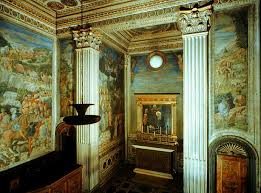
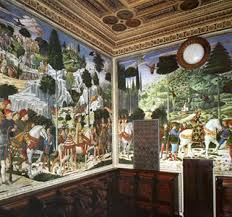
images-10

images-5

While not perfect, at least the 2 photos above give you a sense of the magnificent room.  It is one of the glories of the Renaissance period and one of the surviving in situ masterpieces of Florence.
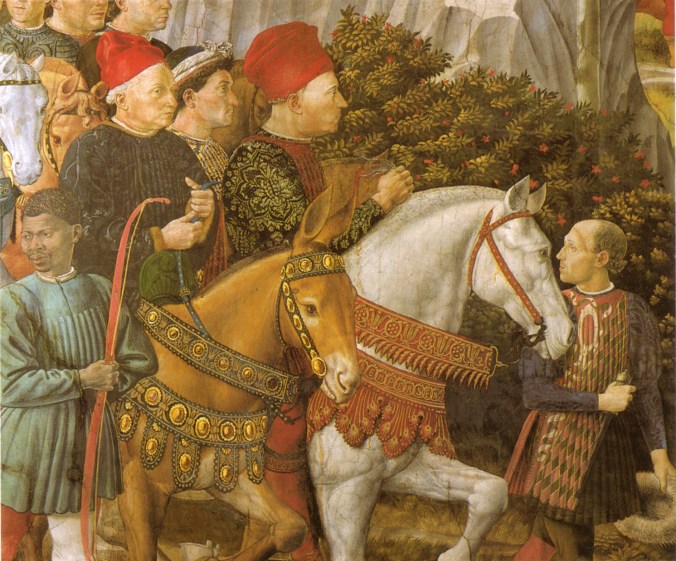
Benozzo_Gozzoli,_cappella_dei_magi,_parete_est_(dettaglio)

The Magi Chapel was begun around 1449-50 and probably finished in 1459 as the private family chapel inside the Palazzo Medici-Riccardi in Florence, designed by famed Renaissance architect Michelozzo di Bartolomeo.  The exterior of the palazzo looks like this.

palazzo-medici-riccardi-exterior

Although there were public churches near the palace, and ones for which the Medici family were patrons, it was customary for wealthy families to have private chapels inside their homes.  In fact it is not unusual for any religious household to have a space to celebrate their gods inside their home, no matter how humble.

Three of the chapel’s walls are almost completely covered by this famous fresco cycle by Renaissance master Benozzo Gozzoli (1421-97). Gozzoli painted the cycle between 1459 and 1463. The Journey of the Magi to Bethlehem is depicted in three large large sections, each one showing the procession of one of the three Magi.
images-10

Let’s begin with the apse wall: An apse contains the centerpiece of any chapel, as it does here as well. The framed altarpiece in the apse is by Fra Filippo Lippi: The Adoration of the Christ Child. Painted specifically for this location, the original is now in Berlin, while a copy by a follower of Lippi hangs in the Magi Chapel. The copy is attributed to Pseudo Pier Francesco Fiorentino, a follower of Lippi, and the painting  was restored in 1992.

The image below is the original Lippi painting.

543px-Fra_Filippo_Lippi_002

Here’s how the apse looks from front on.  It is designed to be the place where one kneels to pray and worship.

images-7

450px-Palazzo_medici_riccardi,_cappella_dei_magi,_scarsella

The sides walls of the apse as above are painted with saints and angels in adoration.  It is possible to see the influence of his master, Fra Angelico, in Gozzoli’s painting style.  These personages are arranged so as to be looking at the Lippi altarpiece, the same as we the viewers do.

This host of angels are gorgeously painted in rich colors with a luxurious application of plenty of gold.

Benozzo-Gozzoli-Procession-of-the-Magi-detail-

BEN70612

B.Gozzoli, Engel / Pal.Medici-Ricc. 1459 - B.Gozzoli, Angel / Pal.Medici-Ricc. 1459 -

Benozzo_Gozzoli_001

The Medici family were, of course, the de facto rulers of the ostensibly republican Florence, and among the greatest art patrons of any era. Books have been written on their influence on the Renaissance, particularly as patrons of all of the arts.

The family had a particular interest in paintings that depicted the Adoration of the Magi, the moment when the Three Kings, led by a miraculous star, discovered the Christ child. As we have said, this event signified the recognition of the holy infant by the secular world and was celebrated in the feast of the Epiphany (from the Greek, meaning “to manifest”).

We know that the city of Florence had mounted an Epiphany festival on January 6 at least since 1390, the date of the earliest surviving record of it. The elaborate pageant, in which men reenacted the journey of the Magi through the streets of the city, must have looked much like the colorful throng that winds through Gozzoli’s fresco cycle.

By 1417, the festival was directed by a lay confraternity, the Compagnia de’ Magi, with funds donated by the Medici. Male members of the Medici family participated in the procession, which passed in front of their famous palace on Via Largo and began and ended at the church of San Marco, headquarters of the confraternity and an important recipient of Medici munificence. Cosimo de Medici even had an image of the Adoration of the Magi in his private room within the monastery of San Marco.

Incidentally, the Procession of the Magi is enacted in Florence today as well.  You can read about it here: http://www.theflorentine.net/articles/article-view.asp?issuetocId=9709

So important was the Epiphany to the Medici family, Lorenzo de Medici even changed his birthdate!  He was born on January 1, which already seems pretty auspicious, but he decided to change his birthday to January 6 to coincide with the Epiphany feast date. Here’s a portrait of Lorenzo as an adult.  I guess when you are a Medici, an earthly prince,  you can change your birthdate as desired.  Lorenzo did.

It is worth remembering that January 1 didn’t have the significance in the period that it does today.  The Florentine calendar treated March 25 as the first day of a new year.  March 25 was the feast day of the Annunciation.  So, I guess being born on Jan. 1 wasn’t that big of a whoop to begin with.  Why not switch to Jan. 6 if you were Lorenzo?  Then maybe everybody would remember your birthday?  Am I projecting too much?

220px-Lorenzo_de_Medici2

There’s no doubt about it: the Medici’s identified with the story of the Adoration of the Magi on the feast of the Epiphany.

Let’s begin our tour of the Gozzoli procession.

Caspar, the youngest Magus, leads the entourage on his beautiful white horse. Caspar is surrounded by a group of young Florentine attendants.
images-5 We see Caspar on the left wall here.

4120085670_f57f902ba7_b

Benozzo_Gozzoli,_lorenzo_il_magnifico,_cappella_dei_Magi

Although this figure has sometimes been identified as a portrait of Lorenzo il Magnifico, who was born in 1449 and so was still a boy when the fresco was completed, most scholars believe Lorenzo is more likely included as another figure, as discussed below.

Behind Caspar, to his left, are the contemporary head of the family, Piero the Gouty, wearing a red cap and seated on a white horse and devout family founder Cosimo in a dark blue shirt riding on a humble brown mule.

Cappella-dei-Magi

Here’s a composite photograph of the entire fresco cycle. It is difficult to study the images without being in the chapel itself. We have begun our look at the paintings on the far left and are moving from left to right.

big-image-of-the-procession

Behind the portraits of Piero and Cosimo, directly to the left of the standing black attendant, are portraits of Sigismondo Pandolfo Malatesta and Galeazzo Maria Sforza, respectively lords of Rimini and Milan, who were often guests of the Medici in Florence.  These men are atop the brown and white horses that face the viewer directly.
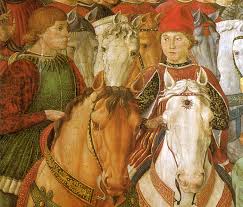
images-9

Behind in the middle ground is a crowded procession of illustrious Florentines, including such as the humanists Marsilio Ficino and the Pulci brothers, the members of the Art Guilds and even the artist, Benozzo, himself. The painter looks out at the viewer and can be recognized for the scroll on his red hat, which reads “Opus Benotii.” It is one of the great artist’s signatures on a work of art in the history of the world.

Gozzoli, Zug der Koenige, Gefolge - Gozzoli, Procession of Magi, Entourage - Gozzoli, Benozzo , 1420-1497.

Picture A above.

benozzo

The self-portrait of the artist himself is marked #14 on the key below Picture B.

Little Lorenzo il Magnifico is the boy marked #7 ; Lorenzo’s elder brother Giuliano is next to him at #8.

The following picture is Picture B, notated with numbers to identify the various illustrious contemporary personages included in Benozzo’s painting.  To see the actual faces, consult Picture A above.

identificazione_1-2
Picture B above.

Key to Picture B:

1 – Cosimo il Vecchio de’ Medici
2 – Piero il Gottoso de’ Medici
3 – Carlo di Cosimo de’ Medici
4 – Galeazzo Maria Sforza
5 – Sigismondo Pandolfo Malatesta
6 – Cosimino di Giovanni di Cosimo de’ Medici (?)
7 – Lorenzo di Piero de’ Medici detto il Magnifico
8 – Giuliano di Piero de’ Medici
9 – Gentile Becchi, precettore di Lorenzo e Giuliano
10 – Giuliano di Piero de’ Medici

11 – allora fattore nella filiale del banco Medici a Roma
12 – Giovanni di Cosimo de’ Medici(?)
13 – Benozzo Gozzoli
14 – Pope Pio II Piccolomini


identificazione_4-3

Picture C above

Key to Picture C:
15 – Benozzo Gozzoli (?),2nd self-portrait

16 – Neri di Gino Capponi (?) (1388-1457):

17 – Bernardo Giugni (?) (+1466)

18 – Francesco Sassetti (?) (1420-1490)

19 – Agnolo Tani (?)

20 – Dietisalvi Neroni (?) (1401-1482)
21 – Roberto di Niccolò Martelli (?) (1408-post 1469)

22 – Benozzo Gozzoli (?), 3rd self portrait

23 – Luca Pitti (?) (1398-1472)

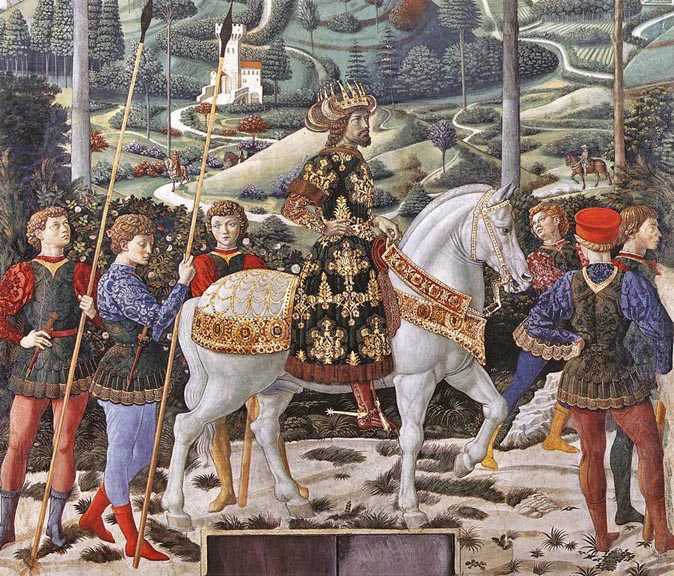
Bearded Balthasar, the middle Magus, rides a white horse on the south wall. He is portrayed with the same facial features as Byzantine emperor John VIII Palaiologos.
GozzoliRicardiProcessionMiddleKing1460

4bec163021411e511fb05f2901dcf12c

Melchior, the oldest Magus, is depicted riding on the west wall.

153w9si-4

Traditionally, his features have been read as those of Joseph, Patriarch of Constantinople, who died in Florence; but they could also be those of Sigismund, Holy Roman Emperor, who helped end the Great Schism by convoking the Council of Constance in 1414. Like Cosimo, he is shown as a peacemaker riding on a humble (this time white) mule.

He is preceded by a page in blue with a leopard on his horse – although he leads the entire procession, no real world identity for this handsome, confident figure has ever been established. Ciao bello!  You’re the one that I love!
images-7


giul

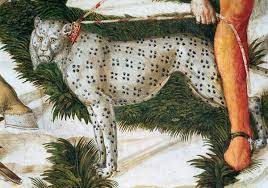
Rather than depict the topography in and around the actual Bethlehem, Gozzoli instead portrayed rich Tuscan landscapes.  As the Three Kings approach Bethelem, they are accompanied by their respective entourages as if they are participating in a noble hunting party with falcons and including exotic felines just for a measure of excess.

GozzoliRicardiProcessionMiddleKing1460

What a divine way to celebrate the Epiphany!  I think I might change my birthday to January 6 myself. I want to be like Lorenzo.

Nah, I can’t do that, even if Lorenzo and I do share the same root word as the stem of our first (Christian) names.*

I can never be a Medici, as much as I might wish it.  Maybe in my next life.


**LAURA f  Feminine form of the Late Latin name Laurus, which meant “laurel”. This meaning was favourable, since in ancient Rome the leaves of laurel trees were used to create victors’ garlands. It was also the name of the subject of poems by the 14th-century Italian poet Petrarch. As an English name, Laura has been used since the 13th century.  LAURETTA f
Italian diminutive of LAURA http://www.behindthename.com/names/usage/italian/2
LORENZO m Italian, Spanish
Italian and Spanish form of Laurentius (see LAURENCE (1)). Lorenzo de’ Medici, known as the Magnificent, was a ruler of Florence during the Renaissance. He was also a great patron of the arts who employed Leonardo da Vinci, Michelangelo, Botticelli and other famous artists. http://www.behindthename.com/names/usage/italian/2

La Befana is her name and gifts for children are her game.

Just as in the USA, where Santa Claus brings gifts for good children on Christmas Eve…

images-5

Italy has a similar tradition.  Only the gifts arrive on Epiphany Eve, which is January 5.  And instead of Santa Claus, the gifts are delivered by an old and ugly woman who rides a broom.  La Befana is her name.


images-6


In popular folklore La Befana visits all the children of Italy on the eve of the Feast of the Epiphany to fill their shoes with candy and presents if they have been good good, or a lump of coal (or dark candy) if they have been bad.

Here’s a fun video to give you the flavor of the celebration:


I love one of the stories about La Befana and how she happens to be in the habit of delivering gifts to children on Epiphany Eve.

According to Italian folklore, La Befena was visited by the three Magi as they made their way to see the Christ Child.  They even invited her to go with them, but she said she couldn’t go because she had too much work to do.  Her work was house cleaning, especially sweeping the floors.

Later La Befana was filled with regret when she realized the magnitude of the event she had missed with her protestations of busy-ness (there is a lesson here all you busy people).  Her response was to bring candy and sweets to all the good children and she does this once a year as a sort of penance for having missed the big event of seeing the baby Jesus with the Magi.

Italian families will often leave out a small glass of wine and a few treats for La Befana to eat before she leaves their home, having dropped off her gifts for the children in the house.

La Befana is usually portrayed as an old lady riding a broomstick through the air wearing a black shawl and is covered in soot because she enters the children’s houses through the chimney. She is often smiling and carries a bag or hamper filled with candy, gifts, or both.

I do hope La Befana leaves you a little something on Epiphany Eve, especially if Santa Claus forgot you for some reason!

Buona Befana a tutti!


Giotto, the Italian version of Crayola

My art historian colleagues know that Giotto is a very appropriate and sophisticated name for a crayon product in Italy, or any other place on earth for that matter, named for the historic person, Giotto (1266/7 –  1337), who is considered to be the first in the line of the amazing artists who transformed the history of painting into the Italian Renaissance.


IMG_6442

So, when walking through a grocery or other inexpensive store in Italy, my eye is always drawn to the children’s art products bearing the Giotto name.  These items never fail to make me smile.

IMG_6451

If you look a little closer on the packaging, you’ll notice this little vignette of two men, one sketching a sheep on a rock, in front of a tree.

IMG_6452

I don’t know how many schoolchildren in Italy appreciate the vignette’s significance, but I’m going to wager that most art teachers there get the reference.

Cognoscenti know well the story of Giotto’s life, including the moment his artistic genius was recognized.  In his famous book, Lives of the Artists, Giorgio Vasari, the first art historian, relates that Giotto was a happy and intelligent child,  loved by all who knew him, and one day the great Florentine painter, Cimabue, literally stumbled across Giotto drawing pictures of his sheep on a rock. The pictures were so lifelike that Cimabue asked Giotto’s father if he could take the boy as an apprentice. The rest, as we say, is history.

So the Fila company uses that crucial moment of Giotto’s genius as their trademark image on all of their children’s art products.

IMG_6450

I think that’s pretty sweet!  Don’t you?


Where have I been?

Thank you to my many followers who’ve asked where I have been!  I’ve been absent from my blog because…

I have spent the last five weeks since I returned from my 3 month sojourn to Italy trying to get back to Italy asap.  I’ve got a bad case of Italy fever and it just never lets up!  It’s a great fever to have and I can’t wait to get back.

But before I can return, there are many hoops I must jump through.  I am really tired from all the jumping I’ve been doing!

Image result for jumping through hoops

I borrowed the image above from Google images (thank you Google), but think of me as the woman with the glasses and briefcase jumping through the hoop held by the barefooted woman who in this case represents the Italian government.

What you don’t see is how hard it is to first of all figure out where the hoops are located!  And then once a hoop is located, there are all kinds of complications before you can even think about jumping through it!  Here’s an image to help you visualize how I’ve been spending the past 5 weeks.

hoops

Another blogger has written a post that covers some of my issues.  If you want to go to Italy for longer than three months, here’s a great place to start to understand the process:

http://italyproject365.com/?s=8+things+you+should+know

I’ll be back subito, I promise!

pink hoops

Happiness, part 2.

Yes, yes, of course Michelangelo’s David is a masterpiece!

Image result for david by michelangelo

Certo, certo.

And yes, Botticelli’s La Primavera is a miracle.

botticelli

Si, si, ragazzi.

And Ferragamo designed fabulously gorgeous shoes.

ferragamo 4

E vero!  Si, si, si.

But, to me today, there is nothing more beautiful than this lovely item.

OLYMPUS DIGITAL CAMERA

With an Italy-compatible power cord for il mio computer, the world is my oyster!

Well, almost anyway.

OLYMPUS DIGITAL CAMERA

Do you see that spot of light?  It is sent from heaven I am sure.  Do you hear the angels singing?  Ditto.

At any rate, this cord has made me very very very happy! :-))))))))))

The 1,000,001st use for olive oil

IMG_3493 IMG_3494

When your baby (Apple laptop) needs the power cord held in a certain position in order to charge!!

Wow, it doesn’t take long to develop a personal relationship with your computer.  And it takes even less time to become acutely aware of the loss of your partner (i.e. computer).

I’ve been kind of running on borrowed time for a while now with my Apple power cord.  I’ve been relying on it everyday, several times a day, sometimes for a long period of time in each use.  That’s every single day for almost 3 months.  The computer has outlasted the cord by a long shot, tg.

I’ve had the flu or a cold or some minor illness for weeks and yesterday wasn’t a good day.  It was pouring rain outdoors as well.  So I thought it was a good day to write (need computer), read a novel and some other print material (need computer), watch some video (film or tv, need computer), or, if I got bored, clean out my photograph files (need computer).  I hate to be obsessive, but did I mention that I needed my computer for all of these projects? Well, I did need it so it bears repeating.

I could tell that my power cord was fraying at the end with the magnetic plug.  So, I started searching for a replacement all around town.

Now, if  you read my blog, you are already familiar with my dissertation on the scarcity of material goods in direct relationship to perceived need of same material goods. In other words, I’ve already ranted about how hard it is to find that relatively special item you need when you are living in Italy.  It doesn’t matter what the special item is, what category it fits, or anything else.  You simply need an item and you are in Italy and the fun is about to begin.

The more you need said item, the harder you will look for it, and consequently, the more rare it becomes.  It’s simple and it’s logical.

So, as I’ve been going about my business while minding my own business but quizzing every person with whom I have any conversation (be it the grocer, the cobbler, the schoolmate [yes, I have schoolmates at my age :-)) ] or a new friend, I’ve gathered intelligence on where to buy replacement Apple power cords.  And here is my finding.  You can’t get there from here.

Before sojourning to bell’ italia several months ago, I obsessively obsessed about what to do if my laptop crashed, or lost a file that I needed, or some other such issue.  Just outside of Florence, where I’d be living while in Europe, there is an Apple store.  Hooray!  My Seattle MacGeniuses and I obsessed together for months before I left as to whether someone at the Florence Apple store would speak English if I made the trip to it. I will say this in praise of Apple stores: they are a pain in the neck to be in but their guides are pretty empathetic by and large.  Your obsession becomes their obsession, at least for the 55 minutes you are working one on one with them.  It makes you feel really heard. Said sarcastically.

And, like any material goods that you covet or actually need in Italy, the Apple store is within sight but unreachable without a lot of expense, time, energy, or any combination thereof. And when you get there, it will be closed for restoration.  Ha ha.

I seem to spend a lot of time falling down rabbit holes. But, I will say this, if you’ve gotta fly through a rabbit hole, there aren’t any prettier than in Italy.  I still maintain that philosophy and I hope I always will. :-))

I want to add something else which is that I planned to study Italian in Italy.  I’d already been studying it for a few months and hoped to become independently independent, relying only on my own Italian and not a go between of some kind while I was living in Italy.

But even I have managed expectations when it comes to explaining technical electronic problems.  I can barely express my issues in English and I doubt I will live long enough–even if I live 100 more years–to express my electronic issues in italiano.  I just don’t think its gonna happen any time soon and thus I really wanted to know that in Italy I could find an English speaker at the Apple store outside of Florence.

We all know that wishing for something is fine as long as you know its a wish and it may not be met.  And that’s what happened with ascertaining that an English speaking genius would be available for me at the Florence Apple Store.  Because after weeks of inquiring and sending and forwarding emails, Seattle Apple reported to me that Florence Apple could not guarantee an English speaking genius.  They could guarantee special assistance if I were blind or deaf, they said, but only if I made advance reservations.  Va bene, good to know.And could we just take a moment to reflect on the irony of Seattle Apple needing weeks and weeks to communicate with Florence Apple about English?  Doesn’t the internet exist for immediacy? You know, like immediate answers and gratification? Or is it just me? Or is it just this particular rabbit hole that started on the West Coast of the US of A and ended in Tuscany? Somehow I just don’t think this is what Steve Jobs or even Bill Gates had in mind when they changed our lives.

OK, so yesterday, raining, cold, dark, sick, sick of being sick, bored, watched some movies, watched some tv, wrote a little, noticed my power was declining on my laptop, screwed around for an hour or more trying different combinations of adapters and converters because at this point I have about 20 options not to mention as many outlets or more in my apartment.  And all this while–and I am no electrician and I jump when a prosecco cork is released so you can imagine how I react when sparks fly noisily from an outlet–I am for some unknowable reason reasoning that it is the power source that is the issue, but not my power cord.

Which is already upside down because as I’ve said I’ve been noticing my power cord was fraying for weeks and I’ve been looking for a replacement. So I don’t know why yesterday I didn’t presume that was the issue at the get go.  Hell no.  That would have been way too easy and no fun at all.

So, I leaned back and thought I’d better enjoy this movie while I can and so I did until the power ran out.  I was operating with a bit of magical thinking which isn’t like me at all.

And it was 10 pm last evening when I hit the panic button because I realized that I had no fricking way to charge my computer.  I got out every damn cord I’ve been lugging around for 3 months: camera cords, iphone cords, you name it cords, and thinking really hard about how you can transfer power from one device to another, which is hilarious if you know me.  Because I can no more understand a computer power cord than I can explain how a car engine works.  And I’m no dummy.

Tortelli lucchese

Any foods prepared in Lucca, Italy are automatically known as “lucchese.”
Makes sense, right?
totelli
 I’ve discovered to my absolute delight that one of the most well-known and delicious primi piatti on many menus in Lucca is special type of meat ravioli. What sets this pasta apart immediately is that has a very bright yellow color, for, as it turns out, it is made with eggs and flour. Typically, pasta in Tuscany isn’t made with eggs; such pastas are more common up north, the traditionally wealthier section of Italy.
But, this lovely pasta fresca is rolled, cut in circles, and stuffed with a mixture of meats often including beef and pork, and served with a meat ragu.

Then there is the whole discussion of ragu. The most popular and widely used sauce in all of Italy is simply known as ragu. Most foreigners think of ragu as a tomato-based sauce, but it is actually a meat-based sauce, with only a small amount of tomato sauce or paste added.

Ragu is usually served with pasta. It often begins with a soffritto, or chopped onions, celery, carrots, and typical seasonings of salt and pepper. Minced beef is added, browned and then the sauce is simmered slowly for several hours to let all the flavors marry, as they say.  I’ve always thought that was a weird use of the word marry, but what do I know?

Italian cuisine is famous for its simplicity and variety with cheese and wine as major components of every Italian food recipe. It is also known for its pasta of different shapes, lengths, and widths and sauces with different ingredients.

Compared to other sauces it is thicker and made creamier by adding milk at the later stage of cooking. It has several different versions, and lamb, poultry, fish, veal, or pork can be used instead of ground beef. Other spices like chilies, peppers, beans, tarragon, and cumin can also be added.

Ragu alla Barese is prepared using horse meat; Ragu alla Napoletana has a lot of tomatoes and uses red wine; Ragu alla Bolognese uses white wine and fewer tomatoes. Ragu alla Bolognese or Bolognese sauce is the most popular version of ragu.

Bolognese sauce originated in Bologna, Italy and dates back to the 15th century. It is a pasta sauce that is meat based and contains a small amount of tomato sauce. It is traditionally served with tagliatelle, green lasagna, and other wide-shaped pasta instead of spaghetti pasta because the sauce holds up better with wider pasta.

Its ingredients include beef, soffritto, pancetta, onions, tomato paste, meat broth, white wine, and cream or milk. Like all other food preparations, Bolognese sauce has different variations. Pork, chicken, veal, rabbit, goose, and other meats can be used instead of beef.

The soffritto is made with celery, carrots, and onions cooked in butter or olive oil. Mushrooms, ham, and sausage are also added together with milk or cream to add more flavors and give it more creaminess. It is usually simmered for at least five hours.