Uncategorized
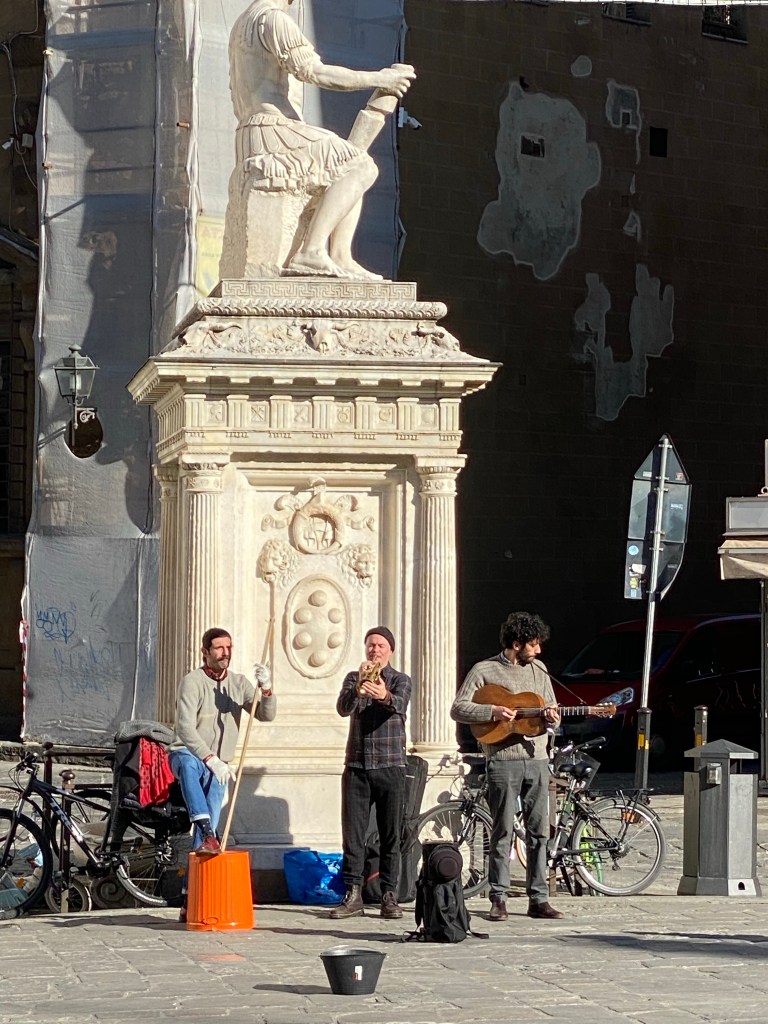
Piazza di San Lorenzo, Florence. What a day!
Sunny, warm January day in a major Florentine piazza! What could be better? Even the buskers were great!
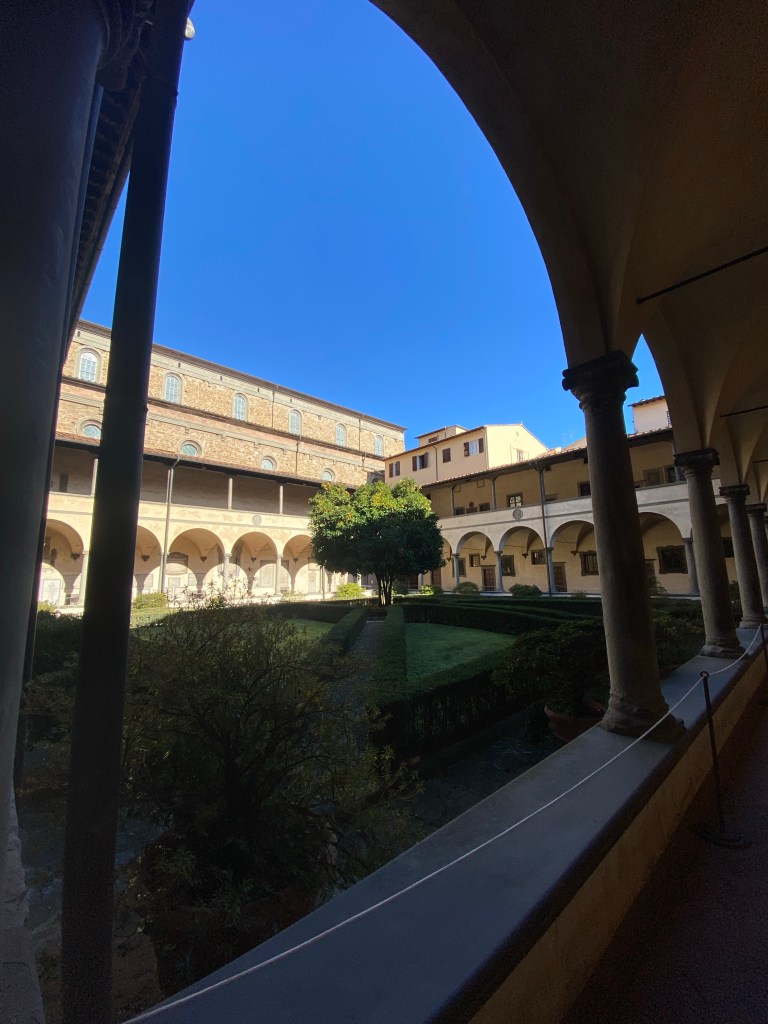
The two San Lorenzo cloisters on a gorgeous January afternoon
The first, main cloister of the basilica of San Lorenzo in Florence.
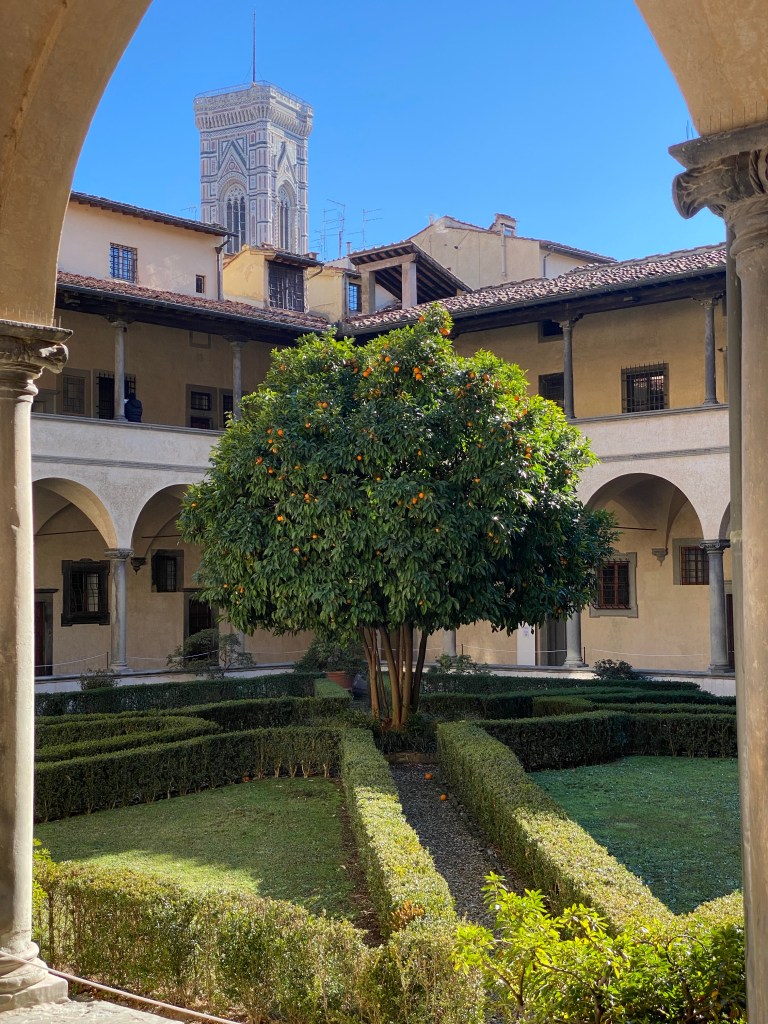
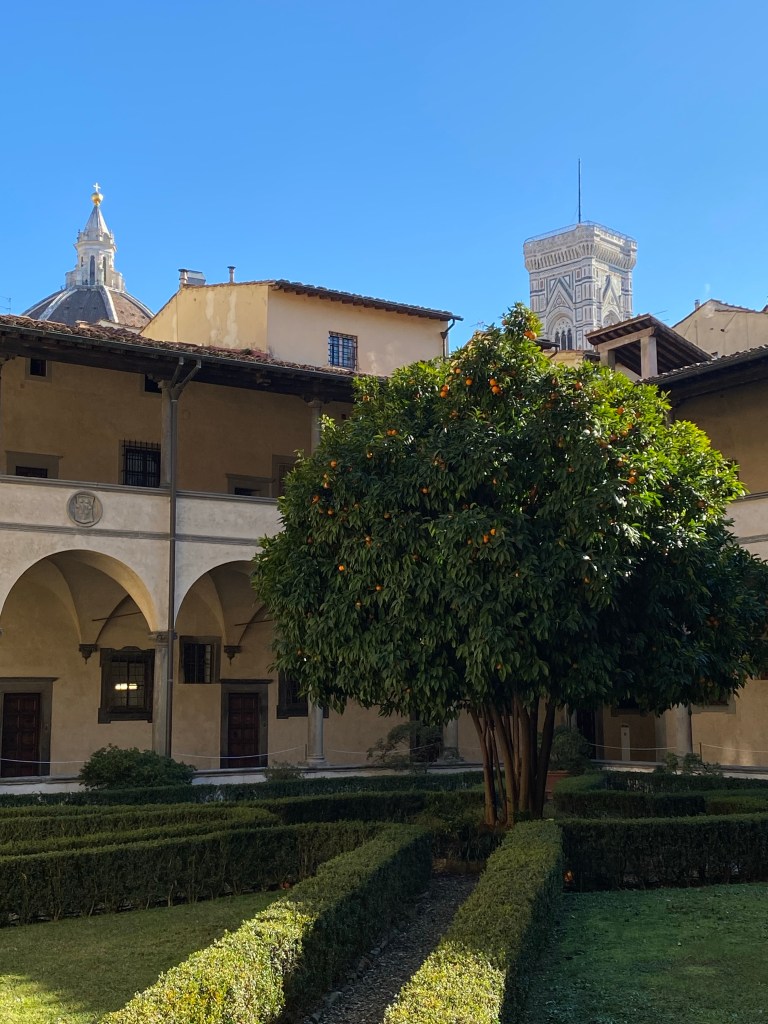
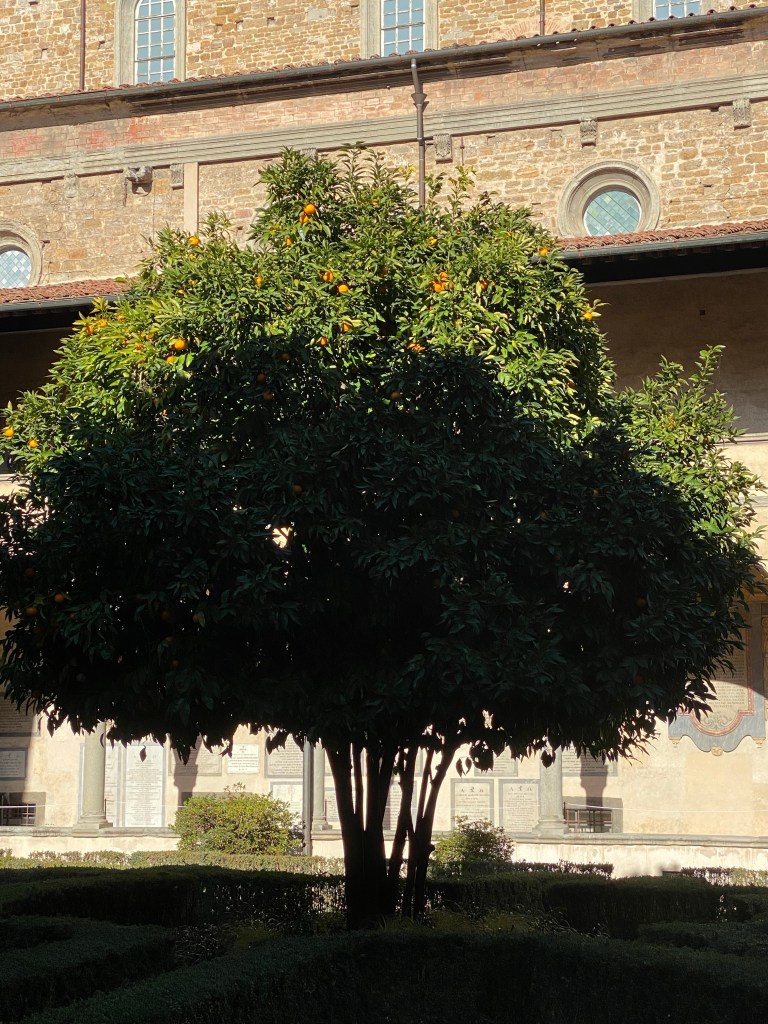
The 2nd, smaller cloister.
Orvieto duomo frescoes: Luca Signorelli’s masterworks
frescoes by Luca Signorelli in the Cappella di San Brizio
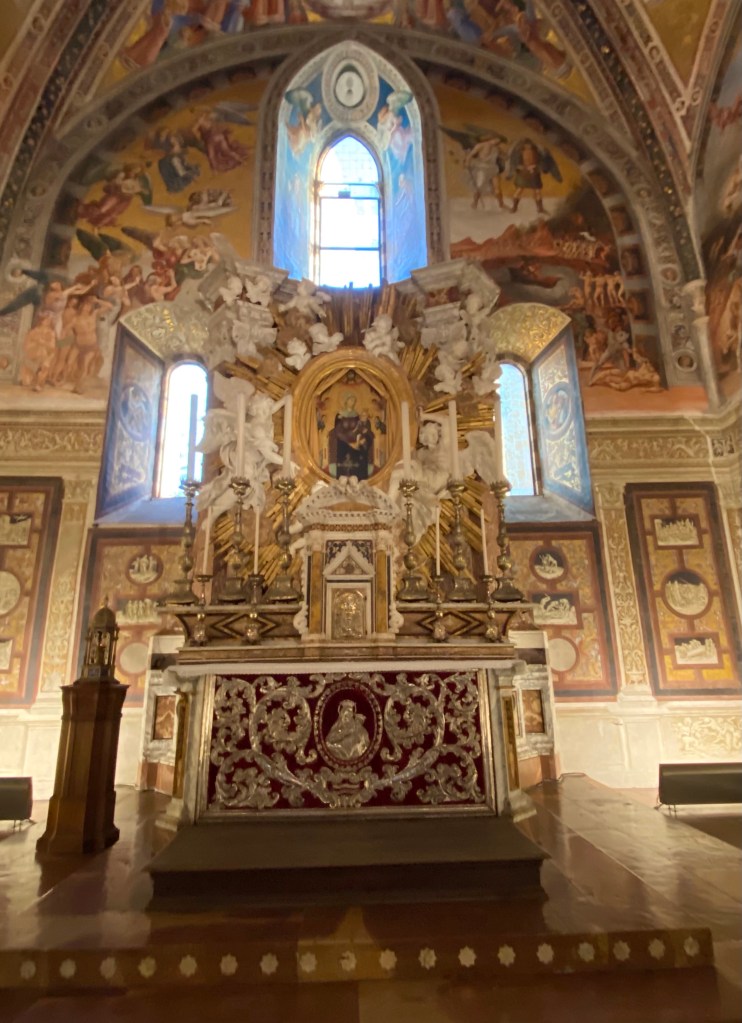
In the Chapel of the Madonna di San Brizio are some of the finest frescoes extant in Italy. They were created by Luca Signorelli in the 1490s.
Partial view on the vault – Christ in Judgment by Fra Angelico and Benozzo Gozzoli; other frescoes by Luca Signorelli and his school
‘
Self-portrait of Luca Signorelli (left) with Fra Angelico.

Christ and the Doubting Thomas
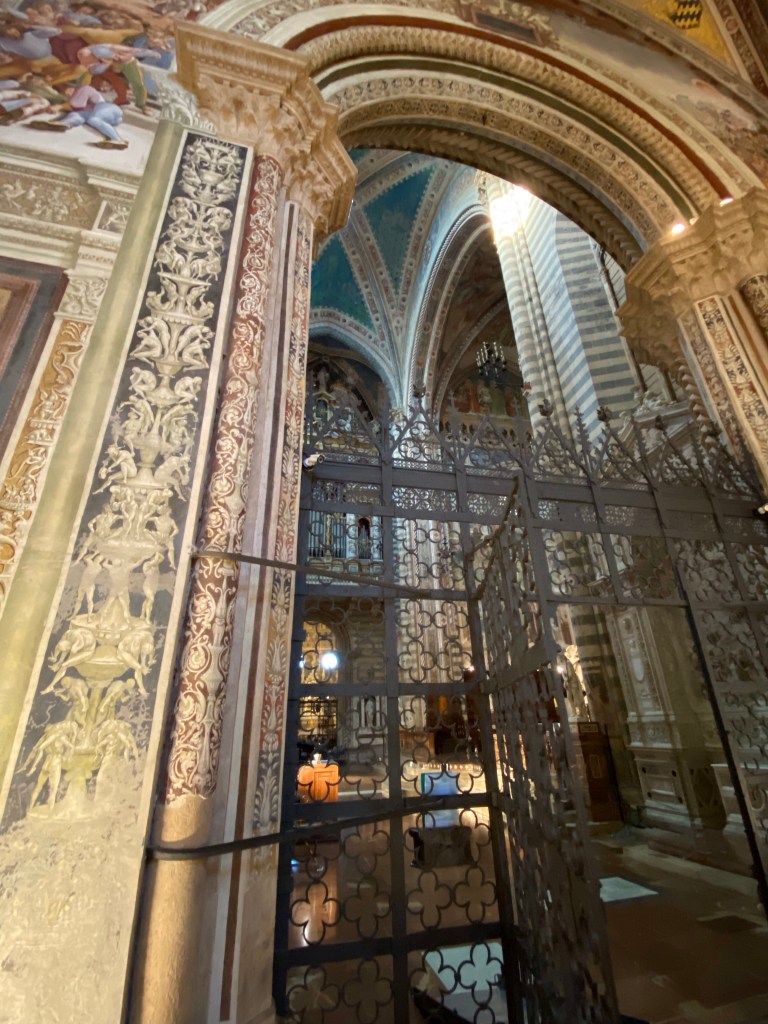
This chapel was a fifteenth-century addition to the cathedral. It is almost identical in structure to the Chapel of the Corporal. The construction of this chapel was started in 1408 and completed in 1444. It is closed off from the rest of the cathedral by two wrought iron gates. The first one closes off the right arm of the transept. It was signed by the Sienese master Conte di lello Orlandi (1337). The second gate stands at the entrance of the chapel and is of a much later date. It was signed by master Gismondo da Orvieto (1516).
Originally called the Cappella Nuova, in 1622 this chapel was dedicated to Saint Britius (San Brizio), one of the first bishops of Spoleto and Foligno, who evangelized the people of Orvieto.
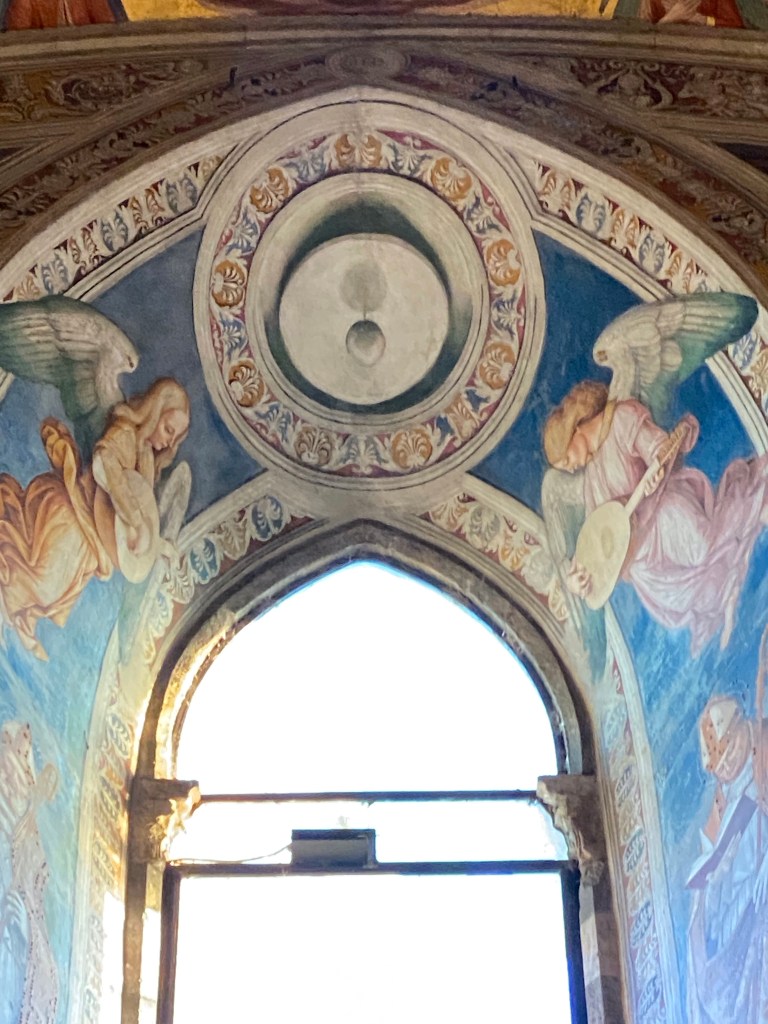
Fra Angelico and Benozzo Gozzoli began the decoration of the vault of the chapel in 1447. They painted only two sections: Christ in Judgment and Angels and Prophets as they were summoned in the same year to the Vatican by Pope Nicholas V to paint the Niccoline Chapel.
Work came to a halt until Perugino was approached in 1489. However, he never began.
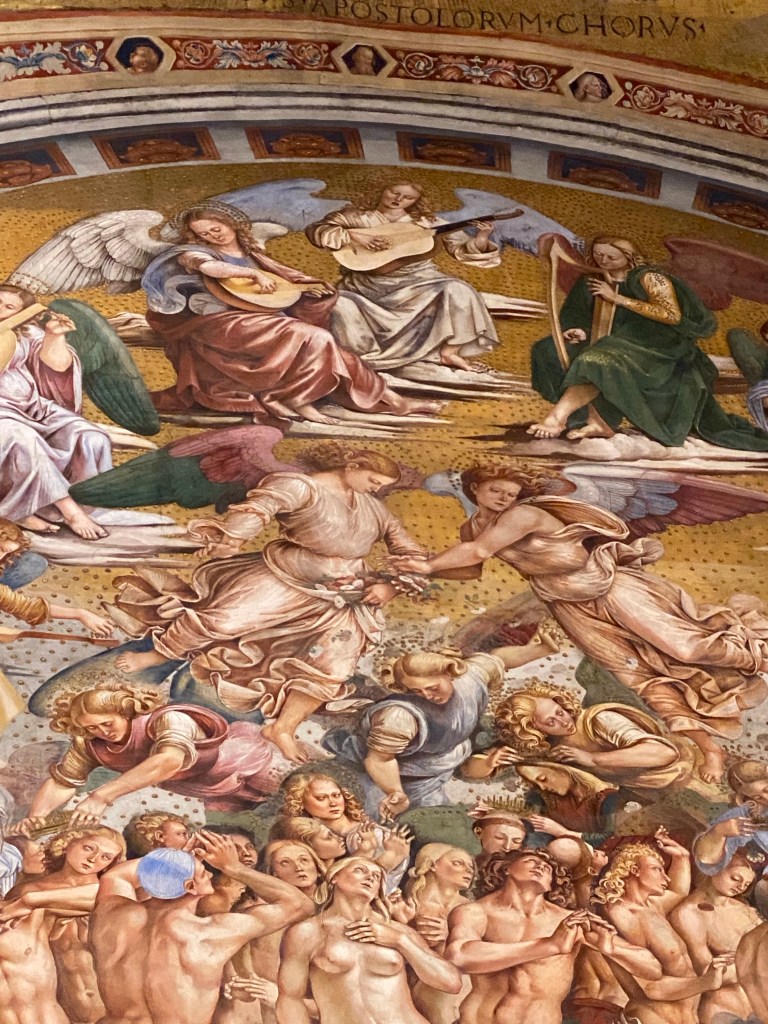
After being abandoned for about 50 years, the decoration of the rest of the vault was awarded to Luca Signorelli on 5 April 1499. He added the scenes with the Choir of the Apostles, of the Doctors, of the Martyrs, Virgins and Patriarchs.
His work pleased the board and they assigned him to paint frescoes in the large lunettes of the walls of the chapel. Work began in 1500 and was completed in 1503. These frescoes in the chapel are considered to be Signorelli’s masterpieces. He and his school spent two years creating a series of frescoes concerning the Apocalypse and the Last Judgment, starting with the Preaching of the Antichrist, continuing with tumultuous episodes of the End of the World, finding a counterpart in the Resurrection of the Flesh. The fourth scene is a frightening depiction of the Damned taken to Hell and received by Demons. On the wall behind the altar, Signorelli depicts on the left side the Elect being led to Paradise and on the right side the Reprobates driven to Hell. He added to these expressive scenes some striking details.
The Preaching of the Antichrist was painted shortly after the trial on charges of heresy and execution of the Observant Dominican friar, Giralamo Savonarola in Florence on 23 May 1498. The Antichirst is depicted under the influence of the incarnated angel named Satan who suggests him what to say, while touching his rib cage. The analogy of the Antichrist sowing discord by preaching slander and calumny, would not have been lost on late 15th-century viewers. To underscore the contemporary analogy, at lower right, Signorelli includes recognizable portraits of the young Raphael, in a striking pose; Dante; possibly Christopher Columbus; Boccaccio; Petrarch; and Cesare Borgia, and, on the left, he depicts himself, dressed in noble garments, and Fra Angelico, in his Dominican habit.
In the left background the Antichrist is expelled from heavens by the archangel Michael, and his acolytes killed by a rain of fire. In the right background he depicts a large, domed temple in the Renaissance style.
The End of the World is painted over the arch of the entrance to the chapel. Signorelli paints frightening scenes as cities collapse in ruins and people flee under darkened skies. On the right side below he shows the Sibyl with her book of prophesies, and King David with raised hand predicting the end of the world. In the left corner below, people are scrambling and lying in diverse positions on the ground, producing an illusion as if falling out of the painting. This successful attempt in foreshortening was striking in its day.
The Resurrection of the Flesh is a study by Signorelli, exploring the possibilities of the male and female nude, while trying to recreate a three-dimensional setting. Signorelli shows his mastery in depicting the many positions of the human body. The risen, brought back to life, are crawling in an extreme effort from under the earth and are received by two angels in the sky blowing on a trumpet.
The Damned are taken to Hell and received by Demons is in stark contrast to the previous one. Signorelli has gone to the extremes of his fantasy and evocative powers to portray his cataclysmic vision of the horrible fate, the agony and the despair of the damned. He uses the naked human body as his only expressive element, showing the isolated bodies entangling each other, merging in a convoluted mass. They are overpowered by demons in near-human form, depicted in colours of every shade of decomposing flesh. Above them, a flying demon transports a woman. This is probably a depiction of the Whore of the Apocalypse.
The Elect in Paradise shows the elect in ecstasy looking up to music-making angels. The few extant drawings, made in preparation for this fresco, are kept in the Uffizi in Florence. They show each figure in various positions, indicating that Signorelli must have used real models in the nude to portray his figures.
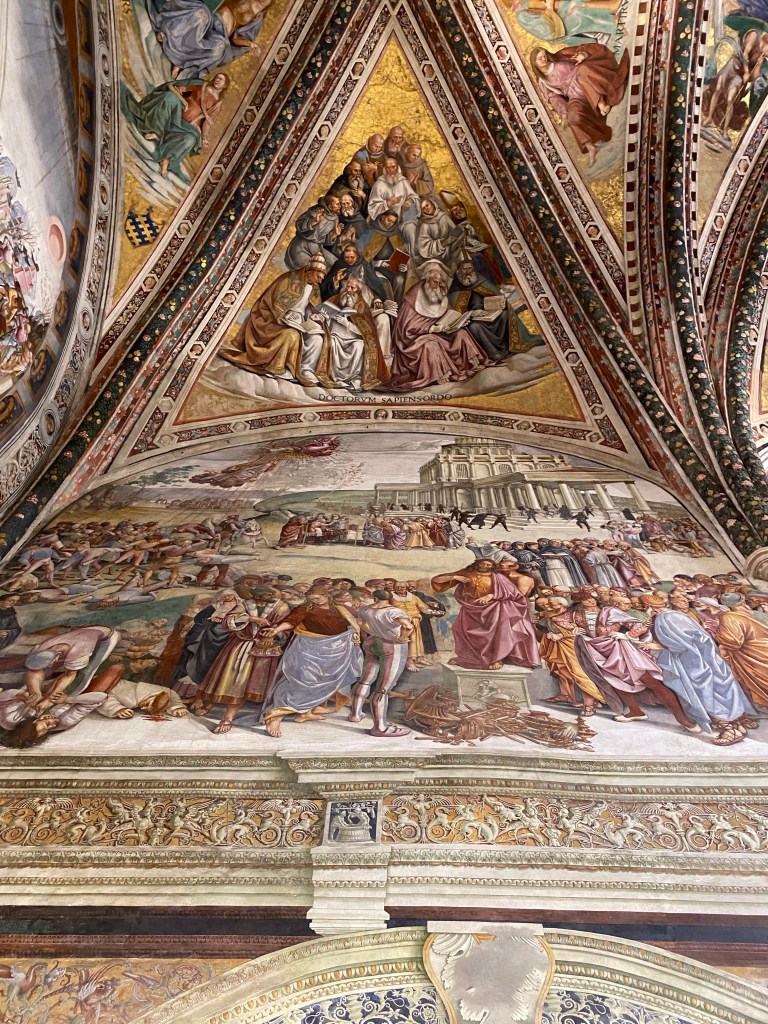
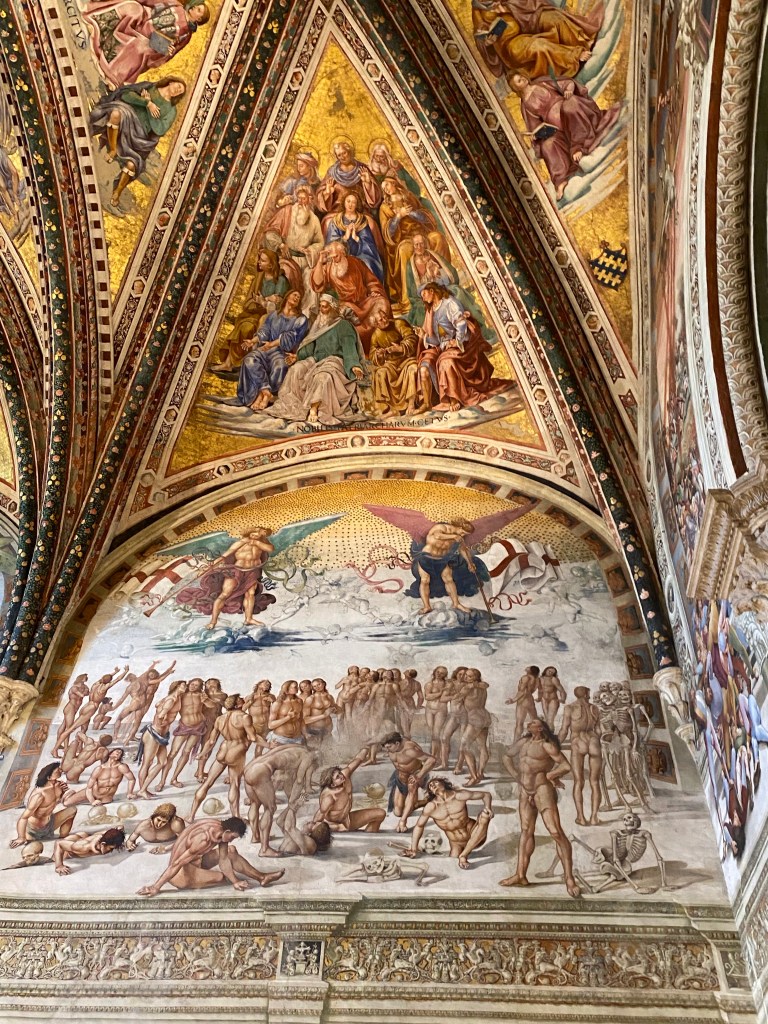
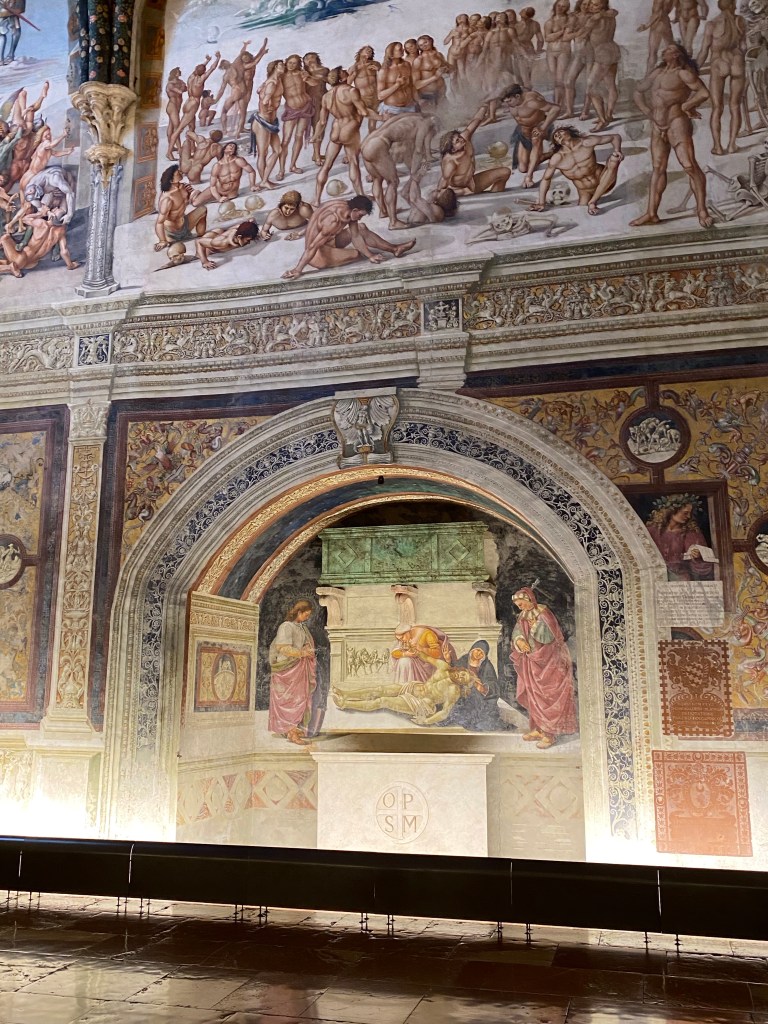
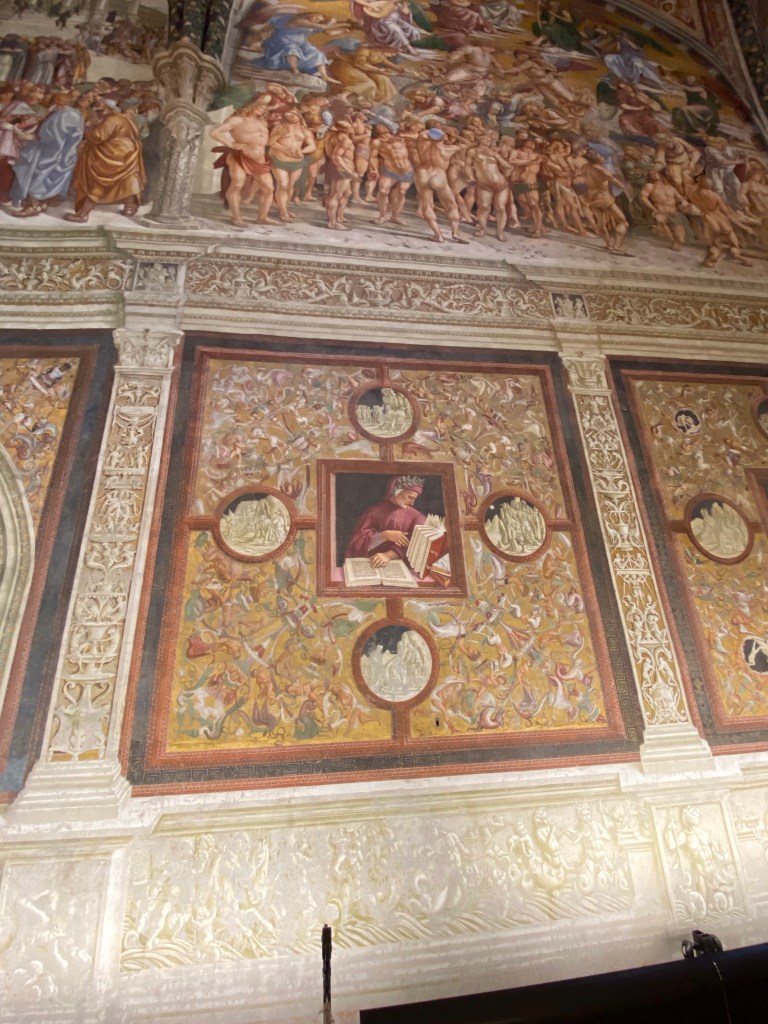
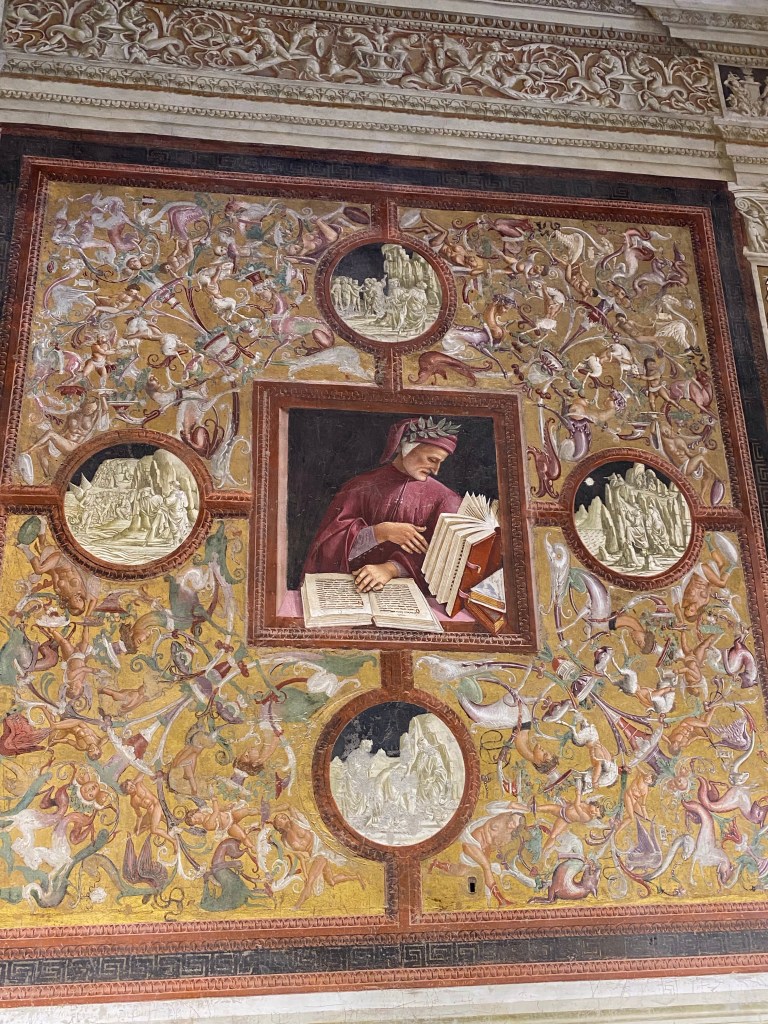
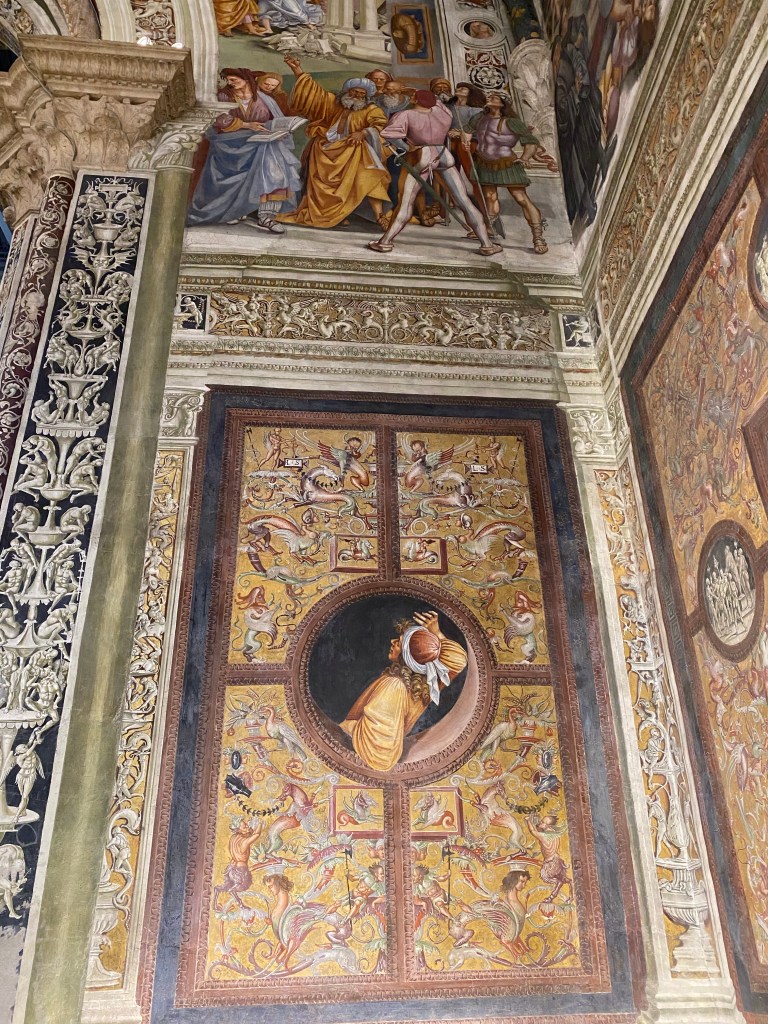
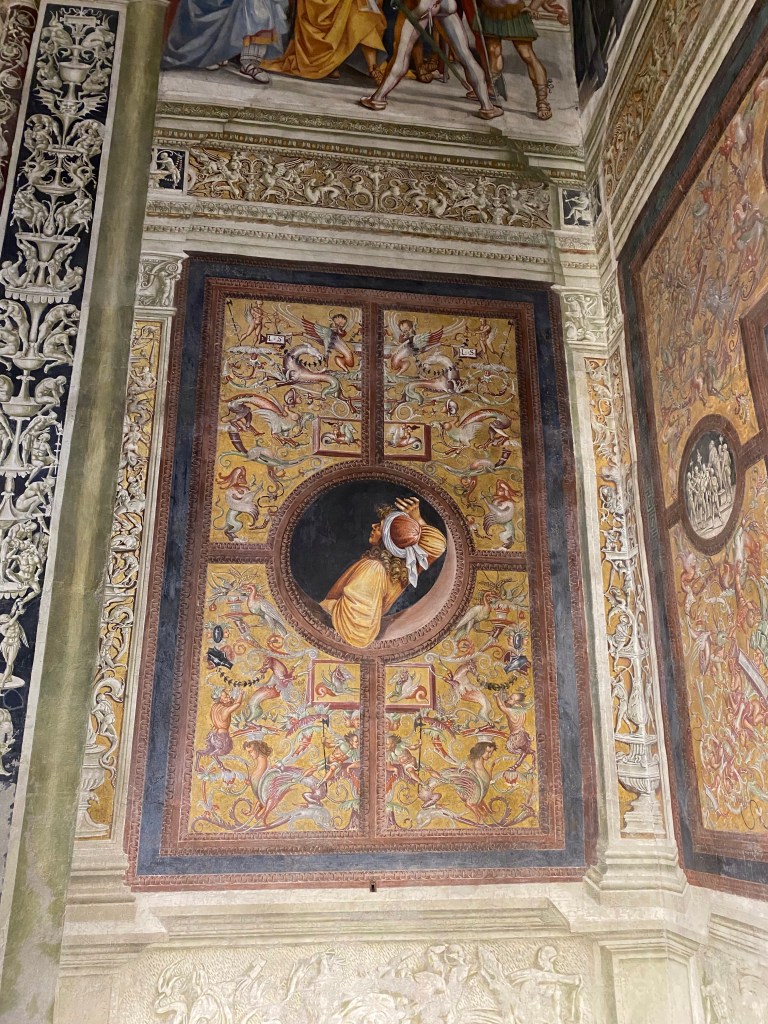
Below this are smaller paintings of famous writers and philosophers watching the unfolding disaster above them with interest. Legend states that the writers depicted here are Homer, Empedocles, Lucan, Horace, Ovid, Virgil and Dante, but the identifications are disputed by modern scholars. Several small-scale grisaille medallions depicting images from their works, including the first eleven books of Dante’s Purgatorio, Orpheus, Hercules, and various scenes from Ovid and Virgil, among others.
In a niche in the lower wall is shown a Pietà that contains explicit references to two important Orvietan martyr saints, S. Pietro Parenzo (podestà of Orvieto in 1199) and S. Faustino. They stand next to the dead Christ, along with Mary Magdalen and the Virgin Mary. The figure of the dead Christ, according to Giorgio Vasari, is the image of Signorelli’s son Antonio, who died from the plague during the course of the execution of the paintings. This fresco was Signorelli’s last work in the chapel.
But Tom Henry in his book “The Life and Art of Luca Signorelli” (Yale University Press, 2012) states that Vasari’s story is not correct: “Signorelli had two sons, Antonio and Tomasso. Tomasso outlived his father and Antonio was alive when this Lamentation was delivered in February 1502, dying a few months later in July 1502.” (Preface, p. xiii)
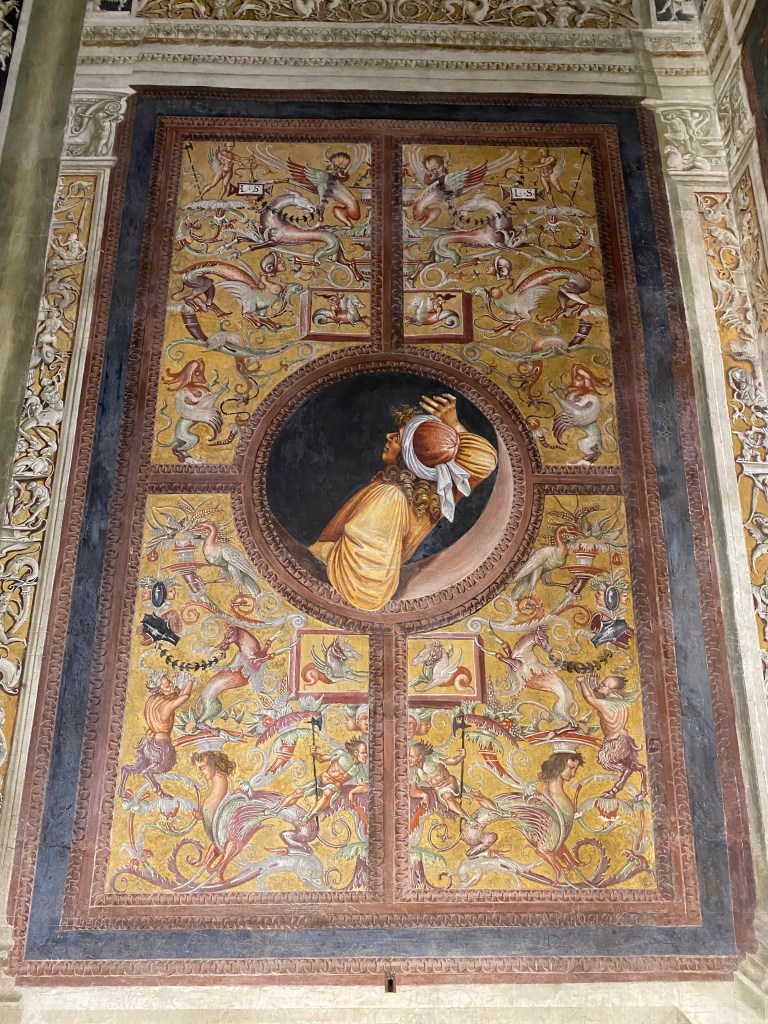
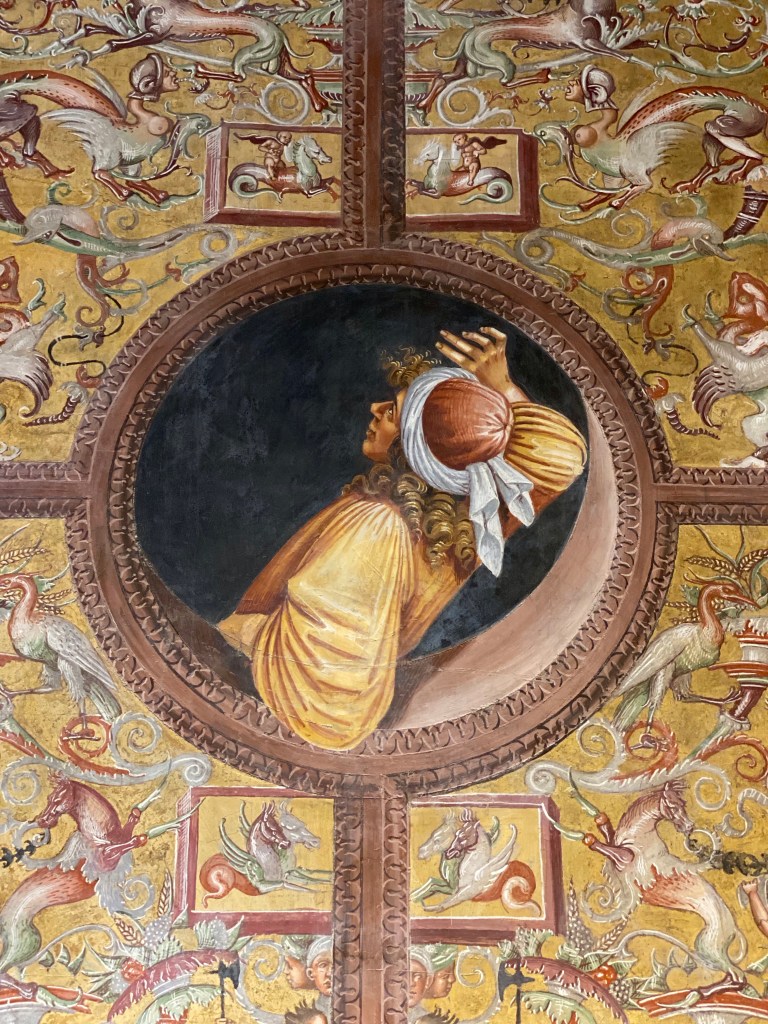
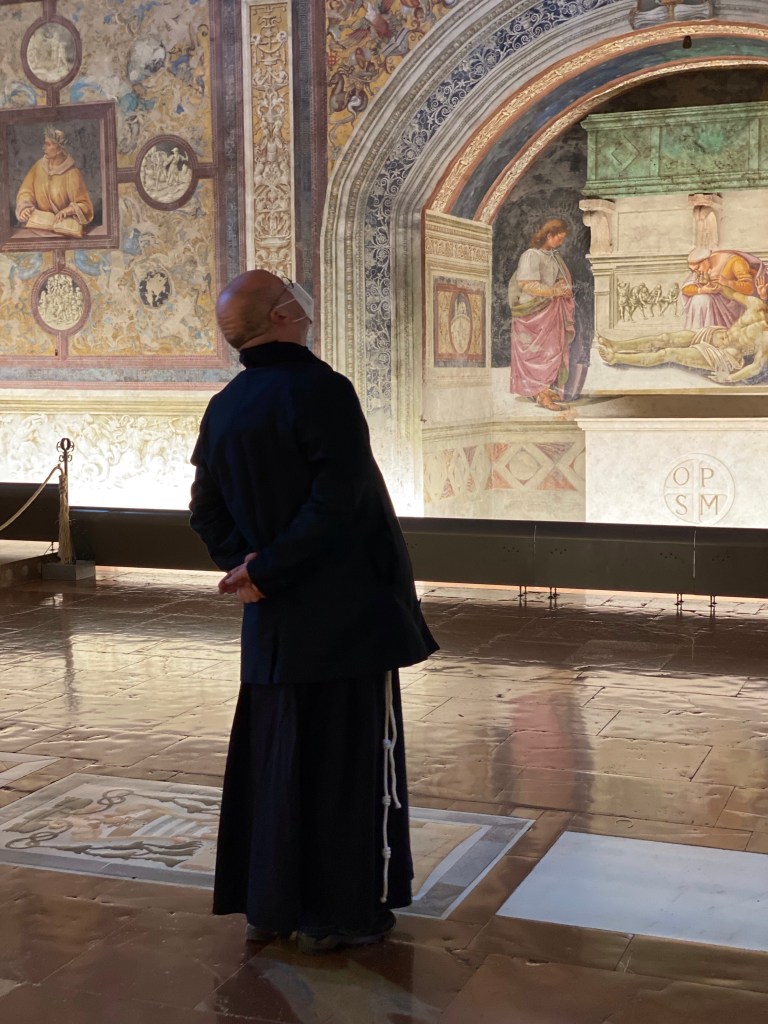
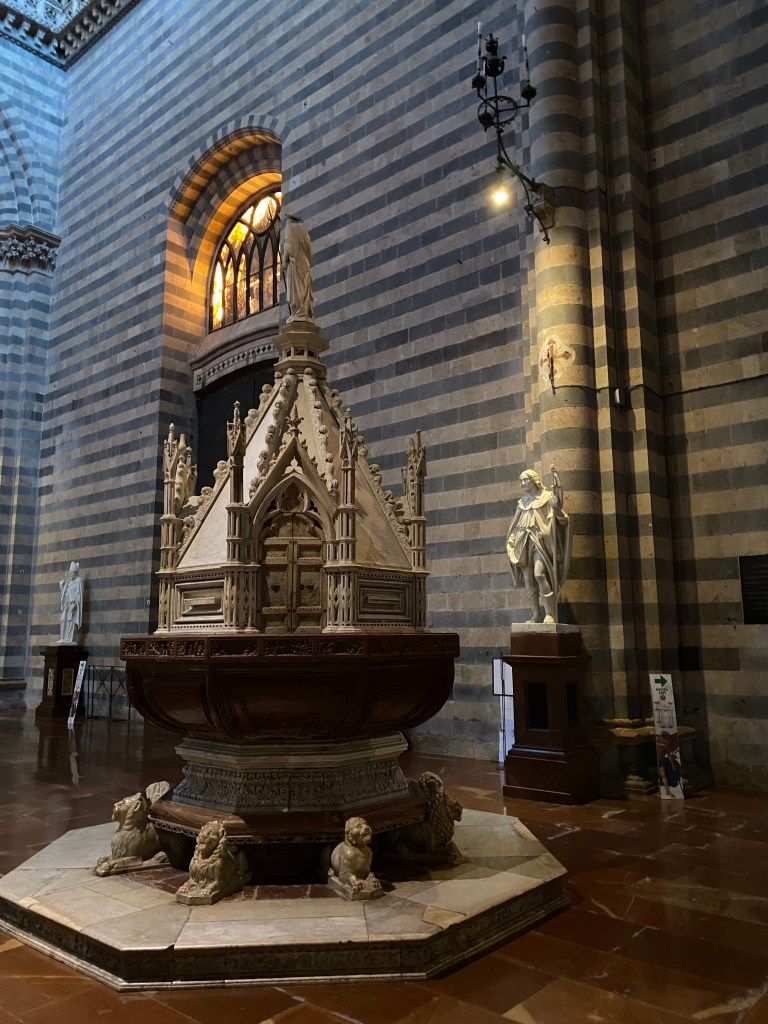
Near the left entrance is the large marble baptismal font with lions and elaborate frieze reliefs. It was begun in 1390 by Luca di Giovanni. It was expanded sixteen years later by Pietro di Giovanni from Freiburg, who added the red marble basin, and Sano di Matteo, who sculpted the octagonal pyramid in 1407.
The Cappella del Corporale lies on the north side of the main crossing. It was built between 1350 and 1356 to house the stained corporal of the miracle of Bolsena. It is from this chapel that the reliquary with the corporal is carried in religious processions through the town on the Feast of Corpus Christi. In this Chapel you will find relics from the eucharistic miracle in Bolsena. Some people refer to this miracle as the miracle of Bolsena, because that is where it actually happened. However the relics are kept in this cathedral in Orvieto, because this is where the Pope was at the time. Therefore people can also refer to this miracle as the miracle of Orvieto.
The chapel is two bays deep and covered with quadripartite vaults. It is closed off by a wrought iron gate, made between 1355 and 1362 by Matteo di Ugolino da Bologna and finished by Giovanni de Micheluccio da Orvieto in 1364.
The chapel is decorated with frescoes depicting on the left wall the history of the Eucharist and on the right wall miracles concerning the bleeding host throughout church history. They were painted between 1357 and 1363 by three artists from Orvieto: Ugolino di Prete Ilario, Domenico di Meo and Giovanni di Buccio Leonardelli. They were painted prior to the frescoes in the apse. They were restored in the middle of the 19th century.
The aedicule-shaped tabernacle on the altar was designed in 1358 by Nicola da Siena and finished by Orcagna.
In a niche on the right wall stands a panel of the Madonna dei Raccomandati (c. 1320). It was painted in the Italian Byzantine tradition by the Sienese artist Lippo Memmi, brother-in-law of Simone Martini.
At the centre of the chapel is the Reliquary of the Santo Corporale in silver, gilded silver and varicoloured translucent enamel containing the bloodstained corporal. This Gothic masterpiece, in the form of a triptych, was made by Sienese goldsmith Ugolino di Vieri between 1337 and 1338. It shows 24 scenes of the life of Christ and eight stories about the corporal.
The extraordinary Orvieto cathedral, interior: overview, apse, and Gentile da Fabriano
Last month I revisited Orvieto. What a delight. I enjoyed the interior as practically the only visitor and, fortuitously, the clergy was preparing for Christmas services, so I got to hear the magnificent organ playing holidays hymns. I will remember this visit for a long, long time to come. Lucky for you, you get to enjoy them too!
Above the entrance of the Chapel of the Corporal stands the cathedral’s large organ, containing 5,585 pipes and originally designed by Ippolito Scalza and Bernardino Benvenuti in the fifteenth century before being redesigned in 1913 and 1975.
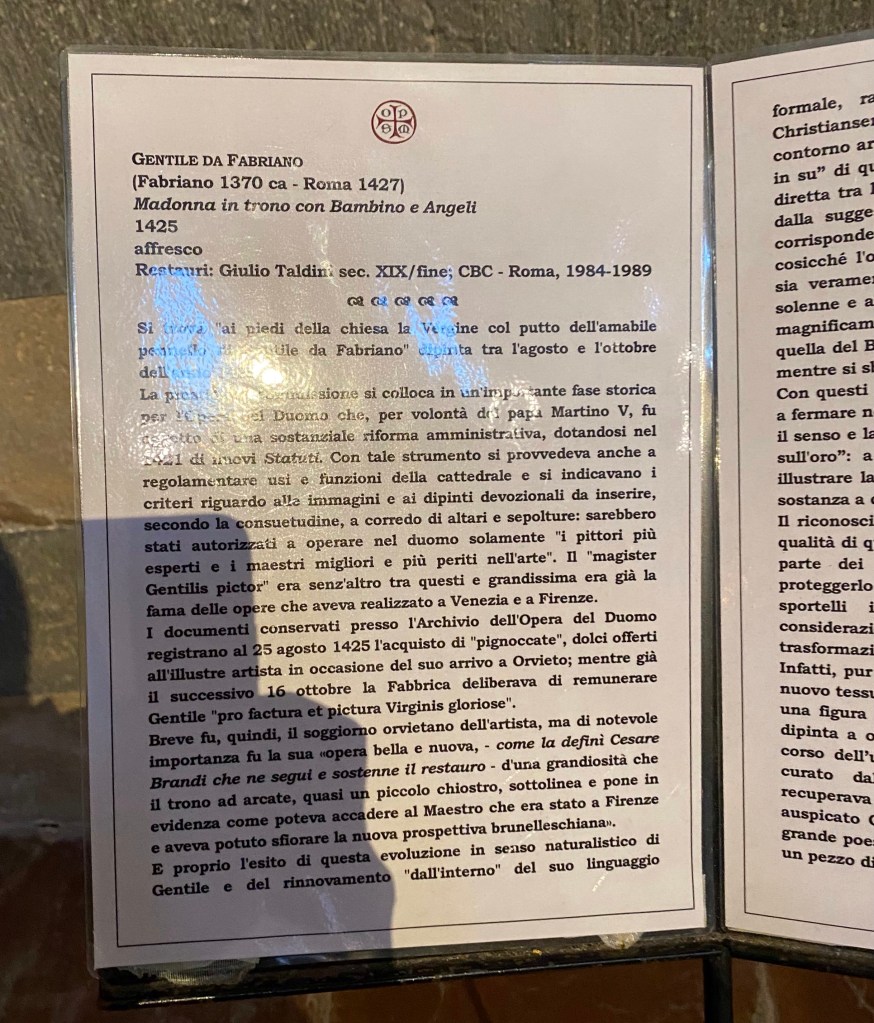
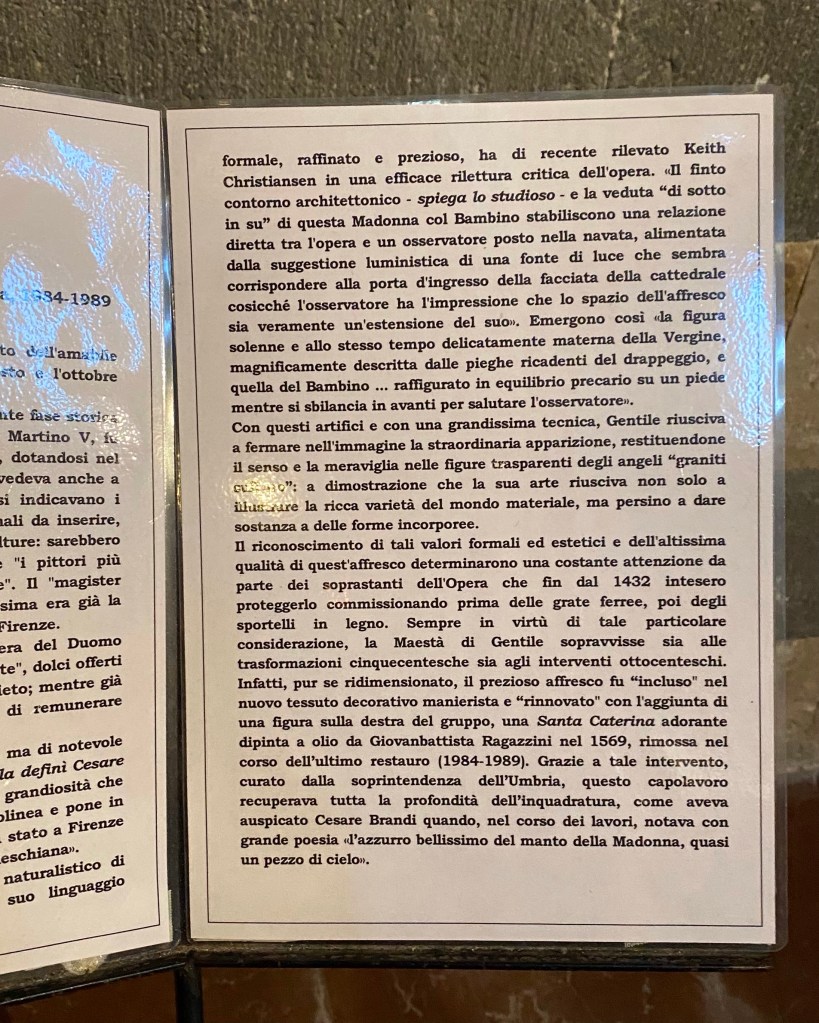
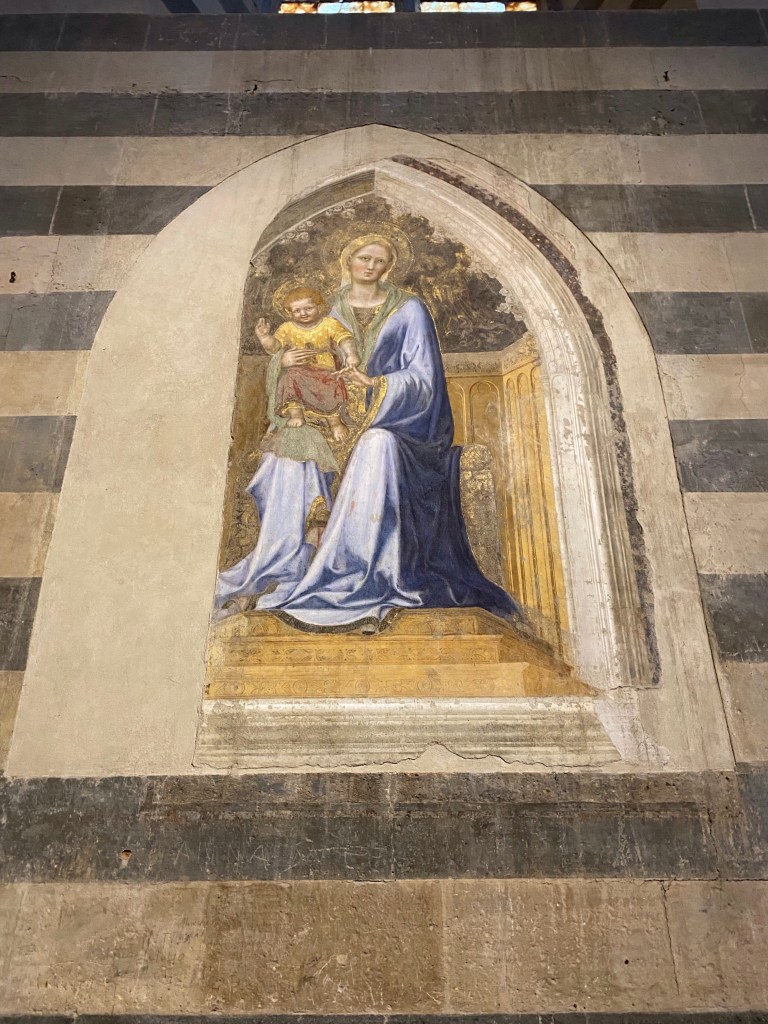
Gentile da Fabriano, Madonna Enthroned with Child.
It is overlooked by a fresco in International Gothic style of the “Madonna Enthroned with Child”, a Maestà painted by Gentile da Fabriano in 1425. This is the only fresco saved when the stucco altars were added to the nave chapels in the late 16th century. These altars in turn were destroyed in the 19th century and only fragments of the other 14th- and 15th-century frescoes reappeared. Some of these frescoes are ascribed to Pietro di Puccio (who also painted frescoes in the Camposanto in Pisa).
The apse:
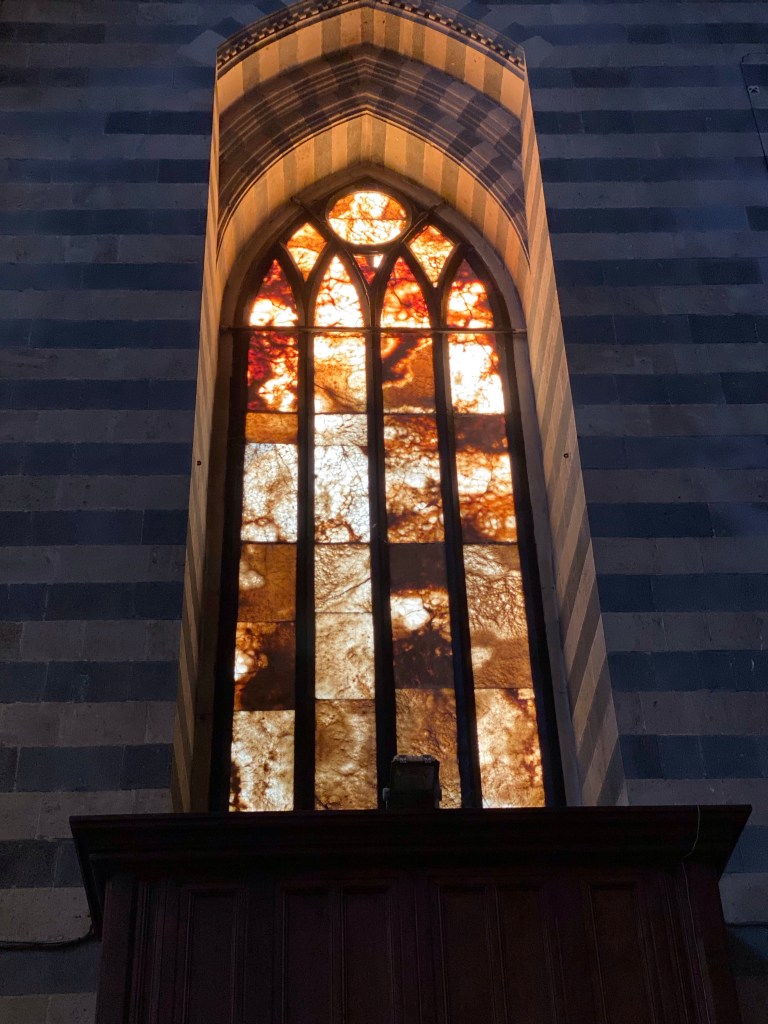
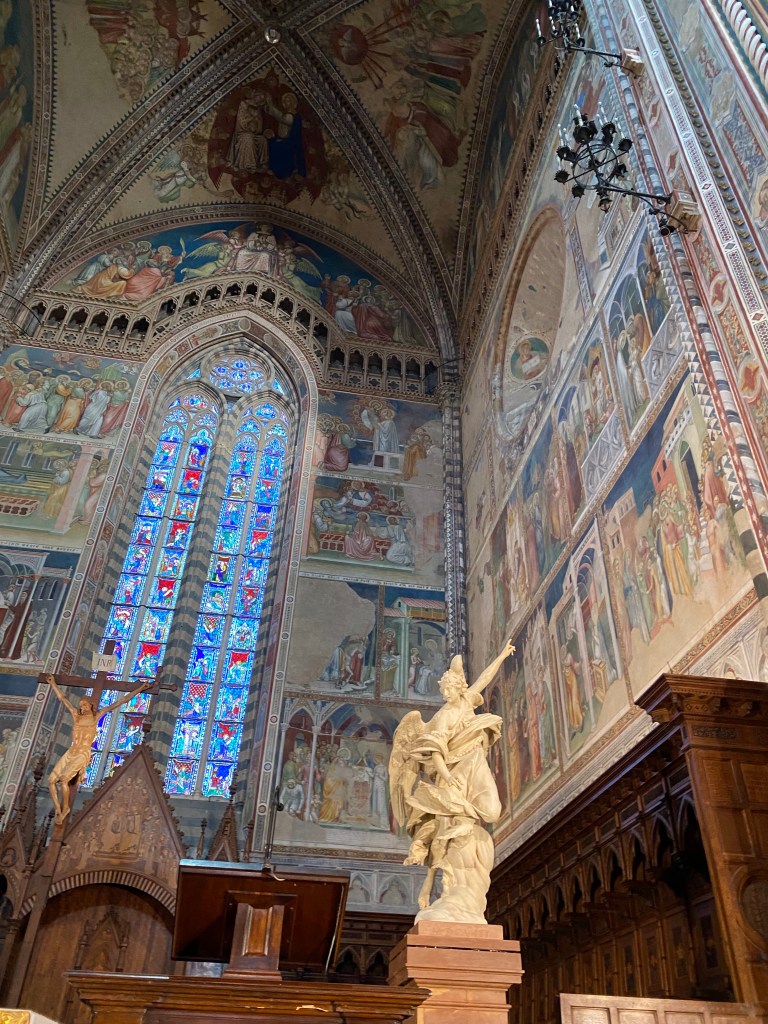
The large stained-glass quadrifore window in the apse was made between 1328 and 1334 by Giovanni di Bonino, a glass master from Assisi. The design was probably made by Maitani. Above the altar hangs a large polychrome wooden crucifix attributed to Maitani.
Construction of the Gothic wooden choir stalls was begun in 1329 by Giovanni Ammannati together with a group of Sienese wood carvers. They stood originally in the center of the nave but were moved to the apse around 1540.
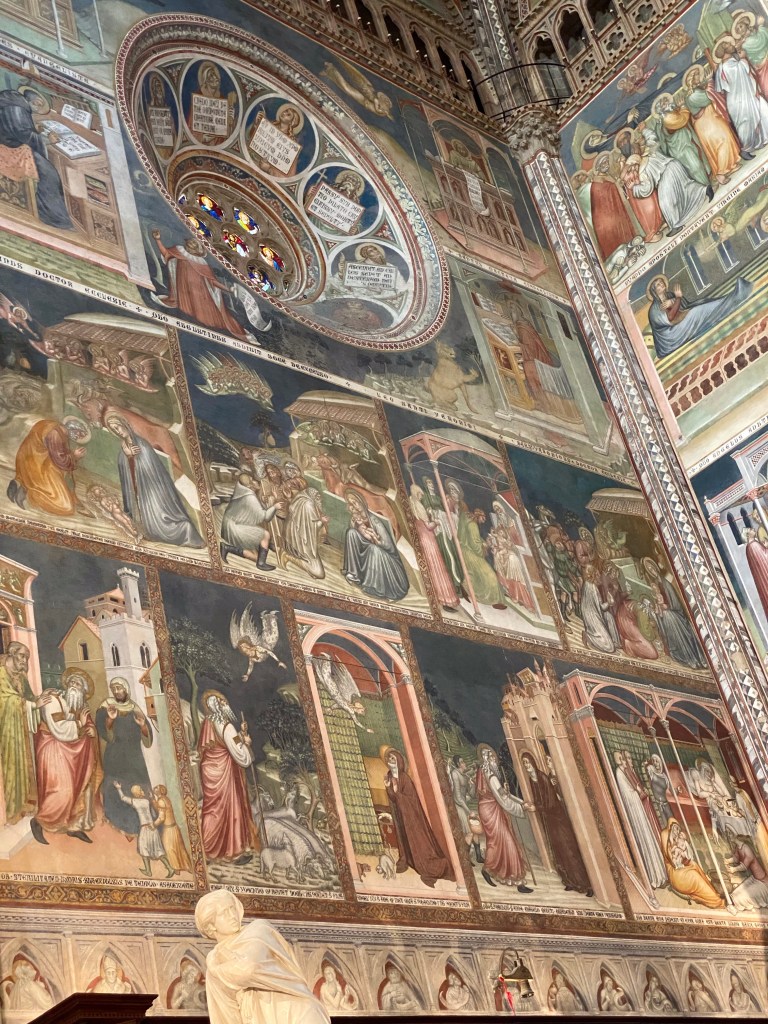
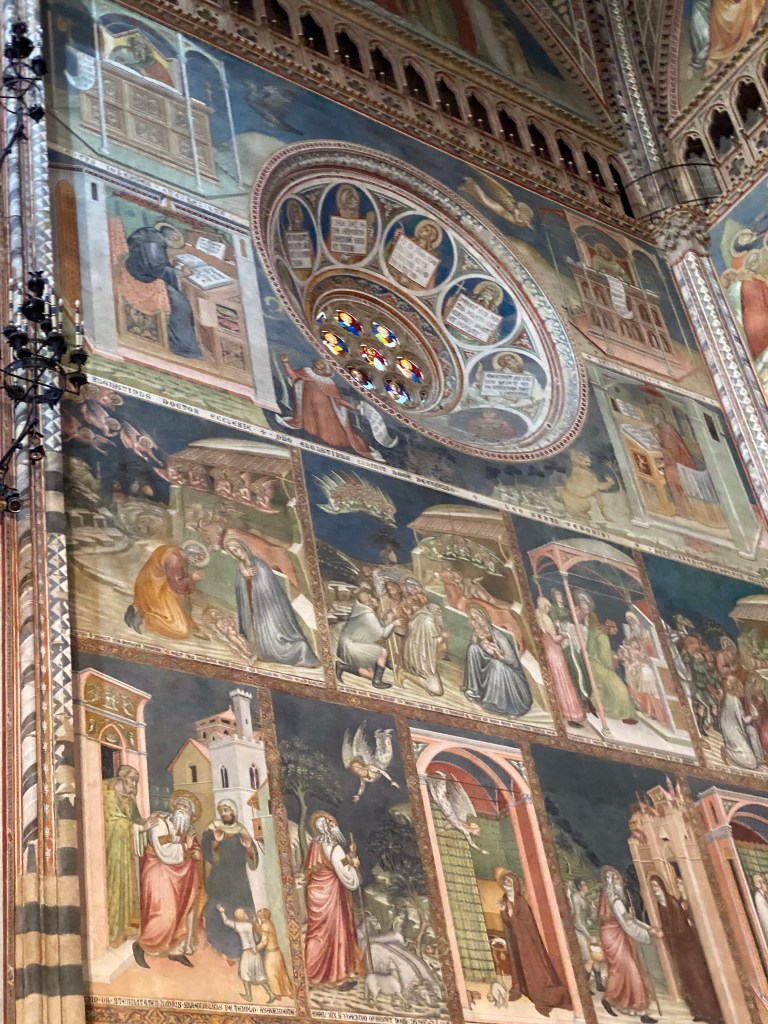
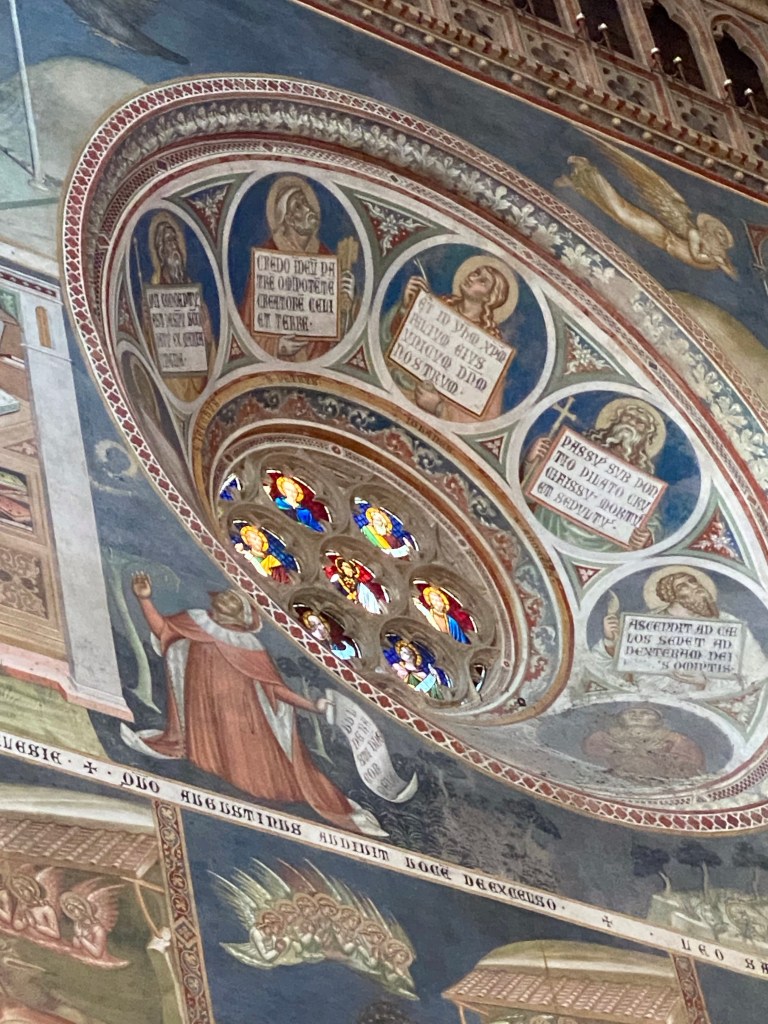
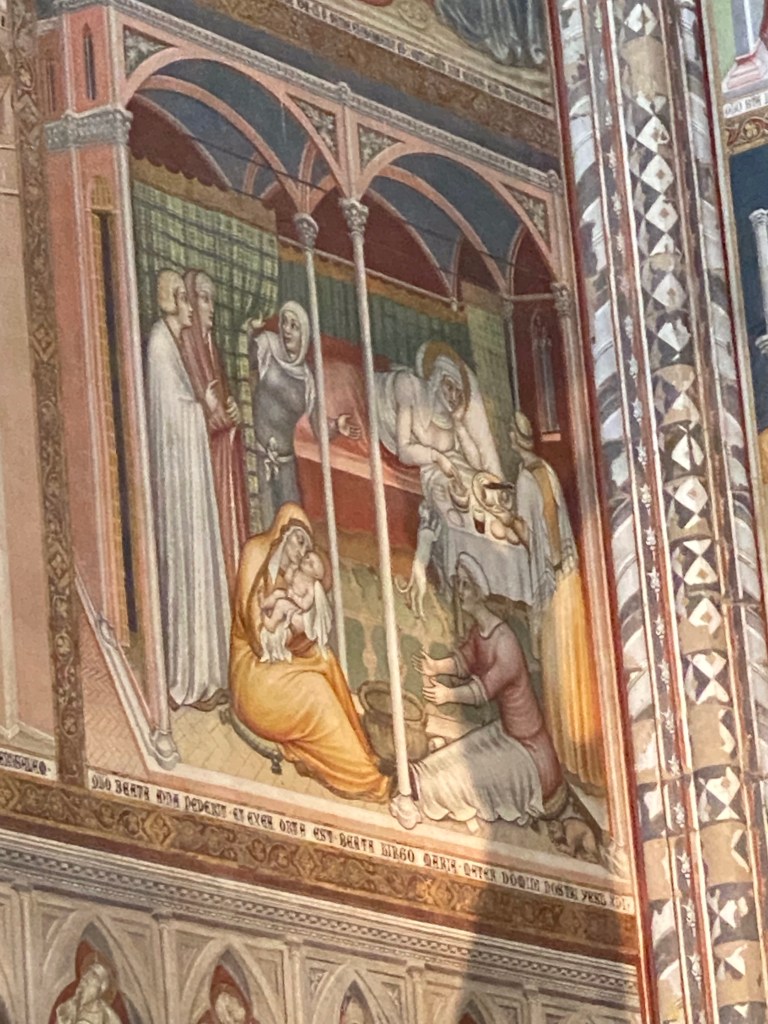
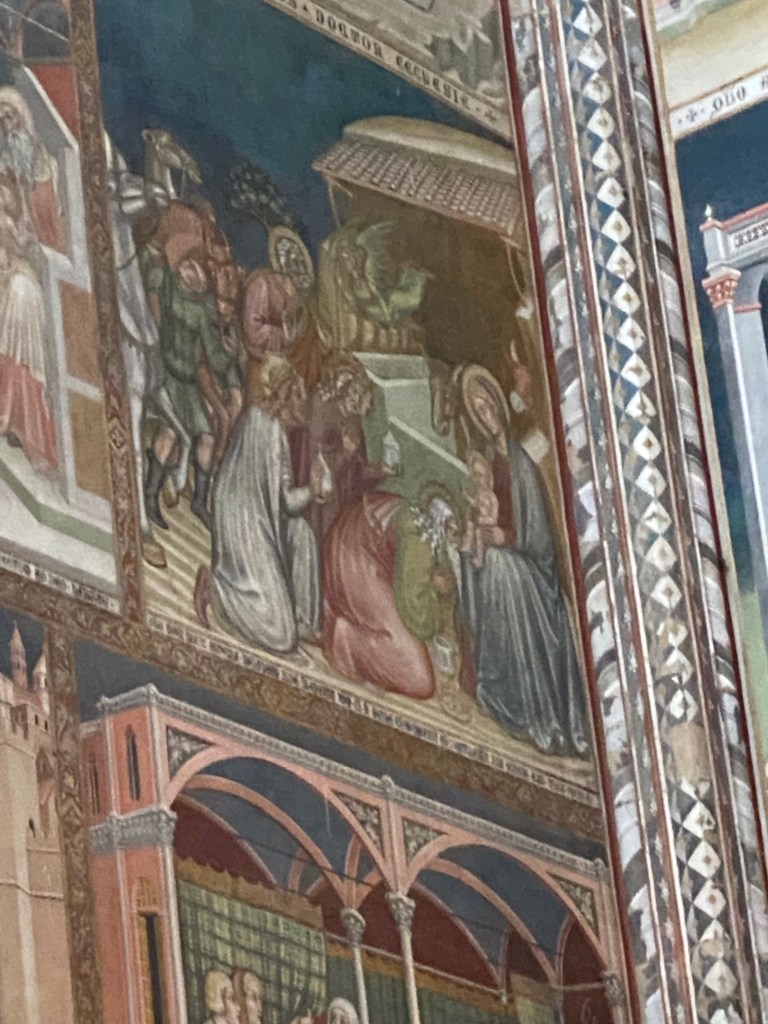
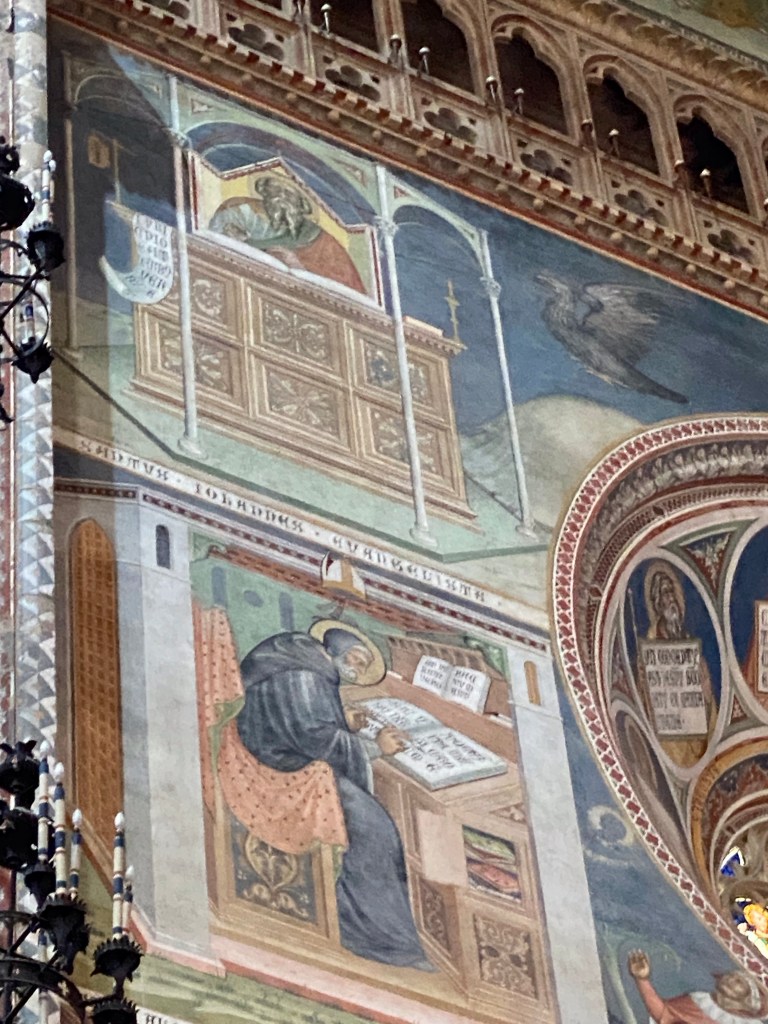
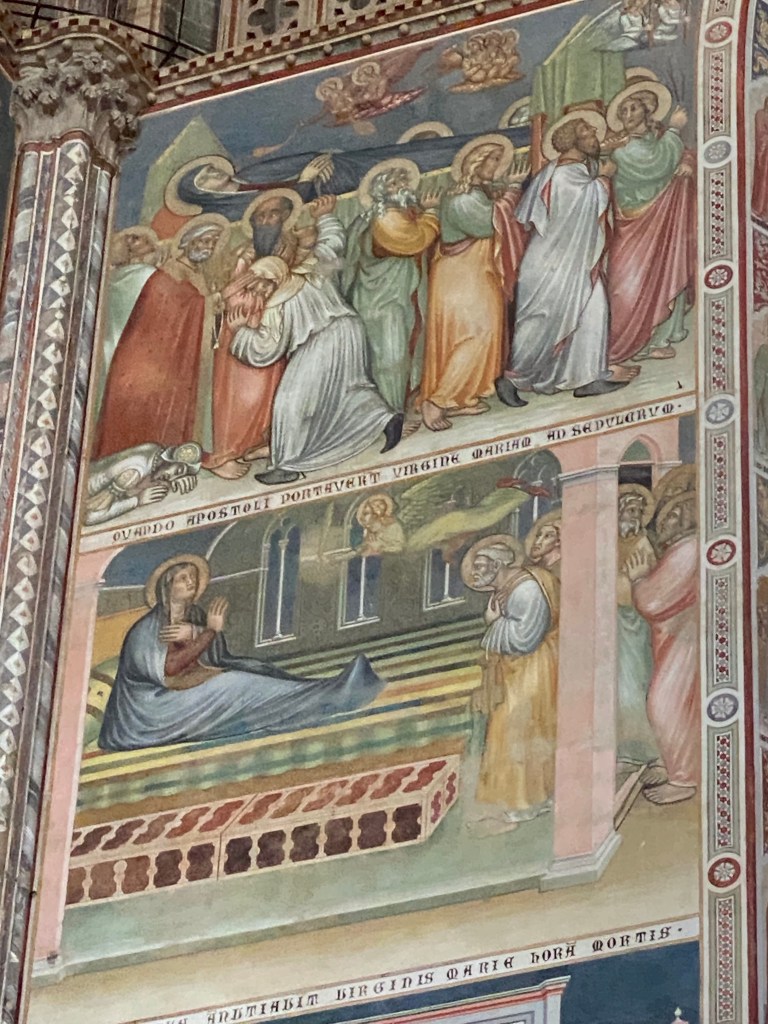
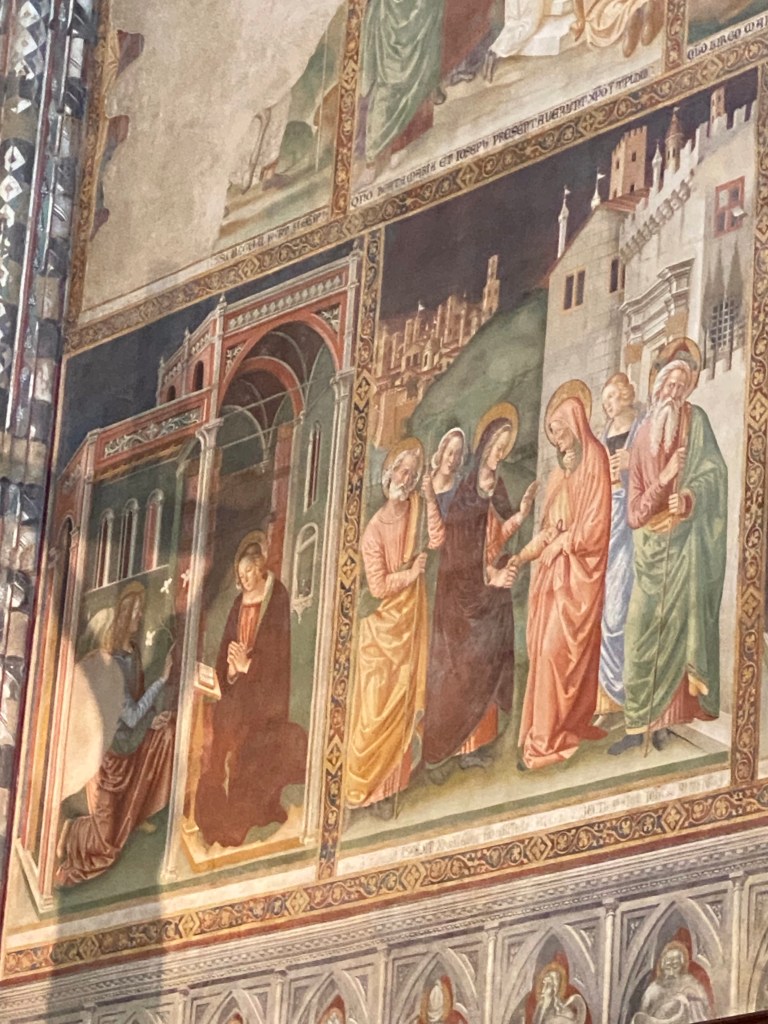
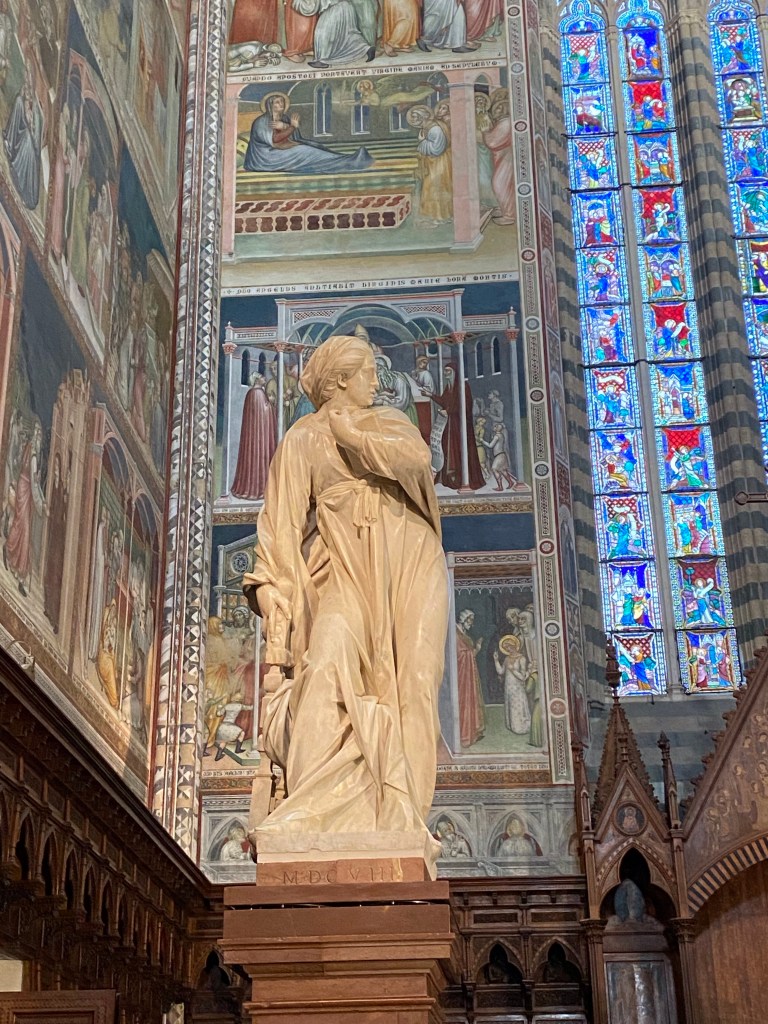
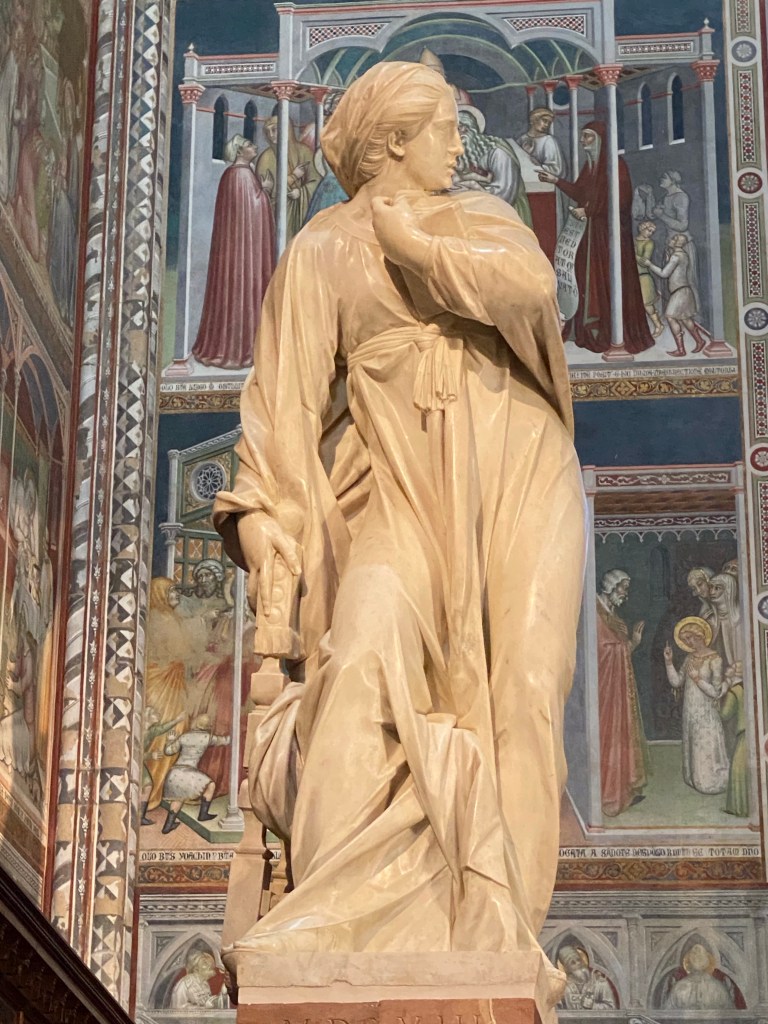
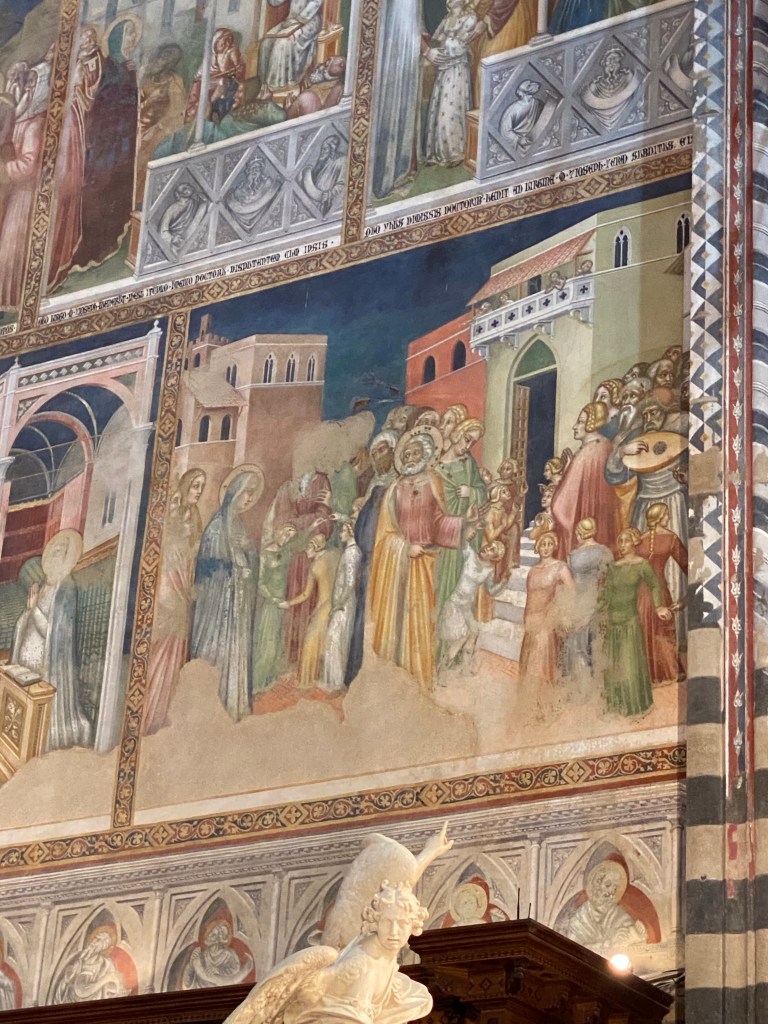
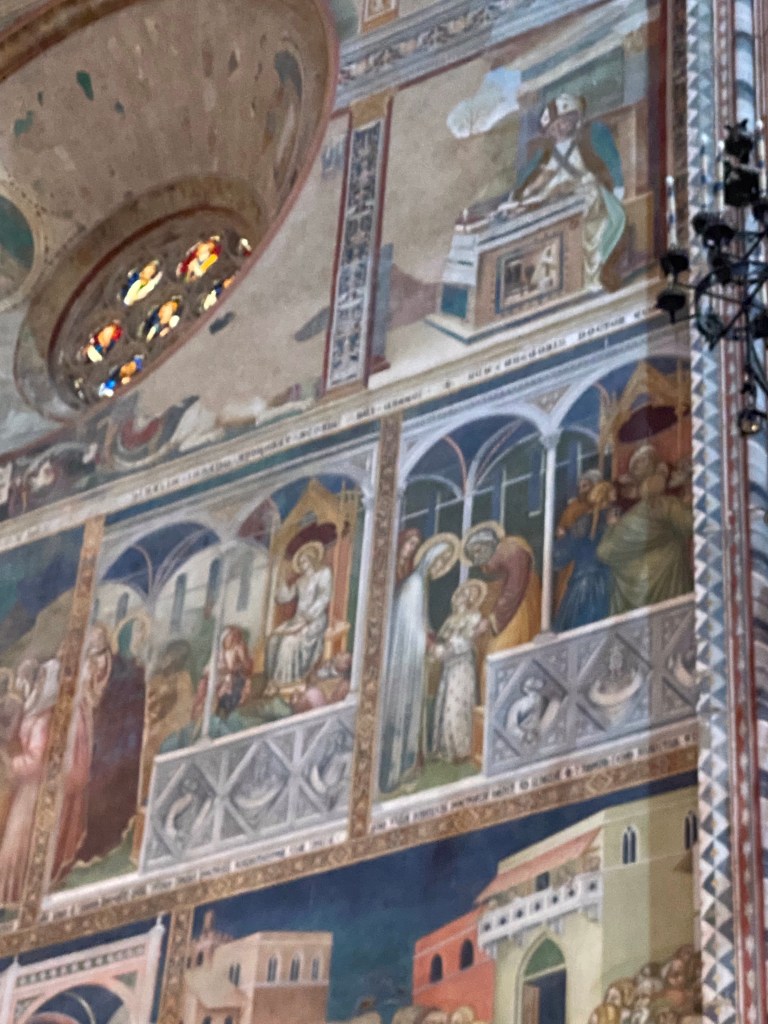
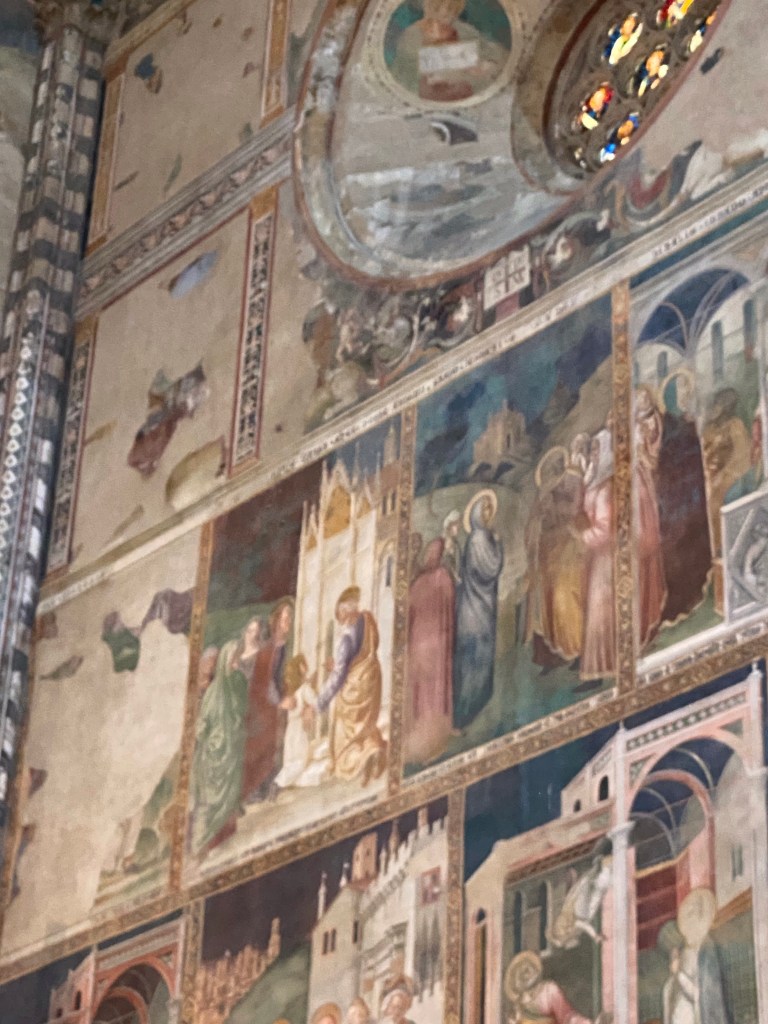
Behind the altar are a series of damaged Gothic frescoes dedicated to the life of the Virgin Mary, occupying the three walls completely. They were created around 1370 by the local artist Ugolino di Prete Ilario and a few collaborators such as Pietro di Puccino, Cola Petruccioli and Andrea di Giovanni. It took them about ten years to finish. This series of frescoes were the largest in Italy at that time. They have been restored every hundred years for several following centuries. Two scenes, the Annunciation and the Visitation, were redone by Antonio del Massaro at the end of the 15th century.
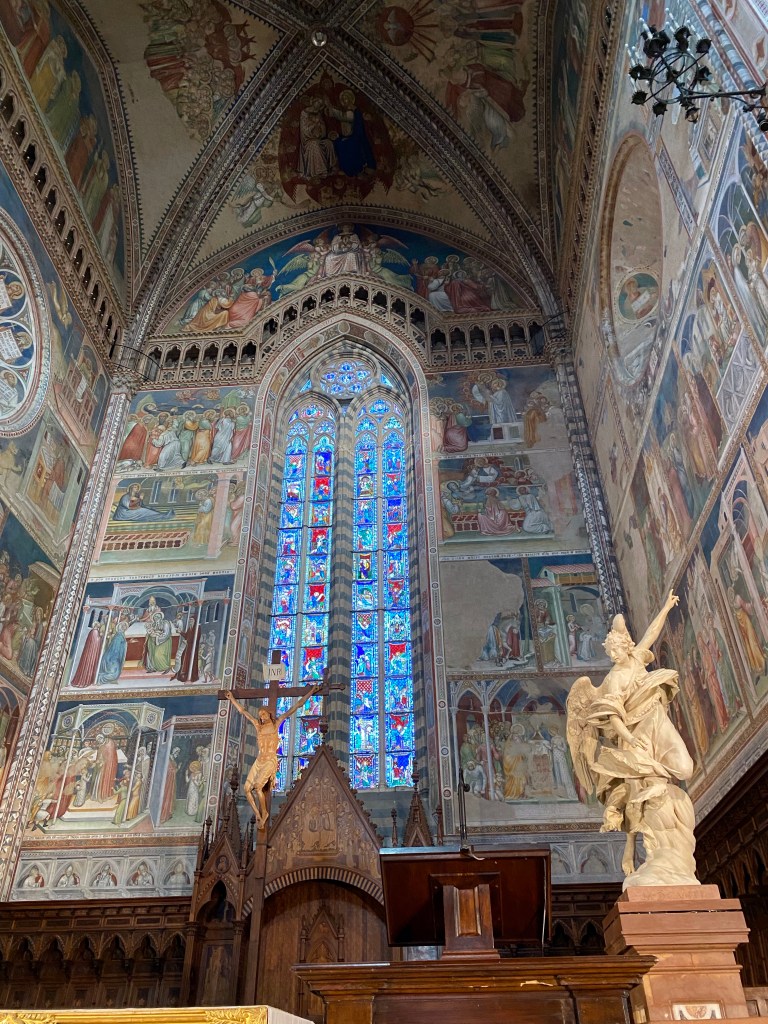
The apse end of the church was cordoned off while I was there, so I couldn’t get a good look or pictures of the paintings. The fresco cycle was beautiful and I longed to get up closer. Alas, these photos will have to suffice.



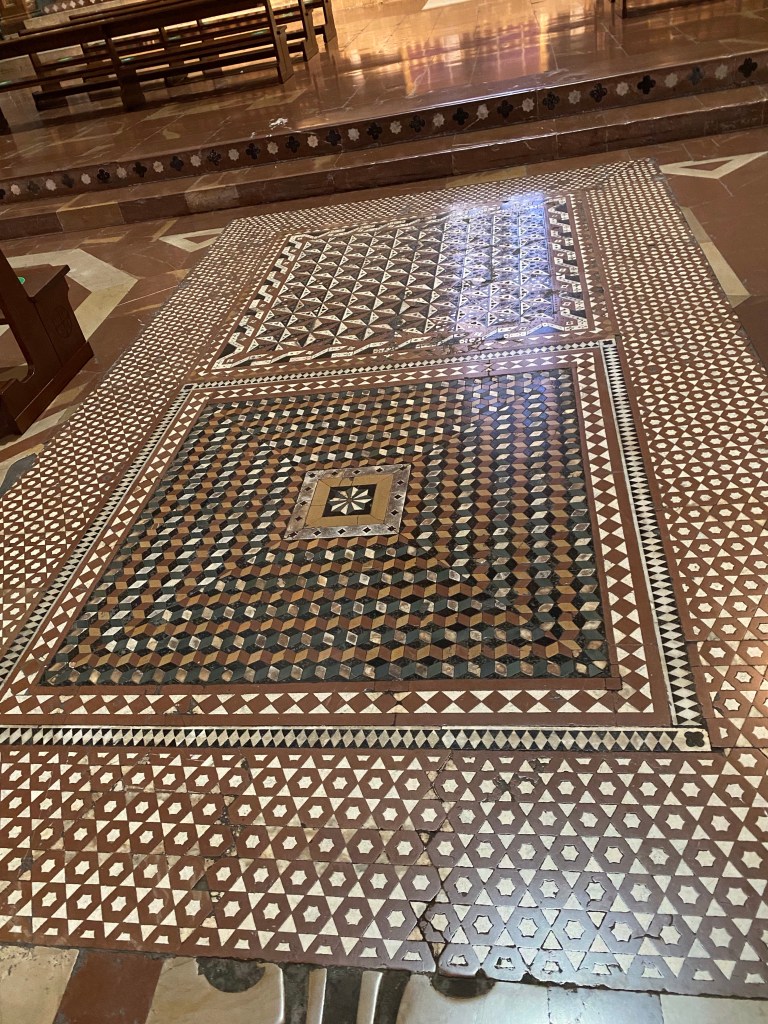
When I was in Orvieto, the Chapel of the Corporal was cordoned off and I could not view it at all. Since it is the duomo’s raison d’être, I thought I should at least mention it here:
The Cappella del Corporale lies on the north side of the main crossing. It was built between 1350 and 1356 to house the stained corporal of the miracle of Bolsena. It is from this chapel that the reliquary with the corporal is carried in religious processions through the town on the Feast of Corpus Christi. In this Chapel you will find relics from the eucharistic miracle in Bolsena. Some people refer to this miracle as the miracle of Bolsena, because that is where it actually happened. However the relics are kept in this cathedral in Orvieto, because this is where the Pope was at the time. Therefore people can also refer to this miracle as the miracle of Orvieto.

And now, in closing, enjoy some Christmas music in this amazing duomo.
Scalza’s other major contribution to the church is the large Pietà he sculpted in 1579. it took him eight years the carve the four figures in this imposing marble group.
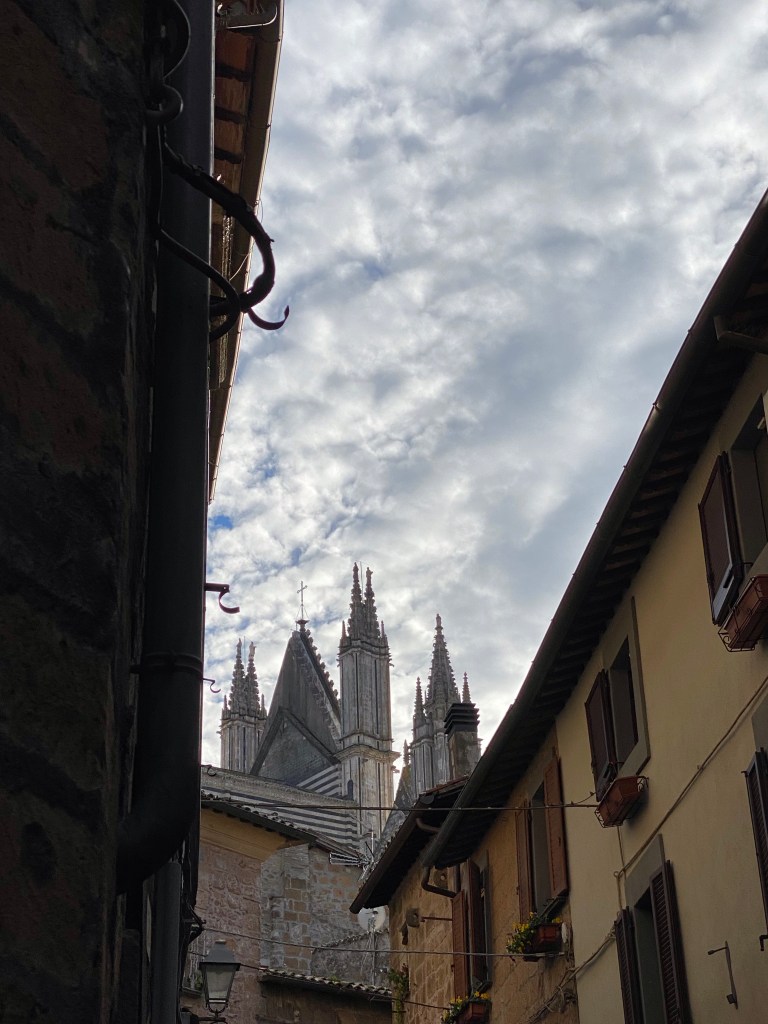
The extraordinary cathedral of Orvieto, the exterior
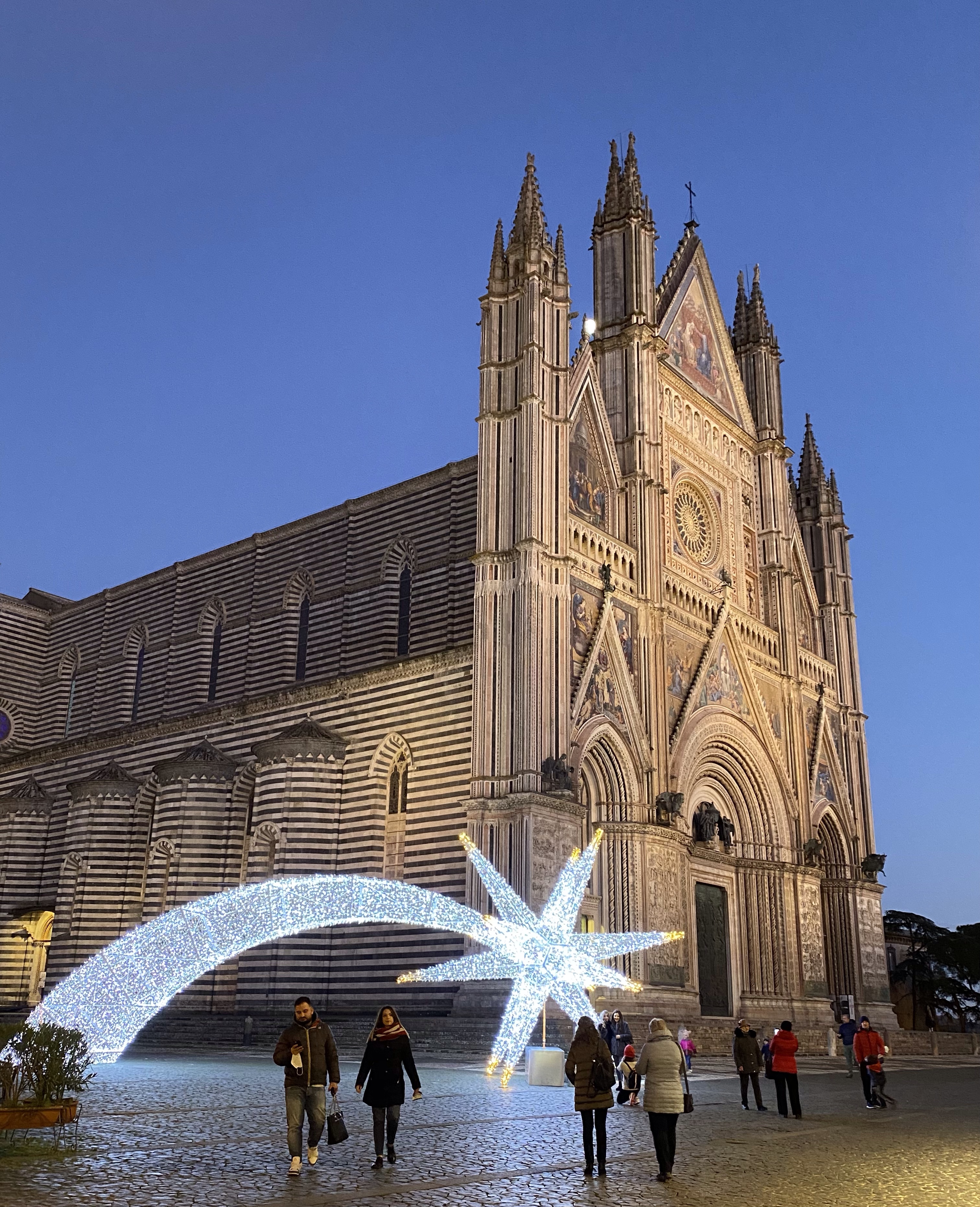
Last month I paid a visit to this incredible church. I spent the night in Orvieto, with a room with a view of the church, so I could see it in all times of day. The bonus was I was there in December, so I also got to view it through the prism of Christmas lights.
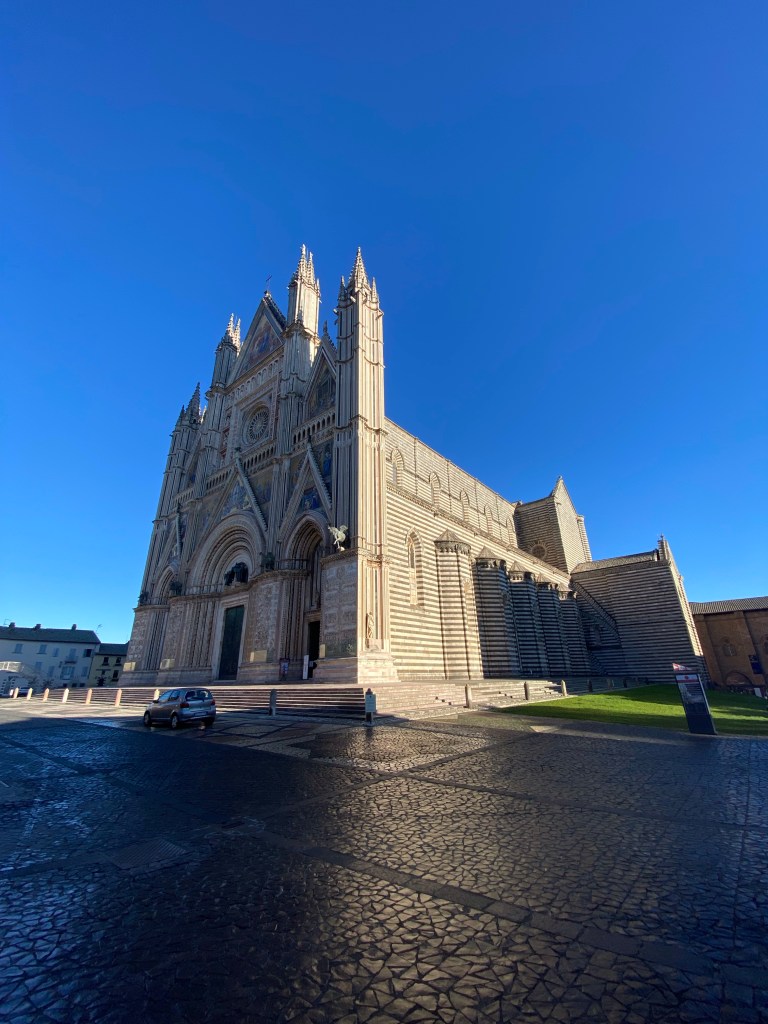

Orvieto Cathedral (aka the Duomo di Orvieto and/or Cattedrale di Santa Maria Assunta) is a large 14th-century Roman Catholic cathedral dedicated to the Assumption of the Virgin Mary.
The building owes its existence to a 13th century miracle. It was constructed under the orders of Pope Urban IV to commemorate and provide a suitable home for the Corporal of Bolsena, the relic of miracle which is said to have occurred in 1263 in the nearby town of Bolsena, when a traveling priest who had doubts about the truth of transubstantiation found that his Host was bleeding so much that it stained the altar cloth. The cloth is now stored in the Chapel of the Corporal inside the cathedral.
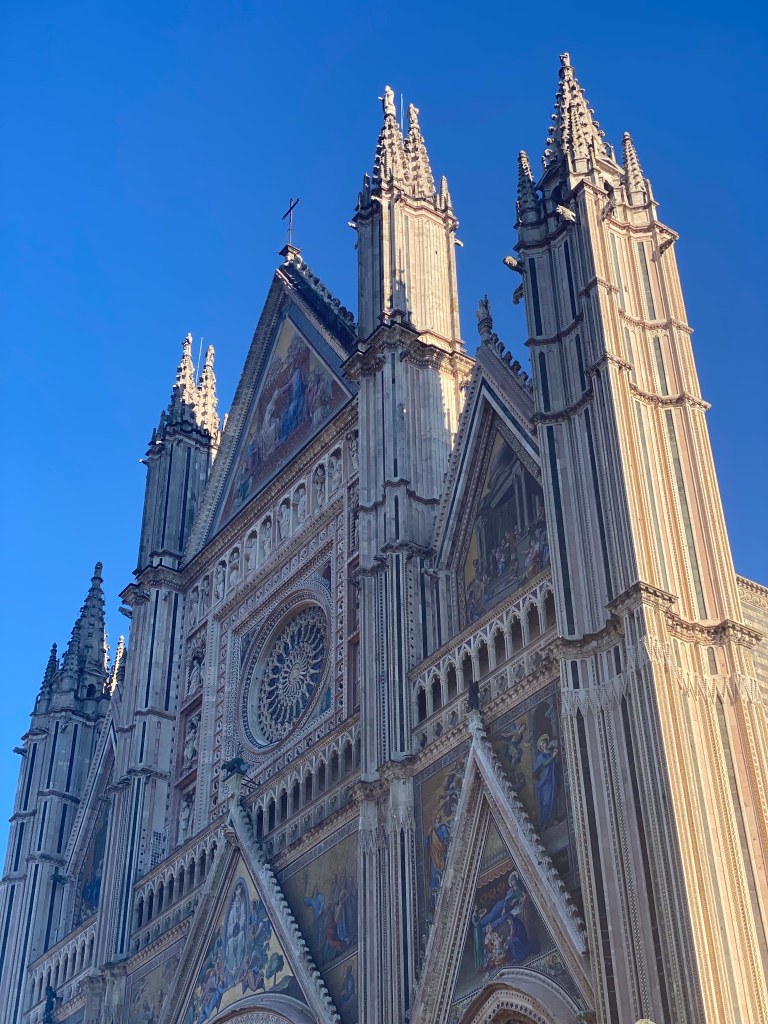
Situated in a position dominating the town of Orvieto which sits perched on a volcanic plug, the cathedral’s façade is a classic piece of religious construction, containing elements of design from the 14th to the 20th century, with a large rose window, golden mosaics and three huge bronze doors, while inside resides two frescoed chapels decorated by some of the best Italian painters of the period with images of Judgment Day. The cathedral has five bells, dating back to Renaissance, tuned in E flat.
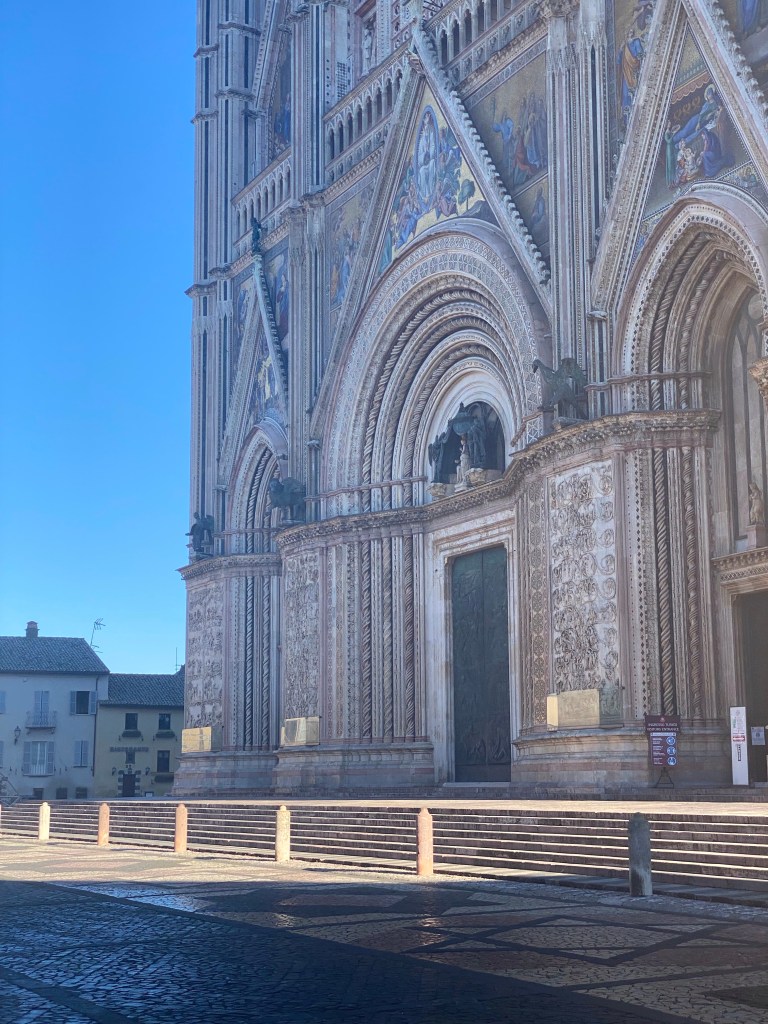
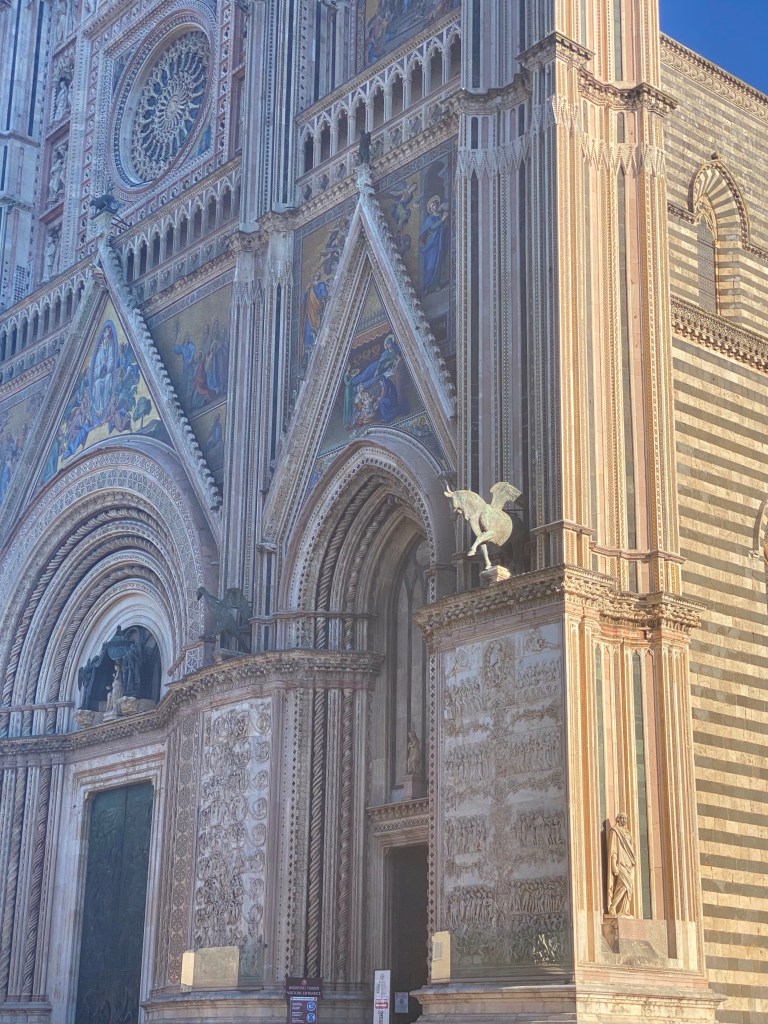
The construction of the cathedral lasted almost three centuries with the design and style evolving from Romanesque to Gothic as construction progressed. The flagstone of the cathedral was laid on 13 November 1290 by Pope Nicholas IV, and construction was entrusted to chief-mason Fra Bevignate di Perugia using a design by Arnolfo di Cambio (the architect of the cathedral of Florence).
The cathedral was initially designed as a Romanesque basilica with a nave and two side aisles. However, when Giovanni di Uguccione succeeded Fra Bevignate, the design was transformed into Italian Gothic forms.
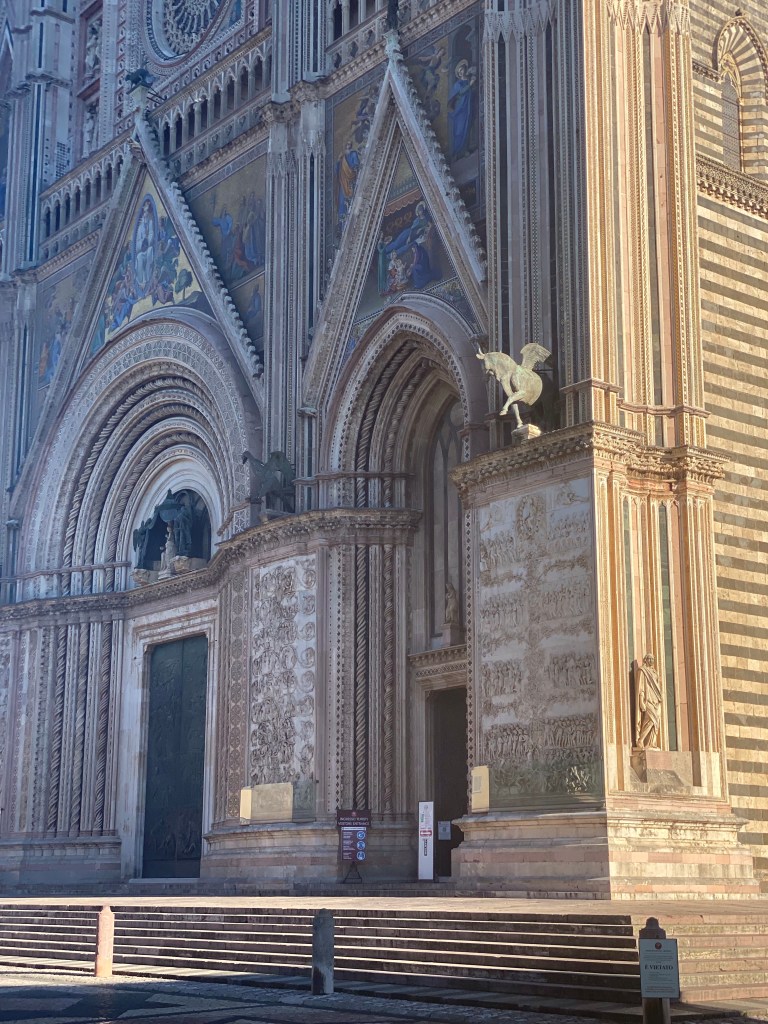
Construction continued slowly until, in 1309, the Sienese sculptor and architect Lorenzo Maitani was commissioned to solve several issues concerning the load-bearing capabilities of the building, especially of the choir. He substantially changed the design and construction of the building, increasing the similarity of the building to Siena Cathedral. The architecture of both buildings sometimes is classified as a substyle of Gothic architecture: Siennese Gothic style.
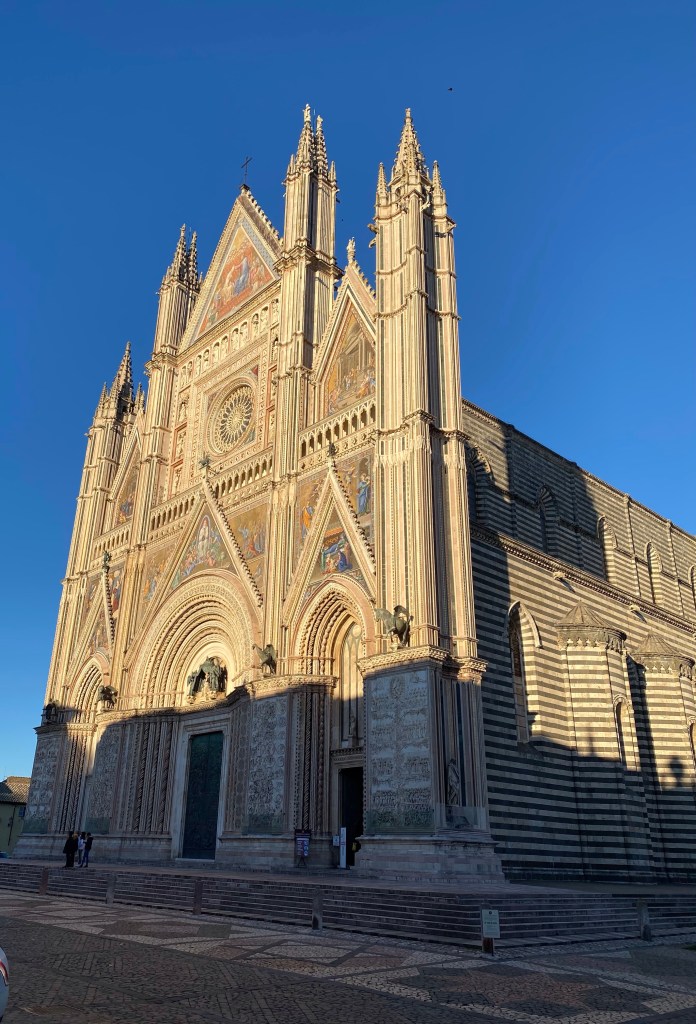
Maitani strengthened the external walls with flying buttresses, which proved later to be useless. These buttresses were eventually included in the walls of the newly built transept chapels. He rebuilt the apse into a rectangular shape and added a large stained-glass quadrifore window.
Starting in 1310 he created the current façade up to the level of the bronze statues of the symbols of the Evangelists. He also added much of the interior. He died in 1330, shortly before the completion of the cathedral, succeeded by his sons.
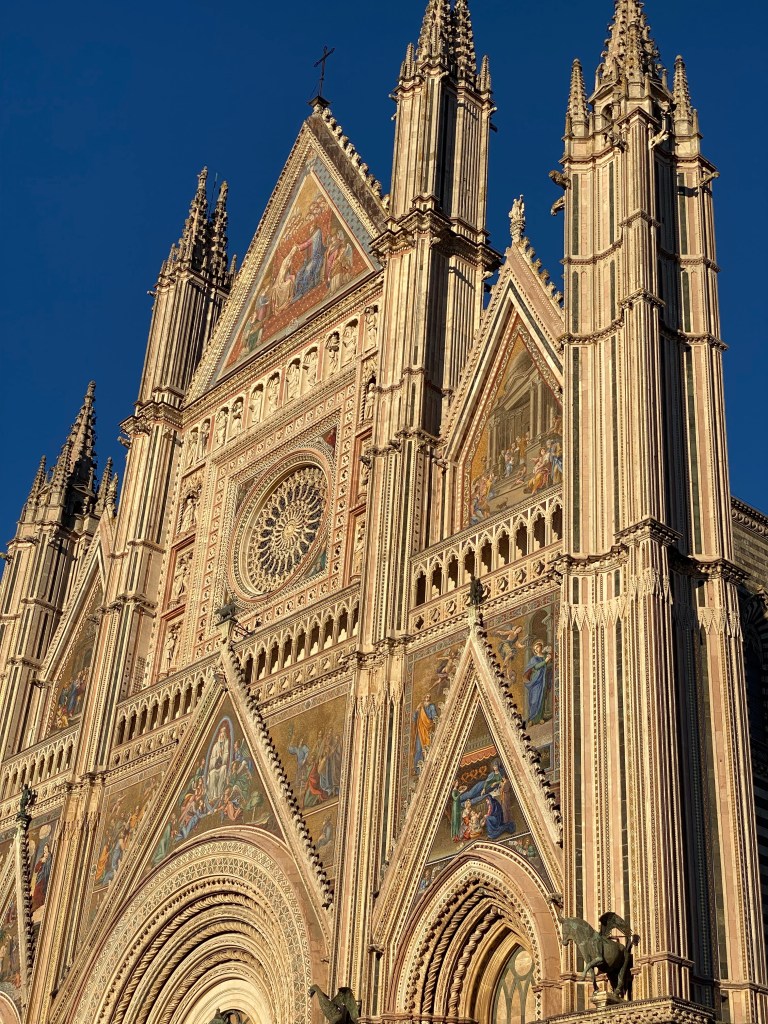
In 1347 Andrea Pisano, the former Master of the Works of the Florence Cathedral, was appointed the new Master of the Works. He was followed in 1359 by Andrea di Cione, better known as Orcagna. The beautiful mosaic decoration and the rose window are attributed to him.
The rose window is the most important stained glass window of a cathedral made in the Gothic era. This once octagon-based design was replaced by Orcagna with the new 22-sided polygon. This type of geometrical base is uncommon in Gothic architecture. Due to the windows unusual shape, statistical and geometric techniques were used to achieve a symmetrical design.
The Sienese architect Antonio Federighi continued the decoration of the façade between 1451 and 1456, adding some Renaissance modules. In 1503 Michele Sanmicheli finished the central gable and added the right spire, which was finished by Antonio da Sangallo, Junior in 1534.
Final touches to the façade were made by Ippolito Scalza by adding the right pinnacle in 1590 and the left in 1605–1607. All in all, the succeeding architects kept a stylistic unity to the façade.
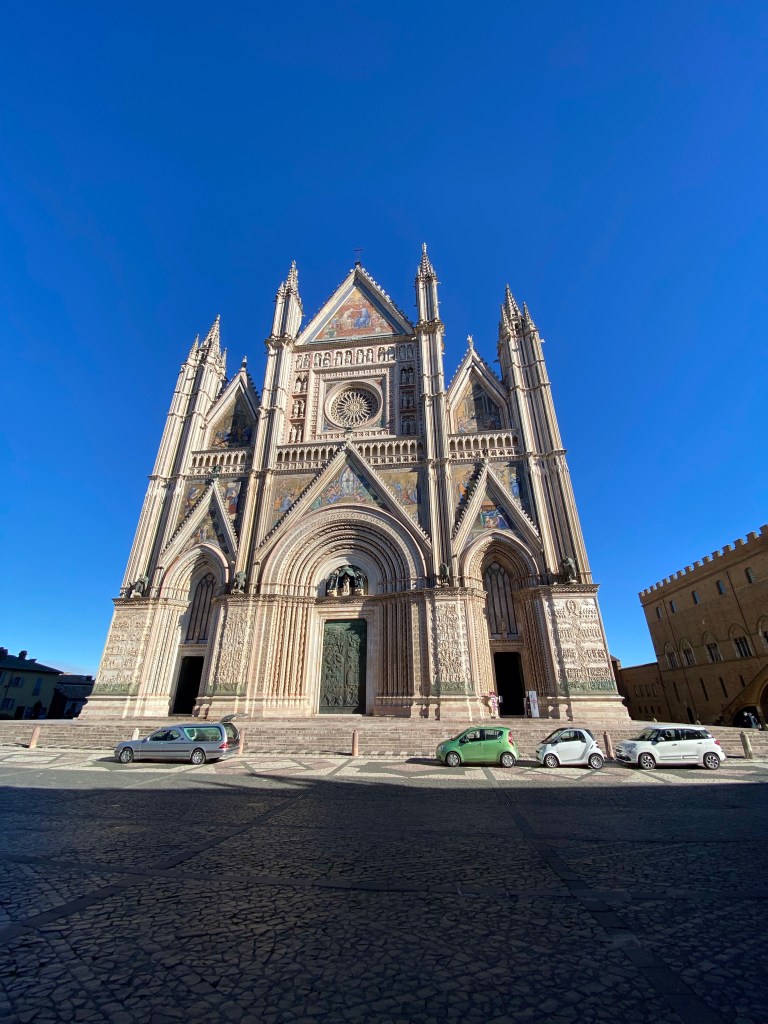
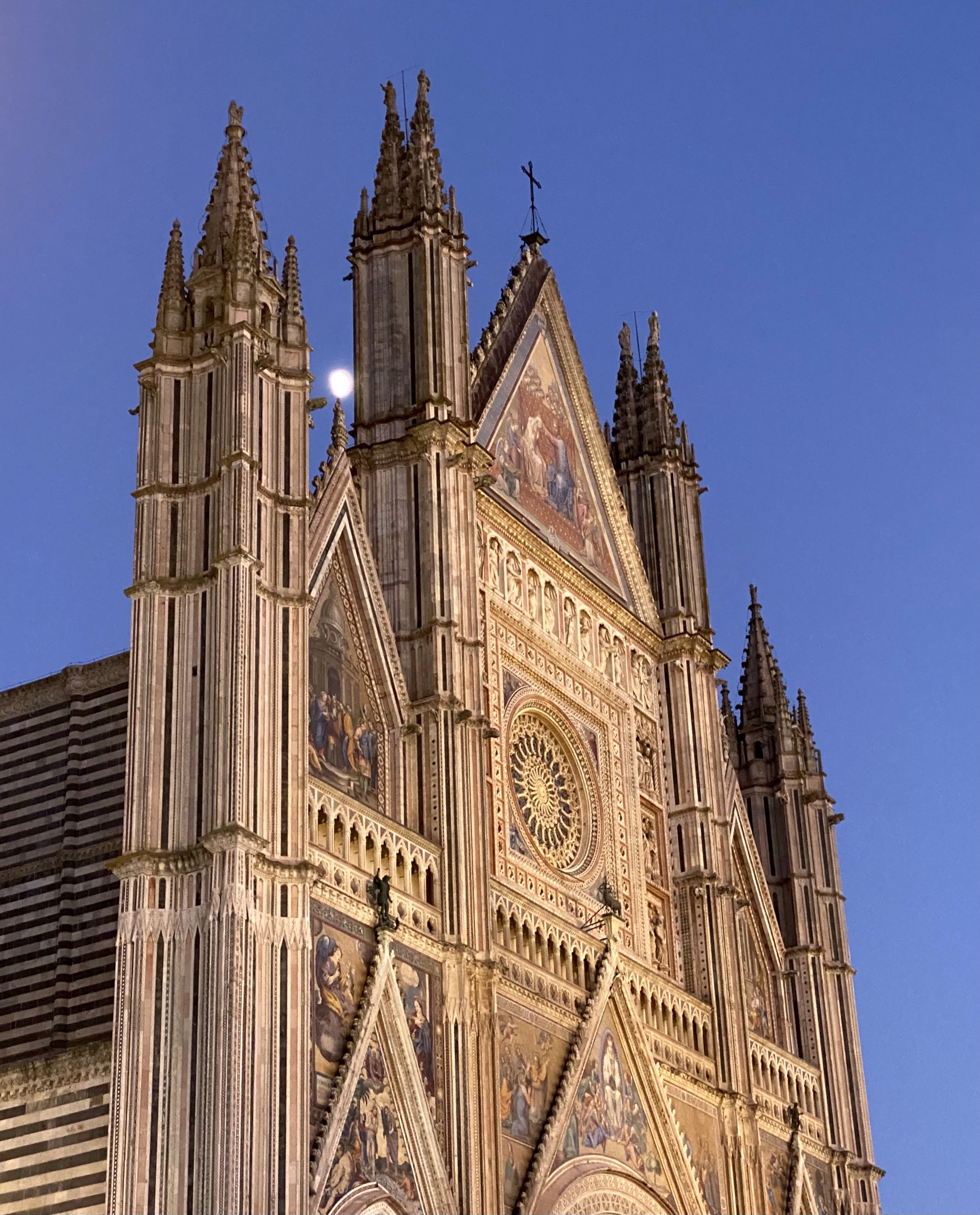
The Gothic façade of the Orvieto Cathedral is one of the great masterpieces of the Late Middle Ages. The three-gable design is attributed to Maitani, who had clearly undergone some influence by the design scheme for the façade in Tuscan Gothic style of the Siena Cathedral by Giovanni Pisano (1287–1297) and the plan for façade of the Florence Cathedral by Arnolfo di Cambio (1294–1302).
The most exciting and eye-catching part is its golden frontage, which is decorated by large bas-reliefs and statues with the symbols (Angel, Ox, Lion, Eagle) of the Evangelists created by Maitani and collaborators (between 1325 and 1330) standing on the cornice above the sculptured panels on the piers. In 1352 Matteo di Ugolino da Bologna added the bronze Lamb of God above the central gable and the bronze statue of Saint Michael on top of the gable of the left entrance.
The bas-reliefs on the piers depict biblical stories from the Old and New Testament. They are considered among the most famous of all 14th-century sculpture. These marbles from the fourteenth and fifteenth century are the collective and anonymous work of at least three or four masters with assistance of their workshops, It is assumed that Maitani must have worked on the reliefs on the first pier from the left, as work on the reliefs began before 1310. The installation of these marbles on the piers began in 1331. They depict from left to right:
Stories of the Old Testament: Book of Genesis
the Tree of Jesse with scenes from the Old Testament with messianic prophesies of Redemption.
scenes from the New Testament with below Abraham sleeping: episodes from the lives of Jesus and Mary
Last Judgment: Book of Revelation
Above this decoration are glittering mosaics created between 1350 and 1390 after designs by artist Cesare Nebbia. These original pieces have been replaced and redesigned in the centuries since, particularly in 1484, 1713 and 1842. Most of these mosaic represent major scenes from the life of the Virgin Mary, from the “Nativity of Mary” in the lower right gable to the “Coronation of the Virgin Mary” in the topmost gable. One of these glassmakers is recorded as Fra Giovanni Leonardelli.
Central to the mosaics is the large rose window built by the sculptor and architect Orcagna between 1354 and 1380. In the niches above the rose window stand the twelve apostles, while in niches on both sides twelve Old Testament prophets are represented in pairs. Statues in niches is typical for French Gothic cathedrals. It is therefore likely that the sculptors have undergone some influence. Eight statues have been attributed in the records to Nicola de Nuto. The spandrels around the rose window are decorated with mosaics representing the four Doctors of the Church. The frame of the rose window holds 52 carved heads, while the center of the rose window holds a carved head of the Christ.
The newest part of the decoration are the three bronze doors which give access to the entrance of the cathedral. These were finished in 1970 by the Sicilian sculptor Emilio Greco (1913–1995) depicting mercies from the life of Christ and are surmounted by a sculpture of the Madonna and Child created by Andrea Pisano in 1347.
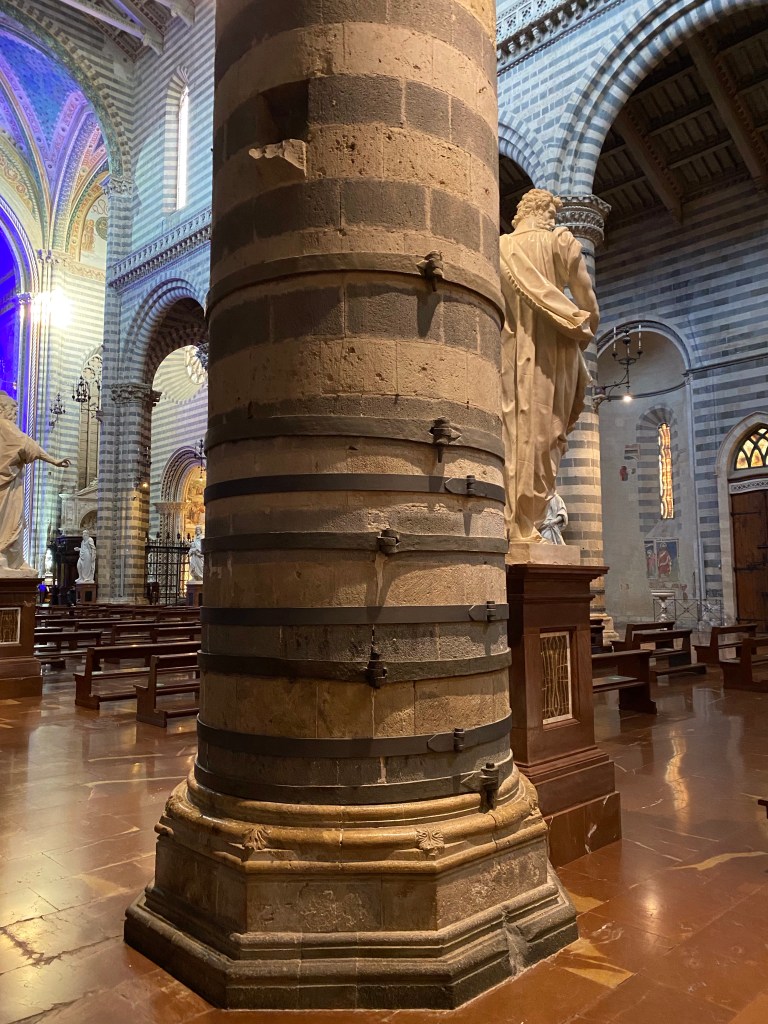
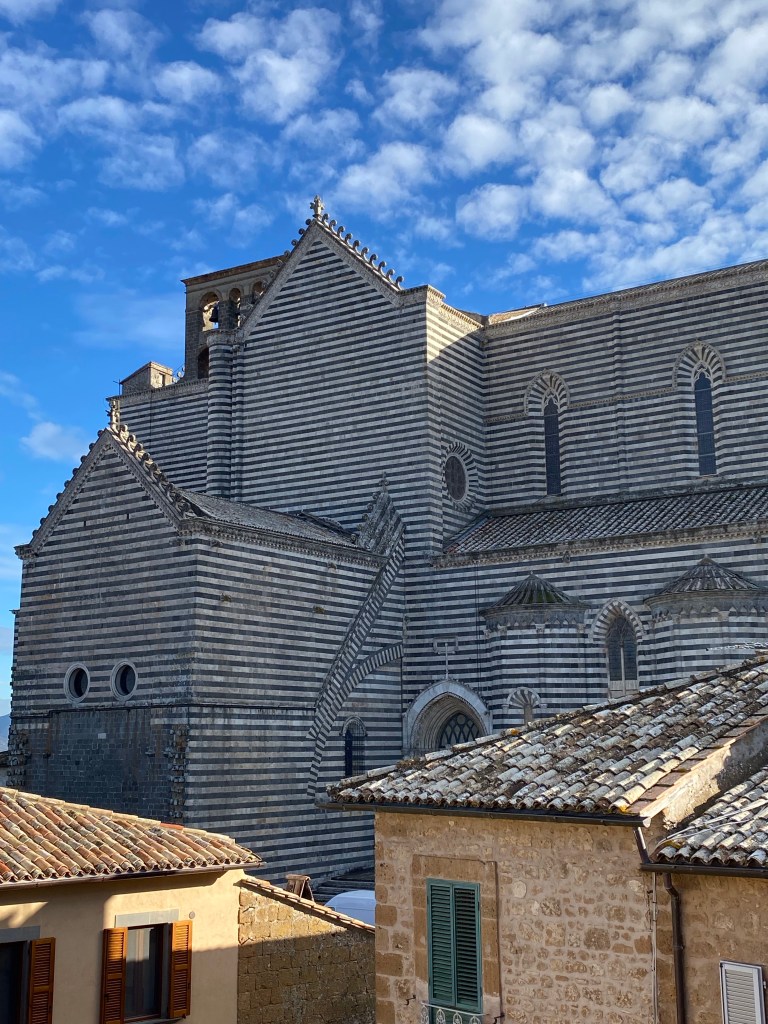
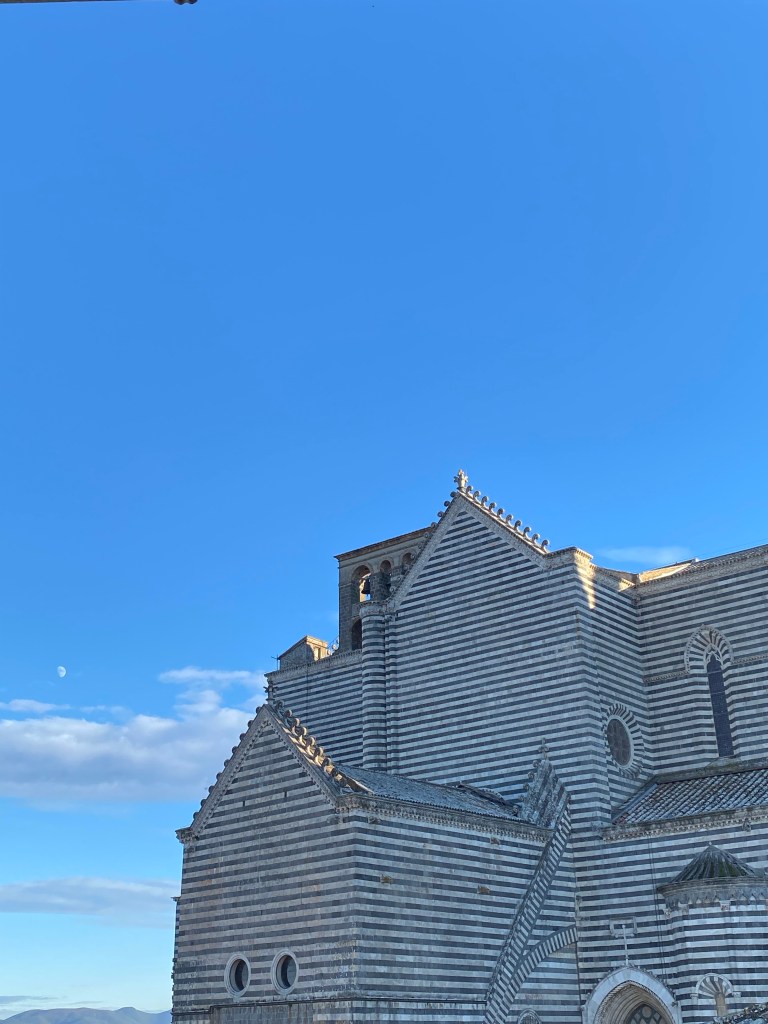
The cathedral’s side walls, in contrast to the façade, are more simply furnished with alternating layers of local white travertine and blue-grey basalt stone.
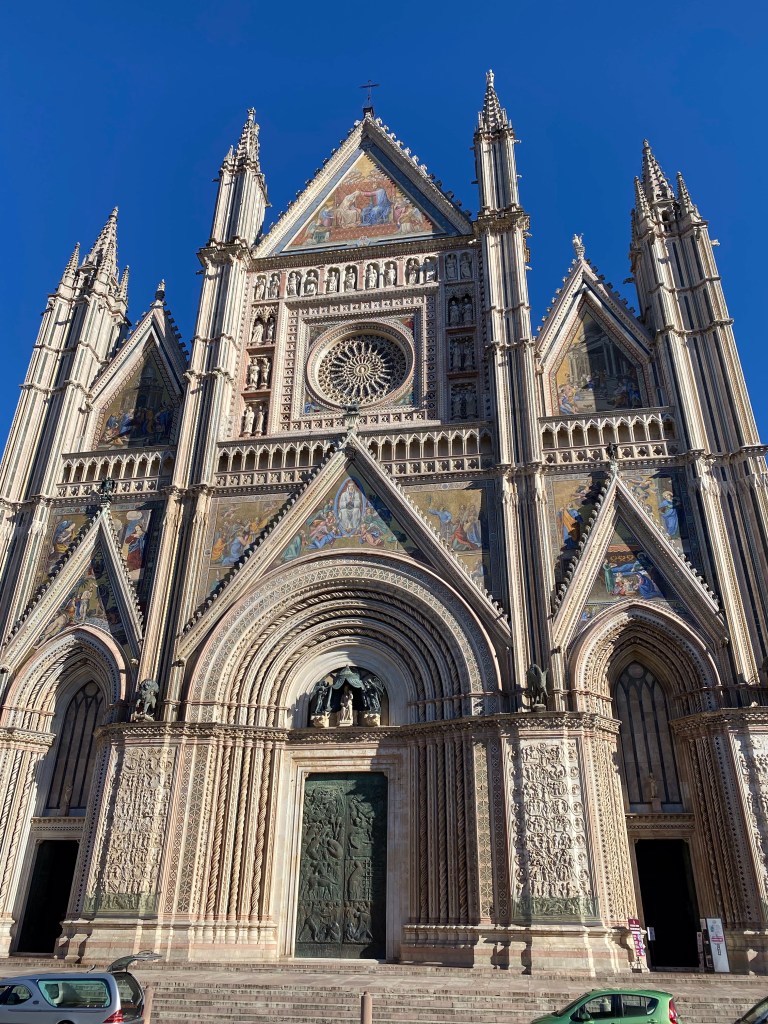
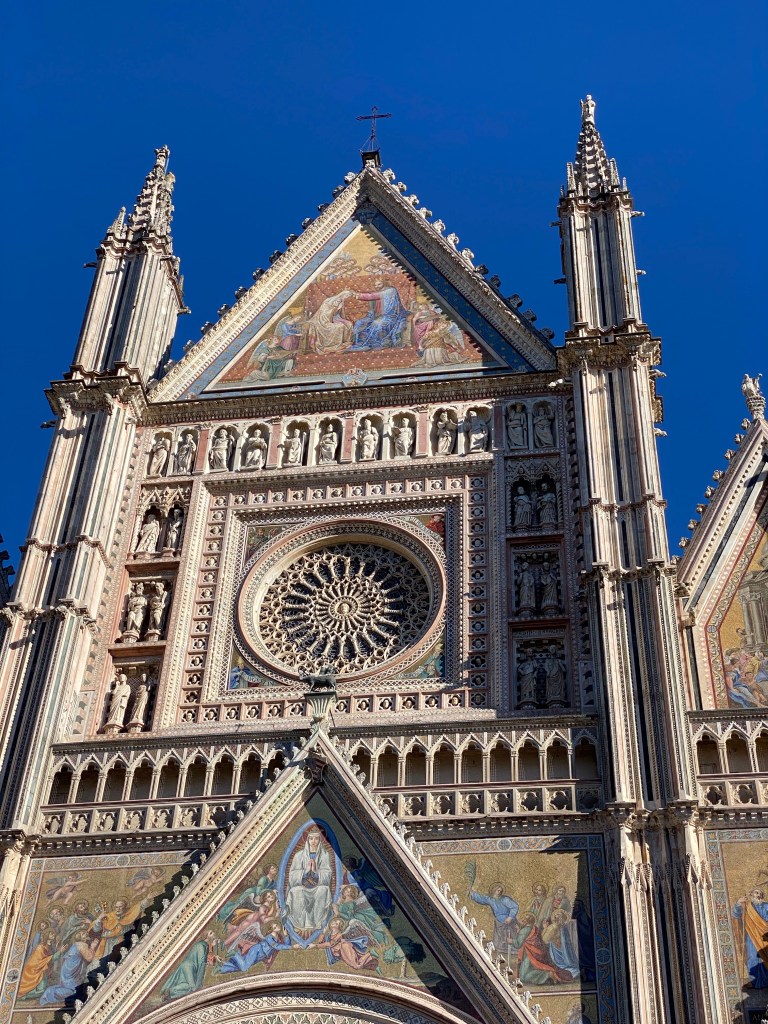
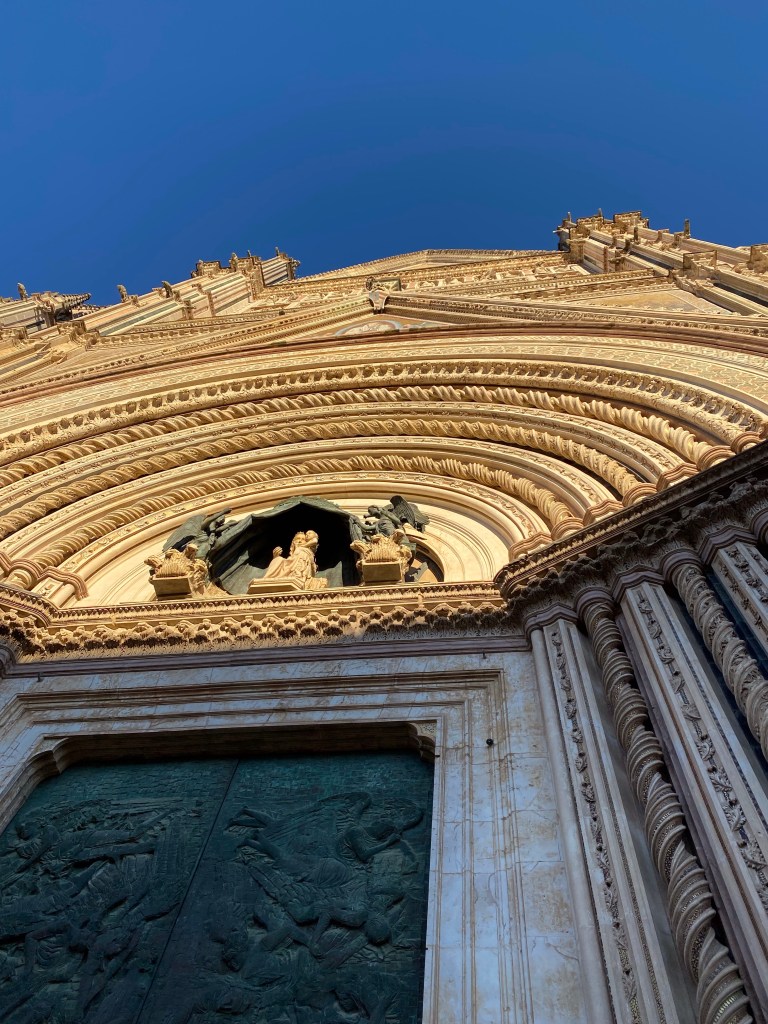
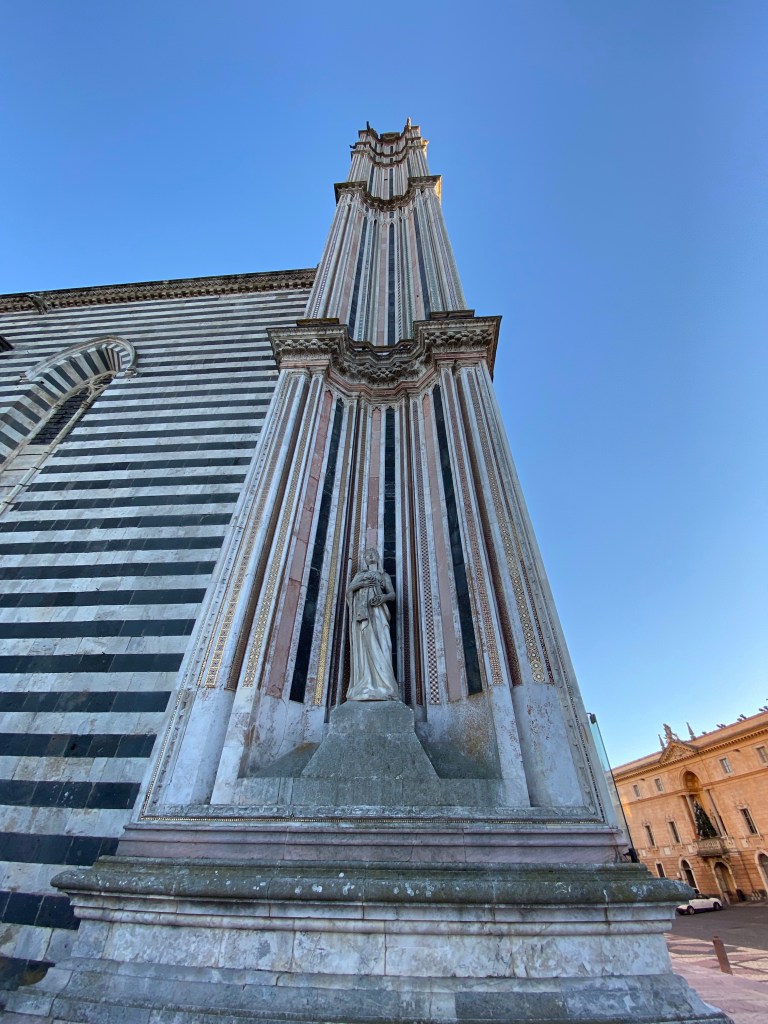
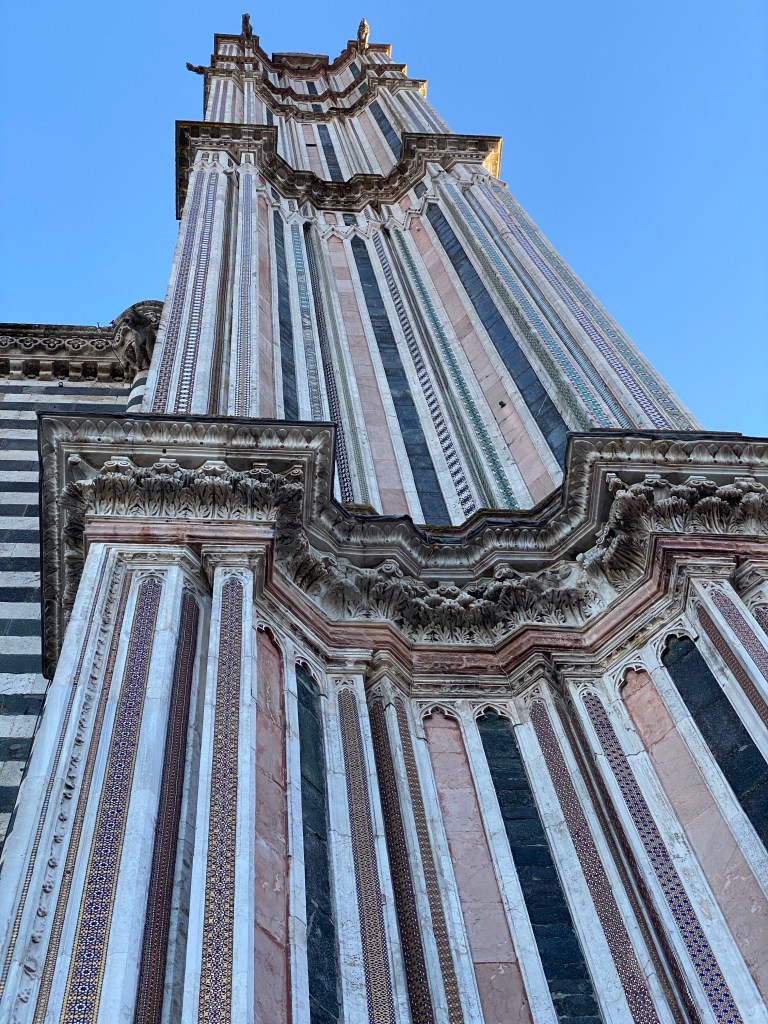
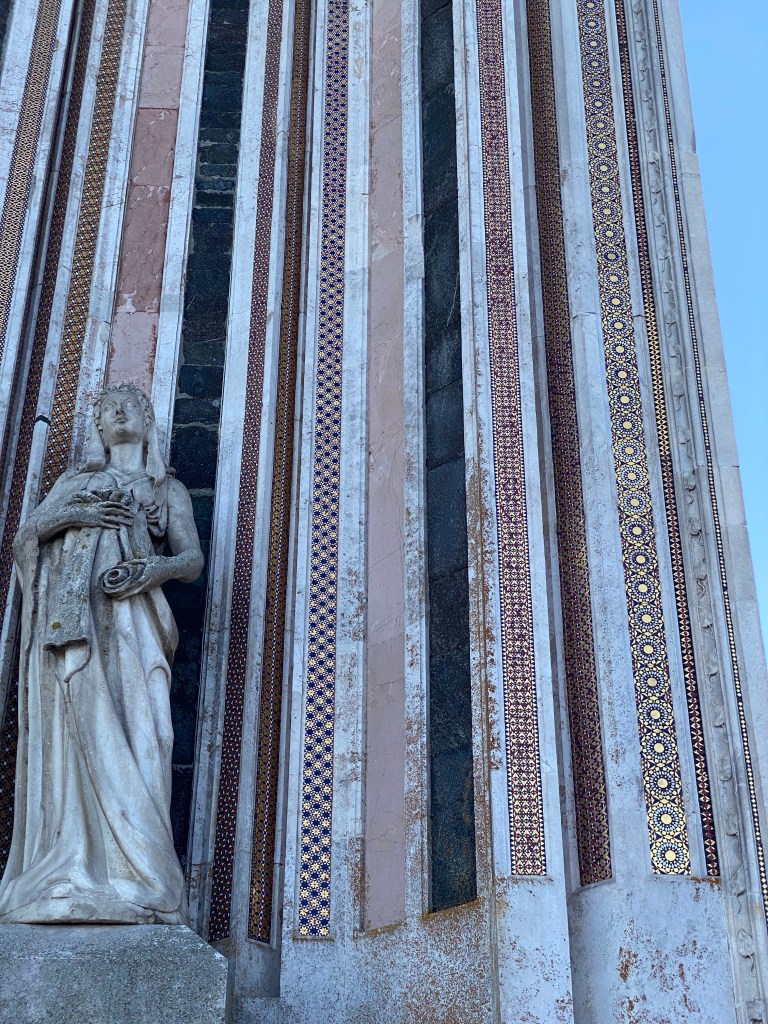
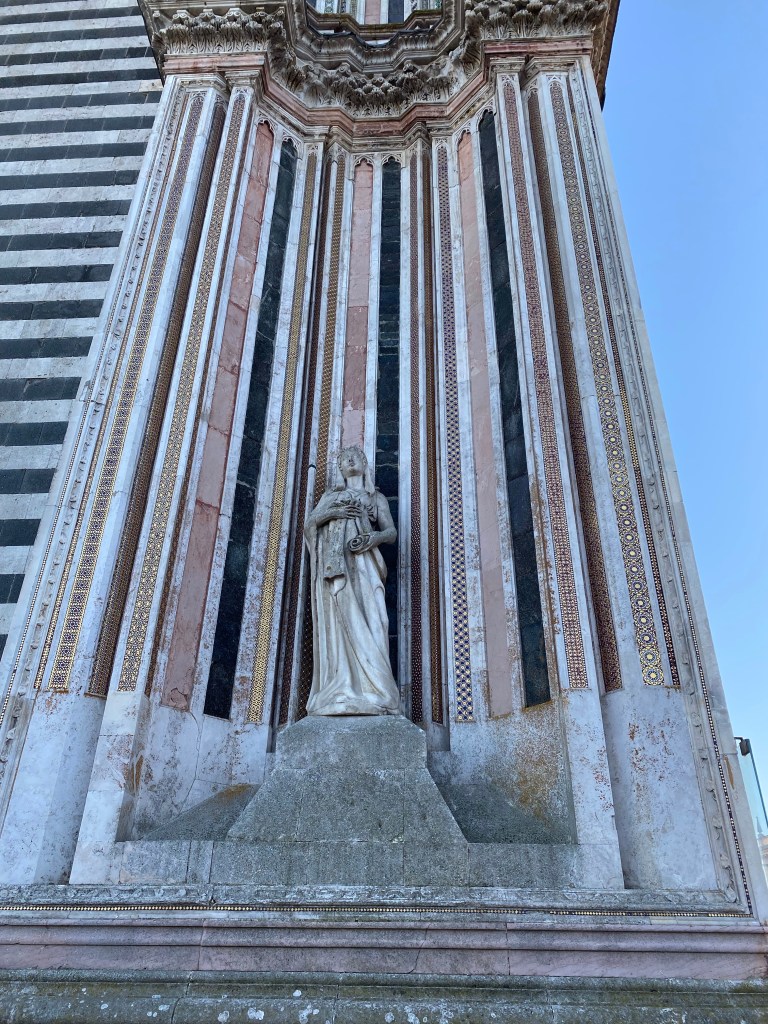
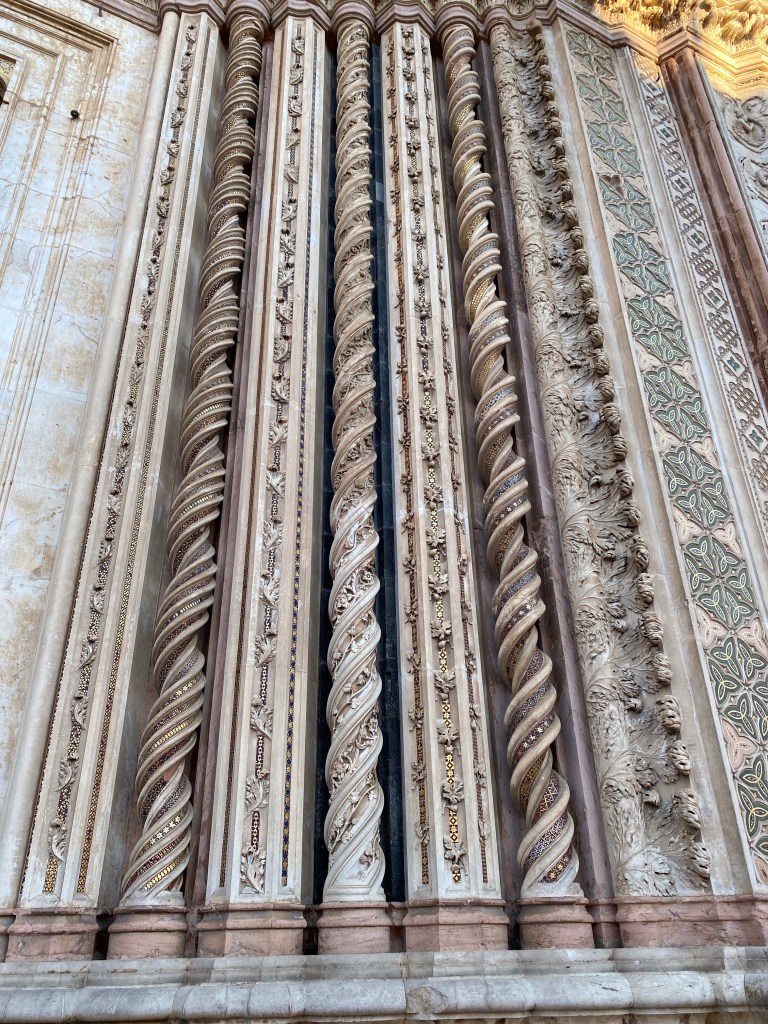
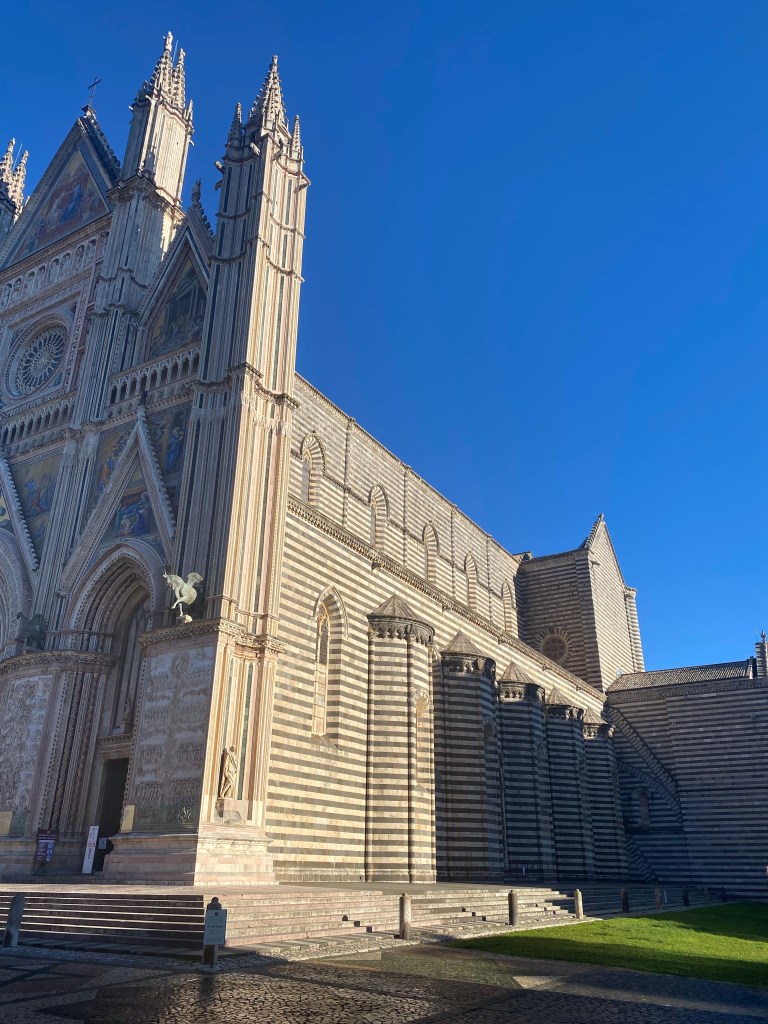
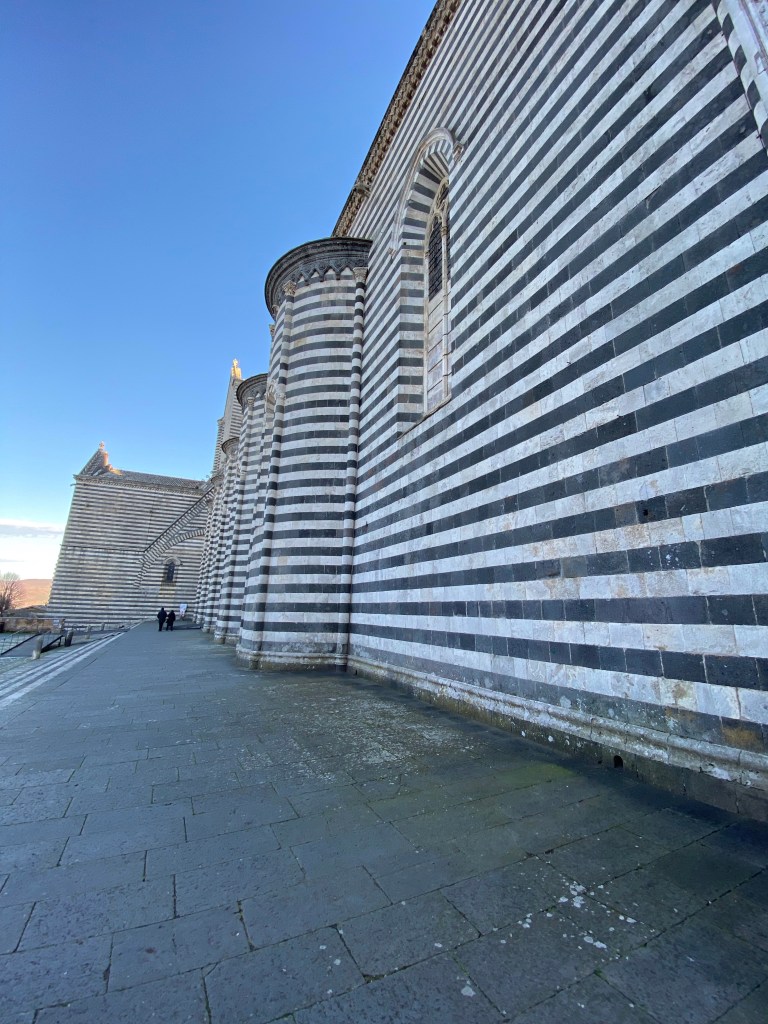
The next few pictures were taken from my hotel room. I had a stunning view of the cathedral.

The Grotto inside the Palazzo Corsini, Florence.
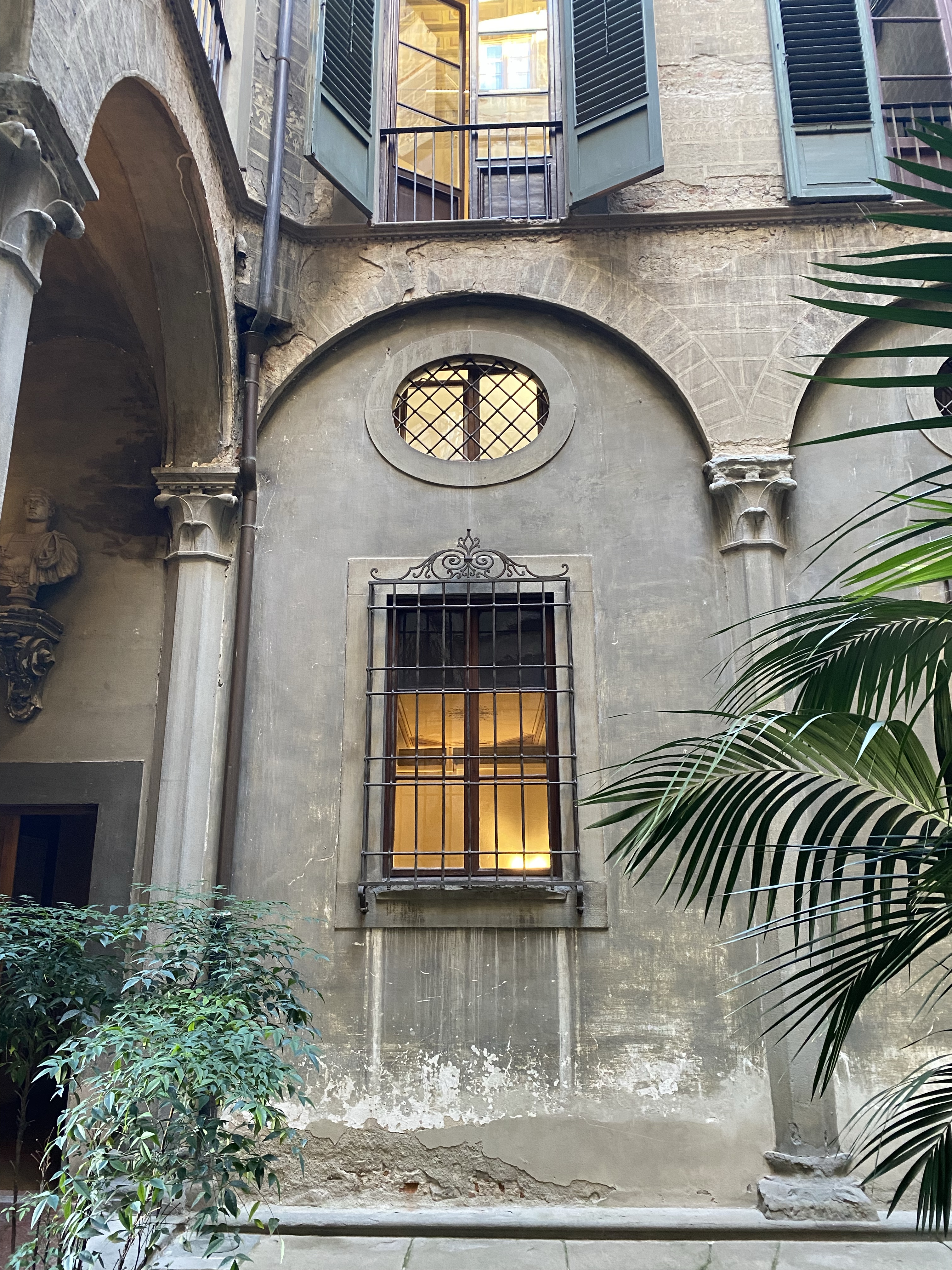
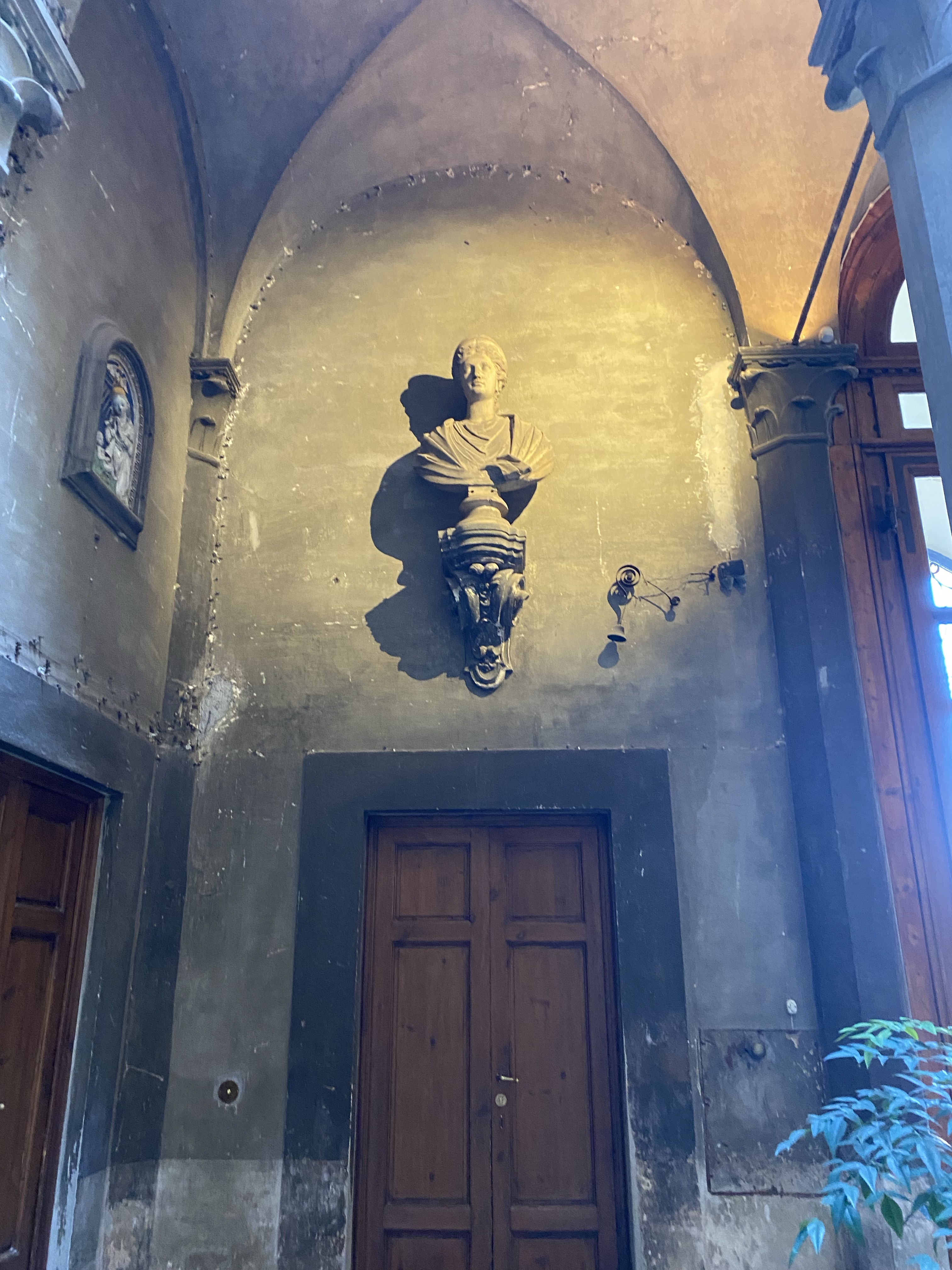
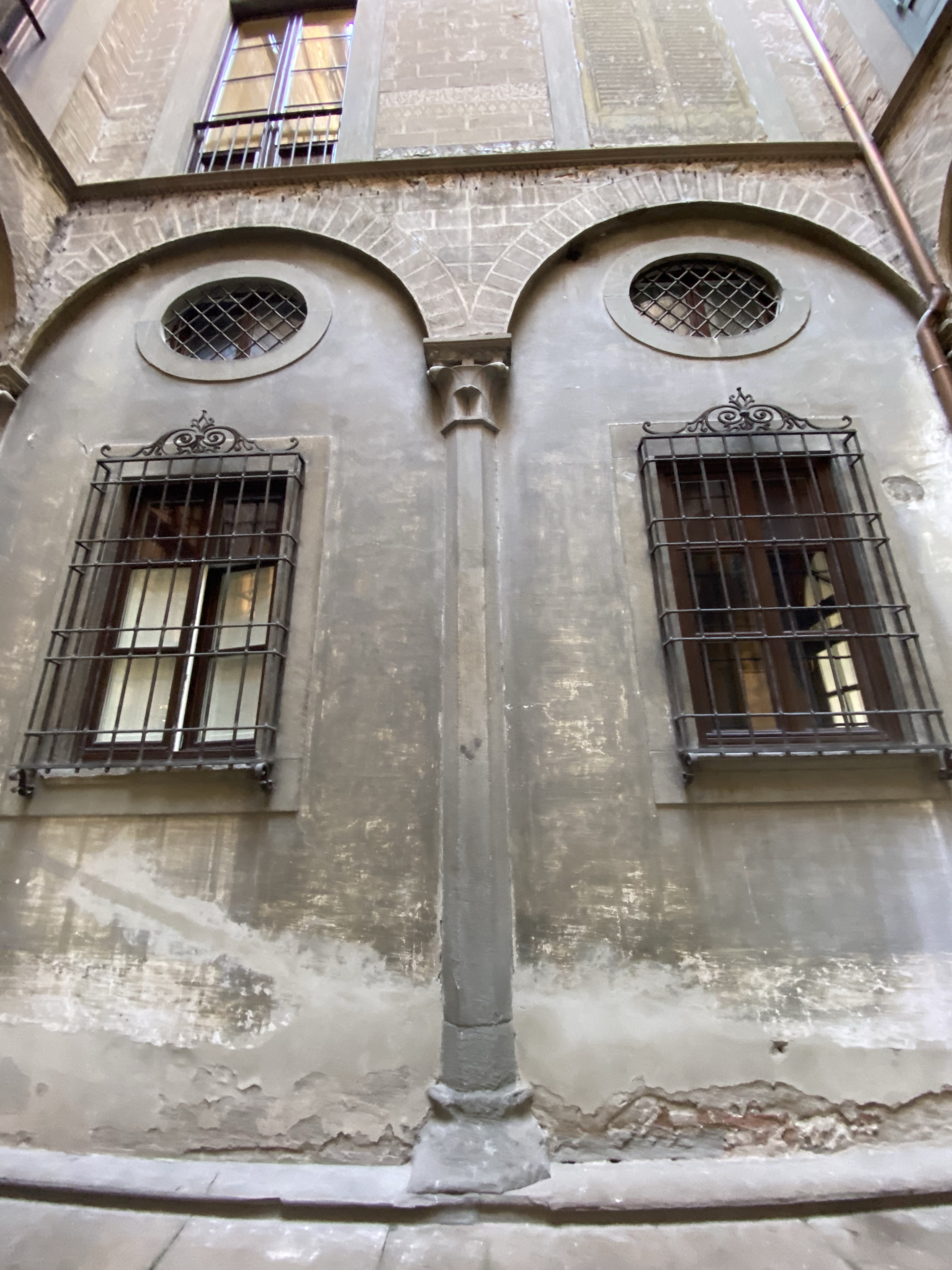
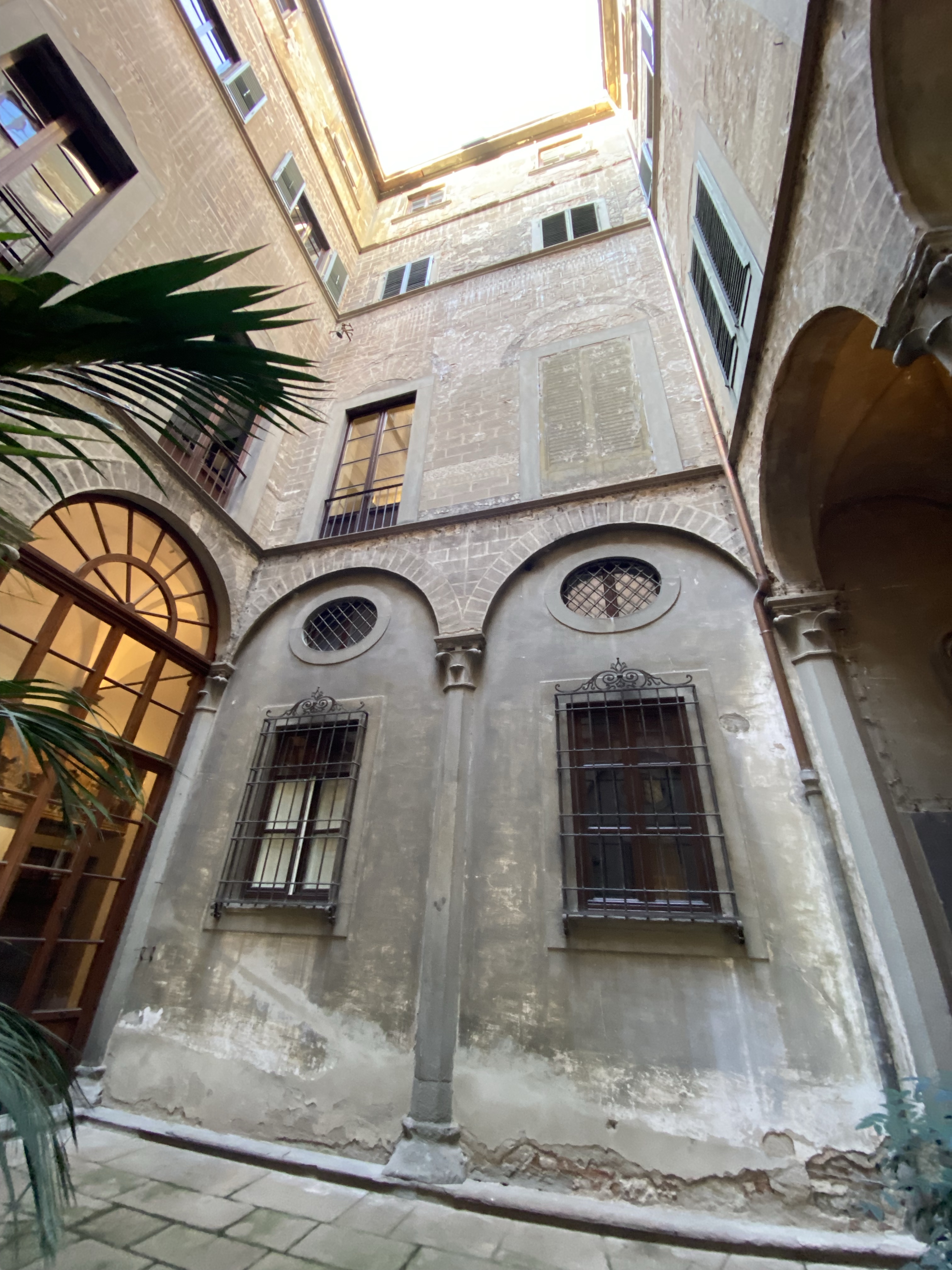
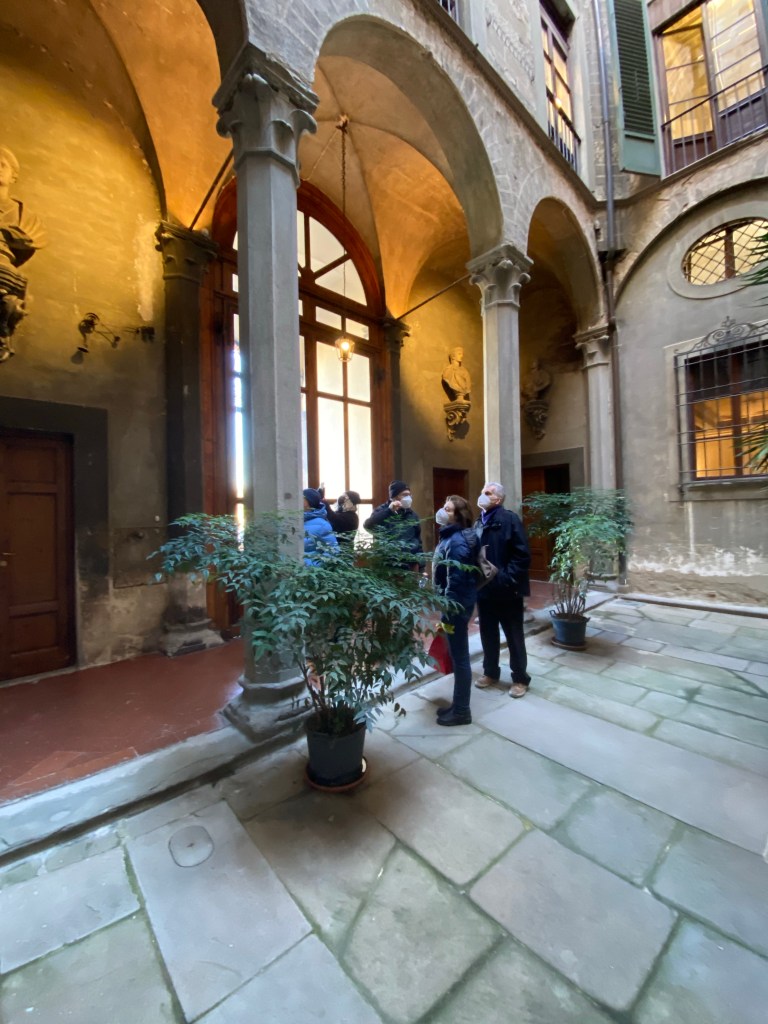
Palazzo Capponi delle Rovinate, Florence
Last month I had the pleasure of visiting this private palace in Florence with a group of friends. It is still the hope of the Capponi family and so closed to the public. However, Stanford University is fortunate to call the palace home in Florence.
The curator of the palace showed us some holdings in the library, including an autographed copy of a book by Mark Twain. In the inscription, Twain recalled the character of Huck Finn. I wanted to take a picture, but this tour was very closed and it wasn’t allowed.
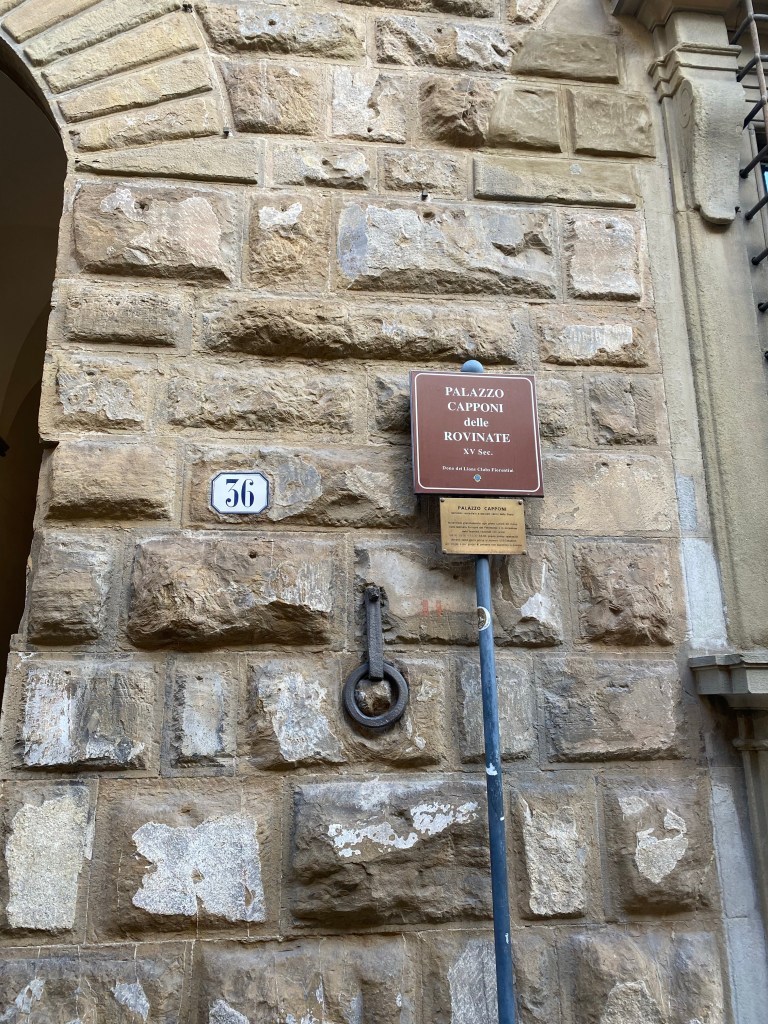
The 15th century façade of the palace on Via de’ Bardi.
Palazzo Capponi alle Rovinate is a late-Gothic and early Renaissance-style residential palace located on Via de’ Bardi in Florence. There are apparently three other palaces once associated with the Capponi family: Palazzo Capponi, Palazzo Capponi-Vettori, and Palazzo Capponi-Covoni.
The palace was built, perhaps by Lorenzo di Bicci (although other scholars have attributed it to Filippo Brunelleschi) for Niccolò da Uzzano. It was finished around 1426. After his death a few years later, it was acquired by the Capponi family
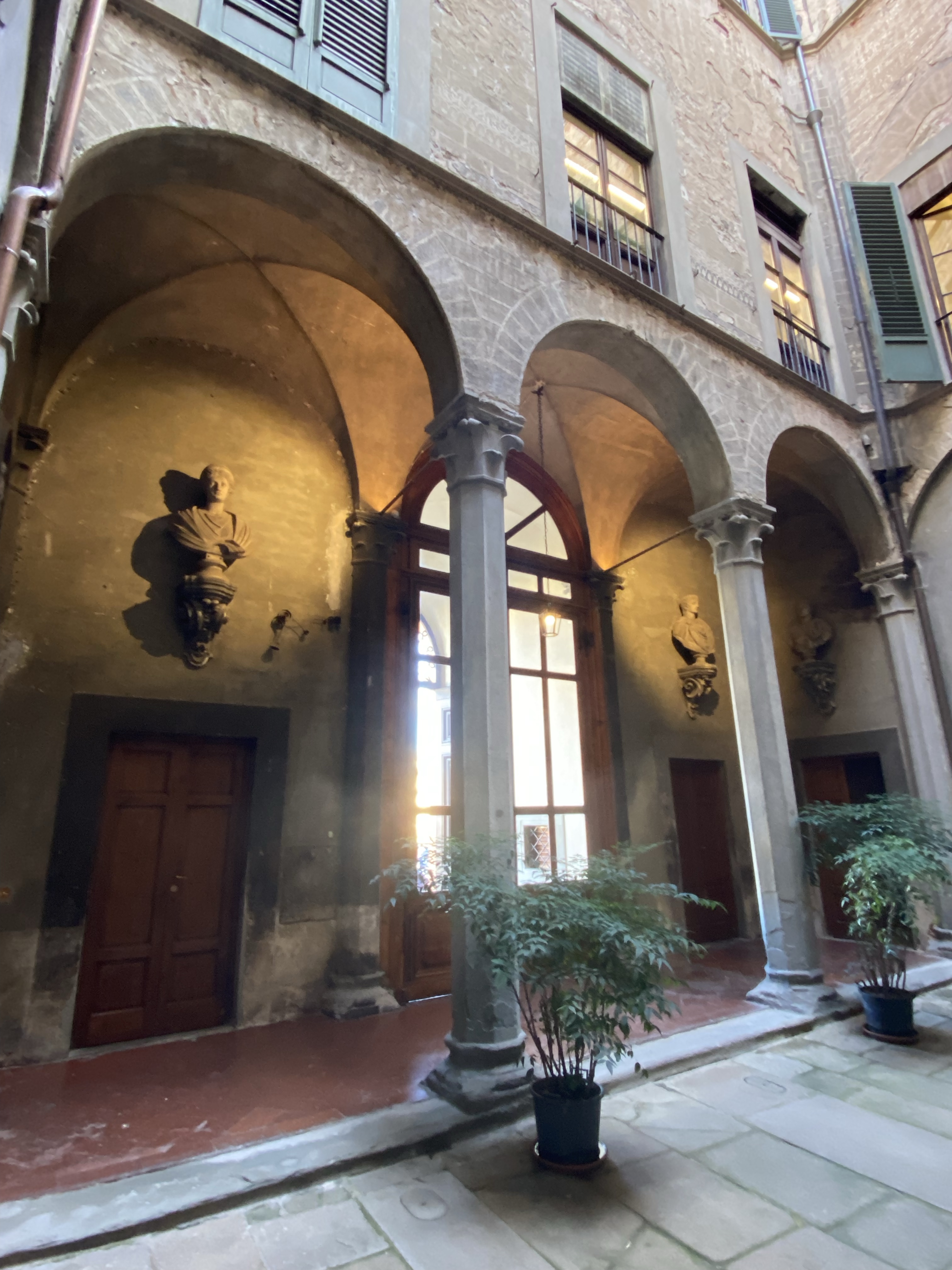
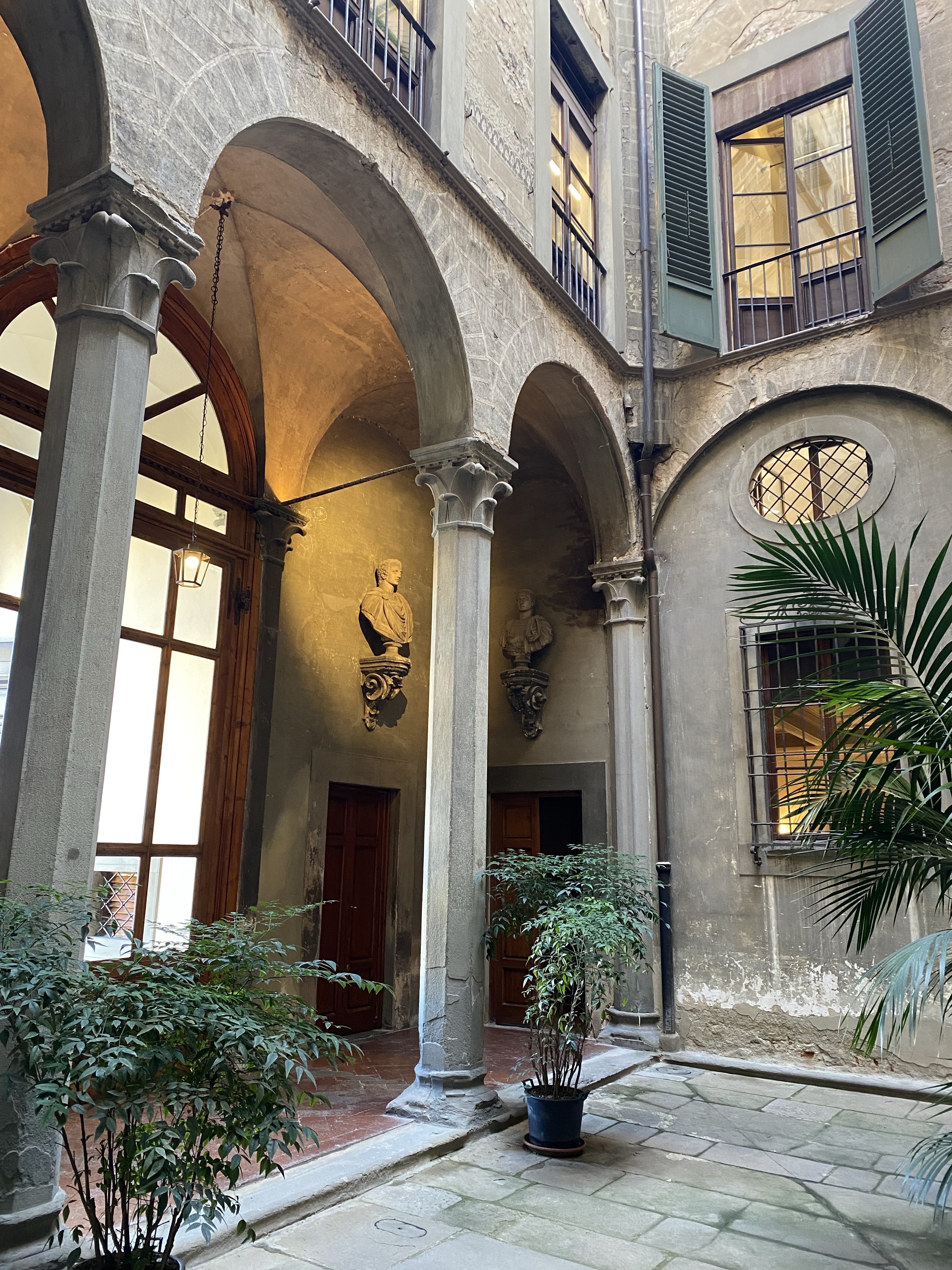
It has a 15th-century late-Gothic façade with a sober rustication at the lower floor, surmounted by irregular rows of mullioned windows (some closed and replaced by rectangular openings). The plan is nearly square, with a central courtyard in Renaissance style. This has porticoes on each side, with graffiti decorations dating to the 1450s and octagonal capitals in a still late medieval style. The porticoes are cross-vaulted.
The entrance on Via de’ Bardi has fresco, attributed to Lorenzo di Bicci himself, with two flying figures holding the Uzzano coat of arms. Internally, at the feet of the main staircase, is a porphyry lion, an ancient Roman sculpture from the 2nd century AD.
In the piano nobile is a small chapel with an altarpiece by Pontormo, perhaps taken from the Barbadori Chapel of the church of Santa Trinita. There is also a stained glass window, with the Deposition from the Cross, by Guillaume de Marcillat (1526).
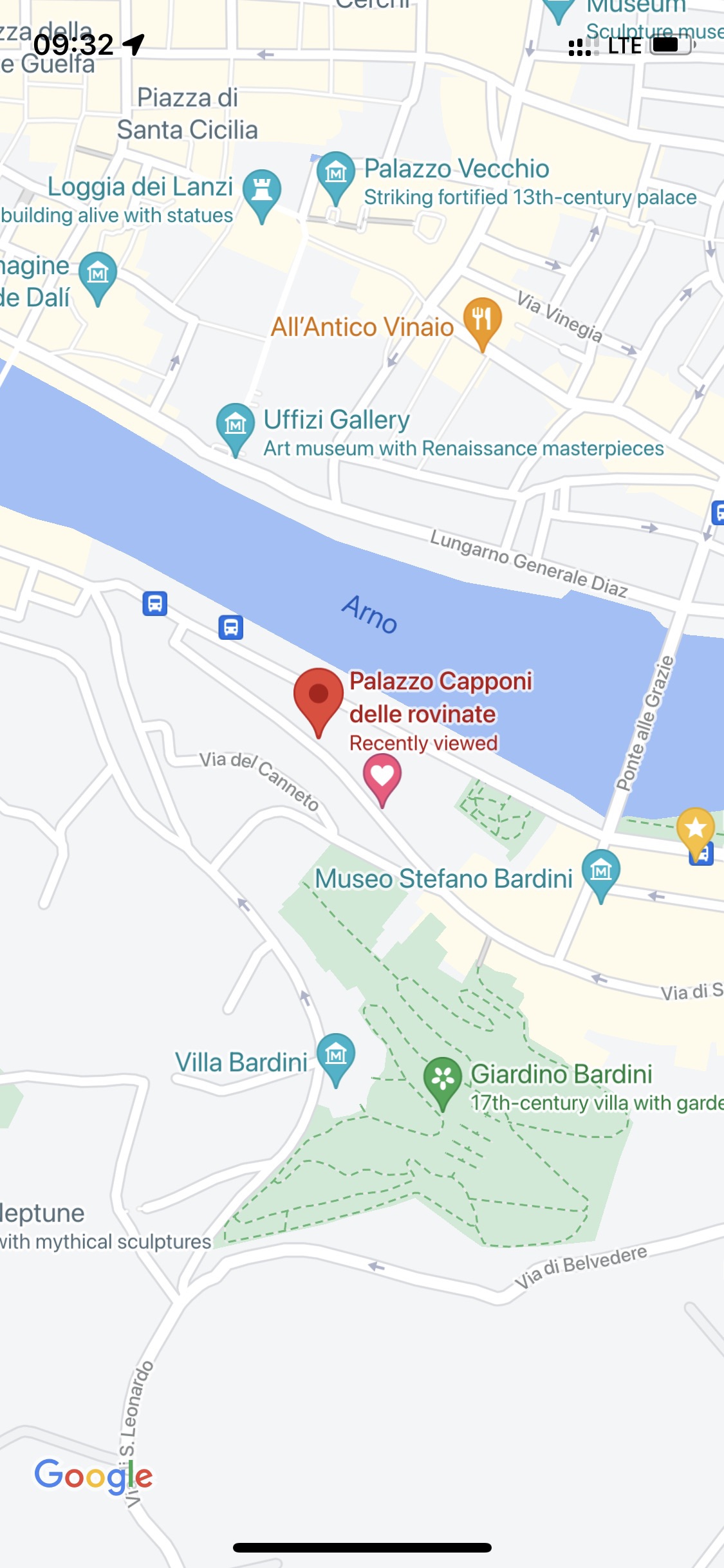
The rear façade, added in the 19th century, overlooks the Arno River.
The Parma violet
I was recently lucky to travel to Emilia Romagna for a few days and a highlight of that journey was time spent in Parma. I fell under the spell, while there, of the Parma violet and its association with the history of this town. You can nowadays find it in the soaps, the perfumes, the candies, and even the savory foods of Parma. Please enjoy!
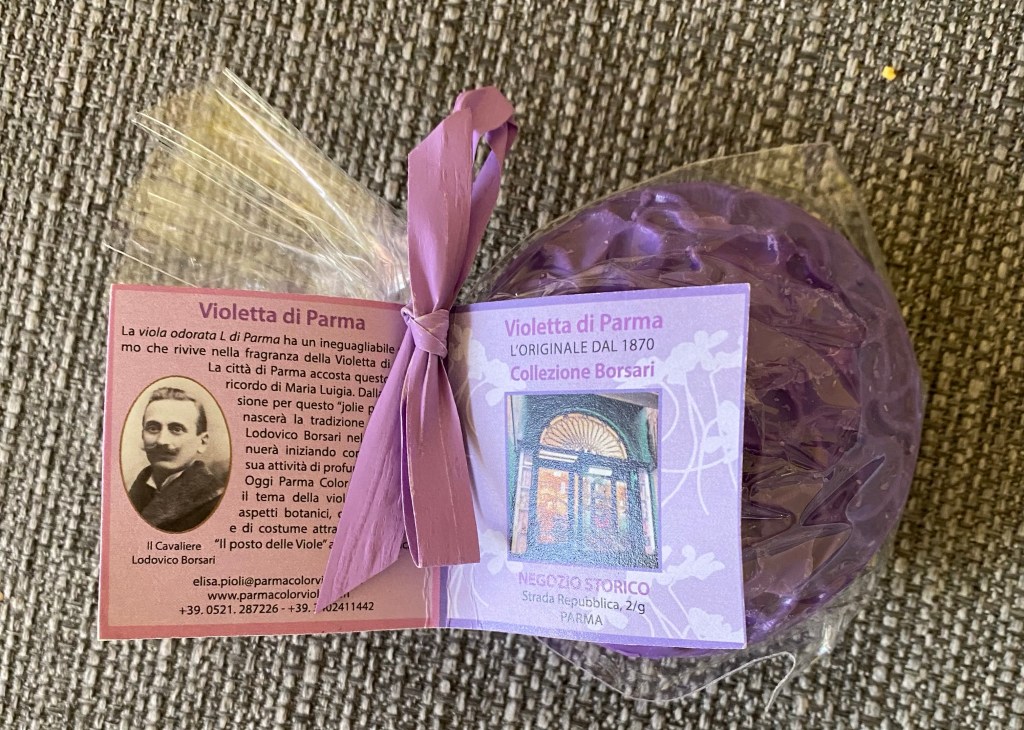
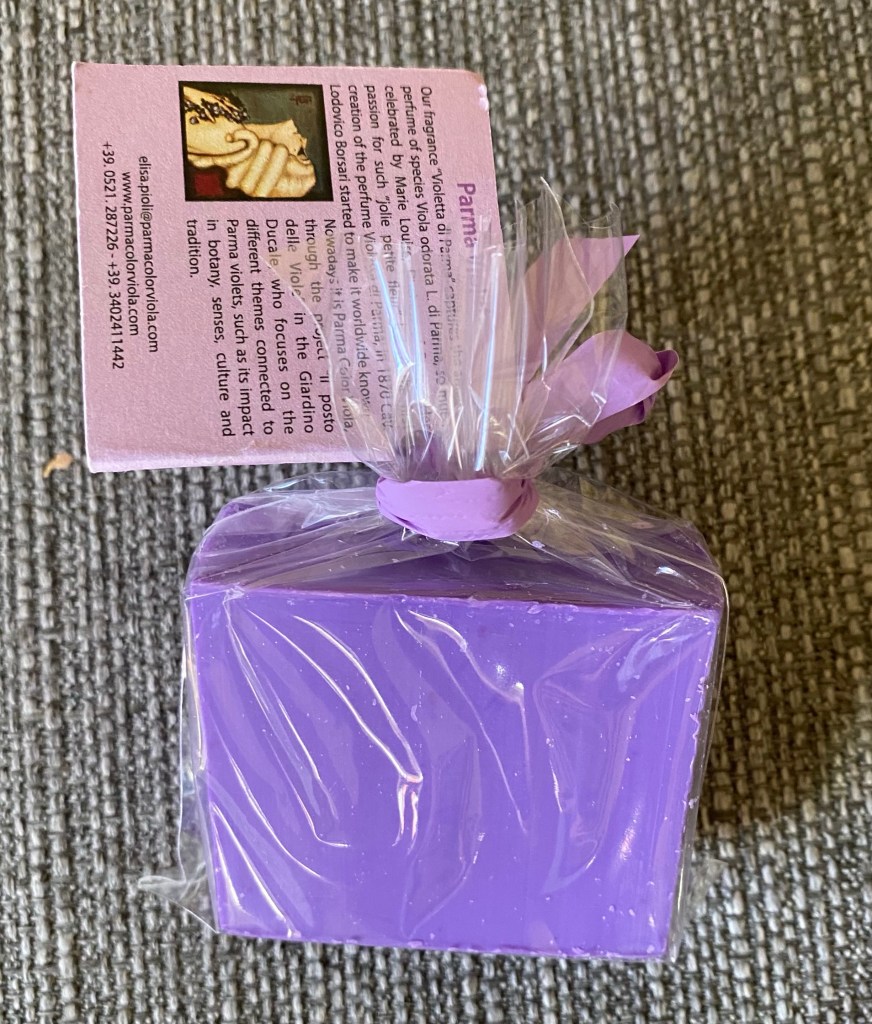
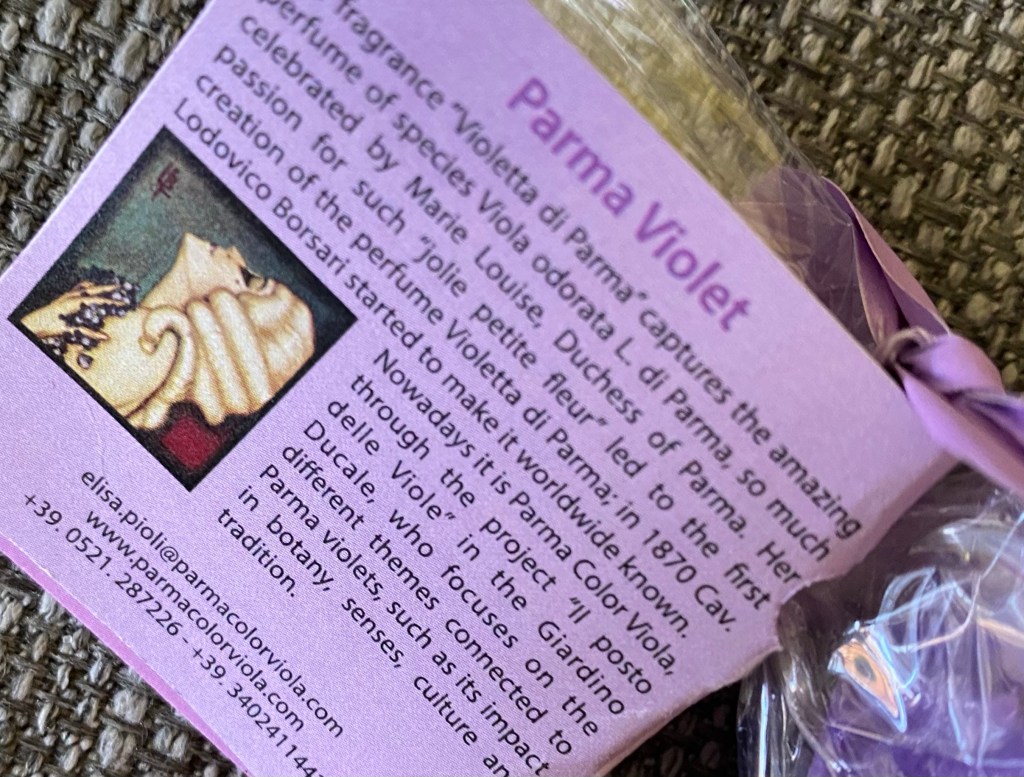

Parma violets belong to the more exotic branch of the violet family. First appearing in Italy, in the 16th century, most types of parma violets have lavender flowers of varying sizes, which have an attractive fragrance.
The origins of the parma violet are unknown, though they have been shown to be derived from two different Viola alba strains, and more closely resemble, in flower colour and odour, Viola odorata. It was first imported into Naples in the latter part of the 19th century, when Filippo di Brazza took the plant to Udine. There are no records of his work, though it is widely believed that he deliberately crossbred to produce at least two varieties of parma. One of these is still available, whereas the other one is romantically believed to languish in some forgotten back garden somewhere, just waiting to be rediscovered.
Parma violets are widely believed to be sterile, and there is much store laid by their reproduction through cuttings. Armand Millet, a French violet grower, proved this belief to be a myth, however, and with the right conditions any sturdy violet could well produce a seed pod.
Parma violet is a deepish shade of violet descriptive of these flowers.
The delicate purple flowers of the parma violet plant also give their name to a delicate, violet-scented sweet Parma Violets, manufactured by Swizzels Matlow.
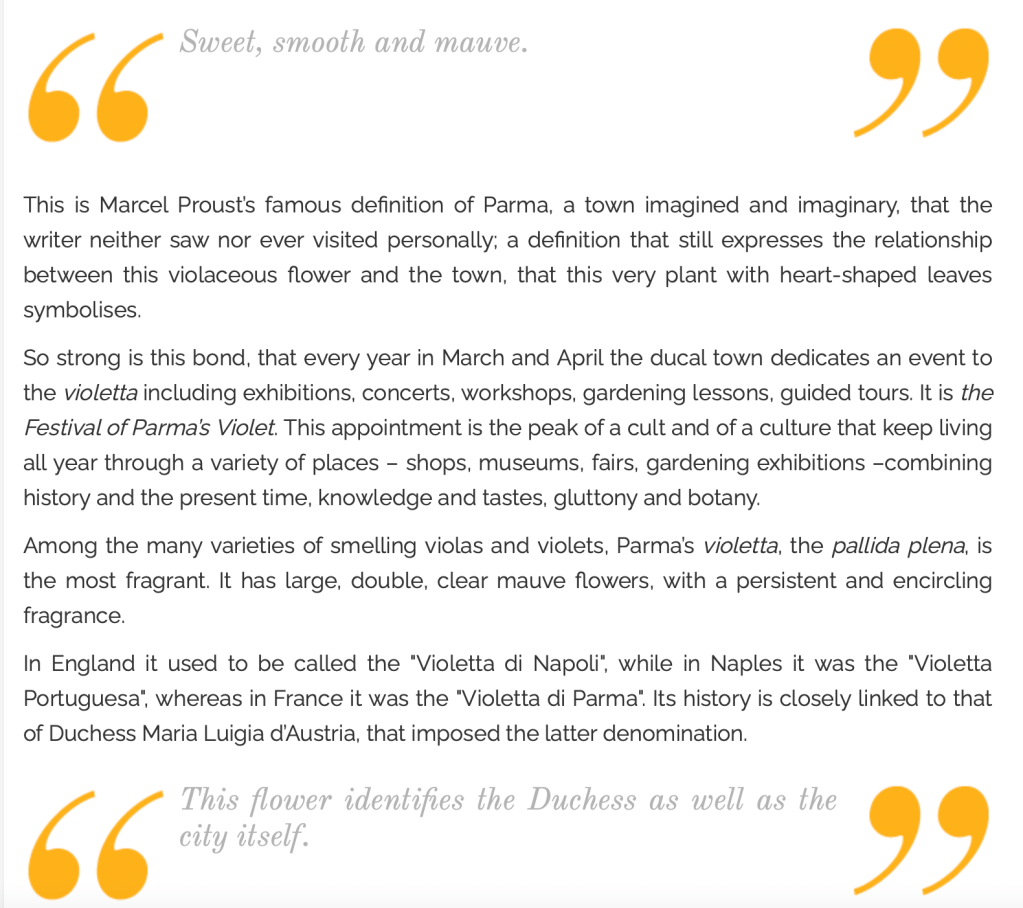
These are the words of Francesca Sandrini, Director of Glauco Lombardi Museum, where all of Maria Luigia’s relics are kept, a sentence that perfectly portrays the relationship between the Austrian Duchess and the violetta, which even adorned her wedding dress.
The sovereign, the second wife of Emperor Napoleon Bonaparte, became regent of the Duchy between 1816 and 1847, governing wisely and spreading her love for beauty.
She dedicated herself personally to the cultivation of this plant, as is demonstrated by the words that she wrote in Vienna in 1815, before settling in Italy: “Please let me keep some plants of Parma’s Violets with written instructions on how to plant them and make them flourish; I hope they will grow well, because I am becoming a botany scholar and I will be happy to grow this graceful little flower … “.
She showed unconditional love for this elegant flower that soon became her hallmark, to be found, engraved or painted, on plates, china, fans, thimbles, writing paper, even reaching the point of replacing her signature or monogram. Purple were also the garments and clothing of her servants and courtiers.
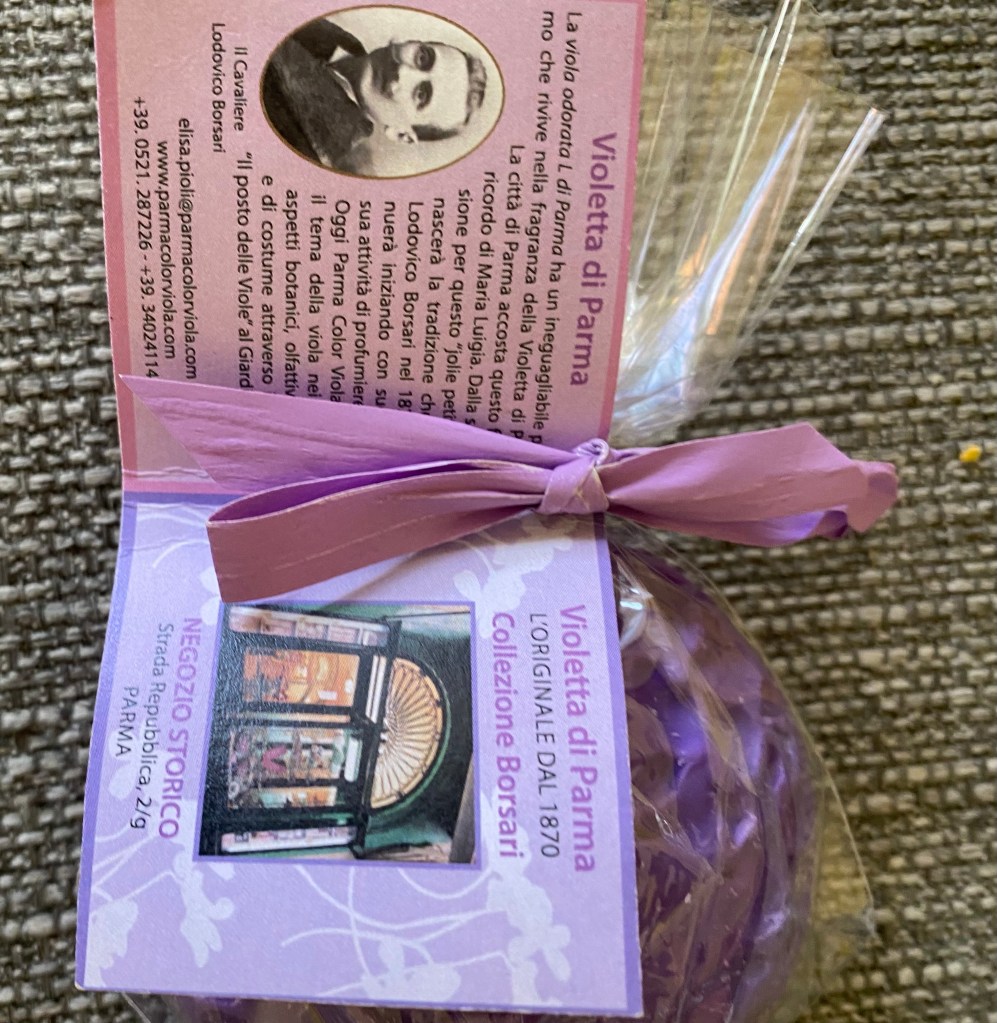
Not content with using violetta as a decorative pattern only, Maria Luigia even decided to make it her personal scent. Thanks to the patient work of the monks in the ancient convent of the Annunciation, the essence was extracted and the Duchess could bring her violetta everywhere, making of this scent the official perfume of the court. In 1870, after her death, the secret formula invented by the monks passed on to Lodovico Borsari, who produced and marketed the ducal essence transforming his company into the largest Italian nineteenth century perfume industry – and its success still continues today.
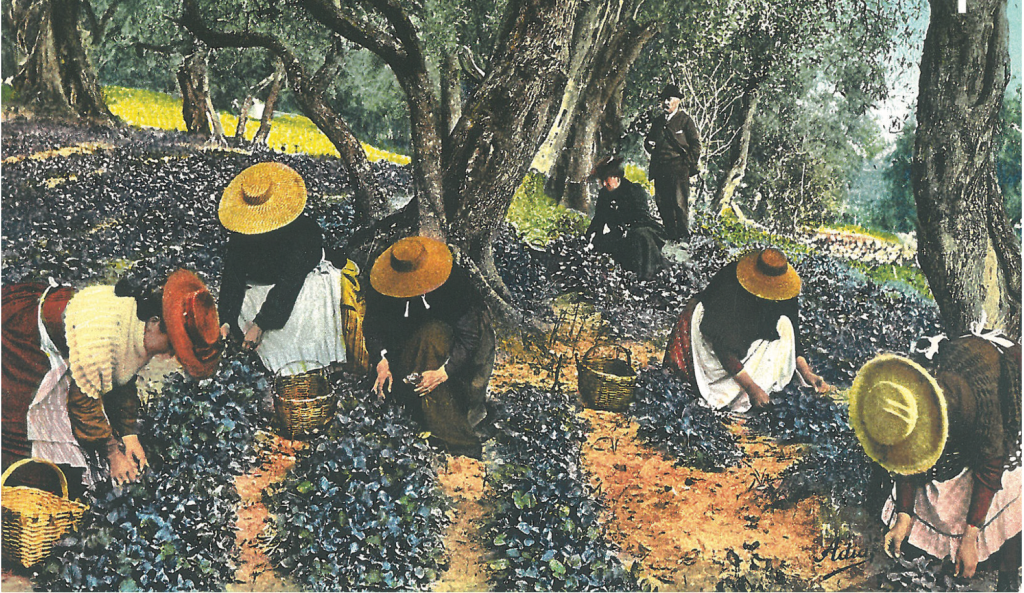
Besides being used for decoration and as a sedative and detoxicant in herbal preparations, the candied violetta is one of the ingredients used in confectionery to garnish desserts, ice-cream, cakes or simply to be enjoyed with coffee.
Recipe for Candied Violets
And now, the sweet conclusion of this story is the original recipe that women peasants used to prepare irresistible candied violets. After washing the flowers, they were made to dry in dark rooms and then treasured in glass jars away from light.
Ingredients:
1 cup of violets (50 Flowers)
a sufficient quantity of water
a sufficient quantity of sugar.
Wash violet flowers without removing the stem and put them down to dry on a cotton cloth.
Meanwhile, put a saucepan with sugar and a few tablespoons of water on a low fire until it gets brownish; don’t let it get caramelized.
Take violets from the stem, dip them into sugar and place them on a plane surface, covered with wax paper. Once cooled, they are ready to be used according to your fancy.
A simple recipe, whose sweet and romantic notes preserve and embody the essence of spring and of Parma!
https://madeinparma.com/en/news/violets-love-and-candied-violets
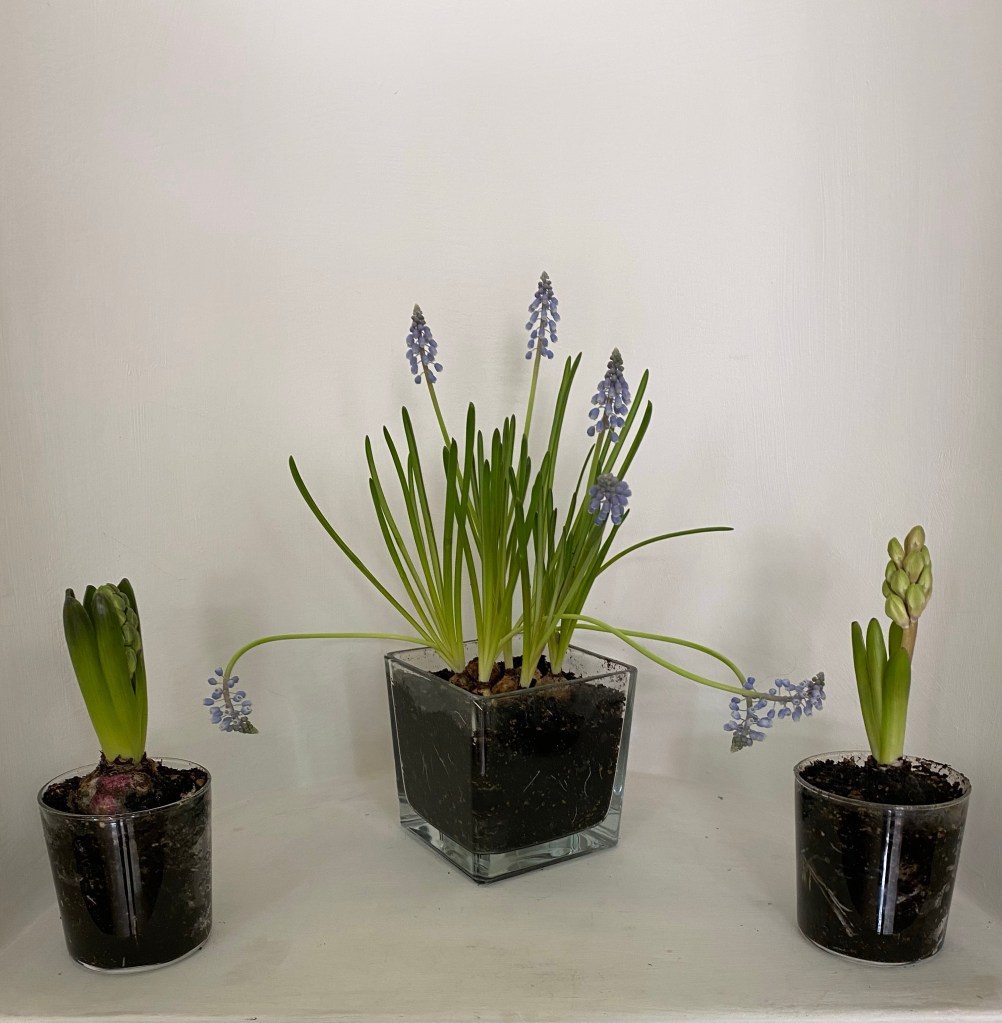
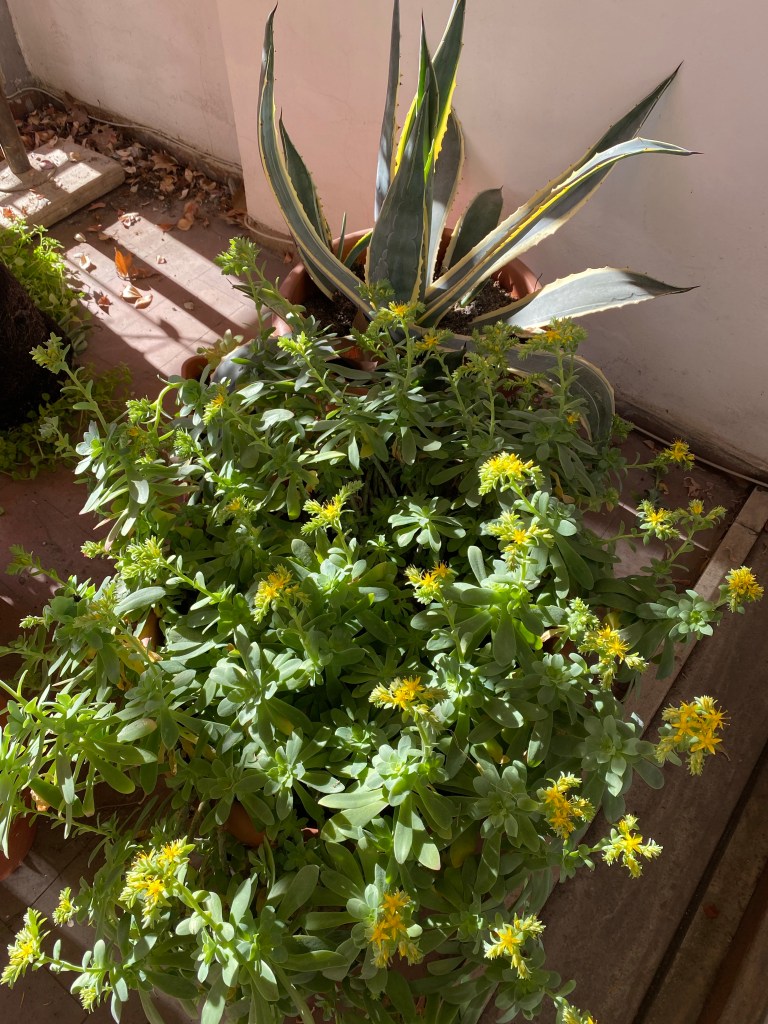
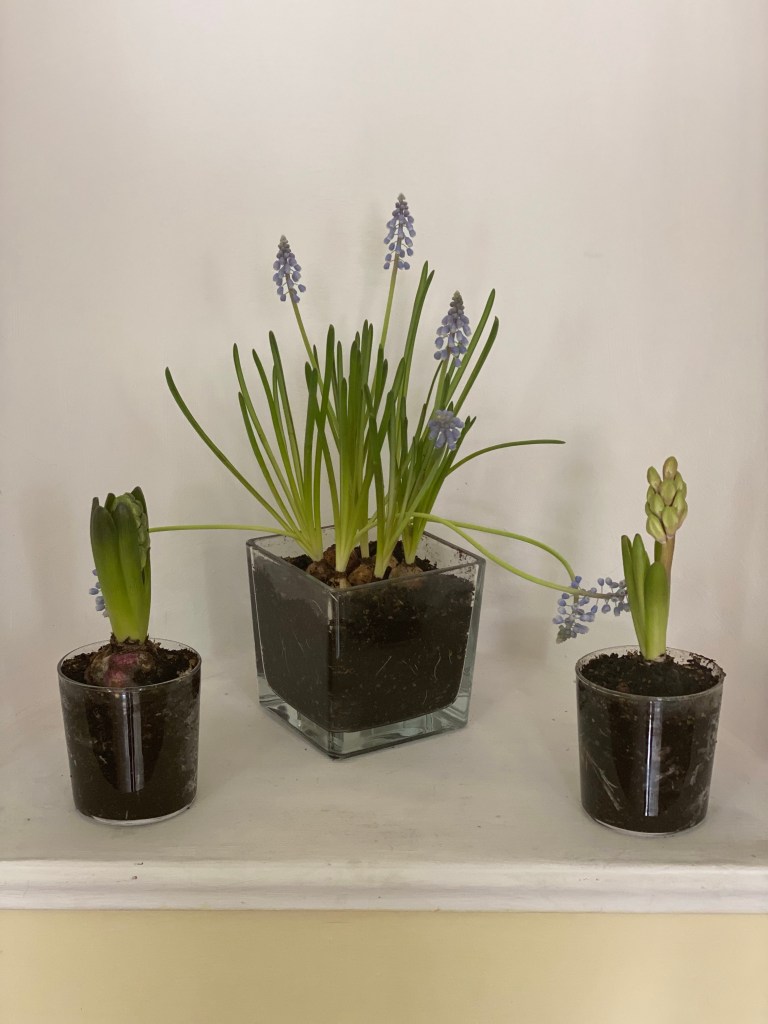
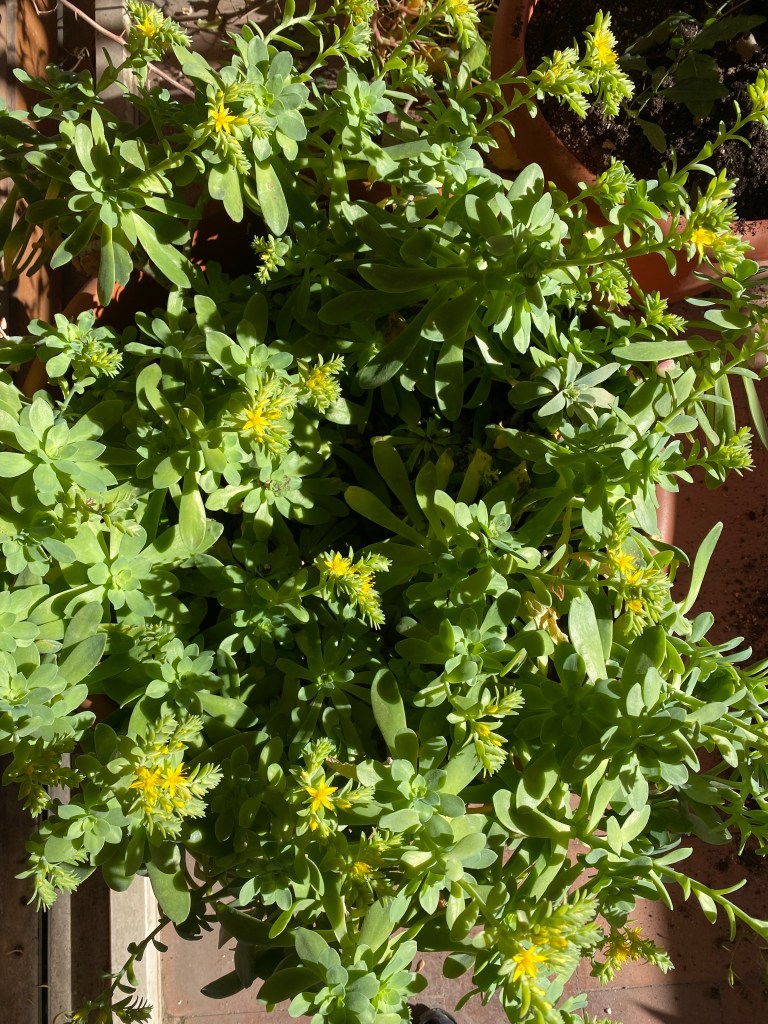
It feels like spring today!
Indoors and outdoors!


You must be logged in to post a comment.