I Giardini di Villa Melzi


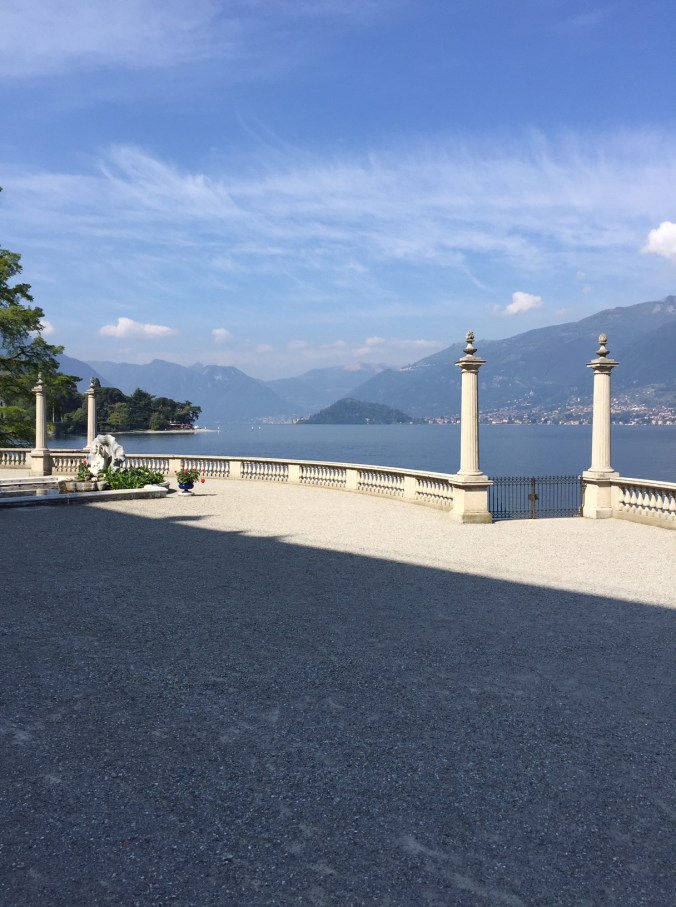
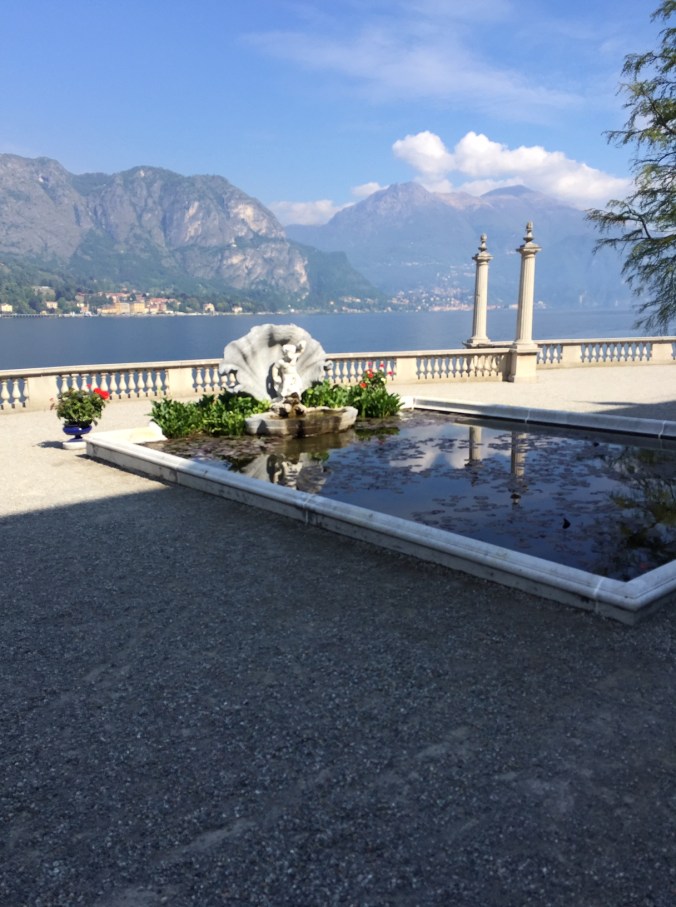


I Giardini di Villa Melzi
The Sant’Anna di Stazzema massacre was a Nazi German war crime, committed in the hill village of Sant’Anna di Stazzema in Tuscan, in the course of an operation against the Italian resistance movement during the Italian Campaign of World War II.
On the morning of August 12, 1944, the German troops entered the mountain village of Sant’Anna di Stazzema, accompanied by some fascists of the 36th Brigata Nera Benito Mussolini based in Lucca, who were dressed in German uniforms.
The soldiers immediately proceeded to round up villagers and refugees, locking up hundreds of them in several barns and stables, before systematically executing them. The killings were done mostly by shooting groups of people with machine guns or by herding them into basements and other enclosed spaces and tossing in hand grenades.
At the 16th-century local church, the priest Fiore Menguzzo (awarded the Medal for Civil Valor posthumously in 1999) was shot at point-blank range, after which machine guns were then turned on some 100 people gathered there. In all, the victims included at least 107 children (the youngest of whom, Anna Pardini, was only 20 days old), as well as eight pregnant women (one of whom, Evelina Berretti, had her stomach cut with a bayonet and her baby pulled out and killed separately).
After other people were killed through the village, their corpses were set on fire (at the church, the soldiers used its pews for a bonfire to dispose of the bodies). The livestock were also exterminated and the whole village was burnted down.
All of this was accomplished in three hours. The SS men then sat down outside the burning Sant’Anna and ate lunch.
These crimes have been defined as voluntary and organized acts of terrorism by the Military Tribunal of La Spezia and the highest Italian court of appeal.
However, extradition requests from Italy were rejected by Germany. In 2012, German prosecutors shelved their investigation of 17 unnamed former SS soldiers (eight of whom were still alive) who were part of the unit involved in the massacre because of a lack of evidence.
The statement said: “Belonging to a Waffen-SS unit that was deployed to Sant’Anna di Stazzema cannot replace the need to prove individual guilt. Rather, for every defendant it must be proven that he took part in the massacre, and in which form.”
The mayor of the village, Michele Silicani (a survivor who was 10 when the raid occurred), called the verdict “a scandal” and said he would urge Italy’s justice minister to lobby Germany to reopen the case. German deputy foreign minister Michael Georg Link commented that “while respecting the independence of the German justice system,” it was not possible “to ignore that such a decision causes deep dismay and renewed suffering to Italians, not just survivors and relatives of the victims.”
Sources, Wikipedia and http://paradiseofexiles.com/liberation-day-in-italy/
In June 2008, seven centuries after Dante’s banishment, the city council of Florence passed a motion rescinding his sentence. It was one further ploy aimed at the repatriation of his remains, but it was no more successful than the previous attempts, and Dante’s remains still lie in a modest tomb beside the fifth-century Church of San Francesco in Ravenna.
Jones, Ted. Florence and Tuscany: A Literary Guide for Travellers (The I.B.Tauris Literary Guides for Travellers) (p. 37). I.B.Tauris. Kindle Edition.
On the afternoon of August 8, the partisan military command in Florence, knowing of the imminent the escape of the Nazis, issued the state of alarm to their teams, telling them to be ready for the insurrection.
The escape of the Germans began on the night of August 10. The Insurrection was begun as planned by the Allied Military Command and the CTLN. It was announced by the ringing of the Martinella, the bell of the tower of Palazzo Vecchio at 6:45 a.m. on August 11. Shortly after, the bell of Bargello rang too. The patriots were instructed to attack the German rearguards.
Simultaneously, the CTLN put up this poster in the streets:
The National Liberation Committee, has assumed, starting from today, August 11 at 7:00 a.m., all the powers of temporary government that are due to it, as representative body of Tuscan people and for delegation of the democratic government of freed Italy. The CTLN have occupied the city since this morning and, standing in defense of the city itself, fight against the Germans, the Fascists and the snipers.
All the citizens must contribute with all their strength to the liberation of the city, giving all available moral and material help to our courageous patriots. The heavy sufferings of the population are coming to an end with our victory. We greet the victorious Allied Armies and we prepare to welcome them, with the fraternity that we feel for all the comrades in arms fighting for the same cause. Let’s conquer the right to be free people, fighting and dying for freedom.
The Tuscan Comitate of National Liberation.
The insurrection had begun.
About 7:00 a.m., the CTLN left via Condotta and entered in Palazzo Medici Riccardi, surrounded by the crackling of machine guns.
People started to leave their homes.
In a semi-deserted via Cavour there was spontaneous applause and some timid invocation from about ten people: “Viva il Comitato di Liberazione” (Long live the Comitate of Liberation). Military command was settled in Palazzo Medici Riccardi. The battle of Florence lasted from August 11 to September 1, 1944.
There were 205 killed in action, 400 injured, 18 missing, from August 3 to September 2. Overall, in the province of Florence, there were 1530 partisans deported or executed by firing squad.
And then Florence was free.
Sources:
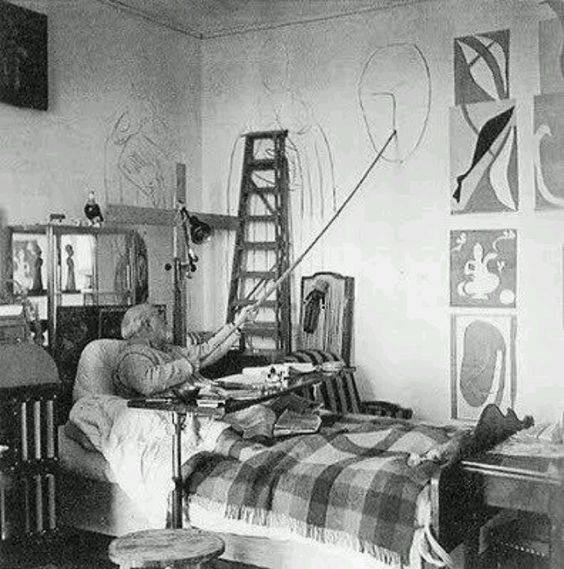
Henri Matisse, towards the end of his life in art.
On August 6, 1944, a bulletin from the Nazi command allowed the women and boys in Florence to leave home during pre-determined hours of the day to gather supplies of water and food. But the lack of electricity, gas, and manpower forced the bakers to distribute flour instead of bread, or even just wheat and corn grain, since the mills had either been destroyed or were unavailable.
A Proclamation of Emergency allowed Red Cross personnel and physicians to circulate freely throughout the city. Exploiting this, the Italian resistance commanders started to produce false medical IDs.
Thanks in particular to the audacity of the partisan Enrico Fischer from the Partito d’Azione, who headed the Third Company of the Third Zone of the city, it had been possibile since August 4 to communicate between the partisans and Allies to communicate. The partisans were located on the right side of the Arno, and the Allied Command was established in the Oltrarno.
Fischer achieved this extremely helpful feat by gaining access to the famed Vasari Corridor shortly after the Germans demolished the cities main bridges. It was an especially amazing feat because the Nazis were still occupying a part of Palazzo Vecchio. By accessing the Corridoio Vasariano, Fishcer was able to connect operations in the Uffizi to the operations in the Palazzo Pitti on other side of the river.
Assisted by some municipal guards, Fischer managed to drag a telephone wire along the corridor, linking the opposite riverside with a partisan guardhouse established in Palazzo Vecchio.
Thus, with a direct link connecting the military command in Palazzo Strozzi, the CTLN in via Condotta and the partisans in Palazzo Vecchio, it was now possible to inform the Allies about all the operations occurring on the right side of the Arno, including the visible conditions of the Germans and their suspected intentions.
In the Occupied Zone, the population conditions were becoming ever more difficult: there was almost no food and only a small ration of flour was available for the population (never higher than 100 grams per person). As an example, on August 9 only 65 grams of flour per person was distributed.
More than food, the very little water was available, and it was now being sold at extremely high prices.
Furthermore, it was impossible to care for the sick or to bury the dead. There was a torrid August temperature, and no one in the city was able to remove garbage from the streets.
The Allies informed the CTLN, using the above cited telephone line passing through Ponte Vecchio, that they would cross the river with two columns, upstream and downstream of the city, to avoid further destructions. Also, they assured that they would not bombard the city’s center.
The military command, after having transferred the key point from the Cupola del Duomo to the tower of Palazzo Vecchio, so to be nearer to the telephone unit, was continuously informing the Allied command about the dislocation of German troops.
Finally, the Nazis knew that the time to escape had arrived.


You must be logged in to post a comment.