Papal excess, the Metropolitan Museum of Art and Stephen Colbert.
Uncategorized
Florence was literally carved out of the surrounding rocky hills
Quarries and their role in the construction of Florence
An itinerary through Tuscany’s ‘cave’
The Florentine, SEPTEMBER 8, 2006
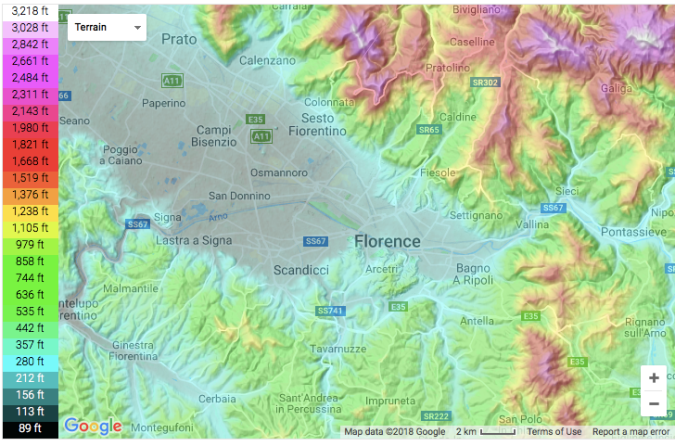
Has it ever occurred to you that the stony city of Florence was literally carved out of the surrounding hills? It’s quite true. Countless local quarries provided the blocks of stone for the walls of medieval and Renaissance churches and palaces, and for the columns and architectural ornaments to decorate them. Pietraforte, a kind of light brown limestone, came from quarries at Costa San Giorgio, in the Boboli hill between Santa Felicità and Porta Romana, at Bellosguardo, and around Marignolle and Le Campore, all south of the Arno. To the north, the hills of Fiesole, Maiano and Settignano provided the blueish-grey sandstone pietra serena.
In the 13th century, load after load of pietraforte was hauled over the Arno to the outskirts of Florence to construct the enormous basilicas of Santa Maria Novella and Santa Croce. Even the piers inside these two churches are of pietraforte. Look at Palazzo Vecchio, the Log-gia dei Lanzi, the Bargello and Orsanmichele, and you are looking at pieces of the southern hills transformed into architecture. The gigantic blocks of rustication that you see on the façades of the 15th-century Palazzo Medici were cut out of pietraforte quarries. Filippo Strozzi, whose palace rivals that of the Medici in size, had endless loads of stone brought from quarries at Boboli and Marignolle. It is said that between November 1495 and March 1497, Strozzi’s heavily-laden carts rattled over the Arno more than a thousand times. At Palazzo Pitti, the builders had it much easier, since their source (the Boboli hill) was right behind the palace. In fact, Palazzo Pitti sits on the hollowed out part of one of these quarries.
If pietraforte was used mainly for the construction of walls, pietra serena was used above all for columns, stairs, doors and windows. The oldest of these quarries, dating back to Etruscan times, were at Monte Ceceri in Fiesole, and they continued to be worked during the Roman and early medieval periods. The demand for pietra serena was so high that in the 13th century new quarries had to be opened further east, around Vincigliata and Settignano. By the 15th century, when Brunelleschi’s architectural style boosted the popularity of pietra serena to unprecedented heights, it was also being extracted at Golfolina, west of Florence.
Brunelleschi chose quarries that would provide enormous blocks of pietra serena from which he could cut entire column shafts. He quarried the stone for the loggia of the Ospedale degli Innocenti at Trassinaia, near Vincigliata. The columns for San Lorenzo came from a site nearby, still known as the Cava delle Colonne.
http://www.theflorentine.net/art-culture/2006/09/quarries-near-florence/
Lauretta’s song
Lauretta makes a final plea to her father with “O mio babbino caro” (Oh, my dear papa), in Puccini’s Gianni Schicchi. Performed today in Fiesole in a Renaissance villa. Magical.
Le dimore aperte per la Giornata Nazionale
One lifetime isn’t long enough!

Domenica 27 maggio
dalle 10 alle 13 e dalle 14 alle 19
FIRENZE CENTRO STORICO
- Giardino San Francesco di Paola, piazza San Francesco di Paola 3
- Giardino Torrigiani, via dei Serragli 146
Apertura esclusivamente per visita a gruppi guidati di max 20 persone, partenze ogni 15/20 minuti con orario dalle 10 alle 13 e dalle 14 alle 17.
Ore 16: “Quartetto d’archi”, concerto a cura della Scuola di Musica di Fiesole. - Giardino Corsi Annalena, via Romana 38
- Palazzo Guicciardini, via Guicciardini 15
- Palazzo Michelozzi, via Maggio 11
- Palazzo Ridolfi, via Maggio 13
- Palazzo Frescobaldi, via Santo Spirito 11
- Palazzo Rinuccini e Teatro Ottavio Rinuccini, via Santo Spirito 39
Il palazzo e il teatro saranno visitabili a piccoli gruppi guidati ogni ora a partire dalle 10 fino alle 18, a cura degli allievi della classe 5B del Liceo Classico Machiavelli. - Palazzo Antinori Aldobrandini, via dei Serragli 9
- Giardino Corsini sul…
View original post 3,320 more words
Bagni di Lucca

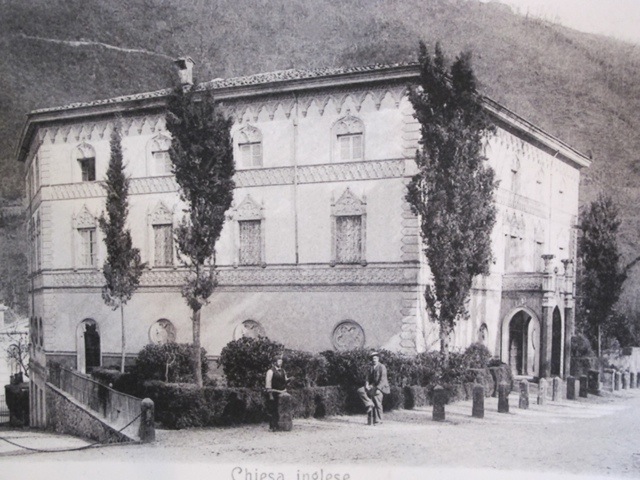
In its heyday, Bagni di Lucca, with its cool climate and great variety of hot springs had been a very fashionable European holiday resort and spa town. Beautiful elegant hotels had been built all around the spas. Villas, owned by heads of state and various ambassadors and dignitaries were crammed with antique furniture, musical instruments and rare books.

There were cultural centres, casinos, Anglican churches and cemeteries, restaurants and theatres. Famous poets, singers, playwrights, writers, actors and actresses used to flock there in the summer months. Presumably, many wars and marriages were arranged and important state decisions taken inside those thick stone walls, so far from indiscreet ears.

With the advent of fascism in Italy, renewed nationalism and World War Two, the “guests” of Bagni di Lucca suddenly became completely undesirable, and were later either deported or forced to flee.
Their properties were confiscated which meant that the local fascist bosses, for the most part rude uneducated thugs, suddenly had access to and became owners of luxurious properties full of rare works of art. There are tales of grand pianos being chopped up for firewood, rare books being transported to the local paper mills and being sold by the kilo, manuscripts being burnt on bonfires, and paintings being thrown out on to the grass where rain and sun eventually got the better of them.
Some of the villas miraculously passed into the hands of new owners. Deeds were drawn up, and illiterate mountain folk suddenly felt like princes and princesses. Some were used for more sinister purposes, housing torture and detention centres for political opponents, intellectuals and partisans or worse, boarding houses for Jewish and gypsy children before they left for their final destinations.
The grand rooms and theatres, which had housed great composers and musicians, were turned almost overnight into brothels or barracks for Mussolini’s troops.
At last! Many dignitaries thought that law and order has been restored. We are in charge again and those foreigners got what they deserved!
Of course, things didn’t quite turn out as expected. Italy did not get its empire, but instead a humiliating loss in which not only did it once again have to bow down to the overwhelming power of the Anglo-American armies, but it also had to sign really unfair future agreements, thus becoming a near slave to the foreign oil barons, military-industrial complexes, big Pharma religion and cars and motorways.
After the war there was no money for the upkeep and maintenance of the once magnificent hotels and spa complexes and anyway the whole of Italy was busy doing other things. People were emigrating in hordes, abandoning villages, hilltops and mountains for large industrial cities in the north, going to work in the booming car industries or in foreign cities.
The people were all working like busy bees for their new masters, building motorways and high rise blocks of flats, spraying clean fields, vineyards and fruit farms with toxic pesticides, getting rich and watching TV.
Bagni di Lucca became a ghost town. Gone were the shepherds and their flocks, the orderly rows of vegetables, the pigs, cows, geese and ducks, the large families and old traditions. Winters passed and vegetation covered the villages and country lanes. Vines grew over and smothered the beautiful old buildings until there was nothing left, except memories in books which no one ever opened.
Small factories sprang up in Bagni di Lucca: paper mills spewing out clouds of black smoke and colouring the rivers pink and blue, and the souvenir industry which exported plastic figurines to many parts of the world. The owners of these businesses became very wealthy and the only people left who had not emigrated elsewhere worked entirely for the “benefactors” who could therefore pay as little or as much as they liked, as people had no other alternative.
In the 1960s and 70s, people had started to talk about the possibility of starting up the tourist business once more but this was generally discouraged by the benefactors as it would have meant distraction for their workers. So by the time the international association arrived in town they were entering a world which might as well have been in a time warp.
Actually, as we later found out, they, being mostly highly intelligent and educated people, had vision and they had realised back then that it was time to flee the big cities before globalisation, the de-industrialisation of Italy, mass unemployment, climate change, wars for oil and water and social unrest hit us all. They were right about that, they just chose the wrong place.
Welcome to Tuscany.
Lord, Anna. Welcome to the Tuscan Dream: Italy’s Broken Heart (p. 63). Scribo Srl. Kindle Edition.
The quarries of Settignano, where Michelangelo lived
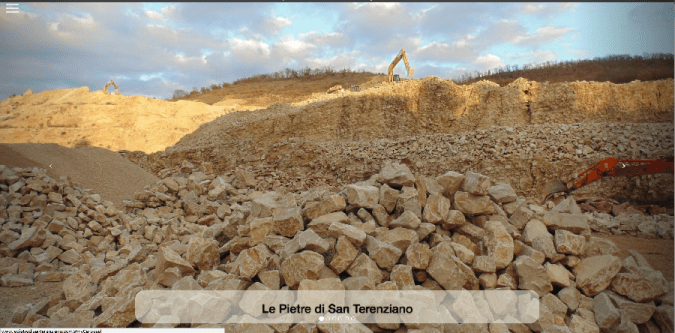
The Settignano quarries yielded macigno, a fine-grained grey sandstone that was much prized in Florence. It is a gravely beautiful material in a range of dark-greenish and bluish greys, fine enough to carve in crisp detail and with a quality of simultaneously absorbing and reflecting the light, producing a paradoxical impression of dark luminosity.
This is the material that Brunelleschi used for the columns and capitals of his buildings. Michelangelo would employ it in the same way in his projects at San Lorenzo in Florence.
The Florentines, being interested in this stone enough to make fine distinctions, gave names to the differing grades, the finest type being pietra del fossato, and the others including pietra serena and pietra forte.
Michelangelo, who had immense sensitivity to stone, went further than these broad categories. He knew that each quarry, every stratum, would produce material of subtly differing character. The contract for the stairs and two doors of the library Michelangelo was building at San Lorenzo in the 1520s stipulated that the pietra serena supplied should be of the same ‘colour and flavour’ (‘ colore et sapore’) as in the sample. ‘Flavour’ is a wonderful word to use of stone: bringing out its sensuous character as if it were actually edible.
When he designed buildings in Rome, Michelangelo was attentive to the qualities of the local material, travertine, a limestone noted for the pits and troughs in its surface – as different in its flavour and colour from Florentine sandstone as roast beef is from pâté de foie gras. His use of travertine for the walls of St Peter’s and the palaces on the Capitoline Hill made the most of its rugged nature.
For sculpture he used only the finest type of pure white marble, known as statuario, found particularly in certain quarries above Carrara. Even this sculptor’s marble, according to the sculptor and goldsmith Benvenuto Cellini, came in at least five or six grades, the first having a ‘very coarse grain’ and the softest, which he describes almost like flesh, ‘the most cohesive, the most beautiful and the tenderest marble in the world to work from’.
Michelangelo was renowned for his ability to discern the quality of a potential piece while it was still in the rockface. When he was engaged from 1516 onwards on large construction projects at San Lorenzo in Florence which involved the quarrying, transport, dressing and carving of huge amounts of both marble and macigno, a majority of the masons he employed were from Settignano.
Gayford, Martin. Michelangelo: His Epic Life (Kindle Locations 803-811). Penguin Books Ltd. Kindle Edition.
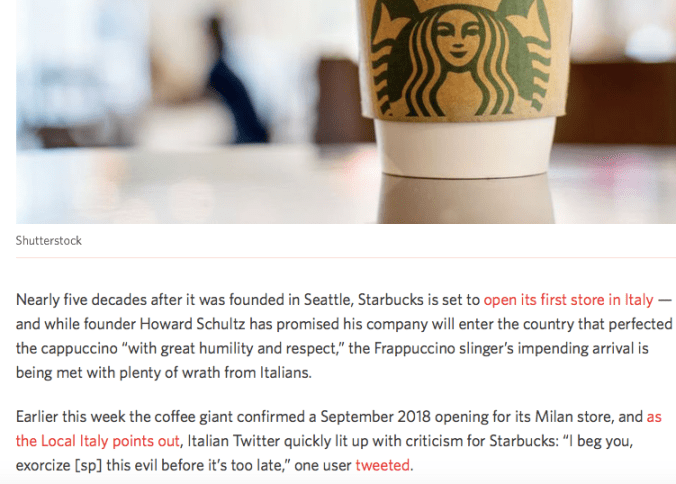
Starbucks in Italy? Italians are pissed!
1960 fashion
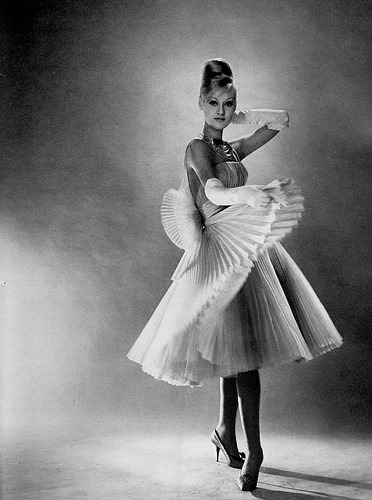
Diana Nixon in a pleated dance dress by Maggy Rouff.
Photo by Georges Saad, 1960
2018 Gardens in Italy
The Italian Garden Guide 2018
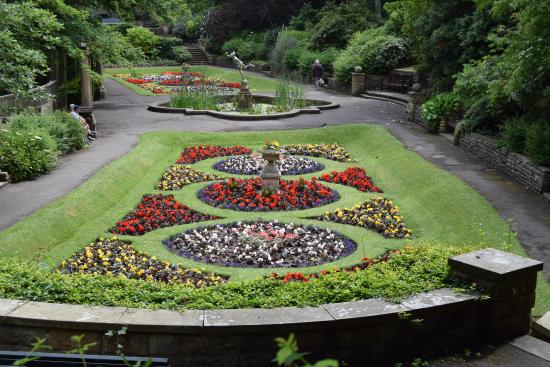
A pocket guide to discover more than 130 among most beautiful gardens created in Italy with beautiful photos!
The Italian Garden Guide is a bilingual guide (Italian and English languages) to discover the most beautiful gardens created in Italy.
Inside the guide you can find updated informations on opening hours and services offered by 130 gardens of the network Grandi Giardini Italiani, that is present in 14 regions of Italy, in addition to Vatican State, Switzerland and Malta.
The Italian Garden Guide 2018 is enriched by more than 250 beautiful photos of gardens and from the section dedicated to ”Designers, creators, and plantsmen at Italy’s top gardens”. Their biographies and works reveals the full richness of the history of the art of gardens over the centuries, and casts a little light on the mistery of the beauty of every
A fascinating journey through history, art and nature in a pocket guide!
The Italian Garden Guide
Pag. 288 + color images
Publisher Grandi Giardini Italiani
Language Italian and English
Edition February, 2018
Size 13×21 cm
ISBN Code: 978-88-909861-7-8
Price € 14,00
The Italian Garden Guide can be purchased with payment by bank transfer of euro 14,00, the beneficiary Grandi Giardini Italiani, Intesa San Paolo
IBAN: IT 71 H 07601 10900 001036565974
News
The guide is now also available on the Amazon e-commerce portal. To purchase your copy click here.
http://www.grandigiardini.it/lang_EN/sponsor.php?id=18
Michelangelo goes to the Met Gala
Ariana Grande wearing Vera Wang. (Charles Sykes/Invision/AP), featuring the Sistine Chapel frescoes.


You must be logged in to post a comment.