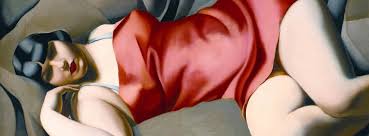
If not, I think you’ll like her work.
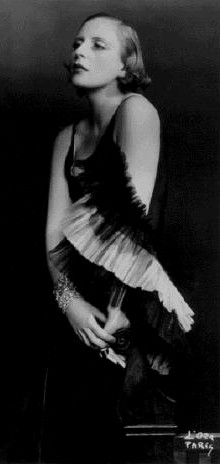
Tamara de Łempicka (1898 – 1980) was a Polish Art Deco painter. Influenced by Cubism, Lempicka became the leading representative of the Art Deco style across two continents, and she was a favorite artist of many Hollywood stars. She was the most fashionable portrait painter of her generation among the haute bourgeoisie and aristocracy, painting images of duchesses, grand dukes and socialites. Through her network of friends, she was also able to display her paintings in the most elite salons of the era.
She also led a very colorful personal life.
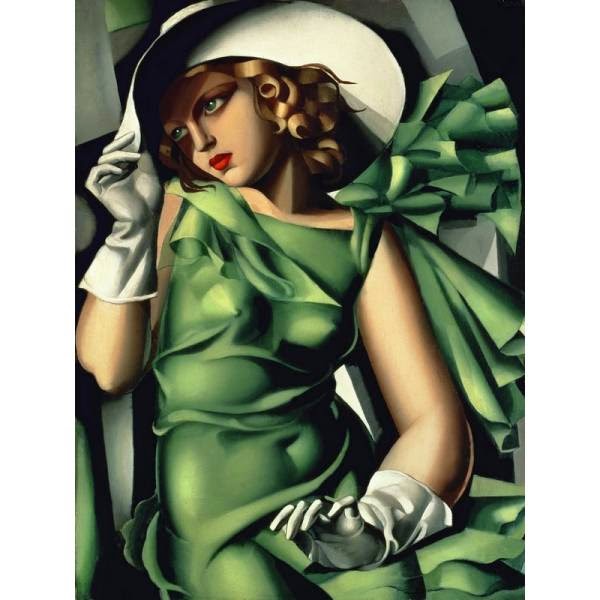
She was born in Warsaw, Congress Poland, under the rulership of the Russian Empire. Her wealthy and prominent father, Boris Gurwik-Górski, was a Russian Jewish attorney for a French trading company. She attended a boarding school in Switzerland and spent the winter of 1911 with her grandmother in Italy and on the French Riviera. She got her first taste of the Great Masters of Italian painting then.
In 1912, her parents divorced, and Maria, which was her given name, went to live with her rich aunt in St. Petersburg. When her mother remarried, she was determined to break away to make a life of her own. In 1913, at the age of fifteen, while attending the opera, Maria spotted the man she decided to marry. Her well-connected uncle helped her and 3 years later, in 1916, she married Tadeusz Łempicki (1888–1951) in St. Petersburg. He was a lawyer and womanizer, who was presumably tempted by Maria’s significant dowry.
In 1917, during the Russian Revolution, Tadeusz Łempicki was arrested in the dead of night by the Bolsheviks. Maria searched the prisons for him and after several weeks, with the help of the Swedish consul, she secured his release. They escaped to Paris to where Maria’s family had also escaped. Once there, they changed their last names to de Lempicka.
In Paris, the Lempickas lived for a while from the sale of family jewels. Tadeusz was unwilling or unable to find suitable work, which added to the domestic strain, and Maria gave birth to Kizette Lempicka.
Her sister, the designer Adrienne Gorska, made furniture for her Paris apartment and studio in the Art Deco style, complete with chrome-plating. The flat at 7 Rue Mechain was built by the architect Robert Mallet-Stevens, known for his clean lines.
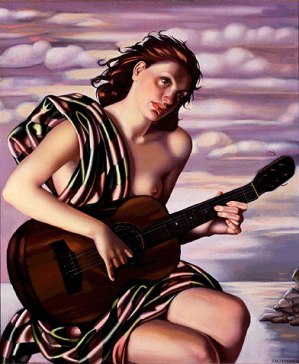
“The Musician” (1929), oil on canvas
Lempicka’s developed her distinctive and bold artistic style at the Académie de la Grand Chaumière under the instruction of Nabi painter, Maurice Denis, as well as the Cubist Andre’ Lhote. Lempicka was particularly influenced by what Lhote sometimes referred to as “soft cubism” and by the “synthetic cubism” of Denis, epitomizing the cool yet sensual side of the Art Deco movement. Of Picasso she said “he embodies the novelty of destruction.” She was less impressed with many of the Impressionists. She thought they drew badly and employed “dirty” colors. Lempicka’s technique would be novel, clean, precise, and elegant.
For her first major show, in Milan, Italy in 1925, under the sponsorship of Count Emmanuele Castelbarco, Lempicka painted 28 new works in six months. A portrait would take her three weeks of work, allowing for the nuisance of dealing with a difficult sitter; by 1927, Lempicka could charge 50,000 French francs for a portrait, a sum equal then to about USD $2,000. Through Castelbarco, she was introduced to Italy’s great man of letters and notorious lover, Gabriele d’Annunzio. She visited the poet twice at his villa on Lake Garda, seeking to paint his portrait; he in turn was set on seduction. After her unsuccessful attempts to secure the commission, she went away angry, while d’Annunzio also remained unsatisfied.
In 1925, Lempicka painted her iconic work Autoportrait (Tamara in a Green Bugatti) for the cover of the German fashion magazine Die Dame.

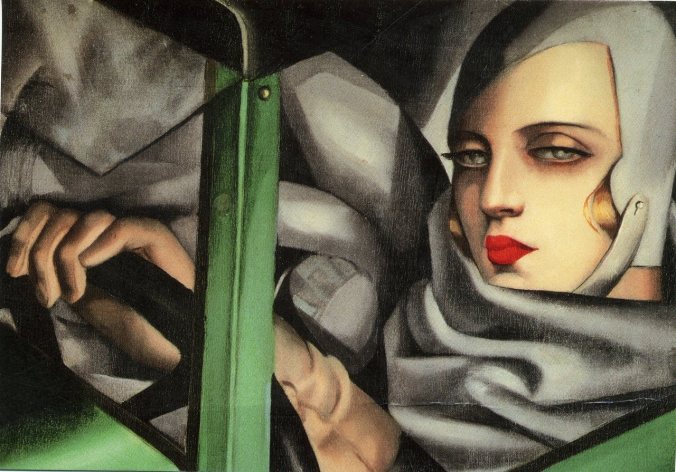
As summed up by the magazine Auto-Journal in 1974, “the self-portrait of Tamara de Lempicka is a real image of the independent woman who asserts herself. Her hands are gloved, she is helmeted, and inaccessible; a cold and disturbing beauty [through which] pierces a formidable being—this woman is free!”
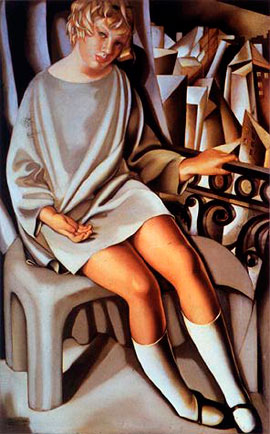
In 1927 Lempicka won her first major award, the first prize at the Exposition Internationale des Beaux Arts in Bordeaux, France, for her portrait of Kizette on the Balcony.
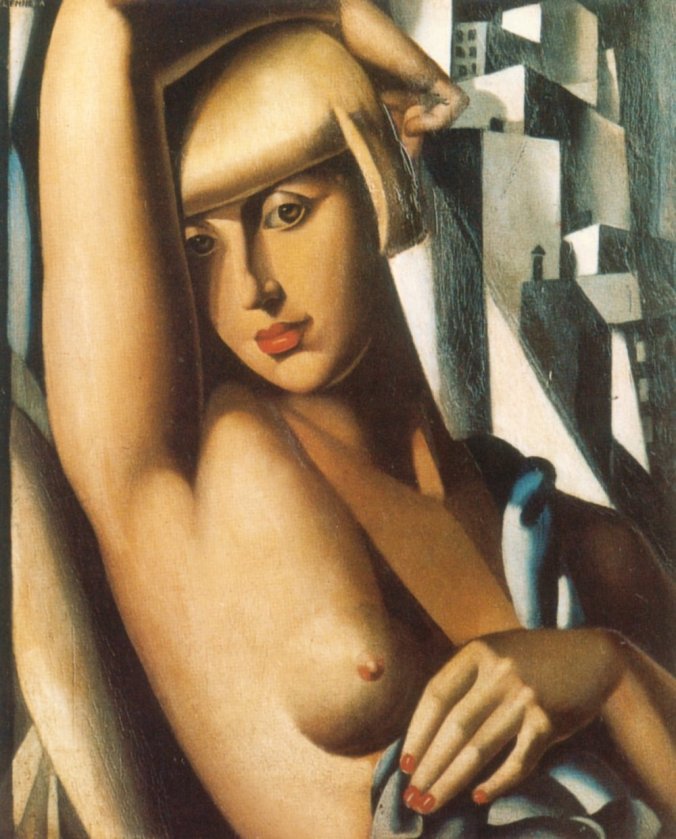
Tamara de Lempicka was an important figure in the Roaring Twenties in Paris. She was a part of the bohemian life: she knew Pablo Picasso, Jean Cocteau, and Andre’ Gide. Famous for her libido, she was bisexual and her affairs with both men and women were conducted in ways that were considered scandalous at the time. She was closely associated with lesbian and bisexual women in writing and artistic circles, such as Violet Trefusis, Vita Sackville-West, and Colette. She also became involved with Suzy Solider, a night club singer at the Boîte de Nuit, whose portrait she later painted.
Lempicka’s husband eventually abandoned her in 1927; they divorced in 1931 in Paris.
Lempicka rarely saw her daughter. When Kizette was not away at boarding school (France or England), the girl was often with her grandmother Lavina. When Lempicka informed her mother and daughter that she would not be returning from America for Christmas in 1929, Lavina was so angry that she burned Lempicka’s enormous collection of designer hats; Kizette watched them burn, one by one.
Despite the fact that Kizette rarely saw her mother, she was immortalized in her mother’s paintings. Some paintings of her include:
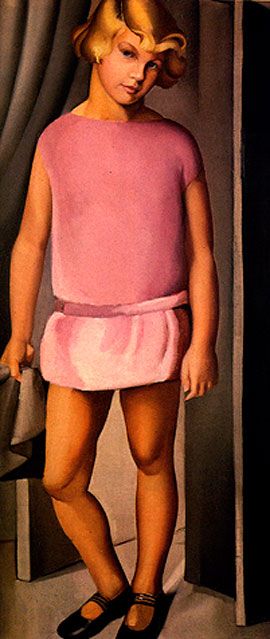
Kizette in Pink, 1926
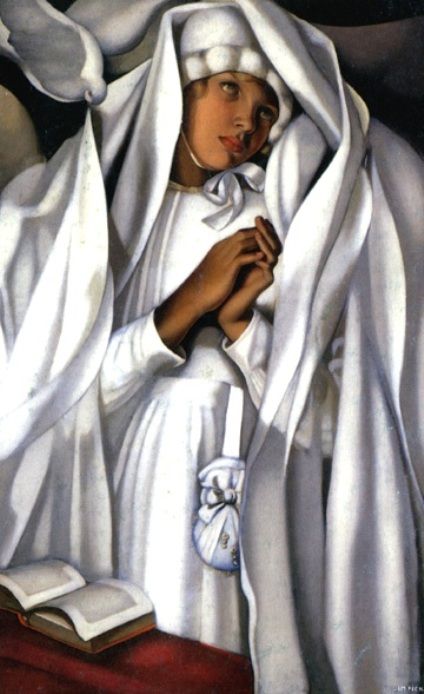
In 1931 Lempicka won a bronze medal at the Exposition Internationale in Poznan, Poland, for another portrait of her daughter, Kizette’s First Communion.
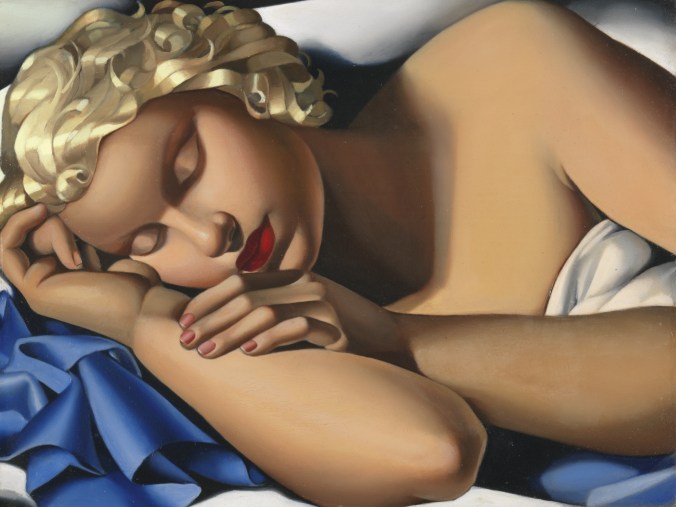
Kizette Sleeping, 1934
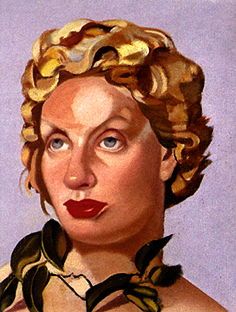
Portrait of Baroness Kizette, 1954–5
Even in paintings of other female sitters, the women depicted tend to resemble Kizette.
In 1928, her longtime patron the Austro-Hungarian Baron Raoul Kuffnervon Dioszeg (1886–1961) visited her studio and commissioned her to paint his mistress, Nana de Herrera. Here is that painting:
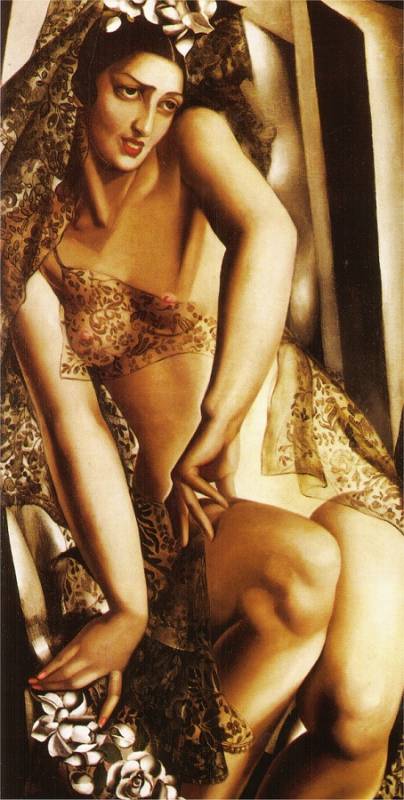
After Lempicka finished the portrait, she took the mistress’s place in the Baron’s life.
Lempicka travelled to the United States for the first time in 1929, to paint a commissioned portrait for Rufus T. Bush and to arrange a show of her work at the Carnegie Institute in Pittsburgh. The show went well but the money she earned was lost when the bank she used collapsed following the Stock Market Crash of 1929.
Lempicka continued both her heavy workload and her frenetic social life through the next decade. The Great Depression had little effect on her; in the early 1930s she was painting King Alfonso XIII of Spain and Queen Elizabeth of Greece.
Museums began to collect her works. In 1933 she traveled to Chicago where she worked with Georgia O’Keefe, Santiago Martinez Delgado and Willem de Kooning. Her social position was cemented when she married her lover, Baron Kuffner, on 3 February 1934 in Zurich.
The Baron took her out of her quasi-bohemian life and finally secured her place in high society again, with a title to boot. She repaid him by convincing him to sell many of his estates in Eastern Europe and move his money to Switzerland. Presciently, she saw the coming of WWII from a long way off, much sooner than most of her contemporaries. She did make a few concessions to the changing times as the decade passed; her art featured a few refugees and common people, and even a Christian saint or two, as well as the usual aristocrats and cold nudes.

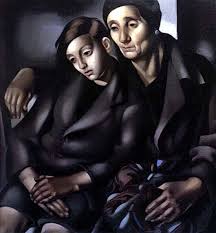
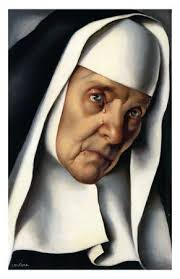
In the winter of 1939, Lempicka and her husband started an “extended vacation” in the United States. She immediately arranged for a show of her work in New York, though the Baron and Baroness chose to settle in Beverly Hills, CA, living in the former residence of Hollywood director King Vidor. She cultivated a Garboesque manner. The Baroness would visit the Hollywood stars on their studio sets, such as Tyrone Power, Walter Pidgeon, and George Sanders and they would come to her studio to see her at work.
She did war relief work, like many others at the time; and she managed to get Kizette out of Nazi-occupied Paris, via Lisbon, in 1941.
In 1943, the couple relocated to New York City. Even though she continued to live in style, socializing continuously, her popularity as a society painter had diminished greatly. They traveled to Europe frequently to visit fashionable spas and so that the Baron could attend to Hungarian refugee work. For a while, she continued to paint in her trademark style, although her range of subject matter expanded to include still lifes, and even some abstracts.
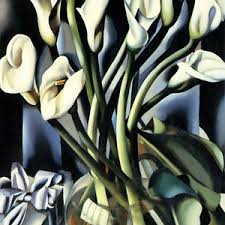
Yet eventually she adopted a new style, using palette knife instead of brushes. Her new work was not well received when she exhibited in 1962 at the Iolas Gallery. Lempicka determined never to show her work again, and retired from active life as a professional artist.
Insofar as she still painted at all, Lempicka sometimes reworked earlier pieces in her new style. The crisp and direct Amethyste (1946), for example, became the pink and fuzzy Girl with Guitar (1963). She showcased at the Ror Volmar Gallery in Paris in 1961.

After Baron Kuffner’s death from a heart attack on 3 November 1961 on the ocean liner Liberte’ en route to New York, she sold most of her possessions and made three around-the-world trips by ship. Finally Lempicka moved to Houston, Texas to be with Kizette and her family. Kizette had married Harold Foxhall, who was then chief geologist for the Dow Chemical Company and together they had two daughters.
In 1978 Tamara moved to Cuernavaca, Mexico, to live among an aging international set and some of the younger aristocrats. After Kizette’s husband died of cancer, she was with her mother for three months. Tamara died in 1980.
Lempicka lived long enough to watch the wheel of fashion turn a full circle: before she died a new generation had discovered her art and greeted it with enthusiasm. A retrospective in 1973 drew positive reviews. At the time of her death, her early Art Deco paintings were being shown and purchased once again.
A stage play, Tamara, was inspired by her meeting with Gabriele D’Annunzio and was first staged in Toronto; it then ran in Los Angeles for eleven years (1984–1995) at the VFW Post, making it the longest running play in Los Angeles, and some 240 actors were employed over the years. The play was also subsequently produced at the Seventh Regiment Armory in New York City.
In 2005, the actress and artist Kara Wilson performed Deco Diva, a one-woman stage play based on Lempicka’s life. Her life and her relationship with one of her models is fictionalized in Ellis Avery’s novel The Last Nude, which won the American Library Association Stonewall Book Awards Barbara Gittings Literature Award for 2013.







You must be logged in to post a comment.