What if you woke up today in Florence and decided you wanted to live in a fantasy world?
Let’s say you thought to yourself “wouldn’t it be cool if I could go into a Renaissance palace in the center of Florence, and be a welcome guest?”
And, further, wouldn’t it be groovy if, when you were in that Renaissance palace, as a welcome guest, you could sit down for a while on a very comfortable, velvet covered chair, and enjoy a glass of nice local wine, while something amazing entertains you.
And, to increase the fantasy, what if this entire experience was air-conditioned, while Florence sizzles in the heat of the summer outside?
And what if I told you that this is actually not a fantasy, but something you could truly experience?! How fast would you beat it there?
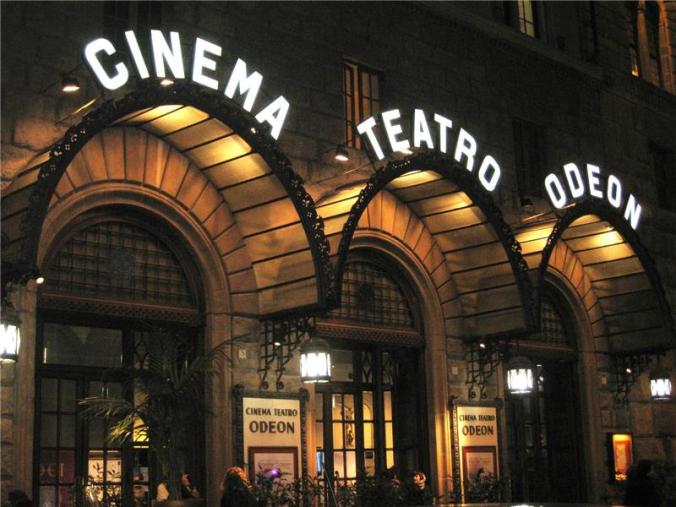
One of my favorite places in Florence ticks all of the boxes above. I love going to this place!
The classic art nouveau/deco interior is gilded and gorgeous and makes an average evening at the movies feel like an elegant affair! And an added bonus is, it has air conditioning! A great place to pass a summer evening in broiling Florence.
So, let’s start with the building, which is the Palazzo Stozzino, constructed in 1450s and 60s. Here t’is!
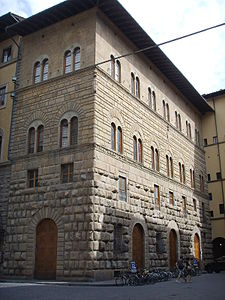
Work on the palace began in 1457. None other than Filippo Brunelleschi is thought to have designed it, but several other architects, among them Michelozzo, also had a hand in the edifice. The façade is attributed to Michelozzo, at least in the lower part, with its rusticated stone facing. Higher floors have been changed during various periods of renovation; they were changed a lot in the 19th century.
Inside the Renaissance palace was a courtyard surrounded by an elegant porch with columns; it is thought Michelozzo designed the cortile and that it was built around 1460. The Palazzo Strozzino took its name after the larger Palazzo Strozzi.
The entire area around the palazzi Strozzi and Strozzini was changed during the 1860s, when Florence became the capitol of Italy. Many buildings were razed. Fortunately, these two palaces were spared.
The story goes that it was the suggestion of a famous Italian actress, Eleonora Duse, to transform the Strozzino into a cinema. Apparently the people who owned the palace in the 1920s were considering turning the building into a luxury hotel. Duse is said to have convinced them into building this stately cinema instead.
At any rate, it was somehow decided to create a cinema in the Strozzino’s courtyard. The Cinema Teatro Savoia was designed by noted architect Marcello Piacentini in 1920 and finished in 1922; the theatre was lavishly inaugurated in December of 1922.

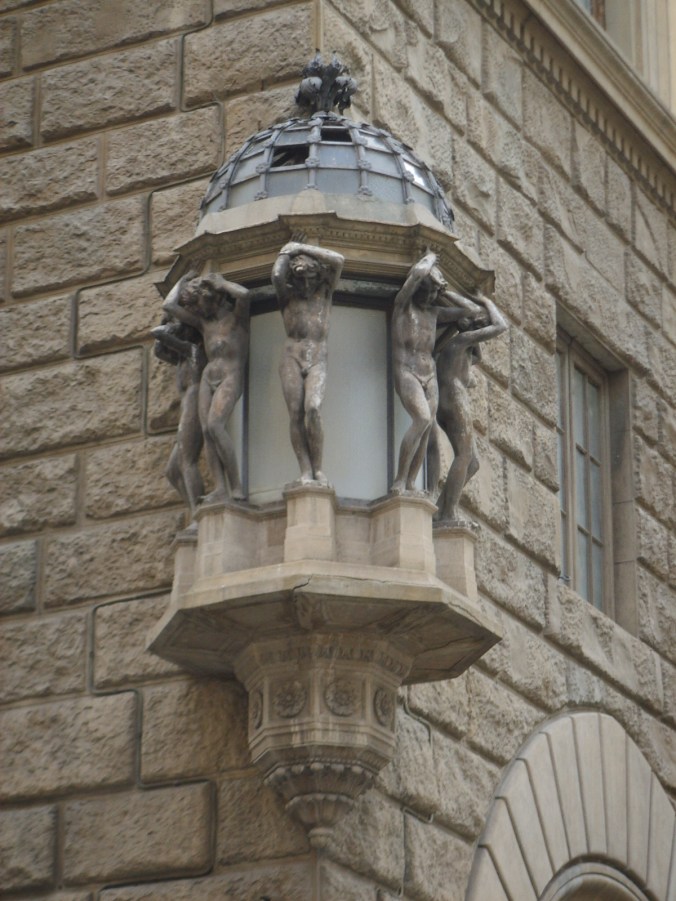
At the same time, two of the palace’s facades were redesigned, and a circular temple-shaped lantern was placed on a corner with bronze nude efibici, by the sculptor Marescalchi.
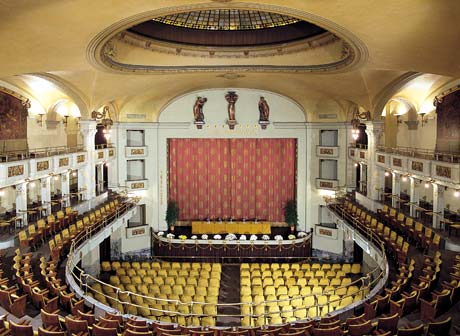
Inside the cinema, the sculptor Giovanni Gronchi created the lacunars and stucco plaques, and sculptor Antonio Maraini designed the three Muses in gilded and polychromed wood on the boccascena. Other specialized artists and firms created the elaborate decorative interior.

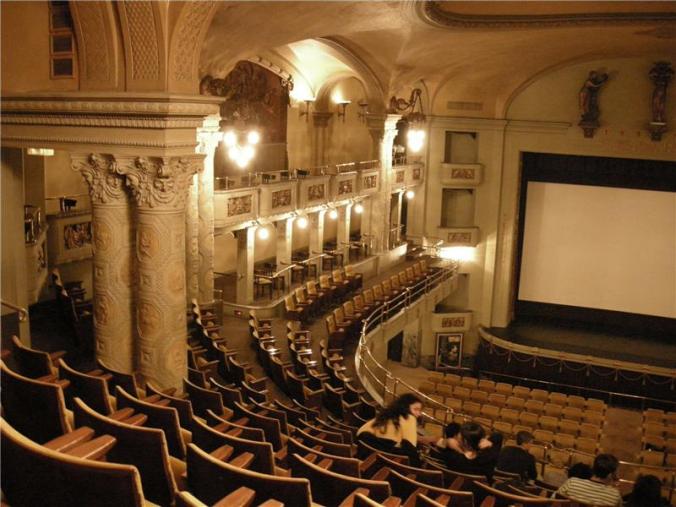
The theatre was later re-named Cinema Teatro Odeon, and it is now operated by the Cinehall Group. It remains a first-run single screen cinema. Many films are shown in their original language version (with Italian sub-titles).
The Odeon has long been a preferred meeting point for members of Florentine cultural and artistic life. Guests such as Louis Armstrong and Ella Fitzgerald visited the theatre, as have directors and actors of Italian neorealist cinema, as well as contemporary artists such as Isabelle Adjani, Angelica Houston, Bernando Bertolucci, Kenneth Branagh, Roberto Benigni, Nanni Moretti and Paolo Sorrentino.
The prestigious and elegant spaces of the Cinema Odeon Theater include a large open room, with a stage holding the movie screen, and has a total capacity of 594 seats, divided into the large stall (with 334 seats) and stylish balcony (seats 260).
Fortunately for us, the Odeon still maintains the harmony and beauty of its original art deco/nouveau style; its tapestries, statues, and colored glass skylight are admired by its many visitors.
The original furnishings of the grand room were red velvet; the furnishings were renewed in 1987 and replaced with yellow gold velvet. Theoriginal wooden chairs remain in the balconies.
On Via dei Sassetti a plaque reads: "Built in the MCMXXII on behal of S.A. Toscano Immobiliare Sindacato - Restored in the MCMXXXVIII".

The Odeon Cinema is a vibrant cultural centre, often hosting cinema
festivals. One of the leading is “50 Giorni di Cinema Internazionale”, which takes place in winter, showcasing movies and directors from
diverse cultures.

In addition to the entertainment venues and offices of the German Management, the building houses the Departmental Department of Tobacco Growth and the Department of Economic Development of the City of Florence, and in the basement a historic disco, the Yab.











You must be logged in to post a comment.