August 4, 1944: Florence, Italy and Anne Frank in Amsterdam

As the Allied Forces entered Florence in the early hours of August 4, 1944,  the brigade Sinigaglia, the division Arno, and the brigade Lanciotto were enthusiastically welcomed into the Oltrarno district. The Allies allowed the partisans to keep their weapons; the Florentine men then started a roundup, searching for the German snipers that were firing at the unarmed populace. These snipers wanted to terrify the population and to slow the progression of the Allies, particularly in the districts of San Frediano, Conventino, and San Niccolò.

Meanwhile, the Nazis were still on the right or north side of the Arno. The military base of the partisans, the CTLN (Comitato Toscano di Liberazione Nazionale, Tuscan Comitate of National Liberation), was installed in the society Larderello, in Piazza Strozzi n. 2.

At first, the command of the third zone in via Roma n. 4, led by the Partito d’Azione, acted as the connection center. In order to follow both the Germans and Allied movements, a sentry was stationed atop the Cupola del Duomo. The personnel stationed there included a deputy commander, a political commissar, and a chief from the first commander corps.

As for the Florentines, on August 4, only a few of them attempted to leave home. But the following day, without food or water, women and boys started to queue in front of the town’s water fountains and doorways with available wells, as well as in front of the bakeries. The few peddlers selling fruit and vegetables were extremely busy.

To be continued.

Sources:

http://diariodiunfiorentino.altervista.org/liberation-florence-11-august-1944/?doing_wp_cron=1564842755.6783099174499511718750

http://diariodiunfiorentino.altervista.org/the-insurrection-of-florence/?doing_wp_cron=1564846863.0551791191101074218750


Meanwhile, in Amsterdam, a place also occupied by the Nazis, on August 4, 1944, after 25 months in hiding, Anne Frank and the seven others in their secret hiding place were discovered by the Gestapo. The German secret state police had learned about the hiding place from an anonymous tipster, who has never been definitively identified.

After their arrest, the Frank family and their fellow Jewish associates, were sent by the Gestapo to Westerbork, a holding camp in the northern Netherlands. From there, in September 1944, the group was transported by freight train to the Auschwitz-Birkenau extermination and concentration camp complex in German-occupied Poland. Anne and her sister, Margot Frank, were spared immediate death in the Auschwitz gas chambers and instead were sent to Bergen-Belsen, a concentration camp in northern Germany.

In February 1945, the Frank sisters died of typhus at Bergen-Belsen; their bodies were thrown into a mass grave.

Several weeks later, on April 15, 1945, British forces liberated the camp.

https://www.history.com/topics/world-war-ii/anne-frank-1

The Princess Diana Memorial, Hyde Park, London

During my first walk through Hyde Park and Kensington Gardens, I noticed these markers in the pavement, guiding the visitor to the Princess Diana Memorial.  I wasn’t sure I wanted to go see it.  I remember her death all too well, just like I can remember the day President Kennedy was shot.  Markers of time that I wish I could forget.

IMG_9696

In the end, I couldn’t not go.  I’m so glad I did.  It is a lovely, lighthearted place.  I think Diana would have loved it.  On the sunny Sunday afternoon I was there, families and especially children were enjoying the water as it flowed through the monument.  I loved it.  But, I couldn’t bring myself to take pictures.  It was still too raw for me.

Screen Shot 2019-07-22 at 17.27.37
The Diana, Princess of Wales Memorial Fountain is a memorial in London dedicated to Diana, Princess of Wales, who died in a car crash in 1997. It was designed to express Diana’s spirit and love of children.

The fountain was built with the best materials, talent and technology. It contains 545 pieces of Cornish granite – each shaped by the latest computer-controlled machinery and pieced together using traditional skills.

Screen Shot 2019-07-22 at 17.27.25

The design aims to reflect Diana’s life, water flows from the highest point in two directions as it cascades, swirls and bubbles before meeting in a calm pool at the bottom. The water is constantly being refreshed and is drawn from London’s water table.

Screen Shot 2019-07-22 at 17.27.51

The Memorial also symbolises Diana’s quality and openness. There are three bridges where you can cross the water and go right to the heart of the fountain.

Screen Shot 2019-07-22 at 17.21.13


The memorial was designed by American landscape architect and artist Kathryn Gustafson.


https://youtu.be/xfVEcRuTdRU

The fountain is located in the southwest corner of Hyde Park, just south of the Serpentine lake and east of the Serpentine Gallery. Its cornerstone was laid in September 2003 and it was officially opened on 6 July 2004 by Queen Elizabeth II.  Also present were Diana’s younger brother Charles Spencer, her ex-husband Prince Charles, and her sons William and Harry.

Working on the project began in 2001. The fountain was designed by Gustafson Porter.  Kathryn Gustafson, an American landscape artist said she had wanted the fountain, which was built to the south of the Serpentine, to be accessible and to reflect Diana’s “inclusive” personality. Gustafson said: “Above all I hope that it provides a fitting memorial for the princess and does credit to the amazing person that she was.”

The memorial has the form of a large, oval stream bed about 165 by 260 ft that surrounds, and is surrounded by, a lush grassy field. The granite stream bed is from 10 to 20 ft wide. It is quite shallow and is laid out on a gently sloping portion of the park, so that water pumped to the top of the oval flows down either side. One side of the stream bed descends fairly smoothly to the downhill end of the oval with gentle ripples; the other side consists of a variety of steps, rills, curves, and other shapes so that the water plays in interesting ways as it flows to the tranquil pool at the bottom. The two sides were intended to show two sides of Diana’s life: happy times, and turmoil.


https://www.archdaily.com/803509/diana-princess-of-wales-memorial-fountain-gustafson-porter-plus-bowman


Here’s to the women behind champagne!

Screen Shot 2019-05-22 at 21.40.06

Screen Shot 2019-05-22 at 21.41.09


The 17th century Benedictine monk Dom Perignon may get the credit for developing the methode champenoise, but when it comes to creating the iconic sparkling wines that fill our flutes, we owe the lion’s share of our thanks to the ladies.

Beginning in the early 19th century it was the women running some of history’s most recognizable champagne houses who pioneered the attributes we consider mainstays today. From the iconic bottle shape to the clarity of the vintage, from that crisp, brut flavor profile to the marketing of champagne as a wine of luxury, it was the so-called “merry widows” of champagne who turned bottles of bubbly into a world-famous celebratory sip.

Why widows, you ask? Unlike many women of the era, widows were allowed the independence necessary for running a business. While unmarried women were dependent on their fathers or brothers (they couldn’t even get a bank account) and married women were forced to rely on their husbands’s money and power, widows were allowed to own property and businesses in their own right, control their own finances, and move freely in society.

Source:

https://www.townandcountrymag.com/leisure/drinks/a26592142/women-champagne-history-veuve-cliquot/?utm_source=facebook&utm_medium=social-media&utm_campaign=socialflowFBED&fbclid=IwAR2VH4uWWDcGOyWIOQrW7LLks_AM4uhfKuVo-H8stXgCLRjvDe4Rxz-0ltA


The history of the American consulate in Florence and #Insieme200

palazzo-calcagnini

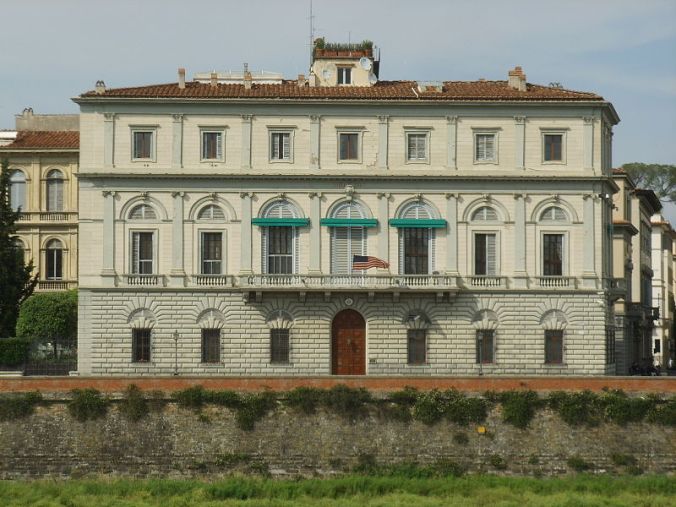
The American Consulate in Florence is part of the United States Mission to Italy and is located at Lungarno Vespucci 38, in the former Palazzo Calcagnini (built 1876-77). This palazzo was purchased in 1949 by the American government, to serve as the site of the Consulate General.

Long before the United States acquired the palazzo however, its presence was already in Tuscany.  The first American consulate to the Grand Duchy of Tuscany was established in Livorno (then known in English as Leghorn), with consular agent Phillip Felicchi being appointed on 29 May 1794.

For some reason, Tuscany would not recognize any consulates posted in Florence, so the first U.S. Consular Agent to serve Florence was Vice Consular Agent James Ombrosi, who was under mandate from the U.S. Consulate at Leghorn (Livorno). Ombrosi was accredited on May 15, 1819.

In the years after the U.S. Civil War and the transition of the capital of the Kingdom of Italy from Florence to Rome, the U.S. Consul General was James Lorimer Graham. Graham was a New York banker and art collector; he and his wife Josephine lived in a building that is now known the Palazzo dei Congressi.

In the early 1870s, Florence was suffering the grave economic consequences of the sudden transfer of the capital, a move that left the city deeply in debt and had bankrupted many investors when boom turned to bust in “Firenze Capitale.”

Resulting higher taxes and slower growth led to widespread poverty. Mrs. Graham was a committed philanthropist back in New York, and so responded to this situation in a way familiar to her. She rallied members of the “American Colony” and started selling mistletoe baskets and Christmas trees to raise funds for the poor.

Then there was the more fraught holiday season of December of 1944. Though Florence had been liberated by the Allied Forces in August of that year, there was little rejoicing along the Gothic Line—the German defensive line that stretched from Carrara to Pesaro—as fighting raged and civilian and combatant casualties mounted.

In the early morning hours of a bitterly cold December 26, Axis forces launched a counter-offensive in the Garfagnana region of Lucca province, focused on and around the town of Barga.

The first target was the hilltop village of Sommocolonia, garrisoned by several hundred African-American “Buffalo Soldiers” and a handful of local partigiani.

During the fighting, German forces drove the Allied troops back. To avoid a complete rout, Army Lieutenant John R. Fox remained in his position in the Sommocolonia bell tower, calling in artillery strikes on the town and finally on his own position in order to slow the Axis advance. For Fox’s bravery and self-sacrifice, he was posthumously awarded the U.S.’s highest military honor, the Medal of Honor.

Today the American International League of Florence (AILO), organizes annual events to collect thousands of euro each year that are then donated to local charitable organizations.

Incidentally, the United States also has 5 other representations in Italy: American Consulate in Palermo; American Consulate in Naples; American Consulate in Milan;
American Consulate in Genoa; and the American Embassy in Rome.

The American Consulate in Florence represents one of 402 foreign consular and diplomatic representations from around the world in Italy.


**********************************************************************************

2019 marks 200 years of American presence in Florence

Screen Shot 2019-01-03 at 17.15.20


Do you have personal experiences or stories that were passed on to you about historic events that occurred in Tuscany, Emilia Romagna or the Republic of San Marino? Were you a Mud Angel? Did you have relatives who worked with the American Red Cross during World War I or witnessed the 5th Army’s fight along the Gothic Line in World War II? Are you doing something now that is strengthening the U.S.-Italy partnership? If so, the U.S. Consulate General in Florence would love to hear from you!

The Florence American consulate is collecting stories in anticipation of the bicentennial of its diplomatic presence in Florence in 2019.

Throughout that year, we hope to see a series of events across Tuscany, Emilia-Romagna and the Republic of San Marino exploring all facets of our past, present, and future together.

These commemorative events and related information will be highlighted on the Consulate’s social media platforms with the #Insieme200 (#Together200) hashtag.

Our 200 years here are built on a foundation of millions of personal and organizational ties, so we need your help to properly celebrate our bicentennial!

If your organization has an idea for a 200th anniversary commemorative event—large or small—or wants to get involved with the events being organized by the Consulate, please let us know:CGFIProtocol@state.gov.

To receive updates on the Consulate’s 200th anniversary and more, join the Consulate’s community by liking its Facebook page @USCGFlorence or following on Twitter!