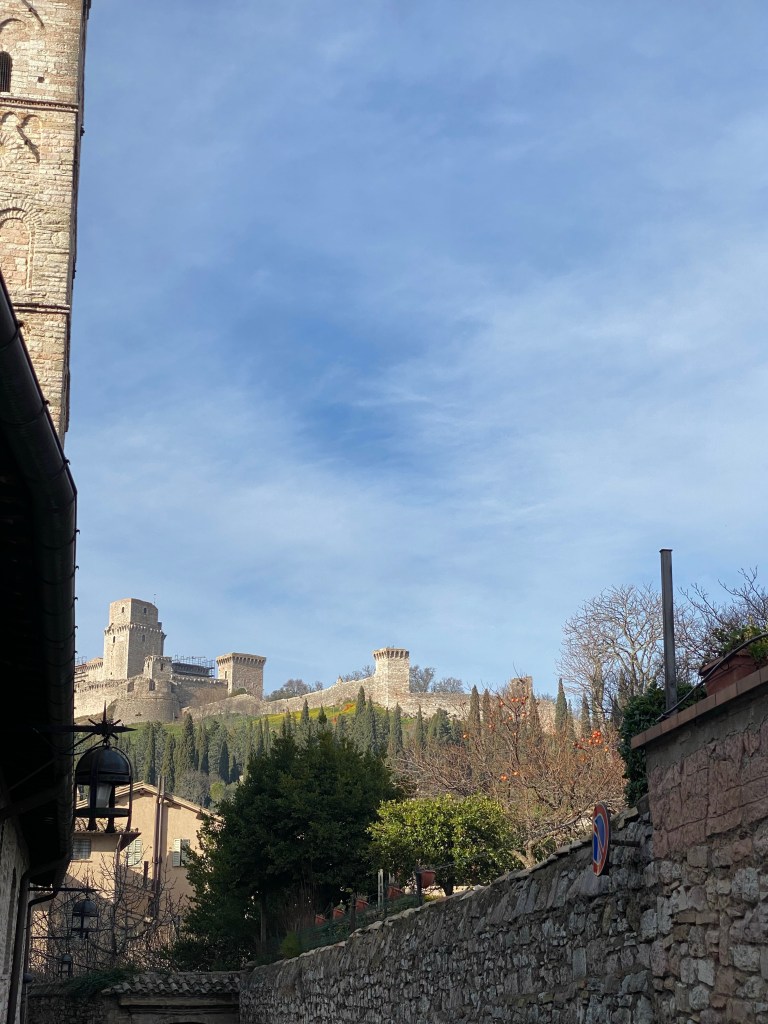
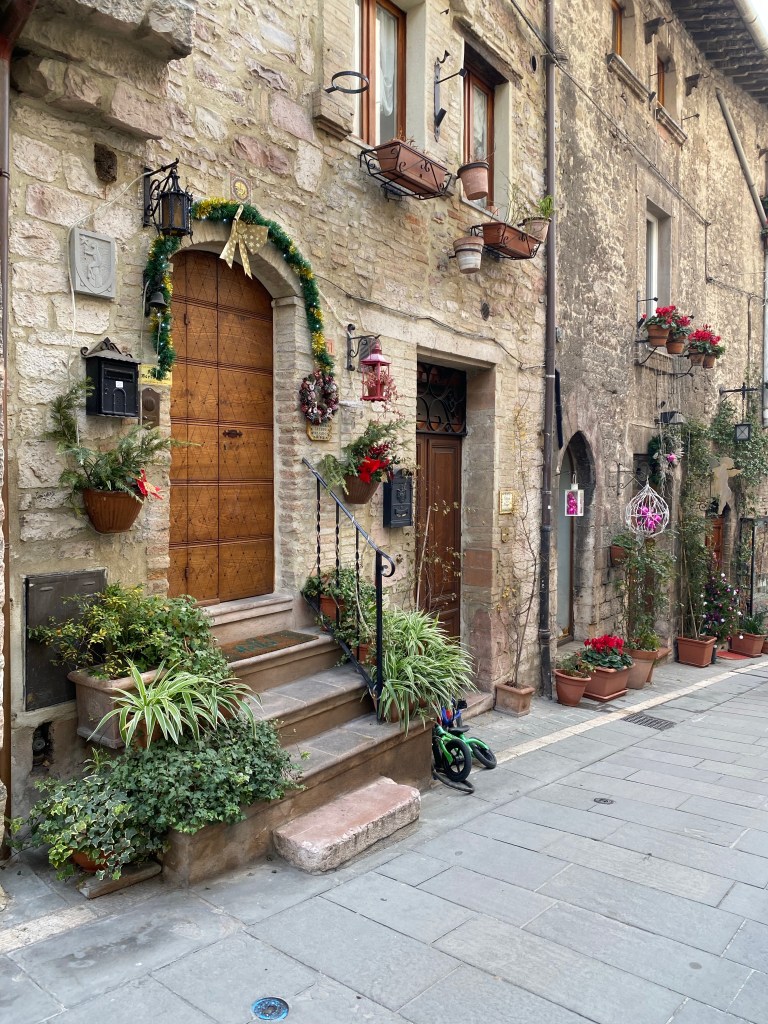
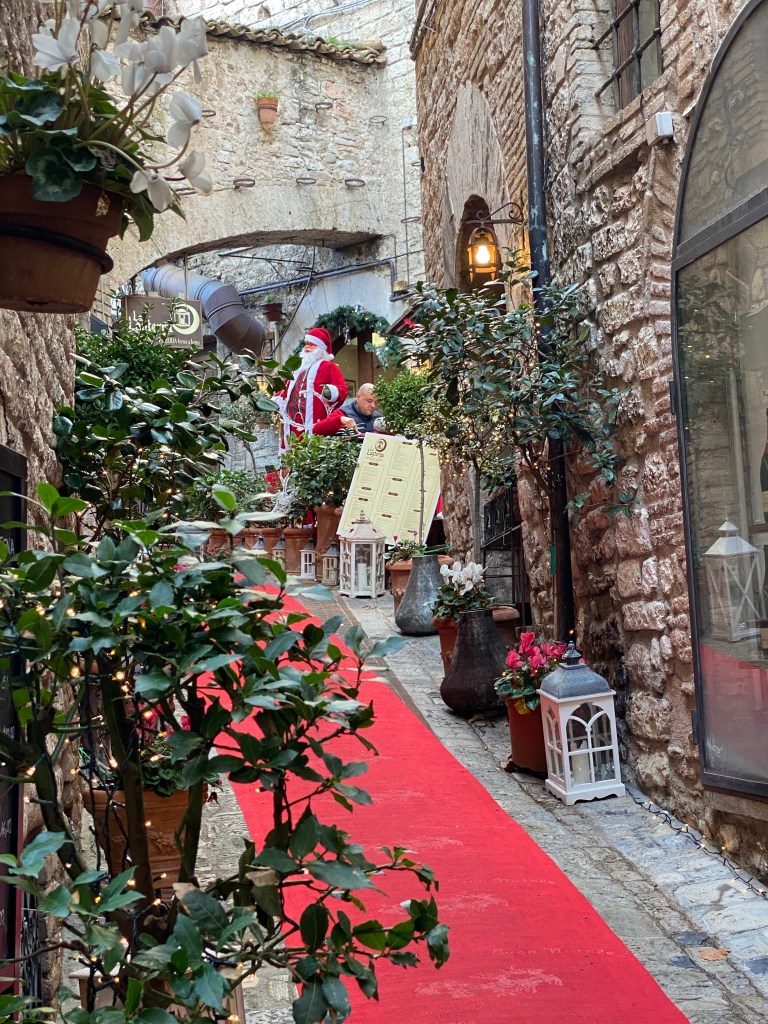
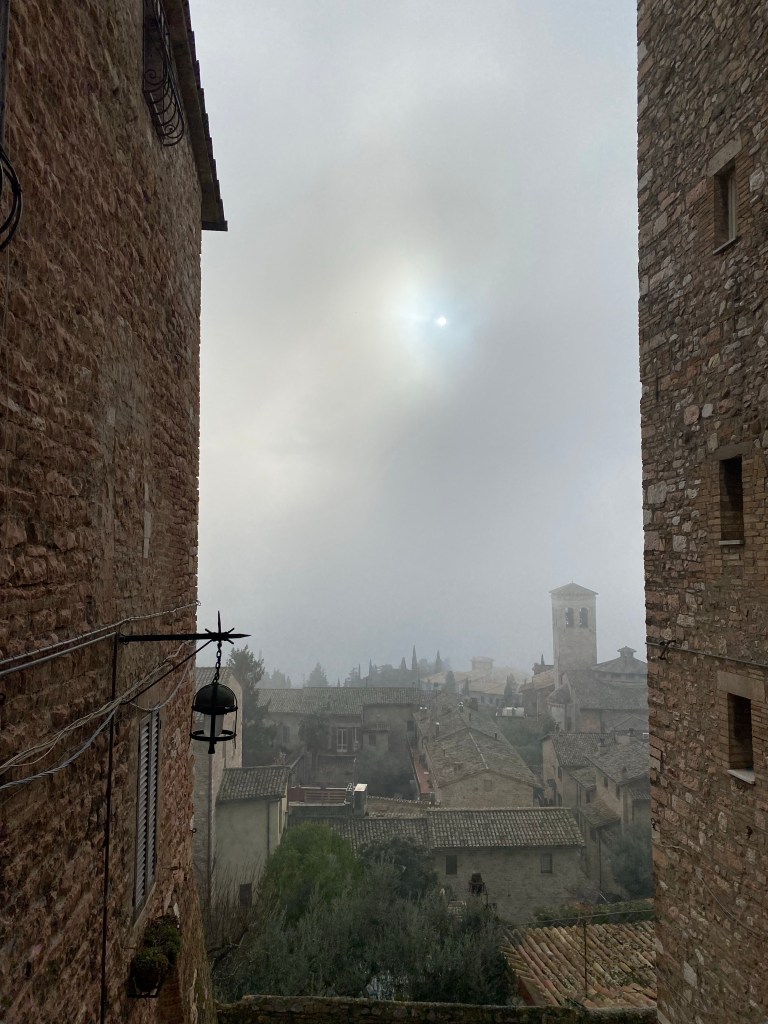
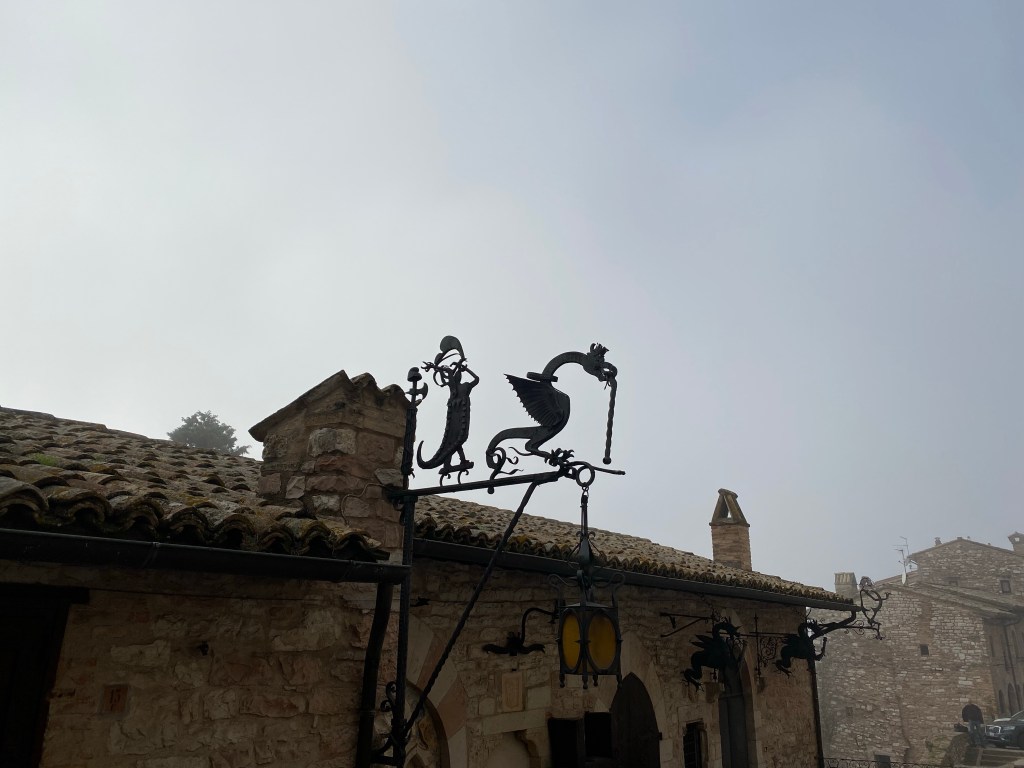
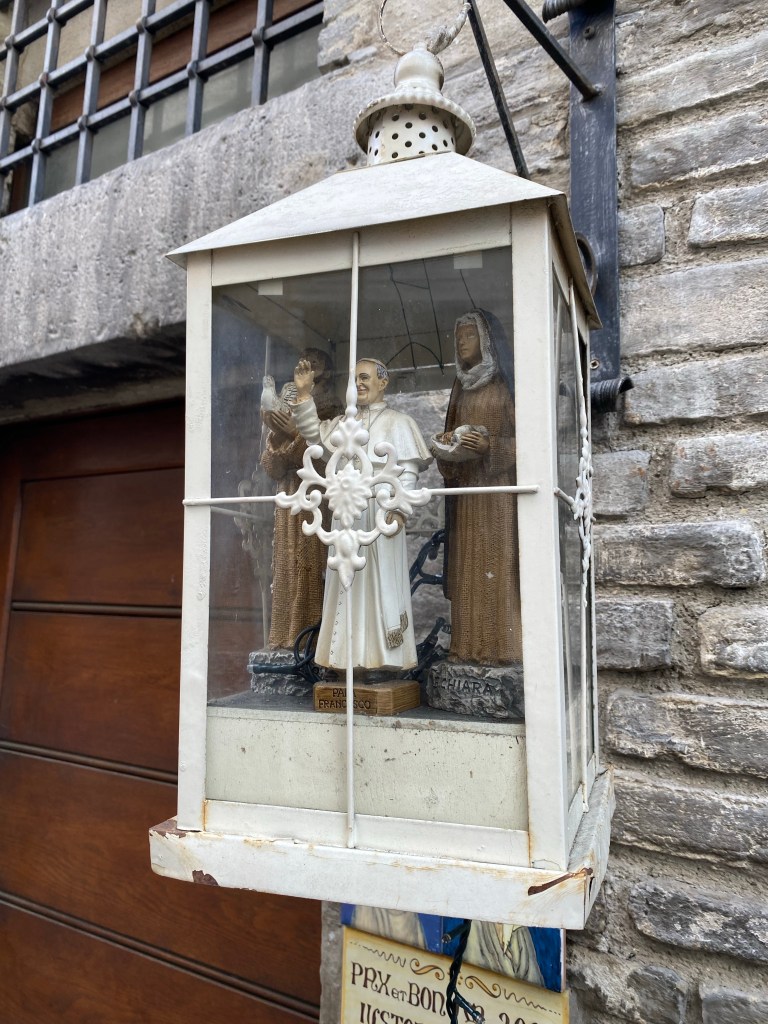
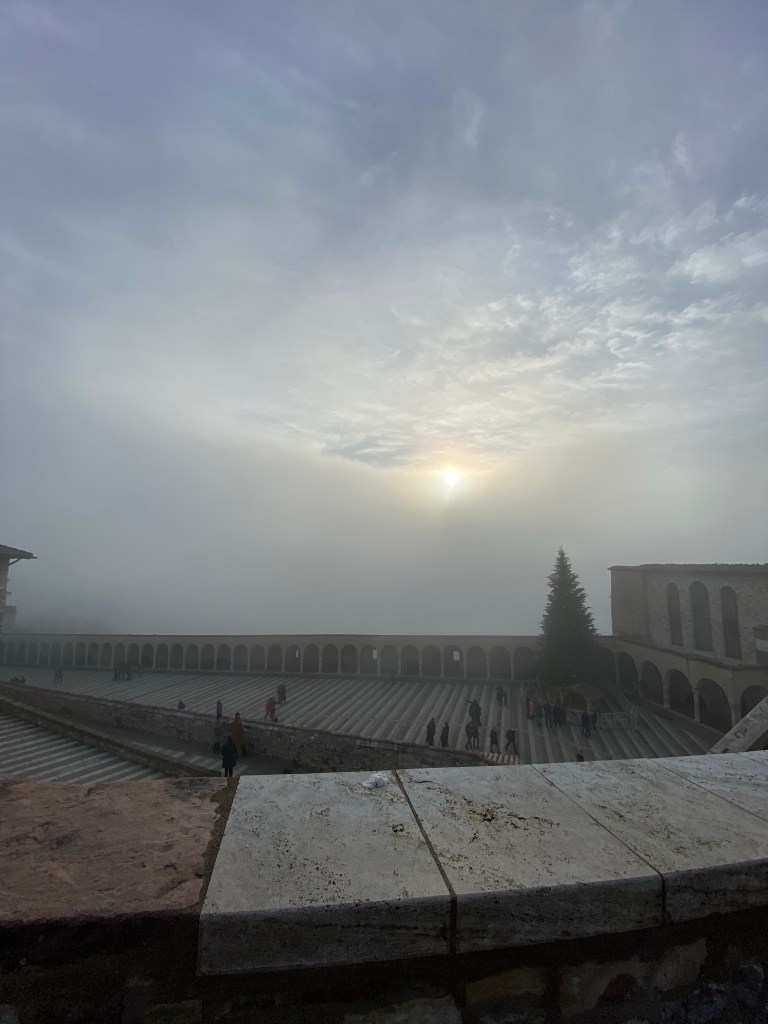
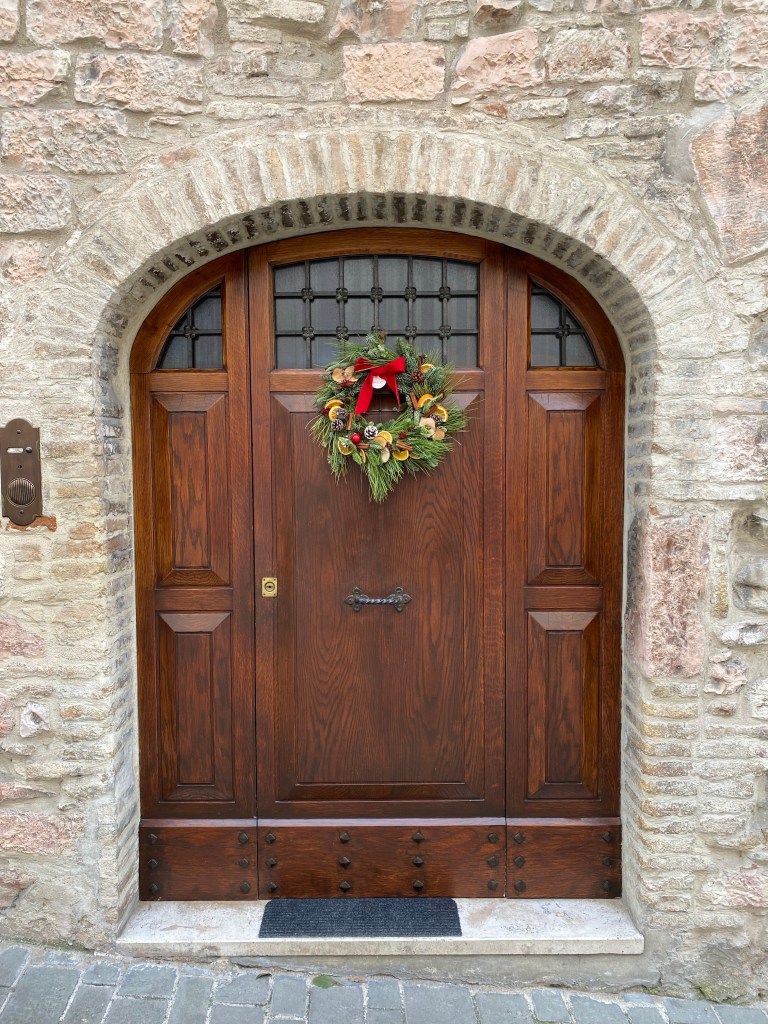
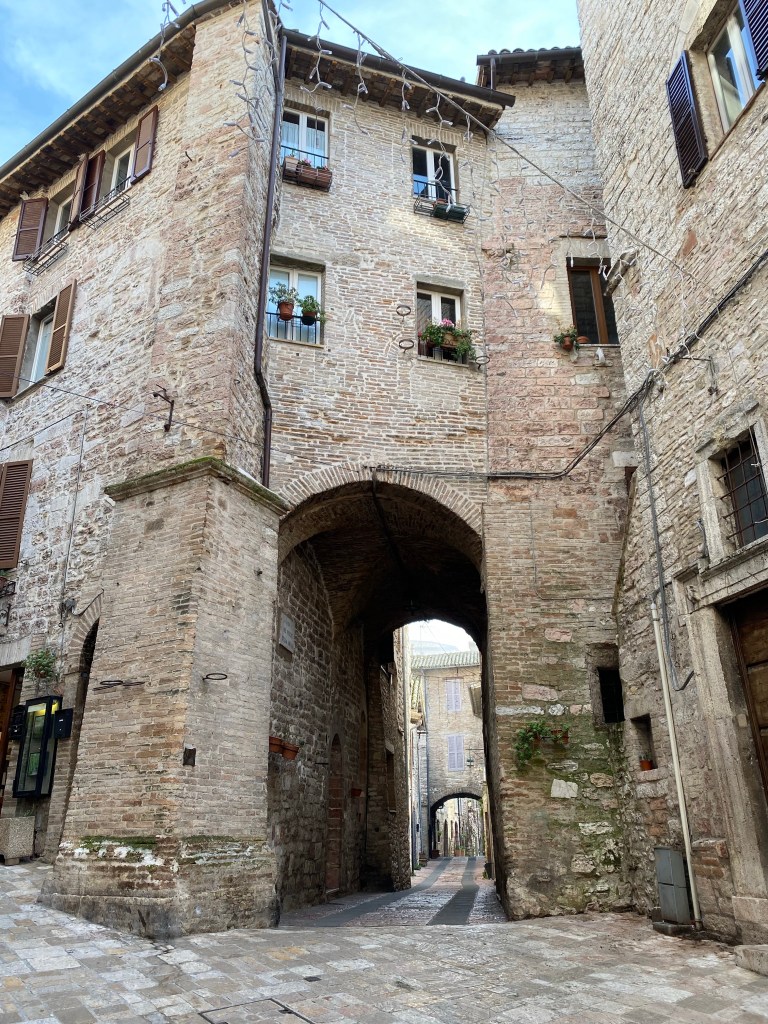
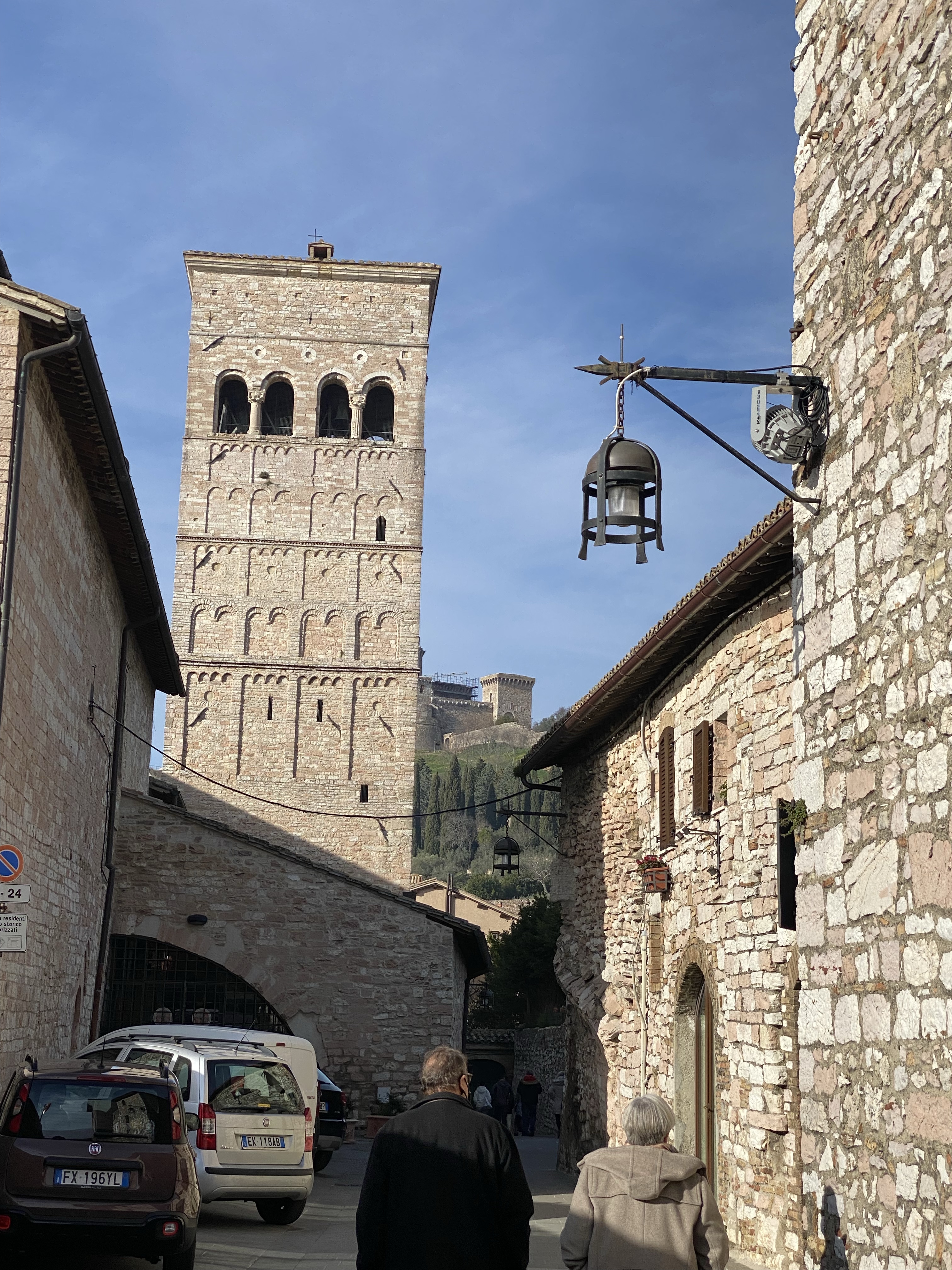
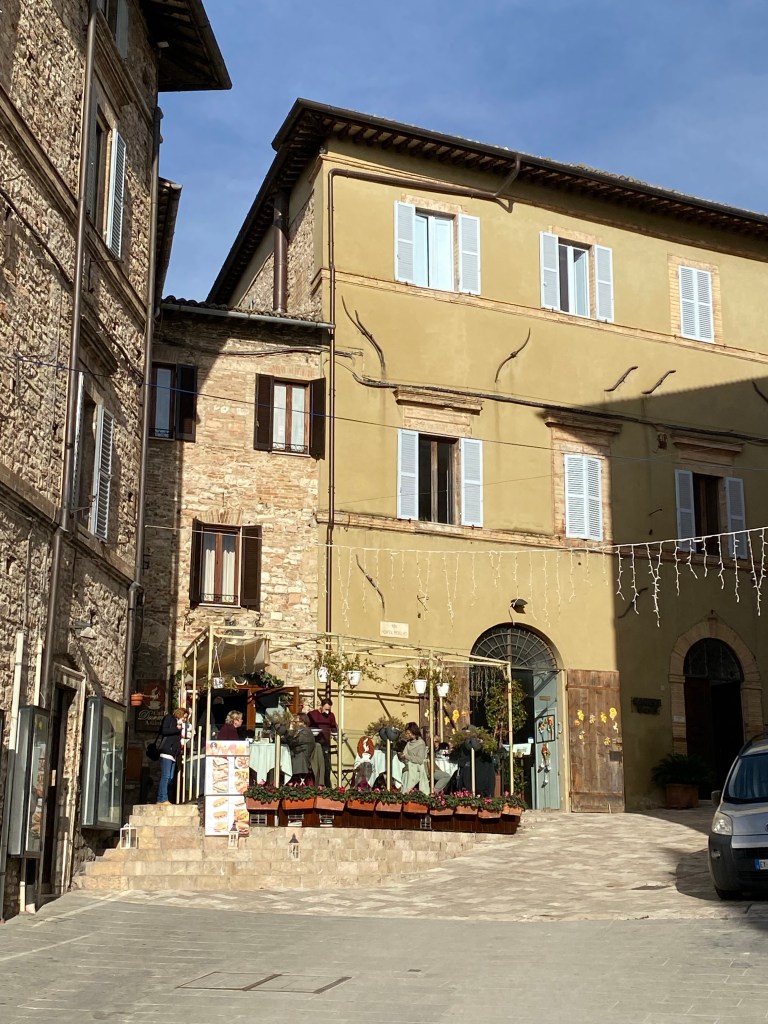
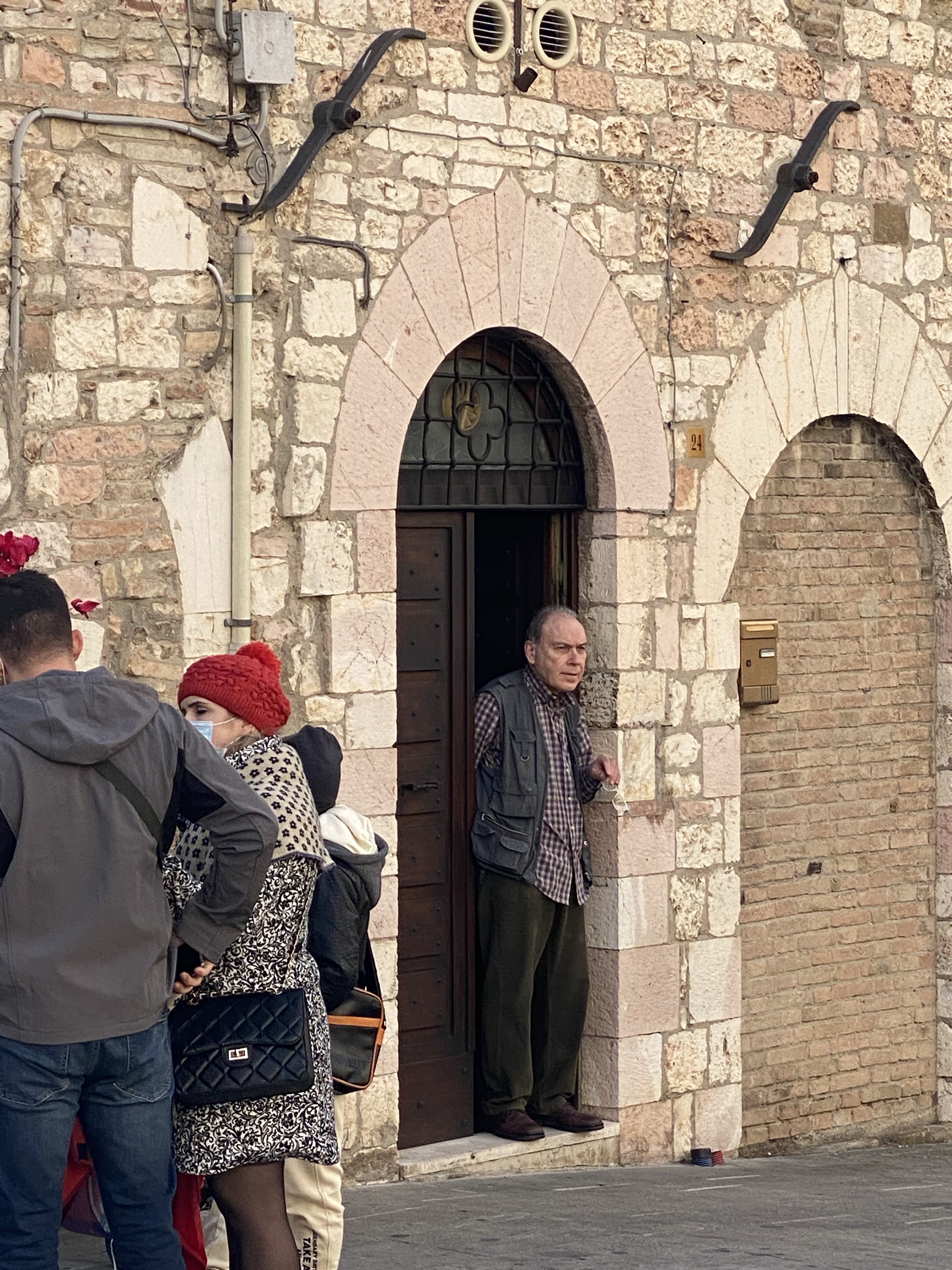
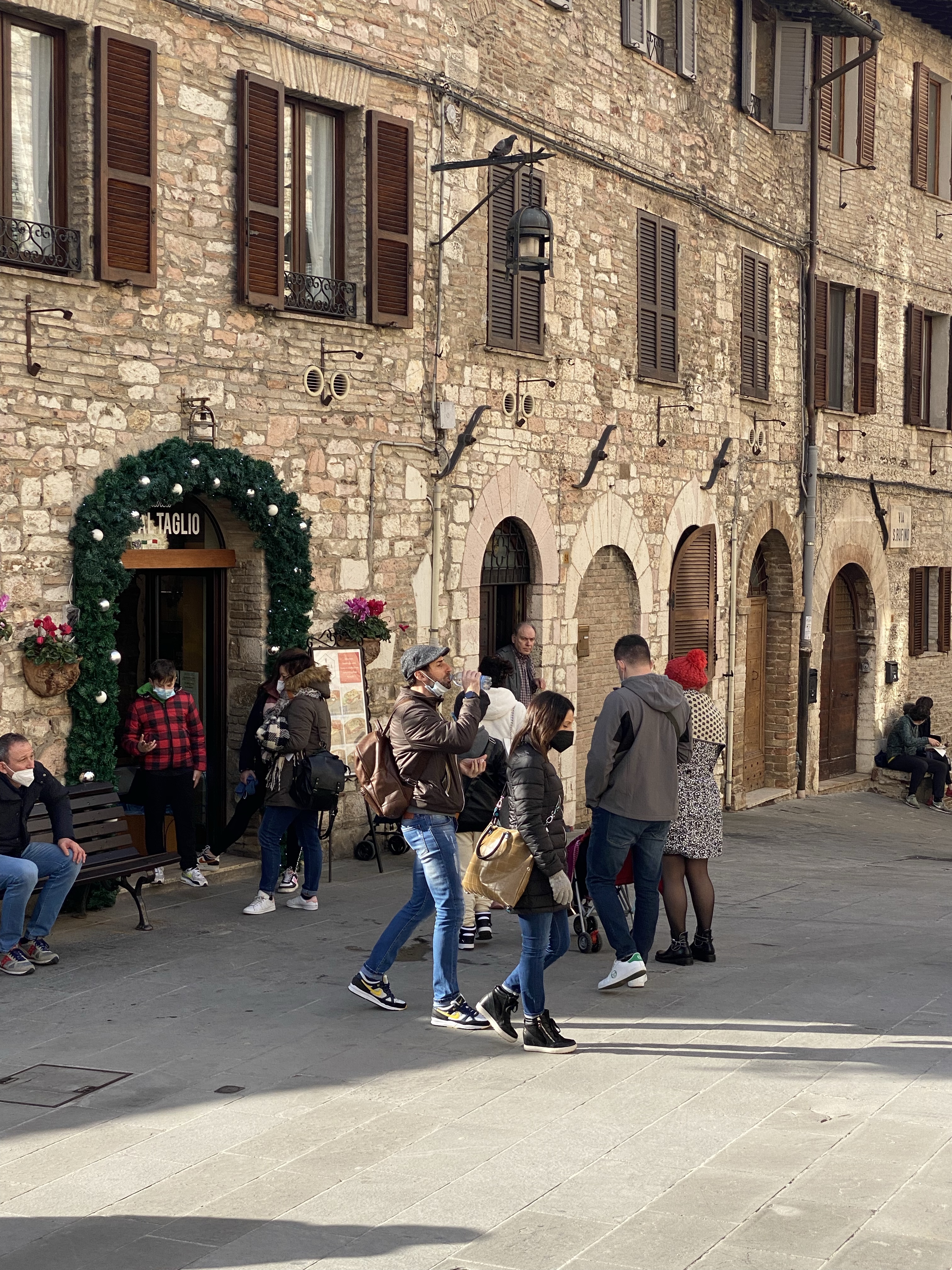
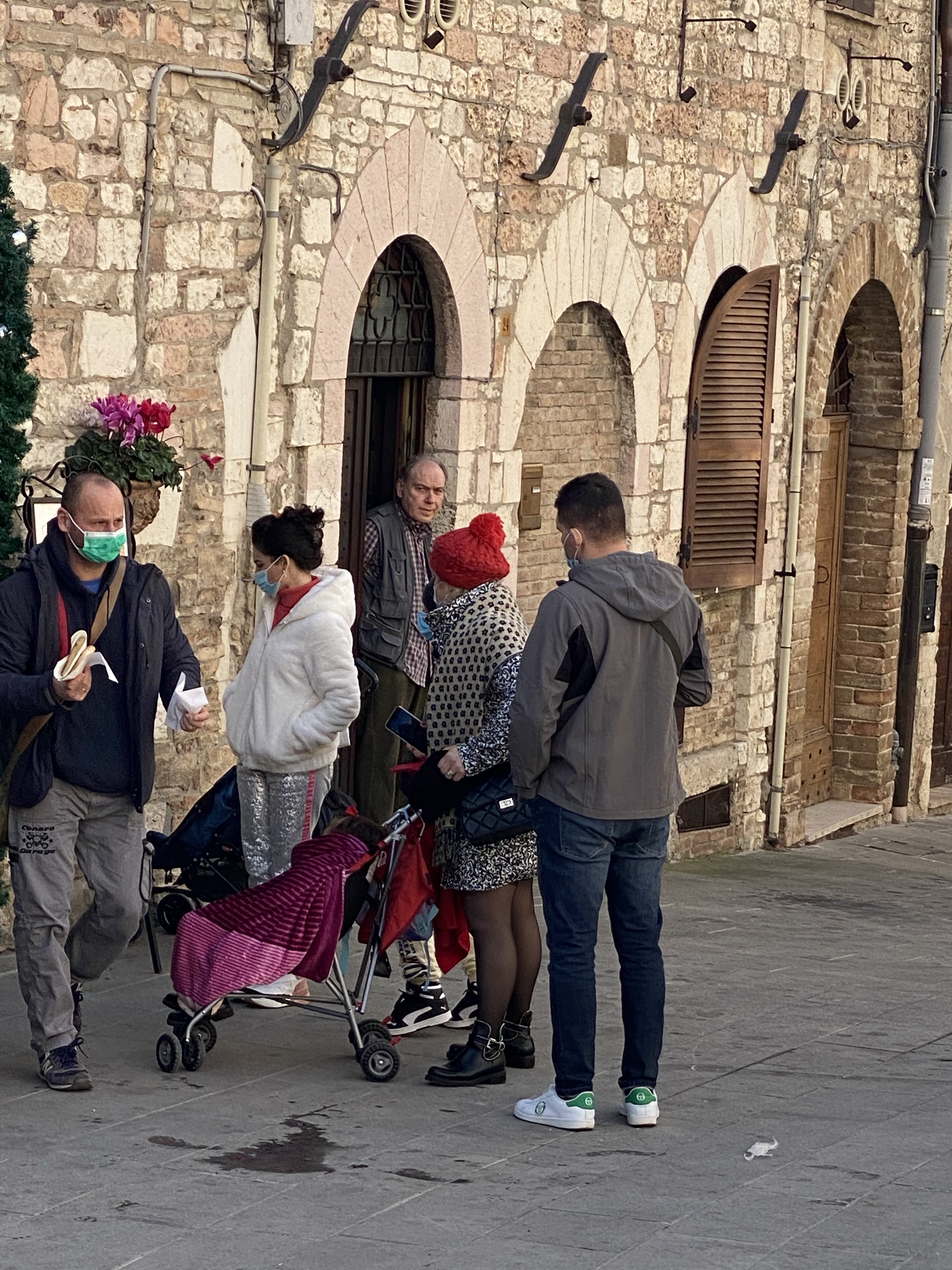
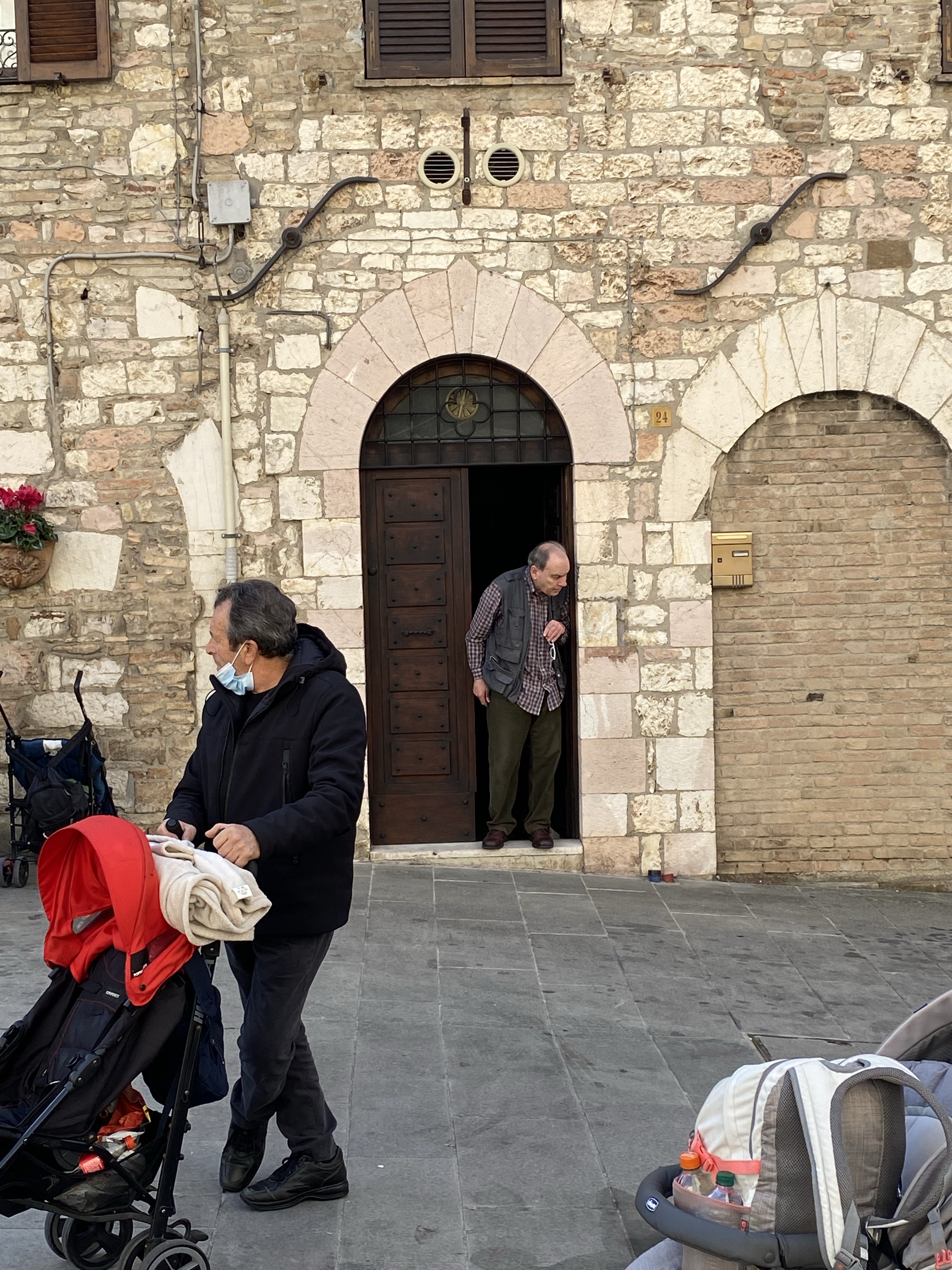
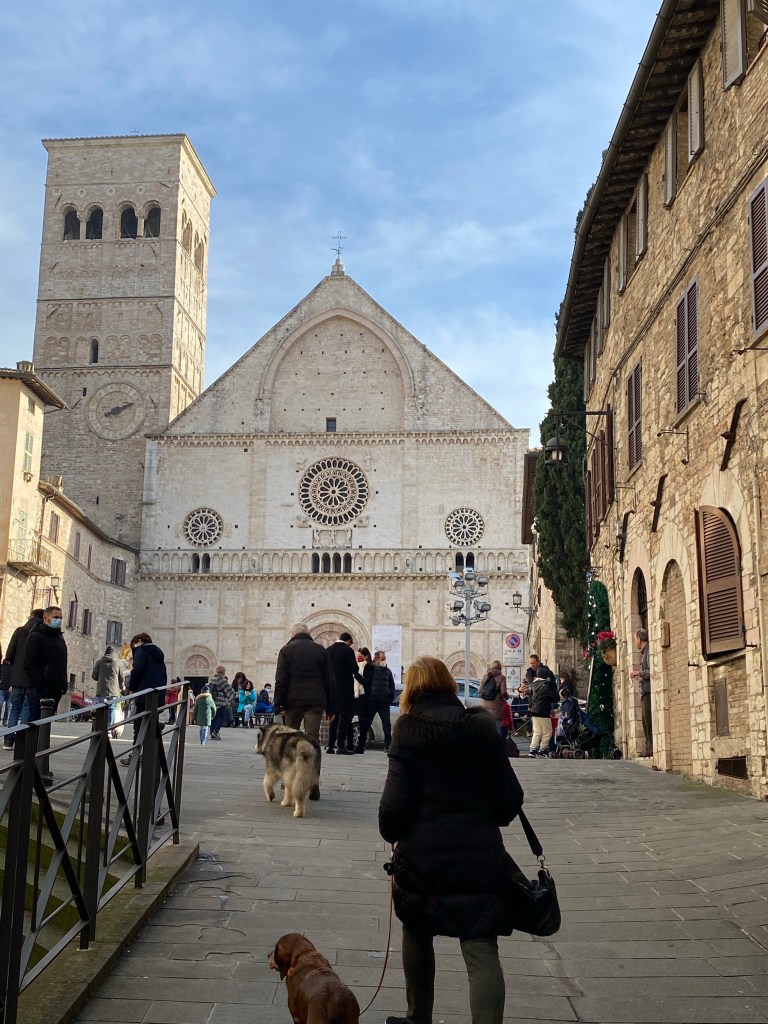
Just before New Year’s I had a chance to slip away to Assisi. I’m so glad I did! Here are various scenes of this charming hilltop town in Umbria:
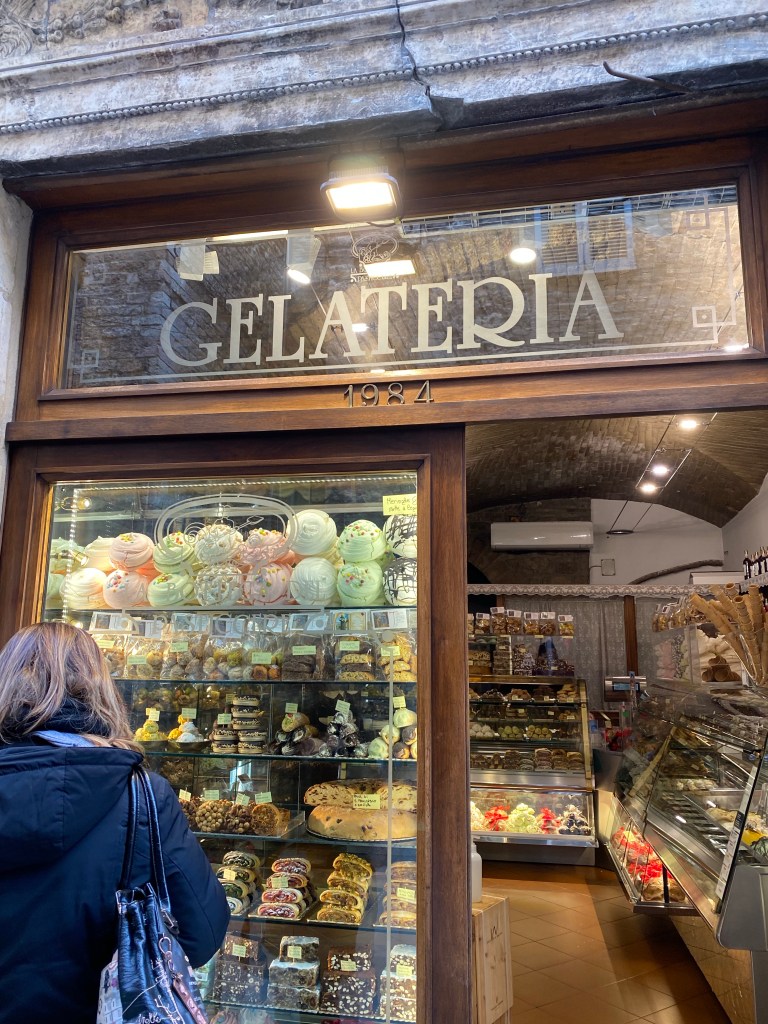
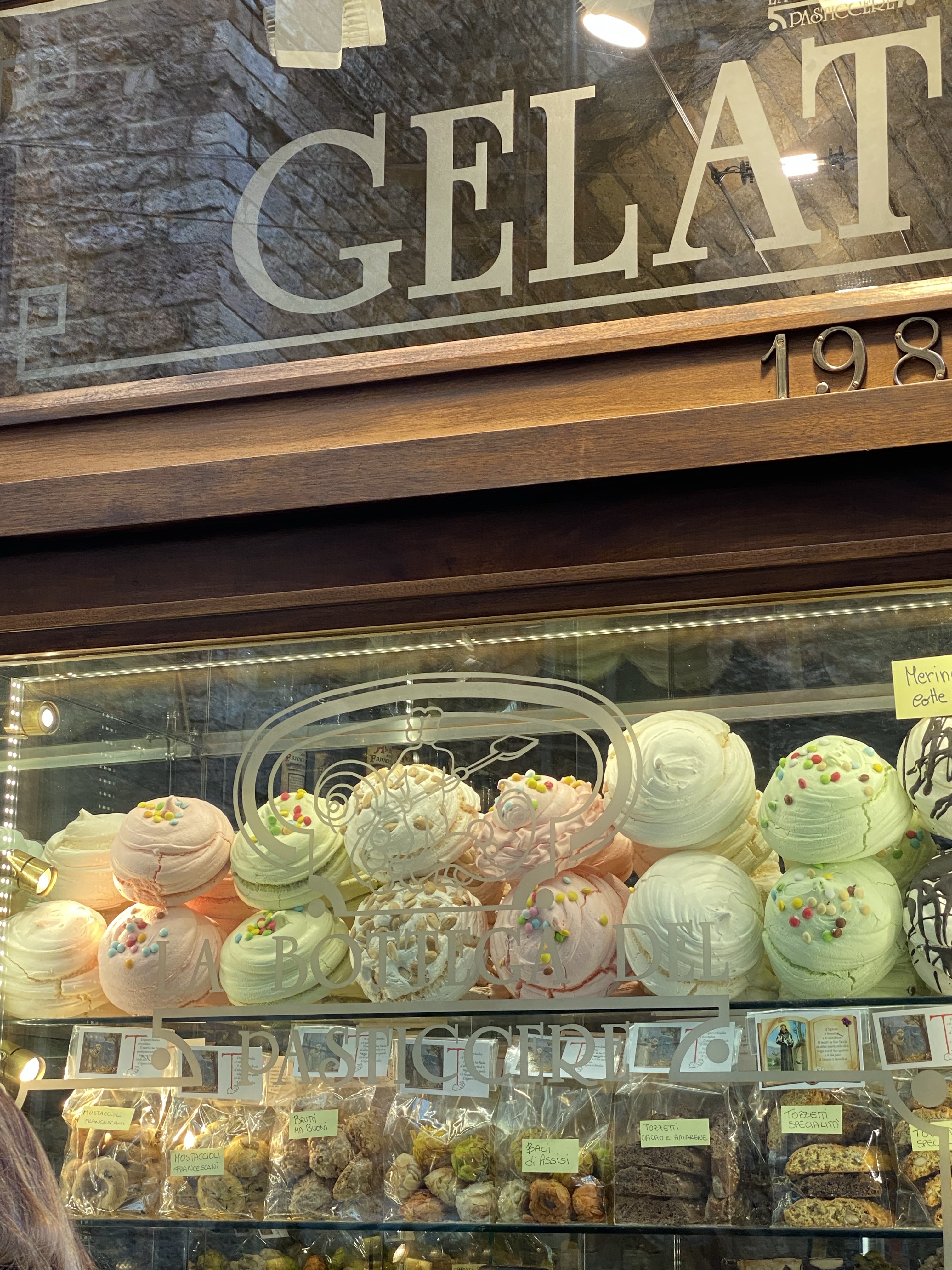
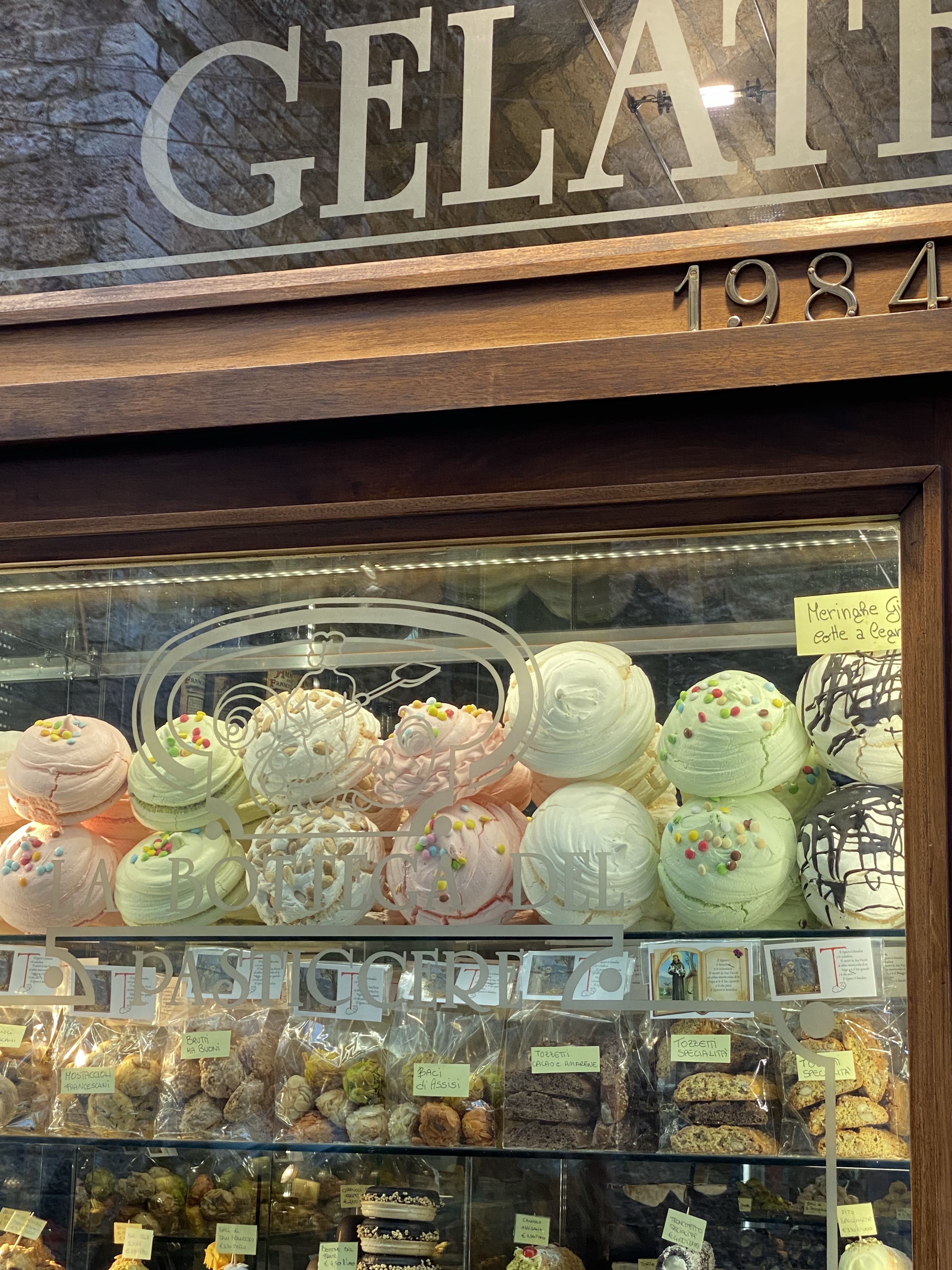
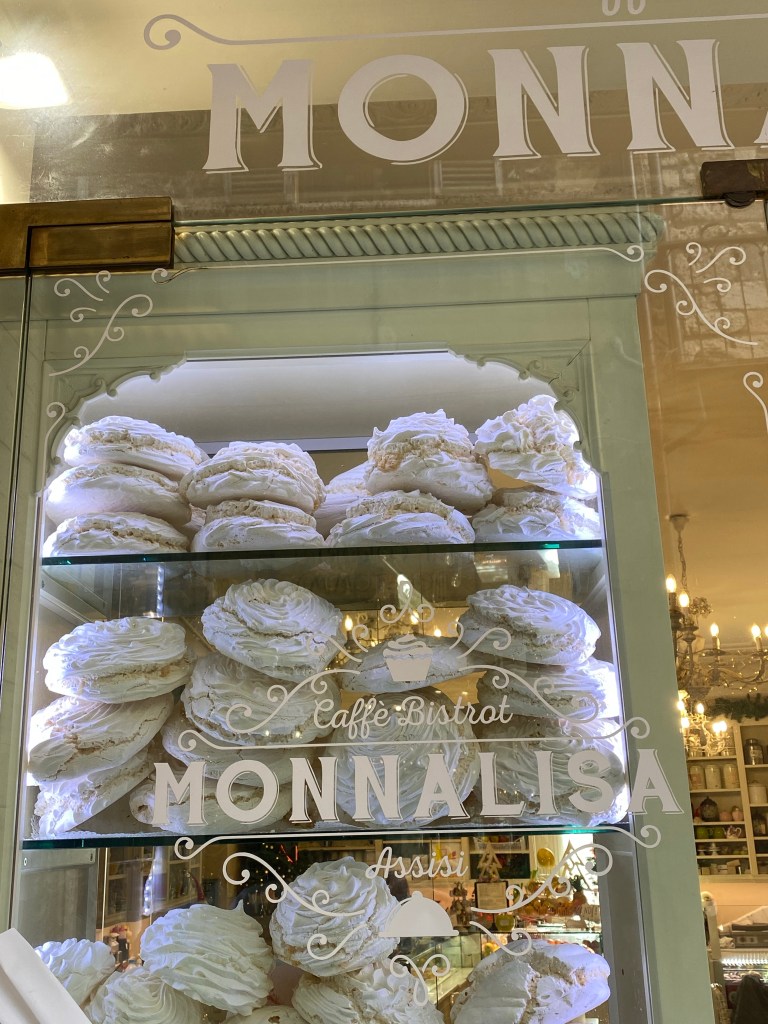
Colorful meringues were for sale in this lovely old gelateria/pasticceria. It may be an Assisi speciality, for I don’t see these in other towns in Italy at Christmas.
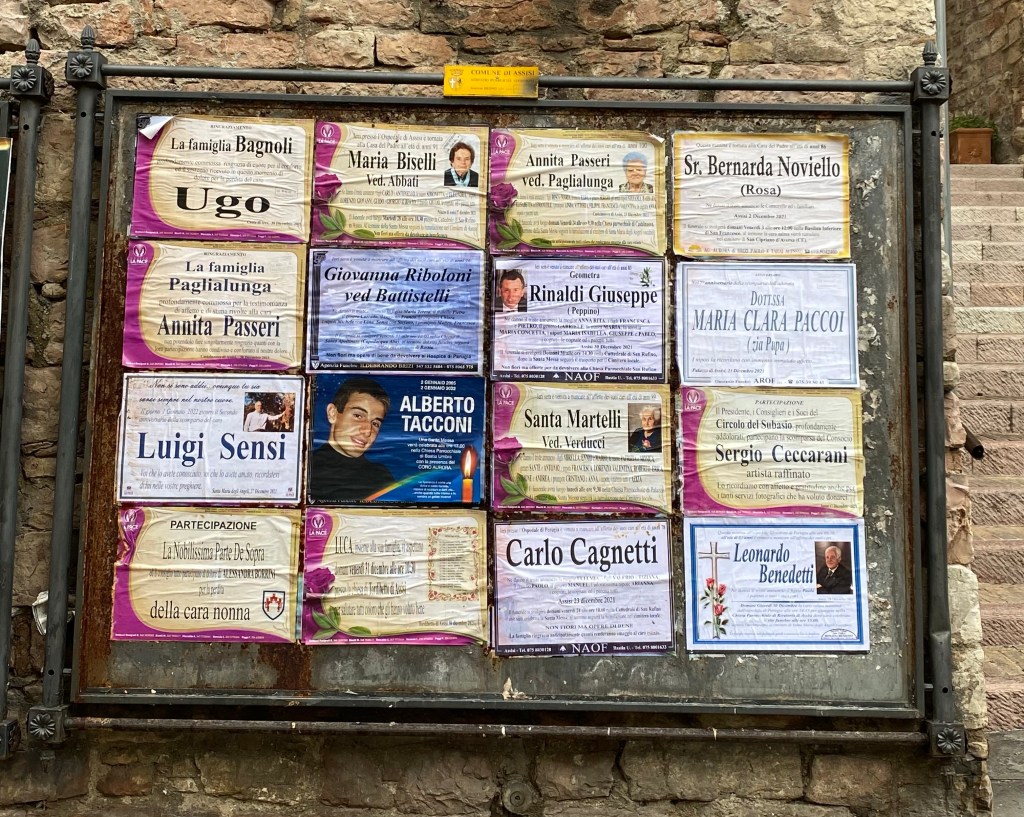
As in so many Italian towns, the recently deceased are celebrated on a sign board. I find these so touching.
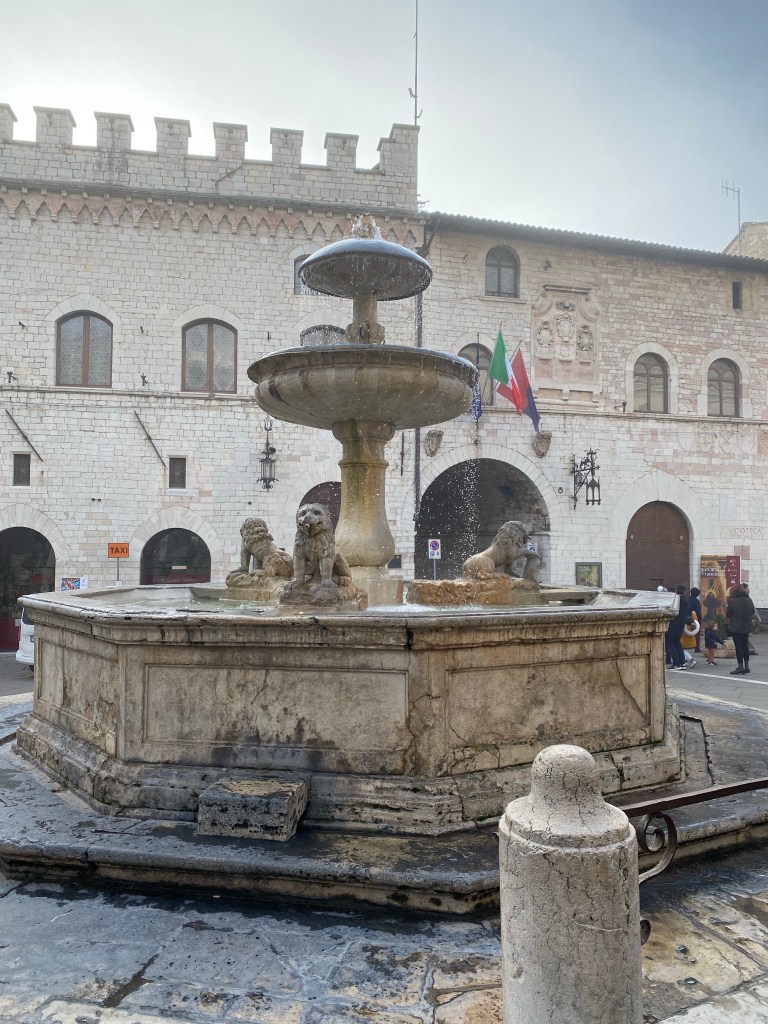
Below, Piazza del Commune in the center of the little town.
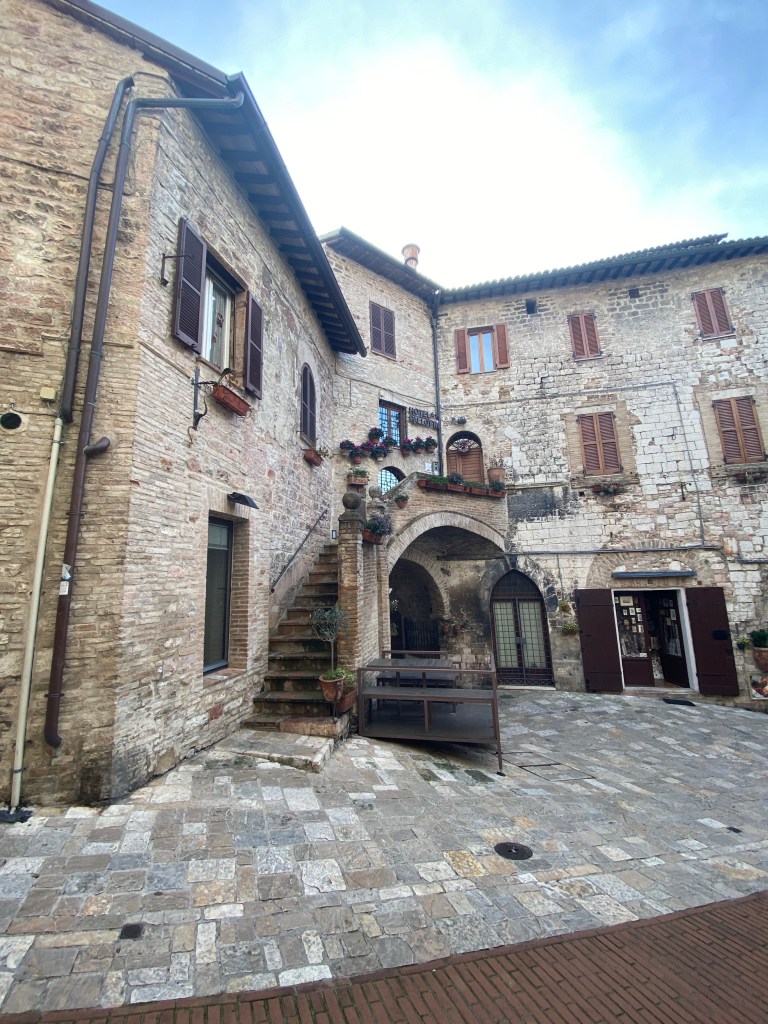
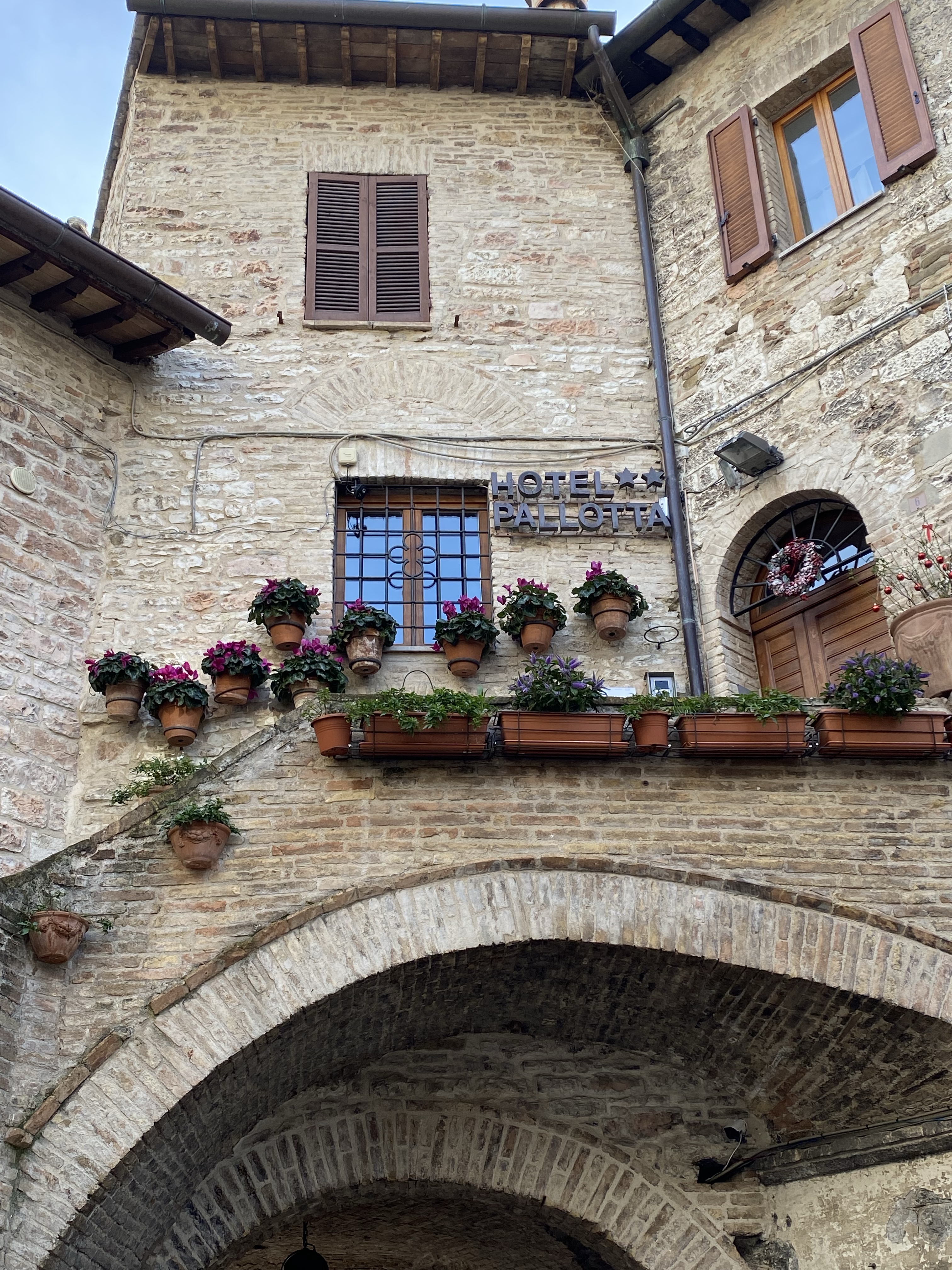
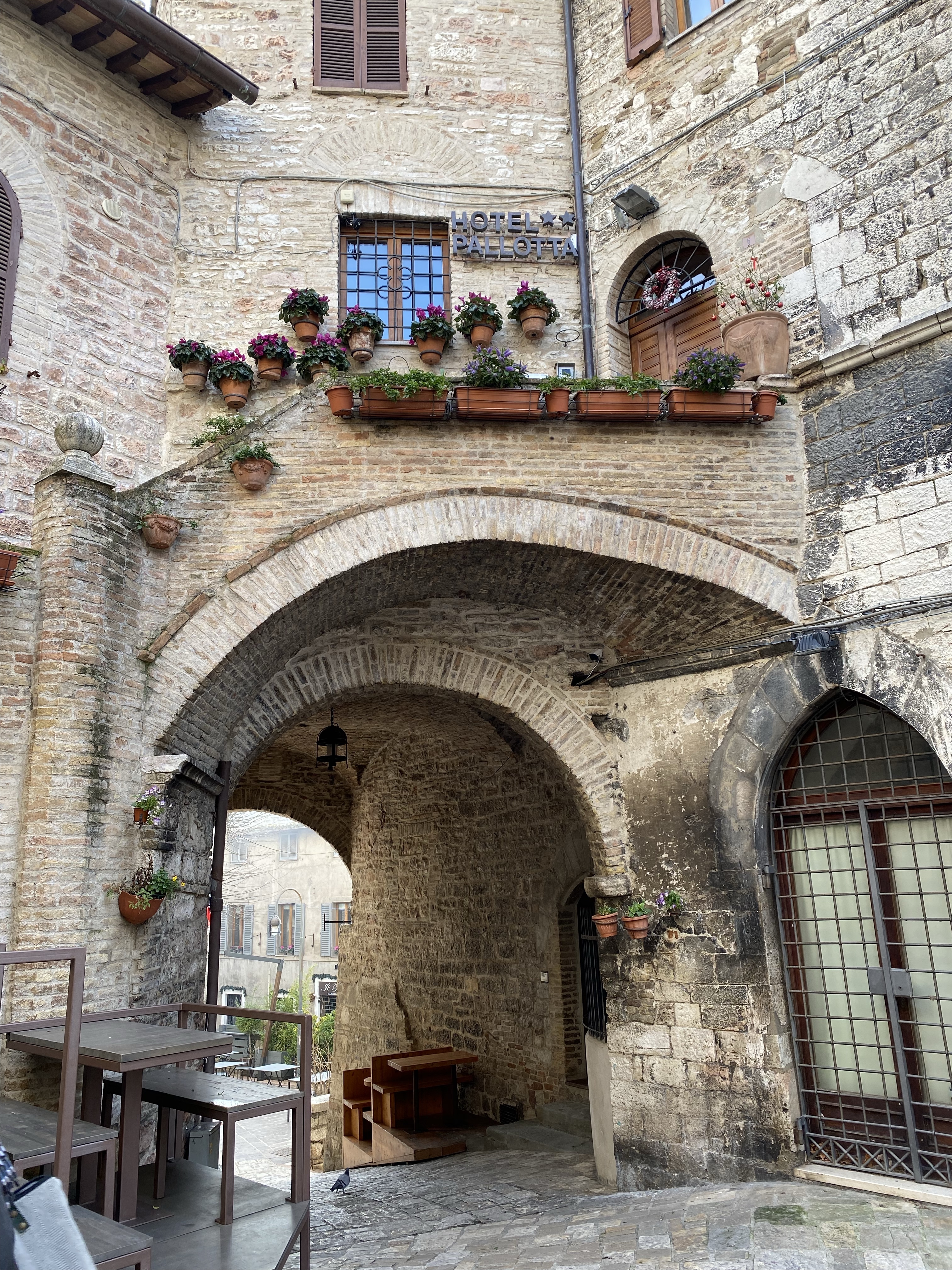
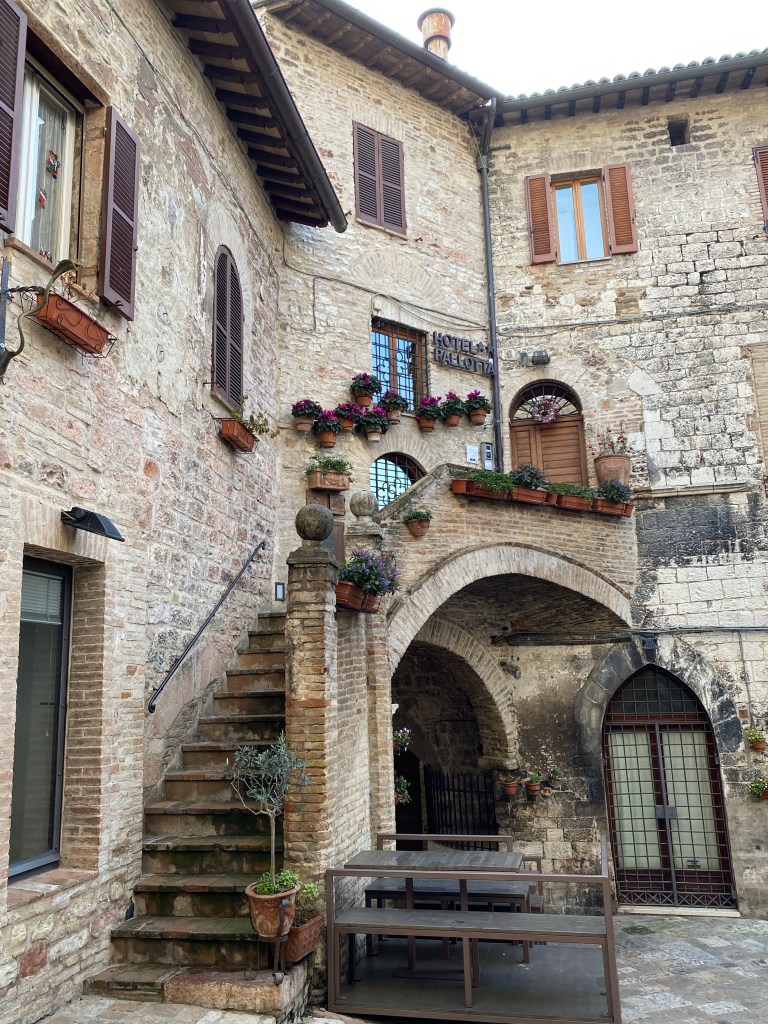
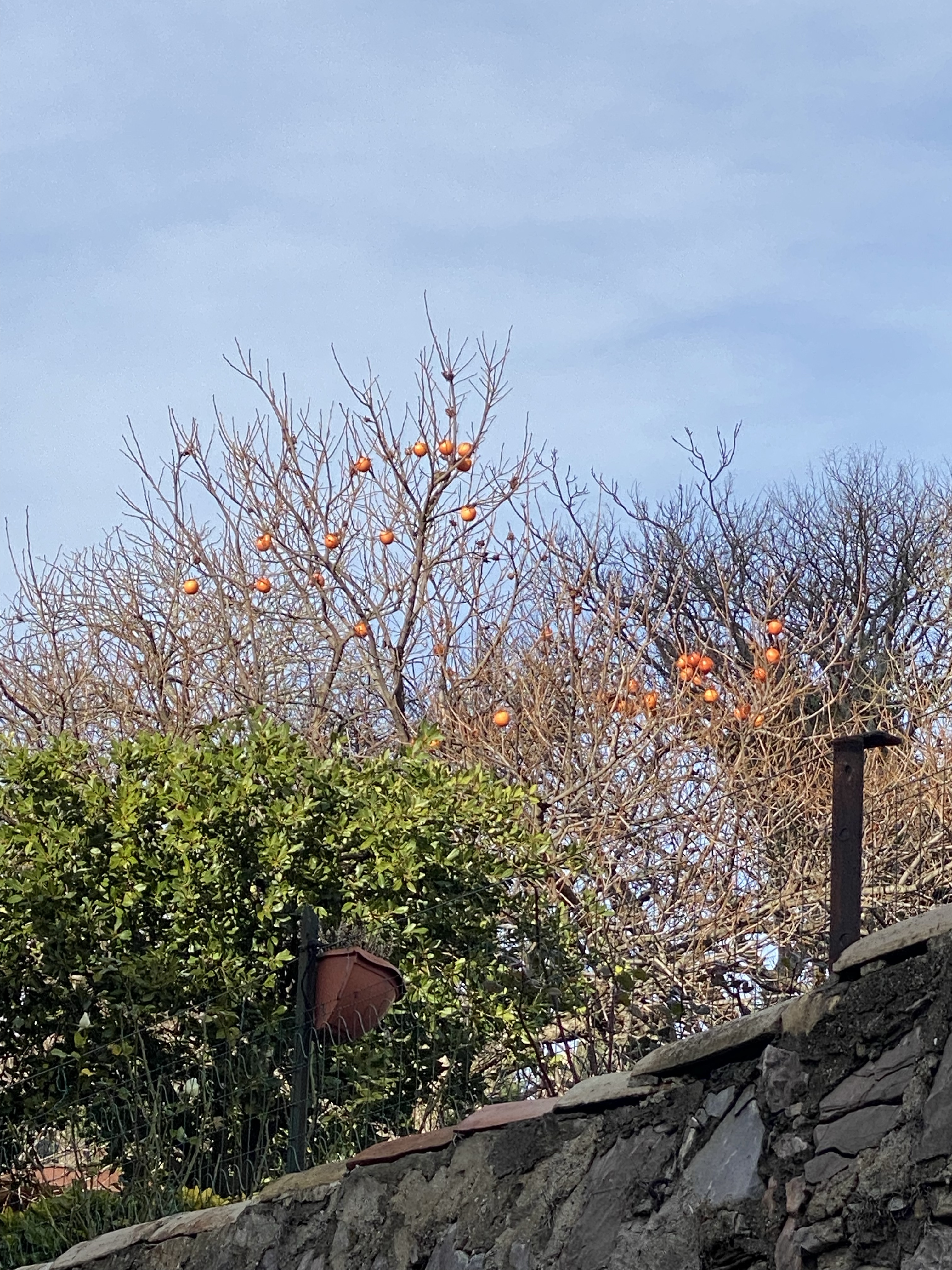
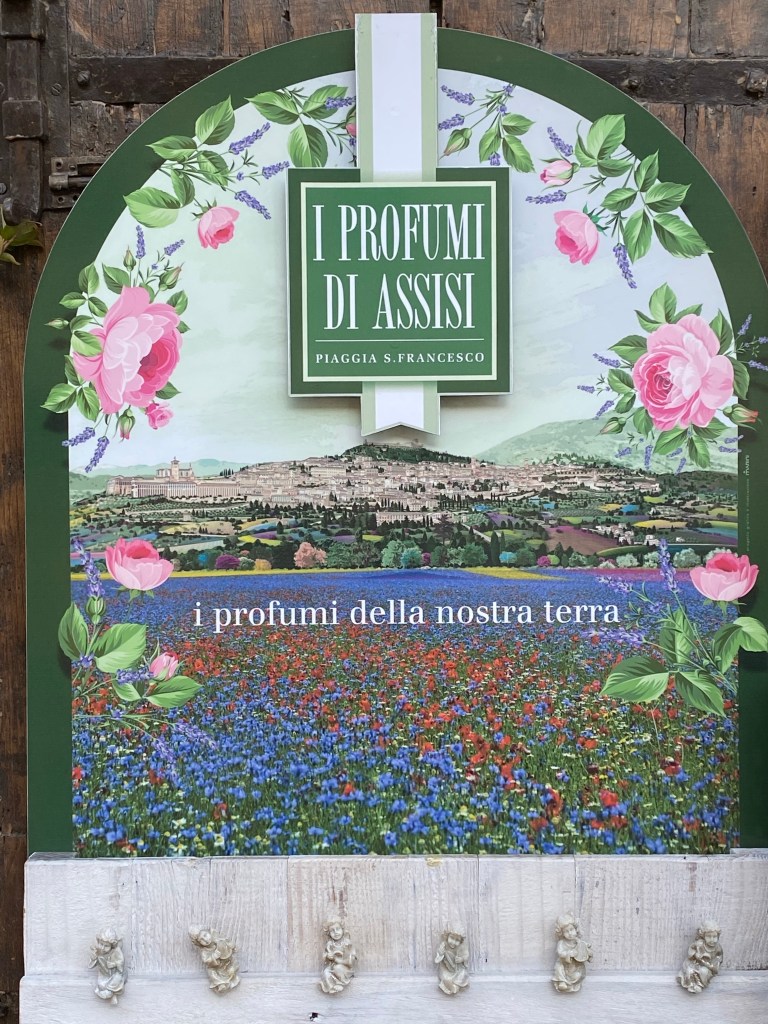
I have a long history at this lovely little hotel. Can’t wait to stay there again!I love seeing persimmon trees in winterAApproaching the cathedral of Assisi from the rearMy favorite bar in Assisi. Near the home of my oldest and dearest Italian friend.A friend and I are always entertained when we see the “perfume” of the various Italian cities. This one really bends the mind. “Piaggia S. Francesco” means “St. Francis beach.” Assisi is as landlocked as they come, so I can’t imagine what they are suggesting!
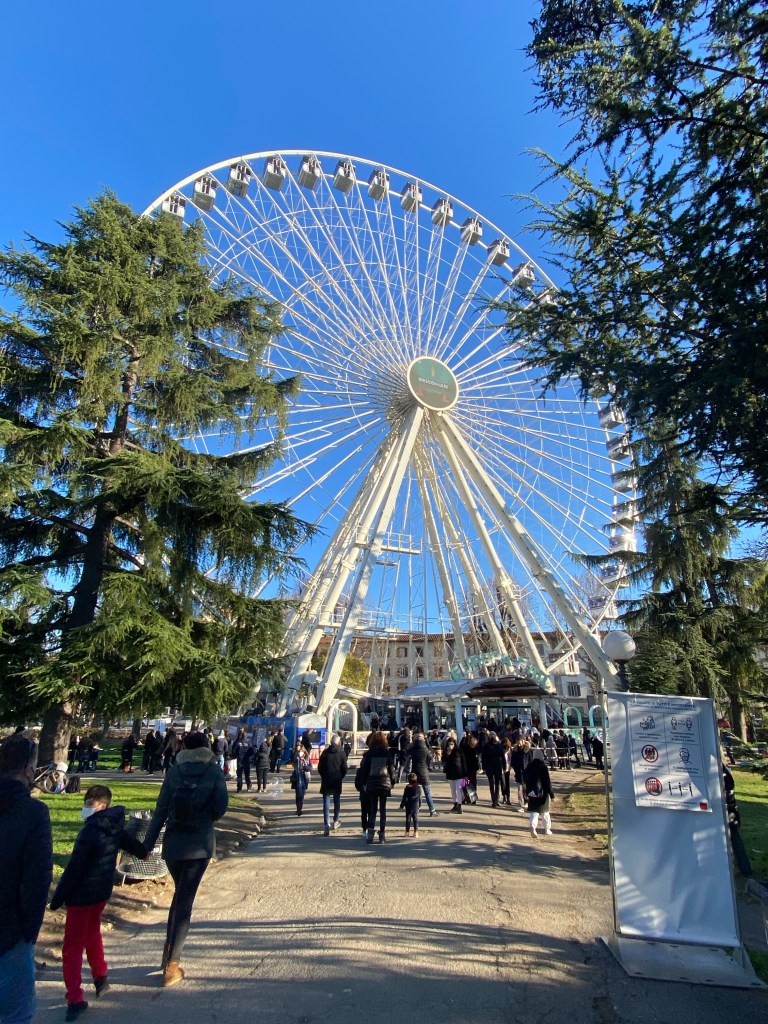
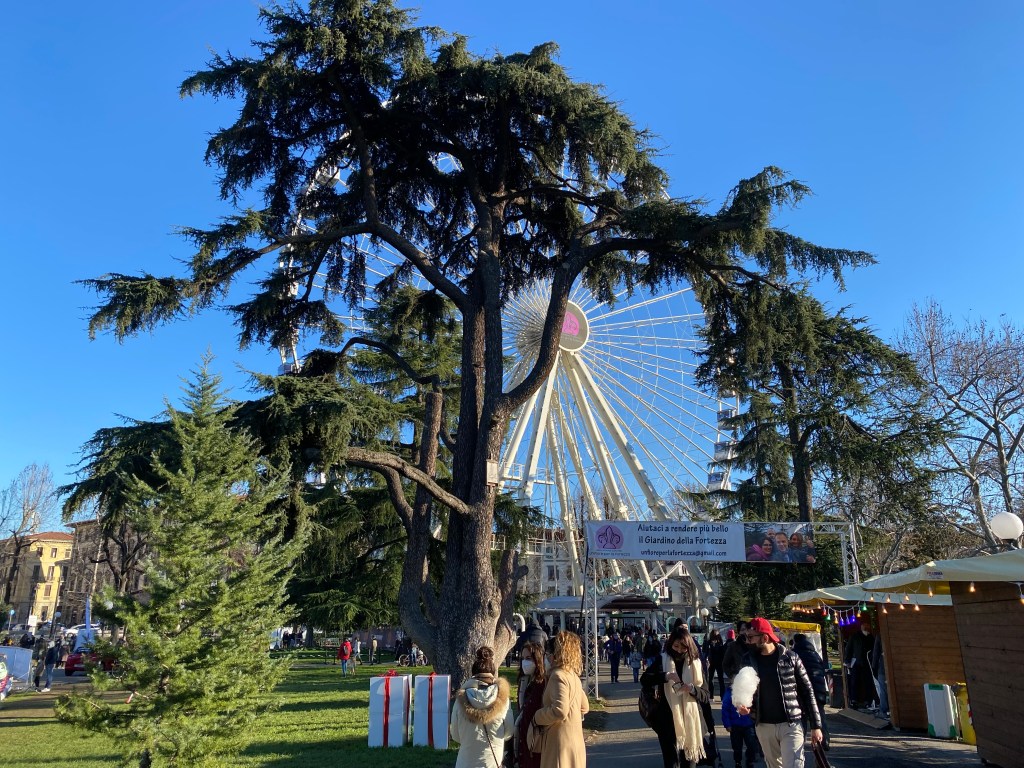
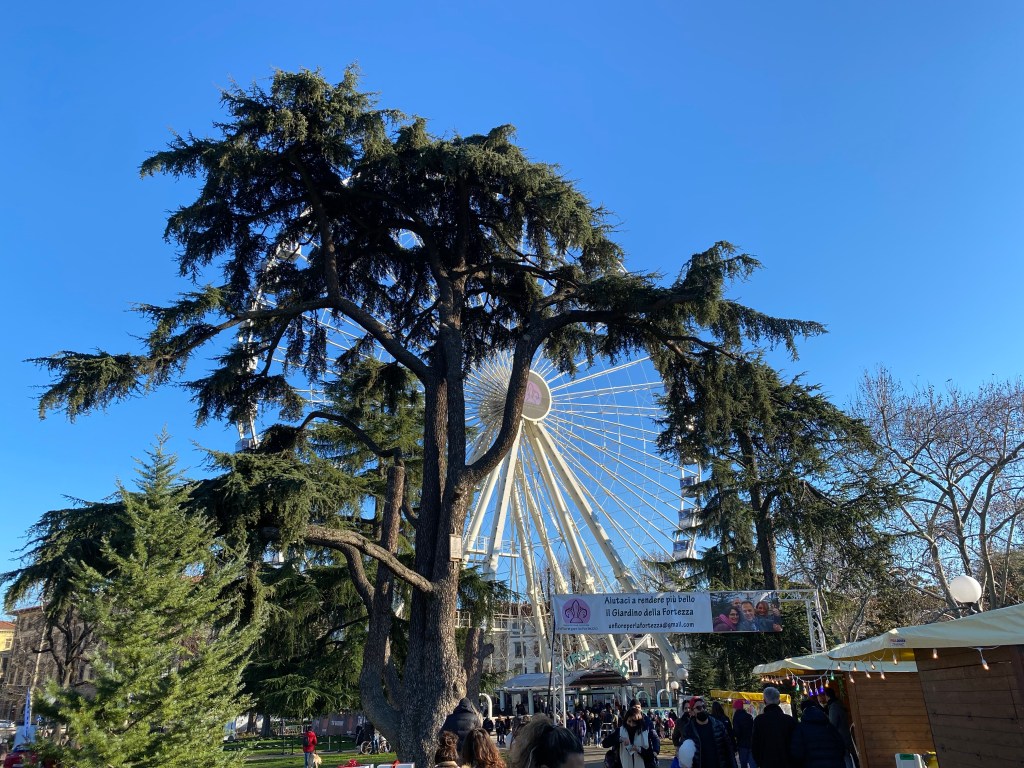
At this small Florentine park not far from my house, “the wheel” is set up to take riders high up and around, and an ice skating rink is set up below to take them low and around. It’s up until 16 January, so hurry if you want to join in! It was about 50 degrees here today, rain tomorrow.
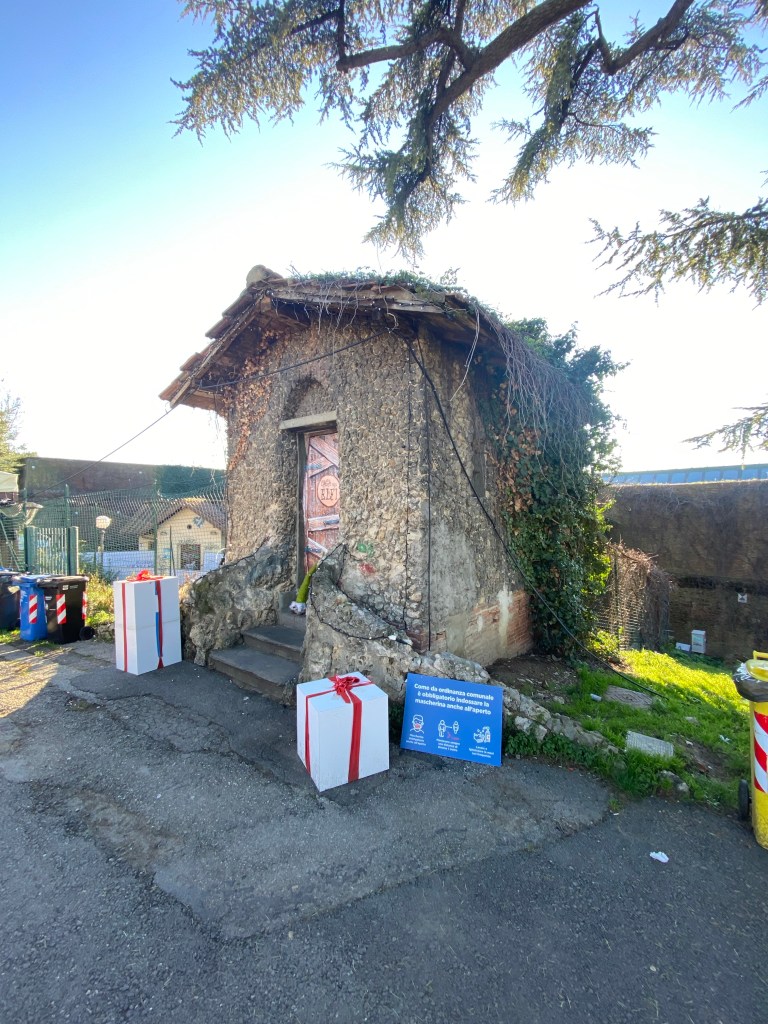
This little ancient building is set up as the elf’s house!
The Basilica of Saint Francis of Assisi is the mother church of the Roman Catholic Order of Friars Minor Conventual in Assisi, a town in the Umbria region in central Italy, where Saint Francis was born and died. It is a Papal minor basilica and one of the most important places of Christian pilgrimage in Italy. With its accompanying friary, Sacro Convento, the basilica is a distinctive landmark to those approaching Assisi. It has been a UNESCO World Heritage Site since 2000.
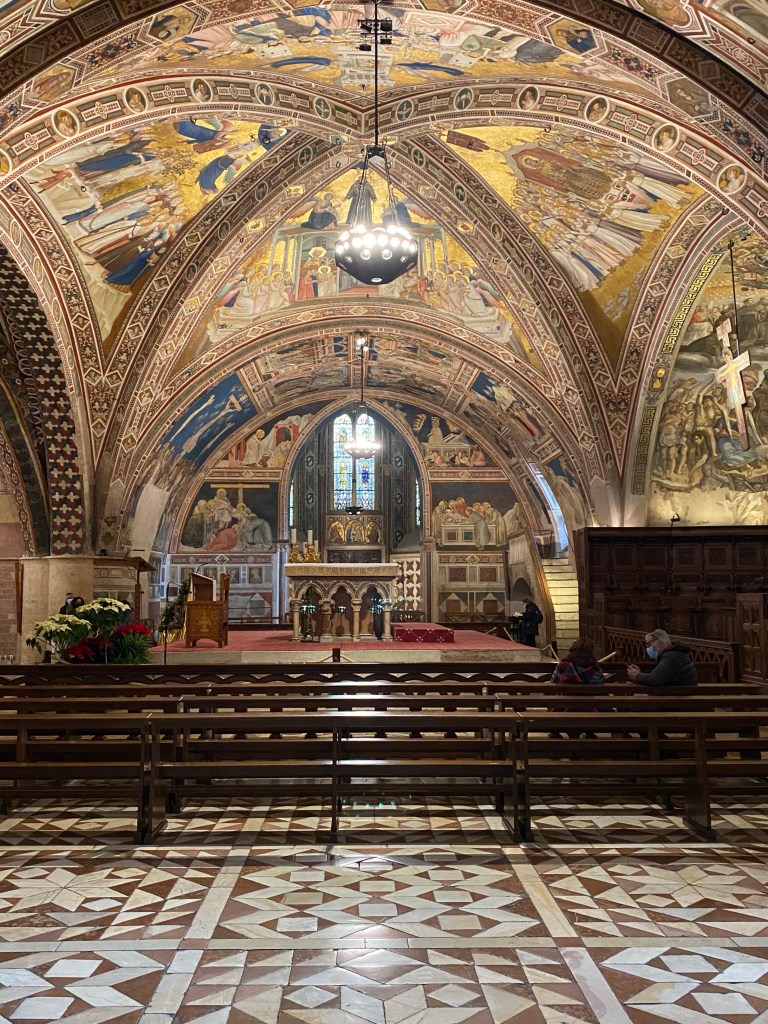
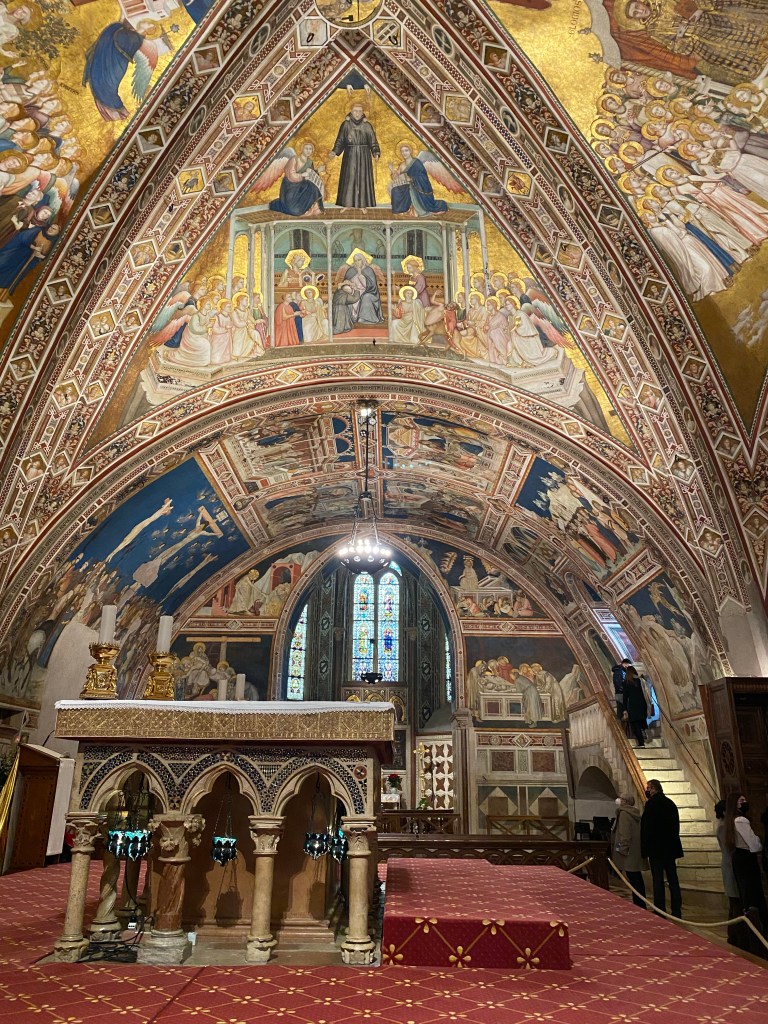
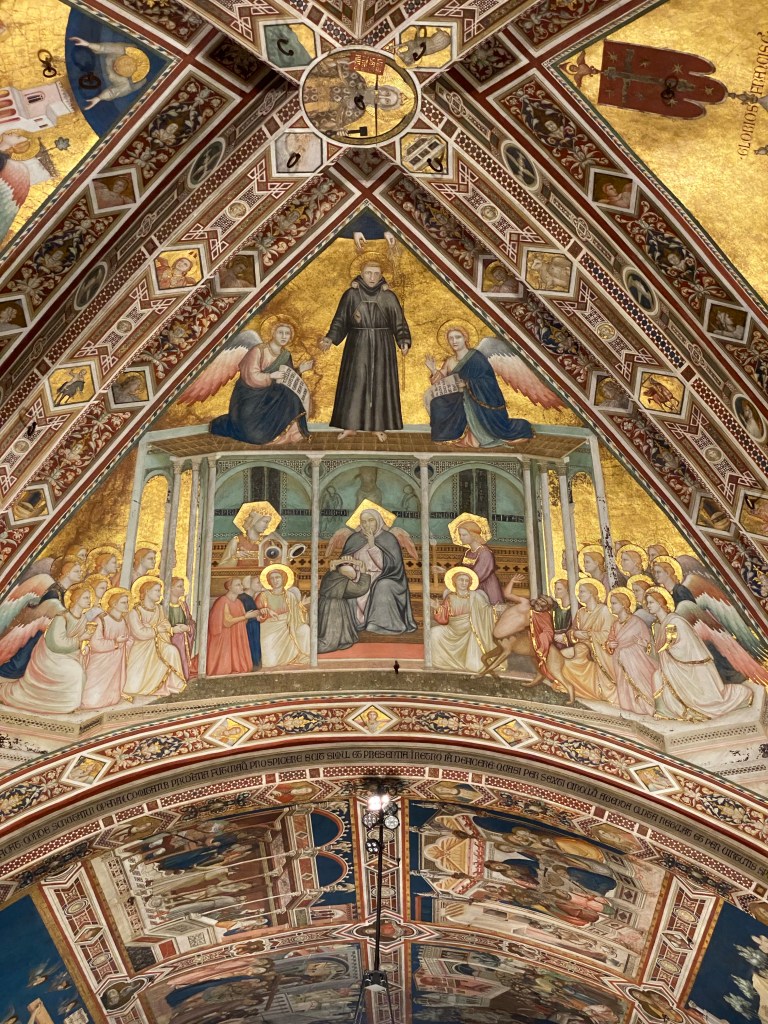
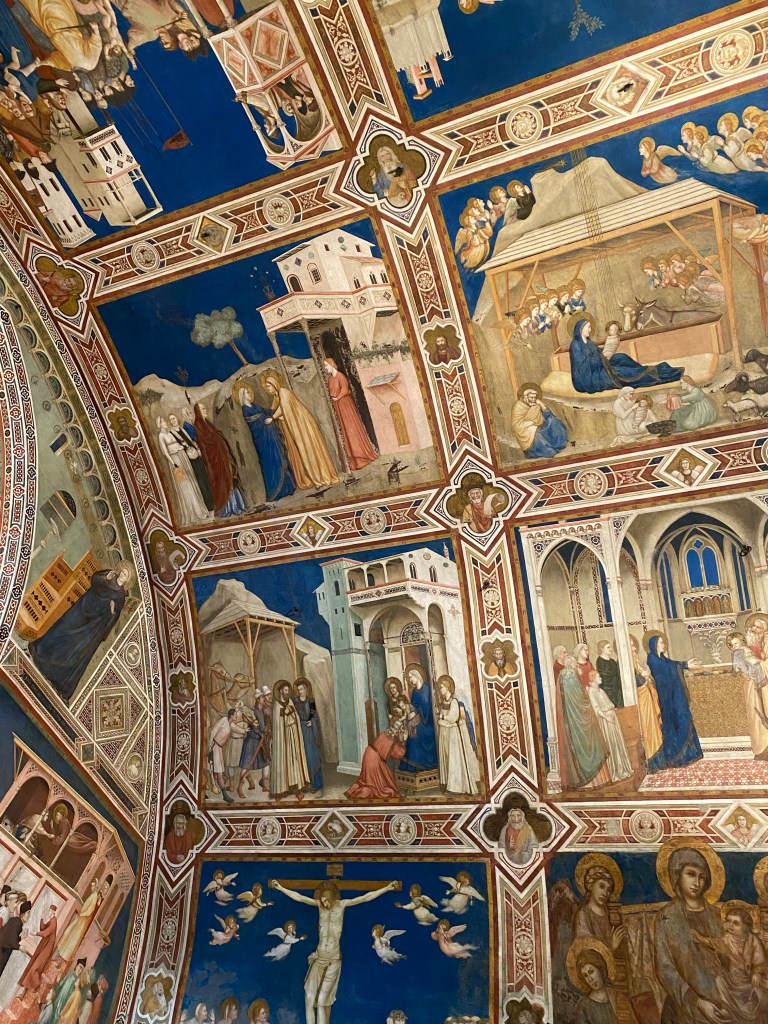
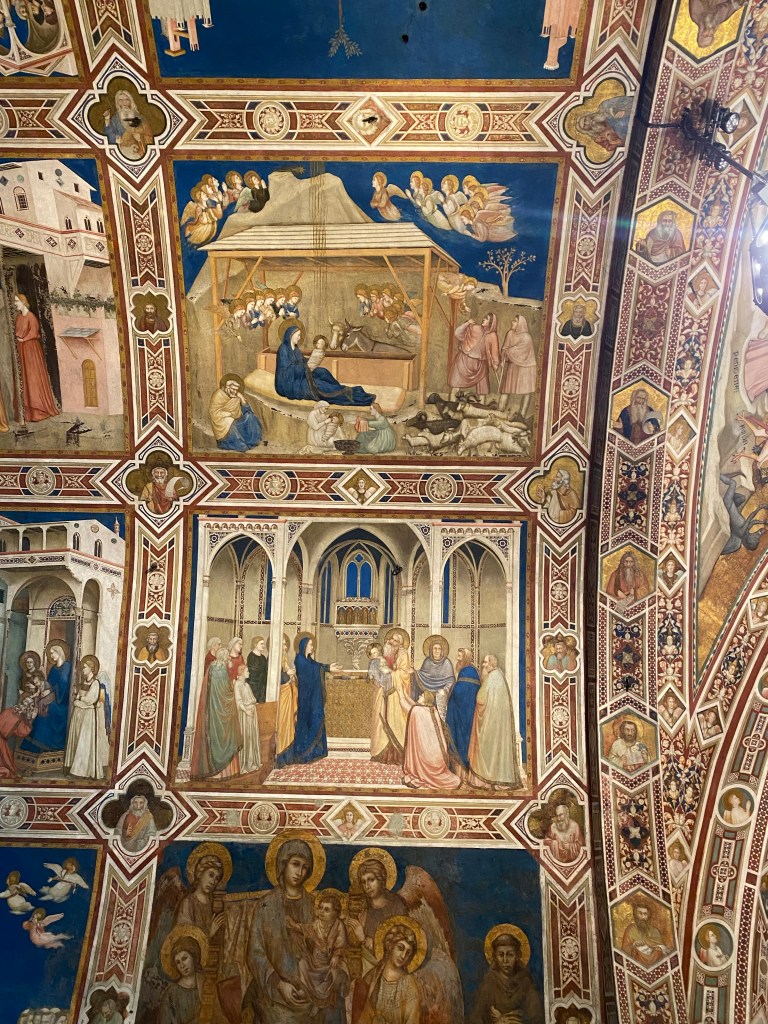
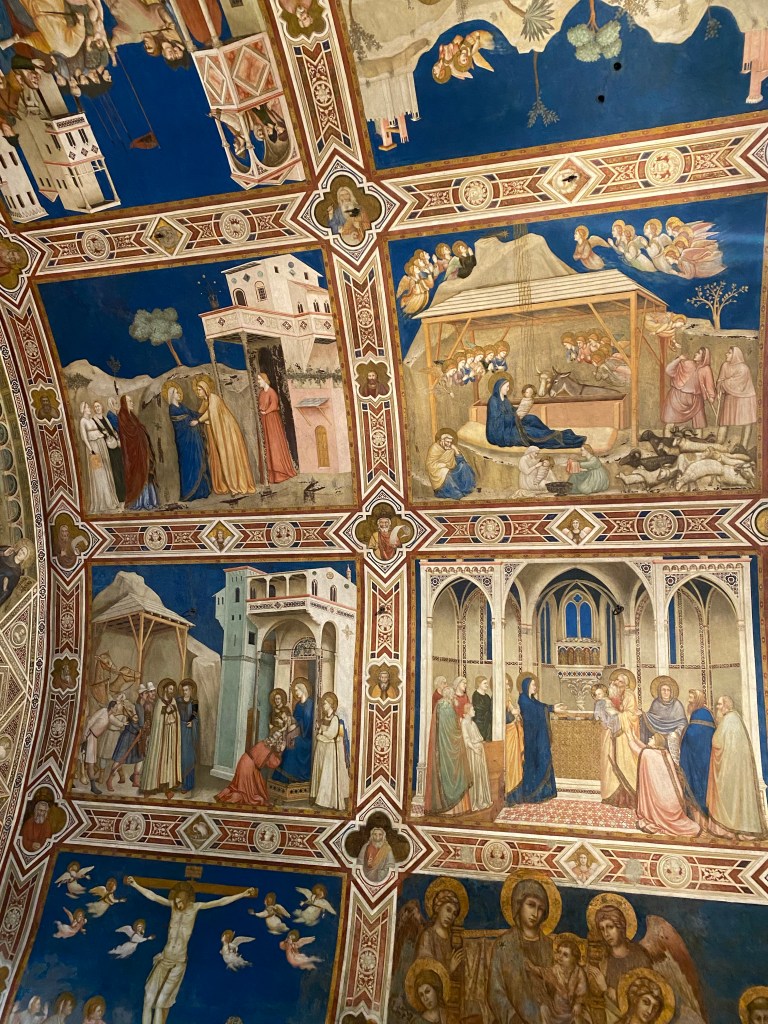
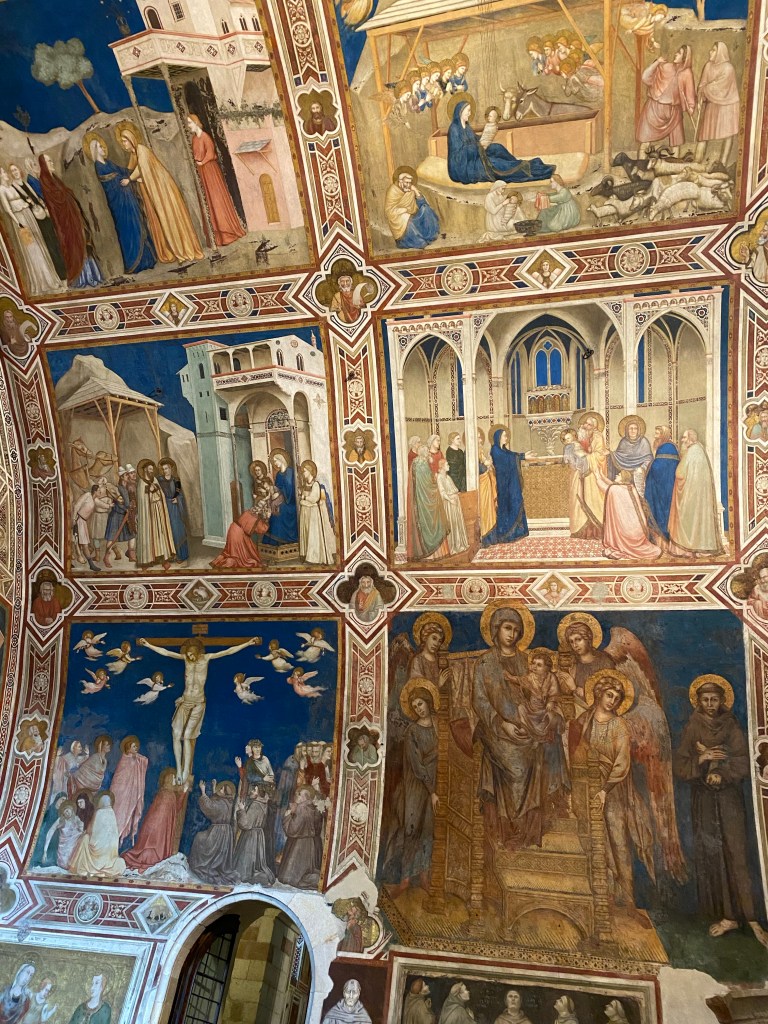
The basilica, which was begun in 1228, is built into the side of a hill and comprises two churches (known as the Upper Church and the Lower Church) and a crypt, where the remains of Saint Francis are interred. The Upper and Lower Churches are decorated with frescoes by numerous late medieval painters from the Roman and Tuscan schools, and include works by Cimabue, Giotto, Simone Martini, Pietro Lorenzetti and possibly Pietro Cavallini. The range and quality of the works give the basilica a unique importance in demonstrating the outstanding development of Italian art of this period, especially if compared with the rest of Christian Europe.
The Franciscan friary (Sacro Convento) and the Lower and Upper Basilicas (Italian: Basilica inferiore e superiore) of Francis of Assisi were begun in honor of this local saint, immediately after his canonization in 1228. Simone di Pucciarello donated the land for the church, a hill at the west side of Assisi, known as “Hill of Hell” (Italian: Colle d’Inferno) where previously criminals were put to death. Today, this hill is called “Hill of Paradise”.
On 16 July 1228, Francis was canonized by Pope Gregory IX in Assisi, and he laid the foundation stone of the new church the following day, although construction may already have been begun. The construction having been begun at his order, the Pope declared the church to be the property of the papacy.
The church was designed by Maestro Jacopo Tedesco, who was in those days the most famous architect. The Lower Basilica was finished in 1230. On Pentecost 25 May 1230, the remains of Saint Francis were brought in a solemn procession to the Lower Basilica from its temporary burial place in the church of San Giorgio (St. George), now the Basilica of Saint Clare of Assisi. The burial place was concealed for fear that St Francis’ remains might be stolen and dispersed. The construction of the Upper Basilica was begun after 1239 and was completed in 1253. Both churches were consecrated by Pope Innocent IV in 1253.
Pope Nicholas IV, a former Minister-General of the Order of Franciscans, raised the church to the status of Papal Church in 1288. The Piazza del Loge, the square leading to the church, is surrounded by colonnades constructed in 1474. They housed the numerous pilgrims flocking to this church.
In 1818, the remains of Saint Francis were rediscovered beneath the floor of the Lower Basilica. In the reign of Pope Pius VII the crypt was built so that the faithful might visit the burial place of the saint. On 27 October 1986 and January 2002, Pope John Paul II gathered in Assisi with more than 120 representatives of different religions and Christian denominations for a World Day of Prayer for Peace.
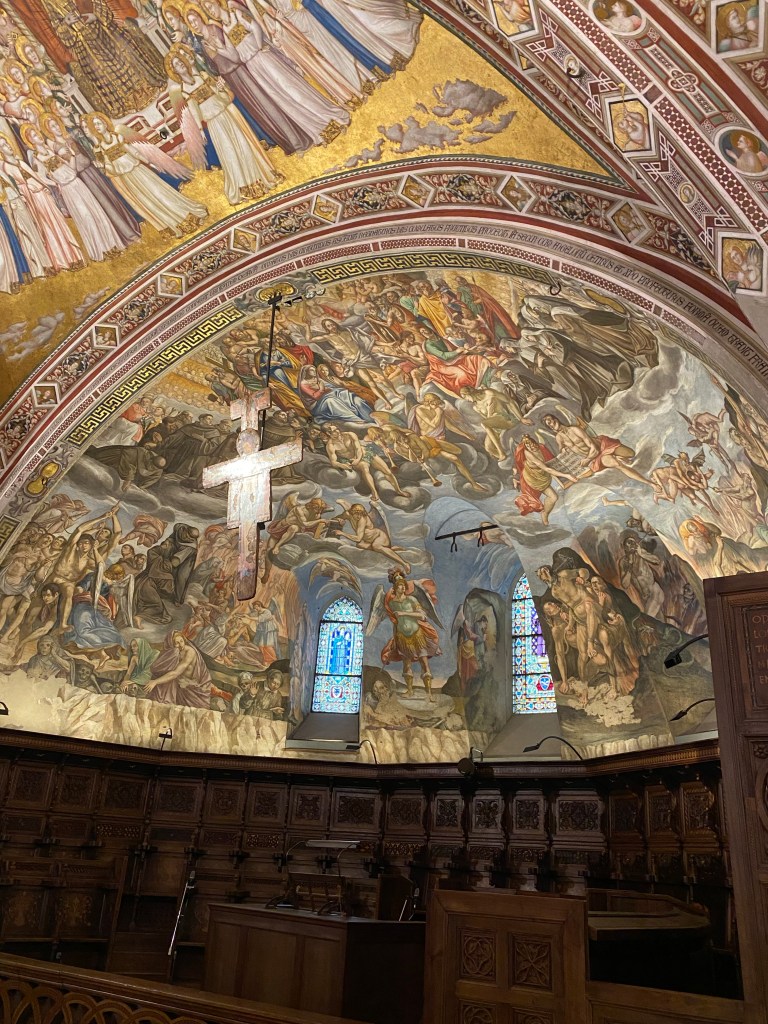
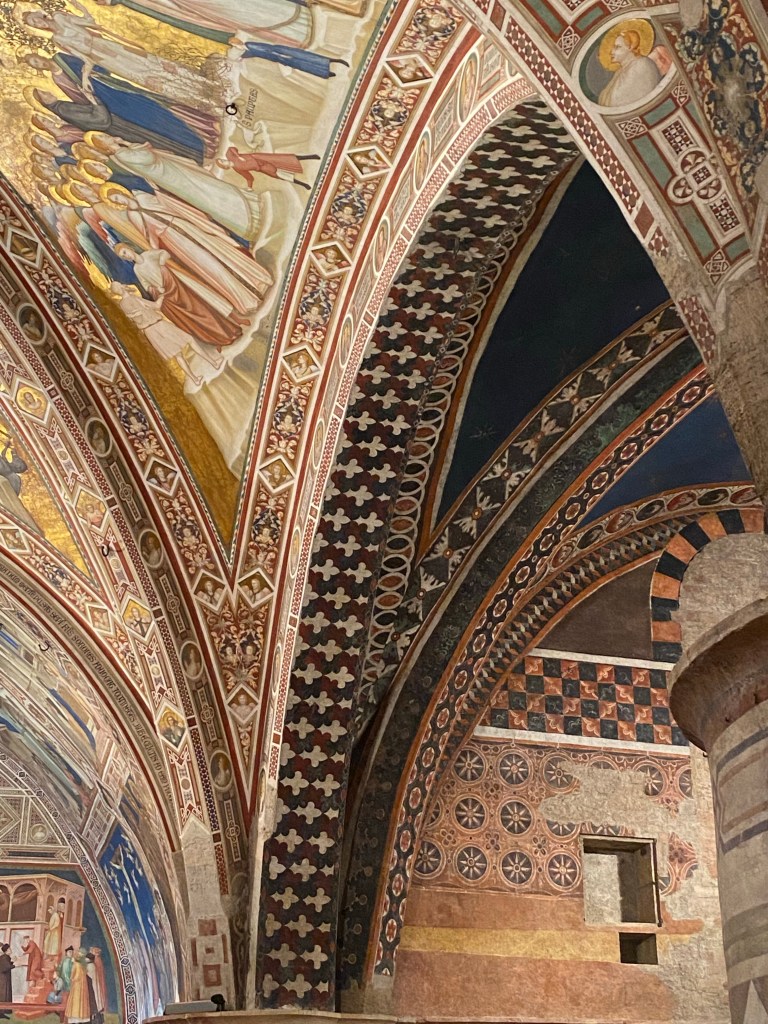
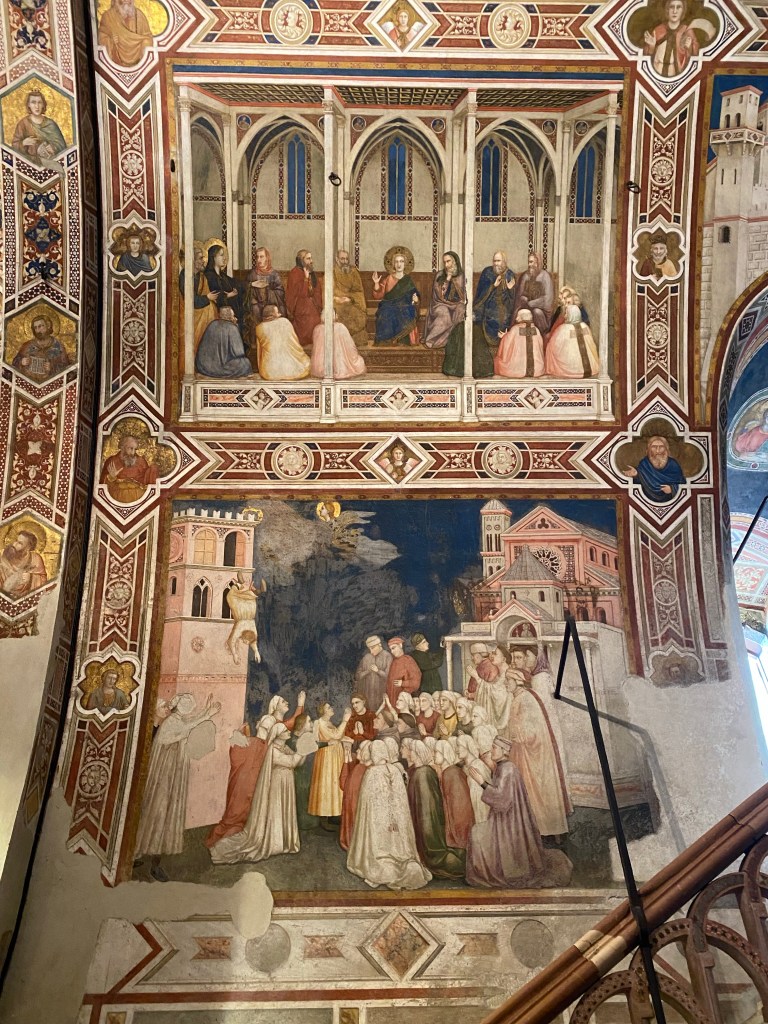
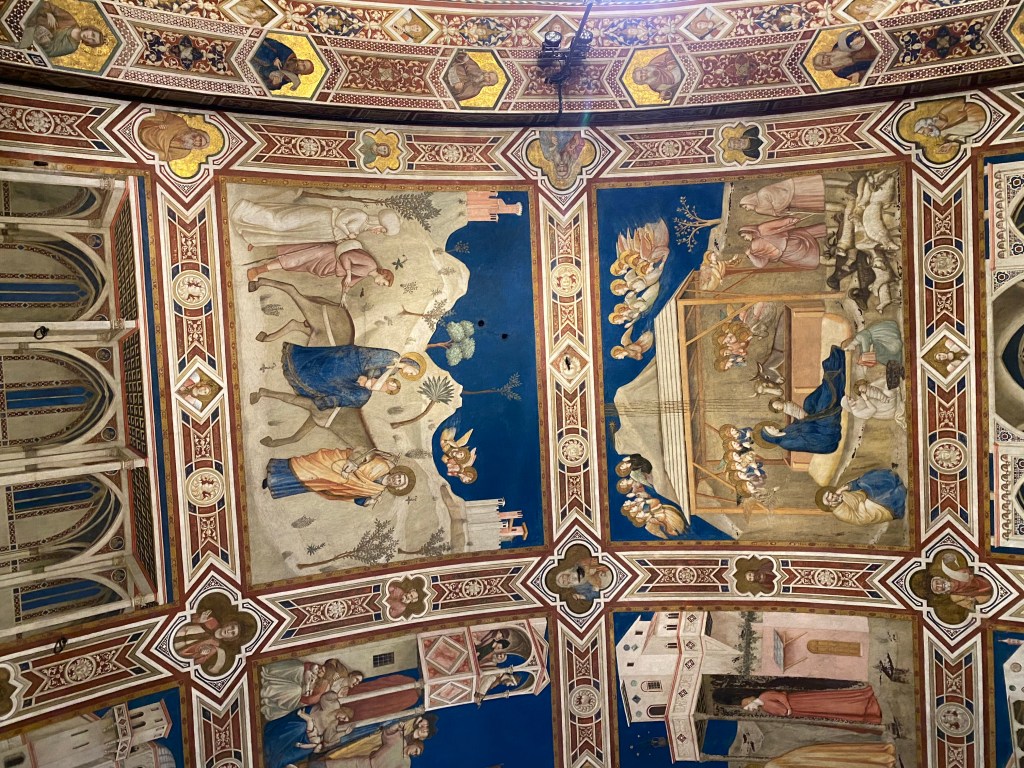
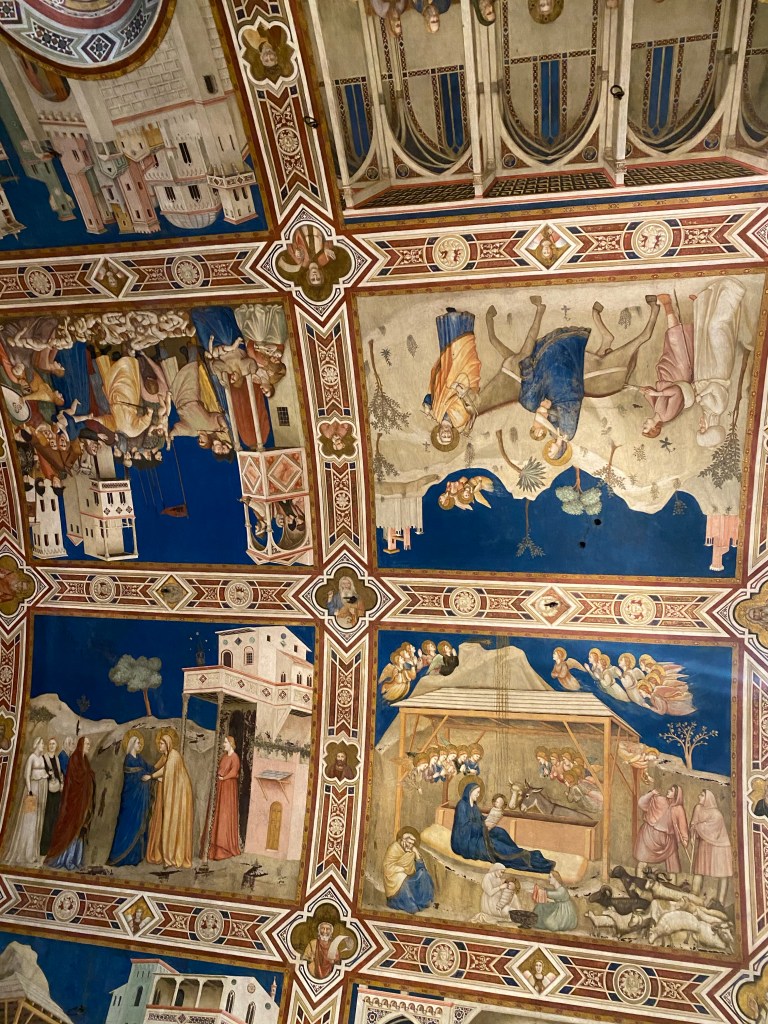
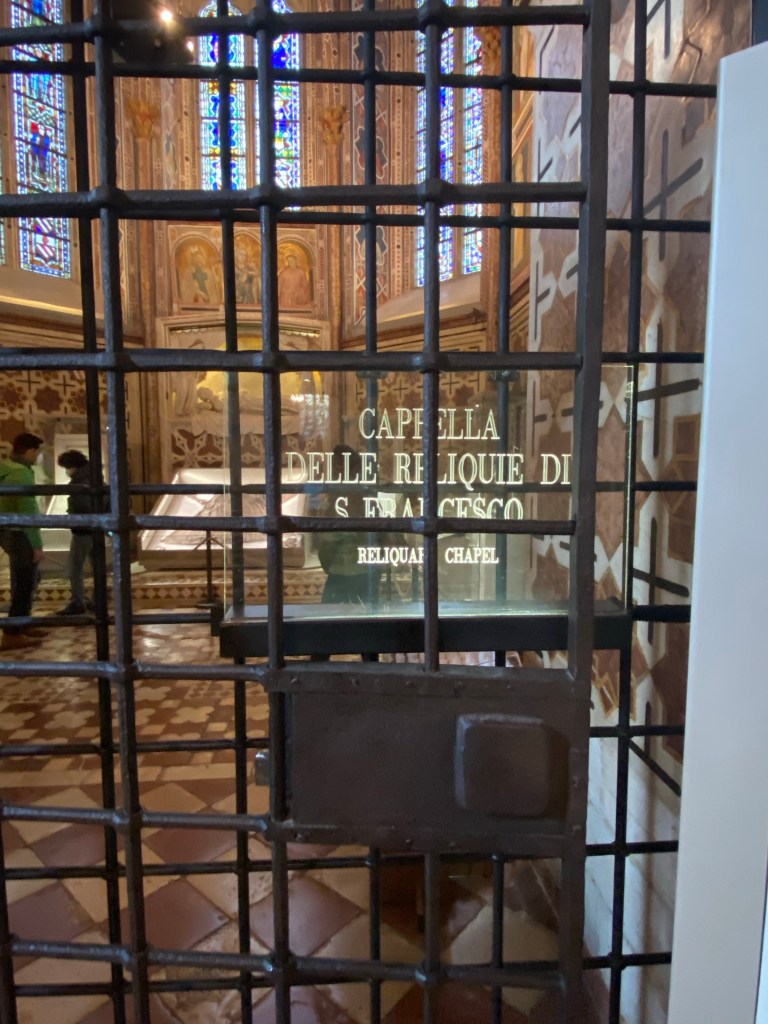
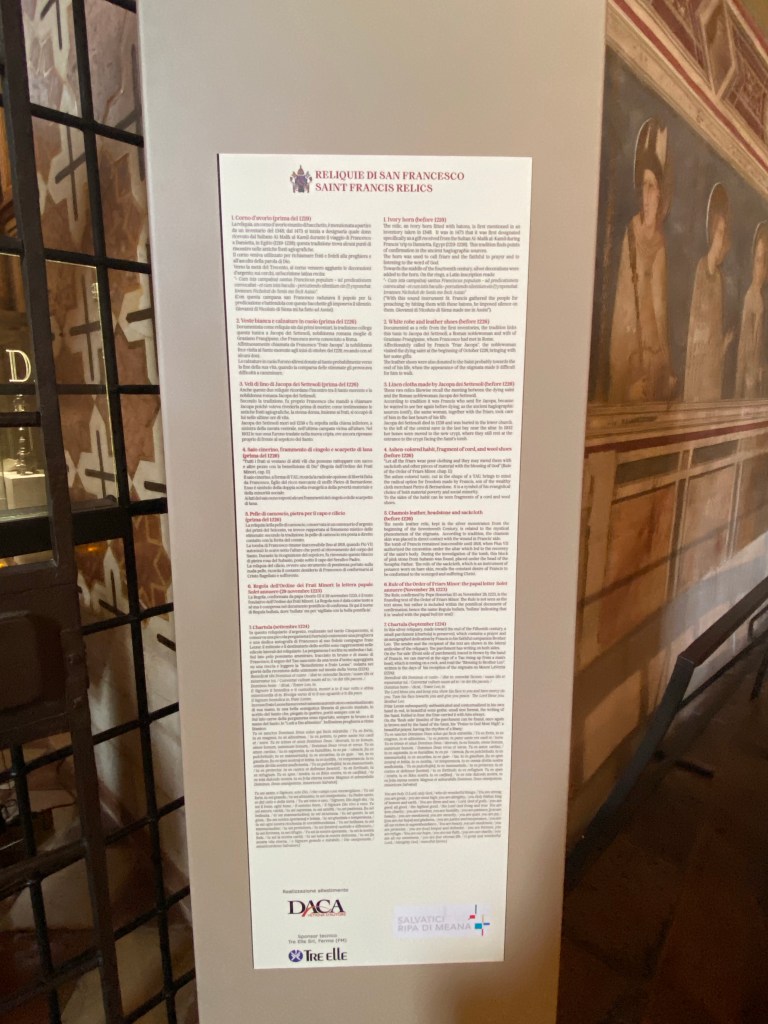
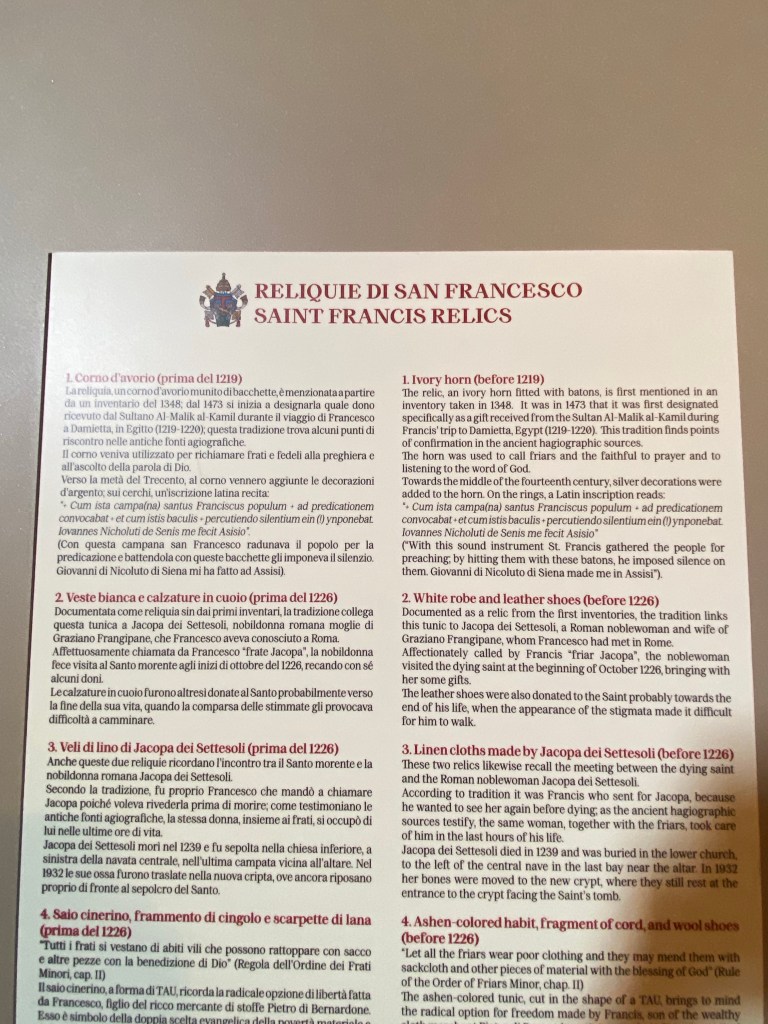
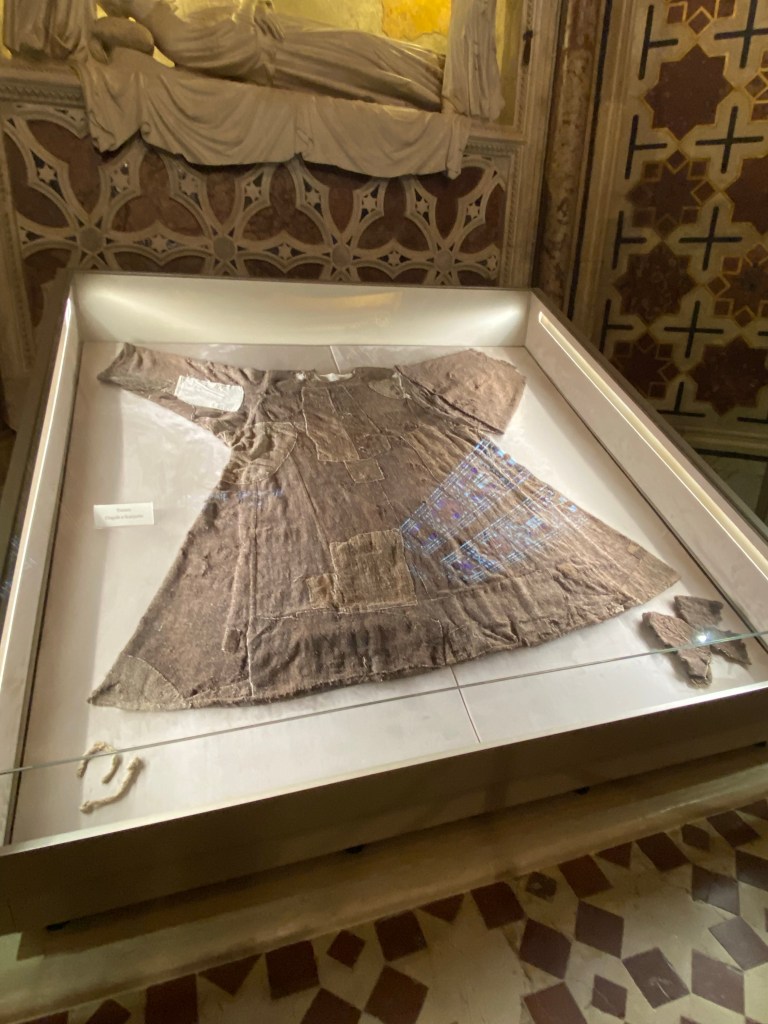
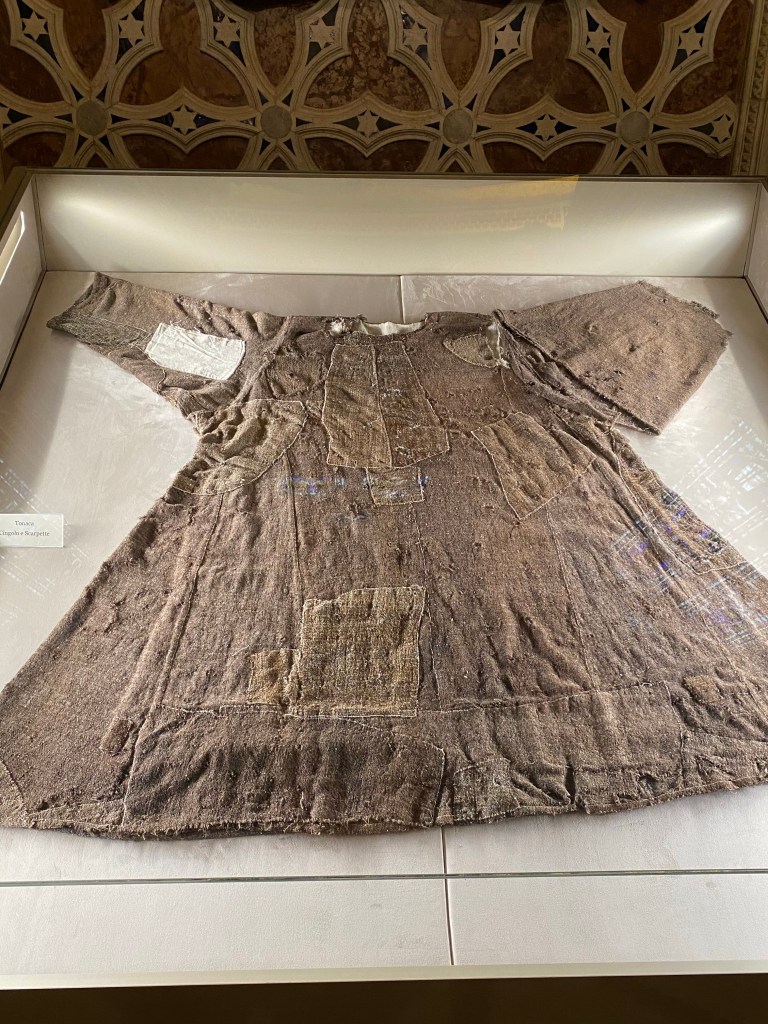
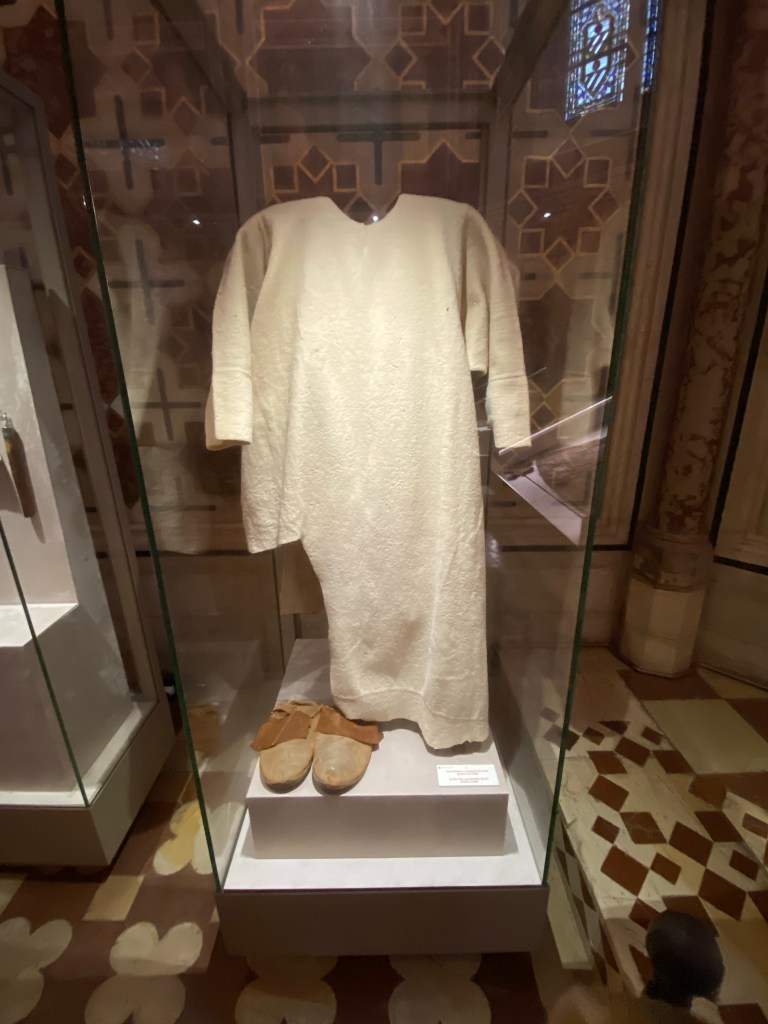
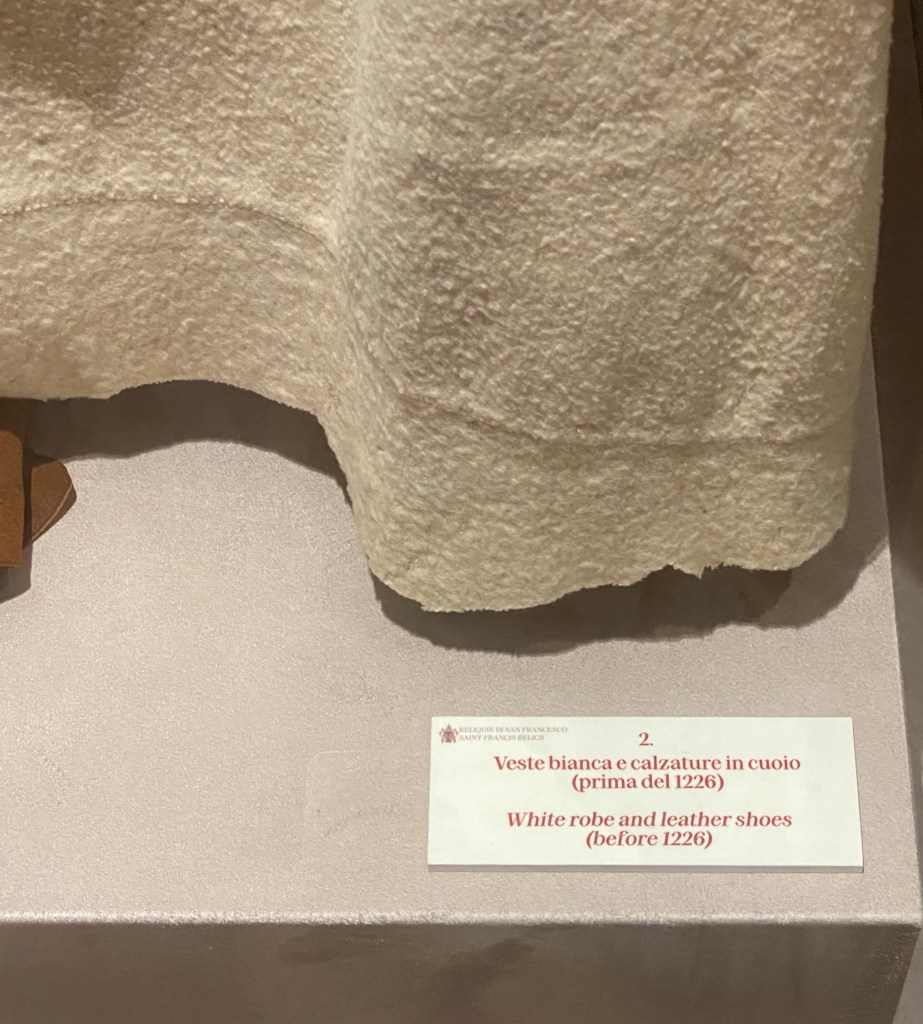
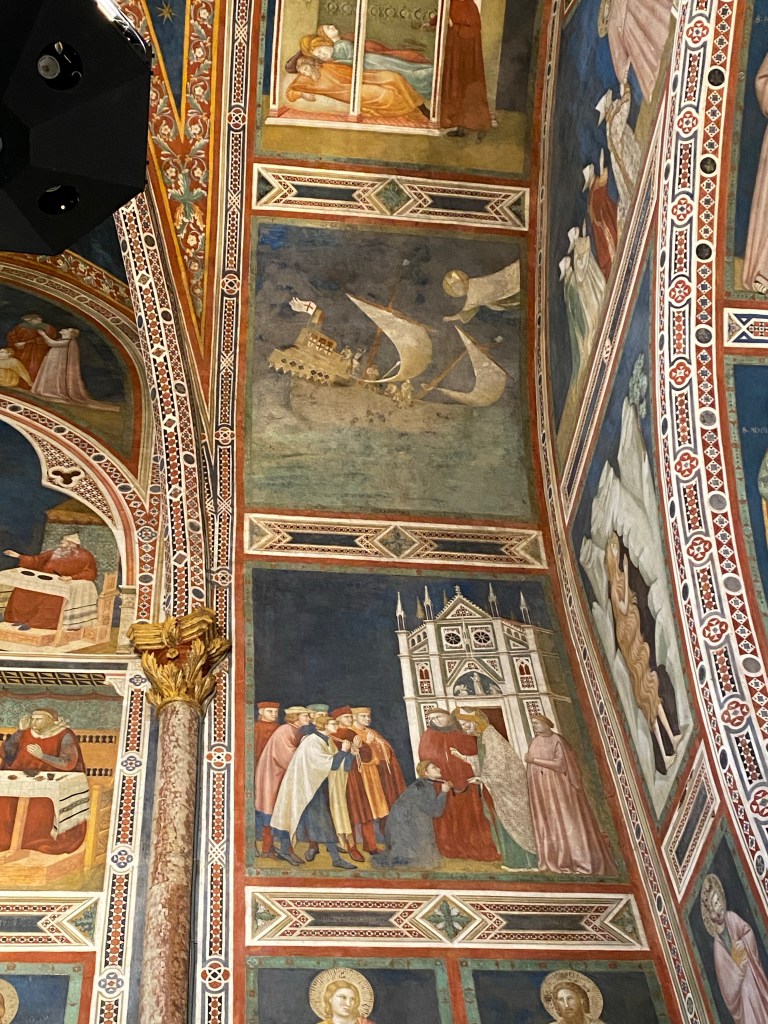
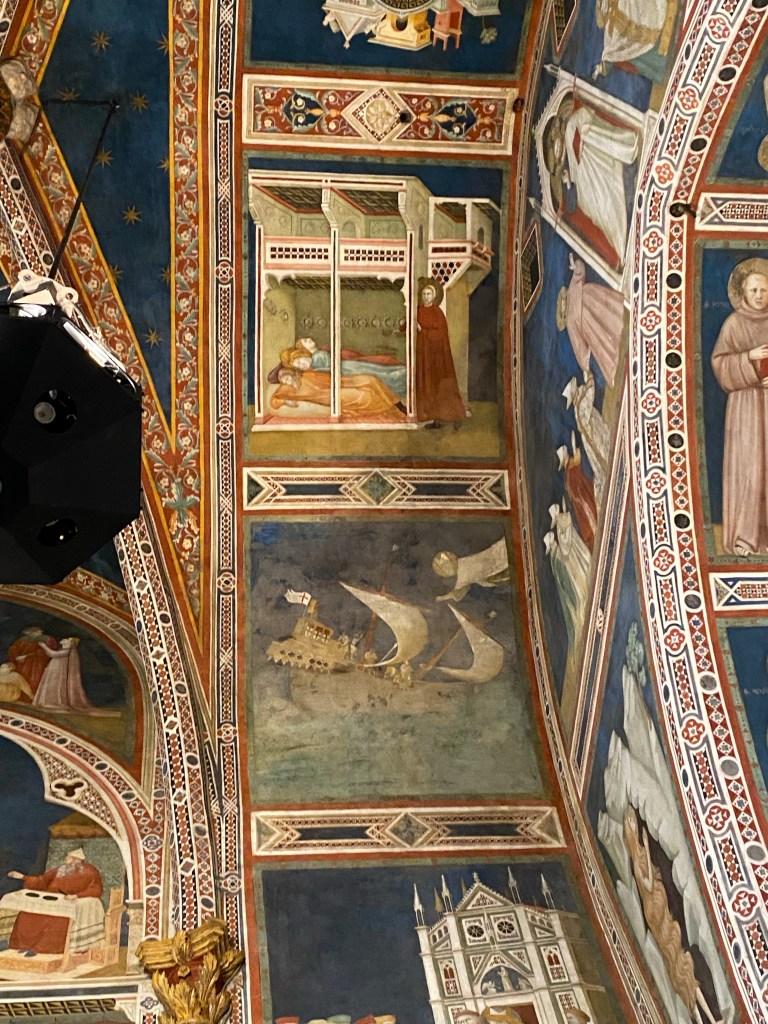
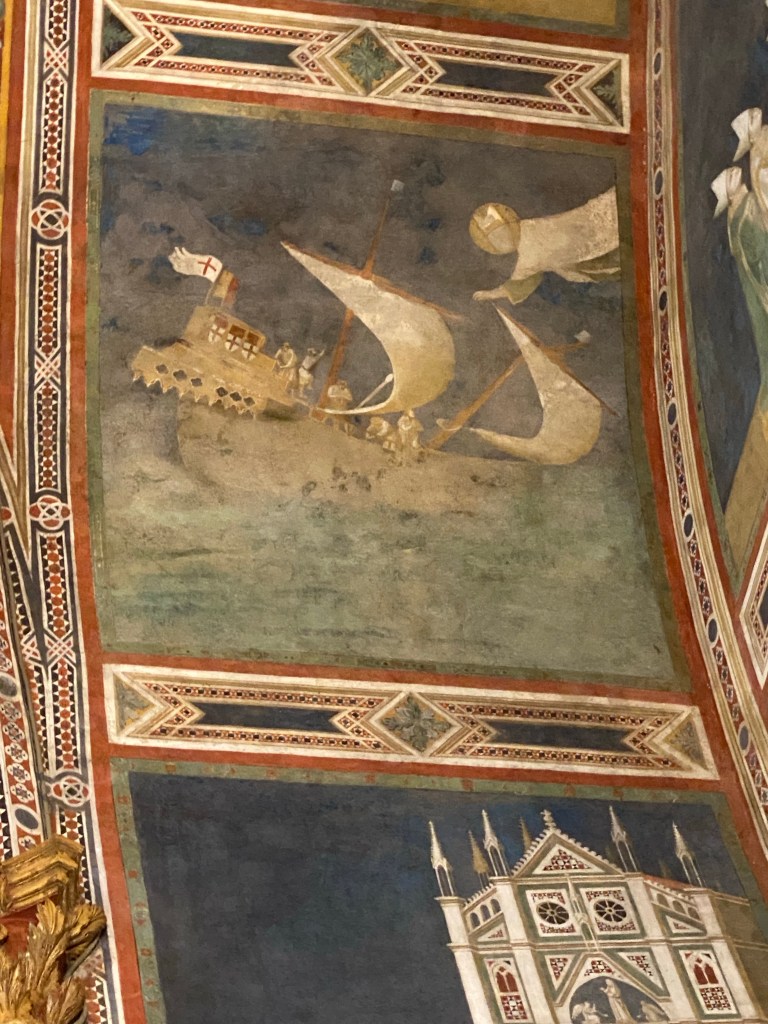
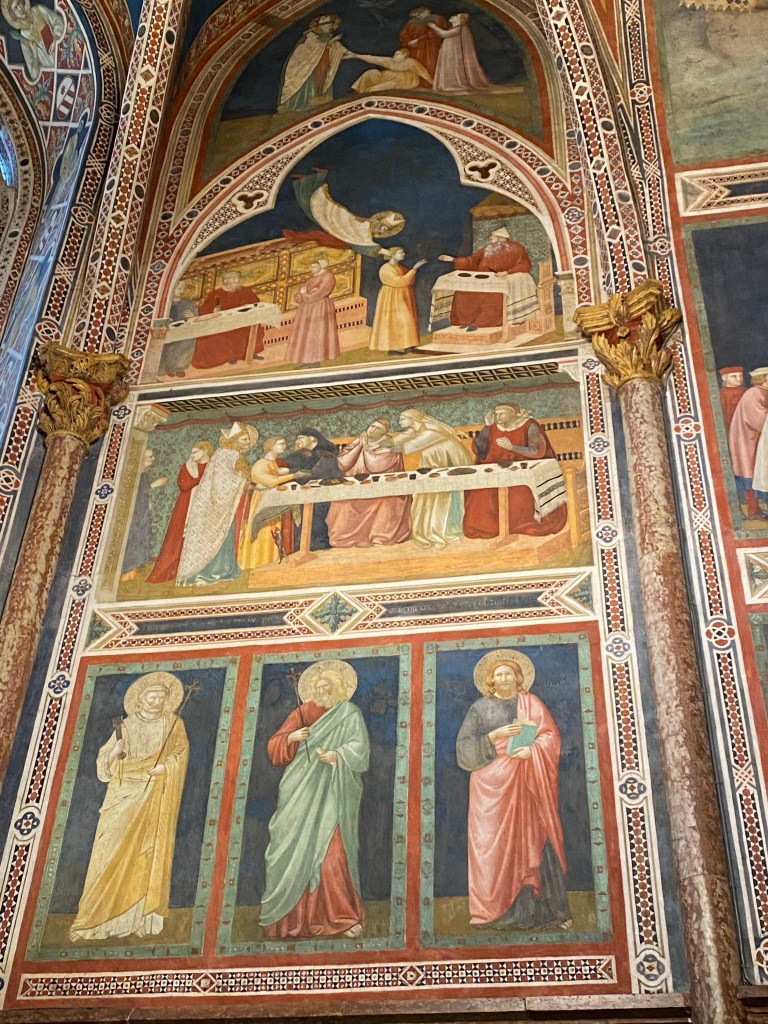
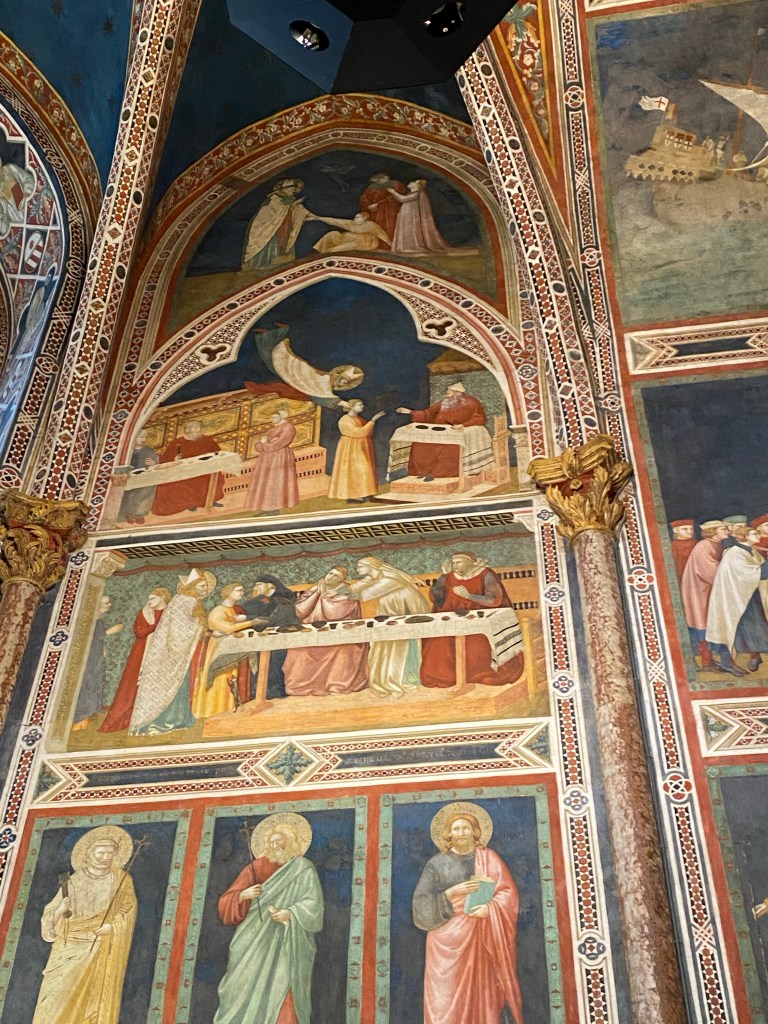
Just before New Year’s, I stole away to Assisi for a day from Florence. I have a long history in this lovely hilltop hamlet, and I never tire of revisiting it. I enjoyed strolling through the center, and the highlight of any visit is to see the amazing frescoes of the church of Saint Francis. I’ll be posting about the paintings in the next few days, but I want to start my posts on the church with these elements below. Enjoy! They are astounding relics from 800 years ago.
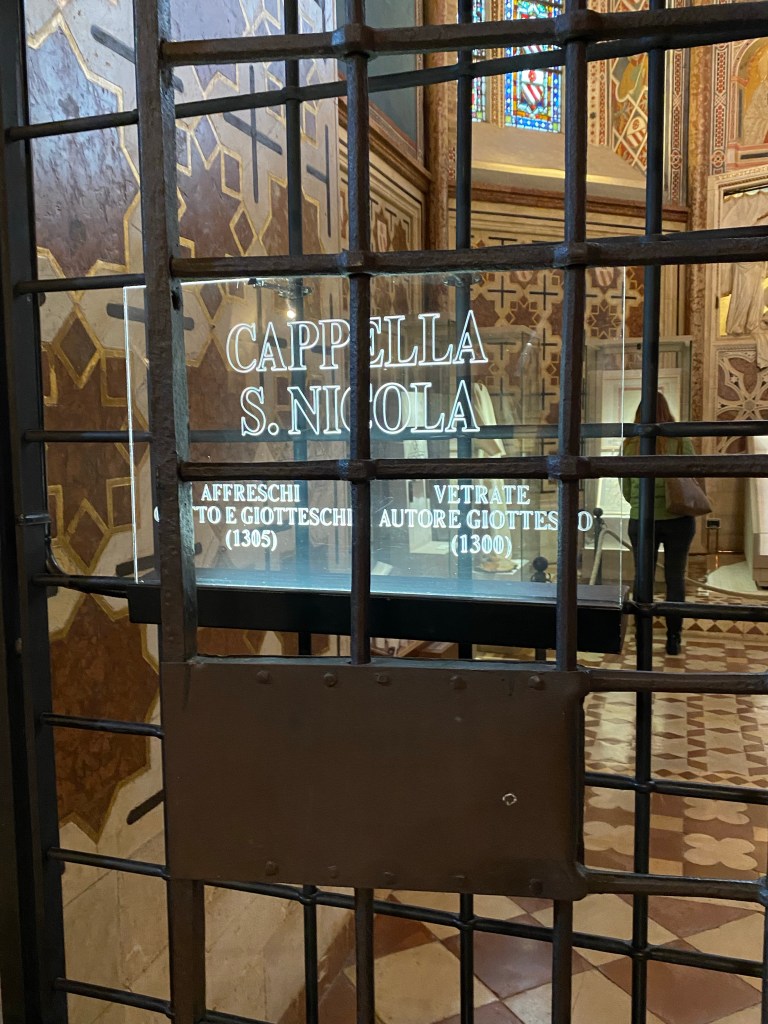
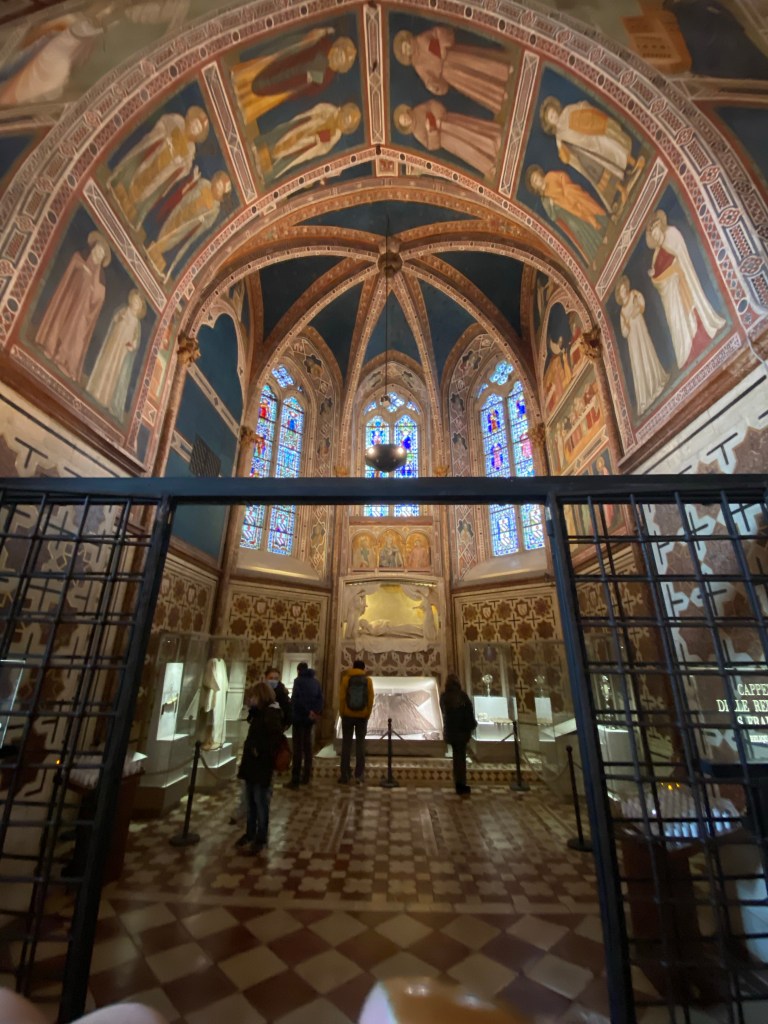
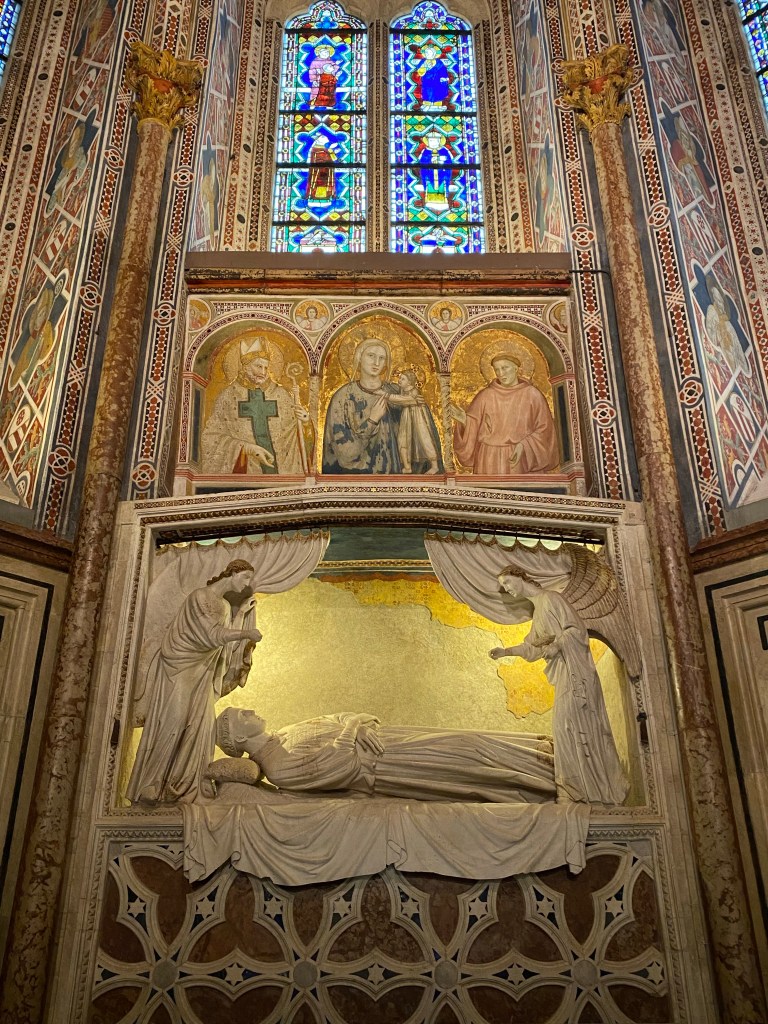
I have a particular fondness for the saint, Nicolas. The frescoes in this chapel are dedicated to the story of his life.
Last November, 2021, I had the incredible opportunity of time and money to explore the region of Emilia-Romagna. I love getting to know Italy, but this was a region I had seldom visited and really didn’t know. What an adventure and pleasure it turned out to be for me.
I love the etymology of the name Piacenza, tracing its origin from the Latin verb placēre “to please.” In French, and occasionally in English, it is called Plaisance. The name means a “pleasant abode,” or as James Boswell reported some of the etymologists of his time to have translated it “comely”. However you look at it, it is a name “of good omen.”
But, like most Italian cities, what a history it has! Read it, try to understand it, and be amazed, as I am!
The area now known as Piacenza was inhabited by Etruscans, who were overtaken by the Gauls when they overtook the entire Po Valley.
Next came the Romans: Piacenza and Cremona were founded as Roman military colonies in May 218 BC. The Romans had planned to construct them after the successful conclusion of the latest war with the Gauls ending in 219 BC. In the spring of 218 BC, after declaring war on Carthage, the Senate decided to accelerate the foundation and gave the colonists 30 days to appear on the sites to receive their lands. They were each to be settled by 6,000 Roman citizens, but the cities were to receive Latin Rights; that is, they were to have the same legal status as the many colonies that had been co-founded by Rome and towns of Latium.
The reaction of the region’s Gauls was swift; they drove the colonists off the lands. Taking refuge in Mutina (now Modena), the colonists sent for military assistance, but the small force sent under Lucius Manlius was prevented from reaching the area. The Senate then sent two legions under Gaius Atelius. Collecting Manlius and the colonists, they descended on Piacenza and Cremona and successfully placed their castra there of 480 square meters (0.12 acres) to support the building of the city.
Piacenza must have been walled immediately, as the walls were in place when the Battle of the Trebia was fought around the city in December. There is no evidence of a prior settlement at that exact location. Piacenza was the 53rd colony to be placed by Rome since its foundation. It was the first among the Gauls of the Po valley.
It had to be supplied by boat after the Battle of Trebbia, when Hannibal controlled the countryside, for which purpose a port (Emporium) was constructed. In 209 BC, Hasdrubal Barca crossed the Alps and laid siege to the city, but he was unable to take it and withdrew.
In 200 BC, the Gauls sacked and burned it, selling the population into slavery. Subsequently, the victorious Romans restored the city and managed to recover 2000 citizens. In 198 BC, a combined force of Gauls and Ligurians plundered the whole region. As the people had never recovered from being sold into slavery, in 190 BC they complained to Senate of underpopulation; in response the Senate sent 3000 new settlers. The construction of the Via Aemilia in the 180’s made the city easily accessible from the Adriatic ports, which improved trade and the prospects for timely defense.
There is an object in Piacenza known as “The Liver of Piacenza,” which is a bronze model of a sheep’s liver for the purposes of haruspicy. The model was discovered in 1877 at Gossolengo just to the south of Piacenza; it bears witness to the survival of the disciplina Etrusca well after the Roman conquest.
Although sacked and devastated several times, the city always recovered and by the 6th century Procopius was calling it “the principal city in the country of Aemilia”.
The first Bishop of Piacenza (322–357), San Vittorio, declared Saint Antoninus of Piacenza, a soldier of the Theban Legion (and not to be confused with the sixth-century Antoninus of Piacenza), the patron saint of Piacenza and had the first basilica constructed in his honor in 324. The basilica was restored in 903 and rebuilt in 1101, again in 1562, and is still a church today. The remains of the bishop and the soldier-saint are in urns under the altar. The theme of Antoninus, protector of Piacenza, is well known in art.
Middle Ages
Mosaic of the old city Coat of Arms
Piacenza was sacked during the course of the Gothic War (535–554). After a short period of being reconquered by the Roman emperor Justinian I, it was conquered by the Lombards, who made it a duchy seat. After its conquest by Francia in the 9th century, the city began to recover, aided by its location along the Via Francigena that later connected the Holy Roman Empire with Rome. Its population and importance grew further after the year 1000. That period marked a gradual transfer of governing powers from the feudal lords to a new enterprising class, as well to the feudal class of the countryside.
In 1095, the city was the site of the Council of Piacenza, in which the First Crusade was proclaimed. From 1126, Piacenza was a free commune and an important member of the Lombard League. In this role, it took part in the war against Frederick I, Holy Roman Emperor, and in the subsequent battle of Legnano (1176). It also successfully fought the neighboring communes of Cremona, Pavia and Parma, expanding its possessions. Piacenza also captured control of the trading routes with Genoa, where the first Piacentini bankers had already settled, from the Malaspina counts and the bishop of Bobbio.
In the 13th century, despite unsuccessful wars against Frederick I, Piacenza managed to gain strongholds on the Lombardy shore of the Po. The preliminaries of the Peace of Constance were signed in 1183 in the Saint Antoninus church. Agriculture and trade flourished in these centuries, and Piacenza became one of the richest cities in Europe. This is reflected in the construction of many important buildings and in the general revision of the urban plan. Struggles for control were commonplace in the second half of the 13th century, not unlike the large majority of Medieval Italian communes. The Scotti family, Pallavicini family and Alberto Scoto held power in that order during the period. Scoto’s government ended when the Visconti of Milan captured Piacenza, which they would hold until 1447. Duke Gian Galeazzo Visconti rewrote Piacenza’s statutes and relocated the University of Pavia to the city. Piacenza then became a possession of the House of Sforza until 1499.
Map of Piacenza (Italy) from 1882 by Camillo Guidotti. Nuova pianta della citta di Piacenza.
Renaissance era +
A coin from the 16th century features the motto: Placentia floret (Piacenza flourishes) on one of its sides. The city was progressing economically, chiefly due to the expansion of agriculture in the countryside surrounding the city. Also in the course of that century a new city wall was erected. Piacenza was ruled by France until 1521, and briefly, under Pope Leo X, it became part of the Papal States. In 1545, it became part of the newly created Duchy of Parma, which was ruled by the House of Farnese.
Piacenza was the capital city of the duchy until Ottavio Farnese, Duke of Parma (1547–1586), moved it to Parma. The city underwent some of its most difficult years during the rule of Odoardo Farnese, Duke of Parma (1622–1646), when between 6000 and 13,000 Piacentini out of a total population of 30,000 died from famine and plague. The city and its countryside were also ravaged by bandits and French soldiers.
Between 1732 and 1859, Parma and Piacenza were ruled by the House of Bourbon. In the 18th century, several edifices which belonged to noble families such as Scotti, Landi and Fogliani were built in Piacenza.
In 1802, Napoleon’s army annexed Piacenza to the French Empire. Young Piacentini recruits were sent to fight in Russia, Spain and Germany, while the city was plundered of a great number of artworks which are currently exhibited in many French museums.
The Habsburg government of Marie Louise, Duchess of Parma (1816–1847), is remembered fondly as one of the best in the history of Piacenza; the duchess drained many lands, built several bridges across the Trebbia and the Nure and created educational and artistic activities.
Union with Italy
Austrian troops occupied Piacenza until, in 1860, a plebiscite marked the entrance of the city into the Kingdom of Sardinia. 37,089 voters out of 37,585 voted for the annexation. Piacenza was therefore declared Primogenita dell’Unità di Italia (First-born of the Unification of Italy) by the monarch. The Piacentini enrolled en masse in the Giuseppe Garibaldi’s army in the Expedition of the Thousand.
Piacenza has two nicknames – it is known as ‘Primogenita d’Italia’ (Italy’s firstborn), as it was the first city to vote in favour of annexation to the Kingdom of Sardinia, which would then become the Italian Kingdom.
It is also known as ‘La Città delle Cento Chiese’ (the city of 100 churches). Throughout the centuries, some churches have disappeared, other have been deconsecrated and now have other uses – like Santa Margherita, turned into an auditorium.
In 1858 the geologist Karl Mayer-Eymar named the Piacenzian Age of the Pliocene Epoch based on deposits close to Piacenza.
In June 1865, the first railway bridge over Po river in northern Italy was inaugurated (in southern Italy a railroad bridge had already been built in 1839). In 1891, the first Chamber of Workers was created in Piacenza.
World War II
During World War II, the city was heavily bombed by the Allies. The important railway and road bridges across the Trebbia and the Po and the railway yards were destroyed. The historic center of city itself also suffered collateral damage. In 1944, the bridges over the Po became vital for the supply from Austria of Field Marshal Albert Kesselring’s Gothic Line, which protected the withdrawal of Kesselring’s troops from Italy. Foremost among these were the railway and road bridges at Piacenza, along with supply depots and railway yards.
In Operation Mallory Major, July 12–15, allied medium bombers from Corsica flew 300 sorties a day, knocking out 21 bridges east of Piacenza, and then continued to the west for a total of 90 by July 20. Fighter-bombers prevented reconstruction and cut roads and rail lines. By August 4, all the cities of northern Italy were isolated and had suffered heavy bombing, especially Piacenza. Transport to Genoa to the south or through Turin to the north was impossible; nevertheless, Kesselring continued to supply his men.
On the hills and the Apennine Mountains, partisans were active. On April 25, 1945, a general partisan insurrection by the Italian resistance movement broke out and on 29 April, troops of the Brazilian Expeditionary Force entered the city. In 1996, president Oscar Luigi Scalfaro honoured Piacenza with the gold medal for Valour in Battle.
There was a prisoner of war (POW) camp located here, Veano Camp PG 29, Piacenza.







 get back, lauretta!
You must be logged in to post a comment.