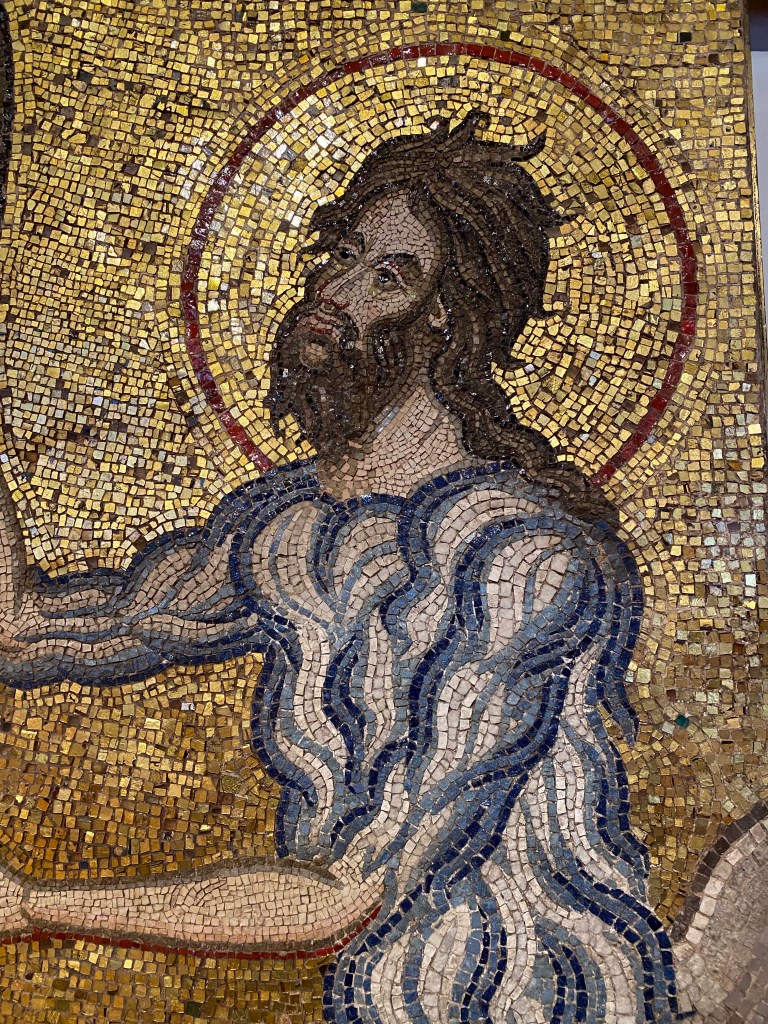
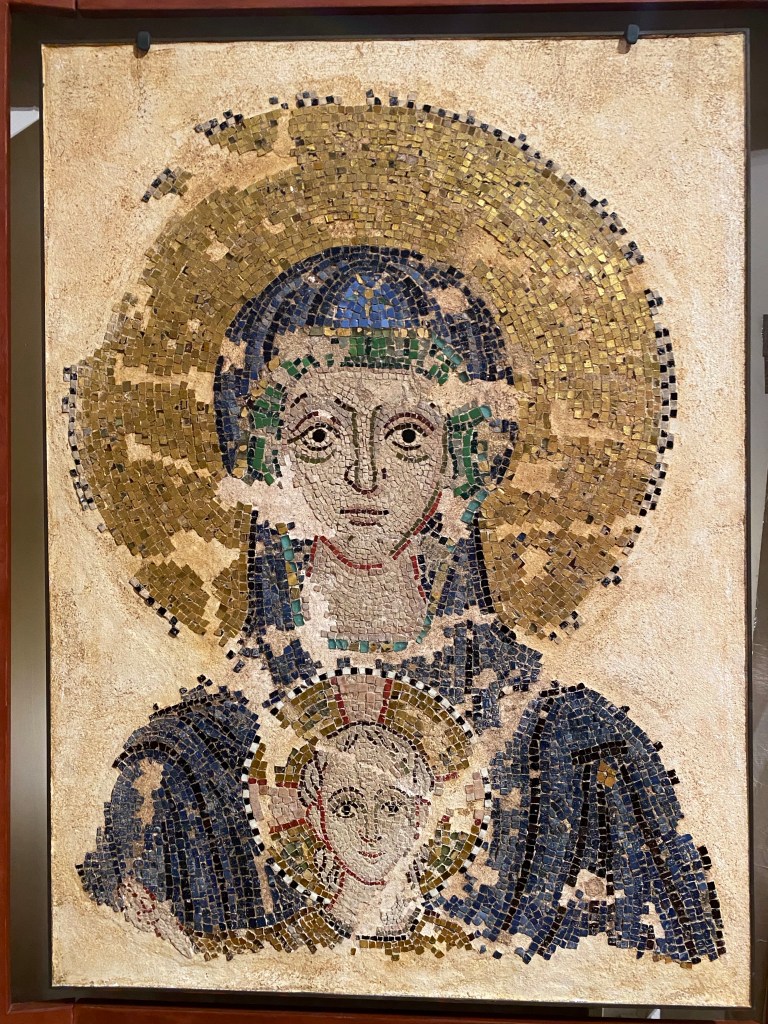
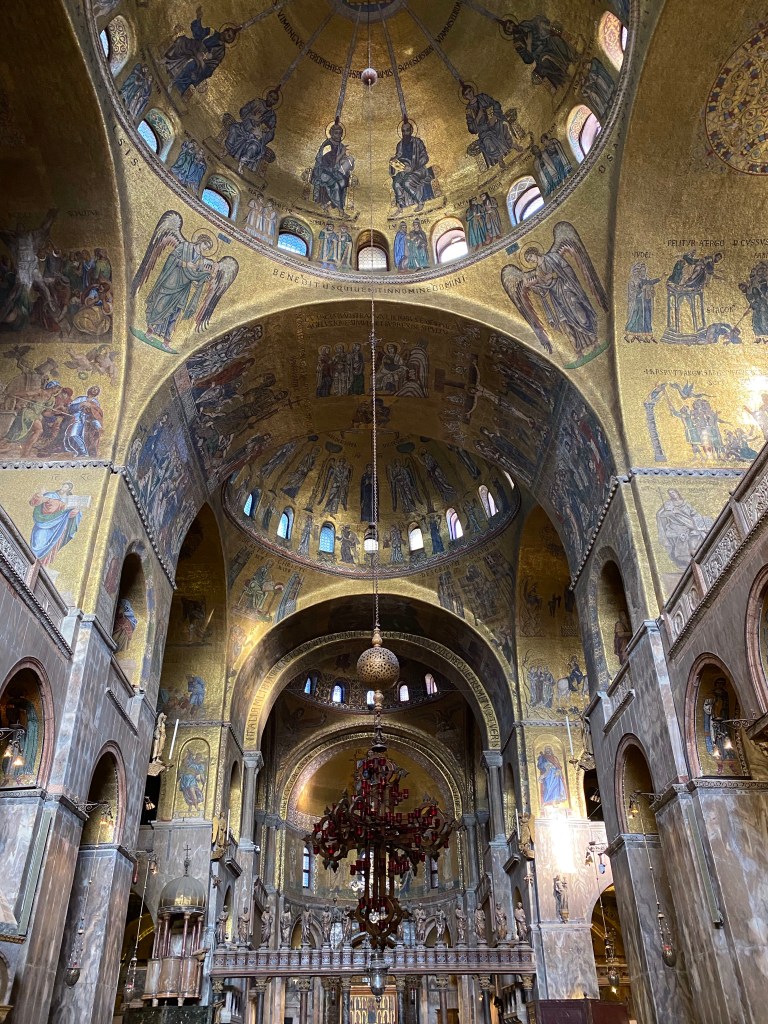
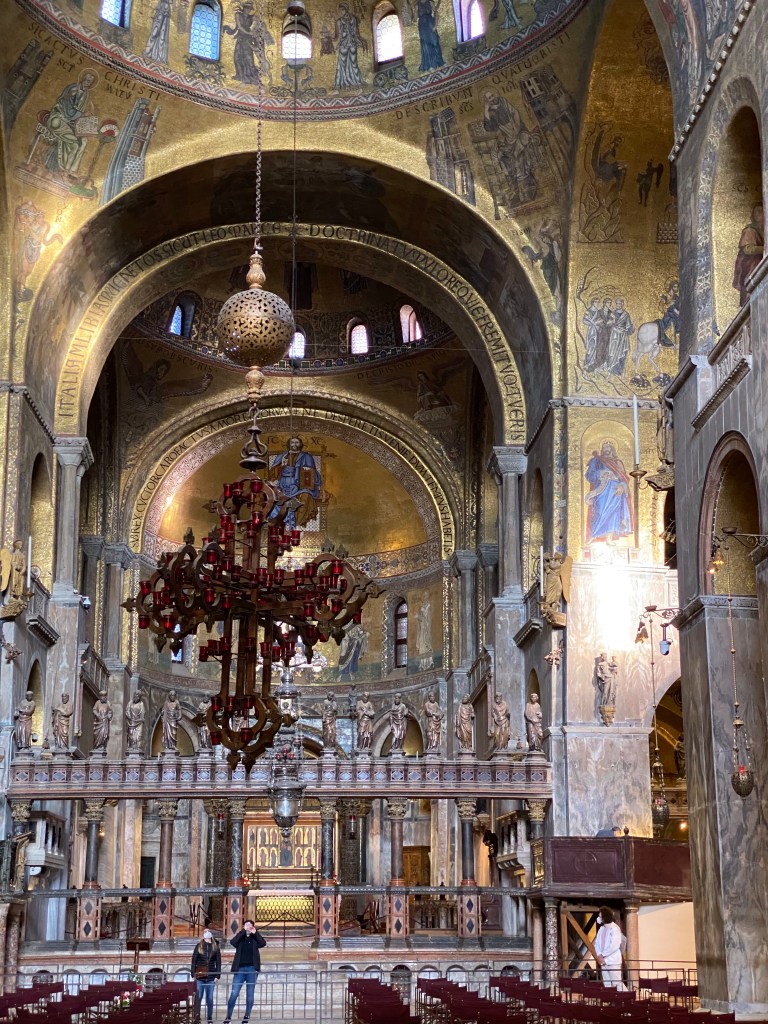
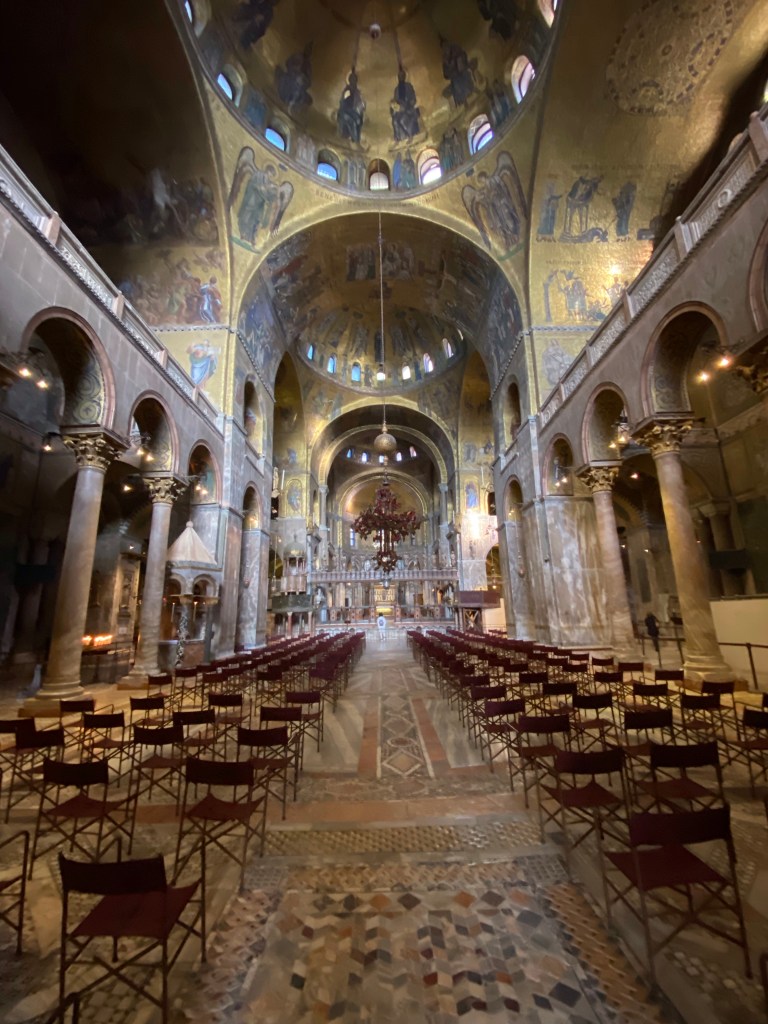
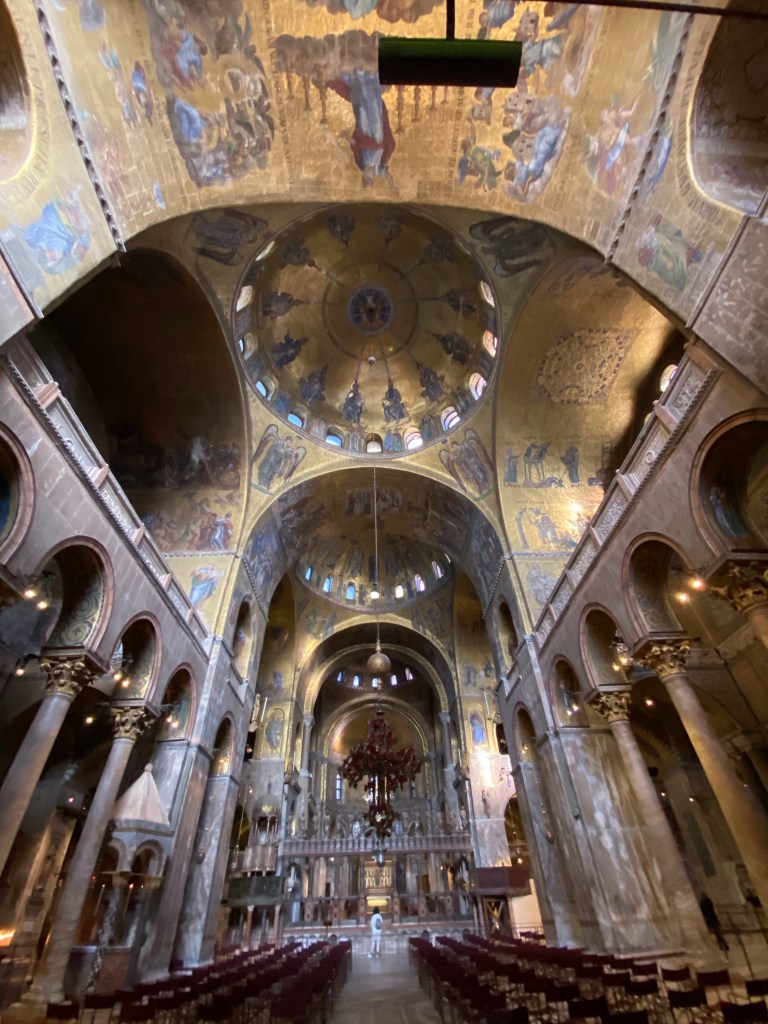
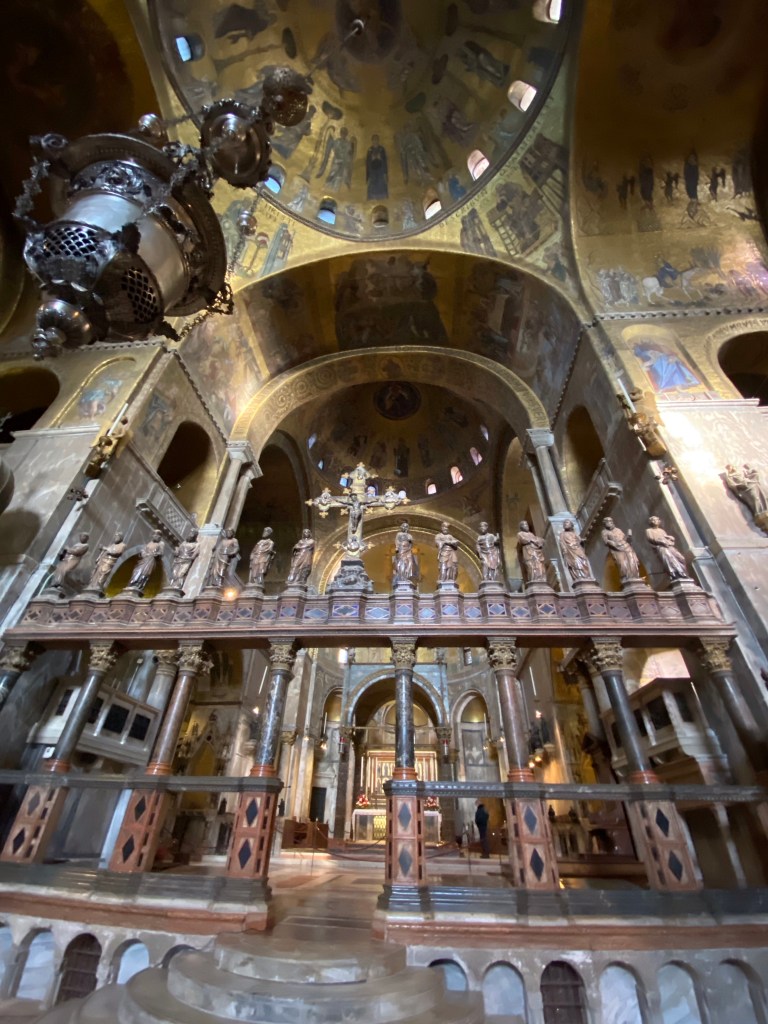
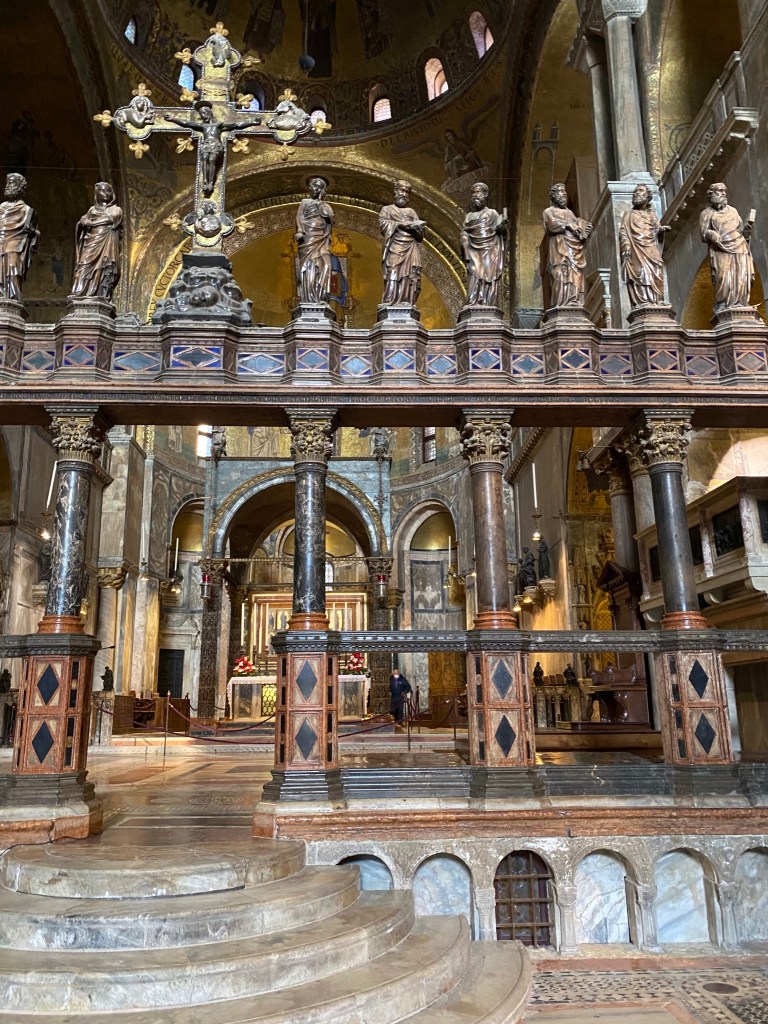
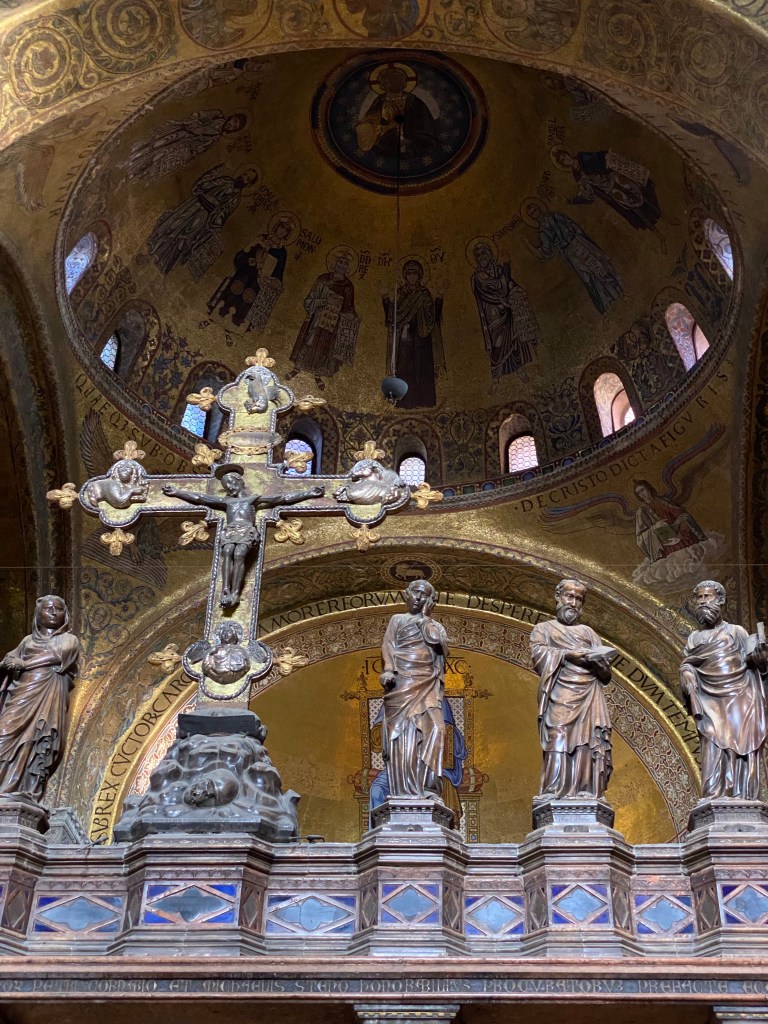
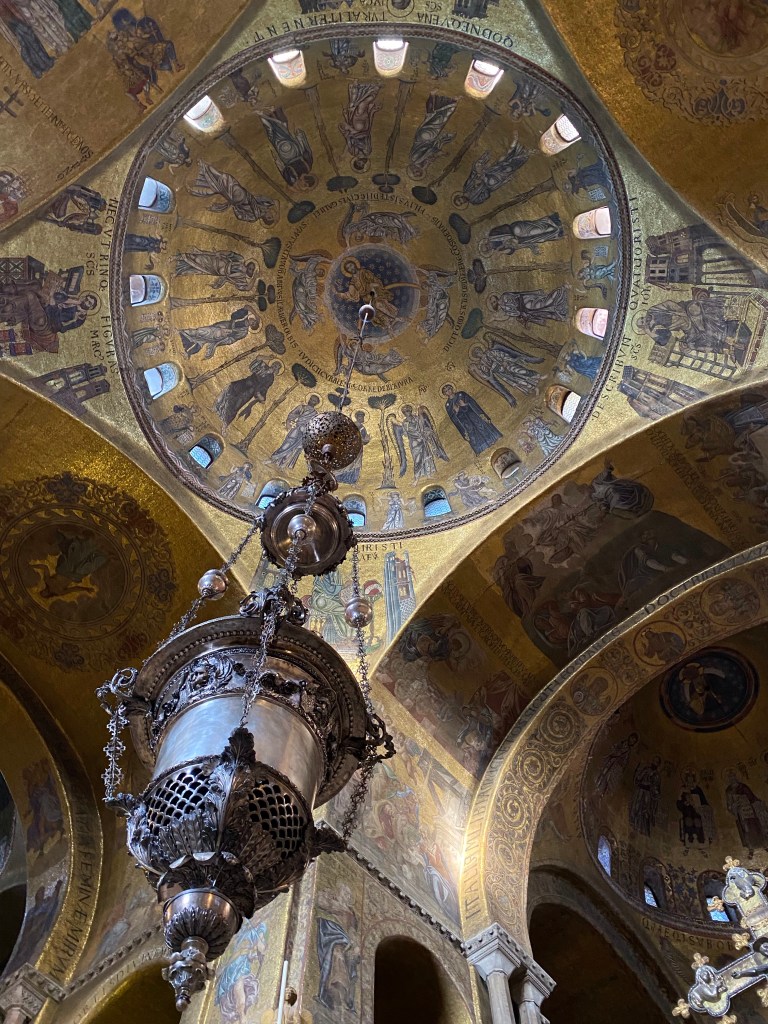
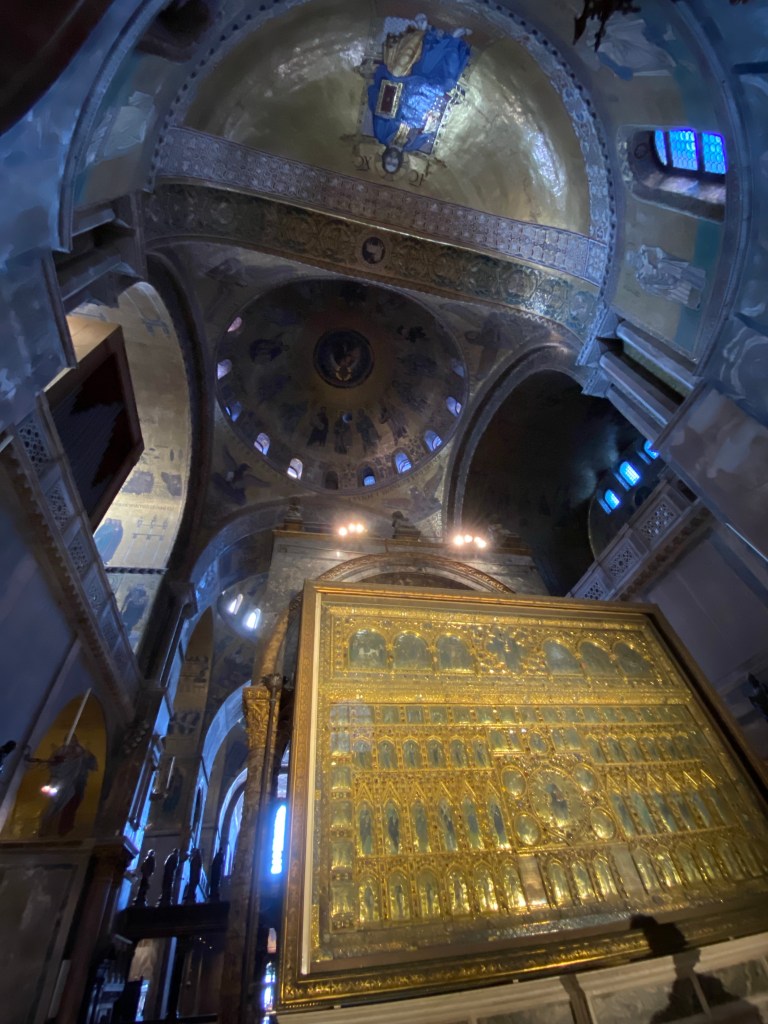
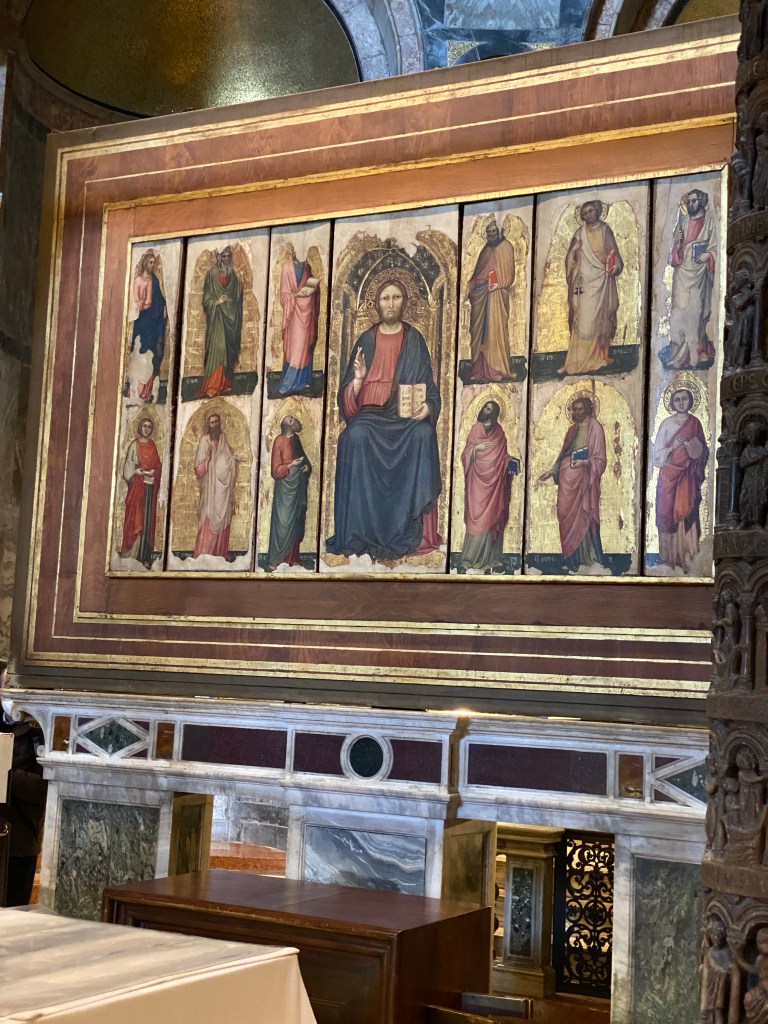
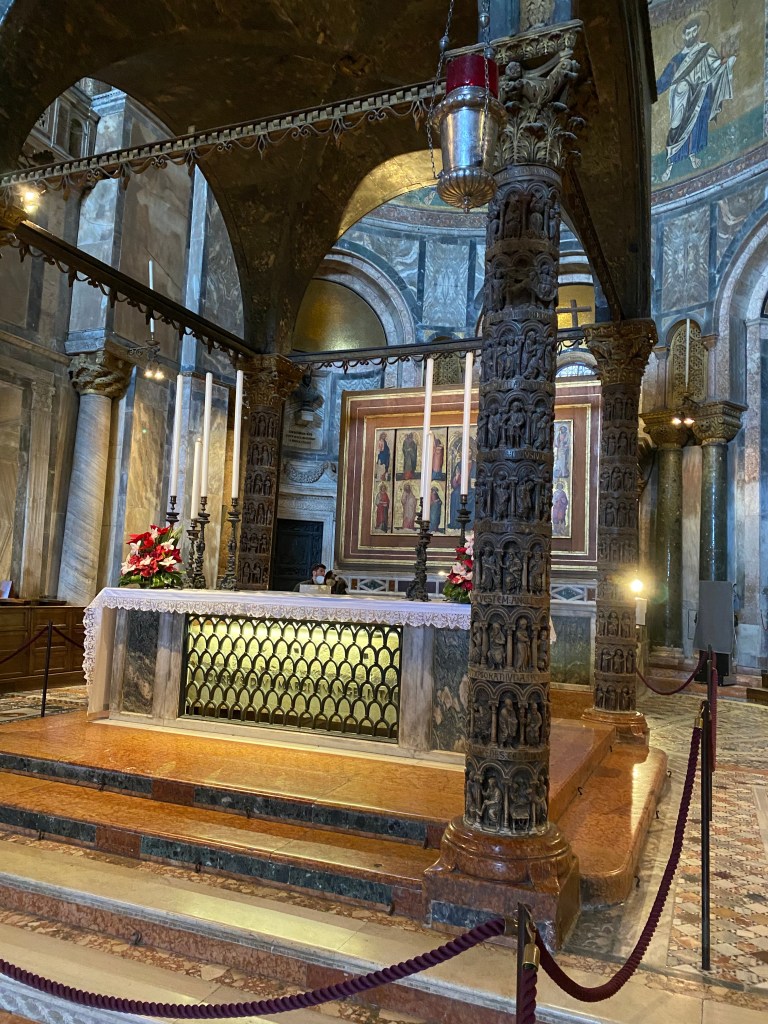
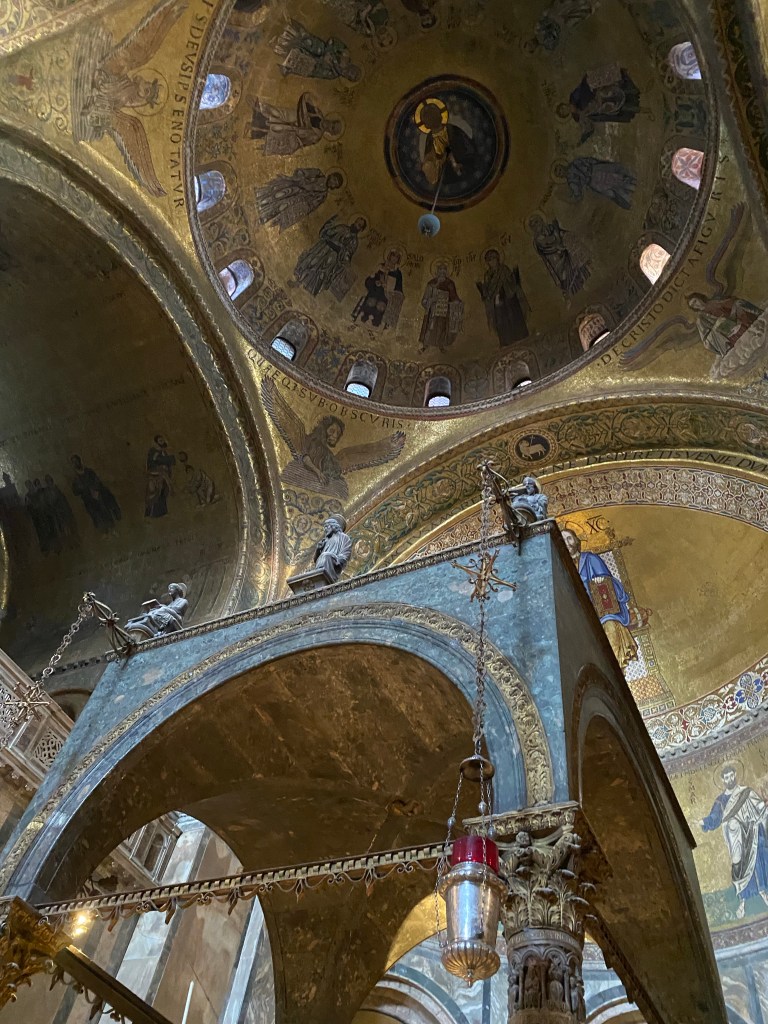
Inside this magnificent synagogue is a small but fine museum.
The Jewish Museum of Florence (Museo Ebraico di Firenze) is located in the Great Synagogue of Florence, Italy, which I posted about last month. The museum is small but holds an important collection of ancient objects of Jewish ceremonial art, evidence of the high artistic level achieved by the Jewish-Italian communities in the field of applied arts. Exhibitions illustrate the history of Florentine Jews from the first settlements to the post-war reconstruction, featuring old photographs, films and a large number of objects of daily and commemorative use.
This was my first visit to the synagogue and museum, and it was very interesting. And heart-wrenching too. Oh, the story of the Jews….
To get to the museum, you can take an elevator with a beautiful view of the 19th century stained glass windows. I caught the video on the way down from the museum.
The museum staff change the exhibitions from time to time and I was lucky enough to visit while these fascinating items from the ceremonial part of a baby’s life. The elaborate and exquisite gown is a dress for the day of circumcision. Below the dress are the tools used to perform the surgery. A baby’s prayer shawl. A bonnet. So evocative.
The next display case featured a embroidered tool for the ritual bath, as well as wedding handkerchiefs and silk bags to hold confetti (confetti here is sugar covered almonds).
I particularly loved the wedding favor bag above. It still has its card from the pastry shop that presumably provided the candies: Doney & Neveux. A quick look on Google images found an advertisement for this famous 19th century Florentine establishment. They were makers of sweets and were distillers.
I tried to pay a visit to this cemetery in October of this year (2021). Unfortunately, it was closed and a sign posted said it is under restoration.
Appena fuori porta San Frediano, in un angolo poco conosciuto agli stessi fiorentini, si trova il Cimitero monumentale ebraico. Un luogo da scoprire tra cappelle e monumenti funebri logorati dal tempo ma altamente suggestivi e rappresentativi del mondo ebraico. Eccezionalmente domenica 14 maggio il cimitero sarà aperto e lo si potrà visitare in compagnia di una guida con due possibilità di visita promosse alle 11 e alle 15.30 dalla cooperativa CoopCulture.
Il Cimitero, aperto nel 1777 in viale Ariosto, rimase in attività per circa un secolo fino a quando fu inaugurato il nuovo sito in zona Rifredi. Un alto muro di cinta custodisce con gelosa riservatezza un importante tesoro culturale costituito da cappelle funerarie e monumenti, tra questi spicca quello a forma di piramide egizia in memoria di David Levi, presidente della Comunità ebraica fiorentina.
La piramide fu costruita nell’Ottocento e disegnata da Marco Treves, del gruppo di architetti che realizzò anche la Sinagoga di Firenze. Pur prive di figurazioni alcune tombe sono vere e proprie sculture di valore artistico, così come le cappelle funerarie in stile neoegizio e neorinascimentale, fra tutte quella della famiglia Franchetti.
Per partecipare alla visita guidata, è necessario presentarsi al cancello del cimitero 15 minuti prima dell’inizio (viale Ariosto 16). La prenotazione obbligatoria al numero 055 234 6654 o sinagoga.firenze@coopculture.it. Il costo della visita è di 9 euro.
Non solo chiese e musei. A Firenze esistono altri luoghi artistici meno conosciuti, ma non per questo meno suggestivi. Uno di questi è sicuramente il cimitero monumentale ebraico di viale Ariosto. Ubicato ai piedi delle antiche mura, a due passi da Porta San Frediano, si trova il cimitero ebraico più antico della città. Costruito nel 1777, rimase in funzione fino al 1870, anno in cui venne aperto quello in via di Caciolle, nella zona di Rifredi, tutt’oggi in uso.
Secondo la tradizione israelita, le tombe non hanno l’immagine del defunto e presentano le forme più svariate. Oltre alle lapidi semplici, vi si trovano monumenti funebri a forma di sarcofago o di piccolo tempio. Su tutte spicca la cappella funeraria della famiglia Levi: una piramide posta su un alto basamento, realizzata in blocchi squadrati di pietra e illuminata all’interno da un piccolo occhio sul lato meridionale, oltre che dal portale d’ingresso.
Accanto alla piramide si trova poi un’altra tomba più piccola in stile neoegizio, appartenente alla famiglia Servadio e realizzata verso la fine dell’Ottocento. Il monumento funebre presenta colonne a fascio e all’interno il simbolo del sole alato, mentre sul sarcofago è scolpita una corona. Vi è poi la cappella della famiglia Franchetti realizzata da Marco Treves, lo stesso architetto della sinagoga di Firenze, un’edicola composta da colonne e decorazioni molto ricche.
Oggi con pacchetto ServiceCare incluso, puoi guidarla sempre nelle condizioni migliori. Scopri di più Contenuto Sponsor
Sebbene non sia più in uso da diverso tempo, il cimitero apre le sue porte al pubblico la prima domenica del mese. Un’occasione da non perdere.
A couple of weeks ago, I set out to visit the Jewish Cemetery which lies near the gate of San Frediano in the Oltrarno district of Florence. Sadly, the cemetery was closed and a sign said they are in the middle of restoring the place. Who know when that will be finished? With Covid for the past 2 years and Italian bureaucracy which makes even easy jobs hard and long, chissa?
Despite my disappointment with the closed cemetery, I enjoyed my walk around the gate:
The ubiquitous caper plant, which grows like weeds in Italy, was growing in the cracks of the gate. You can see the berries.
The fine old Romanelli Sculpture Studio and Gallery is alive in well in this district. It is a sculpture lover’s dream.
Today is La Festa di Ognissanti, or the All Saints Feast, a religious event celebrated on November 1st. This feast celebrates all the saints of the Catholic calendar.
This year the national holiday – also known as Tutti i Santi – falls on a Monday meaning that the country’s schools and public offices will be closed.
The origins of this feast date back to very ancient times. In fact, records exist of celebrations held in honor of Christian saints even during the very first centuries of the development of Christianity. Writings related to the dedication by Pope Boniface IV of the Roman Pantheon to “Mary and all the martyrs” on May 13th 609 AD can be considered as the symbolic text inaugurating the tradition.
Over the course of time, the feast was moved to November 1st for reasons that are still unclear. There are claims that All Saints Day was moved to November so that the Church could christianise the pagan feast of the Celtic New Year, which allowed for celebrations to last three whole days.
Whatever the reason, it was decided that the feast would take place in November and, as of June 1st, 1949, the Italian Constitution listed the day of Ognissanti as a public holiday.
Empoli is a town and comune in the Metropolitan City of Florence, about 19 miles southwest of Florence, to the south of the Arno in a plain formed by the river. The plain has been used for agriculture since Roman times.
Archaeological finds have revealed that Empoli was already settled in the early Roman Empire times, and continued to exist until the 4th century AD. The Arno river acted as a communication way for the trade of agricultural products, together with the local amphorae. In the Tabula Peutingeriana of the 4th century Empoli is called in portu (“in the port”) as a river port on the Roman road Via Quinctia, which led from Fiesole and Florence to Pisa. Empoli was also on the Via Salaiola, connecting to Volterra’s salt ponds.
From the 8th century, Empoli consolidated as a town around the castle, known as Emporium or Empolis. In 1119 it was absorbed into the Guidi counts’ possessions. In 1182 it fell under Florentine rule. In 1260, after the Battle of Montaperti, Empoli was the seat of a famous council in which Farinata degli Uberti opposed the destruction of Florence.
Later Empoli became an important fortress, and was therefore repeatedly sacked and attacked. In 1530 its fall marked the end of the independence of the Florentine Republic.
Pietà by Masolino da Panciale
Below are 4 photos I took of a lovely bronze sculpture depicting the goddess, Victory, in Piazza della Vittoria, Empoli. It was created by Dario Manetti and Carlo Rivalta in 1925.
If you are tired of the usual tourist destinations and you are looking for something different to visit, we suggest you to spend an afternoon in Empoli: a place that will surely amaze you with its rich cultural offering.
Empoli is located about 30 Km from Florence and is easily reached both by car, driving along the FI-PI-LI motorway, and by public transportation, catching one of the frequent trains that connect Florence with Pisa and Siena. It is exactly because of its central position among these important Tuscan cities that Empoli has long been a crossroads for trade and commerce.
Empoli’s old town, just a fews steps away from the train station, developed during the Middle Ages around Farinata degli Uberti square, also called ‘dei Leoni’ because of the lions that stand on the corners of the Naiadi fountain that was made in 1828 right in the middle of the square. Here lie some of the city’s oldest buildings, such as the wonderful Collegiata di Sant’Andrea dating back to the 11th century. The elegant facade decorated with white and green marble, is the only example of Florentine Romanesque style to be seen outside the Florence walls. The inside of the church has undergone several transformations over the centuries: among the most recent works is the one by the Empoli painters Sineo Gemignani and Virgilio Carmignani who, after the First World War, restored the frescoes of the central nave that were destroyed by the collapse of the bell tower.
Many of the art works that used to be housed in this and in other churches in Empoli, are now displayed in the neighbouring Museo della Collegiata di Sant’Andrea. Founded in 1859, the museum collects masterpieces made between the 13th and 17th century: displayed in the first two rooms are the sculptures, such as the 15th century baptismal font attributed to Bernardo Rossellino, and the detached frescoes, such as the extraordinary Cristo in Pietà by Masolino, while on the upper floor lies the picture gallery where the panels by Lorenzo Monaco and Filippo Lippi and the monumental tabernacles made by the Botticini stand out. The visit ends with the refined glazed terracottas of the Della Robbia workshop, on display in the loggia overlooking the cloister.
Coming out of the museum, on the other side of the square, you find the Museo Civico di Paleontologia which displays hundreds of fossils, rocks and relics, complete with information boards and dioramas telling the history of our planet over the last two billions of years. A perfect place to visit with kids!
Walking through the streets of the centre, among elegant shops and traditional businesses, you reach the Magazzino del Sale that used to store the priceless salt coming from Volterra’s salt mines, later to be distributed through the nearby fluvial port on the Arno river. Today the building hosts the MUVE Museo del Vetro di Empoli, where by wandering among artefacts and everyday objects, you trace the history of Empoli’s glass production, an economically crucial industry for the small city, at least until the 1980s.
Finally, a little known fact is that Empoli was the birthplace of two great artists: Jacopo Carucci, called Pontormo (1494-1557), a very great and tortured artist who was an exponent of the ‘modern manner’, whose panels portraying Saint John the Evangelist and Saint Michael the Archangel can be admired in the San Michele a Pontorme church in Empoli, and Ferruccio Busoni (1866-1924), a sublime pianist and composer, whose fame has gone beyond national borders. Their houses are now museums where you can discover their works, their lives and the most intimate world of these great persons.
I love pomegranates. I remember the first time I ever saw one. I was in 2nd grade and a classmate’s mother brought one to our class for us to try. I thought they were beautiful, exotic, and I loved the taste. For years after, I would beg my mom to buy one at the supermarket. They were very messy and the juice stained whatever I was wearing. I would bite the juicy part from the seed and my mom couldn’t believe I would go to so much trouble for such a small reward. But, I thought the taste was worth the trouble.
Years later, I still love them, only now I just chew the seeds and swallow them with the juice.
Even more outstandingly for me, I live in Florence and there are several coffee houses (bars) in town that serve freshly squeezed pomegranate juice. I look forward to October/November, when the juice starts becoming available.
I feel so lucky to live in a place where pomegranate shrubs grow tall and bear lots of fruit. I go crazy taking pictures of the reddish globes that decorate the branches like Christmas tree baubles.
The name pomegranate derives from medieval Latin pōmum “apple” and grānātum “seeded.” Possibly stemming from the old French word for the fruit, pomme-grenade, the pomegranate was known in early English as “apple of Grenada”—a term which today survives only in heraldic blazons. This is a folk etymology, confusing the Latin granatus with the name of the Spanish city of Granada, which derives from Arabic.
Pomegranates are drought-tolerant, and can be grown in dry areas with either a Mediterranean winter rainfall climate or in summer rainfall climates. In wetter areas, they can be prone to root decay from fungal diseases. They can be tolerant of moderate frost, down to about −10 °F.
The pomegranate is native to a region from modern-day Iran to northern India. Pomegranates have been cultivated throughout the Middle East, South Asia, and Mediterranean region for several millennia, and it is also cultivated in the Central Valley of California and in Arizona.
Pomegranates may have been domesticated as early as the fifth millennium BC, as they were one of the first fruit trees to be domesticated in the eastern Mediterranean region.
Carbonized exocarp of a pomegrante has been identified in early Bronze Age levels of Tell es-Sultan (Jericho) in the West Bank, as well as late Bronze Age levels of Hala Sultan Tekke on Cyprus and Tiryns. A large, dry pomegranate was found in the tomb of Djehuty, the butler of Queen Hatshepsut in Egypt; Mesopotamian cuneiform records mention pomegranates from the mid-third millennium BC onwards. Waterlogged pomegranate remains have been identified at the circa 14th century BC Uluburun shipwreck off the coast of Turkey. Other goods on the ship include perfume, ivory and gold jewelry, suggesting that pomegranates at this time may have been considered a luxury good. Other archaeological finds of pomegranate remains from the Late Bronze Age have been found primarily in elite residences, supporting this inference.
The shrub is also extensively grown in southern China and in Southeast Asia, whether originally spread along the route of the Silk Road or brought by sea traders. Kandahar is famous in Afghanistan for its high-quality pomegranates.
Although not native to Korea or Japan, the pomegranate is widely grown there and many cultivars have been developed. It is widely used for bonsai because of its flowers and for the unusual twisted bark the older specimens can attain. The term “balaustine” (Latin: balaustinus) is also used for a pomegranate-red color.
Spanish colonists later introduced the fruit to the Caribbean and America (Spanish America), but in the English colonies, it was less at home: “Don’t use the pomegranate inhospitably, a stranger that has come so far to pay his respects to thee,” the English Quaker Peter Collinson wrote to the botanizing John Bartram in Philadelphia, 1762. “Plant it against the side of thy house, nail it close to the wall. In this manner it thrives wonderfully with us, and flowers beautifully, and bears fruit this hot year. I have twenty-four on one tree… Doctor Fothergill says, of all trees this is most salutiferous to mankind.”
The pomegranate had been introduced as an exotic to England the previous century, by John Tradescant the Elder, but the disappointment that it did not set fruit there led to its repeated introduction to the American colonies, including New England. It succeeded in the South: Bartram received a barrel of pomegranates and oranges from a correspondent in Charleston, South Carolina, 1764. John Bartram partook of “delitious” pomegranates with Noble Jones at Wormsloe Plantation, near Savannah, Georgia, in September 1765. Thomas Jefferson planted pomegranates at Monticello in 1771; he had them from George Wythe of Williamsburg.
To end, just a few delightful images of how pomegranates inspire artists:
Illustration by Otto Wilhelm Thomé, 1885Open Pomegranate in a Dish, with Grasshopper, Snail and Two Chestnuts, c. 1652 by Giovanna Garzoni (1600–1670)Madonna of the Pomegranate, c. 1487, Sandro BotticelliPomegrantes in Majorca, by John Singer Sargent
You must be logged in to post a comment.