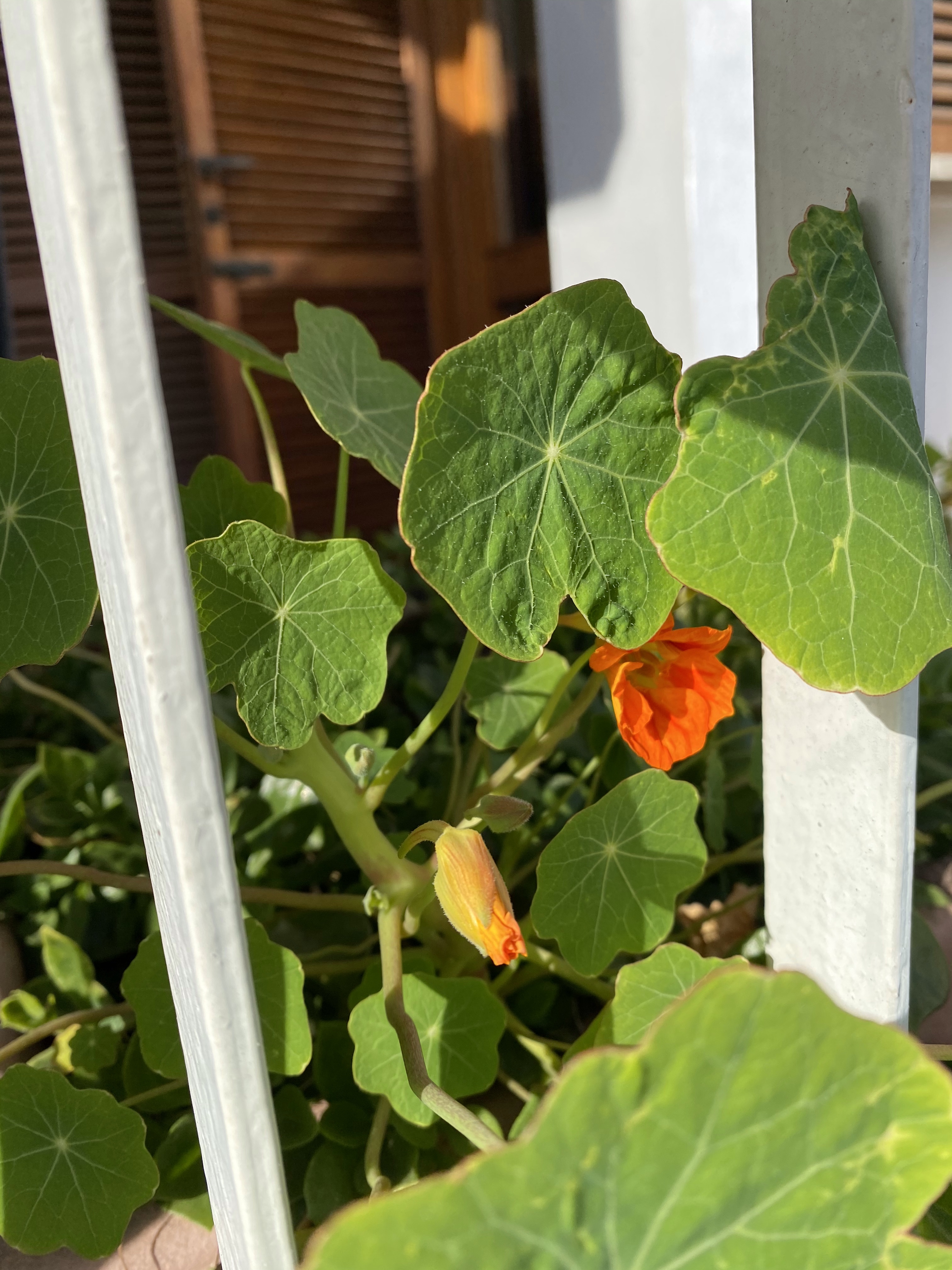
Look who just showed up, all on her own?! This little nasturtium blossom. The plant survived the cold winter on my balcony and has just started giving me pretty flowers!
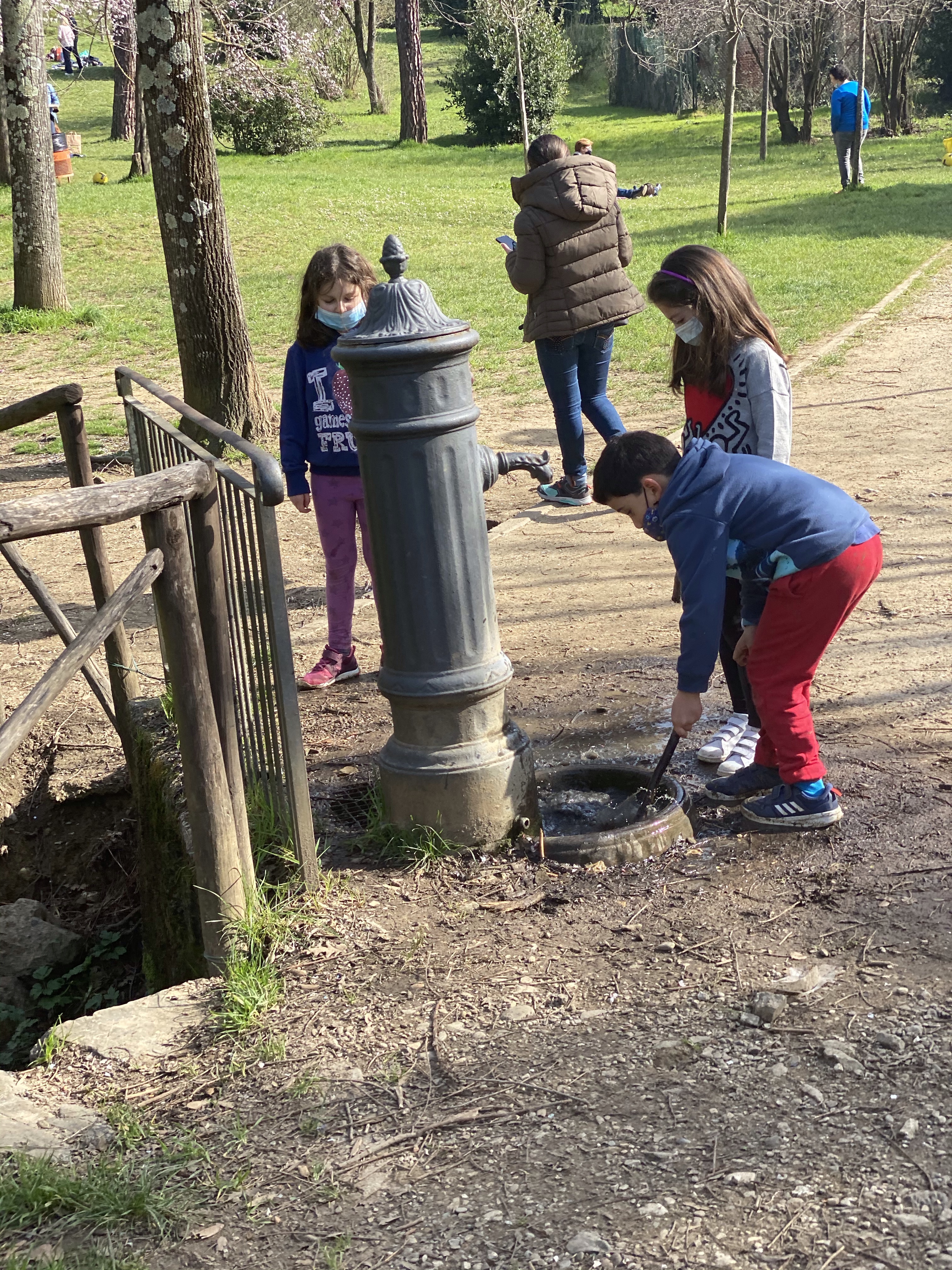
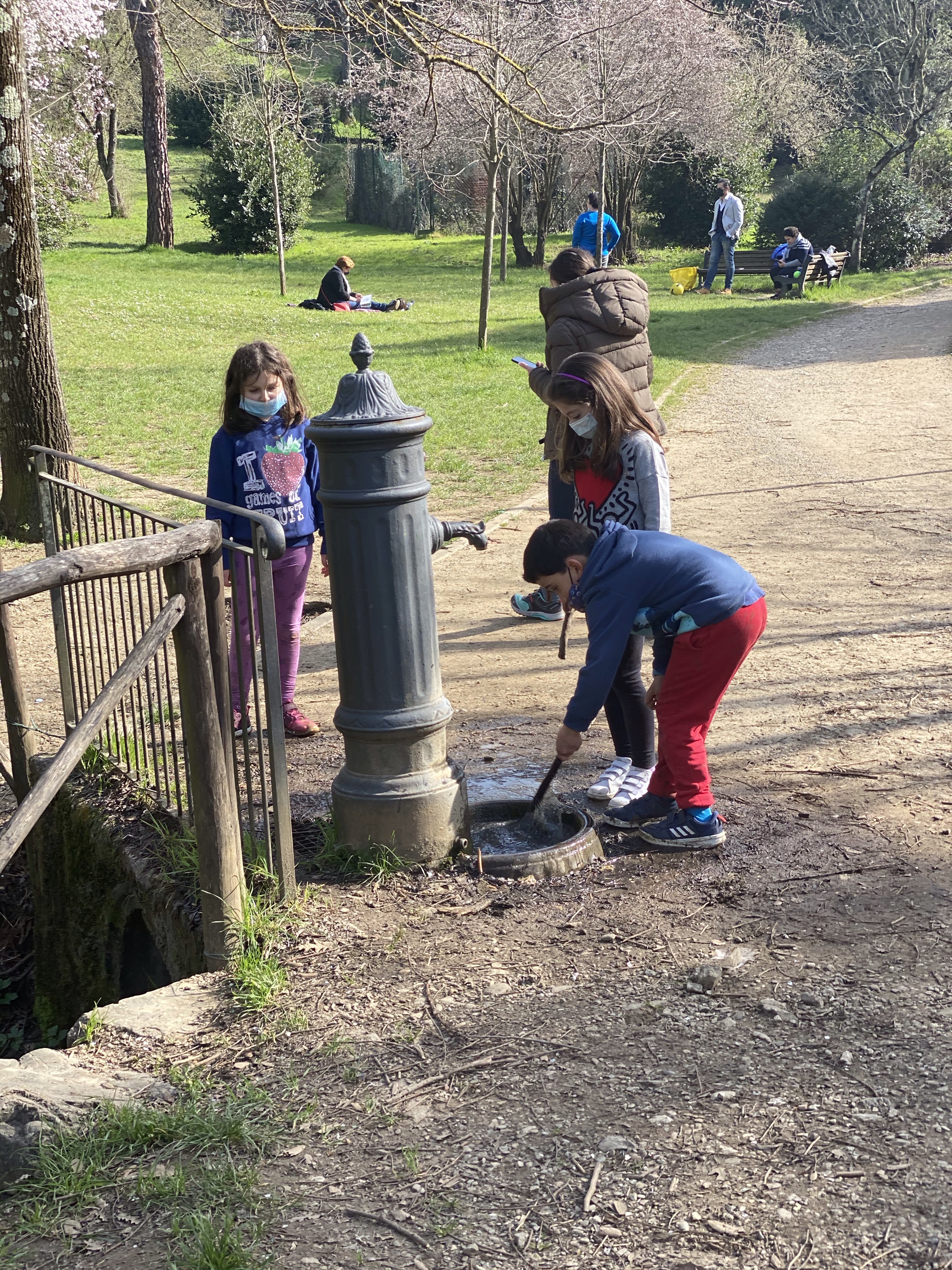
The next two pictures were taken in a local park. Where there is water and a little boy, there will be sticks and water play!
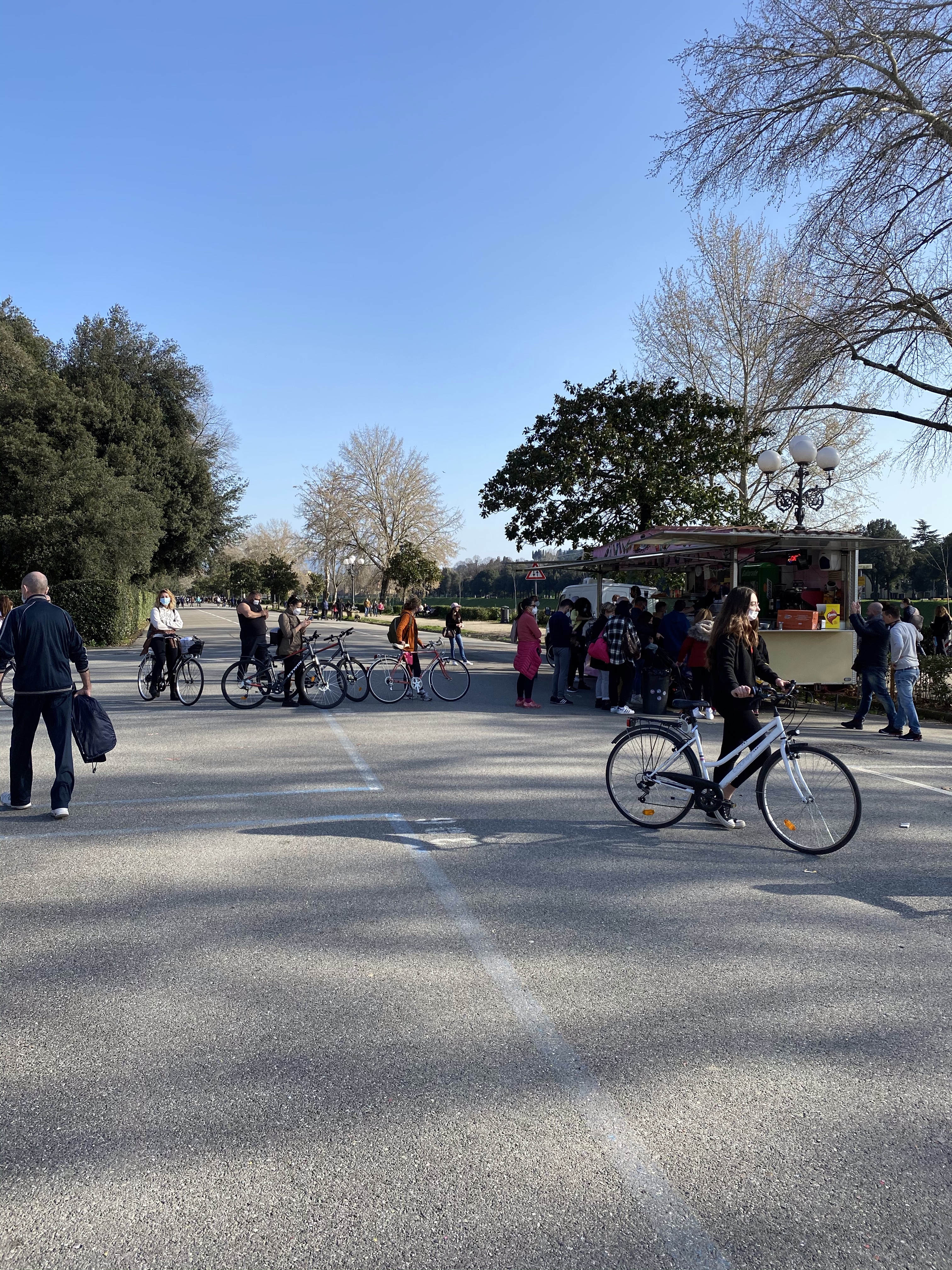
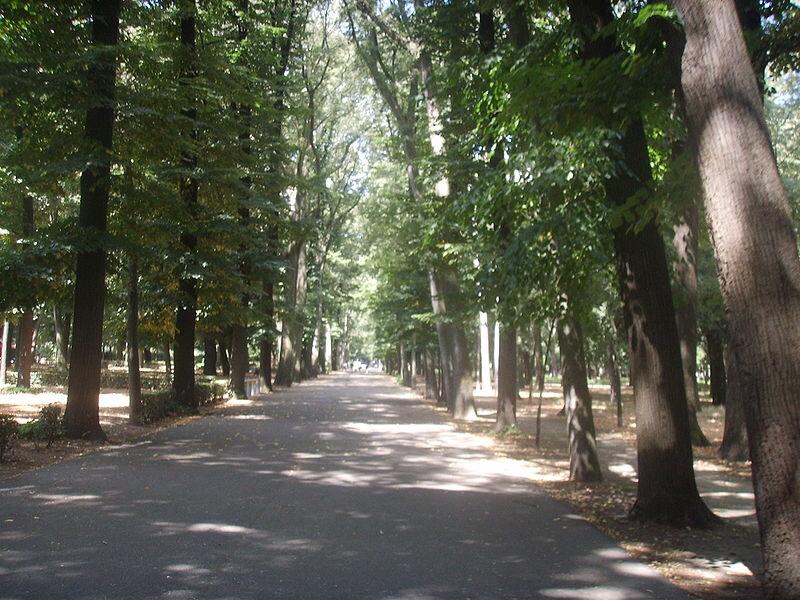
Yesterday I posted on the history of the Cascine; here are some pictures from some recent walks.
One of the million things I love about Italy, is that you are never far from a food truck. They sell coffees and all manner of cold drinks, candy, chips, sometimes panini, and sometimes gelato. They are always popular.
In the video above, I finally found the Vespa I have been looking for. I wonder where this little boy and his sister found theirs? I want one!
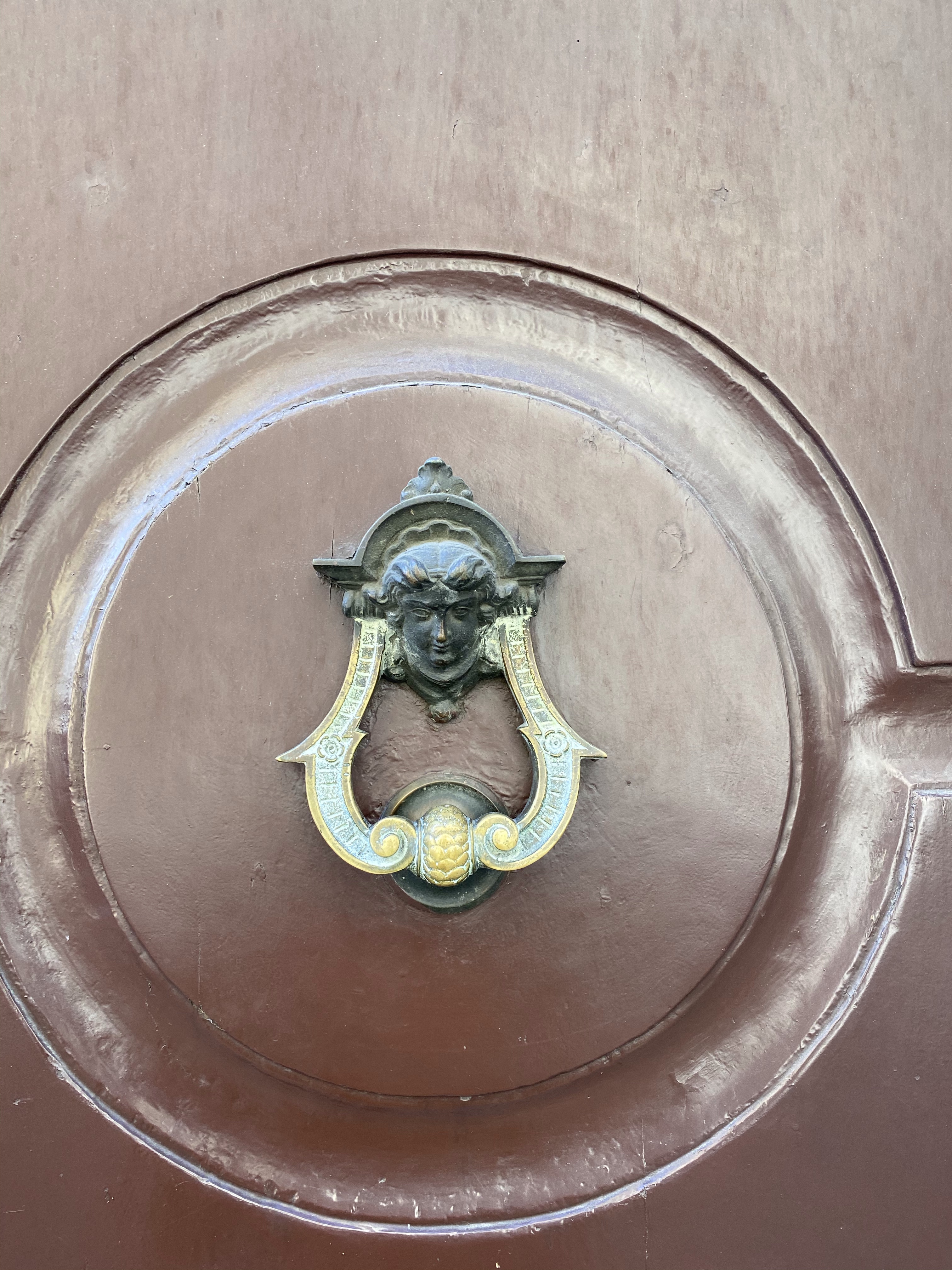
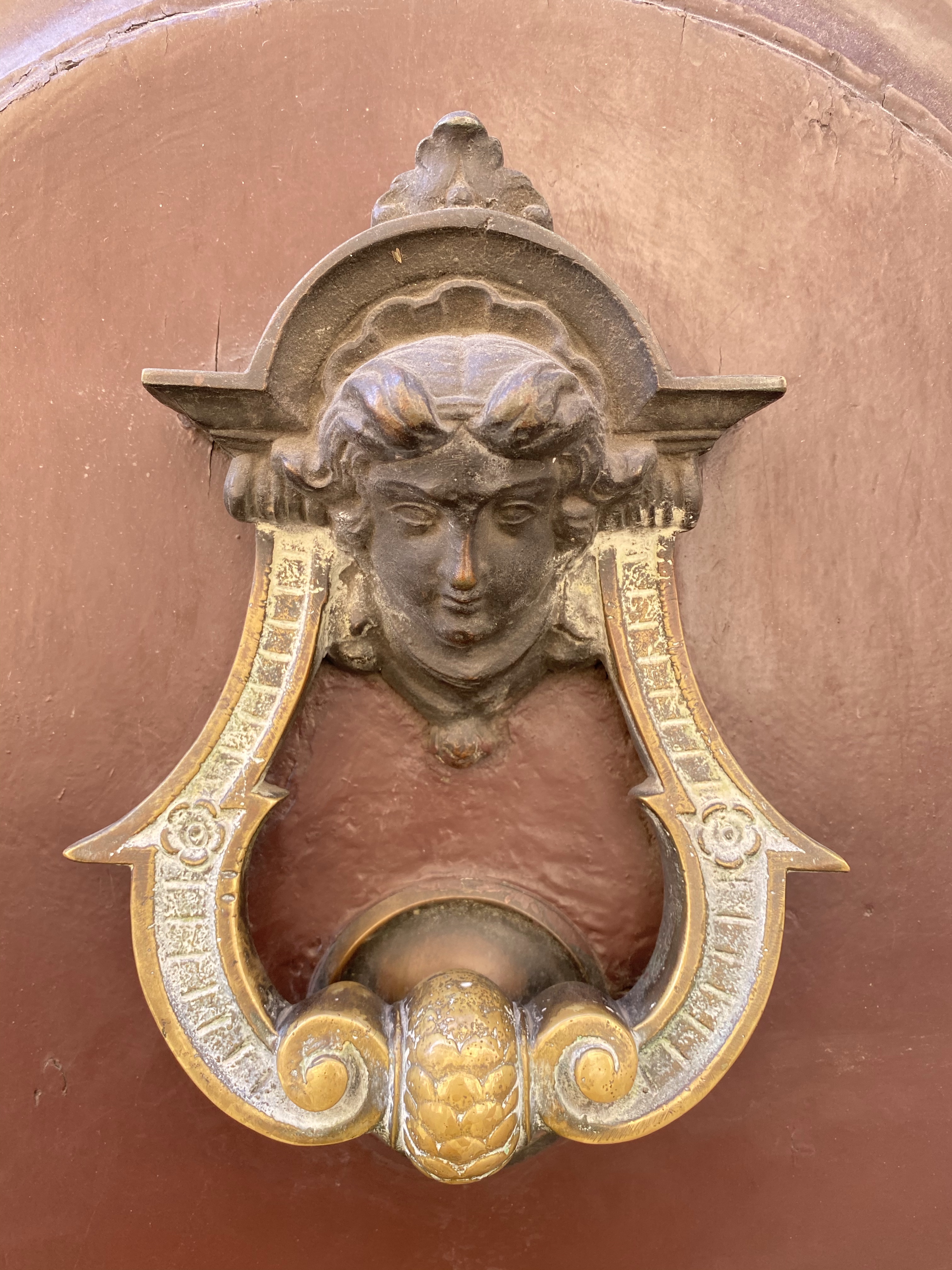
Another day, another walk, more door knocks. Italy is full of them and I love finding new (to me) designs.
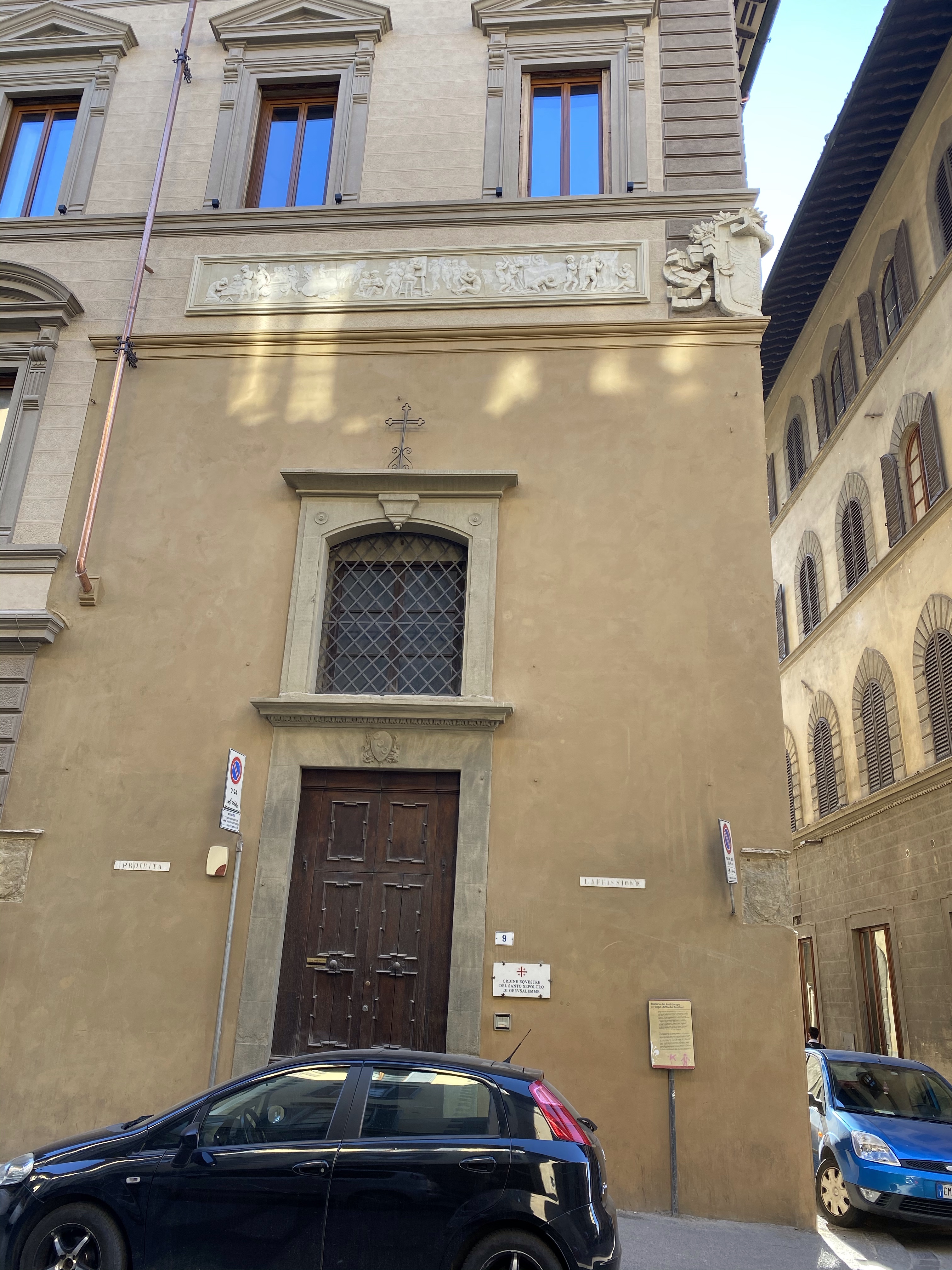
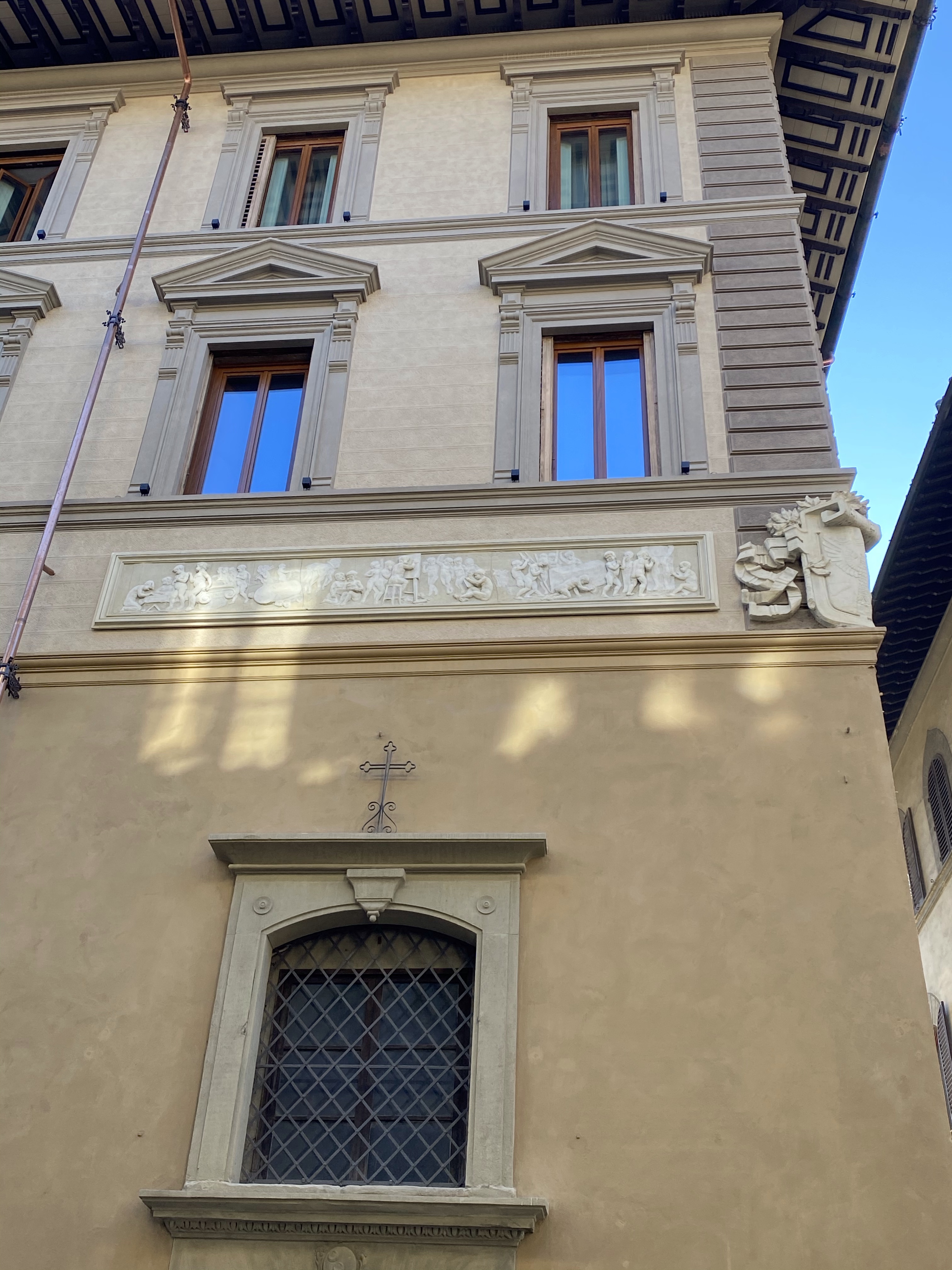
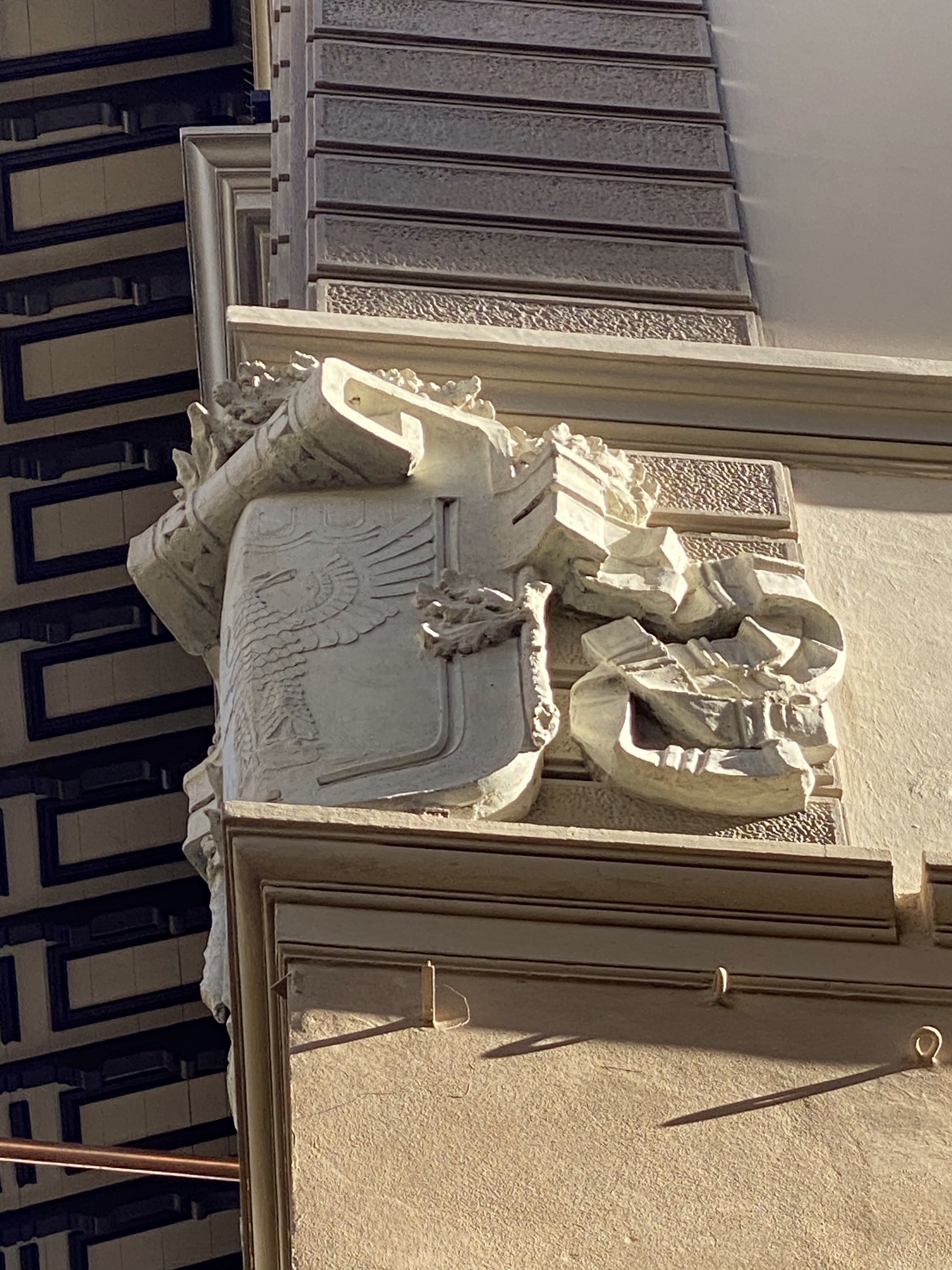
The way the sun was shining on this particular day, the relief sculpture above this doorway on the right caught my eye. Guess what, I’d never noticed it before!
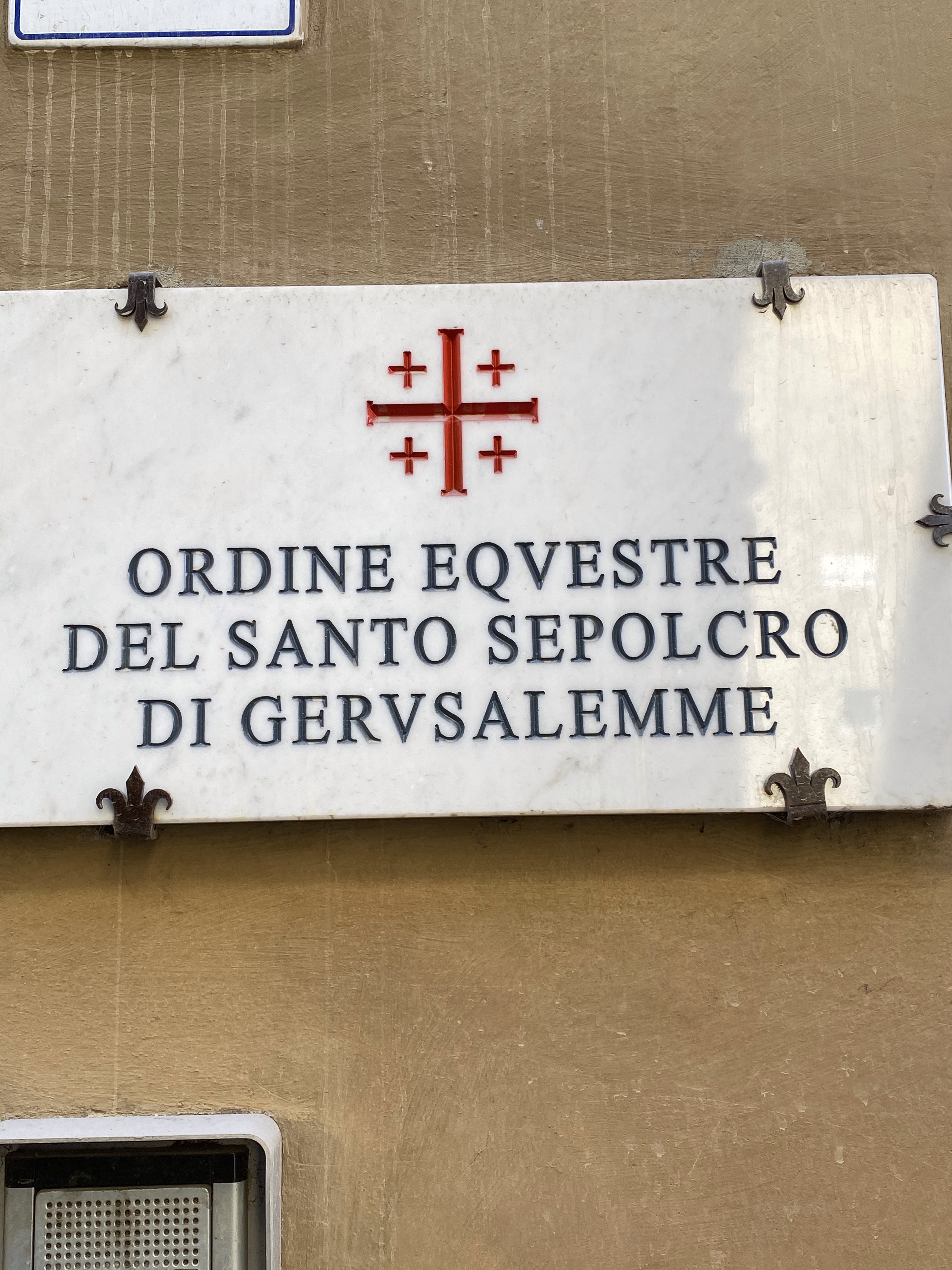
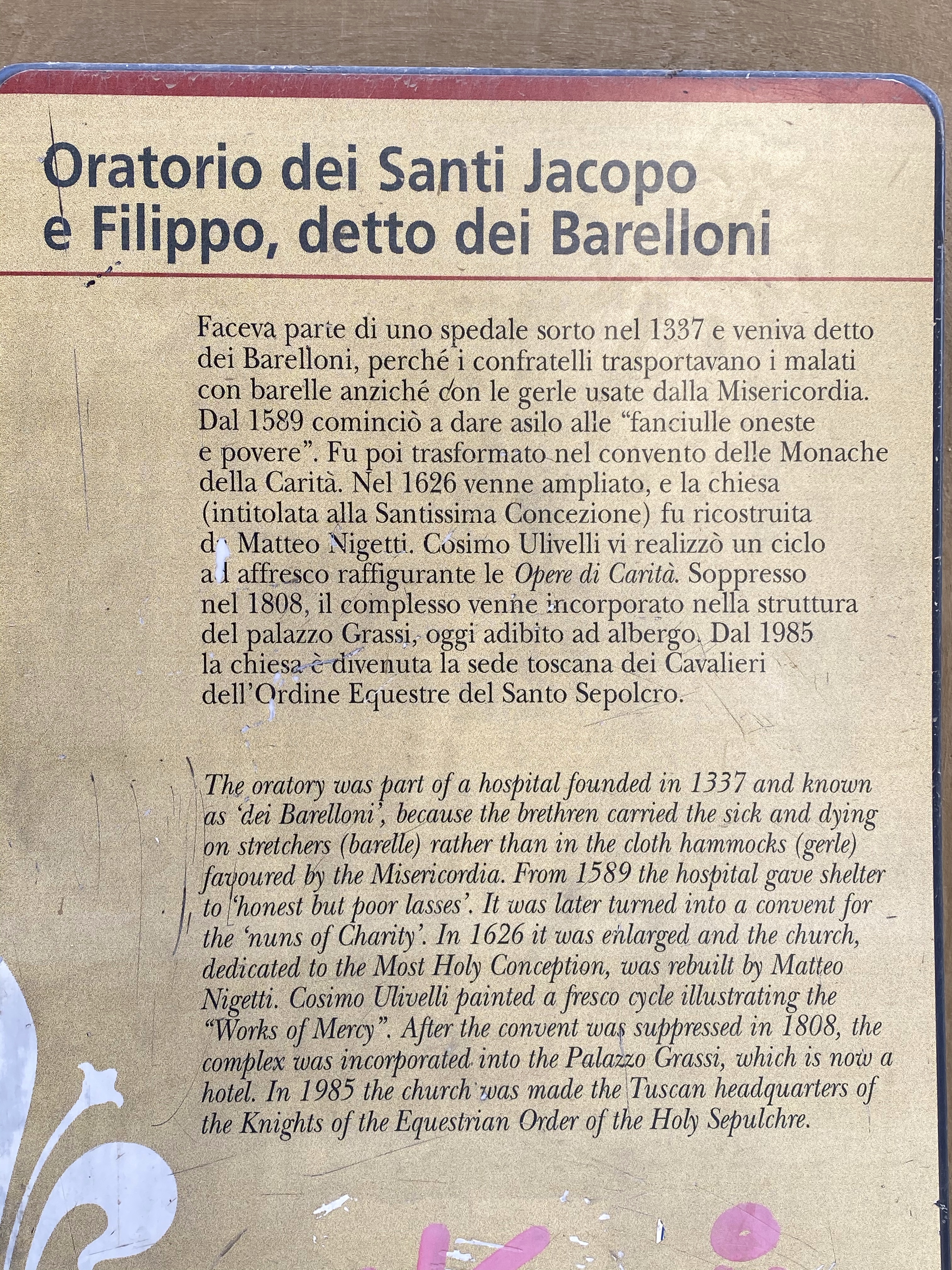
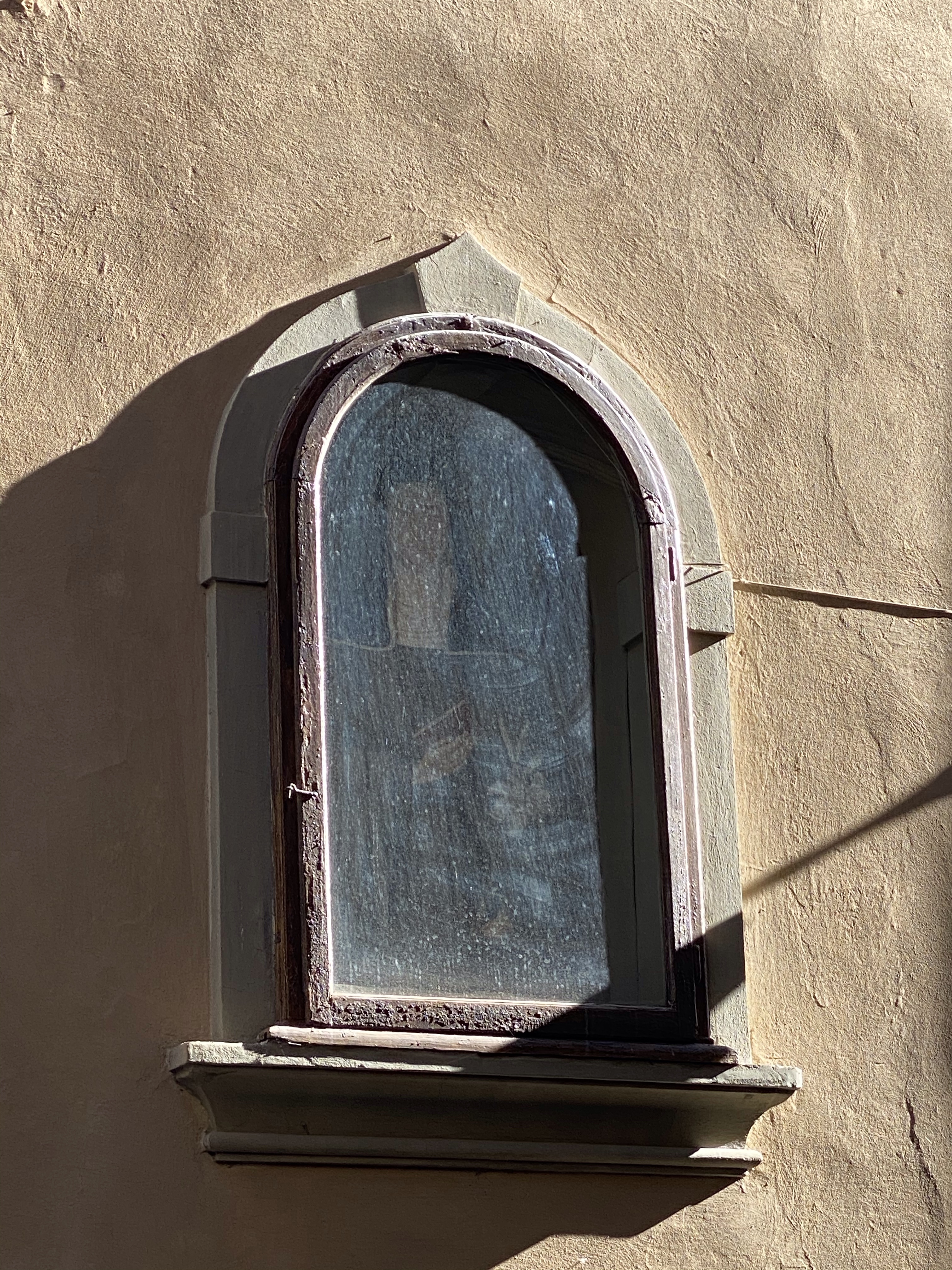
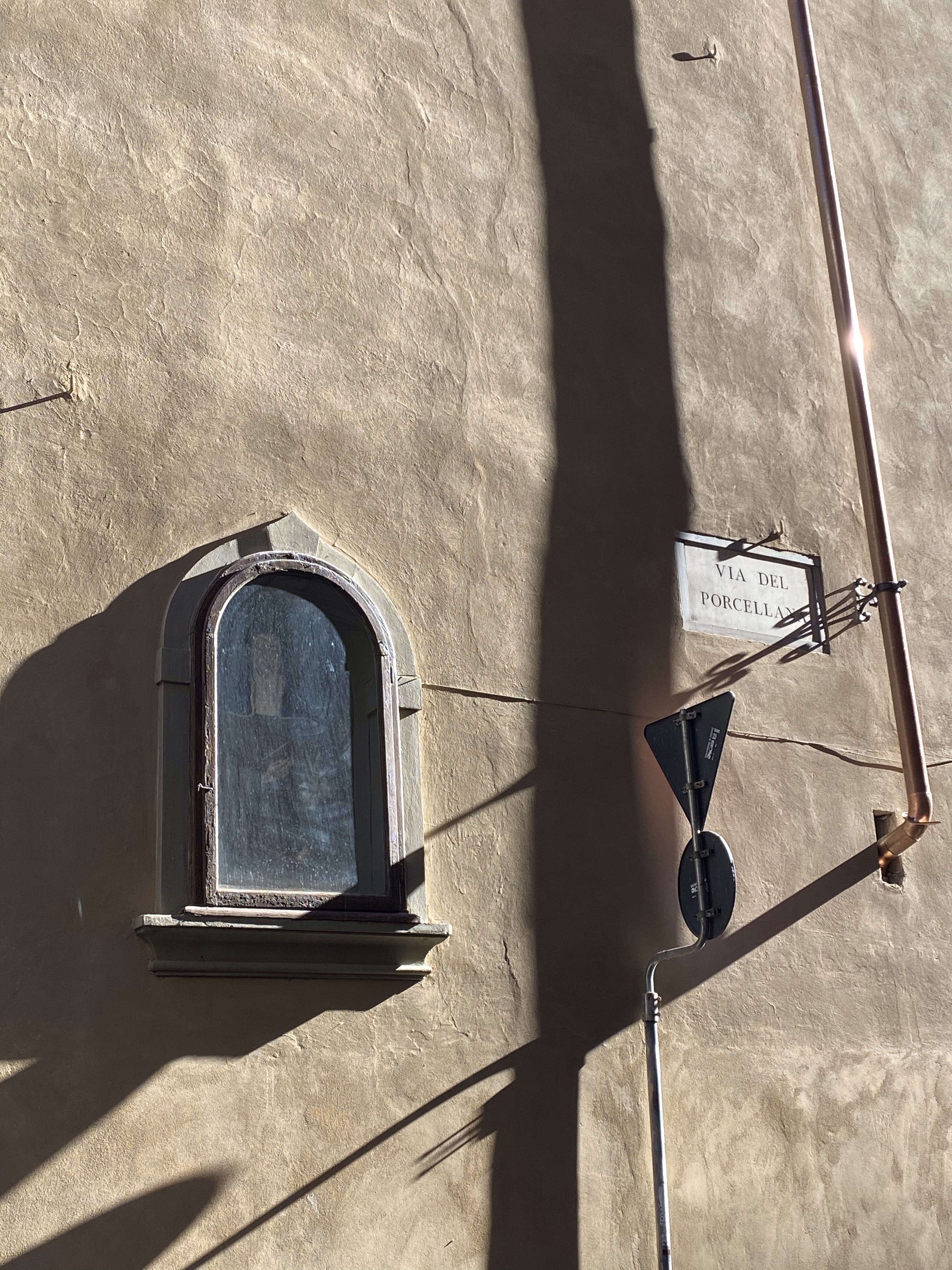
Upon closer inspection, there was a sign telling me this building has historical significance, which I’d guessed, due to the reliefs. It was the Oratorio dei Santi Jacopo e Filippo, detto dei Barelloni, or the Oratoy of Saints Jacob and Phillip, called the Barelloni.
The oratori was part of a hospital founded in 1337 and known as “dei Barelloni” because the brethren carried the sick and dying on stretchers (barelle) rather than in the cloth hammocks (gerle) favored by the Misericordia, which was a sister charitable association. The building occupied the block between via della Scala and via Palazzuolo. In 1504, the hospital was suppressed and in 1589 it began to give asylum to “honest and poor girls,” it was then transformed into the convent of the Nuns of Charity. In 1626 it was enlarged and the church, dedicated to the Most Holy Conception, was rebuilt by Matteo Nigetti. Cosimo Ulivelli painted a fresco cycle illustrating the “Works of Mercy.” After the convent was suppressed in 1808, the complex was incorporated into the Palazzo Grassi, which is now a hotel. In 1985 the church was made into the Tuscan headquarters of the Knights of the Equestrian Order of the Holy Sepulchre.
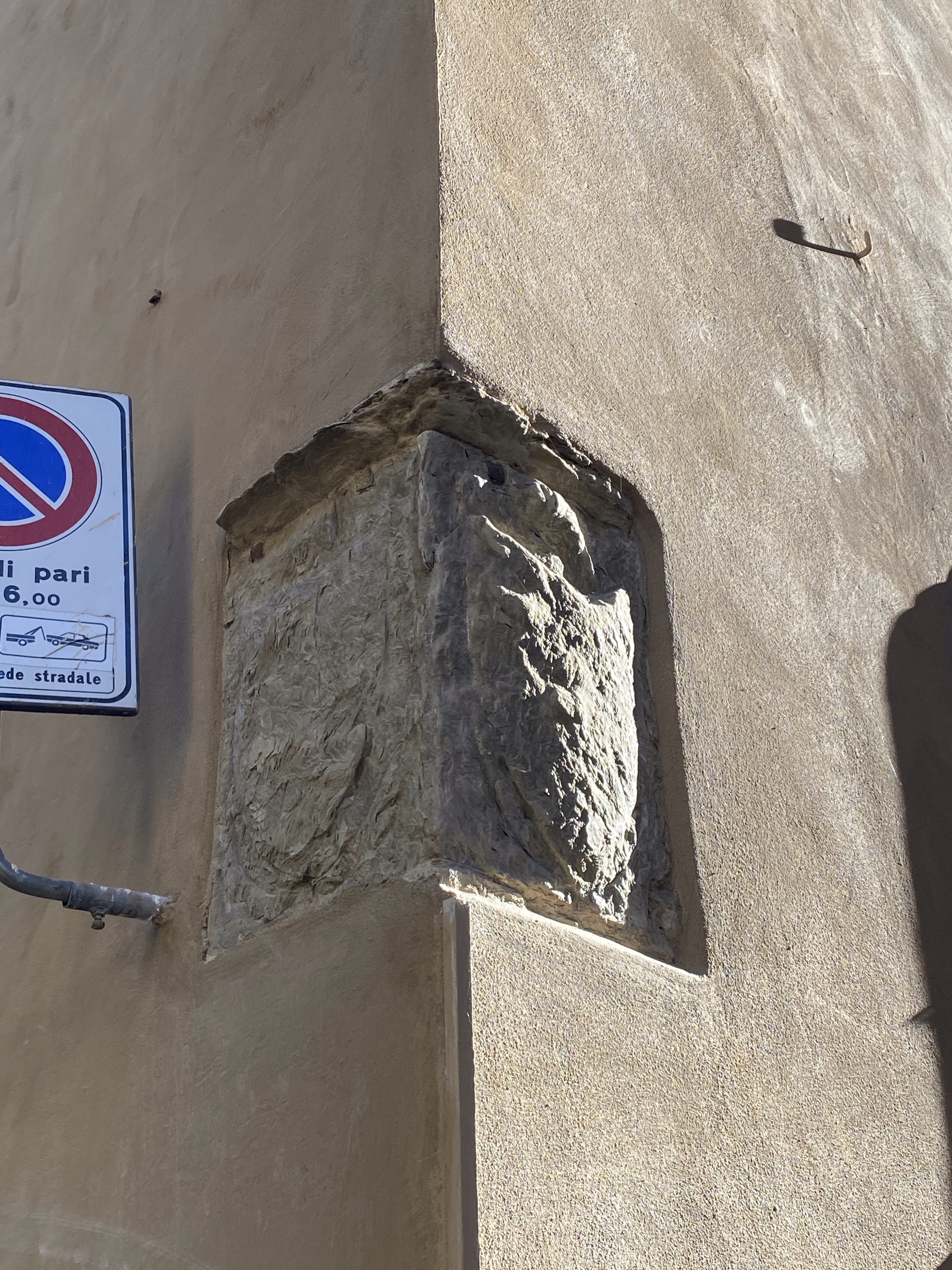
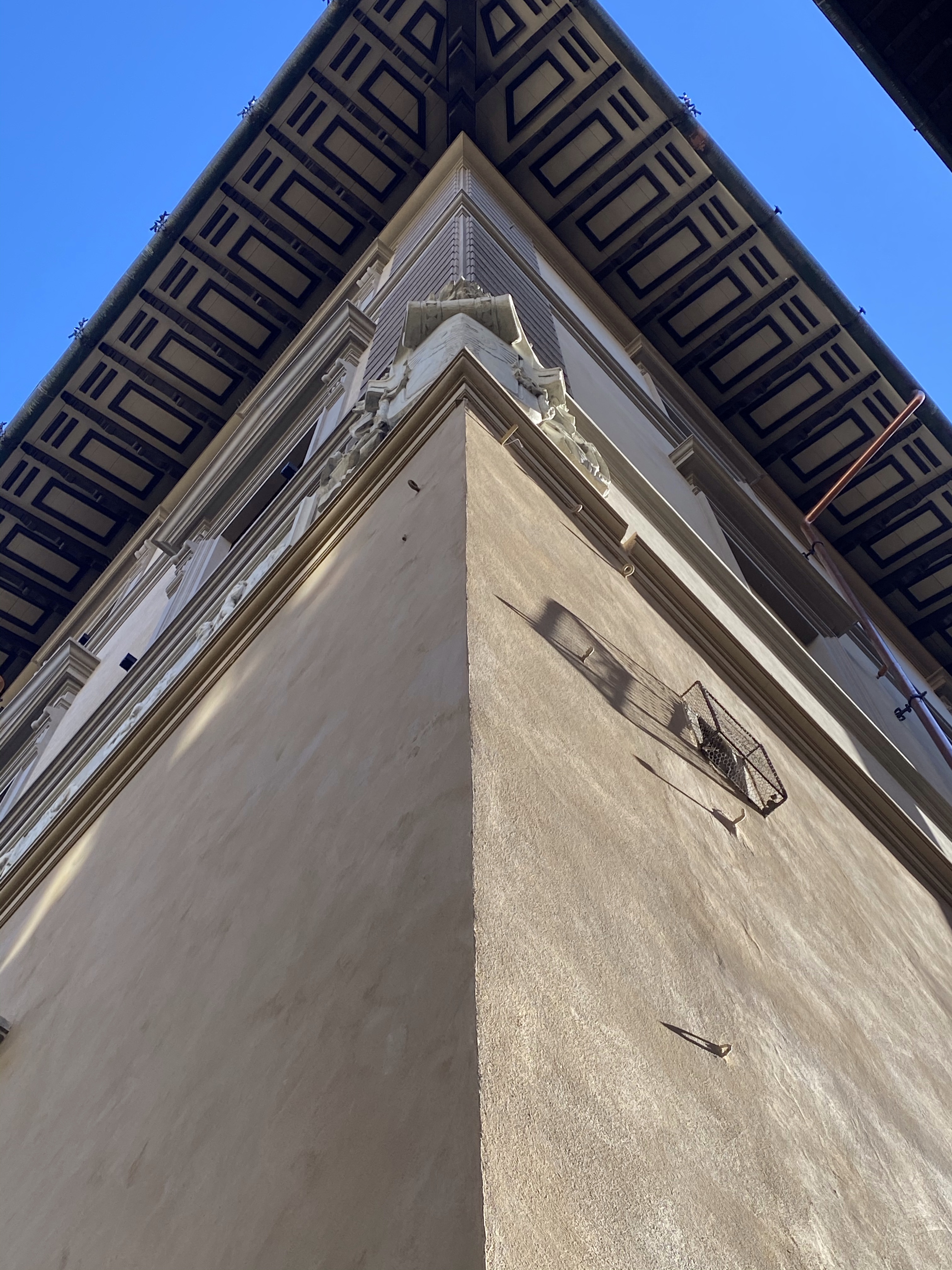
My pictures show some details of this interesting exterior, including a tabernacle on its western wall as well as the remnants of a former building seen on the corner.
It turns out that the Equestrian Order of the Holy Sepulchre of Jerusalem, also called Order of the Holy Sepulchre or Knights of the Holy Sepulchre, is a Catholic order of knighthood under the protection of the Holy See and very much a living thing. The pope is the sovereign of the order which, with the five other papal equestrian orders and the Sovereign Military Order of Malta, are the only orders of chivalry that are recognised and protected by the Holy See.
The order creates canons as well as knights, with the primary mission to “support the Christian presence in the Holy Land”.
The order today is estimated to have some 30,000 knights and dames in 60 lieutenancies around the world. The cardinal grand master has been Fernando Filoni since 2019, and the Latin Patriarch of Jerusalem is grand prior. Its headquarters are situated at Palazzo Della Rovere and its official church in Sant’Onofrio al Gianicolo, both in Rome, close to the Vatican City.
Pilgrimages to the Holy Land were a common, if hazard ridden, practice from shortly after the crucifixion of Jesus onward through the Middle Ages. Numerous detailed commentaries have survived as evidence of this early Christian devotion. While there were many places the pious visited during their travels, the one most cherished was the Church of the Holy Sepulchre, first constructed by Constantine the Great in the 4th century AD.
During the era of the Islamic expansion, Emperor Charlemagne (c. 742–814) sent two embassies to the caliph of Baghdad, asking Frankish protectorate over the Holy Land. An epic chanson de geste recounts his legendary adventures in the Mediterranean and pilgrimage to Jerusalem.
In feudalism it was common practice for knights commanders to confer knighthoods upon their finest soldiers, who in turn had the right to confer knighthood on others upon attaining command. Tradition maintains that long before the Crusades, a form of knighthood was bestowed upon worthy men at the Church of the Holy Sepulchre. In any case, during the 11th century, prior to the Crusades, “milites sancti Petri” were established to protect Christians and Christian premises in the Occident.
Persecution of Christians in the Holy Land intensified. Relations with Christian rulers were further strained when Caliph Al-Hakim bi-Amr Allah ordered the destruction of the Church of the Holy Sepulchre in 1009.
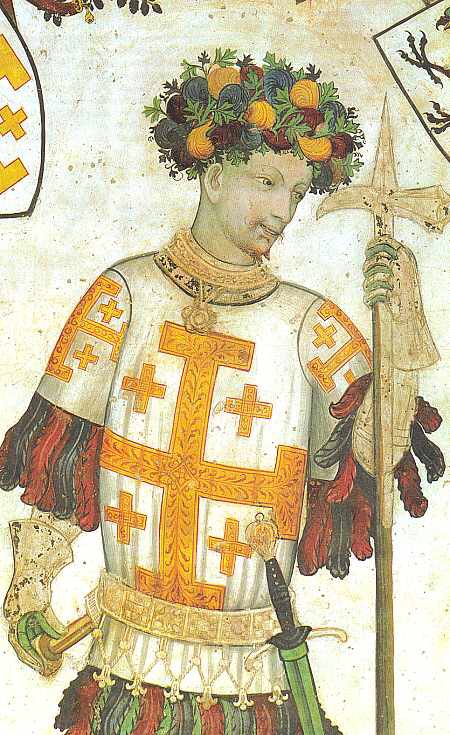
The Order of the Holy Sepulchre traces its roots to circa 1099 under the Frankish knight Godfrey of Bouillon (1060–1100), “advocate of the Holy Sepulchre” (Latin: Advocatus Sancti Sepulchri), leader of the First Crusade and first ruler of the Kingdom of Jerusalem. Fresco by Giacomo Jaquerio in Saluzzo, northern Italy (circa 1420).
Today I am giving you the history of this, the largest green space within the city of Florence. Tomorrow I will show you my recent pictures. I’m spending a lot of time in this park during Covid lockdowns.
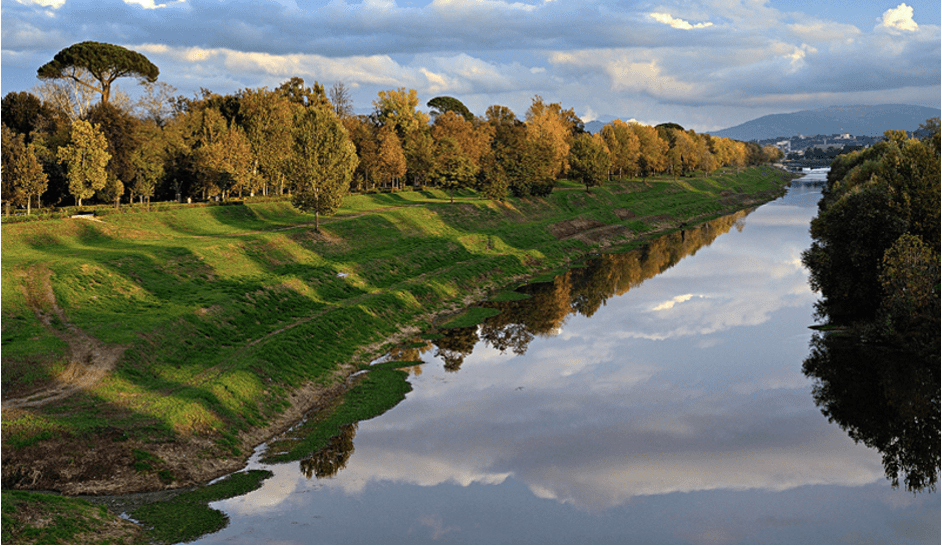
The Parco delle Cascine (Cascine Park) is a monumental and historical park in the city of Florence. The park covers an area of 160 hectares (395 acres). It has the shape of a long and narrow stripe, on the north bank of the Arno river. It extends from the centre of Florence until the point where the Mugnone Torrente flows into the Arno.
The building of the Park began in 1563, under the rule of Cosimo I de’ Medici, as a farming and hunting estate of the Medici family, ruling the city of Florence since 1434. The very name of the Park derives from the ancient Italian word “cascio,” meaning bovine livestock, mainly intended for the production of butter and cheese. Rare and exotic plants were chosen for the park, for scientific as well as aesthetic reasons.
In the 18th century, when the Grand Duchy transferred to the Habsburg-Lorraines, the park gradually acquired a recreative function in the urban system, from which the current public park descends. However, until the beginning of the 19th century, the park remained usually closed to the public, with the exception of some particular events.
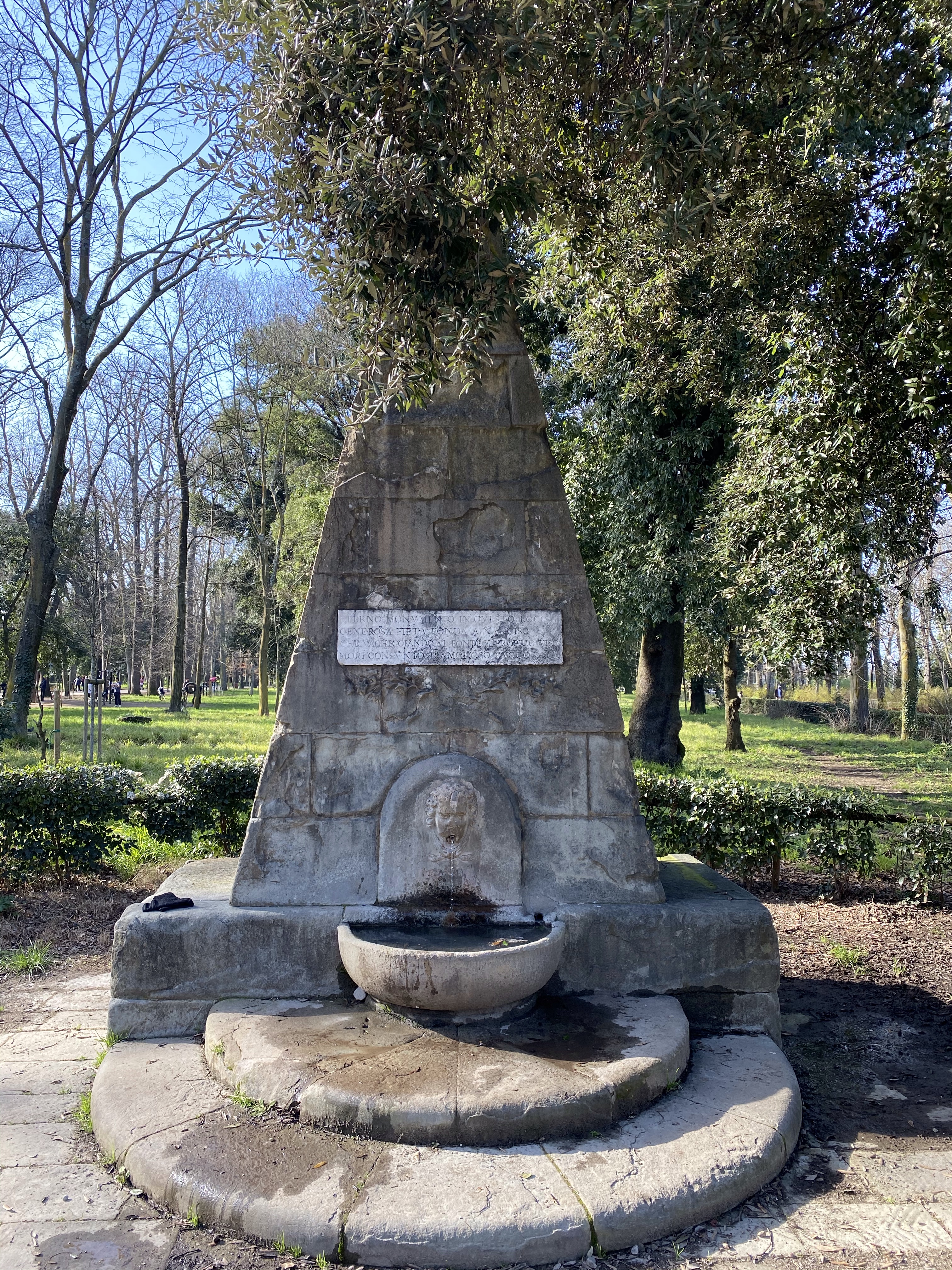
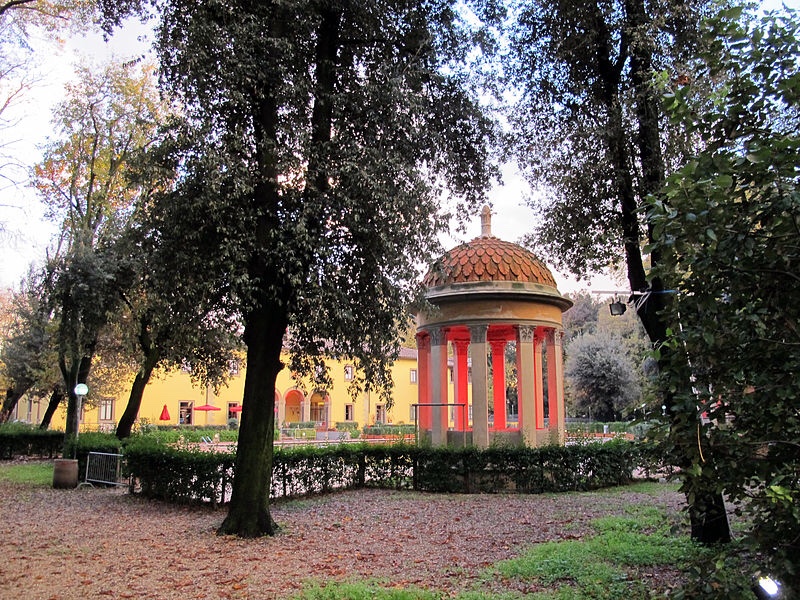
The Grand Duke Pietro Leopoldo commissioned from the architect Giuseppe Manetti, the design construction of a model farming estate, centered around the Palazzina Reale delle Cascine (small casino-palace now housing the Agronomy faculty of the University of Florence) in 1786. Other structures added were the Abbeveratoio del Quercione fountain, the pyramid-shaped ice-house, the amphitheatre and two neoclassical Pavoniere (originally ornamental peacock cages). Along a symbolic path a series of furnishings and architectural structures was positioned, among which is the royal Palazzina, the Quercione drinking trough, the Found of Boccacce, the pyramid which was used as an ice-house (nowadays it is used to store the gardeners’ tools) and two ‘pavoniere’, originally called ‘faganiere’, a type of Neoclassical temple made up of two bird cages, for peacocks.
Among the fountains was the Narcisus Fountain, from which the English poet Percy Bysshe Shelley is said to have drawn inspiration writing the Ode to the West Wind, in 1820. Giuseppe Manetti was also responsible for organizing celebrations and receptions in the park, such as the ceremony to celebrate the arrival of Ferdinand III of Tuscany, in July 1791.
In 1809-1811, the new Grand Duchess, Elisa Bonaparte, converted the farm into a public park. The park was acquired by the Municipality of Florence in 1869; architect Felice Francolini was hired to renovate the park. Sport clubs regularly competed in the Quercione meadow, including the Florence Football Club, Itala Foot Ball Club, Juventus Foot-Ball Club, Firenze FBC, Club Sportivo Firenze and PGF Libertas. However, in 1917 the municipality forbade any sport club to play football in the park.
The last relevant monument built in the Cascine Park was the Monumento all’Indiano, a monument by the English sculptor Fuller, in honor of the young Indian (Maratha) prince, His Highness Rajaram II, Maharaja of Kolhapur, who suddenly died while visiting Florence in 1865. In the latter 19th century, architect Giuseppe Poggi had the idea of the large square of access to the park now known as Piazzale Vittorio Veneto.
The amphitheatre was named in March 2015 after a well-known son of Florence, Ernesto de Pascale, music journalist and blues-rock musician who died 2011.
The beautiful green grounds of the Cascine include a number of meadows, sometimes edged by wooded areas, with the names of Tinaia, del Quercione, delle Cornacchie. Other smaller meadows are situated within gardens or squares. Wooded areas cover more than 35 hectares and there are about 19,000 trees in the park.
Centuries-old English oaks, elms, maples and ashes are slowly being replaced by spontaneous vegetation, represented by acacias, trees of heaven, elders, ivy, pines and nettle trees. A botanic arboretum is situated in the garden of the Scuola di Guerra Aerea (School of Air War).
The strength and luxuriance of plants show the rich soil and the presence of a ample good water reserve, right next to the Arno river bed. Long hedges, selected to resist to dryness and to shady positions, are present everywhere in the park (their overall length is about 30 km).
The central part of the park is characterised by a monumental complex, situated in Piazzale delle Cascine, dominated by the Palazzina Reale, and its bordering areas, including Piazzale Kennedy with its circular fountain.
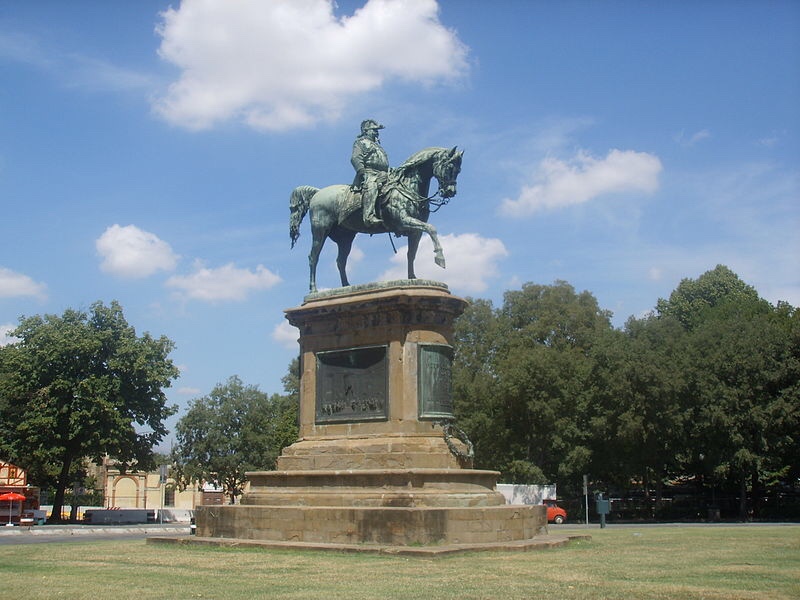
In the Piazza Vittorio Veneto, stands the Vittorio Emanuele II bronze equestrian statue which was formerly situated in the center of Florence in the Piazza della Repubblica. The statue was moved in this position in 1932. The square, along with the bordering Giardino della Catena, is decorated with impressive trees (pines, plane trees, Ginkgo Biloba, oaks, horse cheastnuts and cedars). This variety of species gives the park a lot of autumn color, typical of Italian style gardens.
The park hosts a number of civil and sport infrastructures, such as tennis and football fields, a velodrome, shooting and archery fields, two hippodromes, a public swimming pool, the School of Air War, a visiting centre, police offices, the Faculty of Agronomy and a public school.
Since 2010 the Line T1 of the tramway of Florence has a stop in the park, in Viale degli Olmi, which improves accessibility in the area for visitors arriving from the city center or from Scandicci.
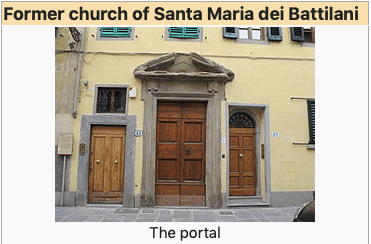
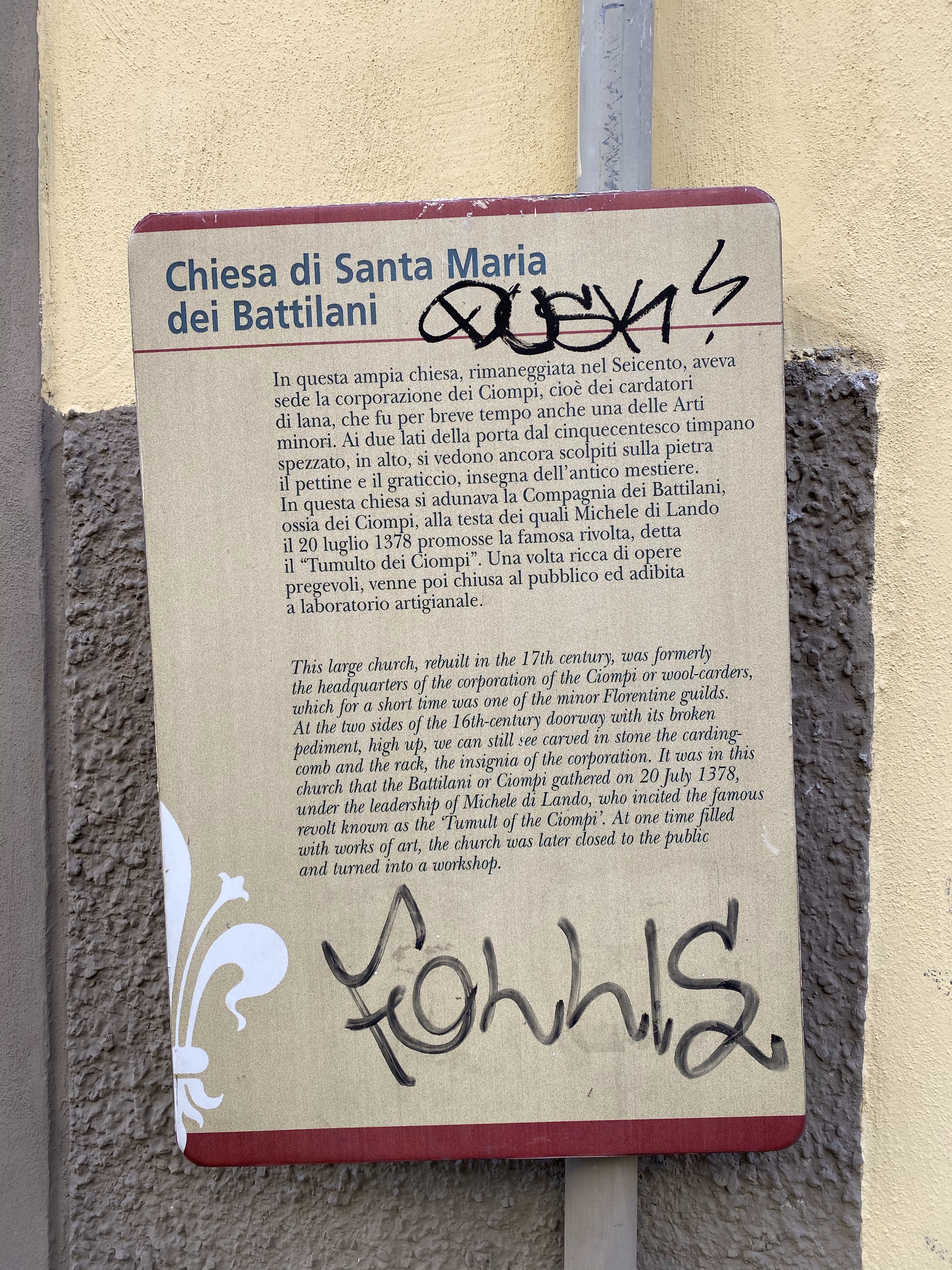
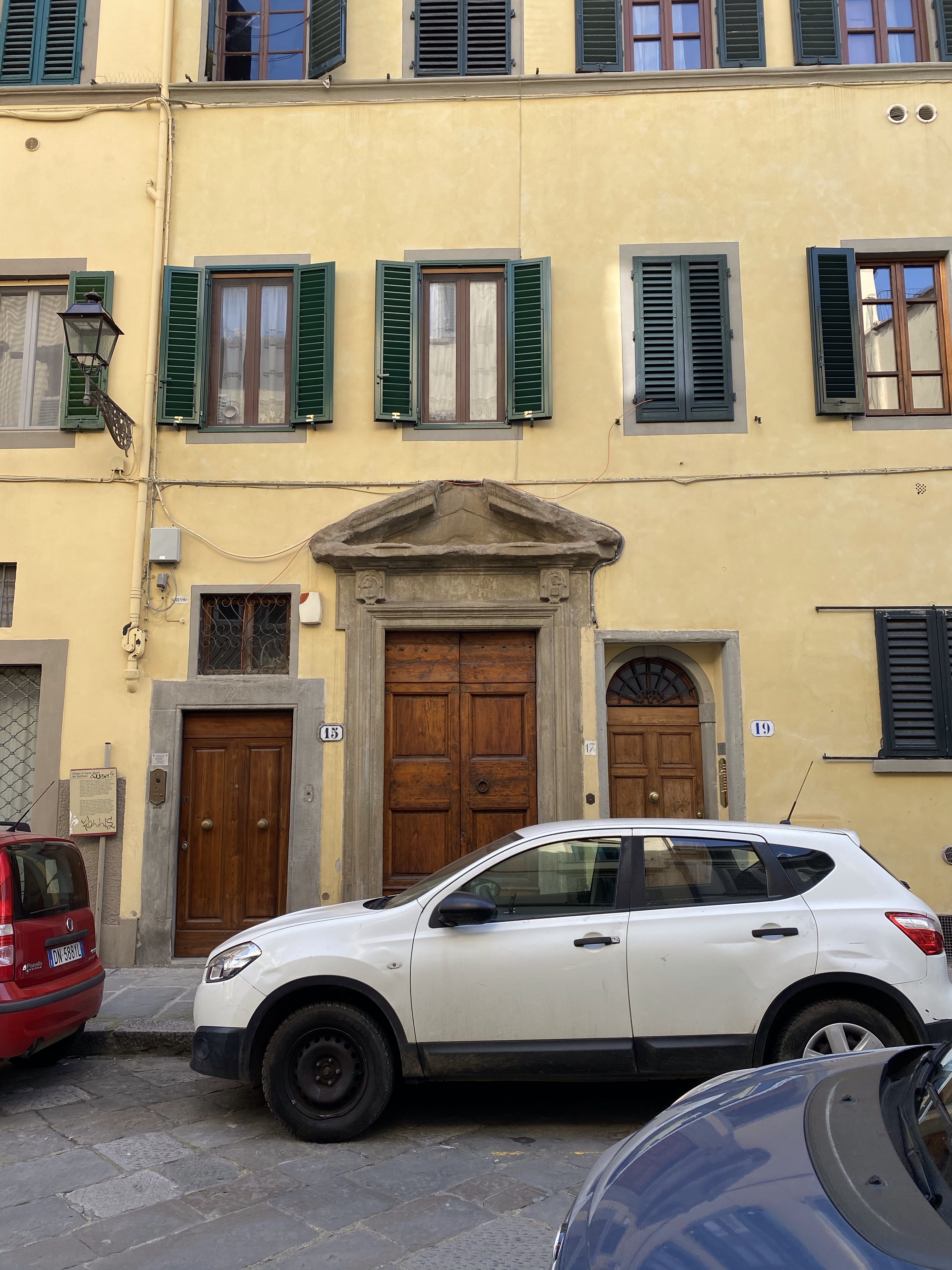
Almost every day I walk by this unassuming doorway on Via della Ruote, but I have never before stopped to read the sign beside it. I was shocked to learn that it marks the location of a large church and was the site where a major Florentine event, the Ciompi Conspiracy or Revolt, was fomented. It was the church of Santa Maria dei Battalani.
The Revolt of the Ciompi was a rebellion among unrepresented laborers which occurred in Florence, Italy from 1378 to 1382. Those who revolted consisted of artisans, laborers, and craftsmen who did not belong to any of the essential guilds that managed political life, and were therefore unable to participate in the Florentine government. These laborers grew increasingly resentful over the established patrician oligarchy. In addition, they were expected to pay heavy taxes which they could not afford, forcing some to abandon their homes. The resulting insurrection over such tensions led to the creation of a government composed of wool workers and other disenfranchised workers which lasted for three and a half years.
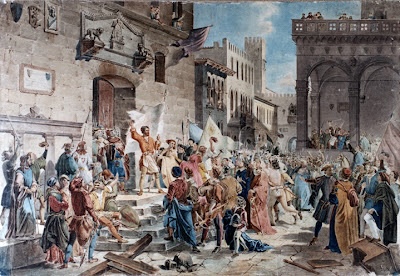
In June 1378 the city’s fourteen minor guilds demanded greater representation in civic office from elites – the Signoria. These guildsmen still wanted to keep the Sotto posti, who were low wage textile workers with no guild representation, from forming their own guilds and being able to gain increased political power. To prevent this, the Signoria quadrupled the fee for admittance to the system. This action sparked indignation and turned the Sotto posti into opponents of the Signoria aligning them with the lower class, the so-called Ciompi. In the summer of 1378, the Ciompi took up arms for the first time, and they violently took over the city’s government and forced the Signoria to create three new guilds and grant them political office.
Above, Il tumulto dei ciompi by Giuseppe Lorenzo Gatteri (1829-1844)
Although the Ciompi Rebellion was brief, it left an impact on future generations. The three and a half year revolt not only affected Florentine society throughout the 15th century, but was a flashpoint in Florentine history, which continued to intrigue historians.
As the sign by the doorway says, this church was the headquarters of the Ciompi, who were the wool carders in Florence’s Medieval urban life. And, also as the sign says, they formed one of Florence’s minor guilds-for a short time-3 years.
“It was in this church that the Battalani or Ciompi gathered on 20 July 1378, under the leadership of Michele di Lando, who incited the famous revolt known as the “Tumult of the Ciompi.” At one time filled with works of art, the church was later closed to the public and turned into a workshop.”
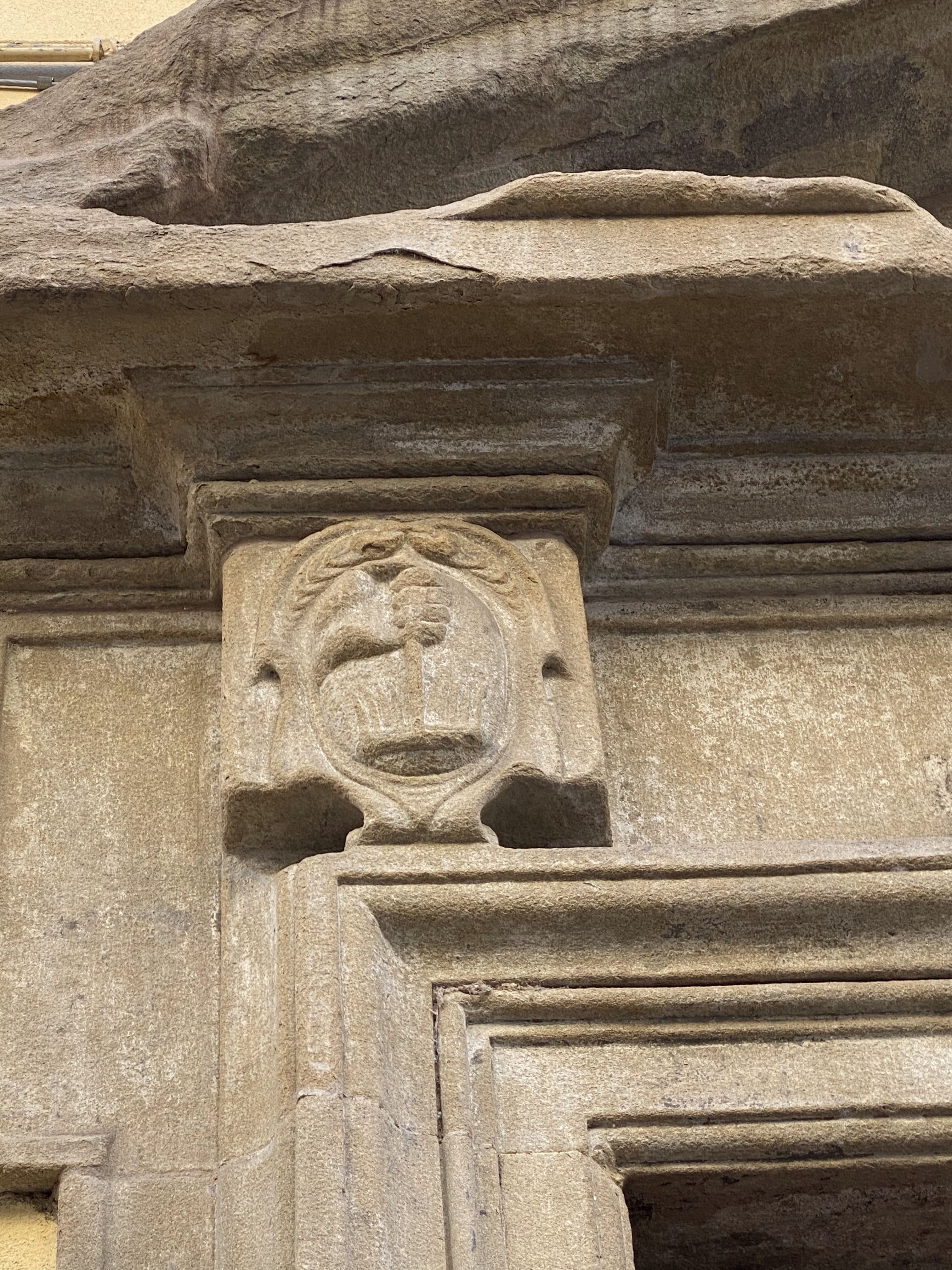
Also, as the sign explains, you can still see emblems of the wool carders on the doorway. Just below the broken pediment above the door, are 2 stone blocks, each carved with an image. One shows the carding comb and the other, the rack; these were the insignia of the guild.
Keep your eyes open in Florence and you will always be repaid with learning something new about something really old. Crazy as it seems, I have Covid restrictions to thank for allowing me the time and space to notice these interesting things in Florence.
Do you know the Judy Garland classic “A foggy day in London Town?” Well, here’s my riff.
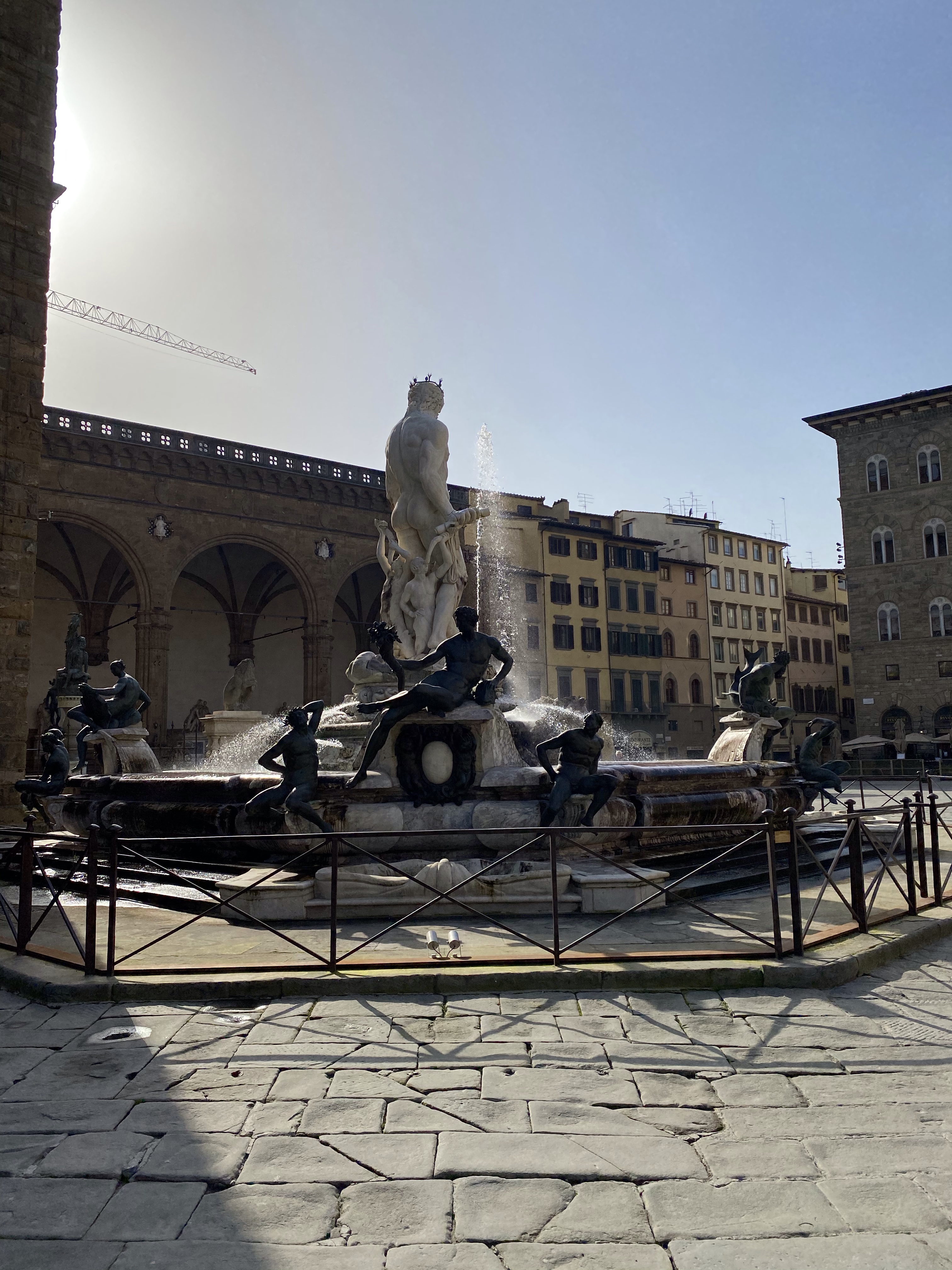
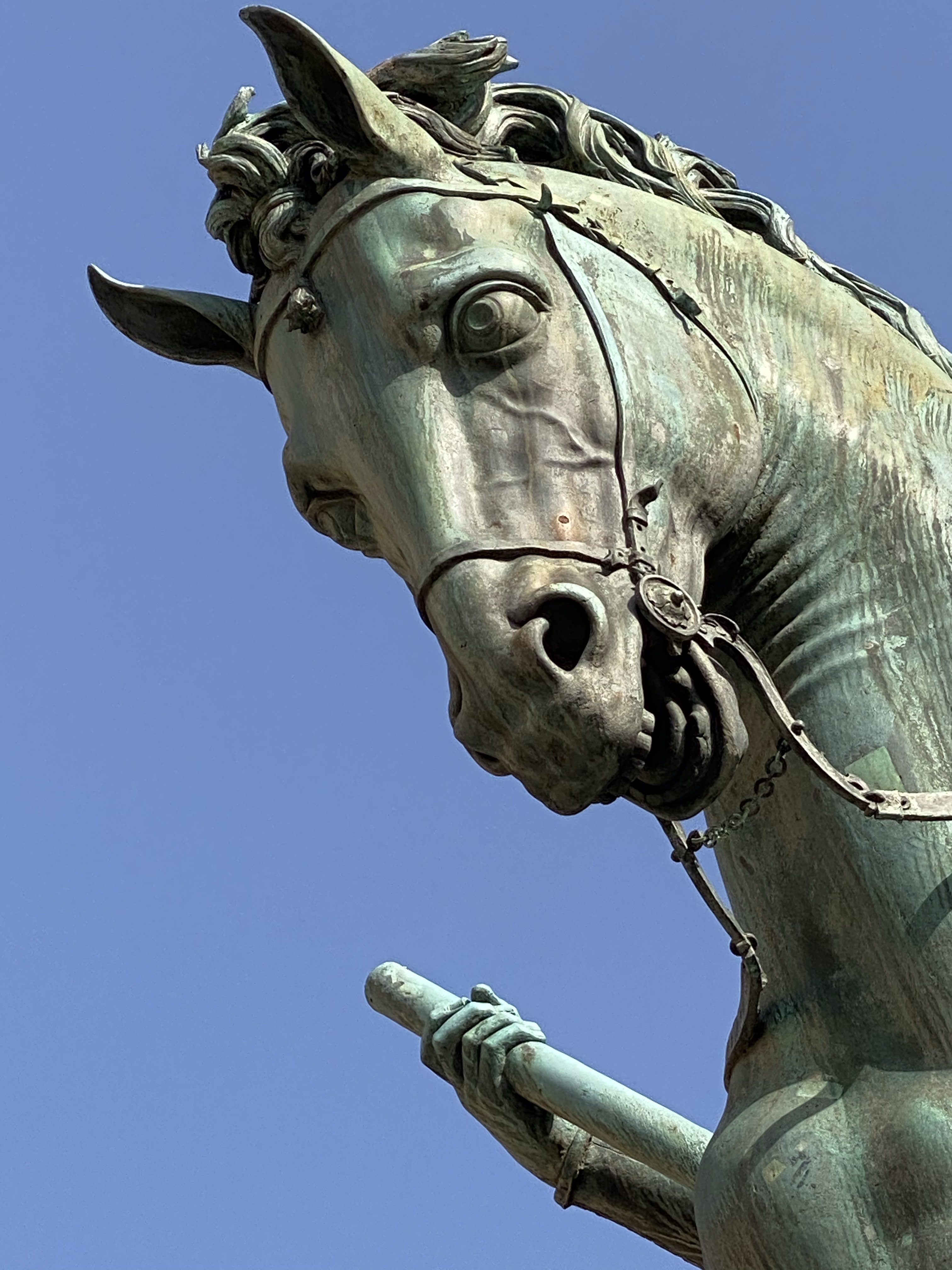
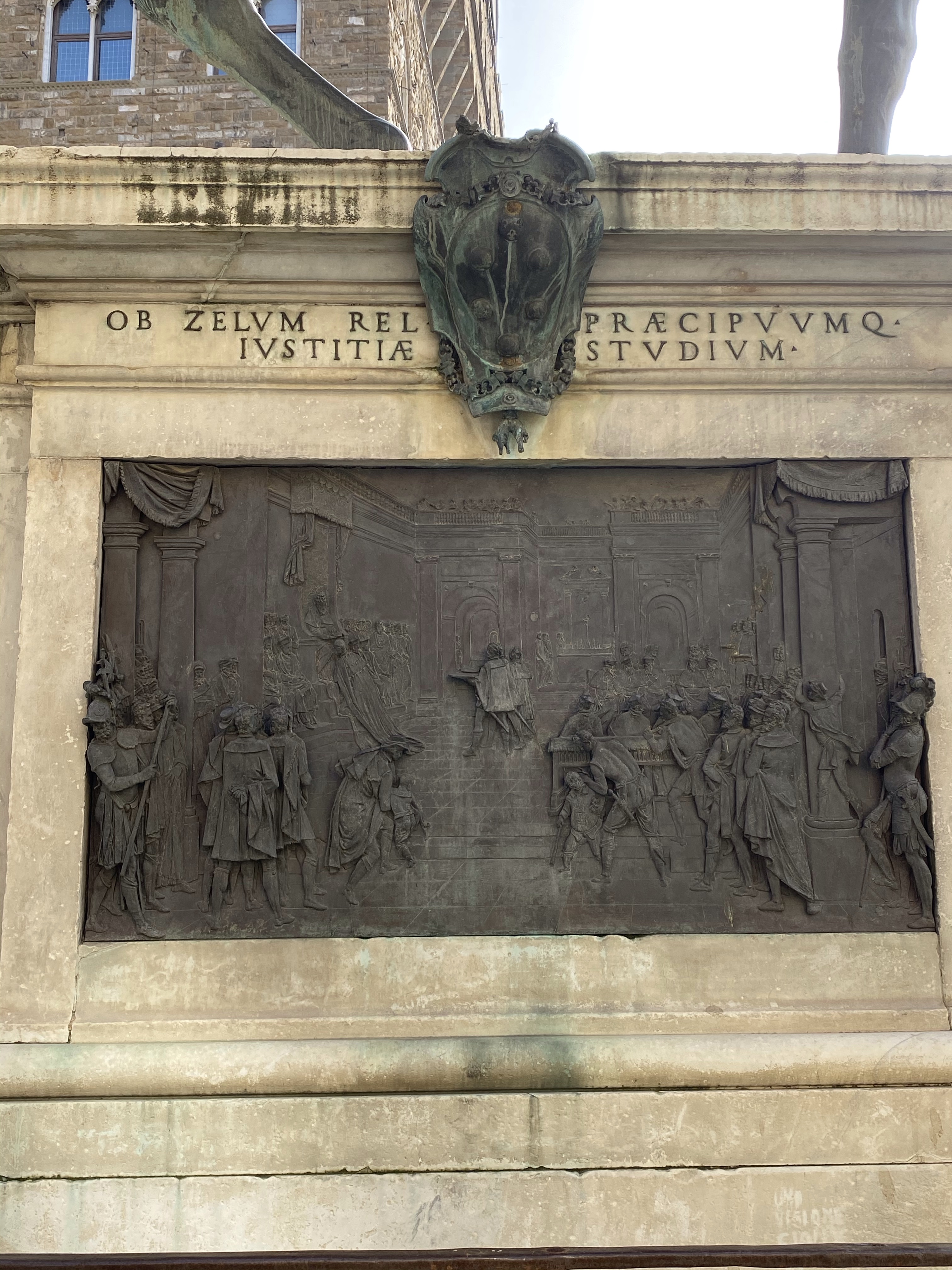
Florence weather has been astounding recently. Warm and sunny. Walking through the center makes me feel like taking pictures of major monuments all over again! These monuments are in Piazza Signora.









You must be logged in to post a comment.