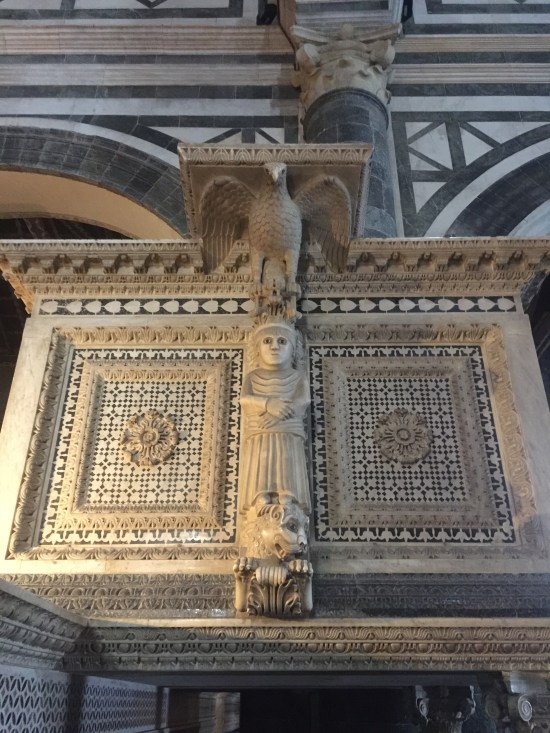
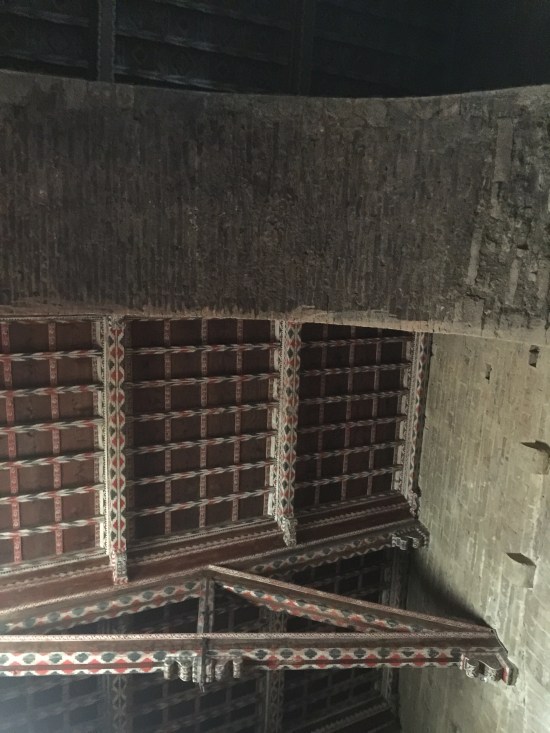
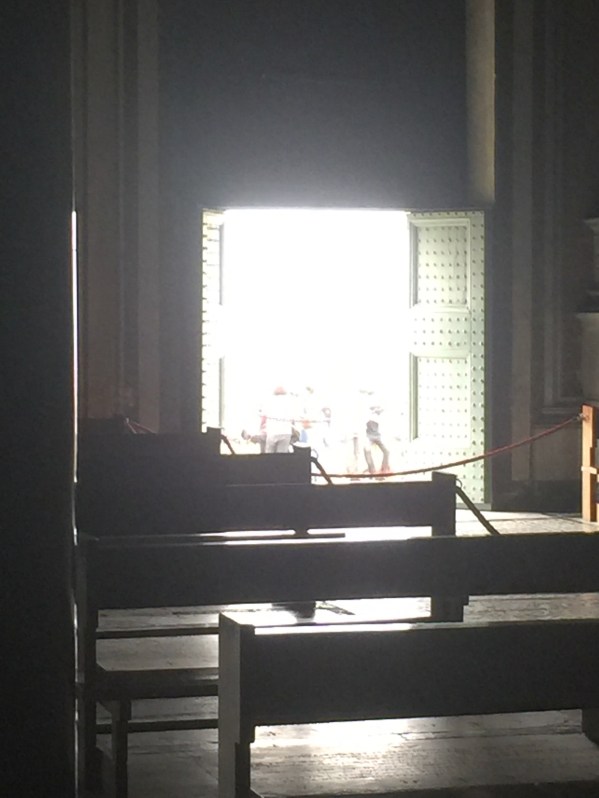
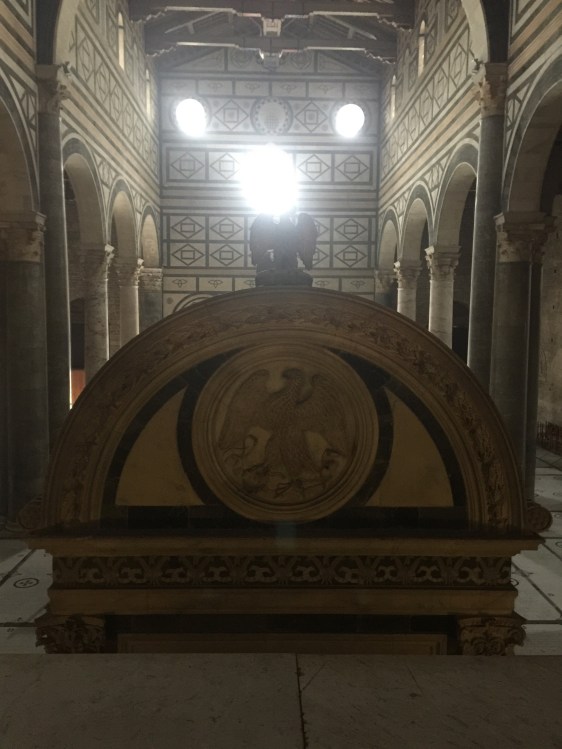
These few photos are from the interior of San Miniato.

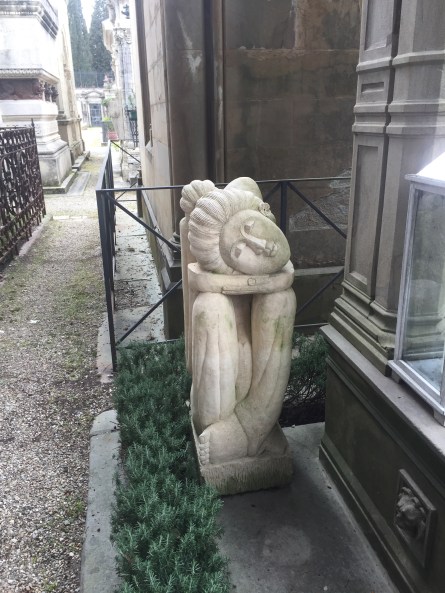
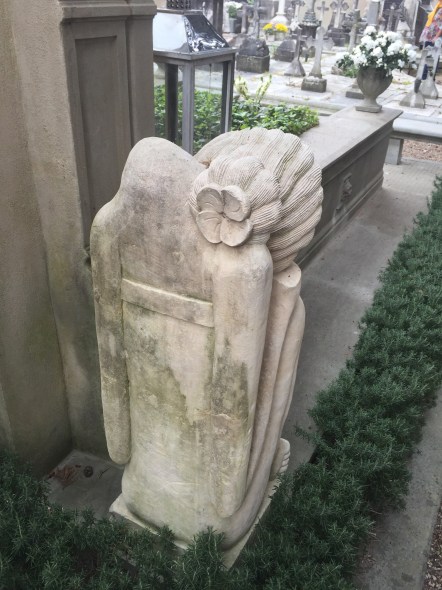
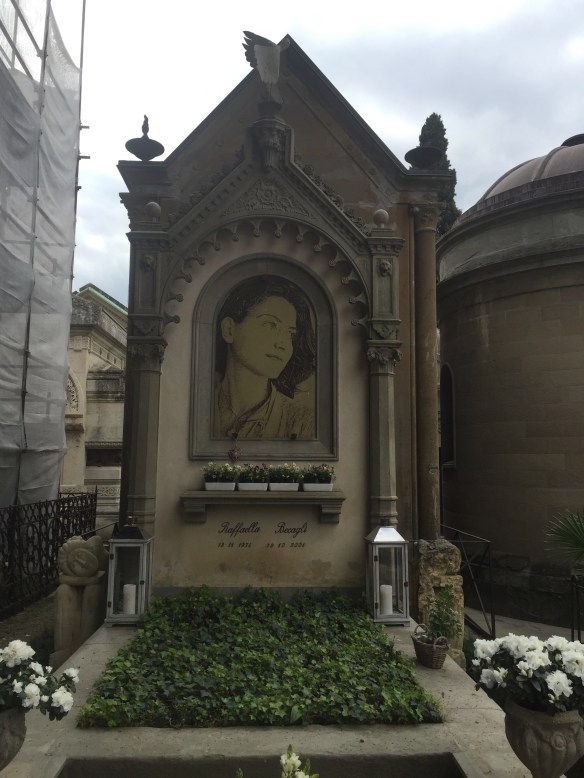
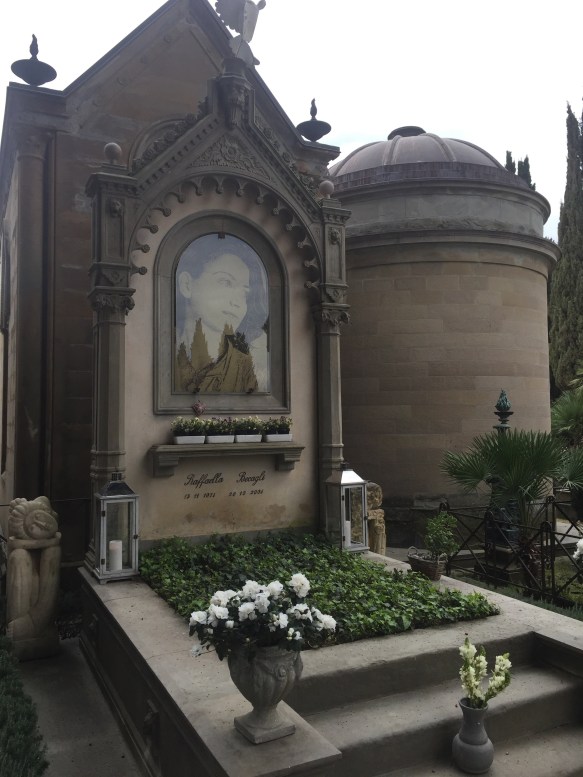
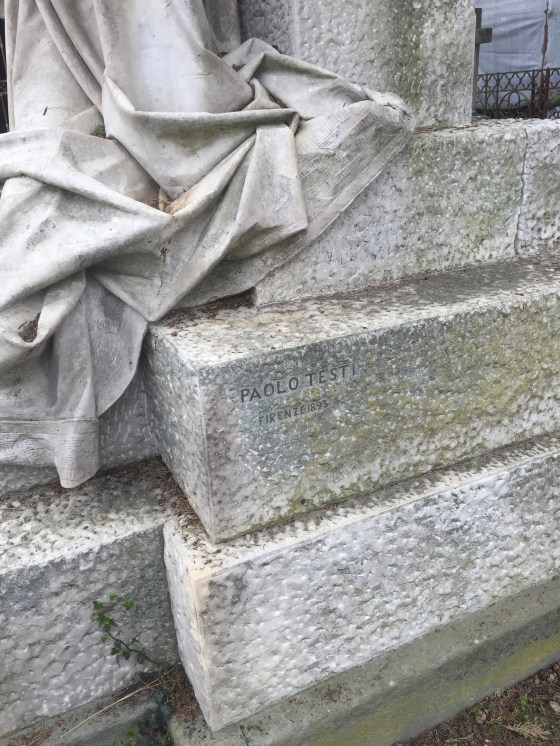
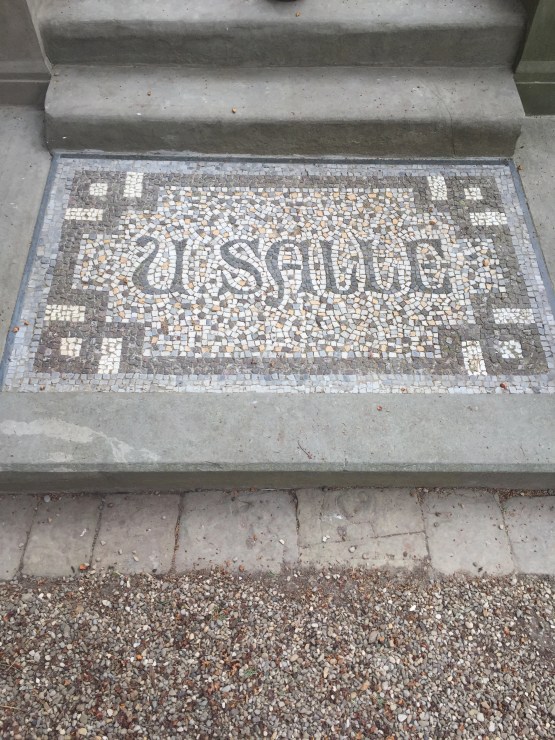
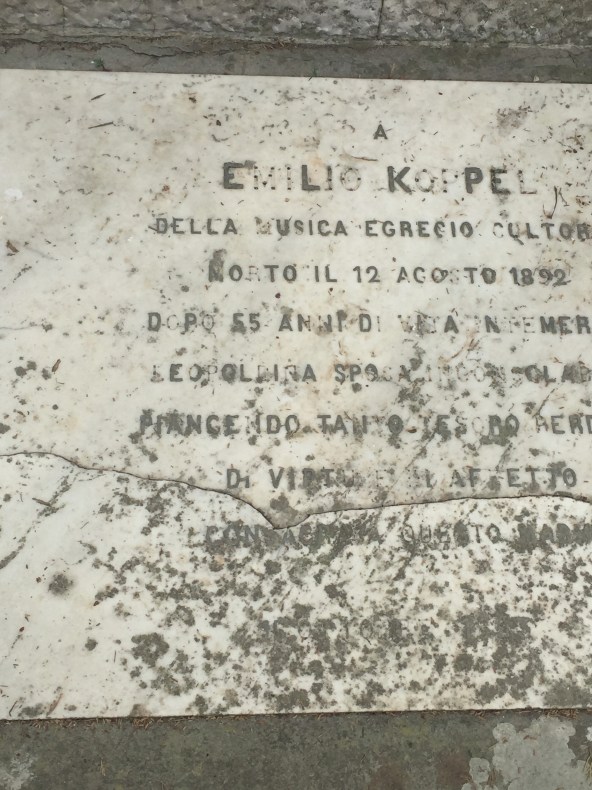
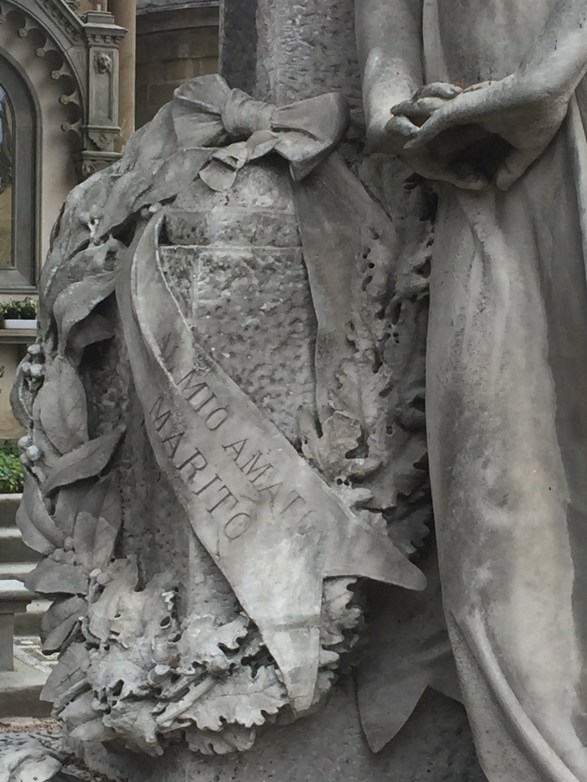
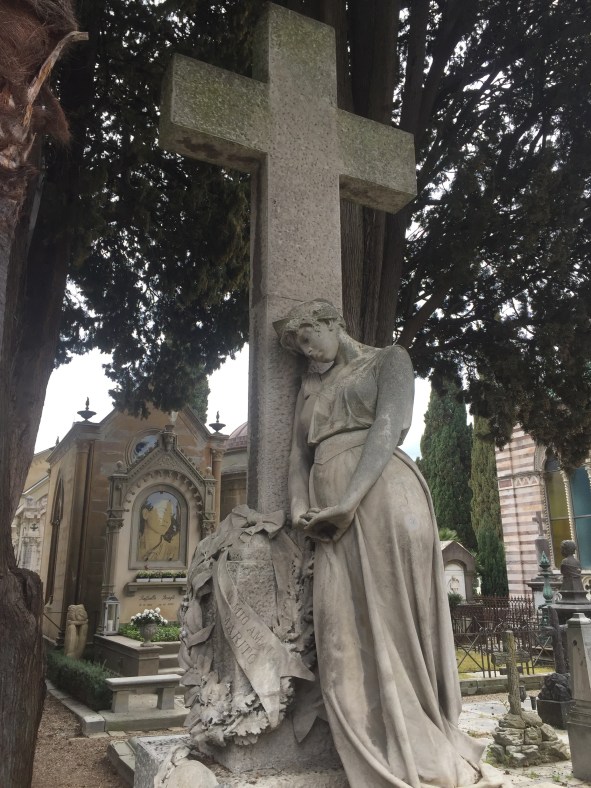
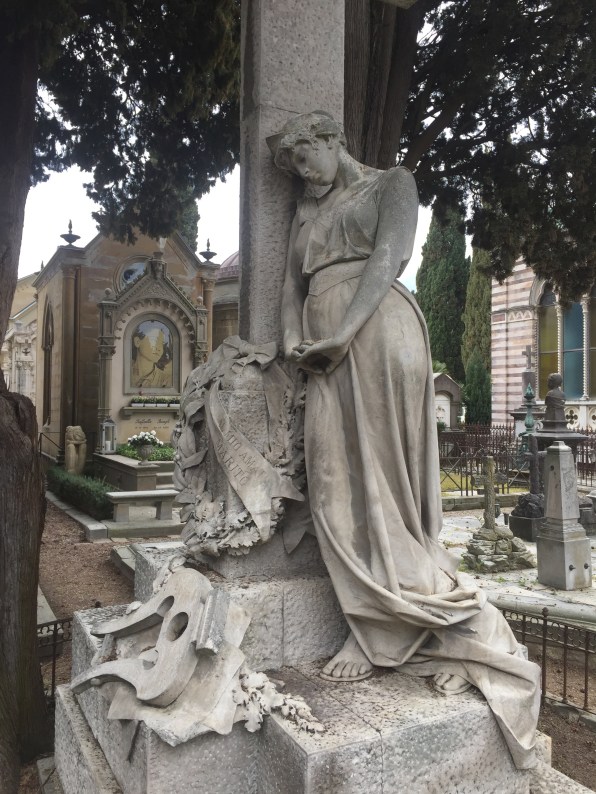
The following images are from the cemetery behind the church:

These few photos are from the interior of San Miniato.
The following images are from the cemetery behind the church:
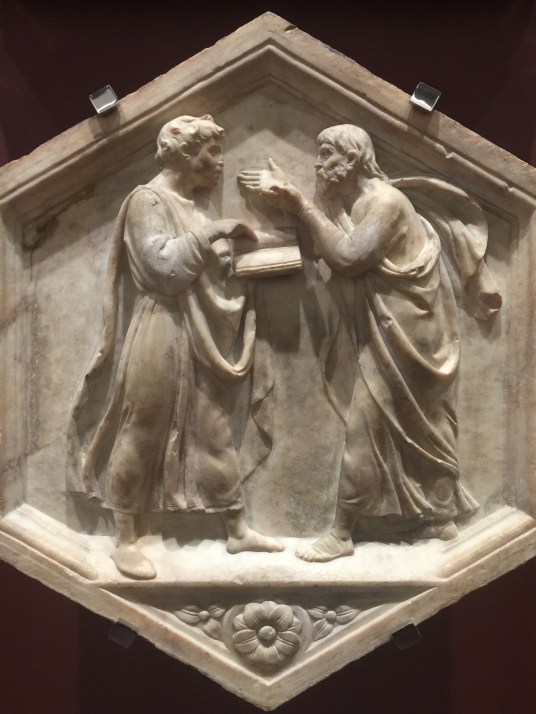
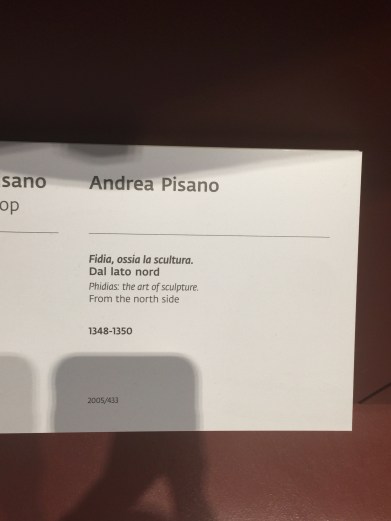
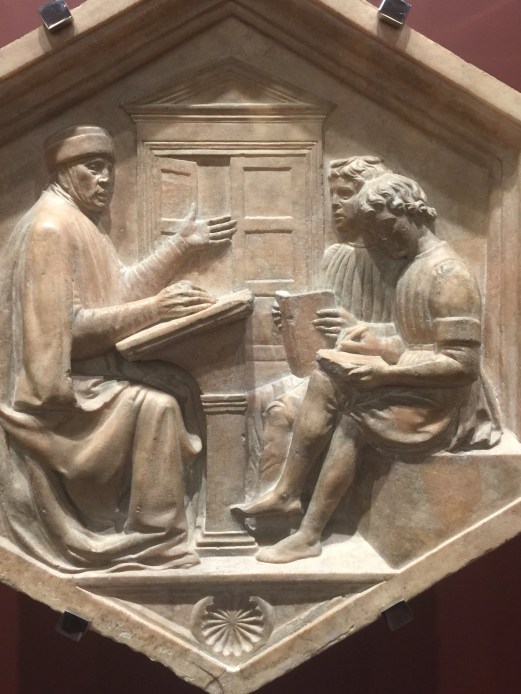
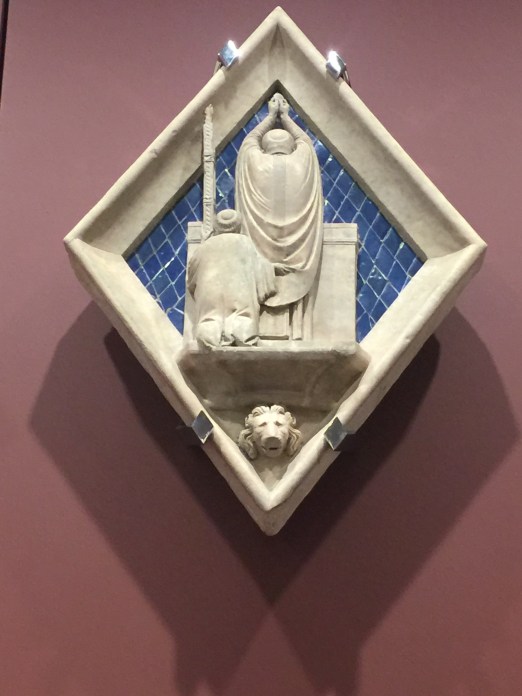
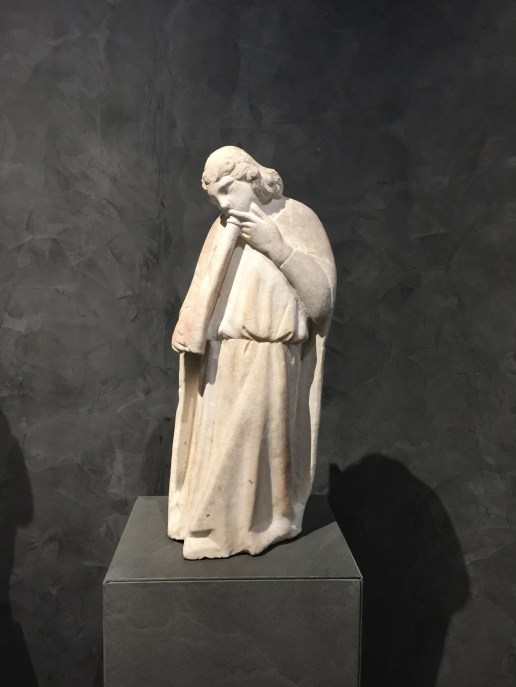
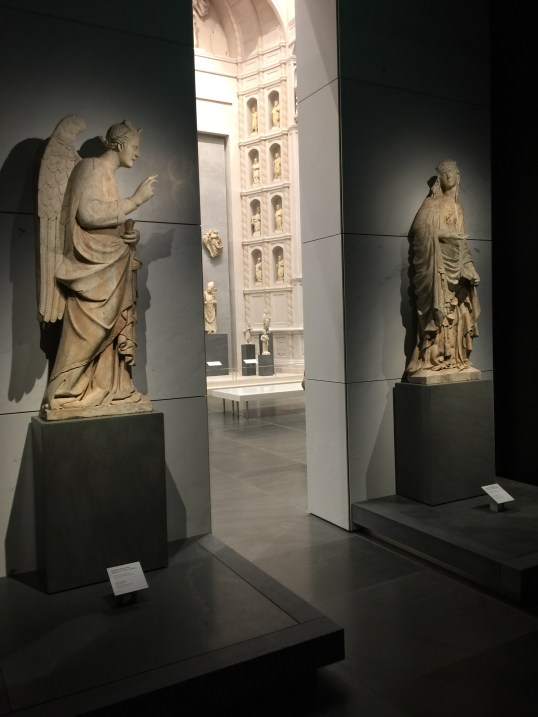
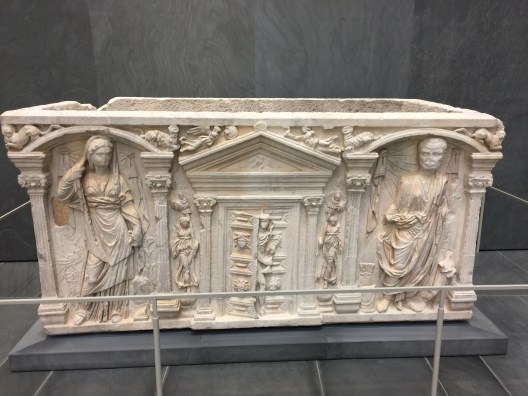
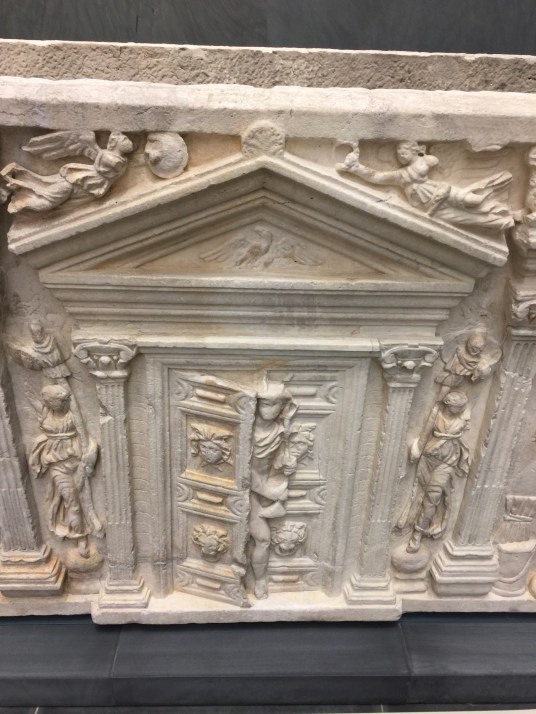
When I first started visiting Florence in the late 1970s, the museum connected to the duomo was housed in a very old, smallish palazzo behind the duomo. About 4 years ago, the museum reopened after extensive renovations and it is one of the best museum spaces I’ve ever seen. It is state of the art and a must-see for anyone who values Renaissance art.
These are just a few samples.






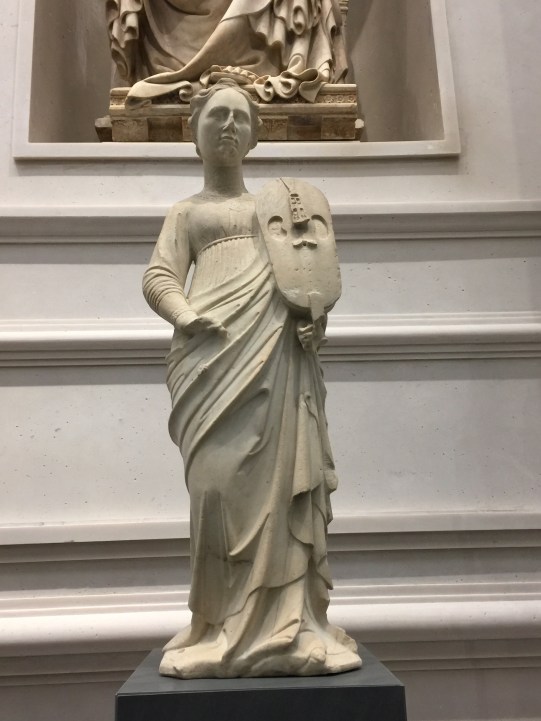

I walk by this glorious church in Florence at least weekly and, if it happens to be open, I always wander through the interior, without really knowing why. It draws me like a magnet, but I’ve never really taken the time to really register what it holds, until yesterday when I had time to really savor the interior.
To really understand the church I start, as I always do, by reading. I discovered that this site was once just outside the ancient walls of Florence and the home of an original Carolingian oratory. Imagine, this very central locale at the heart of contemporary Florence was once outside the city walls.
That building was superseded in 1092 by a slightly larger complex of the Benedictine order of the monks; this order was created by a Florentine nobleman, Giovanni Gualberto.
Sidebar: The Story of Giovanni Gualberto: One Good Friday Giovanni Gualberto left home with his gang of roughs, fully intending to avenge the recent murder of his brother. Upon finding the murderer, who pleaded for his life and, because it was the very day Jesus was crucified, Gualberto decided to spare him. Gualberto went up to San Miniato, where a crucifix was said to have bowed its head to him in honor of his mercy. Gualberto later became a Benedictine monk and founded the Vallombrosan order. He died in 1073. This story is the source of Edward Burne-Jones's early painting The Merciful Knight, which shows Christ
 kissing Gualberto. The Crucifix of Saint Giovanni Gualberto,
now kept in this church, is said to be the miraculous crucifix, but  it isn't that old - the story is around 200 years older than this    crucifix. A cult flourished in the late-14th and 15th centuries which ascribed to it miraculous powers).
When the Vallombrosan monks rebuilt the church, it was done in a simple Romanesque style that reflected the austerity of the order. By this time, new walls had been built (1172-75) to ring the growing city. Parish church status was granted to the church in 1178.
It was again rebuilt and expanded after 1250 in the Gothic style by Niccolò Pisano. Damage from the historic Florentine flood of 1333 resulted in more work on the church, possibly under the direction of Neri di Fioravante. This building period transformed the church into Gothic interior we see today. The inside is a large, dark space, even on bright days.
The understated and harmonious Mannerist façade of Santa Trinita was designed around 1593 by Bernardo Buontalenti, one of the main Mannerist artists in Tuscany, with sculpture by Giovanni Caccini. Buontalenti’s desire for a looming vertical effect led him to omit portions of the actual façade, leaving the odd bit to the sides.


Despite all the rebuildings, we are fortunate that we can still see a bit of the Romanesque medieval building. It is visible inside as you look at the “counter-facade” or back wall of the church’s original front.
A controversial ‘restoration to its original form’ in the 1890s led to the loss of many Mannerist elements, including a staircase in front of the high altar by Buontalenti of 1574 which is now in Santo Stefano al Ponte.
Sidebar: Buontalenti is said to have been inspired by shells and the wings of bats in designing this staircase. It was admired by Francesco Bocchi, writing in 1591, especially for it's bringing the clergy closer to the congregation. He also said that the church responds to the eye with considerable grace despite being planned at"a very uncouth time."
As stated above, the interior of the church is very much a 14th-century Gothic work, and is laid out in the form of an Egyptian cross. It is divided into three aisles separated by pilasters that rise up to gothic archways and a cross-vaulted ceiling.

During the restoration carried out following the 1966 flood the ’embellishments’ added in the early 1900s were stripped away, returning the frescos of the chapels to their original splendor.
The bas-relief over the central door of the Trinity was sculpted by Pietro Bernini and Giovanni Battista Caccini.
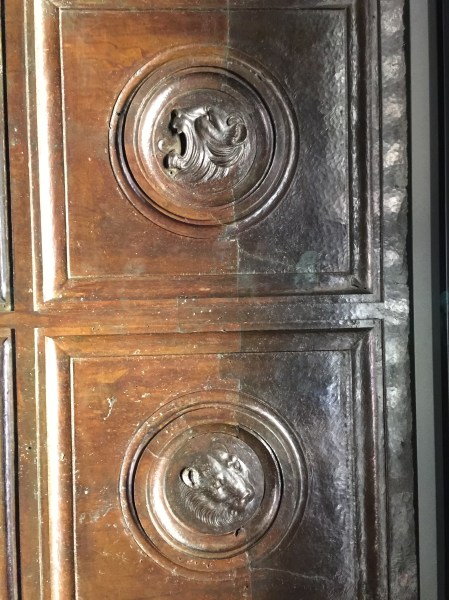
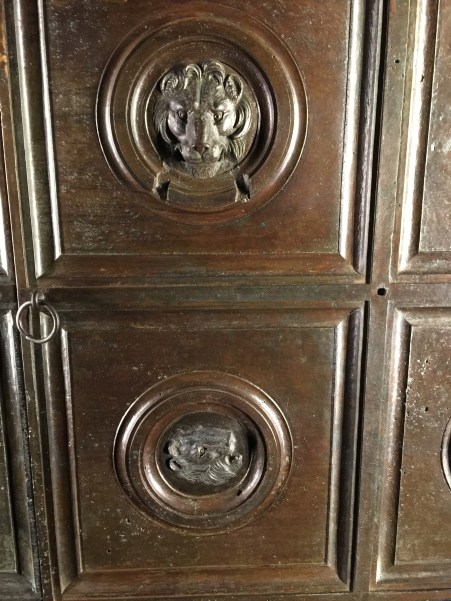
The 17th-century wooden doors have carved panels depicting Saints of the Vallumbrosan order.
The Column of Justice (Colonna di Giustizia) in the piazza, originates from the Baths of Caracalla in Rome, and was a gift to Cosimo I de’ Medici by Pope Pius IV. It was erected in 1565 to commemorate the Battle of Montemurlo in which Florence defeated Siena.

The Church of Santa Trinita belonged to the Strozzi family and later passed to the Medici family. The church was patronized over the centuries by many of Florence’s wealthiest families; as a result its many rebuildings allow it to serve as the text for a course on Italian art history.
Even though the Italian word for trinity is trinità, with an accent  indicating stress on the last vowel, the Florentine pronunciation    puts the stress on the first vowel, and the name is therefore writtenwithout an accent; sometimes, it is accented as trìnita to
indicate the unusual pronunciation.
In this post, I’ll only discuss the art works that seem most important to me. A full accounting of the chapels would need a book.
The sacristy:
The sacristy entrance is to the left of the side door in the right transept. The entrance doorway (by Lorenzo Ghiberti), can be opened on request by the attendant. Originally the sacristy was the Strozzi Chapel, and thus it contains the tomb of Onofrio Strozzi, commissioned by his son Palla, designed by Lorenzo Ghiberti and Filippo Brunelleschi.
On the altar used to stand the Adoration of the Magi by Gentile da Fabriano, now in the Uffizi Gallery and discussed below under the category of “lost works.” Onofrio Strozzi wanted a monument to commemorate Saint Onofrio and Saint Nicholas, which was made by Michelozzo.

Speaking of the Strozzi family, we should keep in mind that Palla Strozzi was banished after the revolt in 1434 against Cosimo il Vecchio. Palla was among the 500 who were banished and he died in Padua. Onofrio Strozzi’s tomb is decorated with flowers painted by Gentile da Fabriano.
To enter the sacristy, to the right, is to step back in time. Alhough Abbot Baldini had the entire church whitewashed “to display his love for it” in 1685, a number of early 14th-century frescoes survived, and were moved here during the restoration following the 1966 flood, including a Noli me Tangere (Jesus saying “Don’t hinder me” to the Magdalen as he leaves the tomb, generally mistranslated as “Don’t touch me”) by Puccio Capanna and a Crucifixion clearly based upon Giotto’s. The chapel also houses also a Pietà by Barbieri.
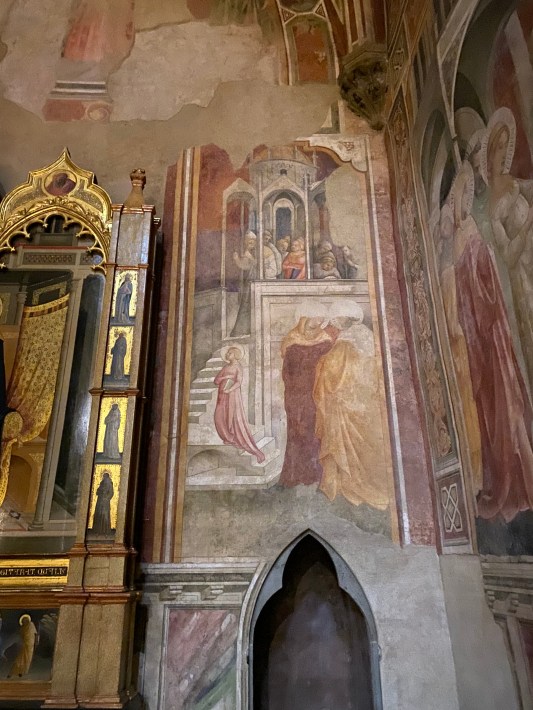
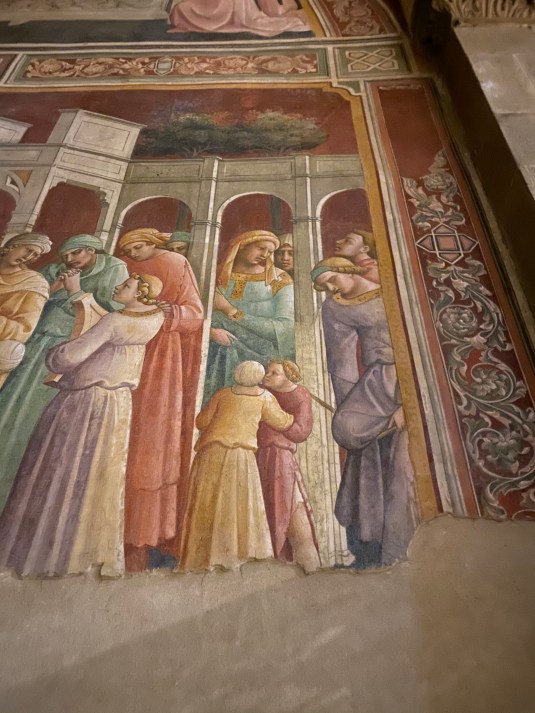
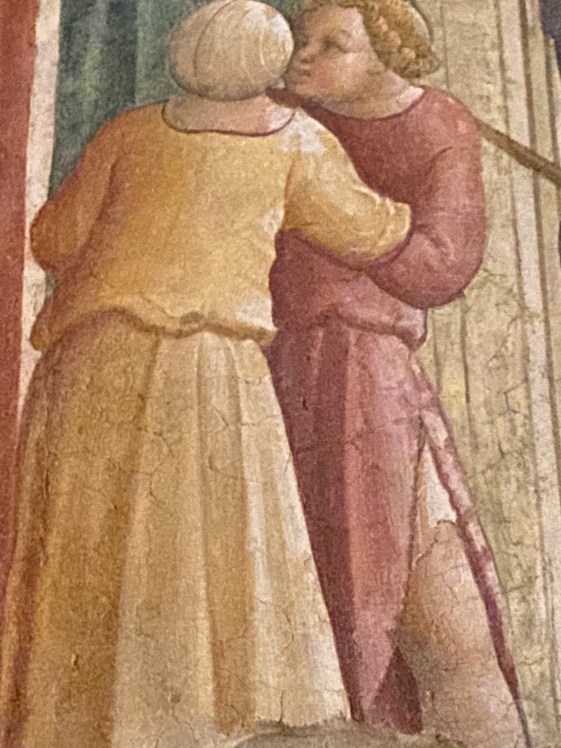
The Bartolini Salimbeni Chapel, with frescoes of The Life of the Virgin by Lorenzo Monaco, painted between 1420-25. These are his only known work in fresco and therefore very special. I love looking at the people on the right wall and the architecture on the left. The frescoes are one of the few surviving examples of International Gothic style frescoes in Italy.
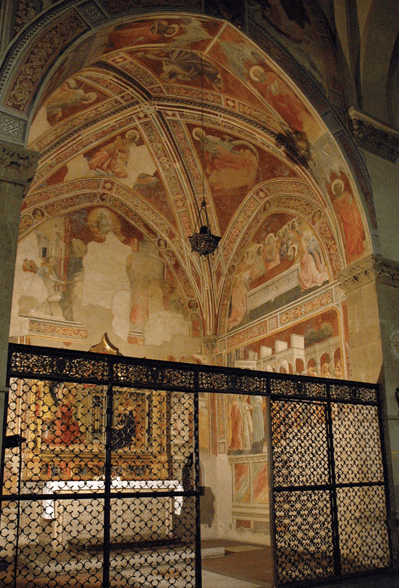
The frescoes were commissioned by the Bartolini family. They covered the earlier fresco cycle by Spinello Aretino believed to have been commissioned by Bartolomeo Salimbeni in 1390.
The chapel, created during the Gothic renovation and enlargement of the church in the mid-13th century, was owned by the rich merchant family of the Bartolini-Salimbeni from at least 1363. Their residence, the Palazzo Bartolini Salimbeni, was located in the same square of the church.
Lorenzo Monaco’s frescoes date to 1420s, when a re-decoration program was carried on in the whole church, as testified also by fragments of Giovanni Toscani’s frescoes in the annexed Ardinghelli Chapel.

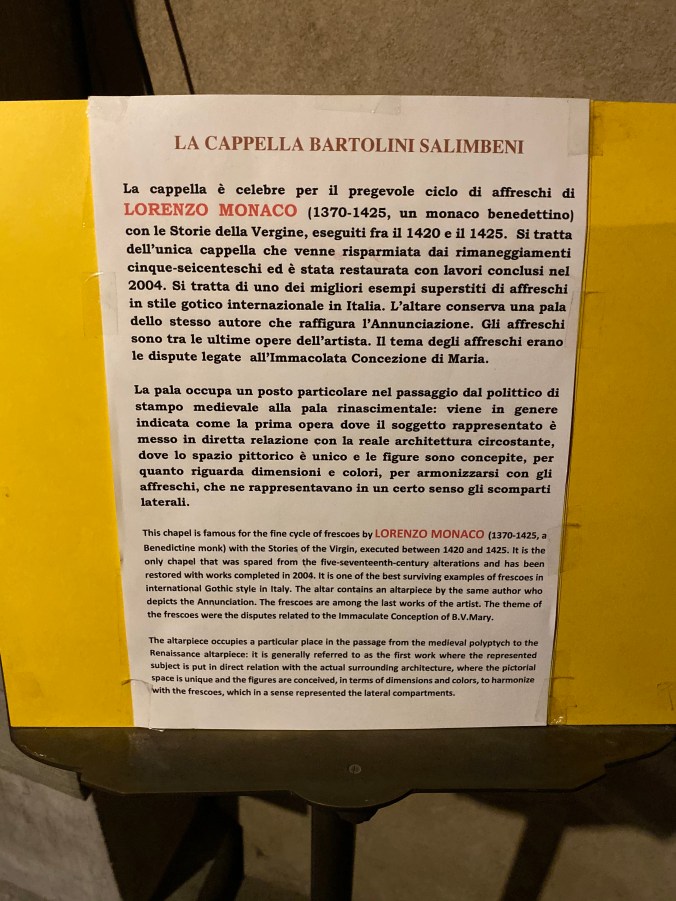
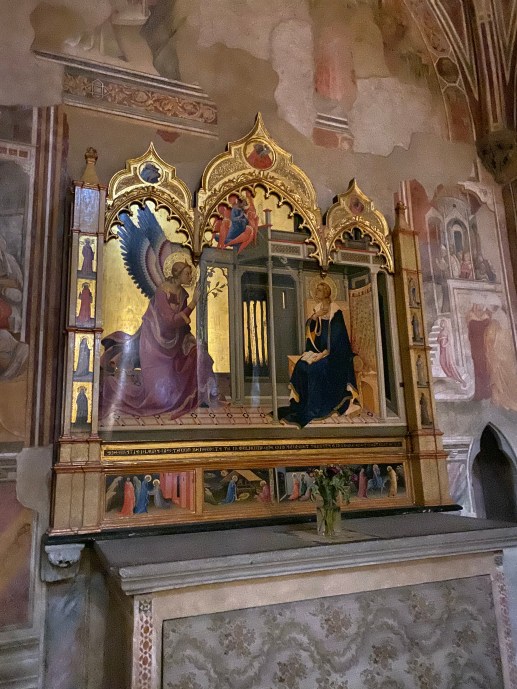
The Annunciation altarpiece is also by Lorenzo Monaco. This beautiful painting on wood is signed by the artist. He did great work at the convent of Santa Maria degli Angeli, but it is in this chapel where you can see his best work in an original context. The floor features poppies, the family emblem, and Per non dormire, their motto, which translates as ‘For those who don’t sleep.’
The frescoes, fragments of which are now lost, occupy the chapel’s walls, vault, arch and lunette. Lorenzo Monaco was mostly a miniaturist, and his (or his assistants’, since he was aged at the time and perhaps at his death in 1424 the work was unfinished) lack of confidence with the fresco technique is possibly shown by the presence of figures completed in different days, or the use of dry painting in some places.
Lorenzo Monaco’s was inspired by numerous contemporary examples of “Histories of the Virgin” cycles, such as the Baroncelli Chapel by Taddeo Gaddi; the Rinuccini Chapel by Giovanni da Milano and others; in the church of Santa Croce; Orcagna’s frescoes in Santa Maria Novella, the Holy Cingulum Chapel by Agnolo Gaddi in the Cathedral of Prato and the stained glasses of Orsanmichele, with which perhaps Lorenzo Monaco had collaborated.
The theme of the frescoes are connected to the contemporary dispute about the “Immaculate Conception of Mary;” i.e. the question of if she had been born without original sin. This was a major philosophical argument at the time and found the Franciscans and the Benedictines (including the Vallumbrosan Order holding the church at the time) against the Dominicans. Lorenzo Monaco’s frescoes were inspired by the apocryphal Gospel of James, dealing with Mary’s infancy and supporting the Vallumbrosan’s view that she had been not naturally born by her father.
The images in the chapel all depict scenes from the life of the Virgin Mary that specifically support the belief that Mary was not born by a human father, but immaculately. Instead of delving into doctrine, just know that at this time a feud was raging between the Dominican and Franciscan orders, and Mary’s Immaculate Conception was just one point of contention. The Vallumbrosians were Team Franciscan and Team Immaculate Conception. The chapel was thus supportive to the Franciscan brothers and unsupportive to the point of view of the Dominicans.
The cycle begins in the lunette on the left wall, portraying the Espulsion of Joachim from the Temple and the Annunciation to Joachim. Below are the Meeting of Joachim and Anne at the Golden Gate, set in a fancifully imagined Jerusalem with high tower, belfries and other edifices painted in pink.
The water of a stream where several youths are drinking is a symbol of Mary as the source of life, while the sea is a hint to her attribute as Stella Maris (“Star of the Sea”) and the islet a symbol of virginity. The stories continue in the middle part of the end wall, with the Nativity of the Virgin, following the same scheme of Pietro Lorenzetti’s Nativity of the Virgin, with Jesus bathing, and the Presentation of the Virgin at the Temple. The latter scene contains several numerology hints in the steps (three and seven, the number of the Theologic Virtues and all the Virtues respectively) and in the arches of Solomon’s Temple (three like the Holy Trinity).
The scene on the mid-left wall, perhaps the sole executed by Lorenzo Monaco alone, depicts the Marriage of the Virgin. The rejected suitors walk from the right to left; one of them (that in the background, behind the arcade) is a possible self-portrait of Lorenzo Monaco, although his age does not correspond to the artist’s one at the time. The next scene is that of the Annunciation, whose predella has scenes of the Visitation, Nativity and Annunciation to the Shepherds, Adoration of the Magi and the Flight into Egypt.
The next episodes in the frescoes include some miracles connected to Mary: the Dormitio, the Assumption, and the Miracle of the Snow. In the cross vault are portrayals of Prophets David, Isaiah, Malachi and Micah.
The frescoes were covered with white plaster in 1740, and were only rediscovered in 1885-1887 by Augusto Burchi. In 1944, the German invasion forces blew up the nearby Ponte Santa Trinita, causing damages also to the frescoes. They were restored in 1961 and again in 2004.
Above all, this chapel is interesting because Lorenzo mixes styles with a surprisingly result. The Annunciation at the altar is done in the High Gothic style, with stylized figures rather convincingly rendered, set against an equally stylized background. The frescoes on the walls, however, reveal that Lorenzo was well aware of the new developments in painting introduced by Masaccio: he displays a firm grasp of the newly emerging Renaissance style, painting natural looking people who are solidly anchored to their backgrounds.
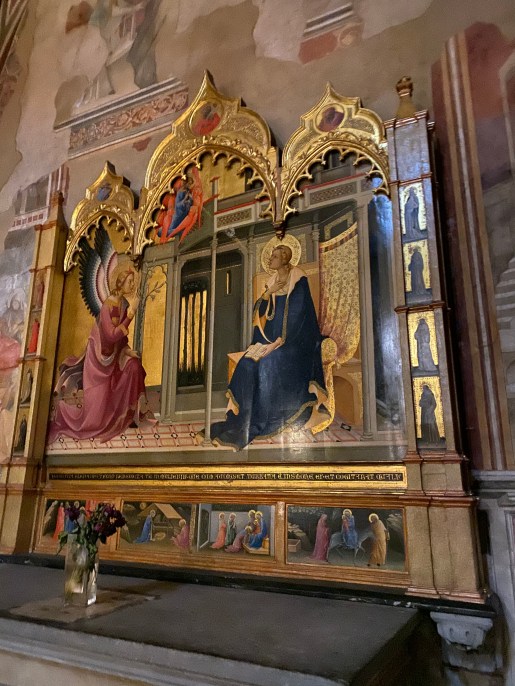

The Compagni Family Chapel, was dedicated to Saint John Gualberto. We will remember that John Gualberto was the Florentine who founded the Vallumbrosan order, for whom this church served. The chapel’s walls were once frescoed with scenes from the life of this saint. The remaining scenes are high up on the outer arches and show The Murder of St. John Gualberto’s Brother and St. John Gualberto Forgiving the Assassin. Some sources say they are by Neri di Bicci and his father, Bicci di Lorenzo, but they have recently been attributed to Bonaiuto di Giovanni, an associate of Bicci di Lorenzo.
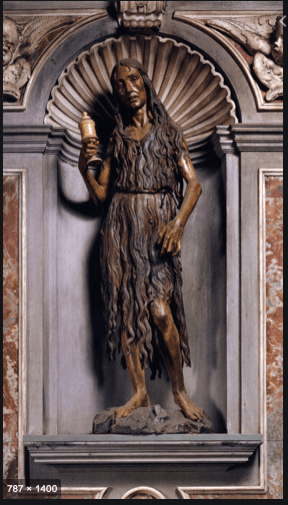
The Spini Chapel is notable for the wooden statue of the Penitent Magdalene, dressed in hair cloth, begun by Desiderio da Settignano and finished by Benedetto da Maiano, in about 1464. It is almost impossible not to compare this work with Donatello’s Mary Magdalene in the Opera del Duomo in Florence. Most likely, Desiderio was inspired by the master.
The Saint John Gualberto Chapel commemorates the founder of the Vallombrosan Order whose relics are preserved here. It was built as a gift to the church by the monks, and it was designed and created to look like a real yet small casket. Frescoes were painted by Passignano at the end of the 1500s.
The Scali Chapel houses a monument to Berozzo Federighi by Luca della Robbia. Federighi was the Bishop of Fiesole who died in 1450; the monument was created by Luca della Robbia in 1454. The monument’s frame is made of majolica using the opus sectile technique: every oval is made of small tiles that create a mosaic (it’s one of the first examples of the use of majolica for funerary monuments).
The monument was moved here from the deconsecrated church of San Pancrazio in 1896.

The Sassetti Chapel is the most famous part of the entire church, filled with a gorgeous cycle of frescoes by Domenico Ghirlandaio’s, depicting scenes from the Life of St Francis.
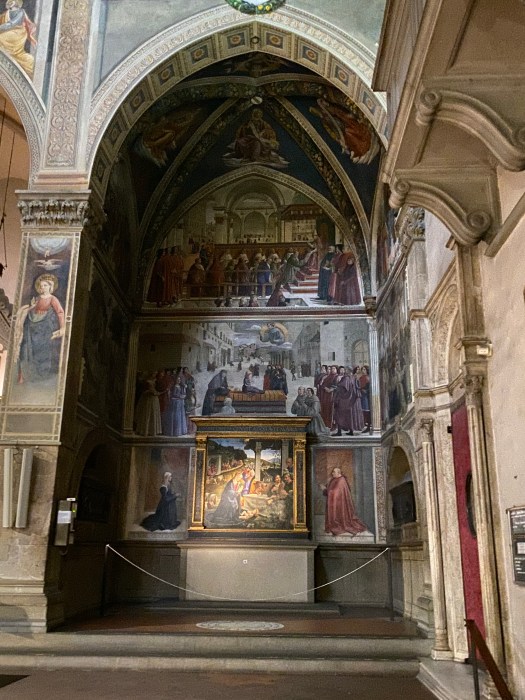
The Sassetti Chapel is the crown jewel of Santa Trinità and often considered to be Domenico Ghirlandaio’s capolavoro.
Aside from its beauty, the chapel tells us so much about life in Renaissance Florence. Francesco Sassetti, a banker for the Medici, obviously had a lot of money. Like any wealthy family of the time, he used his wealth to acquire and decorate a family chapel around the year 1483.
Initially he planned to build his chapel in Santa Maria Novella, but the Dominicans turned him down when they discovered that Sassetti planned to include scenes from the life of the Dominican’s nemesis, St. Francis, decorating the walls. The Vallumbrosians of Santa Trinita, on the other hand, gladly welcomed Sassetti’s petition, thrilled to have the hand of the most prominent artist in Florence at the time, Dominicao Ghirlandaio, decorating their church.
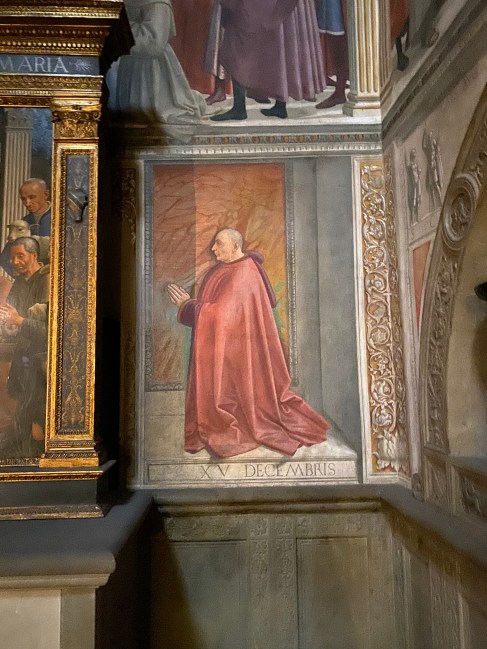
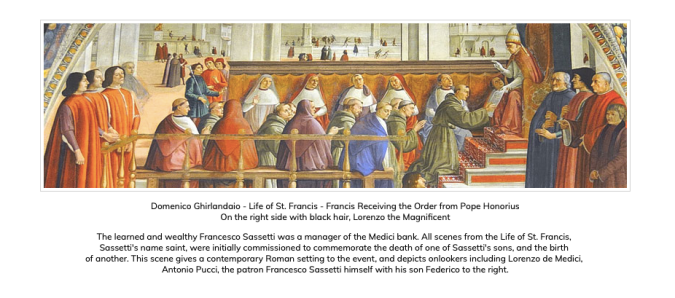
The chapel’s primary function is the burial place for Francesco and his wife Nora Orsi (the two are seen kneeling on either side of the altarpiece). The chapel also became a sort of family photo album as all of the Sassetti children are depicted in the frescoes. Additionally, the chapel served as a humanist who’s who, as it features images of Lorenzo de’ Medici, Poliziano, Costanzo, and even Ghirlandaio himself.
Ghirlandaio also used the chapel to reinforce the emerging Renaissance trend that Florence was the new Rome. He depicts events we know occurred in Rome and sets them in Florence, and in almost every scene we spy notable Florentine landmarks, such as the Duomo and the Palazzo Vecchio.
The Sassetti chapel alone makes a visit to Santa Trinita more than worthwhile and is a celebration of both Saint Francis and of Renaissance art Florence in general. This cycle of frescoes is a high-water mark for painting in 15th century Florence.
In the center is an altarpiece depicting The Adoration by the Shepherds. It dates to 1585 and is signed by Ghirlandaio, as are all of the frescoes in the chapel. This altarpiece is often cited as the work most obviously inspired by the Portinari Altarpiece, especially the shepherds. Ghirlandaio depicted himself as the shepherd pointing to the Baby and the carved garland (ghirlanda) on a sarcophagus. The unusual presence of this antique sarcophagus in a nativity has been explained as it’s thereby making a group of three with the actual tombs of the donors flanking the altarpiece in the side walls.
The altarpiece is quite important, not the least because Ghirlandaio included classical elements, such as the sarcophagus manger and the Corinthian columns holding up the roof of the shack (one is dated 1485), and based the poses of the shepherds on those of the Flemish master Van der Goes’s triptych (now in the Uffizi). This reveals the presence of the newly awakened interest in the Classical world that was one of the characteristics of the High Renaissance, and also get an idea of the impact the Flemish style had upon the great masters.
It’s always so interesting to me to see the clothing; through it, we get to view the way Florentines dressed at the time.
In another scene, we can see contemporary Florence: you can make out Piazza Signoria and the Loggia dei Lanzi. There are no statues in the loggia, however, for those were added later. In this scene Lorenzo il Magnifico and his sons, Piero, Giovanni, and Giuliano climb the steps with their tutors, led by humanist scholar Agnolo Poliziano.
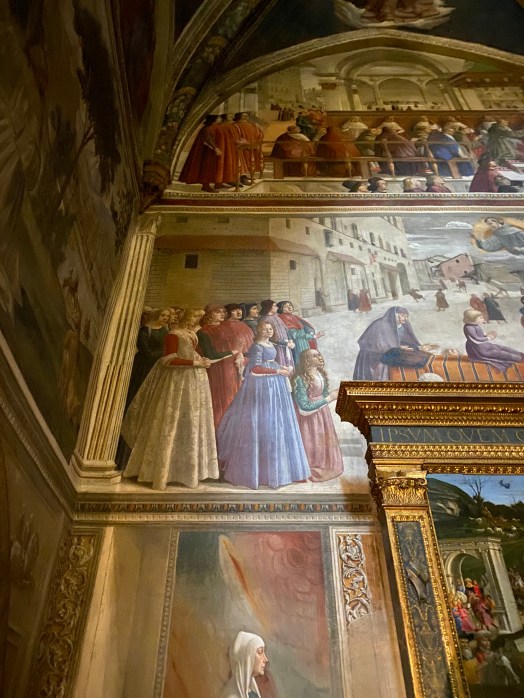
Everyone’s favorite scene is in the fresco panel just above the altarpiece. In the center, we see a young boy sitting at prayer on a bed. According to the story, the poor boy had fallen from the top of the Palazzo Spini, which is just across the piazza from this church (and home to the Ferragamo empire now). This was an actual event that had happened in Florence and had horrified the local population. Luckily, St. Francis–who himself had already died–was able to perform a (posthumous) miracle by bringing the boy back to life. (It is also said to allude to the death of Sassetti’s first son Teodoro and the birth of his second, given the same name as a sort of resurrection.)
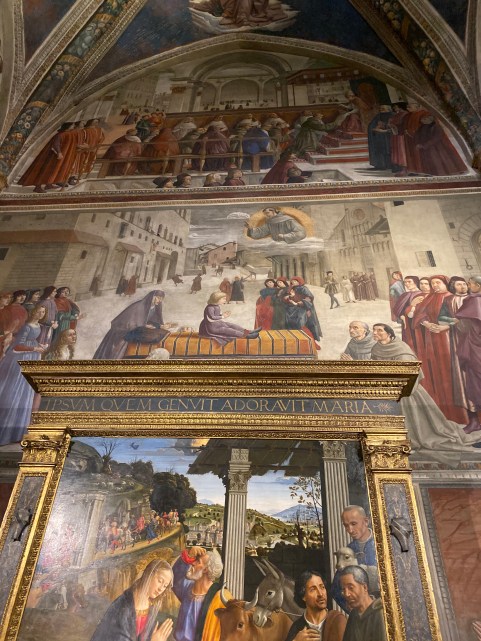
According to the literature, this popular scene was a late replacement by Ghirlandaio for a depiction of the Apparition at Arles, which he had originally planned for this space.
The women clustering to the left said to be Sassetti’s daughters. It is said that the whole cycle contains about 60 of the Sassetti family and friends. The figure far right, with his hand on his hip, is said to be Ghirlandaio.
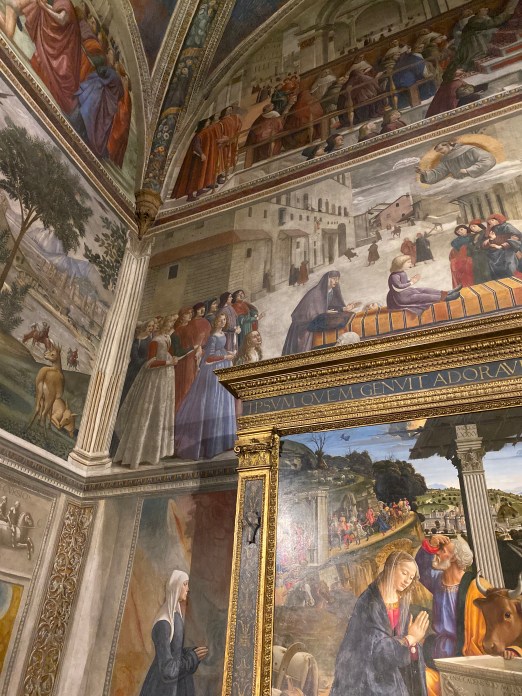
This was supposed to be one of St. Francis' posthumous miracles.Don'tyou love the Catholic Church and its understanding of the passage of time and the supernatural feats of its chosen few? You have got to admire the ingenuity, if nothing else! Never let the death of a sain stop him from performing miracles.
Because this event happened in Piazza Santa Trinita, Ghirlandaio shows us how the square appeared at that time, including the very church in which we are standing, Santa Trinita, as it appeared before the later addition of Buontalenti’s façade. Sassetti’s children fall to their knees (on the left); note the old Romanesque façade and Ponte Santa Trinita as it was before the great flood of 1557.
The Confirmation of the Rule scene above features portraits of Lorenzo de’ Medici with his sons and their tutor, Angelo Poliziano, against the backdrop of the Piazza della Signoria. (Despite the Florentine setting, this event in fact took place in Rome.)
The four Sibyls in the vaults (including one said to have been modeled on Sassetti’s daughter, Sibilla) are also by Ghirlandaio, as is the David and the Tiburtine Sybil telling Augustus of the birth of the Redeemer (Vision of Augustus) on the wall above the chapel entrance.


We should remember that Francesco Sassetti was a Medici banker and it was he who was blamed for the declining fortunes of the Medici, just prior to his death from a stroke in 1490. He and his wife, Nera Corsi, kneel on either side of the equally gorgeous altarpiece. I love the inscription under the donor portraits: December 25, 1480.



On the left wall, Saint Francis dons his habit, and on the right, in a fresco attributed to Domenico’s brother Davide, he undergoes a trial by fire before the Sultan (Francis went on a crusade and returned horrified by what he’d seen).
The next level down, to the left he receives the Stigmata before a realistic representation of the Santuario della Verna, an abbey in the wild mountains between Florence and Arezzo.The Saint’s death is to the right. Francesco Sassetti and his wife, Nera Corsi, are in the tombs, and are also shown kneeling facing the altar.
While a visit to Santa Trinita will repay you a thousand fold with art, now we turn to the works created for this magnificent church but have been removed from it.
The Cimabue Maestà della Madonna, painted around 1280 for the high altar here, is now in the Uffizi Gallery. It was replaced with a Trinity by Alesso Baldovinetti in 1471 and moved into a side chapel and, later, to the monastery infirmary. It’s been in the Uffizi since 1919, where it’s now part of the spectacular Cimabue/Giotto/Duccio trio on display in room 2.
An altarpiece signed and dated May 1423 by Gentile da Fabriano, was commissioned by Palla Strozzi around 1421 for the family chapel here in the sacristy. The gilt and gorgeous central panel, The Adoration of the Magi, and two panels of the predella, The Nativity and The Flight into Egypt, are in the original frame in the Uffizi (since 1919). Another panel from the predella, the impressively architectural and very finely-wrought Presentation at the Temple, is in the Louvre (since 1812), with a copy taking its place in the Uffizi.
There is conjecture that the Presentation panel may feature a building based on the long-lost Strozzi palazzo which stood opposite this church. The main panel is said to contain a portrait of Palla Strozzi in the train of the magi, holding a hawk.
Also commissioned by Palla Strozzi for the same chapel here was A Deposition by Fra Angelico now in the Museo di San Marco. The altarpiece was begun by Lorenzo Monaco; its pinnacles are by him, as are what are thought to be the predella panels of scenes from the lives of Saints Onofrio and Nicholas, now in the Accademia.
The altarpiece had been begun by Lorenzo, but upon his death in 1424 it was completed by Angelico and installed on 26th July 1432. Palla Strozzi is depicted on the right holding the crown of thorns and the nails, his son Lorenzo kneels in the right foreground nearby. A highly finished drawing of The Dead Christ from the altarpiece is in the Fitzwilliam in Cambridge.
Bicci di Lorenzo’s altarpiece of 1434, painted for the Compagni chapel here (see reconstruction above, from Bicci di Lorenzo’s altarpiece for the Compagni family chapel by Dillian Gordon, Burlington Magazine Feb 2019 ) has its main-tier panels now in Westminster Abbey in London. The central panels show the Virgin Enthroned with Saints John Gualberto, Anthony, John the Baptist and Catherine. The predella panels have in recent years been identified as the central Nativity and Saint John Gualberto and the Destruction of the Abbey of Moscheta in private collections, and the Baptism of Christ in the York Art Gallery.
The missing panels are also thought to be scenes from the lives of the saints above them, Anthony and Catherine. The reasons for the altarpiece’s removal, by 1845, are unknown.
Bicci’s son Neri di Bicci painted an altarpiece of The Assumption in 1455/6 for the Spini chapel here. It is now in the National Gallery of Canada in Ottowa.
The striking Trinity with Saints Benedict and Giovanni Gualberto by Alesso Baldovinetti of 1469-71, originally from the Gianfigliazzi chapel here, is now in the Accademia too.
Albertinelli and Franciabigio’s impressive Virgin and Child between Saints Jerome and Zenobius painted for the Zenobi del Maestro chapel here, is now in the Louvre, having been looted by Napoleon.
Bronzino’s early major work, The Dead Christ with the Virgin and Mary Magdalene of c. 1528-29, formerly in the convent here, has been in the Uffizi since 1925.


In Maremma no one picks olives before November 2 (All Souls’ Day), by which point the green has begun mottling into black. This is why Tuscan olive oil is so justly famous; Umbrians and Apulians, by contrast, wait for the fruit to fall before they gather it, which makes their oil more acidic.
Usually it took us about three weeks, working six hours a day, to harvest our olives (from 38 trees). Once we were done, we’d pack them in plastic crates and haul them to one of the two frantoi (olive presses), this one located in a warehouse behind the consorzio agrario.
In the room through which you entered, tons of olives, either loose or in burlap bags through which a little moisture was already seeping, waited to be weighed and pressed. There would be at least one truck parked outside, bearing the immense crop of one of the larger aziende, a thousand kilos in comparison to which our five crates seemed meager.
Still, we gave them to the frantoiano to weigh, and he told us to how much oil we were entitled, using as the basis for his calculations a mysterious algorithm that took into account not only the quantity of olives but their relative oiliness in comparison to other years (on average, about twenty percent of the weight of the fruit). We’d nod acceptance of his terms.
Then he’d take our olives and throw them onto the pile with all the others, for generally speaking only huge crops were pressed individually; in the case of small harvests, the olives of several different families would be mixed together, which meant that one could never say truthfully, “This oil is mine,” though of course everyone said it anyway. Having deposited our olives, we followed the frantoiano into the next room, where the machinery itself was located.
This consisted of a huge tub and a stone grinding wheel, operated not by hand, as in the last century, but by a sophisticated system of gears. For sheer scale, it was daunting. The wheel was easily twice the size of the Bocca della Verità in Rome.
As for the tub: if you fell into it you would certainly be crushed in a matter of seconds. At the bottom, a muddy sludge of olive residue shifted and churned, while from its side a stainless steel pipe led to a series of distillation tubes and then to a tap from which a stream of oil was always pouring.
The oil was such a deep shade of green that you could not see light through it unless you held the bottle up to the sun. It gave off a slightly mulchy odor. This was the cold-pressed “extra virgin” oil for which Tuscany is famous. Later, the pulp would be pressed a second time, producing a paler oil; later still, the crumbly residue, by now the texture and color of potting soil, would be forced, thanks to the addition of certain chemicals, to yield yeta third grade of oil, almost colorless and used chiefly for deep frying.
Next the frantoiano—Paolo) who in the summer worked at the Bar Sport, and in the spring did construction at the Terme—asked us if we wanted to take our oil then or wait until “our” olives were pressed. We told him that now would be fine, at which point he began to fill our thirty-liter stainless steel oil urn.
One of our neighbors, a farmer with a lot of land, walked in and greeted us. We would have felt intimidated by his bigger harvest (this is the curse of masculinity) had not a tiny old man followed him in. In his right hand he held a straw basket containing at most twenty olives, in his left a biberon—a baby bottle.
Leavitt, David. In Maremma: Life and a House in Southern Tuscany (pp. 131-132). Counterpoint. Kindle Edition.
Leavitt, David. In Maremma: Life and a House in Southern Tuscany (p. 130). Counterpoint. Kindle Edition.
Leavitt, David. In Maremma: Life and a House in Southern Tuscany (p. 130). Counterpoint. Kindle Edition.
Continuing my cruise through the Brenta Canal (Il Naviglio del Brenta or the Brenta Vecchia) in late September 2019, our next stop was at La Malcontenta, aka Casa Foscari.
Casa Foscari, or the Foscari house. Only a very rich Venetian could call this Palladian masterpiece a “house.” For the rest of us, it is indeed a villa! And also a UNESCO World Heritage site, grazie a dio.
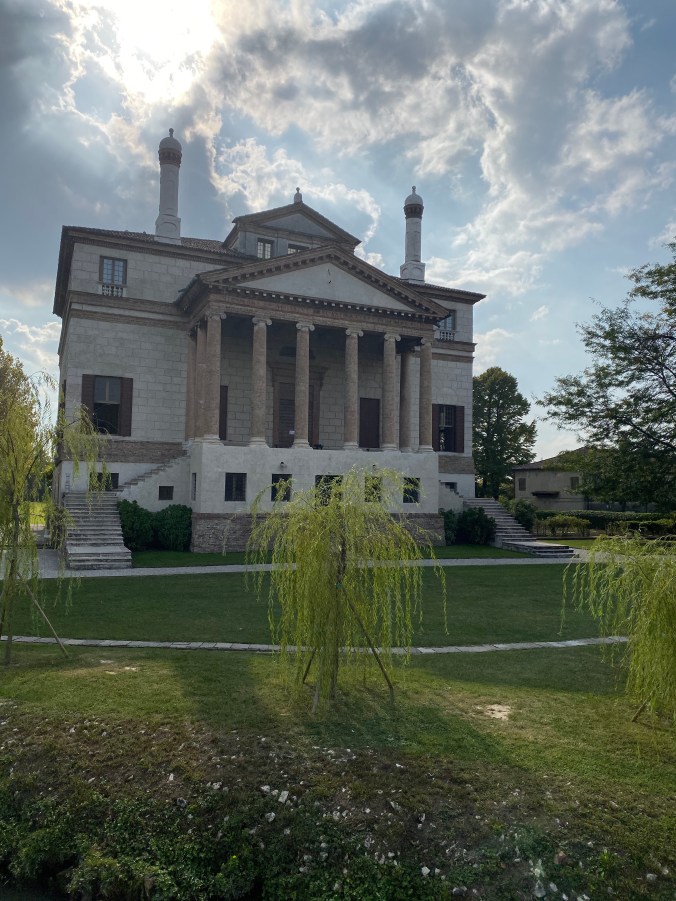
Villa (Casa) Foscari is a patrician villa in Malcontenta near Mira, not far from Venice. It was designed by the architect Andrea Palladio for the brothers Nicolo and Luigi Foscari, members of a very powerful Venetian family that included Francesco Foscari, one of Venice’s most noted doges. The villa was built between 1558 and 1560.
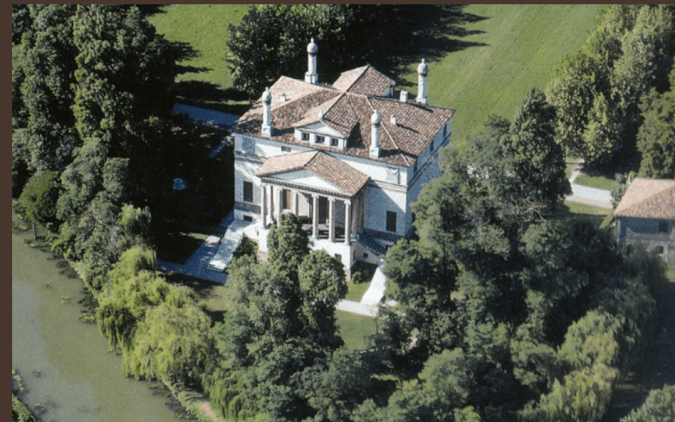
From above:
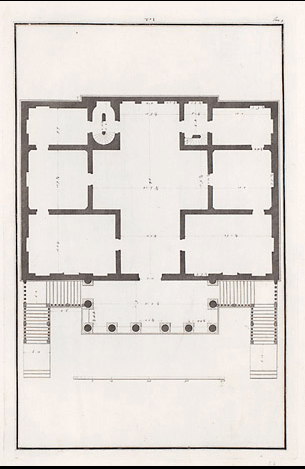
The plan:
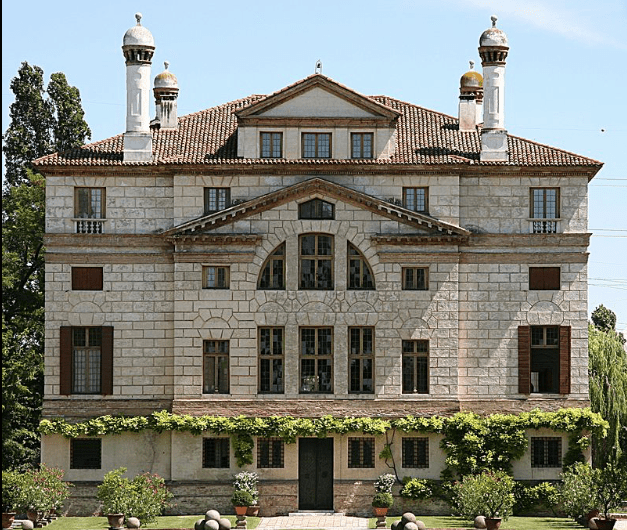
The rear facade:
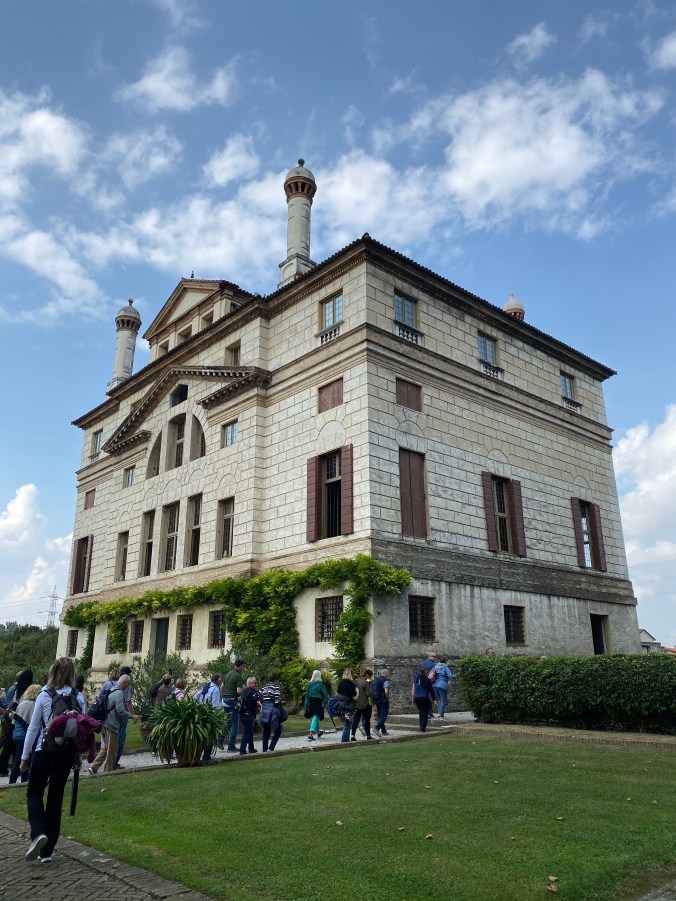
The villa is located beside the Brenta canal, where it stands in isolated splendor. Typical of Palladio’s villas, it is raised on a pedestal; this pedestal is more massive than most of Palladio’s villas (the base is 11 feet high, more than twice the height Palladio normally used) because it was not possible to construct a subterranean basement on the site and the architect needed to protect the interior from the moisture below.
The original villa lacked the agricultural buildings which were an integral part of some of the other Palladian villas. It was used for official receptions, such as that given for Henry III of France in 1574.
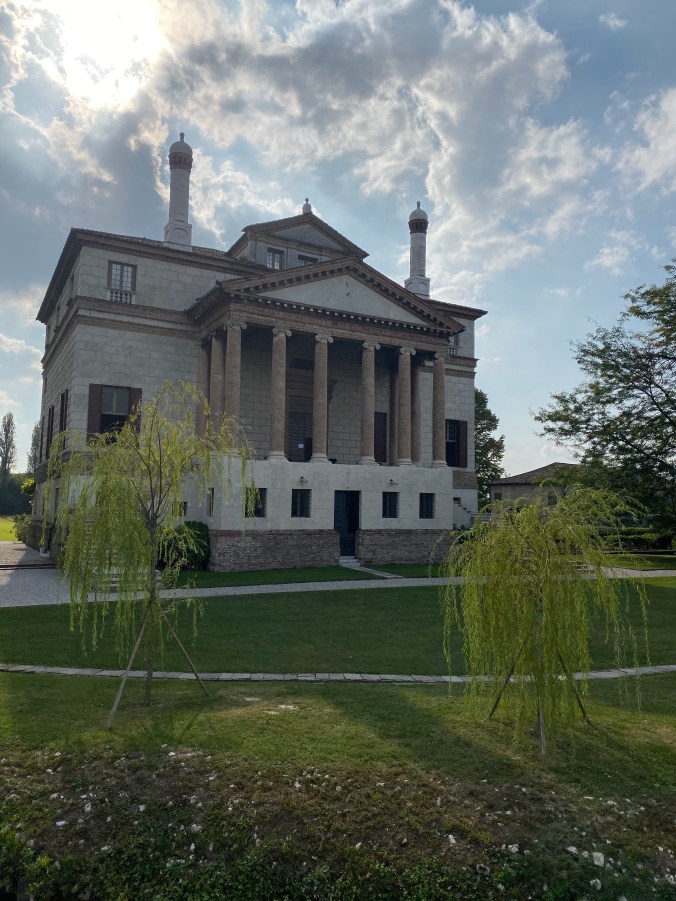
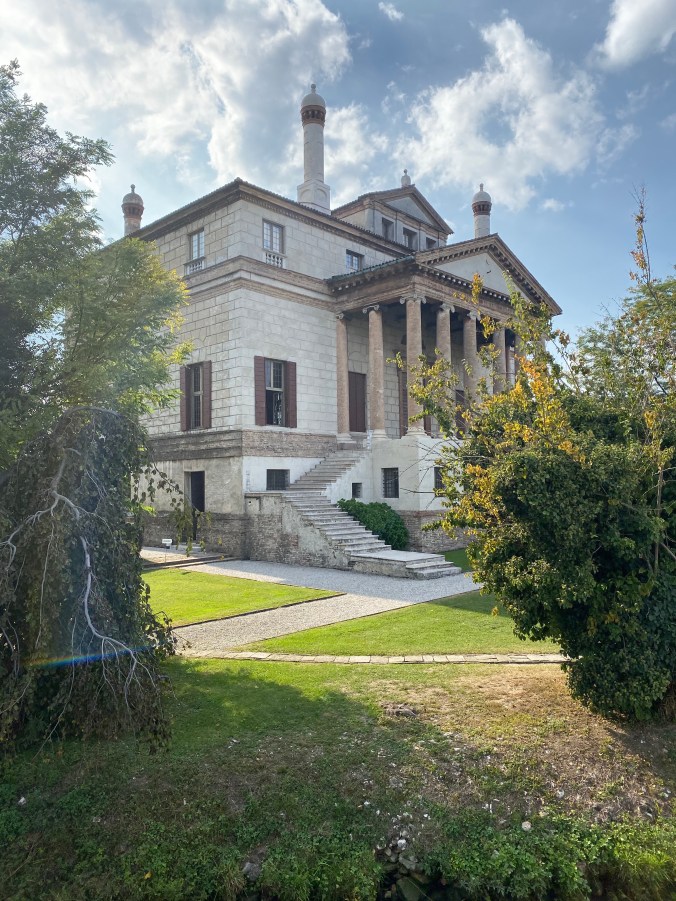
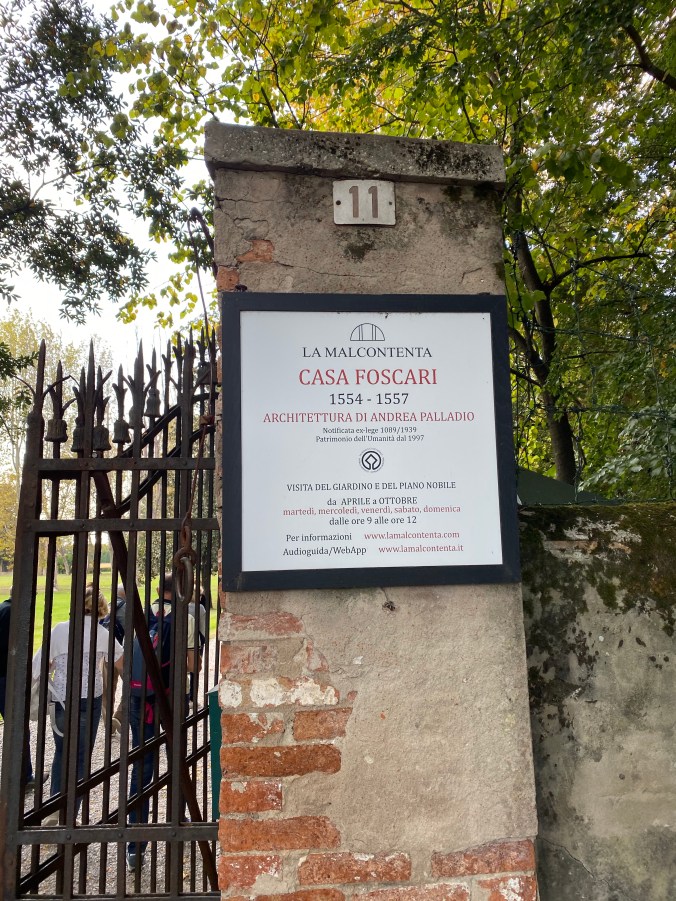
The Foscari family didn’t intend to create a villa farm, but rather a suburban residence, quickly reachable by boat from the center of Venice thanks to the position at the mouth of the Brenta Canal.
The project was entrusted to Andrea Palladio by at least 1554. Unfortunately, Nicolò Foscari died in 1560 and his brother Alvise oversaw its completion.
Painters Giambattista Zelotti and Battista Franco were commissioned to paint the interior with lavish frescoes, but Franco died in 1561, leaving the Fall of the Giants unfinished. While some details about the project are unknown, the building was most certainly completed by 1566, when it was visited by Giorgio Vasari.
I will discuss the frescoes in a separate post.
In the following centuries, the Foscari acquired more property and built outbuildings such as stables and ferries, among others. They also constructed an inn and a guesthouse as well as various rental houses. In fact, they almost created a small village, the so-called “piazza Foscari alla Malcontenta.”
By the early 1800s, the villa was abandoned. In following decades the “piazza” complex was in ruins and during the uprisings of 1848 the various outbuildings were dismantled by the Austrians.
Between 1885 and 1954 the entire countryside along the Brenta Canal was changed with the addition of train tracks of the Padua-Malcontenta-Fusina line. By the 1920s, La Malcontenta was being used as an agricultural warehouse. In 1925 it was acquired by Alberto Clinton Landsberg, who began its first major restoration. A second restoration was implemented in the 1960s, with the collaboration of the Ente Ville Venete.
British travel write Robert Byron provided an eye-witness account of the villa in The Road to Oxiana:
Trip by car to Malcontenta for tea. We took the new road built on the lagoon next to the railway. The famous villa, magnified in all its books on Palladio, was falling into disrepair when Landsberg saw it nine years ago: without doors or windows, it was used as a warehouse for various agricultural products. Landsberg made it habitable. The proportions of the great hall and reception rooms are a mathematical paean. Another would have filled the halls of so-called Italian furniture all with gilding, antiquarian bottoms. Landsberg had natural wood furniture made in the village. There is nothing “vintage” except candles, which you can’t do without in the absence of electricity.
In 1973 the villa was once again owned by a Foscari family member, Antonio “Tonci” Foscari.
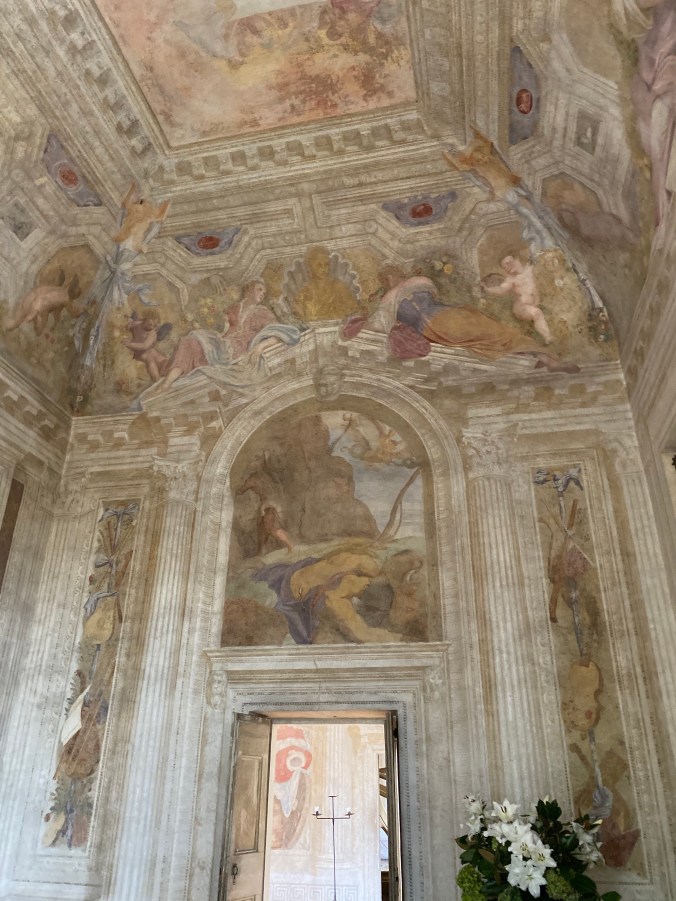
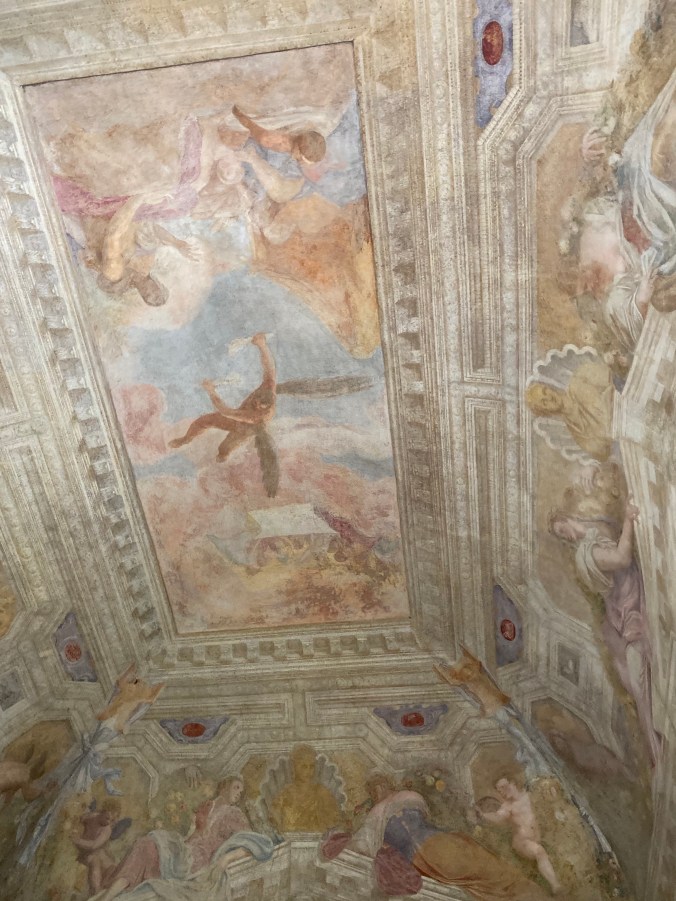
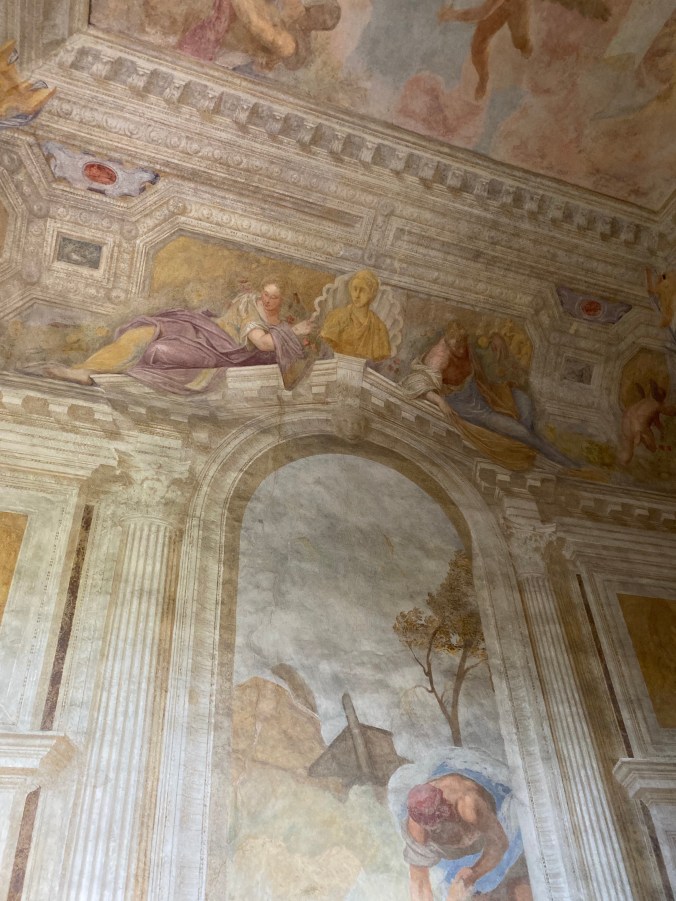
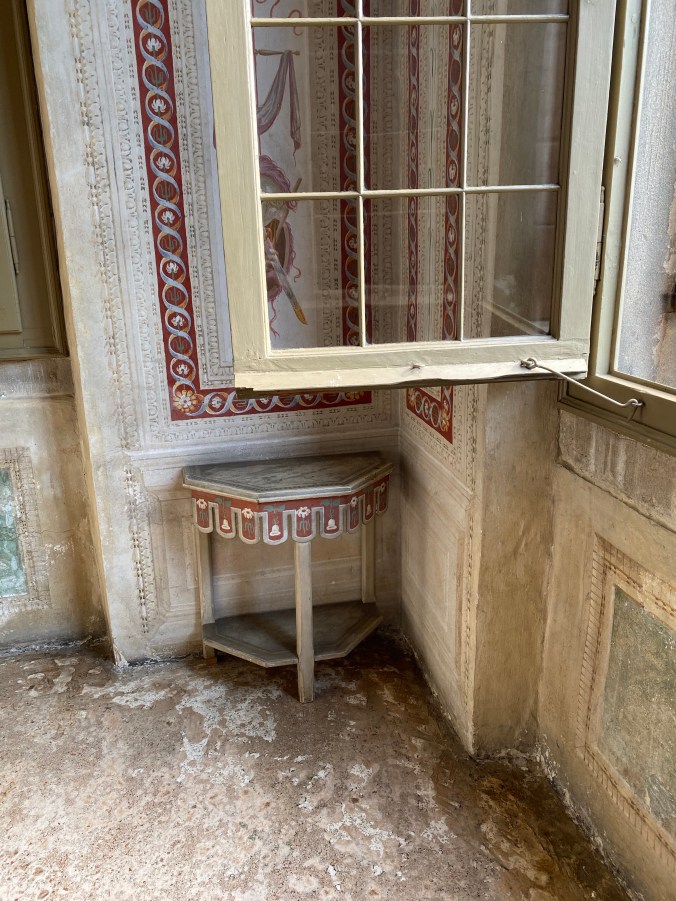
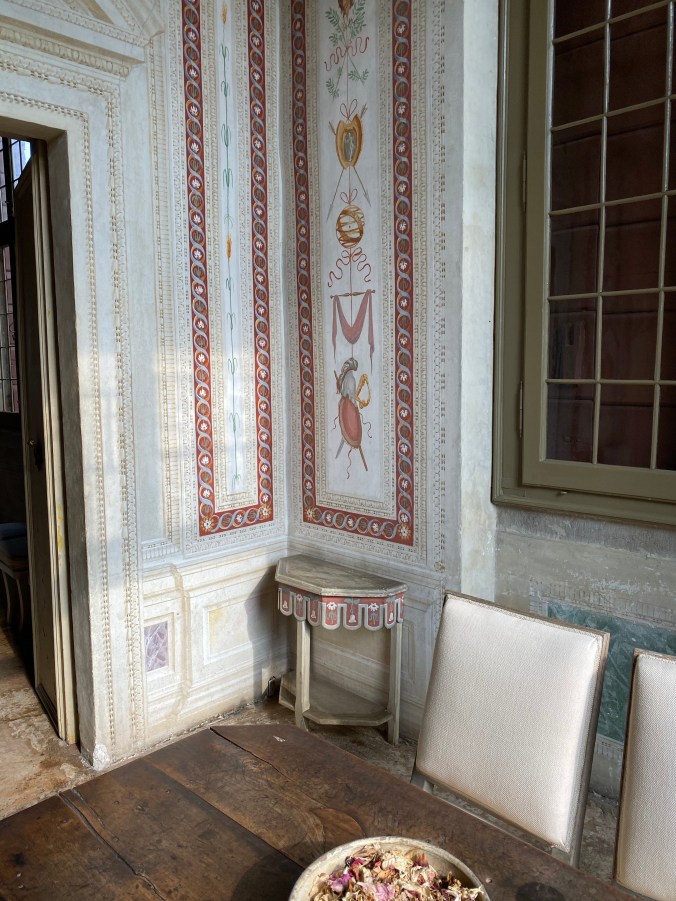
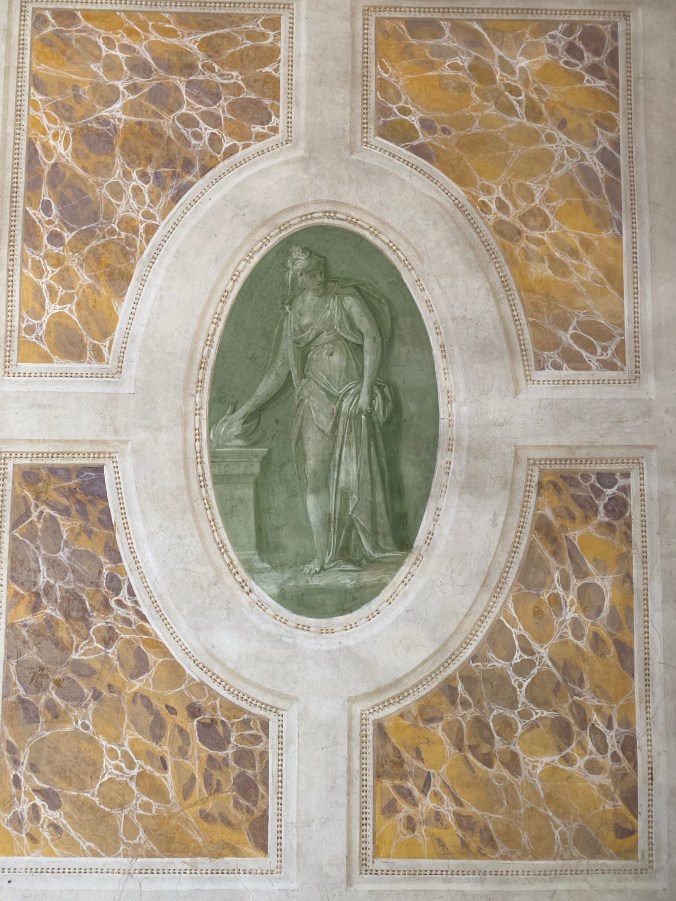
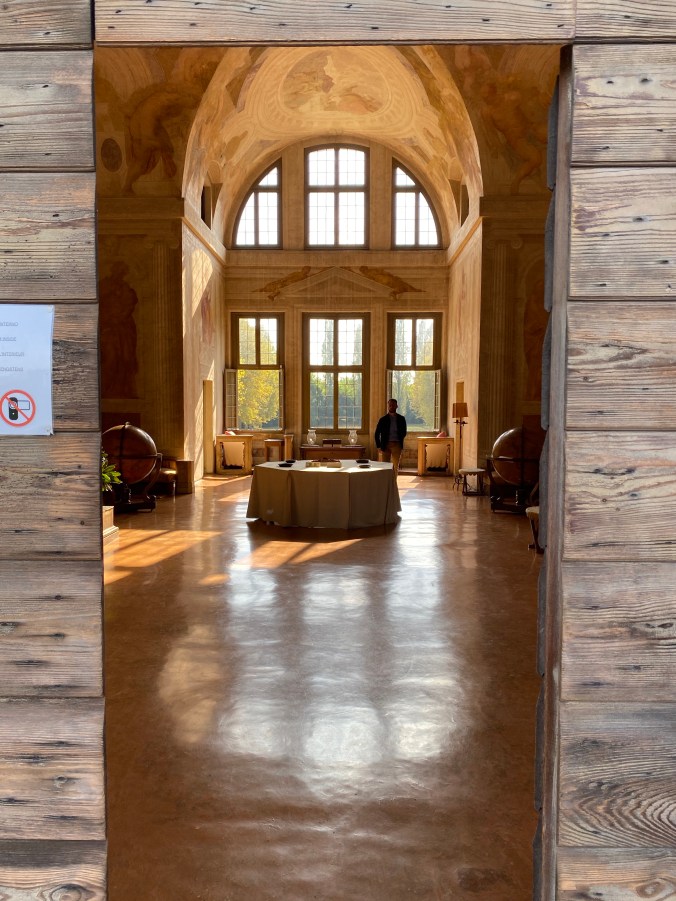
The interior of the villa is richly decorated with frescoes by Battista Franco and Giambattista Zelotti. Mythological scenes from Ovid alternate with allegories of the Arts and Virtues. As at other Palladian villas, the paintings reflect villa life in, for example, Astraea showing Jove the pleasures of the Earth. The frescoes have dulled over time, signs of the increasing threat that air pollution poses to works of art.
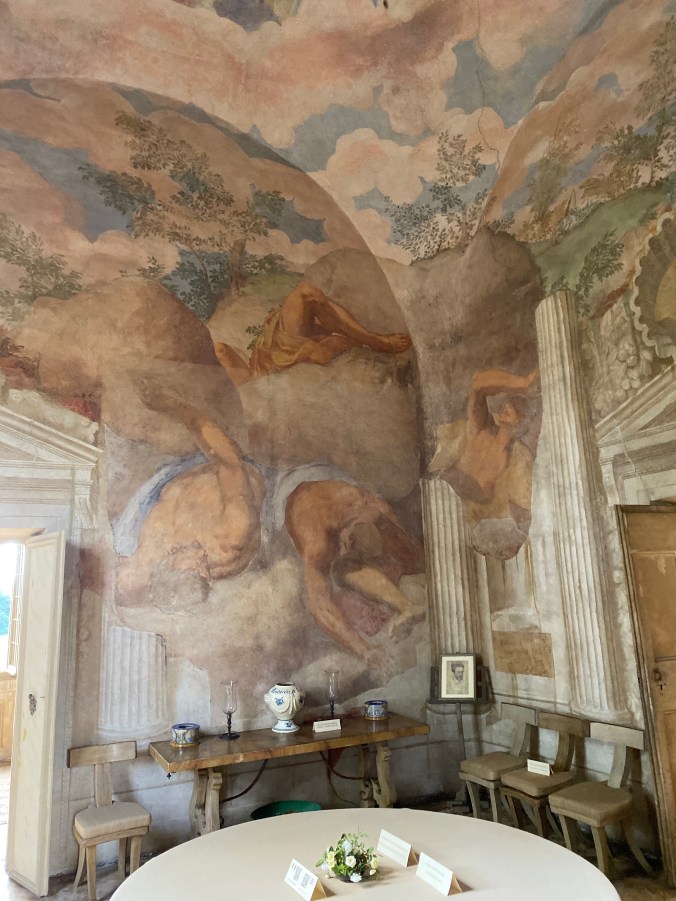

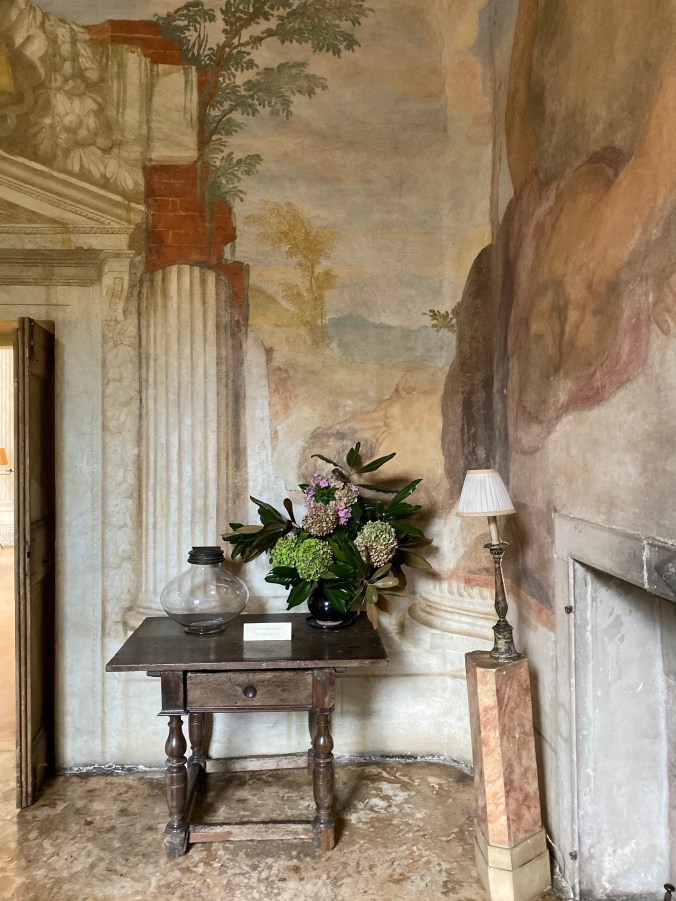
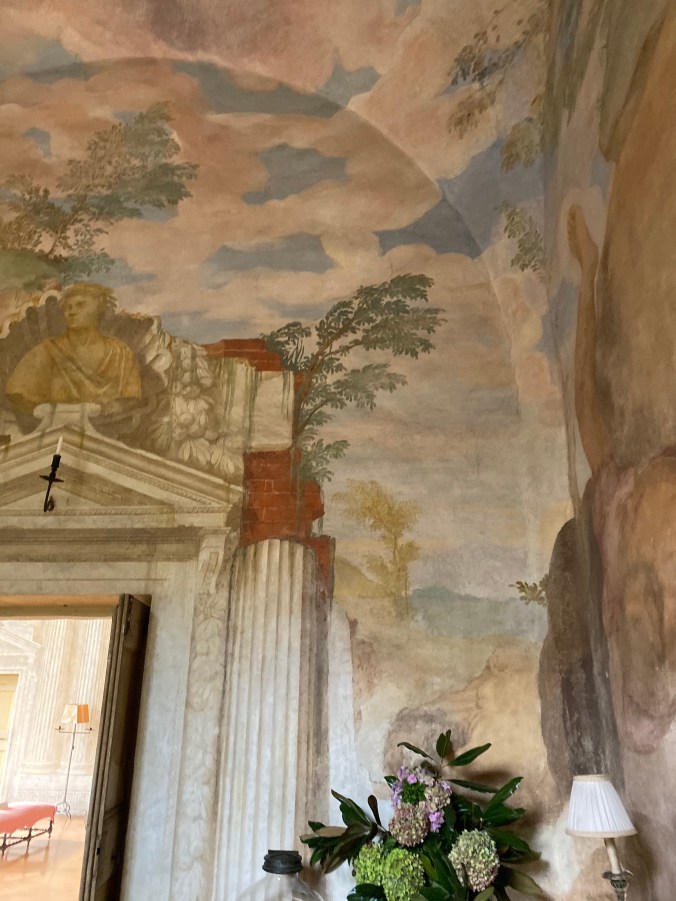
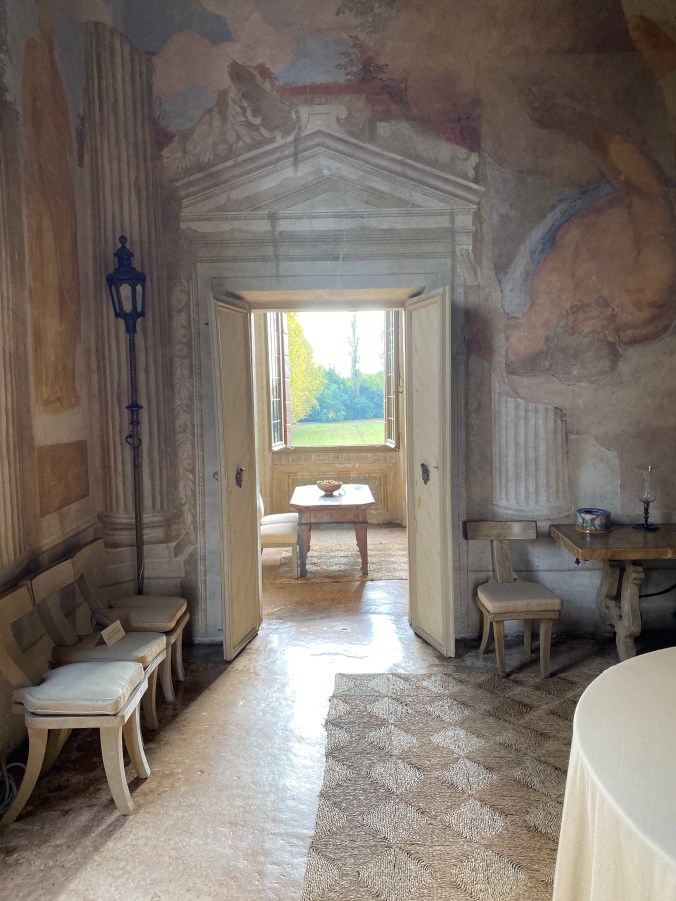

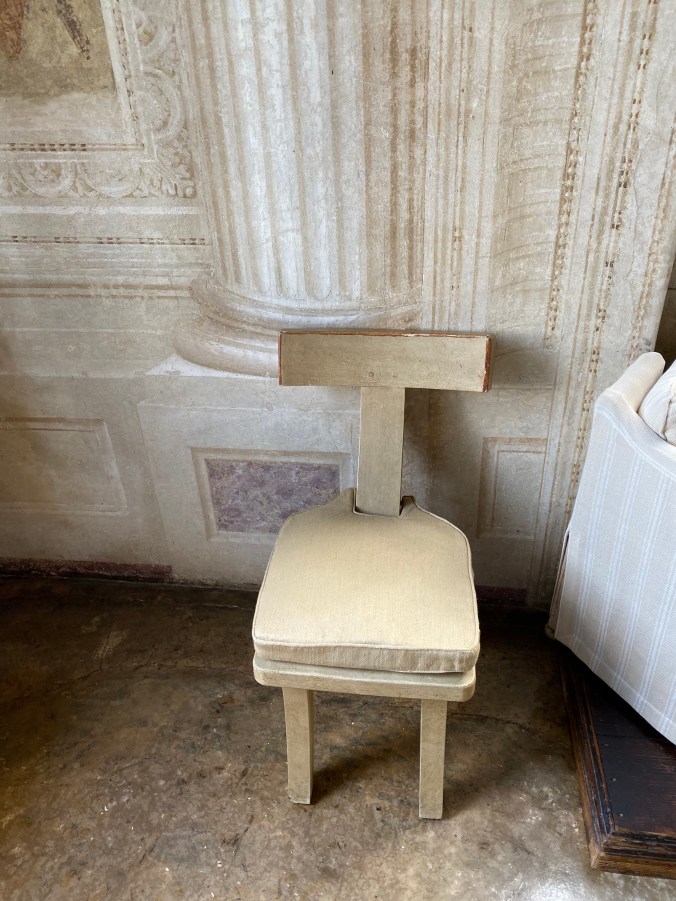
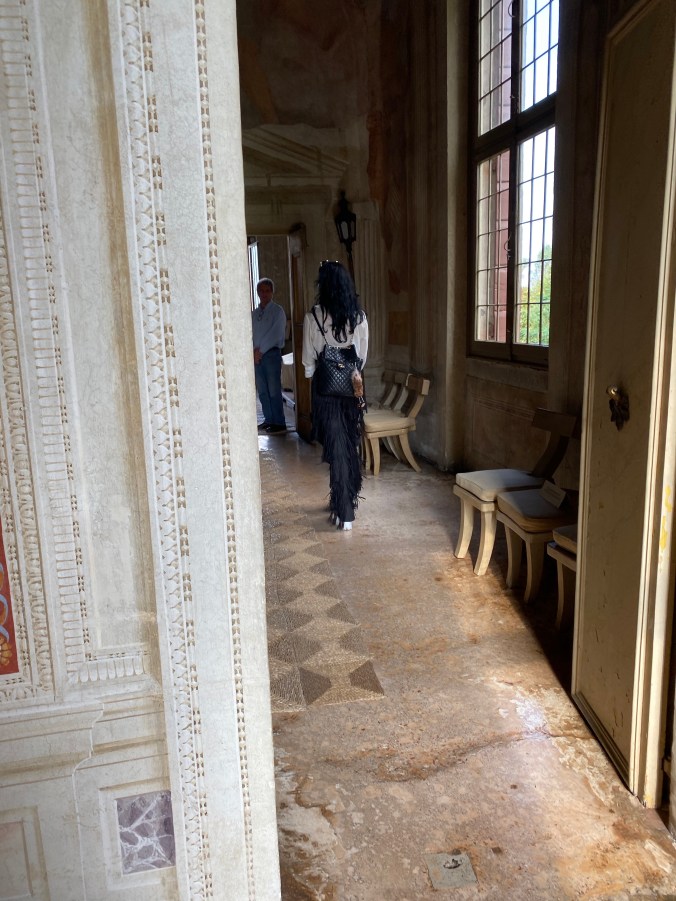
In their plan of restoring the Villa, the actual owners tried to conserve – as much as possible – also the conception of furniture introduced in the 1920s and 1930s by Albert C. Landsberg, with the precious help of Paul Rodocanachi. We owe to them the choice of avoiding the inclusion of pretentious furnishings and any other interference of objects that could reduce the perception of Palladian architecture or interfere with it.
Having found the samples of fabrics that were used in the upholstery of the furniture – those made in the early 1950s of the twentieth century by Albert C. Landsberg – the architects Antonio Foscari and Barbara Del Vicario had them remade identically by the very same weaving shop.
Separately are documented some recent pieces of furniture that had been designed with attention to the problem of combining the antique with the modern.
This “line” from which La Malcontenta has taken its name – has been elaborated and developed over the years by Barbara Del Vicario, an architect who took inspiration from antique motifs and transformed them into her particular conceptions of design and furnishings.
Barbara del Vicario, Curriculum Vitae
M. Caracciolo, The most beautiful house in the world, House & Garden, 10/2001, p. 244
Glassworks
Ottagono
Chairs
Sofà
Candelabra
Bibliography
For information: info@lamalcontenta.com
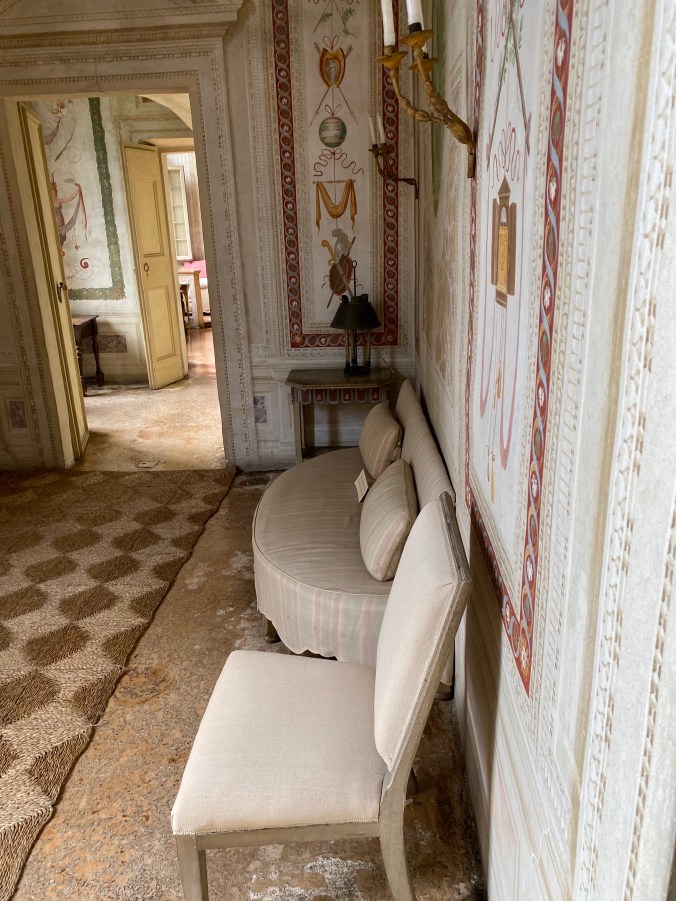
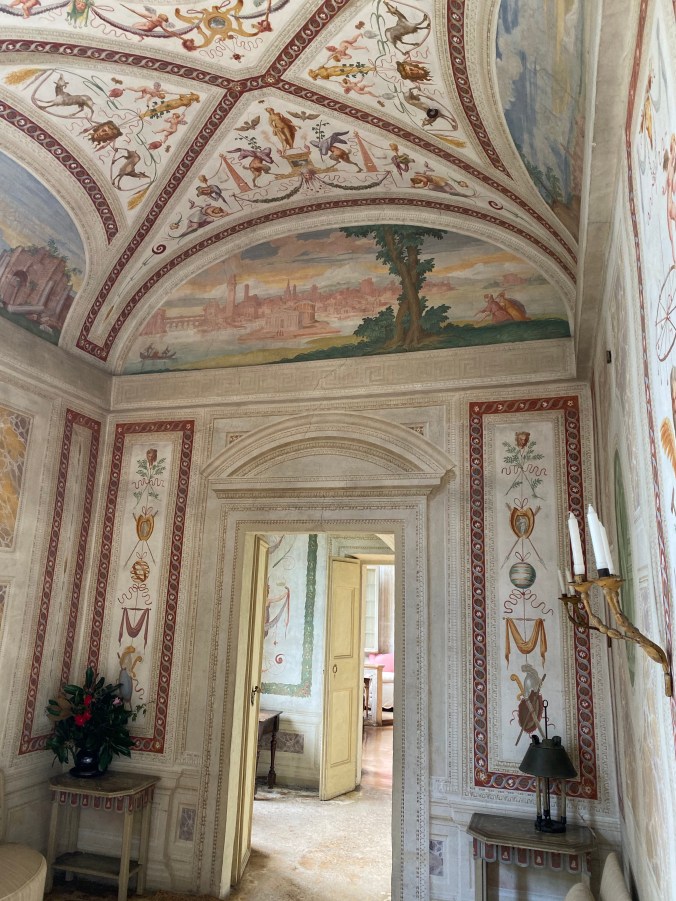

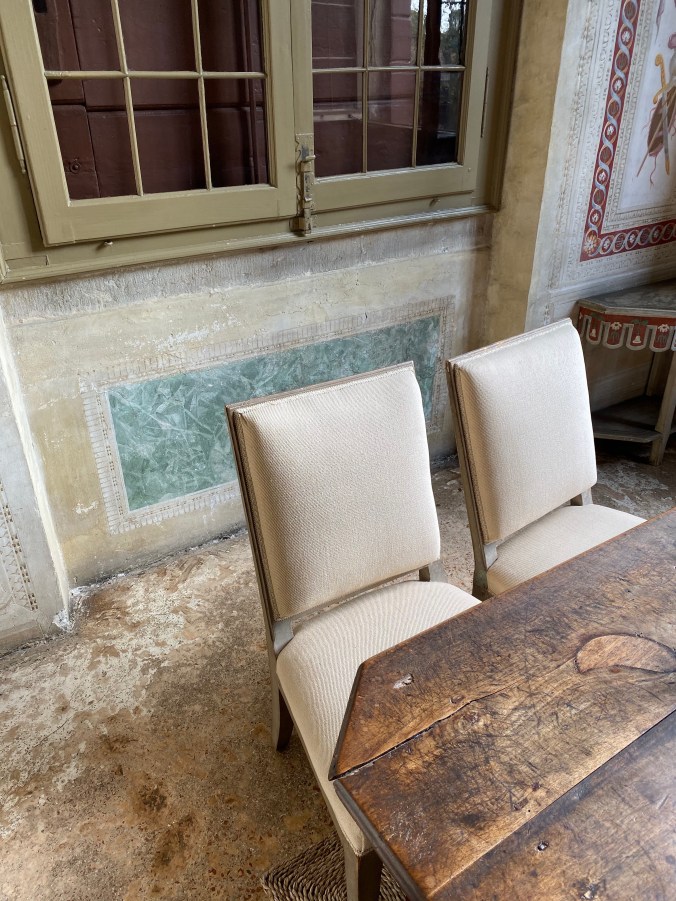
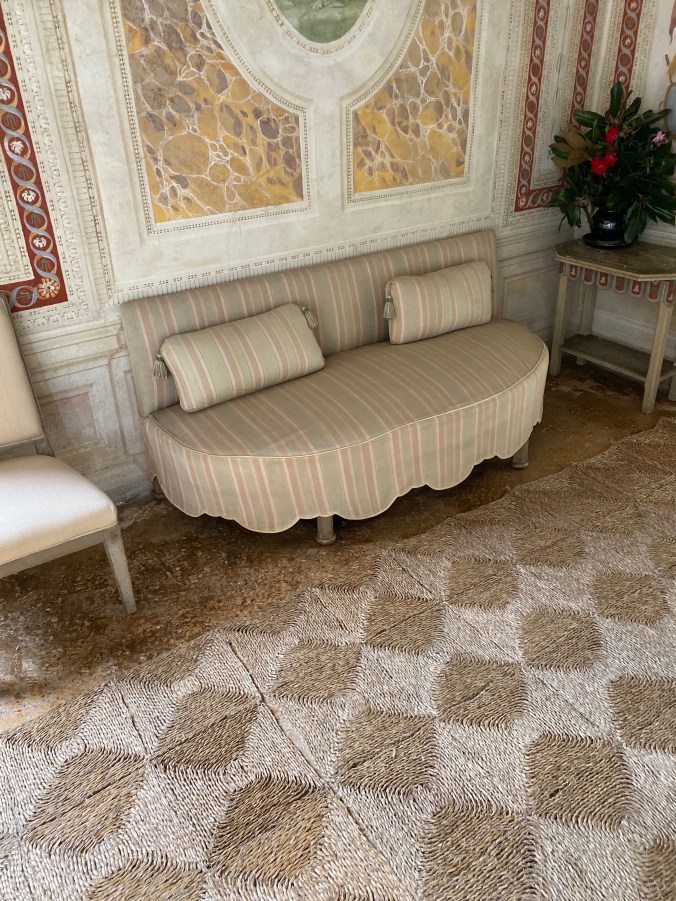
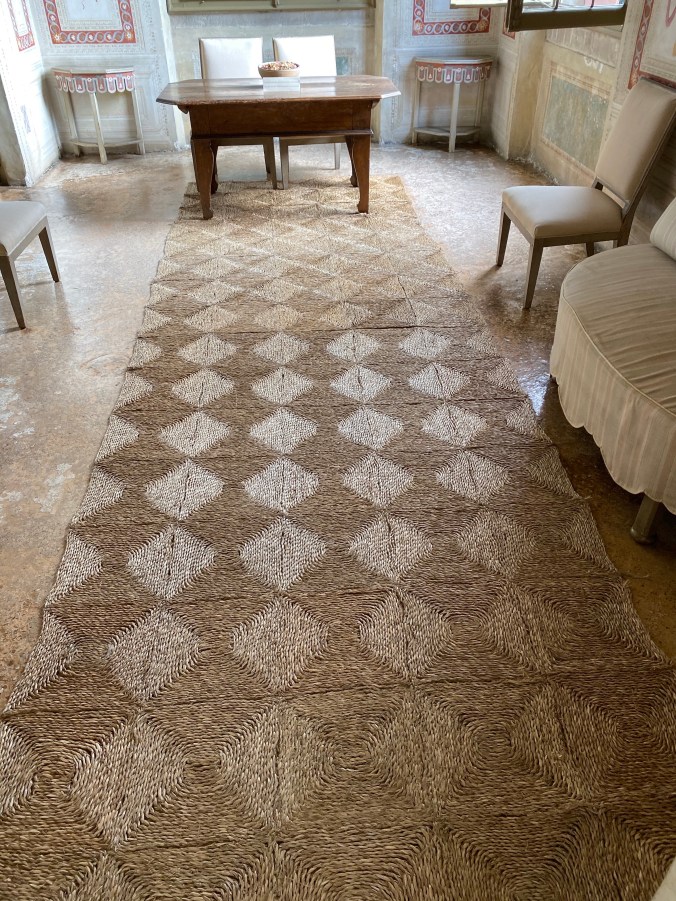
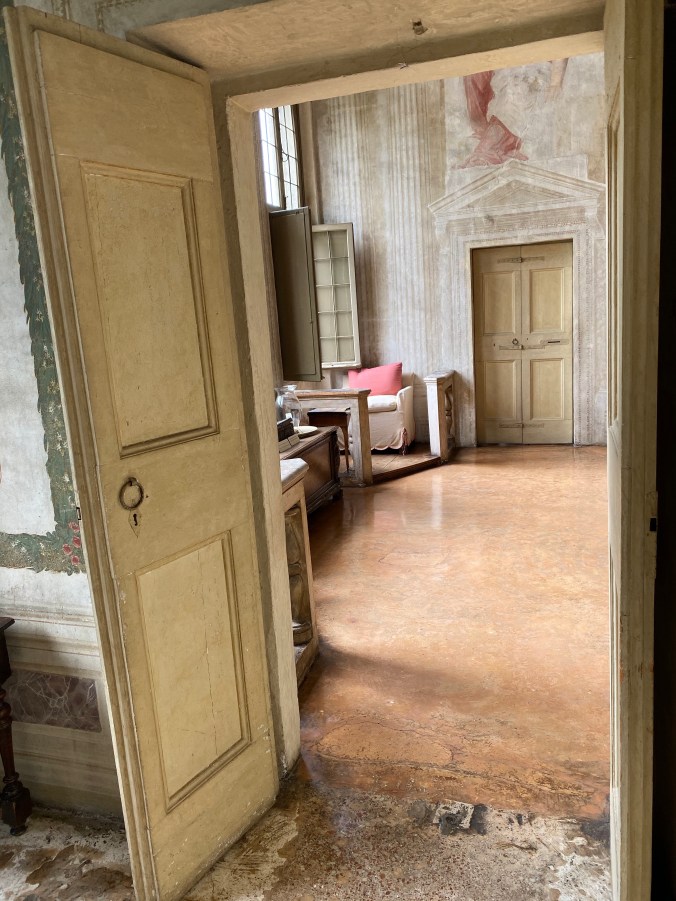
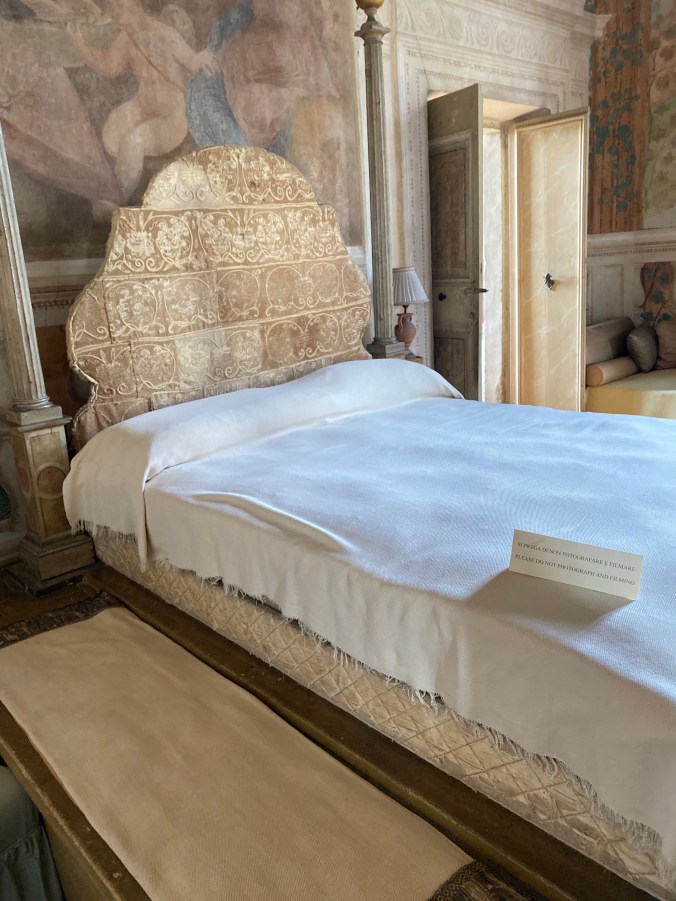

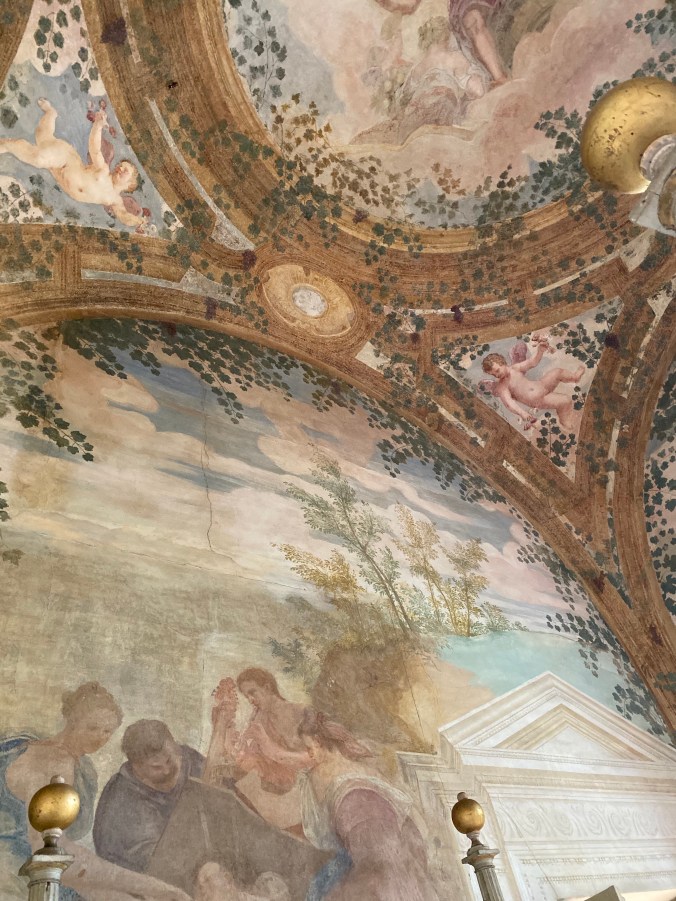
Robert Byron, the British travel writer, visited the villa in 1933 and afterwards wrote that Albert Clinton Landsberg had, nine years earlier, found the villa “at the point of ruin, doorless and windowless, a granary of indeterminate farm-produce,” and had made it a habitable dwelling.
In 1973, Antonio Foscari (a descendant of the Foscari lineage) and his wife, Barbara del Vicario, recovered the villa, and have undertaken a painstaking process of restoring the villa to its original grandeur. In 2012 Foscari wrote of the villa’s renaissance.
Since 1996 the building has been conserved as part of the World Heritage Site “City of Vicenza and the Palladian Villas of the Veneto”. Today, the villa is open to the public for visits on a limited basis.

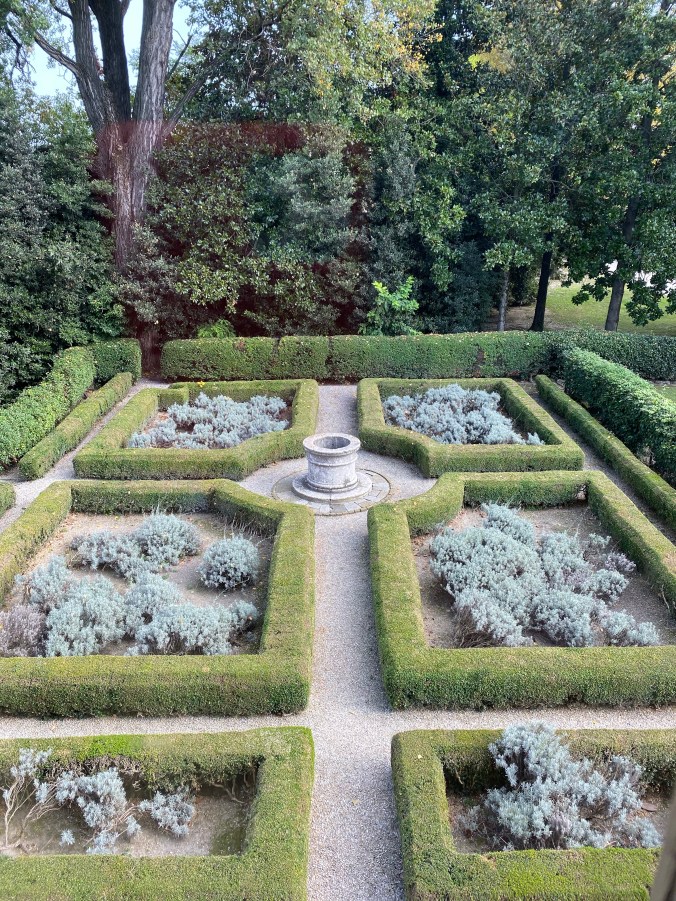
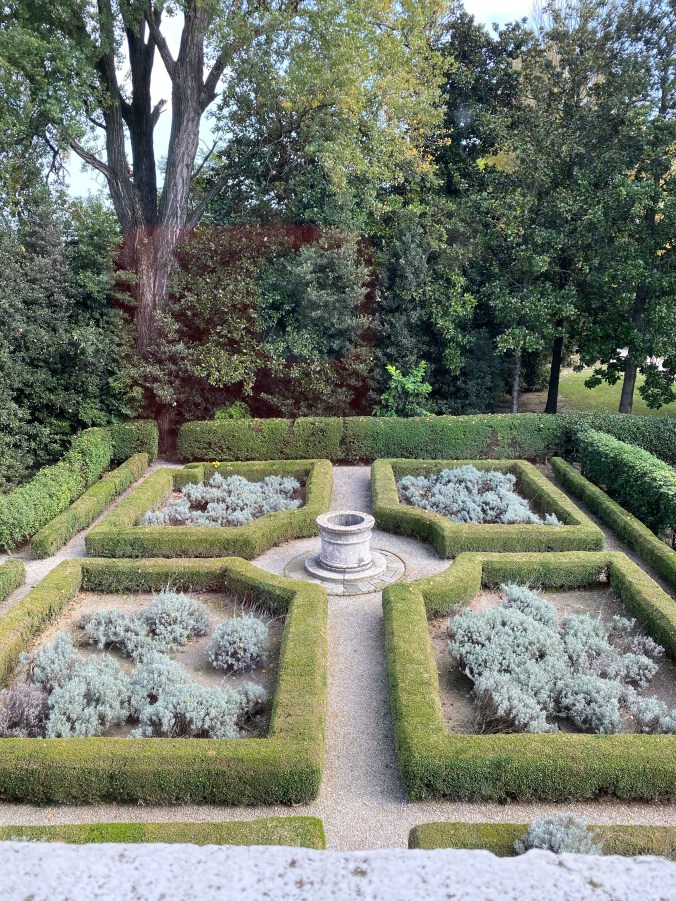

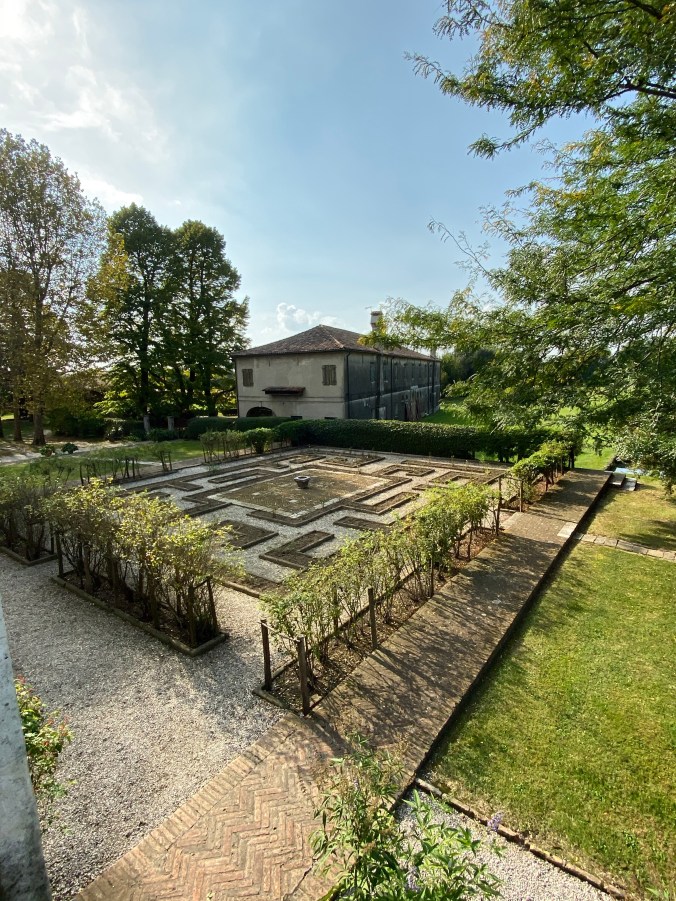
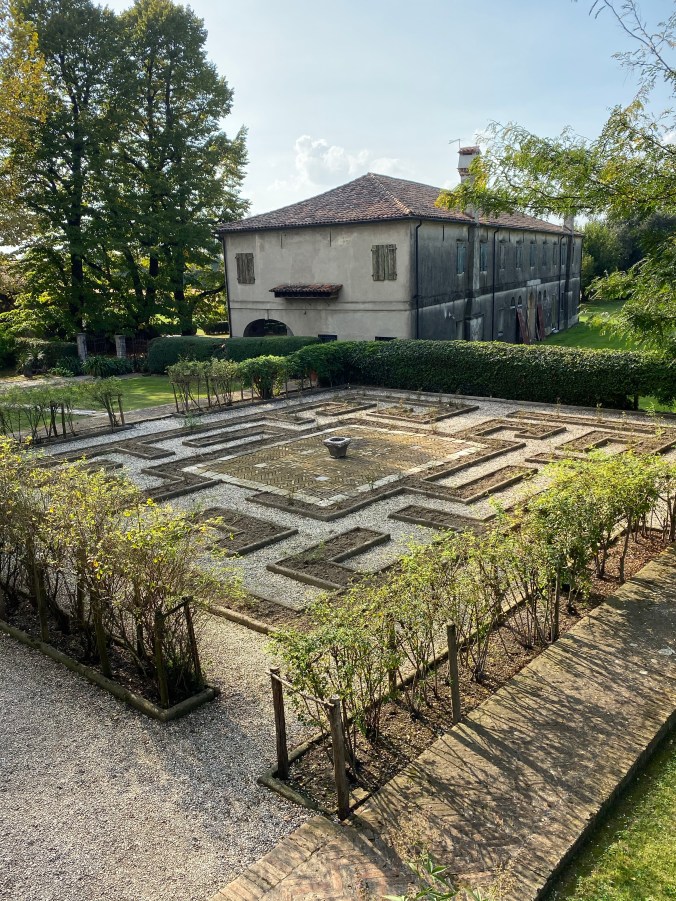
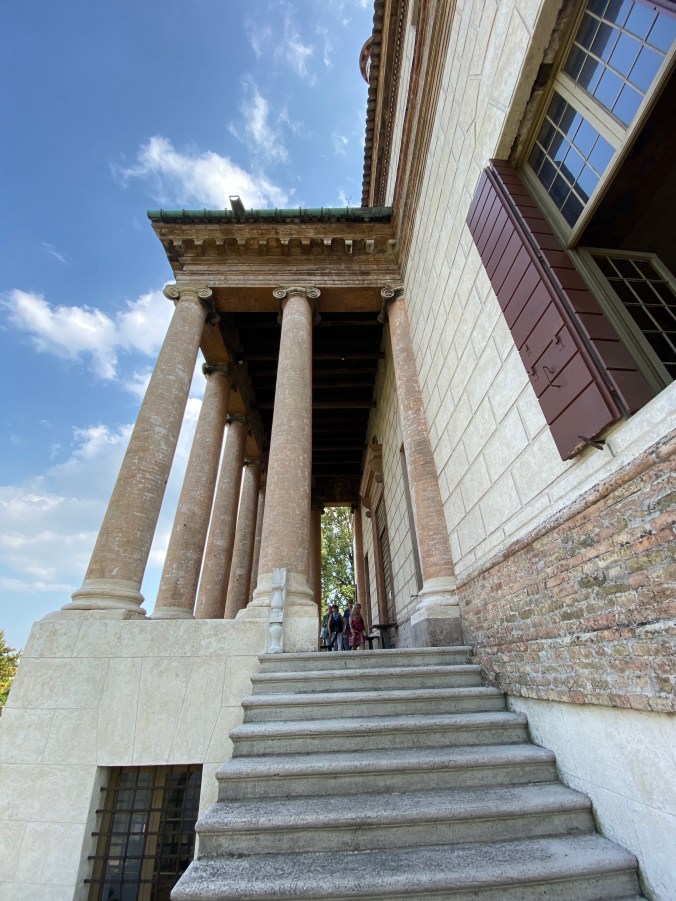
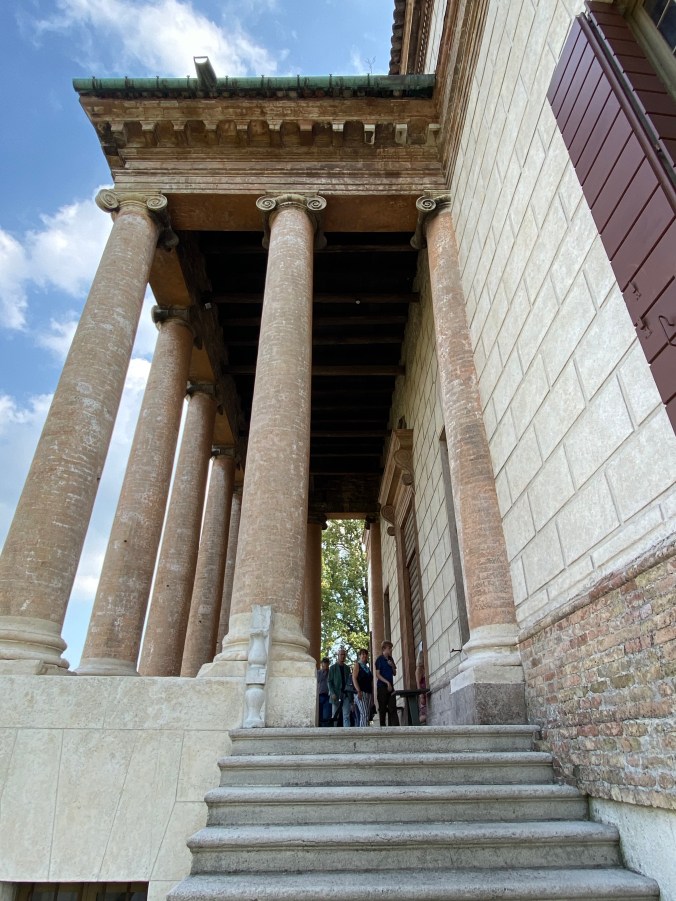
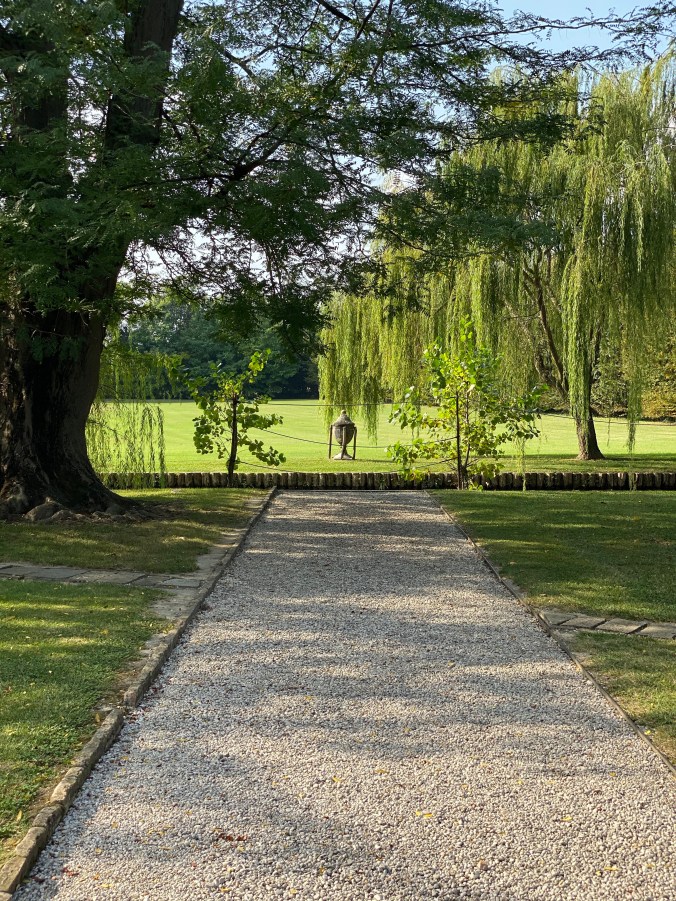
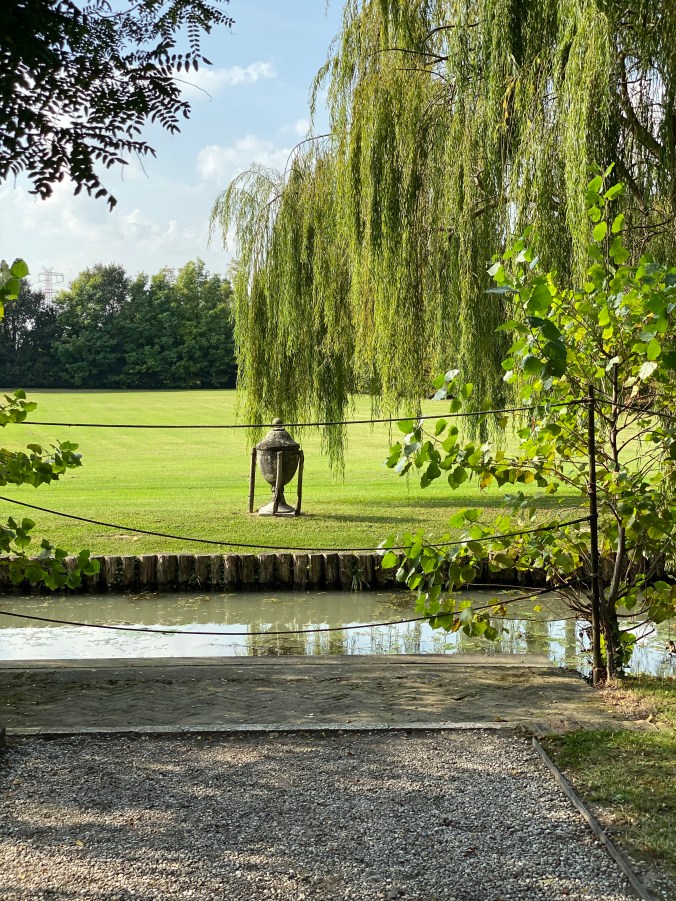
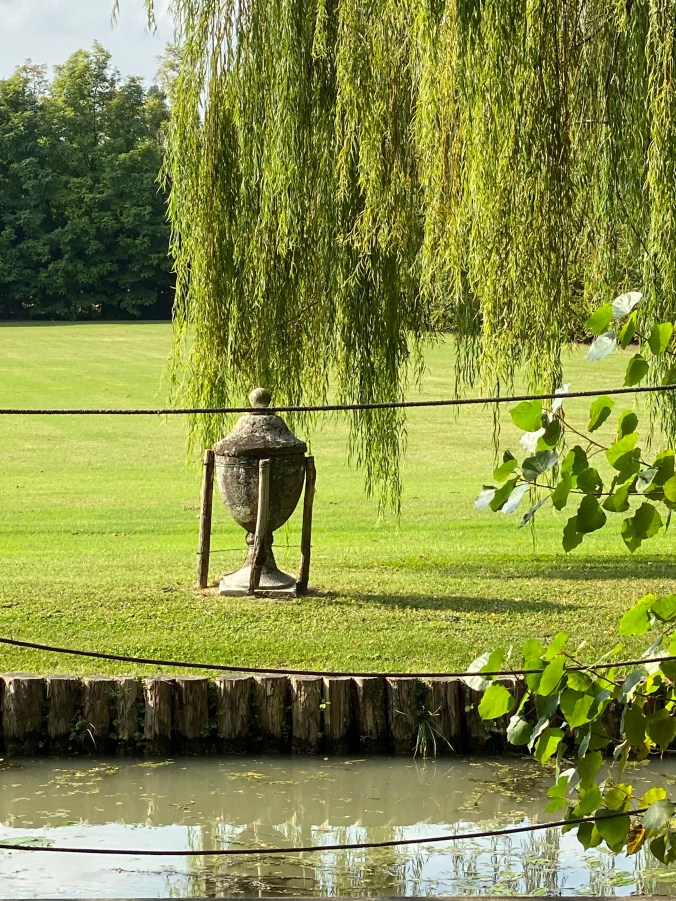
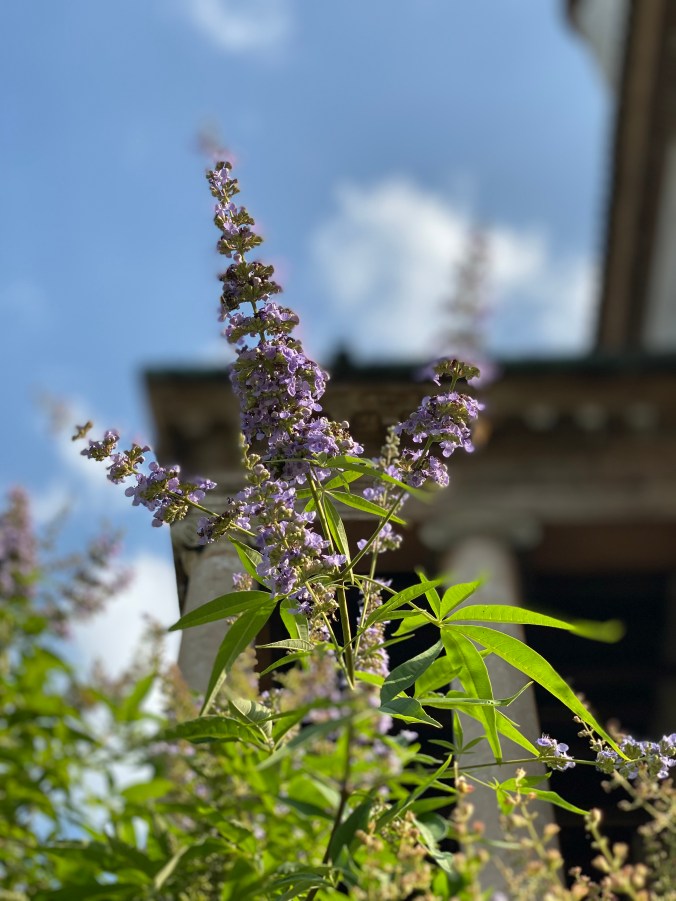


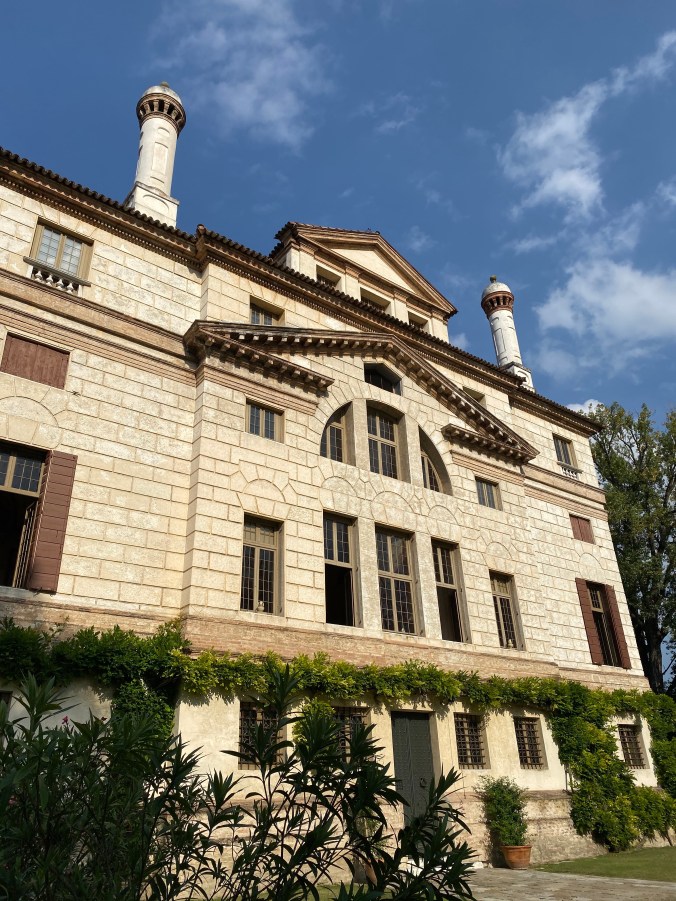
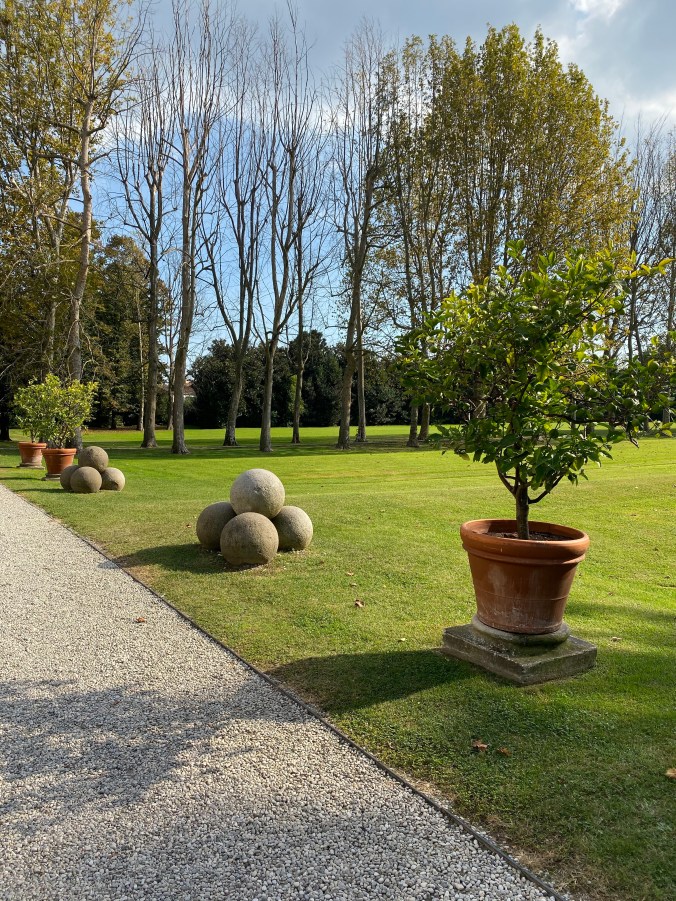
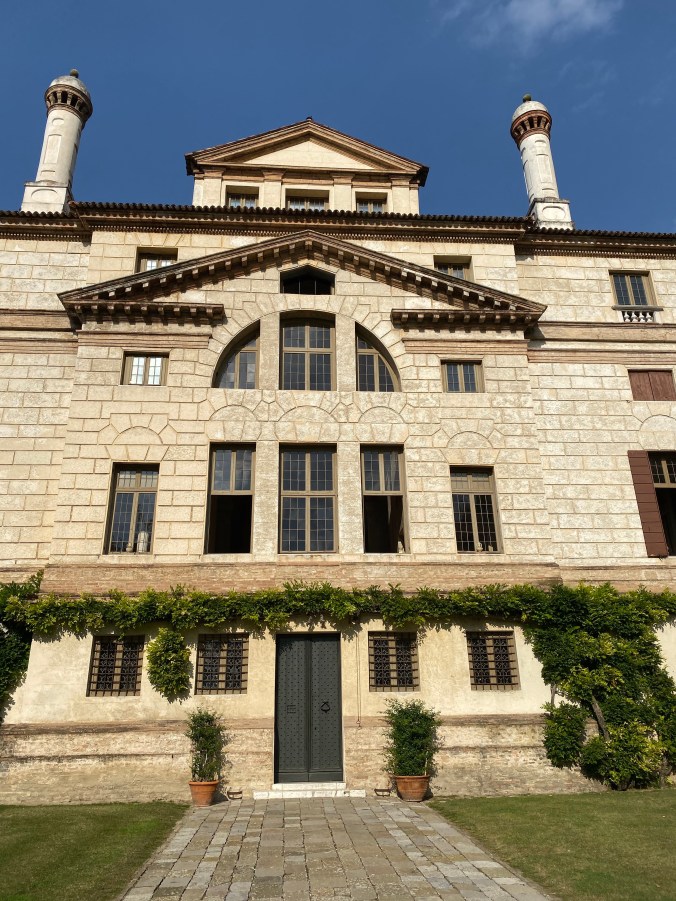


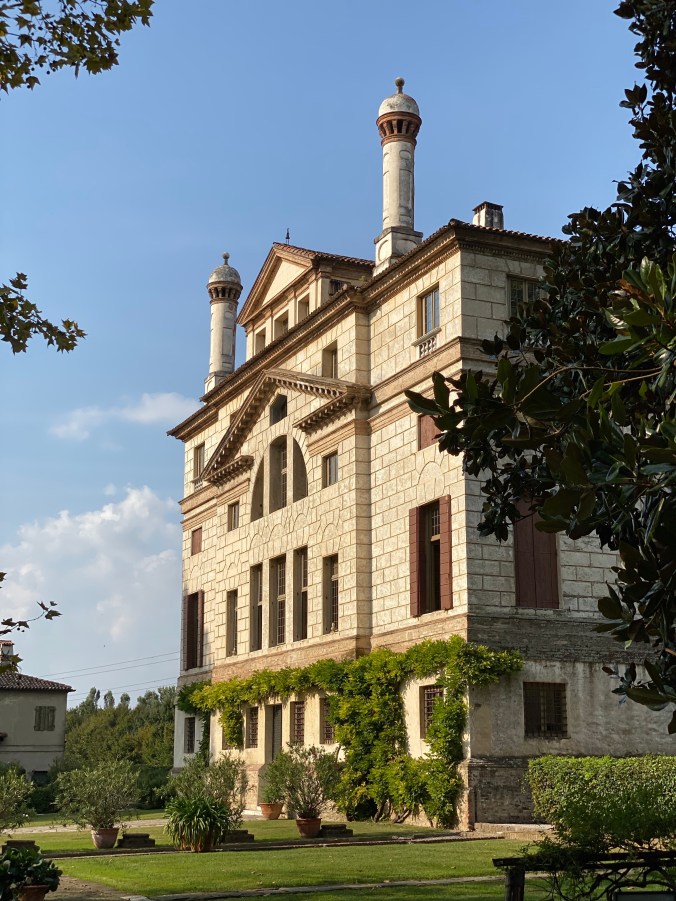
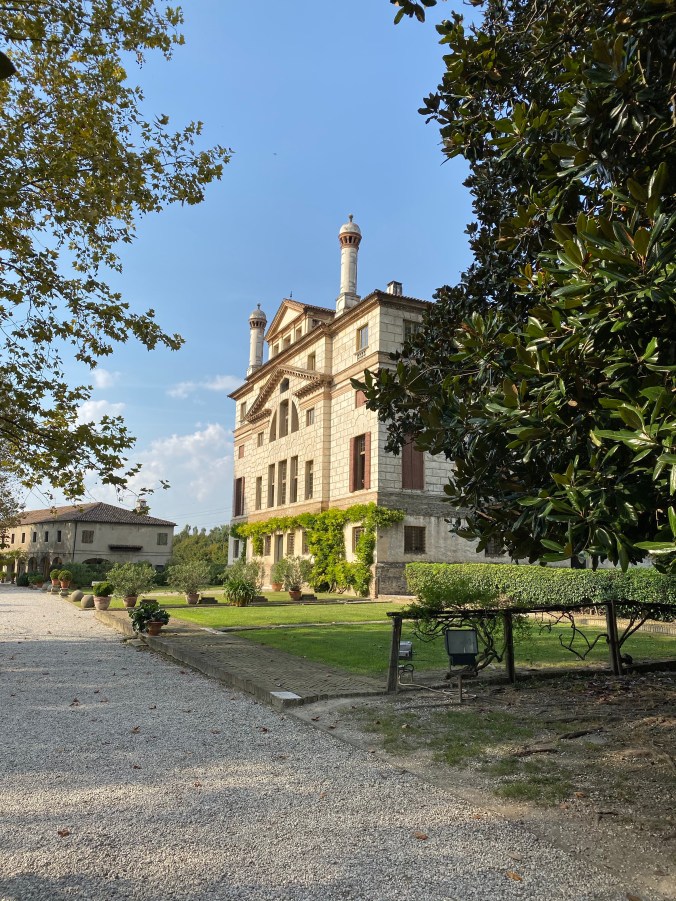
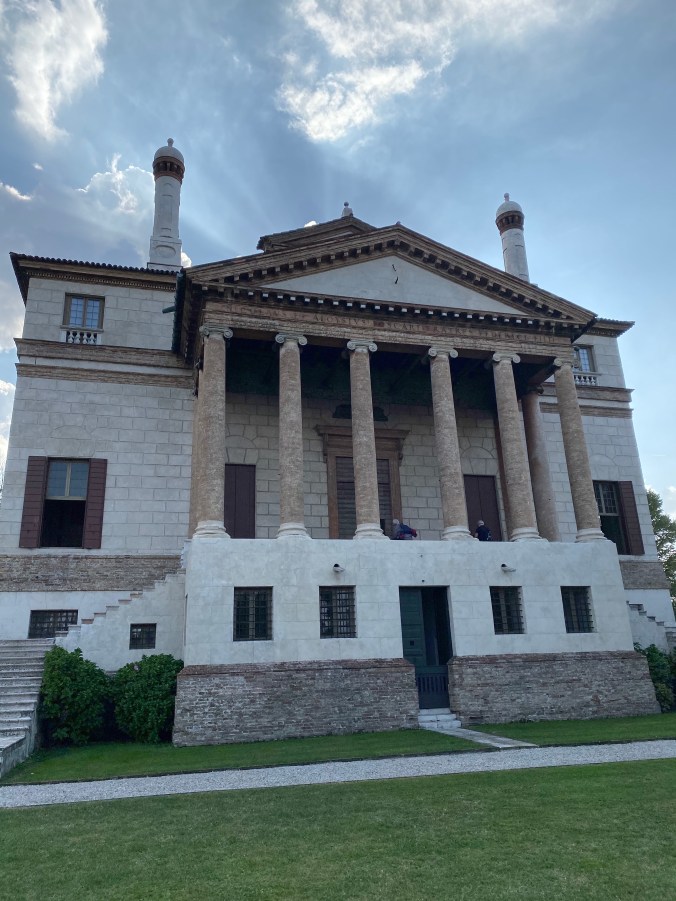
The villa stands upon a tall basement the separates the piano mobile from the humid base and confers a magnificence to the building. The podium is reminiscent of an antique temple. Many motives derived from traditional lagoon building techniques and also the antique model. As in Venice, the main facade faces the water, but the ionic porch and the grand staircase are modeled after the little temple at the source of the Clitumno, so often used by Palladio.
The majestic twin access stairways imposed a sort of ceremonial route for visiting guests: they arrived in front of the building, ascending towards the owner, who was waiting for them in the center of the porch. The traditional Palladian solution of stiffening the sides of the pronaos projecting through sections of wall is sacrificed precisely to allow the grafting of the stairs. Trees and vegetation were also purposely omitted, so the Malcontenta imposed itself on its visitors with all the majesty of the classic elevation towards the Brenta.
The villa is a particularly effective demonstration of Palladian mastery in obtaining monumental effects using poor materials, essentially bricks and plaster. As it is clearly visible due to the degradation of the surfaces, the whole villa is made of bricks, columns included (except those elements that are easier to obtain by sculpting the stone: bases and capitals), with a marmorino plaster that pretends to be an ashlar stone face gentle, on the model of what sometimes appears on the cell of ancient temples.
The rear façade is considered one of the highest results among the Palladian realizations, with a drilling system that makes the internal layout legible; think of the wall of the large central vaulted room, made almost transparent by the thermal window superimposed on a three-light window. In the latter, the reference to Raphael’s villa Madama is very clear, thus documenting a debt of knowledge that Palladio will never admit directly.
The harmonious internal decoration of Malcontenta was achieved by Giovanni Battista Zelotti and, to a smaller extent, Battista Franco. The major decorative theme is of mythological characters, according to custom built in the cycles of villas in the hinterland in the sixteenth century.
One particular element is the references to the famous mannerist frescoes of the Castle of Fontainebleau (south-east of Paris). This was probably suggested by the Villa’s iconographic program manager, Vittore Grimani. He was a learned friend of the Foscari and for years residing at the court of France.
In a land of people familiar with all kinds of superstitions, of course the Casa Foscari has legends attached to it.
One legend has it that the villa owes the nickname of Malcontenta to a wife of the Foscari house; she was supposedly relegated among its walls in solitude to serve its sentence for its licentious conduct. The mystery hovers over the history of the lady: it is said that she lived in this place her last thirty years, while it was never seen to come out or look out of the windows. The park of the villa was uncultivated and full of weeds and the fact of how the woman managed to survive remains shrouded in mystery. No one ever brought her food and no one ever lived with her in the villa; hypotheses and anecdotes circulate about these strange circumstances.
But there are also two historical versions:
for the first: it seems [without source] that the place was so nicknamed as early as 1431, to remember the discontent expressed by the inhabitants of Padua and Piove di Sacco regarding the construction of the Brenta Canal; for the second : thirty years before the act of ownership of the Foscari the area was already called Malcontenta, probably from “Brenta poorly contained”, because the river overflowed often.
A legend has it that the villa owes the nickname of Malcontenta to a lady of the Foscari house, relegated among its walls in solitude to serve its sentence for its licentious conduct. The mystery hovers over the history of the lady: it is said that she lived in this place her last thirty years, while it was never seen to come out or look out of the windows.
The park of the villa was uncultivated and full of weeds and the fact of how the woman managed to survive remains shrouded in mystery. No one ever brought her food and no one ever lived with her in the villa; hypotheses and anecdotes circulate about these strange circumstances.
But there are also two historical versions:
for the first: it seems [without source] that the place was so nicknamed as early as 1431, to remember the discontent expressed by the inhabitants of Padua and Piove di Sacco regarding the construction of the Brenta Canal;
for the second [3]: thirty years before the act of ownership of the Foscari the area was already called Malcontenta, probably from “Brenta poorly contained”, because the river overflowed often.
Antonio Foscari, FRESCOS within Palladio’s Architecture. Malcontenta 1557-1575, Lars Müller Publisher Zurigo, 2013
http://lamalcontenta.com/index.php/en/architecture
The fabbrica designed by Palladio for Nicolò and Alvise Foscari, upon returning from his last trip in Rome (1554), is an expression of extraordinary completeness of his theoretical convictions.
It is laid out on three levels, in a way that each level distinguishes itself among the functional activities (on the ground floor), the “noble” activities (on the first floor), and the deposit of agricultural goods (on the top floor).
It is symmetrical, in a way that each of the two clients could have his own independent apartment.
Each apartment, to either side of the axis of symmetry – is composed of three rooms. Of these, two rooms (the major and the minor) have dimensions that are regulated by the same proportional criteria; the third room has a square floor plan.
The two apartments are laid on either side of a central space of official importance whose function is shared by both clients, according to the practice already adopted in other villas (and that have been used for quite a long time in Venetian homes).
Inside the fabbrica, the central space is a cross space. This architectural solution attributes to the whole construction the character of the building to a central plan.
This body of fabbrica – a type of parallelepipedal is characterized by an exceptional architectural element marking vigorously its external image towards the Brenta River: a portico, specifically a hexastyle ionic portico, that reproduces the typology of a temple of ancient Rome.
It is for the first time that a citation of this kind makes its appearance, instead of a loggia, in the rich Palladian production of case di villa. This exemplary form, with columns also along the side of the portico, will not be repeated again, because no other Palladian fabbrica has external staircases that lead up to the portico from either side.
The ornaments, which are normally in stone, are made here in cotto. They run horizontally along the principle facade, extending as bands on the either side of the fabbrica all the way to the rear facade, contributing to form an unexpected composition.
The window that appears on the rear facade is itself an evocation of ancient Roman constructive typology (that of thermal baths), in the same way as on the principle facade are the appearances of the portico and of the system external staircases leading up to it.
This fabbrica is made – in evident controversy with the Venetian tradition – with a structural system of Roman conception. The floors – both of the piano nobile as well as the intermediate level above the piano nobile – are in fact structured by brick vaults that unload their weight and forces on the walls which thicken as they near the ground.
To be continued

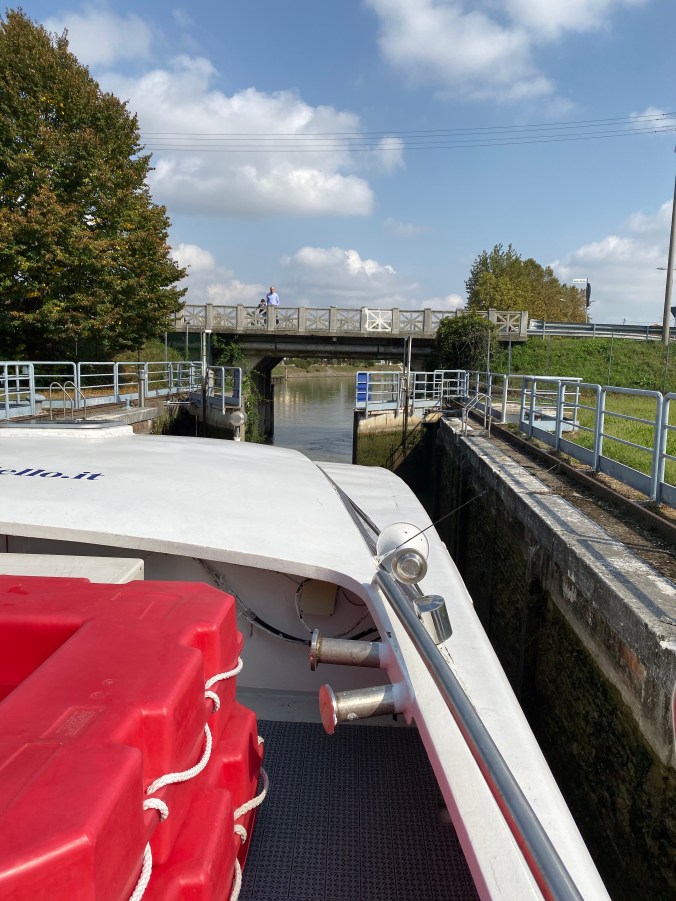
Back onboard the Burchiello, my cruise continued toward Venice from Stra. First we had to sail through the Dolo Locks.
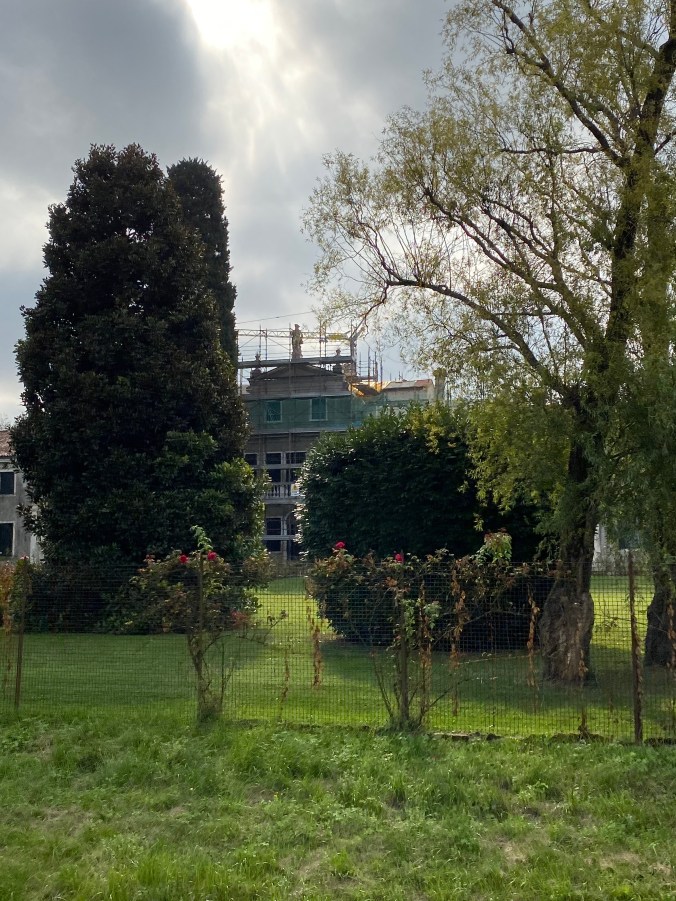
Soon we were passing many amazing ville, visible on the left and right banks of the canal. This area is around Mira, and has a high percentage of villas per square mile! We also passed very beautiful sections of the canals, with willow trees skimming the water and many fisherman catching their Sunday lunch.
It was smooth sailing and I had one of the best seats on the boat.



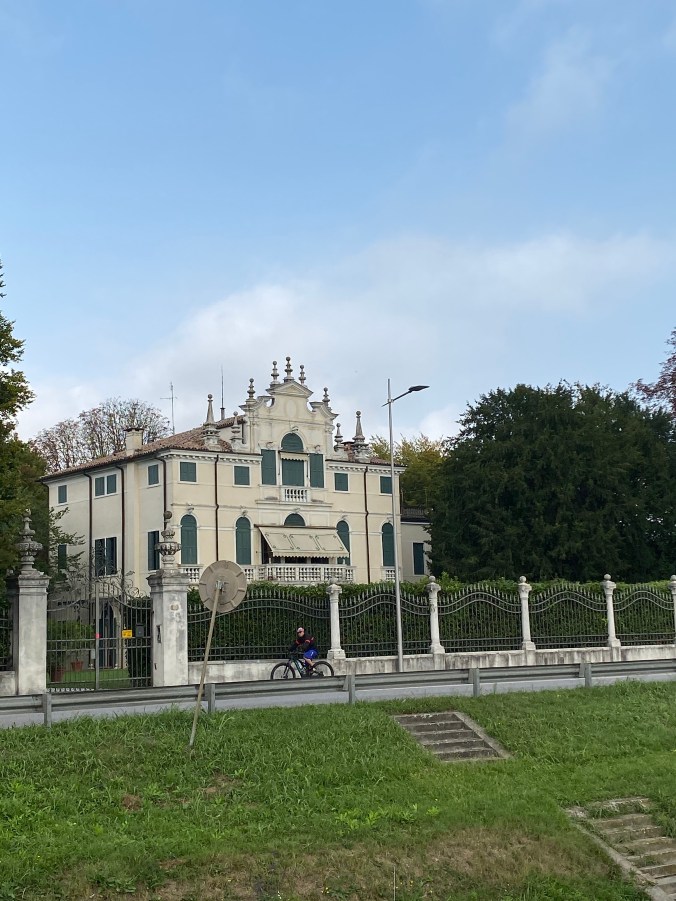


Next we passed through the Mira Locks.


We stopped at Villa Widmann, said to be a typical 18th century residence (that is if you were a part of the aristocracy!). It houses luscious frescoes and has lovely gardens.


To be continued.
1. Italy is only slightly larger than the state of Arizona
2. Italy’s population is about 58 million
3. About one-fifth of Italy’s population is over the age of 65
4. The average life expectancy of an Italian is 79.54 years, slightly higher than the U.S.’s 78.2-year average
5. The pizza was invented in Naples
6. The average Italian loves his bread! They eat about a half-pound a day!
7. The average Italian consumes 26 gallons of wine each year
8. Italy is the fourth most-visited country in the world, with about 5 million visitors annually
9. Italy has more hotel rooms than any other country in Europe
10. More than 75 percent of Italy is classified as either hilly or mountainous
11. Italy did not become a “united” country until 1861
12. Ice cream cones were invented in Italy, and so were eyeglasses!
13. Italy has more masterpieces per square mile than any other country, reflecting the country’s love for great art
14. The wolf is Italy’s unofficial national animal
15. The University of Rome is the largest in Europe, enrolling about 150,000 students at any given time
16. Italians suffer and have suffered more earthquakes than any other country’s people
17. The most common Italian surname is Russo
18. Each night, most Italians take a pre-dinner stroll known as a passeggiata
19. About 85 percent of Italians are Roman Catholic
20. In Italy, soccer fans are known as tifosi, carriers of typhus, due to their rowdy behavior
21. Italy boasts the world’s longest land tunnel, the 22-mile-long Lötschberg Base Tunnel, a railway link between Italy and Switzerland
22. Italians must be 18 years old to vote for the lower house of the parliament but cannot vote for the upper house – the Senate – until they are 25
23. The world’s first operas were composed in Italy and the country is still considered the opera capital of the world
24. There are two independent states that sit within Italy’s borders: San Marino and Vatican City
25. Every day, about 3,000 Euro are tossed into Rome’s famed Trevi Fountain. The money is used to subsidize a market for Rome’s needy.


You must be logged in to post a comment.