Celebrating women art patrons: Gertrude Stein

Gertrude Stein (1874–1946)

Expat American writer who hosted the avant-garde art world at her Paris salons

Screen Shot 2019-09-05 at 08.18.50Through collecting art, American writer Gertrude Stein solidified her position among avant-garde artists in Paris, and found a community that was supportive of both her experimental work and her lesbian lifestyle. In 1901, Stein dropped out of Johns Hopkins Medical School and followed her aspiring-artist brother, Leo, to London and then Paris.

Through Leo, Stein began to acquaint herself with the bohemian artists living around the Montmartre neighborhood. In 1905, Stein met Pablo Picasso. He began to paint her portrait, which he finished the next year. It was a crucial step in the development of modernism: In the picture, Stein’s face adopts a flatness and mask-like quality that Picasso would soon push to the extreme in Les Demoiselles d’Avignon (1907), the firstCubist painting.

Screen Shot 2019-09-05 at 08.19.46
Stein’s patronage helped Picasso to continue painting throughout the early 1900s before he received international acclaim. His portrait of Stein is seen above her left shoulder in the photograph below.

Screen Shot 2019-09-05 at 08.20.44


Stein also collected work by Paul Cézanne, one of the great Post-Impressionist painters, renowned for his radiant landscapes, intense portraits, and complex still lifes.
,Juan Gris and Henri Matisse also benefited from her patronage. Meanwhile, Stein produced her own groundbreaking body of literature, which grew to include Three Lives (1909), Tender Buttons (1914), and The Autobiography of Alice B. Toklas (1933).

The American Memorial Chapel at London’s St. Paul’s Cathedral

Screen Shot 2019-08-29 at 20.03.41

The website of  St Paul’s proudly states that “the UK has had a long relationship with the American people, formed largely after the Second World War, a conflict in which thousands of Americans based within the UK were to give their lives.”
The most visible striking reminder of this sacrifice and subsequent deep friendship can be found beyond the High Altar at the very east end of the Cathedral, in the American Memorial Chapel, a space rebuilt after being destroyed in the Blitz and dedicated in its entirety to the American dead of WWII.


At the heart of the chapel sits a huge, 500-page, leather-bound book; a roll of honor to the 28,000 Americans – from Aaberg to Zingale – stationed in the UK who gave their lives throughout the War. The book opens:

Defending freedom from the fierce assault of tyranny

they shared the honor and the sacrifice.

Though they died before the dawn of victory their names and deed

will long be remembered where ever free men live.

Thousands of the men named in the roll of honor died on the Normandy beaches on D-Day, as well as in training operations in the lead up to the campaign and in the subsequent battles on the European mainland, right up until the day on which the Allies celebrated Victory in Europe.

The book was unveiled in 1958 at a service to dedicate the Chapel, attended by The Queen and American Vice President, Richard M Nixon.

Screen Shot 2019-08-29 at 20.05.09


A year later, President Dwight D Eisenhower visited the Chapel and the roll of honor. Words in the book written by the President, who as a soldier commanded the Allied troops on D-Day, read:

Each name inscribed in this book is a story of personal tragedy and a grieving family; a story repeated endlessly in white crosses girdling the globe. The Americans, whose names here appear, were part of the price that free men have been forced a second time to pay in this century to defend human liberty and rights.

Fittingly, this roll of honor has been enshrined by the Mother Country of all English-speaking democracies in this special chapel of St Paul’s, once a target of barbaric attack. Here, we and all who shall hereafter live in freedom will be reminded that to these men and their comrades of all the Allies we owe a debt to be paid with grateful remembrance of their sacrifice and with the high resolve that the cause for which they died shall live eternally.

St Paul’s proudly states that the chapel itself is truly a place for all Americans. The three stained-glass windows contain the state symbols of every American state. The wood carvings contain the birds, plants and flowers of America and hidden away in one panel are a space rocket and stars – a nod to the space program that was being developed at the time the Chapel was completed.

Screen Shot 2019-08-29 at 20.07.05

Each November, St Paul’s holds a US Thanksgiving service, to which all Americans in London are invited.

Screen Shot 2019-08-29 at 20.06.14


I visited this august memorial last month and was struck by its peaceful majesty.  In this calm, quiet space, the American war dead are remembered.  The inscription in the floor tells the story, simply and beautifully. It reads: “To the American dead of the Second World War from the People of Britain.”

Screen Shot 2019-08-29 at 20.20.26

IMG_0084


IMG_0085

img_0088


Sad and true, the anti-reforms in Italy’s art world

https://www.telegraph.co.uk/news/2019/08/22/director-florence-museum-home-michelangelos-david-forced-italys/?fbclid=IwAR0VBbAXxL02sU8ye1FYAl8aL-ioU3lh5xhR0t8DkPeQxebVbk4qUAwWEwg


Screen Shot 2019-08-29 at 19.40.04

Sadly, the reforms that allowed even foreign art world personnel to guide Italian public museums have been repealed. You can read about it here:

Screen Shot 2019-08-29 at 19.41.45

https://www.ft.com/content/61380d42-c33b-11e9-a8e9-296ca66511c9?sharetype=blocked&fbclid=IwAR2aJOQH_BnAQRoeT849n6zEwKkJ0J1KH1gQdEMsos4s7bJMk4qoqw67RgA

Il Duomo, Prato

duomo_prato_cathedral

The Prato Cathedral (Cattedrale di San Stefano) is a handsome Roman Catholic Church in Prato, Tuscany, Central Italy. It is one of the most ancient churches in the city, already in existence in the 10th century. It was built in several successive stages in the Romanesque style. The church contains a number of notable works of art, in particular fine sculpture.

Error
This video doesn’t exist


Prato’s church of Saint Stephen was built in a green meadow (in Italian: prato) after an appearance of the Virgin Mary near the village of Borgo al Cornio (the present center of Prato). The first building was a small parish church. which the earliest document dates to AD 994.

The expansion of the church began in the 15th century and transformed the modest building into one of the most lovely Gothic-Romanesque buildings in Tuscany.

The video below shows the annual celebration during which the relic, the so-called “sacred belt or girdle” of the Virgin Mary is shown.

IMG_5519

The church we see today dates from the Romanesque period of the 12th century: the nave, side walls and greater part of the bell tower remain from this date. The upper stage of the bell tower was constructed in 1356.
The church’s exterior pulpit by Donatello and Michelozzo:

images

In the 14th century, the cathedral obtained a relic, the so-called Sacra Cintola or “Holy Belt” of the Virgin Mary and the church was re-envisioned.  The 2nd facade was built, allowing a transept to be constructed between the old facade and the new one. This space gives way to a new, exterior pulpit, built by Michelozzo and decorated by Donatello, between 1428 and 1438.

The exterior pulpit was constructed on the right front corner of the facade.

IMG_5898


IMG_5899


IMG_5900


IMG_5901


IMG_5902


IMG_1664


IMG_1644


IMG_1645


IMG_1646


IMG_1647


IMG_1649


IMG_1651

The seven original reliefs of the parapet were removed from the pulpit in 1967 and can be seen today in Prato’s cathedral museum.  Here they are, photographed inside the museum:

IMG_5931IMG_5932IMG_5933IMG_5934IMG_5926IMG_5927IMG_5928IMG_5929IMG_5930IMG_5935IMG_5936IMG_5937


Error
This video doesn’t exist


The church was built with a Latin cross ground plan in Romanesque style.  The aisles are separated from the nave by elegant columns of green serpentine, the capitals being attributed to Guidetto. The vaults, designed by Ferdinando Tacca, were added in the 17th century.

IMG_5826

The north aisle houses a notable Renaissance pulpit in white marble (1469–1473). The base is decorated with sphinxes. The parapet has reliefs by Antonio Rossellino, portraying the Assumption and the Stories of St. Stephen, and by Mino da Fiesole portraying the Stories of St. John the Baptist.

IMG_5829


IMG_5828


IMG_5827


Error
This video doesn’t exist


The Assumption Chapel in the transept was frescoed in 1435-1436 by the so-called Master of Prato and by a young Paolo Uccello, who painted the Stories of the Virgin and St. Stephen. They show a bizarre fantasy of enchanted figures caught in a wide range of brilliant colors, and surrounded by Brunelleschi-like architectures.
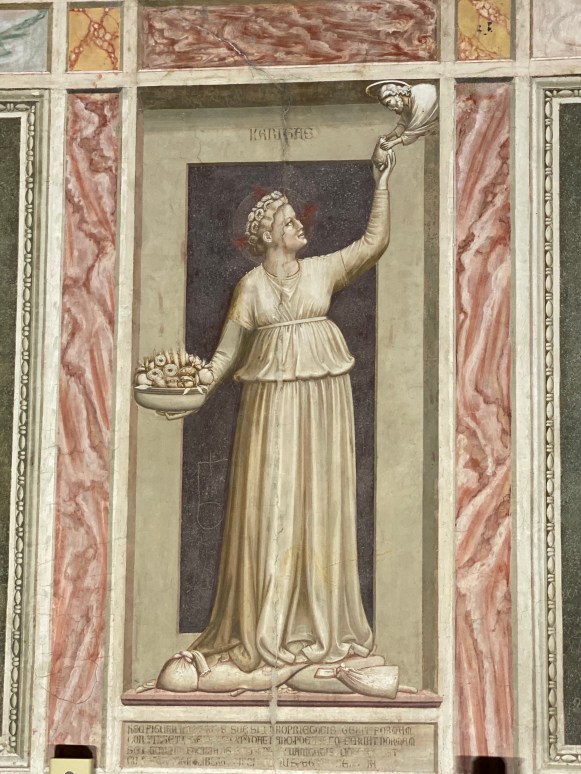
In the main chapel, or chancel, Filippo Lippi and Fra Diamante painted the Stories of St. Stephen and St. John the Baptist.

On the lower north wall are depicted the Obsequies of St. Stephen, in which Lippi portrayed Pope Pius II, set in a Palaeo-Christian basilica, as an imposing figure in scarlet costume. On the right is the artist’s self-portrait. On the opposite wall is Herod’s Banquet, showing a large hall in which Salome is performing her ballet, and the handing over of the head of John the Baptist to Herodias. The altar is by Ferdinando Tacca (1653).

The Manassei Chapel was frescoed by a pupil of Agnolo Gaddi in the early 15th century with Stories of St. Margaret and St. James. The last chapel on the left, the Chapel of the Inghirami, houses a funerary monument attributed to Benedetto da Maiano and a stained glass window from the early 16th century.

IMG_5839


IMG_5841


IMG_5842


IMG_5844


IMG_5845


IMG_5847


IMG_5848


IMG_5849


IMG_5850


IMG_5851


IMG_5852


IMG_5856


IMG_5854


IMG_5857


IMG_5858


IMG_5859


IMG_5860


IMG_5862


IMG_5865


IMG_5830


IMG_5831


IMG_5832


IMG_5833


IMG_5834


IMG_5835


IMG_5836


IMG_5837


IMG_5838


IMG_5839


IMG_5840


IMG_5841


IMG_5842


IMG_5843


IMG_5844


IMG_5845


IMG_5846


IMG_5847


IMG_5848


IMG_5849


IMG_5850


IMG_5851


IMG_5830IMG_5831IMG_5832IMG_5833IMG_5834IMG_5835IMG_5836IMG_5837IMG_5838IMG_5839IMG_5840IMG_5841IMG_5842IMG_5843IMG_5844IMG_5845

IMG_5846IMG_5847IMG_5848IMG_5849IMG_5850IMG_5851IMG_5852IMG_5853IMG_5854IMG_5855IMG_5856IMG_5857IMG_5858IMG_5859IMG_5860IMG_5861IMG_5862IMG_5864


IMG_5858IMG_5859IMG_5860IMG_5861IMG_5862IMG_5864IMG_5865IMG_5866IMG_5867IMG_5868IMG_5869IMG_5870IMG_5871IMG_5872IMG_5873IMG_5874IMG_5875IMG_5876


IMG_5895IMG_5896IMG_5897IMG_5898IMG_5899IMG_5900IMG_5901IMG_5902IMG_5903IMG_5904IMG_5905IMG_5906IMG_5907IMG_5908IMG_5908IMG_5909IMG_5910IMG_5911IMG_5912IMG_5913IMG_5914IMG_5915fullsizeoutput_d39IMG_5917IMG_5918IMG_5919IMG_5938IMG_5939


IMG_1653IMG_1654IMG_1655IMG_1656IMG_1657

IMG_1658IMG_1659

Villa Palmieri in the 19th century, including visits by Queen Victoria

Queen Victoria paid three extended visits to Villa Palmieri in Florence. Florence was one of the favorite holiday locales for the British monarch.  Some labels on trees at the villa record three visits of Queen Victoria to Villa Palmieri in 1888, 1893 and 1894.

In 1888, the New York Times published an article about the Queen’s visit to the villa, giving us an amazing window into 19th-century life. From it we learn that before arriving at Villa Palmieri (she typically came for about a month) sent her personal items. Here’s the Times article:

Queen Victoria’s private apartments at Villa Palmieri, on the first floor, were almost entirely furnished by the Windsors. Her majesty sent the bed, the furniture, a bathroom, with all the bathroom fixtures, a rocking chair, two armchairs, a sofa, a desk and a desk, as well as two portraits of the Prince Consort, a box of photographs of the members of the family and a basket of books. (…) that a kiosk on the ground floor of the villa, with a beautiful view, and here the Queen spends most of the time and during sunny days a tent is mounted above the terrace of the living rooms on the ground floor, overlooking the garden, with a large balustrade to which are hung vases full of flowers.” New York Times, April 29th 1888.

Screen Shot 2019-08-28 at 11.00.05


Screen Shot 2019-08-26 at 13.00.29

The view above is of Villa Palmieri from a late 19th-century postcard, showing us how the villa looked as the Queen arrived.

Screen Shot 2019-08-28 at 11.46.32

Data dell’opera: 1873
Collocazione: Firenze, Villa Palmieri
Fotografo: Pachò Lodovico

Screen Shot 2019-08-28 at 11.48.00

Data dell’opera: 1873
Collocazione: Firenze, Villa Palmieri
Fotografo: Pachò Lodovico
Data dello scatto: 1920-1930
Luogo dello scatto: Firenze
Collezione: Collezione privata-ex Collezione Malandrini/Deposito Raccolte Museali F.lli Alinari (RMFA), Firenze

Screen Shot 2019-08-28 at 12.01.29

BGA-F-023726-0000
Veduta parziale del laghetto e del giardino, di Villa Palmieri, a Firenze.
Credito fotografico obbligatorio:
Archivi Alinari, Firenze
AVVERTENZA:
Autorizzazione obbligatoria per utilizzi non editoriali: rivolgersi ad Archivi Alinari
Data dell’opera: 1873
Periodo e stile: Romanticismo
Collocazione: Firenze, Villa Palmieri
Fotografo: Brogi, Giacomo
Data dello scatto: 1920 – 1930 ca.
Luogo dello scatto: Firenze, Villa Palmieri
Collezione: Archivi Alinari-archivio Brogi, Firenze

Screen Shot 2019-08-28 at 12.02.52

BGA-F-009572-0000
Cortile di Villa Palmieri, a Firenze, con al centro una vasca circolare attorniata da vasi di fiori.
Credito fotografico obbligatorio:
Archivi Alinari, Firenze
AVVERTENZA:
Autorizzazione obbligatoria per utilizzi non editoriali: rivolgersi ad Archivi Alinari
Data dell’opera: 1697 ca.
Periodo e stile: Tardo Barocco
Collocazione: Firenze
Fotografo: Brogi, Giacomo
Data dello scatto: 1890 ca.
Luogo dello scatto: Firenze
Collezione: Archivi Alinari-archivio Brogi, Firenze


Screen Shot 2019-08-28 at 11.49.46

Credito fotografico obbligatorio:
Archivi Alinari, Firenze
AVVERTENZA:
Autorizzazione obbligatoria per utilizzi non editoriali: rivolgersi ad Archivi Alinari
Fotografo: Brogi, Giacomo
Data dello scatto: 1890
Luogo dello scatto: Firenze
Collezione: Archivi Alinari-archivio Brogi, Firenze


Screen Shot 2019-08-28 at 11.50.46

Credito fotografico obbligatorio:
Archivi Alinari, Firenze
AVVERTENZA:
Autorizzazione obbligatoria per utilizzi non editoriali: rivolgersi ad Archivi Alinari
Fotografo: Brogi, Edizioni
Data dello scatto: 1880-1890 ca.
Luogo dello scatto: Firenze
Collezione: Raccolte Museali Fratelli Alinari (RMFA)-collezione Malandrini, Firenze

Screen Shot 2019-08-28 at 11.55.04

APA-F-001557-0000
Una stanza arredata in stile ottocentesco a Villa Palmieri, Firenze
Credito fotografico obbligatorio:
Archivi Alinari, Firenze
AVVERTENZA:
Autorizzazione obbligatoria per utilizzi non editoriali: rivolgersi ad Archivi Alinari
Fotografo: Alinari, Fratelli
Data dello scatto: 21/03/1893
Luogo dello scatto: Firenze, Villa Palmieri
Collezione: Archivi Alinari-archivio Alinari, Firenze


Screen Shot 2019-08-28 at 11.51.45


Credito fotografico obbligatorio:
Archivi Alinari, Firenze
AVVERTENZA:
Autorizzazione obbligatoria per utilizzi non editoriali: rivolgersi ad Archivi Alinari
Fotografo: Borgiotti, Fratelli
Data dello scatto: 1880 ca.
Luogo dello scatto: Firenze
Collezione: Raccolte Museali Fratelli Alinari (RMFA)-collezione Malandrini, Firenze


Mary Quant

fullsizeoutput_1716

Last month I got to see the Mary Quant exhibition at the Victoria and Albert Museum in London.  It was a childhood dream to wear Mary Quant fashion.  Her work was not for sale in the small interior West American town where I grew up.  But, my mother could sew anything and she fashioned some Quant designs for me.  It breaks my heart that we didn’t keep all of those great things my mom sewed. But, they are stored in my memory and I remember how I felt when I wore them.  That suffices in a pretty big way.  Thanks mom!
IMG_0522

But Mary Quant’s fashions, along with Twiggy and the Beatles, were a big part of my burgeoning (teenage) identity.  Well, I mean that’s obvious.  The name of my blog is from the Beatles: “Get back!”

fullsizeoutput_1719


The photo above of legs and the next 3 of hair were the kind of thing that fired my imagination.  I couldn’t buy her fashions in South Dakota in the 1960s, but I could wear the tights and haircuts she inspired!  And I did!
 

fullsizeoutput_1718


fullsizeoutput_1715


IMG_0548


The rest of my pictures of the V & A exhibition are in no particular order.  It was a great and very fun show, and I loved seeing and snapping pix of it.
 

IMG_0519


IMG_0521

IMG_0523


IMG_0525

IMG_0520

IMG_0526


IMG_0530


IMG_0531


IMG_0543


IMG_0541

IMG_0542

IMG_0540

IMG_0539


IMG_0537


IMG_0538


IMG_0544


IMG_0546


IMG_0549


fullsizeoutput_171a


The next photo was completely my scene.  I wore these styles, these colors, and this vibe.


fullsizeoutput_1717


IMG_0560

IMG_0561

IMG_0562

I didn’t know about Mary Quant’s paper dolls, or sticker books, or I would have been seeking them out.  We didn’t have the internet back then, but I bet I could have figured it out, long-hand, so to speak.  I guarantee you that I would have placed an international order with my babysitting money and waited for months to receive my treasures.  This is how I honed my long game, which I still use with great results.

IMG_0563

IMG_0564IMG_0565IMG_0570


The jersey dress changed fashion.  I’m a big fan and I still wear it.

IMG_0571IMG_0574IMG_0575IMG_0576IMG_0577IMG_0578IMG_0579IMG_0580


IMG_0581IMG_0582IMG_0584IMG_0585IMG_0586IMG_0588

IMG_0589IMG_0590IMG_0592


Was Villa Palmieri the setting for Boccacio’s Decameron?

In Boccaccio’s literary masterpiece, The Decameron, three young Florentine nobles and 10 of their friends (the Decamerone) take refuge from the Black Plague in a villa outside Florence.  It is believed that the actual location for the story was the Villa Palmieri, which still stands today in the village of San Domenico, near Florence.

Screen Shot 2019-08-28 at 10.33.20

Screen Shot 2019-08-26 at 13.02.22

An aerial view of the Villa today.

The history of the villa is fascinating. We know that it was in existence at the end of the 14th century, when it was owned by the Fini family. They sold it in 1454 to the noted humanist scholar Matteo di Marco Palmieri, whose name it still bears. Palmieri was a Medici family friend.

One of the descendants, Palmiero Palmieri, restructured the gardens in 1697, sweeping away all vestiges of the earlier arrangements to create a south-facing terrace, an arcaded loggia of five bays, and the symmetrically paired curved stairs (tenaglia) that lead to the lemon garden in the lower level. The lemon garden survives, though postwar renovation stripped the baroque décor from the villa’s stuccoed façade.

In the later 18th century, the house was acquired by a newly ennobled 3rd Earl Cowper.

By 1840, the villa was the home of French novelist, Alexandre Dumas. Dumas describes the villa in his book of Florentine travel essays, La Villa Palmieri (Paris, 1843): “It was in this house that Boccaccio wrote his Decameron. I thought its name would bring me happiness, and set up my office in the same room in which, four hundred and ninety-three years earlier, Boccaccio had established his.”

In 1873 the villa was purchased by James Ludovic Lindsay, 26th Earl of Crawford who recreated part of the grounds in the fashionable English naturalistic landscape manner of parkland dotted with specimen trees.  Lindsay also had plantings of exotic, tender plants that could not be grown in the open in England. His commissions included also the scenic basin of the Fountain of Three Faces and a little chapel in neo-Baroque manner to one side of the villa.

Queen Victoria chose Villa Palmieri as her vacation locale several times in the late 19th century, and the Villa and the Queen will be the subject of another post coming soon.

From 1907-1925, the villa was owned by Chicago industrialist James Ellsworth.

The Villetta, an outbuilding formerly part of the extensive Villa Palmieri grounds, was purchased in 1927 by Myron Taylor, the American ambassador to the Holy see, who recreated a Beaux-Arts version of an Italian terraced garden and named it Villa Schifanoia.

Below, a detail of the villa, photographed c. 1930

Screen Shot 2019-08-28 at 11.57.04

BGA-F-023722-0000
Veduta del cortile di Villa Palmieri, a Firenze.
Credito fotografico obbligatorio:
Archivi Alinari, Firenze
AVVERTENZA:
Autorizzazione obbligatoria per utilizzi non editoriali: rivolgersi ad Archivi Alinari
Data dell’opera: 1697 ca.
Periodo e stile: Tardo Barocco
Collocazione: Firenze
Fotografo: Brogi, Giacomo
Data dello scatto: 1920 – 1930 ca.
Luogo dello scatto: Firenze, Villa Palmieri
Collezione: Archivi Alinari-archivio Brogi, Firenze

During the WWII the villa became a military garrison and some parts, including the baroque decorations on the façade, were destroyed.

The current owners, the Benellis, restored it.

fullsizeoutput_563

fullsizeoutput_5cb

“Unlike the Gamberaia, ” Georgina Masson observed in her book Italian Gardens, “Villa Palmieri has suffered from having been a ‘show-place’ and the alterations of many owners to suit the fashions of their day, so that little of its original character remains.”

Today the oldest remaining parts of Villa Palmieri are the oval geometric garden of lemons which are set out in warm weather ranged round the central circular basin, itself framed in quadrant spandrels, all framed in clipped low boxwood hedging, following an 18th-century engraving of this garden space by Giuseppe Zocchi.

The upper terrace is supported on the vaults of the limonaia, glazed in the 19th century, where the lemon trees were protected from the very occasional hard frost. Some labels on trees record three visits of Queen Victoria to Villa Palmieri, in 1888, 1893 and 1894. I’m writing a post about the Queen and the villa soon.

*****************************

So, was this villa really the setting for Boccaccio’s Decameron?

In fact, we don’t know.

Describing the Third Day in the Decameron, Boccacio mentioned a paradisiacal garden on the outskirts of Florence where the young people met. From the description, it seems that the garden faces south towards Florence, therefore it would be on the slopes of Fiesole.

There are not many villas of 14-century origin in that area and so scholars believe Boccacio’s setting is almost certainly Villa Palmieri.  At that time, the villa was already endowed with large farms, meadows and water sources described by Boccaccio.

The complication is that in the neighborhood of the Palmieri, there were several annexed buildings, which in turn later became villas, and any of them were as likely to have been the setting described by Boccaccio as Palmieri itself.

Among these are the Villa Benelli from the name of the family that lives there, or Villa Schifanoia, which was once included among the properties of Villa Palmieri.

Boccacio’s description of the fictional villa in Fiesole, where his young people retreated from the Black Death raging in Florence to tell stories, is too general to identify any one villa securely.  You can judge for yourself:

To see this garden, its handsome ordering, the plants, and the fountain

with rivulets issuing from it, was so pleasing to each lady and the

three young men that all began to affirm that,

if Paradise could be made on earth,

they couldn’t conceive a form other

than that of this garden that might be given it.

Screen Shot 2019-08-27 at 12.28.24

Regardless, it is an historic and highly interesting site and I recommend visiting it whenever you have the chance. It is on the outskirts of Florence and an easy bus or cab ride from the center.

Screen Shot 2019-08-27 at 12.30.35


Information Sources: Jones, Ted. Florence and Tuscany: A Literary Guide for Travellers (The I.B.Tauris Literary Guides for Travellers) (p. 44). I.B.Tauris. Kindle Edition and English and Italian versions on Wikipedia.

https://www.elledecor.com/it/lifestyle/a28033941/sfilata-givenchy-firenze-primavera-estate-2020-villa-palmieri/


Liberty of London

fullsizeoutput_16d8

A fixture in the London shopping scene, Liberty is a department store in Great Marlborough Street, in the West End of London. It sells highly curated selections of women’s, men’s and children’s clothing, make-up and perfume, jewelry, accessories, furniture and furnishings, stationery and gifts. The firm is well known for its floral and graphic prints.

IMG_0809

I love any business with a great history and didactic information in a store window.  They could just as well be showing their product line for sale, but they choose to edify.  That’s my kinda store. Especially when it’s Liberty of London!

IMG_0803

While the exterior of this classic London stop has remained in its mock Tudor style best, the interior and the product lines have changed vastly, even in my lifetime.  While I prefer the way the store was when I first visited it with my mother in the 1980s, I have no doubt the management knows how to keep the store vital.  I always enjoy a visit to this lovely emporium on any trip to London.

IMG_0804


IMG_0805


IMG_0806

IMG_0807


IMG_0808

Before this summer, the last time I was at Liberty was in the early 2000s with my then 11-year-old red-headed son. At that time, Paula Pryke had a flower shop at the Liberty main entrance.  It was dynamic! Her shop is gone and the store still has a ghost of a flower shop at its front door.  But, I miss seeing Paula Pryke’s gorgeous arrangements there.  He was less interested in Liberty than in going in and out of tube stations and traveling by train.

IMG_0811

IMG_0812


IMG_0815


IMG_0814

Liberty was created by Arthur Lasenby Liberty, who was born in Chesham, Buckinghamshire, in 1843. His father was a draper and, beginning work at 16, he was apprenticed to a draper. Later, Liberty took a job at Farmer and Rogers, a women’s fashions specialist in Regent Street, rising quickly up the ranks.

He was employed by Messrs Farmer and Rogers  in 1862, the year of the International Exhibition. By 1874, inspired by his 10 years of service, he decided to start a business of his own, which he did the next year.

Screen Shot 2019-08-21 at 09.26.31

With a £2,000 loan from his future father-in-law, Liberty took the lease of half a shop at 218a Regent Street with three staff members. His shop opened in 1875 selling ornaments, fabric and objets d’art from Japan and the East.

Liberty hadn’t wanted to open just another store — he dreamed of an “Eastern Bazaar” in London that could fundamentally change homeware and fashion. Naming his new shop “East India House,” his collection of ornaments, fabrics and objects d’art from the Far East captured the attention of London, already in the crux of orientalist fervor.

It only took 18 months for Liberty to repay his loan, purchase the second half of the store, and begin to add neighbouring properties to his portfolio. From the beginning, the store also imported antiques, with the original V&A museum actually purchasing pieces of Eastern embroidery and rugs for its collection. As the business grew, neighboring properties were bought and added.

In 1884, he introduced the costume department, directed by Edward William Godwin (1833–86), a distinguished architect and a founding member of The Costume Society. Godwin and Liberty created in-house apparel to challenge the fashions of Paris.

Screen Shot 2019-08-21 at 09.31.36

In 1885, 142–144 Regent Street was acquired and housed the ever-increasing demand for carpets and furniture. The basement was named the Eastern Bazaar, and it was the vending place for what was described as “decorative furnishing objects”.

Screen Shot 2019-08-21 at 09.27.41

Liberty renamed the property “Chesham House,” after the place in which he grew up. The store became the most fashionable place to shop in London, and Liberty fabrics were used for both clothing and furnishings. Some of its clientele included famous Pre-Raphaelite artists.

800px-Liberty_(store)_London_UK

To show the kind of innovative approach Liberty had for his business, in November of 1885, he brought 42 villagers from India to stage a living village of Indian artisans.

Liberty’s specialised in Oriental goods, in particular imported Indian silks, and the aim of the display was to generate both publicity and sales for the store.

Liberty_art_fabrics_advertisement_May_1888

During the 1890s, Liberty built strong relationships with many English designers. Some of these designers, including Archibald Knox, practiced the artistic styles we now call  Arts and Crafts and Art Nouveau.  Liberty helped develop Art Nouveau in England through his encouragement of such designers. The company became associated with this new style, to the extent that even today in Italy, Art Nouveau became known as the Stile Liberty, after the London shop.

In 1882, author and playwright Oscar Wilde went on a tour of the United States, bringing with him a wardrobe full of clothes from Liberty, creating a demand for the store’s fashions with Americans. Wilde was obviously a huge fan of Liberty.

Screen Shot 2019-08-21 at 09.28.10

The iconic Tudor revival building was built by Liberty so that business could continue while renovations were being completed on the other premises.  This great building was constructed in 1924 from the timbers of two ships: HMS Impregnable (formerly HMS Howe) and HMS Hindustan.

Screen Shot 2019-08-21 at 09.47.49

HMS Impregnable (c.1900), one of the two ships used to build Liberty

The emporium was designed by Edwin Thomas Hall and his son, Edwin Stanley Hall. They designed the building at the height of the 1920s fashion for Tudor revival.

In 1922, the builders had been given a lump sum of £198,000 to construct it, which they did from the timbers of two ancient ‘three-decker’ battle ships. Records show more than 24,000 cubic feet of ships timbers were used including their decks now being the shop flooring: The HMS Impregnable – built from 3040 100-year-old oaks from the New Forest – and the HMS Hindustan, which measured the length and height of the famous Liberty building.

The ships were not Liberty’s only association with warfare. Carved memorials line the department store’s old staircase pay tribute to the Liberty staff who lost their lives fighting in WWII for a different kind of liberty – freedom from the regimes of the Axis powers.

One only need to look up to the roof , upon which stands a marvel of a gilded copper weathervane. Standing four feet tall and weighing 112 pounds, this golden ship recreates The Mayflower, the English vessel famous in American history for taking pilgrims to the new world in 1620.

Screen Shot 2019-08-21 at 09.49.55


The interior of the shop was designed around three light wells that form the main focus es of the building. Each of these wells was surrounded by smaller rooms to create a cosy feeling. Many of the rooms had fireplaces and some of them still exist.


Screen Shot 2019-08-21 at 09.46.47

Liberty of London was designed to feel like a home, with each atrium was surrounded by smaller rooms, complete with fireplaces and furnishings.

Ever the purveyor of craftsmanship, Arthur Liberty had a furniture workshop in Archway, London. Run by Lawrence Turner, the workshop produced Liberty Arts and Crafts furniture and the intricately carved panels and pillars found throughout the store. The craftsmen allowed his fantasy, ensuring every ornament was a one-off – paving the way for discovery.

Screen Shot 2019-08-21 at 09.31.57

Sadly, Arthur died seven years before the building’s completion and so never saw his dream realised. But, his statue stands proudly at our Flower Shop entrance to welcome you warmly into his emporium of wonder.

Screen Shot 2019-08-21 at 09.27.32

The architectural historian Nikolaus Pevsner was very critical of the building’s architecture, saying: “The scale is wrong, the symmetry is wrong. The proximity to a classical façade put up by the same firm at the same time is wrong, and the goings-on of a store behind such a façade (and below those twisted Tudor chimneys) are wrongest of all”.

Screen Shot 2019-08-21 at 09.51.02


During the 1950s, the store continued its tradition for fashionable and eclectic design. All departments in the shop had a collection of both contemporary and traditional designs. New designers were promoted and often included those still representing the Liberty tradition for handcrafted work.

Screen Shot 2019-08-21 at 09.31.47

In 1955, Liberty began opening several regional stores in other UK cities; the first of these was in Manchester. Subsequent shops opened in Bath, Brighton, Chester, York, Exeter and Norwich.

During the 1960s, extravagant and Eastern influences once again became fashionable, as well as the Art Deco style, and Liberty adapted its furnishing designs from its archive.

Screen Shot 2019-08-21 at 09.23.42

LIBERTY PRINT ‘CONSTANTIA,’ 1961

In 1996, Liberty announced the closure of all of its department stores outside London, and instead focused on small shops at airports.

Since 1988, Liberty has had a subsidiary in Japan which sells Liberty-branded products in major Japanese shops. It also sells Liberty fabrics to international and local fashion stores with bases in Japan.

Liberty’s London store was sold for £41.5 million and then leased back by the firm in 2009, to pay off debts ahead of a sale. Subsequently, in 2010, Liberty was taken over by private equity firm BlueGem Capital in a deal worth £32 million.

Screen Shot 2019-08-21 at 09.51.09

In 2013, Liberty was the focus of a three-part hour-long episode TV documentary series titled Liberty of London, airing on Channel 4. The documentary follows Ed Burstell (Managing Director) and the department’s retail team in the busy lead up to Christmas 2013.

Channel 4 further commissioned a second series of the documentary on 28 October 2014. This series featured four, one hour-long episodes based on six months worth of unprecedented footage. Series two aired in 2014.

Liberty has a history of collaborative projects – from William Morris and Dante Gabriel Rossetti in the nineteenth century to Yves Saint Laurent and Dame Vivienne Westwood in the twentieth.

Recent collaborations include brands such as Scott Henshall, Nike, Dr. Martens, Hello Kitty, Barbour, House of Hackney, Vans, Onia, Manolo Blahnik, Uniqlo, Superga, Drew Pritchard of Salvage Hunters and antique lighting specialist Fritz Fryer.

The website for Liberty also has these suggestions for you to watch for as you sally throughout the sprawling store:

Screen Shot 2019-08-21 at 09.37.47

The clock on the Kingly Street entrance of the Liberty store has some words of wisdom for the shoppers who pass by. It says “No minute gone comes back again, take heed and see ye do nothing in vain.” Above the clock, the striking of the hour chime brings out figures of St. George and the Dragon, to recreate their legendary battle every sixty minutes. On each corner of the clock are the angels of the Four Winds: Uriel (south), Michael (east), Raphael (west), and Gabriel (north).