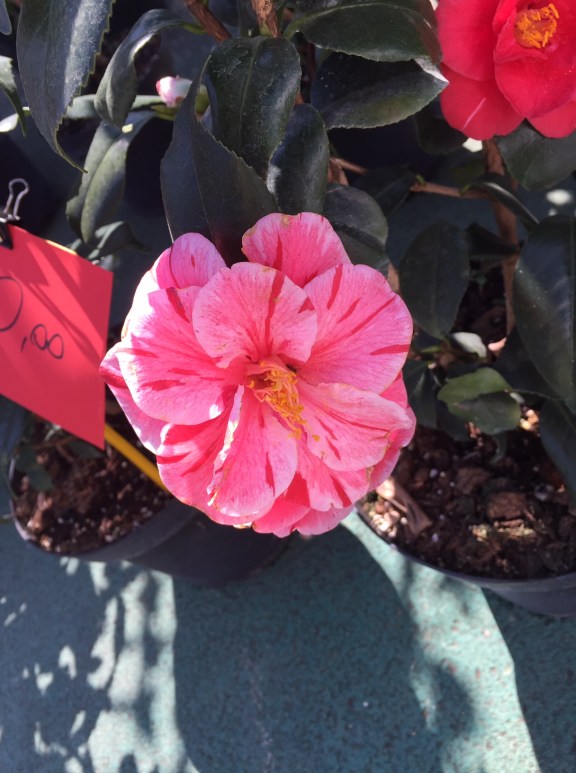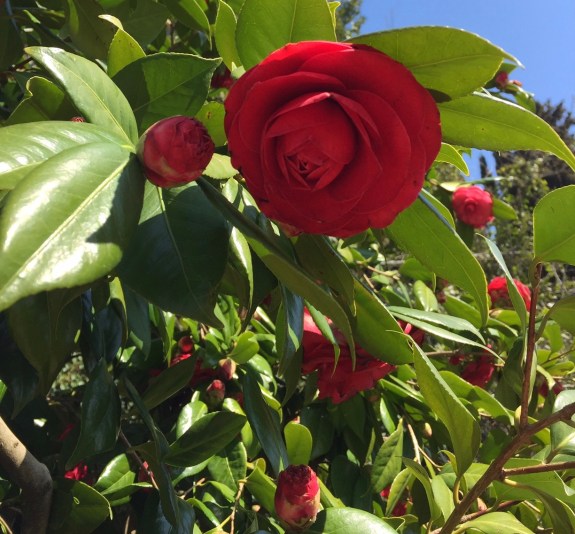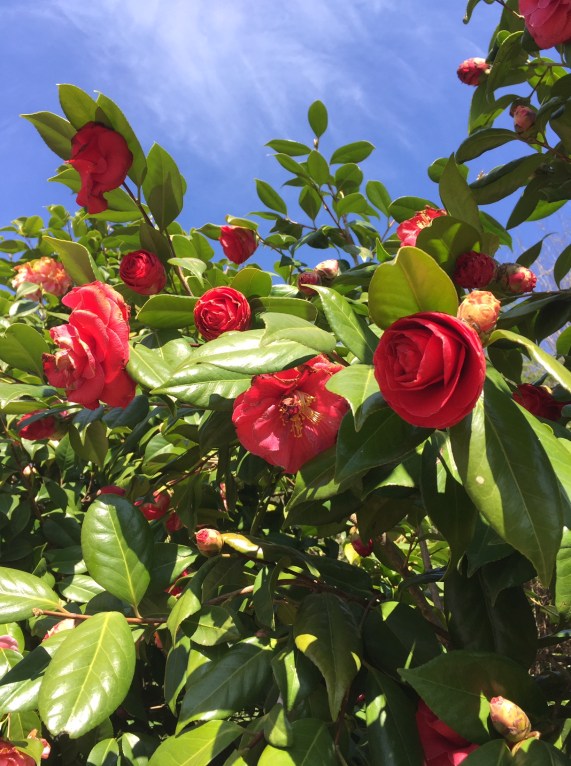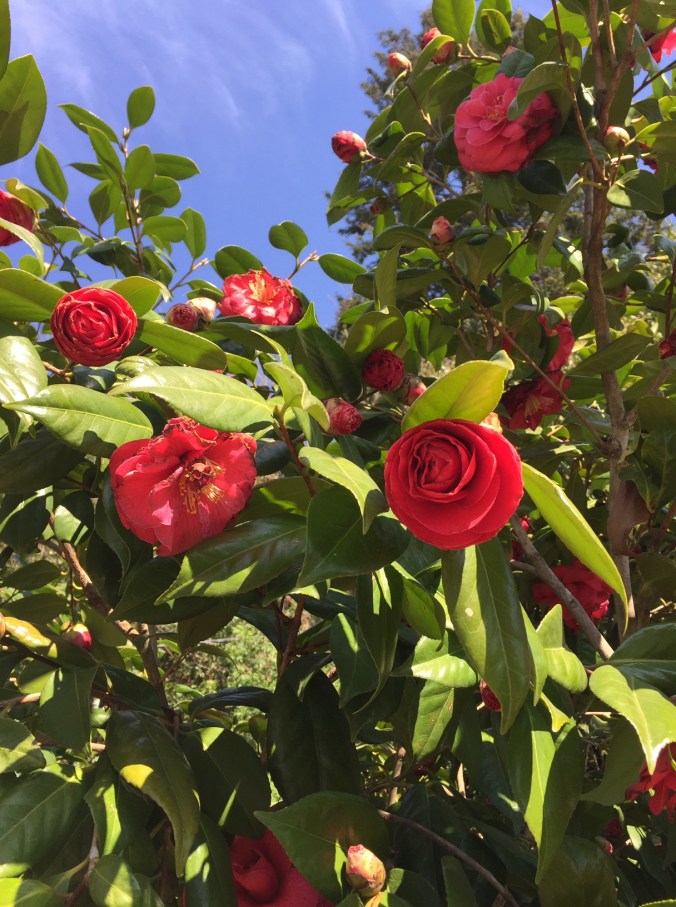
And learn a little something at the same time!
In Italy, real men iron
2 designs for evening by Balmain, 1960s


Walking through Florence’s historical center, I spied…
This sign in marble. The sign of a gone but not forgotten Florentine business.
This evocative old surviving street sign for this long lost business in the heart of Florence, announces “Antica Cascina di Dario Peruzzi.”. Translated it advertises this “old farmhouse,” which served (or sold for takeaway) milk, cream and butter and “a bar room” of coffee and milk. I wish I could time travel in for a moment or two to see what like was like inside this lost business. Dario Peruzzi, whoever you were, I remember you.

The waterlilies of Claude Monet

Yesterday I saw the new film, The Waterlilies of Monet, at the Odeon theater in Florence. I didn’t know much about the film, just that it featured Monet and his waterlily paintings. That was enough to get me there. I’m happy I saw it.
The film is a bit strange, part mystical, part historical. I don’t think it will have wide appeal, but it appealed to me. Here’s info from the press release, in first Italian and then a rough translation. And the film’s trailer.
Milano – Per soli tre giorni, il 26, 27 e 28 novembre, in esclusiva nei cinema LE NINFEE DI MONET. UN INCANTESIMO DI ACQUA E DI LUCE. Un percorso, narrato da Elisa Lasowski de Il trono di spade, che ci porta alla scoperta del più grande progetto pittorico di Claude Monet: le Grandes Décorations, le ninfee.
For just three days, on November 26th, 27th and 28th, exclusively at MONET’s WATERLILIES cinemas. A SPELL OF WATER AND LIGHT. A journey, narrated by Elisa Lasowski of The Game of Thrones, leads us on a discovery of Claude Monet’s greatest pictorial project: the Grandes Décorations, the water lilies.
Il film, prodotto da Ballandi Arts e Nexo Digital, condurrà il pubblico a Parigi, tra il Musée Marmottan, il Musée de l’Orangerie e il Musée D’Orsay, a Giverny con la Fondation Monet, la casa e il giardino dell’artista, e tra i magnifici panorami di Étretat. A guidare gli spettatori alla scoperta dei luoghi, delle opere e delle vicende del maestro, ci sarà Elisa Lasowski, attrice ne Il Trono di Spade, mentre la consulenza scientifica sarà affidata allo storico e scrittore Ross King, autore del best seller Il mistero delle ninfee. Monet e la rivoluzione della pittura moderna, edito in Italia da Rizzoli.
The film, produced by Ballandi Arts and Nexo Digital, takes the public from Paris, between the Musée Marmottan, the Musée de l’Orangerie and the Musée D’Orsay, to Giverny with the Fondation Monet, the artist’s house and garden, and shows the magnificent views of Étretat. Guiding the audience’s discovery of the places, works and events of the master, is Elisa Lasowski, actress in The Game of Thrones, while the scientific advice will be entrusted to the historian and writer Ross King, author of the best seller The mystery of water lilies; Monet and the revolution of modern painting, published in Italy by Rizzoli.
Il grande progetto di Monet
Seguendo il percorso della Senna, il film prende le mosse da Le Havre, dove Monet trascorre il primo periodo della sua vita artistica, e risale il fiume verso gli altri paesi dove ha dimorato: Poissy, Argenteuil, Vétheuil, e infine Giverny. Qui, a 70 anni di età e ormai quasi cieco a causa della cataratta, mentre piovono le bombe della Prima Guerra Mondiale, Monet concepisce il progetto di dipinti di enormi dimensioni, nei quali lo spettatore possa immergersi completamente. Il soggetto, le sue amate nymphéas. Dopo dieci anni, nel Musée de l’Orangerie di Parigi, la sua speranza trova finalmente il giusto compimento, nelle magnifiche sale ovali da lui stesso disegnate. Nel maggio del 1927, l’amico George Clemenceau inaugura finalmente il museo dedicato alla Grand Décoration.
The great project by Monet
Following the route of the Seine, the film starts from Le Havre, where Monet spends the first period of his artistic life, and goes up the river to the other areas where he lived: Poissy, Argenteuil, Vétheuil, and finally Giverny. Here, at 70 years of age and now almost blind because of the cataract, while the bombs of the First World War are raining down, Monet conceives the project of paintings of enormous dimensions, in which the viewer can immerse himself completely. The subject, his beloved waterlilies. After ten years, in the Musée de l’Orangerie in Paris, his paintings find superb fulfillment, in the magnificent oval rooms he himself designed. In May 1927, his friend George Clemenceau finally inaugurated the museum dedicated to Grand Décoration.
19th century Florence
Here are wonderful images of how Florence looked as late as 1870s:

The façade was then left bare until the 19th century.
In 1864, a competition held to design a new façade was won by Emilio De Fabris (1808–1883) in 1871. Work began in 1876 and was completed in 1887. This neo-gothic façade in white, green and red marble forms a harmonious entity with the cathedral, Giotto’s bell tower and the Baptistery, but some think it is excessively decorated. The whole façade is dedicated to the Mother of Christ.

This is an oil painting of La Porta di San Gallo by Odoardo Borrani, c. 1880. I admire it for its flavour and for showing us how the medieval walls around Florence still looked.
The city walls surrounding Florence were widened and rebuilt many times over the millennia .

- In the 2nd century A.D. Florence had 10,000 inhabitants and was surrounded by a 1st wall
2. After the fall of the Western Roman empire, the city suffered deeply and in the 6th century it had only 1000 inhabitants: a 2nd city wall was built, protecting a smaller area than the earlier Roman one.
3. Florence flourished again, and, at the beginning of 10th century the city was surrounded by a wider 3rd wall, which for the first time extended itself to the river Arno.
4. The building of the 4th wall was begun in 1078: Florence was a 20,000 inhabitants city and the Duke of Tuscany had moved his capital from Lucca to Florence. The new city walls surrounded also Piazza del Duomo, but the quarters of Oltrarno remained still unprotected.
5. In the years 1173-1175, the city built a 5th city wall: for the first time a defence wall was built also in Oltrarno, due to the increasing importance of the dwellings around the churches of San Felice, San Jacopo in Soprarno and Santa Felicita. Three city gates were built in Oltrarno (near today’s Piazza San Felice, Costa de’ Magnoli and Piazza Frescobaldi), but a real stone wall was not built: the protection consisted of palisades connecting the gates and houses whose outer façades were built without windows in order to offer more protection.
6. A 6th wall was planned by at least 1284 (possibly under direction of Arnolfo di Cambio). These walls enclosed a very wide area and protected the whole city with all its newer and outer dwellings. The gates were 35 meters tall, and were decorated with religious frescoes (the Madonna and Saints); originally, on the square in front of each gate was also a statue of a famous Florentine writer or poet. The building of the walls was completed in 1333 – and finally the quarters of Oltrarno received a complete protection.
In 16th century, the city prepared to face the army of the German emporer, Charles V, and in 1530 new fortifications were added around San Miniato al Monte. After that, Grand-duke Ferdinando I commissioned Bernardo Buontalenti to build a fortress; it was completed in the years 1590-1595 near the gate of San Giorgio and was named Fortress of Santa Maria, but became rapidly known as Fortezza Belvedere.
Between 1865 and 1871 Florence was provisory Capital of Italy: the city walls were demolished in order to build the new ring road. Only the walls in Oltrarno survived, with all their towers.
In 1998 a part of the wall between the gate of Porta Romana and Piazza Tasso has been restored and opened to visitors.

The sounds of San Miniato al Monte in Florence
On a relatively recent visit to San Miniato, we were treated to the beautiful sounds of Gregorian chanting monks:
After enjoying the interior of the church, we went out back to visit the extensive cemetery. While there, the church bells rang.
Digging deeper: Ognissanti, Firenze. Botticelli, Ghirlandaio & Amerigo Vespucci
Ah, Firenze: the more I discover, the more I learn I know almost nothing. It’s even hard to find the right metaphor to describe Florence.
But, let me try: Florence is like a puzzle, ready to shape itself in many different levels such as beginner’s, intermediate, and mature. Within each of these categories are almost infinite gradations.
For example, you can slip together the main sites of the city to form a large, easily managed puzzle for children. The beginners. Most tourists are satisfied with this strata.
But, for the truly curious, digging deeper in any particular area will reward in spades. Case in point: the Baroque church of La chiesa di San Salvatore di Ognissanti, better known simply as the Ognissanti in the Borgo Ognissanti quartiere. Yesterday I posted twice about this fine church, and still I find I haven’t gone below the surface level. So, today I am back with more.


The Chiesa di Ognissanti or All Saints’ church, as it is now known, was founded in 1256 by the Umiliati, a Benedictine order that played a very significant role in the development of the wool industry in Florence.
The Umiliati moved into the city in the 13th century, bringing with them from Germany techniques for improving the quality of cloth, and they established their workshops next to the Arno, a short distance from their convent (in Italy, the word “convent” is used to describe what an American would call a monastery).
You can see on the map above just how close Ognissanti is to the river. Commerce such as wool drove the Florentine economy, helping to make the city great. Any important guild, such as the wool guild, would sponsor the creation or improvement of the religious orders and church building within the city.
The Umiliati, by the dedication and probity of the lay brothers and sisters, gained a solid reputation in Florence. Important works of art began to accumulate in their severely simple church.
For example, Giotto’s celebrated Madonna and Child with angels (now in the Uffizi), was painted for the high altar of the church, and it is thought that the same master painted the Crucifix now displayed in the church’s left transept.
Other signs of devotion and wealth are the nave chapels frescoes by Domenico Ghirlandaio and Sandro Botticelli. Below is Botticelli’s 1480 Saint Augustine in His Study,
representing Augustine of Hippo:

While Domenico Ghirlandaio’s similarly composed frescoed Saint Jerome in his Study faces the Botticelli in the opposite chapel.

There’s a shallow chapel dedicated to the Vespucci family, frescoed (c. 1472) by Domenico Ghirlandaio and his brother Davide.

The central fresco is a Lamentation:


Above the main fresco is a Ghirlandaio painting in this chapel is the lunette containing the fresco of the Madonna della Misericordia. The Madonna is shown holding open her cape to envelope and protect the members of the Vespucci family. There is reputedly a portrait of Amerigo Vespucci as a child within this fresco. And we all know that Amerigo Vespucci would be of great importance for the later designated western continents.

.
The young boy, whose head appears under the Virgin’s right arm, between her and the man in the red cloak, is thought to be a portrait of the explorer, Amerigo Vespucci. A plaque marking his tombstone can be seen in the floor to the left of the altar.
This Vespucci was, of course, an Italian explorer, financier, navigator and cartographer who first demonstrated that Brazil and the West Indies did not represent Asia’s eastern outskirts as initially conjectured from Columbus’ voyages, but instead constituted an entirely separate landmass hitherto unknown to Old Worlders. Colloquially referred to as the New World, this second super continent came to be called “America,” deriving its name from Americus, the Latin version of Vespucci’s first name.
Moreover, when Amerigo Vespucci would come upon a bay in what would later become Brazil, he named it San Salvatore di Ognissanti, which in Portuguese is San Salvador de Todos os Santos: this is the origin of the name of the city of Salvador and Bahia de Todos os Santos. Could Vespucci have been thinking of his old neighborhood in Firenze? I think so.
But, perhaps the greatest of Ognissanti’s frescoes is Ghirlandaio’s Last Supper in the refectory between the two cloisters, a work with which Leonardo was intimately familiar. So important is this fresco that I will write a separate post about it.

During the 16th century, the Umiliati declined in energy, and the Franciscan order assumed control of the church in 1571, bringing precious relics such as the robe Saint Francis of Assisi wore. The Franciscans remodeled the church to conform with the newer Baroque style and the church was re-consecrated in 1582. It was renamed San Salvatore a Ognissanti (St. Saviour at All Saints)
In 1571 the Franciscans brought from this other church their most precious relic, which is still to be seen at Ognissanti: the habit worn by St. Francis of Assisi when he received the sacred Stigmata on Mount Verna in 1224. As far as I can tell, the Ognissanti relic is no longer accepted as true; no stone is left unturned in Florence: https://www.livescience.com/1855-tunic-worn-saint-francis-identified.html
But we do know that Domenico Ghirlandaio painted frescoes of the Madonna of Mercy and the Pietà (1470-72) over the Vespucci altar. 
Palazzo Vecchio
I walk by the Palazzo Vecchio almost daily. This big set of photos are from a fairly recent tour I took of the Palazzo.


Ognissanti, Firenze
The moon shone brightly last night (which was Thanksgiving night, in the United States) over the Renaissance city.

Earlier today I posted about a concert I once heard at the Franciscan church called Ognissanti. As luck would have it, I had the chance to spend some time last night admiring the interior of the church when it was beautifully lit up in the early evening.

Ognissanti has a harmonious Baroque facade, as seen from the piazza that separates it from the Arno river. The chiesa was originally built in the 1250s by the Umiliati, but it later became a Franciscan church. It was renovated c. 1627 in the Baroque style, by architect Bartolomeo Pettirossi.
Here’s how it looks in the daytime:

In 1637 the church was given this façade, based up designs by Matteo Nigetti. Fortunately, the glazed terracotta lunette depicting the Coronation of the Virgin and placed over the central doorway was conserved. While the lunette resembles the work of Luca Della Robbia, it is now attributed to Benedetto Buglioni. Buglioni was almost the only artist working in the glazed terra-cotta style made famous by the Della Robbia workshop after that enterprise ended.

Ognissanti was among the first examples of Baroque architecture to penetrate this Renaissance city. Its two orders of pilasters enclose niches and windows with elaborate cornices. The campanile, of late 13th and early 14th-century construction, sits back from the front of the church, on the east side.
The church’s interior is equally grand and richly ornamented. It received the same Baroque style remodeling as the exterior in the early 17th-century, when the apse was rebuilt with a pietre dure high altar and, later, in 1770, the incredible sotto in su perspective painting was added to the vaulted nave ceiling.


To start with the perhaps the most important aspect of this venerated church, we turn to Giotto’s celebrated Madonna and Child with Angels (c. 1310), which was painted for the high altar of this church.

This outstanding painting by Giotto was completed in Florence. Today, if you wish to see the masterpiece, you will find it in the collection of the Uffizi. Giotto’s capolavoro is not only one of the finest works in the Uffizi, but it shows the exact moment when painting in Italy turned from Gothic to a proto-Renaissance style.
In the Uffizi galleries, Cimabue’s celebrated altarpiece (above), which was created for the same type of setting and dealing with the same subject matter as Giotto’s altarpiece, one can witness the changes in artistic approach.
But, although the Ognissanti is missing its famous and beautiful altarpiece, it is fortunate to have another work now attributed by Italian scholars to Giotto: the large crucifixion. Giotto painted this large-scale (15 feet tall) cross c. 1315 for the Umilati friars who then held this church.


The Crucifixion is displayed under the Medici coat of arms in the left transept of the church.

Only recently was this Crucifixion recognized as a work by Giotto. For decades it sat, unappreciated, in the storerooms of Ognissanti. There was a rumor that it was by Giotto, but no one was certain. But then, it was restored!
The restoration of Giotto’s Ognissanti Crucifix was started by Paola Bracco in 2002. The majestic tempera on panel, now believed to have been painted by Giotto and his workshop around 1310-1320, had been sadly neglected for centuries. Kept in the sacristy of the church of Ognissanti, it was rarely seen and the vigorous modelling of the flesh tones of the figures, and the many precious details of the pictorial surface, were hidden by layers of varnish from previous “restorations” and centuries-old grime.
Fortunately, this monumental work is now back in the Florentine church, after a careful 8-year restoration.

In the Crucifix (painted in egg tempera), Christ is represented as Christus patiens, suffering, about to expire. The tension in the muscles of the arms is treated with delicacy, and the ashen flesh colors are very impressive. The body hangs on a very decorative Cross, an overflowing mosaic of starred crosses, squares and ellipses. The ‘beams’ of the Cross are painted in bright, but deep and intense blue, the precious lapis lazuli inlaid with greater or lesser amounts of lead white, as in the sloping pedestal to which Christ’s feet are pinned (by a single nail). The blue is crossed by thin red lines, cinnabar blood with more purplish glazes. On the forehead are a few drops of “pure red lacquer,” the color of blood, which springs from Christ’s flesh in response to the crown of thorns.
Here are some other fascinating artifacts from Ognissanti:


Last night I discovered that Sandro Botticelli is buried within the church, near his beloved Simonetta Vespucci.


Botticelli who is buried in the church near his beloved, Simonetta Vespucci.
Amerigo Vespucci is also interred here:


Here’s an unusual funerary monument found within the church. I am not certain whose head this portrays…


And I end this long post with a photo of a significant Neoclassical funerary monument, found within the center of this important church.

You must be logged in to post a comment.