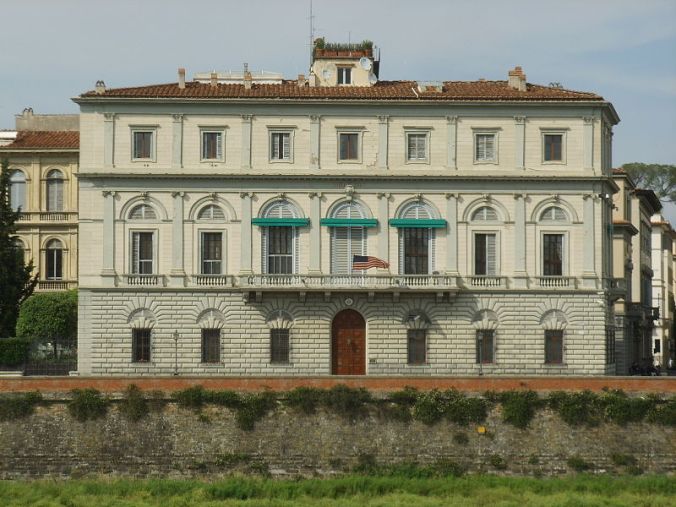
The American Consulate in Florence is part of the United States Mission to Italy and is located at Lungarno Vespucci 38, in the former Palazzo Calcagnini (built 1876-77). This palazzo was purchased in 1949 by the American government, to serve as the site of the Consulate General.
Long before the United States acquired the palazzo however, its presence was already in Tuscany. The first American consulate to the Grand Duchy of Tuscany was established in Livorno (then known in English as Leghorn), with consular agent Phillip Felicchi being appointed on 29 May 1794.
For some reason, Tuscany would not recognize any consulates posted in Florence, so the first U.S. Consular Agent to serve Florence was Vice Consular Agent James Ombrosi, who was under mandate from the U.S. Consulate at Leghorn (Livorno). Ombrosi was accredited on May 15, 1819.
In the years after the U.S. Civil War and the transition of the capital of the Kingdom of Italy from Florence to Rome, the U.S. Consul General was James Lorimer Graham. Graham was a New York banker and art collector; he and his wife Josephine lived in a building that is now known the Palazzo dei Congressi.
In the early 1870s, Florence was suffering the grave economic consequences of the sudden transfer of the capital, a move that left the city deeply in debt and had bankrupted many investors when boom turned to bust in “Firenze Capitale.”
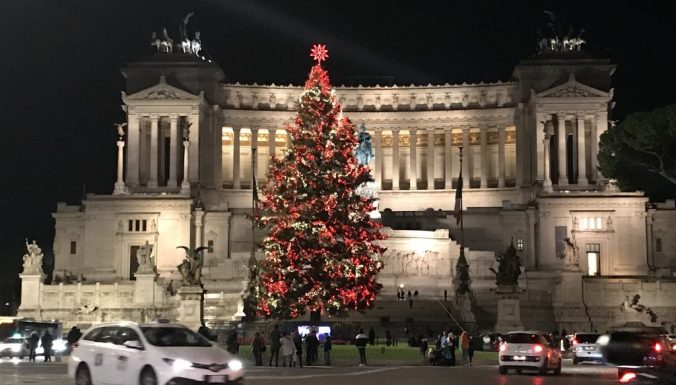
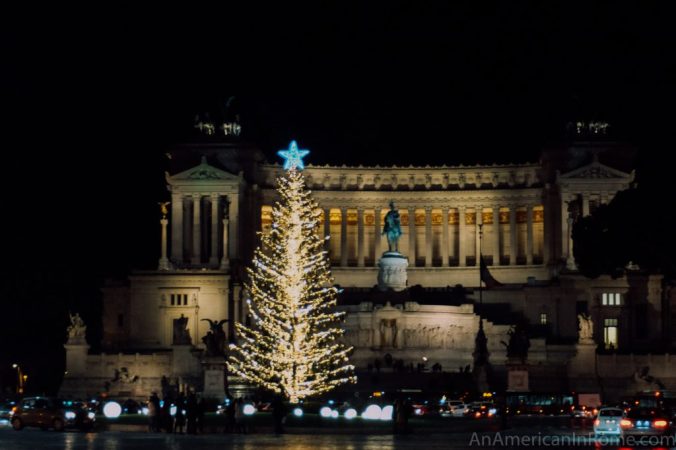
Resulting higher taxes and slower growth led to widespread poverty. Mrs. Graham was a committed philanthropist back in New York, and so responded to this situation in a way familiar to her. She rallied members of the “American Colony” and started selling mistletoe baskets and Christmas trees to raise funds for the poor.
Then there was the more fraught holiday season of December of 1944. Though Florence had been liberated by the Allied Forces in August of that year, there was little rejoicing along the Gothic Line—the German defensive line that stretched from Carrara to Pesaro—as fighting raged and civilian and combatant casualties mounted.
In the early morning hours of a bitterly cold December 26, Axis forces launched a counter-offensive in the Garfagnana region of Lucca province, focused on and around the town of Barga.
The first target was the hilltop village of Sommocolonia, garrisoned by several hundred African-American “Buffalo Soldiers” and a handful of local partigiani.
During the fighting, German forces drove the Allied troops back. To avoid a complete rout, Army Lieutenant John R. Fox remained in his position in the Sommocolonia bell tower, calling in artillery strikes on the town and finally on his own position in order to slow the Axis advance. For Fox’s bravery and self-sacrifice, he was posthumously awarded the U.S.’s highest military honor, the Medal of Honor.
Today the American International League of Florence (AILO), organizes annual events to collect thousands of euro each year that are then donated to local charitable organizations.
Incidentally, the United States also has 5 other representations in Italy: American Consulate in Palermo; American Consulate in Naples; American Consulate in Milan;
American Consulate in Genoa; and the American Embassy in Rome.
The American Consulate in Florence represents one of 402 foreign consular and diplomatic representations from around the world in Italy.
**********************************************************************************
2019 marks 200 years of American presence in Florence

Do you have personal experiences or stories that were passed on to you about historic events that occurred in Tuscany, Emilia Romagna or the Republic of San Marino? Were you a Mud Angel? Did you have relatives who worked with the American Red Cross during World War I or witnessed the 5th Army’s fight along the Gothic Line in World War II? Are you doing something now that is strengthening the U.S.-Italy partnership? If so, the U.S. Consulate General in Florence would love to hear from you!
The Florence American consulate is collecting stories in anticipation of the bicentennial of its diplomatic presence in Florence in 2019.
Throughout that year, we hope to see a series of events across Tuscany, Emilia-Romagna and the Republic of San Marino exploring all facets of our past, present, and future together.
These commemorative events and related information will be highlighted on the Consulate’s social media platforms with the #Insieme200 (#Together200) hashtag.
Our 200 years here are built on a foundation of millions of personal and organizational ties, so we need your help to properly celebrate our bicentennial!
If your organization has an idea for a 200th anniversary commemorative event—large or small—or wants to get involved with the events being organized by the Consulate, please let us know:CGFIProtocol@state.gov.
To receive updates on the Consulate’s 200th anniversary and more, join the Consulate’s community by liking its Facebook page @USCGFlorence or following on Twitter!
























You must be logged in to post a comment.