So many butterflies were swooping through Denver this week that The National Weather Service in Boulder posted two radar images on their Twitter Tuesday showing a giant blob of blue and red to the uneducated eye.
Think of Italian music and you are likely to start humming this classic pop number: Nel blu depito di blu. Or, as it is more popularly known: Volare.
“Nel blu dipinto di blu” (literally “In the blue that is painted blue”), popularly known as “Volare” (meaning “To fly”), is the iconic song recorded by Italian singer-songwriter Domenico Modugno. Modugno and Franco Migliacci wrote the song together an edit was released as a single in 1958.
So here it is, the original song by the songwriter himself, in the 1950s, on the Ed Sullivan Show:
And now for your listening pleasure is the same song, reworked by Gianna Nannini. I love the song in both of its forms!
Buon ascolta!
And then, when you want to know the lyrics in Italian (first) or English (after), here you go:
Penso che un sogno così non ritorni mai più
Mi dipingevo le mani e la faccia di blu
Poi d’improvviso venivo dal vento rapito
E incominciavo a volare nel cielo infinito
Volare, oh oh…
Cantare, ohohoho…
Nel blu dipinto di blu
Felice di stare lassù
E volavo, volavo felice
Più in alto del sole ed ancora più su
Mentre il mondo pian piano spariva, lontano laggiù
Una musica dolce suonava soltanto per me
Volare, oh oh…
Cantare, ohohoho…
Nel blu dipinto di blu
Felice di stare lassù
Ma tutti i sogni nell’alba svaniscono perché
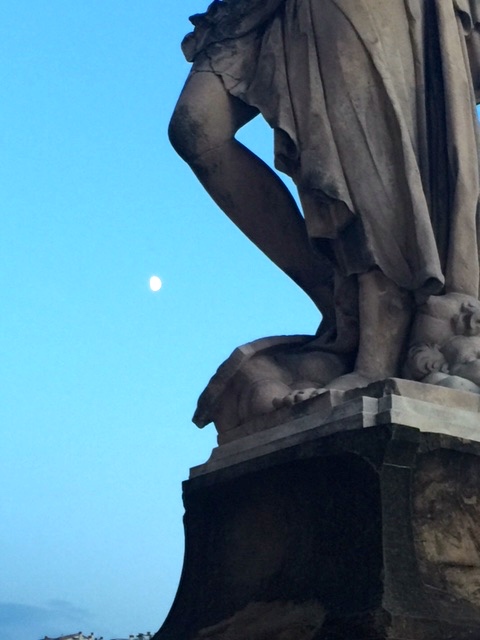
Quando tramonta, la luna li porta con sé
Ma io continuo a sognare negli occhi tuoi belli
Che sono blu come un cielo trapunto di stelle
Volare, oh oh…
Cantare, ohohoho…
Nel blu degli occhi tuoi blu
Felice di stare quaggiù
E continuo a volare felice
Più in alto del sole ed ancora più su
Mentre il mondo pian piano scompare negli occhi tuoi blu
La tua voce è una musica dolce che suona per me
Volare, oh oh…
Cantare, ohohoho…
Nel blu degli occhi tuoi blu
Felice di stare quaggiù
Nel blu degli occhi tuoi blu
Felice di stare quaggiù con te
Flying (In the blue painted blue)
I think such a dream will never come back
I painted my hands and my face blue
Then suddenly I was ravished by the wind
And I started flying in the infinite sky
Flying, oh oh…
Singing, ohohoho…
In the blue painted blue
Happy to be up there
And I was flying, flying happily
Higher than the sun and even higher
While the world was slowly disappearing, far beneath
A soft music was playing just for me
Flying, oh oh..
Singing, ohohoho…
In the blue painted blue
Happy to be up there
But all the dreams fade away at dawn, because
While setting, the moon takes them away
But I keep dreaming in your beautiful eyes
Which are as blue as a sky quilted with stars
Flying, oh oh…
Singing, ohohoho…
In the blue of your blue eyes
Happy to be down here
And I keep flying happily
Higher than the sun and even higher
While the world is slowly disappearing in your blue eyes
Your voice is a soft music playing for me
Flying, oh oh…
Singing, ohohoho…
In the blue of your blue eyes
Happy to be down here
In the blue of your blue eyes
Happy to be down here with you
The Italian culture loves beauty, depends on beauty, is addicted to beauty. The single word to describe all good things, whether they mean great, terrific, wonderful, marvelous, fantastic, satisfying, or well done, is bello.
The roots go way, way back.
Even the Etruscans, the people who occupied the peninsula between the Arno (Florence) and Tiber (Rome) Rivers in the first millennium B.C. before they were ultimately conquered and wiped out by the Romans toward the end of that period, were lovers of beauty. Visit the Etruscan museum at the Villa Giulia in Rome and you will see their civilization, taken whole from the many burial grounds they left behind. There are perfume bottles, containers for makeup, rings that went into hair, and large baskets into which all the combs, brushes, ointments, and powders were put in an effort to please the gods, to make themselves beautiful in the eyes of the deities so that the beauty of their bodies would reflect the beauty of their souls.
And that’s how it stood until Judaism and then Christianity came along to break the connection between outer magnificence and inner purity. The one no longer had anything to do with the other.
Epstein, Alan. As the Romans Do: The Delights, Dramas, And Daily Diversio (pp. 75-76). HarperCollins. Kindle Edition.
Giacomo Puccini’s famous opera, La Boheme, is packed with fantastic arie, like the one Mimi sings: “Mi chiamano Mimi.” When Rodolfo reveals to her that he has fallen in love, he wants to know all about her. He asks her to tell him something about her. Mimi’s reply begins by telling him she is called Mimi, but her true name is Lucia.
The English translation is as follows:
Yes, they call me Mimi
but my true name is Lucia.
My story is short.
A canvas or a silk
I embroidery at home and outside…
I am happy happy and at peace
and my pastime
is to make lilies and roses.
I love all things
that have gentle sweet smells,
that speak of love, of spring,
of dreams and fanciful things,
those things that have poetic names …
Do you understand me?
They call me Mimi,
I do not know why.
Alone, I make
do by myself.
I do not go to church,
but I pray a lot to the Lord.
I stay all alone
there in a white room
and look upon the roofs and the sky
but when the thaw comes
The first sun, like the
first kiss, is mine!
Buds in a vase…
Leaf and leaf I spy!
That gentle perfume of a flower!
But the flowers that I make,
Alas! no smell.
Other than telling you about me, I know nothing.
I am only your neighbor who comes out to bother you.
You can listen to a diva perform it here:
The Italian lyrics are as follows:
Si. Mi chiamano Mimì
ma il mio nome è Lucia.
La storia mia è breve.
A tela o a seta
ricamo in casa e fuori…
Son tranquilla e lieta
ed è mio svago
far gigli e rose.
Mi piaccion quelle cose
che han sì dolce malìa,
che parlano d’amor, di primavere,
di sogni e di chimere,
quelle cose che han nome poesia…
Lei m’intende?
Mi chiamano Mimì,
il perché non so.
Sola, mi fo
il pranzo da me stessa.
Non vado sempre a messa,
ma prego assai il Signore.
Vivo sola, soletta
là in una bianca cameretta:
guardo sui tetti e in cielo;
ma quando vien lo sgelo
il primo sole è mio
il primo bacio dell’aprile è mio!
Germoglia in un vaso una rosa…
Foglia a foglia la spio!
Cosi gentile il profumo d’un fiore!
Ma i fior ch’io faccio,
Ahimè! non hanno odore.
Altro di me non le saprei narrare.
Sono la sua vicina che la vien fuori d’ora a importunare.
Una bella scappatella—the Italians have a word for everything. Una bella scappatella is a never-to-be-repeated fling with a lover who is similarly disposed and available.
Wow! I’ve seen some live performances and heard some music in my life, but last Saturday in Florence was very special.
The Opera di Firenze mounted a true spectaclo. One of the finest orchestras in Italy, the sonorous Orchestra del Maggio Musicale Fiorentino, is directed by Ivan Ciampa (my Italian teacher says the Florentine orchestra is second only to that of La Scala in Milano. My teacher has never led me astray) provided the rich, beautiful music, while the company performed the libretto.
La Bohème, the opera in four acts composed by Giacomo Puccini.
The world premier of this beloved opera was in 1896 in Turin, conducted by none other than Arturo Toscanini.
(btw, in 1946, 50 years after the opera’s premiere, Toscanini conducted a performance of it on radio with the NBC Symphony Orchestra; this performance was eventually released on records and on compact disc and is the only recording of a Puccini opera by its original conductor.)
La bohème went on to become part of the standard Italian opera repertory and is one of the most frequently performed operas worldwide.
The opera this fall in Florence was directed by Bruno Ravella and the stage sets were designed by Tiziano Santi. Santi’s scenes tend to suggest rather than literally depict the French environments with a system of small, open and slightly distorted stage boxes.
The story unfolds in a traditional way, and for me, the most captivating moments were in the large choral scenes suggesting Paris’s Latin Quarter in the 1840s. The opera choir is sensational and delights the audience through their singing and choreography. A favorite scene is when Musetta sings of her romances on a swing like a cabaret performer. One stark but moving scene is between the two lovers in their duet “O soave fanciulla.” They stand on the proscenium in front of a dark mesh-looking screen, on which are projected snowflakes. The young people seem distanced from the rest of the world, caught up in their isolated sphere.
Also surprising and delightful is the projection of light to resemble a carpet of flowers which accompanies “Sì, mi chiamano Mimì.”
The cast is composed of many young performers.
Benjamim Chou reprises the role of Marcello; according to the same critic above, who wrote that Chou’s Italian accent is not perfect. Angela Nisi plays Musetta. Goran Jurić takes the part of Colline and Andrea Vincenzo Bonsignore provides Schaunard. William Hernandez plays Benoit and Alessandro Calamai is Alcindoro. Carlo Messeri reprises Parpignol.
Matteo Lippi performs Rodolfo and opposite him shines the key role of Mimi, reprised by Maria Mudryak. Of her superb performance, an Italian critic wrote (I’ve translated it):
The young soprano draws a flurry of flattery and fragile, in line
with tradition, through a voice with a burning stamp, which is
intensified especially in the centers
and in the acute register. Such voice material allows the interpreter
to face the part with the right glance and an enviable security.
Shee only misses a variety of accents and phrasing to make the character really
remarkable.
I guess the talented soprano should practice her Italian; kinda like me! The only thing, alas, that she and I have in common.
At 23, soprano Maria Mudryak’s singing career has already brought her to the world’s great stages, to sing some of the most enviable roles in the operatic repertoire. Her training started early, with a move to Italy at the age of 10; she soon joined the children’s chorus of the Teatro alla Scala, and was later accepted into the Conservatory Giuseppe Verdi in Milan at just 14. She made her professional debut as Susanna in Le nozze di Figaro in Genova, and has since filled her seasons with performances of Adina (L’elisir d’amore), Musetta (La bohème), Marie (La fille du régiment) and Violetta (La traviata).
Here you can get a sense of Mudryak (n.b. the videos are not from Florence’s La bohème).
Al termine della recita il pubblico elargisce grandi ed entusiastici applausi a tutti gli interpreti e al direttore.
Teatro del Maggio – Passione Puccini LA BOHÈME Opera in quattro quadri di Giuseppe Giacosa e Luigi Illica Musica di Giacomo Puccini
Mimì Maria Mudryak Musetta Angela Nisi Rodolfo Matteo Lippi Marcello Benjamin Cho Schaunard Andrea Vincenzo Bonsignore Colline Goran Jurić Benoit William Hernandez Alcindoro Alessandro Calamai Parpignol Carlo Messeri Sergente dei doganieri Vito Luciano Roberti Un doganiere Nicolò Ayroldi
Orchestra, Coro e Coro delle voci bianche del Maggio Musicale Fiorentino Direttore Francesco Ivan Ciampa Maestro del coro e del coro delle voci bianche Lorenzo Fratini Regia Bruno Ravella Scene Tiziano Santi Costumi Angela Giulia Toso Luci D. M. Wood Nuovo allestimento del Teatro del Maggio Musicale Fiorentino




 get back, lauretta!
You must be logged in to post a comment.