It you’ve been fortunate enough to travel to Italy, chances are good that you have been through the Stazione Termini in Rome. If you think about the name of the station, it would seem to be named Termini because it is the final stop or terminus of a journey.
But in fact, contrary to popular belief, the name for Roma Termini does not come from its being a train terminal or terminus. Instead, the name originates directly from the ancient Roman baths that stand right across the piazza from the station’s main entrance.
Here’s how the name evolved through a linguistic journey over the centuries:
- The ancient Latin word for public baths is thermae.
- In 306 AD, the colossal Baths of Diocletian (Thermae Diocletiani) were completed in this area. They were the largest public bath complex in the entire Roman Empire.
- Over time, the Latin thermae evolved into the Italian word terme. The neighborhood built up around the ruins gradually became known as the Termini district.
Consequently, everything discovered or built on this specific hill, from the ancient residential complex (Villa di Termini) to the Renaissance estate (Villa Peretti Montalto) and finally the 1862 railway hub, adopted the Termini name simply because of its proximity to the ancient baths or thermae.
In 1860 Pope Pius IX decided to build Rome’s Central Railway Station in what was then the sprawling gardens of the Renaissance-era Villa Peretti Montalto. I wonder how he and his advisors chose this neighborhood for rebuilding the city? The whole concept just seems so foreign to me. Can you imagine Pope Leo XIV waking up one morning and saying he was going to install a new airport in a settled section of Rome?! But, times have changed since the 1860s. Prior to that, the popes and Roman rulers had dictated the shape of the city.
In 1862, while workers were clearing the massive earth embankments that had buried the ancient Servian Wall, they discovered ancient structures. What else is new? It is Rome after all!
After the annexation of Rome to the Kingdom of Italy in 1870, the new government decided to make the new railway Stazione (di) Termini a key element in the design of a “modern” capital and in 1888 the Casino of Villa Peretti and the long sequence of low buildings on its northern side were pulled down to make room for a large square.
When we walk over that square, which is called the Piazza dei Cinquecento, we are treading over two Roman insulae (multi-story apartment buildings in ancient Rome that housed the city’s common working and middle-class populations; the Latin word literally translates to “island,” likely because these large buildings stood isolated like islands surrounded by streets) and a later stately building form the Antoinine period (c. 2nd C AD).
These discoveries were made in 1947-49, during the construction of Rome’s first underground transit system (Metro B line), when archeologists initiated a systematic dig. They found a sprawling wing from the Antonine period, uncovering an entrance hall, an advanced thermal bath suite, a decorated nymphaeum (fountain room), and a massive apse-shaped hall. This phase yielded even later art, including 4th-century frescoes depicting bathers wearing loincloths.
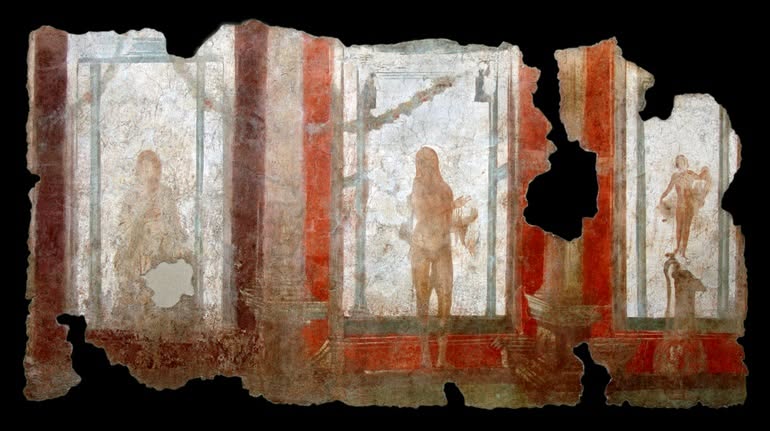
Unfortunately, the original villa structures were demolished during the rapid urban expansion and railway construction of late 19th-century, early 20th-century Rome.
But we are extremely fortunate because the surviving decorations and frescoes from that ancient site are preserved and exhibited on the second floor of the Palazzo Massimo alle Terme, part of the National Roman Museum about which I have been going on and on about for several posts.
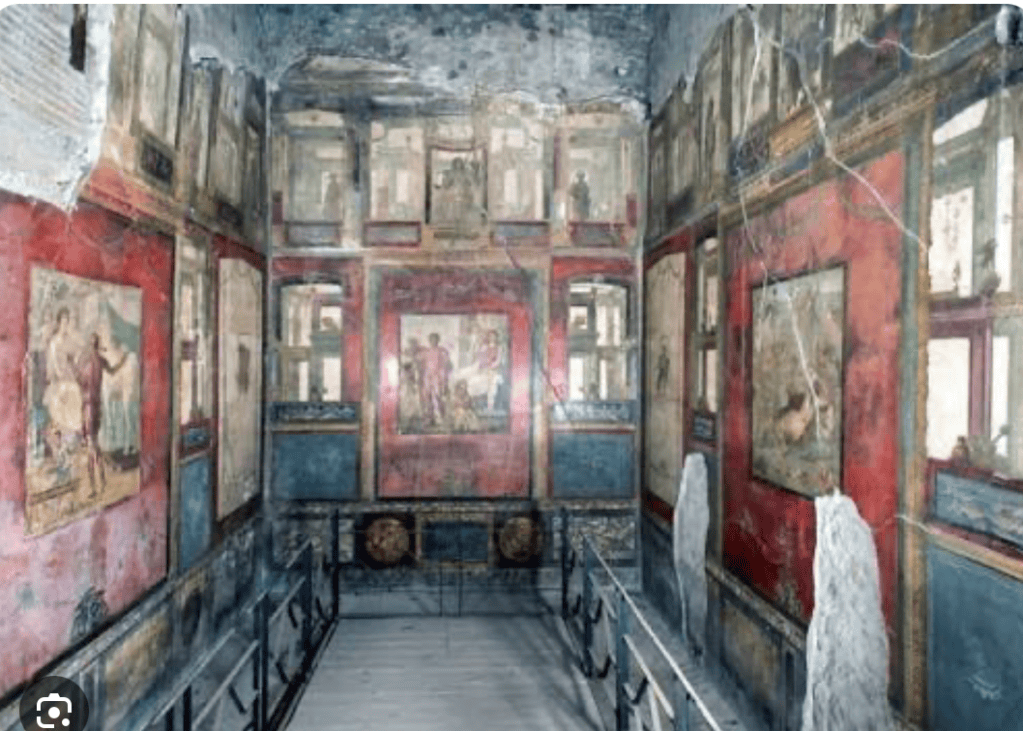
The detached fresco panels show elaborate perspective designs, delicate architectural frameworks, and decorative pavilions. The artwork represents the rich interior decoration styles used in high-society Roman residences during the peak of the empire. The gallery also exhibits geometric floor mosaics and black-and-white plant motifs recovered from the same Termini archaeological zone.
The frescos are outstanding because they illustrate the development of pictorial styles in the full Imperial Age. They represent refined examples of Roman painting, often characterized by illusionistic perspectives and fantastical settings typical of sumptuous urban residences.The paintings are very refined.
I found this source very helpful in understanding the timeline: (https://exhibitions.kelsey.lsa.umich.edu/galleries/Exhibits/Empire2/objects/termini.html),
And I found this video fascinating: https://www.youtube.com/watch?v=y00HVpFlDSk
If you watch the first minute of this video, you’ll see what the earlier,1860s, train station looked like in Rome: https://youtu.be/mCgmaiR5sVY
The current Stazione Termini was finished just after WWII. see it here: https://youtu.be/S7q49xdVPfM
And, if you’ve got time, try this 1950s movie! Bet you’ve never seen it! https://youtu.be/_ZJbqmKE16k Imagine, an entire film set pretty much within the Stazione Termini.
Here’s a postscript about the film:
Terminal Station (Italian: Stazione Termini, released in the United States as Indiscretion of an American Wife) is a 1953 romantic drama film directed and produced by Vittorio De Sica and starring Jennifer Jones, Montgomery Clift and Richard Beymer. Truman Capote was one of the screenwriters. It tells the story of the love affair between a married American woman and an Italian/American academic. The title refers to the Roma Termini railway station in Rome, where the film takes place. The film was entered into the 1953 Cannes Film Festival.
Terminal Station was the first Hollywood film by Italian director De Sica, as an international coproduction with American mogul David O. Selznick. The collaboration was fraught with constant and severe creative differences that resulted in two different versions of the film, an 89-minute Italian version and a 72-minute American recut version with a different name. After this experience, De Sica never again worked with a Hollywood producer, although he later directed English-language films with American actors.

The Eternal City, with its endless stories to tell.
Alla prossima!

