Did you realize that just steps from the train station in Rome you can walk into a Roman era frescoed room, completely decorated in a way to make you feel you are in a lush exterior garden? Not only are the frescoes extraordinary, it is absolutely remarkable that they are so accessible (assuming of course that you can get to Rome).
So, let’s look and discuss!
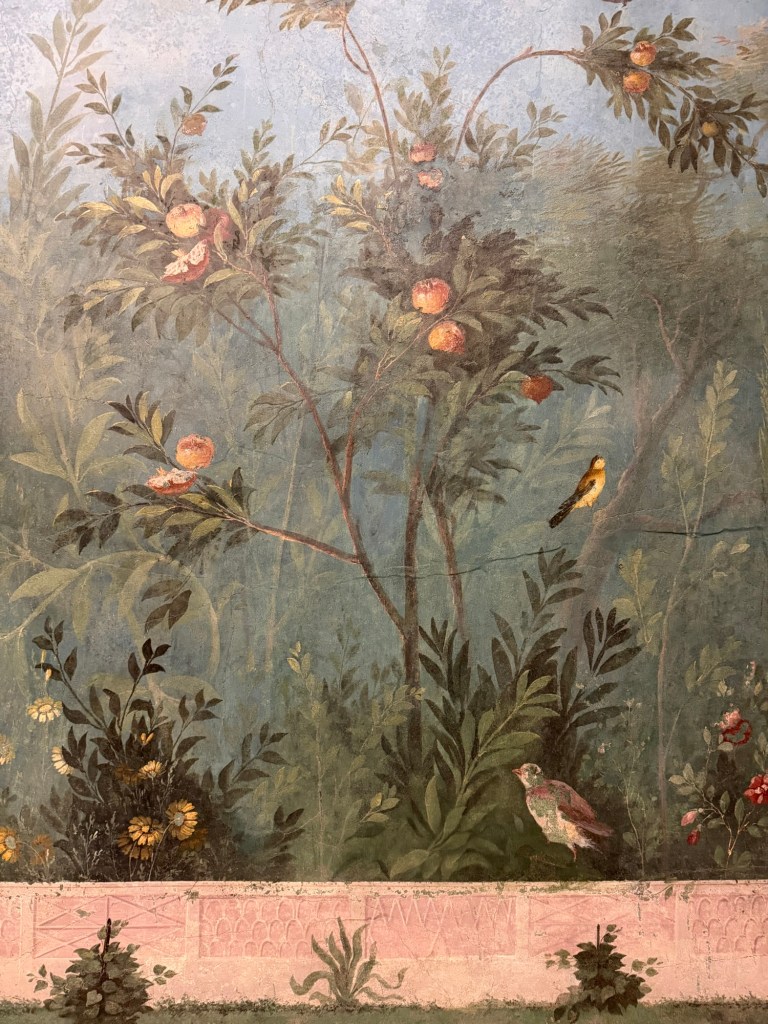
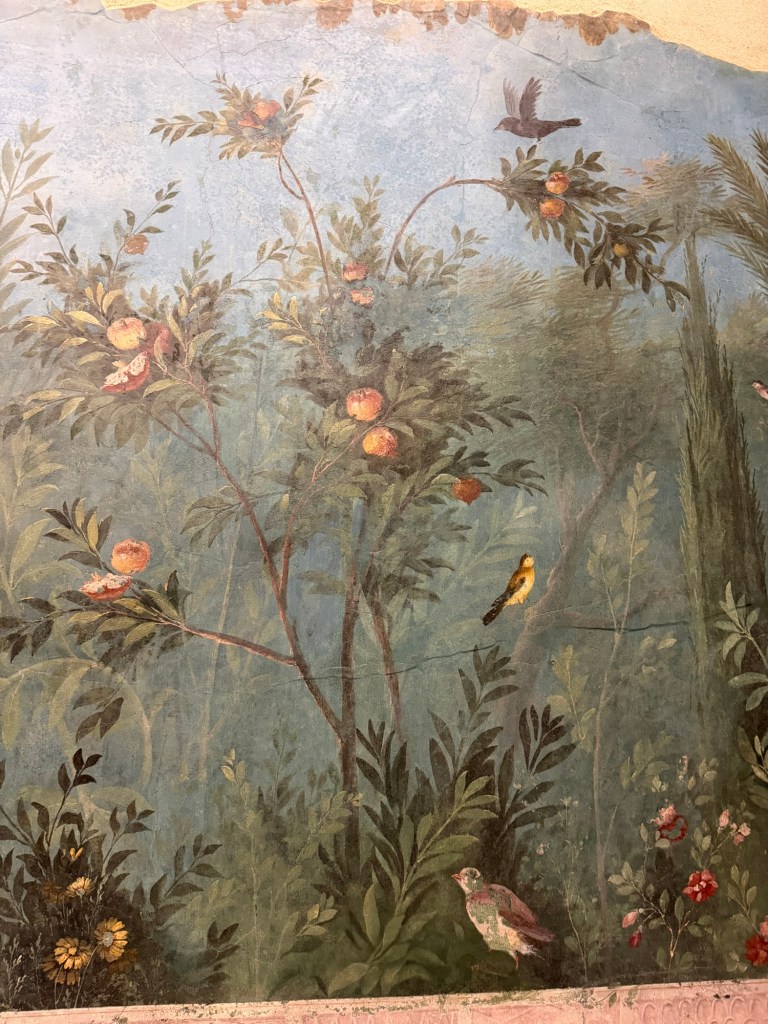
This lush painted garden decorated the triclinium or dining room of Livia, the wife of the Emperor Augustus, in her villa along the Via Flaminia. Did you know that it was from the laurel bushes grown in her groves at this villa that the leaves were taken to be used to create the triumphal crowns of the Roman Emperors? I mean, come on!
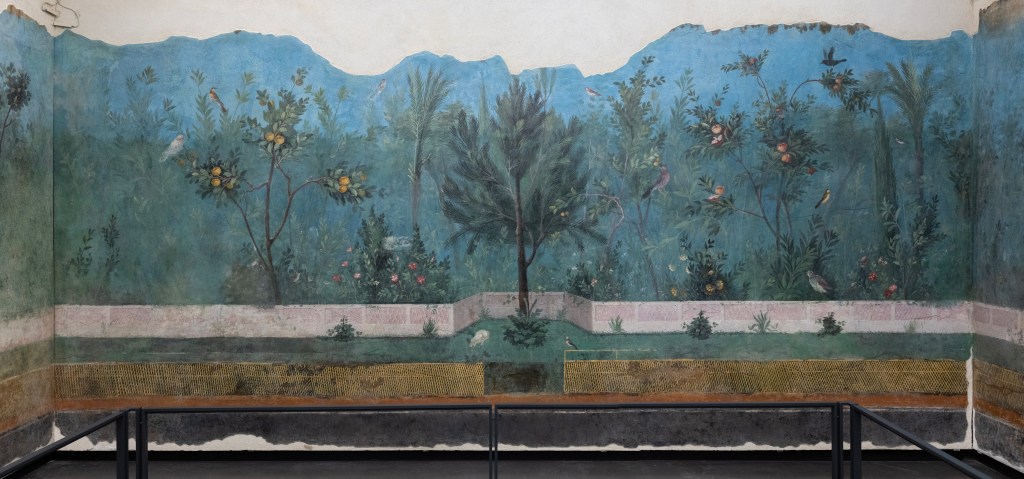
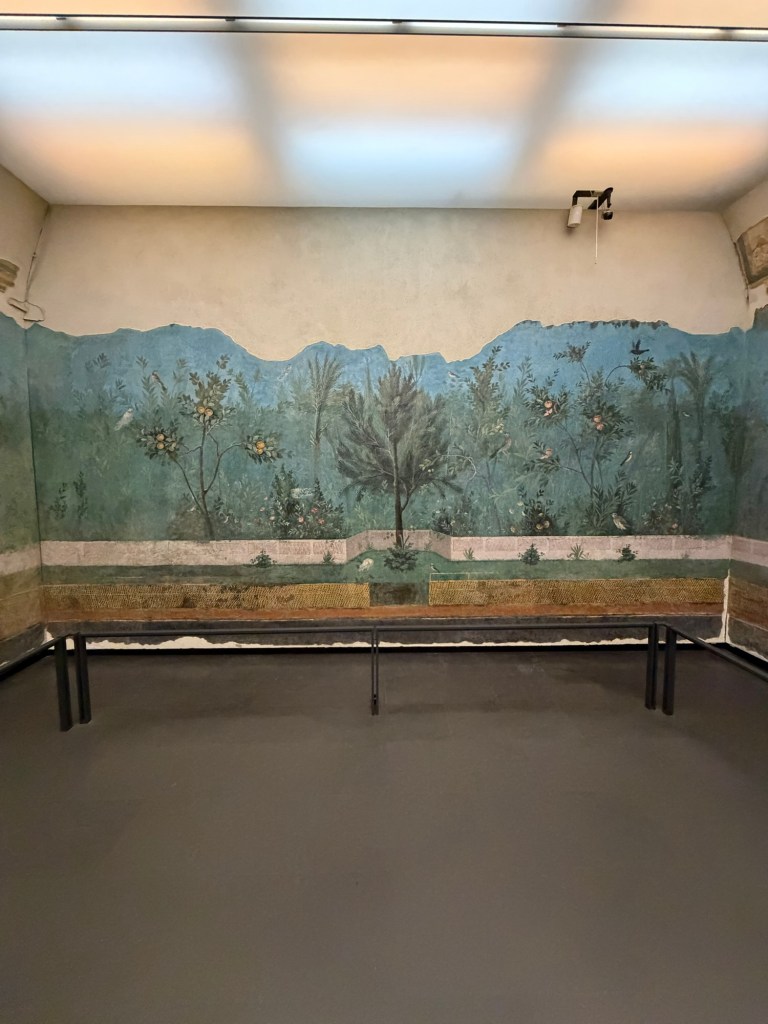
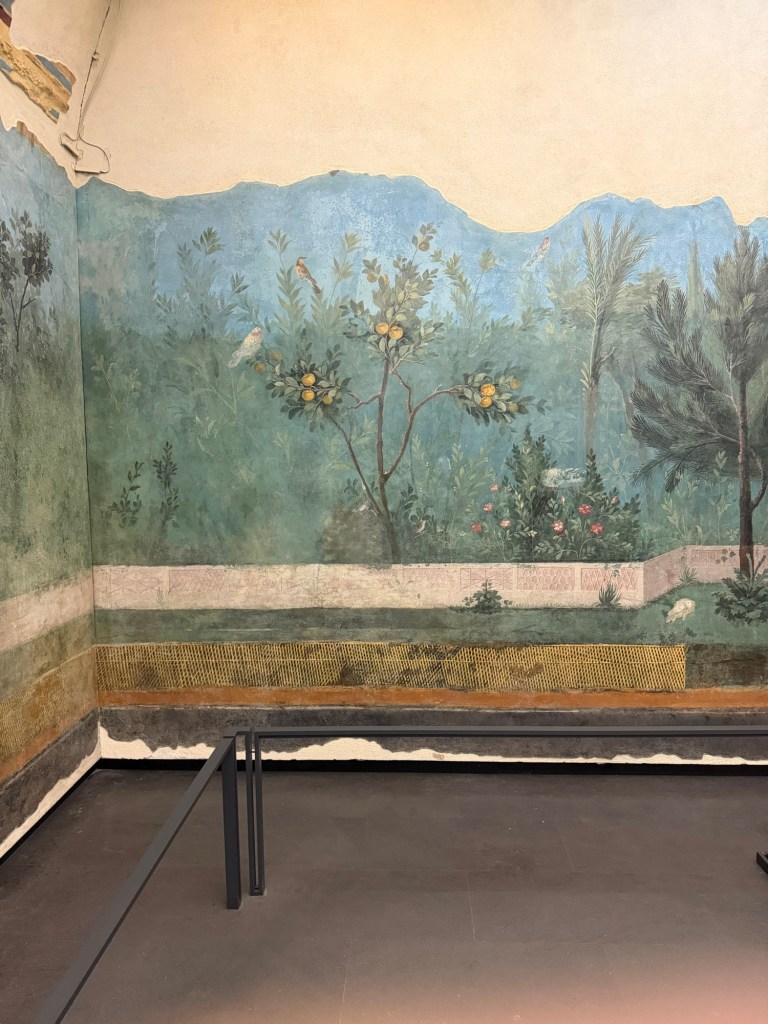
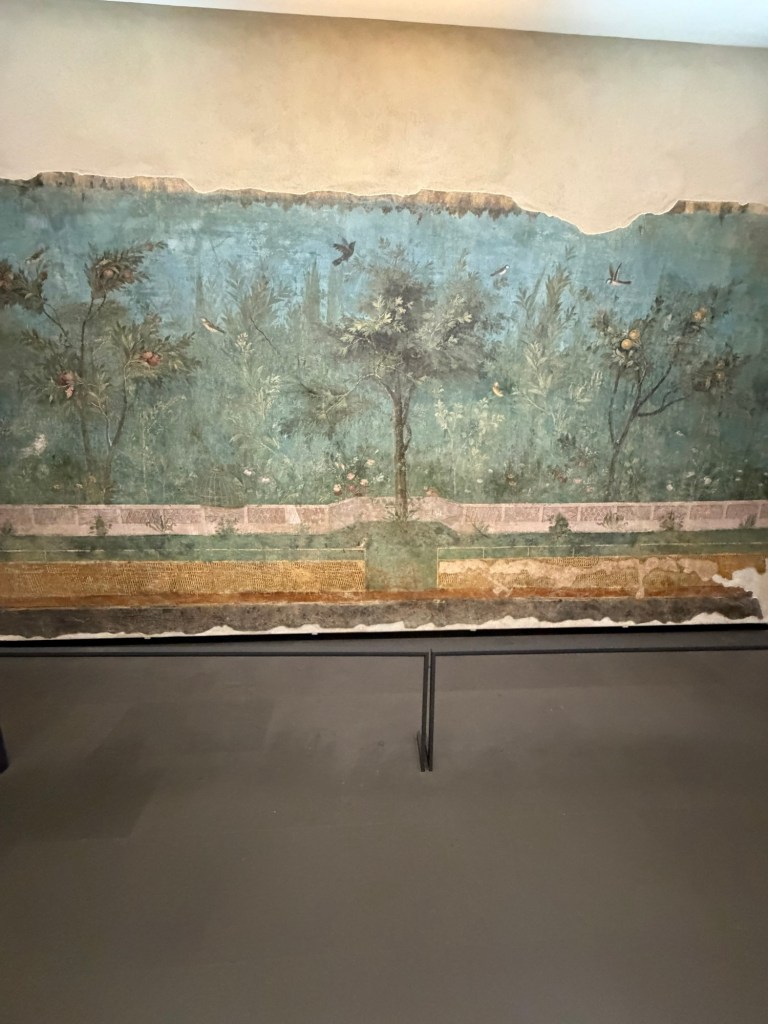
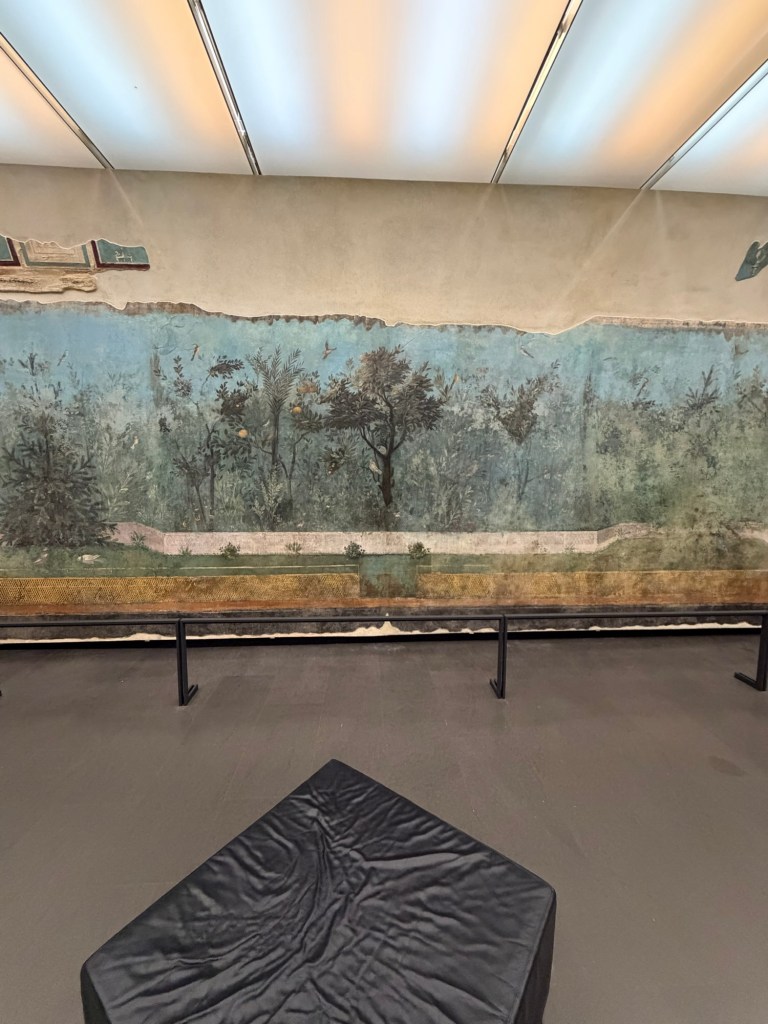
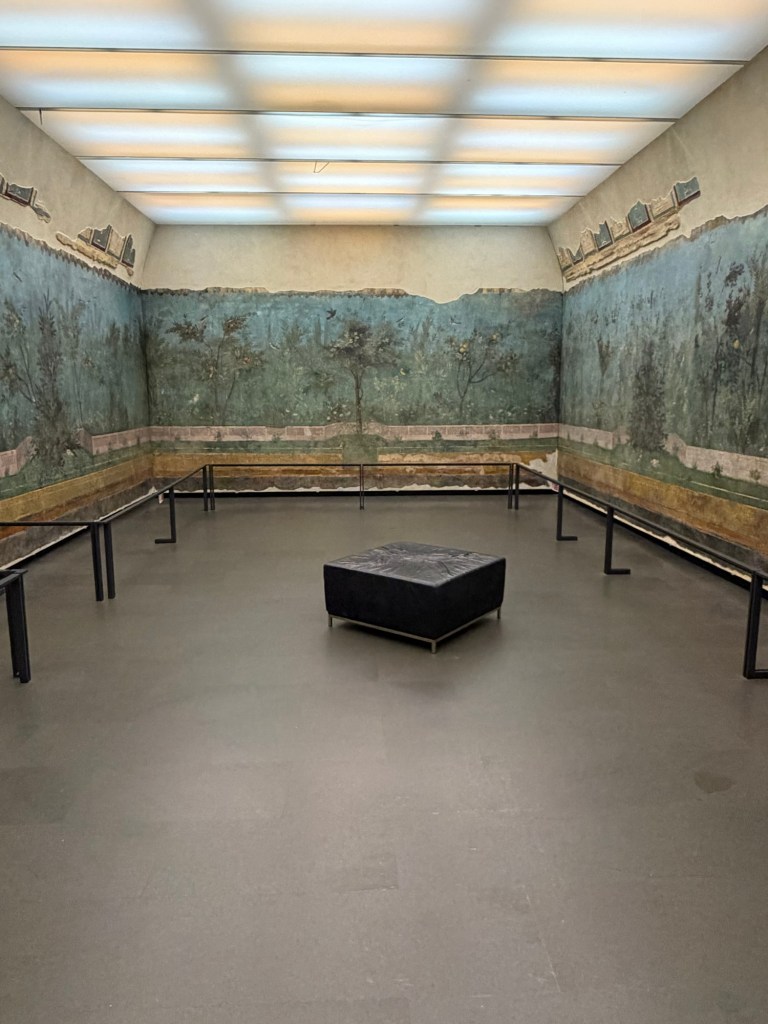
At the Palazzo Massimo near the Rome train station you can be immersed in this beautiful panted enclosure of 4 walls covered with blue skies and several types of trees including those bearing fruit and many other kinds of plants and an abundance of birds.
By Gleb Simonov – Own work, Public Domain
The ruins of the Villa of Livia still exist at Prima Porta, 12 kilometers north of Rome, Italy, along the Via Flaminia. The Villa may have been part of Livia Drusilla’s dowry that she brought when she married Octavian (later called the emperor Augustus), her second husband, in 39 BC. Some scholars believe that Livia may have received the site from her first husband, Tiberius Claudius Nero. However, most likely, it may also have been a gift given to her by Octavian upon their betrothal.
Ancient sources (Suetonius) tell us that Livia returned to this villa following the marriage. It was her sumptuous country residence complementing her house on the Palatine Hill in Rome. Livia was the original owner of the villa.
It was situated high up with a view down the Tiber Valley to Rome and the Apennine mountain rages. The upper terrace had a three sided portico with a belvedere over the valley. Some of the walls that retained the villa’s terraces can still be seen. It was originally built on a 20 meter plateau 14 kilometers north of Rome,
The location was strategically important due to the iron-rich cliffs of red tuff that approach the river Tiber at this point, the confluence of several roads, and the northern entrance to Rome. The name Prima Porta (First Door) came from an arch of the aqueduct over the Via Flaminia, which brought water to the villa and which travelers saw as the first indication of having reached Rome.
The villa was built and modified in nine phases, from the late republican age to the 6th century AD. After Livia, it remained an imperial residence.
Its Latin name, Villa Ad Gallinas Albas, referred to its breed of white chickens, which was said by Suetonius to have auspiciously omened origins. The area acclaimed the name Ad Gallinas Albas because of the legend of white fowl carrying a laurel branch in it beak that fell from the talons of an eagle and onto Livia Drusilla’s lap. It is said that the emperor kept the fowl and its offspring.
The villa and gardens have been excavated and can be visited. There are three vaulted subterranean rooms, the largest of which contained superb illusionistic frescoes of garden views in which all the plants and trees flower and fruit at once. These have since been removed to Rome, where, following cleaning and restoration, they have been installed in the Palazzo Massimo. The vault above the fresco was covered with stucco reliefs, some of which survive.
The site was rediscovered and explored as early as 1596, but it was not recognized as the Villa of Livia until the 19th century. In 1863–1864, a marble krater carved in refined low relief was discovered at the site. On 20 April 1863, the famous heroic marble statue of Augustus, the Augustus of Prima Porta, was found at the villa; it is now in the Vatican Museums (Braccio Nuovo). The magisterial Augustus is a marble copy of a bronze statue that celebrated the return in 20 BC of the military standards captured by the Parthians in 53 BC after the defeat of Crassus at Carrhae.
In the 19th century, the villa belonged to the Convent of Santa Maria in Via Lata.
A new series of more meticulous modern excavations was initiated in 1970. More modern scientific work began at the site in 1995, carried out by the Soprintendenza Archeologica di Roma and directed by Professor Gaetano Messineo, in tandem with the Swedish Institute in Rome.
New excavations starting from 2002 led to the discovery of the front of the platform structure (basis villae) crowned by a windowed portico (porticus fenestrata) and the rooms between this and the southern portico of a peristyle. An Augustan period peristyle was discovered in the central area. In the Flavian period a natatio (swimming pool) had been added in the garden of the peristyle and connected to the new baths. A mosaic featuring a marine thiasos was added later to the pool.
But, The Villa of Livia is most famously known for its frescoed wall in a partially subterranean room with a barrel vaulted ceiling. The frescoes were floor-to-ceiling continuous depiction of a lovely garden that fades into the distance.
Once accessed through a dark five meter long hallway obstructing a visitor’s vision as they adjust to the darkness and then the light again as they enter the room, visitors are transported to a garden paradise. This is believed to have created a space of relaxation and fun during the summer months as an escape from the heat outdoors, providing a greater feeling of refreshment. The room could have also retained heat in the winter months providing function throughout the year.
There are many conflicting beliefs concerning what the garden room was used for, however, it is most commonly believed that the space served as a triclinium, where guest were entertained, meals were served, and people could lie down on beds and cushions around a low central table.
The purpose and layout of the Villa Livia are important. The Roman activity of “[d]ining was much more than the satisfaction of human need — it was a ritual of great social and political significance.” In terms of layout, the room is underground and measures 40 feet long by 20 feet wide. There are no separating moldings, no painted architecture, and no visible structural elements — the room unexpectedly transports the viewer “outside.” The enclosure is striking because of the spatial play of the room itself with its illusionistic quality, there is incredible accuracy of plant species, and the variety provides a landscape that in reality cannot exist as one garden. A low stone wall contains the thickest and largest plantings, and in between the viewer and the space rests another fence with a narrow grass walkway. The garden layout encompasses a “perfect combination of variety and abundance with stylization and order” as nature grows freely while simultaneous evidence of human activity is present, specifically as some birds exist in cages and a neatly manicured lawn is visible closest to the dining room space.
The trees in the background of the fresco become less detailed when compared to those in the foreground with tendrils falling over the painted stone wall. All flora in the room are in bloom and all fruits are ripe, even though in fact they would have flowered and ripened at different times of the year. This may symbolically represent the expected prosperity of the union between Livia and Augustus and the couple’s rulership of a new era in Roman history.
The taxonomic interpretation of the garden fresco reveal 24 different species of floras within twenty families including autochthonous, or indigenous, and exotic plants with the painterly precision of botany, as well as zoology. The fresco includes a variety of birds perched on tree limbs or in flight that creates movement along with a painted breeze that moves the foliage.
The background sky is painted with Egyptian blue which was a rare and expensive color at the time, making the room feel open and light, set in a lush, brightly colored, airy environment, despite being underground and indoors.
All of the videos and stills in this post were taken by me on my recent visit to this incredible installation. I hope you feel the same pleasure from viewing the work as I do.
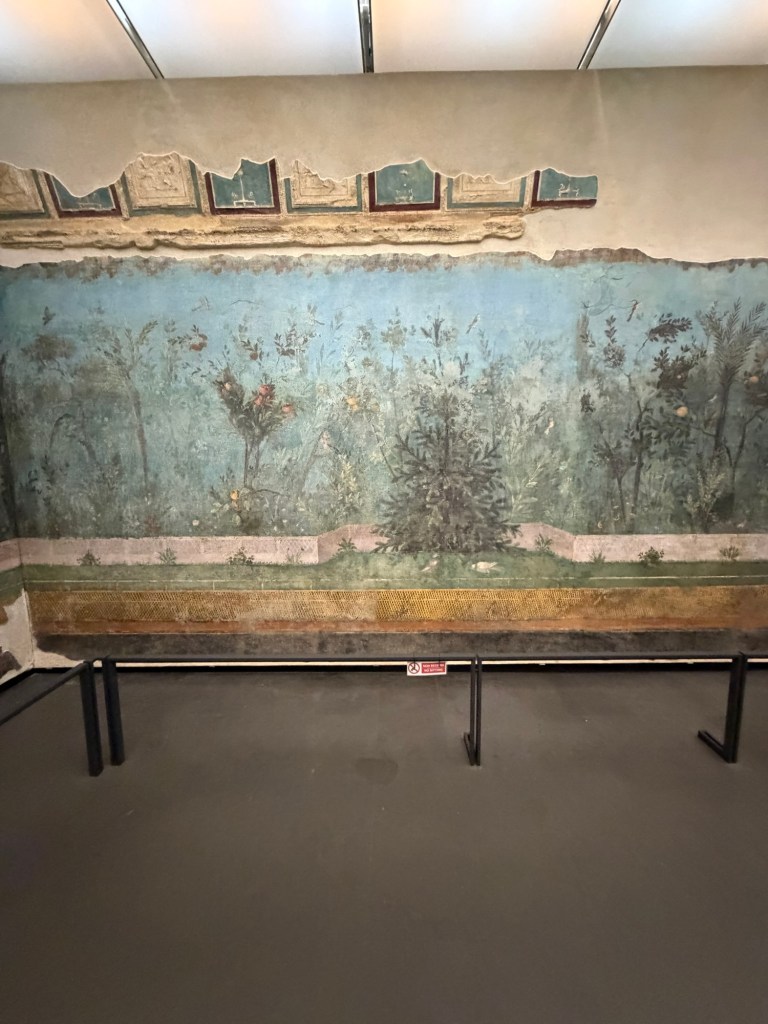
The plant species depicted include: umbrella pine, oak, red fir, quince, pomegranate, myrtle, oleander, date palm, strawberry, laurel, viburnum, holm oak, boxwood, cypress, ivy, acanthus, rose, poppy, chrysanthemum, chamomile, fern, violet, and iris.
I found the following video very interesting: https://smarthistory.org/painted-garden-villa-of-livia/


I could live there forever
You and me both!