There is another amazing set of Roman era frescoes preserved at Palazzo Massimo! Their collection is simply superb!
Today’s post is centered on the antique discoveries found in Trastevere, at the incomparable Villa Doria Pamphili. While the 17th-century estate we can see today was designed as a modern Baroque escape, the villa sits directly atop and extensive ancient Roman necropolis and the ancient Via Aurelia Antica.
Frescoes from this necropolis and specifically its columbarium are the subject of today’s post. A columbarium holds funeral urns filled with the cremated ashes of deceased persons in ancient Rome. It takes its name from the Latin word for dove, columba, and is so-named because the niches look like dovecotes. The group of niches could be combined as a freestanding structure or a part of an underground burial place. They were often decorated with small paintings and might include an epitaph.
The ancient frescoes from the great columbarium discovered at Villa Doria Pamphili are now permanently displayed at Palazzo Massimo. These intricate wall paintings were recovered from the underground burial chambers that sit below the later constructed villa. This subterranean structure belonged to a wealthy Roman family or a burial society.
The frescoes feature miniature friezes that depict diverse themes, ranging from everyday life and Nilotic landscapes to exotic animals, Pygmies, and various mythological scenes painted directly above the niches meant for funerary urns. In the long walls of the burial building from the 1st century AD, landscape scenes alternate with burial niches for cinerary urns and inscriptions with the names of the dead. The walls featured detailed landscape scenes, floral motifs, exotic animals, theatrical masks, and mythical scenes such as Prometheus and the eagle. The ancient tombs were unexpectedly joyful, covered in vivid, delicate frescoes meant to resemble the interior of an elite Roman villa.
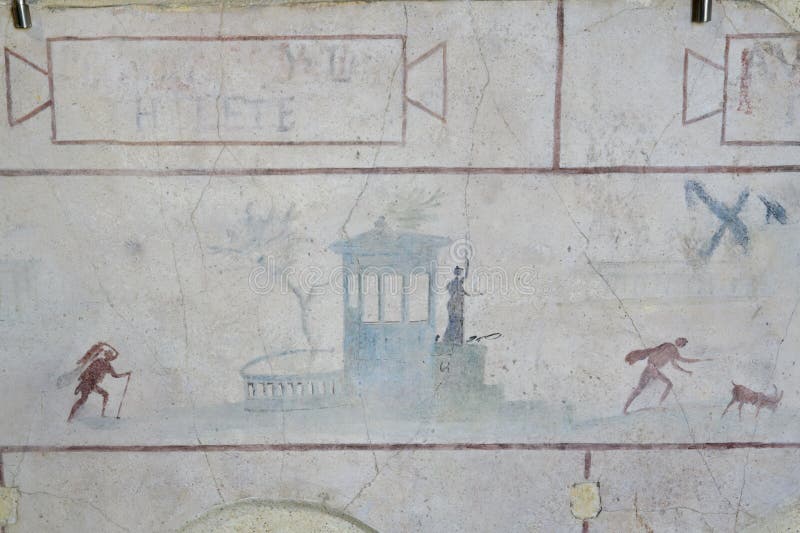
The discovery and extraction of the frescoes from the Villa’s necropolis is also a fascinating story; it spanned nearly a century, evolving from a private aristocratic excavation into a major state conservation effort.
The initial discovery in occurred in 1838 when the Great Columbarium was unearthed on the expansive grounds of the Villa estate. It was found on the slopes of the Janiculum Hill, close to the Casino del Bel Respiro. The excavation was commissioned directly by the noble family, who owned the property and often went looking for classical antiquities. This had. been a rewarding pastime for Romans since antiquity itself.
Excavators realized the columbarium was part of a vast Roman burial complex, running along the ancient Via Aurelia. Because the building was burned underground, its vibrant early Augustan-age paintings (dating to 30-20 BC) remained exceptionally well-preserved.
To protect the delicate wall paintings from deteriorating from environmental exposure inside the subterranean chamber, a team of specialized conservers officially detached the frescoes in 1922.
Following their removal, they became part of the state collections administered under the National Roman Museum. They were meticulously transferred onto new supports so they could safely be put on public display.
The historical significance of the site was further cemented in 1984. During the fast-tracked structural renovations of the Palazzina dell’Allgardi, (done to prepare the building to host the Italian Presidency of the Council of the European Communities (EC). Today, the building serves as an official representative office for the Italian Presidency of the Council of Ministers) on the villa grounds, architects accidentally rediscovered another beautifully pained adjacent structure, the Columbarium of Scribonius Menophilus, but Columbarium of Caius Scribonius Menophilus is a remarkably preserved tomb featuring an intricate black and white tile mosaic floor detailing the name of the freedman owner. However, that must be a subject for another day.
Today the main room of the original columbarium discovered in 1838 still stands hollowed out at the villa, but its artistic heart is fully reconstructed inside the climate-controlled rooms of wonderful Palazzo Massimo.
For a video of the site, I can recommend this: https://youtu.be/n66bqfGdbx4.

