Piazza Sant’ Ambrogio, Florence and Pope Pius VII

I recently met a friend in front of the church in Piazza Sant’ Ambrogio, near Santa Croce, in a spot that is the terminus for 3 streets : via de’ Pilastri, via di Mezzo, and Borgo la Croce e via Carducci.

While waiting, I noticed for the first time, although I’ve been in this piazza a hundred times before, something new.

fullsizeoutput_1853

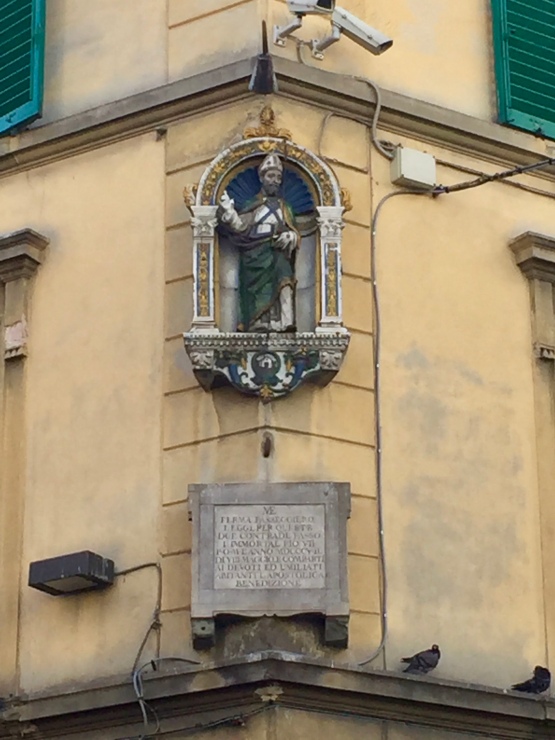
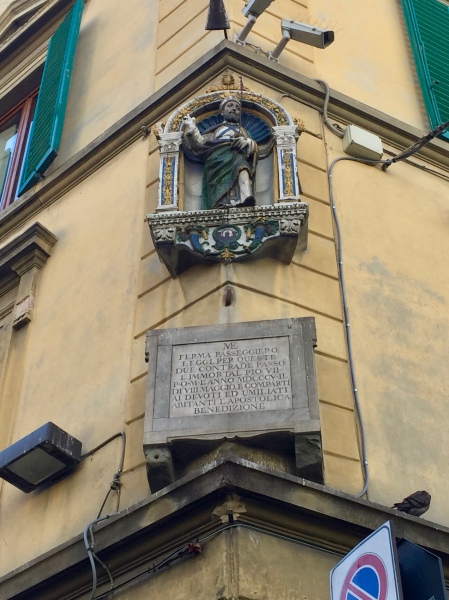
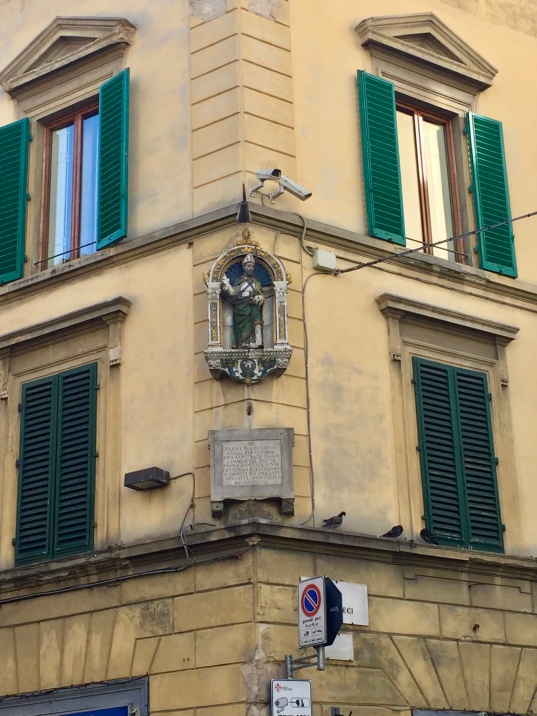
Looking a bit higher than I normally do, I saw a glazed terra-cotta tabernacle, in the style of the Della Robbia, of a figure that I assumed was a priest or even a pope, making a sign of blessing.

fullsizeoutput_1854

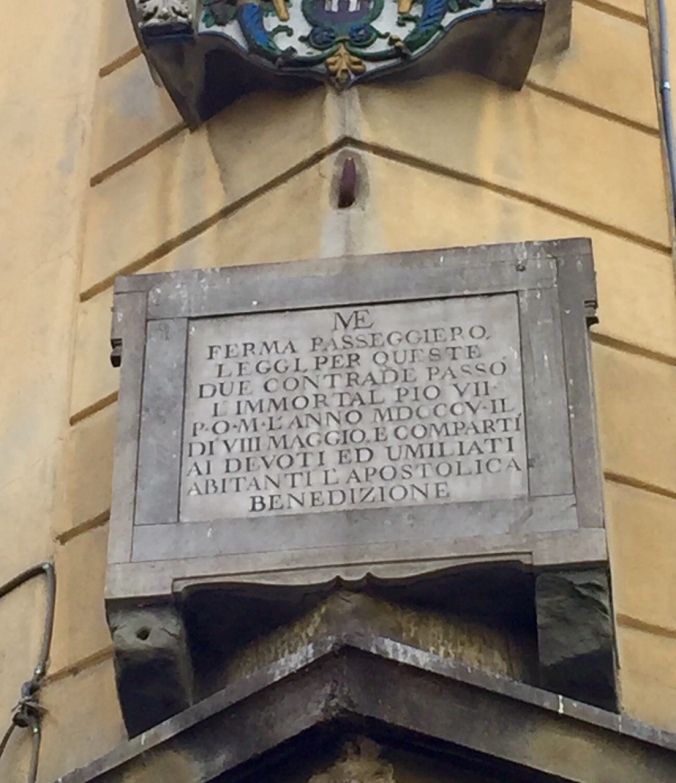
I ventured nearer to photograph the inscription below, and was rewarded with this information:

fullsizeoutput_1855

IMG_1394

Loosely translated, the inscription reads: “Stop, you passers by, and read this. Know that 2 neighborhoods were passed by the immortal Pope Pius VII on 8 May, 1807, where he devotedly and humbly gave an apostolic blessing to the inhabitants.”

I seldom have occasion to discuss the Catholic Church, that foundational stone of Italian culture, in my blog, so let’s do a little something about that now.

Who was Pope Pius VII?

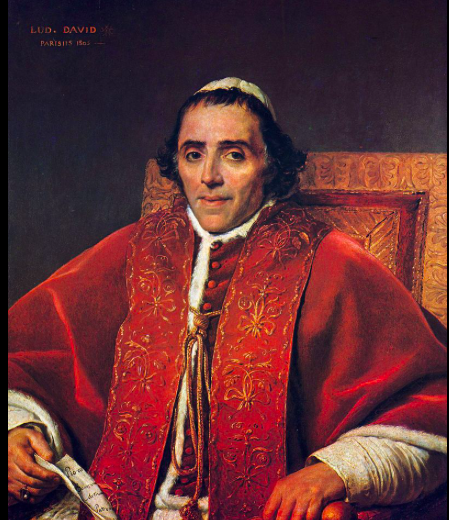
Screen Shot 2019-09-17 at 14.35.54

Portrait of Pius VII painted by Jacques-Louis David

He was born in 1742 as Barnaba Niccolò Maria Luigi Chiaramonti. He would rise all the way to head of the Catholic Church and ruler of the Papal States from 1800 until his death in 1823. Chiaramonti was also a monk of the Order of Saint Benedict in addition to being a well-known theologian and bishop throughout his life.

Chiaramonti was born in Cesena, about 30 miles south of Ravenna, in 1742, the youngest son of Count Scipione Chiaramonti (1698 – 1750) and Giovanna Coronata (d. 1777). His mother was the daughter of the Marquess Ghini; though his family was of noble status, they were not wealthy.

Like his brothers, he attended the Collegio dei Nobili in Ravenna but decided to join the Order of Saint Benedict at the age of 14 on 2 October 1756 as a novice at the Abbey of Santa Maria del Monte in Cesena. In 1758, he became a professed member and assumed the name of Gregorio. He taught at Benedictine colleges in Parma and Rome, and was ordained a priest on 21 September 1765.

In 1789, as the French Revolution took place, a series of anti-clerical governments came into power. During the French Revolutionary Wars, troops under Napoleon Bonaparte invaded Rome and took Pope Pius VI as a prisoner. He was taken as prisoner to France, where he died in 1799. The following year, after a sede vacante period lasting approximately six months, Chiaramonti was elected to the papacy, and took as his pontifical name Pius VII, in honor of his immediate predecessor.

He was crowned on 21 March 1800 in a rather unusual ceremony, wearing a papier-mâché papal tiara as the French had seized the tiaras held by the Holy See when occupying Rome and forcing Pius VI into exile. Pius VII then left for Rome, sailing on a barely seaworthy Austrian ship, the Bellona. The twelve-day voyage ended at Pesaro and he proceeded to Rome.

Screen Shot 2019-09-17 at 14.36.06

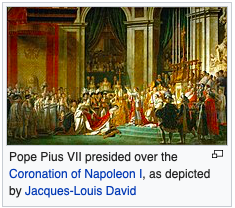
Pius at first attempted to take a cautious approach in dealing with Napoleon. He signed the Concordat of 1801, through which he succeeded in guaranteeing religious freedom for Catholics living in France, and presided over his coronation as Emperor of the French in 1804. Pius VII presided at the coronation of Napoleon I in 1804.

Screen Shot 2019-09-17 at 14.36.46

Once again, in 1809, Napoleon invaded the Papal States during the Napoleonic Wars; this earned him ex-communication. Pius VII was taken prisoner and transported to France. He remained there until Napoleon abdicated in 1813 and Pius VII returned to Rome.  He was greeted warmly as a hero and defender of the faith and immediately revived the Inquisition and the Index of Condemned Books.

His works, some notable, some to be regretted:

Pius VII joined the declaration of the 1815 Congress of Vienna, represented by Cardinal Secretary of State Ercole Consalvi, and urged the suppression of the slave trade. This pertained particularly to places such as Spain and Portugal where slavery was economically important. The pope wrote a letter to King Louis XVIII of France dated 20 September 1814 and to the King John VI of Portugal in 1823 to urge the end of slavery. He condemned the slave trade and defined the sale of people as an injustice to the dignity of the human person. In his letter to the King of Portugal, he wrote: “the Pope regrets that this trade in blacks, that he believed having ceased, is still exercised in some regions and even more cruel way. He begs and begs the King of Portugal that it implement all its authority and wisdom to extirpate this unholy and abominable shame.”

Under Napoleonic rule, the Jewish Ghetto had been abolished and Jews were free to live and move where they would. Following the restoration of Papal rule, Pius VII re-instituted the confinement of Jews to the Ghetto, having the doors closed at nighttime.

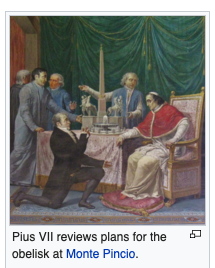
Pius VII was a man of culture and attempted to reinvigorate Rome with archaeological excavations in Ostia which revealed ruins and icons from ancient times. He also had walls and other buildings rebuilt and restored the Arch of Constantine. He ordered the construction of fountains and piazzas and erected the obelisk at Monte Pincio.

Screen Shot 2019-09-17 at 16.00.53

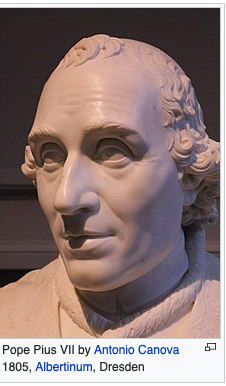
The pope also made sure Rome was a place for artists and the leading artists of the time like Antonio Canova and Peter von Cornelius. He also enriched the Vatican Library with numerous manuscripts and books.

 
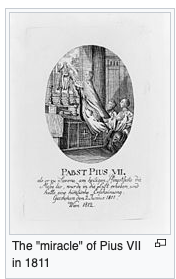
The so-called “miracle” of Pius VII. On 15 August 1811 – the Feast of the Assumption – it is recorded that the pope celebrated Mass and was said to have entered a trance and began to levitate in a manner that drew him to the altar. This particular episode aroused great wonder and awe among attendants which included the French soldiers guarding him who were in disbelief of what had occurred.

Screen Shot 2019-09-17 at 16.00.46

Relationship with the United States. On the United States’ undertaking of the First Barbary War to suppress the Muslim Barbary pirates along the southern Mediterranean coast, ending their kidnapping of Europeans for ransom and slavery, Pius VII declared that the United States “had done more for the cause of Christianity than the most powerful nations of Christendom have done for ages.”

For the United States, he established several new dioceses in 1808 for Boston, New York City, and Philadelphia. In 1821, he also established the dioceses of Charleston, Richmond and Cincinnati.

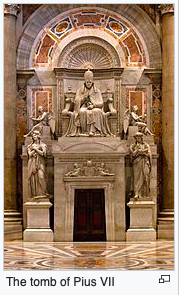
Pius VII died in 1823 at the age of 81. He was later buried in a monument in Saint Peter’s Basilica by the leading sculptor of the day, the Danish Bertel Thorvaldsen.

Screen Shot 2019-09-17 at 16.01.03

For posterity, a marker in Florence

One of the millions of things I love about Italy is:  they never miss an opportunity to mark something for posterity.  No matter how modest the contribution.

Case in point, a stone’s throw from my home on the north end of Florence is an underground parking lot in a neighborhood known as the “Parterre.”  It serves a vital function of providing parking for some of the thousands of cars that cannot enter historic Florence on any given day, because the historic center is designated a pedestrian area and does not allow entry for unauthorized vehicles.

The above-ground section marking the Parterre is nothing much to brag about:

IMG_1383

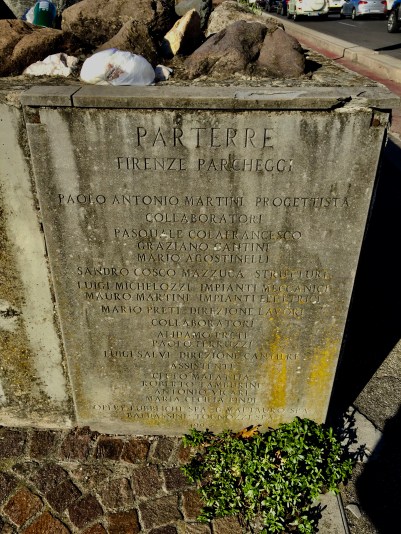
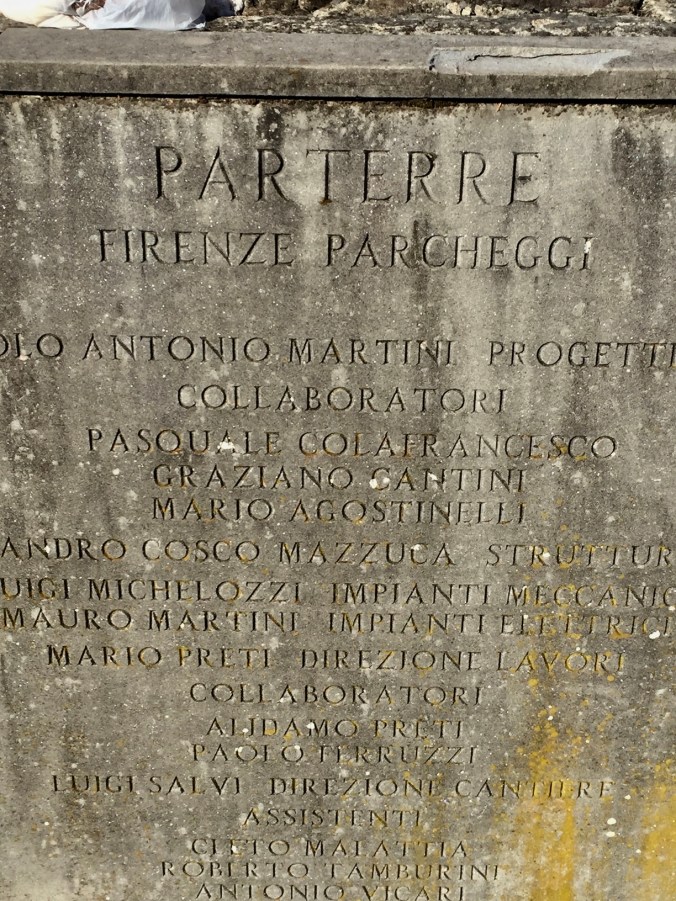
But, nevertheless, the city’s leaders wanted credit given to the masterminds behind the underground parking, and to this end they installed a very grand-sounding plaque with inscriptions lauding them all.

fullsizeoutput_1843

fullsizeoutput_1844

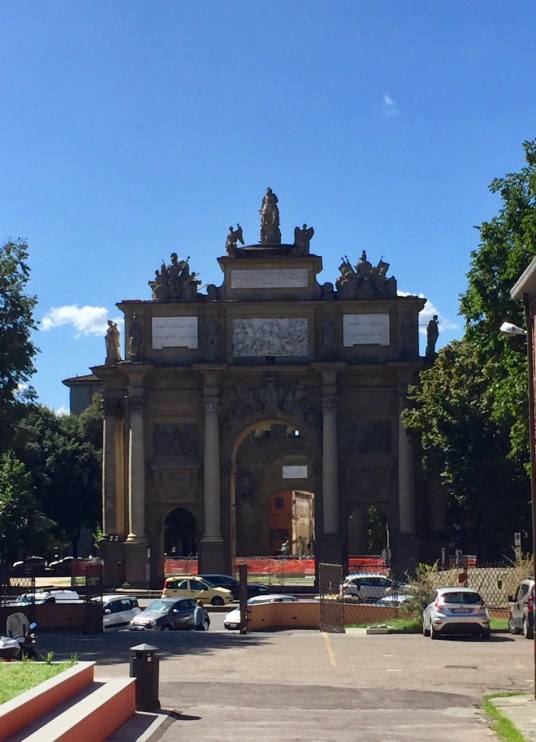
The French Triumphal arch in Piazza della Liberta

0XYTReQtT%KAygkw8ZQx4gTMoSIBlKR6eGAGLDSjZWVQF4PyifUPSGikhxanLoS3Cg+l8WN6xFR6yDMM28Dhvc8g

VYrwFcbNTLCd7gGDdfSjfgfullsizeoutput_1834

The triumphal arch of the Lorraine, a gateway to and from power in Piazza della Libertà


IMG_1377

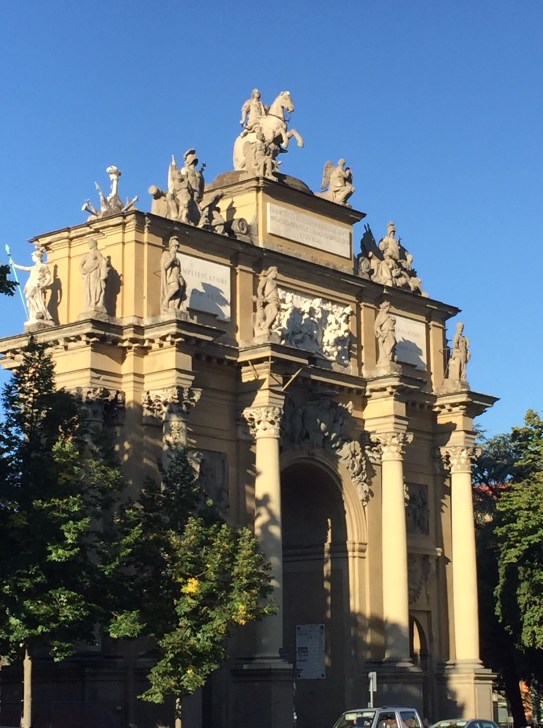
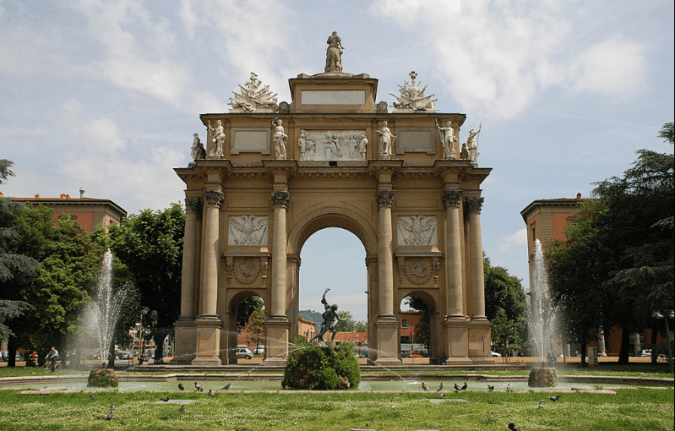
There is a grandiose and quite ornate — at least by Tuscan standards — neoclassical arch standing in my neighborhood.  It sits not quite in the middle of Piazza della Libertà.

Based on the model of Roman triumphal arches, the arch in Florence was built for the entry of Francesco Stefano, the First Grand Duke of the House of Lorraine, a dynasty imposed on Tuscany following the death in 1737 of the last of the Medici grand dukes, Gian Gastone.

Screen Shot 2019-09-11 at 11.22.23

Ironically, in 1859, the same arch saw the exit of the last of Tuscany’s Lorraine rulers, Grand Duke Leopoldo II, after he was ousted in a bloodless revolution.

In a kind of territorial “musical chairs,” the French, Austrians and dukes of Lorraine agreed under the peace treaty that ended the war of Polish succession (1733–37) that the duchy of Lorraine be given to Stanisław I, the former king of Poland and father-in-law of France’s King Louis XV. As compensation, the dukes of Lorraine were designated the duchy of Tuscany.

Screen Shot 2019-09-11 at 11.21.18

Thoroughly mystified by these geopolitical machinations, the Tuscans did not relish the idea of foreign occupation. Witness to this, French writer and future president of Burgundy Charles de Brosses commented that they would have willingly given “two-thirds of their property to have the Medicis back, and the other third to get rid of the Lorrainers….They hate them.”

Screen Shot 2019-09-11 at 11.32.44

Screen Shot 2019-09-11 at 11.21.36

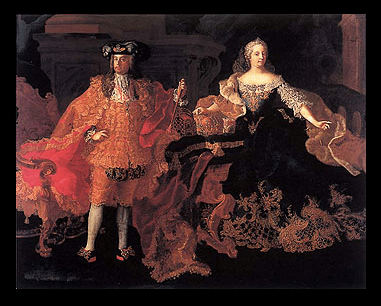
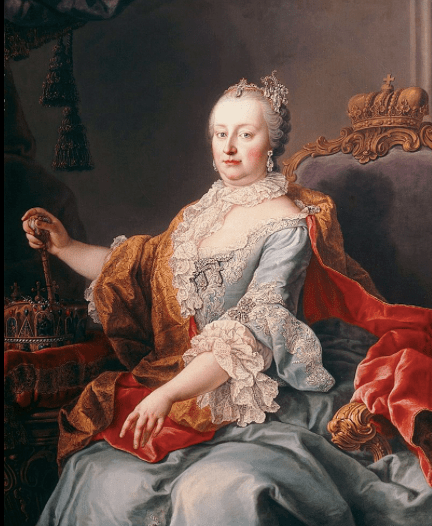
Nonetheless, to welcome the new sovereign, his young bride, Maria Theresa of Austria (the daughter and heir of the Holy Roman Emperor, Charles VI), on their first –and only–visit to Florence in January 1739, Senator Carlo Ginori, founder of a porcelain factory, proposed the construction of an arch near the ancient Porta di San Gallo gate, which was and is the main northern entrance to the city.

Here’s a double portrait of the newlyweds:

Screen Shot 2019-09-11 at 11.33.55

The arch was designed by Jean-Nicolas Jador, an architect from Lorraine. Work began on December 16, 1738, but, despite more than 400 men working day and night, it was impossible to complete the complicated edifice on schedule for the couple’s arrival.

The three main arches, a large one in the centre with two smaller ones each side, were finished, but painted wood and canvas decorated with temporary statuary covered the section above them.

As the sound of cannons boomed out from Forte Belvedere and fireworks exploded into the sky, it is likely the grand duke could barely see these improvisations as night had almost fallen by the time he reached Florence on that cold winter’s day.

Work on the arch continued for another 20 years, with many artists and artisans involved before it was completed in 1759.

Supported by 10 Corinthian columns, the monument features 15 allegorical statues, heraldic decorations, four adornments of flags and arms, and six bas-reliefs of episodes from the life of Francesco Stefano, including his coronation.

IMG_1378

On the southern façade, two double-headed eagles symbolize the Habsburg dynasty.

IMG_1380

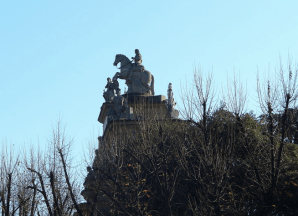
The monument is topped by an equestrian statue of Francesco Stefano by Florentine Baroque sculptor Vincenzo Foggini, known for his masterpiece Samson and the Philistines, now in the Victoria and Albert Museum in London. The statue faces away from the city, intended to welcome the grand duke and his entourage on his approach to the city from via Bolognese.

Screen Shot 2019-09-11 at 11.21.36

On that first visit, after celebrating mass at the Duomo, the royal couple took up residence in the Pitti Palace and spent their days sightseeing. During the carnival season, they held three lavish masked balls at the Palazzo Vecchio and even managed to attend a game of football in costume.

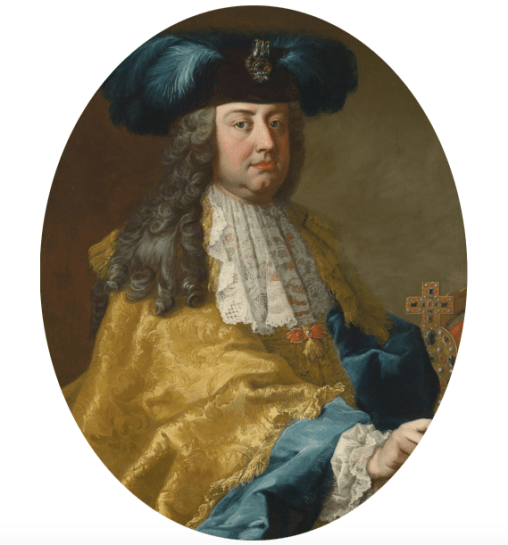
In describing Francesco Stefano in his Letters from Italy, John Boyle, the fifth earl of Cork and Orrery, wrote that he was “of a cheerful aspect, and of a most princely personage, yet something sinister and obscure may be perceived in his countenance … He is a Lorrainese, the shadow, not the substance of a sovereign.”

Here he is in a portrait:

Screen Shot 2019-09-11 at 11.28.39

And it was the shadow of Francesco Stefano that would, in fact, reign over his subjects because his stay, albeit it a pleasant one, lasted only three months, and he would never set foot in the city again. After the death of Charles VI in 1740, Maria Theresa succeeded her father and named her husband co-regent of the Holy Roman Empire.

Screen Shot 2019-09-11 at 11.30.41

For the next 27 years, Tuscany was governed in his name by a regency, first by Count Emmanuel de Richecourt and then by General Antonio Botta-Adorno.

In effect, Florence and the region simply became a convenient cash cow to be heavily taxed and plundered of its art or of whatever else could be of use to the court in Vienna for supporting its economy and the Austrian army.


http://www.theflorentine.net/art-culture/2016/05/triumphal-arch-lorraine/


Florence’s tiny little wine windows

One of the hundreds of interesting things you see when walking around the city of Florence are these small windows, measuring about 12 inches wide by 15 inches tall, cut into the masonry of some major palazzi.  There are hundreds of them in Florence.

The buchette del vino (“small holes [for] wine”) were added to the buildings by entrepreneurial families who produced wine on their country estates and thought to themselves, “why not sell some in Florence on a glass by glass, or a refilled bottle by bottle, basis?”

Screen Shot 2019-09-11 at 10.39.21

Together, these windows form a collection of Renaissance-era vestiges of a once-popular and admirably no-fuss form of wine sales.

Without exception, I have never seen one of these windows open.  They are usually boarded up, sometimes in quite decorative ways.

Screen Shot 2019-09-11 at 10.39.49

But now, an organization is working to preserve—and help reopen—the city’s “wine windows.”

“These small architectural features are a very special commercial and social phenomenon unique to Florence and Tuscany,” Matteo Faglia, a founding member of the Associazione Culturale Buchette del Vino, told Unfiltered via email. “Although they are a minor cultural patrimony, nevertheless, they are an integral part of the richest area of the world in terms of works of art and monuments—Tuscany.”

The buchette first came into vogue in the 16th century, when wealthy Florentines began to expand into landowning—notably, owning vineyards—in the Tuscan countryside. The aristocrats’ new zeal for selling wine was matched only by that for avoiding paying taxes on selling wine, so they devised the simplest model for wine retail they could: on-demand, to-go, literally hand-sold through a hole in the wall of their residences.

It was convenient for drinkers, too: Knock on the window with your empty bottle, and the server, a cantiniere, would answer; upon receiving the bottle and payment, he would return with a full bottle of wine. Buchette eventually became popular enough that nearly every Florentine family with vineyards and a palace in Florence had a wine window, and soon the trend spread to nearby Tuscan towns like Siena and Pisa.

The windows stayed open for the next three centuries, but by the beginning of the 20th century, more social wine tavernas had spread throughout the city, with better-quality wine, better company and equally easy access to a flask.

By 2015, most Florentines had lost track of their wine windows, if not vandalized them. That year, the Associazione was founded, with a mission to identify, map and preserve the buchette—nearly 300 catalogued so far.

And this summer provided a new boost to their work: One restaurant has cracked open its buchetta anew for business. Babae is the first restaurant to re-embrace the old tradition, filling glasses for passersby through their buchetta for a few hours each evening.

It’s a welcome development to the lovers of wine windows. “Although the ways of selling wine have obviously changed since the wine windows were fully active … this small gesture, which highlights a niche of Florentine history, is very welcome,” said Faglia, “to help to keep alive this antique and unique way of selling one of Tuscany’s most important agricultural and commercial products: its wine.”

This new association even has a Facebook page: https://www.facebook.com/buchettedelvino/

http://buchettedelvino.org/home%20eng/index.html

https://www.winespectator.com/articles/florence-s-forgotten-renaissance-wine-windows-are-open-again-for-business

The wonders of Padua (Padua, part 3)

Padova or Padua is a big subject! I’ve recently posted 2 times about it, here, here, here and here.  And, still, I am far from done!

This post includes a list of the major features that grace this lovely, historic town. But first, a sweet little video about the town itself:


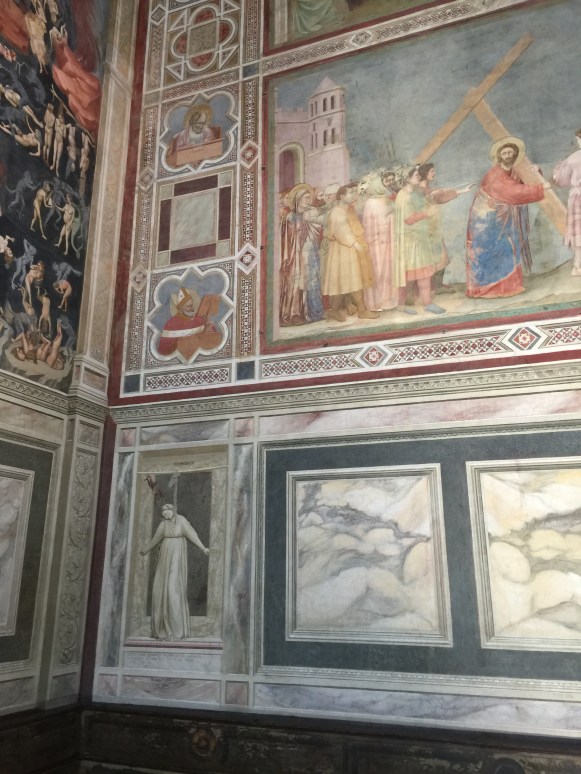
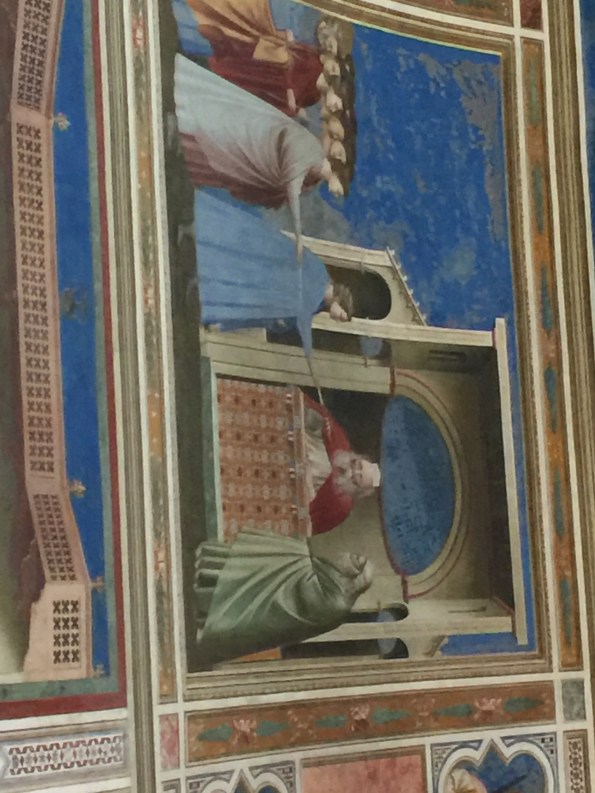
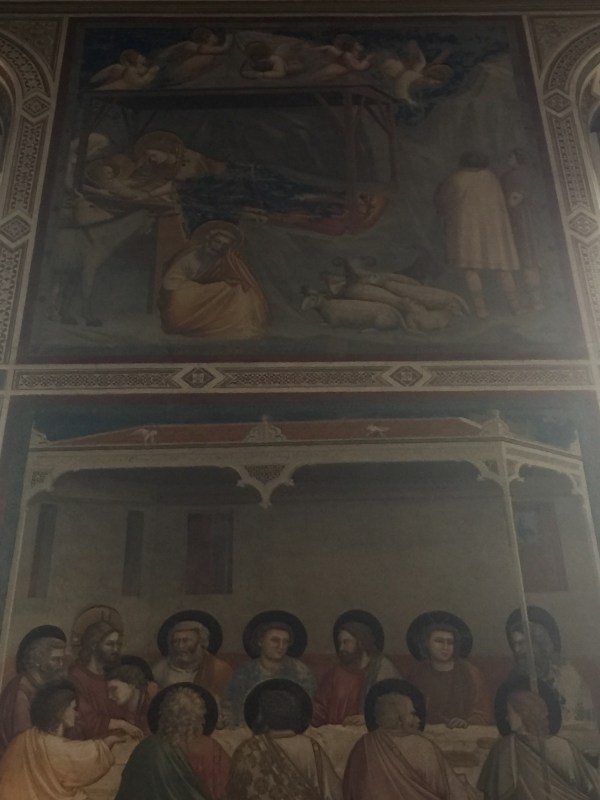
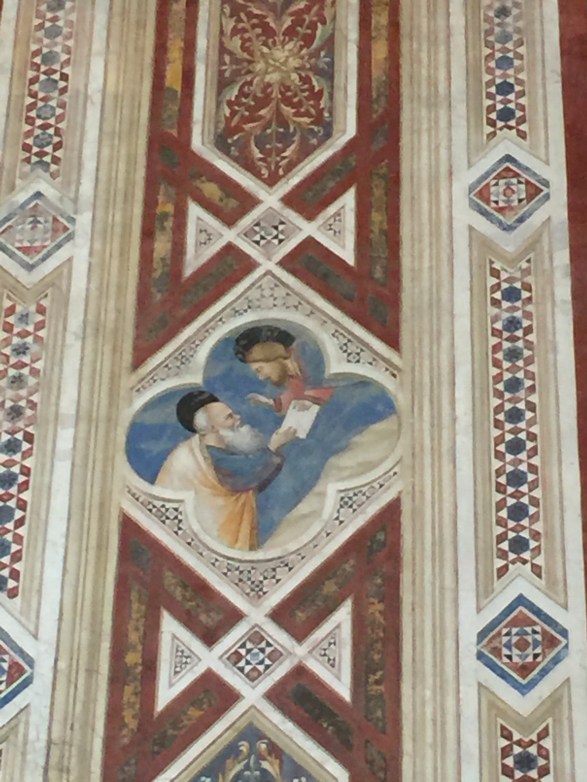
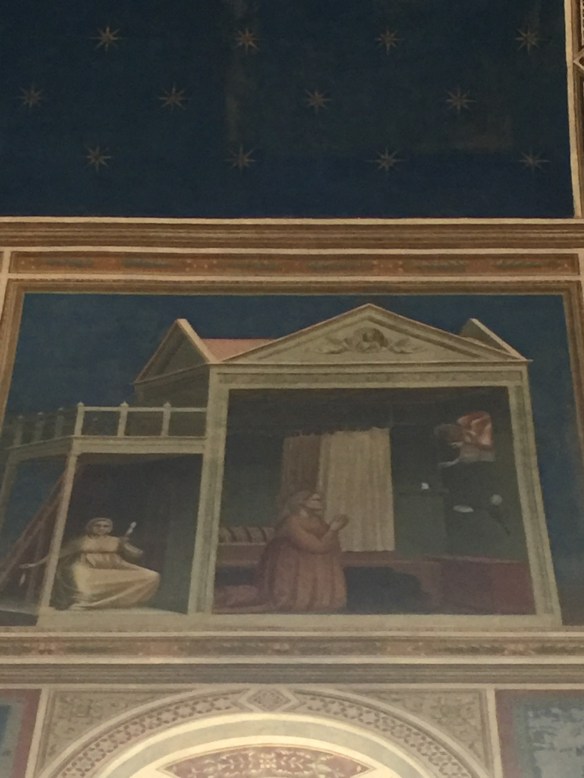
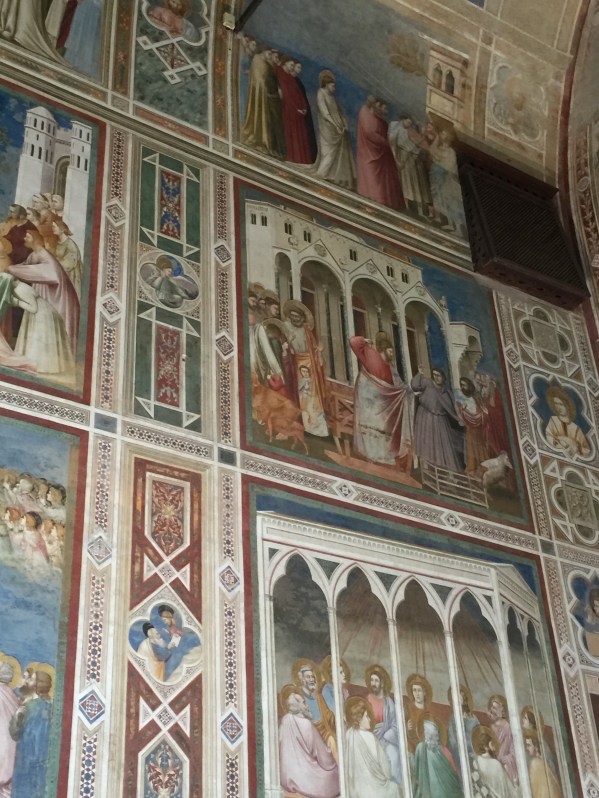
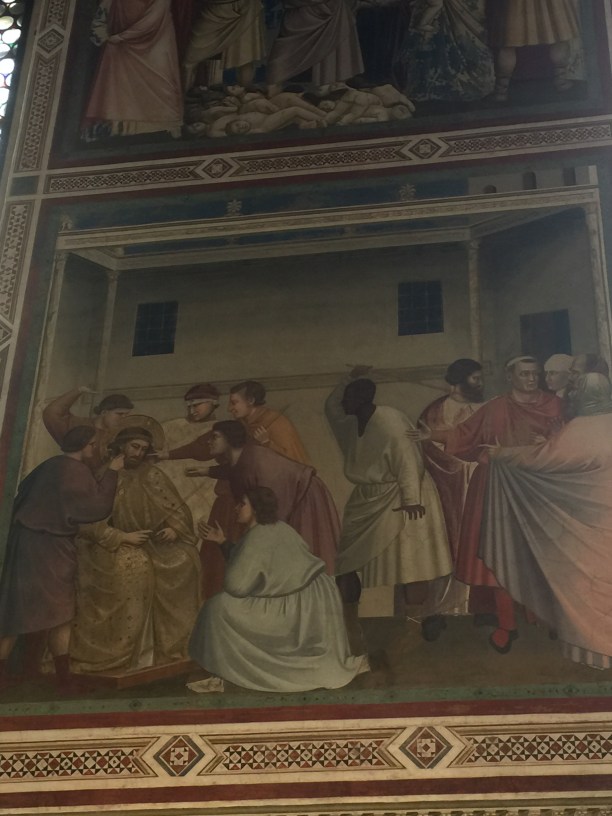
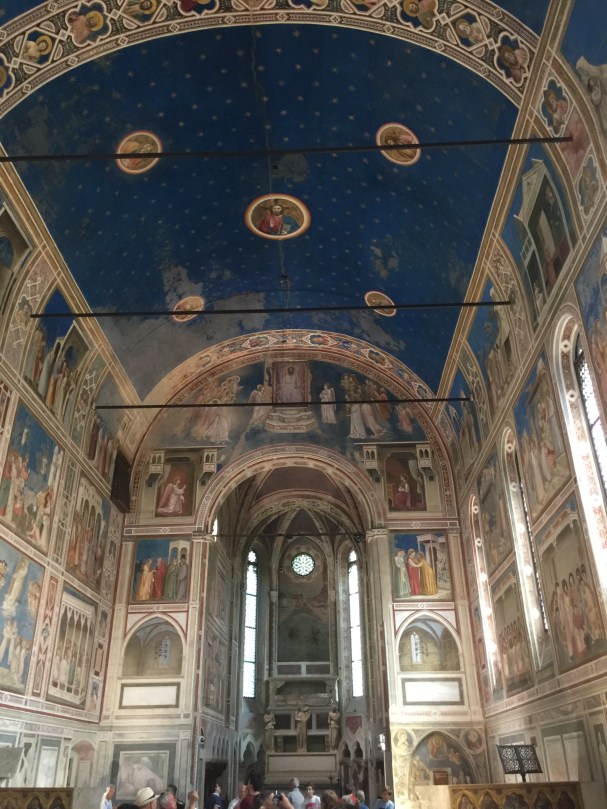
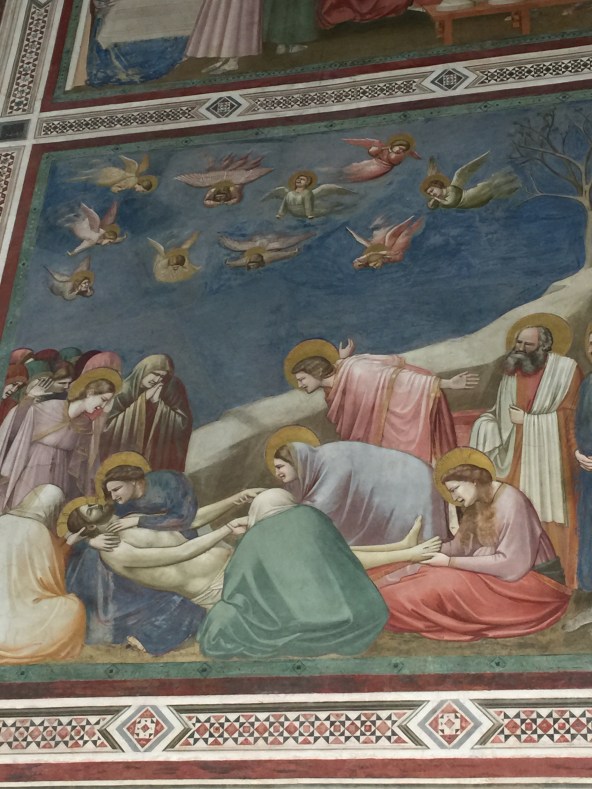
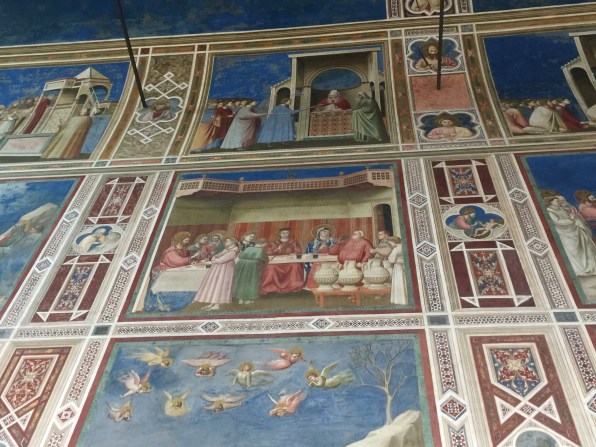
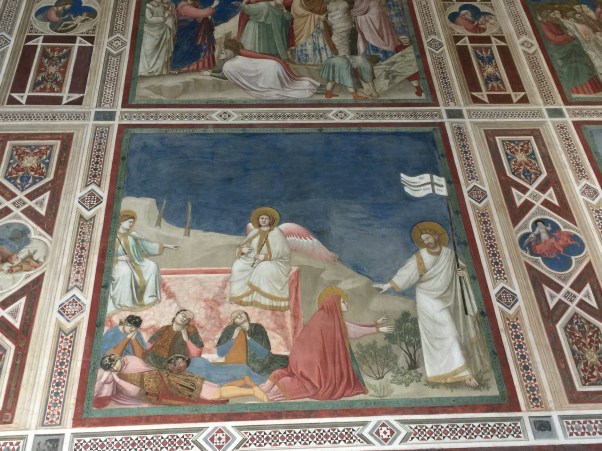
Undoubtedly the most notable things about Padova is the Giotto masterpiece of fresco painting in the The Scrovegni Chapel (Cappella degli Scrovegni).  This incredible cycle of frescoes was completed in 1305 by Giotto.

It was commissioned by Enrico degli Scrovegni, a wealthy banker, as a private chapel once attached to his family’s palazzo. It is also called the “Arena Chapel” because it stands on the site of a Roman-era arena.

The fresco cycle details the life of the Virgin Mary and has been acknowledged by many to be one of the most important fresco cycles in the world for its role in the development of European painting. It is a miracle that the chapel survived through the centuries and especially the bombardment of the city at the end of WWII.  But for a few hundred yards, the chapel could have been destroyed like its neighbor, the Church of the Eremitani.
The Palazzo della Ragione, with its great hall on the upper floor, is reputed to have the largest roof unsupported by columns in Europe; the hall is nearly rectangular, its length  267.39 ft, its breadth 88.58 ft, and its height 78.74 ft; the walls are covered with allegorical frescoes. The building stands upon arches, and the upper story is surrounded by an open loggia, not unlike that which surrounds the basilica of Vicenza.

The Palazzo was begun in 1172 and finished in 1219. In 1306, Fra Giovanni, an Augustinian friar, covered the whole with one roof. Originally there were three roofs, spanning the three chambers into which the hall was at first divided; the internal partition walls remained till the fire of 1420, when the Venetian architects who undertook the restoration removed them, throwing all three spaces into one and forming the present great hall, the Salone. The new space was refrescoed by Nicolo’ Miretto and Stefano da Ferrara, working from 1425 to 1440. Beneath the great hall, there is a centuries-old market.
In the Piazza dei Signori is the loggia called the Gran Guardia, (1493–1526), and close by is the Palazzo del Capitaniato, the residence of the Venetian governors, with its great door, the work of Giovanni Maria Falconetto, the Veronese architect-sculptor who introduced Renaissance architecture to Padua and who completed the door in 1532.

Falconetto was also the architect of Alvise Cornaro’s garden loggia, (Loggia Cornaro), the first fully Renaissance building in Padua.

Nearby stands the il duomo, remodeled in 1552 after a design of Michelangelo. It contains works by Nicolò Semitecolo, Francesco Bassano and Giorgio Schiavone.

The nearby Baptistry, consecrated in 1281, houses the most important frescoes cycle by Giusto de’ Menabuoi.

The Basilica of St. Giustina, faces the great piazza of Prato della Valle.

The Teatro Verdi is host to performances of operas, musicals, plays, ballets, and concerts.

The most celebrated of the Paduan churches is the Basilica di Sant’Antonio da Padova. The bones of the saint rest in a chapel richly ornamented with carved marble, the work of various artists, among them Sansovino and Falconetto.

The basilica was begun around the year 1230 and completed in the following century. Tradition says that the building was designed by Nicola Pisano. It is covered by seven cupolas, two of them pyramidal.

Donatello’s equestrian statue of the Venetian general Gattamelata (Erasmo da Narni) can be found on the piazza in front of the Basilica di Sant’Antonio da Padova. It was cast in 1453, and was the first full-size equestrian bronze cast since antiquity. It was inspired by the Marcus Aurelius equestrian sculpture at the Capitoline Hill in Rome.

Not far from the Gattamelata are the St. George Oratory (13th century), with frescoes by Altichiero, and the Scuola di S. Antonio (16th century), with frescoes by Tiziano (Titian).

One of the best known symbols of Padua is the Prato della Valle, a large elliptical square, one of the biggest in Europe. In the center is a wide garden surrounded by a moat, which is lined by 78 statues portraying illustrious citizens. It was created by Andrea Memmo in the late 18th century.

Memmo once resided in the monumental 15th-century Palazzo Angeli, which now houses the Museum of Precinema.

The Abbey of Santa Giustina and adjacent Basilica. In the 5th century, this became one of the most important monasteries in the area, until it was suppressed by Napoleon in 1810. In 1919 it was reopened.

The tombs of several saints are housed in the interior, including those of Justine, St. Prosdocimus, St. Maximus, St. Urius, St. Felicita, St. Julianus, as well as relics of the Apostle St. Matthias and the Evangelist St. Luke.

The abbey is also home to some important art, including the Martyrdom of St. Justine by Paolo Veronese. The complex was founded in the 5th century on the tomb of the namesake saint, Justine of Padua.

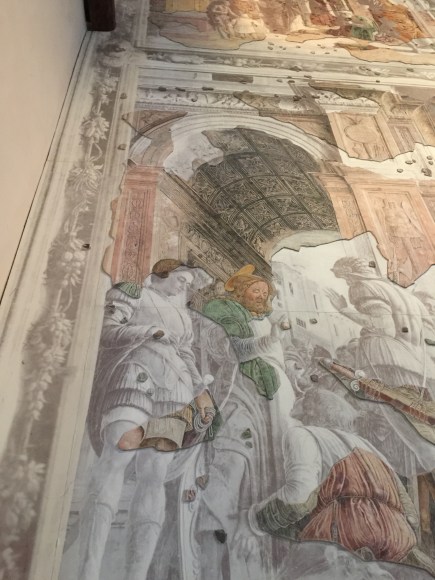
The Church of the Eremitani is an Augustinian church of the 13th century, containing the tombs of Jacopo (1324) and Ubertinello (1345) da Carrara, lords of Padua, and the chapel of SS James and Christopher, formerly illustrated by Mantegna’s frescoes. The frescoes were all but destroyed bombs dropped by the Allies in WWII, because it was next to the Nazi headquarters.

The old monastery of the church now houses the Musei Civici di Padova (town archeological and art museum).

Santa Sofia is probably Padova’s most ancient church. The crypt was begun in the late 10th century by Venetian craftsmen. It has a basilica plan with Romanesque-Gothic interior and Byzantine elements. The apse was built in the 12th century. The edifice appears to be tilting slightly due to the soft terrain.

Botanical Garden (Orto Botanico)

The church of San Gaetano (1574–1586) was designed by Vincenzo Scamozzi, on an unusual octagonal plan. The interior, decorated with polychrome marbles, houses a Madonna and Child by Andrea Briosco, in Nanto stone.

The 16th-century Baroque Padua Synagogue

At the center of the historical city, the buildings of Palazzo del Bò, the center of the University.

The City Hall, called Palazzo Moroni, the wall of which is covered by the names of the Paduan dead in the different wars of Italy and which is attached to the Palazzo della Ragione

The Caffé Pedrocchi, built in 1831 by architect Giuseppe Jappelli in neoclassical style with Egyptian influence. This café has been open for almost two centuries. It hosts the Risorgimento museum, and the near building of the Pedrocchino (“little Pedrocchi”) in neogothic style.

There is also the Castello. Its main tower was transformed between 1767 and 1777 into an astronomical observatory known as Specola. However the other buildings were used as prisons during the 19th and 20th centuries. They are now being restored.

The Ponte San Lorenzo, a Roman bridge largely underground, along with the ancient Ponte Molino, Ponte Altinate, Ponte Corvo and Ponte S. Matteo.

There are many noble ville near Padova. These include:

Villa Molin, in the Mandria fraction, designed by Vincenzo Scamozzi in 1597.

Villa Mandriola (17th century), at Albignasego

Villa Pacchierotti-Trieste (17th century), at Limena

Villa Cittadella-Vigodarzere (19th century), at Saonara

Villa Selvatico da Porto (15th–18th century), at Vigonza

Villa Loredan, at Sant’Urbano

Villa Contarini, at Piazzola sul Brenta, built in 1546 by Palladio and enlarged in the following centuries, is the most important

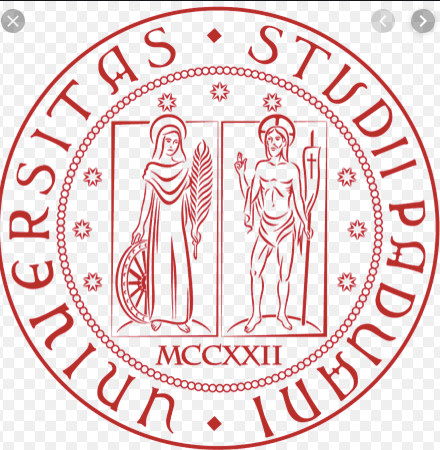
Padua has long been acclaimed for its university, founded in 1222. Under the rule of Venice the university was governed by a board of three patricians, called the Riformatori dello Studio di Padova. The list of notable professors and alumni is long, containing, among others, the names of Bembo, Sperone Speroni, the anatomist Vesalius, Copernicus, Fallopius, Fabrizio d’Acquapendente, Galileo Galilei, William Harvey, Pietro Pomponazzi, Reginald, later Cardinal Pole, Scaliger, Tasso and Jan Zamoyski.

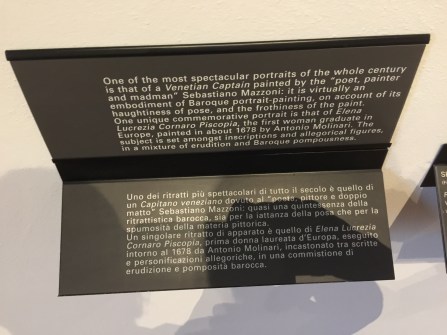
It is also where, in 1678, Elena Lucrezia Cornaro Piscopia became the first woman in the world to graduate from university.

The university hosts the oldest anatomy theatre, built in 1594.

The university also hosts the oldest botanical garden (1545) in the world. The botanical garden Orto Botanico di Padova was founded as the garden of curative herbs attached to the University’s faculty of medicine. It still contains an important collection of rare plants.

The place of Padua in the history of art is nearly as important as its place in the history of learning. The presence of the university attracted many distinguished artists, such as Giotto, Fra Filippo Lippi and Donatello; and for native art there was the school of Francesco Squarcione, whence issued Mantegna.

Padua is also the birthplace of the celebrated architect Andrea Palladio, whose 16th-century villas (country-houses) in the area of Padua, Venice, Vicenza and Treviso are among the most notable of Italy and they were often copied during the 18th and 19th centuries; and of Giovanni Battista Belzoni, adventurer, engineer and egyptologist.

The sculptor Antonio Canova produced his first work in Padua, one of which is among the statues of Prato della Valle (presently a copy is displayed in the open air, while the original is in the Musei Civici).

The Antonianum is settled among Prato della Valle, the Basilica of Saint Anthony and the Botanic Garden. It was built in 1897 by the Jesuit fathers and kept alive until 2002. During WWII, under the leadership of P. Messori Roncaglia SJ, it became the center of the resistance movement against the Nazis. Indeed, it briefly survived P. Messori’s death and was sold by the Jesuits in 2004.

Paolo De Poli, painter and enamellist, author of decorative panels and design objects, 15 times invited to the Venice Biennale was born in Padua. The electronic musician Tying Tiffany was also born in Padua.


The history of Padua, including the city walls, part 2

The rich history of Padua was only partially discussed here.  This post continues the story.

Beginning with the 12th Century in Padova:


Screen Shot 2019-09-12 at 10.58.24

The Carrara Family, also called Carraresi, was a medieval Italian family who ruled first as feudal lords about the village of Carrara in the countryside near Padua and then as moderately enlightened despots in the city of Padua.

Having moved into Padua itself in the 13th century, the Carraresi exploited the feuds of urban politics first as Ghibelline and then as Guelf leaders and were thus able to found a new and more illustrious dominion. The latter began with the election of Jacopo da Carrara as perpetual captain general of Padua in 1318 but was not finally established, with Venetian help, until the election of his nephew Marsiglio in 1337.

For approximately 50 years, the Carraresi ruled with no serious rivals except among members of their own family. Marsiglio was succeeded without incident by Ubertino (1338–45), but Marsigliello, who succeeded Ubertino, was deposed and murdered by Jacopo di Niccolò (1345–50).

Jacopo was then murdered by Guglielmino and succeeded by his brother Jacopino di Niccoló (1350–55), and Jacopino in turn was dispossessed and imprisoned by his nephew Francesco il Vecchio (1355–87). Such a nice family to call your own.

Despite this chaos, the Carrara court was one of the most brilliant in all of the Italian peninsula. Ubertino in particular was a patron of building and the arts, and Jacopo di Niccolò was a close friend of Petrarch.

Only with the exception of a brief period of Scaligeri (the ruling family in Verona) overlordship between 1328 and 1337 and two years (1388–1390) when Giangaleazzo Visconti held the town, Padua was pretty much owned by the Carraresi.

The many advances of Padova in the 13th century naturally brought the commune into conflict with Can Grande della Scala, lord of Verona. In 1311, Padua had to yield.

But, even under the Carraresi, it was a long period of restlessness, for the Carraresi were constantly at war. Under Carraresi rule, the early humanist circles at the University of Padua were effectively disbanded: Albertino Mussato, the first modern poet laureate, died in exile at Chioggia in 1329, and the eventual heir of the Paduan literary tradition went to the Tuscan Petrarch.

In 1387, John Hawkwood won the Battle of Castagnaro for Padua, against Giovanni Ordelaffi, for Verona.

Screen Shot 2019-09-12 at 11.24.24

The Carraresi period finally came to an end as the power of the Visconti and of Venice grew in importance. Padova came under the rule of the Republic of Venice in 1405, and mostly remained that way until the fall of the Republic of Venice in 1797.

There was just a brief period when the city changed hands (in 1509) during the wars of the League of Cambrai.  Padova was held for just a few weeks by Imperial supporters, but Venetian troops quickly recovered it and successfully defended Padua during a siege by Imperial troops (Siege of Padua).

As a part of the Venetian Republic, Padova was governed by two Venetian nobles, a podestà for civil affairs and a captain for military affairs. Each was elected for 16 months. Under these governors, the great and small councils continued to discharge municipal business and to administer the Paduan law, contained in the statutes of 1276 and 1362. The treasury was managed by two chamberlains; and every five years the Paduans sent one of their nobles to reside as nuncio in Venice; this elected official was in place to watch out for the interests of his native town.


The City Walls:

For more information see: https://digilander.libero.it/clapad5/padova/mura.html

1. The Romans would seem to be the first to surround Padova with walls. Of the walls built during the ancient Roman era, the only traces to survive are those incorporated into the foundations of certain palazzi. The route of these walls corresponded to a meandering line formed by the river Medoacus (now the Brenta). Inside the walls, Padua’s first urban center developed.

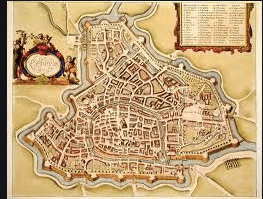
2.   The Mura Duecentesche (“13th century walls”; aka the mura comunali or mura medievali) were built at the start of the 13th century by the Comune of Padua. Their route was delimited by the two branches of the Bacchiglione, the Tronco Maestro and the Naviglio Interno, which came to be used as defensive ditches. There are several remains of them around the Castello and near Porta Molino. More minor remains are to be found in the Riviera Tito Livio and Riviera Albertino Mussato; the only gates to remain from this wall are the main north gate, Porta Molino (or Molini, after several mills in the area which functioned up to the early 20th century), and the main west gate, Porta Altinate (named after the road to Altino which began here).

(The Porta Molino‘s upper stories were used at the end of the 19th century as a reservoir for the town’s first drinking water system; tales of the tower being used as an observatory by Galileo Galilei during his time in the city are probably false. The Porta Altinate fronted onto the Naviglio Interno, crossed by an ancient Roman three-arch bridge, and in 1256 this gate was stormed and destroyed by crusaders fighting against Ezzelino da Romano [as recorded in an inscription recorded by Carlo Leoni].  It was rebuilt in 1286. The Naviglio and the bridge were buried in the 1960s.)

3. 14th century, the Mura Carraresi were built by the Carraresi in the 14th century and followed a route that would be followed almost by the later 16th century wall. Almost nothing remains of them the Mura Carraresi, since they were demolished during the War of the League of Cambrai to create the Renaissance wall.  However, some sections can be seen in via delle Dimesse, near the Prato della Valle.

4. The Mura Cinquecentesche (16th century Walls; aka the Mura rinascimentali or Mura Veneziane) were built to protect Padova by the Venetian Republic during the first decades of the 16th century. It was a project of the condottiero Bartolomeo d’Alviano.

Screen Shot 2019-09-16 at 14.55.00

Canaletto, View of Padua from outside the city walls with the Church of San Francesco and the Palazzo della Salone

The Mura rinascimentali  were protected on their west flank by a canal known as the fossa Bastioni, which still exists. The Renaissance walls survive to this day, almost entirely unbroken apart from sections demolished in the 1960s to build the new Ospedale Civile.


The City Gates:

Nearly all the walls’ gates survive.  For even more information, see: http://digilander.libero.it/clapad5/padova/porte.html

Porta Savonarola – Completed in 1530. Designed by the architect Giovanni Maria Falconetto, this gate was built with a frieze showing the Lion of Saint Mark, symbol of the Venetian Republic, which still survives. Picture below:

Screen Shot 2019-09-16 at 15.11.18
Porta san Giovanni – Completed in 1528. Designed by the architect Giovanni Maria Falconetto, this gate originally had a frieze showing the Lion of Saint Mark, symbol of the Venetian Republic (the frieze here was destroyed during the Napoleonic Wars). Picture below:

Screen Shot 2019-09-16 at 15.12.11

Porta Ognissanti (or Portello, Portello Nuovo or Portello Venezia) – Originally entitled Portello or Little Port, the gate was built at the terminus for the river trade along the Brenta between Padua and Venice. The present building replaces the Portello Vecchio, on what is now via San Massimo, but is rather different from the city’s other gates of this date – the external facade is adorned with shining rocks from Istria, with four pairs of columns surmounted by an architrave embellished with four trachyte cannonballs. The three-arch bridge carrying the road over the Canale Piovego and through the gate is guarded by two white stone lions. Stones in the gate (still legible today) commemorate the ancient origins of the town, speaking to “its good governance.” Since 1535, a clock stands out from the gate in Nanto stone. Traces of frescoes can also be seen inside the gate. 5 pictures below:

Screen Shot 2019-09-16 at 15.13.15

Screen Shot 2019-09-16 at 15.13.04

Screen Shot 2019-09-16 at 15.12.53

Screen Shot 2019-09-16 at 15.15.56

Screen Shot 2019-09-16 at 15.15.43


Porta Liviana – Begun in 1509, it was completed in 1517 and named in honour of Bartolomeo d’Alviano himself.

Porta Santa Croce – On the site of a gate in the Carraresi wall, the present gate was begun in 1509 and was originally defended by a tower, demolished in 1632.

(For a walk to view the city walls, you can start from Piazza Garibaldi, where there is the medieval Porta Altinate (1286), one of the 3 oldest city gates,  with short sections of walls still visible at various points of the Ponte Romani and Tito Livio rivers, then walk along via San Fermo (with the church of the same name leaning against the city walls). Walk from the Largo Europe and the Riviera Mugnai until you reach the intersection with via Dante, then you arrive at the 2nd medieval gate, Porta Ponte Molino, with its large pointed arch surmounted by a mighty tower.)


The End of the Venetian Republic: 

In 1797, the Venetian Republic came to an end with the Treaty of Campo Formio, and Padua, like much of the Veneto, was ceded to the Habsburgs. In 1806, the city passed to the French puppet Kingdom of Italy until the fall of Napoleon, in 1814, when the city became part of the newly formed Kingdom of Lombardy-Venetia, part of the Austrian Empire.

Austrian rule was unpopular with progressive circles in northern Italy, but the feelings of the population (from the lower to the upper classes) towards the empire were mixed.

In Padua, the year of revolutions of 1848 saw a student revolt which on 8 February turned the University and the Caffè Pedrocchi into battlegrounds where students and Paduans fought side by side. The revolt was, however, short-lived and there were no further episodes of unrest under the Austrian Empire (nor previously had there been any), as in Venice or in other parts of Italy. The opponents of Austria were forced into exile.

Under Austrian rule, Padua began its industrial development; one of the first Italian rail tracks, Padua-Venice, was built in 1845. In 1866, the Battle of Königgrätz gave Italy the opportunity, as an ally of Prussia, to take Veneto, and Padova was also annexed to the recently formed Kingdom of Italy.

At that time, Padova was at the center of the poorest area of Northern Italy, as the Veneto was until the 1960s. Despite this, the city flourished in the following decades both economically and socially, developing its industry, being an important agricultural market and having a very important cultural and technological center as the University. The city hosted also a major military command and many regiments.


The 20th Century:

When Italy entered World War I on 24 May 1915, Padova was chosen as the main command of the Italian Army. The king, Vittorio Emanuele III, and the commander in chief, Cadorna, lived in Padua for the period of the war.

After the defeat of Italy in the battle of Caporetto in autumn 1917, the front line became the river Piave, only about 35 miles from Padua. This put the city in the range of the Austrian artillery. However, the Italian military command did not withdraw. The city was bombed several times, with about 100 civilian deaths. A memorable feat was Gabriele D’Annunzio’s flight to Vienna from the nearby San Pelagio Castle airfield.

In 1918, the threat to Padua was removed. In late October, the Italian Army won the decisive Battle of Vittorio Veneto, and the Austrian forces collapsed. The armistice was signed at Villa Giusti, Padua, on 3 November 1918.

During the war, industry grew rapidly, and this provided Padua with a base for further post-war development. In the years immediately following WWI, Padua grew outside the historical town, despite the fact that labor and social strife were rampant at the time.

As in many other areas in Italy, Padua experienced great social turmoil in the years immediately following World War I. The city was shaken by strikes and clashes, factories and fields were subject to occupation, and war veterans struggled to re-enter civilian life. Many supported a new political way, fascism.

As in other parts of Italy, the National Fascist Party in Padua soon came to be seen as the defender of property and order against revolution. Padua was  the site of one of the largest fascist mass rallies, with some 300,000 people reportedly attending one speech by Benito Mussolini.


New buildings, in fascist architectural style, sprang up in the city. Examples can be found today in the buildings surrounding Piazza Spalato (today Piazza Insurrezione), the railway station, the new part of City Hall, and part of the Palazzo Bo hosting the University.

Following Italy’s defeat in WWII on 8 September 1943, Padua became part of the Italian Social Republic, which was a puppet state of the Nazi occupiers. The city hosted the Ministry of Public Instruction of the new state, as well as military and militia commands and a military airport.

The Resistenza, the Italian partisans, was very active against both the new fascist rule and the Nazis. One of the main leaders of the Resistenza in the area was the University vice-chancellor Concetto Marchesi.

Toward the end of the war, as the Allied Command freed Italy from German occupation moving from south to north, Padua was unfortunately bombed several times by Allied planes. The worst hit areas were the railway station and the northern district of Arcella. Because of the location of the German command center in Padua, it was during one of these bombings that the Church of the Eremitani took a direct hit.  It was a miracle of sorts that the nearby Scrovegni Chapel was not hit as well.

Screen Shot 2019-09-12 at 11.32.51     Screen Shot 2019-09-12 at 11.35.08

You can see on the map below how close the Scrovegni is to the church (Chiesa degli Eremitani on the map).

Screen Shot 2019-09-16 at 15.36.40

Tragically, the Church of the Eremitani was graced with some of the finest frescoes by Andrea Mantegna and they were almost complete obliterated. This is considered by some art historians to be Italy’s biggest wartime cultural loss.

Art conservators have been able to do the almost impossible and stitch together the remnants of the frescoes as seen in the next picture. I’ll be posting about the frescoes soon.

IMG_1316

The city was liberated by partisans and the 2nd New Zealand Division of the British Eighth Army on 28 April 1945. A small Commonwealth War Cemetery is located in the west part of the city, commemorating the sacrifice of these troops.

After the war, the city developed rapidly, reflecting Veneto’s rise from being the poorest region in northern Italy to one of the richest and most economically active regions of modern Italy.

The subject of Padua is vast.  I’ll be posting yet more very soon.

Giotto: the magnificent fresco cycle in the Scrovegni Chapel, Padua

IMG_1125

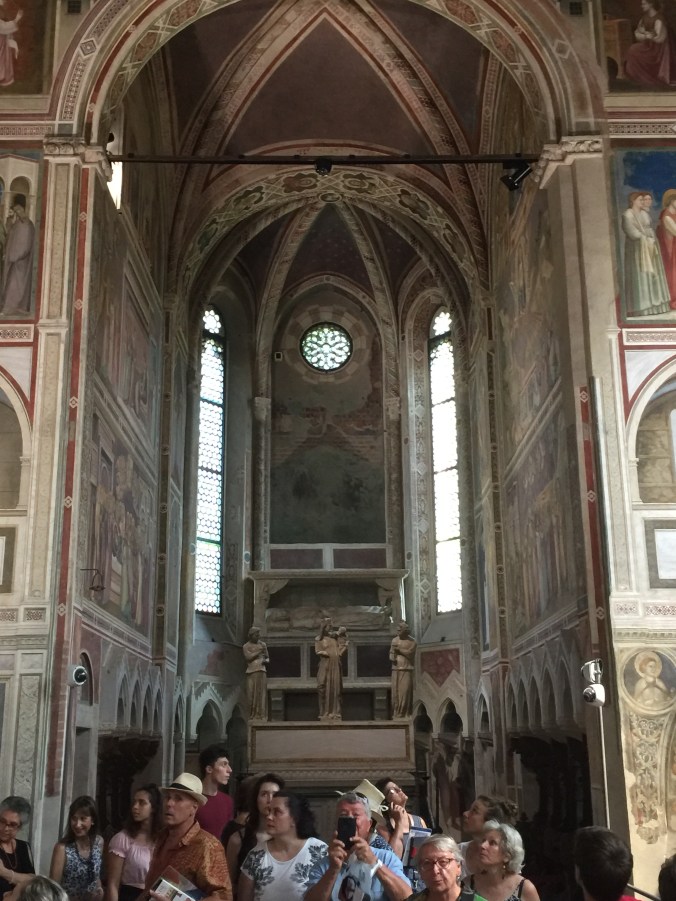
Above, looking at the altar of the Scrovegni Chapel, with marble sculpture by Giovanni Pisano.


Below: the fresco cycle


IMG_1123


IMG_1124


IMG_1121


IMG_1122


IMG_1126


IMG_1127


IMG_1130


IMG_1131


IMG_1132


IMG_1133


IMG_1134


IMG_1135


IMG_1136


IMG_1137


IMG_1138


IMG_1139


IMG_1140


IMG_1141


IMG_1142


IMG_1143


IMG_1144


IMG_1145


IMG_1146


IMG_1147


IMG_1148


IMG_1149


IMG_1150


IMG_1151


IMG_1153


IMG_1154


IMG_1155


IMG_1156


IMG_1157


IMG_1158


IMG_1159


IMG_1160


IMG_1161


IMG_1162


IMG_1163


IMG_1164


IMG_1165


IMG_1166


IMG_1167


IMG_1168


IMG_1169


IMG_1170


IMG_1171


IMG_1172


IMG_1173


IMG_1174


IMG_1175


IMG_1176


IMG_1177


IMG_1178


IMG_1179


IMG_1180


IMG_1181


IMG_1182


IMG_1183


IMG_1184


IMG_1185


IMG_1186


IMG_1187


IMG_1188


IMG_1189


IMG_1190


IMG_1191


IMG_1192


IMG_1193


IMG_1194


IMG_1195


IMG_1196


IMG_1197


IMG_1198


IMG_1199


IMG_1200


IMG_1201


IMG_1202


IMG_1203


IMG_1204


IMG_1205


IMG_1206


IMG_1208


IMG_1209


IMG_1210


IMG_1211


IMG_1212


Padova, a lovely historic town in the Veneto (Padua, part 1)

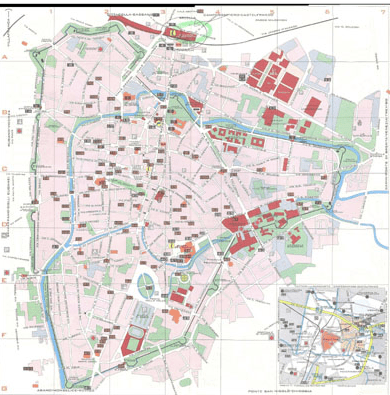
Lovely Padova, or Padua, is a city and comune in Veneto, northern Italy.  It is the capital of the province of Padua and the economic and communications hub of the area. Padua’s population is 214,000 and when the city is included, with Venice (Venezia) and Treviso, in the Padua-Treviso-Venice Metropolitan Area (PATREVE), the sum population of around 2.5 million.

Padua stands on the Bacchiglione River, 25 miles west of Venice. The Brenta River, which once ran through the city, still touches the northern districts.

Its agricultural setting is the Venetian Plain (Pianura Veneta). To the city’s south west lies the Euganaean Hills, praised from time immemorial by Lucan and Martial and later by Petrarch, Ugo Foscolo, and Shelley.

Padua was the setting for most of the action in Shakespeare’s The Taming of the Shrew and in and in Much Ado About Nothing, Benedick is named as Signior Benedick of Padua.” There is a play by the Irish writer Oscar Wilde entitled The Duchess of Padua.

The University of Padua, founded in 1222, is where later Galileo Galilei was a lecturer between 1592 and 1610.
Screen Shot 2019-09-02 at 15.20.55

I was fortunate enough to pay a 2nd visit to Padova recently. I’d been once before, at least 30 years ago, just to see the Giotto frescoes in the Scrovegni Chapel. I  had crystal clear, bright blue memories of that chapel and it has been high time, for some time, to pay another visit.  So off I went.  It was wonderful.

The main goal of my recent trip to Padua was to again see the Giotto frescoes.  Nowadays, with the continual press on all the cultural monuments in Italy due to mass tourism and inane “bucket lists,”  many sites have time limits on how long you can see the art. The Scrovegni Chapel has joined that rank.

You must book your visit at a particular time well in advance, arrive early to pick up your ticket, meet 10 mins before your time, be ushered into a waiting room and watch a (very interesting) film in Italian while you are “dehumidified”. Is this hocus pocus? I don’t know. But it’s fine.

The only issue I have is that you now enter the chapel with 19 other dehumidified persons and get to stay in the chapel for 15 minutes only and then you are ushered out and the next group is ushered in.
IMG_1125

But, before discussing the sublime Scrovegni Chapel, let me say a few words about the archaeological museum that is next door to the chapel.

In fact, the truth is that prior to my recent visit, I had not realized there was an archaeological museum in Padova, let alone attached to the same complex of buildings.  And I certainly did not know that Padova was home to such an amazing collection.

I arrived at the Scrovegni Chapel about 45 minutes early and checked in and got my ticket for my 1:00 o’clock visit.  The pleasant woman at the check-in desk suggested that I visit the museum when I was thinking aloud, hmmm…I wonder what I should do for the 45 minutes while I wait to visit the chapel.

I am so glad she made that suggestion.  I am already planning another visit to Padova later this fall, and you can bet that I’ll be spending a lot more time at this fine museum. Below are just a few pictures from my initial visit.

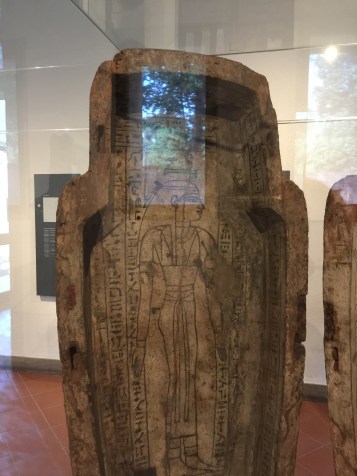
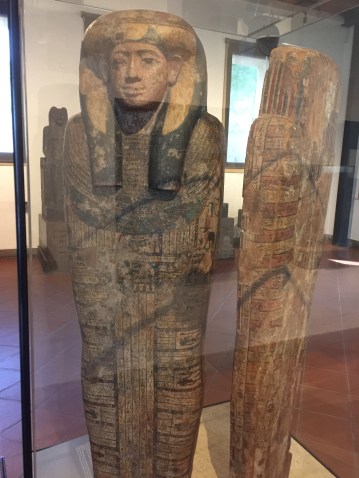
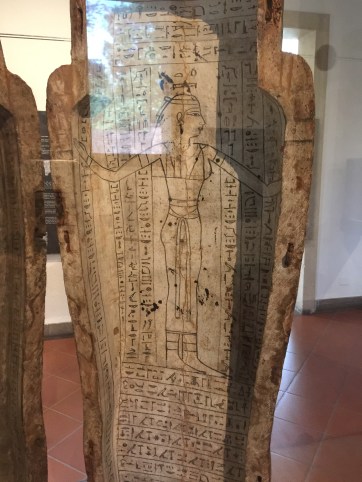
So…have you ever wondered what the inside of an Egyptian sarcophagus looks like?  I have.  Fortunately, the Padova museum exhibits one of their sarcophagi open, making both the outside and inside visible. Fascinating.

IMG_1082

IMG_1083

IMG_1084

IMG_1085


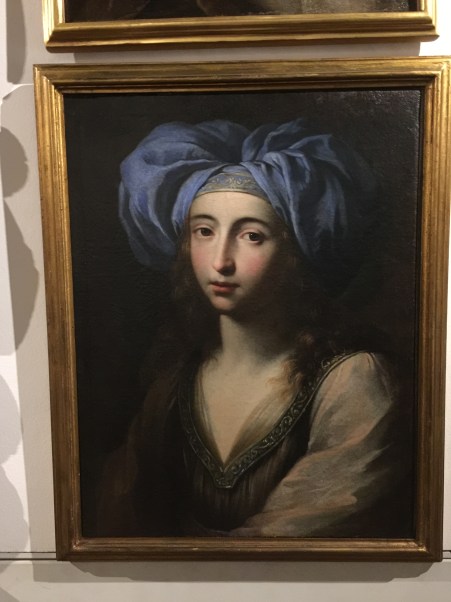
The Musei Civici has many areas of collection and I just snapped some random pictures of some of the objets that caught my eye.  For example, I want to wear the headdress in this painting:
IMG_1089

Painting above: Young Woman in Oriental Clothes by Ginevra Cantofoli, Bologna 1618-1672

IMG_1091

Painting above: Young Man with turban by Ginevra Cantofoli, Bologna 1618-1672

Check out the amazing frame on painting below.  I’ve seen a lot of frames in my day, but this was a first!

Painting below: Armed Minerva by Pietro Liberi, 1614-87. Born in Padova, died in Venezia.  This modest little frame that captured my attention and my heart!

IMG_1093


IMG_1095IMG_1096

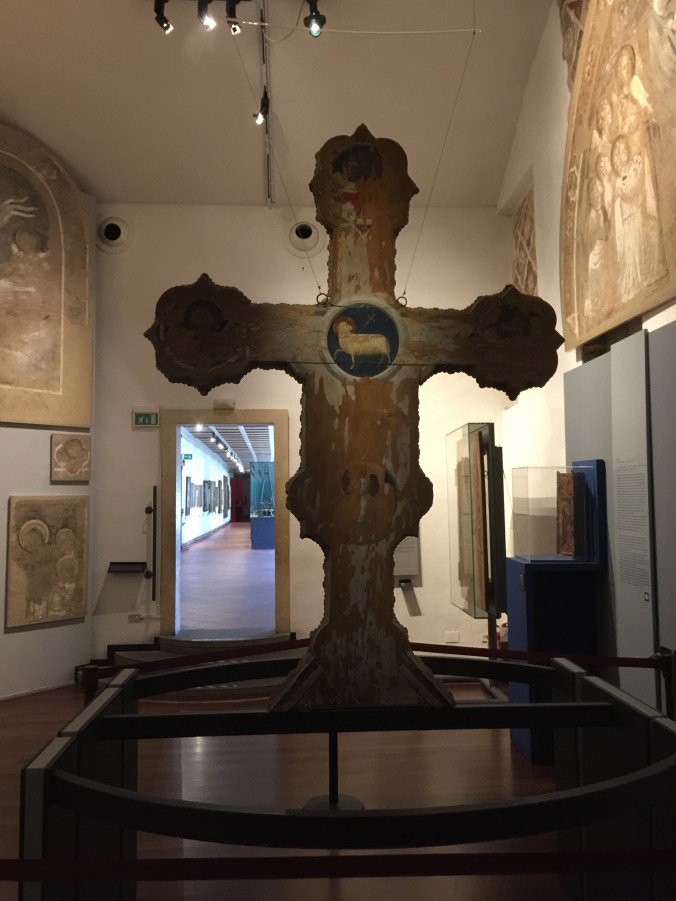
Above, the front and back of a crucifix by Giotto.

Some other strange and/or wonderful works I spied on this visit:


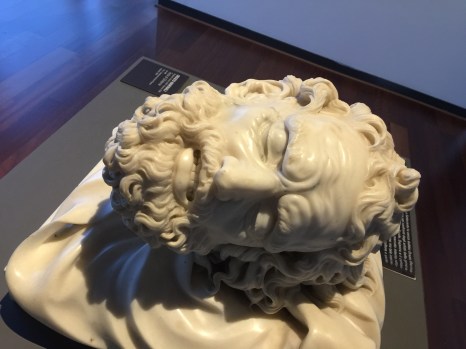
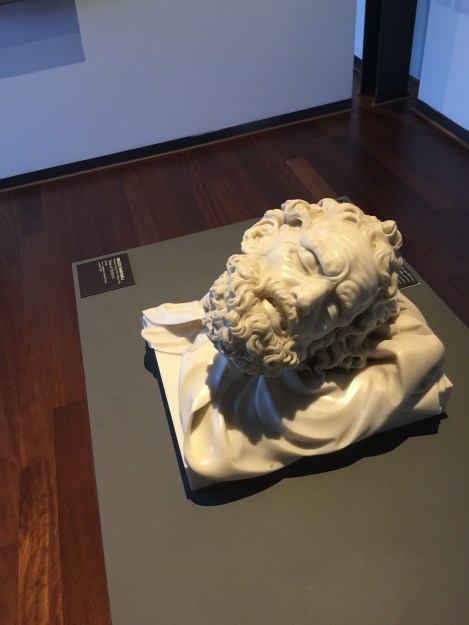
Orazio Marinali, Head of Holofernes
IMG_1119

IMG_1120

I mean, come on…anatomically correct with a severed spinal cord??

IMG_1117


IMG_1106

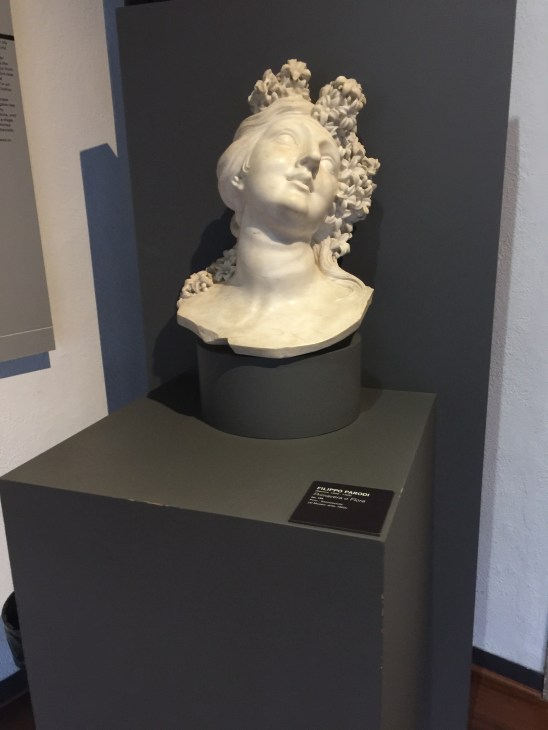
Above and below: Filippo Parodi, Head of Spring, or Flora
IMG_1108


Love this one below for the frame, the painting, meh…Baby Bacchus by Marco Liberi. But the frame carver, now that’s a masterpiece!

IMG_1109


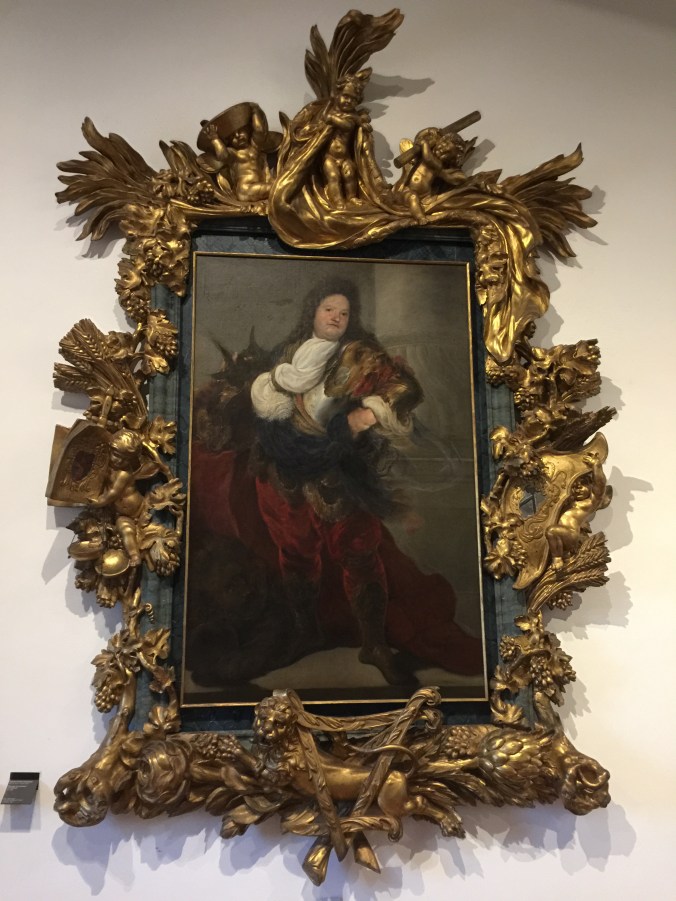
Likewise for the painting below, I can take or leave the painting (Sebastiano Mazzoni, Portrait of theVenetian Captain), but that frame…!
IMG_1111 IMG_1113


This marble piece below was freaky, the way it combines 2 angel’s heads, showing them kind of like Siamese twins.

IMG_1114IMG_1115


Padova’s historic center is picturesque, with a dense network of arcaded streets opening into large communal piazze, and many bridges crossing the various branches of the Bacchiglione, which once surrounded the ancient walls like a moat.

The city is also known for being the city where Saint Anthony, a Portuguese Franciscan, spent part of his life and died in 1231. The huge pilgrimage church of Sant’ Antonio is a major feature of the city’s life and skyline.
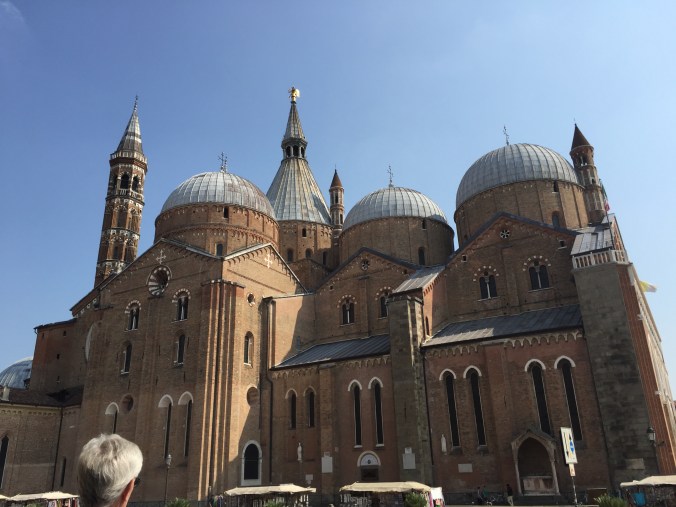
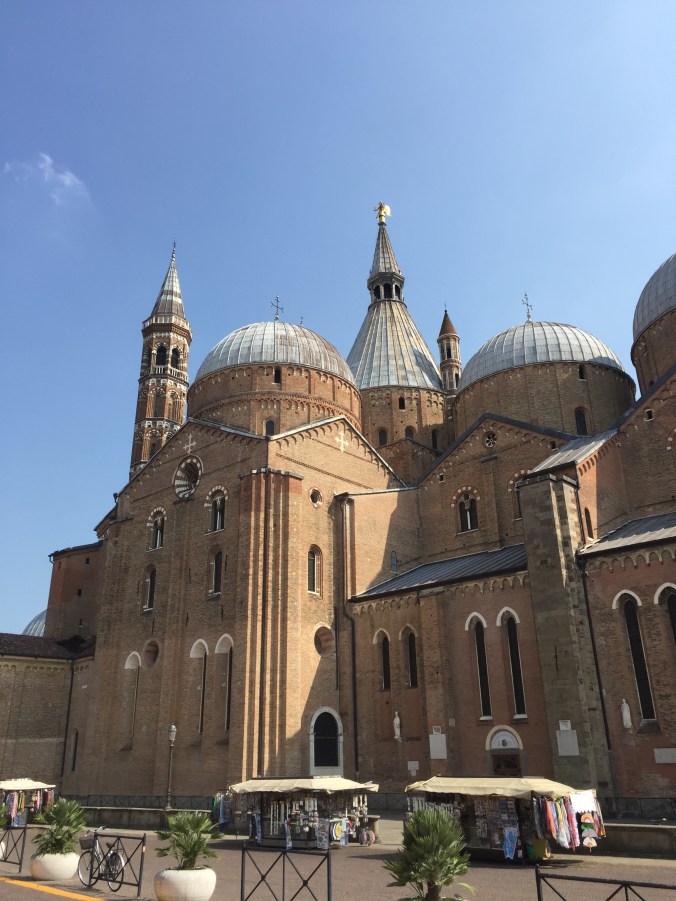
IMG_1253IMG_1254IMG_1255


Although I don’t have a clear memory of it, I know I visited the Gattemelata equestrian statue by Donatello on my first visit to Padova. I have clear memories of it from this visit. Here it is:
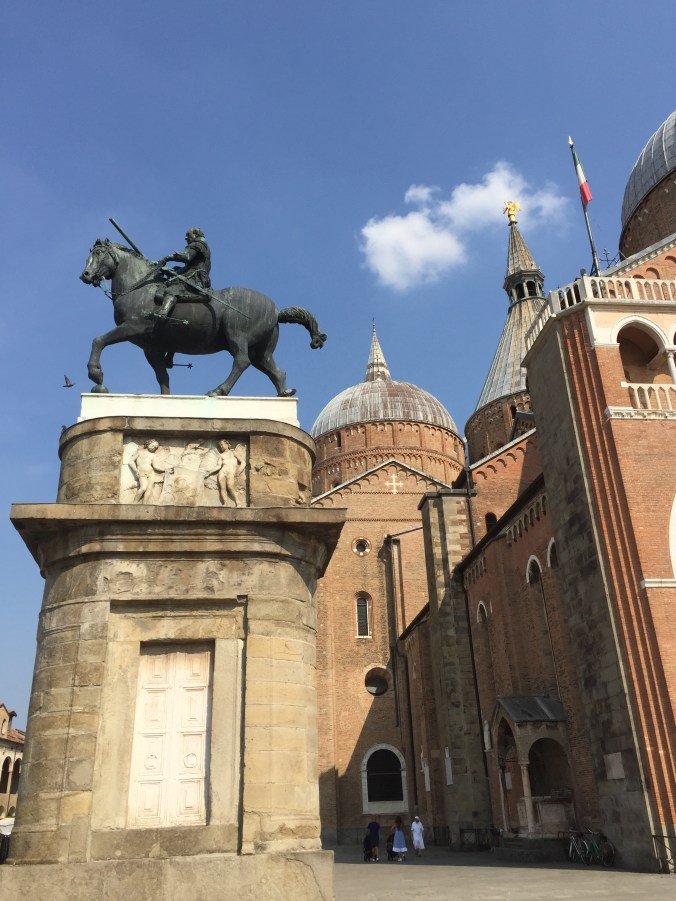
IMG_1267


The name of the city, Padova, is derived from its Roman name Patavium. Its origin is uncertain. It may be connected with the ancient name of the River Po, (Padus). The root “pat-,” in the Indo-European language, can refer to a wide open plain as opposed to nearby hills.  The suffix “-av” (also found in the name of the rivers such as the Timavus and Tiliaventum) is likely of Venetic origin, precisely indicating the presence of a river, which in the case of Padua is the Brenta.

Screen Shot 2019-09-12 at 10.52.15

Padua claims to be the oldest city in northern Italy. According to a tradition dated at least to the time of Virgil’s Aeneid and to Livy’s Ab Urbe Condita, Padova was founded in around 1183 BC by the Trojan prince Antenor.

After the Fall of Troy, Antenor led a group of Trojans and their Paphlagonian allies, the Eneti or Veneti, who lost their king Pylaemenes to settle the Euganean plain in Italy. Thus, when a large ancient stone sarcophagus was exhumed in the year 1274, officials of the medieval commune declared the remains within to be those of Antenor. An inscription by the native Humanist scholar Lovato dei Lovati placed near the tomb reads:

This sepulchre excavated from marble contains the body of the noble Antenor who left his country, guided the Eneti and Trojans, banished the Euganeans and founded Padua.

More recent tests suggest the sepulchre dates to the between the 4th and 3rd centuries BC.

Nevertheless, archeological remains confirm an early date for the foundation of the center of the town to between the 11th and 10th centuries BC. By the 5th century BC, Padova rose on the banks of the river Brenta and was one of the principal centers of the Veneti.

Screen Shot 2019-09-12 at 10.54.13

The Roman historian Livy records an attempted invasion by the Spartan king Cleonimos around 302 BC. The Spartans came up the river but were defeated by the Veneti in a naval battle and gave up the idea of conquest.

Still later, the Veneti of Padua successfully repulsed invasions by the Etruscans and Gauls. According to Livy and Silius Italicus, the Veneti, including those of Padova, formed an alliance with the Romans by 226 BC against their common enemies, first the Gauls and then the Carthaginians. Men from Padova fought and died beside the Romans at Cannae.

With Rome’s northwards expansion, Padova was gradually assimilated into the Roman Republic. In 175 BC, Padova requested the aid of Rome in putting down a local civil war. In 91 BC, Padova, along with other cities of the Veneti, fought with Rome against the rebels in the Social War.

Around 49 (or 45 or 43) BC, Padova was made a Roman municipium under the Lex Julia Municipalis and its citizens ascribed to the Roman tribe, Fabia. At that time the population of the city was perhaps 40,000.

The city was reputed for its excellent breed of horses and the wool of its sheep. In fact, the poet Martial remarks on the thickness of the tunics made there. By the end of the 1st century BC, Padova seems to have been the wealthiest city in Italy outside of Rome.

The city became so powerful that it was reportedly able to raise two hundred thousand fighting men. However, despite its wealth, the city was also renowned for its simple manners and strict morality. This concern with morality is reflected in Livy’s Roman History (XLIII.13.2) wherein he portrays Rome’s rise to dominance as being founded upon her moral rectitude and discipline.

Still later, Pliny, referring to one of his Padovan protégés’ grandmother, Sarrana Procula, lauds her as more upright and disciplined than any of her strict fellow citizens (Epist. i.xiv.6).

Padova also provided the Empire with notable intellectuals. Nearby Abano was the birthplace, and after many years spent in Rome, the deathplace of Livy, whose Latin was said by the critic Asinius Pollio to betray his Patavinitas (q.v. Quintilian, Inst. Or. viii.i.3). Padova was also the birthplace of Thrasea Paetus, Asconius Pedianus, and perhaps Valerius Flaccus.

Christianity was introduced to Padua and much of the Veneto by Saint Prosdocimus. He is venerated as the first bishop of the city. His deacon, the Jewish convert Daniel, is also a saintly patron of the city.
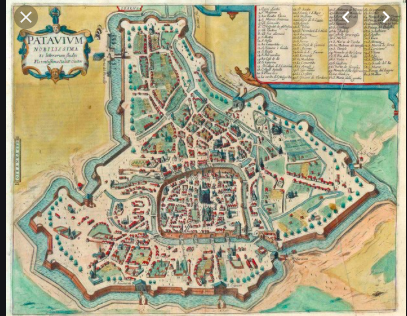
Screen Shot 2019-09-12 at 10.57.34

The history of Padua during Late Antiquity follows the course of events common to most cities of north-eastern Italy. Padua suffered from the invasion of the Huns and was savagely sacked by Attila in 450. A number of years afterward, it fell under the control of the Gothic kings Odoacer and Theodoric the Great.

It was reconquered for a short time by the Byzantine Empire in 540 during the Gothic War. However, depopulation from plague and war ensued.

The city was again seized by the Goths under Totila, but was restored to the Eastern Empire by Narses only to fall under the control of the Lombards in 568. During these years, many of Paduans sought safety in the countryside and especially in the nearby lagoons of what would become Venice.

In 601, the city rose in revolt against Agilulf, the Lombard king who put the city under siege. After enduring a 12-year-long bloody siege, the Lombards stormed and burned the city. Many ancient artifacts and buildings were seriously damaged.

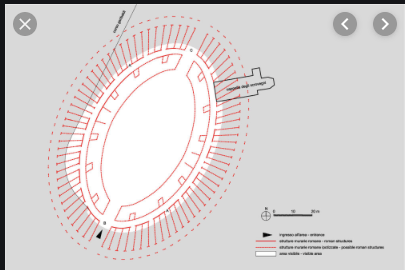
The remains of an amphitheater (the Arena) and some bridge foundations are all that remain of Roman Padua today. The townspeople fled to the hills and later returned to eke out a living among the ruins; the ruling class abandoned the city for the Venetian Lagoon, according to a chronicle. The city did not easily recover from this blow, and Padua was still weak when the Franks succeeded the Lombards as masters of northern Italy.
Screen Shot 2019-09-12 at 10.59.45


At the Diet of Aix-la-Chapelle (828), the duchy and march of Friuli, in which Padova lay, was divided into four counties, one of which took its title from the city of Padova.

The end of the early Middle Ages at Padova was marked by the sack of the city by the Magyars in 899. It was many years before Padua recovered from this ravage.

During the period of episcopal supremacy over the cities of northern Italy, Padova does not appear to have been either very important or very active. The general tendency of its policy throughout the war of investitures was Imperial (Ghibelline) and not Roman (Guelph); and its bishops were, for the most part, of German extraction.

However, under the surface, several important movements were taking place that were to prove formative for the later development of Padova.

At the beginning of the 11th century, the citizens established a constitution, composed of a general council or legislative assembly and a credenza or executive body.
Screen Shot 2019-09-12 at 10.58.24

During the next century they were engaged in wars with Venice and Vicenza for the right of water-way on the Bacchiglione and the Brenta. The city grew in power and self-confidence and in 1138, government was entrusted to two consuls.

The great families of Camposampiero, Este and Da Romano began to emerge and to divide the Paduan district among themselves. The citizens, in order to protect their liberties, were obliged to elect a podestà in 1178. Their choice first fell on one of the Este family.

Screen Shot 2019-09-12 at 11.01.43

A fire devastated Padua in 1174. This required the virtual rebuilding of the city.

The temporary success of the Lombard League helped to strengthen the towns. However, their civic jealousy soon reduced them to weakness again. As a result, in 1236 Frederick II found little difficulty in establishing his vicar Ezzelino III da Romano in Padua and the neighboring cities, where he practised frightful cruelties on the inhabitants. Ezzelino was unseated in June 1256 without civilian bloodshed, thanks to Pope Alexander IV.

Padova then enjoyed a period of calm and prosperity: the basilica of the saint was begun; and the Paduans became masters of Vicenza. The University of Padua (the second university in Italy, after Bologna) was founded in 1222, and as it flourished in the 13th century, Padua outpaced Bologna, where no effort had been made to expand the revival of classical precedents beyond the field of jurisprudence, to become a center of early humanist researches, with a first-hand knowledge of Roman poets that was unrivaled in Italy or beyond the Alps.
Screen Shot 2019-09-12 at 11.02.49

There is so much more to the story of Padova.  I’ll be posting about it soon.


Celebrating women art patrons: Theodora, Empress of Byzantium

Theodora (497–548)
Empress of Byzantium

Screen Shot 2019-09-08 at 12.15.05

In a classic rags-to-riches story, Theodora rose from working as an actress—a low-class profession associated with prostitution—to shaping the nascent Byzantine empire, which spanned present-day Turkey, North Africa, and the Middle East. Theodora met Justinian, the emperor’s nephew, in Constantinople when she was 21.

Despite her social status, the emperor was so enamored with her that he changed a law that would have prohibited their marriage. After ascending to the throne, Theodora used her authority to support sex workers’ rights and established anti-rape legislation. During her tenure, the empress also supported significant building projects that projected the couple and the empire’s dominance. One was the original Hagia Sophia, consecrated in 537.

The mosaic portraits of Justinian and Theodora that face opposite one another in the apse of the Basilica di San Vitale (ca. 547) in Ravenna, Italy, however, have cemented the couple’s image in history. The empress, flanked by attendants, wears dangling gems and a long, royal purple gown. In her hand, she holds a chalice that indicates her as the building’s patron. The portrait confirms Theodora’s influence, glamour, and patronage, and flies in the face of her detractors.
Writing not long after her death in 548, the historian Procopius described her as “Theodora-from-the-brothel,” a wanton temptress who once said she regretted only having three orifices for pleasure. More recently, scholar Nadine Elizabeth Korte has suggested that Procopius probably disapproved of the substantive power Theodora wielded over Justinian and the empire.