Florence’s Protestant Cemetery, also called the English Cemetery

There’s an interesting place in Florence that was, when it was founded in 1828, an extremely bucolic locale.

IMG_2385 2

Today, it stands isolated as an island (Piazzale Donatello) in a ring road system, which is really too bad.  Nevertheless, knowing how land development works all over the world, it is a comfort that the place still survives.


IMG_2397

IMG_2387 2

IMG_2388 2

The cemetery was founded to provide a solution to a very real problem. Before 1827, non-Catholics who died in Florence had to be buried in Livorno. The cemetery acquired the name ‘English’ because Protestants, most of whom were English, had to be buried outside the medieval city walls.

IMG_2392

IMG_2391

IMG_2393

IMG_2390

IMG_2386 2

IMG_2384 2


The English Cemetery was officially closed in 1877, when the medieval walls of Florence came down, making burials within the city boundary illegal, and for a century and a quarter the mini-necropolis remained locked and neglected.

Fortunately, Julia Bolton Holloway, a literary scholar specialising in the works of Elizabeth Barrett Browning – whose Penguin Classic Anthology she co-edited – took on responsibility for the cemetery. It was reopened to the public in 2003 for the reception of ashes but not bodies, and Holloway is actively raising restoration funds.


Ted Jones, wrote the following in his book, Florence and Tuscany: A Literary Guide for Travellers:

When I called, she [Julia Bolton Holloway] was re-lettering a gravestone, and she has set up a number of charitable institutions to ensure its future maintenance. Today, with the gardens replanted and well-maintained and the memorials inscribed and re-erected, it is a pleasure to visit, and well worth the slalom through the traffic – safe in the knowledge that if you don’t make it to the cemetery, there is a hospital next door.


Andrea del Castagno, The Last Supper in the Cenacolo of Sant’ Apollonia, Florence

If you’ve been to Florence, you know how the hordes of tourists can dampen the spirit of art appreciation.  Think of the Uffizi and you know what I mean.

But, there are several places in Florence where you can view Renaissance art up close and personal and rarely have another soul in the room with you.

One of the most amazing of these places is housed within this entrance:


ciU9CF5gTteNGmv9cw6LzA

I mean, really, would you even know there was anything at all inside, let alone a masterpiece?

There are no lines at this former convent and no crowds. Few people even know to ring the bell at the nondescript door. What they’re missing is an entire wall covered with the vibrant colors of Andrea del Castagno‘s masterful Last Supper (c. 1450).

The end wall of the large refectory was decorated with frescoes, although these were never known to the outside world since the nuns were strictly cloistered. It was only with the suppression of the convent in 1860 that the existence of this masterful fresco of the Last Supper was revealed. Interestingly, it was initially attributed to Paolo Uccello, but then finally to the true painter, Andrea del Castagno (1421-1457).

Castagno created a richly colored composition, filled with interesting details. For one, the deeply colored “marble” panels fill the middle-ground register and the depiction of black and white ceiling tiles follow a strict linear perspective system.  The long white tablecloth  sets off only one figure: the darkly hued figure of Judas the Betrayer, whose face is painted to resemble a satyr, an ancient symbol of evil.

Another three frescoes were discovered above this one in the 1950s. Three scenes are represented: the Resurrection, the Crucifixion, and the Entombment of Christ. At the time of the restoration in 1952, the three frescoes were removed to be preserved, thus revealing the splendid sinopie that were painted over.

So, here’s the single sign that tells the observant visitor that something wonderful is kept within this sober facade.

fullsizeoutput_1e69

UOx986o8T82h94LO1kCJ9w

TSJrqGuHSp2Veo5rhV9qzA


Here is the experience of the refectory:


5YE6PaaBRf6RguOA7VyQgw


X8ATCayZRC6yUKbERhFLIw

von9GB9bRxmHeVJLCNa5MA


Some introductory information about the artist:

zQICc2jMRHuL6d%vU6T9QQ


FOfBMio9SX6jZNTRoiCWeg


7H6h2J0+TeKCvcTyQCuntg


rLrgWv82QPW1ADCDVv42vA


vgvETZ8ARYK2paGegAPHaQ


6bOh7ilmTi6SFrK%Eha%aQ


CGWBJRHdQrmLO2sIeWQlPw


fullsizeoutput_1e6b


fullsizeoutput_1e6d


fullsizeoutput_1e71


fullsizeoutput_1e73

fullsizeoutput_1e79

fullsizeoutput_1e75


fullsizeoutput_1e77


CAaBRfCYQJ+pJ1zjqfitmA


VvJXS27kRZqS5D%TG2llUg


FRS9avbBTmqHPW8WBIImTg


XYZSGYzeTNiemlUc4LCRww


q6g0KhXARGSzSFQuoCRaag


tz+SA1pvRom7Z4IsZpdC%w


xZEyUfGXQT2FtroFFFYkdQ


Hboo1zZVTZmh4WTiD53eWg


cfDuOxfWRQijVnoMZaFrGA


ZBJxdP5bSkWTpkHko+NERg


Mk80R%vTQ+eF7iOTU%RwpQ


bTHhZL5ET1uLLAHnq0Avcw


VDSF3f0uTl+OMnsijAi+jw


C4B3byDWTr6qCzceZjgCow


wXTY72WjRd2jIQjeNOxDag


S2DMtH24Tt+lFHzZfjSpKg


f8hmx4biSyGR38sIjp5aNw


P+34HlcETii2FZrO2faGbg


3xbjdgM2Rqid7YuNdrvfDw


C1UwINQyTR2tQC+stdTj2w


EoQj7WSURKaBJ5SThWE72g


ZXksXdKsTkeB7J8At+mqPQ


Xy0c8G8xS8aeR7RDl2Z3IQ


TIOAXCDSQgOUkSN%zzYliw


fullsizeoutput_1e7b


ElL10CY4QHahbDg638H8zg

Grand Hotel Minerva, Florence

Screen Shot 2019-10-26 at 10.57.10

Not long ago I wrote a post on the visit the great American poet, Henry Wadsworth Longfellow paid to Florence. The palazzo in which Longfellow lived during his stay in Florence is alive and well today in one of the most beautiful piazzas in the city,  the Piazza di Santa Maria Novella. Known then and now as the Hotel Minerva, this albergo opened at Piazza Santa Maria Novella, # 15-16, in 1869. Alfredo Ciappei was the owner and manager.** (You can see the hotel to the right of the famous church in the image above.)

But the hotel’s history goes back much further. This is Florence, after all.

In the Middle Ages, on the place where the Hotel Minerva now stands, was a building belonging to the “Company of the Archangel Gabriel,” one of the many Florentine confraternities attached to the Convent (monastery) of Santa Maria Novella. In 1472, the building became a part of the Scala Hospital, an important welfare institution of the city.

A great increase in the activity of the piazza presumably took place around 1848, when the 2nd Florentine railway station, called Maria Antonia, was opened, linking the town with Pistoia and Lucca.

The Piazza was by then an attraction for many tourists and it was given the name of “The Mecca of the foreigners.”

Screen Shot 2019-10-27 at 09.12.17

The building housing the Grand Hotel Minerva began life as housing for the monks of Santa Maria Novella and afterwards as a home to several noble Florentine families. It officially became the Locanda della Minerva, an Albergo, in 1869.

Screen Shot 2019-10-27 at 09.19.18

In the early 20th century, the tavern was turned into a hotel and in the 1950s two innovative Italian architects, Edoardo Detti and Carlo Scarpa, transformed the premises into the Grand Hotel Minerva. Scarpa was a pioneer in balancing new and old, revealing the history of the original building, something the current owners also value.  The Maestro, as he was known, deconstructed and transformed the hotel structure, leaving a few rooms unaltered, with beautiful frescoes and original hand-painted ancient wooden beams. While transforming the hotel, Scarpa created design details that would become a symbol of Italian modernist architecture for years to come.


Screen Shot 2019-10-27 at 09.07.19


In 1995, a Florentine family purchased the  hotel and did a complete renovation.

https://www.theflorentine.net/travel/2019/05/grand-hotel-minerva-celebrate/

**I am not a Longfellow scholar, but from my cursory research I discovered that Longfellow was in Florence sometime during his first European sojourn lasting from 1826 to 1829.  That is before the Grand Minerva opened officially as the hotel it still is today.  However, the conglomeration of buildings on the site were no doubt used as hotel space even before the Minerva was inaugurated.

Andrea del Sarto, Fresco cycle at the Chiostro dello Scalzo, Firenze; Part 1

Once upon a time in Florence, there was a small oratory (church) dedicated to the Compagnia dei Disciplinati di San Giovanni Battista (Confraternity of St. John the Baptist), a group founded in 1376.

The tiny facade of the Cloister of the Scalzo in Florence, on present day Via Cavour, was built as the entrance to that now-destroyed church. Buildings that served the Confraternity were called “dello Scalzo” because the cross-bearers in the Confraternity’s processions walked with bare feet as a sign of humility, and scalzo means barefoot.

fullsizeoutput_1e64

fullsizeoutput_1d9e

The brothers belonging to the Confraternita dressed in long, simple, black robes with a cowl. Their garb is depicted in the della Robbia style glazed-terracotta lunette above the entrance portal to the chiostro.

fullsizeoutput_1da6


fullsizeoutput_1da2


The emblem of the confraternity is the bust of Saint John the Baptist wearing a garment of camel hair with a leather belt around his waist. He is depicted with a halo and holds a golden cross. In the lunette over the entrance, the saint is in the center, with 2 brothers, one on either side. The saint was intentionally represented in a larger scale than the brothers, as a sign of of his relative importance.

The brotherhood lasted until 1786, when the property was sold. The small oratory was destroyed in the 19th century, to make way for the modern Via Cavour.

Fortunately for posterity and lovers of art in particular, the Chiostro was saved. The Accademia delle Belle Arti used it for a while, but it was opened to the public in 1891.

While the small cortile, designed by Giuliano da Sangallo, is a lovely little piece of Florentine Renaissance architecture in and of itself, with its harmonious proportions and lovely use of pietra serena, it is the fresco cycle on the four walls of the cloister that make it a must-see for any art lover.

Screen Shot 2019-10-27 at 19.14.02


This fresco cycle was painted by Andrea Del Sarto (Andrea Vannucchi, 1486-1530), and shows episodes from the Life of St. John the Baptist. With the 12 main scenes presented in large, horizontal frames, subdivided by grotesque style motifs, the beautiful cycle is complete. Unlike the more famous places in Florence, such as the Uffizi and the Accademia, one can visit the chiostro in a quiet and relaxed manner, and often have the entire venue to yourself. I highly recommend a visit to this exquisite, almost secret, gem.


dQycsQWWQyijmP4Pql4C0A


Here, in all its quiet glory, is the cloister interior:


It is believed that Andrea del Sarto painted the entire cycle, including the paintings in the decorative bands, with one exception which will be discussed below.

In addition to the large panels depicting the saint’s life, four tall, vertical paintings represent the Virtues on the sides of the 2 main axes: Charity (1513), Faith (1523), Justice (1525) and Hope (1523).

Screen Shot 2019-10-27 at 19.27.18

Screen Shot 2019-10-27 at 19.14.13

The 12 distinct moments from life of Saint John include his birth,  the famous dance of Salomè, and the beheading of the saint. The scenes also include the baptism of Jesus and the preaching in the desert. Curiously, the sequence of the scenes is not presented in chronological order on the walls.

fullsizeoutput_1e26

We know that the paintings were created over a relatively long period, from 1509-26.  This is a bonus for the world of art history, for the stylistic evolution of Andrea del Sarto can be followed, starting with the Baptism of Christ, c. 1509-10. This painting bears the clear influence of the quattrocento Florentine masters.

Screen Shot 2019-10-29 at 12.19.13 Self Portrait, Andrea del Sarto

The later scenes, painted when he had achieved his maturity as an artist, reveal the  increasingly dynamic sculptural clarity of Andrea’s figures, which he borrowed from Michelangelo and which has the manneristic foreshadowings for which Andrea is noted. In The Capture of the Baptist painted in 1517, we see a more dynamic composition, probably inspired by the work of  the very popular Michelangelo and other peers like Andrea’s friend, Franciabigio.

The frescoes painted in the decade of 1520 were made during Andrea del Sarto’s maturity, and we notice the much more solemn and majestic figures. Their heroic proportions run parallel with the era’s then dominant michelangiolismo.

The Baptism of the Multitudes, painted in a sumptuous almost Mannerist style, is both harmonious and complex: it is full of moving figures, many nude, and filled with pictorial virtuosity. This would inspire the entire next generation of artists.

Interestingly enough, Andrea del Sarto himself was a member of the Confraternity of St. John the Baptist and practiced a lifestyle based on the sober and spiritual edicts of the group. He was thus a direct messenger of the spiritual values of simplicity shared by his brothers, which is why, perhaps, this spartan approach of monochromatic frescoes were chosen. Certainly, these paintings were less expensive to paint than fresco decorations with gold leaf and precious color mineral pigments.  I don’t know why the chiaroscuro palette was chosen; perhaps it was a combination of the two influences.

fullsizeoutput_1e08


Not only was Andrea del Sarto a member of this confraternity, but he lived nearby of the current Via Gino Capponi and Via Giusti.  You can see his house pinned in red on the map below.  Note how close the Chiostro is, located on the upper left side of the map. They are about a 6 minute walk from each other.


Screen Shot 2019-10-28 at 18.17.33


The plaque below marks the former home of Andrea Del Sarto.

fullsizeoutput_1e34


fullsizeoutput_1e3e

The coat-of-arms on the corner of the house in which Andrea lived tells us clearly that this section of town was part of Medici territory.  It makes sense, the house and Chiostro are very near San Marco.

fullsizeoutput_1e40


fullsizeoutput_1e42


fullsizeoutput_1e46


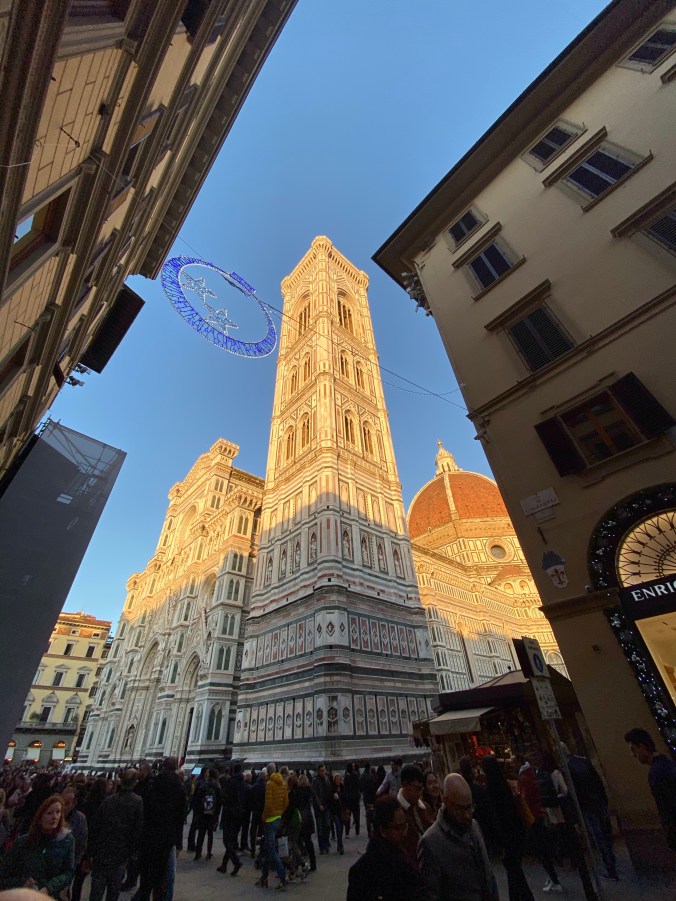
The photo below shows how close Andrea lived to the Duomo of Florence.  He lived, like so many Renaissance artists,  in its shadow.

fullsizeoutput_1e48


Andrea reached extraordinary stylistic and technical skill and is important, as well, because he played an important role in the complex artistic events of Florence at the beginning of the 16th century. He also played a critical role now recognized as fundamental to the development of Mannerism.

Two of the scenes, the Departure of John the Baptist for the Desert, and the Blessing of the  Baptist, were actually painted by the artist’s friend and collaborator, a man known as Franciabigio (Francesco di Cristofano, 1482-1525). Franciabigio was asked to paint these 2 panels because in 1518 Andrea was absent from Florence.

In fact, Andrea had been summoned by King François I to the French court at Fontainebleau. The king personally invited Andrea join the Fontainebleau school, for his fame of being the “faultless painter” (as Vasari would say) had gone beyond the borders of the Italian peninsula. The elegance and balance of Andrea’s figures were considered to have no match among any living painters.

However, Andrea returned to Florence a year or so later and finished the Cloister’s fresco cycle himself.

Admired by Michelangelo, Del Sarto was also teacher to Giorgio Vasari, who later became his biographer, describing him as the faultless painter or “painter without errors.” Del Sarto played an important role now acknowledged as fundamental to the development of Mannerism. Sarto’s style is marked throughout his career by an interest in the effects of color and atmosphere and by a sophisticated informality and natural expression of emotion.

Incidentally, the terracotta bust in the cloister represents bishop Saint Antonino Pierozzi who, as archbishop, sanctioned (in 1455) the birth of the Compagnia dello Scalzo. The Confraternity became increasingly more popular in Florence, as witnessed by an official document in 1631. The chronicles refer to a large community of brothers composed of a Governor, a council held by two elder brothers, an accountant, a copyist, six nurses, a dozen of specialized clerks, a priest, a doctor, and a servant.

The frescoes in the cloister were exposed to weather and thus deterioration for centuries. In the early 1960s, the frescoes were detached from the walls for restoration and were finally returned to the cloister to be reopened for public viewing in 2000.

Andrea del Sarto’s fresco cycle is certainly among the most important of Florentine painting of the early 16th century.  Many experts consider this cycle to be his masterpiece.

http://www.polomusealetoscana.beniculturali.it/index.php?it/183/chiostro-dello-scalzo-firenze

https://commons.wikimedia.org/wiki/Category:Chiostro_dello_Scalzo