
Inside Brunelleschi’s dome, Florence
Last month found me climbing the millions of steps to the top of the Florence cathedral dome. Wow, what a hike and what an incredible view from the top!
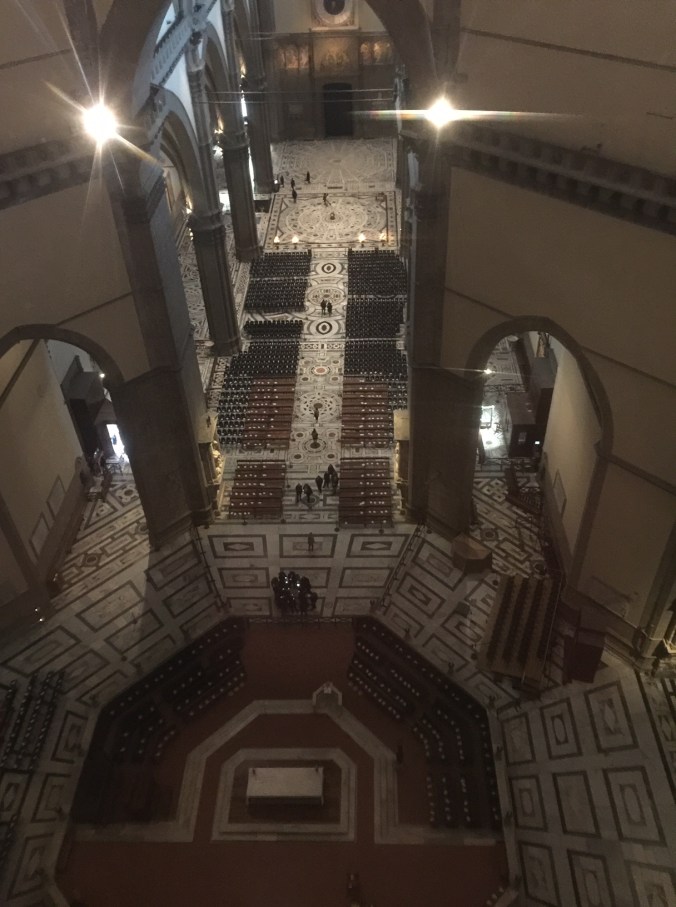
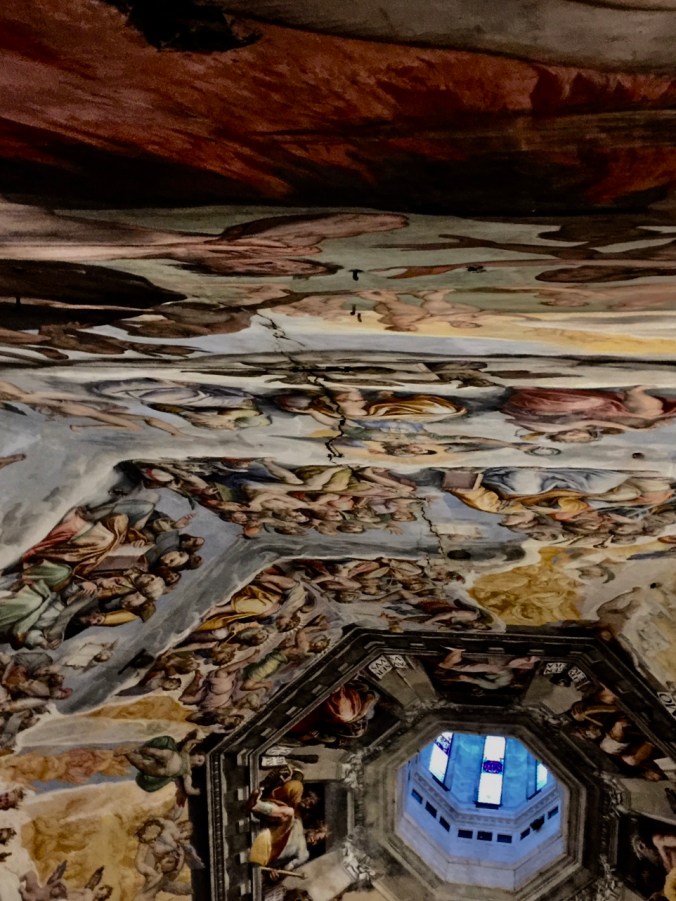
One of the many treats of that worthwhile climb is the opportunity to see the Vasari frescoes of the Last Judgement, that adorns the interior of Brunelleschi’s magnificently engineered dome. This post is dedicated to the Vasari paintings.







Trevi Fountain news
ROME – Most of the tourists who have tossed coins over their shoulder into Rome’s Trevi Fountain over the past 20 years probably did not know that they were helping the city’s poor. But the Rome city government has said no more.

Beginning April 1, the city said, the coins will no longer be delivered to the Rome diocesan Caritas for funding homeless shelters, soup kitchens and parish-based services to families in difficulty.
Instead, the city plans to use the money to help with the upkeep of monuments and to fund grants to “social projects,” which are yet to be defined. It also will hire workers to sort and count the coins, something that Caritas volunteers did for free.
In 2018, the international collection of coins added up to about 1.5 million euros or about $1.7 million.
Interviewed Jan. 12 by Vatican News, Father Benoni Ambarus, director of Caritas Rome, said, “The first thing I want to say is thank you to the millions of tourists who created a sea of solidarity with their coins.”
The priest was still hoping something would change before the change dried up in April. After all, the city council voted in October 2017 to start keeping the money in city coffers, but after a public outcry, the agreement with Caritas was extended to April 2018 and again to Dec. 31, 2018.
Venetian Carnevale, 2019
Il Duomo, Firenze: urban climbs
My birthday was last month and I marked it in a big way this year. A fellow-January birthday girl and I got tickets to climb to the top of the Florence cathedral dome. It is a bit of a hike. You climb up more than 1200 steps, many very steep, and, even in January, the stairways are crowded. It was worth every step!
You must be very careful on these stairways, some narrow, some steep, some filled with people going down while you are going up. I was very, very careful, bc who wants to fall on a stairway from the roof of the duomo?
This post covers the exterior, a separate post is coming soon on the interior of the dome.
So, the first stopping place is the terrace level below the dome, as seen here:


The views, even from this lesser level, are outstanding! There’s the dome of San Lorenzo:


Beguiling views of the baptistry:


So, as I said, I was extremely careful as I climbed up the duomo stairways. And then, 2 days later, I missed a step on a small stairway in my apartment building, lost my balance and twisted my ankle. And I’ve been laid up ever since! I finally got an X-ray and nothing was broken, thank goodness, but the ligaments were torn, so we think.
Anyway, feeling sorry for myself with my foot elevated for several weeks, I haven’t felt like talking about the dome climb. I am almost back to walking well by now, and this is my post to celebrate that fact!

Above and below, shots of the January skies over Florence:

Ahoy down there!


Looking to San Lorenzo: when I’m high up above Florence I realize again how small this city really is!

Looking toward Fiesole:

Looking up and thinking: “can I climb that many more steps to get up there?” Not completely convinced.


The quality of the sculptural details at this height was amazing to me. The architects and sculptors could have been excused for skimping on details: I mean, how many people will ever see the work from close-up?

But they skimped on nothing:


So, okay, chicken, let’s keep climbing. You made it this far. So, up we go, and the climb got more severe:


This sweet woman encouraged me every step of the way, which was a lot of steps!

Above: Looking south, way across Florence, we see Forte Belvedere with its tower:


Below: looking across Florence to San Minato al Monte:

Looking over to the synagogue with the green dome:

Looking towards Santa Croce:
O

In the middle ground, the Bargello and Badia:
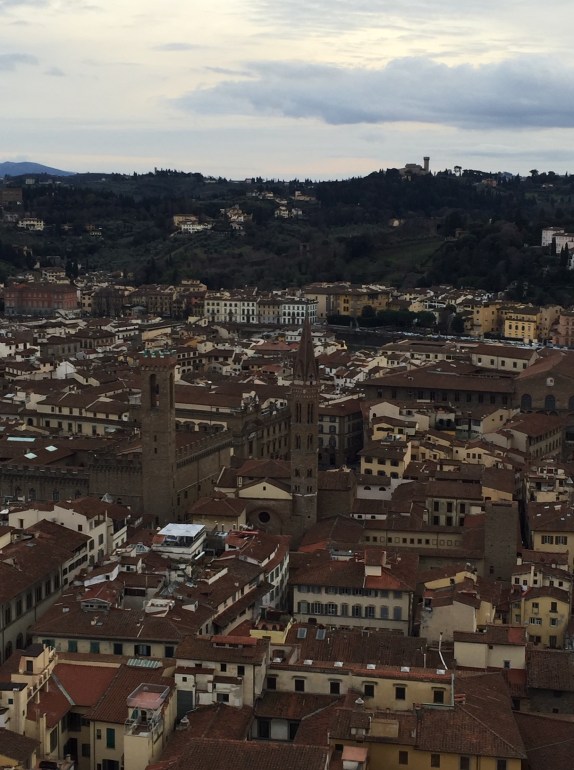


Looking toward the Mercato Centrale, with the green roof:

San Lorenzo with train station in background:


Looking way across town to the church of Santa Maria Novella:


Another shot of San Lorenzo with its entire complex shown:


Orsan Michele in foreground, Palazzo Pitti in front of forest (Boboli Gardens).


Below: looking to Piazza della Repubblica:


Below: details inside the Giardino Boboli:


An Italian opera director turns a painted Renaissance masterpiece on its head…
And much, much more.
PARIS — You can’t always expect to understand the work of Romeo Castellucci. But you’re sure to be awed by its beauty.
Especially when the Italian director — really, a polymathic theatrical artist — stages opera. His productions are rich in symbols and enigmas; each movement leads to a picture-perfect tableau….Mr. Castellucci’s latest project, Scarlatti’s “Il Primo Omicidio” (“The First Homicide”), which continues at the Paris Opera’s Palais Garnier through Feb. 23, is…relatively direct, yet still striking.
“It’s a portrait of Cain,” Mr. Castellucci said of Scarlatti’s 1707 oratorio, an account of the Cain and Abel story, in an interview under the ornate chandeliers of the Garnier’s grand foyer. “But it’s really about innocence.”
The switch from adult singers to children happens the moment Cain murders Abel. “We are in the domain of childhood,” Mr. Castellucci said. “It is a childish mythology.”
A story of jealousy and murder, in his telling, becomes one of rediscovering lost innocence, of adults in search of their youthful doppelgängers….a journey abounding in imaginative stage magic — with layers of lighting and scrims, Mr. Castellucci conjures vast Rothko canvases that have the soft seamlessness of a James Turrell — reaches its end.

The soprano Birgitte Christensen, center, as Eve.CreditJulien Mignot for The New York Times
For the scene in which Eve learns she will be a mother, Mr. Castellucci thought of the Annunciation — the angel Gabriel delivering the news to the Virgin Mary that she would give birth to Jesus. So he turned to “Annunciation With St. Margaret and St. Ansanus,” an Italian Gothic triptych by Simone Martini and Lippo Memmi that now hangs in the Uffizi in Florence.
But he turned it upside down. As Eve sings of her coming motherhood, the massive altarpiece is lowered, slowly, above her head. “It’s a kind of guillotine,” Mr. Castellucci said. “A menace.”
The Venice Carnival, opening February 16, 2019
These are my pictures of the carnivale from 2017. I can hardly believe that I never got around to posting them. It was a wild, exuberant experience I will never forget.
Here’s everything you need to know about this year’s event: https://veniceevents.com/news-blogs/venice-carnival-2019-dates-and-events
And now, finally, 2 years late, my photos:

I was in Venice in 2017 for the water parade. Amazing floats skimmed along the Rio di Cannaregio waterways. It was quite a spectacle. I managed to get a bird’s eye view in the 2nd floor home of a perfect stranger, a delightful Venetian man and his wife! All of these images were shot from their window.


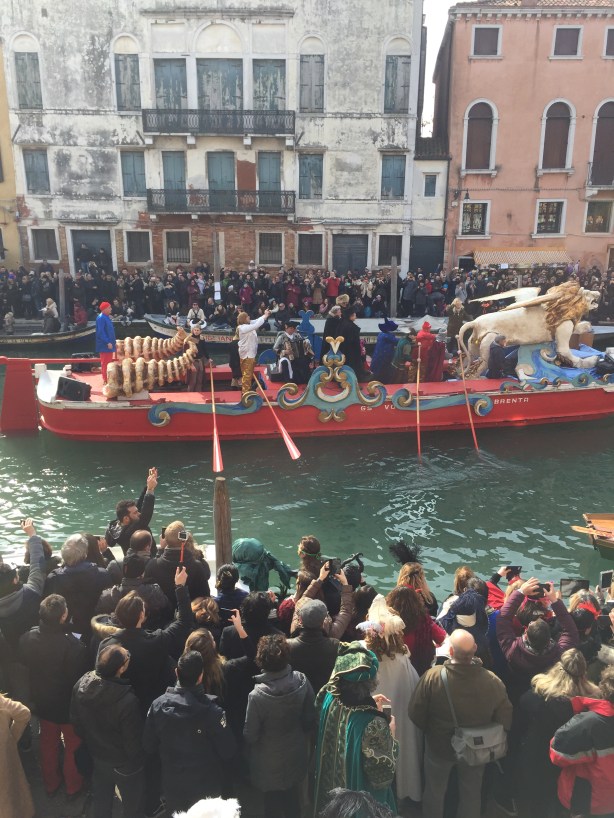


As I left, I got a couple of shots of the delightful Venetian man who shared his window with me and a woman from Russia who went with me to Venice.


The Russian woman (we were classmates in Italian language school in Florence) wanted to buy an elaborate mask and she did!


The wigs available in Venice at this time of year are astounding.


And the costumes, oh my Lord!


Santa Maria della Salute, possibly the world’s most beautiful church and location.


Japanese woodblock print (and European paintings) brought to life by…Honda!
You have to play this to believe it! Japanese woodblock print, a painting by Van Gogh, and 2 paintings by Millet! Art and agriculture together at last.

Happy Valentine’s Day, 2019!
My funny (Florentine) valentine
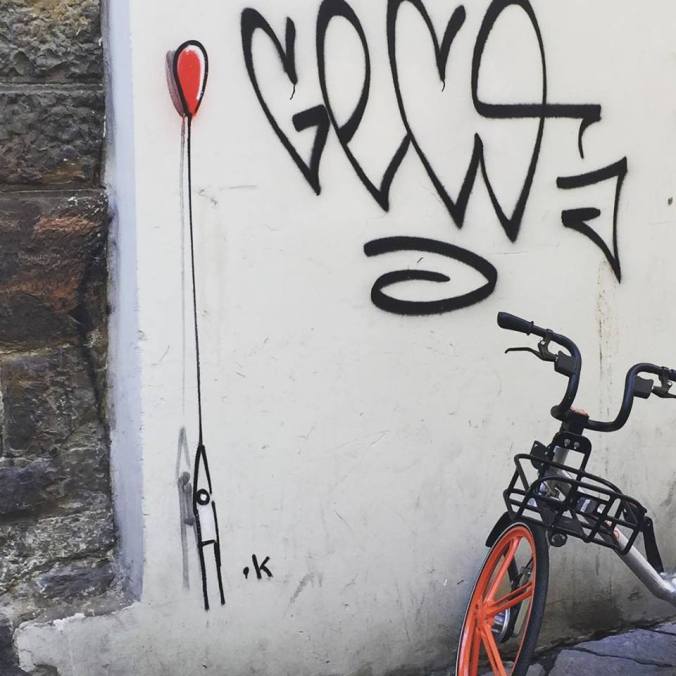
Exit/Enter, Firenze


You must be logged in to post a comment.