Casa Martelli, Florence, part 1

Last month, I finally visited the Palazzo Martelli, which I’ve walked by for several years, always hoping to enter. It’s only open a few days of the week and only by guided tour, but it is so worth the visit!  I highly recommend!

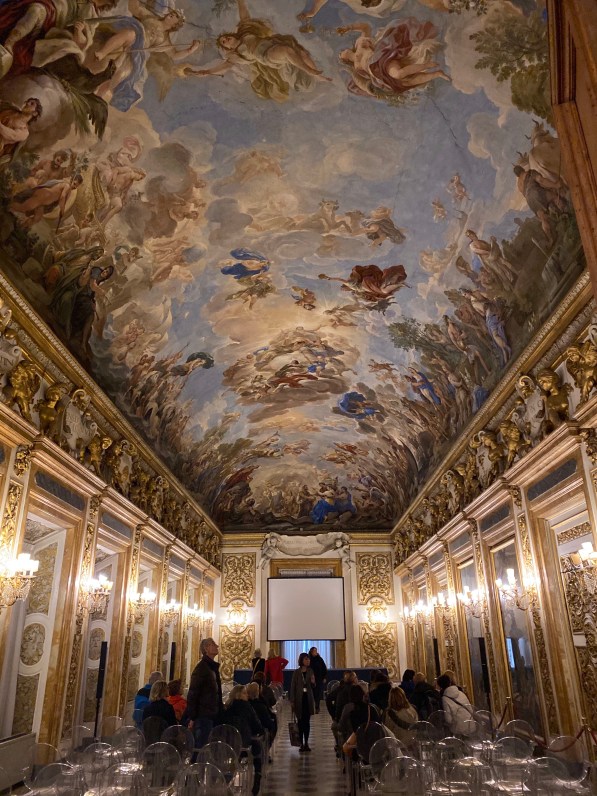
For centuries–right up to the 1980s– the the Palazzo Martelli was the residence of one of Florence’s oldest noble families. A visit to this jewel of a museum takes the visitor into a suite of opulent period interiors, including the ground-floor stanze paese (landscape rooms), whose walls and ceilings are painted with trompe-l’œil scenes; an elegant grand staircase leading to the piano nobile; the spaces of the main floor, which include a chapel, a ballroom, fascinating picture galleries, and a great hall and other richly-decorated rooms.

Screen Shot 2019-11-25 at 16.38.01

Palazzo Martelli underwent a series of renovations in the early 18th century, under the care of Niccolò Martelli and his son Giuseppe Maria, who was the archbishop of Florence. Although there had been Martelli family homes on this site from at least the 13th century, it was only in 1738 that the family’s residence was transformed into the palazzo we see today.  It was designed by architect Bernardino Ciurini, and decorated by the painters Vincenzo Meucci, Bernardo Minozzi and Niccolò Contestabile, and the stuccatore (stucco artisan) Giovan Martino Portogalli.  The exterior, as shown above, presents a sober, austere image to the outside world, with only the balcony to soften the hard edges. This hard exterior is the way Florentines presented themselves to the outer world. But, oh, what lies inside is quite the opposite!

Today, Casa Martelli houses the last Florentine example, in public hands, of a well-known art collection formed largely during the 17th and 18th centuries. A visit proceeds through the rooms of the ground floor and the piano nobile, updated according to the tastes of the period, where visitors can enjoy the picture gallery—rich with masterpieces such as Piero di Cosimo’s Adorazione del Bambino, two wedding panels (pannelli nuziali) by Beccafumi, and magnificent paintings by Luca Giordano and Salvator Rosa—as well as the antique furniture, tapestries, and various decorations and objects dispersed throughout the home.

Casa Martelli remained in the Martelli family’s possession until the death of Francesca Martelli in 1986. For a brief period, the residence passed into the hands of the Florentine Curia, to whom Francesca had bequeathed the palazzo in her will, before eventually becoming property of the Italian State.

Two of the most outstanding art works that the Martelli family possessed have now been removed from the palazzo and are in the Bargello and the National Gallery of Art, Washington, D.C. Both are attributed to Donatello. The monumental coat-of-arms that Donatello created for Roberto Martelli is now in the Museo Nazionale del Bargello collection.  Today a copy hangs in the place of honor. You see it below, on the far wall with a red background.

Likewise, a statue of David also attributed to Donatello (see below) once stood in this hall; today the statue is in Washington, D.C.

Screen Shot 2019-11-25 at 16.36.17

Currently the museum is only open to visits a couple of days of the week, and then only with a guided tour.  If you get the chance, you should definitely visit the casa, or palazzo.  It is wonderful.

But, if you can’t wait or can’t get to Florence, you can fortunately take a virtual tour of the museum here: http://www.polomuseale.firenze.it/musei/visita/casamartelli/tour.html

Even accounting for the loss and dispersal of items, the collection remains impressive, including works by Piero di Cosimo, Francesco Francia, Francesco Morandini, Salvator Rosa, Giordano, Beccafumi, Sustermans, Michael Sweerts, Pieter Brueghel the Younger, Orazio Borgianni, Francesco Curradi, and collections of small bronzes, including some by Soldani Benzi. The works are displayed in the crowded arrangement typical of the period.

When you visit the casa today, you enter through large wooden doors and an iron gate, both dating to 1799.  Inside the building, at the far end of a short interior courtyard, is a mural painting with an illusory effect, done in 1802 by Gaspero Bargioni.

 
Screen Shot 2019-11-25 at 16.28.54


One enters a door to the grand staircase from this cortile:


The original ironwood of this staircase is fabulous!


Where you see the neoclassical sculpture of Psyche, imagine a statue of David by Donatello standing there.  That’s the work of art the Martelli family displayed in this place of honor.  The Donatello statue is today in Washington, D.C.

Screen Shot 2019-11-26 at 09.20.56


Below is the copy of the Donatello coat of arts made for the Martelli family.  The original is in the Bargello.


Entering the first gallery off the entrance, you begin to enjoy the art collections for which the Martelli family was renowned, including the many outstanding ceiling frescoes they commissioned over the centuries for this opulent family home.


In the painting below, we catch a glimpse of members of the Martelli family in the 17th century. A servant offers them a tray bearing cups of the hot chocolate which were a la mode at the time. Oh, to have been a fly on the wall!


Many of the doors throughout these galleries are embellished with these gilt decorations, every door with a different combination of items:


The artist signed his name on the ceiling mural, as you can see below:


I was interested in these little pops of passamaneria (trimmings) found covering the nailheads that these paintings are hung on.  I’m a huge fan of all things passamaneria, and I’ve never seen anything like these before.  I love it when I experience something completely new!


Now we enter the 2nd gallery, with its own wonderful ceiling mural.  I was enchanted by these 2 little boys in the mural.  They are busily talking pageboys,  holding the lady’s train.  What were they discussing, I need to know!


The door knobs in some of these galleries were fabulous! Butterflies!


The inlaid commesso fiorentino furniture was outstanding as well:


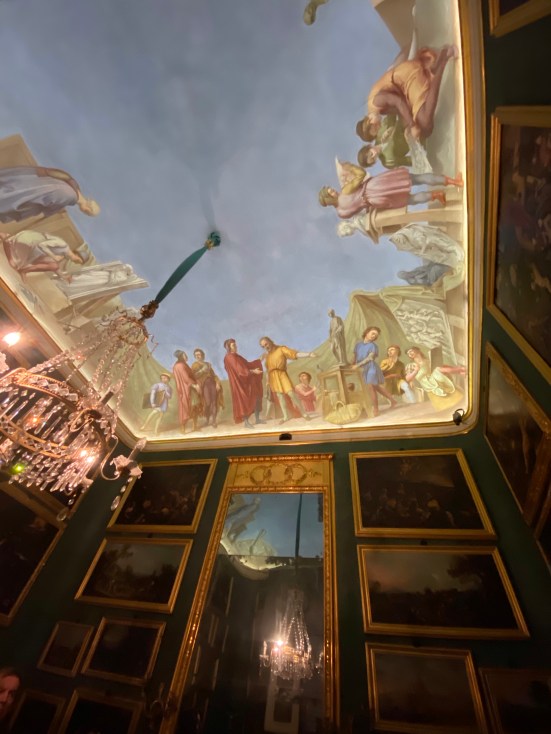
Next we enter the 3rd gallery, with a ceiling fresco treating the subject of Donatello as sculptor to the Martelli family.  The connection was real and it is very entertaining to see its history play out on the ceiling!


That’s Donatello in the yellow smock:


Oops, another shot of my latest obsession.


Below: my other obsession.


Also notable in this room are the very old and very elegant draperies, also with very elegant trim or passamaneria.


And, of course, this family would own some fine Manifattura Richard Ginori ceramics:


The next gallery, with another fine frescoed ceiling:


In this room, I love the way the 2 drapery rods meet in the middle in a laurel wreath.  The message is clear, the Martelli family was crowned with laurel:


That, of course, is Dante in the red, accompanied by Petrarch and Boccacio. Naturally they are crowned with laurel wreaths and the putto is sailing in with an extra, just in case:


In the next room, a private chapel was built for the last Martelli owner of the home.  It is really quite something in terms of casework.


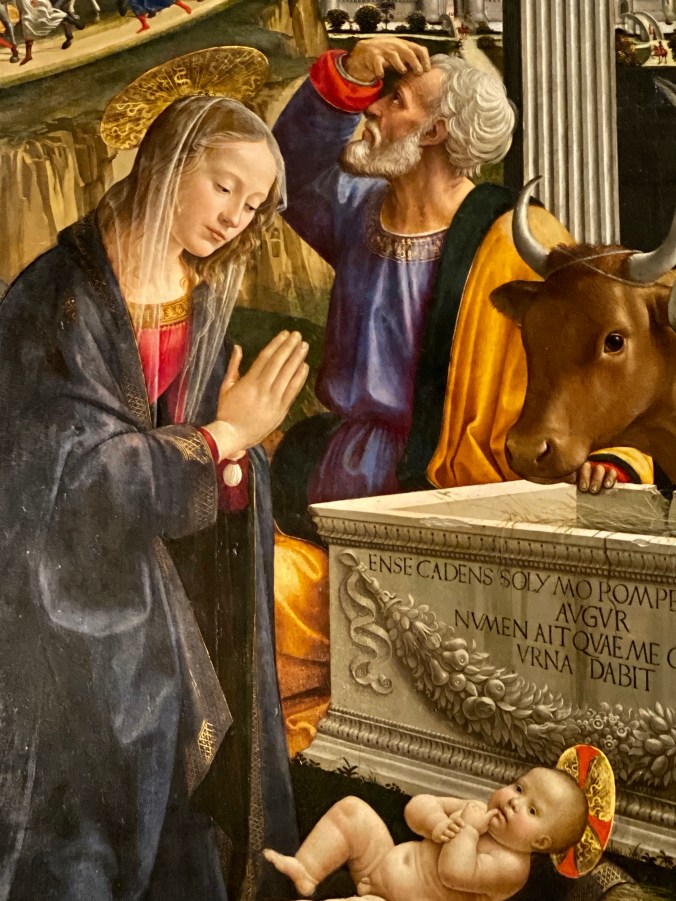
I don’t remember ever seeing a painting of a swaddled Christchild before.  Another something new.


I’ve still got more to show you, but this post is already too long.  I’ll finish it tomorrow…stay tuned!

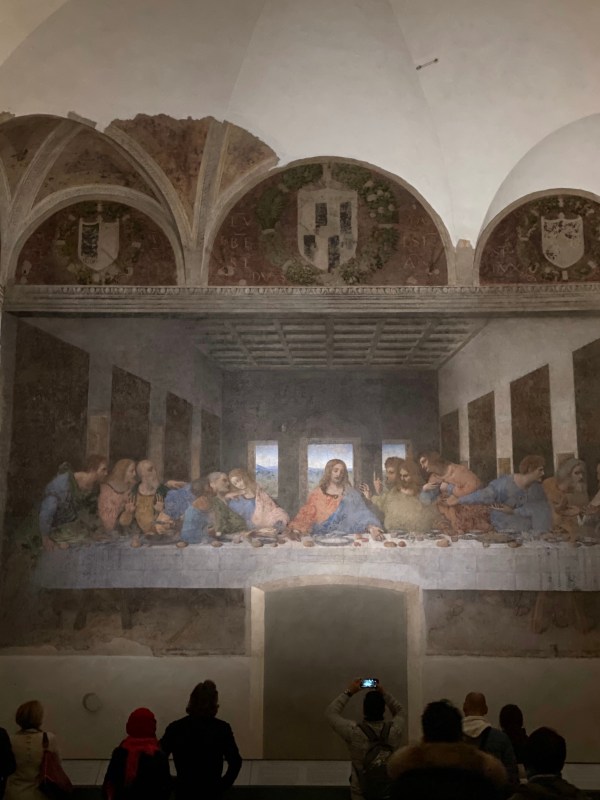
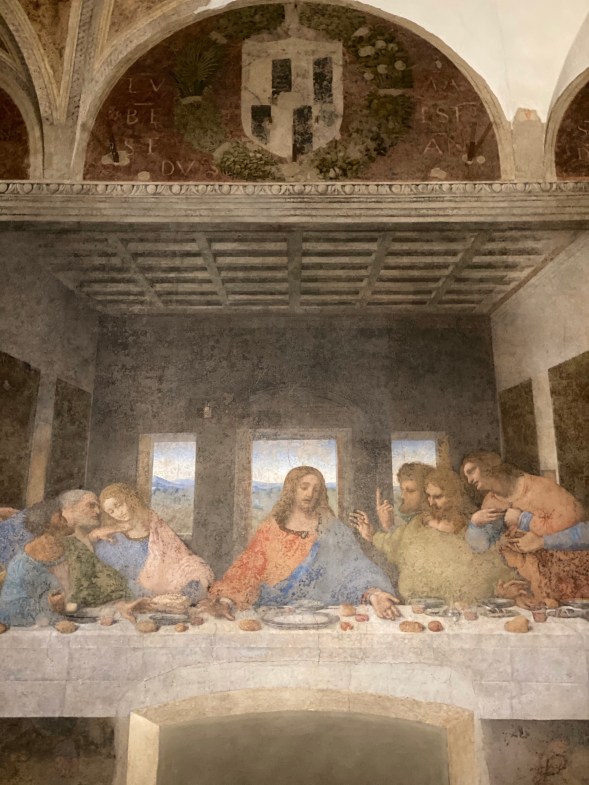
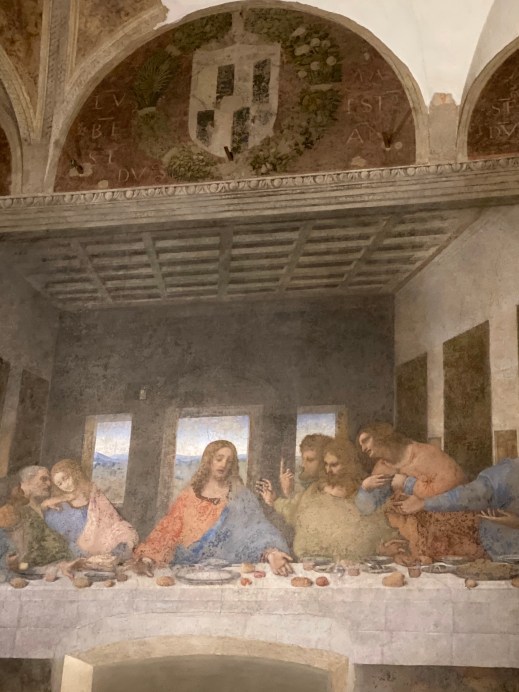
Leonardo’s Last Supper, Milan


Dear Fellow Former Met Girl,

So, I think you will enjoy this. I had a ticket to visit the Last Supper for 15 minutes on Wednesday at 5 pm. That’s how they do it nowadays. You buy your ticket online if you want to be sure to get in. No more dropping by anything interesting in Italy anymore; sure, you can try, but you will most likely be disappointed.

My visits to the Scrovegni Chapel were 20 minutes long. Didn’t realize I was spoiled with that!

Anyhoo, I have a new iPhone and it has a mind of its own. Typically when I take a video, the light doesn’t come on. So, I was making a video of the last supper when I heard this screeching coming from somewhere in the refectory. I knew right away somebody had made a faux-pas.

I kept filming until I realized, when 2 Italian matrons were bum-rushing me, that the faux pas was mine. My camera light was on and that was a huge no- no.

I turned off my camera and apologized profusely, explaining that I didn’t know the light was on. Finally they stood down, but only after telling me I had to delete the video. I promised to do so and acted like I was.

But, I kept it and here it is for all the world to enjoy!

This is how a former Met girl goes to Milan. Just like a bronze foundry in Brooklyn!

xx, L


The church and convent della Calza, with a Last Supper by Franciabigio

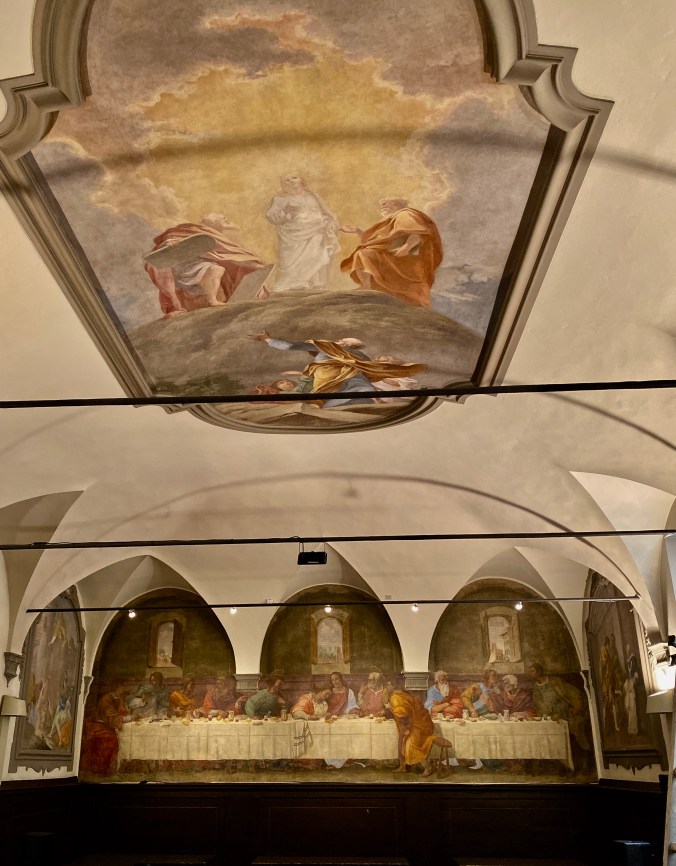
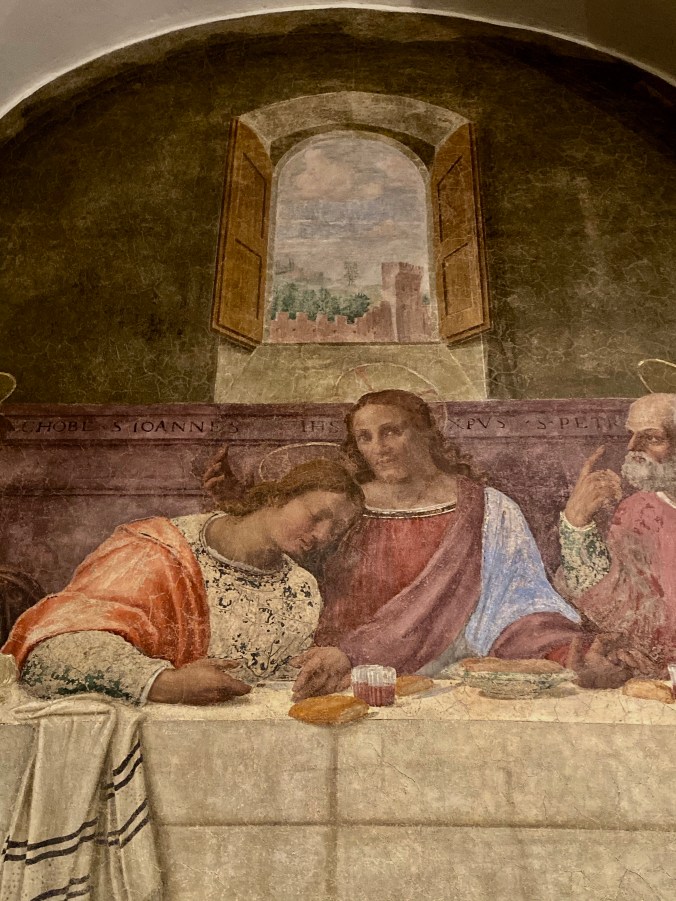
Just inside the ancient gate of Porta Romano, lies a simple church and attached convent (in Italy, convent can mean monastery or convent or both) dating to the 13th century. An almost unknown (relatively speaking, at least, to the hordes of tourists who descend on Florence every year) masterpiece of  Renaissance paintings is housed here: a beautiful cenacolo, or a painting of The Last Supper. Florence is so fortunately rich in these frescoed depictions of that fateful dinner.

Screen Shot 2019-11-09 at 16.54.42

fullsizeoutput_1fb0

fullsizeoutput_1fae

fullsizeoutput_1fb4

The church dedicated to San Giovanni Battista, in Piazza della Calza, was founded as a hospital in 1362.  There were once many oratories, hospitals and shelters for pilgrims and travelers along the present via Senese and via Romana. These were major roads leading to Florence.

At the end of the 14th century, the convent was established by the Gerosolimitan nuns. They commissioned Franciabigio to paint The Last Supper in 1514 in their refectory. Unfortunately, the sisters soon had to leave the hospital, during the 1529 siege of Florence.

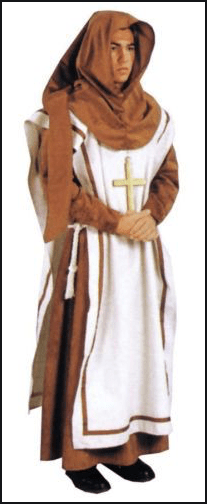
The nuns were replaced in 1531 by Jesuati friars (not Jesuits) who changed the dedication of the church from Hospital of Saint John the Baptist  to San Giusto. They  used the hospital as a charity for children, an ecclesiastic boarding-house, and eventually as a seminary. The church and the convent became known by the name “della calza” (sock) which was a name derived from the long white hoods that the monks wore over their left shoulders. The hood was shaped like a sock and the name stuck.

The picture below is not authentically one of the della calza habits, but it shows the shape of the hood and how it was worn.

Screen Shot 2019-11-09 at 17.43.26

From this nickname of “the sock” came the name of the church, the convent, and even the square.

Screen Shot 2019-11-09 at 16.36.20

The true hidden gem kept inside is the Cenacolo by Franciabigio, still preserved in the ancient refectory.

fullsizeoutput_1f92fullsizeoutput_1f98

Mother Superior Antonia de’ Medici entrusted Francesco di Cristofano, called Franciabigio (1482-1525), to portray a specific scene, during the Last Supper, just after Christ says: “Truly, I tell you, one of you will betray me.”

Franciabigio thus knowing, deep sadness in the countenance of Christ. Judas, the only figure on the outer side of the table, reacts strongly to the words of Jesus: his sudden movement causes his wooden stool to tip over. All around the table, the expressions of the Apostles register various states of confusion.

img_1640

fullsizeoutput_1f78

fullsizeoutput_1f7c

fullsizeoutput_1f80

One can notice each reaction and recognize each Apostle because the artist added their names, painted along the strip which runs above their heads. The painter added here the date A(nno) S(alutis) MDXIIII (A.D. 1514) and his signature, through a twisted shortened monogram (FRAC).

img_1647

On the painted floor, you can even distinguish the name of the Mother Superior Antonia (SVORA AN), marked on the lower left side, under the table, between the second and third Apostle.

Franciabigio carefully fashioned magnificient details; along the fine linen tablecloth you see ceramic jugs, breadrolls, glasses with red wine, and sliced watermelon. Some of the jugs feature the typical Medici coat-of-arms (the one with the red spheres) referring to Mother Superior Antonia and the Red Cross of the Order of Knights of Malta to whom the nuns originally belonged.

Giorgio Vasari describes (Lives of the Most Excellent Painters, Sculptors and Architects) how Franciabigio “was very keen on studies of perspective” and human anatomy. We see that throughout and especially in the accurate position of the wooden shutters painted along the wall.

img_1639


img_1638


img_1637

A fascinating contrast is given by the dark green wall and the light of the crystal clear sky in the background, where the painter depicted the old Florentine town walls (the destroyed gate of San Pier Gattolino).

For the Jubilee in 2000, the fresco was restored.

Just a quick word about the Church of San Giovanni Battista della Calza:

Screen Shot 2019-11-09 at 16.36.20

My quick walk through the church introduced me to this arresting sculpture near the entrance to the small church.

I was alone in the church and had free rein to poke around.  In a small room off the church itself I noticed an amazing della Robbia fountain.  You never know what treasures you will happen upon in this fascinating city.

And, finally, I can’t leave this post without mentioning that, depict the austerity of this church, some major paintings were once a part of the church.  They are now in the Uffizi:

Screen Shot 2019-11-09 at 16.38.52


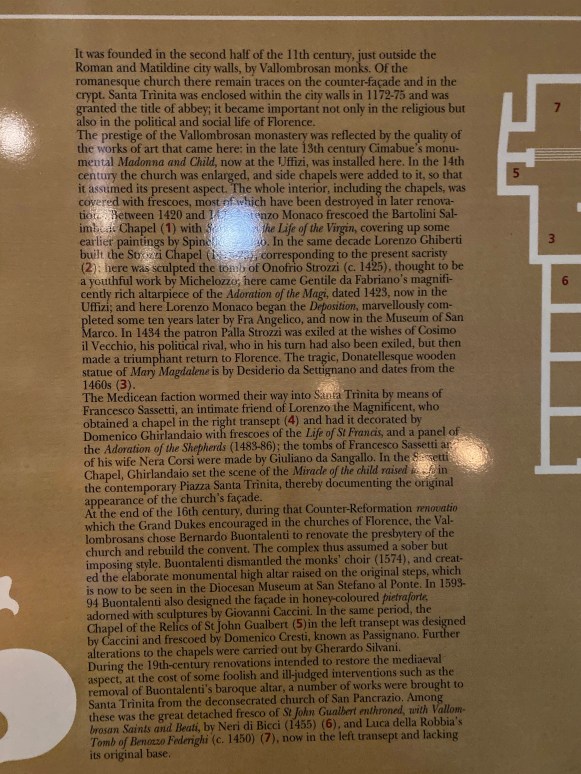
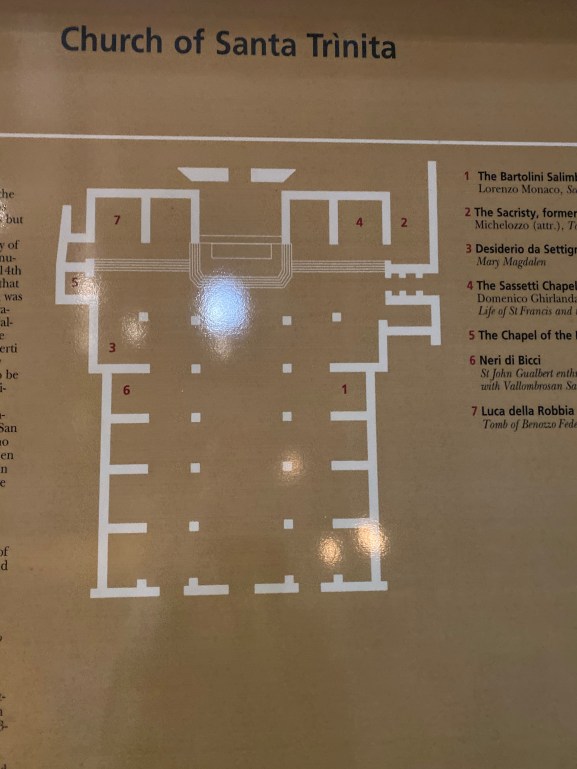
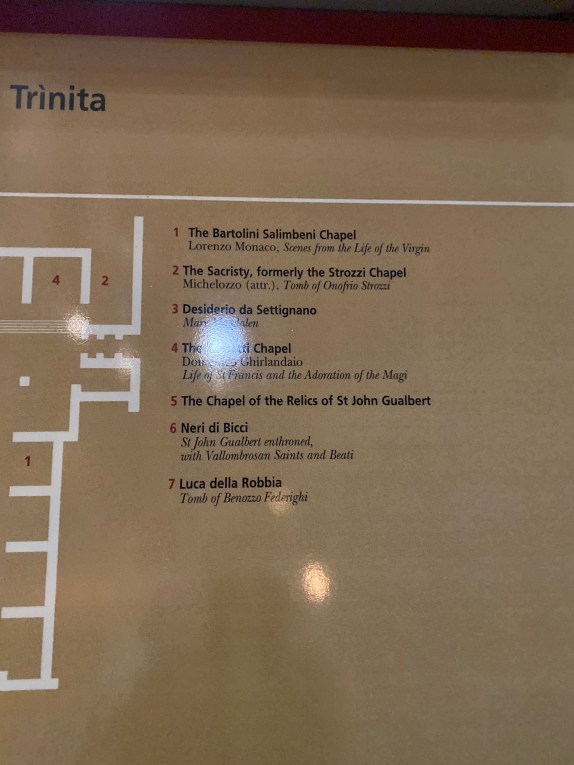
Santa Trinita, another look

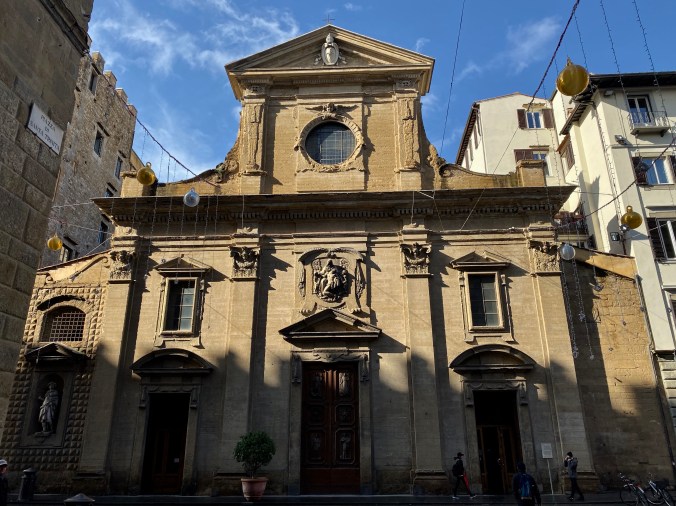
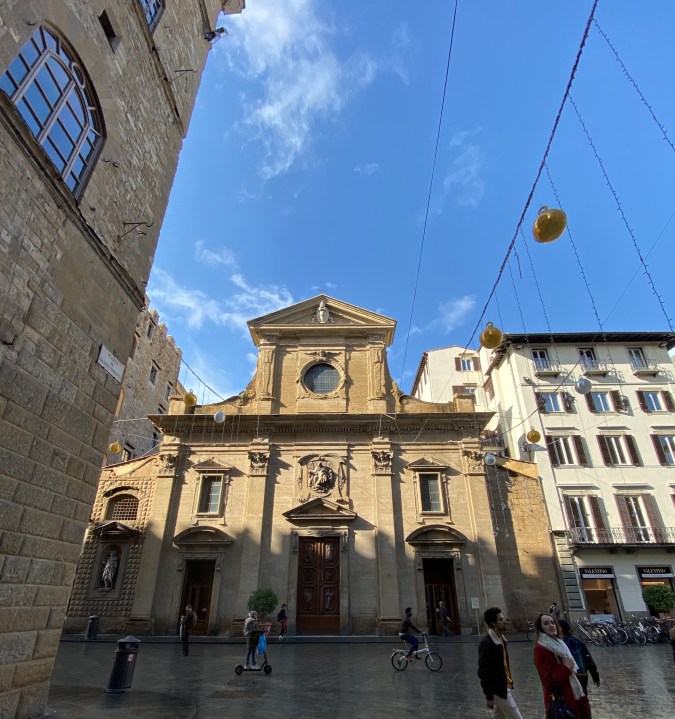
Recently I posted about Santa Trinita and I just had another chance to pay it another visit.  It was a sunny day following a week of rain, and it just felt good to be out and in the sunshine.  You might notice that the city of Florence has begun decorating for Christmas already!

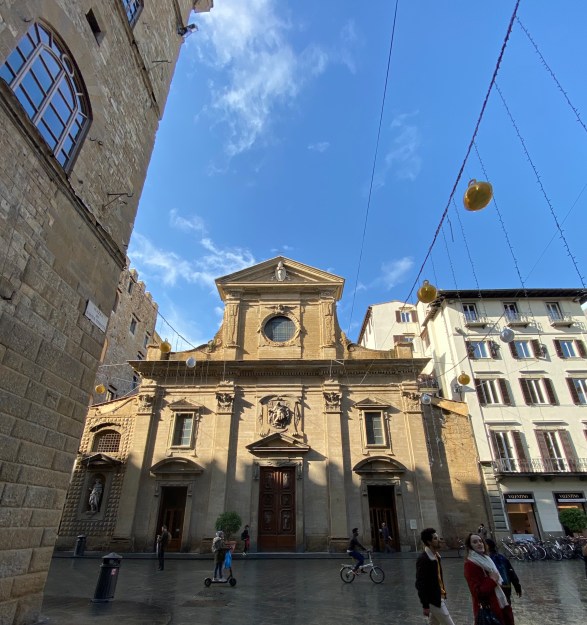
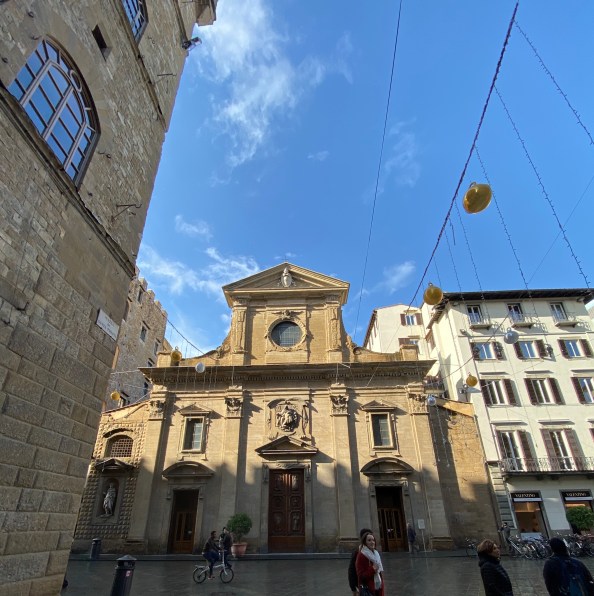
The Mannerist facade by Buontalenti:

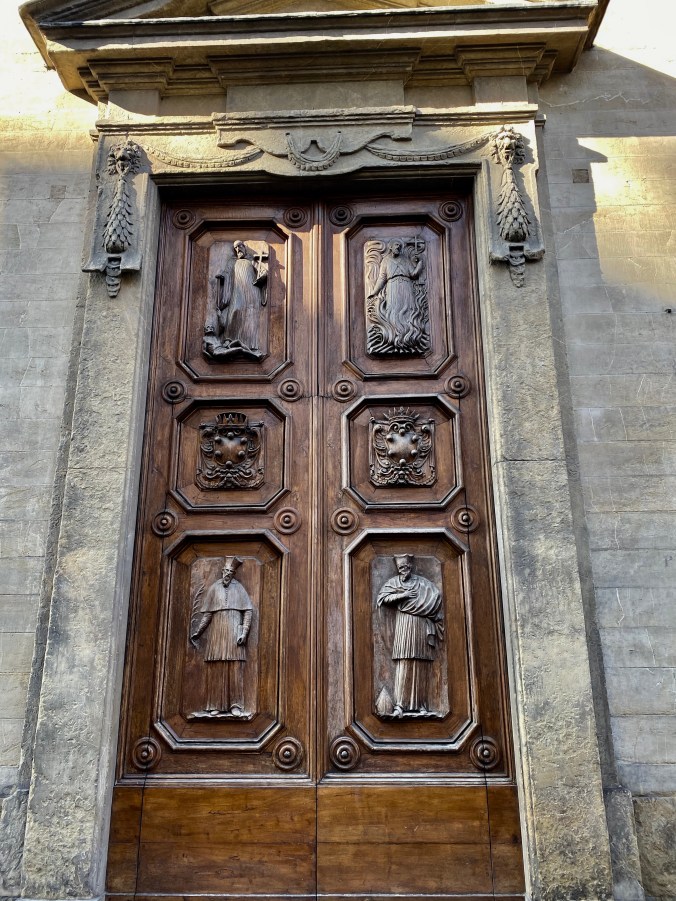
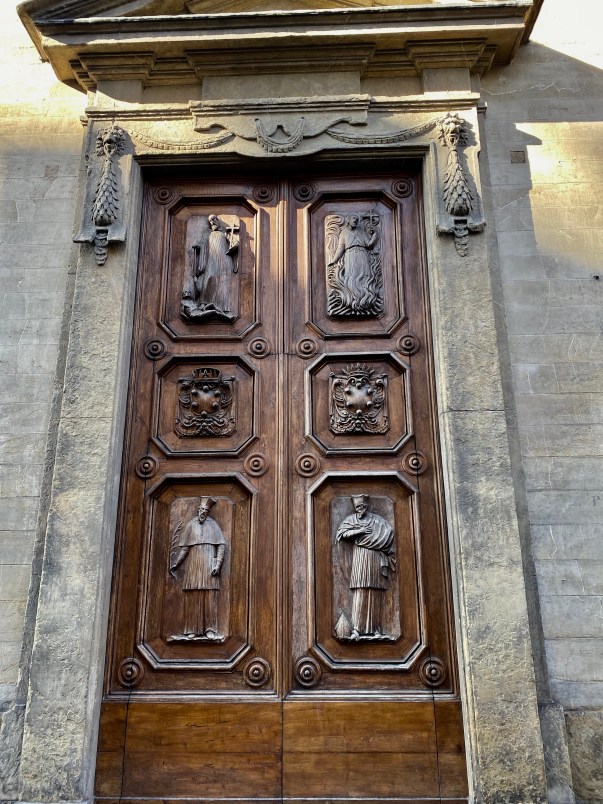
The beautifully carved central doors:

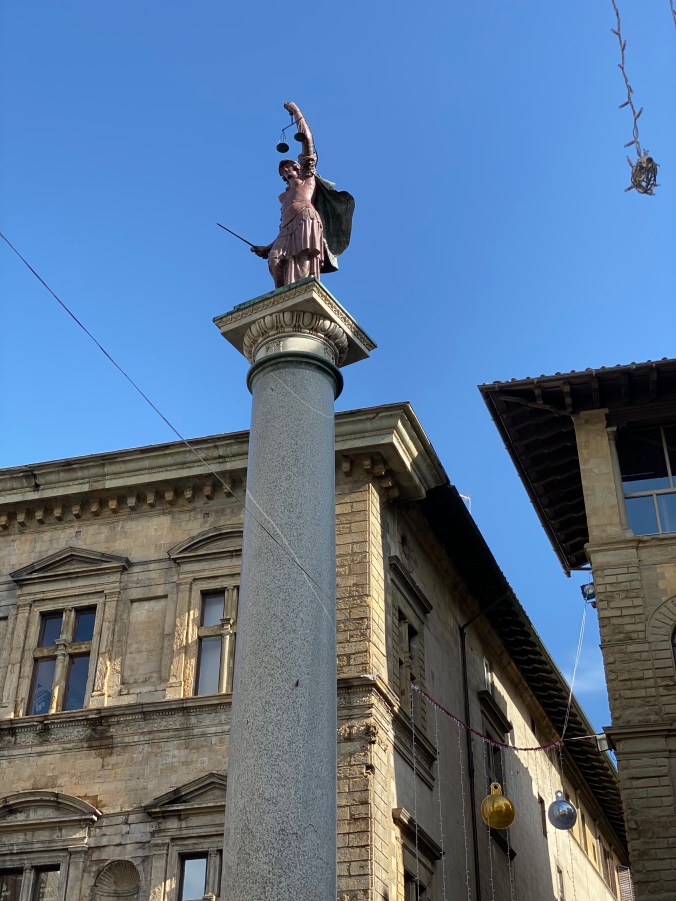
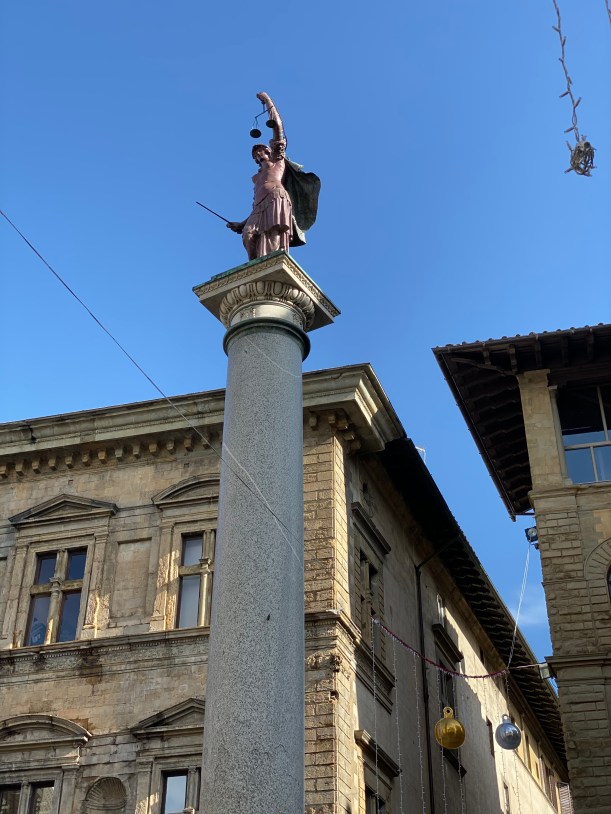
You must never forget the fabulous column and Roman statue in the piazza outside the church:


Once more, the facade:


Inside the church we are fortunate to see the extant old Romanesque facade of the church. Luckily for posterity, they didn’t destroy it when they constructed the new front for the church:


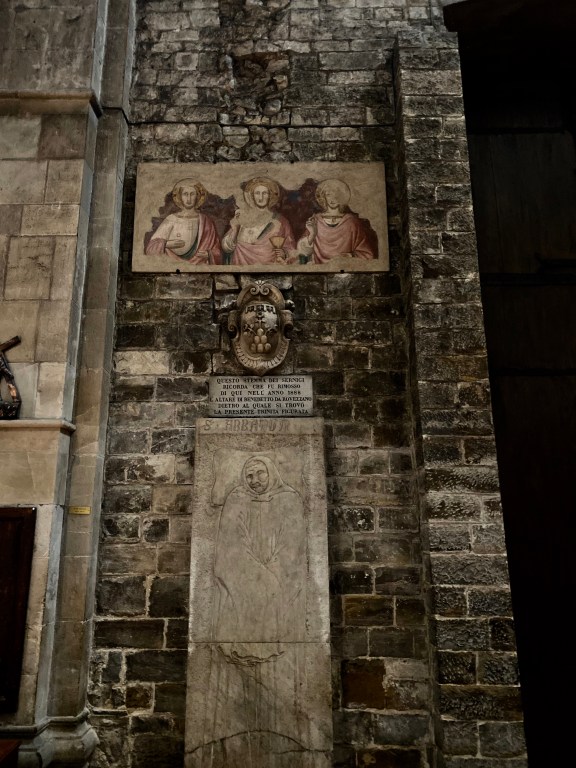
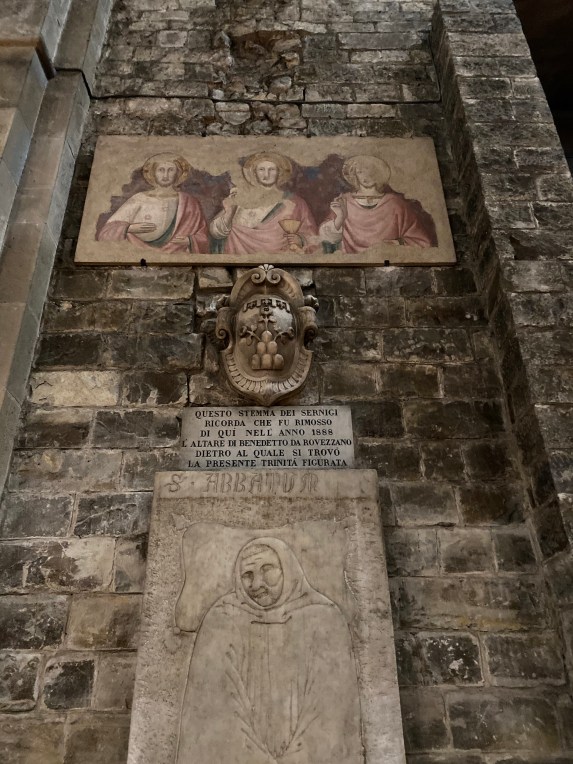
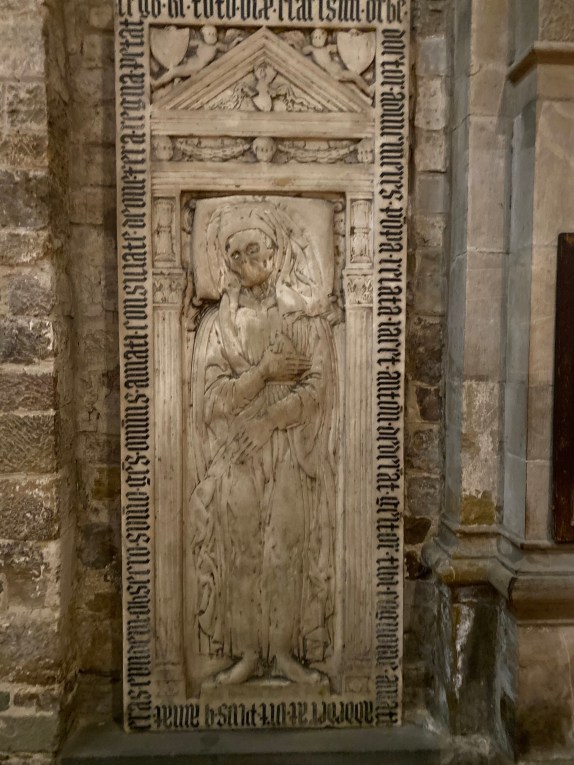
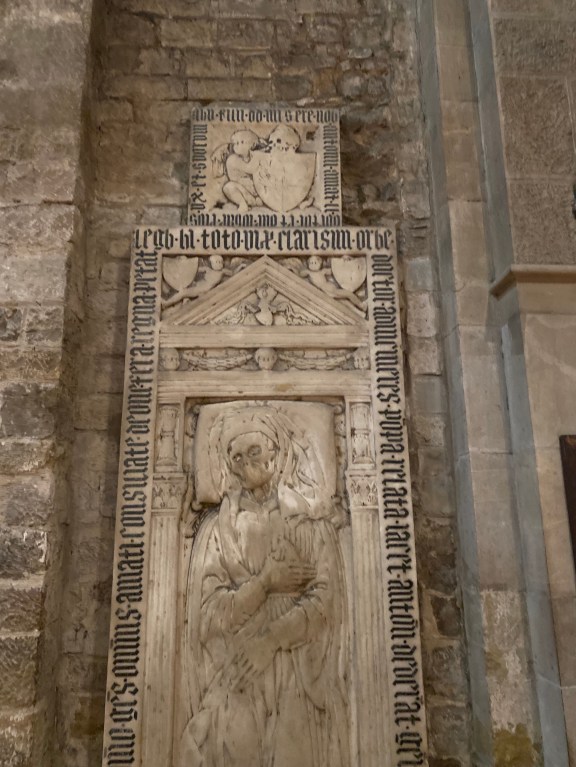
One either side of the central door, inside the church are these tombstones and paintings:


The interior:


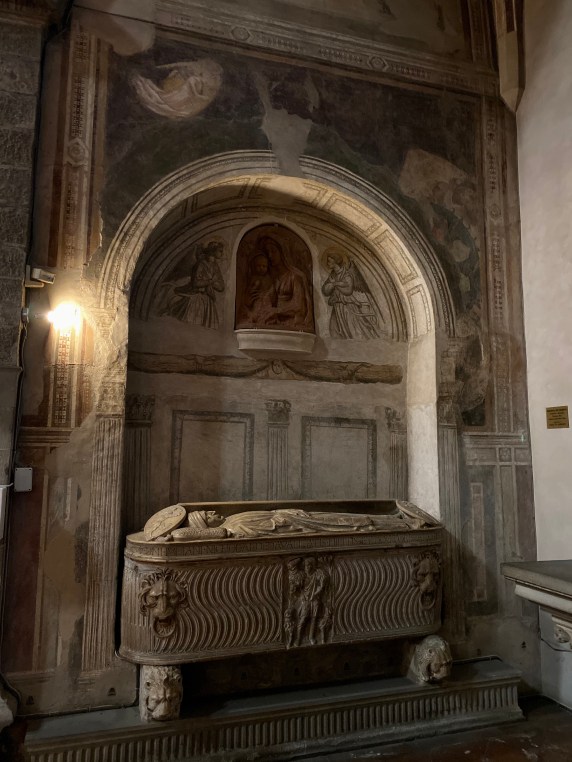
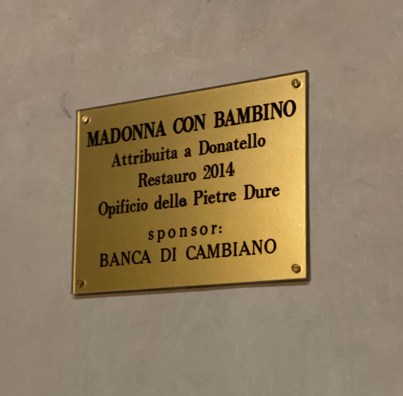
The Chapel containing the (presumed) Donatello:


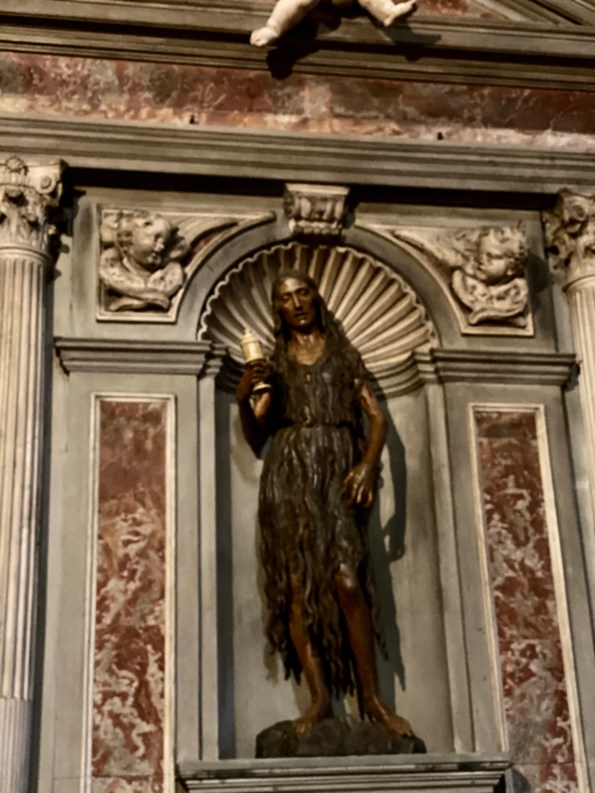
The statue of Mary Magdalene by Desiderio di Settignano:


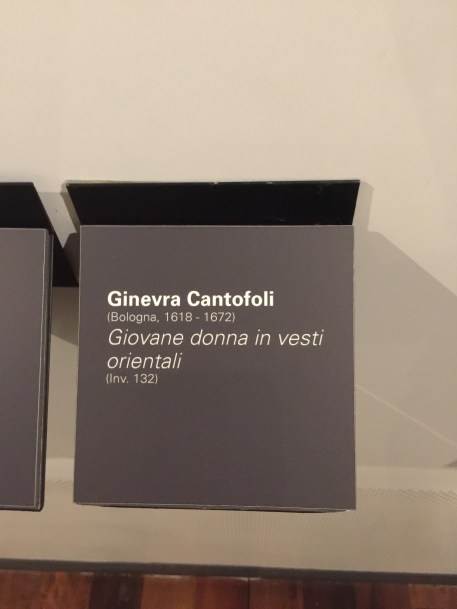
Ginevra Cantofoli, who are you?

On a recent visit to Padova, I was arrested by some paintings in the Museo Civici, both done by Ginevra Cantofoli.  I vowed to write a post on this intriguing painter, and here it is.  It isn’t much…I hope someday to add more.

IMG_1089IMG_1090IMG_1091IMG_1092

All I can add right now is this info from Wiki:

Ginevra Cantofoli
Born 1618

Bologna, Italy
Died 1672 (aged 53–54)
Nationality Italian
Known for Painting
Movement Baroque

Ginevra Cantofoli (1618–1672) was an Italian painter. She was active in the Baroque period.

Scena Allegorica. Date unknown.

Cantofoli was born in Bologna, Italy in 1618.

Cantfoli received her training as an artist from Elisabetta Sirani in Bologna. She painted works for several churches. These works included a Last Supper for the Church of San Procolo, a St. Thomas of Villanova for San Giacomo Maggiore, and a St. Apollonia for the Church of La Morte.