
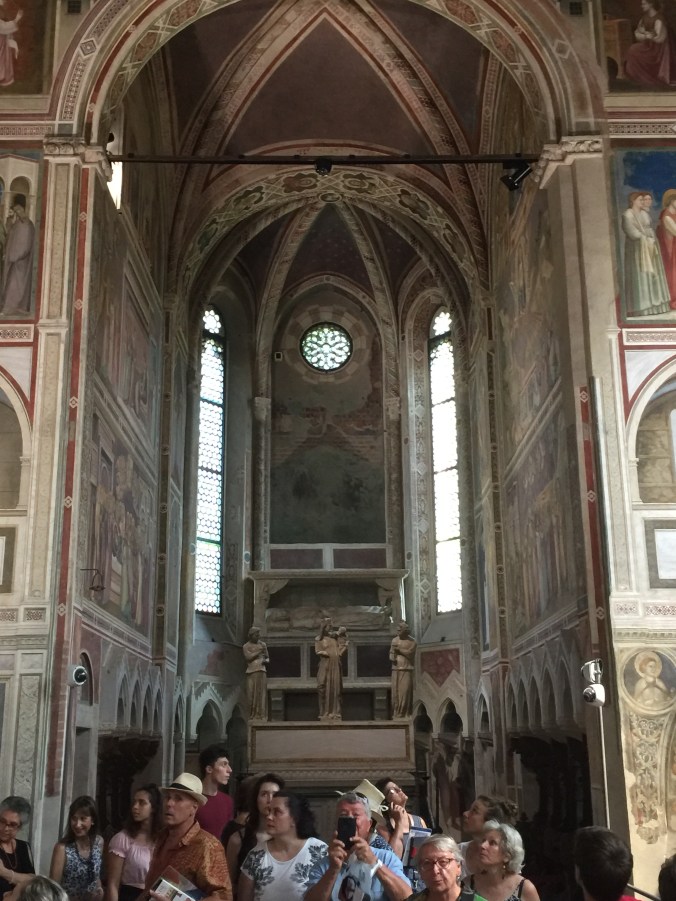
Above, looking at the altar of the Scrovegni Chapel, with marble sculpture by Giovanni Pisano.
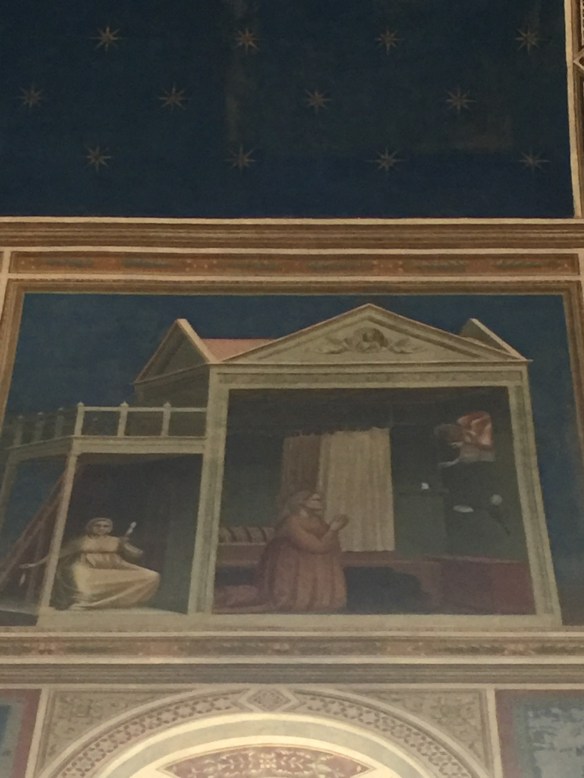
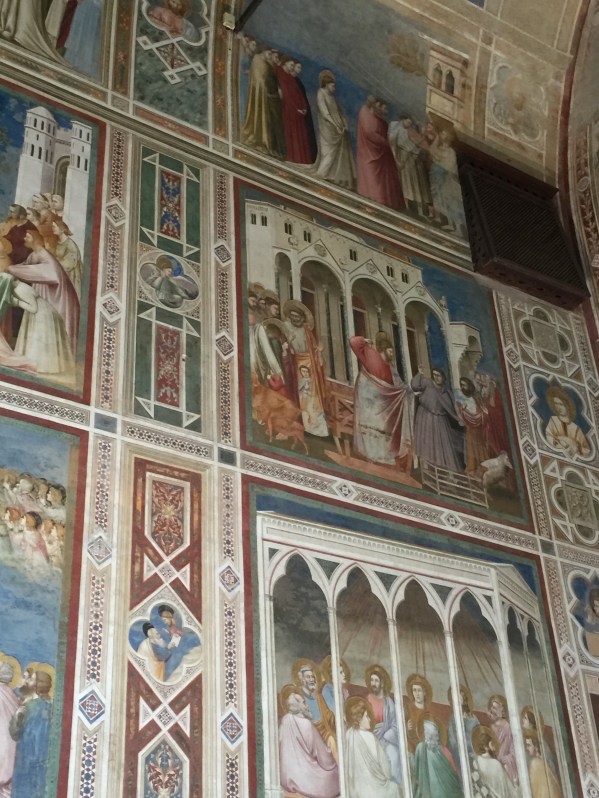
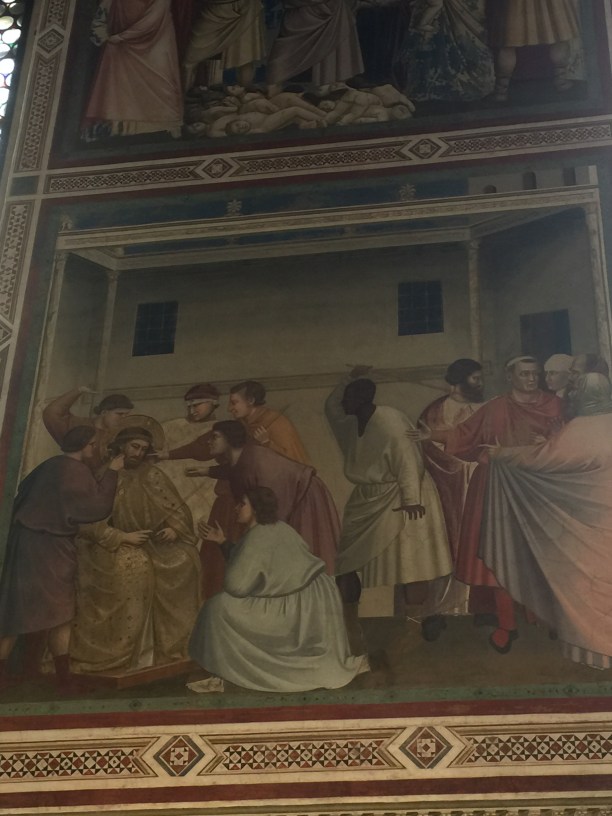
Below: the fresco cycle


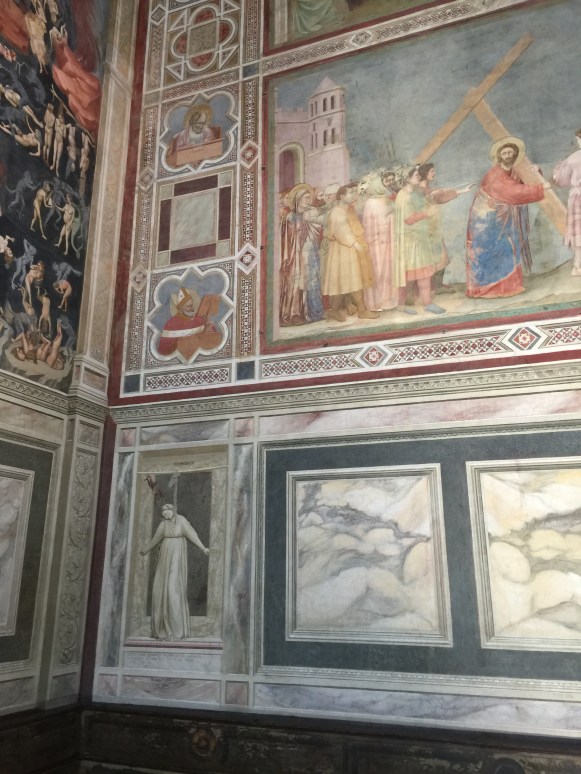


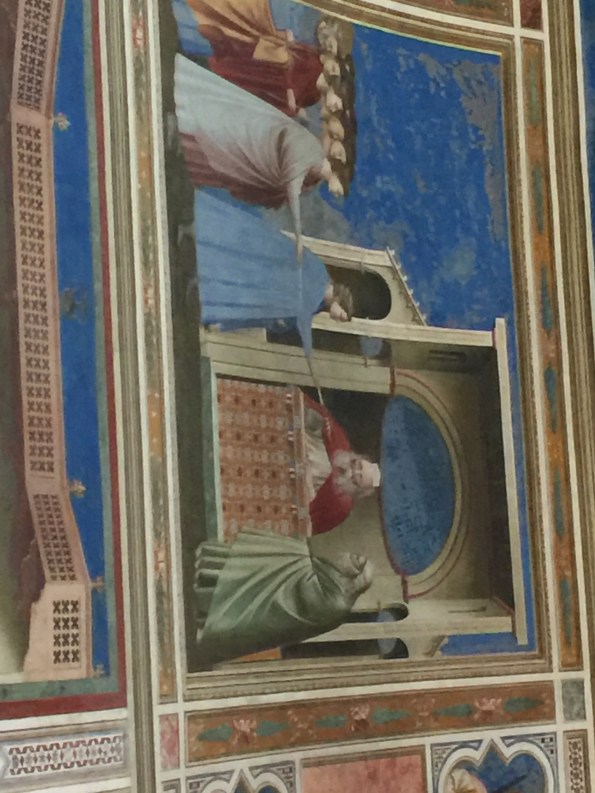


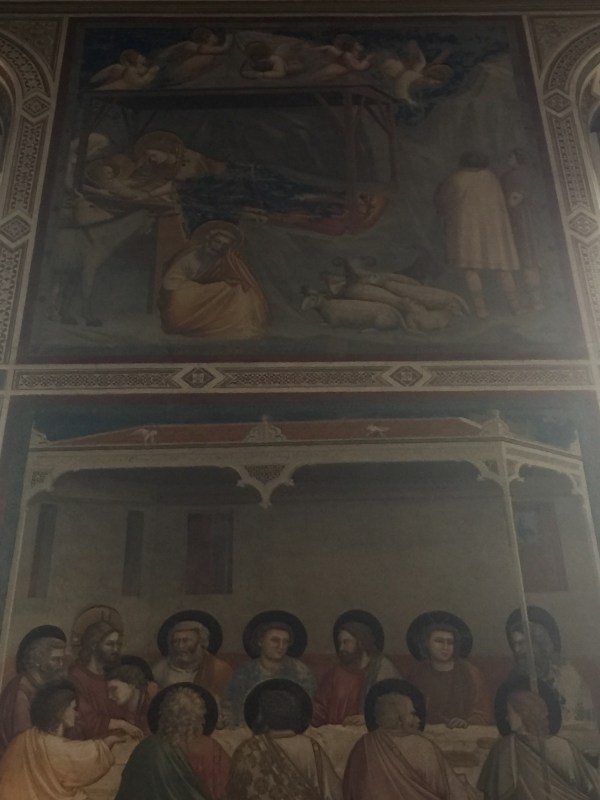


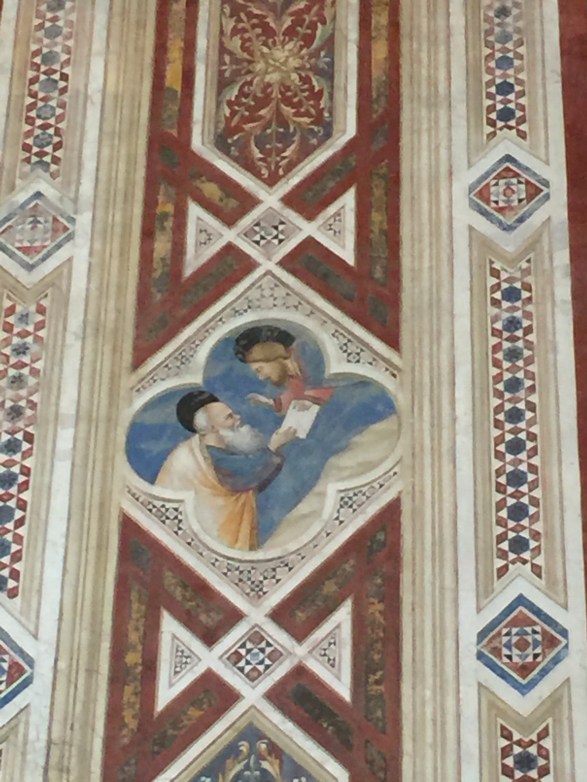








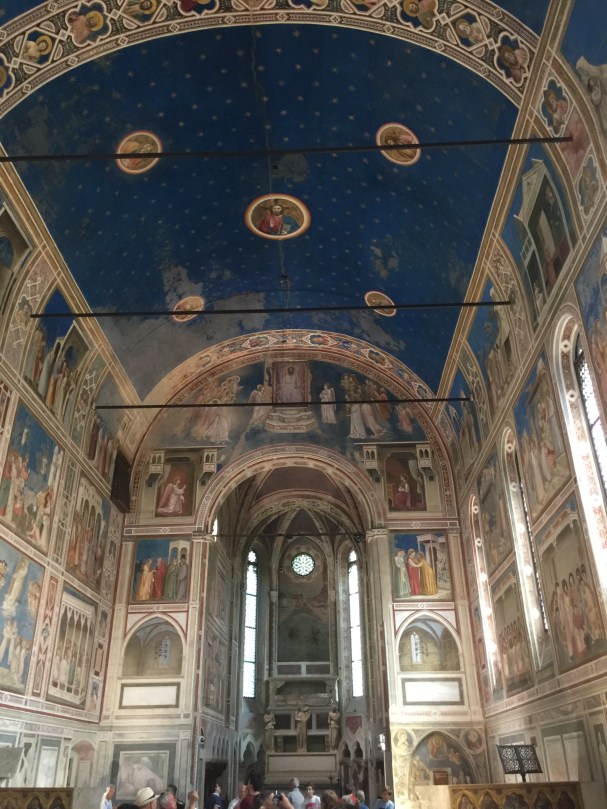


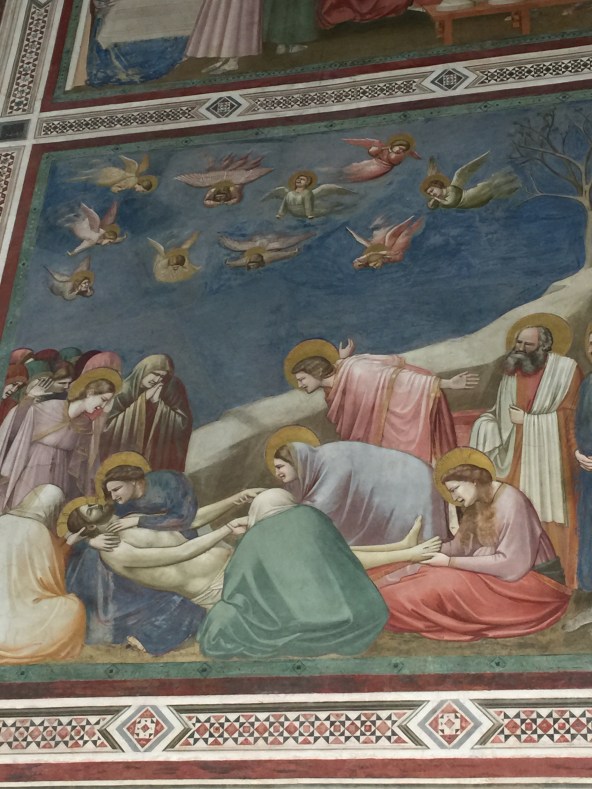

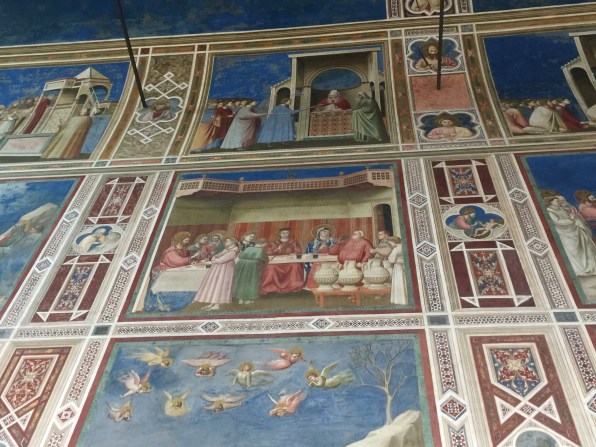
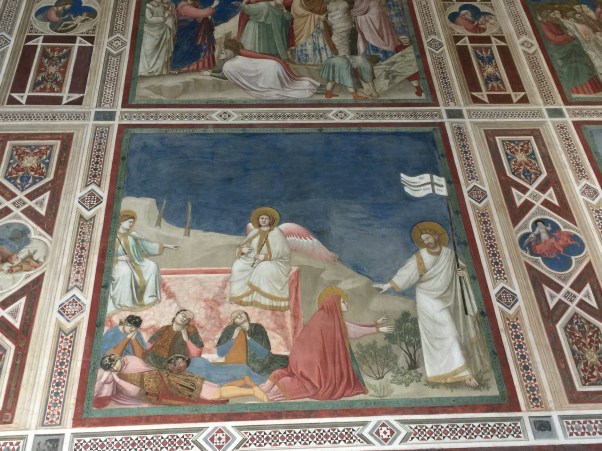


Above, looking at the altar of the Scrovegni Chapel, with marble sculpture by Giovanni Pisano.
Below: the fresco cycle
Lovely Padova, or Padua, is a city and comune in Veneto, northern Italy. It is the capital of the province of Padua and the economic and communications hub of the area. Padua’s population is 214,000 and when the city is included, with Venice (Venezia) and Treviso, in the Padua-Treviso-Venice Metropolitan Area (PATREVE), the sum population of around 2.5 million.
Padua stands on the Bacchiglione River, 25 miles west of Venice. The Brenta River, which once ran through the city, still touches the northern districts.
Its agricultural setting is the Venetian Plain (Pianura Veneta). To the city’s south west lies the Euganaean Hills, praised from time immemorial by Lucan and Martial and later by Petrarch, Ugo Foscolo, and Shelley.
Padua was the setting for most of the action in Shakespeare’s The Taming of the Shrew and in and in Much Ado About Nothing, Benedick is named as “Signior Benedick of Padua.” There is a play by the Irish writer Oscar Wilde entitled The Duchess of Padua.
The University of Padua, founded in 1222, is where later Galileo Galilei was a lecturer between 1592 and 1610.
I was fortunate enough to pay a 2nd visit to Padova recently. I’d been once before, at least 30 years ago, just to see the Giotto frescoes in the Scrovegni Chapel. I had crystal clear, bright blue memories of that chapel and it has been high time, for some time, to pay another visit. So off I went. It was wonderful.
The main goal of my recent trip to Padua was to again see the Giotto frescoes. Nowadays, with the continual press on all the cultural monuments in Italy due to mass tourism and inane “bucket lists,” many sites have time limits on how long you can see the art. The Scrovegni Chapel has joined that rank.
You must book your visit at a particular time well in advance, arrive early to pick up your ticket, meet 10 mins before your time, be ushered into a waiting room and watch a (very interesting) film in Italian while you are “dehumidified”. Is this hocus pocus? I don’t know. But it’s fine.
The only issue I have is that you now enter the chapel with 19 other dehumidified persons and get to stay in the chapel for 15 minutes only and then you are ushered out and the next group is ushered in.
But, before discussing the sublime Scrovegni Chapel, let me say a few words about the archaeological museum that is next door to the chapel.
In fact, the truth is that prior to my recent visit, I had not realized there was an archaeological museum in Padova, let alone attached to the same complex of buildings. And I certainly did not know that Padova was home to such an amazing collection.
I arrived at the Scrovegni Chapel about 45 minutes early and checked in and got my ticket for my 1:00 o’clock visit. The pleasant woman at the check-in desk suggested that I visit the museum when I was thinking aloud, hmmm…I wonder what I should do for the 45 minutes while I wait to visit the chapel.
I am so glad she made that suggestion. I am already planning another visit to Padova later this fall, and you can bet that I’ll be spending a lot more time at this fine museum. Below are just a few pictures from my initial visit.
So…have you ever wondered what the inside of an Egyptian sarcophagus looks like? I have. Fortunately, the Padova museum exhibits one of their sarcophagi open, making both the outside and inside visible. Fascinating.

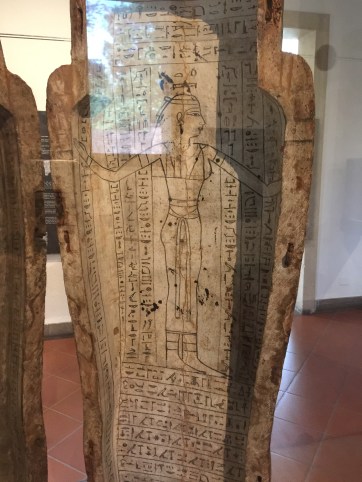
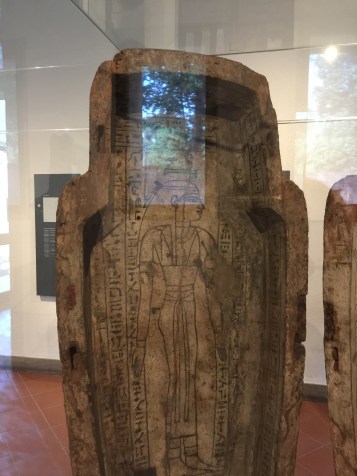
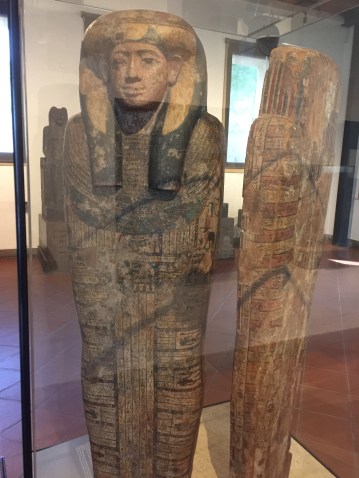
The Musei Civici has many areas of collection and I just snapped some random pictures of some of the objets that caught my eye. For example, I want to wear the headdress in this painting:
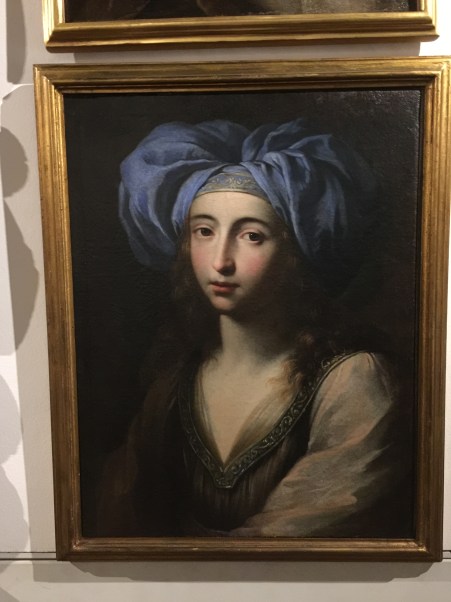
Painting above: Young Woman in Oriental Clothes by Ginevra Cantofoli, Bologna 1618-1672

Painting above: Young Man with turban by Ginevra Cantofoli, Bologna 1618-1672
Check out the amazing frame on painting below. I’ve seen a lot of frames in my day, but this was a first!
Painting below: Armed Minerva by Pietro Liberi, 1614-87. Born in Padova, died in Venezia. This modest little frame that captured my attention and my heart!


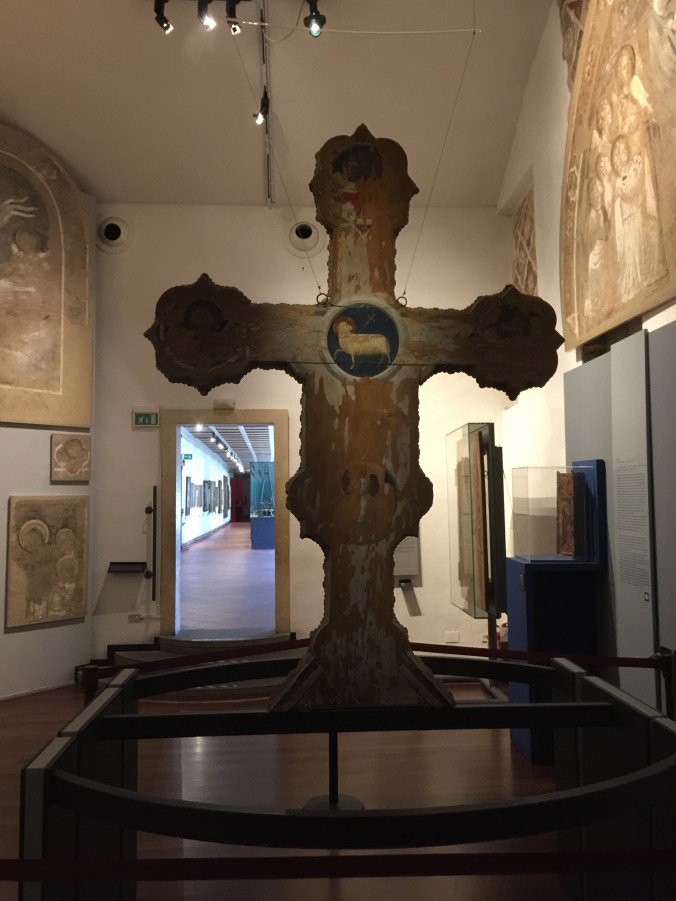
Above, the front and back of a crucifix by Giotto.
Some other strange and/or wonderful works I spied on this visit:
Orazio Marinali, Head of Holofernes
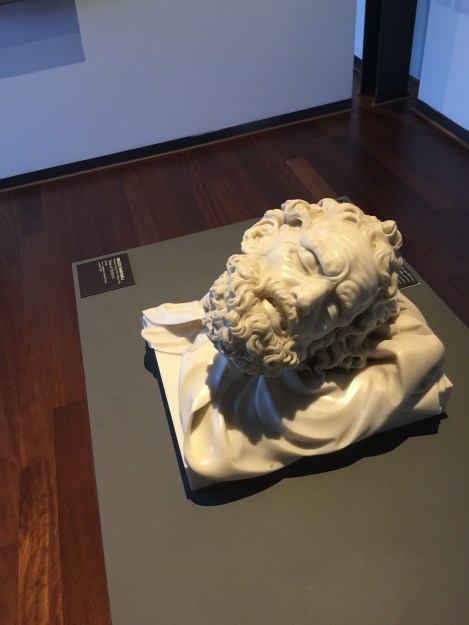
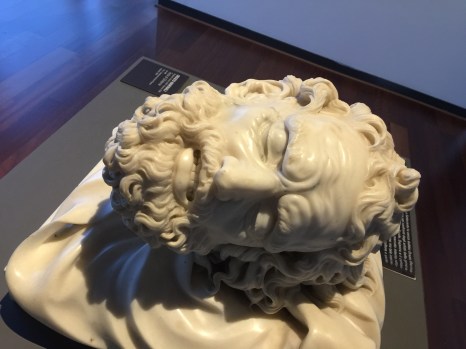
I mean, come on…anatomically correct with a severed spinal cord??


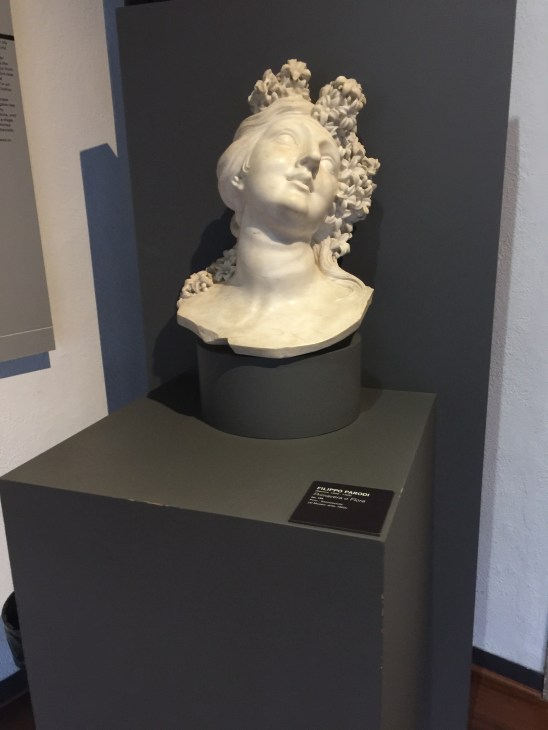
Above and below: Filippo Parodi, Head of Spring, or Flora
Love this one below for the frame, the painting, meh…Baby Bacchus by Marco Liberi. But the frame carver, now that’s a masterpiece!

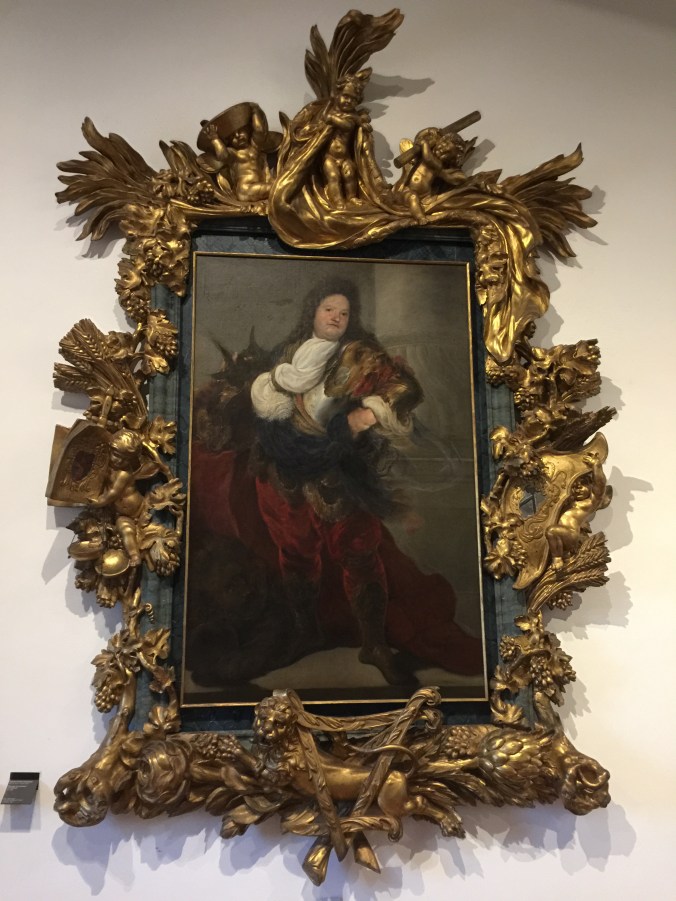
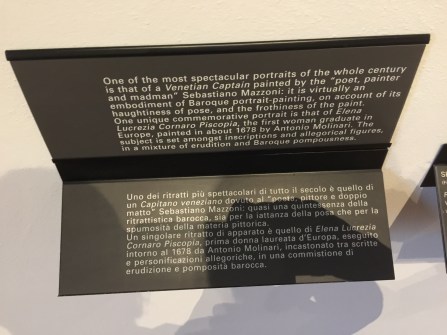
Likewise for the painting below, I can take or leave the painting (Sebastiano Mazzoni, Portrait of theVenetian Captain), but that frame…!
This marble piece below was freaky, the way it combines 2 angel’s heads, showing them kind of like Siamese twins.


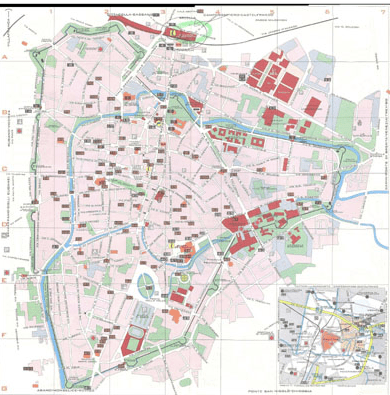
Padova’s historic center is picturesque, with a dense network of arcaded streets opening into large communal piazze, and many bridges crossing the various branches of the Bacchiglione, which once surrounded the ancient walls like a moat.
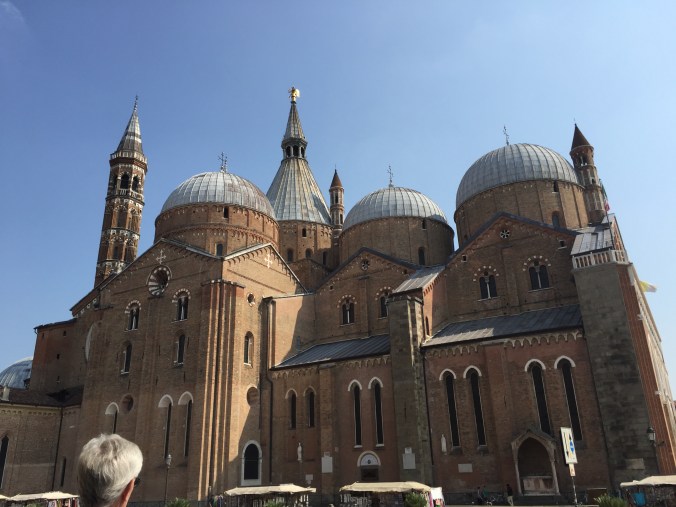
The city is also known for being the city where Saint Anthony, a Portuguese Franciscan, spent part of his life and died in 1231. The huge pilgrimage church of Sant’ Antonio is a major feature of the city’s life and skyline.
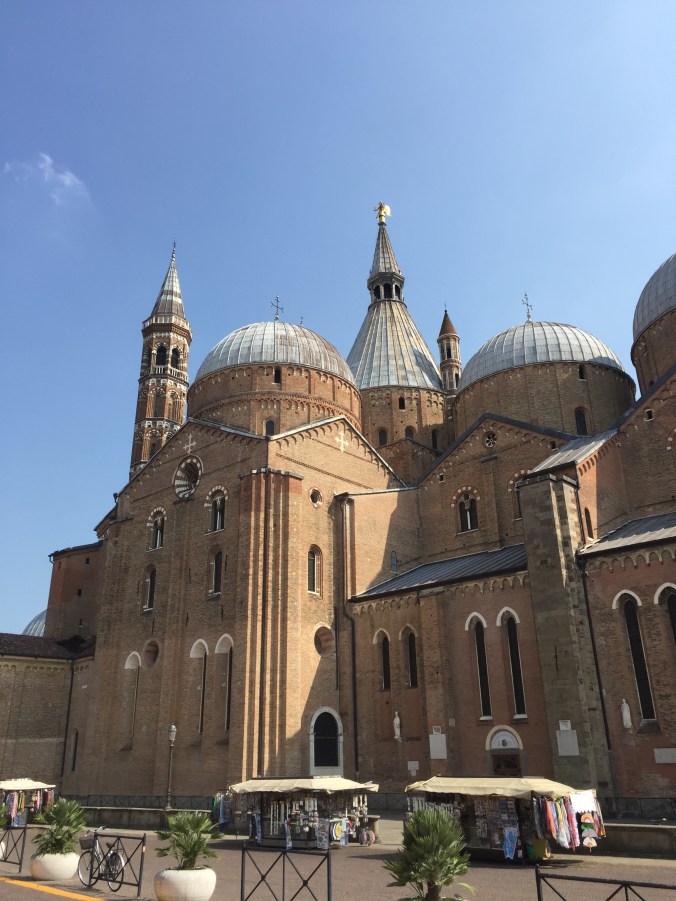
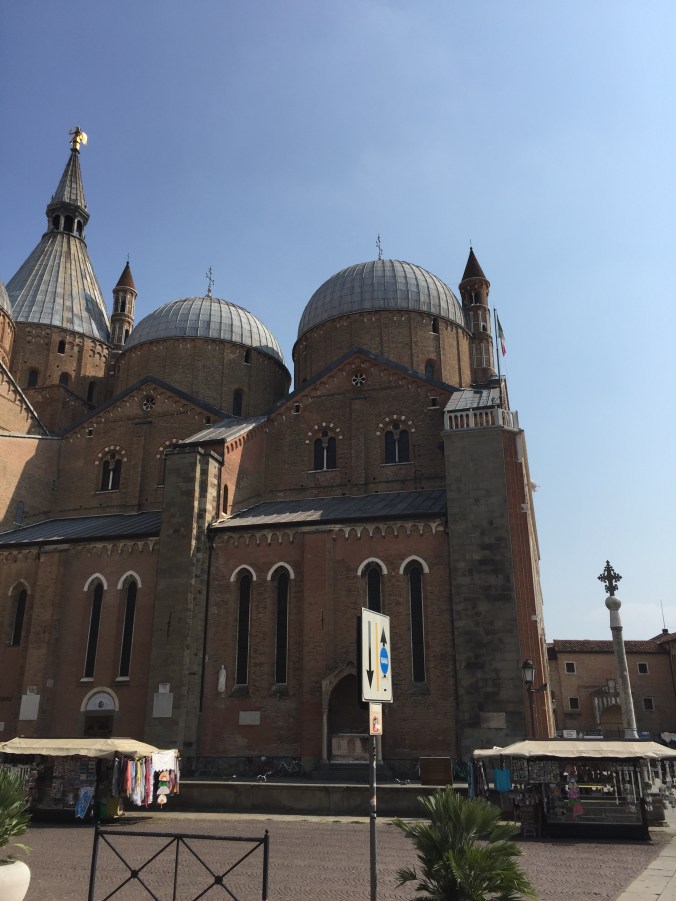
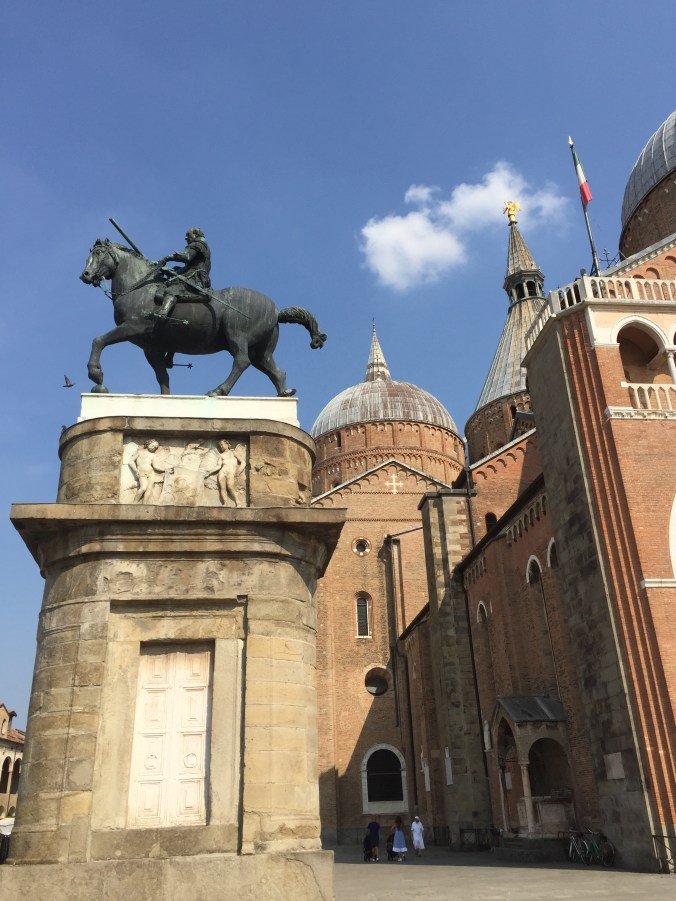
Although I don’t have a clear memory of it, I know I visited the Gattemelata equestrian statue by Donatello on my first visit to Padova. I have clear memories of it from this visit. Here it is:
The name of the city, Padova, is derived from its Roman name Patavium. Its origin is uncertain. It may be connected with the ancient name of the River Po, (Padus). The root “pat-,” in the Indo-European language, can refer to a wide open plain as opposed to nearby hills. The suffix “-av” (also found in the name of the rivers such as the Timavus and Tiliaventum) is likely of Venetic origin, precisely indicating the presence of a river, which in the case of Padua is the Brenta.

Padua claims to be the oldest city in northern Italy. According to a tradition dated at least to the time of Virgil’s Aeneid and to Livy’s Ab Urbe Condita, Padova was founded in around 1183 BC by the Trojan prince Antenor.
After the Fall of Troy, Antenor led a group of Trojans and their Paphlagonian allies, the Eneti or Veneti, who lost their king Pylaemenes to settle the Euganean plain in Italy. Thus, when a large ancient stone sarcophagus was exhumed in the year 1274, officials of the medieval commune declared the remains within to be those of Antenor. An inscription by the native Humanist scholar Lovato dei Lovati placed near the tomb reads:
This sepulchre excavated from marble contains the body of the noble Antenor who left his country, guided the Eneti and Trojans, banished the Euganeans and founded Padua.
More recent tests suggest the sepulchre dates to the between the 4th and 3rd centuries BC.
Nevertheless, archeological remains confirm an early date for the foundation of the center of the town to between the 11th and 10th centuries BC. By the 5th century BC, Padova rose on the banks of the river Brenta and was one of the principal centers of the Veneti.

The Roman historian Livy records an attempted invasion by the Spartan king Cleonimos around 302 BC. The Spartans came up the river but were defeated by the Veneti in a naval battle and gave up the idea of conquest.
Still later, the Veneti of Padua successfully repulsed invasions by the Etruscans and Gauls. According to Livy and Silius Italicus, the Veneti, including those of Padova, formed an alliance with the Romans by 226 BC against their common enemies, first the Gauls and then the Carthaginians. Men from Padova fought and died beside the Romans at Cannae.
With Rome’s northwards expansion, Padova was gradually assimilated into the Roman Republic. In 175 BC, Padova requested the aid of Rome in putting down a local civil war. In 91 BC, Padova, along with other cities of the Veneti, fought with Rome against the rebels in the Social War.
Around 49 (or 45 or 43) BC, Padova was made a Roman municipium under the Lex Julia Municipalis and its citizens ascribed to the Roman tribe, Fabia. At that time the population of the city was perhaps 40,000.
The city was reputed for its excellent breed of horses and the wool of its sheep. In fact, the poet Martial remarks on the thickness of the tunics made there. By the end of the 1st century BC, Padova seems to have been the wealthiest city in Italy outside of Rome.
The city became so powerful that it was reportedly able to raise two hundred thousand fighting men. However, despite its wealth, the city was also renowned for its simple manners and strict morality. This concern with morality is reflected in Livy’s Roman History (XLIII.13.2) wherein he portrays Rome’s rise to dominance as being founded upon her moral rectitude and discipline.
Still later, Pliny, referring to one of his Padovan protégés’ grandmother, Sarrana Procula, lauds her as more upright and disciplined than any of her strict fellow citizens (Epist. i.xiv.6).
Padova also provided the Empire with notable intellectuals. Nearby Abano was the birthplace, and after many years spent in Rome, the deathplace of Livy, whose Latin was said by the critic Asinius Pollio to betray his Patavinitas (q.v. Quintilian, Inst. Or. viii.i.3). Padova was also the birthplace of Thrasea Paetus, Asconius Pedianus, and perhaps Valerius Flaccus.
Christianity was introduced to Padua and much of the Veneto by Saint Prosdocimus. He is venerated as the first bishop of the city. His deacon, the Jewish convert Daniel, is also a saintly patron of the city.
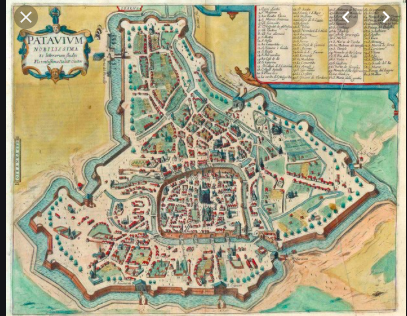
The history of Padua during Late Antiquity follows the course of events common to most cities of north-eastern Italy. Padua suffered from the invasion of the Huns and was savagely sacked by Attila in 450. A number of years afterward, it fell under the control of the Gothic kings Odoacer and Theodoric the Great.
It was reconquered for a short time by the Byzantine Empire in 540 during the Gothic War. However, depopulation from plague and war ensued.
The city was again seized by the Goths under Totila, but was restored to the Eastern Empire by Narses only to fall under the control of the Lombards in 568. During these years, many of Paduans sought safety in the countryside and especially in the nearby lagoons of what would become Venice.
In 601, the city rose in revolt against Agilulf, the Lombard king who put the city under siege. After enduring a 12-year-long bloody siege, the Lombards stormed and burned the city. Many ancient artifacts and buildings were seriously damaged.
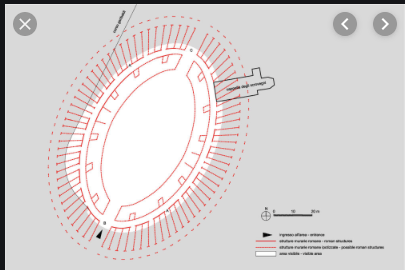
The remains of an amphitheater (the Arena) and some bridge foundations are all that remain of Roman Padua today. The townspeople fled to the hills and later returned to eke out a living among the ruins; the ruling class abandoned the city for the Venetian Lagoon, according to a chronicle. The city did not easily recover from this blow, and Padua was still weak when the Franks succeeded the Lombards as masters of northern Italy.
At the Diet of Aix-la-Chapelle (828), the duchy and march of Friuli, in which Padova lay, was divided into four counties, one of which took its title from the city of Padova.
The end of the early Middle Ages at Padova was marked by the sack of the city by the Magyars in 899. It was many years before Padua recovered from this ravage.
During the period of episcopal supremacy over the cities of northern Italy, Padova does not appear to have been either very important or very active. The general tendency of its policy throughout the war of investitures was Imperial (Ghibelline) and not Roman (Guelph); and its bishops were, for the most part, of German extraction.
However, under the surface, several important movements were taking place that were to prove formative for the later development of Padova.
At the beginning of the 11th century, the citizens established a constitution, composed of a general council or legislative assembly and a credenza or executive body.
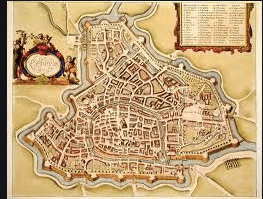
During the next century they were engaged in wars with Venice and Vicenza for the right of water-way on the Bacchiglione and the Brenta. The city grew in power and self-confidence and in 1138, government was entrusted to two consuls.
The great families of Camposampiero, Este and Da Romano began to emerge and to divide the Paduan district among themselves. The citizens, in order to protect their liberties, were obliged to elect a podestà in 1178. Their choice first fell on one of the Este family.

A fire devastated Padua in 1174. This required the virtual rebuilding of the city.
The temporary success of the Lombard League helped to strengthen the towns. However, their civic jealousy soon reduced them to weakness again. As a result, in 1236 Frederick II found little difficulty in establishing his vicar Ezzelino III da Romano in Padua and the neighboring cities, where he practised frightful cruelties on the inhabitants. Ezzelino was unseated in June 1256 without civilian bloodshed, thanks to Pope Alexander IV.
Padova then enjoyed a period of calm and prosperity: the basilica of the saint was begun; and the Paduans became masters of Vicenza. The University of Padua (the second university in Italy, after Bologna) was founded in 1222, and as it flourished in the 13th century, Padua outpaced Bologna, where no effort had been made to expand the revival of classical precedents beyond the field of jurisprudence, to become a center of early humanist researches, with a first-hand knowledge of Roman poets that was unrivaled in Italy or beyond the Alps.

There is so much more to the story of Padova. I’ll be posting about it soon.
Livia Drusilla (ca. 58 B.C.E.–C.E. 29)
Empress of Rome

In the long-running Roman Empire, statues, portraits, and coins were the best indications of a ruler’s identity. Livia, the wife of the republic’s first emperor, Augustus, used these media to her advantage. “She looked to statuary to present her persona in Rome and the empire, relief sculpture to describe her relationship to other members of the imperial family, coins to advertise the emperor’s policies, and gems to articulate that same vision for a more selective audience,” writes art historian Diana E. E. Kleiner in Cleopatra and Rome (2005).

Livia was less interested in creating a uniquely individual presentation than in codifying a traditionally feminine ideal for Roman empresses and nobility in general. She took inspiration from statues depicting classical Greek goddesses and Hellenistic queens to align herself with the values of the previous Republican “golden age” that Augustus hoped to restore in his new empire. Unlike Cleopatra, her opulent predecessor in Egypt, Livia communicated virtuousness through an austere image that favored modesty and simplicity. Still, Rome’s first empress took measures to stand out among other elite women. Kleiner has suggested that the empress had artists depict her with hairdos that only a stylist could have arranged, indicating her superior taste and wealth.
During my first walk through Hyde Park and Kensington Gardens, I noticed these markers in the pavement, guiding the visitor to the Princess Diana Memorial. I wasn’t sure I wanted to go see it. I remember her death all too well, just like I can remember the day President Kennedy was shot. Markers of time that I wish I could forget.

In the end, I couldn’t not go. I’m so glad I did. It is a lovely, lighthearted place. I think Diana would have loved it. On the sunny Sunday afternoon I was there, families and especially children were enjoying the water as it flowed through the monument. I loved it. But, I couldn’t bring myself to take pictures. It was still too raw for me.

The Diana, Princess of Wales Memorial Fountain is a memorial in London dedicated to Diana, Princess of Wales, who died in a car crash in 1997. It was designed to express Diana’s spirit and love of children.
The fountain was built with the best materials, talent and technology. It contains 545 pieces of Cornish granite – each shaped by the latest computer-controlled machinery and pieced together using traditional skills.

The design aims to reflect Diana’s life, water flows from the highest point in two directions as it cascades, swirls and bubbles before meeting in a calm pool at the bottom. The water is constantly being refreshed and is drawn from London’s water table.

The Memorial also symbolises Diana’s quality and openness. There are three bridges where you can cross the water and go right to the heart of the fountain.

The memorial was designed by American landscape architect and artist Kathryn Gustafson.
The fountain is located in the southwest corner of Hyde Park, just south of the Serpentine lake and east of the Serpentine Gallery. Its cornerstone was laid in September 2003 and it was officially opened on 6 July 2004 by Queen Elizabeth II. Also present were Diana’s younger brother Charles Spencer, her ex-husband Prince Charles, and her sons William and Harry.
Working on the project began in 2001. The fountain was designed by Gustafson Porter. Kathryn Gustafson, an American landscape artist said she had wanted the fountain, which was built to the south of the Serpentine, to be accessible and to reflect Diana’s “inclusive” personality. Gustafson said: “Above all I hope that it provides a fitting memorial for the princess and does credit to the amazing person that she was.”
The memorial has the form of a large, oval stream bed about 165 by 260 ft that surrounds, and is surrounded by, a lush grassy field. The granite stream bed is from 10 to 20 ft wide. It is quite shallow and is laid out on a gently sloping portion of the park, so that water pumped to the top of the oval flows down either side. One side of the stream bed descends fairly smoothly to the downhill end of the oval with gentle ripples; the other side consists of a variety of steps, rills, curves, and other shapes so that the water plays in interesting ways as it flows to the tranquil pool at the bottom. The two sides were intended to show two sides of Diana’s life: happy times, and turmoil.
My home away from home these days is in the Marylebone neighborhood of London. A key feature of this burgh is The Marble Arch, a 19th-century white marble-faced triumphal arch. It sits, rather isolated, on one edge of Hyde Park.
But, once upon a time, the Marble Arch was located in a much more regal place. This rather simple triumphal arch is neither in its intended location, nor was it completed in the intended way. Nevertheless, during their coronations, the processions of both Queen Victoria and Queen Elizabeth II passed through the arch.

Marble Arch
John Nash (1752-1835) was the favoured architect of the Prince Regent, later King George IV. Under George’s auspices Nash designed and planned such landmarks as Regent’s Park, Regent Street, Carlton House Terrace, much of Buckingham Palace and Marble Arch. Marble Arch was designed to be both a grandiose gateway to an expanded Buckingham Palace and an exuberant celebration of British victories in the Napoleonic Wars – a Triumphal Arch. But the Grade I listed Arch that we see today is nowhere near as grand as Nash originally intended.

This model below, now in the Victoria and Albert Museum, gives an impression of how Marble Arch might have looked. Nash had it made to illustrate his intended design to George IV.

Bristling with sculpture, including an imposing equestrian statue of George IV crowning the structure, the overall design was approved and sculptures were commissioned in 1828.
By 1830, most of the statues and panels were complete and Nash’s work at Buckingham Palace and on the Arch was progressing. And then the King died.
Shortly after the King’s death Nash was sacked by the Prime Minister, the Duke of Wellington, for overspending on the project. The architect Edward Blore was commissioned to complete the works in a more economic and practical fashion.
Alas, had George IV lived a little longer we would certainly have a very different Marble Arch today.
Edward Blore found himself in possession of a jumbled collection of statues and panels. Blore tried to get Nash to provide drawings to explain how the jigsaw was intended to fit together but Nash, unhappy about his dismissal, would not cooperate.
All Blore really had to go on was Nash’s model and the assortment of sculptures in his yard.
The model has a “military side,” celebrating the Duke of Wellington’s victories, including the Battle of Waterloo and a “naval side” putting Lord Nelson’s achievements center stage. Both sides were to have friezes of battle scenes and allegorical panels along with a selection of “winged victories” and other figures.
On each end of the Arch these two themes were to have been repeated. One end would bear the word “Waterloo” and the other the “Trafalgar” and under each, the names of commanders and battles.
The model was never intended to be a definitive plan, but rather to give an overall impression of how the finished arch might look. It contains at least one big mistake, the military side is topped with the portrait of Nelson and the naval side with one of Wellington.
Blore eventually decided to complete the Arch but without most of the sculpture. So, the Arch today has only four allegorical panels and a little decoration. The ends are blank except for three laurel wreaths.
The Arch was completed in 1833, although the central gates were not added until 1837, just in time for Queen Victoria’s accession to the throne.
Blore incorporated most of the battle scene friezes high up in the central courtyard of Buckingham Palace. In 1835, the rest of the sculptures were given to William Wilkins to use in the construction of the new National Gallery.
Wilkins used some of the statues, but he wanted less military symbolism so he adapted many of figures. Statues representing Asia, seated on a camel, and Europe sat upon a horse with an empty frame between them can still be seen above the main door of the National Gallery. Above both the western and eastern doors of the gallery are some figures of “winged victories,” many shorn of their wings. Some of the statues even had their laurel wreaths replaced; one now holds a painter’s easel and brushes.
A portrait of Wellington that was to have filled the empty frame between Europe and Asia is now inside the staff entrance to the gallery.
The other significant surviving remnant is the Equestrian Statue of George IV, by Francis Chantrey, which stands on a plinth in the north-eastern corner of Trafalgar Square.


The Marble Arch stood as a formal gateway to Buckingham Palace for seventeen years. But, it was overshadowed by Blore’s enlarged Buckingham Palace and seen as unsatisfactory.
In 1850 the decision was made to move the Arch to its current location of Cumberland Gate where it would form a grand entrance to Hyde Park in time for the Great Exhibition of 1851.
The stone by stone removal and reconstruction of the Arch was overseen by architect Thomas Cubitt who completed the entire complex process in just three months.
The relocation was a success, vast crowds of people passed through the Arch en route to the Great Exhibition in Hyde Park and Marble Arch remained a grand and direct entrance to the park for more than 50 years.
In 1908 a new road scheme cut through the park just south of the Arch, leaving it completely separated from Hyde Park. In the 1960s roads were widened still further, leaving the Arch in its current isolated position, no longer part of a Royal Park.
The whole Arch is clad in ravaccione, a grey/white type of Carrara marble from Italy. This was the first time marble had been used in this way on any British building. The eight enormous Corinthian columns were each cut from a single slab of marble.
North side of the Arch:

The sculpted panels on this side are by Richard Westmacott, who also produced the statue of Achilles nearby at Hyde Park Corner.
Three female figures representing England (center) wearing Britannia’s helmet, Ireland (left) with her harp and Scotland (right) with the shield of St Andrew.

“Peace with Trophies of War” Peace stands on a heap of shields, helmets and weapons. She holds an olive branch and two cherubs hold her gown. The cherub on the right side makes me laugh; he looks like he is on a carnival ride.

Above each of the three arches are pairs of “Victories” with their laurel wreaths.
The central keystones of the lower arches are the heads of warriors wearing Greek helmets pushed back in the manner of statues of Athena. The central arch has a magnificent lion’s head carving as its keystone, with clawed feet protruding from under its mane.
South side of the Arch:

On this side the panels are by E.H. Baily, who is perhaps best known for the statue of Nelson in Trafalgar Square.
“Virtue and Valour” Virtue is the figure on the right holding the fasces (a bundle of rods around an axe) that symbolise strength through unity and on the left stands a soldier in Roman dress representing valour.
“Peace and Plenty” The Angel of Peace is to the left. Plenty with her cornucopia to the right. The flame in the middle represents liberty.

On this side, between the Victories, the keystone of all three arches is a bearded male head, possibly Neptune.
The Central Gates:
Originally planned to be cast in “mosaic gold”, the gates were actually cast in less expensive bronze. Each gate features the same three designs: a lion at the top, George IV’s cypher in the middle and St George slaying the dragon at the bottom.

The smaller side gates were added in 1851.

Above: Coronation procession of Queen Elizabeth II passes through Marble Arch, 1953 © Press Association.
The arch at night, below:

Today, the neighborhood around it is called Marble Arch, particularly the southern portion of Edgware Road and also to the underground station.


Mention The Monument to a Londoner and, as generic as that title might seem to the average person, a Londoner knows that you mean The Monument to the Great Fire, London. The horrible conflagration swept through the central parts of London from Sunday, 2 September to Thursday, 6 September 1666.
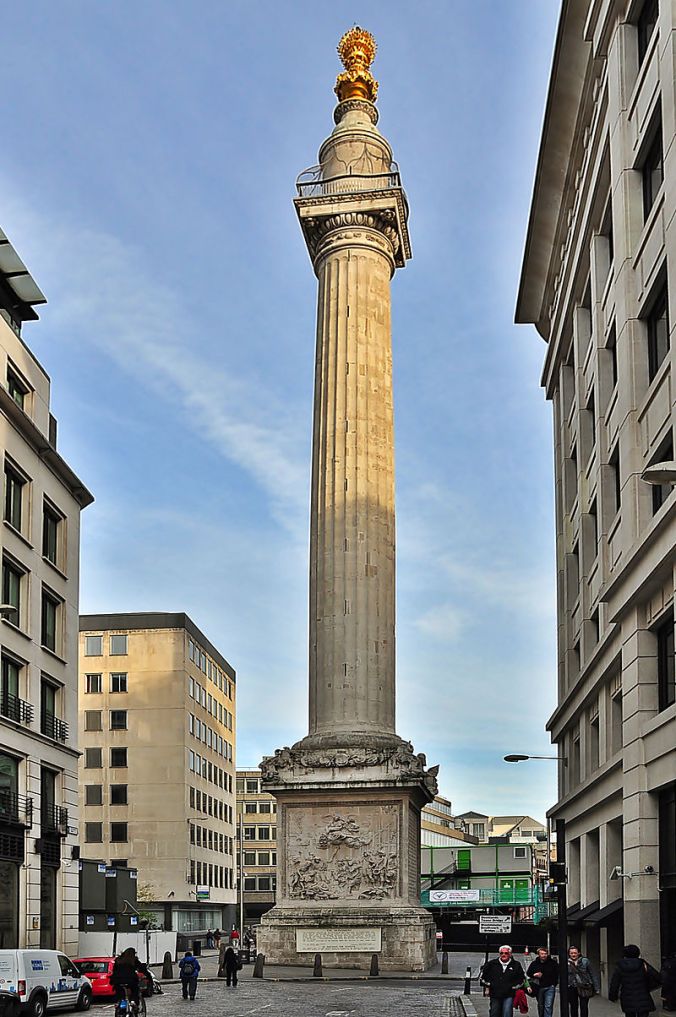
Modern-day view of The Monument, designed by Sir Christopher Wren.
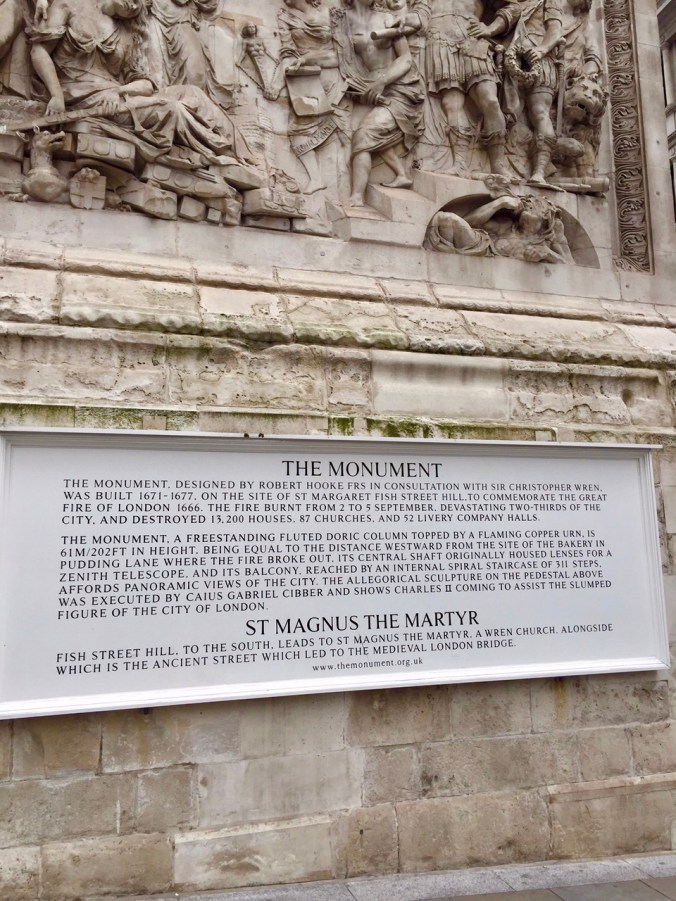
The Monument to the Great Fire of London takes the form of a Doric column in Portland stone, situated near the northern end of the London Bridge. Atop the column is a gilded urn of fire. Commemorating the Great Fire of London, the monument stands at the junction of Monument Street and Fish Street Hill, 202 feet in height and 202 feet west of the spot in Pudding Lane where the Great Fire started on 2 September 1666. It was designed by Christopher Wren and Robert Hooke. Its height marks its distance from the site of the shop of Thomas Farriner (or Farynor), the king’s baker, where the blaze began.
Constructed between 1671 and 1677, the monument was built on the site of St. Margaret’s, Fish Street, the first church to be destroyed by the Great Fire. Another monument, the Golden Boy of Pye Corner, marks the point near Smithfield where the fire was finally stopped.
The viewing platform near the top of the Monument is reached by a narrow winding staircase of 311 steps. A mesh cage was added in the mid-19th century to prevent people jumping to the ground, after six people had committed suicide there between 1788 and 1842.
Three sides of the base carry inscriptions in Latin. The one on the south side describes actions taken by King Charles II following the fire.
The inscription on the east side describes how the Monument was started and brought to perfection, and under which mayors.
Inscriptions on the north side describe how the fire started, how much damage it caused, and how it was eventually extinguished.
The Latin words Sed Furor Papisticus Qui Tamdiu Patravit Nondum Restingvitur (“but Popish frenzy, which wrought such horrors, is not yet quenched”) were added to the end of the inscription on the orders of the Court of Aldermen in 1681 during the foment of the Popish Plot.
The inscription on the east side originally falsely blamed Roman Catholics for the fire (“burning of this protestant city, begun and carried on by the treachery and malice of the popish faction”), which prompted Alexander Pope (himself a Catholic) to say (in
Moral Essays, Epistle iii. line 339 (1733–1734) of the area:
Where London’s column, pointing at the skies,
Like a tall bully, lifts the head, and lies.
The words blaming Catholics were chiselled out with Catholic Emancipation in 1830.
The west side of the base displays a sculpture, by Caius Gabriel Cibber, in bas and alto relief, of the destruction of the City; with Charles II and his brother, James, the Duke of York (later King James II), surrounded by liberty, architecture, and science, giving directions for its restoration.




The fire gutted the medieval City of London inside the old Roman city wall. It threatened but did not reach the aristocratic district of Westminster, Charles II’s Palace of Whitehall, or most of the suburban slums.
The fire consumed 13,200 houses, 87 parish churches, St Paul’s Cathedral, and most of the buildings of the City authorities. It is estimated to have destroyed the homes of 70,000 of the city’s 80,000 inhabitants.
The death toll is unknown but was traditionally thought to have been small, as only six verified deaths were recorded. This reasoning has recently been challenged on the grounds that the deaths of poor and middle-class people were not recorded; moreover, the heat of the fire may have cremated many victims, leaving no recognisable remains. A melted piece of pottery on display at the Museum of London found by archaeologists in Pudding Lane, where the fire started, shows that the temperature reached 1,250 °C (2,280 °F; 1,520 K).
The first Rebuilding Act, passed in 1669, stipulated that “the better to preserve the memory of this dreadful visitation,” a column of either brass or stone should be set up on Fish Street Hill, on or near the site of Farynor’s bakery, where the fire began.
Christopher Wren, as surveyor-general of the King’s Works, was asked to submit a design. Wren worked with Robert Hooke on the design. It is impossible to disentangle the collaboration between Hooke and Wren, but Hooke’s drawings of possible designs for the column still exist, with Wren’s signature on them indicating his approval of the drawings rather than their authorship.

The Monument depicted in a picture by Sutton Nicholls, c. 1753.
It was not until 1671 that the City Council approved the design, and it took six years to complete the 202 ft column. It was two more years before the inscription (which had been left to Wren — or to Wren’s choice — to decide upon) was set in place. “Commemorating — with a brazen disregard for the truth — the fact that ‘London rises again…three short years complete that which was considered the work of ages.'”
The Edinburgh-born writer James Boswell visited the Monument in 1763 to climb the 311 steps to what was then the highest viewpoint in London. Halfway up, he suffered a panic attack, but persevered and made it to the top, where he found it “horrid to be so monstrous a way up in the air, so far above London and all its spires.”

Views published in The Graphic, 1891.
[edit]
During the 2007–2009 refurbishment, a 360-degree panoramic camera was installed on top of the Monument. Updated every minute and running 24 hours a day, it provides a record of weather, building and ground activity in the City.

Panorama of London taken from the top of the Monument
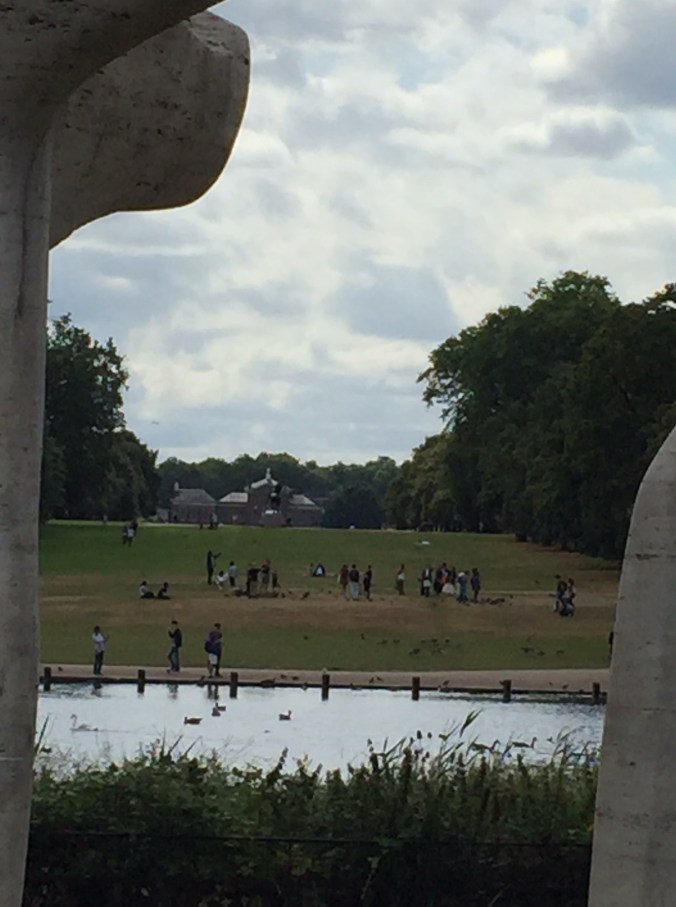
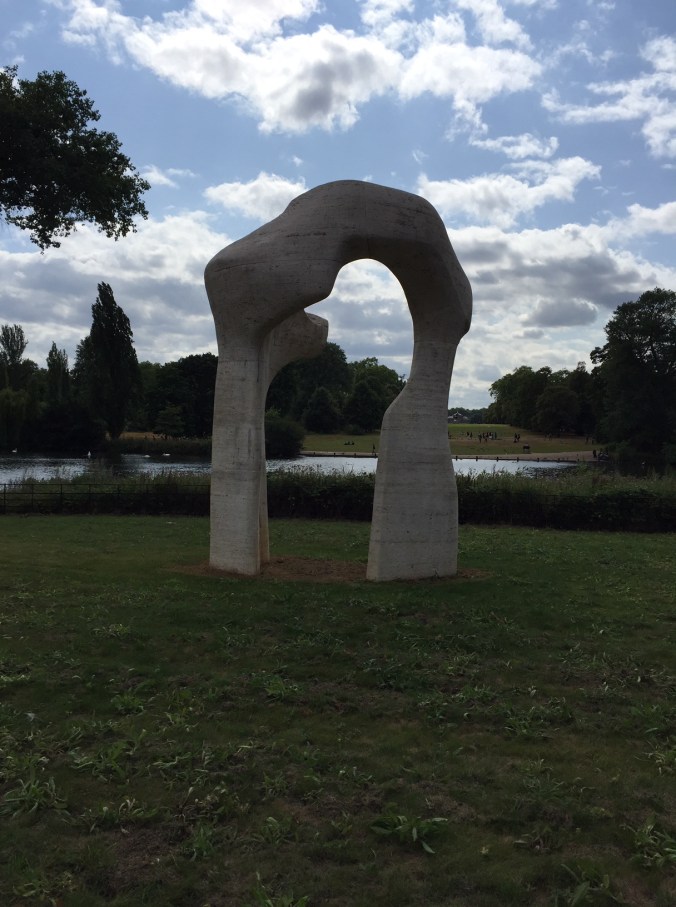
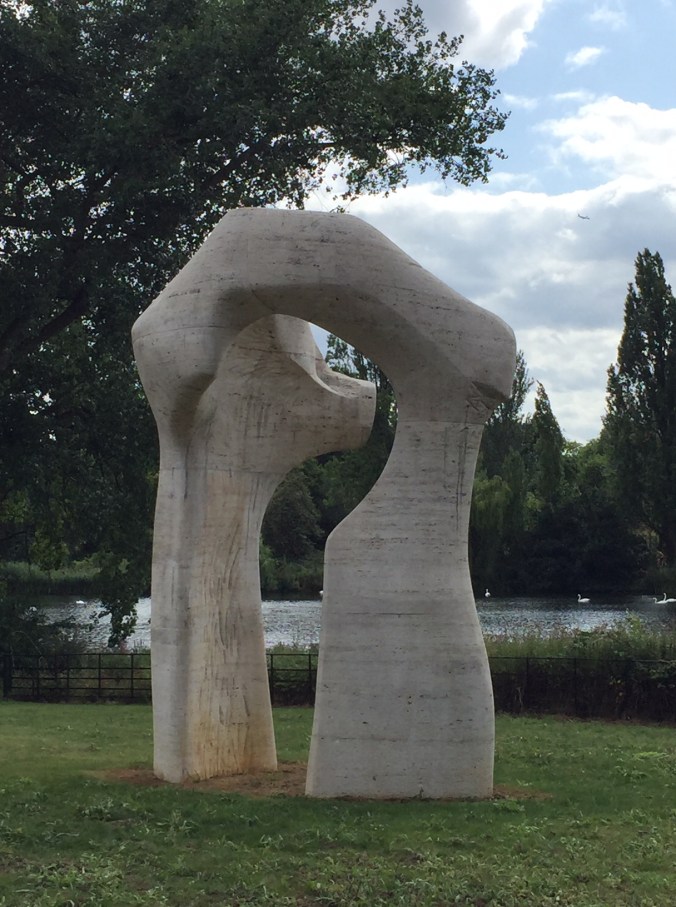
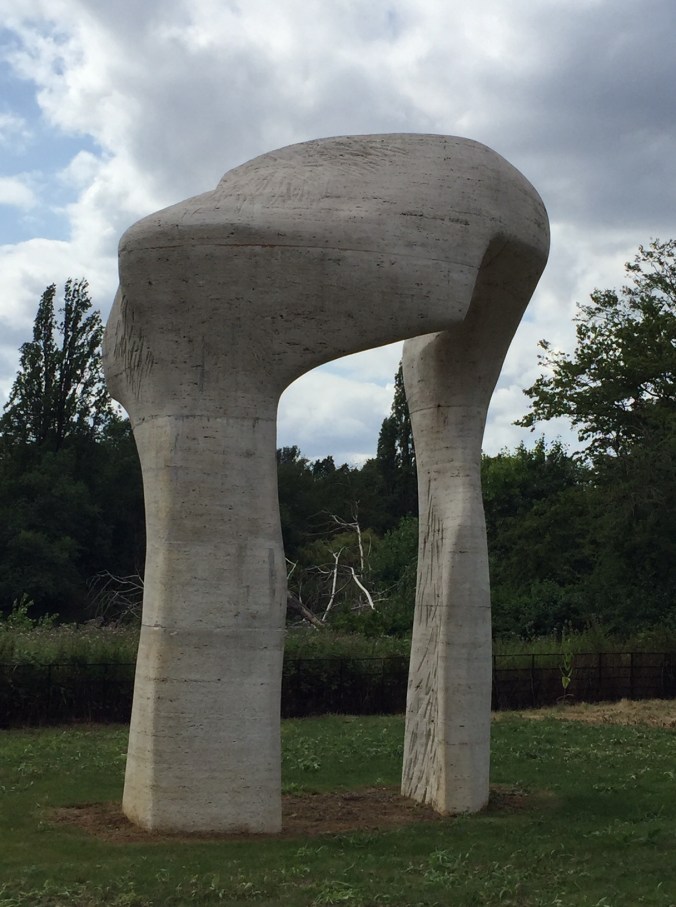
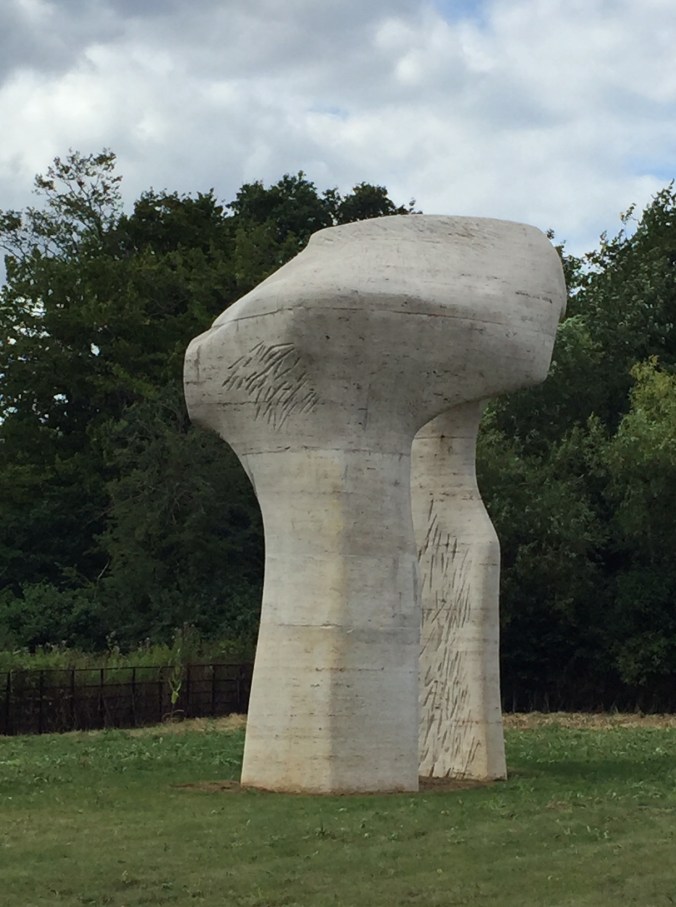
Moore’s “The Arch” stands proudly in the Gardens and, from a certain angle, perfectly frames the Kensington Palace.

If you are a regular reader of my blog, you know that I rarely post images of the decorative arts. I am typically not a fan of fussy porcelains or fine cabinetry. I just don’t seem to have the gene that lets me appreciate that stuff.
But, today in London, I visited the Wallace Collection and it knocked my socks off. I mean, this place is crazy! The former mansion of the Wallace family was gifted to the country of Britain in the last years of the 19th century, and is still set up in a similar manner to the way in which the family lived.

As you might know, I’ve been to a few museums and house museums in my day, but this place is more opulent than any other.
All I can say is WOW! And then show you some (a lot, probably too many) pictures of this amazing place.
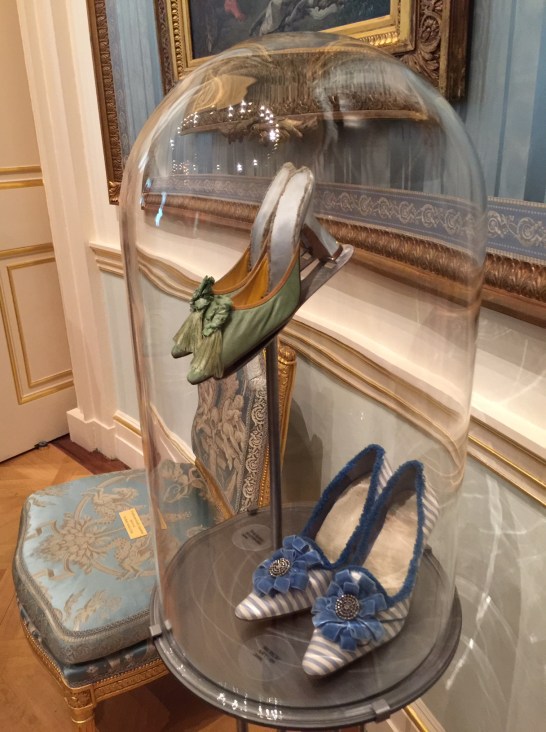
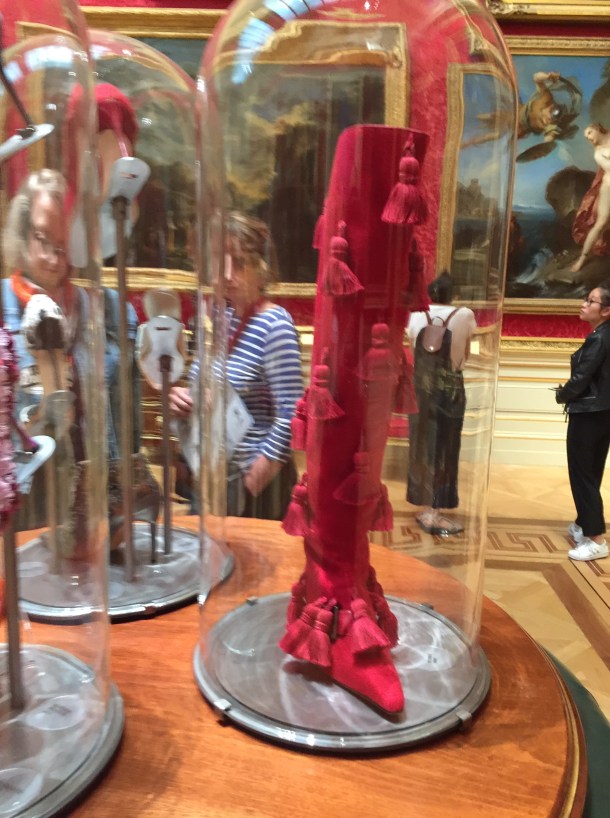
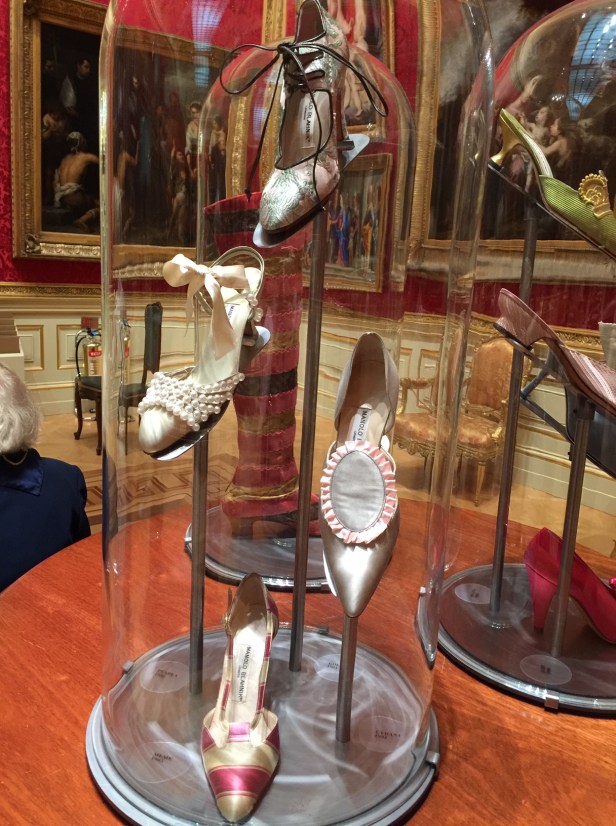
Oh, and p.s….Manolo Blanik shoes were also on display. I’ve never owned a pair and never will. But, to see the shoes interspersed with the collections added an element I’d not thought of before. My guide at the Wallace Collection told me that Blanik was an Anglophile and was particularly interested in the Wallace Collection. This is a new point of approach for me, and I could dig it!

Let’s go!
The first thing I heard in the excellent tour I joined, is that when this Japanese chest (and its matching partner) arrived in Europe, it absolutely blew the minds of connoisseurs. They were obsessed with the black lacquer and wanted to emulate it. They couldn’t, it turned out, because the plant that produces the lacquer did’t grow in the west.

Here’s my guide, standing in front of the Japanese chest.

That didn’t daunt them. The king of France set up a artisanal workshop, patronizing the best of the artistic producers known to France, and they experimented and experimented, trying to produce–if not lacquer itself–at least something that looked very close to it.

Above, King Louis XV, the king who developed the French fine arts.
This is the time period in which France is lifted by the decorative arts. France would no longer import fine luxury goods–they would produce them. It started then and is still going strong today.
The wardrobe below was produced in this workshop.


Before having a gander at the million photos I took today, introduce yourself to the Wallace Collection here with the director:
Now, please join me as I wander through the collection:


Can you say “opulence?”


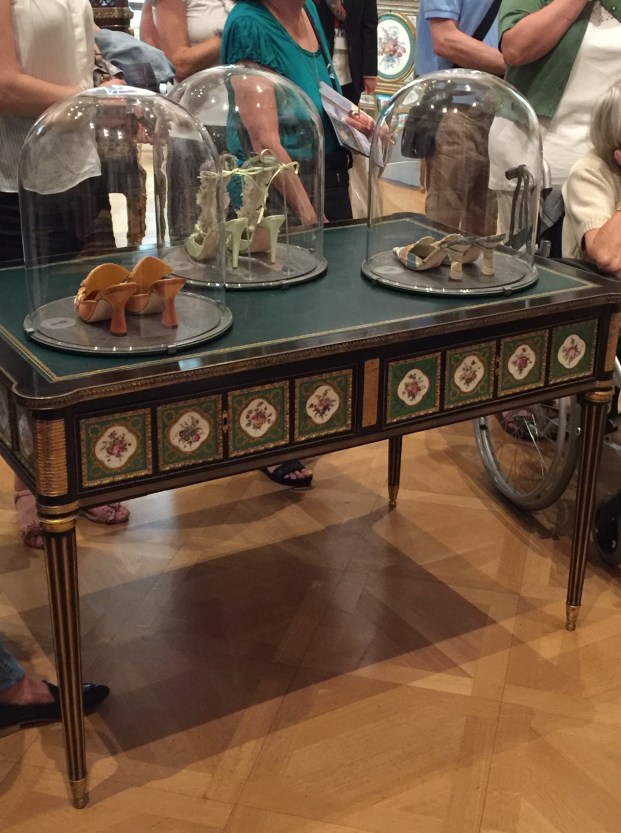
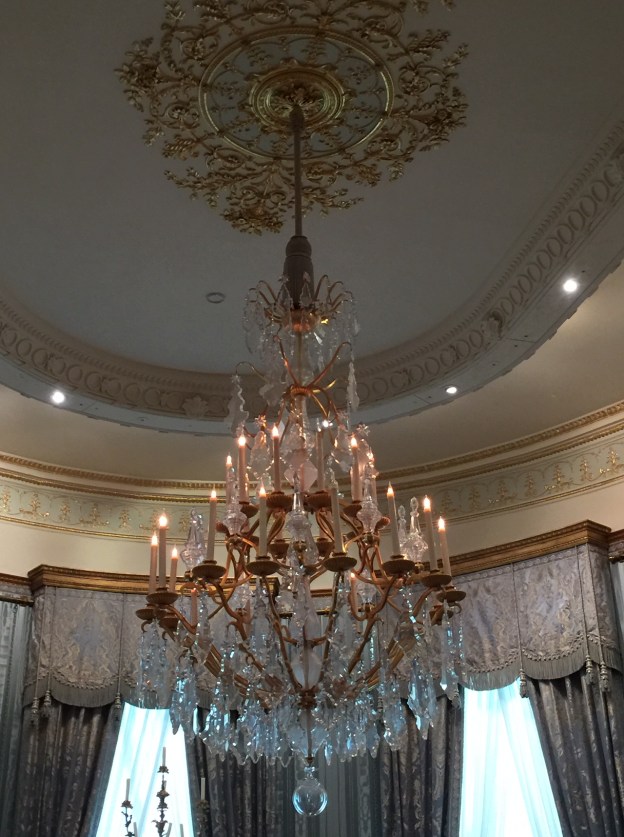


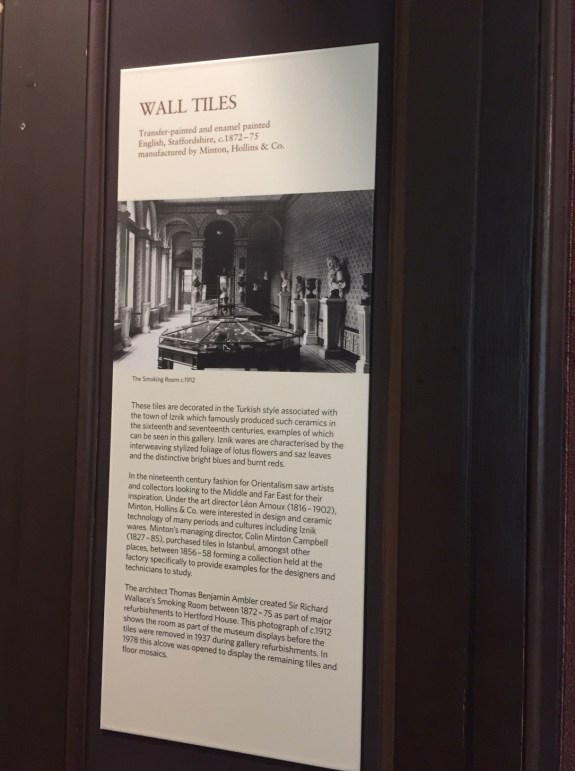
Also, the Wallace Collection has a lovely restaurant!

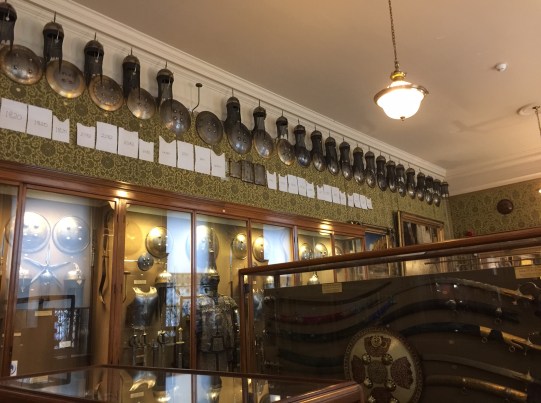
And then, on to the armor!


And to a Gothic crown. Because, why not?

Check out the line of matching armor head pieces and shields.

Below: a portrait of Madame de Pompadour, commissioned by herself. My guide told the fascinating story of this woman and her involvement with the French king, and discussed the fascinating iconography of this portrait. Please note her tiny shoe peeking out from under her “Pompadour pink” gown, for which she set the fashion of the day. This is the type of detail by which Blanik was inspired. Looking at his shoes today, I could see it.




And, then there is this Jean-Honoré Fragonard masterwork: The Swing (1767).






Without a doubt, the most moving monument I’ve seen in the few short days I’ve been in London so far is the Animals in War Memorial. They had no choice. Simple. Direct. Heartbreaking.

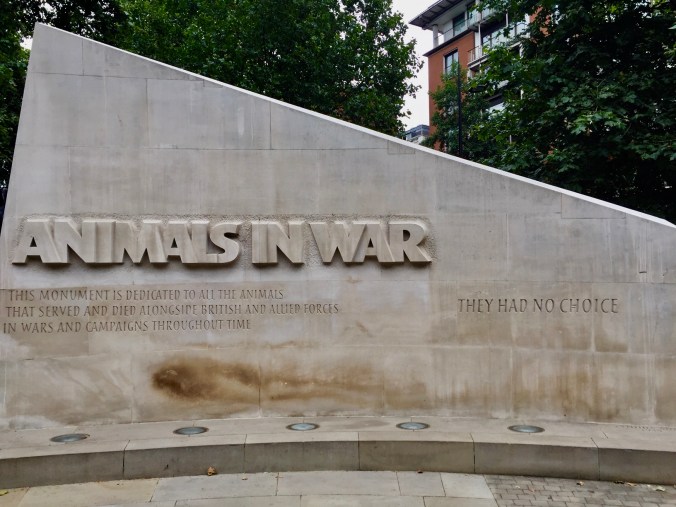
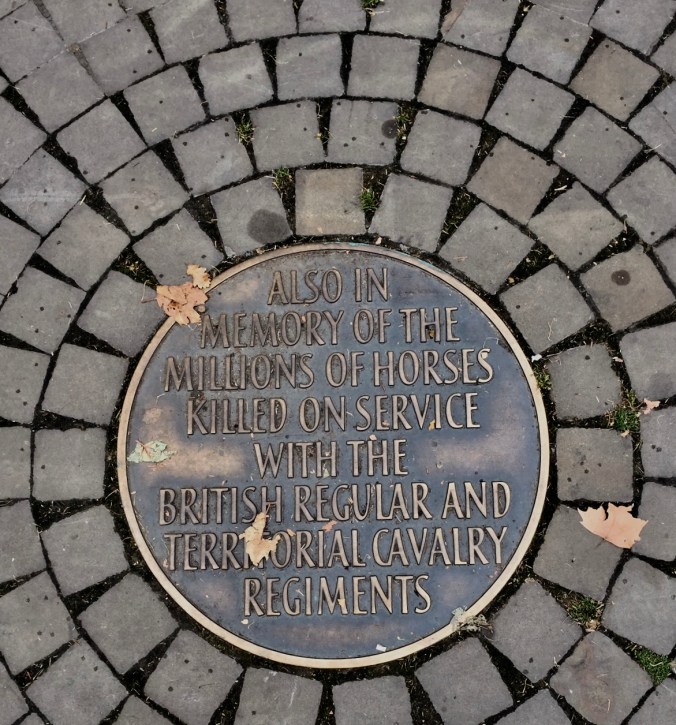


The Animals in War Memorial is a war memorial, in Hyde Park, London, commemorating the countless animals that have served and died under British military command throughout history. It was designed by English sculptor David Backhouse and unveiled in November 2004 by Anne, Princess Royal.
The memorial was inspired by Jilly Cooper’s book Animals in War, and was made possible by a specially created fund of £1.4 million from public donations of which Cooper was a co-trustee. The memorial consists of a 55 ft by 58 ft curved Portland stone wall: the symbolic arena of war, emblazoned with images of various struggling animals, along with two heavily laden bronze mules progressing up the stairs of the monument, and a bronze horse and bronze dog beyond it looking into the distance. The horse was modelled on a retired Charger from The King’s Troop Royal Horse Artillery called Ben Bragg.
The inscriptions on the moving monument are in various fonts and sizes and are all uppercase. In addition to the ones on the front, here are several inscriptions on the rear or outside, and on the inner edges of the wings (in the gap), attributing the creators and funders.
On the face of the right wing when viewed from the front or inside
Main heading, with the largest and heaviest cut inscription:
Animals in War
Directly beneath the main heading:
This monument is dedicated to all the animals
that served and died alongside British and allied forces
in wars and campaigns throughout time
Beneath and to the right of the main heading:
They had no choice
On the face of the left wing when viewed from the rear or outside (on the reverse of the main heading):
Many
and various
animals were employed
to support British and Allied Forces
in wars and campaigns over the centuries
and as a result millions died · From the pigeon to the
elephant they all played a vital role in every region of the world
in the cause of human freedom · Their contribution must never be forgotten
 get back, lauretta!
You must be logged in to post a comment.